← Conversations with Tyler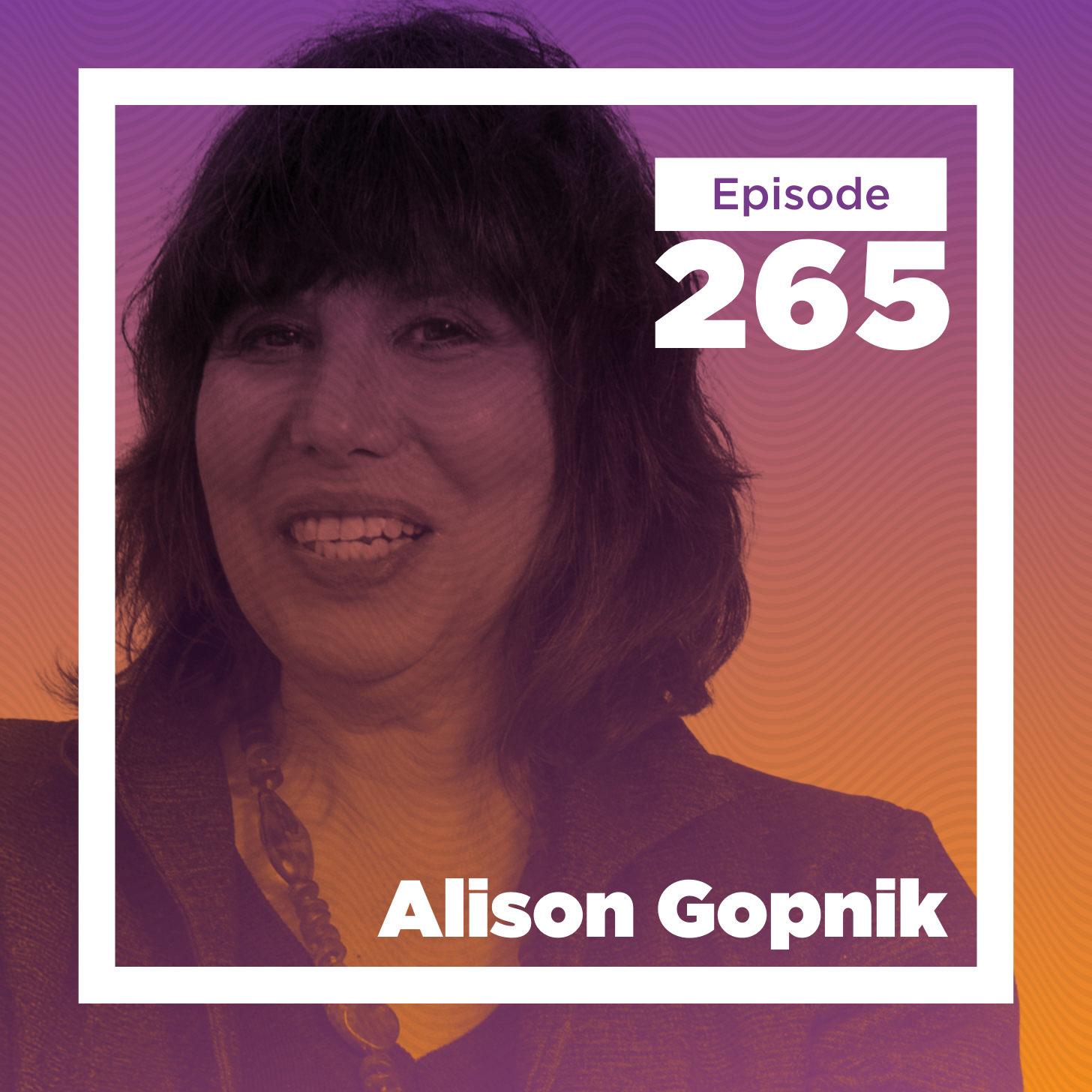
Conversations with Tyler
Alison Gopnik on Childhood Learning, AI as a Cultural Technology, and Rethinking Nature vs. Nurture
01:01:18
Loading summary
Transcript91 lines
- [00:04]
A
Hi listeners, this is Tyler. Thanks to your support, Conversations with Tyler is celebrating 10 incredible years. We've brought you over 250 conversations with some of the world's sharpest minds. From Margaret Atwood to Steven Pinker to Sam Altman and countless others. Together we're making the world wiser and more appreciative of one episode at a time. But here's the thing. We can't do this without you. Your tax deductible contribution keeps these conversations coming. New episodes every other week, sometimes more often than that. Full transcripts, live shows and listener meetups. And to thank you, we've got some amazing donor benefits. If you can give before January 1, 2026 at $50, get exclusive 10th anniversary swag and a signed message from me at $750. Sponsor a transcript. $1,500 gets you into a virtual Ask me anything with me. $5,000 gets you dinner in the D.C. area with me and other listeners. And I do promise the food will be good. Donate $25,000 and you'll get a private one on one dinner. If you in the DC area with me, every dollar matters. Please head to the link in the show notes to learn more and make your contribution today. Thank you for listening and for helping to make this podcast possible. Conversations with Tyler is produced by the Mercatus center at George Mason University, bridging the gap between academic ideas and real world problems. Learn more@mercatus.org for a full transcript of every conversation enhanced with helpful links, visit conversationswithtyler.com. Hello everyone and welcome back to Conversations with Tyler. Today I am talking with Allison Gopnik. She is a professor of psychology and also philosophy at University of California at Berkeley. She is a very well known expert in fields of human learning and also child developmental psychology, among other things. And she has written extensively for the New York Times, Wall Street Journal, where she was a columnist for 10 years, Atlantic magazine, and dozens of other places, all of which you will have heard of. Alison, welcome.
- [02:34]
B
Thank you.
- [02:35]
A
Now, one hypothesis you're known for is this idea that the way children learn has a lot in common with the way that human scientists learn. What's your basic model of how human scientists learn?
- [02:49]
B
Well, this is interesting. When we started this out, one of the big puzzles that we had was it's fine to say that children are learning like scientists. But then the question became, but how are scientists learning? And when I started this project, a lot of the philosophers of science said, well, you know, Kuhn showed that there was nothing systematic you could Say about that, it's just sociology. But interestingly, during the time that I've been working, there's been this real change in the way that people think about philosophy of sc and we have some good computational models of how scientific theory change works. And it turns out that those apply to children as well. So the specific thing that I've looked at is what is it that scientists do? Here's this big hard problem. All we seem to get from the world are a bunch of photons at the back of our retina and disturbances of air in our ears. And yet we know children know about people and things, and scientists know about quarks and quantum phenomena. How do we ever get from the data to the theory? And one subcategory of that is how do we ever get causal structure, which is so important in science? How do we ever figure out what causes what, just from a bunch of data that we have? And what's happened is that philosophers of science and computer scientists have found some systematic ways that you could talk about that. And scientists, I think, mostly not necessarily consciously, but just as part of what they do. And little kids are looking at data and systematically figuring out what kind of structure out there in the world could have caused this pattern of data. So that's not the only thing, of course, that's going on in science. There's lots of other things too. But it's at least one central thing going on in science that we've started to really understand. And of course it sort of makes sense that scientists have the same brains that we had in the Pleistocene. Something in those brains must be enabling them to do what they do in addition to all sorts of other institutions and social things. And it's something about this deep capacity to figure out the structure of the world, a world model, as the AI people say, from data.
- [04:51]
A
Are human scientists ever Bayesian? I think of them as not very Bayesian at all, that they're mostly pretty stubborn.
- [04:58]
B
Yeah, well, it's interesting. One of the things that we've looked at is whether little kids are Bayesian, and you might be even more surprised to find that little kids are actually being pretty rational Bayesian. But a lot of it depends on how you ask. So if you asked a 3 year old, do you think that this pattern of conditional dependencies is giving you a confounding causal structure? Right. They would probably not give you a very sensible answer. And even when you ask scientists that, they don't give you a very sensible answer. But when you look at their actual practice, what you See is that, in fact, kids, for example, are Bayesian and so are scientists. Now, the thing is that, in fact, in many respects, kids are better Bayesians than scientists. But a lot of it depends on your prior. So if you have a very, as they say, you have a very peaked prior, you have a lot of experience, you have a lot of reason to believe that this prior assumption is right, then it's rational not to change it when you just have a little bit of evidence. You should require a lot of evidence to overturn something that you have a lot of confirmation for. And it's interesting that the kids actually are better at solving problems that involve sort of unusual outcomes than the scientists are. And I think what happens in science, we've just been doing some work about this, is that there's also a kind of social factor where having a big distribution of people who are more likely to, you know, go with the prior versus people who are more likely to go with the evidence, which seems to be true in science, that collectively can get you to the right answer, because there's no arbitrary principle you can have about when should you abandon the theory and when should you hold onto it.
- [06:38]
A
I think of the kids as much more Bayesian than the scientists. And here's what worries me about the scientists. When they revise their views, the direction in which they move is almost always predictable. So if they're, say, thinking over decades, how much does the money supply matter? They'll move a bit in the direction of thinking it matters, then they'll move a bit more, and then finally they might decide, well, it matters quite a bit. And it shouldn't be predictable if they're Bayesian, it should be more like a random walk. So basically, they're stubborn. And then what I observe, if they're proven to be wrong, they don't usually admit it, or as a child might, they just start working on something else. And that, too, is a funny way of dealing with being wrong. Right?
- [07:23]
B
Well, there's a beautiful idea that I've been using, thinking about the kids, that is in computer science and actually comes from physics called simulated annealing. And the idea behind simulated annealing is that you have some problem to solve, you have some space of solutions that you're trying to get to. And one thing you can do, which is like what you're describing about the money supply, is just make little changes to what you already know. That's what you mean about moving in the predictable direction. You're just changing things a little bit and. And then seeing if, okay, If I change it a little bit, is it doing a better job of accounting for the data? That's what people think of as a low temperature search. The other kind of search you can do, the high temperature search, is just bounce around the space, try wild crazy things. Exactly as you were saying, have, have some random, just sort of a more random walk. And the strategy that you see in computer science is this annealing is start out with this wild, crazy, out of the box, high temperature kind of search through the space and then cool off and just fill in the details. And you know, if you think about your four year old, who do they sound like? Do they sound like the, the creature that's just moving a little bit or do they sound like they're noisy and bouncy and random and doing all sorts of weird things? Well, the four year old seemed to be a really good idea of this kind of random search. But if you're a scientist, of course you have to balance those things. You have to, you're not, you can't just think of crazy new ideas, you have to figure out how you're going to test them. You have to get grant proposals. So in science you're always kind of going back and forth between do I do the high temperature, wild, crazy, out of the box kind of search, do I think of ideas that don't look like they would be very likely to begin with or do I fill in the details? And I think you see both things happening. So when you get big paradigm shifts, as Kuhn said, when you get big changes in science, a lot of times it's because someone found an idea that looked like it was improbable. But the nice thing about kids is because they don't have to worry about grant proposals, they can be off in the wild space all the time.
- [09:24]
A
Well, here's a few things a four year old might do and I'm going to ask you which one is the most Bayesian? So a four year old pulls his sister's hair, a four year old tries to figure out how to use a fork properly and a four year old tries to put together the pieces of a puzzle, which of those. Or pick your own nomination, in which do we see the child being the most Bayesian and then the least Bayesian.
- [09:48]
B
Yeah, well that's an interesting case. I think it's funny when you said tries to use the fork properly. Right. That's a matter of conforming to a norm. But if you just to get food.
- [10:00]
A
Into his mouth, at least do that. I don't mean Proper manners in the Ann Lander sense.
- [10:06]
B
Yeah, yeah. I don't think any of those are really an example of the kind of exploration that I think is trying to get new evidence to change your theory. I think there are lots of things that you'll see the kids doing. Like, for instance, the fork is a good example. I have a lovely video of my. My son that I use to do teaching. He has a spoon and he's trying to eat an avocado with a spoon. And of course, eating an avocado with a spoon when you're two years old is extremely challenging. Right. It's a full avocado. And so instead of actually trying to get it in his mouth, what he does is try all these different things that you could do with a spoon and an avocado. You know, he. He bangs it on the side, he picks it up and turns it over. And a lot of them don't have the output of getting any of the avocado at all. And that's something that's completely characteristic of what you see with. With little kids. You see them doing these kind of experiments all the time. And I think with scientists, we underestimate how much that kind of, you know, we sometimes dismissively call it a fishing expedition, how much that kind of very general experimentation is playing a role in scientific progress. So, you know, we're. You're supposed to. In the grant, you're supposed to say, here's my three hypotheses and here are the four experiments I'm going to do to test them. But I think in practice, a lot of times scientists are being like the little boy with the avocado and the spoon. They're saying, I don't know what will happen if I try this, what will happen if I try that. And then they write the grant to get money to do the things that they've already done by doing all these experiments.
- [11:39]
A
There's an alternate division of how people learn, if learning's even the right word. And it comes from Carl Friston. I think of it as a minimize surprise kind of theory, that you're confronted with data from the world and you interpret the data and coordinate your actions in such a way to minimize surprise, that will imply a lot of cognitive biases. But that's his basic model of humans. What do you think of that theory?
- [12:05]
B
I think it's very underspecified. So, you know, there's this kind of category of theories in science of things that have a good combination of a kind of intuitively being in the right direction and then have a lot of math. But it's actually very hard to connect them to experiments and to an empirical research program. So I think there's something right about the fact that children and people in general, when they're learning, are looking for violations of their predictions and something like surprise. But I'm a little skeptical about whether that formalism isn't going to end up accounting for everything. I think it's one of those kinds of theories, but it's certainly very closely related to ideas that come out of the sort of theory, theory framework, which include things like, well, what you should be doing is making predictions and you should be exploring things that are surprising and don't fit the predictions that you already have. And, you know, it's interesting because everyone in science knows that experimentation is really crucial for science, and yet we don't have very good accounts of how to do experiments, like why and when would you see something surprising and decide that you should follow it up or you should go out in the world? And this is something that I think is a bit different from what Friston says and what I would say I think a lot of the time, and I think this increasingly, it's not just that you're seeing something surprising and then changing your view, it's that you're seeing something surprising. You're doing an intervention, something in the world to try to explain or reproduce or find out the parameters of that surprising thing. And then that's really the thing that's driving your theory change.
- [13:42]
A
Let's say you have $100 million unconstrained to run experiments on young humans and how they learn. Now, there's an ethics constraint. You're not going to do anything you don't think is right. But what would you actually study with those resources?
- [13:56]
B
Well, it's interesting because one of the good things about being a developmental psychologist is that it's really cheap, you know, like little chairs and a little table. And the thing we use for causal inferences is about, you know, twenty dollar toy. There are some really interesting attempts now to use big data with kids. And I think that might be something that you could use a lot of money for. So someone like Mike Frank at Stanford is putting GoPros on babies, little GoPros that the babies don't mind. And then you end up with this giant amount of data about what is it that the babies are actually experiencing. And of course, you'd want to do that for a very large group of babies because they're all different. And then it would take some real computational power to analyze all of that data. But that might be a direction that you could go in that you could use the extra. You know, you could use the extra money for when we're.
- [14:47]
A
But what do you want to test? Let's say you. You have that set up. You hire the assistants, you have the quant people. What hypothesis do you want to look at?
- [14:55]
B
Well, again, what I'd really like to know is how is it that the kids experiment? So if you just took that kind of GoPro data and you looked at what did the child do? What happened just before the child did that? What was the consequence of what the child did in terms of their, you know, their data, their experience? I think that would be really interesting to analyze. And my hypothesis is that you'd find that that was actually much more systematic than looks on the surface. So on the surface, it just looks like baby, kid crawling around, doing a bunch of things. Bunch of things are happening. But I think you'd find that there was much more systematic relationships between what happens, what the baby does next, what the outcome is than you might think on the surface. And a lot of those are going to be in the service of how could I figure out what's going on in the world?
- [15:44]
A
What does it mean to say babies are more conscious than we are?
- [15:48]
B
One of the kind of traditional, I should say, first of all, my view about consciousness is that it's very unlikely to be a single thing. So there's a famous analogy that I think is right about consciousness and life. So life is an example of something that we thought was back in the 19th century was going to turn out to be a simple thing. And there were whole research programs about, you know, what is it that makes a living thing living? And it turned out that was just the wrong question, that actually there's many, many different kinds of processes and that are all involved in different things that we think of as life. And I think that's likely to be what will happen with consciousness. But it is interesting that. And maybe not surprising that the thing that, you know, professors first thought of as consciousness is that experience you have when you're sitting at your desk and you're introspecting and you're trying to solve a problem and so on and so forth. But I think that's really different from awareness, from sentience, from your experience of the world around you. And in fact, in some ways, I think professors all recognize this. It's in tension with those things. So while you're sitting at your desk Trying to solve this problem. You are notoriously not paying attention to all the other things going on around you. And I think if you look at the science, what you see with babies is that they are conscious of all the things that are going on around them. That the way that even their brains work is to take in lots and lots of information. Their brains are very much what neuroscientists would call plastic. They're surrounded by novelty. They're not just focusing on one thing at a time, the way we do when we're grownups. And I think if you think about the kind of context as grownups that we are in that state, like if we travel to a new place or we're trying to do something new, I think we're. Those are times, you know, it's not like we're unconscious when we go to Paris for the first time. On the contrary, it feels like we're full of experience. We're vividly experiencing the world around us. And I think that's what it's like.
- [17:42]
A
With babies, those people who have weaker episodic memories. And as we know that's a thing. Are those people less conscious?
- [17:50]
B
No. I think arguably, if you think about the children, for example, they don't have as much episodic memory, especially the little ones like the 23 year olds. But I think that may actually be making you more conscious in the sense that, again, this adult tendency is to try to. You could think of it as being kind of reduce the. Compress the information around you into a particular narrative, like the kind of narrative you have in an episodic memory. And a lot of times as adults, what we're trying to do is take all this information, all this data, and just compress it into a single. A single narrative, which is a very useful thing to do. And I think babies, before they develop a lot of episodic, you know, they have some episodic memory even from very early on, but it's around three or four that they develop the kind of autobiographical memory that grownups have. I think that actually makes them more conscious in the sense that they're more focused on the present and they're experiencing the present more.
- [18:44]
A
If someone has Aphantasia so they don't retain images very well, are they also more conscious for that reason?
- [18:51]
B
Well, again, I think. Well, Aphantasia is a whole complicated. A complicated story. So Aphantasia is a puzzle about why it is that we have the kind of imagery. We have the kind of imagery that we have. It's not that people who have aphantasia aren't vividly experience the visual world. It's that they don't use that experience when they're trying to say imagine something or when they're trying to generate an image. I think that what the Aphantasia work shows you is that that business of generating an image when you're trying to solve a problem is sort of epiphenomenal. That it's not that you're solving the problem by looking in your head and seeing the picture. Because people with aphantasia, like my friend Ed Catnall, who's the co founder of Pixar with my husband, has aphantasia. Doesn't, you know, he's an animator who doesn't see pictures inside of his head. So I think it just shows that there's a big gap between what we think of when we think about, say an animator having a picture inside of his head and what's actually going on cognitively. So I don't think it would be relevant to the consciousness. The question about consciousness as we usually.
- [19:59]
A
Experience it, if someone has aphantasia, is it somehow that the top down processing is broken and thus the image is not retained because some part of the digesting of the image doesn't happen?
- [20:14]
B
No, I don't think that's what's going on. I think what's going on is that all of us in our ordinary experience, when we're doing something like making an image, are doing this kind of cognitive work of generating a visual representation. The interesting and I think contingent thing is that some of us also have this feedback to our actual visual system, to our actual, you know, visual cortex. And I think there's some neuroscience evidence that supports that. So what happens is almost as a kind of side effect when we're generating these ideas or generating these pictures, we actually activate the parts of our brain that are usually activated when we're really genuinely seeing something. But it's interesting that it doesn't seem to have consequences for all these other abilities like being able to generate a picture or being able to do a lot of cognitive capacities like, you know, being an animator.
- [21:06]
A
But aphantasia, it is pretty strongly correlated with autism, right? So it ought to have some micro foundations in common with autism.
- [21:14]
B
I don't think so. I don't think that's right. It may be that people with autism. No, I don't think that's right.
- [21:20]
A
You don't think it's correlated?
- [21:21]
B
I don't think it's correlated.
- [21:23]
A
Now you Mentioned Pixar. What is it from graphics and animation? What is it we learn about how babies process the world? Babies love animation, right? Young kids love animation. What do we learn?
- [21:35]
B
Well, it's interesting, I think we all thought to begin with that when we were talking to, say, the animators at Pixar, there'd be great insights into things like facial expressions. So one thing we do know with babies is that from the time babies are born, they're incredibly tuned into facial expressions. And the way that facial expressions indicate emotions, for instance. And of course, any animator that's their stock in trade is being able to, you know, take a bunch of polygons, have them have a face and have it express emotion. And then, you know, an example I like is in Ratatouille, there's this wonderful moment where little Remy the rat looks very embarrassed and proud at the same time. And you can just tell that from his facial expression. So we thought that if we talked to those animators, we could get an idea of how is it that babies and children and grownups are so good? We're incredibly good at inferring emotion from, you know, just tiny little, little indicators in. In someone's face. And we know that babies, you know, in the first few months of life can do that. Well, it turns out that the way the animators do it is completely intuitive. They have no. They have no explicit idea of what it is they're doing. They're like actors. And in fact, they have a lot of the same kind of characteristics as actors. You know, an actor can do the same thing, can give you a piece of information about the way that the world works. They can make their faces have a particular emotion without really understanding it. So that didn't seem to help very much. On the other hand, an idea that a lot of people have had now and are formalizing is the idea of the visual system vision as what people sometimes call inverse graphics. So the idea is that the same way that in computer vision you can take a bunch of data and get a picture of the world, that maybe something like that is happening for humans, that what we have, and some people sometimes describe it as being a game engine in the head. So the same thing that lets you generate pictures in a video game is the thing that's actually letting you figure out how the visual world works for your visual system. And that's actually been really productive.
- [23:44]
A
Is there anything in Freud's understanding of childhood that's really held up?
- [23:50]
B
Well, that's a good question and a complicated question. When I first Started doing the work that we do now. You know, Freud was. And Freud still is, I think, rather surprisingly to, you know, the world of the intellectual world in general. It just doesn't show up in modern psychology. So even having someone teach a class about Freud would be unusual in. I don't think anyone does in Berkeley's department, which is the best, you know, the best department in, in the country. On the other hand, some of the ideas, some of the Freudians have been very enthusiastic about the work that people like me and my colleagues have done, because I think the intuition that there was more going on in even little infants, that even small babies and young children could make inferences about the social world around them or the psychological world around them, and that that was influencing how they grew up. I think that idea has turned out to be right. And it wasn't obvious that that was going to turn out to be right.
- [24:51]
A
What in Piaget has held up the best?
- [24:54]
B
Well, Piaget, on the other hand, still is, I think, the big theoretical foundation of what everyone has done since in cognitive development. And all of us, you know, we sort of. Our attitude about Freud is, yeah, well, of course there's. Here's this little bit of something that turns out to actually be right. Whereas with Piaget, we're all sort of trying to claim his legacy, that what we're doing is what Piaget was trying to do. So here's what I think has held up well, two things that have held up. One thing is, you know, I started out talking about this problem of how is it that we could ever know as much as we do about the world around us, given that we have such a small amount of data. Well, going back to Plato and Aristotle, Plato and Aristotle talk about that problem and the two solutions that they come to are. One is, okay, that structure couldn't have been learned from the data. It must have just been there innately in a past world for Plato, through evolution, for someone like Chomsky or Steve Pinker or some people like that. So one solution has been, okay, it's all just innate. And the other solution has been, it looks as if there's all this abstract structure, but really it's just statistical combinations of the data. And if you think about the current AI deep learning approach that's like that, it looks as if there's all this knowledge and intelligence, really, if you just put enough data in together, you'll get the same results. And what Piaget thought, and I think what most developmentalists thought was, you know, neither of those is a Good account of what's happening with kids. Because if we look at kids from the time they're very, very little, from the time literally from the time they're babies, from the time they're born, we see a lot of abstract structure, we see a lot of coherence, a lot of inference, a lot of generalizations, and we also see that change as a result of the kids experience. So neither of those options, either the sort of nativist or empiricist one, is a good account of what's happening with kids. And Piaget just had this word constructivism about what was going on. But I think what a lot of us since then like the Bayesian approach, the Bayesian approach, quite explicitly people have called rational constructivism. We want to try and take that idea that you're really building a world model from data in a rational way that Piaget had and give it some modern juice. The other thing that's interesting about Piaget, and there's a bit of a narrative about this, is his observations. And it turns out they probably weren't his observations. Mostly if you look at his books, the observations and the theory have quite a different tone. And his wife Jacqueline actually did a lot of the actual observations of the babies. And those observations have held up remarkably well. So you can, you know, you can take like your average 9 month old and do one of Piaget's experiments with them and you'll get the result that Piaget had, even though his interpretation of that had changed a lot over time. So he didn't think that. And I think that the way that change has gone is there's much more going on in the babies minds, it's much more abstract. There's much more of this representation than, than Piaget thought. It's much more theory.
- [27:58]
A
Like some of my colleagues, they're big fans of using twin studies to try to separate out nature from nurture. Do you find that enterprise convincing?
- [28:10]
B
Well, you know, any science that people do is interesting. I think if you look at someone like Eric Turkheimer's work, one of the things that comes out of that is that your kind of intuition to begin with, okay, well we're going to look at the twins and if there's a high correlation between what one twin does and the other twin, it's going to be nature. And if there isn't, it's going to be nurture. I think increasingly that kind of model has turned out to just be wrong. It's just the wrong model, it's just too simple.
- [28:38]
A
But what's wrong with it.
- [28:39]
B
Well, here's one thing that's wrong with it that Eric has shown. Well, let me give you the example that I give when I'm doing my developmental psychology class. So we know that there's a particular kind of disorder in a particular gene that means that you can't metabolize a particular substance in your food. And the result is that you have mental retardation and a lot of difficulties. And we actually know pretty much what the gene is. We test babies, you know, they prick their heel when they're born to see if they have this disorder. And if they do, then we make sure that they don't eat anything that has that enzyme or that piece in it, and then they're fine. So the question is, does this come from nature or does it come from nurture or how much is it nature? How much is it nurture? In one sense, it's 100% nature. It depends on this particular gene brain. In another sense, it's 100% nurture. If you get rid of the material in the environment, then then you'll, you won't get the syndrome. And, you know, that's a very specific case. But the same thing's true in Eric's work with, with something like ses. So what Eric found was that you had much more convergence in twin studies in upper class contexts than in poorer families. And sort of the explanation is that if you're in a poor family, small differences in your environment can make a big difference in how the rest of your life goes. And if you're in a core family, small differences in your environment can make a big difference. And that's less likely to be true in a richer family. One that I particularly have thought about, and I think is really interesting, is thinking about the effect of nurture on development. So the effect of having caregivers. And as you probably know, there's assorted people who've said no, we are overestimating how much what parents do influences kids development. But the argument that I and others have made is that the effect, and we're doing this more and more in the context of this big caregiving program, is that the effect of having a protective caregiver is that it allows more variability. So when you don't have to worry at a particular moment about your particular, you know, about what your particular situation is, you can do many more different things and you can have more variability. And that's true in biology and ecology, for example. So the example I give in my book the Gardener and the Carpenter is if you have a garden that is protected and has a lot of possibilities, you're going to get a much wider variety of plants than if you have a much more restricted kind of circumstance in which only a few plants will thrive. Okay, so what does this have to do with kids? Well, when people say that there isn't an effect of the family environment on development, what they mean is that they don't see high correlations between kids in the same family and some measure of what an adult is like, right? So you get siblings. It's sometimes called the non shared environment. The things that don't seem to be the same things are playing a larger role than the shared environment. So what you might think is, okay, if you have two kids and they have the same parents, though, kids are going to be more similar to one another. But if this picture about what caregiving does is allow variability is true, then you might expect the opposite. You might think if you have a really caring family, what that means is that the siblings are going to have more opportunity to develop in really different ways. So you won't see a correlation. So again, part of the problem is if the effect of nurture is not sort of on the mean but on the variation, right, on the standard deviation, you're not going to see it in any straightforward way in a twin step.
- [32:19]
A
So if the true hypothesis is correct and societies are growing wealthier and wealthier over time, virtually everything will be genetically determined rather than environmentally, because we'll all be higher ses, we'll all have better environments, less likely to be, you know, crippled by polio and our youth or whatever. And it will just be about genes.
- [32:40]
B
I think that. Well, let me give you an example, Tyler, of another example of the kind of Turkheimer phenomenon that I think is interesting. So if you look at smoking, for example, right, it turns out that when smoking was very available, right? There was a relatively small, when you did a twin study, there was a relatively small genetic contribution to whether you smoked or not. As smoking became less and less likely and as there were more and more restrictions to keep you from smoking, then you start seeing what looks like more of a genetic effect. And it's because the only people who are smoking are people who have a very strong tendency to smoke in the first place. So exactly what happens, how the caregiving, how the nurture is going to affect and interact with the genetics is going to be really complicated and unpredictable. So you could argue just the opposite. You could say as we develop a more and more safe environment, that actually what's going to happen is that the potential for variability is going to get to be greater and greater. The possibility of doing something new, doing something different from what you did before, those are the kinds of things that are going to become more important. So, you know, I just, I think the nature nurture is one of those examples of something that sort of intuitively seems like a good way of characterizing things, but is again, like the example of life. Right. Just isn't the right framework that what we have to do is say, okay, here's a particular trait, here's a particular capacity. Let's track all these complicated ways that the environment and genetics are going to interact to bring a particular kind of outcome.
- [34:16]
A
But if it's something like height, where there is clearly an environmental component, especially if the child is not well fed, but it seems perfectly fine to, say, above a certain dietary level, it's mostly genetic, right? No one says that's ambiguous. Well, even, yeah, more and more traits will become like that.
- [34:36]
B
Well, first of all, I'm not sure that's true. So to a striking degree, the traits that people have looked at, like educational attainment, for example, we haven't found consistent relationships to genetics. And I think the reason for that is exactly because there's this very complicated developmental process that goes from the genetics to the outcome. And even if you think about fruit flies, for example, an example that I have some geneticists, colleagues who work on this, you know, fruit fly sex determination, you'd think, well, that has to be just the result of genes. But it turns out that there's this long developmental, long, by fruit fly standards, developmental process that goes from the genetics to the proteins to the morphology, and there's lots of possibility of variation throughout that. So I just, I think that that's just not. Hasn't turned out to be a scientifically helpful. Hasn't turned out to be a scientifically helpful way of understanding what's going on in development. And the other thing, of course, is from my perspective, the common features of, say, what kids are doing are much more interesting than the variations. What I really want to know is how is it that you could have, anyone could have a brain that enables them to accomplish these amazing capacities. So, you know, thinking about, is this child smarter than the other one, given how unbelievably smart all of them are to begin with, I just think it's not an interesting question.
- [36:07]
A
But say what you would call the lay belief that smarter parents give birth to smarter children, at least above subsistence, surely you would accept that, right?
- [36:17]
B
Well, again, I mean, what does smarter mean?
- [36:20]
A
How you would do on an IQ test, genetics mean?
- [36:23]
B
You know, it's interesting, Tyler, that IQ tests, for example, they have kind of have their own scholarly and scientific universe, but they're not something that we would teach about or think about in a, in a developmental psychology class. And there's a good principled reason for that. The good principled reason. This has come up a lot in AI recently. So there's this idea in AI of artificial general intelligence. And that is assuming that there's something called general intelligence. Again, I think a lot like consciousness or life. It's one of these kind of lay ideas about how people work. When you actually look at children, for example, what you see is not just that there isn't a single thing that's general intelligence. You actually see different cognitive capacities that are in tension with one another. You mentioned one about the scientist who's trying to think of some new idea versus the scientist who's looking at a more specific idea. A classic example of this tension that I've talked about and studied is in computer sciences. Exploration versus exploitation. So what do you count as iq? Do you count as iq? In fact, most of what IQ is about is how well do you do on school tests. But that's actually in many respects in tension with how good are you at exploring the world around you. The kinds of things that you need to do to have particular goals to accomplish them. The kinds of things that we emphasize a lot, say, in a school context, are actually intention. This gets back to the point about babies being more conscious than we are are actually in tension with the kinds of things that will let you explore or, you know, think about the Bayesian example. If you have a flatter prior and you pay more attention to evidence, you are probably not going to do as well on an IQ test.
- [38:09]
A
But say in five factor theory, openness is positively correlated with iq, right?
- [38:14]
B
Well, again, you know, even if you're thinking about what's happening in the personality literature, that's another example of sort of reifying things that are going on. And, you know, again, I think an advantage of doing stuff with babies and young children is that we can actually look at what are the cognitive capacities, specifically, how are kids learning? How are their computations affecting what they do? And that's just very orthogonal from the whole discussion about IQ.
- [38:41]
A
Let's say you're called into a typical American K12 school, not a top one, but say like 70th 75th percentile, like a pretty good school, and they just say to you, maybe this has happened. Well, you've studied all this about children. How can we improve how we teach our kids? What is it that you tell them?
- [39:00]
B
Yeah, so I've written about this in my book and I think there's two kind of different things to say if you're thinking about young kids in particular, like early childhood, before 7, say. I think we have a very good model of, you know, it's kind of inquiry based, often play based education where you have a good, a warm caregiver and you get lots of opportunities to play and explore. And I think we have pretty good reason to think that's the right thing for these very young children. But I think for what we think of as the school age children, it's a really different kind of model. It's a different kind of thing they're trying to do. So if you think about development, as I've argued as being this shift from mostly about exploration to skills that you're going to use for exploitation, how do you actually develop those skills? And I think we have good reason to believe that some kind of apprenticeship, intuitive apprenticeship model is how you develop those skills. So you do something that you think is going to be important. You have a teacher who gives you feedback, the teacher shows you how the examples of the skill and that kind of interaction. Sometimes, you know, these are, sometimes the teacher could be quite mean about telling you when you've done something wrong. I think that's a really good way for school age children to learn. And I think it's not a coincidence, for instance, that so many kids really want to do music and sports even though we all say no, learn how to code. That's the thing that will actually be helpful to you because music and sports are among the few examples where we actually do this kind of apprenticeship. You do the thing, you get feedback, you try and do the thing again. And one of the things I say is imagine if we tried to teach baseball the way that we teach science. So how do we teach science? You know, what we would do is we would tell everybody about great baseball games when they were little and maybe when they were in high school they could throw the ball a lot to second base and when they were in college they could reproduce great baseball plays, but they wouldn't actually get to play the game until they were in graduate school. If you taught baseball that way, you kind of wouldn't think that people would be as good at baseball. And it's funny because of course what kids end up this is, I don't know if you've had this experience, but I think a lot of faculty have had this experience that, that because kids are so naturally tuned to this model. What do they get to be good at at school? They get to be incredibly good at going to school. So they get to be really good at taking tests. And the ones that we get in our first year college classes, you know, just of these masters of all the things you need to do for school. And then we faculty are kind of worried because we say to them, well think up a new experiment. And they say, oh, I don't know how to do that. Nobody ever taught me, you know, nobody ever taught me to do something on my own or do something creative. There's a wonderful idea. Do you know about Goodhart's law?
- [41:46]
A
Sure. We use it in economics.
- [41:48]
B
Yeah, yeah, that's right. It's funny because I learned about it from my son in law who's actually the chief quant for the Seattle Mariners and he was telling me about his difficulties in that job. And of course in a way Goodhart's law. What happens in school, in our current school system is the. A really good illustration of Goodhart's law where. So Goodhart's law is the idea that when you try and optimize something that you think is a signal for something else, very often what happens is that the people that you're trying to choose just try and maximize the first signal and it ceases to be correlated with the thing that you're trying to really measure. And I think the current way that we do schooling is a good example of Goodhart's law. We teach kids. Cause kids are so good at wanting to be skilled. We teach them how to be good at school, which we think is going to be correlated with the ability to do a wide range of things as an adult and then it ends up being a separate kind of skill. So sorry, that was a long answer.
- [42:44]
A
We have generative AI, right. So how should that change what the K through 12 schools do in terms of which qualities or features they want to bring out in the kids?
- [42:54]
B
My view about generative AI and I've actually written about this in a paper in Science with Henry Farrell, who I think you know, with. Yes, I know Henry, political, political scientist and James Evans, who's a sociologist. I think our whole again our kind of intuitive lay conception of what, how AI works is really misguided. So we very much have this kind of Gollum view about here's this non living thing that we've given a mind to and you know, that always Works out badly, and it's gonna either be for good or for ill. It will be super intelligence. That's kind of the we think the right narrative is to think of it as what I've called a cultural technology. So it's a way of getting information from other people. And you know, the way that generative AI works is that it's trained on all the stuff that very intelligent humans have done. So it's not surprising that a lot of times it will simulate what intelligent humans would do. So I think it's analogous to things like print or writing or Internet search itself, libraries, where one of the things that is characteristic of humans and has always been and is, some people have argued, I think rightly, is our superpower, is that we can get information from other people and we can use that information to make progress ourselves. And generative AI is the latest technique for doing that. What generative AI tells you is, here's a summary of what all the people on the net have said in this context or have said in this context, and learning how to use those cultural technologies. And again, I mean, if you want an extra, a new intelligent, genuinely intelligent agent in the world, you know, if you have a kitten that will be a genuinely intelligent agent, probably won't change the world too much. You change a cultural technology, you introduce print. That really does change the world in radical ways, for good or for ill.
- [44:49]
A
But that seems wrong to me. In your piece with Henry, you don't consider reasoning models and reasoning models in some way, quote, unquote, think they can now prove some mathematical theorems. Almost every day there's some new, albeit often minor, scientific discovery that comes from AIs that was not previously on the Internet. Isn't the actual model of AI now 20, 25, quite different?
- [45:14]
B
I don't think so. If you look at the way that the reasoning models work, they work the same way that all the other models work, which is that they look at patterns on text, on the web. And one of the things that is a pattern that you have, and again, this is positive, right? One of the things that you have are patterns of reasoning. So what you have are patterns of, here's someone who was trying to solve a math problem. Here's the steps that they took to solve that math problem. Can I find a, a general statistical pattern in those steps and reproduce it in this other context?
- [45:45]
A
But they do much more than that. It's clear. They look at data on the web, but the people I speak to who build them say it's not transparent. Even to them exactly how the thing works. But as they apply more scaling, it gets better and better at its own reasoning. So there's 01, there's 03, now there's GPT5, GPT6 is on the way. The scaling just seems to give it more ability to. To do actual reasoning of a unique sort that's not just copying the reasoning of some human.
- [46:13]
B
Well, I mean, that's the question, right? I think the fact that they're so good in this mysterious way at picking up patterns and reproducing patterns, that's clearly a really important thing that these technologies can do. But that's not what humans are doing, and it's not even what animal agents are doing. So I would be impressed if they were actually designing experiments that would tell you something about something new that was going on in the world that all the other people around them didn't know before.
- [46:43]
A
But they do that in biology already, right?
- [46:45]
B
The way they're reasoning is the way that like a kid in a multiplication class who learns, here's what the formula is that you need to do for multiplication. And it's interesting that they're not good at things like basic arithmetic often, right? So, so you get this weird kind of combination of it's reproducing a reasoning process that you saw in a reasoning process that you could imagine in math, but it's not doing basic arithmetic. And I think the thing where another place where they're really falling down is the kind of novel relationships that humans are very good at generating. Those are the kinds of things where the generative AI is not working. But in any case, in terms of the issue about, you know, K through 12, every time we have a new way of accessing information, it's really important to teach. I mean, that's why we, you know, teach kids how to read, we teach kids how to calculate, we teach kids how to use the Internet. And a lot of that teaching is going to be here's how this cultural technology works positively to give you some information about that's true. And here's how it works to give you information that's completely false. And it's funny that, you know, these reasoning systems are still hallucinating. And I think the reason why they're hallucinating is because their objective function isn't about truth in the way that it is for even a little baby. Their function is produce something that is going to be the sort of thing that a human will like with something like reinforcement learning from human feedback.
- [48:16]
A
But hallucination rates are Plummeting, Right. So if I use GPT5 Pro Edition, it will outperform a very good human liar for a typical query. It will do better on a medical exam than say, you know, a prospective doctor would do. So I'm not saying there's zero hallucination, but they're already ahead of humans. If I took an economics test, GPT5 would beat me.
- [48:39]
B
Right. Well, that again gets you back to this point about what's going on in schooling. Right? So what we're doing is we're working out an analogy. Who knows more, right? You are the UC Berkeley library, Right? So think about that example of the law case, right? All that legal information is there in the legal code. It's just that you don't really think about the legal code. And you can access it and you could access it better. You could have more of that legal information than any individual lawyer is going to have. But you don't really think about that legal code as being a lawyer. Right. The legal code is a place where you can combine and generate lots and lots of information that's come from all the lawyers who've done work before and, you know, a great lawyer. And again, the fact that you have a legal code that's written down makes it much easier to do the law. The fact that you can quickly access what previous lawyers have done makes it easier to do the law. The fact that you can, you know, answer them medical test makes it easier to do medicine. But the capacities that are the human capacities are the ones that go beyond just extracting the information from other people. Now having, again, having ways of extracting that information more effectively is great. I mean, that's really going to be transformative.
- [50:02]
A
But I think if I write out a unique economics problem, it will beat most human economists in trying to solve the problem. Right? A problem that no one's ever seen before. I create it, I write it down, I give it to the beast, I give it to some humans. Mostly it beats the humans.
- [50:18]
B
Yeah, but is it going to actually get a novel insight about economics that isn't there before, as opposed to it's using the kind of apparatus that you already have?
- [50:28]
A
Well, the demand curve will still slope downwards, but it gets the answer. And maybe the humans don't. There's something unique about that.
- [50:35]
B
It depends on the humans. Right. So the kind of thing that. And you know, the other thing to say is we don't know. We'll actually see what happens. We'll see what the outcomes are going to be. I'm pretty skeptical because we have been trying to figure out how, you know, two year old babies go out and solve the kinds of problems that they solve in the world. And they're solving problems like, I mean, here's a really good example. If you go to robotics, for instance, there's a giant gap between what the LLMs, the large models are doing and what robotics is doing. Because in robotics, which again is the thing that the two year olds are doing is going out experimenting with the real world, getting data from the real world, doing something new in the real world. And that's the thing that the LLMs are really not good at doing. Some people have argued, I kind of like this idea that they're like Derrida's revenge, that the postmodernist idea that all you had to do is have text and as long as you had more and more text, you didn't have to worry about whether the text actually was, was making contact with some external reality. ChatGPT is kind of like Derrida in practice, right? What it's doing is putting together lots and lots of text and generating more text without ever quite making that make contact with an external reality.
- [51:55]
A
There's some papers in experimental economics, they indicate that autistic people, they're more likely to be Bayesian and they're more likely to do better at game theoretic exercises than non autistic humans. Should we infer from that that autistics have theory of mind?
- [52:14]
B
This is another example of something where there's a simple kind of intuitive account. People have autism or people don't have autism. And again, I think the reality beyond just thinking about the spectrum is that there's a whole incredibly wide range of ways of interacting with the world, some of which you'd think of as being in the normal variations, some of which cause trouble for the people who have them. To the point of kids who are, you know, can't speak, never learn how to use language, need to be taken care of all the time. And it's not at all clear that there's any single underlying fact about how that variation works. So it's not, you know, there's some evidence even in people who wouldn't be diagnosed with autism that there's this tension between being very socially involved and engaged and being good at this kind of abstract pattern induction. But I think it's just not, it's just too simple. Again, to use another analogy, it's as if in the 19th century you said, do people with dropsy have some characteristic or not? And it turns out dropsy is not actually a thing, dropsy is a symptom. And I think the same thing is going to turn out to be true and has turned out to be true with autism.
- [53:37]
A
So diagnosis of autism doesn't pick up or reflect anything.
- [53:42]
B
Well, it's like dropsy, right? So diagnosis of dropsy in the 19th century was picking up something, right, which is that the person had swelling in their legs. I guess that's what dropsy was about. But it didn't actually track something that was going on in the external world about what was going on inside of that person. And I think that's kind of the situation with autism as well.
- [54:02]
A
How do you understand adhd?
- [54:05]
B
That's another example where you have a lot of variation and a lot of the variation is just variation in individuals. And some of it is variation in what it is that the culture thinks is important. And sometimes that variation is just variation. Sometimes that variation gets to be dysfunctional or cause difficulties. I think one thing that's interesting is again, to go back to the consciousness point. We know, and we just sort of take for granted that little kids like 2 year olds, we say that they don't pay attention, but what we really mean is that they don't not pay attention. They're paying attention to everything at once. And that's why two year olds are really distractible. And then as we get older, we get this more and more focused kind of attention. And people vary in how much they end up within that state of focused attention. And I think there's lots of reasons to believe that an industrial schooled society really pushes people in the direction of having very focused attention. We really want people to have very focused attention. And what that means is that the kind of variation in what people are like becomes dysfunctional in a way that it might not have been in the past. And I think that's true in general, you know, that we have to think about ways that there are these interactions between the environment that you find yourself in and something like, you know, whatever the combination of genetics and development is that lets you have a particular phenotype. And you're trying to figure out how those, how those two things interact.
- [55:30]
A
Andy Warhol, overrated or underrated?
- [55:33]
B
Oh, well, there's a good, you know, as you probably know, Tyler, I have a brother who wrote the definitive biography of Andy Warhol. I don't know if you did know.
- [55:43]
A
Of course, that's why I ask.
- [55:45]
B
Exactly. And I think he's. I wouldn't say that he's underrated, but he's definitely not overrated. He's someone who made a much wider, broader difference to the way that we think about artistic practice than other artists have. He kept doing interesting things. He kept doing different things. He kept doing things that ended up having consequences for what was going on with other artists. He was someone who was really shifting the way that people thought about art. And I've talked enough with Blake and also with my various members of my family who are interested in art to think that that's really part of the thing that you want an artist to do.
- [56:25]
A
The movie Tar. Overrated or underrated?
- [56:28]
B
You know, I haven't seen.
- [56:30]
A
Your brother's in the movie.
- [56:31]
B
I know my brother is in the.
- [56:33]
A
Movie, and he's great in it. He's tremendous in it.
- [56:36]
B
That's what everybody says. It's an interesting question about why I didn't actually feel moved to see it, but I haven't, so I don't have a good opinion about it.
- [56:45]
A
But there's you, your tenured at Berkeley. You're famous. There's Blake, the definitive Warhol biography. Adam, who's amazing, writes for the New Yorker. And you don't believe in heritability and IQ being very concrete things. I just don't get it. I think you're in denial.
- [57:01]
B
Well, actually, I think that example is maybe partly why I don't believe in that, because we had this. In fact, what I do believe is that the effect of caregiving, right, is to increase variability, is to increase variation and our family, our care. There were six of us in 11 years. My parents were graduate students. And even before they were graduate students, they were, you know, that great generation of immigrant kids. And we had this combination of a great deal of warmth, a great deal of love, enormous amount of stuff that was around us, books and ideas. And, you know, we got taken to the Guggenheim when Adam was three and I was four for the opening of the Guggenheim. We both remember this vividly, but we were also completely free. We were never in a. We were just in regular public schools. We came home after, as was true in those days in general, we came home after school and we basically did whatever it was that we wanted. And I was involved. The kids were taking care of each other a lot of the time. And the result is that you get a lot of variation. So it's an interesting example in our family where we have six kids who are presumably all, you know, have similar, somewhat similar genetics, all in that 11 years grow up in the same context. And they come out completely differently, right? They come out with really different strengths, really different weaknesses, things that they're good at, things that they're not good at. And even if you think about what Blake and Adam and I are like as thinkers, we're all foxes instead of hedgehogs. We're all people who have done lots of different things and thought about lots of different things. So my view is that what nurture will do is let you have variability. That's the thing that is, in a sense, is heritable. And that's kind of contradictory, Right. The idea that what's heritable is the standard deviation instead of the mean. But that's my view. I think my childhood did have the effect of making me suspicious of those simple nature nurture oppositions.
- [59:07]
A
Very last question. What will you do next?
- [59:10]
B
So the big thing that we've been working on now, as I mentioned a couple of times, is this project about caregiving, because caregiving. And this speaks to the issues that we've been talking about with nurture and nature and what the effect of caregiving is. And caregiving is fascinating because if you ask people, what's most important in your life, what are your greatest moral issues, what's most meaningful to you? They'll say something about taking care of my kids, taking care of my elderly father, taking care of my spouse. And yet you can read, I mean, economics is a really good example where that doesn't even show up in the gdp. Right. All that work that we do, taking care of each other, it's just completely invisible from an economic perspective. And even the sort of fundamental structure of caregiving, which is that you're giving resources to someone else to accomplish their goals. Exactly. Because they don't have resources. That is a really. That's very different from the kind of usual social contract power kinds of relations. And yet it's been not very, very understudied compared to all the other kinds of social relationships that we've studied. And obviously, since I'm someone who thinks about children and about taking care of children, that's true. But I think it's also true about taking care of elders. And. And one of the things in the new book that I'm writing is going to be about thinking about elders and the role of perhaps a bit autobiographical, but as we have more and more elders around too, what's the role of elders? How are they working? How do we take care of them? How do they help take care of the rest of us?
- [60:41]
A
Alison Gopnik, thank you very much.
- [60:43]
B
Thank you, Tyler.
- [60:49]
A
Thanks for listening to conversations with Tyler. You can subscribe to the show on Apple Podcasts, Spotify, or your favorite podcast app. If you like this podcast, please consider giving us a rating and leaving a review. This helps other listeners find the show on Twitter. I'm TylerCowen and the show is OwenConvos. Until next time, please keep listening and learning.