Podcast
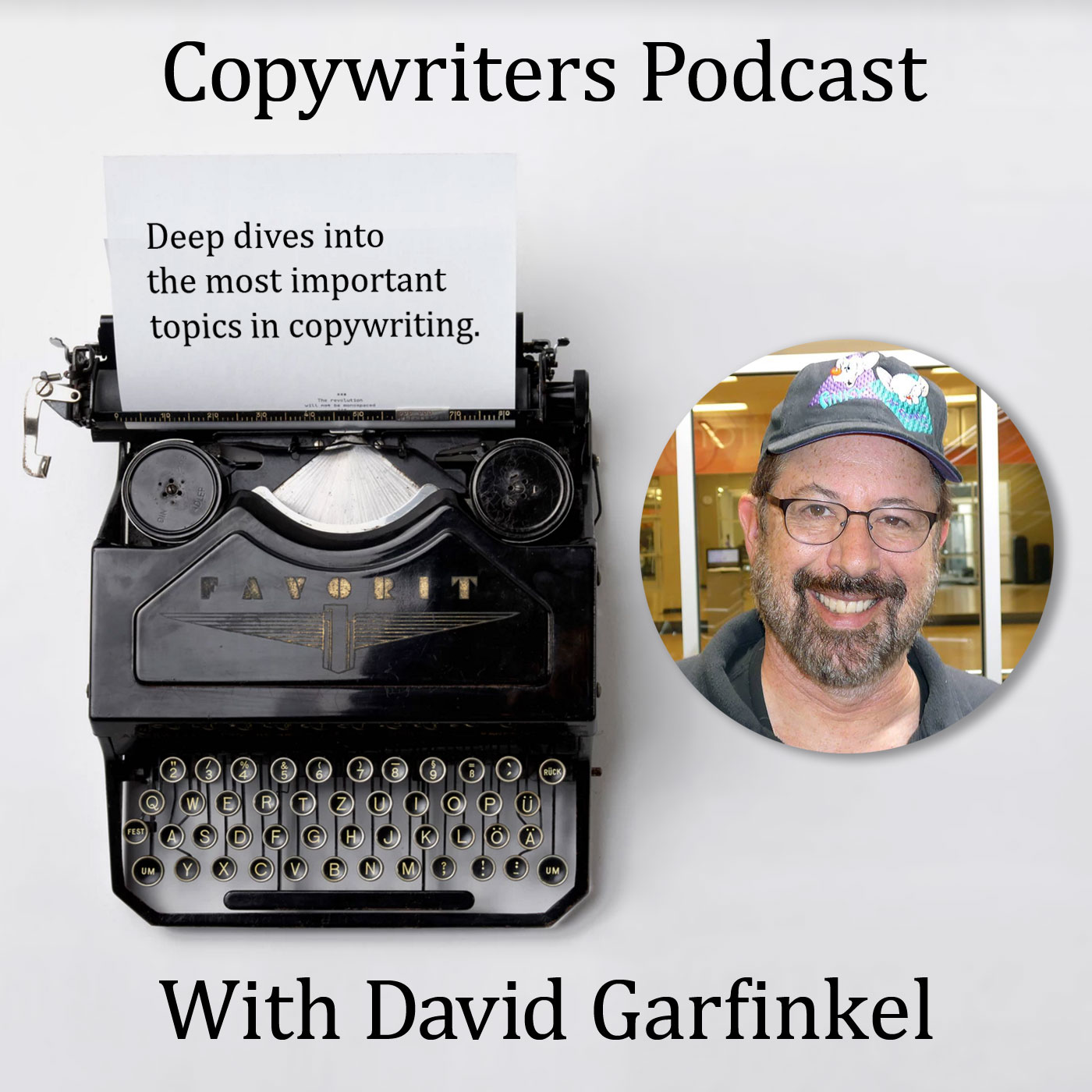
Copywriters Podcast
Hosted by David Garfinkel · EN
Copywriting lessons from David Garfinkel
22episodes
Episodes
Newest firstAll episodes
The Master Key To Persuasion
6d ago00:33:14Tap to summarizeI was rummaging around on youtube when I came across this video with an outrageous claim:“This book literally teaches you to think like a Harvard lawyer.”My skepticism shot into high gear, but when I watched the video, from a youtube educator named Stephan L. Petro, I saw he was on the level.I’ll tell you about the book in a minute. It’s really valuable for any copywriter, because it will help you sharpen up your sales argument quite a bit.But more important, it has one idea called “the bridge” which most experienced copywriters do automatically but most beginners miss out on–and this idea can make all the difference between whether your copy works.Now, we’re not lawyers, but in some ways we do the same thing, so it will be worthwhile to find out more about this book and what it means to us as copywriters.ResourcesThe Uses of Argument, by Stephen E. Toulminhttps://www.amazon.com/Uses-Argument-Stephen-Toulmin/dp/0521534836The Persuasion Story Codehttps://www.amazon.com/dp/B0CFD2KXNQ
Transcribe →More Screenwriting Secrets For Copywriters
2w ago00:28:51Tap to summarizeThis week I had a great conversation with a Hollywood screenwriting coach and screenwriter himself, and it reminded me about how much people in Hollywood know that copywriters can learn and use.One of his most important points was there are structures that make stories work. Not rigid formulas or two-dimensional templates, but guidelines with benchmarks that have proven time and time again to act as a container for great stories.I was reminded that we’re not always talking hero’s journey when we look at stories. I went back into some of my own research and found some more micro-story structures that we as copywriters can adapt to make our own copy that much more compelling.We did this a couple months ago when we talked about The Dark Knight, Inception and Rocky.Today I’ve got three new story types that will add a little Hollywood intrigue to our sales letters, sales funnels, websites and VSLs. Really, to any type of copy.RESOURCE:The Persuasion Story Codehttps://www.amazon.com/dp/B0CFD2KXNQ
Transcribe →Old Masters Series, Advertising’s Founder, Albert Lasker Part 3
3w ago00:36:57Tap to summarizeToday we’re continuing with Part 3 of our Old Masters Series, focusing on the contributions of Albert Lasker. That’s because in 1898, Albert Lasker arrived in Chicago to work at Lord and Thomas, which he took over in only a few years.And what Lasker and the copywriters he hired would do over the next 10 years would change the course of advertising.We’ve covered lessons in Parts 1 and 2 of this Old Masters Series. Particularly, lessons for direct-response marketers.Today we’re going to cover the last four lessons and then broaden our lens, because Lasker in fact had major and lasting impacts on our CULTURE, and he hasn’t gotten all that much credit for it as far as I’ve been able to tell.So now’s the perfect time, since I think you’ll find some of the most important changes he caused to be interesting and possibly very useful in your own world.Resources:The Man Who Sold America, by Jeffrey L. Cruikshank and Arthur W Schultz https://www.amazon.com/Man-Who-Sold-America-Advertising-ebook/dp/B003SNJYTYThe Persuasion Story Codehttps://www.amazon.com/dp/B0CFD2KXNQ
Transcribe →Will AI Shopping Make Copywriting Obsolete?
4w ago00:28:02Tap to summarizeThe world of copywriting and ecommerce almost changed forever last September 29, when Open AI launched something called Instant Checkout.This new service was designed to let you seamlessly buy something right from Chat GPT.Instant Checkout crashed and burned over the next six months for a number of reasons.One, the infrastructure wasn’t there to let it happen. It was launched before there were enough figurative runways, air traffic control towers, connections between Chat GPT and merchants, and other things like that.Two, the cost to merchants was really out of line:7% per transaction, more than double what they were paying when customers came directly to their site.They shut it down in March. Not forever; just, for now.So Instant Checkout was an early attempt at what’s called Agentic Shopping, where you order right from the AI and an AI agent does a lot of the heavy lifting for you.We’re most likely 3-5 years out from Agentic Shopping becoming a widespread reality.But when it does, our world as copywriters will change. In a big way.We’re going to look at how, and what you can do to prepare for this inevitable future, today.
Transcribe →Part 2- Old Masters Series, Advertising’s Founder, Albert Lasker
Jul 1300:33:35Tap to summarizeToday we’re continuing with our Old Masters Series focus on the contributions of Albert Lasker. This is Part 2.Lasker is the one person in history who, more than anyone else, created the foundation for what advertising is today—at least direct response advertising.On today’s show, we’re going to review some more of the most important lessons we have learned resulting from his innovations more than 100 years ago.Here’s the short version of his history:At age 18, Albert Lasker arrived in Chicago to take a job at the Chicago ad agency Lord and Thomas. The year was 1898.And the location was in the Trude Building, at the corner of North Wabash Avenue and East Randolph Street. A little less than a mile south of where I worked for McGraw-Hill, on Michigan and Erie, when I lived in Chicago in the early 1980s.But back to 1898. What Lasker and the copywriters he hired would do over the next 10 years would change the course of advertising. Today we cover eight more lessons from Lasker.Resources:The Man Who Sold America, by Jeffrey L. Cruikshank and Arthur W Schultz https://www.amazon.com/Man-Who-Sold-America-Advertising-ebook/dp/B003SNJYTYThe Persuasion Story Codehttps://www.amazon.com/dp/B0CFD2KXNQ
Transcribe →Old Masters Series– Advertising’s Founder, Albert Lasker
Jul 600:32:32Tap to summarizeAlbert Lasker didn't just become one of advertising's biggest names—he helped invent the way modern direct response marketing works.In this episode of the Old Masters Series, we explore the principles that transformed advertising from clever announcements into measurable sales systems. You'll hear the stories behind the ideas that influenced generations of copywriters, from Claude Hopkins to David Ogilvy, and why many of those lessons still outperform today's marketing trends.If you've ever wondered why some ads persuade while others are forgotten, this episode traces the origins of the answer.The tools may have changed. Human psychology hasn't.Resources:The Man Who Sold America, by Jeffrey L. Cruikshank and Arthur W Schultz https://www.amazon.com/Man-Who-Sold-America-Advertising-ebook/dp/B003SNJYTYAdvertising Headlines That Make You Rich, https://www.amazon.com/Advertising-Headlines-That-Make-Rich-ebook/dp/B00513MQ2G
Transcribe →Copywriting Secrets Of Human Nature, With Andrew Gould
Jun 2900:37:10Tap to summarizeOur special guest today didn’t start out planning to be a copywriter, but found his way into it after posting online reviews of his favorite martial arts movies in college, and getting his writing compared to that of Dan Kennedy.He looked up Dan and found what he had to say interesting. But he didn’t become a copywriter or a marketer at the time. Instead, he finished his degree and went from job to job for a few years until he landed in sales, where he ended up doing really well. 12 years after his first internet posting came the crash of 2009. Andrew Gould was the top salesman at his company at the time. But the company itself went under, and Andrew was out of a job. It was then he remembered Dan, and found his way into copywriting.That was 17 years ago.Since then, Andrew has racked up about $150 million in sales for his clients. He’s always been a freelancer and he’s written copy for companies in niches ranging from self-defense to joint mobility to power generators.He’s also taken several hobby businesses from a few thousand dollars a month to $50K and even $100K a month.Copywriters Andrew has coached have had multiple six-figure launches across a wide variety of niches.Andrew says he’s not a great writer himself, but what has helped him do so well is his research.And I quote:“I focus on becoming the audience I’m writing for. For example, I’ve taken hot yoga classes this year for an offer I’m writing.”Andrew told me he loves to focus on the fundamentals, which is something we both have in common. Andrew has a very systematic and easy approach to the fundamentals of understanding people, which ties right into his extraordinary accomplishments in research and the resulting sales.I think this is incredibly valuable information that is not talked about very much, but should be.Andrew agreed to share this approach with us today, and I was really excited to hear what he had to say.You can contact Andrew on X online, at https://x.com/AndrewWriteCopy
Transcribe →Sales- Friendly Content Marketing
Jun 2200:35:44Tap to summarizeLast week, we did a show on how content marketing is failing direct marketers when you do it the way everyone else does it.Basically, social media encourages you to crave attention and approval, instead of get results.Nathan asked me if we could a completely different version of the show, where we focus on including direct response elements in our content marketing.I thought that was a great idea! So, we’ll do that, and cover the use of direct response thinking and techniques in social media, articles, videos and emails.RESOURCESMy books:The Persuasion Story Codehttps://www.amazon.com/dp/B0CFD2KXNQBreakthrough Copywritinghttps://www.amazon.com/dp/1548706957Mentoring:https://garfinkelcoaching.com
Transcribe →A-List Copywriter Bullet Secrets, With Kim Krause Schwalm
Jun 1500:35:14Tap to summarizeOur returning champion today is Kim Krause Schwalm, and she is going to share some amazing and unique information with you.The late Clayton Makepiece, a legend himself in copywriting, said, and I quote: “Kim Krause Schwalm is one of the hottest copywriters alive.”Here’s a little background:Kim was always a marketer who could write copy. Before she launched her freelance career in 1998, she spent years in corporate marketing — from Brand Manager to Publisher — including building the Healthy Directions supplement business to the equivalent of nearly $40 million in sales within its first three years. But we’re talking to Kim today as one of the top A-list direct response copywriters in the country. She's racked up dozens of controls, beat legendary copywriters head-to-head, and was the first female copywriter to create a package that became a Boardroom control. Her clients have included Bottom Line, National Geographic, Green Valley Natural Solutions, and other leading companies across the US, England, Germany, and Singapore. Kim has a bachelor’s in Math and Statistics and an MBA in Marketing. She brings that rare combination of creative instinct and analytical rigor to everything she writes. And, she is the author of the number-one Amazon bestselling book, Client Badassery Secrets.Today, she’s going to share secrets about writing bullet points you simply won’t get anywhere else.Here’s Kim’s offer. There’s really more than I can tell you about. Seven deliverables and three bonuses. Some highlights include• Her Get Dangerously Good Copywriting System• The bullet writing boot camp, which today’s show was drawn from• Kim’s Million Dollar Controls Master Class• Her Supplement Copy Boot Camp… and much, much more. Six more pieces, in fact. Copywriting education I wish I had when I got started.This bundle will only be available until midnight Pacific Daylight Time on Friday, June 19. You’ve got to read about it for a sense of everything you get, and then you can decide if this is for you.Here’s the link:https://kimschwalm.lpages.co/kims-copywriting-vault-for-david-garfinkels-followers/
Transcribe →Why Your Content Isn’t Getting You Buyers
Jun 800:37:11Tap to summarizeIf you’ve always wondered about content marketing, you’re not alone. It’s a confusing term and there’s no standard definition to describe what it means.It really depends on your point of view.Well, we have a point of view on this podcast, and it is the point of view of direct-response copywriting.Now, to be sure, not EVERY word you write is part of a sales letter, even from our point of view.But every word should lead in some way to a sales process at best or build up the business another way at worst.And a lot of people get lost along the way, chasing shiny objects and striving for accomplishments that really don’t mean very much, outside of the momentary thrill of bragging rights.We’re going to sort things out today so you can decide for yourself what matters and what you should be going after with your content marketing.Links:Cultish Contenthttps://cultishcontent.com/Garfinkel Coachinghttps://garfinkelcoaching.comMy new book, The Persuasion Story Codehttps://www.amazon.com/dp/B0CFD2KXNQ
Transcribe →