← Creative Pep Talk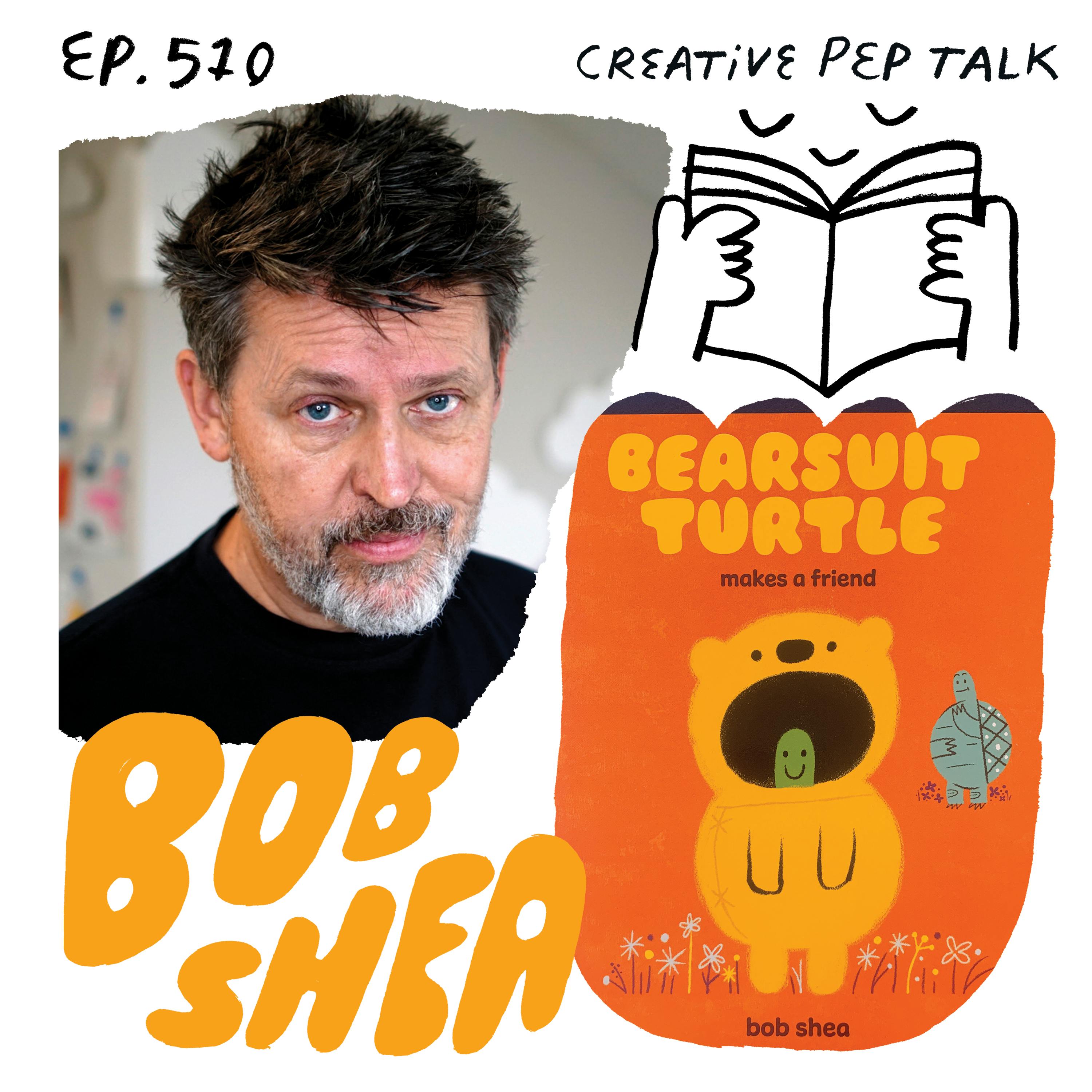
Creative Pep Talk
510 - Remember How to Have Fun and Get Loose, ADHD / Being You, Storytelling, Ignoring the Industry & More with Picture Book Maker Bob Shea
01:16:12
Loading summary
Transcript242 lines
- [00:03]
Andy J. Pizza
On the creative journey, it's easy to get lost, but don't worry, you'll lift off. Sometimes you just need a creative pep talk. Okay, you're in for a treat today because one of my favorite creative people is on the show, author, illustrator Bob Shea. He is an incredible picture bookmaker, one of my favorites. Doing it today. And I loved soaking in Bob's hilarious wisdom in this episode. He has kind of been a bit of a guide for me since early days, even when I was just starting to consider writing picture books. He was super helpful all the way back in probably 2012, 2013, giving me feedback and some pointers. And then we've stayed in touch a bit over the years. And he's one of the people out there making tight stories in picture book form, which is not super common in, you know, a lot of, A lot of picture books are more topic driven these days, or they're maybe more whimsical in a lot of that. Both of those categories I really like. But, but you know, my penchant for storytelling. And Bob's been doing some phenomenal work in that direction. But also he's just one of the funniest, loosest creators and picture book makers that I know. And I'm so inspired and jealous by how silly and weird and fun his ideas are. He has a new book called Bear Suit Turtle. I mean, Bear Suit Turtle. That alone is just like, I so aspire to have that kind of freedom in, in my creativity. And so I was just soaking up everything that Bob could give me here. And I think you're gonna love it. We talk a bit about adhd, talk a little bit about ADHD medication, and you know, neither of us are doctors. We can't give you any medical advice. We have really different experiences. So we're covering kind of a wide set of opinions there, which I think is good. You know, if you're, if you're questioning that stuff, I highly recommend doing the, the difficult work of finding professionals. But to, to advise you particularly. And I also would recommend getting the gene site test, which gives you an idea of your DNA and how you're likely to interact with medicine. Medicine. But it's out of my league to really have any advice or any, you know, strong opinions on such things. But we talk a little bit about that because we're both ADHD and we handle it differently. And I think that that can be useful and valuable to anyone listening, no matter who you are. I think it's just good to see people deal with things in different ways. And find some similar results. So we, we go through, we go through storytelling, we go through how to have fun. How do you remember to have fun again? How do you get loose in your creative work? We talk about picture book making, we talk about the good part of learning from the industry and when to like ignore it. And also a lot about just how to be yourself in the work and go your own way and chart your own creative path. So tons of really great stuff here. So pumped to have on the show. If you have kids in your life or you love picture books, go check out all of Bob Shea's books. They're hilarious and fun and just so well done. Definitely go check out Bear Suit Turtle. And at the end I'm going to be back with the CTA for this episode. The Call to Adventure. I like to leave you with something to do so you're not as feeling excited about making creative work, but you're making creative work. So I'm going to be back at the end with with Action. A Call to Adventure inspired by this chat called Tickle Yourself. And I did this activity, I didn't like try to make myself laugh tickling myself, but I tried to do this in my creative work recently and it was to a positive effect. So stick around for that and I will be back at the end to talk about how you can put this stuff to action. All right, let's get into this chat. This episode is sponsored by Squarespace. I love Squarespace. I'm a long time user. One of the things I love about Squarespace is I will use it's so easy to use that I will use it to create pitches. If I'm pitching a book or I'm pitching something to a client, I will use a Squarespace page in my website and I'll build the whole thing there. Then you don't have these clunky like document PDFs clogging up people's inboxes and it looks super slick. If you want to see one of those that I use all the time, I did one for my series right side out. Andyjpizza.com RSO and you can can see how I create a little pitch summary of that project. Go to squarespace.com pep talk get building for free and trying it out and testing it. And then when you're ready to launch, use promo code pep talk all one word for 10% off your first purchase. Thanks Squarespace. My day kicks off with a refreshing Celsius energy drink.
- [05:50]
Bob Shea
Then straight to the gym, pre K.
- [05:52]
Andy J. Pizza
Pickup back home to Meal prep time for my fire station shift. One more Celsius. Gotta keep the lights on when the three alarm hits. I'm ready. Celsius Live fit. Go grab a cold refreshing Celsius at your local retailer or locate now@celsius.com. i'm really excited to chat. I've got, like I said, I got some books for. There it is on the video. There it is. Two fantastic, hilarious books. And. Okay, so the first thing I want to say is these books are great. You know, I know you've had some really big hits. You've done lots of books. And the thing that every time I read one of your books, this is what I'm thinking. How do you stay like lucid and loose when you're writing? Because you're. It feels like a person. It feels like talking to you. And you know, often when I go right, I'm like, okay, I'm writing something for, you know, whatever it is. And it just. That's the thing I'm always struck by. So just to like jump right in. Yeah, yeah, that's my, that's my first question.
- [07:09]
Bob Shea
So the one book you. That's a, that's a good question. And I don't, I don't do it consciously. It's funny. I was just listening to your podcast from last week about talking about how comedians finding yourself is hard and you go through all this stuff and, and do whatever and you, it takes a process in the beginning of your career is a lot like the end you're. When you're established, it's a lot like the beginning of your career. And I, the hardest part is shutting up the part of my brain that is trying to make it correct and to just free flow however I want. And like if you see that one book Bear Suit Turtle makes, Makes a Friend is a conversation. It's my brand new one and it's in dialogue and it doesn't even have any. We should play Pumpkin King said Bear Suit Turtle. It's got. No, none of that stuff. It's just the words because it's, it's a, it's a conversation that I would imagine happening and I'm just trying to make myself laugh, but I want to make it sound as natur as possible. And it's, it's as organic as I can make it because it's my sense of humor. And even in Shay Bob, which isn't full on dialogue like that, I'm like, how. Every, every page I'm like, how can I make this funnier? Like not Not. And, you know, I know you, like, you love comedy. I know that you know what I'm talking about. Not, like, how do I force humor in there and make it like, this has got to be really funny? And I'm gonna. It's gonna be really contrived. It's like, what's. What's an unexpected, fun, playful thing to say that's not gonna bother anybody or get in the way of the story. So it's like that. It's. It's a lot of walking around talking to myself, and it's a lot of giving myself permission to. To do it the way I want.
- [09:02]
Andy J. Pizza
Yeah.
- [09:03]
Bob Shea
And I've had a couple of books where I just. I just was like, did what?
- [09:08]
Andy J. Pizza
The.
- [09:08]
Bob Shea
What the editor of someone else told me I can't even look at those books anymore. So I've tried. So I've tried both ways.
- [09:16]
Andy J. Pizza
Yeah. Anyway, I should have said from the top. The two books I was. That I just have been reading is Shabob and Bittersweet Turtle. Both of them. Even the premise of them has that looseness that I know for. And the reason I ask you that is because when I go make a comic or a book or episode or whatever, I know when I'm in that state, but I don't always know how to get there. So I know when weird things are happening that are making me laugh, but it's not. It's not easy to get there. And the, you know, Shay Bob, which is about an alligator. Do you want to talk about what that is?
- [10:00]
Bob Shea
And I know what you're talking about, too.
- [10:02]
Andy J. Pizza
Okay.
- [10:02]
Bob Shea
Yes, exactly. So, Shea Bob is an alligator who wants to eat birds, but he's lazy, so he opens a restaurant on his nose so that the birds will land on his nose.
- [10:13]
Andy J. Pizza
Yeah.
- [10:14]
Bob Shea
And so when he does that, he becomes equally interested in making a. A good restaurant. And there's some gentrification happens in the woods around him, and birds come, and he's like, boy, if it wasn't for these birds, I'm going to eat. I'd be out of business and all this stuff. And let me tell you something, Andy. Sometimes I'm in a school visit reading that, and I'm like, this is absurd. Like, when did I do, like? Because I don't. I don't connect the making it part with the product. I'm like, oh, yeah. Because you. You know what the thing is, you're in the middle of a project. You're like, I got to get the colors. I'm doing the things. And you're you're writing it and rewriting stuff. And I have pages of just jokes written 10 times to make them sort of just feel. Not to make them feel natural.
- [10:57]
Andy J. Pizza
Yeah.
- [10:58]
Bob Shea
And. But there's so many moving parts. And then like, it's like two years later, I'm like, this book is silly. That was great.
- [11:04]
Andy J. Pizza
I.
- [11:04]
Bob Shea
That's one of my most popular books that won all these state awards because kids vote on it and they're like, yeah, that's silly and fun. So.
- [11:12]
Andy J. Pizza
Yeah. You know, that is.
- [11:13]
Bob Shea
I get what you're. I get what you're asking me.
- [11:16]
Andy J. Pizza
I love what you. I love the books you make because they're so clearly for kids. Yeah. Which is a difficult thing to do in this industry because they're not the people that buy the books, you know, so there is a lot of. That's a difficult line to. To walk. And. Yeah, just like you said that. One of my favorite things that kept making me laugh in that book is the line about he's. He's like getting endeared to these birds that he's going to eat. And he keeps saying that, like, these birds are really great that I'm going to eat later or whatever it is.
- [11:50]
Bob Shea
Right, right. That's the refrain.
- [11:52]
Andy J. Pizza
Yeah. It's so funny. But that. But the thing about, you know, both titles reflect that creative energy. Shay Bob, which is your name flipped. That kind of weird. Shay, like again, that's the weird. I wish I had a word for it. I can't even like. But it' this, like looseness that. Where you get that and bear suit turtle is the same thing where you're like, yes, I know I could have drawn a bear suit turtle. Maybe I even did one time, whatever. But I never would have even had the eyes to notice it. But that's what makes it so weird and interesting. So I don't know what. Does that make sense?
- [12:31]
Bob Shea
Yeah. Yeah, it does.
- [12:33]
Andy J. Pizza
So I know you said you walk around. I've. You've talked to me a little bit about this. Like.
- [12:37]
Bob Shea
Yeah.
- [12:38]
Andy J. Pizza
Tell me a little bit more about that process. Because even though I know this happens in my own creative practice, I want to be able to have some ways to trick my brain there more often.
- [12:50]
Bob Shea
Yes. You can't force it. I know that. You know all these things, you have to be relaxed and loose. Do you know what I mean? There was a short time when my wife was in my studio with me. She was doing. Had a little letter press and I had to leave because I couldn't sit at my. I couldn't sit and work on my stuff and have her go, hey, you know, we have to take our son to the. Something that we have to do with our son later.
- [13:19]
Andy J. Pizza
Yeah.
- [13:20]
Bob Shea
I get like, I'm not there. I can't. I'm happy to be there when I'm there, but right now I'm not here. I. I love things that are absurd and smart and silly and absurd, funny. That's my favorite stuff. And that's the stuff I react to. And sometimes it's. It's like, it's. It's just automatic. You see things, and right away in your brain, you're like, what's the weirdest thing this could be? What if this wasn't this? Or what do people expect? And what's the opposite? Not for any. Not for commercially to sell it, but just. I'm trying to keep myself entertained.
- [13:57]
Andy J. Pizza
The.
- [13:57]
Bob Shea
The adhd. I'm trying to make everything interesting. It's. It's how I make sense of the world and how I make moving through boring situations interesting. I. I purposely don't bring my phone or stuff to the post office or whatever because I'm like, I'm gonna be. I'm gonna freestyle it. Just see what I can. What I can just make up in my head. And those long walks. I just start having conversations and saying some funny dialogue, and maybe I'll use it, maybe I won't, you know.
- [14:31]
Andy J. Pizza
And will you record that?
- [14:33]
Bob Shea
I was thinking about. So. So when I say I talk to myself, it's not that linear. Some of it's in my head. And then I'll say a line because I think it'll sound funny.
- [14:44]
Andy J. Pizza
Yeah.
- [14:44]
Bob Shea
But I'm not like going. Doing the everything. And I'm afraid that if I record it, it will be.
- [14:50]
Andy J. Pizza
I feel this too. You're going to aware. Adding this pressure to it. Yeah.
- [14:56]
Bob Shea
And you don't want to go through all that.
- [14:58]
Andy J. Pizza
Yeah, I don't.
- [14:58]
Bob Shea
40 minutes of.
- [15:01]
Andy J. Pizza
Oh, I know.
- [15:01]
Bob Shea
Yeah. Nonsense. For one thing. That's like, maybe I'll use that.
- [15:06]
Andy J. Pizza
It's. I mean, it's really interesting. One of the things that. Whenever I do this show with my buddy Andrew Nair, we do this color in show. And one of the things that he's. I think I have this. I think the ADHD thing, which I think we'll talk about in a bit. Feel free to talk about as much as you want.
- [15:24]
Bob Shea
Oh, yeah.
- [15:25]
Andy J. Pizza
Planned some questions about that. I think the ADHD comes with so much anxiety around getting something done that. That really gets in the way of getting in there. Of Getting in the looseness. And so this is something I've learned from Andrew, where we'll go into the city. We have to. We have, like, three days to paint this mural, draw this mural, and he will just want to mess around. And I. And he's doing it strategically, really, like, literally knowing, like, this will be good if we can be loose and have fun. And the. And it takes me so much time to let go, because I'm thinking, we're not gonna. Are we gonna have time to do this? Like, they're gonna get mad at us and, like, you know, I'm not. Am I gonna get. Be able to control myself to do this? So. Yeah. I don't know if you can speak to that or help me.
- [16:25]
Bob Shea
He's. He's right. He's right. And I'm like you, but he's right. And the part that you're talking about, about my books that feel loose and free and fun and sound like me, that's the only part of the process where I don't put any constraints on myself.
- [16:40]
Andy J. Pizza
Right.
- [16:40]
Bob Shea
I'm like, this is done when it's done. If it's not fun and funny and playful and sound like me, then why would I make it? But when I get that, when I get the story locked, and it's not even locked because I'll edit it till the last second.
- [16:54]
Andy J. Pizza
Yeah.
- [16:55]
Bob Shea
And I get the. And I'm starting to do page layout and stuff. That's when the ADHD kicks in. I'm like, no one's going to like this. I'll make it easier on you. I'm going to get yelled at. Someone's mad at me.
- [17:08]
Andy J. Pizza
Yeah.
- [17:09]
Bob Shea
And nobody's mad at you. And I get that with the. I've done a couple of murals, too, and it's. And my. My wife would go with me to help me, and I'd be like, yeah, I'm starting to work, or whatever. She's like, you. You did not schedule enough time for this. I don't care if there are 10 people here. I'm like, I know. You're right. And I. And. And you. You get that there's those two parts of you where that panic kicks in, and you just start drawing shapes.
- [17:34]
Andy J. Pizza
And I know that, you know, if this was. That kind of execution mode is not the worst thing when you're painting a mural that you've already designed.
- [17:43]
Bob Shea
Yeah.
- [17:44]
Andy J. Pizza
This particular project, we're freestyling. So he is right that if we are.
- [17:49]
Bob Shea
Yeah. Yeah.
- [17:50]
Andy J. Pizza
If we're not loose, it's going to be Terrible. And so he always has to kind of coax me into, like, slacking off for the first half a day or something. It always works. And I think that I'm trying to figure out a way. I think, you know, what I take from that is when it comes to that, the creative phase where you're really ideating, like, can you make sure that you make that enjoyable? And can you make sure that you give space around that? And that is something that I try to do. Like, if I know, like, I'm getting into the kind of cognitive work that only can be done when you're not feeling pressure, which is such. It's. That's one of the risky things about doing it for your job is that finding those pockets is art in itself.
- [18:40]
Bob Shea
That. Yeah. And the other thing is, it is. And it's hard to do that. And the other thing is I was a graphic designer doing freelance graphic design, like, clients and stuff. I'm so grateful that I make up my own projects now that I invent them. And it's. The more it sounds like me, the more the happier people are, which is.
- [19:02]
Andy J. Pizza
It's just.
- [19:02]
Bob Shea
It's still. It's amazing to me. It's bizarre. So when it comes to that part of it, I know that I'm like, this is the part that people are paying for. Don't. You can't put pressure on this. So that allows me to do that. Do you know what I mean?
- [19:18]
Andy J. Pizza
Yeah.
- [19:19]
Bob Shea
A practical thing I do. I used to do. I used to draw online, on Instagram, with people. And I find that it's a lot easier to draw loosely and be loose creatively when I'm not paying attention. Do you know what I mean? Like, if I'm talking to somebody else, like, right now, if I was drawing, I'd be like, oh, these drawings look really good. I wouldn't even think about them. But if I was like, I have to draw something, it makes it a lot harder.
- [19:42]
Andy J. Pizza
Yeah, I mean, I totally, honestly, I think that's exactly it. I. I don't claim to actually know real things about the brain, but I've read some things, I've understood some of it, and it sounds like it checks out in terms of, you know, thinking, especially for me. I think, in words, that a lot of that's coming from the other side of the brain that you're not trying to access, if you're trying to make weird associations and surprise yourself and work in symbol and picture and all that. So I do think it's trying to get into a space where you're not really thinking, you're not really trying like that. All of that stuff, I think is really essential. And I try to take it more seriously all the time of, like, okay, if you're trying to come up with an idea for an episode or a book or something, that's when you're going to go to the coffee shop and you're gonna mess around and you're gonna walk around until you feel great, then you're feeling great, then you can have some fun, and you real. You're ready to have fun, then it's. Then it's time to maybe start messing around.
- [20:45]
Bob Shea
It's play. Yeah.
- [20:48]
Andy J. Pizza
Yeah.
- [20:49]
Bob Shea
And it's hard because the coffee shop thing is great, because you're in a new location, so everything looks different. Your brain's like, hey, we're doing something different. It's hard, though, because, like, I'm like, work is digging a hole. You know what I mean? If the shovel's not moving, I'm not working. And it's like, you really have to be like, walking around is what I'm supposed to do right now. It's not easy.
- [21:09]
Andy J. Pizza
It's. It's weird. It's. It's not easy to have fun, which is the funniest, dumbest thing. Another thing I wanted to ask you about, and really, if. If y' all don't know Bob's books, none of this is blowing smoke. This. Bob has hilarious books that also, you know, pay off better than lots of books. I know. I don't want to. I'm not trying to throw shade, but also, they. They work too. Is that something. How do you feel about that? Because I. Because you're so light and funny. I'm like, does he. Is he just doing this on accident that he's just like, all these books work now? What about that side of it?
- [21:48]
Bob Shea
Well, I mean, you know, we'll. I'll talk a little bit about Shay Bob. If you look at Shay Bob, I know you, and I'll know you get this too. I mean, I hit. I hit a lot of Hero's Journey beats in that.
- [21:59]
Andy J. Pizza
Yeah.
- [22:00]
Bob Shea
Yeah. I mean, it's all Hero's Journey, the whole thing. So, I mean, I'm. I'm construct. I'm like, I'm not just going. I used to just be like, I got a funny idea. I got a way to end it.
- [22:12]
Andy J. Pizza
Yeah.
- [22:12]
Bob Shea
String of jokes, we're out. Yeah.
- [22:14]
Andy J. Pizza
Right?
- [22:15]
Bob Shea
And now. And for Shay Bob, I was like, what if I applied Hero's Journey to this and made this happen? And this happen and hit these beats and it. And I was able to do it. Not all of them, sure, but some big key points I was able to get in there. So it is. Oh, thank you so much. And then. And then, like, I was really bad at page layout. So, like, during the pandemic, I was watching all these videos on dynamic symmetry and, like, layout and looking at all these, like, old master paintings. And, like, I use dynamic symmetry when I lay out my books. Even, like, bear Suit Turtle. Like, if you look like. If you. If you put a grid over that and started drawing lines, you're like, like, oh, he really did do that. I'm like, yeah, but it helps me. I'm not being like, well, and, you know, I'm using dynamic symmetry. I mean, like, it helps me. It. It helps me focus and keep it and have a framework to work within.
- [23:09]
Andy J. Pizza
Well, I really love that you just hit on that because I think so many creative people, especially people that are in your shoes, that are doing light, funny stuff, they're going to gloss over that. And I think for me, you know what, honestly, first of all, I'm just gonna say here on the recording, you're one of the most helpful people to me. Early on, when I first started wanting to do books, you. I mean, I don't really know if I should say this so that everybody goes after you and, like, help me, Bob, but you are really. You were so helpful. And early on, it's people like you that were giving me some tips. This is, like, probably 2013, something like that. Tips around story stuff. And at first, I think my reaction is what I see a lot of creative people react with is just this skepticism around structure that comes from insecurity. At least it did for me. I'm not saying that's everybody else. I'm not going to project it on everybody else. But for me, that's my initial. When I was getting that early feedback, my initial reaction was like, screw that. I'm trying to have fun and be creative. And so I love that you brought that into it because it. It definitely shows, like, as I'm working through it, this really fun book, I'm like, oh, man. Like, he's hitting these beats and it's like. And I know. I know where it's going in the good kind of way, where it's gonna pay off and feel good. Yeah, go ahead. Yeah.
- [24:40]
Bob Shea
No, I was just gonna say, yeah. I mean, obviously he's gonna be friends with the birds at the end, but it's the way he gets there.
- [24:46]
Andy J. Pizza
Y. And that. And people underestimate how desperately we want it. We want that. I also, I love books that break it. I love books that ignore. I love all of them. But I actually think too few people will want to. Will figure out how to do it. Because guess what? It's also really hard to do it. It's hard in my experience and it's very satisfying to do it. And so anyway, I'm. I'm blabber, but I.
- [25:13]
Bob Shea
No, no, no, I get it.
- [25:14]
Andy J. Pizza
Talked about that.
- [25:15]
Bob Shea
And it's, it's helpful to me when I'm writing a story to, to know that there's a. It's not. Because everybody, people who criticize it think it's cookie cutter. And it's like, oh, it's just, it's just you fill in the blanks and you got a book. It's like, doesn't really work that way. You're kind of just, you're trying to make people feel things and this is like a way to like draw some of those emotions out and making sure you put. And making sure that your story has that stuff in there.
- [25:39]
Andy J. Pizza
Yeah.
- [25:39]
Bob Shea
You know, it's just, they're just reminders. They're just helpful reminders.
- [25:43]
Andy J. Pizza
Reminders. And also to me, it's like this is the other side we're talking about. The way I think about it, there's. There's these two sides of the exploratory side and then the strategic side or the pants side and the plot side. And I, I think that I almost, I hope I never, I've never read any researchers talk about these different ways of being creative, but to me there's a creativity in solving a puzzle. There's a. You know, and.
- [26:09]
Bob Shea
Yeah.
- [26:10]
Andy J. Pizza
And so people that will. That haven't maybe familiarized themselves or used any, any of these sorts of structures and creative stuff might seem like it feels cookie cutter when you go to do it. You realize like tremendous amount of creativity to make this work. To figure out how you come up with something and put it in this box that works. And once you do that, then you're like, this is a totally different gear creatively. Yeah, it's really fun. Yeah. So I, I love, I love what you did there. It's. It's great.
- [26:41]
Bob Shea
Oh, thanks. Yeah.
- [26:43]
Andy J. Pizza
And my wife said the same thing when she read the follow up book to this. She was like, damn. Like, that's like, what. Yeah. What's it called?
- [26:51]
Bob Shea
Pizza for Birds.
- [26:52]
Andy J. Pizza
Yeah, Pizza for Birds. She's like, dude, this is like, this is like paying off. This is Everything comes back. This is like working.
- [27:00]
Bob Shea
Oh, good. I'm glad you said that.
- [27:02]
Andy J. Pizza
Which is even harder to do when it's that the text is very sparse.
- [27:08]
Bob Shea
Yeah, that was a little longer than Shay Bob's. Yeah, that was. That was. That was longer. That's one. My son's a musician, and so he comes to town. Shay Bob, I always think is me. So. So my son comes in with a pizza bike and the birds like him better. And Shay Bob goes on the Internet and internest and he writes a bunch of bad reviews about Shea Ryan. Horrible. I look. I look terrible and my son looks really cool.
- [27:34]
Andy J. Pizza
That's great. What a great dad.
- [27:36]
Bob Shea
He's a good kid.
- [27:38]
Andy J. Pizza
You know, now I'm just getting. I'm just complimenting you, but here's another question. Here's so you. Last time we talked, I said something to you, and as you. Your reply really helped me. So I want to see if you remember.
- [27:52]
Bob Shea
Oh, good.
- [27:53]
Andy J. Pizza
What you said. So you gave me this advice. Really helped. We're having lunch and I said, you know, I kind of want to go this way or I want to do this thing, but I'm feeling like people in my industry are going to like, not really like that, and I don't really know what to do about that. Do you remember what. Maybe you even just know what you would say to something like that. Do you have any recollection?
- [28:17]
Bob Shea
I don't, but I probably would just tell you to do it anyway. I wouldn't care what the people think.
- [28:21]
Andy J. Pizza
That is what you said.
- [28:23]
Bob Shea
Yeah, I don't care. The industry's. I don't want to say meaningless, but I try to not think about it as much as I can. I don't read trade publications. I don't follow things. I honestly. Your. Let's see what creative ones I listen to. ADHD podcasts, yours new and news ones. Use the only creative one I listen to. I've tried other ones. It's a couple others I tried and I was like, you know, you're. You're much more casual and much more authentic and. And I understand a lot of the points you make, so I stick with that. But I mean, as far as the industry goes, don't worry about history.
- [28:58]
Andy J. Pizza
Do you have any tips on that? But that just. Your reaction was basically that. But you also are like, this is your job, man. Like, you know, like. And it just really helped me to realize. I don't. I think I didn't even realize, like, oh, this is kind of the. What I think of as, like, the Artists. Artists trap. Where you're really performing for your peers.
- [29:21]
Bob Shea
Yes.
- [29:22]
Andy J. Pizza
At the, you know, detriment to your own self.
- [29:26]
Bob Shea
Yes.
- [29:26]
Andy J. Pizza
Yeah, I.
- [29:28]
Bob Shea
That's bad. You. And again, it goes back to the thing we were talking about before, about being authentic and getting the best work out of yourself because it's. You. Like, I can't do books like you do or anybody else, because I have to be myself the whole time. If I'm worried about what everybody else does, I don't look at other books, too. Not because I'm like, I'm too busy to be bothered with that. I don't want to go in the bookstore and be like, there's a lot of kangaroo books. I better make a kangaroo book.
- [29:57]
Andy J. Pizza
Yes.
- [29:58]
Bob Shea
Kangaroos are hot. Or. Or worse. Which I hate this feeling. And I avoid it as I'll be like, man, these books are really good.
- [30:06]
Andy J. Pizza
Yeah.
- [30:08]
Bob Shea
I don't know what. I'm. Question everything I'm working on, and I'm in the middle of. And all the finals and look back at my finals and go, holy cow, what's. What's up? You know what I mean?
- [30:17]
Andy J. Pizza
Yeah.
- [30:18]
Bob Shea
It's like, my work is. Even my illustration is my illustration. It's not. There's a million better illustrators than me. My stuff's graphic design. Very straightforward screen printing looking kind of stuff. It works for what I'm doing. But if I go in there and try to compare with some tight. You know, I'm friends with Lane Smith. Like, I go over and I'm. He's like, oh, look at this great painting. I'm like, yeah, that's really great.
- [30:42]
Andy J. Pizza
I can't be distracted by.
- [30:46]
Bob Shea
He's so nice, though. It's fine. And he actually talks to me like a peer. And that's kind of nice of him to do that.
- [30:52]
Andy J. Pizza
I mean, come on.
- [30:52]
Bob Shea
You know what I mean? But you go. But you know what I'm saying, though? You go. And you see, if you. If you immerse yourself in the other work too much and what. And what the industry's doing, that has nothing to do with you and your work. It just doesn't.
- [31:06]
Andy J. Pizza
I think that's great. And I. I think, first of all, Lane Smith is on a short list of people that determined my future. So, you know. Yeah, not in there. I'm. You know, I'm. I'm hooked. Yeah. Like stinky cheese, man. I remember that revelation for me, and I think, you know, I love this advice because to me, there's a. I try to keep in mind when I'm Talking about creativity, that there's almost. It's a very like non. Dual thing where. Or seasonal thing where there's a period of time where it's this and then there's a period of time where it's that and there. And you have to be aware of that. And I think starting out or even when I was young and I was loving all these books by John Sheska and Lane Smith and all these greats, that there was a time for being this massive fan. And then I even got into a period of time where I was even more plugged in and reading and thinking about it. And I think now, like you say, I'm in exactly the same position where I really don't want to know. Like, I like, yeah, I have a couple people that I'm friendly with in the industry and I like checking in with them from time to time and celebrating their books or enjoying something they did. But. But most of the things I'm trying to do, if they're inspired by anything, they're inspired by totally different industries or mediums.
- [32:26]
Bob Shea
Yeah.
- [32:26]
Andy J. Pizza
Which I think has been good for me.
- [32:29]
Bob Shea
And that's. And that's great. Like when you're early on and you're learning about the industry and you're learning what's expected of you and how the process works, but after you've done it for a while and you're in it, you can not retreat, but you can kind of go into yourself and be like, now I'm going to do whatever I want to do. Just like the people that I look up to did. Just like those people did. That stinky cheese man. Everything about it. Molly Leach did the design that was create the whole thing. The writing, illustration and design was of one piece. And it was like nothing before it changed picture books from that time on.
- [33:11]
Andy J. Pizza
It blew my mind.
- [33:12]
Bob Shea
Now everybody was. After that, everybody was like, let's do creative picture books. And they could never even nail it. I got two copies of it here. It's like you pull it out and you're like, it still holds up. It wasn't like, oh, this doesn't this look early 90s?
- [33:24]
Andy J. Pizza
It's like classic, credible.
- [33:26]
Bob Shea
Yeah, yeah.
- [33:27]
Andy J. Pizza
And hilarious, man.
- [33:28]
Bob Shea
It's freaking hilarious.
- [33:30]
Andy J. Pizza
And I just was like, I couldn't believe it. Here's another kind of follow up that's adjacent to that. But this is a question that I got from a podcasting guy named Eric Newsom. I've then like translated it into. I think it's a really good hack for storytelling. But we, we don't have to go there. That's just my ADHD tangent that way. That's.
- [33:56]
Bob Shea
I was right with you.
- [33:57]
Andy J. Pizza
When I'm with someone who's adhd, my ADHD is worse.
- [34:00]
Bob Shea
Yeah, yeah, but it's okay because like, I'm like, I'm not lost at all. I'm like, ye. I get it.
- [34:06]
Andy J. Pizza
I'm calling it out for the listener because you might notice that I'm off my game in terms of interrupting, being, you know, tangential, whatever. I'm blaming Bob for that.
- [34:16]
Bob Shea
That's fine.
- [34:17]
Andy J. Pizza
The question that he says is, what do people in your world or your industry really, really get wrong? And I just, I will just shift it so that you don't have to, you know, throw any shade on people. But you can also answer it like, what did you really, really get wrong earlier on in your, in your journey?
- [34:41]
Bob Shea
Oh, that's a good question. I. There, I'll tell you because there's so many things, any, any book, more than, and I only say this more than three years old, I can't open up and look at. Yeah, I mean, so there's. I got things wrong technically, like illustration wise, story wise. What I, what jokes I jokes I insisted on that were. I should not have insisted on that were a mistake styles that were a mistake. Like, I'm gonna try this because I was always like, I'm gonna keep experimenting and like sometimes experiments don't, they don't go right. You know what I thought things early on, you get things wrong. Like you think you make mistakes that everybody makes. And you're like, I'm not. I hate to say that I'm important, but you like, sort of are like, you don't understand the landscape of it. Because I've been working for 15 years as a creative director already or whatever. So I was like, oh yeah, I've got this down. Nobody has to tell me. And that was short lived. I'll tell you. As soon as I learned I was like, whoop, yes, time to make an apology to somebody.
- [35:52]
Andy J. Pizza
This is a embarrassing parallel because it, it's hilariously grandiose, but it reminds me of, I heard a random clip on, on the Internet of Pete. What's his name? What, the comic from snl? Davidson. Yeah, Pete Davidson. I blanked talking to Bill Murray and they were talking about like Bill Murray said the first couple years, people are famous, they're terrible people. And then usually it kind of course corrects. And I thought, even though I don't know anything about that, I do think that when you get into an industry, you have this idea of, like, this is the way it's going to be and you're calling the shots and you see it all the time, like, you know, criticizing and whatever. And then you get humbled and, and you've. And you figure it out. So I, I think that there's definitely something to that. And yeah. Yeah, if you can kind of see it coming, maybe you can avoid some of the worst of it.
- [36:51]
Bob Shea
Yeah, I got off easy, I do have to say, because I see a lot of illustrators, especially years ago, I saw a lot of illustrators. And my reaction was. You've never had a job before, have you? Like, you've always worked for yourself. Like, because, like, if you get mad at, like, the publicity people or whatever, you're like, yeah, that's just somebody who. They just have a job they have to go to every day and they don't need your. You're. Need you to give them a hard time.
- [37:18]
Andy J. Pizza
Yep, yep, I. I get that.
- [37:20]
Bob Shea
So I got 20 other authors to deal with.
- [37:23]
Andy J. Pizza
Yes. And. And also you realize that one of the. Yes. People want to work with you because you have great work or you're interesting or that you're right for the job, but you also learn, like, they're also not trying to make their lives terrible. And so if you're having. If you're easy to work with, they're likely to consider you for future stuff.
- [37:43]
Bob Shea
It goes a long way. It goes a long way if you're a decent person. And most people in this industry, most people in publishing, very few have I been like, I don't want to be near that person anymore. People are cool. It's nice. The kids book people are cool.
- [37:59]
Andy J. Pizza
They're doing it for the love of the thing. That seems to be true to me. Summer's here, and Nordstrom has everything you need for your best dress season ever. From beach days and weddings to weekend getaways in your everyday wardrobe. Discover stylish options under $100 from tons of your favorite brands, like Mango Skims, Princess Polly, and Madewell. It's easy, too, with free shipping and free returns in store order pickup and more. Shop today in stores online@nordstrom.com or download the Nordstrom app.
- [38:54]
Bob Shea
I think you're on mute. Workday is starting to sound the same. I think you're on mute. Find something that sounds better for your career on LinkedIn. With LinkedIn job collections, you can browse curated collections by relevant industries and benefits like Flexpto or hybrid workplaces, so you.
- [39:14]
Andy J. Pizza
Can find the right Job for you.
- [39:16]
Bob Shea
Get started@LinkedIn.com jobs, finding where you fit. LinkedIn knows how.
- [39:26]
Andy J. Pizza
So another question I wanted to ask you about was ADHD stuff.
- [39:29]
Bob Shea
Sure.
- [39:30]
Andy J. Pizza
You. It wasn't that long ago when you got diagnosed and you've talked, spoke about it publicly. I'm not just, like, calling you out.
- [39:38]
Bob Shea
Oh, I don't care.
- [39:39]
Andy J. Pizza
Yeah, it wasn't that long ago. Right?
- [39:42]
Bob Shea
Like three years ago, maybe four now. This spring. Yeah, maybe three or four years ago. Yeah.
- [39:47]
Andy J. Pizza
So, okay, what was that like?
- [39:51]
Bob Shea
I. How old were you? You were. You were in teenager. Right. But you didn't do anything about it for a while.
- [39:57]
Andy J. Pizza
20S. That. I really started to take that idea. Yeah. Yeah, it was.
- [40:02]
Bob Shea
I mean, my life was a wreck at the time. I mean, it's. It's amazing because you get this diagnosis and you're like, it all starts that you could. All of a sudden, this movie of your whole life plays in your brain, and you're like, all those things were because of this. And then I went on stimulant medication, and, like, 20 minutes in, my wife was like, that's working. I was like, what do you mean it's working? Because I'm not, like, hyperactive. She's like, you're standing, looking out the window. You've never done that before. It's a Saturday, and you're not sitting on the couch sketching, trying to catch up for the rest of the week. That medication's working. Yeah, it changed. And then the thing is, you think going in that it's like, oh, I'll be more focused and I'll be organized with my life. It was everything. It's like your mood and your emotional regulation. And, like, my wife was like, you're a much nicer person again. And I was go. At the time I got diagnosed, I had just gone through a hard time with, like, my. It was during COVID which. That was everybody's hard time. But right before that, my father had been sick for a few years and, like, dealing with an elderly parent passed away. All this stuff. I had a surgery in there, like, was like, crazy surgery. And, like, I was not in a good place, you know? And my wife was like, I don't know what's wrong with you, but you are not the same person anymore. She didn't know what was going on with me. And then I just went on stimulants, and she's like, you're back. Because it just. It just. Over the years, it just got worse and worse, and stress made it worse. Oh, so.
- [41:43]
Andy J. Pizza
Absolutely. And A lot of people don't understand that the emotional component of adhd, with all of the different ways that a neurotypical brain regulates, are not as available to you. And it's one of the reasons why you have things like rejection sensitivity, dysphoria, and all of these kind of these issues that are adjacent to it that you're not even fully aware are part of it. And you know, just for the sake of the conversation, I, I, I don't take medicine now. There were times where I did. I ended up doing a gene test that said I'm lucky enough to have like, bad interactions with most drugs. So I, I'm not medicated. But I also, I know a lot of people that are, have had your exact experience, I think.
- [42:36]
Bob Shea
And also. And it's, and it's pills. It's pills and skills. I don't want to be like, I took a pill and I magically was fixed.
- [42:42]
Andy J. Pizza
Yeah.
- [42:43]
Bob Shea
Like, it was like, I didn't want this. I know people are like, my brothers have it. And they're like, no, I'm fine. I'm like, yeah, you're not fine. But like, it's not, it's not like I took it and then I, I didn't want it in me. And I was, and I know. And you, you're a runner too, right? So you, I know that you exercise a lot. I was running.
- [43:02]
Andy J. Pizza
Primarily ADHD related.
- [43:04]
Bob Shea
Yeah, yeah, it helps it. It's huge. Run and meditating. I was doing. I quit sugar just for, because it was covet. I was getting fat. I had quit drinking at the time. Like, I, and that. So that when this. So all I'm trying to say is that the awareness of it was huge. Besides the medic, I didn't want to come across as I took a freaking Adderall and I was done.
- [43:24]
Andy J. Pizza
That's what I wanted to touch on because I, I wanted to just set the stage for that because you were also commenting on this. Just what it's like to be seen in that way is a huge thing. And yeah, I guess I'm highlighting it because I'm not always clear why I am so public about it. And so some people might guess that they'll guess whatever I'm trying to say about why this has been huge for me, but I know from conversations we've had that we, we deeply share this thing of it, you know, without the diagnosis, without the list of traits, that list of traits you already know, but you've been told that it's just called being a bad person.
- [44:10]
Bob Shea
Oh, yeah. I was incompetent. I couldn't do anything anybody else could do. I was completely incompetent. And my wife has no adhd. She's like, the opposite. And she's also a creative person. She's an art director and makes, like, leather goods and. But everything. I'm like, why is everything so easy for you? Why can you sit down and do a task and I have to mill around for a while and, like, get. I have to get ready to do it. Like, it's like. You're like, what's. I really. I was like, what's wrong with me? And then at the end with the emotional stuff, I thought we. My. I thought I was gonna leave my family. Not this.
- [44:43]
Andy J. Pizza
That's.
- [44:43]
Bob Shea
I'm not being dramatic, but I was like, I can't be around people. I can't. I can't. I couldn't handle more input into my brain of people talking to me like, what's for dinner? I was like, how can you do that to me? Do you know what I mean?
- [44:57]
Andy J. Pizza
Like, I wish I didn't know what you're. Man. That.
- [45:00]
Bob Shea
Yeah, see? But, you know, and I just was like. I was like. I'm like, I'm broken. I can't be around these. That my family hates me now. So what do you. So exercise and do. Do you, like, do other things too?
- [45:12]
Andy J. Pizza
Like, I mean, yes, most if it's personal stuff around managing myself, but, yeah, exercise is huge. I gotta. I gotta run. I have, like, a lot of people know about my bath regimen. That's a big part of it. That's a whole. You know, it's funny because the more you dive into the information around this, how many weird patterns you get. I've heard a lot of neurodivergent people, like, say all you need to do to regulate your system is wake up eight to 10 hours before everybody else and just, you know, meditate. And so I think that there's, you know, truth to that. So I'm definitely doing that. I think that I'd be a lot worse off if I didn't build the career that I have. That's another reason why I'm so. It's not my place to have opinions on medicine, first of all. Not to mention, yeah, my medicine, my brain is gonna interact differently, you know, as a fact. But also my circumstance is dramatically different. So than most people. So, you know, the. Anytime that I've had a regular job, all of my health has gone out the window dramatically quickly.
- [46:34]
Bob Shea
Yeah.
- [46:35]
Andy J. Pizza
Every time. Every single time. You know, I'm eating. My eating habits turn into just numbing out, like, all those kind of things. I. I smoked cigarettes for five years, getting through being employed, and that was a stimulant, you know.
- [46:52]
Bob Shea
Yeah.
- [46:53]
Andy J. Pizza
And so, yeah, I have all these different methods, but I. I wanted to ask you about. Because I know that you have an. Kind of a. Interesting way of scheduling and dealing with that. Can you talk about that? Yeah, yeah.
- [47:08]
Bob Shea
So I. I'm just. I'm still. I'm. I was working on it today because I'm doing a substack about it, about what I do during my day. Yeah, it's called. It's called I'll do.
- [47:24]
Andy J. Pizza
That's an amazing method.
- [47:25]
Bob Shea
Yeah, thanks. I. I have to make. I. Before I was. I. Before I was diagnosed, I was like, obsessed with time management things, and they don't work. Like, they don't work for us. Like, I can't. I don't know how you deal with doing a podcast and stuff. I'd be. It'd be crazy. I. Yeah, I. First. Beginning of the week, Sunday.
- [47:49]
Andy J. Pizza
It is.
- [47:49]
Bob Shea
It is. Oh, yeah. Was. I was like, wow, look, he's got that schedule where you go to the calendar and you could pick your day. I was like, that's really good.
- [47:57]
Andy J. Pizza
That took me years to set up. Years after I knew about it, years after I'd used other people's. He's talking about, like a calendar thing where you send a link and someone sets it up. That's. It's a classic ADHD thing of, like, when you need to schedule going to the dentist, the I've. It take. There's like. Like eight steps in between you and that thing.
- [48:18]
Bob Shea
Yeah.
- [48:18]
Andy J. Pizza
So that calendly thing, that took me years to do something that took me 20 minutes to finish. So. Yeah.
- [48:25]
Bob Shea
So good. I was telling my. I was like, telling my wife, we should do this for my school visits. And then schools just go on there and do a thing. She's like, no, it's too hard. And she was right. But so. So my thing I've called. I. I call it time blobbing, because I don't want to call it. It's like. It's like time block planning, but without wanting to, like, I can't do this. I can't have a. I have a job now.
- [48:50]
Andy J. Pizza
Yeah.
- [48:51]
Bob Shea
So basically, you, like, you know your head is full of bees, right? Your head is full of all the bees. And the first thing you do. I could. I have it in my. This is my planner. The first thing you do is you Dump everything onto a piece of paper. Like you dump. Find a Sunday. You dump everything you have to do that week. Like this is it. Like everything. So that's like projects. Call the mechanic. Dentist. Second project. Oh, I want to make some videos.
- [49:20]
Andy J. Pizza
Everything.
- [49:21]
Bob Shea
So it's in a big pile, like the piles on your desk. Right. It's just a big pile. And then you take the. Then you do five days for the week, morning and afternoon. And then you have to block out things that you can't do. I'm at the dentist here, I got a zoom call, blah, blah, blah. And now the time starts getting smaller and you start plugging things in from the big pile. And then you re. What this does is you realize I can't add anything to this pile because beforehand I'd be like, you know, it'd be fun. Welding. I'm going to learn welding. But you got 500 other things to do, right, that you're not doing.
- [49:58]
Andy J. Pizza
Yes.
- [49:58]
Bob Shea
And then. So then the day is 16 squares of 30 minute increments. Right. Eight hours. And then you block off first square. Meditation. I can't do anything then because I'm meditating. Right. I don't do it every day. But what it's training you to do is to see how much time you really have as opposed to what you think you have. Because at the beginning of the week I'd be like, I got a whole week. That's an infinite amount of time. I'll do two books this week. And then when you get to the day I block out, I always skip lunch. I don't know about you. And so I block out, go have lunch or else the rest of the day's pointless.
- [50:40]
Andy J. Pizza
Yeah.
- [50:41]
Bob Shea
So now I'm like, have lunch. My wife comes over, I can't work that time. And at the end of the day I put clean up blocks. I never use those, but I put them in every day anyway. Because the day falls apart by then and you're focusing. 4 o' clock is different than 10 o' clock or whatever it is. But. But all it is, it's training me to learn because I have no idea how time works. It's training me to visually learn how time works. And then the other thing is I write down how long I think something's gonna take. Oh, go to the post office, four minutes. And then I go to the post office. I'm like, that was an hour and a half. How the hell did that happen? But I write that down. So the next time I go to the post office, maybe I'll Say, I'll get it in a half hour this time, maybe. No, you know what I mean? You train yourself to learn how long things take. I've been working on this. This. You get a PDF if you sign up for the sub stack.
- [51:35]
Andy J. Pizza
Yeah.
- [51:35]
Bob Shea
But working on it for a week. I'm like, take me half a day. Half a day is gonna bang this out. I'm like, what's wrong with me? Like, I'm not saying that and I'm cured and everything works. But when you have an awareness of it, like, awareness. You have adhd, when you have an awareness of. Of the way it is, you don't get to the end of the day and beat yourself up and go, what. What did I get done today? I didn't do anything. Because you look back and go, oh, I was supposed to be working on this, but I was caught up. Caught up on. Instead, I wanted to. I was really making progress on the other projects, so I stayed on that. So I didn't jump over to this. And then, you know, why it didn't get done. And then you're like, all right, that's cool. Oh, and then, you know, you. The timers. Do you use the timer?
- [52:16]
Andy J. Pizza
Yeah, I got one.
- [52:18]
Bob Shea
Do you use it?
- [52:19]
Andy J. Pizza
I use it. I. The main way I use it. It is this. I do one thing and it's. I say if there's. And this is something that I. You know, I'm a Cal Newport fan. And. Yeah, that's the thing that he talks about with cognitive load of, like, trying to get into switching. Yeah, yeah. Context switching. Like this thing of the cognitive load of getting into something and how it's this 15, 20 minutes of pain, essentially, to get into what he calls deep work. And so the thing that I do. The only thing I do with the timer is I say, you know, the thing you really don't want to do? You only have to do it for 20 minutes. You only have to do it for 15 minutes. So I set the timer, and then I keep doing it after that. That just makes me.
- [53:07]
Bob Shea
That's good. Yeah.
- [53:12]
Andy J. Pizza
That wall and your brain is all in. You don't really want to get out of it.
- [53:16]
Bob Shea
Yeah. You're like, all right, well, let's. Let's get this over with.
- [53:19]
Andy J. Pizza
Yep.
- [53:20]
Bob Shea
If it's painful thing. Yeah, that's a good one. Yeah. And then that's the thing, too. In the mornings, for me, I use that deep work to. I look at it as deep work because that's where I'm the most awake.
- [53:31]
Andy J. Pizza
Yeah, same.
- [53:32]
Bob Shea
And the most Focused. So I'm like, that's precious time. Like, that's creative time in the afternoons. Administration or whatever.
- [53:39]
Andy J. Pizza
Yeah, yeah, that's great. I think that works super well. And I. I love what you said about going to the post office. My brain's like, what is that, 30 seconds? Come on.
- [53:49]
Bob Shea
Right? And then you're like, find it. Stamps and envelopes. Where's my shoes? Yeah, to get down there. Oh, is it cold? I have my keys. And then you go down there, like, I'm gonna go get a cup of coffee because I ran an errand. So then you're like, what I want to do. But you don't add those things up.
- [54:04]
Andy J. Pizza
And again, this is. This is difficult for me. I gotta figure out some different ways of tricking myself into doing this. But. But I love what you said about. I get that same way where I'm looking at a free week and I'm like, okay. I mean, I just did this where I had. I was working on. I did this the first time. I really blocked out time for making the art for a picture book. That was great. That was a great move. I did a couple things. I blocked out a bunch of time. I also created a little autoresponder for my email with all links. Wow, that was a good move because even if. And I told him what was going on, so even if it wasn't someone else's responsibility to answer that email, I knew that the person that got it knew I wasn't just completely ignoring it. So that was. That was really good. But the problem was the way that I really messed up was I just thought. And then the week after I'm done, first week of April, anything's possible. So I just, like, loaded that with so many calls, so many deadlines. It was. It was outrageous. So I'm gonna take your advice and I'm gonna. This. I have a new project I'm just starting, and I'm just going to block out as much time that I, you know, I'm going to try to overestimate in the coming weeks all these different things I need to do. And I think it is going to help me out, because free time on my calendar, I am so I. I get drunk with it, man. I'm just like, wow, look at. Look at me go.
- [55:30]
Bob Shea
Look, I can start a new business or 320 projects. Yeah, I got 20 things I could put in there. And you keep putting stuff in there. You're like, I'll do that in my free time. That's the thing. But if you overestimate your brain is like, you overestimated. I'm gonna. I'm gonna take it easy, which I love.
- [55:49]
Andy J. Pizza
That's. That's a great point where you're actually auditing. How long did it actually take?
- [55:55]
Bob Shea
You're like, yeah, that's good. You can't.
- [55:57]
Andy J. Pizza
You can't only trick your brain so well. Yeah.
- [56:00]
Bob Shea
That's why I was like, put blocks in the, like, always go to lunch. Because then in the morning you're not like, I have all day. You're like, no, my wife's gonna be here at 1:30. I got to get this done by 1:30 or whatever it is. Yeah, you got it. Like, think about what works for you and then like, try to work that into the thing. Are you good at long term planning? I can't plan long term at all.
- [56:22]
Andy J. Pizza
Not really. You know, I think that there's kind of two things at play. One of them I am good at, the other one I'm not good at. So I was thinking about this the other day. I was talking to my wife about like, like, I. I know one thing I'm good at that I don't. You know, I don't. I don't. I feel like this is kind of unusual is I said, it's not fear. I'm not just driven by fear all the time. And I was trying to explain like, what I was saying, like, going through some decisions I made to shift things and invest in different areas and whatever over the past 10 years. And she said, oh, it's like law, like long game or big picture thinking. So I am good at that. I am. I can. I definitely feel like I have a sense of the 40,000foot view or whatever it is. Yeah, yeah, I do have that, but I don't have. And I am good at being like, okay, this is what I'm doing now. And all these other things, if I'm not doing them now, it doesn't mean I'm throwing them in the trash. I tell my brain that I'm throwing them in the crock pot. So they're in the crock pot. Doesn't mean they're gone. I put kids books in the crock pot for four years while I was getting the podcast started. So those are two things that help me with that. But I'm not good with. I'm not good with like, blocking it out or sticking to it, even if I did block it out.
- [57:46]
Bob Shea
Right, right. That's good though. I'm terrible at long term planning. And I mean, it's Hard, because I do picture books, which that's all it is. But, I mean, I can't go more than. And in my brain, I can't go more than two or three weeks out. And I'm always wrong. Anyway, I should be done with a book that I'm barely starting now, like the finals, because all this other stuff came up in that process. Yeah. But that. Putting it away for four years in the crock pot, that's a great way to think about it because a lot of people just abandon that stuff.
- [58:19]
Andy J. Pizza
Yeah.
- [58:19]
Bob Shea
Shay. Bob. I had that idea 10 years ago. Before. 10 years before I drew it, before I did it. I had the little. The seed of the idea that I. I just held on to. Yeah. People. And. And if you can do that without beating yourself up about it and feeling guilty, because then you're like, oh, and I got all these books I have to do and blah, blah, blah, you're like. And again with the. Any kind of day planning you do. Any kind of. Any kind of planning you do during the day, then you don't feel guilty about all the stuff you're not getting to because you're like, well, I know this is. This is what my capacity is.
- [58:50]
Andy J. Pizza
Yeah. And. And also it speaks to that thing we were talking about earlier where you're not so invested in the industry, where you're getting all the FOMO and you're getting all. No, that's what they're doing. That, you know, I'm falling behind this or that. I think that the people most, the creative people I respect the most and have consumed all their interviews and all their writing and all that, almost all of them have this sense of, like, a timeless relationship to the stuff that they do and not. Not so. You know, it's funny, I. Both of us being in publishing, one of the things that I like, I'm not here to, you know, talk crap about publishing. I love the people I work with so much and.
- [59:35]
Bob Shea
Right.
- [59:35]
Andy J. Pizza
I love all of the work that we do. But one thing that I'm like, one I would love for publishing to let go of is anything about time and trends. Because it's a. It's a world that's so. Talks about it so much. And it's one of the slowest moving things.
- [59:55]
Bob Shea
It's the slowest moving thing. It's like a year later. I don't know.
- [60:01]
Andy J. Pizza
Okay. So the only thing to do with that is the opposite. The only thing you can do with that information is go a totally different direction.
- [60:10]
Bob Shea
That's the thing, too. That's The. That's why I say I don't follow the industry also, because I'm like, I don't want that stuff in my head.
- [60:17]
Andy J. Pizza
Yeah.
- [60:17]
Bob Shea
And the. The first. One of the first books I did was called Dinosaur versus Bedtime. It is very graphic design heavy. Every page looked like a poster because I was a graphic designer. And I did. I was like, I better stick with what I know. And then when it came out, everybody was like, this feels so fresh and new and different. I'm like, yeah, well, you know, I did. Couldn't draw spaghetti, so I took a picture and put it in. In Photoshop. You know what I mean?
- [60:42]
Andy J. Pizza
So it's like you do your thing. Thing. Yeah, it's. It's.
- [60:46]
Bob Shea
Thank you.
- [60:46]
Andy J. Pizza
Yeah.
- [60:47]
Bob Shea
I'm just saying, like, the trends. I hear about the trends, and I'm like, I'm not doing that. The couple times that I tried, not even on purpose, my wife was like, what are you doing that for? She's like, that's going to be over in two weeks. Don't. What are you doing? Because you just get. You get, like, insecure, and you're like, I got this. This is what people are buying. Doesn't matter. Good. You know, I. I feel so grateful that I. The idea that we do this on our own terms, I. Anytime. And I do feel jealous sometimes. I go and I'm like, wow, that's a really good book. I wish I. Because I'm like, that's the problem with being able to do more or less whatever you want.
- [61:25]
Andy J. Pizza
Right.
- [61:26]
Bob Shea
If you see something better, you're like, I got nobody to blame. It was me. So it's on me. But I'm like, how can I be jealous of what more could I want, you know what I mean, than to create a freedom and be able to do it as a job.
- [61:41]
Andy J. Pizza
Job.
- [61:41]
Bob Shea
It's like. It's nice.
- [61:42]
Andy J. Pizza
You know. I'll give you one more question then. All right, which is back to this thing of, like, it's all on you, and you have these ideas in your pocket for ages and ages. How do you choose what the next project is?
- [61:59]
Bob Shea
It's. It's. It's hard to say that because it depends where. Depends where I am because I have a ton. I have a ton of books in my notebooks and hard drives and things, and it's what I. It's what I did last and sort of what I think I'm feeling the most. Yeah, I just sold one last couple weeks ago that was. It's not. It's like, me It'll sound like me, but it's not as funny as, like Shay Bob, like funny as as high, you know. Oh, look, all the jokes on every page and. But I thought it was a sweet book. It's a really. And it still sounds like me and it's got very modern illustrations, all that stuff. But I mean, I just was like, this is. This feels like a thing to do a lot of times. It's whatever you feel, it's whatever you can get. It sounds terrible. Get to your agent soon. Yeah, they're all, you know. You know what I mean?
- [62:58]
Andy J. Pizza
That answer is fantastic. It's extremely ADHD friendly and I probably wouldn't have thought of it that way, but that is, I mean, it's the same for me, which is what can you get yourself to do? Do that. Yeah, yeah. Because you got to capitalize on it when you have it, if you like. Yeah, that's exactly how I feel.
- [63:17]
Bob Shea
You get that. If you, if you're like, I'm jazzed to do this thing, do it and get it out as fast as you can. I got a chapter book I've been working on for a couple of years now and I know if I stop everything and just work on that, it's six months before I get it to my agent. But if I like. But if I'm like, I could get this picture book to him in two weeks and then something's in the mill so I can go work on the other thing.
- [63:39]
Andy J. Pizza
Yeah.
- [63:40]
Bob Shea
Anyway, it's a whole. That's a little inside baseball, but I like that.
- [63:43]
Andy J. Pizza
And I, I also think what's interesting about, you know. Oh, so like one of the, through lines of the whole show, like when I go back, I don't go back early episodes, hardly ever. Okay, almost never. But I did when we were doing 500th episode or no, when we're doing hit the 10 year thing, I went back against my better judgment, ready to just cringe, which I did. But yeah, I also, I listened to the first three episodes or something and the funny thing was, yeah, you know, it feels very awkward and bizarre, but I also was like, oh, these are the same things I'm talking about. I'm talking about the same. I have a bunch of different. I have like a lot more information. I've thought a lot about more but the same things. And one of the earliest episodes is about leaning into your strengths, which is about a positive psychology of. It's easy as a creative person to focus all of your energy on getting better at what you're terrible at and be passable. Whereas, you know, this thing that you're saying about getting the thing that you can get over quick, as quick as possible, that has a. That has to have a lot to do with why you have this looseness that other people wish that they could do. Because you have this. It's a frenetic, like, energetic thing of getting it over. Get. You know, So I. I think that there's something really good about that.
- [65:05]
Bob Shea
Yeah. Yeah, it is. And it's hard. It. Going back to the beginning, it's hard to give yourself permission to do that and to. My son's a musician, he's going to music school. And I'm like, just go be yourself. Like, just go and do that the most that you can. Those are the most successful people and the happiest. I'm like, look, you, You. You chose this thing. Enjoy it. This is it.
- [65:29]
Andy J. Pizza
That's excellent. And we'll leave it there. Thank you for spending all this time with me and ADHD and out. Really let it roam. It was going, but I hope you come back too.
- [65:43]
Bob Shea
Thanks, man. Andy, thanks for having me. That was great. Thank you. I appreciate it.
- [66:03]
Andy J. Pizza
All right. I'm back from the future after I had the chat with Bob. Been thinking about this chat. Had a great time talking to him. I should. I wish I would have had him earlier on the show, and I hope to have him back because I just have so much to learn from this guy and he's just tons of fun to hang out with. So I hope you love the episode. I'm back with the cta, the call to adventure. It's called Tickle Yourself. And the idea is that even though if you've ever tried to actually tickle yourself, you know that it's impossible, but when you're making creative work, it is possible. One of my favorite things to do, and I forget about this all the time, is to try to draw stuff that's going to make me laugh. Like, literally, verbally, out loud laugh. And one of the ways that I've found to do this, you don't have to be funny. Right? It doesn't have to make anybody else laugh, really. It's about giving yourself permission to goof off and waste time. And so recently my daughter has been like, really trying to get me to go, like, let's go downtown Columbus, where we live. Let's go find a cool coffee shop. Let's waste a bunch of time journaling, doodling, whatever, And I thought it was a great idea. So we made some time to do It a week ago or so, maybe two weeks ago. And I just decided that I wasn't going to do any work drawing. I was going to only draw whatever came to mind, whatever I could see around me. And then I also was going to try to make it weird and silly and fun, just to enjoy myself. And I would draw these characters and some of it was a little bit influenced by the things that were around me at the coffee shop and then other things were just like weird top of my head stuff and I was giving them speech bubbles and they were interacting with each other and I kept chuckling to myself embarrassingly for my 16 year old daughter, I mean, she honestly, she likes me. But you know, it was a great experience and it felt very similar to the way that Bob lets himself create. And for me, nothing huge came out of it. Not a picture book or something, but one of the prints that I'm going to release through a company ended up coming out of that time. And it was just a great experience to have the goal not to make a print that was going to sell rapidly, not to make a successful picture book, not to have any other goal from that creative section. Great session. Than tickling myself, trying to make myself laugh, trying to have some fun. And I like this because it also reminds me of stuff that I've heard John Cleese talk about where when they were running writing for my writing for Monty Python, they would do these writing sessions where the only goal was to have fun. It wasn't to have an episode done when they were through with the session. It was literally to just stack as many sessions up as they could where they had fun and they knew if they did that they would end up with good episodes and they would end up with something to show for it. And so my challenge to you is just find 20 minutes, 30 minutes, an hour, two hours, whatever you can muster, whatever you can find. To have a creative session where the only goal is to have some fun, is to make yourself laugh, is to make yourself feel something and to remember what it's like to create for fun again. And you know, we're in the summer. I'm trying to lean into some of the seasonality of that and part of that is how do I make all this process a little bit more enjoyable? And so I hope that inspires you to loosen up like Bob does so well. He's just a hero of mine in that way. And I hope you got a ton for this episode. Massive thanks to. You know what? I'm not gonna go to the thanks Yet I'm gonna just say one more thing. I'm switching it up. You know, in the era of we're in this time where, you know, the sound bites get taken out of context, there's so much pressure to be on point to not waste time. Short form video has us being like, okay, I gotta say something really important every single second. And, you know, it's actually. I don't know if it's a contrarian in me or what, but it's caused me to wanna go off script more and be more present and authentic in how I'm feeling and thinking. So anyway, just real quick to go off scrap. We meet up at the end of every month with our Patreon backers, Substack supporters in our creative pep rallies. First Monday of the month. Sometimes we meet in the morning, sometimes midday, sometimes later in the afternoon. And they're not just great for the people attending, they're great for me because I finally have a place to talk about this stuff that's not alone in this room. And so if you have ever listened to episodes and you wanted to talk about it with me or talk about it with other people that listen or follow up questions or added comments or other perspectives, that's the space for it. And it's kind of been incredible and it's been growing. We've been doing it for about a year and a half now, and it's become part of the process. And I think the episodes are actually improving because of that. So thank you for the supporters. And if you want to join in, you can show up, you can keep your camera off, you can just listen in the background while you're doodling, working, whatever it is, cleaning up, and then eventually you might have the courage to join in and turn the camera on, ask questions, participate, whatever. But if you're a fan of the show and you want a space to explore some of these things and apply some of them directly to your creative practice, that's a good place for it. So you can go check that out. Anniejpizza.substack.com or patreon.com creativepeptalk whichever place is more interesting or easier for you to support, supporting the show. And either of those places will get you access to that. So hope to see you there. These are people that are building creative careers, want to make creativity a practice, and, you know, they're serious about it. There's beginners there, there's seasoned veterans of creativity there and everything in between. So hope to see you. Thanks for that. Thanks to Sophie Miller for giving me great notes on this episode and helping me put it together be the producer editor on the show. Thanks to Connor Jones of Pending Beautiful for audio edits, video edits, animation, sound design extraordinaire Connor Jones. Happy to have you in the mix my friend. Thanks to Yoni Wolf of the band Y for our theme music and soundtrack and thanks to all of you for listening. Until we speak again, stay pepped up. Okay, the podcast is over, so I don't know why you're still listening, but I am glad that you enjoyed it enough to stick to the end. I have one more thing for you. If you're in a place where you're feeling a lack of clarity and you want to figure out your industry, market and niche and find the perfect strategic side project to do next, go sign up to our newsletter@andyjpizza.substack.com and you will get a confirmation email that will give you the download of our Creative Career Path Handbooklet. And the whole process is in there. And you might also get a few bonuses in there depending on when you sign up. But again, thanks for listening. Glad you enjoyed the episode and stay pepped up y' all.
- [73:58]
Bob Shea
Did you know not all organic food is created equal? While we trust the organic label to mean soil grown, pasture raised, and ethical, industrial agriculture is quietly rewriting the rules. That's why the Real Organic Podcast, produced.
- [74:09]
Andy J. Pizza
By the Real Organic Project, is cutting.
- [74:10]
Bob Shea
Through the greenwashing to expose the corporate greed that is reshaping organic food and farming. Each episode brings you in depth conversations with farmers, scientists and advocates working to protect organic standards in the US without corporate shortcuts or industrial loopholes. Follow the Real Organic Podcast on Apple Podcasts, Spotify, or wherever you get your podcasts.