← Creative Pep Talk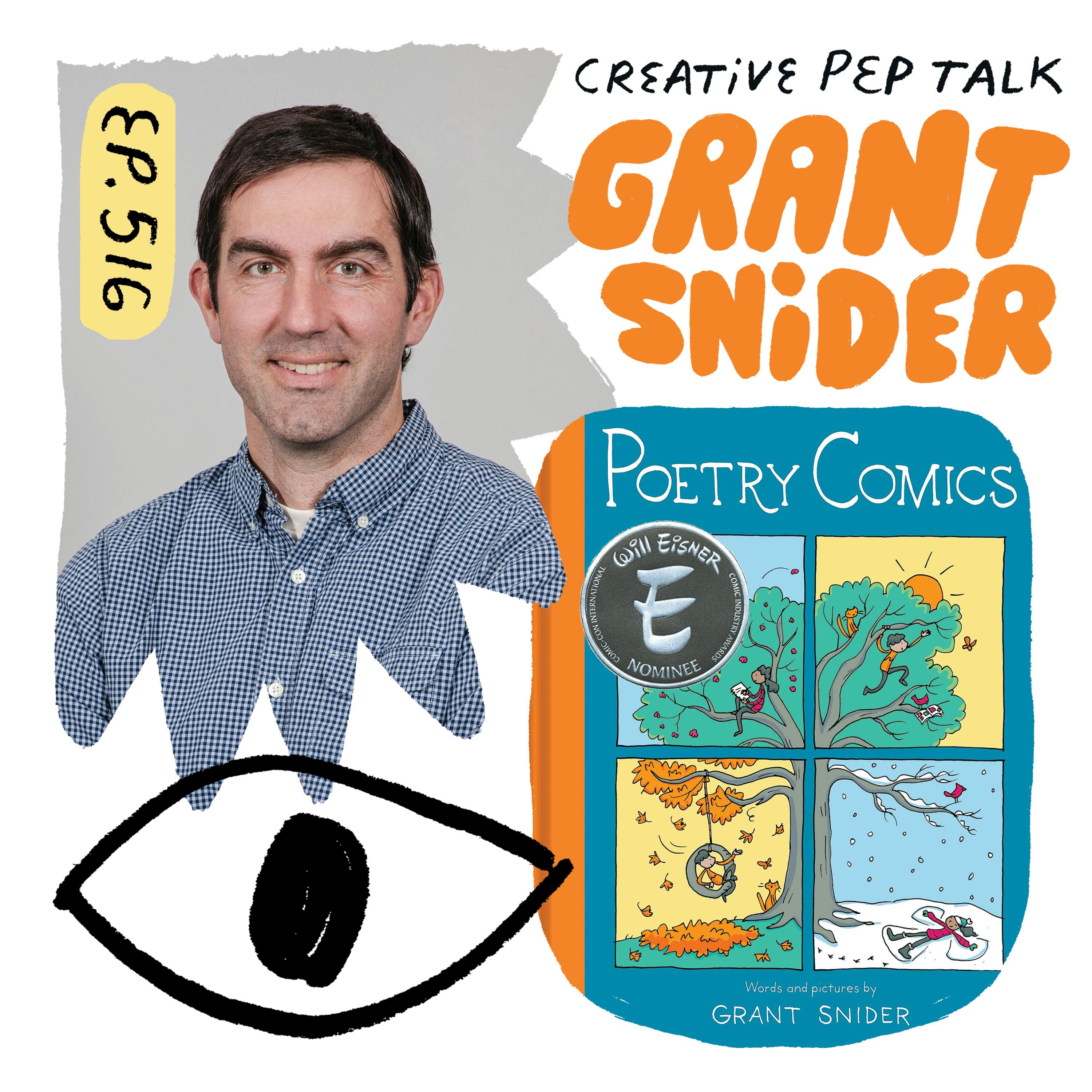
Creative Pep Talk
516 - How to Recognize Your Ideas, Juggling Different Roles and More with Cartoonist Grant Snider
01:02:12
Loading summary
Transcript133 lines
- [00:03]
Andy J. Pizza
On the creative journey, it's easy to get lost, but don't worry, you'll lift off. Sometimes you just need a creative pep talk. Where do good ideas come from? That's a question you hear a lot in creative circles and I get it. I but I'm less kind of concerned about where they come from and more how do you generate them on purpose? If you're trying to do this not just as a hobby, but as a creative practice, you have to learn how to do this. How do you steadily cook up ideas consistently rather than just wait and hope you figure out where they come from or hope that they just show up in your lap? And today on the show I have Grant Snyder who is an orthodontist a couple days a week. Not only part of the reason I want to talk to him, the main reason I want to talk to him is because he's an incredible comic artist with a bunch of great books, tons of great comics online on his substack and Instagram and elsewhere. He's super prolific, has so many great ideas, really clever, heartwarming, interesting stuff. I did want to talk to him because he's also an orthodontist and I think it's a really interesting aspect of how his creative practice works. And I know that most of us have to do a lot of different things to keep the lights on, whether that's full time work, part time work, or just different aspects of our creative practice. And so we talk a little bit about that. We also talk a lot about how to have ideas and going to come back at the end with our creative call to adventure. Something you can do today with the ideas and inspiration from this show. So it doesn't just stay as inspiration. It's called Automatic Filter and it's about having ideas on purpose automatically. And I will come back with that. But for now, enjoy this chat that I had with Grant Snyder. Hey, do you like fun? Because if you do, go check out Cookie Jam, a mobile game from Jam City. I like fun. Mobile games can be fun. Phone games, some people call them phone games can be very helpful in certain scenarios. For me, it's like airports and airplanes anywhere where I'm just like contained for a specific period of time. I need a game that's just gonna be some easy fun. It's gonna help me pass some time. Cookie Jam is that kind of game. Match cakes, cookies and candy, thousands of puzzles, free daily rewards, and of course, adorable pandas. What are you waiting for? Download Cookie jam now.
- [03:12]
Courtney Act
On WhatsApp. No one can see or hear your personal messages. Whether it's a voice call message or sending a password to WhatsApp, it's all just this. So whether you're sharing the streaming password in the family chat or trading those late night voice messages that could basically become a podcast, your personal messages stay between you, your friends and your family. No one else, not even us. WhatsApp message privately with everyone.
- [03:46]
Andy J. Pizza
The first thing I wanted to ask you about. So we've had chats before, but you haven't been on the show. And the first thing I wanted to ask you about was around this idea that you're the first artist I've talked to that also has a background in being an orthodontist. Are you still an orthodontist?
- [04:06]
Grant Snyder
Yeah. So I, I work as an orthodontist Thursdays and Fridays, so I have this nice 3/5, 2/5 balance where I can do all my creative work and burn myself out Monday through Wednesday. And then I get to relax and send emails and do do the, the other job Thursdays and Fridays. So. But I'm always, I'm always reevaluating that balance. You know, maybe four and one is right. I don't know.
- [04:31]
Andy J. Pizza
Sure. It's funny that you're like, I like to take some time off and fix teeth on my. But one thing I haven't asked you about is like, how did that, how did you get into what drew you to orthodontistry? Is that what it's called?
- [04:49]
Grant Snyder
Oh, orthodontics. Yeah. Yeah. You can call whatever you want. Yes. Teeth straightening. I'm not sure how you were when you were, you know, 17, 18 years old, trying to figure out, okay, what am I going to do with my post high school life? I had absolutely no idea. I mean, did you, did you know, like, hey, I'm going to be a podcaster, creative guru, you know, illustrator, author, extraordinaire. Like, were, though, was that on your agenda when you were 18 years old?
- [05:15]
Andy J. Pizza
Not really. The only, you know, I think my path maybe is even as windy as my path is. I still feel like it's maybe a straighter path than the one that you took. But I, I think I had the benefit of watching a parent who was a creative person.
- [05:33]
Grant Snyder
Oh, interesting. Okay.
- [05:34]
Andy J. Pizza
Find it impossible to do a regular life.
- [05:37]
Grant Snyder
I see.
- [05:37]
Andy J. Pizza
So I think, I think from an early age I was like, whatever I do is going to be weird. I knew.
- [05:43]
Grant Snyder
Yeah.
- [05:43]
Andy J. Pizza
Yeah. And the part time jobs that I'd had, I was like, I suck at this. I am like, I know. I'm not just like, you know, I don't know. I. I know I don't just have, like, worse software than everybody else, but I. For some reason, this. I can't. This is impossible for me.
- [06:00]
Grant Snyder
Well, I won't say I hated all my high school jobs too, and I think it'd be an interesting podcast to just go over every single person's, like, middle school through high school jobs, paying or not, and just hear those amazing, awful, horrible experiences. But anyway, so, yeah, speaking of, like, models for creativity. So both my parents are very creative. Not necessarily in, like, a drawing, painting, you know, writing type of way, but they're gardeners and woodworkers and, you know, are always doing something with their hands, building something, making something. And so I definitely had that model, but I didn't see it as, like, maybe I just didn't think of it as a viable career for some reason, I don't know. So I thought I wanted to be an engineer. My dad was a software engineer, retired now, now does a lot of woodworking. My mom stayed at home and did, you know, gardening and lots of crafts and things like that. But I was like, oh, yeah, engineering seems up my alley. I like math. I like science. Let me try that. Went into chemical engineering and quickly realized, nope, this isn't going to be the thing. I had a family member who was in the dental field, and he said, hey, you should look into that. So I shouted a few dentists. I was like, okay, this is pretty cool. It's hands on, it's technical, it's sciency, but not so dry, like crunching numbers on a computer all day. And so I started going down that path. At the same time, I knew I wanted to do something with my art. Like, I'd been super into drawing ever since I could hold a pen drawing with my twin brother Gavin, who's another, you know, creative spirit. But I never found, like, that thing that was like, okay, this is how I can work art into my. My daily life. You know, I tried, like, watercolor painting. It was fun, but it didn't quite click. I loved reading cartoons, but I never made the connection. Oh, I could probably draw cartoons.
- [07:40]
Andy J. Pizza
Yeah.
- [07:40]
Grant Snyder
Until, like, my. My junior year of high school when I. I saw at the University of Kansas, they had this awesome student newspaper and nobody was drawing opinion cartoons. So I'm like, okay, this is something maybe I could do. Maybe I could start trying that. And I submitted a cartoon, misspelled a word. It wasn't very funny. But it got published, and pretty soon I got that. That Job and just kept doing it.
- [08:05]
Andy J. Pizza
You, you heard like, this might be more hands on, which is. It's interesting because it, there is an element of it that's like a little bit creative or, or like busy with your hands. That's not just knowledge work, which is.
- [08:20]
Grant Snyder
Right. It's. It's artistic or artisanal or it's. It's craftsmanship, basically.
- [08:24]
Andy J. Pizza
Yeah, there's a craft to it. Yeah. So that, that makes sense. I wouldn't have even thought of it that way. But your entry point to comics was you tried this comic, but you'd already liked comics before that.
- [08:35]
Grant Snyder
Yes, I was, I was like a devoted Calvin and Hobbes reader. Far side, you know, all the, all your like 90s newspaper strips. I never quite got into like the superhero comics or alternative comics. I didn't discover these, you know, like some of these cartoonists or graphic novelists existed till I was in college. But I knew that was there and I had a. Had a strong interest in that. I just never thought about picking up a pen and trying it. It just seemed like, I don't know, I had some mental block or barrier to doing that. Maybe the multiple panels thing, you know, you have to string more than one drawing together. I'd always just draw in like a single drawing, a single scene. The idea of like making a character move through space and time and more than one panel and. Yeah, that's. How do you do that?
- [09:16]
Andy J. Pizza
It's weird things like that that seem obvious in retrospect, but especially in the. In a. As a kid and just depending on what your world is like, you're just not aware of what the options are or how these things get made. A lot of these things just feel self evident. One question I had though was it takes us a long time to have any self awareness. How did you know that you wanted something hands on? Why did that appeal to you? Were you. Were you aware that you wanted a craft?
- [09:47]
Grant Snyder
I think so. I think spending hours and hours studying kind of like abstract things, you know, numbers, equations. I realized, you know, this is fascinating to some people, but not to me. Yeah. And I just, I just couldn't envision myself pushing numbers at a desk with a computer in front of me, which ironically is now I'm pushing colors and words and pictures on a desk with a computer. Computer screen in front of me and hours in Photoshop every day. So. Jokes on me, I guess, but. But, but I still retain some hand, draw some. Some of that hands on element of my work, so.
- [10:21]
Andy J. Pizza
And that was your little stint with engineering, right, that. Okay. Where you're like, okay, I need to do something. I don't. I can't just be like, I want.
- [10:28]
Grant Snyder
To see, like, yeah, I want to see the product. Like, you know, I mean, that's what I love about making art, is you start with something blank, you start with something unformed, and, you know, stick with it for long enough, it becomes this. This formed piece. And maybe you love it, maybe you don't, but you always have something to show for it. You know, it's kind of like mowing a lawn in a way. I mean, speaking of summer jobs, you know, after you spend an hour with it, you can look back and say, okay, here's the job. I did that. Visual satisfaction.
- [10:57]
Andy J. Pizza
That. Yeah, I totally relate to that. And I want to stick with this for a minute, and I want to go to some creative stuff. But you're unique also in the fact that you have. Not only do you have this other job that you do, it's a pretty serious job. And also you kind of have left it in stages, which is. Everything about that is opposite to the creative journeys that are glamorized or celebrated or kind of the tropes of, like, jumping in the deep end or having no backup plan, no plan B, all that kind of stuff. Like, that's all the stuff that we kind of associate with what a creative is supposed to do. And I. That's what makes me so fascinated about your path. What do you think? What are the positive effects that having this balance of having this kind of solid other job that you do. What positive effects do you think has that had on your creative work, your creativity?
- [11:56]
Grant Snyder
As you were saying that, I was just imagining, like, this life story of myself as an artist on a TV version where it's. Or a movie version where it's like 15 years compressed. And then he took the jump into the deep end. It only took 15 years, condensed into this 32nd.
- [12:10]
Andy J. Pizza
I love the idea of the montage.
- [12:12]
Grant Snyder
The montage, that's the word, not monologue.
- [12:14]
Andy J. Pizza
It's 15 seconds, but it's you aging 15 years, right?
- [12:19]
Grant Snyder
All of a sudden, he has gray hair. But he took that leap anyway. But no, I think. I mean, I guess I value stability. And I think I was never forced to, like, make a choice. Like, you know, there was never this dramatic moment, like, you choose this or this. It's like they both slowly grew, and they slowly grew together. And sometimes I wanted to focus more on or was forced to focus more on, like, you know, studying dentistry or whatever. And sometimes I had to focus more on the art. But, you know, I could kind of go back and forth between them, never get too burned out. I wanted a single time and they definitely inform each other in that way. And I do get a break. So, like, it's nice I mentioned, you know, finishing my Monday through Wednesday creative time. And sometimes I just feel exhausted and the idea of going back into the studio the next day, you know, it's. It's nice to just step away from that at least for a minute.
- [13:09]
Andy J. Pizza
Yeah.
- [13:10]
Grant Snyder
Let my subconscious kind of take over and let. Let some ideas percolate. Then I'll come back on Monday feeling fresh and be like, okay, this thing that seems so frustrating or this creative problem that was insurmountable. Yeah, now it's pretty easy again.
- [13:21]
Andy J. Pizza
I love that you said that. There's two things that I think that highlights that really dispels some of the classic myths around what it means to be an artist. This idea of like the full time artist, you're doing nothing but making creative work. I think there's two things that really are don't. The times that I've had just my entire schedule is making stuff.
- [13:44]
Grant Snyder
Oh yeah.
- [13:45]
Andy J. Pizza
There's so many things that go wrong with that. One is that you don't have what you just described, which is that incubation phase where you get to step away and let your subconscious work on it. Like all the creative researchers highlight the incubation phase, but I have heard very few creative people talk about it or it's not. Doesn't feel like it's a well known practice for most creative people. I love what Taika Waititi said when he's like the filmmaker, he's like, I like to write a movie and then forget the script for like a year and then come back to it.
- [14:20]
Grant Snyder
That's awesome.
- [14:21]
Andy J. Pizza
Yeah. I just think that there's something about that. And then there's also just the fact that having a portfolio career or multiple pieces of your career mean that the pressure isn't on, on any one particular aspect of what you do. I think that's especially true, especially important when it comes to creative work. So I have to imagine that that helps too. Just like, you know, it's not all riding on these books or these.
- [14:48]
Grant Snyder
Can I throw in a personal story on the time I didn't do that? So like, and I might have talked about this last time we spoke, but I had the opportunity maybe five years ago or more now, maybe even longer than good than that. So to go do a writer's retreat or an artist retreat. So I was at the time trying to do my very first picture book. And I'd tried these dozens of ideas and nothing was quite working. And I had an editor I was working with and I had some momentum on it, but I just never had that idea. So I'm like, okay, I'm going to go to this cabin in upstate New York, this beautiful natural environment. I'm going to be all alone. I think I had three young kids at the time, you know, quiet in my own space, and just, you know, retreat to the mountains and come back with this fully formed, you know, beautiful, perfect picture book. And you can guess how that story ended. So I spent the time and the place was beautiful and the retreat was amazing and the work was frustrating and awful. I mean, you know, I had these like, self imposed goals that I didn't meet. I had these expectations of how much I would actually get done, which I didn't do. And so the whole time I felt guilty. Like I have all this time I have this perfect environment and yet I'm not getting the work done. And so you use the word incubation period, which I love. So I came back and like, literally not two months later, after I'd said, okay, I'm going to take the foot off the gas pedal and, you know, not try to force these picture book ideas so hard. I had this zing of inspiration on a walk, sat down at my desk and like on a single evening came up with the script for my first picture book. And like, bam. The book was done basically, you know, almost a day, two or three days that looked pretty similar to the final draft.
- [16:29]
Andy J. Pizza
So I love that. And I, you know, again we have the, the trope or the myth around. Here's an artist in the studio banging out paintings all day, every day, or just sat at the computer writing and writing and writing. And I think for me it's way healthier to think of it more like either an ecosystem where there's these, all these things feeding into it. Because even I think about that trip is a part of the creative process. Even if you didn't do creative work, it's stuff that feeds into what you're doing. And there's these different aspects, you know, rest, nature walks.
- [17:04]
Grant Snyder
Right?
- [17:05]
Andy J. Pizza
Things that make you money, things that bring, you know, where you're actually capturing the stuff. And then there, so there's the ecosystem and there's also this idea of like the flywheel where this thing leads to this thing, leads to that thing. And there's, there's a Lot of moving pieces rather than this holy grail of this one thing. That's what I do. And I wish I would have kind of understood that earlier because I don't.
- [17:28]
Grant Snyder
Think you can understand it until you, yeah. You know, feel. And I still, I repeat the same mistake. So I, I had my, my golden shining idea of writing a novel that I pretty much did the same thing. I forced it so much until it was ground into the ground. And you know, months after I realized, okay, I need to step away from this, a different idea sprung up. So maybe, I mean maybe those like creative frustrating, you know, put, put you, I have expectations on your work moments aren't all that bad because they, they leave an opening for something else to move in.
- [17:59]
Andy J. Pizza
I absolutely agree. I've thought about that same thing as like a slingshot where a slingshot, like a lot of creative people are, myself included, I would think, oh it's man, what happened when that great idea just happened, it clicked. It feels like this, like letting go, but it's like a slingshot where there's all this tension leading up to that. It's not just the letting go moment. It's not just like, oh, it's almost always on the back of like racking your brain gut churn, like trying a million things that don't work. And that's. Yeah, like you say, it's part of the whole process.
- [18:38]
Grant Snyder
Yeah. So I'm sure five years from now I'll be, I'll be talking about how I, you know, tried to force this other project and thought it was going to be so amazing and it crashed and burned and then, you know, this other weird different thing arose from it. So maybe. Yeah, it's just, it's a, it's cyclical maybe.
- [18:51]
Andy J. Pizza
I think, I think it's really like an essential piece. You're a parent, you've got this other job. Like how do, how did you find time to get art going and off the ground initially while you were like in the thick of assuming a full time job? Maybe you didn't have kids then, but.
- [19:14]
Grant Snyder
How did you happen? When I, when I look back at this, it's, it's kind of like it feels a little bit like creative mythologizing. So I want to just preface it by saying like this is not as like attractive as it, as it sounds maybe when I tell it. And it was, you know, felt super frustrating and kind of sometimes pointless. But I worked through it anyway. So when I was in dental school, I was married, but we didn't have kids. I would Basically be busy with studying and, you know, going to school, you know, 40 hours, if not more a week, have a bunch of work to do and have very little time. But I was trying to draw a weekly comic strip at that time for the local newspaper and I was putting it online and sharing it, you know, you know, on the Internet and blogspot and that sort of thing. So I would take my entire Saturday, my only free time, and make a big pot of coffee, sit down at the drawing table and just make this comic strip from start to finish. And sometimes it was amazing and really fun, but I would say three chords at the time, it was really frustrating and just a recipe for burnout. So once I continued on in school and we were expecting our first child, our daughter Anna, I quickly realized, okay, this Saturday burnout thing is not going to work. It's not going to be good for the family. It's already not good for my marriage, my mental health, et cetera, et cetera. So I would start waking up early before I'd go off to school. I still had that roughly 40 hour workweek, a little bit less demanding than it was when I was in dental school. But I would just say, okay, I'm going to set my alarm for like 6 or 6:30, I'm going to wake up and you know, for an hour or so before I go off to the real, you know, real job, quote, unquote, I'm going to do this other thing. So just by stringing together an hour, hour and a half, you know, three days a week, four days a week, sometimes five days a week, I realized I could get just as much work done as I needed to. Not be quite as burnout, still be a little bit tired and groggy most of the time, but, but that, that was a lot more healthy balance. And as my family got bigger and turned into the day job, I, I, you know, I did pretty well working like that for quite a long time.
- [21:27]
Andy J. Pizza
Yeah, I think we underestimate what you can get done by stringing together small amounts of time. And I also think it's, it's worthwhile highlighting that there were a lot of seasons of my life where I could do those sorts of things for spurts. Even if those spurts were six months to two years, three years, I don't think it's, it has to be a full life plan to live that way.
- [21:54]
Grant Snyder
Yeah, and it was, it was fun when I was, you know, 25 or 30, and now that I'm approaching, I turn 40 this year, it's like okay, that doesn't seem so quite so appealing to me anymore. I could still do it if there's a pressing deadline, but, yeah, it's. It's. It's lost some of its allure, I would say.
- [22:11]
Andy J. Pizza
Yeah, I feel exactly the same. The. The other thing I was going to ask you about, though, is when you're doing these Saturdays or anytime, because you've. There's a few times you talked about, like, the frustrations. So you talk about trying, and three quarters of the time it's not fun or it's a disaster, or you don't like how it turned out, or this trip where you tried to make the picture book and it was complete failure or whatever. A thread through this whole show is relationship to challenge and a growth mindset of it being difficult doesn't mean that it's wrong. But there's something about me and then also just creative people. I think that that's an especially tricky obstacle for us because we have these expectations of what it's supposed to be like if you're good at this, what it's supposed to be like, if it's the right thing. And yet my experience as all of those challenges and hard times and when it's not fun are really, really essential. How do you think. What kept you going? Like, did you feel. Were there times early on where you're like, maybe I'm just not good at this. You know what I mean? All the time. How did you. What was your relationship to it being challenging and difficult at different times.
- [23:38]
Grant Snyder
That's interesting. Yeah. So I feel like, I mean, maybe I'm using this word in the technical sense, but, like, creative ego is really important. So I've always felt like, oh, I'm really good at this. I can do this. Even when all evidence was pointing otherwise. So, like, maybe just that innate sense of, like, hey, I'm, you know, ever since I was young, I've been told, hey, you're good at drawing, you're good at writing. So I was like, well, why can't I do a picture book? Why can't I make a comic, a weekly comic strip? Why can't I try a novel? So, yeah, maybe that's foolish, but I think an overdeveloped sense of your own abilities is kind of important sometimes. But I think the other part of that is just I've been so inspired by the stuff I read. I just really, really have this burning desire to try to match that, to try to do my own version of that, to try to imitate that. So I Think it's that like innate self confidence, but also just seeing those, those examples of work you think is amazing. Being really, really moved by it and using that kind of as your fuel to, to work through those necessary difficulties.
- [24:38]
Andy J. Pizza
I, I really like that because I think you, you hear artists talk about this and I definitely had this early on that, that sense of ego that like you said, is maybe borderline on like delusion.
- [24:50]
Grant Snyder
Narcissistic. Yeah. Yeah.
- [24:51]
Andy J. Pizza
There's something. I know I've got something in me and that I do think that's like. I like to think of careers also as like a multi stage rocket where there's an engine that gets you off the ground, but then that sometimes has to fall away and something else has to carry you to the next level. And I like that idea of, you know, maybe the delusion helps you get off the ground. Like, I could do this and then at some point there's a p. Or it may, might be, you know, not as clear cut as that, but there's also this like passion and love for the form. That's something that I have to do even now, maybe more now that I'm really, you know, making stuff every day, making stuff for my job, meeting deadlines, all that kind of stuff. It's almost more important for me to have a diet of things that remind me why I'm obsessed with art. You know, like, it's funny, I don't know if you have that, but it seems like you do. Because just knowing you, knowing your creative heroes, when you really taste something, you're like, this is it. That makes me so motivated creatively. Is that kind of what you're describing?
- [26:05]
Grant Snyder
Yeah. And I think the times that I feel like lost in space. To go back to your rocket booster metaphor, it's because I haven't really been, been, you know, filling that bucket, but I haven't been refueling those, those inspirations. Like, I just need to take it, take time and like go outside and draw something that's not related to a project or go to a museum and look at somebody else's art or go to the library and find some, somebody's work I'm not as familiar with and just like, you know, I don't know, plant those seeds again. So, yeah, I'm curious. I mean, because you have a lot of different creative things you do. Like, how do you, how do you prevent burnout? I assume you're working five to seven days a week on your creative stuff. Like you don't have a job to go away to. And Sarah, Teeth and stuff. Right. Like, like, how do you, how do you keep.
- [26:47]
Andy J. Pizza
I don't. It's not my job.
- [26:50]
Grant Snyder
Yeah, it' your, it's your. That's your hobby, right?
- [26:52]
Andy J. Pizza
Just open your mouth. Yeah, that's my other hobby. Teeth watching you. Yeah, I mean I, I have to. There a lot of. It's just down to that kind of thing where I have to. It's almost a. It is a discipline. It's a discipline of. I have a discipline of listening to new music that's coming out this year. Like I. That's something that it's effort to do, but I know it's important to me and similar to that is like listening to stand up comedy and comedians talk about stuff. Like stuff. Stuff of that nature. It's like an effort to do at this point, but it's always like worth it. What things do you do?
- [27:34]
Grant Snyder
Well, no, I mean, not the music thing because I just got on my ipod that's stuck in like 2007 and I'm like, okay. I really, I really need to get. I mean I get recommendations.
- [27:46]
Andy J. Pizza
Music is pretty serious.
- [27:48]
Grant Snyder
I get recommendations from my brother who plays music and plays in a band. But I feel like I don't have. I need to do more things that make me feel 18 or 19 again and feel like I'm exploring and discovering. But yeah, I think it's just a lot of reading. So I have this especially in the summer when my kids are home and my house is a war zone with siblings throwing things and yelling and screaming. Anyway, I'll go to the university library and it's quiet. There's not that many, you know, people studying. I can still kind of pass for a student if I walk quickly. And I find this like the seat by the children's book section and they have this amazing collection, you know, going Back to like 1950s and 60s graphic design type books like Bruno Minari, stuff you wouldn't necessarily find at the public library to like, you know, new releases.
- [28:41]
Andy J. Pizza
This is all. Continue. Sorry.
- [28:43]
Grant Snyder
And no, no, no. And right and right by the. The picture book section is like the middle grade and the YA and the graphic novel. So it's like all like this universe that I know a lot about but still haven't fully explored. So if I get bored with what I'm doing, I could just walk over, pick up a book, flip through it and it's like I just need to spend hours and hours here and try to read like literally every single thing I can from this and that. I would just feel so creatively. Fulfilled doing that. That is so far, about 0.05% through their collection.
- [29:13]
Andy J. Pizza
I love that because going to the library when I was in college was a huge thing for me. I would go at the time, it was like the design illustration books. Look at everything. And I was. It was so exciting. It was like a treasure trove, right? And I live actually, I live, you know, near several decent colleges and schools. The OSU library. I gotta go check that out and go, I bet they have collection. I'm gonna do that. That's a great tip for. For anybody to go. Just peruse any college library. I think that's a great, A great idea. You're also like a sketchbook guy, right? Like, you carry a sketchbook.
- [29:53]
Grant Snyder
Yeah. So right now I'm kind of frustrated because I have. You won't be able to see it on podcasts. But yeah, my sketchbook is okay. So it's this huge sketchbook which is not very portable. So I feel like. Then I end up getting like three or four different little sketchbooks where I can never find. But yeah, I've had a sketchbook practice almost since I started my cartooning career, which I mark as like about 15 years ago now. And so I'm never at a lack for ideas. If anything, I have too many because I can always revisit those sketchbooks and find what I was thinking last week, last month, last year, a decade ago, if I wanted to go back that far. So, yeah, that's essential. I think.
- [30:54]
Andy J. Pizza
Prime delivery is fast.
- [30:56]
Courtney Act
How fast are we talking?
- [30:58]
Andy J. Pizza
We're talking puzzle toys and lick pad delivered so fast you can get this puppy control fast. We're talking chew toys at your door without really waiting fast. Pads, cooling mat and petcam are fast and fast. And there's training T R E a.
- [31:08]
Grant Snyder
T s faster than you can say sit fast.
- [31:11]
Courtney Act
And now we can all relax and.
- [31:14]
Andy J. Pizza
Order these matching hoodies to get cozy and cute. Fast, fast. Free delivery.
- [31:19]
Courtney Act
It's on Prime.
- [31:24]
Andy J. Pizza
The McDonald's snack wrap is back. You brought it back. Ranch snack wrap, Spicy snack wrap. You broke the Internet for a snack? Snack wrap is back. I was thinking about how I know that you carry a sketchbook around and I hear people be like, yeah, I'm not a sketchbook person or. Or don't want to integrate the discipline of that. But it got me thinking about that quote around. I don't know who said it. I couldn't find it attributed to anybody. But I know it's just like a thing of, you know, if you want results that other People don't have. You have to do things that they don't do. And I think something like the discipline of. It's kind of annoying to carry something around all the time. It's not like it's not just something that is second nature until it becomes a habit and a discipline. I think that that's. That's the kind of thing you have to do if you want to have a different kind of career and path. But I. I was curious about. Because your comics, they have a lot of insight. They're clever, they're. There's a lot of ideas in there. And I wondered, how does going out and sketching a bird or something, you see, how does that translate into an idea? Because that wasn't. That's not obvious to me.
- [32:53]
Grant Snyder
I don't think it's obvious to me either. Yeah, but first, I'll say it never felt like I was being disciplined doing it. So, like a lot of creative people, I'm pretty introverted. So it's like, sometimes my way, so I don't have to engage with people. So I think my wife has this mental image of me at a family gathering, and I'm off sketching in the same room as everyone, where everyone's having this involved conversation. I'm either reading a book or on my sketchbook, you know, trying to get away from it all. And it's also an antidote to boredom. So, like, if I. If I know I'm going to be, like, watching my kids basketball practice, and I know I'm going to, you know, be sitting there for an hour, I can either waste it and scroll my phone, which I do plenty of the time, or have that sketchbook with me. So. So, yeah, to me, it's almost felt like an escape rather than a discipline, which, you know, makes it easier.
- [33:44]
Andy J. Pizza
But, yeah, that's great. I'm glad you said that because that's a great correction and. And it's a good correction for me. Like, I think that that's more insightful to see, like, what are the things that you need? And, like, rolling with them rather than trying to. I think discipline is important. There's a lot of disciplines I have in my creative practice that are important, but I think it's a good distinction you made that there's something natural about that for you. That and the other thing I'm going to. I always get antsy at all these, like, rehearsals and, you know, shows and all games and all that stuff. I'm taking that. I don't know, why do I not do that I'm a freaking illustrator. I'm definitely doing that because I'm always like, how many. I gotta have a few packs of gum and some, you know, Skittles and Mountain Dew or stuff. I don't know, how am I gonna get through, like, sitting. But that's great. I'm gonna start doing that. I love that.
- [34:38]
Grant Snyder
Yeah. Sketchbook and a novel. I won't leave home without it.
- [34:41]
Andy J. Pizza
Yeah.
- [34:41]
Grant Snyder
Yeah. So. So, like, I. I think it's just about those connections between ideas. So I'll have. Okay, well, this is like a fully formed idea for a comic strip. And that's just because I've been doing it long enough. I know. Okay, here's like an image I can connect to another one, a path I want to go down. I have kind of my stock character, which is sort of me, but not me, if that makes sense. My avatar that I can put. Put into these situations. But other times I'm just, you know, just mining for images around me. So, like, you mentioned like watching a bird. So, like. Yeah, I feel like my sketchbook lately has turned into like, you know, middle aged guy bird watching. Yeah. And I'm okay with that on birds too.
- [35:21]
Andy J. Pizza
I'll see like 40, because we're.
- [35:24]
Grant Snyder
Yeah, yeah.
- [35:25]
Andy J. Pizza
It's Merlin app. Collecting them like Pokemon right now. We. It's amazing.
- [35:30]
Grant Snyder
You gotta catch them all. Yeah. No, and I think, I think that's like, especially if you live anywhere near, you know, a place where like, we have like birds migrating, I think, I assume to the Gulf of Mexico. I don't know. So we have like pelicans, like, in the neighborhood nearby. I'm like, I didn't know pelicans were in Kansas. Is this. And then I'll see all kinds of different herons and stuff. So like, I'm always noting. Okay, I saw a new bird today. Anyway. It's awesome.
- [35:54]
Andy J. Pizza
Continue. Sorry.
- [35:55]
Grant Snyder
Although I heard. I'm going to go on a heron tangent here. Okay. I was at home watching like a suspenseful show and my wife Kayla was. It was, you know, somewhere out of the house and the kids are all tucked in for bed. I thought. And I hear this like, loud scream. I was like, oh, is what's happening is like a kid having a nightmare. Is somebody up? Or like, is somebody just being ridiculous? And then I realized my windows were open. I think it was a heron from the nearby neighborhood pond that was like making this, you know, unholy noise. So that was pretty cool. It might have been a seagull. I don't know.
- [36:25]
Andy J. Pizza
They're like dinosaurs, man. Huge. They're like pterodactyls in real. I love. I love.
- [36:32]
Grant Snyder
Have you seen the. The new Ghibli? The. The Boy in the Heron. Okay. That was cool.
- [36:38]
Andy J. Pizza
I cried. I was. I just. I loved it.
- [36:42]
Grant Snyder
But I forgot what your question was.
- [36:43]
Andy J. Pizza
I don't know how does that. Because I. I'm gonna This a little bit. I'm gonna get a little bit pedantic here, because I think that I'm asking this question for me at 22, who doesn't really know how to have ideas? I've learned to have ideas or to notice them. Right. Like, I've. I know how I do that now. And so I'm wondering if on a granular level, if there's anything else you can talk about. Like, you can even give me an example of how a bird turns into a comic or whatever example you want, but where that moment of these two threads click. Anything you can say about that, I would appreciate. Because I think until you're doing that, you don't know how it feels, and it is hard to describe. But tell me anything you can.
- [37:34]
Grant Snyder
No, I think. I think what you said, learning to have ideas that.
- [37:37]
Andy J. Pizza
Yeah, I've never heard it put that.
- [37:38]
Grant Snyder
Way, but that makes a lot of sense. We think these ideas are these things shining down or given to us in a platter or that we're somehow mining for. But no, it's a process of learning to recognize what your ideas are, what you respond to. And, yeah, I'm sure I didn't. When I first started keeping a sketchbook, I'm sure I didn't know what was. I didn't know how to learn how to have ideas yet. I think just lowering your barrier to entry of like, okay, what should I put in there? Just put everything in there. Don't have a filter, really. That's a hard thing because I like to draw well. I don't always like my drawings. I don't always draw well. And most of my drawings in my sketchbook are scribbles, doodles, ugly, bad drawings. And I could get hung up and be like, oh, this drawing is not very good. I don't want to draw my sketchbook because I don't like that drawing. So getting past that is important. Just noticing, like, noticing, okay, here's a painting I liked. Here's a tree that looked cool. Here's a random thought or a line somebody said that stuck with me. Here's something my friend said to me that I thought was funny that I want to include Here. Here's a building that I've never noticed before. That was pretty interesting. So just start with everything. And then I think you'll gradually know, like, just by that process of not filtering how you need to start filtering it. So one specific sketchbook moment that always sticks with me is for my comic, which I called Nature of Ambition, which is, like, when I did, I'd say early in my career, but when I was kind of figuring out, okay, this cartooning thing is something I'll be doing for my lifetime for a real job, not just for this random hobby. I'd seen scrolling in Tumblr in the middle of a lecture in school. I saw this image from maybe the 1930s or 40s of this little girl in a dress walking an alligator down a stairway. And I was like, oh, that's pretty cool. That's an awesome photograph. Let me put that in my sketchbook. There's a girl walking a crocodile. What does that mean? But of course, I changed it to my self avatar character walking a crocodile down the street. And months later, when I was looking back at that, I was like, okay, that's the start of a story. That's the start of a comic strip. And so I use the crocodile walking as a metaphor for creativity as a career. The character goes through all these different stages of, like, he starts walking other reptiles and other animals. He gets competitive with the fellow animal walkers. He eventually is pulling this whole zoo behind in front of him and, you know, loses control and is back to walking that crocodile. So from that tiny little image, you know, scrolling randomly through my laptop in class, you know, came this whole comment, came this whole metaphor for my creative career.
- [40:20]
Andy J. Pizza
I. I love it. I think you said so many really brilliant things in there. I. I feel like there's. I'm gonna do. I don't know when this will air, but I'm gonna do a series about. I heard a researcher call it Contradictions. I think about it, like, both and. Or yes. And. And it's like this. Instead of thinking either or that creative people tend to think, yes, and they think, I'm going to do this and this thing at different times. And one of those things is being open and then being closed. And so being open. I think that correlates you. When you were talking about just drawing anything, just drawing, just drawing without discernment, just. That's the open mode of. And I think it's why. I've heard. I've had the same experience with free writing. I've heard comics talk about this, like. And I Think it's why the artist's way morning pages is so such a huge thing for so many creative people. It literally just gets you free associating Ouija board creating, where you're just, like, letting it happen. Right. And so there's that. There's. There's these two pieces to having that idea where you're letting open flow. And then over time, it's annoying because I feel like this happens. It just takes a lot of time to recognize what of these. This stuff that's flowing is the kind of idea that you are looking for or that you work with. And that happens to me where I'll write and write and like, every once in a while, something will happen. Like, oh, that's. That's the kind of pattern that I'm looking for. And then I'm like, okay, now I can go and, like, turn this into something. And that's where you switch from that open to the closed, executing something. So I. Yeah, I love it.
- [42:11]
Grant Snyder
It's a tough switch to bake, for sure.
- [42:12]
Andy J. Pizza
Yeah, it is. Yeah. Why do you. Why do you say that?
- [42:16]
Grant Snyder
Well, for one thing, it's hard to. It's hard to choose. Like, what? Like, say you have these. Say you have three different ideas. They both look pretty good. It's hard to choose that one. Once you choose that one, you're. You're neglecting the other ones. And maybe you feel like, okay, I'm not going to get back to that, or I won't have the same passion for that when I get back to it.
- [42:33]
Andy J. Pizza
Yeah.
- [42:34]
Grant Snyder
And I struggle with this, with story ideas especially. But then once you have that one idea you're working on now, you're having to sort of, like, take away your idealized notion of it and make it something real. So you end up losing some of that. I don't know, I'm talking too abstractly here, I guess, but you lose some of that.
- [42:55]
Andy J. Pizza
I know exactly what you're saying.
- [42:56]
Grant Snyder
Free floating thing of like, oh, this perfect idea is now not necessarily perfect, but it's something.
- [43:03]
Andy J. Pizza
Yes. And also. Go ahead.
- [43:05]
Grant Snyder
No, no, you go ahead.
- [43:07]
Andy J. Pizza
I was just gonna say. And also, the thing I've learned too, is that pendulum sometimes has to swing a few times before you get anything. So sometimes I'll do, like, free flow. I'll pick out of the couple things happening, I'll pick this one. I'll run with that, and I'll start, like, turning that into something. Then as I'm doing that, I'm like, oh, actually, I'm gonna free flow this Aspect again. Now I'm gonna go back and, and it kind of takes a few, you know, processes to get there, to get to something that's like, oh, this is actually a thing.
- [43:40]
Grant Snyder
Yeah.
- [43:41]
Andy J. Pizza
When one.
- [43:41]
Grant Snyder
It's been important for me to learn like, or to learn to relearn that like yeah, you don't have to do it all in one sitting or one week or one, you know, year even. So like if you have an idea and you've, you've, you've done that, you know, free flowing association where you've developed the idea and now you're kind of whittling away at it and making what it's going to be, it's okay to put it away for a while and switch gears. It's not going to go away. That's like something I have to constantly remind myself and maybe that goes back to this thing of like, oh, I have to draw a comic strip from start to finish on a Saturday morning. Otherwise I don't get anything done. Like there's still this part of me that's like, oh, if I don't do this idea all the way through perfect right now, it's never going to be. And that's completely false. But it's hard, it's hard to remind.
- [44:24]
Andy J. Pizza
Myself that that's so true. I heard recently about Murakami talk about how he has this set times where he writes and when the timers up, it doesn't matter if he's in a block or if it's like flowing like crazy, he stops right there. And he's just learned to treat it like clockwork, treat, treat it like a job. And that trusting that cycle just kind of feeds it and you know, if it's something he was like, oh, I wanted to do more, that just makes him start better the next day.
- [44:56]
Grant Snyder
Right. That's so hard to do though. Like I'm always like how can I use up all these last bits of creative juice even if I know I have to go back to it tomorrow? And yeah, it's, that's leads to burnout. So I guess that's why her. Kim Murakami has, you know, written how many dozens of amazing novels and yeah.
- [45:12]
Andy J. Pizza
Yeah, I, I'm, I'm not that. But I did have a good practice for a while where I would write before taking the kids to school and there were a lot of times where it was like, oh, it's just getting good now I have to leave. But maybe, maybe there's something good to it.
- [45:25]
Grant Snyder
No, the time. Boxing is important. Yeah, I Think it is.
- [45:27]
Andy J. Pizza
Yeah, I. I do a lot of that, too. I wanted to ask you what is something that you felt you had really, really wrong as an artist early on and then what taught you to shift your perspective? It's.
- [45:47]
Grant Snyder
Can I hear your take on it while I think about it?
- [45:50]
Andy J. Pizza
Sure. I mean, I can think of a lot of different versions of that. I. I have one random one. This is like a personal thing. I guess these are both, like, more personal. But an example is like, I live in the Midwest, hate the winter, hate it so much that I would refuse to even, like, get a winter coat. Right. I don't want anything to do with this thing. And then it wasn't until I was like, you know what? I'm staying here. I'm not going anywhere. I'm going to have this. I'm going to have these winters the rest of my life. I'm going to go find a coat that I'm obsessed with that keeps me super warm. And. And then embracing it actually made it so I don't hate winter anymore because I actually have a proper coat. And so that's just like a little tiny shift. But I've also had bigger ones in my, like, life in terms of how I move through life and think about life. Like, I used to think that becoming the person I wanted to be would be would happen by basically hating who I was and, and trying to overcome myself rather than cultivate myself, love myself enough to take care of myself. And so that's another. That's a big shift. Those are two that come to mind. But I could tell you I'm. I'm sure I have a million in terms of being an artist, of what I got wrong. I. I'll tell one other one is when I was starting out, I thought, when I find my thing as a creative, it'll just be easy.
- [47:23]
Grant Snyder
Oh, yeah.
- [47:24]
Andy J. Pizza
You know what I mean? And so I think I had to learn the hard way that, oh, the, the difficulty and the challenge is part of the process. And it doesn't mean it's not a wrong way sign.
- [47:34]
Grant Snyder
Yeah. If you, if you were. If it was easy every time, it would quickly lose its appeal, I think, to do it.
- [47:39]
Andy J. Pizza
Yeah, I agree completely. So, yeah, I don't know. If nothing comes to mind, that's fine.
- [47:43]
Grant Snyder
But no, I have an idea. I mean, I think yours are more maybe profound to mine, but I think I've always thought you have to do, like, you have to have just like one thing. Like, like going back to that picture book idea, I was like, well, I have to have this one perfect picture book. You know, when I started that novel, I was like, well, it has to be this one perfect novel. And if you miss that chance or that, that, you know, one thing isn't perfect, you don't get the chance to make another one or do another thing. And I think that's completely false. Like, I don't think any editor or publisher or reader wants to have an author that just makes one really amazing, miraculous thing and then goes away. Like they want to see somebody try something different or learn and grow or go off on tangents and detours. Yeah. So, like, whenever I take on a new creative project, maybe it's a new style I haven't used before, a new medium, a new type of story that I haven't told, I have to remind myself, okay, it doesn't have to be this amazing, perfect single thing. I'll get a chance to try it again. If it doesn't work, I'll get a chance to build on it if it works a little bit, and maybe accidentally sometime I'll stumble and make that perfect thing. But that hasn't happened yet for me.
- [48:54]
Andy J. Pizza
Is that something that you think you learned over time, or was there something specific that maybe helped you learn over time?
- [49:02]
Grant Snyder
Yeah, I think I'm just a natural perfectionist who thinks that everything they make has to be the best thing they ever make. And certainly part of that's good to have because it keeps you accountable to putting in the time of making decent work. But the flip side of it is kind of crippling as well.
- [49:20]
Andy J. Pizza
Yeah, I, I completely relate. I mean, I. This is something. This is why I haven't made a published book around stuff from the podcast is because of that feeling of. It reminds me of. On a much smaller, tiny, micro scale. It reminds. My version is micro nothing but that. It reminds me of Jonathan Larson who made Rent and watching the. The movie Tick, Tick, Boom. And he just pours everything into this sci fi musical that he thinks is going to be his ticket to success. And it just leaves it all on the court and just like pours everything into it. And then the he. He calls the person at the end. He's like, what do you think? They're like, yeah, I can't wait to see you next.
- [50:11]
Grant Snyder
Oh, there's a Dex.
- [50:13]
Andy J. Pizza
And that's such a healthy mindset. Like, you're. You don't have to. This album or this song or this piece doesn't have to do all of the things that you're capable of, all the things you Love. It can just be this thing and then you can move on to the next thing. I think that's a really healthy shift that's difficult to internalize, but it's something that is definitely inspiring to me. I need to internalize that. That.
- [50:44]
Grant Snyder
Yeah, I think I, you know, I don't watch baseball much, but you're. I've hit a lot of singles and, you know, I, I think if you try to swing for a home run, you're never going to hit any singles. You're never going to get on base. I don't know. My baseball metaphor is striking out here.
- [51:01]
Andy J. Pizza
But I think, I think it works. I think there's also, there's a temptation to. I mean, I feel like in my own creative practice, I tend to, I can fall so easily into wanting to create hits, but those hits are like winning the lottery there. It's. So much of it is out of your control. And I do try to get into into this mode of a middle class creative, you know, or just a blue collar creative that shows up and does the thing and just has a, has a, A lifestyle of doing it, rather than having these memorable home runs, as you say, from, from the baseball metaphor. I love that. Okay, so lately you've been working. I want to talk a little bit about what you're doing right now so that people can go check it out. You've been doing a word project. Could you tell us a little bit about that?
- [52:00]
Grant Snyder
Yeah. So a little over a year ago now, I came up with, I called it Words of Wonder. Just taking a single word, a simple definition, illustrating it, and doing maybe four to nine of these at a time and putting them online. And people really love words. Like, I'd underestimated, like, the interest and how people would have, like, comments of like, oh, well, this word means this to me, or, hey, you should try this word. Like, I was getting a ton of feedback for it and everyone was always like, okay, when are you going to do a book of it? So there's no book of it yet, but we're doing like a card deck with maybe 100 or so of the words. And so that'll be neat. Yeah, I try to do those kind of as like a. I hate to use the word filler because it sounds like kind of derogatory. But you know, when I'm like, okay, I have. I've been really pushing hard on this other creative project. I need kind of like some space to do something that's a little more automatic and fun and just playful. I'll Go through my sketchbook, find a bunch of words I've jotted down from books or poetry I've read, look up these words and illustrate them with, you know, interesting definitions. And, yeah, it's been. It's been cool and kind of like an evergreen project because some of these words are, like, pretty frequently used. Some are, like, archaic words from, like, the 1700s, but even those don't go out of style.
- [53:18]
Andy J. Pizza
I love it. I saw the one you posted today, and I was like, this is so cool. And, I mean, I love words, too, but I also love that you have all these different practices that allow you to never have to face the blank page, which is just great. You constantly capturing stuff from real life without a filter, not thinking, is this good? Is this bad? But you're just filling this up so that you can always transfer some of that over. You're filling it up with words. You can always do something on that. That's automatic. I think that that's really inspiring.
- [53:51]
Grant Snyder
Yeah, the blank page, it's. It's terrifying.
- [53:54]
Andy J. Pizza
Yeah. You found some good tricks against it. Well, thank you so much for coming and hanging out. I am completely inspired by all the ways that you approach your creative practice, and I love your work. I love the kind of unique way that you've set up your whole ecosystem. And if people are going to go check out your work, where's the place you want to send them?
- [54:18]
Grant Snyder
Yeah, so you can find my newsletter@app incidental comics.subset.com on Facebook, it's under Incidental Comics. And on Instagram, Blue Sky, Twitter, it's Grant Draws. So I'm always posting, trying to post one new comic a week. I post one or two of those words of wonder a month, and then I. I'm always, you know, shouting about the latest book project. So, yeah, it's fun to do.
- [54:46]
Andy J. Pizza
Highly recommend following Grant. Tons of great stuff. Just lots of. Just, like, good palette cleanser for the rest of the timeline and scrolling and yeah, I'm very impressed and love what you do.
- [55:03]
Grant Snyder
Thanks, Andy. We're a big fan of your work. In my household, the kids love the invisible things we have, the feelings, flashcards. Yeah, it's all great stuff, and your podcast is awesome.
- [55:11]
Andy J. Pizza
Thanks, Grant. Really appreciate it. Okay. Huge thanks to Grant for being on the show. Had a great chat. Hope to chat with him again. Feel like there are elements in which we're really different creatively and then elements where our practice is super similar. And I love comparing notes with this guy. Hope you love the episode, by the way. You should go Check out his substack Incidental Comics. Great follow. Great to show up in your email inbox. I'm back with the call to Adventure. Something to do with this episode and this information. It's called Automatic Filter. Automatic Filter. And it's called that because here's what I suggest you do. I suggest it's like a two day process, but it could be an every other day process where on one day you do basically morning pages. You take the free flowing, set the timer for 20 minutes and just write or just draw. Have no plan going in, just start doing it. One way to trick yourself into doing that is if you really don't know what to write, just say I'm writing because I have to write for this full 20 minutes. If you don't know what to draw, just start doodling or doodling what's in front of you right in front of your face and then let it flow. Sometimes a random memory will come to mind and I'll start drawing or writing about that or something I'm worried about right now will will show up on the page. But whatever it is, spend 20 minutes just automatically, no thoughts, letting the free association and flow happen. And then at the end, stop, look over it, think of what is the most interesting thing that stands out in this little free flow thing. And then the next day, filter it. Don't do the free flow. Write and ruminate on that one interesting thing and then the day after do it. Go back to unfiltered. You do that a few times and you will start building a snowman. You'll start building something towards a real idea. And a lot of episodes of this show have started that way. A lot of comics I've done have started that way. And I think that this automatic creative work mixed with not just letting that happen, but mixed with this filter is how some really, really great stuff can happen. So I hope that helps. And I want to say thanks to Grant again. Check out his deck of cards. Words of wonder. Get on that. Also massive thanks to Sophie Miller who's a producer and ed editor on the show. Thanks to Connor Jones of Pending Beautiful for the audio edits, audio edits, audio edits, video edits, animation, sound design. This guy's just, just a. He does a lot of cool stuff for us and for others. Massive thanks to Yoni Wolf and the band Y for our theme music and soundtrack. And thanks to all of you for listening. Until we speak again, stay pepped up. Okay, the podcast is over, so I don't know why you're still listening, but I am glad that you enjoyed it enough to stick to the end. I have one more thing for you. If you're in a place where you're feeling a lack of clarity and you want to figure out your industry, market and niche and find the perfect strategic side project to do next, go sign up to our newsletter@andyjpizza.substack.com and you will get a confirmation email that will give you the download of our Creative Career Path Handbooklet. And the whole process is in there. And you might also get a few bonuses in there depending on when you sign up. But again, thanks for listening. Glad you enjoyed the episode and stay pepped up y'. All.
- [59:36]
Courtney Act
I'm Courtney Act. Many of you may know me from RuPaul's Drag Race, celebrity Big Brother, Dancing with the Stars, or probably my hit album Kaleidoscope. Well, well, guess what? I have got a brand new show called R and R with Courtney act and I want you to check it out. You know I hate small talk. I want to go deep and I want to go quickly. And on my show, we do just that. In today's world, it feels really polarized and we're more connected than ever. But really, we can feel isolated and I don't like that. I want the story shared here on R and R to make us realize that our similarities are greater than our differences. So join me and my fabulous guests like Nicole Byer, Tom Daly, Margaret Cho, Katia Adore Delano, Jackie Beat, and many more. If you're looking for some rest and relaxation, you've come to the wrong place, because we are peeling back the layers of superficiality and we're getting down to the real stuff. Follow R and R with Courtney act on Apple Podcasts, Spotify, YouTube, or wherever you're listening now.