← Creative Pep Talk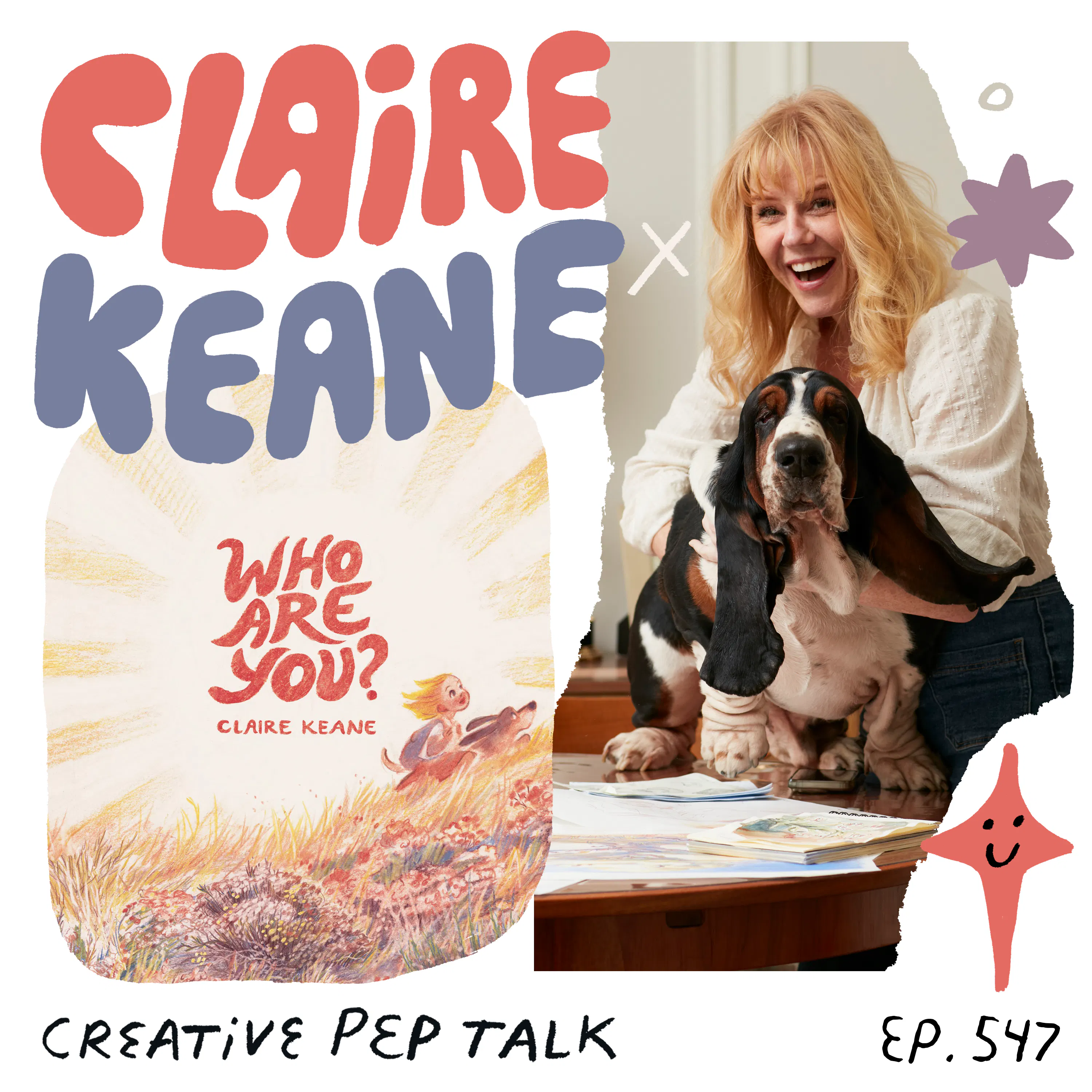
Loading summary
Transcript147 lines
- [00:01]
A
For the longest time in my creative journey, I felt like what I was making just was so surface level. It didn't really feel like me. It kind of felt like trends and things that were going on in the industry and the people around me. I didn't feel what I felt like I was supposed to feel, which was like, this is mine. This is what I want to say. This is who I am. Think that missing piece is your creative voice. I think it's actually normal and okay to feel like that at the start of your journey. You're just kind of getting into it, participating, learning the ropes and what have you. But if you're ready to have a sense, get a sense of your creative voice, this episode is for you. Because today we have Claire Keen, the illustrator and author of the new book who Are youe? If you don't know Claire, I saw this book and I instantly wanted to have her on the show before I ever found out that she's kind of creative royalty. Her dad, Glen Keane, worked on some of the biggest Disney movies from the 90s. Little Mermaid, Beauty and the Beast, huge role there. And then. Claire herself has worked on the Disney movies Enchanted, Tangled, Wreck It Ralph and Frozen. And then her grandfather, Bill Keane, was the guy who created the comic the Family Circus. So she has been surrounded by creativity her whole life. I had an absolute blast in this conversation. There's so many takeaways as she tells her story, insights, action items about figuring out who are you as a person, as an artist. That's the name of her children's book, but really that's the theme that we explore. And there's some really, really powerful stuff here, including at the. I'm going to come back and bring a creative call to adventure, something you can do with stuff from this episode. And we're calling it you're Holding Back, which came from something that Claire told me after we had the chat. And I'm going to bring a little bit of that back when this is all wrapped up. You're going to love this, and I hope to have Claire back on the show sometime. Without any further ado, here is Claire Kane on the creative journey.
- [02:24]
B
It's easy to get lost, but don't worry, you'll lift off.
- [02:30]
A
Sometimes you just need a creative Pepsi. This episode is sponsored by Squarespace. I freaking love having Squarespace as a sponsor because it's easy to sell it when you love something this much. I'm a big fan. Squarespace is an all in one website platform designed to help you succeed online. And here's what I love about Squarespace. They're intuitive and super versatile. Drag and drop tools mean you can make a custom website without knowledge of code. That makes people say whoa, who made that for you? Looks like you built that from scratch. People have really said stuff like that to me about my site and I built it myself quite easily with Squarespace. You can check it out@andijpizza.com if you want to check that out. What I did with it, it doesn't look template and it screams my creative brand. I also love that I have all of my domains through Squarespace now, which makes seamless and easy to manage. I know the first thing us creative folks do when we get an idea is to grab that URL. Now you can keep track of all your websites and your domains in one place. That's super intuitive and easy to manage. Head to squarespace.com pep talk for a free trial and when you're ready to launch, use promo code PEP Talk all one word to save 10% off your first purchase of a website or domain. For me, a home cooked meal is very hard to beat. Fresh food, real ingredients. Nothing is better than that. Hellofresh makes home cooking easy, delicious and fun night after night. Look, my family has freaking loved our hellofresh meals. It was amazing for my 17 year old because it's been this easy entry point to cooking real recipes which is just so cool to see before she starts going off to college. We are a family that loves food but the portions have been great and we've had leftovers after every meal. It's inspired us to try things we've never made and my youngest daughter can't stop talking about the coconut rice that we had with the rainbow trout. You can pick from lots of high protein meals. Feel great about the wholesome ingredients like sustainably sourced seafood and 100% antibiotic and hormone free chicken and even get seasonal produce that keeps things fresh and interesting. Go to hellofresh.com pep talk10 to get 10 free meals plus a free Zwilling knife a $144.99 value on your third box offer valid while supplies last. Free meals applied as discount on first box. New subscribers only varies by plan. Because this is your second time living in France, right?
- [05:15]
C
Yeah.
- [05:15]
A
Do you feel different this time? Do you feel like a different person this time around?
- [05:22]
C
Oh, 100% different.
- [05:24]
A
Really?
- [05:24]
C
Well this time I'm here with my two kids and so I'm living Paris as a mom. The first time that I came I was 16 years old and I was living Paris as a daughter and then as an art student and just discovering it. And I'm still discovering it, but I just want to show my kids everything.
- [05:49]
A
You're discovering it through them? Kind of.
- [05:51]
C
Yeah. Yeah. So I'm always like, oh, this is where my friends and I used to go for a drink after school and just kind of trying to show them all the things that I was so excited about growing up.
- [06:05]
A
That makes sense. But it feels like home.
- [06:09]
C
Yeah, it does. Also, it helps that my parents and my brother and his family also live here, although they're moving back in a few months. But it really has made the transition feel all the more, like, solid.
- [06:29]
A
Yeah. It seems like I wanted to talk about your latest substack post. Call yourself feels kind of connected to the book that you have coming out too. But knowing a little bit about where you are right now and what you've been through, it seems like that time between being in France the first time and the time being there now, seems like a lot happened in between those two things. That's why I asked, like, do you feel like a different person coming there because you've been kind of on a journey?
- [07:05]
C
Yeah, yeah, yeah. So, yeah. So when I moved from Paris to California in my 20s, I moved with my ex husband, my boyfriend at the time, who ended up becoming my husband, who then became my ex husband and father to my kids.
- [07:25]
A
But that's the story. That's the beginning.
- [07:32]
C
But it was. Yeah, I moved back to California just thinking that it was gonna be like, oh, it's just gonna be good for my career, just to kind of get a head start on my career, because I knew that my dad had a lot of connections in Los Angeles and he was working on Tangled at the time. And so I was like, oh, that would just be a dream to be able to work on a fairy tale. And so then Disney movie for people
- [07:59]
A
that aren't putting that together. Tangled, the Disney movie.
- [08:02]
C
Yeah, yeah. And so I was able to work on that after college. And that really just. It was such an amazing way to start my. My life in. In the working world, just surrounded by really inspiring people and getting to work with my dad and working on Tangled. I mean, it was. It was honestly like, it was one. When it was just talking about knowing yourself, it. That was such a motivator for me or like a conduit for me to understand myself better working on that movie. Yeah. Yeah. Somehow I didn't know who the character of Rapunzel was, so I. I wanted to go home and see how she could be a real person. And. And so I took this sketchbook home with me, and I. I decided to just document everything I was doing during the day and kind of translate it into Rapunzel World. And that. That moment was a chance for me to really discover. Oh, oh. I'm really kind of just laying around at home, like, not doing anything, but I'm actually doing things. I'm like, I'm putting clothes away. Which really didn't happen very often. But when I would do it, I was singing while I was doing it. So I'm like, okay, that's a sketch, or me drawing Rapunzel, drawing it in bed, and then realizing, oh, okay, that's me drawing Rapunzel, who's drawing herself in bed. And it's just like this. This way of starting to kind of go deeper into the character of Rapunzel ended up taking me deeper into my knowledge of myself. In that little comic that you're talking about, Know Yourself. I didn't even know if it. I would call it a comic. It's just some sort of post.
- [10:11]
A
Yeah. Like a comic. Yeah, yeah, yeah. I think of it that way.
- [10:17]
C
Yeah. I. I talk about, like, how I. I was waking up in the middle of the night with these. With these panic attacks, which I didn't know at the time were panic attacks.
- [10:30]
A
And you'd wake up screaming.
- [10:33]
C
And wake up screaming. Yeah. Have you ever had that?
- [10:36]
A
I don't know if I've had that. I've had waking up crying a few times. Have you ever had that?
- [10:43]
C
I have had that. Where I have tears on my pillow. Yeah. Yeah. I find that fascinating. It's just. Yeah. That whole subconscious world and what that means to us. So I ended up going to see a hypnotherapist so I could understand, well, a little bit about what was going on. My subconscious that was only coming out at night, but not coming out during
- [11:15]
A
the day, because during the day you didn't relate to that. You said that you were like, you didn't feel like an anxious person. You didn't feel like you were having panic or anything like that. And then you would wake up with the screaming episodes and you were trying to figure out what was going on there.
- [11:32]
C
And, you know, what's really funny is I really didn't understand that until I started drawing the comic. Like, I was like, oh, yeah. I was trying to illustrate how unanxious I was. So I'm like, drawing myself in this messy whirlwind of a mess, which is my life. And it was even more so when I was in my 20s. But while I was doing it, I had all these different examples. I had one of, like, me leaving the house with the door open, and my daughter was like, hey, wait. I was like, we just get. Claire. These are not examples of somebody who is not anxious. Like, none of this looks like somebody actually looks like somebody who is anxious, who has anxiety, who is just literally overwhelmed. And that came through as I was drawing that little post on Substack, which I think is. I'm just so thankful for having this gift of being able to draw storytelling, because it's a way of getting to know myself better than had I not had it.
- [12:48]
A
Yeah. So I love all this. I want to dive a little bit deeper into it. The thing that comes to mind for me that's been on my mind a lot lately is this thing you hear actors say sometimes. Like, really great actors. I've heard them say in interviews a bunch of times, like, that every role that they got kind of came to them at the right time, and it was allowing them to work out things that were happening in their real life. And I often think. I don't feel like being an illustrator is anything like the glamour of being an actor or the acclaim or whatever, but I often think that these two roles are very, very similar. So, you know, in the same way that, like. Yeah. Do you know what I mean?
- [13:40]
C
Oh, yeah. 100%. I've always just taken my work very much like an actor. Like, oh, I'm really gonna get into the role of the character and, like, live in it in my drawings. Yeah. My dad is an animator, and he would always refer to himself as an actor with a pencil.
- [14:00]
A
Oh, really? I didn't know that.
- [14:02]
C
Yeah. Which makes sense.
- [14:04]
A
And for people that don't know, maybe just mention who your dad is, and we might get to this later. But you've talked about him a couple times, so maybe just tease that a little bit.
- [14:15]
C
Yeah. Yeah. My dad is. Or he was at Disney. He's an animator, Glen Keane, and he designed Ariel and the Beast.
- [14:27]
A
And he's a little bit of a legend. Let's just say that.
- [14:30]
C
Yes.
- [14:30]
A
Okay.
- [14:31]
C
Well, technically, he is a legend.
- [14:33]
A
He is a legend.
- [14:35]
C
Disney gave him that title.
- [14:36]
A
Oh, really?
- [14:37]
C
Yeah.
- [14:39]
A
He's a legend. Yeah. That makes sense. But I didn't know he said that, but I feel like that I didn't. It didn't really occur to me for a long time. I think I started thinking about it when my kids pointed out that when I'm drawing a Character that I'm often making the face that I'm drawing.
- [14:57]
C
Yeah.
- [14:58]
A
Do you do that?
- [15:00]
C
Oh, yeah. All the time. Yeah.
- [15:02]
A
Yeah. And I'm doing it subconsciously. I don't even realize I'm doing it, but I'm like, trying to. There's some kind of subconscious thing that I'm trying to emote this text or whatever it is.
- [15:13]
C
Yeah. And there's something about the pose of, like, having to feel it in my body in order to draw it. There's something. There's something about that. Some sort of embodied embodiment of the character while I'm doing it.
- [15:30]
A
But I like this thing of. For me, this was a kind of important shift in my creative work for a long time. I think there was just a lot of anxiety about trying to make it, trying to be good enough, trying to get jobs, trying to succeed at the jobs I was getting and all that sort of thing. And then eventually I started to see it, even the commercial stuff, as a more personal thing. Like I was saying with these actors, like, trying to see that. I'm really drawn to this idea of. I've heard researchers call it questing, where you're seeing your outside external journey as intimately connected to your inner. Inner journey. And that. That's kind of a. That's about as spiritual as I get these days. I try not to over spiritualize stuff because I'm very, like, drawn to the symbolic. And I can really fantasize deep in there. So I try not to go. I try not to go off the top deep in. But I like that vision of kind of a spiritual life, of what I'm going through has a connection to who I need to become or. Or. Or what I'm. Who, you know, who I want to be. And so I'm curious if you have anything else to say about, like, yeah, Tangled in particular.
- [16:57]
C
Well, just exactly what you said. Like, I just. Tangled in particular was. Was very much that. Just because I was able to kind of live through the eyes of this character, Rapunzel. And kind of just the main struggle was trying to make her relatable to an audience. Like, she's a character that was in her tower, locked away in her tower. And so how do we make that somebody that we could actually be relating to? And so that made sense. And so that was that. But. But I think that being able to recognize that everything that you're going through, whether that be work stuff or, like, things that are happening in life, that there's an actual reason why you're going through it. Like, it's such a gift to be able to see it as meaningful. When I was in the middle of my divorce, it was kind of this sudden and kind of traumatic moment and. And I was having a really hard time accepting it. And. Have you. Have you ever been to this cafe called Gratitude Cafe and Los Angeles?
- [18:25]
A
I don't know. I don't. I don't think so. Tell me about it.
- [18:28]
C
Okay, well, so Gratitude, there's one in the Bay Area, and they have a few in Los Angeles, too. Anyway, so I go to this cafe. I'm like, like, drowning my sorrows in, like, matcha latte or something.
- [18:43]
A
And this is during divorce or.
- [18:45]
C
Yeah, yeah, yeah. And I've always been a pretty, like, optimistic person, but at this point, I was just like, wait, there's no future. Like, nothing. Nothing means anything. Like, nihilistic. And this. At the cafe, they have this thing where the waiters come and they ask you a question and you can respond to them or you can just, like, keep it for yourself. It's so hippie and so Los Angeles.
- [19:19]
A
Very la. Yeah, I like it.
- [19:22]
C
But it was life changing because the question that day was, what do you believe in? And I just like, well, I mean, I know what I want to believe in. Do I believe in God? I don't know. I grew up really religious and have since kind of gone away from that. And. But I want to believe. Wait, do I want to believe in God? I don't. I don't even know if I want to do. I. I know it. I want to believe that things are going to work out. I want to believe that my life has meaning. And so then I just sat there and I, like, really, really thought to the very end of it and thought about all the times that I believed that. That my life, what I was going through, had meaning. And thinking about this moment, okay, if I think about my life as having meaning right now, then I search for the meaning and I find that meaning. And if I don't, if I decide that life doesn't have meaning, then everything I'm going through right now is just happenstance and, you know, just get through it and there is no meaning. And so then I realized, oh, this is just a choice. This is a choice that I can make. Like, that my life has meaning and everything that I'm doing has some sort of meaning to where I'm supposed to be and the greater good of at least my life, hopefully the world too, but. And that just turned everything around. And I haven't looked back, like, oh, no, it's a choice. I can choose to have meaning or I can choose to not have meaning. And that was very much also kind of like hearkening back to that know yourself post that when I went in that hypnotherapy session, I. I'm like, recounting it for people who haven't seen it. Yeah, but so I come across my grandmother who had passed away in the sickness therapy session. And, and I'm like, trying to see why I'm having these, like, nocturnal panic attacks. And she just kind of says, oh, don't worry so much. I'm like, God, that's like, what kind of advice is that?
- [21:56]
A
I didn't think about that. That' great idea.
- [22:00]
C
Like, really, that's what my subconscious has to say to me. And so profound. Yeah, profound. But then I am in front of this really dark, scary forest and I feel the fear and anxiety and. And so then I take her advice and I take one foot in front of the other and go through the forest. And as I do, all of the shadows just illuminate. And I realize inside the shadows are these gorgeous jewels. And the forest is filled with jewels, but only visible as I walk through it. And so that day at Gratitude Cafe, when they were asking about what I believe in it, I went back to that image like, no, I want to believe in those jewels. I do believe in those jewels in the darkness.
- [23:07]
A
That's very powerful. And thanks for sharing that. I really loved it. I also was thinking that this waiter is asking you that question and then you're doing all of this stuff in your head and they're like, and are you going to order anything? Sorry, I just triggered an existential crisis.
- [23:31]
C
Oh, totally. Yeah.
- [23:33]
A
It's amazing.
- [23:35]
C
I remember just sitting, like, I ended up finishing the meal, thinking about it throughout the whole meal, ended up going to my car and sitting at the, Driving at the steering wheel, just like, wait a second. Just sitting in the, in the parking lot for maybe like an hour and a half thinking about this and coming to this conclusion very logically, and I'm not a very logical person, but this was very much like, if you do this, this, this, this, there it is.
- [24:08]
A
I love that. It also reminds me of in your post, the Know yourself post, which we'll put in the show notes. You're telling the story of kind of being I, I, by the way, no judgment. I'm a very messy person. I'm super adhd, very chaotic. So I, I very much relate. But you, you show like, oh, this very, like, messy studio in life and all this, and you're kind of oblivious to all this stuff happening. Then you're having these episodes at night where you're waking up screaming. Then you go to the hypnotherapist and you're trying to work out what's going on there. You see that giant dark forest and decide to walk in it, and you see all these shining gems, and it really reminds me of. I don't know how, if you're in touch with, like, Jungian psychology.
- [24:58]
C
Yeah.
- [24:58]
A
But that's one of the. That lines up, right. With what he says about the shadow is where the gold is. Like, you have to go in there and. And I think it's perfectly illustrated by what you said around. You get to choose to walk in there and look for that stuff or not. And I think I totally relate to. It's. For me, it's kind of a way of thinking about life as a story and seeing that these conflicts that are in my path, I can choose to try to avoid them, or if I engage in kind of a story lens, I can assume that this conflict is there to change me in the way that I need to be changed.
- [25:41]
C
Yeah, yeah, yeah.
- [25:43]
A
So that I. I find that really profound, that whole.
- [25:47]
C
Yeah. And take the. Take the wisdom that all of these events that happen in our lives. Take the wisdom and use it for something meaningful. Because. Because you believe that there's something meaningful in it.
- [26:03]
A
Yeah, I love that. It also reminds me a little bit of tangled. Of her having to really, like, liberate herself out of this scenario and it being going into the dark woods and everything feeling very, very overwhelming and scary and then really finding life there. There's a lot of parallels.
- [26:24]
C
Yeah, there are. It's interesting. There are. And also at the very end, where she. She recognizes herself within her art and realizing that she had been drawing herself within all of these murals that she had painted.
- [26:41]
A
It's. There's so many. It's. It's. There's so many layers upon layers upon layers. Do you feel like the. Having gone through that, if you think back to when you were in France the first time, to when you're there now and you've gone through all of this stuff that really seems like it nearly broke you. Do you feel like. What do you feel like you gained from that experience? What do you feel like you've brought into where you are now from all that as an artist and as a person, even.
- [27:17]
C
That's such a big answer. Like, to put it. To put it into something cohesive that I could say, I would say something about resilience. I feel like, I think the most difficult part was packing all those boxes 15 years in my house and, and doing it alone. Like that's something that I would have normally had my ex husband, like doing with me and bills and stuff like that. Or like building furniture. Like those type things in that little, in those sketches I put, like putting up the Christmas lights for me. That was like such a huge thing, being able to put up the Christmas lights by myself. I was like, oh, oh my gosh, I am a free woman. Like I am capable. So that. Something about. Something about being able to find my own, my own strength despite feeling so weak. And then creatively I felt so inspired during that time. Like inspired in a way that I hadn't been before. Like everything up till then had been like four specific projects. Suddenly I was inspired for my, for my life and wanted to start making something much more personal. And it's actually been a while that I've been wanting to start doing like a graphic memoir. And it wasn't until just the Know Yourself post, it was. It came out of nowhere. I was actually writing a different post about traditional medium and the undo button and stuff like that, which I'm still trying to figure out how to write. But I was writing it and then I was just doing a little side blurb about my, my, what do you call those, the book, the book plates that I was signing that I had written Know Yourself. I was like, oh, and I'm going to be signing these Know Yourself book plates. And I just, as soon as I typed out Know Yourself, I'm like, why, why, why? Know Yourself. Like, what is it about this idea that does tie into who Are youe? My latest book that makes me. That just fascinates me to no end. Like, what is it? And that's when I started thinking about, oh, it was when I went to the hypnotherapist, which really was because of the panic attacks, which I didn't really know were panic attacks. And so I thought that it was just going to take like two days of sketching. And then two weeks later I was like doing all these drawings and not sleeping and like, I don't know why I'm doing this, but I love it. I love it and I miss it. Like, I want to have another project that like pulls me like that.
- [30:49]
A
It sounds like that Journey gave you identity, helped you know yourself both as a person and what you were capable of and that you were a full person. And then also identity As a creative person, where your authorship was kind of born, I think in my. In my path. And it seems to be the case for a lot of creative people. The thing that pulls you into the kind of art that you want to make a lot of, it's like, esthetic or the scene or the surface of. It's just cool. And you, you know, rich, and you want to be part of that. You want to be that kind of thing. And then hopefully, at some point, you go through. Through something that gives you something to say where it's not.
- [31:37]
C
Yeah.
- [31:38]
A
Where, like, I've even seen people get frustrated where they lose. They're like, oh, I'm just not passionate about drawing anymore. I just want to write or whatever it is. And I always think, well, you know, you've. You've built this skill of drawing. Let that be a skill, and then have the passion be like, I want to say something. I want to. And then use that skill. It seems like that's kind of what happened. Do you feel like there was any other way to unlock that, rather, other than going through this stuff, or was it just that
- [32:15]
C
I. I don't think. I think so, but I don't think I would have ever dared to go through it.
- [32:23]
A
Right.
- [32:24]
C
Like, I think had I. Well, it's getting, like, really personal, but,
- [32:29]
A
like, feel free to share whatever you want. But, you know, also, you don't have to spill everything if you don't.
- [32:36]
C
Just thinking about. Because it was so much about the divorce.
- [32:39]
A
Right.
- [32:39]
C
And I think that had I. Had I made the decision to. To get out of the marriage prior to it blowing up, I think I could have ended up going through some sort of similar journey. But I don't think that I was strong enough. I don't think that I had the wherewithal. Like, I mean, as soon as I would have been faced with putting up the Christmas lights by myself, I would have been like, no, I'm out. Let's stay together.
- [33:20]
A
So funny. Like, oh, you love me. No, I just need somebody put these damn Christmas lights up.
- [33:25]
C
Exactly.
- [33:28]
A
That's so funny. There's no one that's had a bigger impact on my productivity than writer Cal Newport. But he has a lot of books, so where should you start? I now have an answer for this question. Because he has a new class rebuild, you'd focus and Reclaim youm Time on Masterclass. This class is an accessible way into his philosophy and gives you a breakdown of his approach to time blocking, which changed my schedule forever. My wife often teases me about these big chunks of my time that are just labeled deep work. That's Cal Newport. Another class I'm super interested in exploring next is Dopamine. Take youe brain back by Dr. Anna Lemke. Being ADHD, I have been looking for the right resource about dopamine to dive into and this class looks like just the ticket. With plans starting at $10 a month billed annually, you get unlimited access to 200 plus classes taught by the world's best business leaders, writers, chefs and more. Maybe my favorite thing about Masterclass is audio mode. Turn your commute or workout into a classroom with audio mode. You can listen to Masterclass lessons anytime, anywhere. There's no risk. Every new membership comes with a 30 day money back guarantee. Right now our listeners get an additional 15% off any annual membership of Masterclass@masterclass.com Pep Talk that's 15% off@masterclass.com Pep Talk. You don't need a million killer outfits to look good. You need a few well designed pieces and everyday essentials that feel comfortable, stylish and dependable no matter what season it is. Quint's works directly with top factories and cuts out the middlemen. You're not paying for brand markup or fancy retail stores, just quality clothing. Their clothing is rated between 4.5 and 5 stars by thousands of people wearing them every day and they only partner with factories that meet rigorous standards for craftsmanship and ethical production. We went out for Valentine's Day recently and when I saw what Sophie was wearing I thought oh man, I don't think I have anything that can match that put together look. And I went in my closet just, you know, already defeated and then saw my long sleeve quince button down and thought boom. That is the ticket. Comfy, real fabrics. I felt very sharp right now. Go to quince.com pep talk for free shipping and 365 day returns. That's a full year to build your wardrobe and love it. And you will now available in Canada too. Don't keep settling for clothes that don't last. Go to Q u I n c-e.com Pep Talk all one word for free shipping and 365 day returns. Quince.com Pep Talk I think it's really inspiring to me because I have felt like art can be yes, art can be an escape sometimes from I remember as a kid a lot of drawing was like trying not to be bored. It's almost like a disassociation or, you know, trying to escape or something. But I also feel like the way you're describing, it feels kind of like what I think they're getting at when they're calling, when you're thinking about your thinking, like a metacognition where you're being an observer of your life and kind of, what, working through it. And I feel I'm inspired by what you said, where as you're going through hard stuff, there can be a secret artist part of you that's like, this is unlocking stuff for me creatively. This is material. This. There's. There's something. And, you know, you can't always feel like that. Sure, there are. There are definitely tragedies where you're not going to feel like that.
- [37:29]
C
Yeah.
- [37:29]
A
Through your everyday, all the things that are difficult and the ways that you're being stretched, it does have the potential.
- [37:36]
C
I do remember feeling, like, at the darkest, darkest parts. I remember just feeling such gratitude, like, wow, I get to live this. Like, I never thought that I would. And I guess it's just something about, like, being human, about, like, the gratitude to be. To feel. To feel life so deeply, to have lived such high highs, and now I get to live the lowest of lows. And that's such a beautiful gift, even though it's dark.
- [38:22]
A
Yeah. That's a good mindset when you can access it. The other thing that comes to mind is something that I wish I could have told my younger self was collaborating or delegating or working with other people, partnering. I think it can be rooted in, oh, I don't prefer to do this stuff, or I don't like doing this stuff, or I'm not the best at doing this stuff. But I think for a long time in my 20s, I was giving away so much agency and power and opening myself up to being exploited because I just didn't believe I could do things. And so, yeah, that can be true in Christmas lights and things at home and all that kind of stuff, but it's definitely true for lots and lots of artists. I think it's why we see this story.
- [39:13]
C
Like, in what way were you, and how. How. How did that relate to you letting yourself get exploited?
- [39:19]
A
It could look like. Like, when I started this podcast 10 years ago, and I was very overwhelmed by the microphones and the editing and the scripting and just so many things. I just felt incapable in so many ways that I almost gave 50% of it to somebody else. Like, hey, can you just come in and join me on this? Because I don't know what I'm doing, and you look confident. And I did that. I've done that 10 times in my career because I'm like, oh, I can't do this thing. I can't do the math. I can't do the thing, you know, whatever it is. And I feel like we just see so many artists. You know, the classic stories are the musicians that didn't realize their manager was taking 80% of their money or whatever it is. Like, I just think that what you're. The story you're telling just reminds me of having to learn the hard way a bunch of times that I'm capable of doing it. If I'm going to delegate it, if I'm going to partner, if I'm going to collaborate. It needs to be fair, even. And I need to understand it's not because I couldn't do this. It's because this is a. This is better. This is. You know, if we make somebody else. Yeah. Someone else is bringing something and there's an exchange and there's reciprocity. And it's not just me, like, oh, thank you. I'll give it all to you because you're the one.
- [40:39]
C
I have no idea what I'm doing. Yeah.
- [40:41]
A
I don't know if that relates to this 100%.
- [40:44]
C
Yeah, well, yeah, actually. It actually relates very much to my book, who are you? I had had this idea to do the book, which came to me also one morning. I had this voice asking, who are you? And I was so surprised.
- [41:07]
A
And it was. Was that audible voice.
- [41:09]
C
It was an audible voice.
- [41:11]
A
That is so freaky.
- [41:13]
C
It was so magic. Yeah, yeah. And I had just, like, spent, like, the past few days doing some sort of publicity thing for a book that was coming out where I was introducing myself. And so I was like, wait, why? Why this voice asking who I am? I literally just did, like, a whole video about it. And I realized, okay, well, clearly, like, my career is not who I am.
- [41:41]
A
I like the idea of you telling the voice, watch the video. I just literally explained
- [41:48]
C
should be very clear. But I knew that it was. The voice came, and it was also a children's book. It was like, who are you? Children's book. Okay, I understand that. I understand that this is an idea for a children's book. I have to make it work. And this is where that idea of these things have meaning. And so that I believed in it. And I believed in it, and even through some. A very long period of time where I was completely stuck on it. So I basically kind of came up with this idea for the text. And somehow I don't know why I wasn't thinking to. I was describing myself in very vague terms, like, I am this and I am that, but I'm like, nothing, you know, like. Like, basically undefinable. That's what the idea of the book was. And that was. That was it. And. And I used this metaphor of this girl on a boat, and she was going out into sea. And for me, it was like a metaphor for me, but I was like, but why is she on a boat? I don't even. I'm not a boat person. And it kind of kept bugging me that I'm making this book called who are you? And I'm answering the question, who are you? With this story about a girl on a boat. And I'm not a boat person. But I liked the text that I had written. And this is where it kind of goes back to what you're saying. I was having a hard time taking it to the next step, and I thought that I really needed, like, somebody to come in and, like, help me figure it out. And so I did. I showed it to someone who. Whose opinion I really, really admired. And. And she had, like, some really great notes and was like, oh, yeah, this is good. Blah, blah, blah. After that, then it was like, done deal. That text. That's what I was going to be using. But I hadn't really started doing any sketches yet. And for a year and a half, all I could draw was circles. Like, literally could not draw. And so I started trying to like, okay, I'm gonna go in my office and draw. Okay, now I'm gonna go draw in my kitchen. Now I'm gonna go draw at the cafe. I'm gonna go draw at the beach. And so then finally, like, after a year and a half, I drove all the way down to Malibu. It's like, I just got to get out. I'm going to find my drawings out there. And I get to Malibu, and I can't draw. And so I'm like. I seriously, like, I'm sweating tears. I'm just like. And I can't. I can't get past this huge block. And I mean, I've gone through so many creative blocks, but this one was so frustrating because I believed in it so much. And I was like, but the voice, I mean, it was there. And I like, maybe this is all for nothing. I was like, no, no, no, Just keep going. But at this point, I was like, I can't even do a drawing. And so I was like, claire, just back up, back up. Forget about the book. Just draw. Just do any Sort of drawing that, like, you want to do. And I was sitting in there, and there was this little tree. And I was like, okay, I just want to draw that tree. And then I drew it, and then I put a little girl in the tree. I was like, oh, it reminded me of when I was a kid and I would go climb the oak trees in my backyard. I was like, oh. And it was like this little whisper of a voice. I was like, what if you did it like that? What if you did you. What if you actually answered this with you,
- [45:51]
A
Forget the boat, Claire.
- [45:53]
C
Exactly. But I was like, but wait, I don't understand how a tree fits with a boat.
- [46:01]
A
By the way, there's no boat in the book. Just so people know where it ends up. Yeah, there's no boat.
- [46:08]
C
I was like. My hands were sweating. I was, like, so nervous about this. I'm like, claire, don't worry about it. You can go back to the boat idea. You love this boat idea. So you could go back. The boat idea. If this doesn't work out, just, like, take a little parentheses and, like, draw yourself in the 80s and the 90s. And, like. And so then I started drawing myself, like, listening to Debbie Gibson and, like, with my girlfriends, like, oh, I want to live in that world. And then I remembered, like, the. The dry, arid canyons that I grew up. And I was like, oh, I want to. I want to be in that world. And so then, well, what if I change this text of. And then suddenly everything came out, and it was something else. And when it became about me, it suddenly took on this other meaning that I hadn't understood when I was just working it out through text. And it really started becoming about presence, about all of the moments that I'm living, make up who I am. Not just the big moments, not like the really dramatic moments, but just, like the small moments where I'm, like, just sitting and smelling the air outside, whether that be in the canyons or here in Paris. Like, that's my life, and that's who I am. And that's such a gift of having my five senses. Then the book took on a whole other journey. But I think about that, like, this is a lesson I have learned so many times in my books. Like, do not bring any. Do not show your work to anyone until you have done a drawing and feel good about it. Don't just try to bring on somebody to collaborate with you because you're stuck. Like, figure it out so that you can bring somebody else on to make it even better. But what you're stuck on is something that you're gonna stay stuck on because you have to figure it out.
- [48:21]
A
I've experienced that. Exactly. I do think it's very easy to want to outsource the experience, outsource going through the thing. And I'm wondering if you could zoom into what you think you did and maybe learned when you were in Malibu. I don't know if it happened there, where you let yourself draw what you wanted to draw, what was the inner. I'm very fascinated by. I've had those moments so many times. So many times. And it's so annoying when it happens because you're like, I already know this. I already know to let this thing happen. But I've been really. I'm very interested in trying to step back and look at what really did happen. What. What was I. What was I trying to do that was getting in the way? And then what did I allow that that allowed for it to kind of take shape? Do you have a sense of what was in the way of, why were you drawing circles? Why were you stuck on the boat? What was it about that that was keeping you caught up?
- [49:41]
C
I think it was something about. Trying to do something that would please everybody, that making it about myself would have been just too specific. And ultimately, I mean, when you look at the book, I mean, the book is pretty general. I mean. I mean, I drew the character as myself, but it still remains kind of very accessible.
- [50:12]
A
Yeah. Universal feels like. Yeah.
- [50:15]
C
Yeah. And I think that it was just. That it was like, just kind of a fear of messing up, I guess. But then when I was able to make it about something that I actually cared about, I mean, seriously, like, thinking about me listening to Debbie Gibson in the dry grass of Santa Clarita, I was just like, oh, I want to go back to that. Yeah. I could spend so much time just. I could spend the next few months drawing that space.
- [50:58]
A
I love that going back to the acting thing. It reminds me of kind of creating. Like, I've heard writers talk about, oh, I wrote that because I wanted to film in that location. I wanted to go be there. And it sounds like almost exactly what you did. You're like, you know, I want to be there, so let's just draw and let's be there. And I think it's really. There's. To me, it sounds. I wrote down inner validation. There is this thing. I completely relate to you. I don't know if this is everybody's struggle. I don't. It might be some people more than others. But I do think the thing that gets in my way a lot is I want to draw something or write something that somebody else will be like, yes, you're. You did it. I have such a drive for me, you know, especially people that have made things that you love and respect. There is this. It's this weird thing because if I try to go for that, if I'm trying to make something that's going to get their praise or validation, I get lost. And yet if I try to figure out, like, where do I want to spend my time, where do I want to ruminate and sit in and. And. And like, what sounds fun to draw? What, like, if I allow myself to do that, then sometimes I do get that validation from people I respect. Like, there are times where I've had, you know, picture book, but then it's secondary. It's secondary. And. And actually it doesn't matter. Like, that's the thing that's so interest. I love what you said about, like, work on it until you are jazzed about it. That's how I would say. And what I've realized then is sometimes the big. There's another trap that comes in where. And it's. I'm okay with this trap. It feels like a more mature trap than I used to get into, which is that block of other people's validation, which is once I like it, I don't even feel that much hang up to. To get it out there, to, like, push it. I don't feel like there's lots of stories that I've written that will never see the light of day because I'm just like, oh, I like that. I'm like, done.
- [53:12]
C
That's such a great feeling. I wish I had more of that feeling. Like, I want that. Yeah, I want that. No, like, I'm not there. Like, when I've done something that I like, I want literally everybody to see it.
- [53:26]
A
And I feel that too. I totally. I totally feel that. I just feel I'm grateful that it was such a long journey for me to get to a place where I'm just satisfied with something I made that. It feels nice to highlight that. Sometimes I'm just like, yeah, it does it for me. I don't know.
- [53:44]
C
Yeah. Yeah. And it really is about the journey, like, making this book. Except for that first year and a half where I was not able to do anything. But once I cracked it, I just, like, I don't want to finish this. I just want this to go on forever. That I love it.
- [54:05]
A
That is the feeling. I Complete. I don't always feel like that, but when I do, I'm like, I'm doing it. Like, this is. I want to just do this. This is. That's. That's so good.
- [54:16]
C
Yeah. And that's how I felt last week when I was doing those drawings for the Know Yourself post. I just like, wait, how do I make this? I mean, it was also like, every day that went by, I felt like I was late because I had told myself I was going to do it. I was going to post it a week before. So I was late. So I wasn't sleeping. I wasn't eating. Like, the house was a wreck. The kids were like, mom, we're hungry. I'm like, go get yourself some food for two weeks straight. But. But I loved it. Like, I loved every single second of it. I'm like, I want my life to be like this. I'm like, wait. But no, you don't, because you want to live your life, too. But I miss, like, I just missed that, like, having something to say and, like, trying to get. To get to the end of getting it out there. It's just such a wonderful gift to have those ideas when they come, because I don't feel like they come all the time.
- [55:10]
A
Yeah. And I think it's really cool to hear you share that, because for those, like, there was a long stretch of my creative journey where I had never experienced that yet. I hadn't really fully felt that. And so it's good to hear someone say it. If you haven't experienced that, to be like that. If you keep going, that could be on the horizon. Like, you can get into these moments where you're just like, you are just loving the creative process. And then if you have experienced it, it can be a good reminder to be like, remember to allow yourself to create what you want to create, because that's the goal. To be like, oh, I'm just. I just want to be doing this. I just want to be wrestling with this and working with this. It's because it's really easy for me to forget that that exists sometimes.
- [56:01]
C
Yeah.
- [56:01]
A
And that's where I'm back in that
- [56:03]
C
block of the bills to pay. And you got deadlines and kids to feed. Yeah, yeah, yeah, yeah.
- [56:12]
A
Totally. Well, that the book is gorgeous. From when I first saw it, I just thought, oh, this is. This is. It feels so. What I love about the aesthetic of it and your drawing, there's a bunch of stuff, but I love that it feels old and new, and it feels both. It captures something about the life of animation, like storyboarding and that sort of thing that you don't see in final animation, but translated into final picture book art that feels like a picture book. So it's doing a lot of these different things that I hadn't really seen before. And then also this incredible drawing mixed with illustrative lettering. It's so good.
- [57:02]
C
Thank you. Thank you. I love that. It can be appreciated.
- [57:08]
A
Where can people follow you? Is Substack the best place?
- [57:13]
C
Substack. Instagram. I'm loving Substack right now. I mean, honestly, I just feel like once I got onto Substack, I just started getting so much more inspiration. I feel that too, I guess, because. Really? Yeah, because I feel like, oh, now I have, like, subscribers and we're expecting something from me. And, I mean, that can, I'm sure, be daunting at times, but for the moment, it's just been kind of encouraging, kind of like pushing me out of my comfort zone to, like, actually think about, what is it that you want to say?
- [57:46]
A
Yeah.
- [57:47]
C
Which is your audience that you're.
- [57:48]
A
A great question. For me, I don't think it's every artist's question, like, their prompt. Like, I don't think everybody resonates with that. But for me, that's my number one question. Sometimes if I'm thinking about what to write, what to make a podcast about, whatever, I'll kind of like. It's almost like a mantra for me. I'm like, what do I want to say? What do you want to say? And I just kind of like, that is. That's the creative question for me.
- [58:17]
C
How do you find it?
- [58:19]
A
I think I some. So, you know, you were talking about earlier, like, when you're working on something and you're wrestling with it and you're trying. You're really. The whole creative process is for me, asking that question. I'm trying to get to. What am I trying to say?
- [58:40]
C
Yeah.
- [58:40]
A
And especially as someone who, like, I heard you say that you didn't learn to speak for the first four years. You were, like, drawing, not talking, Right? Yeah. So as people.
- [58:52]
C
Where did you see that?
- [58:54]
A
I heard you on an interview as I was kind of doing prep, talk about that, and I thought, yeah, this is, like, for people that are visual or even just abstract in a creative way, getting to the point is sometimes hard. Like, getting to, like, I don't know. Oh, it's like an impression. I don't know what I'm trying to say. So so much of the creative work, that's what it like when I'm working on a podcast or a picture book or something, the moment where it really kind of clicks is like, oh, that's. That's what's bringing me to this. That's why I'm.
- [59:28]
C
But it's all the creative work, like all the kind of like messy creative work leading up to making something tangible.
- [59:38]
A
Yes. You work it out in the work you're. You're making. You don't start. Yeah, I don't start planning an episode when I know what I want to say. You know, I start working on an episode and I start trying to say it in a bunch of different ways or, you know, attacking a bunch of. I've heard creative researchers talk about it, like playing with the problem. And it's this. It's this feeling. It kind of reminds me of maybe what you were talking about earlier, where jumping to the boat thing or jumping to whatever you think it should be. For me, that's like an anxiety of I might not get the idea, so I better just latch onto something. I better just hold because I got. Because I might not ever find anything good, so I better just go with what I've got. And so playing with the problem is a self trust where you're like, okay, I have this thing in my back pocket. I could explore that. Maybe I'll work on that more. But then also, let's try this version and let's throw. Scrap it and go this version. And. And there's something about that where I get closer to, oh, this is what I'm trying to say.
- [60:46]
C
Oh, that makes me want to kind of just kind of jump in there and start coming up with what is the next thing I want to say before knowing what I want to say.
- [60:56]
A
Yeah, and sometimes it comes in like an image, like you said, like the girl in the tree. I. I think sometimes it. There's for me there. It can happen either way. Where it's like, here's an image and I don't really know or a symbol or something I want to, like, that's reoccurring in my life or I'm drawn to or whatever. And I'm like going to work with it until I figure out, oh, it's kind of. Maybe it's kind of about this or this kind of reminds me of. It's like an inkblot test or my God, it's kind of. Maybe that relates to this thing that I'm experiencing. And then sometimes it's like it shows up. I've heard Rian Johnson, the filmmaker, say it Shows up as anger, where you're like, I'm angry. Which is like a bubbling up of a thing that I'm, like, holding in. I want to say something and I'm holding it in.
- [61:41]
C
Yeah, yeah, yeah. That happened. That happened to me recently.
- [61:45]
A
Oh, really?
- [61:46]
C
Yeah, yeah. And I think that post, know yourself has come out. Come out of that. Like, I had had some sort of altercation with somebody close to me, and I hung up the phone. I was just like, oh, my God, well, if he's not going to keep his opinions to himself, then I'm not going to keep mine. And then I realized, wait a second. I've been keeping my opinions to myself to protect somebody else.
- [62:19]
A
And
- [62:23]
C
why? Like, I can actually, like, say I want something to say. Yeah. And I can. I can do this. And I recognize, like, when people talk about anger as, like. Like, that's the motivation to actually do something creative. I realize, oh, that's what it is like. And it really launched me for the
- [62:46]
A
longest time that, you know, when I was younger, it didn't. I didn't. If I heard anybody say that, it didn't make sense to me. And it wasn't until later I realized, like, oh, anger is literally this. This. This steam that's rising from something that I'm holding, trying to repress or hold in.
- [63:04]
C
Yeah.
- [63:05]
A
And that. That's a great. That's. You ask, what are you angry about? Like, oh, it's this thing, and your work then doesn't have to be angry. It's like, oh, I just want to express this thing.
- [63:14]
C
You know, it's just something that I've been like, yeah, it's more me angry with myself for having stopped myself from expressing how I actually. What I actually think about this or that.
- [63:27]
A
Absolutely. All right. I had an absolute blast chatting with you. I love what you said about all this chat just making you want to go jump in and wrestle with a new thing. That's exactly where we want to leave people. So that's so perfect. Perfect. This was so fun chatting with you. Really great to get to know your world. I hope that in the future, when you have new stuff coming out, we can talk again.
- [63:52]
C
Yeah, yeah, for sure. Yeah. That's been really fun. Foreign.
- [64:12]
A
I'm back with the creative call to adventure. It's called you're holding back. This is inspired by something. Sometimes when we throw off the recording of a conversation, we end up having some juicy takes afterwards that I sometimes wish. Like, I wish that was on the tape and that happened this time. Claire and I were Talking about. She was telling me that I had to go watch the movie Hamnet, which I've heard a lot about, and it's on my list to watch. And she was saying, oh, it just really relates to all the stuff we're talking about. And she was talking about the filmmaker accepting an award and saying that this movie was really a lesson in having the vulnerability to be seen as an artist and that that's what it's all about. And she was talking about how we were talking about anger as a clue to what you might be wanting to say. It's something bubbling up from the surface. She said she realized that her substack post came from a conversation with somebody. And she got off the phone and she realized, like, oh, there's all these things I wish I could have said or I should have said, and I've been holding back, and I didn't even realize I was holding back. And it really resonated with me too, because a lot of the work that I do, the podcast, the stories that I tell, a lot of them come from leaving a conversation and thinking, you know what I really wish I could have said to that person? This thing. And then I'll turn that into an episode, hopefully obscure it plenty. So that doesn't feel like sub tweeting or something, but is art kind of a sub tweeting thing? Maybe even with yourself of this is what's really going on with me. This is what you're really ignoring. This is your creative call to adventure today. It's called you'd're holding back. My challenge to you is to do this exercise I did a couple months ago. I was pretending to do an open mic for a comedy night, a stand up open mic. And I was thinking about what could I get up there and say that would be a good opener? That would be the most shocking thing I could say that would kind of acknowledge what they were seeing, what they thought they were seeing in this person that I am. And then also what I really think I started getting into. It was an interesting exercise about who am I? Who do people think I am? Then who do I think I am? I ended up writing this whole thing about toxic masculinity, which is a. Is just a huge theme for me in my life. I really feel. I really feel that it's incredibly important to embrace your masculinity and femininity and everything that transcends all of that. And I've always felt that way. Ever since I was a kid. I always thought this was a funny thing. To play with and how threatened macho people seem to be by that. And it's always just been interesting and funny to me. So I'm not going to go into what I wrote in there because the point of this exercise is to create a little journal entry or a piece of paper and draw and write whatever you are holding back. Anything. The thing especially that you feel like you can't say or shouldn't say or would be afraid if people knew that you thought or be afraid if you let yourself know that you are thinking about that and the thing that you really want to express, the thing that's frustrated, that thing that you're holding back, that is your creative voice. Now you don't. You can choose what to do with this afterwards. You can burn the piece of paper, you can delete the thing from your phone, you don't have to make it into your art. But it's. It may give you a clue about what you want to explore. And so I probably will never do anything with that open mic thing. Not because I don't really believe it. I do really believe the things I wrote. I just don't think there's a bunch of. I mean, I'm not a stand up comedian. There's so many reasons why I won't maybe directly use that. But it did give me this hint of like, oh, toxic masculinity. That's a thing that has always been something that drives me insane. Before they even had that phrase, I loved teasing it and messing with that idea. This is the challenge you ask yourself if you had. If you could say anything to a open room and have no repercussions, or erase it from history. If you could write anything on a piece of paper that you've just been desperate to get out, what would you write? That frustration that holding back may be a clue to what your creative voice is and what you want to say. So I hope that you find that inspiring. Massive. Massive thanks to Claire Keane for taking the time had a blast. Could have talked to her for a lot longer. Hopefully she'll come back someday. Go check out her book who Are you? And also check out her substack. The links are in the show notes. Massive thanks to Sophie Miller, of course, for being an editor and producer on the show. Thanks to Connor Jones of Pending Beautiful for audio edits, video edits, sound design, animation. And thanks to Yoni Wolf for our theme music and soundtrack. And until we speak again, stay pepped up.
- [69:50]
B
Sometimes it feels like red and blue states are just as divergent as post World War II, east and West Germany. So what can the US learn from German political history in order to create a more perfect union? Find out on the new season of the Future of Our Former Democracy, the Signal Award winning podcast from More Equitable Democracy and Large Media, hosted by me, Colin Cole and hello Villanueva. It's time to rethink democracy, so follow the future of our Former Democracy wherever you get your podcasts.
- [70:19]
D
Not all darkness is dangerous. Sometimes it's the doorway to becoming whole. On the brand new podcast the Shadow Sessions, hosted by me, Hiba Balfaqueh, a psychologist and trauma expert expert, we shed light on the hidden corners of the human experience through raw, unfiltered conversations. From the edge of healing. The Shadow Sessions invites you to do the deeper work that leads to real change. Follow the Shadow Sessions wherever you're listening now.