← Creative Pep Talk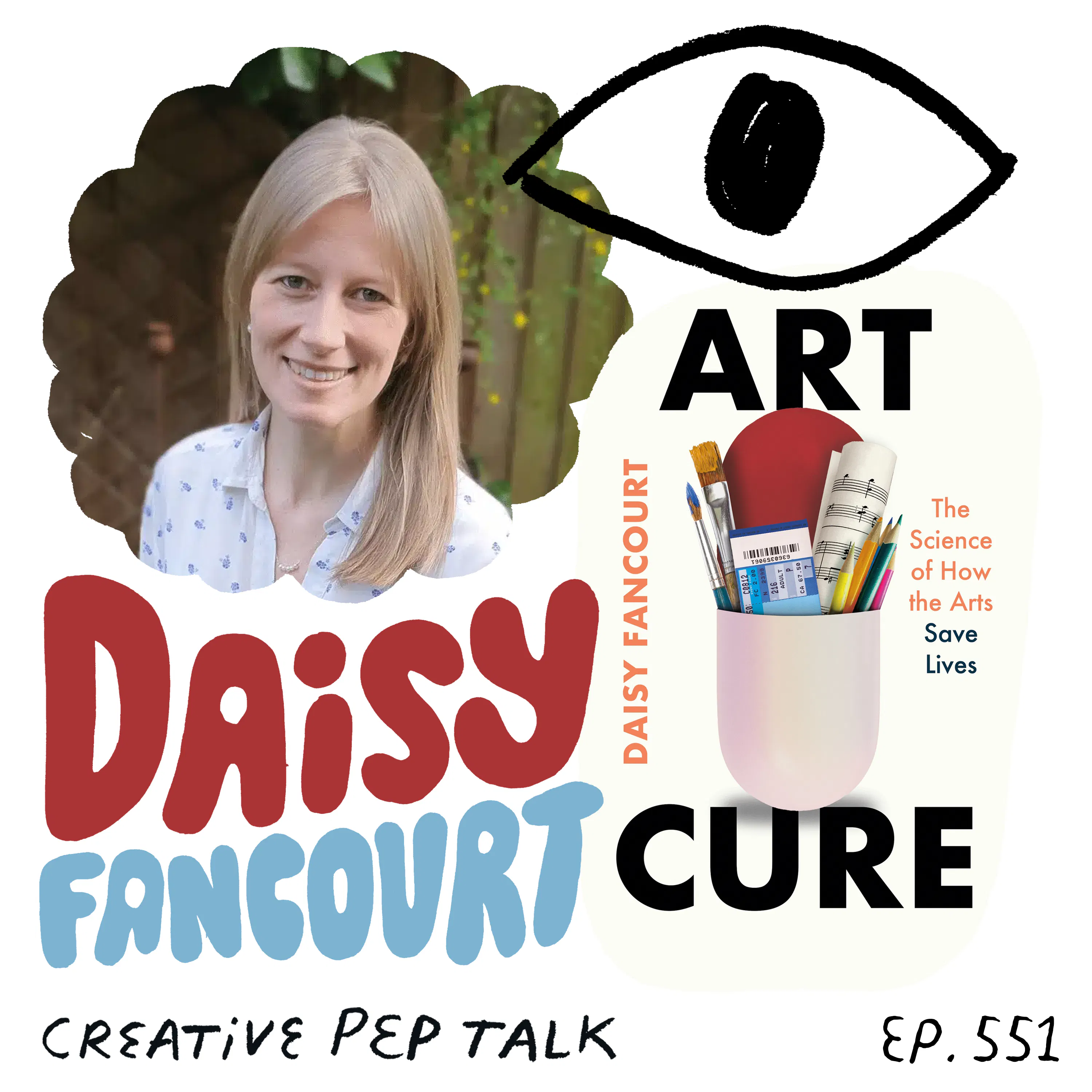
Creative Pep Talk
551 - Consume and Create Art to Get Your Brain Back with Scientist Daisy Fancourt
00:30:50
Loading summary
Transcript35 lines
- [00:01]
A
Is it just me or do you feel like you can't function right now because your brain is mush? Maybe it's just me. I hope it's not, because if it is just me, it's very embarrassing to make a whole episode about it. But I have felt increasingly over the past 10 years like my brain is just more and more chaotic, more static. Not just because I'm adhd, but because of just the chaotic nature of the times that we live in. I have a theory that I explored last episode where I think that part of the problem is, is yes, we're in trying times, but there have been lots and lots of trying times throughout history. I feel like ours is unique in how mushy our brains are. And I wonder if it has something to do with our lack of whole food, creativity, like the creativity media, art, movies, books that are really helping us have a lens to view our lives as meaningful even in the fight, even in the difficulty. Like that's what art can really do. And I feel like this static of short form, video and screen engaging with art through screens primarily is making it harder to see the threads, to see the point of view that I want to have in my art and the stance I want to take and the values I want to hold in my life. And so last week we did an episode exploring this idea. But guess what? I am limited in my experience as an artist and I wanted to ask an actual expert, Daisy Fancourt, who wrote this book called Art Cure the Science of how the Arts Save Lives. And this person knows a thing or two about this because she's a freaking professor and scientist, award winning scientist and science communicator and director of the World Health Organization's Collaborating center for Arts and Health. So she actually knows a lot about this and I'm going to chat with her today. I absolutely loved this talk and it just made me want to double down on the creative discipline of making sure that I am consuming stuff that isn't just creative junk food. She's going to talk about all that and what art can do for you and why it's so essential. And at the end we're going to talk about swapping how you can do something really small to get more of your creative five a day, to get more of the fruits and veggies that make life just so much more meaningful and make more sense and, and give you a solid ground to, to kind of create from and walk your through your life with. But first, let's talk about, with Daisy, why art is this missing core piece of our healthy lifestyles. On the creative journey. It's easy to get lost, but don't worry, you'll lift off. Sometimes you just need a Creative Pep talk. If you've been listening to the podcast lately, you know I am a big believer in simplifying your wardrobe so that you have a few really nice pieces that mix and match and elevate your style. But you don't have to spend tons of time thinking about it. So you can spend all that decision making potential on your creative work and not just getting dressed and looking decent. Quints makes that easy When I go to a talk or go to an event, my Quint shirts are my go to. In fact, I just snagged the 100% European linen relaxed short sleeve shirt for my spring summer events that I have coming up. I can wear it on its own or open with a little graphic tee. Stylish, breathable. Dare I say even a little bit snazzy Even. Everything is priced 50 to 80% less than what you'd find at similar brands. Quint's works directly with ethical factories and cuts out the middlemen so you're getting premium materials without the markup. Refresh your everyday with luxury you'd actually use. Head to quint.comPep Talk for free shipping on your order and 365 day returns. Now available in Canada too. That's Q-U I N C E.comPep Talk for free Shipping and 365 day returns. Quint.comPep Talk this episode is sponsored by Squarespace. I freaking love having Squarespace as a sponsor because it's easy to sell it when you love something this much. I'm a big fan. Squarespace is an all in one website platform design designed to help you succeed online. Here's what I love about Squarespace. They're intuitive and super versatile. Drag and drop tools mean you can make a custom website without knowledge of code. That makes people say whoa, who made that for you? Looks like you built that from scratch. People have really said stuff like that to me about my site and I built it myself quite easily with Squarespace. You can check it out@andijpizza.com if you want to check that out. What I did with it, it doesn't look templatey and it screams my creative brand. I also love that I have all of my domains through Squarespace now, which makes it seamless and easy to manage. I know the first thing as creative folks do when we get an idea is to grab that URL. Now you can Keep track of all your websites and your domains in one place. That's super intuitive and easy to manage. Head to squarespace.com pep talk for a free trial. And when you're ready to launch, use promo code PEP Talk all one word to save 10% off your first purchase of a website or domain. You have a new book, Art Cure. I've got an early copy here. From my understanding, it's like you're kind of arguing that engaging in art is this missing fifth pillar of health. Is that correct? Like, is that what the book is kind of about?
- [06:11]
B
Yes. I mean, essentially, we're all familiar with the fact that exercise, diet, sleep, nature, these things are really important to our health, but we just don't see the arts being discussed alongside those other behaviors. And I think that's fundamentally wrong because actually the evidence base shows that it has health benefits just like those other behaviors. We should all be doing it day to day. We should all be talking about it. And that's why I wanted to write this book, to raise awareness about the evidence base and hopefully help people to change their own behaviors.
- [06:39]
A
I love that. One thing that's been on my mind recently is I know not everyone in culture has moved away from religion, but increasingly secular culture in the West. And I wonder if that is a little bit why. We've. I don't think a lot of people think of religion as art engagement, but there is. There are so many arts wrapped up in spiritual practice. And as that's exited our lives, that seems like maybe that's a part of it that I. I'm curious if you ever. If you've thought much about that. It's kind of a random aside, actually.
- [07:14]
B
No, it's actually a really fundamental one. Because if you look back across our history, the way that we've engaged with the arts has been fundamentally embedded within community, ritual and participation. Often that's been around religion or other kinds of community, congregation. And actually, for a lot of people, church or wherever else they went for their faith was a place where they would encounter the arts day to day or week on week, whether that's through singing or through dancing or through seeing artworks within those religious spaces. But as many societies have become more secular, those opportunities within that weekly calendar to have that arts engagement have actually disappeared for a lot of people. Meaning that now we're often forced to find other ways to engage in the arts. And it's not necessarily interwoven into the patterns of our week in the way it used to be.
- [08:02]
A
It's. It's interesting because for a long time in my life I wouldn't have thought of engage as a creative person. I wouldn't have thought of engaging in art as anything more than just something I wanted to do. I was passionate about doing it. I enjoyed the entertainment side of it. Whereas now I almost feel like there is a desire and a movement towards seeking a little bit of discipline in the way that we engage with art. Similar to you see in the. What you see in like a religious culture where there is this discipline of days of the week that you're doing these things, singing together, reflecting, all that kind of thing. But because of things like the Internet and short form video and these sorts of things, it seems like our engagement with art is just being completely edged out if we don't take a more active stance.
- [08:57]
B
I think this is a real concern because actually our lives are so crowded and busy nowadays, it's sort of like we're having to compete behaviors are having to compete for which ones we're actually going to have the space for day to day. And again, if you look back, like arts engagement was something that people had much higher levels of organically. Whereas now we ran a study in the US last year looking at time, use data. And if you ask average adults in the street in the US did you engage in the arts yesterday? Do you want to guess what percentage will say yes?
- [09:26]
A
Oh man, I'm scared to just 5%. Oh my gosh, that's worse than I was going to guess. It was bad news. I was going to guess like 12%, but 5% is bad.
- [09:40]
B
So this is why I think it's really important that we are like thinking how can we integrate this behavior more into our lives? It's not about forcing people that they have to do arts, but it's about saying this is a behavior that is so important to your health, to your well being, you need to make space for it. And we want to support you in using the latest in behavioral science to know how you can motivate yourself to find that space.
- [10:03]
A
Yeah, that, that sounds important. And I think that as an artist myself, I of course value the arts. And that's an intuitive thing for me. Like I have this feeling that this matters to me and to other people, whether they're making it or engaging in it, you know, engaging in consuming it and reflecting on it. But you have more than intuition around this. Like what is the, what does the data say around what this does for people or what the absence of it does?
- [10:33]
B
So if we're just looking at that day to day engagement. So you're not doing it for your health, you're just doing it because you enjoy it, because it's a leisure activity. I'm an epidemiologist, so I specialize in looking at how those day to day behaviors influence long term mental and physical health outcomes. And actually what we see from very big data analysis is that daily patterns of arts engagement are linked in with a reduced risk of developing conditions like depression. They're linked in with higher levels of well being over time, higher life satisfaction. People who engage regularly actually have better preservation of cognition as they get older, a lower risk of developing dementia. They also have a lower risk of developing conditions like chronic pain as well as better aging as they get older. So in fact reduced risk of developing age related conditions like frailty. And in fact there are even now over a dozen studies showing that people who are regularly engaged in the arts that that is linked through to a longer life expectancy as well.
- [11:25]
A
And does this, is this making art specifically or is it consuming? Is it mix of both?
- [11:32]
B
Both. Essentially what we see is that both participating or more receptive watching or consuming, that they both have benefits for health. Often the ways in which they're working can be a little bit different about whether you're participating or whether you are sort of enjoying that, that, that watching experience of it. And I think a crucial thing people sometimes say is, is it actually about arts or is it just if you've got enough money to do arts or you've got enough spare time, or is it in other words, about these other things in your life? But actually no, it is about the arts. And we see this both from the big data analysis and also from randomized controlled trials which use kind of very causal approaches, using the same kinds of approaches you'd use to test a drug. But to look at arts engagement actually showing that these are the outcomes that we see as a direct result of that engagement.
- [12:17]
A
That's fantastic. So the thing that I just hate talking about, I really hate talking about, I try not to bring it up very much because every conversation everywhere I go is just consumed by, you might guess what I'm going to say, AI. I'm sick of it. I don't really want to talk about it, but there's like a latent or deep hidden hope and feeling that all of this rise of AI is going to awaken some kind of alternative counterculture that is deeply obsessed with humanity and artistry and kind of handmade things and heart filled stuff. And as I, you know, news around AI is coming out. And we're seeing things like the MIT study that's like, claiming, like, 47% drop in brain activity with regular engagement in AI. Like, really scary stuff. It feels like this work that you've done is almost a counter to that. It almost feels like, hey, or you could. Yeah, you could engage with AI constantly and see this happen, or you could consume and engage in art. Have you thought much about this connection?
- [13:34]
B
Yeah. One of the really interesting areas of evidence around arts is around their cognitive effects. And arts engagement is really good because it's actually a sort of whole brain workout. If you're doing something like, for example, making music that's involving so many different parts of the brain that are involved in visual optics of seeing notes on a page in memory, remembering lyrics, for example, that the regions of the brain involved in emotions also involved in the sensory and the motor actions that are responsible for making that music. So there are so many different brain regions being activated. And actually a lot of studies now show that if people are regularly engaged in arts, this can actually affect the connectivity between brain regions and even alter the size and functioning of different regions in the brain. And actually, some of the latest evidence that came out just a couple of months ago was showing that both amateur and professional artists, so people who've got those regular patterns of age, of engagements, they actually have better connectivity between regions of the brain that are most vulnerable to aging, and they actually have younger overall brains. And this very much feeds into a lot of evidence on a theory called cognitive reserve, how you can build the resilience of your brain against conditions like dementia. So, in other words, even if your brain might be developing the pathological signs of dementia, if you've got good cognitive reserve, it means you can compensate for longer, so you can sort of maintain better cognitive functioning longer before it really starts to affect you day to day. And what's concerning is a lot of things like AI that are then removing things that would be cognitively challenging. There is a truth to that saying, use it or lose it. And I think arts engagement is really valuable as being such a good way of using it, because it is that whole brain workout. So I am hopeful that people will be latching onto that more as we start to see more fears about the loser attitude that AI could have on our brains.
- [15:23]
A
I love the idea of thinking of going to an art museum, going to the movies, these sorts of things as an art gym. That is a gem for your brain as all these, like I've heard it compared to actually, like, as transport became Things like cars and we were walking less. That's when gyms had to spring up. Right. Like, we had to compensate for the fact that we weren't using those muscles on a regular basis in ways of, like, manual labor and. Yeah, engaging with art, maybe that. I can just imagine a world where you go to a doctor and they're like, okay, it looks like you've just AI is completely atrophied your brain. We're going to have to prescribe art.
- [16:07]
B
Ah, but that already happens.
- [16:08]
A
Yeah.
- [16:08]
B
So, in fact, doctors already can prescribe arts. So in the uk, we've actually got a whole national program of what's called social prescribing. So doctors can literally write a prescription for you to go to arts classes or nature classes or volunteering or social or community groups. And it's actually now a program that's operating in 40 different countries around the world. And arts activities are one of the really common things people get referred to. In fact, I've been working in the US over the last couple of years on a project that was called One Nation, One Project, and it was looking at arts on prescription in 18 different sites around the US like, piloting it and evaluating it. And the results that come through are so positive in terms of these sort of myriad health benefits. So actually, I think this is something we're going to need more of because organically, we're often now not engaging as much in the behaviors that are beneficial for us. So we're sort of having to almost medically prescribe it ourselves to make sure that we have that time, that we recognize that value and we engage.
- [17:06]
A
Yeah, I love that. And I also love what you said about the whole brain exercise. One of the things that I say on the show most often is I think of creativity as a whole brain activity. It's a. It is a whole brain require. I think we just. When we think of creativity, we. We associate that with types of thinking and behaviors that are kind of isolated to certain parts of the brain. But as a creative and a writer, I'm always thinking like, oh, when I'm creating versus editing, I can tell these are total. They're almost totally two different people. And I can feel like, oh, I have to access different rooms of my brain. And it's true, like, even when you engage with music versus movies or a book, you can feel also, oh, this is a totally different cognitive space. It feels like.
- [17:52]
B
But do you remember a few years ago, there was that big fad about brain training apps like, use these apps to stop dementia risk. But of course, that was a fundamentally flawed approach because each one of those apps, like, trained one specific cognitive process. But the whole point is that actually, if you want to build cognitive reserve, cognitive resilience, it's about building lots of new neural connections and strengthening lots of different pathways, which, again, is what the arts are so good at. So it's not that surprising that when they did big studies, a lot of those brain training apps actually weren't achieving the overall benefits that people were hoping for. Whereas actually, when you engage in arts, you can actually see these cognitive benefits, particularly as people get older, in a really tangible way.
- [18:31]
A
It feels like the equivalent of saying, you've got to do the brain version of leg day. You can't just work on the biceps. Okay. With these.
- [18:39]
B
Exactly.
- [18:42]
A
So I know that you have 10 guiding principles in your book that kind of go along with integrating this into your life. I wanted to see if you had one that was your favorite, and if not, one, two or three, that you were like, oh, these are, like, really juicy.
- [18:56]
B
Yeah. Well, throughout the book, I tried to give really, like, specific recommendations for particular clinical outcomes, clinical conditions. Like, this is how you can really tell target your arts engagements. But I think for a lot of people, it's just about how can you engage more day to day. So I give people a whole checklist of, like, what are the barriers? Because depending on what your barriers are, there'll be different solutions, whether it's more of a psychological fear that you're not creative or kind of a practical issue about having enough time or having enough opportunities. But I think there are some. There are some very simple ways we can think about it, and one is to align it to our diet. So many of us are aware of, like, we've got a rule, like, have five a day of fruit and vegetables or something like that. And I think it's really helped helpful if we can figure out what's our equivalent of that. What's that single rule you could have in your life? Like, is that having 10 or 15 or 20 minutes a day that you always make for creative engagements? And I'd say you can extend that metaphor as well if you want to broaden it. So we know with our diet, you need, like, a variety of ingredients because they've all got different health benefits. It's the same for arts like you actually. You can't just do one art form all the time because that is giving you some benefits, but actually diversity of different benefits through doing different arts activities. Each one of those will challenge your brain and support your health in different ways. And I'd say most of all as well. Remember, you don't have to be a great chef to cook your food equally. You've not got to be really good at arts for it to benefit your health. It genuinely is the participating that actually achieves a lot of those health benefits.
- [20:20]
A
That's great. And it reminds me of when I have done episodes on finding your style and developing your creative voice. One of the things I do talk about a lot is, you know, the outdated food pyramid. I know they don't use that in health circles anymore, but I like to think of like an art food pyramid of I think of this thing of like you art what you eat. So what you consume has a lot to do with the stuff that you're making. And I think about like if you're only consuming the creative junk food like short form video, that's mostly what you're going to create. So I like this idea of kind of tying it to thinking of your diet as a creative person too. I like that.
- [21:01]
B
Nice. And actually I am really clear in the book to be really careful about screen based arts engagement. I call it the ultra processed food of the arts world.
- [21:08]
A
Yes.
- [21:08]
B
Which is probably a little bit rude. But the reason is when we look at the evidence base actually we tend to see diluted benefits for many of the health outcomes. So for example, we see lower emotional benefits from screen based vs non screen based engagement. We see lower social benefits, which is not particularly surprising. It is different interacting in real life with people. And we also see that the cognitive benefits just are not as strong. So it's just a kind of warning of being offline and in real life wherever you can. But obviously accepting that there are still some benefits. And sometimes when the screen based is the best way to reach people and the best opportunity to break down the barriers.
- [21:46]
A
Like you're eating creative veggies but you're deep frying them. Okay, so you're not getting the full thing. I one last question I had was, what's your favorite like practical, actionable piece of advice for people that want to fit this into their day in a way that's going to make the biggest impact?
- [22:05]
B
I'd say in that case, go for a swap. So on your way to work, if you're normally someone that scrolls the news, well, read a book. Like use that as your book reading time. If you're someone who meets up with friends for drinks or dinner, why not meet up and go to a gig or meet up in a gallery so that you've got that arts engagement interwoven with a behavior you're already doing and even really simple ones. Like if you have an alarm clock in the morning, swap that to a piece of music that really sets the mood that you want to have when you first get up. Like it sounds so trivial, but actually that's something that could really affect your stress levels and your mood on waking, which could actually influence how you then feel and how you then cope with everything that comes your way during the day.
- [22:43]
A
I love that and I love all the work you're doing. It feels very, very important to me and I'm sure important to the listeners. What is the best place to follow along with your work and check out the book?
- [22:55]
B
Well, I'd say you can look for Art Cure online and also we've got so many Art Cure events coming up in the uk, the US and online as well. So I can share a link with you that people can follow and come along in person if they want to chat more.
- [23:08]
A
Fantastic. I'll put all those links in the show notes. Thanks Daisy for taking the time.
- [23:13]
B
It's a pleasure.
- [23:31]
A
I could really use your help. Now as a rule I try to give way way more on this show than I take, but every once in a while I have an ask. I think it's been about three years since my last big ask when we launched me and Sophie. Sophie's book Invisible Things and now its companion Mysterious Things is on its way and we could really really use your help by buying a book and spreading the word. Pre orders can make or break a book success. If you can launch a book with momentum, it has a chance to get into people's hands and we really really want to get this book into kids hands because it was written to ignite kids curiosity to get them curious about our mysterious universe. And I don't know about you but I am hoping this next generation is curious, open, full of wonder and engaged and excited about living life on this planet. If you pre order from our local bookshop Bertie Books, you can get a copy that is signed by me and Sophie. There's also a bunch of links to everywhere else. You can get the book at InvisibleThings Co and by the way I'm doing some talks to virtual groups, schools, companies and conferences in exchange for what's called a pre order book buy AKA buying copies for your group or the attendees. So if you've ever wanted to book me to speak, this is the least expensive it'll ever be. Write to me@hidjpizza.com and I can walk you through how that works. If you love my art, this is one of my favorite collections of paintings that I've ever made. If you loved Invisible Things, you're going to love Mysterious Things. And if you have children, nieces, nephews, students, or friends with kids in your life, ignite their curiosity with Mysterious Things. Pre order at invisiblethings co or click the link in the show Notes. Thank you so much for your help. We really, really, really appreciate it. It's time to refresh your yard during Spring Backyard Days at the Home Depot. Get low prices guaranteed on propane grills starting at $179 like the next grill 3 burner gas grill. Or get $50 off a select Weber Spirit Grill and bring big flavor to your backyard. Then set the scene with Hampton Bay String lights that bring it all together. Shop Spring backyard days for seven days at the Home Depot now through May 6th. Exclusions apply to home depot.com pricematch for details. All right, it's time for our creative call to adventure. You know, we don't like to just get you pepped out of your mind and then send you on your way. We want to give you something you can do that will actually make a difference in your creative journey. This week it's called swapping. It's exactly what Daisy was just talking about. What could you swap out? Could you swap the screen for something else either in your creative practice or in your creative consumption? For me, this has looked like about a month ago I swapped out writing on my phone for writing in a journal. Longtime listeners will know I used to do all of my writing in a bathtub. Don't worry, I'm still taking baths and showers more than any human needs. I'm constantly dripping in sudsy waters. But that is not any of your damn concern. What I am trying to talk about is this sweat swap that I made. I started doing morning pages and I usually a lot of my like writing and podcast planning and stuff like that starts in my phone. And then over the past month I've experimented with doing that all in a journal. And so I'll do three pages every morning with my morning coffee and and not in water because that doesn't make any sense. And I've actually started the other thing I've done is because I'm not in water I can go put one side of a vinyl on and I've started buying instrumental records. Ezra Feinberg, by the way, if you don't know him, I would highly recommend this album, Soft Power. He I Believe he's a therapist and he is. This music is just absolutely incredible. It was one of my most listened to albums of 2025. Another that I throw on is Gia Margaret's romantic piano. Yoni Wolf, the guy who does the theme music and the, the soundtrack to this show produced some of the tracks on here. You might know Gia Margaret from Hinoki Wood which is a track that went viral on TikTok for this thing called the Chill Guy which I don't fully understand so I can't speak to that. But that album is just fricking awesome. But I'll throw these, you know, retro specimens on at the vinyl and throw that on. It feels so warm and nice. And then I'll go sit and do my journal and an actual book. And that little swap has just giving given me a lot of life. And so it can be something like that. It can be something on your commute, it could be swapping out a book instead of reading on your screen or scrolling. But I love this idea of everything that you consume through a screen is almost like a deep fried creative thing. So even for me like getting inspiration, going back to like these things behind me, these books and looking through those and just feeling in real life like that, that's so key. And just getting more of those creative whole foods in your life I think is just going to help you feel a little bit more grounded in your values and your excitement about being alive. And yeah, it's, there's proven, it's. It's just proven. Okay, Daisy proved it. The, the data proves it. You need this frickin art in your life. So let's all get serious about it. Massive thanks to Daisy Fancour and you can check out her book Art Cure wherever books are sold. I think this is really important and I'm excited to dive into some of this. I saw a chapter about how art can relieve stress and I don't know about you, but these days that's something that I could really use. Thanks Daisy, that was a great chat. Thanks for the work that you're doing to just prove how vital creative work and art is to our lives as creators. But also every human, every puma, every human, every human is what I said. It's not what I said, but it's what I meant. Thanks Daisy. Thanks to you. And hey listen, we make this show every single freaking week we're putting out this damn show. I love making it. It's been, it's been. Sorry I'm so, I'm in such a goofy mood. I don't know what that is. I'm trying to end this episode. I love making this show. It's not always easy to do it every week, but we do it every week because the discipline of consuming good whole foods creatively is so essential to creating in a disciplined way, in a consistent way, to see it add up and take you to the places you want to go. So if you want to get on that track of getting pepped every single week, if that's a core value of yours, to have to have a creative discipline, to have a creative practice, to make it a part of your regular life, to have that art in your life that can save lives, according to Daisy. I also think that's true, but she proved it. Go to andyj pizza.substack.com Sign up to the freaking newsletter so you don't miss episodes. At least you get an idea of what every episode is and see if it's the kind of thing that you need in your life that week. But also, if you're listening every week, it can help you kind of get into a rhythm. Thank you all for listening. Thanks to Sophie Miller for being an editor and a producer on the show. Thanks to Connor Jones of Pending Beautiful for audio edits, video edits, animation and sound design. Thanks to Yoni Wolf of the band Y for our theme music. And thanks to all of you. Stay pepped out. We all need advice, but it's not always clear who to ask. Even in 2026. Enter how to the Long Standing Advice show, an Ambie Award nominated Best Personal Growth podcast. That's back with new episodes and a new host. Who? Me. Mike Pesca. Each week I tackle a listener question ranging from travel to finance to relationships and beyond, with help from a world class expert. You know, someone who actually very much knows what they're talking about. Think of it as eavesdropping on someone else's therapy session without the copay or awkward silences. You've got questions. We'll find the experts and the answers. So follow how to with Mike Pesca wherever you get podcasts. Have you ever asked yourself, can the president really do that? Or wondered if there was too much money in political campaigns? Then check out the new season of you Might Be Right. Hosted by us former Tennessee governors Phil Bredesen and and Bill Heslam. We're back for a brand new season now, and you Might be right. Cements the idea that constructive disagreement can lead to real problem solving. This season we're going to dig into the role of National Guard AI regulation and a lot more new episodes drop every other week. Follow you might be right. Wherever you get your podcasts.