Podcast
Crossing Faiths
Hosted by John Pinna and Elliot Toman · EN
Crossing Faiths is a podcast where people from diverse religious backgrounds openly discuss everything you're NOT supposed to discuss at the dinner table. Join hosts Jt Pinna, a career national security, international affairs, and D.C. insider, and Elliot Toman, a former media director in the Evangelical church, as they engage in lively conversations about the impact of faith on current events. Crossing Faiths also welcomes guests from various religious and experiential backgrounds to share their insights. The podcast was initially developed in collaboration with Matt Hawkins, a former policy director for the Southern Baptist Convention. Their conversations are built on a decade of collaboration, advocating in Washington, D.C., for religious freedom domestically and globally. The two developed the podcast to share conversations that model friendship and cooperation despite profound differences in religion and background. The podcast has reached almost 3 million multi-faith listeners, 83% millennials.
23episodes
Episodes
Newest firstAll episodes

209 - Ruth Reck
2w ago00:56:26Tap to summarizeIn this episode of Crossing Faiths, John Pinna interviews Ruth Reck, a social media content creator who documents her visits to faith-based attractions and religious sites alongside her wife. The discussion centers on Reck’s experiences exploring young-earth creationist locations—such as the Ark Encounter and the Creation Museum—as well as evangelical megachurches. Reck shares her motivations for visiting these sites, driven by a curiosity about human psychology, concerns regarding the rise of Christian nationalism, and a desire to document the way religious narratives are packaged and commercialized. Throughout the conversation, Pinna and Reck reflect on the stark contrasts between literalist biblical interpretations and scientific consensus, the emotional and sensory tactics used to engage believers, the pervasive commercialization within these environments, and the broader social implications of indoctrination versus open, respectful dialogue across different belief systems. https://www.youtube.com/@ruthreckmediaSupport Crossing Faiths
Transcribe →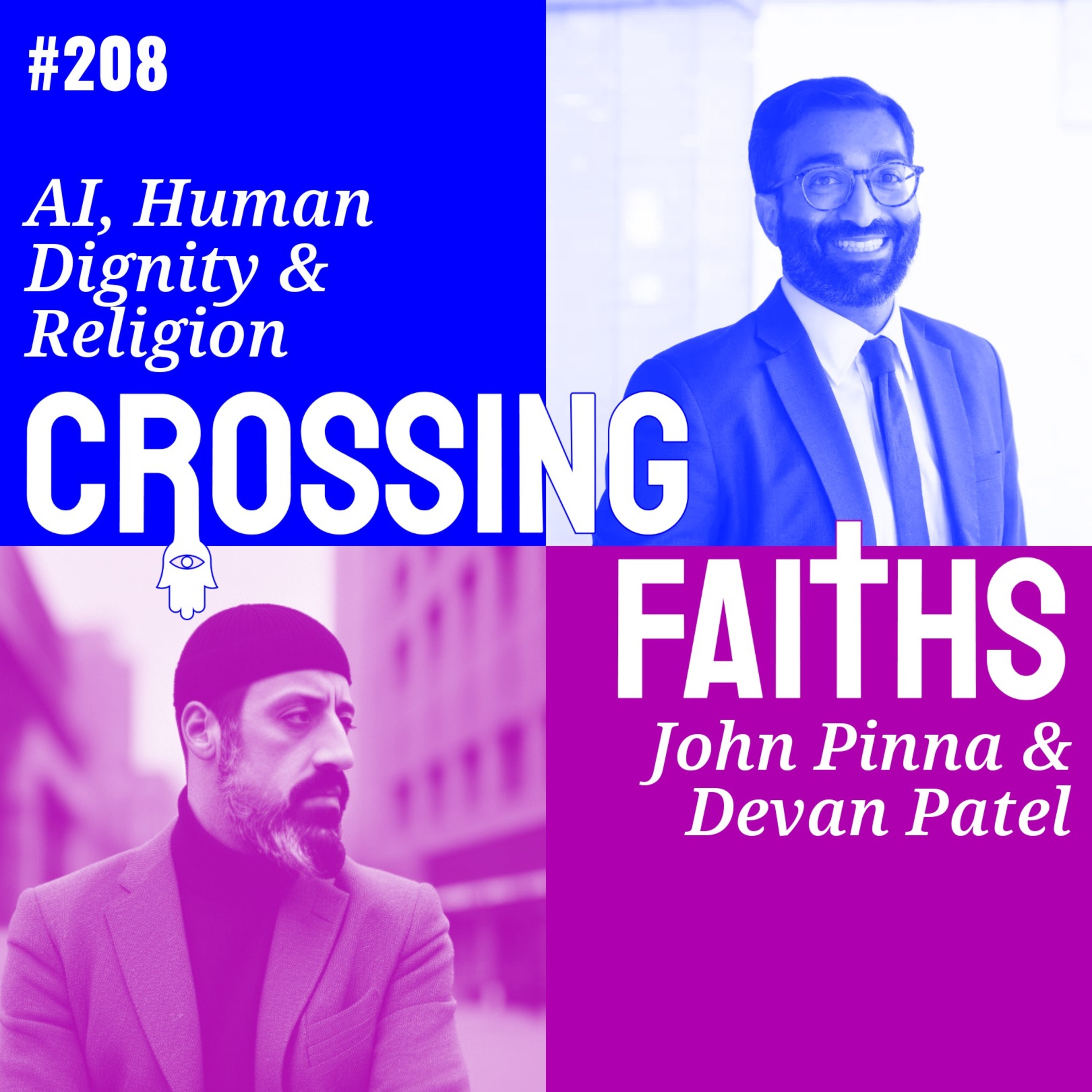
208 - Devan Patel
3w ago00:40:11Tap to summarizeIn this episode of Crossing Faiths, John Pinna interviews Devan Patel, a lawyer and strategist who collaborates with multi-faith communities on technology, policy, and ethics. The discussion centers on the intersection of artificial intelligence, human dignity, and religious communities, particularly focusing on the Vatican's forward-looking involvement in the AI discourse. Patel shares details about the newly released papal encyclical Magnifica Humanitas issued by Pope Leo XIV, which addresses the safeguarding of human dignity in the age of AI. Drawing historical parallels to Pope Leo XIII's Rerum Novarum, which responded to the Industrial Revolution, the conversation explores how various global faith leaders are universally responding to the risks of AI—such as companion chatbots affecting youth—and how the Vatican’s receptive, human-centric framework provides a welcome platform for collaborative, cross-disciplinary dialogue on technology's future. Devan Patel is a Washington, D.C.-based lawyer, political strategist, and educator who operates at the intersection of law, faith, and technology. He is the founder and president of Crux Advisory Group, a fellow in AI ethics at the Rainey Center for Public Policy, and an adjunct professor of law at Notre Dame Law School. Throughout his career, Patel has focused heavily on legal strategy, public policy, and international AI ethics, which includes co-drafting the Electoral Count Reform Act, working on amendments for the Respect for Marriage Act, and convening industry leaders and faith figures at the Vatican to establish global ethical principles for artificial intelligence. https://www.devanpatel.com/Support Crossing Faiths
Transcribe →
207b - Jason Boyett (Reprise)
4w ago00:29:41Tap to summarizeIn this episode of Crossing Faiths, John Pinna interviews Jason Boyett about the concept of collective effervescence—a term originally coined by sociologist Émile Durkheim to describe the intense burst of shared energy and emotion that occurs when people gather for regular religious rituals. Boyett explains that this phenomenon is essentially a neurochemical event driven by group synchronization, which increases endorphins and expands personal experience beyond the individual. The conversation explores how this phenomenon mirrors experiences found in modern secular settings, such as mass sporting events like the FIFA World Cup or large-scale concerts. They further discuss the multi-faith nature of collective effervescence, drawing parallels with experiences in Muslim and Christian worship, while noting the decline of traditional community gatherings in contemporary culture. Jason Boyett is a journalist and writer who has authored several books about religion and religious history. His writing has appeared in a variety of publications, from The Guardian to American Cowboy. He writes The Religiverse newsletter on Substack and is the cofounder of Brick & Elm, a regional magazine in the Texas Panhandle.Support Crossing Faiths
Transcribe →
207 - Jason Boyett
Jul 1300:51:49Tap to summarizeIn this episode of Crossing Faiths, John Pinna interviews Jason Boyett to explore the deep cross-cultural and personal complexities of navigating different structural beliefs, focusing on how individuals form, question, and expand their understandings of faith. Boyette shares his journey from growing up in a conservative Southern Baptist tradition to writing 12 Major World Religions, emphasizing how taking an "outsider's perspective" can reveal logical inconsistencies within one's own background and foster genuine interfaith understanding. The two dissect the tribalism that exists not only between different religions but also as sectarian divisions within the same faith traditions, using specific examples from both Islam and Christianity. Additionally, they discuss the civic necessity of religious literacy in modern society and the evolving landscape of media, noting how platforms like Substack and short-form video on TikTok can be leveraged to deliver nuanced, objective religious journalism to younger audiences. Jason Boyett is a journalist and writer who has authored several books about religion and religious history. His writing has appeared in a variety of publications, from The Guardian to American Cowboy. He writes The Religiverse newsletter on Substack and is the cofounder of Brick & Elm, a regional magazine in the Texas Panhandle.Support Crossing Faiths
Transcribe →
206 - We're Not Supposed to Be Here
Jun 1500:59:17Tap to summarizeIn this episode of Crossing Faiths, John Pinna and Elliot Toman discuss the multifaceted nature of religion, dynamic interpretations of Islamic principles, and the socioeconomic impacts of modern capitalism. The conversation begins with a casual sci-fi reference to Star Trek and quickly segments into a philosophical debate regarding whether religion is meant to enforce a collective societal order or serve as a strictly personal, inward-facing moral code. Pinna delves into standard Islamic principles, emphasizing the explicit historical allowance for non-Muslims, pluralism, and private free-will options under genuine Islamic law, highlighting how the faith’s spiritual intentions are often corrupted when fused with state governance, political violence, or totalitarian empires. This leads to a broader systemic critique of extreme modern capitalism, exploring how billionaires like Jeff Bezos use theoretical loopholes and "shell game" rhetoric to redirect conversations about wealth responsibility toward government inefficiency. The hosts contrast standard corporate structures with sovereign wealth funds and perpetual endowments. arguing that the super-wealthy should leverage their influence to address systemic crises rather than hoarding their wealth. Yesterday's EnterpriseSupport Crossing Faiths
Transcribe →
205 - Rotten at the Warp Core
May 2500:55:22Tap to summarizeSupport this podcast via Patreon.Support Crossing Faiths
Transcribe →
204 - Dr. Minhas Khan
May 1001:04:57Tap to summarizeIn this episode of Crossing Faiths, John Pinna speaks with Dr. Minhas Khan from Peshawar University about the complexities of intra-faith relations and the limitations of Samuel Huntington’s "Clash of Civilizations" theory. They explore how the perception of the Muslim world as a monolithic entity is often a reductive Western construct used to serve political agendas, rather than an accurate reflection of its diverse cultural and ethnic landscapes. The conversation delves into the historical and structural roots of internal divisions within Islam, such as the Sunni-Shia divide, arguing that these fractures are frequently exacerbated by deliberate foreign engineering and statecraft rather than purely ancient theological hatred. Pinna and Khan also examine the ongoing geopolitical tensions between the U.S., Israel, and Iran, highlighting the role of resource control—specifically oil—and the unique position of Pakistan as a potential diplomatic mediator in a region where economic interests often override religious identity. Dr. Minhas Majeed Khan is an Assistant Professor of International Relations at University of Peshawar, Khyber Pakhtunkhwa (KP), Pakistan. Born in Lakki Marwat, a remote area in the South of KP, she was married at the age of 16 due to which she had to discontinue her studies. With the support of her husband and three children she took a restart after 16 years of marriage and obtained her Ph.D. degree in International Relations in 2013. Dr. Khan teaches various courses to students of Masters level, MPhil and Ph.D. She is currently supervising one Ph.D., one Mphil and six undergrads dissertations. She has to her credit various publication in national and international academic journals. Her areas of interest focus on the study of religion and its role in politics, role of gender in peace and security, foreign policy decision-making, conflict resolution, US and Pakistan relations; regional politics of South, South West and Central Asia, the Pakhtuns; and Federally Administered Tribal Areas (FATA). As a Muslim woman, she strongly feels committed to strengthen the role of women in conflict transformation and peace building in a diverse setting with an aim at promoting peace and tolerance for a peaceful and stable international society. Dr. Khan is an active member of Pakistan Girls Guide Association and member to Regional Institute of Policy Research and Training (RIPORT) Board of Directors since 2010.Support Crossing Faiths
Transcribe →
203 - The Hammer of Fundamentalism
May 400:56:36Tap to summarizeIn this episode of Crossing Faiths, John and Elliot discuss the intricate and often nuanced overlaps between different religions and belief systems, comparing and contrasting internal divisions within Islamic tradition with those in Christian tradition. They explore the historical and theological distinctions between Sunni and Shia Islam, examining how each sect interprets concepts like leadership, succession, and divine authority. Their deep dive unpacks how these factions navigate their respective identities, the role of historical figures and political movements in shaping these differences, and the ongoing challenges of reconciling distinct interpretations within the broader Islamic community. Throughout the discussion, they also reflect on how historical, cultural, and geopolitical contexts have influenced these sectarian identities, highlighting how they both shape and are shaped by the shared quest for spiritual legitimacy.Support Crossing Faiths
Transcribe →
202 - Choosing Violence
Apr 2701:08:09Tap to summarizeIn this episode of Crossing Faiths, John and Elliot discuss the multifaceted and often unsettling implications of technology and power in our society. The conversation shifts from science fiction, specifically the depiction of Starfleet in Star Trek, to historical events like Pearl Harbor and World War II, examining how societies grapple with traumatic events and the subsequent need for justification and moral clarity. A significant portion of the dialogue focuses on the intersection of government, technology, and ethics, particularly regarding modern infrastructure and military operations. John and Elliot explore themes of systemic responsibility, the role of leadership in shaping national narratives, and the psychological impact of technological advancements, debating how these elements collectively influence our understanding of humanity and progress.Support Crossing Faiths
Transcribe →
201 - Insider Warmongering
Apr 2000:47:35Tap to summarizeIn this episode of Crossing Faiths, John and Elliot discuss the multifaceted relationship between global events, economic trends, and political leadership, particularly focusing on the actions of Donald Trump. They explore themes of insider trading and market speculation tied to geopolitical tensions, such as the war in Iran, suggesting that a significant portion of international conflict is driven by financial incentives that benefit a small elite. They also touch on the "messianic" perception of political leaders and the psychological dynamics of those who support such figures, linking these to broader societal trends like the "Indie Web" movement and the desire for alternative, decentralized information sources. Finally, the conversation highlights a growing cynicism toward established institutions and the perceived influence of powerful individuals over the economy and public discourse.Support Crossing Faiths
Transcribe →