← Crucible Moments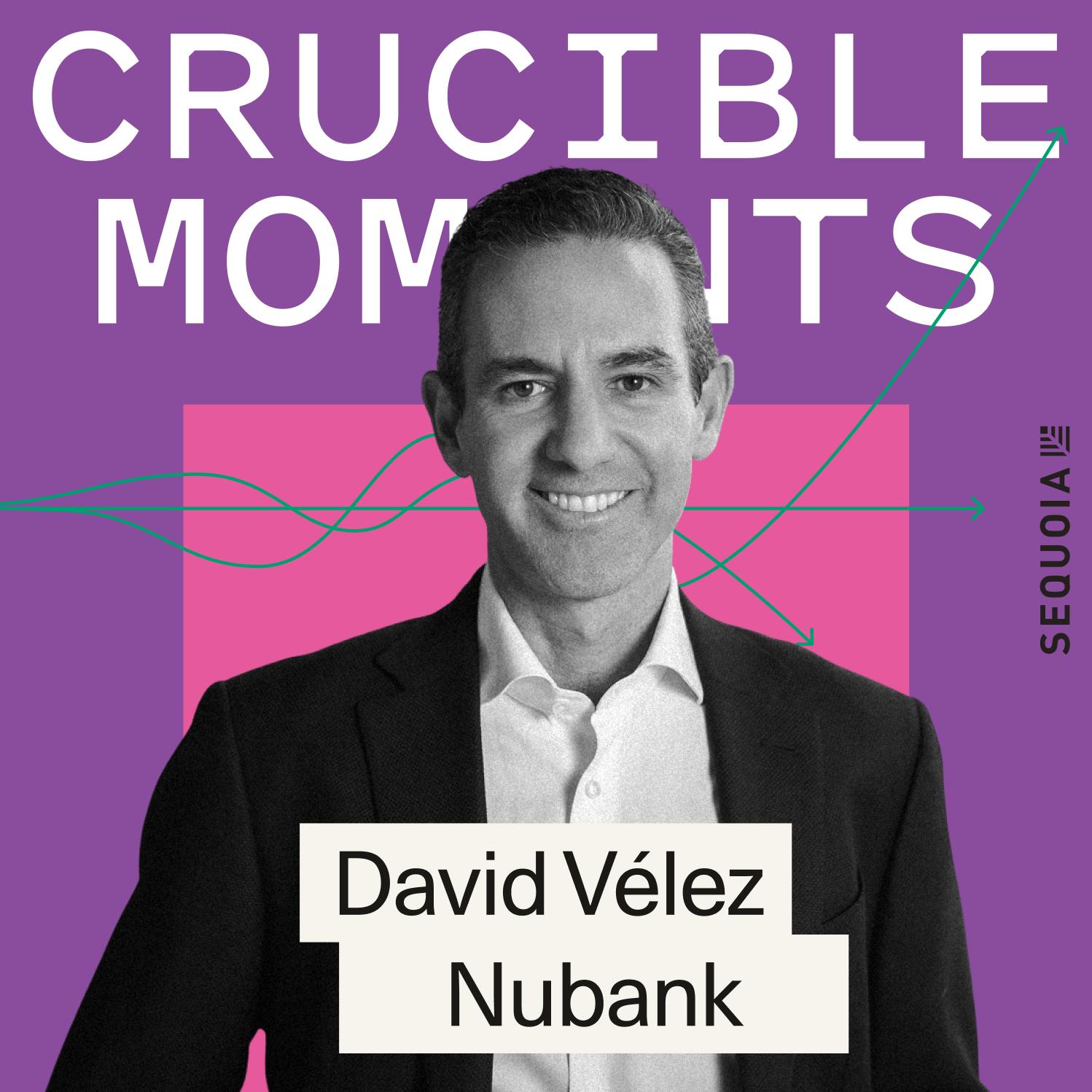
Crucible Moments
Nubank ft. David Vélez - An Outsider Upends the Brazilian Banking System
00:50:04
When Nubank started 10 years ago, a few big banks in Brazil had a stranglehold on the largest economy in Latin America.
Loading summary
Transcript97 lines
- [00:00]
Roloff Goethe
Hi listeners. Got a bold idea Brewing this new year, Masters of Scale can help you turn it into reality. Hosted by Jeff Berman and LinkedIn co founder and my former PayPal colleague Reid Hoffman, this podcast reveals scaling secrets from operators across industries. Hear from leaders at Microsoft, Reddit, Canva and Airbnb as they share the insights behind their success. Tune in to Masters of Scale on your favorite podcast platform and start scaling your vision Today.
- [00:40]
David Velez
It was our end of year celebration and I had to speak to entire company. Part of our culture was treating everybody like an owner and a partner, and that means being very transparent with our employees. The natural thing to do was to tell everybody, don't worry, everything is fine, we're all good. Let's celebrate, let's have some drinks. We're going to figure it out. The reality is we had no idea how we were going to figure this out. What was consistent with our values was to say, this is real. We're going to work really hard over the weekend and figure out what to do. But right now, I don't know how we're going to solve it.
- [01:15]
Roloff Goethe
Welcome to Crucible Moments, a podcast about the critical crossroads and inflection points that shaped some of the world's most remarkable companies. I'm your host and the managing partner of Sequoia Capital, roloff Goethe. In 2013, David Velez set out to upend the Brazilian banking system, where big banks charged among the highest fees and interest rates in the world. His mission was to democratize financial services for those with no good options. Nubank is the story of an underdog team determined to disrupt an oligopoly in a geography most would have bet against. By delivering on a consumer experience unimaginable to most Brazilians. David and his co founders faced Crucible Moments as they navigated a highly regulated industry, persevered as competitors conspired to shut them down, all while cultivating rabid customer love.
- [02:17]
David Velez
My name is David Velez and I'm the founder and CEO of nubank. I was born in Colombia and I lived in Colombia until I was eight. Colombia in the 80s and early 90s was going through a very tumultuous time. A lot of violence, drug cartels, and so my family decided to leave the country and was lucky enough to end up in Costa Rica. My dad has 11 siblings and they're all entrepreneurs. They all started their own business. So I grew up working with my dad in his factory. He had a button factory. I spent a couple of summers working there, saving a little bit of money. There was definitely an entrepreneurial ethos inside the family that supported being your own boss. There was this sense of freedom and autonomy that entrepreneurship and having your own business broad. I looked up to Stanford and Silicon Valley as the place where the biggest companies got started and where some of the best entrepreneurs operated. And so my own dream was to try to make it somehow to Stanford. Nobody from my school in Costa Rica had ever gone to Stanford, but that was a dream of mine. I was trying to figure out how to end it up there and was lucky to be able to go to Stanford and study engineering there. Did my undergraduate Stanford, worked in finance in New York for a couple of years in financial services and private equity and then went back to business school at Stanford. And I was ready to use my two years at business school to finally start a business business. I felt a bit disappointed that during undergrad and even after undergrad I hadn't decided to go on my own and I wanted to use business school to do exactly that, have two years to focus on figuring out what I was going to do. But a couple of weeks into the first quarter of business school, a friend of mine from my class told me that Sequoia was starting to look at Latin America and Douglione wanted to meet me.
- [04:05]
Doug Leone
We were looking for someone to help lead our efforts in Latin America. We had just expanded to India and China and as we looked around the globe and you think of the word brick, Brazil was a key part of that. My name is Doug Leone. I am a partner at Sequoia Capital. The natural place to look was at Harvard and Stanford. And so I interviewed the second year students at Harvard and at Stanford. They were terrific young men and women, but I just couldn't tell them apart. They, they look like the same single type of person. And so I, I had given up on that channel. The following year my now son in law, David George said there is a, a lion, a tiger who has just started at business school. And so I got to David, I cold called him, I invited him to Sequoia. There are people you interview where you look at your watch, it's 20 minutes, 30 minutes. And Mike Moritz, my partner, calls them half pagers, meaning you have a half pager of notes and that you can come up with. Well, the conversation with David ran way over. He was a great communicator. The experience he had, the investments he made and the investments he didn't make, the ability to articulate the issue, the drive. He was not only a half pager, he was a two pager, a three.
- [05:32]
David Velez
Pager and as I was going down the stairs of the Sequoia office, by the time I get into my car, I already had an email from Michael Moritz telling me, david, come back, I want to meet you. So I went back and met Mike and spent another hour with him and it was a phenomenal conversation. And then ended up with an offer from Sequoia to join them as a part time intern to help them figure out if we should open an office in Brazil and Sequoia Latin America.
- [06:01]
Doug Leone
Basically. He worked full time in business school and he worked full time at Sequoia. We used to figure out when his classes were for the two days classes. He didn't have classes. We would fly down to Brazil, fly right back. Time zones didn't matter. I mean, he was working day and night. And then as soon as he graduated, we flew to Brazil and we opened a shared office. Think of a we were kind of office and we started getting rolling and I would fly to Brazil once, twice a month and we'd look at companies and we made a couple investments. But through those travels, we learned there wasn't a lot of original technology in Brazil. Every tech company started with we are the so and so of Brazil. You pick your favorite US company. We are the Uber of Brazil. We're the door desh of Brazil. And so it was a lot of me too investing. And while we liked the founders, the vibrancy that we saw in Faria Lima street where lots of young people would meet with their laptops open, sharing ideas, we were questioning whether the market was going to be a thriving market. And we had a seminal trip where we invited another partner, Jim Getz, to join us. We wanted a fresh pair of eyes. And at the end of that trip, it was fairly obvious based on what we saw and on a conversation we had among us, that we probably were not going to open a Brazil office, we came back to Sequoia, we had the conversation and now we had to communicate to David Velez.
- [07:38]
David Velez
It was a very tough moment. I remember it was right around my birthday in 2012, in October, that Duck was supposed to come and visit with a number of people of Sequoia. And he called me and said, david, you know what? This is not going to happen. It doesn't make sense to open a full office in Brazil. Why don't you come back to Sequoia and let's figure out what to do? And initially it was a big shock because there was a big change of plans. I've been working for two years to set up this Office in Brazil. It was going to be a great move for Brazil and for Latin America to have somebody like Sequoia investing in the region for an entire ecosystem. But the reality is that a lot of the startups that we were seeing at that moment, they were just not that interesting. It was a very sudden call from Doug, who told me, we have decided not to do it anymore.
- [08:24]
Doug Leone
That was very straight with him. No sugarcoating anything. He has a career. He's a young man, a man with respect. And we told him one, we would hire you in California. All day long, you want to come work in California, you have a job offer.
- [08:37]
David Velez
The proposal was, why don't you move back to California, David, and you help us do growth equity internationally. Maybe you'll get to invest in Latin America, but also you look at Asia and other parts of the world. But already at that point, I. I was very clear that I did not want to invest anymore and I did not want to be in California.
- [08:57]
Doug Leone
He told us snow he believes in Latin America for the next 50 years.
- [09:01]
David Velez
That ended up being the window that created the opportunity for me to finally become an entrepreneur. It was a very honest point of view, which allowed me to not waste any time doing something that ultimately was not going to be successful. It made it easier for me to finally pursue what I really wanted to pursue, which was starting my own business from scratch. I spent about two months, this was the end of 2012, figuring out what to do. I was enamored with financial services. I had spent a lot of my career in financial services, and I had also felt the pain of financial services. When I moved to Brazil, I had to open a single bank account. And it was a horrible experience. I had to go to one of the biggest branches in Faria Lima, which is like the center of financial services in Latin America. And I was so surprised about how hard it was to get a simple bank account. I had to go into this banking branch that had bulletproof doors. There were a lot of armed guards that asked me to leave the branch and leave my backpack in a locker and then walk back in and wait 45 minutes for a branch manager to throw a bunch of paperwork at me and then start process of five months trying to open up a simple bank account. And there was so much anxiety and frustration and pure rage about how hard it was to get a simple bank account, to then pay some of the highest fees and interest rates in the world, that I didn't understand how it was possible that Brazilians were putting up with this. How isn't anybody competing with these big banks and offering better solutions. And I started talking to my friends in the space and my Brazilian friends and say, you know what? Yeah, these banks are horrible, but you know what? All the other banks are the same. There are no any alternatives. If you complain to your bank, they're going to say, well, where else are you going to go? And when you combined that consumer pain with everything that I had seen at Sequoia around smartphone penetration and Brazil becoming the social media capital of the universe, as the Wall Street Journal called it, there was an opportunity of reimagining a new financial services brand and a new bank that was fully digital that would pull the consumer in front and center and would create an incredible opportunity. So after spending those two months digging in this opportunity, I got really excited about doing this and decided that I was going to focus on this idea of nubank, which was a consumer obsessed, digitally native bank for Brazilians. So I remember going back to Sequoia with the idea. Once I had it laid out, I had a deck specifically telling the story that there was this opportunity to disrupt the single biggest industry in Latin America. So this was as big as it gets in terms of market cap and market size. And so this definitely got Sequoia's attention because it was not just me too. It was fundamentally rethinking an entire industry. But I remember a conversation with Roloff when I showed him on the story and also in very critical, candid feedback, I remember Roloff telling me, well, David, very interesting story. There could be a really opportunity, but you're not Brazilian, you're Colombian, you're not native speaking Portuguese. You have never worked for a Brazilian bank. You have never worked for a Brazilian credit card issuer and you want to do credit cards. You never done credit and you want to go do credit. You don't have a local network of regulators. You want to build a technology company, but you're not a computer scientist.
- [12:26]
Roloff Goethe
I remember this conversation well. David was going up against five entrenched banks, some of the most powerful and influential companies in Brazil. These banks were operating essentially as an oligopoly and they would do everything in their power to stop a newcomer. David's mountain of obstacles was steep. The fact that he was an outsider would make the challenge even more daunting.
- [12:53]
David Velez
Once he gave me that list, I thought his conclusion was going to be, therefore you should not do it. And that was not it. His conclusion was, therefore you gotta go and find a team that is very complementary to you in nature and they're going to be filling all of these different gaps and your single most important job right now is going to be building that team.
- [13:16]
Doug Leone
Choosing the right team is a crucible moment because if you choose the right first people and they're A people, they will bring like people along. If you bring people that, look, I don't want to label people A, B, C, but for the point, if you bring B people, you're never going to recover from that B people. Don't bring A people, you have to bring five breathers. You have to continue to average up the quality and the skill set of the people through the first 50 or 100 hires. Because you know for sure when you go from 100 to a thousand or five thousand, it is difficult to move the average up in a caliber people. So it is not just important, it is paramount that the first few hires are nothing short of excellent.
- [14:05]
David Velez
After that meeting, I was very laser focused in finding two co founders that were going to be filling the biggest gaps that I had. As a founder, which was first, I was an outsider. It's great to be an outsider, but to execute, I need an insider that understood the banks from inside out, that understood the regulators that had the network that I didn't have. And then the second big gap that I had was I wanted to build a technology company, not a bank. This meant technology had to be at the forefront of our strategy. So clearly we needed very strong technologists.
- [14:39]
Roloff Goethe
David set out to find a winning team of co founders, but when he returned to Sequoia with his selections, both raised eyebrows.
- [14:48]
David Velez
So both co founders were contrited in a number of different ways.
- [14:52]
Christina Junqueira
I was very young to begin with. I was 30 years old. I was barely out of business school. I knew nothing about the venture capital industry. I'm Christina Junqueira and I'm one of the co founders and currently chief growth officer at nubank. So before meeting David, I had spent five years working for the largest incoming bank here in Brazil. And most of the time I was actually running the largest piece of their credit card business. And I remember being blown away by the fact that nobody even talked about competitors. And the customer's perspective was actually very, very low on the hierarchy of priorities for them. I remember spending the best part of my last year trying to change that from within. I worked for a long time in a project to design products that would actually be interesting to people so that we could have much more of a pull type of demand in a position of this push system. And after a year of work and getting very Close to starting a pilot that was completely shut down. So I resigned. Then David and I met on a Thursday evening. He told me how he was thinking about the financial system, how he thought about technology and design and data dramatically changing how we do things. That just sounded like music to my ears. But I, I had no experience with tech companies whatsoever. I had never worked outside Brazil and I had just met Daveed. So he didn't have a lot of references and he got some references on me, like by talking to some people that I had worked with. There were mixed reviews.
- [16:23]
Doug Leone
Christina, who had worked on one of these big banks, truth be known, her references were mixed and it was a tough call. It was a 55, 45 call.
- [16:34]
David Velez
So there was a specific point of one of her former boss that said if Christina was a state of matter between liquid solid and gas, she would be gas. Because she's the type of people that expand completely inside a room and fills every single empty space.
- [16:53]
Christina Junqueira
I wouldn't take no for an answer. I would challenge a lot. What was being done in many different ways.
- [17:00]
David Velez
In a big company, that's a negative because everybody feels threatened by that type of presence. People feel like, stick to your lane, do your job, don't get into my turf. And so that was a net negative. But as an entrepreneur, that was a huge positive because there was so much work that needed to be done that we needed somebody that could expand and take a lot of space if that was possible. And Chris is an athlete. She's a deca athlete. She can do everything. She could do marketing, she can do consumer, she can do customer service, she can do product, she can do finance. Is one of these that you ask her she can do and she will expand to do it. So Christina's pick was contrarian in that sense. Ed was a contrarian pick in that he was not the traditional technology CTO or technology co founder.
- [17:50]
Edward Weibel
Of course, people looking at my CV and not seeing any tech operating experience on it were naturally skeptical. My name is Edward Weibel. I was a co founder of Nubank. I was the CTO for a number of years and today I am a software engineer at Nubank.
- [18:07]
Doug Leone
Edward had been an associate at Francisco Partners, which is a tech private equity firm. It has the word tech in it, but associate in a private equity firm isn't part of the spec. It was clear when I met him that he was very smart. But between very smart and lots of experience, there's an abyss.
- [18:27]
Edward Weibel
Starting a startup is risky. Taking risky bets on unproven talent is even riskier. And the multiplication of these things, it just sounded imprudent, unwise, unadvisable. But I think that what Daveed saw from the time we spent together was probably hunger, just like extreme motivation to find a way to prove or to establish that that sort of a career was going to work for me. To jump from a career like private equity to operating in a startup environment was not necessarily a long term dream of mine. But it became increasingly clear as I was working in a private equity setting that I didn't really want to be managing a diversified portfolio of bets. Like I wanted to just completely fall in love with one of them and I wanted it to be mine.
- [19:25]
David Velez
Ed was a hacker. He loved to code, he loved technology, he had an incredible work ethic and he's the type of people that we call inside New Bank a human learning machine. If on Friday he doesn't know how to do something, by Monday he had just read 10 books and he had downloaded so much information that he will know how to do it. But I remember that Eduard as a co founder almost got fired during our first board meeting, the very first four meeting after having raised the seed, we had a slide with the team and Ed appeared as co founder with his resume. And Doug immediately pushed back on that profile. And I had to say, hey Doug, by the way, Ed is right here next to me. I don't know if you knew that. So Ed always tells that he almost got fired in his first poor bidding because he was not a traditional pick as a co founder.
- [20:18]
Edward Weibel
For me it sort of didn't matter, right? Like I was in it to prove and to prove to myself more than anybody that this could be my new career. So the fact that somebody said something or other was, was very secondary. But I can only imagine how hard that would have been for Daveed to maintain the conviction that he was making the right choice when a lot of people around him were saying how risky that must be. But he trusted me to execute on the plan we built together and really buy into what we needed to achieve.
- [20:51]
Doug Leone
The deal that we made with Daveed and Edward. Fine, we'd love to have you join us but we had a gentleman at Sequoia Capital called Bill Korn. Bill had run engineering at Google for many years and we agreed that we would have two way Bill and Edward or four way conversation with David and I and just have a look at the recommendation that Edward was making on how to build the platform.
- [21:19]
David Velez
Dog asked Bill Korn to shadow Ed, to grill Ed, to ask a lot of questions on Ed along the path. And every time that Bill grilled Ed, Bill ended up being confident with some of the decisions that we were making.
- [21:33]
Doug Leone
Everything Edward recommended was approved by Bill. Bill confirmed these are absolutely the right choices. And the more these meetings we had, the more we felt confident about Edward and quite frankly, the less we needed Bill Korn and the more we started being extremely confident on the choices that David can make. His sniffer was terrific. And so the first two highs, which are critical in these companies were a plus moves. There's no other way to say it. They were terrific, terrific choices. And that's what David started to show us and me at Sequoia, that he had real talent for understanding what the company need, finding people and leaning the right way in choosing the right people.
- [22:20]
Roloff Goethe
Ready to begin work on nubank? The trio of founders settled into their first office.
- [22:25]
Edward Weibel
It was a dingy house in a suburban neighborhood and Chris found a way to actually let me live upstairs in the house. I definitely have memories of people arriving at the house and saying, this isn't what I expected. I thought you were going to be creating a bank that would be competing with the likes of the giant, legendary banks in Brazil. We ended up with engineers who were not super preoccupied with perks and comforts and the bells and whistles. We got folks that were anxious to prove that there's a better way to build systems, there's a better way to make a bank like this. Can't be the best that we can do.
- [23:09]
David Velez
So by around April and May in 2013, we had raised our seed round from Sequoia and Kazak and Christina, Edward and then a few early engineers were on board. And then we had our specific goal of we need to launch our first mvp, our first product, which is going to be a credit card fully managed by the smartphone app.
- [23:33]
Christina Junqueira
There were many reasons why we decided to start with a credit card. The main one was actually because it was one of the few products that we could do without being a regulated entity.
- [23:43]
Roloff Goethe
Brazil had strict laws around foreign backed companies providing banking services. Getting a bank license to offer checking and savings accounts was nearly impossible for a startup. Credit cards, which were unregulated, would be the company's way in, or so the team thought.
- [24:01]
David Velez
We set up a timeline of around 12 months to have the first products up and running, the first customers up and running. However, a couple of months into the entire process, a new regulation in financial services in Brazil came in that regulated issuing credit cards.
- [24:20]
Christina Junqueira
They created this new framework called the Payment Institution. And now credit card issuers would be payment institutions. And for that they would need to be regulated. They would need to be authorized by the Central bank of Brazil.
- [24:33]
David Velez
And the new regulation basically said that we had to be up and running by April 2014. And if we were not up and running by April 2014, we were going to first need to ask for a license to then start operating. And that meant effectively waiting two years to get that license. That would have been the death because we were not going to be able to raise more capital. We only have the seed. The seed would have been exhausted. And that effectively meant a life or death decision. Either we were operating four months earlier than we expected, or we were done.
- [25:05]
Roloff Goethe
Crucible moments that bring these kinds of constraints can actually have benefits. They demand focus and creativity. They force you to operate at a higher level than you thought possible.
- [25:17]
Doug Leone
When you're given an impossible type of deadline. I have no doubt there are constant doubts in the ability to meet that deadline. But first, it takes the courage to say that we can do it. It takes the foresight to come up with plans where you question everything and knew everything from first principles and you just go, go, go.
- [25:39]
David Velez
I don't think anybody got terrified. I think everybody got crystallized. Everybody got motivated, Everybody got even more focused. There was no debate. It was easier to debate the initial timeline when we thought we had until fall 2014. Now there was no debate. We had to do it.
- [25:56]
Christina Junqueira
Every day counted. Every day counted. We couldn't afford to miss a day here, a day there, because those things add up and they would certainly put us out of the safe zone in terms of the finish line.
- [26:07]
David Velez
We were always asking why, why, why? If somebody told us, no, that cannot be doable or we cannot do it in two weeks, we would ask why five or six times until we found the real bottleneck. There was on one end, the engineering team, all hands on deck, building the integrations and the system that we needed to build. Ed was leading a lot of the charge. He was working 20 hour days. He would take a couple of naps up in the second floor and then come back down with everybody else.
- [26:34]
Edward Weibel
In terms of technical decision making, the regulation helped a lot with prioritization and trade offs and just decision making. What is the absolute minimum that needs to work in order for us to claim active operations? Does it absolutely need to be in? And if not, it's out? So some of the decisions became very simple and maybe they weren't the ones that I really wanted to pick, but it helped us to find that alignment and that clarity and to galvanize the engineering team and getting people just really fired up about this sort of do or die moment.
- [27:07]
David Velez
Chris and I were not coding, so we were trying to remove all the different bottlenecks. And the single biggest bottleneck was integration with MasterCard as a credit card issuer. And MasterCard has timelines that are generally designed for larger organizations that have 12, 24 months to get something done. We didn't have 12 or 24 months to get anything done. So this meant that we had to go to MasterCard. And every time they told us, well, I was going to get 30 days to get back on you, we said, no, no, no, no, no. We need an answer in seven days. Just to give you a specific example, there was a specific process of approval where we needed to get A yes from MasterCard in about 15 days to be on track on our timeline. And three out of those 15 days was sending assigned paper via the mail to MasterCard's headquarters in Belgium. So we started realizing that it's going to be faster for us to actually fly to Belgium and hand deliver the paperwork that was going to save us 48 hours.
- [28:05]
Christina Junqueira
I'm like, I'm taking this to Belgium. Like, I'll get on a plane, I'll show up there, and I'll hand deliver the envelope that we're going to send at, like, what? You know? And the Master guys were like, no, you're not allowed to. I'm like, are you telling me that you're okay receiving a random FedEx guy with an envelope at your center, but if I show up there with the same envelope, you won't take me? They're like, yes, that's exactly what we're saying. Like, how, you know, how can that possibly be true?
- [28:32]
David Velez
They didn't have a process to be able to process actually a piece of paper and anybody receiving that. So ultimately, they said, no, no, no, hold on. Don't do that. It's okay. Just send it via FedEx. And as soon as we receive it, there are a couple of things here that we can move so that we match your timeline.
- [28:49]
Christina Junqueira
Long story short, I didn't go to Belgium, but this was the level of restlessness that we needed to take on to be able to get to that finish line. Every single day mattered, and we were just willing to do anything and everything that that required. So that was just the very first of many lessons on why it pays off for you to aim really high and be aggressive. But you know what? We got through it.
- [29:13]
Roloff Goethe
We made it just weeks before the new regulation would force Nubank to shutter the company launched to the public. The first Transactions with the Nubank credit card were made on April 1, 2014. But the purple card, designed to stand out in a sea of grey and silver ones, didn't immediately catch on.
- [29:35]
David Velez
Initially, we actually were a little bit disappointed about the level of interest in the market. I remember that we expected that there was going to be a lot of interest among the university students community. And we actually went to the universities and we talked to students and nobody had any interest in getting a new credit card. They all had the credit cards of their parents and why would I want a new credit card? And what are the miles? And I already have miles. So they wanted rewards and our credit card had no rewards initially. So in the first couple of months there was not as much interest as we expected. But then after a few months, there was one publication, a very niche online publication that gave glowing reviews about the entire process of getting a card without fees, all in the smartphone. And that described the experience as being magical. And that day we get around 5,000 customers. And then the following day we got like 10,000 customers. And then by the end of that month we were getting 10, 20, 30, 40,000 customers because we were getting so much interest. We had to create a wait list because we didn't have the team, we didn't have the customer service to say yes to everybody. And that wait list created even more interesting, this very odd looking purple credit card became this aspirational product that everybody wanted and not everybody could have. So we start growing from there to 100,000amillion customers. We had always decided that the foundational value was going to be we wanted customer to love us fanatically. So the entire experience, the customer service, everything was designed to get customers to love the product, which was insane considering the emotion that banks elicited in consumers in Brazil at that moment was hate or rage or anxiety or frustration. It was the opposite emotion. We wanted consumers to love us fanatically.
- [31:24]
Doug Leone
Let me tell you about the culture of Nubank. There was one month that we noticed that customers had become suddenly more profitable and we went looking. Why did it become more profitable? And the reason they became more profitable is we forgot to send them a letter, that payment was due. So a number of customers had missed their payments, thereby owning us more money. So they became more profitable. So what should we do? I can tell you, in most cases, the banks would say, wow, we should stop sending letters and make every customer more profitable. At Nubank, we did the exact opposite. We sent a letter apologizing to the customers we had left out, apologizing that we had neglected to send them a letter reminding them and we reversed their charges. I can tell you we are probably the only financial services company in the world that would have done that. I will also tell you that those customers that got that letter without apologies of not getting the original letter, under which we were no obligation to send, and seeing the charges reversed, are probably customers for life. But that is the culture of nubank. That is the culture of David Velez. Internally, externally, how we treat employees and how we treat customers. And that is a unique advantage for this company. And it shows you the character of the man.
- [32:52]
Roloff Goethe
Nubank's customer loyalty would prove critical when just a few years later, another regulatory disaster struck. This time the proposed change was the result of lobbying efforts by established banks looking to smother the new competition.
- [33:10]
Christina Junqueira
In 2016, we had a pretty big scare with a potential regulatory change.
- [33:16]
David Velez
I remember on a Friday morning I wake up and I realized that suddenly there was going to be a change in regulation. One more change in regulation. Regulation where the credit card in Brazil, we had 27 days to pay the merchants. So if somebody used a credit card to buy a TV, we as a credit card issuer have 27 days to pay that merchant for that TV.
- [33:38]
Edward Weibel
This legal threat was something that would change paying the merchant 27 days later to paying the merchant one day later.
- [33:45]
David Velez
And when we made the calculations, that meant that going to need billions of working capital overnight.
- [33:52]
Christina Junqueira
That was really a life or death moment for us. Sure, we were a little bit of a bigger company than we were in 2013 when we started from scratch. But we were still very much a startup. We were still printing losses, we were still living off of our own capital, far from being break even. And it would certainly put us out of business or force us into flesh selling the company to somebody else.
- [34:17]
David Velez
I remember it was our end of year celebration and I had to speak to entire company. Part of our culture was around treating everybody like an owner and a partner. And that means being very transparent with our employees. So in a way, this culture value was being tested here. The natural thing to do was to tell everybody, don't worry, everything is fine, we're all good, let's celebrate, let's have some drinks. We're going to figure it out. The reality is we had no idea how we were going to figure this out. What was consistent with our values was to say, this is real. We're going to work really hard over the weekend and figure out what to do. But right now I don't know how we're going to solve it.
- [34:56]
Christina Junqueira
Of course, after the first few minutes in which we freaked out, we came into problem solving mode and we were working the regulators and working the press and talking to different stakeholders to educate people on the catastrophic effect that that regulation would mean if it were to take place.
- [35:13]
David Velez
We said, listen, this will end the little competition there is for these five big banks because this will require so much capital for any entrant that is going to make it impossible for any startup to enter this space. This is going to be end of competition in Brazil. This is going to be end of Nubank, the five big banks that own 85% of the market. They're going to just get stronger and stronger and stronger.
- [35:37]
Christina Junqueira
At some point, news broke out that nubank could go out of business. Because till then we were trying to work the press, work the regulators, but off the records. We didn't want to scare people in such way, but at some point somebody just broke that and it was just all over the place and the bank could go out of business. What we saw was heartwarming. What we saw was like customers taking social media, taking the Internet to stand by us and to ask for the executive branch and especially the central bank to not let that happen. Because this was the first competition that they had seen in years, in decades in the financial system. And for the first time they were being well treated by a company and they absolutely did not want that to go away.
- [36:18]
David Velez
Tens of thousands of consumers telling the Central bank of Brazil, you cannot do this change, you cannot end new bank. You got to support competition. Very organic, bottom up, grassroots mobilization of consumers saying, stop, don't do this, this doesn't make any sense.
- [36:35]
Christina Junqueira
It was in a way a beautiful moment of people coming together to stand by us.
- [36:40]
David Velez
By around noon of Monday, we get a call from the president of the Central bank of Brazil telling us, just come over, let's talk. So we go to the central bank and sit down with the president of the central bank and he clearly sees us coming into the room with a lot of like challenge and preoccupation and concern in our faces. And the first thing he tells Cristina and I is like, relax, this is not happening. We're not making this change, this is not going to happen. And we were like, amazing, great, we're saved, all good. And so we were able to go back to the office and in a big old hands, we tell the company, relax, the change is not going to happen. And it was a great crucible moment. Because it was once again a moment of survival where this threat made us focus, this threat made us clarify what we needed to do. We stayed true to our values. We treated our employees as partners, even though it was hard and it was amazing to see these consumers, these millions of consumers, becoming ultimately our biggest defenders. Doing something that was great for consumer meant our biggest defense against any unnatural changes in the market environment. So it was a very foundational moment for all of us.
- [37:51]
Roloff Goethe
This moment marked a turning point in the company's relationship with regulators. From inception, there had been a question of how Nubank would be viewed by the government.
- [38:01]
Doug Leone
We did not know if regulators would view us as champions of consumers that can bring the price of banking services down or our enemies, the disruptors of the five or six large companies to which the regulators might have been tied. We're pleasantly surprised that it was the former. From that point on, we embarked on a strategy to stay very close to regulators to apprise them what we're doing, because they seem to be huge fans of Nubank, mostly because we don't want to get crosswired with them. There's no reason why we should now work closely with regulators to make sure we do everything right and we can run as fast as possible and help consumers all over the world bring down the cost of banking.
- [38:51]
David Velez
We wanted to be the kid in the front row of the class that has all the answers and that it gets an A plus in every test. I think that's very different from a lot of other startups in our spaces that are regulated, because a lot of entrepreneurs want to operate a business in a space that are regulated, doing everything possible without being regulated and almost going against the regulator. We took the opposite approach of that. We said we're going to be regulated, but let's excel at being regulated. Let's see regulation as an area where we can develop comparative advantage.
- [39:27]
Roloff Goethe
Working closely with regulators, in 2017, Nubank received its banking license, allowing the company to expand from credit cards to debit and savings accounts. The scale and scope of the regulatory ambition continued to expand. Shortly after becoming a multi product company, Nubank became a multinational one.
- [39:48]
David Velez
Today we have regulated licenses in Brazil, in Mexico, in Colombia. We maintain very good relationship with regulator. That makes us influential since they know that we stand for consumers on one end and that we get A pluses on the other. They listen to us, they want to hear what we think, they want to hear what we expect, and it's a situation of partnership where we are partnered with a regulator and not a zero sum game.
- [40:14]
Roloff Goethe
After expanding to two international markets, Mexico in 2019 and Colombia in 2020, Nubank began to consider going public.
- [40:24]
Christina Junqueira
We knew that becoming a public company was in our future because we certainly weren't going to sell the company to any other players. So that was for sure. So eventually the only possible track was becoming public.
- [40:37]
Doug Leone
We decided it was time to go public. One, to shore up the balance sheet and second, to make sure the world knew we were real, we were safe, we were a place you can park your money. The IPO for us was a financing event and a branding event. Branding to Wall street and branding to our customer base.
- [41:02]
Christina Junqueira
We also knew something else. We knew that this is always a very important moment in the life of a company. And we knew that we needed to do this our way, meaning we needed to bring our customers with us. We've always been such a customer oriented company. We've always felt like customers were such an important piece of this. They were the center of everything. They were the reason why we were doing this in the first place. So it wouldn't make sense for us to go public without having our customers play a role in it.
- [41:32]
Roloff Goethe
Nubank decided to launch a directed share program called New Socios. The program would allow existing customers to buy shares in the IPO and also award shares to new customers who started banking with the company.
- [41:46]
Christina Junqueira
So we designed a program to allow many millions of customers to become our partners. We knew that this was going to bring some trade offs, especially on the time side, because we needed to take the time to build the infrastructure that would allow for that.
- [42:00]
Edward Weibel
We had to make sure that the investments platform was ready to have customers A investing and B investing in the nubank IPO on the platform on the day, combined with all the other things that have to go right for the ipo, there's no way to really get that dialed and experiment your way gradually into it. It's sort of a big bang thing by nature. And that makes even good engineers nervous, right? Even confident engineers nervous.
- [42:28]
Roloff Goethe
The company had planned to go public in September 2021. But due to the intricacies of the platform needed to support New Socios, the company failed to meet this timeline.
- [42:40]
Doug Leone
The September IPO started getting pushed out, first to October, then to November. And now we're in the month of December. And we were told the systems were in pretty good shape. Shape? But were they perfect? Well, we knew it would take another quarter to get them exactly to where we wanted.
- [42:59]
Edward Weibel
I remember there being a sort of go no go moment when we were planning the IPO and Negotiating around how many months can we afford to delay versus at what point has all the work that's gone into the IPO sort of getting stale, and we're sort of exiting the window that was planned for and everything because of systems.
- [43:18]
Doug Leone
I was a proponent of pushing very hard, even at the expense of this program. I was willing to scrap the program to get the company public. The markets are fickle, and they're subject to overnight change. We've seen overnight change in the markets. We have lived through 08. And so I was eager to get the company public, not because I saw something happen in January, but I sense that things could change at any time for whatever reason.
- [43:48]
Christina Junqueira
One of the things that we talked about was like, listen, the stars are aligned. The market is there. There's a window. There's no major political disruption in Latin America. We're doing well. Investors are excited, like, God knows when this is going to happen again. So we knew it was good timing and that we should take that opportunity because that window may not open again.
- [44:08]
Roloff Goethe
The team decided to move forward with the IPO just before the year's end, but they refused to scrap the new Socios program. They bet that their systems would work.
- [44:19]
Edward Weibel
I think that's a common compromise, is that you sort of end up going to market with the product you have, maybe not the product you wish you had. Given other constraints.
- [44:28]
Christina Junqueira
We were just willing to do that because otherwise it wouldn't be the same. It wouldn't be us. We wouldn't be true to what we stand for. So, sure, it made a lot of people nervous. It made a lot of people really question our judgment. But we believe it was the right thing to do.
- [44:44]
Doug Leone
We decided the systems were good enough, and we planted a stake in the ground that one way or another, we were going to go public in 2021. And by the way, the program we installed for the stock buyers worked, and the systems didn't crash. We got right under the wire. We raised a few billion dollars. The IPO was well received. The stock ran up immediately after the IPO, and then the crash hit.
- [45:13]
Roloff Goethe
Nubank went public on December 9, 2021. But the euphoria quickly wore off. In January, US stocks tumbled, plunging the economy into a bear market that would continue through October 2022.
- [45:28]
Christina Junqueira
The funny thing about the moment of our IPO is that I usually tell people that it was one of those Indiana Jones moments in which there's this big door, door, like closing, just sliding by right before it closes. And that was us. That was us becoming public at the end of 2021, because this big crash came and the window was closed.
- [45:46]
Edward Weibel
We did get lucky in going out before and not after. And I think we got lucky in being well funded and able to be on the front foot at a time when many other companies were distracted and stressed about financial concerns that they hadn't managed to resolve before the markets fell apart.
- [46:04]
Doug Leone
The crash hit and thankfully we were not credible. We had money in the bank, but then we had to deal with a stock price that every company had to deal with that went from a high level of 12 or $13 a share to 3 to $4 a share. And what that does to morale and everything, it does affect the morale of people. And we had to endure that, which we did in flying colors because while the stock was really a three or four, we kept announcing one better quarter than the other. And as I told to Daveed, it's only a matter of time until Wall street wakes up and says, look at this gem of a company. They're beating earnings and they're increasing guidance, and so let's keep on doing what we do. And the stock will take care of itself. And so far it has. The stock is close to $15 a share. The market cap is about $775 billion. And I happen to think that the future for years to come is very bright for this company.
- [47:06]
Christina Junqueira
I'm a mom of three and I'm pregnant with my fourth child. And coincidentally, my first child, I tell people that she's New Bank's twin because she was born the month that we launched the company. My second child was born when we launched Mexico and my third child was born right after Dapio. I rang the bell. I was eight months pregnant in New York and I'm pregnant now. So let's see what the next big thing is going to be.
- [47:35]
David Velez
Behind in that product and strategy that we've executed lies actually a very simple insight, which is people want to have business with companies that treat them well, and we should treat people like we would want to be treated by others. And so we just kind of executed that vision. Through the past 10 years, it's been amazing to see the speed at which everything has happened, putting us in a position today, a decade after, as the most valuable financial services company in Latin America. If anybody would have told me 10 years ago that we would have reached that level, I would have thought it was really impossible. Nubank began with a big vision and big purpose of challenging effectively the largest and most powerful companies Latin America. It was a very low probability journey we had to work over several years against a lot of skepticism and a lot of the negativity around what we were trying to do. But as we think back again over a decade on the big thesis of nubank, this is a global thesis. This is not a Latin American thesis. This is not a Brazilian thesis. Financial services globally is the single biggest thesis industry yet to be disrupted. Technology companies have only really been able to make a little dent in this market size that is over $6 trillion in value. There are several billion consumers that haven't been banked across the world and another several billion customers that are completely overpaying in terms of fees and interest expense, and they're just not being treated well by their banks. And so what we feel very good about what we've done over the past decade. We feel very humbled and energized and hungry around the next decade and taking this model, really internationally into many more countries. So we are very excited about being able to take this journey and just feel that we're just at the beginning. We're really not at the end at all. We're just at the beginning of this great opportunity that we have ahead.
- [49:42]
Roloff Goethe
This has been Crucible Moments, a podcast from Sequoia Capital.
- [49:52]
Edward Weibel
Crucible Moments is produced by the Epic Stories and Vox Creative podcast teams along with Sequoia Capital.
- [49:59]
David Velez
Special thanks to David Velez, Christina Junqueira.
- [50:02]
Edward Weibel
Edward Wyble and Doug Leone for sharing their stories.
- [50:07]
David Velez
It.