← Crucible Moments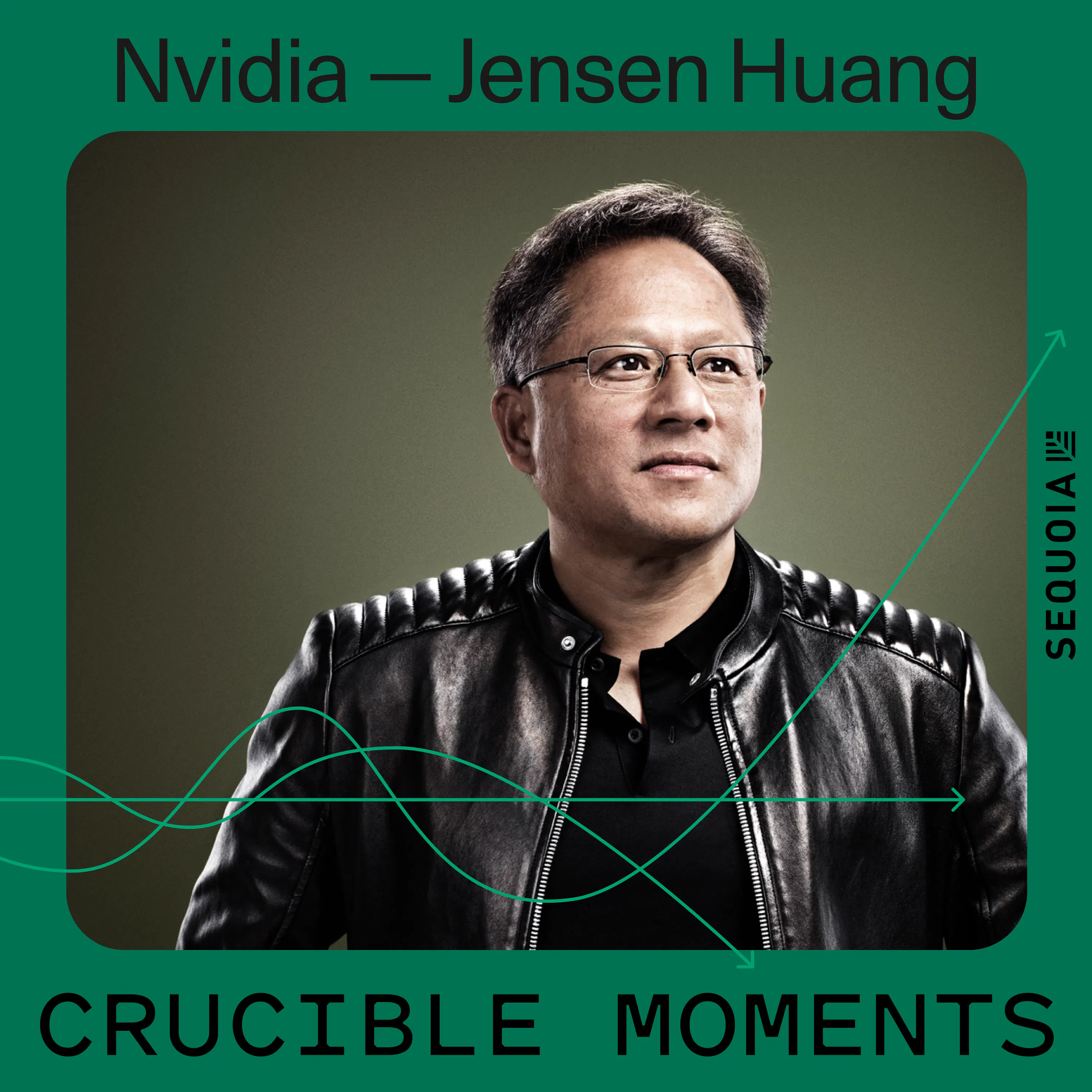
Crucible Moments
Nvidia ft. Jensen Huang - An overnight success story 30 years in the making
00:38:53
CEO Jensen Huang tells the legendary story of Nvidia, from the company’s early days pioneering 3D graphics cards for a niche PC gaming market
Loading summary
Transcript82 lines
- [00:01]
Jensen Huang
I was confronted with a situation where we would finish the project and die or not finish the project and die right away.
- [00:08]
Mark Stevens
We were very concerned about are we going to lose this company or not?
- [00:13]
Jensen Huang
We only got one shot. And if you have one shot, that chip has to be perfect. But how do you build a perfect chip the first time?
- [00:23]
Rolof Bosam
Welcome to Crucible Moments, a podcast about the critical crossroads and inflection points that shaped some of the world's most remarkable companies. I'm your host, Rolof bosam. Almost exactly one year ago, in November of 2022, ChatGPT took the world by storm. Within five days, it had 1 million users. Within eight weeks, 100 million. It was the fastest adoption of a new technology product the world had ever seen. What fewer people know, however, is the decades long story of the company that developed the technology that ChatGPT and much of AI as we know it today, relies on. Today we're looking at Nvidia, the technology company founded in 1993 by Jensen Huang, Chris Malachowski and Curtis Priam. Their initial idea was to create 3D graphics cards for gamers. Nvidia's eventual shift towards AI is one of the most remarkable business pivots in history. It has spotlighted Nvidia on our cultural stage and cemented the company as a global leader in AI computing. The crucible moments in today's episode center on Nvidia's willingness to bet on unproven markets years ahead of time. We'll look at how Nvidia took a risk at its outset, entering a competitive field and targeting a user base few took seriously. How? Days from bankruptcy, they scrapped their product architecture entirely and embarked on a timeline so ambitious, no one thought they could pull it off. And how? The company, finally dominant in gaming, decided to stake its future on a radically new field that many doubted would ever become a viable market.
- [02:09]
Jensen Huang
I'm Jensen Huang. I'm the president and CEO of Nvidia. I met Chris and Curtis. They were at Sun Microsystems. I was at LSI Logic. So we were all from the workstation industry and all we had ever worked on were sun workstations and valid workstations and things like that.
- [02:25]
Rolof Bosam
This was in the 80s, back when most computers were bulky, expensive machines really only available to businesses that could afford them. Sun Microsystems manufactured high end computer workstations and LSI Logic specialized in semiconductors. Concurrent with the computer revolution was the race to create the most sophisticated computer chips.
- [02:46]
Jensen Huang
Very few companies had the ability to build their own chips, with the exception of IBM. Really at the time. And so sun was venturing into building semi custom chips for their computers. Chris and Curtis were building chips at Sun Microsystems and I was the assigned engineer to work with them from LSI Logic.
- [03:04]
Chris Malachowski
So in essence, Jensen was assigned to me. And that started a friendship between the three of us. My name is Chris Malachowski. I'm senior vice president, fellow and co founder of Nvidia Corporation.
- [03:16]
Jensen Huang
We really hit it off. Chris and Curtis are two of the best engineers I've ever known. Incredible people, visionary in architecture and design and really, really enjoyed working with them.
- [03:29]
Rolof Bosam
The chips most companies were focused on developing were central processing units, or CPUs, the general purpose chips that execute commands entered into a computer. But in the early 90s, Chris, Curtis and Jensen were tasked with building something more challenging. A graphics card. A chip that could be inserted into Sun's workstations alongside the CPU to render graphics on screen.
- [03:54]
Chris Malachowski
The three of us went about building this graphics subsystem that was challenging. LSI Logic, who had announced they knew how to build chips this size, had never done it, and we were able to get the job done, each sort of staying in our lane and being at what we did.
- [04:08]
Jensen Huang
One year there were quite a few changes in the computer architecture and the graphics architecture at sun, and the architecture that Chris and Curtis worked on fell out of favor and they decided to leave the company. Chris and Curtis reached out to me and asked me if I would like to leave LSI Logic and join them to build a company. And first of all, none of us knew what company we would build. And I told them that, you know, I wish them well, they're going to do great. I was gainfully employed and really happy doing what I was doing. They kept asking me and finally I said, well, you know, tell you what, why don't we just go out and we can think through what kind of company you guys can go build. And so we would meet at Denny's, which is right at the corner of Capital and Berryessa, this place in East San Jose. I used to wash dishes at Denny's and I was a busboy at Denny's and I was a waiter at Denny's. So I really like Denny's. I mean, Denny's I consider my first company, you know. And so we would go hang out there and it was always a fun thing for me and a fun thing for them. We just sit there and drink a bunch of coffee and the thing that's really great about Denny's is all you can drink.
- [05:13]
Chris Malachowski
We'd show up we'd order one bottomless cup of coffee and then work for four hours.
- [05:18]
Jensen Huang
So we just sat there until we ran out of ideas or ran out of things to talk about and go home and come back and do it again.
- [05:24]
Rolof Bosam
The PC revolution was just beginning in earnest. And the trio recognized this as an important why now?
- [05:32]
Jensen Huang
For with their nascent company, this is now 1993. The PC revolution really started in 1995. We knew that the PC was able to reach price points and a level of ease of use that might actually have a chance to become, you know, quite pervasive. And so we were excited about the PC revolution and we thought, okay, well, what application would we bring to the PC and what would we enable as this computer becomes a consumer computer and goes into the home? You know, what would you do with it? Well, the one thing you would do with it more than anything in the world is play games. The capability, the graphics capability, the multimedia capability of the PC was non existent at the time. There were no sound, there was no microphones, there were no speakers. There's no video, there's no graphics. Basically it was a text terminal. And we thought, you know, maybe 3D graphics would be the thing that'd be really cool. And for the very first time, you have a platform that could both be a computer and use for, you know, whatever you want to use it for, you could also use it to play games. And we just need to go build a chip that makes it possible to play games. None of us had even seen a PC before, so we had to go buy a PC. We bought a Gateway 2000. Nobody even knows how to program Windows or DOS. Nobody even seen DOS. And so we had to tear it apart, start learning about the industry.
- [06:54]
Mark Stevens
If you were to go to market research firms and you ask them, what's the market size for 3D graphics for PCs? In 1993, the answer would have been zero. My name is Mark Stevens. I joined Sequoia in 1989, and in 1993 I became the Sequoia representative on the board of directors of Nvidia.
- [07:17]
Rolof Bosam
Mark has since left Sequoia, by the way, but remains on Nvidia's board. Chris Curtis and Jensen, who still hadn't left his job at LSI Logic, wrestled with the idea of launching a company that made 3D graphics chips for personal computers. But they realized if they were to move forward, they would have two major factors working against them. The first was competition.
- [07:41]
Mark Stevens
The market for 2D graphics for PCs was crowded at this point. The differentiation here was Nvidia was going after 3D graphics, but there's a whole raft of chip companies that came out in the 1980s. You had companies like Xilinx and Altera, companies like Cirrus Logic and Chips and Technologies. One could argue why did the world need Nvidia? Why did the world need another graphics.
- [08:08]
Rolof Bosam
Chip company in addition to a crowded chip market? The second factor working against Nvidia was its target audience and the chip's intended use.
- [08:18]
Mark Stevens
The people who did gaming on PCs at that point were teenagers gaming.
- [08:23]
Chris Malachowski
It just didn't have a lot of respect. It just didn't feel like a first year business that everybody got and everybody appreciated.
- [08:30]
Mark Stevens
And the overall gaming market was much smaller at the time versus the market for movies and other media forms. The gaming market has become huge on a worldwide basis. But back then, gaming on a PC was a fairly small application.
- [08:48]
Alfred Lin
Games were just thought of, not serious applications. I'm Alfred Lin, I'm a partner at Sequoia Capital. Throughout my life, I've always been fascinated by Nvidia and fascinated with games, even though I decided not to do any of that professionally. But I've been fascinated with game consoles and the graphics and how you could represent graphics the most efficient way. I would say a lot of things that don't seem serious, a lot of things that seem like toys can very much start out that way, but over time they have this ability to blossom into other applications.
- [09:25]
Rolof Bosam
The crucible decision for Curtis, Chris and Jensen was do you enter a hyper competitive field of chip making where you have to fight to stand out and if you do, do you position your innovation as a 3D chip for gamers, an unproven market at the time, and bet on the potential of that market to grow?
- [09:49]
Jensen Huang
There are several things that we say in the company and that is, do you believe it or not? The first principles say you start from your assumptions, whatever you believe and you break it all down. And it says, therefore you should do this, ergo this. So why don't you do it? For what reason don't you do it? And so if you believe this is going to change the computing industry altogether, for what reason don't you take this first move? Just start. I think it was towards the end of 1992, beginning of 1993, that I said, okay, Chris and Curtis, I'll go do it with you guys. And February 17th, my birthday in 1993, was my first day of work.
- [10:31]
Rolof Bosam
The founders began looking for investors for their new company and Jensen went to meet with his old boss, the head of LSI Logic, Wilfred Corrigan.
- [10:40]
Jensen Huang
Wilfred said, look, if you're going to start a company, go talk to Don Valentine. And while I was sitting there, he picked up the phone and he said, hey, Don, I'm going to send a kid your way. He's one of my best employees. I'm not sure what he's going to do, but give him money. I went to Sequoia. Don Valentine was there. And he just scares you. I was 29, I just turned 30. I did a horrible job with the pitch, but thankfully he was already instructed to give me money. Don, at the end, he just said one thing. He said, if you lose my money, I'll kill you. We were working in a small office at a strip mall. I think we probably hired up to 20 people or something like that. And here we are, we're going to build a new chip for a new industry. And so we just started from first principles and started building it up. And we specified this chip called NV1.
- [11:31]
Mark Stevens
The NV1 chip was the first device that the company delivered to the market. I believe it took us 18 to 24 months to deliver the chip after the company was founded. And we thought it was going to be a great chip. The reality is the chip was a failure.
- [11:46]
Jensen Huang
It was a great technology achievement. It was a terrible product. You know, when you're done describing MV1, it sounds like an octopus, because what kind of a chip does the PC industry buy that has 3D graphics, video processing, audio, wavetable processing, IO port, game port acceleration, has this programming model called UDA, no applications that run for it. You know, what do you call this thing that sounds like an octopus? You know, when you pull it out of the box, it actually comes with these dongles. And these dongles makes it kind of feel like an octopus. And you need all these things because you gotta, you know, connect the whole computer to it.
- [12:30]
Mark Stevens
The way I've always thought about it is we built a Swiss army knife with lots of functions, and the chip was overpriced for what the market wanted. The market wanted a 3D graphics chip and that's it. And they wanted it as cheap as they could get it and as fast as they could get it. And so it was a flop.
- [12:53]
Jensen Huang
Our customer partner, Diamond Multimedia, we sold them 250,000 MV1s. The retail sales wasn't very good, and so diamond panicked. They returned basically most of those products to us. 250,000 units went out. 250,000. Well, 249,000 came back and practically put us out of business.
- [13:17]
Mark Stevens
We Learned a lot from that, from that failure. You know, nowadays people refer to this as product market fit. And so we had a very good product, but the fit was not there in vis a vis pricing and functionality.
- [13:32]
Jensen Huang
I had to learn all of those things. And you know, how do you position it against the competition? Because the customer's always thinking of alternatives. And so your PC companies are trying to figure out, okay, so this MV1, you can't compare to anything. But it's not as good as this thing at this, it's not as good as that thing at that, but it's incredibly good together. It's really hard to buy things like that. Nobody goes to a store device with army knife and it's something you get for Christmas. And so in every single way, from product strategy, go to market, how to think about the competition, how to think about positioning, how do you even price it? Not to mention, why would you go build such a thing in the beginning? Or are there other ways to go build it? I mean, the list of mistakes that we made and that I made in the first three years of the company, you could really write a book.
- [14:17]
Mark Stevens
I think the lesson that we learned at Sequoia was that we might have been too early investing in the 3D graphics PC market. And that's always a risk or a fear that we have as early stage investors. The failure mechanism for most venture backed technology companies is that they're too early to market, not too late to market. We were out there sort of waiting, you know, on our surfboard in the Pacific Ocean, waiting for that big wave market wave to come in. And you know, if the wave never comes in, you never get to shore and you freeze to death out in the middle of the ocean.
- [14:59]
Rolof Bosam
While the failure of the NV1 chip was apparent, there was a bright spot on the horizon. The company was simultaneously developing the NV2 in partnership with the video game company Sega.
- [15:11]
Jensen Huang
Sega's latest game at the time was Virtua Fighter and Daytona and Virtual Cop and really, really fantastic 3D arcade games. They were completely revolutionary. Sega was also looking for a partner to build their next generation console. And it opened the doors for us both in trying to build their next generation console, as well as encouraging them to take the Sega Games over to PCs.
- [15:36]
Rolof Bosam
On the engineering side, the NV1 and NV2 were developed to support an architecture that rendered images using quadrangles. When Nvidia first launched, it was the only company in the market making 3D graphics chips for PCs. But soon, other 3D graphics companies began to Emerge and their chips supported a different type of architecture, one that rendered images using triangles.
- [16:02]
Jensen Huang
The architecture we chose was clever at the time, but it turned out to have been the wrong architecture completely. This is 1995. Microsoft had come out with Windows 95, and the API called DirectX is the architecture that everybody else uses except us. We had never even implemented a graphics architecture like DirectX before. And the rest of the industry, now some 50 companies are, are all over us. And so the question is, what do we do? If we had finished that game console with Sega and fulfilled our contract, we would have spent two years working on the wrong architecture, while everybody else is racing ahead in this new world that, quite frankly, we kind of started. On the other hand, if we didn't finish the contract, then we run out of money. And so I was confronted with a situation where we would finish the project and die, or not finish the project and die right away.
- [16:59]
Rolof Bosam
Your first trip is a failure and your second trip is doomed. Nvidia had arrived at a crucible moment. Do you finish the job you started and hope the revenue can sustain you, or do you break your contract, scrap your entire architecture, and start from scratch?
- [17:17]
Jensen Huang
This existential moment for our company was pretty difficult, you know, heated discussion among us to try to figure out what to do. And I think the final decision was the right one, which is we have to figure out what is the right path forward long term and work our way back. And the long term answer, of course, is we have to support this new architecture, this new graphics. It's called inverse texture mapping. And we have to abandon the forward texture mapping architecture that we had started, and whatever we had to do to achieve that is the right thing to do. So I went to Sega and to the credit of their CEO, Irimajiri San, I told him our circumstance is that if we finish this game console for you, our company would be out of business. And quite frankly, I think that this architecture that we would build for you would be the wrong architecture, because the world is moving towards this other approach called inverse rendering, inverse texture mapping. He asked me what I'm asking him to do, and so I told him that although there's no reason for him to do this, I would like him to let us off of our contract, relieve us of our responsibility of fulfilling the contract, but pay us in full. And they got absolutely nothing out of it. There was no reason for him to do it. And he thought about it for a couple days and, you know, came back to me and said, you know, I'd like to help you. You can't discount the kindness of people when you're starting your company, when you benefit from the kindness of all the people that support you. But in this particular case, it was some $5 million, I think it was, that they continued to pay us. It was all the money that we had, and it gave us just enough money to hunker down.
- [19:06]
Mark Stevens
After the failure of NV1 and then after NV2 sort of being abandoned, we were very concerned as investors. You know, at this point, we're probably three years into the company, something like that. And it wasn't clear if Nvidia was ever going to sort of have escape velocity. One of the things that Jensen, he said this for many, many years was, we're only 30 days away from going out of business. Well, the fact of the matter is, on a few occasions in the mid-90s, that was true because we were burning cash and developing these graphics devices. You needed some of the best hardware in silicon engineers in Silicon Valley. And these folks do not come cheaply, especially when we were competing with Silicon Graphics, which was sort of a juggernaut at the time for engineering talent, and Apple at the time. So we were very concerned about, are we going to lose this company or not?
- [20:12]
Rolof Bosam
With the last of their resources, the company mounted one more attempt at a breakthrough chip.
- [20:18]
Jensen Huang
We only got one shot, and if you have one shot, that chip has to be perfect. But how do you build a perfect chip? The first time, nobody knew how to do that, because in the old days, you would build a chip, bring it up, write software for it, find bugs, iterate the chip, tape it out again, bring up more software until you get it done. So tape out to production was oftentimes at least a year, year and a half. I told the team that, look, we. We get one tape out. And they said, why? Because if we need more than one tape out, we don't need it. We'll be out of business. And so we get one shot in.
- [20:54]
Mark Stevens
Times of crisis is when real quality CEOs are on display. And this was a time where we as investors and board members discovered that Jensen was really unique in the way he managed a crisis.
- [21:09]
Jensen Huang
I said, let's work backwards. If we get one shot, what do we have to do to make sure that that one shot was perfect? And so we have to do all the software in advance. We had to do everything in advance. And we did it in about six to seven, eight months and on complete fumes. And there was this other company that went out of business at the time And I'd heard about it. It's called iqos. And iqos had built this thing called an emulator and system emulator we called iqos. They said, thanks for calling, but we're out of business. And I said, really? That's insane. We really could use one of your instruments. It's like a size of a refrigerator. You plug it into the PC that you want to emulate for, and you pretend it's called emulation. You pretend like you're the final chip. And he says, we have one in the warehouse that's an inventory. If you want it, we'll sell it to you. And so we bought the scraps out of a company that was going out of business. And we emulated Revo120 MV3, the first PC chip the world's ever emulated. And we taped out the chip, and the chip worked the first time, unsurprisingly to me, anyhow, that the genius of the people that were at Nvidia would come up with the world's best inverse texture mapping engine and completely crushed everyone and revolutionized what we know today about modern computer graphics. We changed the way that chips were designed. We changed the way that you tape out chips, the way almost everything about our company today. Yeah, we saved the company.
- [22:48]
Rolof Bosam
The Riva 128 was a feat of engineering, and in its first four months sold 1 million units. Even more importantly, the expedited process of building and testing the Riva allowed Nvidia to then launch its next chips at a cadence more than twice as fast as compared.
- [23:06]
Alfred Lin
At the beginning, Nvidia was behind. But soon, probably soon after 1999, they were just far ahead of their competition. And you can just see it. So when Quake 3 Arena came out in 1997, you just could see how much better the Nvidia chips performed against others.
- [23:29]
Rolof Bosam
Nvidia's fifth chip was its first programmable chip. It was called the GeForce 256.
- [23:36]
Jensen Huang
That was the world's first GPU. And that was adding programmability to acceleration. So we created the world's first programmable accelerator. A programmable accelerator is accelerated computing. And the benefit of an accelerator is whatever you designed it to do, it does it incredibly efficiently. And so no matter how effective a CPU is with a programmable accelerator, you could be a thousand times more effective.
- [24:01]
Rolof Bosam
This programmability would prove critical to the company's next chapter, but it also paid immediate dividends with programmable shaders enabled by GeForce GPUs. Video games exploded in creativity and popularity. Nvidia went public in 1999. And in a twist of fate, Microsoft, whose DirectX architecture nearly sidelined Nvidia in its early years, chose GeForce to power its new project, the Xbox.
- [24:29]
Alfred Lin
It took five generations for them to get this graphics acceleration right before they produced their first GPU. And so the company was founded in 1993, and I don't think they released the GeForce 256 until late 1999. So it was a long time of just iterating, iterating, iterating until they got it right to produce the first GPU unit. If you solve really hard problems that nobody else can solve, which is what Nvidia has done, and you're patient, you can build a tremendous company over time.
- [25:10]
Rolof Bosam
The success of the GeForce carried Nvidia into the mid 2000s. But as with all companies that break new ground, eventually competitors catch up. And while Nvidia had solidified its position as a major player in the 3D graphics market for PC games, over time its singularity, its shine began to fade.
- [25:31]
Mark Stevens
The PC market at that point was starting to asymptote in growth, and we were worried about that. And since we were selling into the PC, we still had to contend with intel as a competitor AMD to some extent. And so we felt we were always going to be sort of boxed into the PC gaming market and always knocking heads with intel if we didn't develop a brand new market that nobody else was in. Nvidia had invented the gpu, and it was a programmable device, which means that it could be programmed and adapted for applications outside of gaming.
- [26:06]
Rolof Bosam
The 2006 release of CUDA, a general purpose programming interface for Nvidia's GPUs, opened the door for use cases far beyond gaming.
- [26:17]
Jensen Huang
Molecular dynamics, seismic processing, CT reconstruction, image processing, a whole bunch of different things.
- [26:24]
Chris Malachowski
I remember starting to hear and musing about. A lot of graduate students for their research found these, you know, graphics chips at their local electronic store, and they were writing simulators on them and doing research on them.
- [26:37]
Jensen Huang
Universities after another researchers realized that by buying this gaming card called GeForce, you add it to your computer, you essentially have a personal supercomputer. One of the scientists that I saw was in Taiwan, and he was a quantum chemist, and I was in Taiwan at the time. And he reached out to me and said, you know, come and see something. And I went to NTU National Taiwan University, and he opened his closet and there was this giant array of G Force cards sitting on all these shelves with these house fans. Rotating. And he said, I built my own personal supercomputer. And he said to me that because of our work, because of your work, he's able to do his work in his lifetime. And simultaneously, Andrew Ng was working on deep learning at the time.
- [27:31]
Andrew Ng
So around 2008, 2009, my students and I started to work on and push the idea that GPUs could be used for deep learning for neural networks. Hi, my name is Andrew Ng. I'm managing general partner of AI Fund Adventure Studio, and I also lead DeepLearning AI and Landing AI. You know, neural networks have been around for a long time, for many decades, and so have GPUs. But I think the convergence of these two ideas came for a couple of reasons. One is we finally had enough data that we needed that compute to feed into neural networks. And then there was one other breakthrough technology. I remember at Stanford when my students were telling me, hey, Andrew, there's this thing called cuda. Not that easy to program, but it's letting people use GPUs for something different. Could we build a server to use GPUs and see if they could scale up deep learning? And one of my students at the time, Ian Goodfellow, who is my undergrad, helped me build a GPU server in his loan room. And that server wound up being what we use for our first deep learning experiments to train neural networks. We started to see 10x or even 100x speedups training neural networks on GPUs, because we could do 1,000 or 10,000 things in parallel rather than one step after another. That's a total game changer of what you can do with neural networks.
- [29:00]
Jensen Huang
Meanwhile, in Toronto, Canada, Hinton's lab was doing the same thing. Yann Lecun's lab in New University was doing the same thing. They all kind of simultaneously reached out to us, and we realized that maybe there's a new type of computing model that we could create.
- [29:14]
Rolof Bosam
This was just before Alexnet, the first breakthrough in computer image recognition. In 2012, and years before AlphaGo AI was still a niche pursuit.
- [29:25]
Mark Stevens
The biggest risk of trying to pursue the AI market was very similar to the risk the company had encountered back at its founding. The market for AI chips in 2012, 2014, 15. It was a $0 billion market. And Jensen always likes to say that, you know, we're investing in $0 billion markets. This would be spending R and D dollars on a market that may never materialize. There was no guarantee that AI would ever really emerge, because keep in mind, AI had had many stops and starts over the last 40 years. I mean, AI has been around as a computer science concept for decades, but it had never really taken off as a huge market opportunity.
- [30:11]
Jensen Huang
This is the type of risk that unless you've survived building a startup, you're probably allergic to doing. And the reason for that is at this time we're public, we're a multibillion dollar company, we're actually successful now and you know, we've dodged several life threatening challenges. Nobody wants to derail the company. They want to defend the company and protect the company.
- [30:32]
Rolof Bosam
Success can make you risk averse. For two decades, Nvidia had been synonymous with chips for gaming on PCs. Should the company stay in its lane or stake their future on a market that was unproven, but which leadership and researchers around the world felt had enormous potential?
- [30:51]
Chris Malachowski
At some point somebody said, you know, this actually is a way to expand the market. There's a lot of opportunity for computation that wasn't strictly put a color up on the screen. So in order to capture that and maybe take advantage of this growing undercurrent of desire to get access to this, you know, Jensen and the team were willing to go for $0 billion business on the hopes because you got to believe what you got to believe and you put your money where your mouth is. So if we thought this was likely to be an important segment of the market that we could tap into, that we could grow our TAM into, then you do it. You know, I credit a lot of people, not me, with the courage to just go do it and let's see where it takes us.
- [31:38]
Rolof Bosam
Nvidia made a crucible decision that would change not only its own trajectory, but that of the intelligence, entire technology industry. They would commit to AI computing.
- [31:50]
Jensen Huang
This was a giant pivot for our company. We're adding costs, we're adding people, we have to learn new skills. It took our attention away from our normal day to day competition in computer graphics and gaming. The company's focus was steered away from its core business. And it wasn't just in one place. It's all over the company. It was a wholesale pivot in this new direction.
- [32:13]
Andrew Ng
To Jensen's credit, I saw him leap early and place a very significant bet. He started to allocate more resources to it pretty quickly. I was impressed that the CEO of a large company, that he saw it clearly enough to commit his company to this direction early.
- [32:29]
Jensen Huang
As a CEO or anybody who's trying to steer the ship in a new direction, you have to have some intermittent, some near term positive reinforcements. And so you have to keep promoting the idea. Whenever something good happens that reinforces the direction you're going, you have to, you know, put into perspective, what is this, why is this important? How does this help us get to the next level? When we pivoted to ship in that direction, we sought out every single AI researcher on the planet. And our platform being useful to them was the positive feedback that we were getting at the time. Which is the reason why I'm friends with all of the world's great AI researchers. They were all helpful in providing the early indications of future success along the way for me. And you got to make a big deal out of those small wins.
- [33:21]
Mark Stevens
I think we realized that Nvidia was the Spearhead of the AI revolution, really. Within the last two to three years, we saw our GPUs being adopted by large scale data centers and cloud service providers. We began to see the applications again in transportation, healthcare. That was really when we discovered, hey, this is going to be a very diverse and a multi billion dollar opportunity that had, you know, 10 years or 15 years in front of it.
- [33:59]
Jensen Huang
For the last 30 years or so, the computer industry has been advancing at about 10 times every five years. Moore's Law.
- [34:05]
Rolof Bosam
Moore's Law is the famous prediction that CPU performance will double roughly every two years or 10 times every five years.
- [34:13]
Jensen Huang
Now with AI, we're advancing at the chip level, at the system level, at the algorithm level, and also at the AI level. And so because you have so many different layers moving at the same time for the very first time, we're seeing compounded exponentials. And if you go back and just look at how far we've gone since imagenet, Alexnet, we've advanced computing by about a million times. Not a thousand times, a million times, not a hundred times, a million times. And we're here now, compounding at a million times every 10 years.
- [34:47]
Rolof Bosam
This new pace at which computing is advancing a million times every 10 years has been affectionately dubbed Huang's Law.
- [34:55]
Jensen Huang
And so the question is, what can you solve in the past that you were waiting for a million times to solve a problem that you thought, you know, I could solve this probably in about 30 years? Well, if you can solve it in about 30 years, you're probably going to solve it in five. That's the big realization that's groundbreaking. That's really the reason why I think it's an inflection point. Things that look far on the horizon, you really, really ought to think about it not in decade timeframe, but in years timeframe.
- [35:22]
Rolof Bosam
Nvidia's acceleration of computing now includes a platform for transforming data centers and cloud computing and extends beyond AI to anything that can be simulated. As Jensen looks to the future, Nvidia is already building hardware and software for everything from digital twins to climate modeling to drug discovery.
- [35:45]
Chris Malachowski
Everybody suddenly wants to know where we came from. I find it humorous that where the hell these guys come from, we thought they were just gaming and suddenly the Cuda stuff, it allowed us to make a difference in markets that weren't gaming, which I think then help people value the fact that gaming was such a strong market and such an economically large market. We did what was necessary to continue to move the needle, stay in business long enough to let the ideas come together. I met somebody the other day and she said, how do you feel about your success? And I said, well, feels like this overnight success was 30 years in the making.
- [36:26]
Rolof Bosam
There's a concept we talk about at Sequia called the timespan of discretion. What is the timescale across which you operate? How do you stretch your imagination to make an enduring impact? No founder has embodied this notion like Jensen. It's been 30 years since Nvidia launched. Not many of us think in 30 year timeframes. And paradoxically, by seeing its decades long vision through to fruition today, Nvidia's technology is enabling us to accomplish far more in far less time.
- [36:56]
Jensen Huang
Every CEO's job is supposed to look around corners. By definition, we should be able to connect more dots. The CEO also has to be the most bold about what opportunities, what problems we can go solve that nobody imagines us solving. You want to be the person who believes the company can achieve more than the company believes it can. When you're a startup CEO, you're zero and you're trying to become something more than that. The idea that you would be a global anything is insanely ambitious by almost all measures. We shouldn't be here. There are only so many diving catches you can make in life. And it's not just diving catch doesn't mean luck. It does require a lot of effort. You have to realize it's existential. You have to be surrounded by amazing people. And the people that did those diving catches, many of them, most of them are still here. And so it's pretty amazing.
- [37:57]
Rolof Bosam
This has been Crucible Moments, a podcast from Sequoia Capital. We'll be back with season two next year. If you have an idea for a company, we should feature questions about company building or any feedback on the show. We'd love to hear from you, email us@ideasruciblemoments.com in the meantime, keep an eye out for bonus material coming soon. Thanks for listening.
- [38:30]
Jensen Huang
Crucible Moments is produced by the Epic Stories and Vox Creative podcast teams along with Sequoia Capital. Special thanks to Jensen Wong, Christian Malachowski, Alfred Lin, Andrew Ng and Mark Stevens.
- [38:45]
Alfred Lin
For sharing their stories.