← Crucible Moments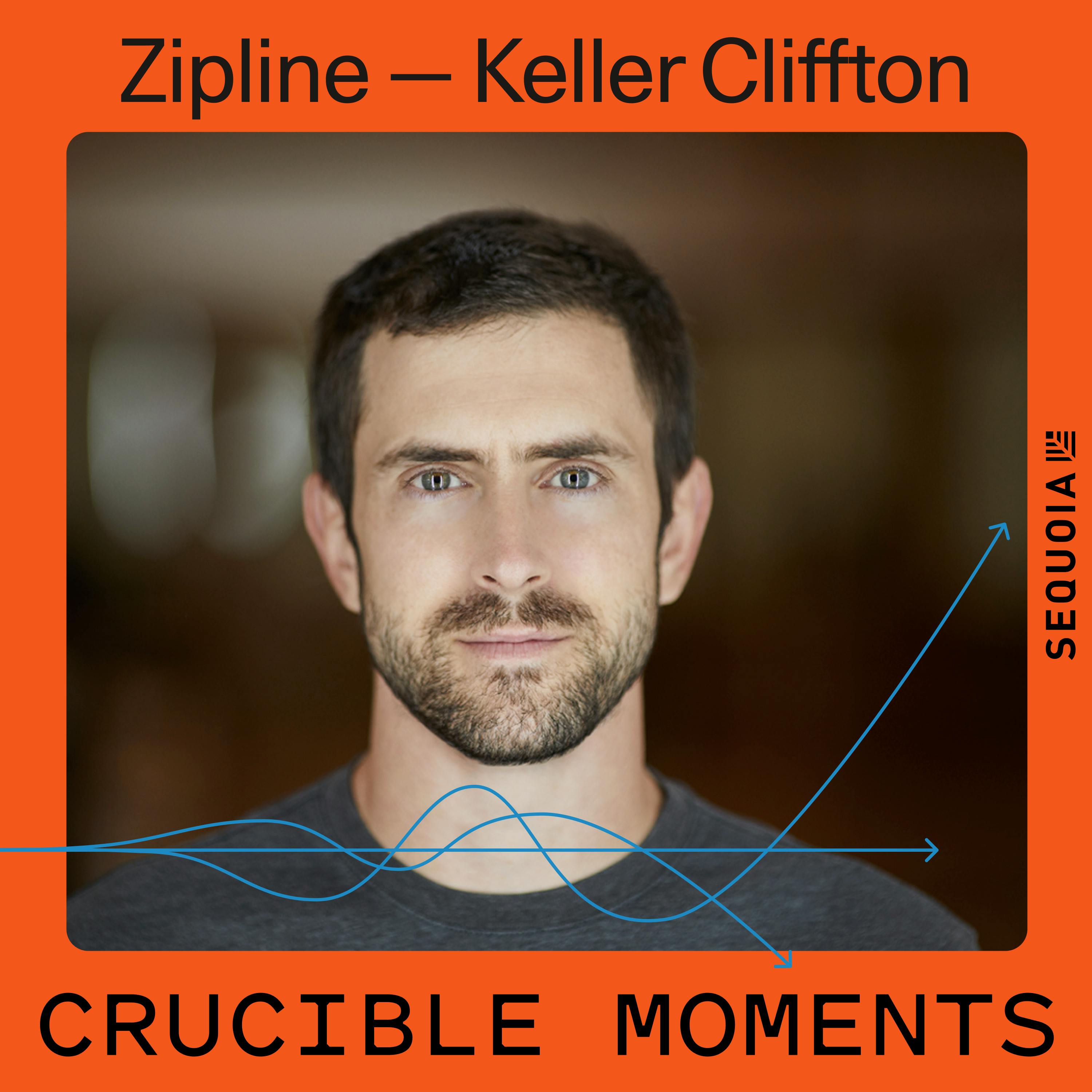
Crucible Moments
Zipline ft Keller Cliffton - Reinventing Delivery with Instant Drone Transport
00:45:55
Loading summary
Transcript100 lines
- [00:06]
Keller Clifton
I think, you know, for a lot of our investors, I think they had largely written the company off and we're like, yeah, the company's just dead. It's not going to go anywhere. Frankly, that was probably the worst and most difficult time I've ever had to go through, like, in my life. It just felt like chewing glass. It's just so scary. It's incredibly difficult. You're totally emotionally raw. You have no idea if you know you're going to make it to the next week, like let alone the next month. And I think that we had to get lucky. And it also helped that we were just totally stubborn and hard headed and we're like, we're doing this. No one's going to get in our way.
- [00:43]
Roloff Wotan
Welcome to Crucible Moments, a podcast about the inflection points that defined some of the most consequential companies of our time. I'm your host and the managing partner of Sequoia Capital, Roloff Wotan. In this season, we'll explore the transformation of finance for the digital age, the story of the world's biggest cybersecurity company, and how a radical approach to game development created Europe's first Decacorn. Today's episode is about a startup's audacious vision to take on global delivery and logistics. In 2014, Keller Clifton presented an idea to his current investors and board. He was going to scrap the direction of his consumer robotics company and repurpose the business entirely towards building an autonomous drone delivery system that would bring life saving medical supplies to remote populations around the world. The response was less than enthusiastic. The challenge of pulling off hardware and software for this type of endeavor would be steep, if not impossible. The investors asked Keller what did he know about drones? What about healthcare or logistics for that matter? The answer was, not a lot. Today, Zipline is a global leader in autonomous delivery, credited with delivering critical supplies to over 40 million people. Today we'll look at the pivotal Crucible Moments that shaped Zipline's rise from a bold idea to reimagining global logistics.
- [02:38]
Keller Clifton
I'm Keller Clifton, the CEO and co founder of Zipline. I didn't even really know that entrepreneurship was a thing you could do graduating from college, but I read Delivering Happiness, which was this book by Tony Hsieh. And I was kind of blown away because Tony and his partner Alfred Lynn had built these amazing businesses coming out of college and they'd actually both lived in the same dorm that I lived in in college. And so it was like, wow, you know me seeing people who had Built these really cool things completely from scratch. It really caused me to, you know, to think differently about what I wanted to do with my life. We were about two years out of college, and a few friends and I got really interested and passionate about robotics. Around that time, iPhones had become totally ubiquitous. And while there were a lot of people trying to build these huge apps on top of the iPhone, we were looking inside the iPhone and seeing all of these interesting components that would be really, really key to building powerful robotic systems for the world. Very few people were thinking about robotics in 2011, but it felt to us like there was this obvious opportunity to try to build the apple of robotics, a big robotics company focused on solving problems in the real world. So, you know, at that time, the idea of building a robotics company was stupid. Like, we're investing in robotics. Nobody was really that interested.
- [04:04]
Roloff Wotan
Feeling stuck, Keller thought back to the book that had inspired him in college and decided to reach out to its author, Tony Hsieh, for advice. Hsieh saw potential in Keller and offered him and his team an apartment in Las Vegas to start building their company. They called it Romotive. Their first product was a robotic toy called Romo that users could control with a smartphone app. Shea also introduced Keller to his former colleague at Zappos and Link Exchange, Alfred Lynn, who was now a partner at Sequoia.
- [04:38]
Alfred Lin
Tony Hsieh sent me an email about Remotiv and asked me to come out to Las Vegas. And when Tony tells me that he has an interesting company, I listen. I'm Alfred Lin. I am a partner at Sequoia Capital. So I went out there, met with Keller and his team. Keller was a very special founder. He would light up the room, is such a good storyteller. And his effervescence for technology for robotics really came through.
- [05:14]
Roloff Wotan
In the first meeting In October of 2012, Sequoia invested in Remotiv. But the team soon faced a painful reality.
- [05:28]
Keller Clifton
We were so extraordinarily naive. You know, when you're 23 years old and thinking like, oh, it would be so cool to build robots, like, let's go figure out a way to turn this into. Into a business. The team didn't really have a ton of expertise that we were bringing to bear.
- [05:44]
Alfred Lin
He started selling the product, and people played with it and they were overjoyed to get the product. But inside of a somewhere between 24 hours and two weeks, they put the product back on the shelf and they stopped playing with it. And so it was really hard to see how this was going to be a large business.
- [06:06]
Keller Clifton
I think ultimately when we started shipping that first product for Emotiv, it started to become pretty clear to us that consumer robotics was not the right place to start.
- [06:14]
Alfred Lin
One day Keller even told me, I don't think this is what we aspire to be. And I told him, did you think that this is the way it would end? And I think that inspired him to rethink what he could do in that moment, which was a tough meeting, a tough conversation. But he was left in one sense, crush in another sense figuring, trying to figure out exactly what he still had at Remotive and what he can turn it into.
- [06:47]
Ryan Oxenhorn
Quite literally everything was at stake during this transition. My name is Ryan Oxenhorn and I am a co founder and responsible for software. At Zipline. We fully shut down the toy company. We kind of like, you know, fully closed that door before knowing which door we were going to open next. And at least for me, I had a pretty simple criteria that I was weighing when considering different opportunities, which was ultimately which of these problems that if left unsolved was a really bad thing for humanity.
- [07:18]
Keenan Weirobeck
We explored a bunch of things together, the three of us, as to what that higher impact could look like. One of which turned into Zipline. Kenan, I'm Keenan Weirobeck and I'm the co founder and CTO at Zipline. What became Zipline was inspired by a few things. My wife is an epidemiologist and kept telling me about these projects in public health that gets stuck on logistics. Things like vaccine campaigns where they have the vaccines, they have the doctors and they just the logistics of actually getting the vaccines where they need to be, when they're needed, just kills the whole project. And that's one of the things that inspired us to go dig into that and really see what that was.
- [07:58]
Keller Clifton
The more we learned about global logistics, the more we understood that, you know, this is a market that really only serves the golden billion humans on earth. Well, if you're the 7 billion people who aren't in the golden billion, your access either sucks or is non existent. As a result of that, millions of people, mainly children, die every year due to lack of access to basic medical products. And we've been making excuses for a hundred years why why it's so hard to get things to where they need to go. Robots had already at that time scaled pretty dramatically in warehouses in some hospitals. And I remember going and seeing this company, Kiva Robotics, and I got to go to one of the Kiva warehouses and see these orange robots running around Inside this warehouse, moving things back and forth, they would go and pick up a shelf and bring it to a human packer. And I remember seeing that thinking, man, somebody's going to do that for outside the warehouse. And that's going to be one of the biggest companies in the world. We thought, man, somebody's going to build an automated logistics system for Earth. And that would be something we would be very proud to spend a decade of our lives working on.
- [09:05]
Roloff Wotan
The team's interest in healthcare logistics coincided with the rise of new technology.
- [09:11]
Keenan Weirobeck
Amazon had just announced that drone delivery is coming any day now.
- [09:16]
Ryan Oxenhorn
The summer of 2013. I remember you couldn't go to a park in San Francisco without seeing someone flying a DJI copter. That was pretty cool. That was an example of like, wow. Technology that was previously just a TED Talk and a college lab demo was now suddenly out in the world.
- [09:33]
Roloff Wotan
The founders began to consider whether drone technology could be applied to the problem of healthcare logistics.
- [09:40]
Keenan Weirobeck
As a very huge tech skeptic, I was like, all right, we're going to go spend time in the field and understand a million reasons why we could never make a dent in this problem. And the deeper we got, the more convinced we were that we actually could solve this problem and that we should go for it. Solving medical supply logistics with drones.
- [10:03]
Keller Clifton
I think it's worth pointing out that all of our investors thought focusing on logistics was an extremely stupid thing to do. And we were talking about, oh, maybe we'll go to Africa, we'll focus on global healthcare. People were like, what are you talking about? I remember some of the conversations with Alfred were rather difficult.
- [10:21]
Alfred Lin
The idea sounded kooky at the time, which was, we're gonna figure out drone delivery. We also challenged them that delivery at scale, you can charge a small dollar amount, but at the beginning, when you're subscale, delivery costs will be very high. And the only kind of applications that would work in that situation are high value applications. He took that into account and then came up with an even kookier idea, which is to do healthcare logistics. You don't know anything about drones, you don't know anything about healthcare logistics. And then on top of that, we're gonna go find a country in Africa where road infrastructure is hard and complicated, and we're going to fly there because they're gonna want our application, which is healthcare deliveries, and we can do it instantaneously versus waiting three weeks for delivery.
- [11:17]
Roloff Wotan
It's common for startups to pivot, but the ambition and magnitude of this pivot is almost unheard of.
- [11:25]
Alfred Lin
Companies make little P pivots all the time. These capital P pivots probably happen less often. But if you're going to be a successful company, you probably will have these re founding moments because Inev, your first product, your first idea is not the product that gets you to the largest scale ever.
- [11:47]
Keller Clifton
I think, you know, for a lot of our investors, I think they had largely written the company off and were like, yeah, the company's just dead, it's not going to go anywhere. I remember, you know, trying to fund the company during that period was extraordinarily difficult. There were just a few investors who were willing to believe in us with like this totally crazy vision of building automated logistics. I mean, frankly that was probably the worst and most difficult time I've ever had to go through like in my life. I mean it's just so scary. It just felt like chewing glass. It's incredibly difficult. You're totally emotionally raw. You have no idea if you know you're going to make it to the next week, let alone the next month. And I think that we had to get lucky. And it also helped that we were just totally stubborn and hard headed and we're like, we're doing this, no one's going to get in our way.
- [12:38]
Roloff Wotan
The team charged ahead with its vision for what would become Zipline. Their next step was selecting a first market to build and test a healthcare logistics system.
- [12:50]
Keller Clifton
We knew we needed a public healthcare system and we also thought we probably needed a smaller country that would be more impedance matching with Zipline in terms of like the velocity we wanted to operate at the way we wanted to innovate. Hard for a really small company to operate with a really giant ossified, bureaucratic government. And so we were looking in Central America, we were looking in Africa, starting to talk to governments. No idea really what we're doing or like how to sign an infrastructure contract with the government. But it ended up being Rwanda, this first country that really took a bet on us saying, yeah, you should build that here and we would use it and we would pay for it.
- [13:30]
Maggie Jim
One of the innate things about Rwanda that made it a perfect first country for us is that first of all they were entrepreneurial like us and they really wanted to become a leader at the intersection of healthcare and technology, which is very much our goal as well. My name is Maggie Jim. I'm the chief of staff to our executive office at Zipline. The nature of Rwanda's topography is that it's super hilly. Even though if you look on in the sky map, it's like 40 miles away. It could be anywhere from three to six hour drive, depending on the weather condition. And so the conventional logistics system is insufficient in solving the problem. The challenge that we could help with in Rwanda would make the impact undeniable. And so all of those things made it the best place we could have started with.
- [14:26]
Keller Clifton
I remember this very specific meeting with the Minister of Health where I was saying, hey, we'll use these autonomous aircraft. It'll deliver all different medical products to every hospital and health facility in the country. And she looked at me and said, keller, shut up, just do blood. And I was kind of blown away by that. But she had a lot of conviction. She was like, look, 50% of transfusions are going toward moms with postpartum hemorrhaging. 30% are going toward kids under the age of five. This is a really hard product to get to where it needs to go, when it needs to be there. You have all these different components packed red blood cells, platelets, plasma, cryoprecipitate, different storage requirements and shelf lives. You have different types of the blood, A, B, A, B and O positive and negative RH factor. Just a really hard thing to get the logistics system right for. And I actually only discovered like seven years later, seven years after that conversation, I was meeting with this minister and she told me, oh yeah, Keller, you never knew. But the reason we said yes was that just that morning, this email had gone around the Ministry of Health about this mom who had lost her life because it took us like nine hours to get a blood transfusion to her. And she had passed away by the time we got it to her. And I remember thinking like, this is so screwed up. There has to be a better way. And that afternoon you happened to walk in. But, you know, she really believed in us. President of Rwanda believed in us. They took this big bet on us and asked us to start delivering blood to 21 different hospitals. And we were like off into the races.
- [15:56]
Roloff Wotan
With Rwanda's blessing and a goal of delivering blood via drone to 21 hospitals across the country, the team got to work on bringing this technology to life.
- [16:07]
Keenan Weirobeck
I was sure when we started zipline, we could just buy a drone. Just like, why wouldn't we buy a drone? Even if it wasn't the best thing to scale on, it would get us out to serve customers sooner rather than later. And so let's find a small aircraft style drone and modify it for delivery and we'll be off to the races. And. And when you're making Things that fly at the time. And still today, the rage is vertical takeoff and landing. But if you want to go really, really far at the lowest price point, you don't do that with a vertical takeoff and landing vehicle. You do it with an airplane. We, like, had that insight and we were all aligned to go do it, despite everybody around us, including some investors, being like, what are you doing? Don't do an airplane. You got to do VTOL vertical takeoff and landing.
- [16:47]
Ryan Oxenhorn
The moment the vision for Zipline really clicked for me was when we got past the idea of a quadcopter and really started to think deeply about an airplane. At first it seemed totally preposterous, like, wait, how? How are you going to make an airplane work for this? And I think it was only a few days of thought experiment and whiteboarding out that we started to realize, oh, hey, the number one thing we are hearing from our customers is each additional kilometer that you can get outside of a region's biggest city is that much more value. We started talking to some experts and realized a pretty small little airplane could fly pretty fast, extremely efficiently, and range estimates for that, you know, 10x20x30x. What a quadcopter could do was pretty mind blowing and pretty obvious in hindsight.
- [17:40]
Roloff Wotan
Zipline built what it called Platform 1, a compact unmanned aircraft designed to cover long distances and deliver small packages by paper parachute. While the company had done preliminary testing in California, it soon found that operating a drone in a testing area is one thing, flying it out in the real world is another.
- [18:01]
Keller Clifton
We didn't know this until we launched, but Rwanda has some of the most volatile weather of any country on Earth. And so we were operating in lightning storms, rainstorms, insane dust storms.
- [18:12]
Keenan Weirobeck
We'd be flying very low over mountains. And so before we went to Rwanda, we engaged with our friends at NASA, the world experts in this low altitude. And they helped us figure all this out. How are we going to simulate it? How are we going to tune this? And we go to Rwanda and we see that the air over these mountains in thunderstorms is way worse for the aircraft. Way more turbulence than we were expecting. Not like 10%, more like 10x more. And so we go back to them, we're like, hey, what do we do wrong here? We in a hurry. We got to get this figured out. And they sort of were scratching their heads for a minute. And then like, you know, now that we think about it, we've never actually had the data from flying low over mountains and storms because no one does that General aviation Pilots would never do that because that would be suicidal. And medevac helicopters stopped doing that 50 years ago because way too dangerous. And so that's probably why we didn't accurately model what the wind and air is doing low over the mountains in these stormy conditions.
- [19:10]
Keller Clifton
We had to harden the system to, over the course of many years of like, just learning by doing and learning from the real world and observing what was breaking and then fixing it, making it more reliable.
- [19:20]
Roloff Wotan
Perfecting the drone's hardware was demanding, but it was only a small part of the challenge of delivering blood to a remote location.
- [19:30]
Keller Clifton
Probably the biggest thing that we realized, maybe the biggest crucible moment for us was like understanding that the vehicle is only 15% of the complexity of the problem. We had thought, oh, we're going to design this really cool robot, we're going to design this really cool autonomous aircraft, it's going to deliver things autonomously. But it turns out that in a national scale logistics system, there are a lot of different kinds of software and systems that all have to be interacting in concert to actually have an instant delivery service that people can rely on with their lives.
- [20:01]
Maggie Jim
We didn't really know anything before we had a package. So I ended up building the first half of the operation, which is what we call fulfillment operations, which is everything that has to do with how we interact with the hospitals, how they place order, how we actually manage and store the inventory, and how we do pick packing. We thought the hospitals can place order via a nice iPad interface. I visited some of the health facilities. They barely had cell coverage in most parts of the hospital. The other thing was there's no standard operating procedures for how you like pack and fly and receipt blood that was just delivered from the sky. And so we had to do testing with the Ministry of Health as well, you know, drop test to understand and make sure that the product's still intact. There's no hemolysis.
- [20:47]
Ryan Oxenhorn
For the first maybe three or four years of building Zipline, I remember every single night going home with the sensation that my brain was melting and that every single day the scope of, of the problem ahead of us had just grown. So, you know, we worked a long 14, 15, 16 hour day, but the list of to dos only grew.
- [21:10]
Maggie Jim
I remember the first time the Rwandan Civil Aviation Authority came to visit our distribution center because we have to get approval to fly beyond visual line of sight. Otherwise how do you deliver it to the hospitals? Because we never had regulatory to fly beyond visual line of sight, but we've never actually had a zip disappear into the horizon. You know, we had to like walk them through all of our procedures, do all the pre flight checks and everything. And then the moment the ZIIP launched and then it, you know, 10 seconds later, it disappeared into the horizon. I think the whole company stopped breathing in that moment. And you just never seen it before. It was the very first time we were seeing it. And we just kept looking down and up, down and up, like, is it coming back yet? Is it back yet? And then finally when it came back, it felt like the longest, like five minutes of our lives. And to see on the iPad and team members on the other side just be like, it delivered. We ran back inside the tent, made sure they couldn't see us, and then we started just screaming and jumping up and down because that was the very first time any of us had ever seen an actual beyond visual line of sight flight.
- [22:24]
Roloff Wotan
The team's hard work was finally paying off. But Zipline was still struggling to support just one hospital. And the Rwandan government was growing impatient.
- [22:35]
Keller Clifton
We had done a soft launch and so we had done like a few deliveries to this first hospital that we were serving. But the President was coming to inaugurate the distribution center. He was bringing all of this, like international press because this was going to be the first autonomous logistics system on Earth.
- [22:51]
Maggie Jim
It was an event that was being broadcasted to the entire nation. The President was very proud to show that he's worked with the technology company to bring this to Rwanda.
- [23:03]
Keller Clifton
And we were awake at 3am because the launchers for the system were completely broken. I mean, it was fundamentally unreliable.
- [23:12]
Maggie Jim
The rain came in and so it kind of like ripped through the floor. It was like muddy, it was water puddles everywhere.
- [23:18]
Keller Clifton
This event is supposed to start at 8am Nothing is working. The launcher is a total piece of garbage. And to make matters more interesting, whenever the President goes somewhere, they send this like special forces team of soldiers, like to secure the area beforehand. So there are like four Navy SEAL looking guys with like submachine guns sitting there watching us try to fix this launcher. And you could just tell they're looking at us like, you guys are totally fucked. After a couple hours, we somehow got that launcher like to a state where it could like ostensibly function. The President showed up, System operated absolutely perfectly for the three hours that he was there.
- [23:55]
Maggie Jim
It was magical. Like everything played out perfectly. And the package just like magically floated down super gently and landed in the middle of the banner. It was like picture perfect. And I got the opportunity to actually go and pick it up, open it up to show the president, like, yes, the blood has been delivered and it was intact. It was an amazing moment.
- [24:18]
Keller Clifton
It was like a total miracle. And then he left, all the press left, and then everything broke again for the next eight months as we had to, like, fix things and iterate. So, yeah, that's really what the early days felt like.
- [24:29]
Keenan Weirobeck
We live by the motto at Zipline that we don't do these things because they are hard. We do them because we think they'll be easy. During that period of time, the Minister of Health started sending us photos of mothers who were passing away, who were bleeding out during childbirth, because they were trying to provide us our motivation to get this done. When you have that in front of you, all kind of academic debates about technology decisions go out the window because you know exactly what your customer needs and why they needed it and when they needed it. And not only is that super motivating, but focusing.
- [25:01]
Roloff Wotan
After relentless obstacles, perseverance, and iteration, the system at that first hospital was finally operational.
- [25:10]
Keller Clifton
Once it was working well for that hospital, it was clearly saving lives. Then it was like, can we expand to 21 different hospitals? Interestingly, that only took us about three months. It was nine months to get the first hospital working, and then three months to get to all the 20 other hospitals that we had signed up to serve. And then over time, we expanded from there to 1000, and then to 2000 hospitals and health facilities that are served via Zipline. It just required an extraordinary amount of humility to be like, we will do whatever it takes and we will learn from the real world and we'll assume we know nothing. And that wound up being a good assumption.
- [25:42]
Roloff Wotan
By 2019, the company was servicing over 1,000 hospitals and had expanded from Rwanda into Ghana and later Kenya, Cote d' Ivoire and Japan. In 2022, a study published in the Lancet revealed Zipline's powerful impact. The company helped reduce blood wastage across Rwanda by an astonishing 67%.
- [26:07]
Alfred Lin
I always get chills when I hear the stories that without Zipline, this baby would not have been born or this mother would have passed away, or this person would have lost a limb.
- [26:19]
Keller Clifton
We were willing to ignore a lot of naysayers, a lot of people who told us that this was stupid and we were willing to put up with a lot of pain and a lot of setbacks along the way because we could meet patients who were alive because of what we were doing. We could meet moms and kids who had received blood transfusions or like life saving deliveries that they would not have otherwise received. And I think that that started to become this pretty powerful sense of like, there is a mandate. We felt like there was a moral imperative that if this could serve one hospital, then it should serve every hospital in the world. And I think that that really wound up becoming the thing that for us it was like, yeah, it has to expand.
- [26:58]
Roloff Wotan
As Zipline saw increasing success in Africa, the company set its sights on a new market, one that many believed impenetrable.
- [27:07]
Keller Clifton
Zipline always wanted to build an automated logistics system for Earth. And we wanted to build the first logistics system that served all people equally. So the vision was definitely global. A lot of investors said, wow, what you're building in Africa is completely amazing, but it'll never scale in the U.S.
- [27:21]
Keenan Weirobeck
Really, the biggest challenge there was a regulatory one.
- [27:24]
Keller Clifton
One of the biggest challenges from a regulatory perspective in the US has been that drones started with these commercial quadcopters and those are always flown within visual line of sight. So you have a human pilot who's responsible for the safety of that vehicle and they're not allowed to fly it so far away that they can't see it. Obviously, when you really dream about what you want the future world to look like and what are the exciting commercial applications of this kind of technology, you want to be able to fly beyond visual line of sight. And so for a decade, it's been clear that getting permission to fly beyond visual line of sight in the US is really the holy grail. From a regulatory perspective. The challenge in these highly regulated markets, especially for new technology, is that it's a little bit of a chicken the egg problem, right? It's like what a regulator really wants to see is 50 million or 100 million commercial autonomous miles with zero human safety incidents. But what a company needs is regulatory permission so they can go prove that the system is Safe and get 100 million commercial autonomous miles without being able.
- [28:23]
Maggie Jim
To fly beyond visual line of sight. It doesn't serve the use cases.
- [28:33]
Alfred Lin
It was a crucible moment to enter the U.S. is this the right time? Is there a why now? Do we have enough safety data to prove to the FAA that we can do this effectively and safely?
- [28:47]
Keenan Weirobeck
We're betting that not only can we influence, but that the regulator is going to put the effort into it, that they are going to be motivated as much as we are. That was a big, big bet. Because obviously it's not unheard of for a regulatory process for a brand new technology like autonomous flight to take a year or two longer than the regulator might want it to or in some cases, you know, five, 10 years longer, which, of course, in startup vocabulary, that's called the end of a startup.
- [29:16]
Roloff Wotan
Despite enormous risk, in 2019, the team decided to move forward and attempt to enter the US market. But just as Zipline began the uphill battle of winning regulatory approval to fly beyond the visual line of sight, demand for Zipline services surged in ways no one could have predicted.
- [29:40]
Keller Clifton
When the pandemic hit, there were a bunch of health systems that basically had urgent needs to deliver things directly to people's homes.
- [29:47]
Maggie Jim
Covid really all of a sudden made it so obvious why automated logistics and being able to deliver in a contactless way is a crucial part of the resiliency of a supply chain. It gave us an opportunity to demonstrate a lot.
- [30:04]
Alfred Lin
Since Zipline was a healthcare logistics business, they made the pitch that you can suspend some of the rules, regulations of the FAA because they provided a service that allowed them to save lives. And they used that exception, and they talked to the FAA about flying medical equipment and PPE across the country.
- [30:30]
Keller Clifton
We had always known that the US Would be an important market that we would need to launch in the next couple years, but Covid accelerated that, and we launched with a couple health systems just a few months later.
- [30:39]
Roloff Wotan
The pandemic gave Zipline a powerful opportunity to prove its value, as the company continued to work toward FAA approval to fly beyond the visual line of sight. While other companies in the drone industry bemoaned the FAA's excruciatingly slow pace of regulatory approval, Zipline chose a path rooted in patience and partnership.
- [31:03]
Ryan Oxenhorn
For five years, the FAA was really just a punching bag where people in the industry kept blaming them as the recent drones were not taking off in the US And I really think that was actually just. They were treated as a scapegoat.
- [31:20]
Keenan Weirobeck
If you're thinking that way, you have the wrong mindset. To be successful, you have to treat them as a partner.
- [31:25]
Maggie Jim
We realized that the best way for us to actually work with them is to develop the framework with them. Because if we were trying to kind of like, take what they have and try to, like, edit our way around was going to be the wrong way to approach it.
- [31:40]
Keenan Weirobeck
The clarifying moment for me was when the FAA sent a contingent of folks to Rwanda first. The fact that they would just do that to go see our operation there at scale. But when that contingent came back raving about the elite level of operation that they saw that they came back believing that actually was a bar setter for how the FAA and scaled autonomous flights should work. In the US the fact that they saw what we already knew, that our Rwanda operation and all of our operations around the world were operated at this elite international standard level, the fact that they believed that, too, that flipped a switch for me, where I was like, okay, we can work with them. This is going to go well. We'll get there eventually.
- [32:27]
Roloff Wotan
Zipline's strategy of engaging with the FAA as a partner rather than an adversary paid off. In September 2023, Zipline became one of the first companies to receive FAA approval to operate beyond the visual line of sight, marking a major milestone for autonomous drone delivery in the United States.
- [32:49]
Maggie Jim
Getting the Vyond visual line of sight flight to fly in the US Was monumental. It's not just, like, because it's technically cool and we're the first ones to do it, but all of a sudden it meant this is now going to be viable as a business.
- [33:04]
Keller Clifton
It certainly felt like it was a milestone 10 years in the making. Because we had started building zipline in 2013, thinking ultimately, like, will this ever be possible?
- [33:13]
Ryan Oxenhorn
When the technology was actually safe enough to operate at scale in the US Airspace, it was approved. So bringing them along for that journey and shaping the technology based on what their concerns were was essential.
- [33:25]
Roloff Wotan
Zipline had grown from a scrappy startup building toy robots to delivering blood in Rwanda to becoming a major player in global logistics. But as operations scaled in the U.S. the limitations of its original drone platform one, became clear.
- [33:44]
Keller Clifton
The initial platform that Zipline built, which we creatively called Platform One, you know, we're an engineering company. Platform One was originally designed to fly over pretty significant distances. And interestingly, companies like Walmart ended up saying, hey, like, let's just use that to start delivering directly to people's homes. Will that work? It wasn't really designed to deliver to people's homes.
- [34:05]
Keenan Weirobeck
Our customers had been asking us for years, let's not just serve outside these metro areas, let's serve inside the metro area. And we're like, no, we don't do that, we don't do that, we don't do that. And once we had told every customer that over and over and over for a couple years, it's a pretty good sign that you maybe should think about trying to solve that problem.
- [34:21]
Keller Clifton
It kind of became clear to us two things. One is that overall, like, logistics directly to homes, building, instant delivery, and what we thought of as teleportation directly to homes was basically almost an infinitely large market. It was clear to us that there was demand for many tens of billions of deliveries every year for this kind of a service. And it was also clear that Platform one, the overall architecture of the system, was not designed to serve millions of homes in a suburban or even in an urban location.
- [34:52]
Alfred Lin
The shift to Platform two was another crucible moment. We got Platform one to be a reasonable sized business and profitable, but it wasn't large enough for Keller and the Zipline's team's scale of ambition.
- [35:07]
Maggie Jim
We're like, okay, Platform one is getting to the point where the business is self sustaining. We're in the moment where now we can save every dollar possible to invest in the new platform and that this platform in the next five years can help us achieve 100 to 1000x growth and kind of capitalize on a new market that is fast growing. And so that was the business thesis.
- [35:40]
Keller Clifton
Hardware companies are hard. And most hardware companies die. Obviously most hardware companies die before shipping anything. But then there's like another crucible moment which is like the second product because you need to like prove something quickly and get something launched into the real world because every new product is 100% bet the company we will for sure die if this product is not successful moment. And Platform two, we had to be extremely confident that this was the right thing to build and that it would be successful. That required us to think totally differently about the overall architecture of the system. It's not easy requirements to meet to be able to deliver in a way that is 10 times as fast, half the cost, zero emission, and then have it be silent and extremely accurate. It's a hard product to build.
- [36:28]
Maggie Jim
I always joke like, we're not Amazon or Google. We don't have a parent company that prints money. We have to be like extra careful. We have to work on, you know, economics. We have to make sure that we're using every dollar wisely, spending it as if it's coming out of your own pocket, because we're betting kind of the future of the company. Keenan led its small team to really de risk it from a technology standpoint. Like, could we actually tackle some of these use cases? And what would the design look like? How crazy is it going to be?
- [36:56]
Ryan Oxenhorn
They came up with this crazy contraption where the aircraft undocks, flies up high, flies along, and from altitude on a string, it lowers down a second robot. And that second robot is going to be silent and safe and small. And that is going to leave the package behind. And then that second robot will fly back up along the string and redock with the first robot. And then that whole flying robot will then fly back and dock on the Ground to recharge for its next flight. We called it like the most complicated game of mousetrap ever. And frankly, I thought Keenan might have been insane.
- [37:37]
Keenan Weirobeck
So the little thing we call the delivery sip, the aircraft that comes down on the string to the ground and actually puts the package down, that's the only thing that comes anywhere near you. The drone that's doing the heavy lifting is 100 meters up, so as high up as the Statue of Liberty is tall. So it's way up there. It doesn't feel like it's in your space. It looks like a dot in the sky. But this little robot that comes to the ground does come in your space. And having been someone who likes robots and has been designing robots forever, I am hyper paranoid, because most robots, most people hate, take a robot, show it to most people, and they're like, what? Like, get that away from me.
- [38:08]
Ryan Oxenhorn
I don't want that.
- [38:09]
Keenan Weirobeck
There's a lot of layers to that, right? How does it move? Can make people feel comfortable or not comfortable, right? Is it smooth? Is it not smooth? How does it sound? We spend a lot of time making sure it's nice and quiet, but then also, how does it look? We have a phenomenal industrial designer on the team who built all kinds of prototypes of different shapes, evocative of different things, and everything that felt like a little animal, like a puppy or a seal or baby seal. When it felt like that, it was very disarming and felt very okay. And that's part of what we converged on the design. Now it is very evocative of a small cute animal. And of course, it also moves in a very non threatening way that also makes it feel very acceptable.
- [38:46]
Ryan Oxenhorn
They got that working good enough to deliver to a small folding table outside on our cattle ranch. And we call that the conviction milestone, where we invited everyone from the company to come out and see this delivery experience. And Kenan basically posed this challenge to pretty much the company, which is, come see what this delivery experience is like. And if you have as much conviction as we do in this, let's bet the company on it.
- [39:10]
Keenan Weirobeck
And the night before, Ryan texts me and says, no hard feelings, but like, I want to give you a heads up, I'm going to try to kill the delivery aircraft. Comes to the ground concept tomorrow. And I remember thinking to myself, I was like, all right, Ryan hasn't seen this demo yet, so let's see what happens. And by noon that day, Ryan was like, all right, how fast can we ship this thing?
- [39:32]
Ryan Oxenhorn
From the first time I saw that Janky concept working. I immediately knew we had been working on drone delivery for eight, nine years at that point, but I still couldn't picture how this could deliver to my home. And then seeing that early concept of Platform 2 totally changed everything for me.
- [39:53]
Roloff Wotan
In March of 2023, Zipline publicly unveiled Platform 2. Then in January 2025, Platform 2 completed its first customer delivery in Peerage, Arkansas.
- [40:07]
Maggie Jim
Platform 2 really marks the next stage of growth for the company. While I think back to 2016 and we were gearing up to launch the 21 in Rwanda, and in some ways it almost feels familiar because we're trying to launch like this similar number of stores for Walmart at this very moment. And it feels familiar, but it's also a whole new level of scale for us to achieve. And the market is huge. It's definitely us really realizing the vision.
- [40:42]
Keller Clifton
If Platform 2 failed, Zipline would have failed. I don't think there's any surviving. And it's hard. You know, I think it's easy to come up with a hit once. It's hard to come up with hits multiple times. And I think this is the reason that there are so few transformational hardware companies in the world. But it's also the reason that when you do succeed at doing that, those are also the most valuable companies in the world because it's thin air.
- [41:03]
Roloff Wotan
Today, Zipline delivers everything from meals and groceries to blood and specialty pharmaceuticals for the likes of the Cleveland Clinic, Walmart and Chipotle. Platform 2 deliveries are now starting to roll out with the goal of dropping a lunch order on your doorstep from out of the sky. Zipline will be reimagining the future of logistics for years to come.
- [41:33]
Ryan Oxenhorn
Longer term, I think the one thing that definitely motivates me is the fear that Zipline might just be a small blip in history. And I'm really hopeful that in the long run, we can really change how the planet works. You know, we're essentially rolling out a layer of robotic infrastructure around the world that both frees up humans and frees up space, but also provides a totally new level of service that really no legacy provider is able to match. I think a lot of people think everything is getting worse in the world and the future is just destined to to be a sadder, darker, colder place. And I really love that. Zipline shows that, no, the future can be exciting. The world can work better.
- [42:21]
Maggie Jim
I think about when, like, TV was commoditized, when, like, mobile phones and PCs were commoditized, it transformed the world. And I think about us Commoditizing in some ways that basic access to whatever you need is really going to change the way people live. And I think we haven't seen that yet. And it's going to be really cool.
- [42:44]
Keller Clifton
To put it into perspective, you know, it took Zipline eight years to do our first million commercial autonomous deliveries. And we now have customer demand that requires us to do a million deliveries a day starting in a couple years. You always kind of dreamed like, oh man, like eventually I think this is going to be totally normal. Like this is going to be a completely normal part of our kids lives. And it'll seem really OD that we used to pay a human to get into a 4,000 pound car and then like move the steering wheel back and forth and like drive to a restaurant, pick up something that weighs five pounds and then drive it five miles out into the suburbs to deliver it to your home. Our kids are going to be like, wait a minute, what did you, how.
- [43:25]
Alfred Lin
Did you do that?
- [43:26]
Keller Clifton
So we always thought probably there would be this moment where it goes from sci fi to normal. So I mean, we're totally naive. I think that, you know, our superpower has been assuming that we're stupid and just getting into the real world quickly and learning by doing Life is short and we should be choosing missions that are extremely inspiring and that you imagine like, wow, I mean, if this were working, this would fundamentally change the way the world looks. This would be a future that I would be very proud to hand to my children. And I guess the flip side of that then is these companies are a real pain in the ass to build. They're harder than building B2B SaaS company or, you know, the next app that might just get popular and explode. When you think about the next decade, like what does it mean for us to build abundance for humanity? That is primarily going to be companies that are building hardware or operating very complex services in the real world. And it's going to require founders with the tenacity to build those kinds of companies. And probably a lot of times the instinct would just be to give up. I guess Zipline is an example of like, but, but what if you don't? What if you just keep going even once all your investors think you're dead, even once everybody has written you off? If you just keep going, you can eventually build something that works and is important.
- [44:55]
Roloff Wotan
This has been Crucible Moments, a podcast from Sequoia Capital.
- [45:07]
Keller Clifton
Crucible Moments is produced by the Epic Stories and Vox Creative podcast teams along with Sequoia Capital. Special thanks to Keller, Clifton, Ryan Oxenhorn, Keenan Yrobek, Maggie Jim and Alfred Lynn for sharing their stories.