← Culture Apothecary with Alex Clark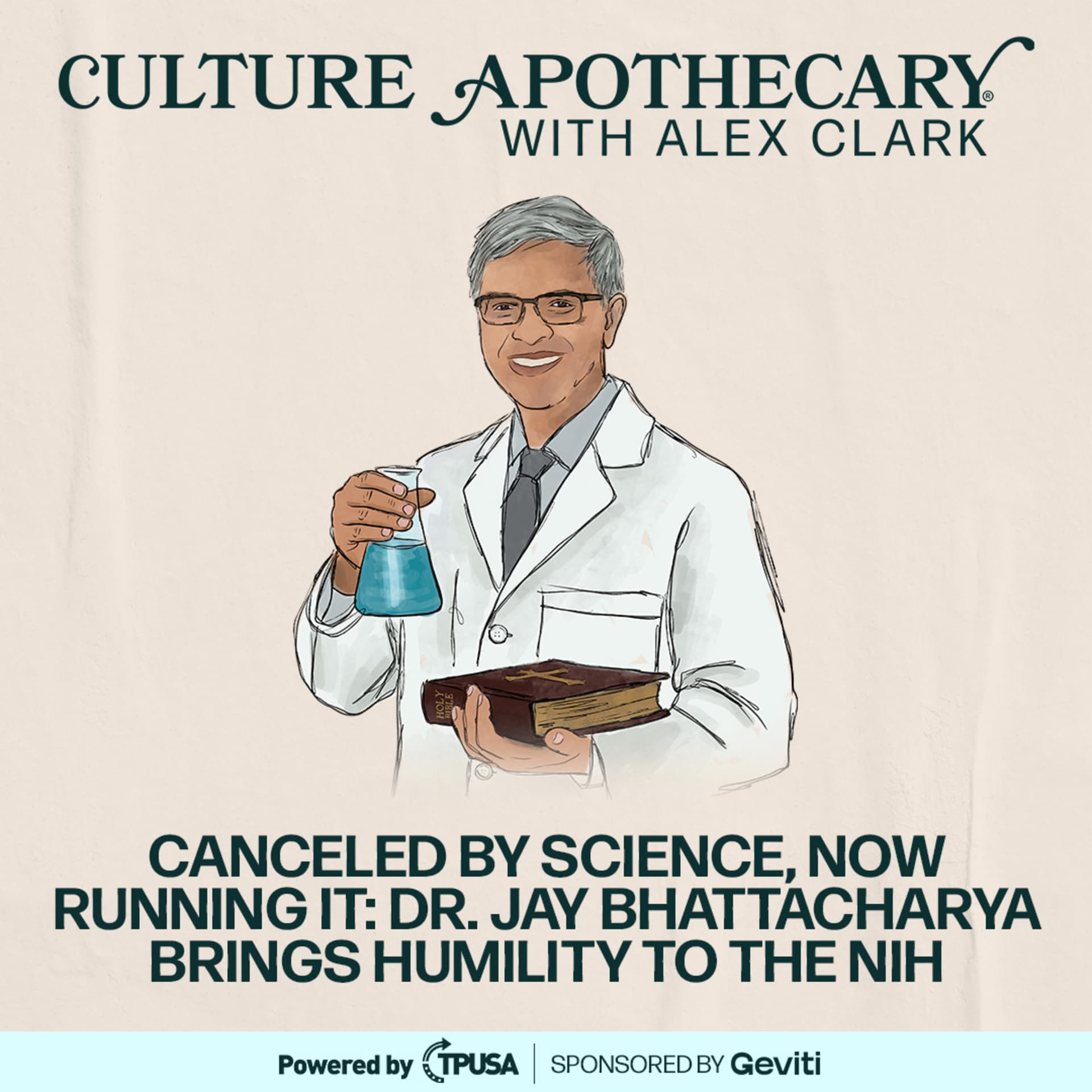
Culture Apothecary with Alex Clark
Canceled By Science, Now Running It: Dr. Jay Bhattacharya Brings Humility to the NIH
00:49:27
Loading summary
Transcript117 lines
- [00:00]
A
The mandates for the vaccine, the COVID lockdowns really shattered trust from the American public in the nih. Why is this version of the NIH different than the one that failed them?
- [00:12]
B
I've seen what the NIH can do to help create a cadre of scientists who actually want to learn the truth and help people. But at the same time, you were right. The trust is shattered. I think the NIH is worth saving and I think it's savable. We have to make sure that the work of the NIH actually translates over to better health. We actually have to use science to make Bank America healthy. The problem that went on happened is that you had a few people at the top of the scientific food chain getting to decide what everyone else thought was true.
- [01:06]
A
What happens when questioning the scientific consensus gets you labeled dangerous and then puts you in charge of the very institution that tried to silence you? Today's guest has lived that story from co authoring the Great Barrington Declaration to being publicly dismissed as a fringe epidemiologist. Dr. J. Bhattacharya now sits at the helm of the National Institute of Health at a moment when public trust in science is fractured and fragile. In this episode we talk about dissent in medicine, free speech and science, COVID lockdowns and their fallout, chronic disease, environmental health, vaccines, and whether the NIH can truly serve the people again rather than the institutions that fund it. Dr. Bhattacharya is a physician, epidemiologist, health economist and the director of the National Institute of Health with a background at Stanford University and decades of research in population, health and medical policy. Watch this episode on the real Alex Clark YouTube channel or culture Apothecary on Spotify and don't forget to pause. Leave a five star review for us and tell everyone why this is your favorite podcast. Please welcome Director of NIH Dr. Jay Vattacharya to Culture Apothecary. The first thing I want to start out with is just congratulating you on the news that at the time we're recording this came out yesterday we're filming at America Fest and yesterday this news comes out that we're doing all of this incredible work working with detransitioners and really incentivizing hospitals to stop mutilating children. Can you kind of talk about that?
- [02:30]
B
I'm the director of National Institute so let me just focus on the science to start because then we'll talk about what the policies was. A lot of parents were told that if they didn't let their kids transition, meaning hormone blocking sort of mastectomies for girls, a whole, whole bunch of irreversible surgeries. If they didn't let that happen, that their kids were gonna commit suicide. That's a form of blackmail, in my view. And the reason why I say that is because there was never any scientific evidence of any value, of rigor that actually demonstrated that doctors were telling parents that on the basis of nothing, nothing real. They would tell patients and families that if you, oh, well, you can do hormone blocking and you can block puberty and it's reversible. Actually, that's not true. Especially if you do it for a sufficiently long time, it's not reversible. And so on the basis of scientific lies, we basically put parents in a very difficult position. And especially for kids that are troubled, you know, teenage years are difficult for everybody, I think. And so you can understand there'd be kids that are, like, having a tough time. And especially when there's, like, social media, these, like, social contagion that's happening. And then you have the power of science supposedly telling you, you have to do this, let the kids transition, or else they're going to kill themselves. That's how we find ourselves, where we were. And yesterday there was a whole suite of announcements by Secretary Kennedy, with President Trump's full backing, saying, we're not going to let this happen anymore.
- [04:07]
A
How did you feel hearing that?
- [04:09]
B
I was absolutely thrilled. I mean, again, let me just stay with science and we'll talk about the policy in a second. To me, the perversion of science, using science. I mean, I'm a scientist. I've been in science. I entered science because I want to do good for the world. I was in favor of making America healthy for the last 40 years of my life. My life. That's the purpose of my career, more than just America. And I think the idea that science could be used to essentially harm children, it's been a tragedy to watch. I mean, of course, this happened during COVID as well, with the lockdowns and the school closures and so much else in the name of science. It's been just devastating to watch. And it felt so good to be part of a. An announcement, an administration, a set of policies that's. That's seeking to reverse that, at least in this, in this case, of detransitioning.
- [04:57]
A
Do you think, as a scientist, that having humility when it comes to science is. Is crucial? And do you think that Bobby Kennedy is doing that, bringing humility back to science?
- [05:08]
B
You can't be a good scientist without humility.
- [05:10]
A
Yeah.
- [05:10]
B
I mean, I just. Just to be blunt, if you are a scientist and you are always right, you're probably a very bad scientist. I mean, you have to. You have to, like, challenge the conventional wisdom. If you're a scientist in places where your expertise says, okay, this isn't right, and then let nature decide, let experiments decide, let reality decide what's right. And as a scientist, it's very common that you'll have ideas that when you test them, they're wrong. There's nothing wrong with that. That's actually good for scientists to have that. It's kind of a strange blend of uber confidence that you know what's right, but then humility when you see data that contradicts it, that you change your mind. I mean, that's the easiest way to always be right is to change your mind.
- [05:50]
A
How do you reconcile. Who is it? The American Academy of Pediatrics. Am I thinking of the right group that is really against these recommendations?
- [05:58]
B
Yeah.
- [05:58]
A
What do you think about that?
- [05:59]
B
Once upon a time, I actually had a lot of respect for it. During the pandemic, they were all in on closing schools. Now, how is it that a pediatrics group that supposedly represents the best interest of children was advocating to keep close schools closed when there was no scientific evidence in favor of that? They were all in favor of mandating vaccines, the COVID vaccine, specifically for kids as young as six months old, where the risk benefit ratio didn't actually warrant that kind of. And then for detransitioners, I mean, I challenge anyone who's actually from the American Academy of Pediatrics, look at the evidence. There's been reviews in Scandinavia, in the uk, and now this amazing report that Secretary Kennedy ordered out of HHS in the United States, all documenting that scientific evidence doesn't support the AAP position.
- [06:52]
A
Really?
- [06:53]
B
Yeah.
- [06:53]
A
What is it exactly that Bobby Kennedy is saying we're going to do with detransitioners?
- [06:58]
B
Well, a few things. So on the clinical front, if hospitals are going to engage in this process, we're going to stop paying them, like Medicare. They'll lose all Medicare payment. Like, they're. These are. I mean, just to be blunt about this, we are going to remember this as one of the darkest moments in medical history.
- [07:17]
A
100%.
- [07:18]
B
I mean, kind of like we think about, like, frontal lobotomies. We used to, like, recommend those once upon a time.
- [07:23]
A
Some might even recommend it to me now.
- [07:25]
B
I don't think so, Alex. I don't think so, Alex. But, but, but, but, yeah, I mean, those kind of like, dark, Dark episodes in medical history. I, I believe that we will look back in, in, in, in. In the fullness of time and say, well, this was one of those dark moments in history of medicine. Um, and so we're just, we're just. The hospitals that do this. They're not going to get, they're not gonna get money from the government. We're gonna start at the nih. We're gonna start doing research on helping detransitioners like Chloe Cole, who's actually at this event announcing this, because I don't want the doctors and patients and families to be making decisions about detransitioning based on bad evidence either. We need to have gold standard science. You asked me earlier about Bobby Kennedy. He is surprisingly humble, actually. I mean, I've, I've had arguments with him, arguments, you know, with him about scientific matters where, like, you know, we learn from each other. Right? It's, it's actually kind of, kind of neat. He'll change his mind. You know, I think that you have no choice if you're, if you're going to be doing science or talking about science, you have to understand that no one, no single person on earth knows everything.
- [08:32]
A
When you got into the NIH and you were really looking at everything and how it's been done for, you know, years and years and years before you, what was some of the most shocking, jarring things that you kind of came across that you were like, how. How is this happening?
- [08:48]
B
So I was a professor at Stanford until 2020. Stanford is a fantastic school. Until 2020. I had a great time there just doing my thing as a scientist. In 2020, there was like, there was essentially like this, this huge pressure to like, fall in line with the lockdowns and the people who didn't, you know, people like Scott Atlas, a man named Johnny Ioannidis, who I believe is one of the best scientists on Earth. Michael Levitt, a Nobel prize winner. We all got tremendous pressure from the administration to stop, stop talking. That is a violation of academic freedom. And why is that important? Because academic freedom, if it actually exists, groupthink can't exist. What I found at the NIH was that scientists at the NIH had to get permission from the director in a way, or the sort of the bureaucracy, if they were sending scientific papers out for publication. I mean, that's just shocking to me. Right. I fully expect there will be scientists at the NIH who will write papers I don't agree with as the director. Sure, that's a good thing.
- [09:44]
A
That, to me, shows Integrity.
- [09:46]
B
You have to accept the fact that I can't know everything. And so I have to accept the fact there may be scientists that will find things that I don't think are true now. But if I look carefully, I'll believe them. Or maybe I won't. I don't know. I mean, but I. So I put in a policy where they don't have to ask that kind of permission.
- [10:04]
A
Were they excited?
- [10:05]
B
It's funny, I don't. I'm not sure they trusted me at first.
- [10:08]
A
They're like, this is good. This guy is crazy. Yeah.
- [10:10]
B
It's just because, like, they've been so long under this regime where, like, if you said something that the leadership didn't agree with, you weren't allowed to publish the paper.
- [10:17]
A
That's not science.
- [10:18]
B
It's not.
- [10:22]
A
Let's talk about this story I over overheard in Pilates because apparently we need a public service announcement for spouses everywhere. This chick is talking about her stinky husband. She says he's a walking biohazard smelling like a mix of gym socks and cheese. It's ruining their intimacy and she doesn't know how to fix it. I'm like, so you're just standing there doing nothing? Doing nothing to fix this. How can you stand living like that? Honestly, like somehow this is acceptable behavior for a human being. It's not. You cannot just marry a stinking manchild and pretend the world won't notice. I almost threw a my personal zebra deodorant adder. The only clean deodorant that actually works. It's for men and women. Aluminum free Paraben free fragrance free. Goes on smooth, not chunky. Smells amazing. Two formulas, with or without baking soda. So even if your husband has the constitution of a toddler who hates soap, Zebra's got him. So do your job, Mrs. Pilates. Buy Zebra, save your husband's dignity, your nose, and maybe, just maybe, humanity. Go to yay zebra.com, use code Alex for 10% off. That's yay zebra.com code Alex. Your friends will judge you less and your husband might stop clearing a room. I realized something was wrong when my hairbrush looked like a crime scene. Not thinning, vanishing. Like my hair had joined a startup and quietly folded. So naturally, I panic. I research collagen and discovered most brands are running a seed oil Ponzi scheme. They take one bag of collagen, fluff it up with gums and oils, don't list it on the label, and call it wellness. That's not beauty, that's Enron. That's why I use Agent Ator's holy mane, known as the Hermes of collagen. Two ingredients. That's it. Wild caut, deep sea fish in saltwater pearl. No fillers, no oils, no chemical escapees. It's non agglomerated, tested for heavy metals and it meets strict European standards. Which already tells you it's better than anything made in a strip mall lab. Unflavored, tasteless. Throw one or two scoops in your smoothie or coffee or matcha or milkshake. Boom. 15g of protein. Hair, skin and nails. Handled like an adult. Now let's talk about thinning hair for both men and women. You should get Holy Growth 84. This is a leave in scalp spray by Agent Nour. It's non greasy. It uses reden nasal and spermidine. Science words that basically mean more hair, less shedding spritz morning and night. Takes 10 seconds. 84 days later, you look like you made better life choices. Your hair is looking glamorous and growing. And for my nervous system also got to recommend their calm beauty agent, A Tour's calm beauty. Cherry flavored little sachets. No melatonin, no knockout. Just calm mood, sleep, longevity. Fewer gray hairs, fewer existential spirals. I drink it in sparkling water like I'm pretending everything's fine. Okay, go to agentour.com use code Alex Clark for 15% off. You can use that on anything on their website. Those are just three of my favorite products. That's agentour.com code Alex Clark for 15% off. When people hear the Great Barrington Declaration today, what does it represent to you and how did it change your life?
- [13:22]
B
Oh, it changed my life entirely. So first the Great Barrington. Just some context. The Great Barrington Declaration. I wrote it with Martin Koldorff, who was then at Harvard, who got fired from Harvard because of the vaccine mandates. And then Sunetra Gupta of Oxford University. She's one of the top epidemiologists in the world. Three of us wrote this in October of 2020. And I'll tell you, this is the one thing I'm the most proud of in terms of my work as a scholar, as a scientist is the Great Bantam Declaration. But it is also the least original thing I've ever written.
- [13:53]
A
Why do you say that?
- [13:54]
B
Okay, so here's what it said. It said, look, it's October 2020. Covid has been around for many, many months now. We've already seen the harm that has been done to closing schools for children. You know, suicidality is way up. Depression, anxiety, it's done huge damage to the poor because of the economic damage and the dislocation caused by the lockdowns. The lockdowns are a disaster, so don't do them. No lockdowns. But we also know that older people are vulnerable to the virus, and we're not doing a good enough job protecting them from the virus. Like we have to protect nursing homes better. Let's use what resources we have to protect older people from the virus. At the same time, let younger people and other people who are less vulnerable live their lives because the harm from the lockdown is worse than whatever increased likelihood of getting the disease is. That is the way we've handled all these respiratory virus pandemics in the past. I mean, if you go back in time in the United States and around the world, we protect the vulnerable and we don't harm the less vulnerable. That's how we've done every other. That's the normal standard playbook. The Great Barrington Declaration was just a restatement of that normal playbook in hindsight.
- [15:06]
A
Why do you think this happened? Was it a red herring? Let's throw something crazy out there to really scare people into not voting for Trump? I mean, what was that about?
- [15:15]
B
I mean, I think there was some political aspect to it, but this was worldwide, Alex. This was happening literally everywhere. It wasn't just about the president. Imagine that It's October of 2020, and in March of 2020, you. You are one of the top scientists in the world running an agency like the NIH or the WHO or something, and you've recommended lockdown, and you're watching all around. The disease is spreading anyways. The lockdowns are starving the poor of the world, causing havoc to working class populations, to children. And you're thinking to yourself, you know, well, we. It's like communism, like, y', all, you know, I'm sure you've heard what. Like, people would. Sometimes they'll say, well, the problem with communism, it just hasn't been tried yet. Well, it has. It's been tried, and tens of millions of people have died as a result of it. Right? You can never get it pure enough. So they. They're essentially the leaders. Many of the scientific leaders of the world were doubling down on a failed policy because they wouldn't admit they were wrong. And to do that, they had to create an impression in the public that all scientists agreed with them. And so that's why the Great Barrington Declaration was such a threat to people like Tony Fauci. Because for them, scientists from Harvard, Stanford, Oxford saying this is wrong meant that there had to be a debate, there had to be open mindedness, there had to be discussion, and that was the last thing they wanted.
- [16:34]
A
Do you think that criminal charges against Fauci would be justified?
- [16:37]
B
I mean, this one's tough because I believe very strongly in forgiveness. I do believe in justice. I mean, if, if, if he did something that broke the law, let the DOJ decide that. I, I don't, I mean, I'm not gonna. Wouldn't, I wouldn't, you know, gainsay that. Of course, you know, there's a presumption of innocence until you're proven guilty. I believe you're strongly in that. For my part, as a scientist, what I want is an honest scientific discussion. I think that actually has a bigger impact on his legacy than going to jail would, if you had an honest scientific discussion. That said, look, these lockdowns, the vaccine mandates and all that were a tremendous mistake. And Tony abused his position in order to push them and push scientists aside so the debate couldn't happen. That's a huge black mark on his reputation. He'll go down in scientific history as, as, as having essentially abused his power to stop science from like, doing the thing it's supposed to do.
- [17:33]
A
Francis Collins called you fringe, that you had dangerous ideas. You now lead the nih. What does that moment reveal about how dissent is treated in science?
- [17:45]
B
That's really sad for me because I, I had and have tremendous respect for Francis as a scientist. And of course he's also very famously. He's also a Christian.
- [17:53]
A
Yeah.
- [17:54]
B
And so it was when I first saw the email that he'd written about me calling me and my great parenting declaration. Co authors, Fringe epidemiologists Sunetra Gupta is one of the very top epidemiologists in the world. Martin Koldorff, who was one of the very top biostatisticians and epidemiologists at Harvard University. I mean, it really shocked me. In that same email, he called for a devastating Takedown. This is October 2020, just a few days after he wrote the declaration. That led to like vicious media smears about me. I wanted to let the virus rip and kill people like I spent my life trying to protect people from. It was very sad. But I've had the chance to like break bread with him. I had breakfast with him. We prayed for each other. I mean, I believe in forgiveness. I can't live my life seeking retribution. I mean, I think if I live my life seeking that kind of vengeance, it'll destroy me. And I won't be able to accomplish the things I think are really important, and that is to restore science to where it should be and actually use science to make America healthy.
- [18:57]
A
What role does free speech play in medicine? And what happens when it's suppressed?
- [19:01]
B
I mean, you can't have medicine or science without free speech. It's not an accident that the United States is the world's leading power in science. It's because of our tradition of free speech. When you have suppression of free speech, what you end up with is groupthink and the role of politics on scientific outcomes. It becomes paramount. Right. Just look at the old Soviet Union. So there were biologists, a very powerful biologist named Lysenko in the Soviet Union who didn't believe in Mendelian genetics. And he got Stalin to throw scientists who did believe in Mendelian genetics, which is really a true theory, in jail into gulag. And as a result, people starved in the Soviet Union because the agriculture stagnated. That's what happens when you have no free speech in science. It's messy. Right? People are going to disagree. People are going to criticize each other. That's. But that's much better than the alternative.
- [19:59]
A
Some people question the legitimacy of Maha because they say, well, President Trump loves Diet Coke and McDonald's and KFC, so this can't even be real. He doesn't actually believe in this or care about this. I have my theories. I want to know what you think. Do you believe that President Trump really believes in Maha, even if he doesn't necessarily abide by every single Maha principle himself?
- [20:21]
B
I mean, if Maha were a sort of, like, authoritarian. Everyone's, like, watching behind my back of what I eat. Do I exercise the right way? No one would want it. Right. I mean, it's actually. It's Maha is to help set you free.
- [20:37]
A
Mm.
- [20:37]
B
It's not to enslave you. And President Trump absolutely is a huge fan of Maha. Bobby tells me every. That he gets calls from President Trump almost every other day, and they just talk about Maha. They talk about, like, you know, what's the cause of autism, or, you know, I think the president genuinely wants to make America healthy.
- [20:56]
A
Okay. I saw the funniest. I was, like, in tears, laughing. The funniest quote from President Trump, maybe, ever, ever, to me anyway, is he was asking Azer something. He said he wanted snacks. So he said, okay, bring in the poison. And then they bring in this, like, basket of snacks. He picks what he wants. He goes, okay, take the poison away. I was like, look, that's Proof right there that Bobby Kennedy is having at least some sort of influence on him.
- [21:21]
B
No, he is. I mean, there's a really funny picture from, I think it was like, January 2025, and they're on, like, President Trump's plane, and it's like, Bobby Elon, the president, I think, was Don Jr. Yeah, they're having McDonald's. They're having the look on Bobby's face. And I pick. He's like, absolutely priceless.
- [21:38]
A
It's so funny.
- [21:40]
B
But, you know, I mean, the thing is, is it's not. Again, not. It's not like a you must do this or you're. Or you're a bad guy kind of thing. It's like, here's what. Here's what the scientific evidence says for the tools to keep yourself healthy 100%.
- [21:53]
A
And I mean, I'm like, guys, if President Trump wants to eat this stuff, fine. You certainly don't have to. I don't choose to. Bobby doesn't choose to, you know, unless he's being hazed on a plane, 2am or whatever. I'm just kidding. But, like, he does recognize and. And listens to Bobby when he says that there is a chronic disease epidemic with children. We need to get to the bottom of it. Look at the stats. Look how sick children are. We have to do something. And President Trump says, yeah, let's look into it. Who cares if he wants to eat this or drink that? He's the only president we've ever had who has set green lit. Let's go forth with gold star science.
- [22:27]
B
I mean, he. I got to stand behind him as he was signing a presidential executive order, essentially asking the nih, ordering the NIH to double down on our investments in pediatric cancer. I mean, this is a man that cares deeply about the health of children, and he wants science to lead the way on. Actually has hurt to see the press sort of display him as if someone who doesn't care about science or. Same thing with Bobby. They care deeply about science, but they want science to translate into better health for people. They want scientific debate. They want the kind of permission to have scientific ideas that you weren't previously allowed to have and then have data lead the way on what ends up being what people believe is to be true.
- [23:20]
A
So last week, my friend Ashley Newlywed calls me up and she's like, alex, my husband, won't stop farting under the covers. It's like I'm trapped in a little Dutch oven with a human pressure cooker. Good for him.
- [23:32]
B
Him.
- [23:32]
A
But Ashley, not so much. She's over there sweating like a hog and like she's running a marathon in a sauna while her husband's just letting loose. I told her to get cozy earth sheets because I'm a good friend and I know what's up. These aren't your average sheets. We're talking viscos from bamboo, luxuriously soft, breathable and cool enough to keep you from turning into a human soup in the middle of the night. And if you've ever been trapped in a blanket with someone who thinks their farts are natural, you know the importance of temperature regulation. Cozy earth sheets will keep Ashley cool, calm and collected, even while her husband turns their bed into an all natural gas chamber. These sheets are so breathable, I'm telling you, they might as well be air conditioning for your bed. She said it was like she was sleeping in a cloud instead of feeling like she was stuck in a prison of hot, humid, silent but deadly fumes. Plus, you can try them for 100 nights and if you don't love them, return them. But trust me, you're not going to want to go to cozy earth.com use code ALEX for 40% off temperature regulating sheets, apparel and more. Get that sweet cool fart free sleep. Trust me, you're gonna feel the difference the first night. That's cozyearth.com code Alex for 40 off sleep warmer, lounge softer and avoid Dutch oven disasters. You know, our kids are in the middle of a silent health crisis and nobody's really talking about it. What we've been told is normal for our children isn't. Faces are shrinking, jaws are narrowing, and it's causing a mouth breathing epidemic that is quietly stealing their health. Your kid is always sick, bad attitude, adhd, bedwetting, poor sleep, snoring, all sorts of issues, chronic congestion, teeth grinding, crooked teeth, and more. If your child has even one of those signs I listed, it is a red flag. That is why airway dentist Dr. Ben Maragula, Dr. Cali Hale and Dr. Kevin Goals founded Tooth Pillow. It's a revolutionary virtual dental program that addresses the root causes of airway and developmental issues in kids. Tooth Pillow doesn't just manage symptoms, it actually helps fix the problems affecting your child's sleep, growth and overall health. It starts with a simple virtual assessment from a Tooth Pillow airway dentist. You can use Code Alex Clark For a free video assessment today, go to toothpillow.com click is my child a Candidate? And then use Code Alex Clark. Take the first step towards healthier sleep and development. That's toothpillow.com code Alex Clark the mandates for the vaccine, the COVID lockdowns really shattered trust from the American public in the nih. Why is this version of the NIH different than the one that failed them?
- [26:04]
B
I mean, first, I agree with you. It shattered. It shattered my trust. The NIH is institution I love. Like I have been supported by the NIH my entire career. You know, I was trained by taxpayer dollars given to me, which I treasure, to become the kind of scientist and doctor I am. I've seen what the NIH can do to help create a cadre of scientists who actually want to learn the truth and help people. But at the same time, you were right. The trust is shattered. What I've tried to work on is I ask myself, what can I do to help fix that? Because I think the NIH is worth saving and I think it's savable, right? So first we have to make sure that the work of the NIH actually translates over to better health for people. We actually have to use science to make America healthy. Life expectancy in this country from 2010 to 2019 flatlined. First time in a century that life expectancy hasn't increased in this country over a decade. And it's only in 2024. We're back to 2019 levels after the collapse during COVID We have to make sure that the advances, the amazing scientific advances that scientists have from the NIH translate over to better health for people. That's first goal. And I've seen, we've done lots and lots to make sure that that happens. And we're not just going to be funding work to suppress people. There's no more devastating takedowns. It's going to be science unleashed for the benefit of the American people. I mean, that's what Bobby Kennedy's asked for. That's the President asked for. That's what I'm going to deliver for the nih. And second, the problem that when it happened is that you had a few people at the top of the scientific food chain getting to decide what everyone else thought was true. Right? The best way to protect kids is to shut their schools down. That wasn't true. It wasn't true that the scientific evidence said that the best way to protect your kids from killing themselves is to trans them. Not true. The scientific evidence doesn't say that. But you have scientific authorities like the AAP we said earlier, getting to decide what scientific truth. You know, this is like the dark ages. Like back before the first scientific revolution, you had high ecclesiastical authority getting to decide what was true about physical reality. Right. The first scientific revolution was no, a person with a telescope gets to decide what's true because you can check yourself, everyone can look through a telescope, see the same thing. See if the thing I'm saying I see is right or wrong. It doesn't matter if I'm the Pope or a king or whatever. That's the first scientific revolution. The Dark Ages was authority gets to decide what's true over physical reality. We need a second scientific revolution where you have. Instead of, I'm the head of the nih, Just because I say something is true in science doesn't make it true. It's never been the case. Instead, if I say something and lots of other independent teams of people find the same thing, then what I'm saying is true.
- [29:01]
A
Right?
- [29:02]
B
If they don't, then it's not. With the nih that Bobby Kennedy enabled me to lead, that President Trump's enabled me to lead, we're gonna get a second scientific revolution restoring reality as the basis for truth rather than authority in science.
- [29:16]
A
For people that believe that the NIH serves institutions rather than people, are they wrong?
- [29:22]
B
Not if it's well run. If you are doing real honest science, you don't know what you're going to find. It's really dangerous for, for, like, you know, pharmaceutical companies, for institutions that are used to doing things a certain way based on what they think science is saying. Like, for instance, like the discovery of the, of the, of the, of the, you know, the, the automobile, like, and the. Basically it overturned the whole, the whole horse and buggy industry. Right. Imagine if the horse and buggy industry got to say, well, you can't do research on, on, on automobiles in like 1900 or something.
- [29:56]
A
Yeah.
- [29:58]
B
What we have is like, and you can see this with Elon Musk, you see all these normal ways of doing things that everyone thinks is gonna be like that forever. And you have one little scientific advance and all of a sudden everything changes. Right. And it overturns, all the industries overturns. It's a very dangerous thing, but it's also very productive. It has to be focused on things that really matter for people.
- [30:19]
A
When you took over the nih, did you find that there was an ideological or political monoculture? And if so, how are you working to change that?
- [30:28]
B
There was some of that. There absolutely was some of that. I'll give you an example of that. Right. So about a month and a half in, I did a town hall, sort of introducing myself to all the nih. And during the Town hall. I said that it's possible that that work that the NIH supported alongside dispensing meanly, the Chinese were to blame, but might have caused the pandemic.
- [30:49]
A
Did people gasp and fall out of their chairs?
- [30:52]
B
Actually, a bunch of, of this postdoc union, they stood up and walked out on me. I'm like, okay, they don't want to talk about it, I guess. But at the same time, I've gotten messages from all across the NH from scientists who are like, you know, just thanking me for wanting open scientific discussion. I'd say, like, think about scientists is we're not always the bravest people on earth. And so like. But we do care about reality. Right? So what I'd say, like 90% of the NIH, the scientists that work there, they're excellent scientists. They just want to do their work and they kept their heads down and what, assigned to the DEI statements because otherwise they were going to get fired. They're not ideological. They really just want to do science. And I've unleashed them. No more DEI statements, no more. None of that, none of that nonsense. I just told them to go do science and have academic freedom so you can argue with each other. 10%, 5%. I don't know, there's, there's some like, politics there, I think. And what I've seen is that that faction has gotten less and less over time.
- [31:54]
A
Like, great.
- [31:55]
B
Yeah. So I'm, I've been, I've been pretty heartened to watch this. You know, you're still going to see some. Yeah, but because I, I don't, I'm not a. I don't want to purge people. That doesn't make sense. What I want to do is I inspire them back to what they should be doing, which is science for the benefit of the American people.
- [32:09]
A
There are some criticisms of people in Maha of the nih. They feel like, you know, the NIH sometimes prioritizes really rare diseases over chronic conditions like diabetes. Is that a fair critique?
- [32:20]
B
I mean, it's true that, that we made that there's a lot of support for rare disease research. Actually, I think it's not bad because it turns out that often the advances you make in rare disease research have benefits elsewhere. So this is not exactly a rare disease, but some of. There's a disease called sickle cell anemia affects a lot of, especially African American kids. And it's like, terrible. Those kids are in the hospital all the time. They have these pain crises. It's a single gene mutation. And when I was in med School. I looked at it. It was tragic. Right. I was a med student. I saw some patients with it. I never thought we'd see the day where we'd have a cure for it. And we do. We have a cure for it. And part of it was investments in rare disease research.
- [33:05]
A
Yeah.
- [33:06]
B
At the same time, it's $3 million for treatment. I want to invest in lowering the price of that treatment. That will have big impacts because that same kind of manufacturing process, if we invest in that, in lowering the price of it, will have impacts on cancer treatment, on a whole host of other diseases where you can treat it with these cell therapies. Lower the price of manufacturing in one area and all of a sudden everywhere else you have lower price treatment.
- [33:34]
A
And President Trump is very motivated to lower drug prices and treatment prices.
- [33:39]
B
Absolutely.
- [33:40]
A
Yeah.
- [33:40]
B
It's been, that's been heartening to watch too.
- [33:42]
A
Is the NIH seriously investigating environmental health threats such as glyphosate, microplastics and fertility disruption, or have those concerns been sidelined?
- [33:51]
B
No, we have a whole institute called the National Institute of Environment Health Sciences that's focused on. On environment health threats. Actually, just to give you one example, the Vice President, he asked the NIH to conduct a study on this. Remember that East Palestine train derailment?
- [34:08]
A
Yes, yes, yes, yes.
- [34:09]
B
There was a huge chemical explosion and all these folks lived around the area in Ohio where it is. They felt abandoned.
- [34:18]
A
Yeah. I would be terrified.
- [34:19]
B
At the Vice President's behest, we are conducting a study to see what those environmental exposures are doing to people there and finding ways to mitigate it. We're absolutely committed to seeing how environmental exposure can bad things can harm people and working to mitigate it.
- [34:39]
A
Millions of Americans are now using GLP1 drugs like Ozempic. What do we still not know about the long term effects of drugs like Ozempic and WeGovy?
- [34:51]
B
It's funny because I studied obesity as a one of my scholarly topics for and I gave up because I couldn't find something that would actually last long. It was very frustrating, actually. The body weight of the United States kept going up and up and up. Last year was the first year that it actually went down on average.
- [35:09]
A
Crazy.
- [35:10]
B
We don't know. It's like if you're on Ozempic for a while and you lose weight and you get off of it, you know, you start to gain your weight back. Is it, is there some transition that like makes it. That actually poses a health threat to you? There's like some evidence of muscle loss if you take it for a long time. Some people have these rare side effects, vision side effects, and other side effects. But on the other hand, a lot of people have benefited from it, especially people who have had a lot of trouble, struggling with their weight and especially if they're diabetic. I think that there's good evidence of benefit. There's still, you know, if you're. I don't want kids to be on it forever.
- [35:47]
A
Right.
- [35:48]
B
I'd rather have them, you know, living healthy, like choosing, you know, good diets, exercising. I think that's. That's the primary way we should be dealing with this. But it might have a role, like, you know, especially for. For people who are already, you know, quite overweight or diabetic.
- [36:07]
A
You ever actually try to use your health insurance? I tried last year. Went in for something minor, filled out all the paperwork, spent two hours on hold listening to music that sounded like it was made by a drunk robot. And they denied my claim. Denied. I'm like, wait, I pay every month so I can be denied? What am I funding here? A Netflix for bureaucrats. Let's be honest. Navigating health insurance feels like trying to solve a Rubik's cube blindfolded. It's expensive, complicated, and somehow you still get screwed when you need it most. Last year alone, one in five Obamacare claims got rejected. Health insurance is broken. But here's the thing insurance companies do not want you to know. You don't have to play by their rules. Crowd health is a platforming community that puts the power back in your hands. I got the chance to talk to Andy, the CEO a few episodes back, and he straight up told me insurance companies are incentivized to deny claims and jackup premiums. They are not on your side. Crowd health is built by people who get that. They're our people. You get telemedicine visits, cash, pay, doctor databases, discounted prescriptions, all without being trapped in some insane network. Every month, you help fund another member's medical needs. And when it's your turn, the crowd has your back. Covering illness, injury, pregnancy, home, birth, whatever. No insurance, just people helping people. Let crowd health help with your health healthcare needs. Get started today for just 99 per month for your first three months by using code culture@joincrowdhealth.com Crowd health is not insurance. Learn more at joincrowdhealth.com that's joincrowdhealth.com Code culture. You know how everyone's always chasing the next thing in wellness? Well, my friend was one of those People who tried it all, supplements, fancy creams, yoga, cryotherapy, and still had nagging joint stiffness and sore muscles after workouts. Then she started using this red light therapy device from Juve that I recommended and it really did change her recovery game. After just a few weeks of consistent use, she told me that she literally noticed less stiffness, less inflammation and a real energy boost on the day she used it. It is clinically tuned wavelengths of red and near infrared light that penetrate your cells and help support healthy cellular function. That is the science behind it. These wavelengths energize your mitochondria, which is your body's energy engine, so your cells can repair and function better and faster. There are so many benefits. Better muscle recovery, reduced pain and inflammation, healthier skin, improve circulation, enhanced sleep quality, better digestion. Also, it helps with eyesight in some cases. I've heard people are talking about hair growth where their hair is thinning. They deliver a safe, effective dose of light and their devices are true medical grade panels. This is not a cheap knockoff. You don't need much time either. Most sessions are 10 minutes and you can do them in the morning or evening, just while you relax. You can do your devotions or whatever. If you want to try it out, go to Joovv.com Alex that's J O-V.com Alex Jove.com Alex See for yourself what red light therapy can do for your recovery and energy. Why is asking about vaccines or autism treated as disqualifying in science?
- [39:11]
B
That's so crazy, isn't it Alex? Yes, I've been, I've been watching that. So like first to talk about vaccines as a single thing, when in fact there's lots of different vaccines. They all have their own story, right? Some are. I'll give you an example. Like the smallpox vaccine. I was born in India in 1968. I had the smallpox vaccine. Left a little scar on my shoulder, right? No one takes it anymore for very good reason. Smallpox is gone, eradicates from the earth. You shouldn't take it. The vaccines depend. Whether you should or shouldn't take it depend on a whole, whole host of things, right? In 1968, smallpox was a real threat to children and adults. It would made sense to require people or ask people to take it or at least offer it to people to take it because it protected against a real terrible disease. That disease is gone now. It doesn't make sense to take it anymore. So you have to consider the epidemiology of the disease. You also consider the efficacy of the vaccine. There's a vaccine that was on the market a few years ago called Zostavax for shingles. Shingles is like reactivated chickenpox. And the problem is it didn't work very well against shingles. It faded in efficacy within a year. It left you vulnerable. Shingles again, that got taken off the market because it wasn't efficacious. Actually, it's a funny story about that one. There's now evidence to suggest it might actually reduce your Alzheimer's risk. But they replaced that old vaccine with a new vaccine because it didn't have evidence of efficacy. Then there's also side effects, right? Some vaccines have more side effects than others. That's just the reality. You have to ask if you are Pro Vax, you have to ask questions, vaccine by vaccine by vaccine. This idea that if you are asking questions about side effects of vaccines, you're anti vaxx. Well, the exact opposite is true. You need excellent scientific evidence so that people can make good decisions for themselves and their kids, right? So and the idea of shared decision making, that's how you build trust, right? If I tell you, Alex, you have to take this or I'm going to throw you in jail. I won't let you go to work. I want you to let you. You know, that's what happened during the pandemic. Like in Canada, you couldn't fly on an airplane if you weren't Covid vaccinated. People lost their jobs. I had people from the American military writing me, telling me they've had a long career. They're being forced to take a COVID vaccine that they don't think is good for them. And they were begging me to like write during the pandemic, write letters of support to say, look, they shouldn't be fired. My own colleague of the great mantra declaration, Martin Kulldorf, got fired from Harvard because it didn't make sense for him to take the COVID vaccine. He has sort of a genetic condition that made him more vulnerable to the side effects of the vaccine. And yet they fired him because they were trying to force everyone at Harvard to take the vaccine.
- [42:01]
A
Have you heard of plans to kind of revamp, speaking of the military, water and food on military bases?
- [42:08]
B
I haven't heard of a specific plans in the military, but I wouldn't be in the loop of some of that stuff anyways. But I have heard of shifts and changes to the dietary guidelines. In fact, I think this coming month we're going to start to. Secretary Kennedy has started talking about this. We're going to have new dietary guidelines that are going to come out that'll be science based. We're going to have opportunities to tell the American people about what actually does make America. There's a lot of questions in nutrition research that really need good scientific answers. I mean, I don't know for you, but I grew up in a household where in the 70s, everyone in public health was saying, you can't eat eggs. Eggs are bad for you. Eggs are going to kill you. So I did not eat an egg until I was like 15 years old.
- [42:51]
A
Whoa.
- [42:52]
B
And so I'm like. It was like the first time I had an egg, I was like, wow, what I've been missing for forever. But then it was just egg whites.
- [42:59]
A
Oh, yuck.
- [43:00]
B
I know. Well, okay, if I've never had an egg before, an egg white's pretty good though. So I like the egg white. Then I had, then the eggs are a superfood. The first time at egg yolk, I'm like, okay, I really regret science having, like, misled me on this. We need excellent scientific evidence so the nutrition advice we give to people doesn't go shift back and forth in this, in this way.
- [43:18]
A
Where do you and Bobby Kennedy genuinely disagree on vaccines and where do you align?
- [43:24]
B
Well, we align that we all want excellent gold standard science to underlie the decisions on specific vaccines. I think he thinks about things slightly differently than me about. I mean, that's okay. I mean, my job is to give him my best professional advice. He's the secretary and he's supposed to take that into account. There's debate at HHS is what I'm trying to say. And that's. I mean, I really love that. I think that debate is reflected in the sort of like, you know, you'll see Bobby say things about in public. I often hear things that have come out of our debates reflected in what he's saying in public. And so I just find that heartening. I mean, it's, you know, of course, I've never met a scientist or anyone else that's agreed with me about everything. If they did, it'd be really boring.
- [44:12]
A
When your time at NIH ends, what do you hope people say that you restored to American science?
- [44:18]
B
I mean, I really want a second scientific revolution. I want physical reality experiments, logic, data to underline an independent replication to underlie what we believe is true in science. I don't want authority to do devastating takedowns in order to get their scientific ideas entrenched. That's what happened during the pandemic. And I want to restore science to a place where that can never happen again. I think it's vital for our future, for the future of the United States and for the future of humanity that we do that.
- [44:50]
A
What has been one of the funniest behind the scenes stories you have about President Trump?
- [44:54]
B
I'm gonna speak a little out of turn on this one, but we love that. Mr. President, please don't fire me. Okay, so there was an announcement we made about autism and in particular about Tylenol use. I'm sure you remember this, right? So there's a big scientific debate going on, and I come down on the side that the data show that it's probably not a good idea to take Tylenol while you're pregnant unless you have a high fever or something like. Right. You want to be careful with it. But there's a scientific debate going on. There's some people who look at the data differently than me and think, well, that's probably okay. Right. In my view, though, like, from a public health point of view, you tell women who are pregnant to not eat sushi, don't drink alcohol. We don't have perfect data that demonstrates eating sushi is going to harm your child.
- [45:43]
A
I know. We could talk about this, too.
- [45:45]
B
You don't have perfect data. So we have a principle to say, well, you got to be careful in pregnancy. So we give this advice. Don't eat sushi, don't eat, don't drink alcohol. I think Tylenol fits in that same category. Okay. I just described it the way I just described it, right?
- [45:58]
A
Yeah.
- [45:59]
B
I was standing behind the President when he's announcing it, and I just love him. But the way he talked about it was like he looks at the camera, says, don't take it, and then he says, unless you need it. And unless you need it was like you almost didn't hear it. But he said it. He definitely said I did. Unless you need it. Which is. Is actually substantively the right advice. But like, Mr. President, please don't start with don't take it unless you need it. Do it a little more. You know, he's not a nuanced communicator in that sense.
- [46:28]
A
No, he isn't. And you either. And people love it or they hate it. I personally love it. Speaking of something I love, I love that you're a believer. When you are praying about this administration or the Maha movement. What do you pray for?
- [46:42]
B
Wisdom. I think the weight of the kind of responsibilities we have in government in HHS are enormous. And their competing interests it's so easy to get lost. And so for me, I pray for wisdom all the time to make sure I may have the right decisions, have people around me to keep me grounded, and that we do the right thing for the American people. I think we've done a really good job and. But you know, there's more to do, a lot more to do. We can always do better.
- [47:16]
A
I ask every guest this. If you could offer one remedy to heal a sick culture, physically, emotionally or spiritually, what would it be?
- [47:24]
B
A reverence for the truth is at the heart of our problems in our culture. Right? Like we want to. Our egos get in the way. Our. Our financial interests get in the way. Our desire for our team, our political team or whatever to win get in the way. Our culture gets better when we have a reverence for the truth. We're sitting here in America Fest where Charlie Kirk's organization was centered. Right. I think. And what I saw in him, I actually had the honor of doing a podcast with him just before he was murdered. What I saw in him was a reverence for the truth. And I think that spirit, it underlies advances in all of those areas you talked about. Spiritually, what is a love of God other than reverence for the truth? A seeking of him? In science, a reverence for the truth means we're humble in face of data. In politics, when our opponents have a better argument, we change our mind. Right? A reverence for the truth over our own egos.
- [48:32]
A
Thank you so much Doctor for coming on Culture Apothecary.
- [48:35]
B
Thank you so much, Alex.
- [48:39]
A
So thankful to get this little snapshot with Dr. J. Bhattacharya. He is so cool. I love that he is conservative. He's a believer and just the all around most nice guy that you will ever meet. So support him and his work at the nih. I'm very proud of what they're doing. Culture Apothecary drops new episodes every Monday and Thursday at 6pm Pacific, 9pm Eastern, anywhere you get your podcast. Don't forget you can also watch episodes on the real Alex Clark YouTube channel. I would love a five star review from you. That means a lot to the show and all of the people that work on it and helps other guests, you know, see the great work we're doing and want to come on the show. So thanks for that helping us out. You can follow the show on Instagram at Culture Apothecary and me at Real Alex Clark. I'm Alex Clark and this is Culture Apothecary.