← Culture Apothecary with Alex Clark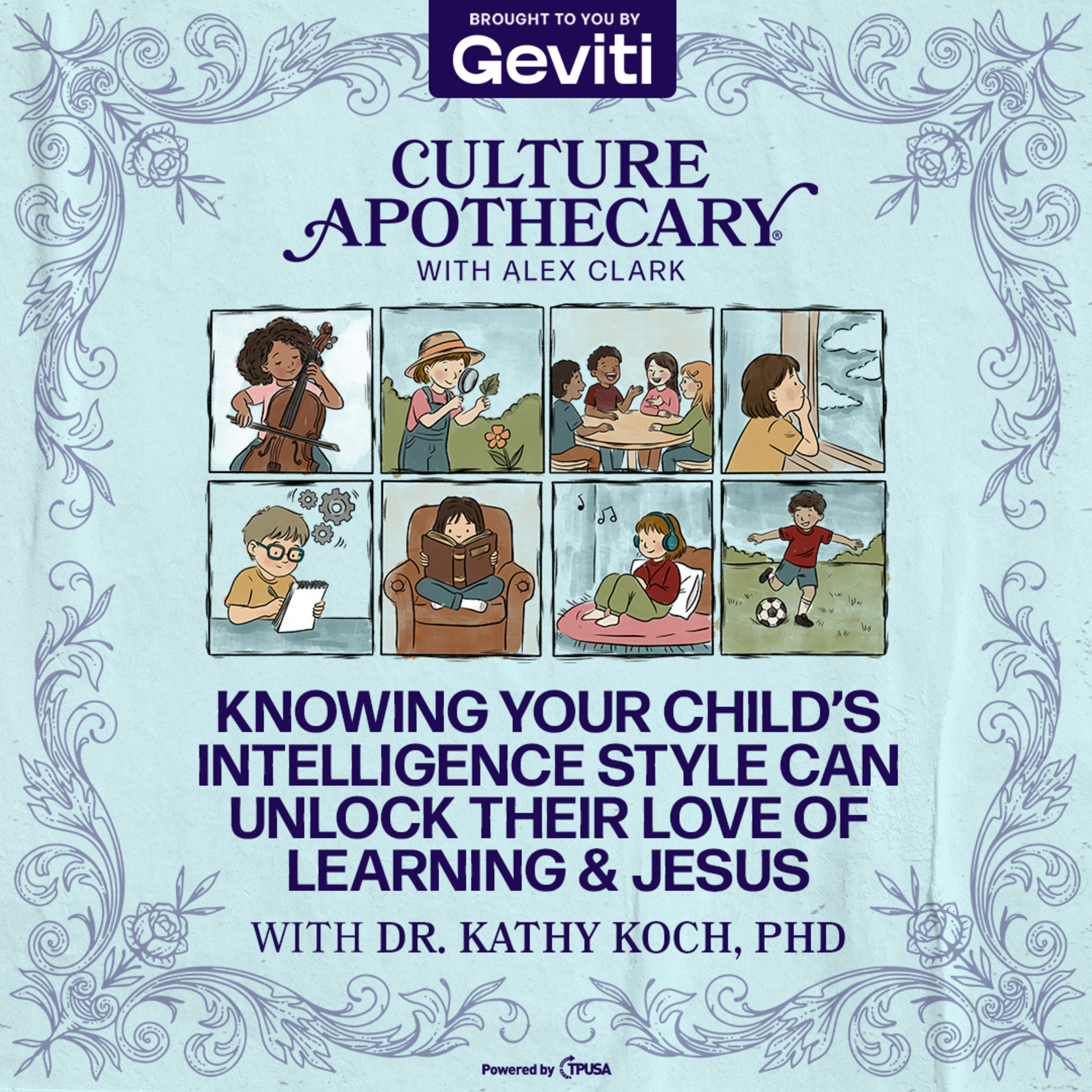
Culture Apothecary with Alex Clark
Knowing Your Child’s Intelligence Style Can Unlock Their Love of Learning & Jesus | Dr. Kathy Koch
01:03:07
Loading summary
Transcript198 lines
- [00:00]
Alex Clark
Walk us through the eight great smarts.
- [00:02]
Dr. Kathy Cook
Word smart, we think with words. The second one is logic smart and logic smart. Children think with questions. Then the third one is picture smart. We think with our eyes. And then the fourth one is music smart and music smart People think with rhythms and melodies. Number five is body smart and we're the movers and the touchers. Number six is nature smart. Usually kids would rather be outdoors than indoors. Number seven is people smart. But people smart people read body language well and respond appropriately to that. And they also are able to debate without arguing. This is Charlie Kirk. Charlie was word and logic and people extraordinarily. Number eight is self. But self smart people think with deep reflection inside of themselves.
- [00:36]
Alex Clark
When a parent starts celebrating the way God made their child instead of making them fit in a man made box, do you think that God receives that as a form of worship to him?
- [00:45]
Dr. Kathy Cook
Oh, come on, Alex. Yes. Oh, I have tears in my eyes. It honors God. He is a strategic, intentional, loving creator with a capital C. He knows what he's doing and when we recognize that and we we work with him and we don't get in his way, we are thanking Him.
- [01:25]
Alex Clark
Have you ever wondered why your child struggles in school or at home? Maybe it isn't because they aren't smart. It's because no one has noticed how smart they are. Today we're flipping the script on traditional ideas of intelligence and uncovering the unique strengths that every child was created to have. Our guest is Dr. Kathy Cook, a former tenured professor, award winning author, and the founder of Celebrate kids. With a PhD in reading and Educational Psychology from Purdue, Kathy has spent her career helping helping parents, teachers and mentors see children for the brilliant, unique learners they truly are. From teaching second graders to coaching middle schoolers, serving on a school board and writing nine books, she's devoted her life to one mission. Helping kids and the adults guiding them discover their God given gifts. With the eight great smarts I Love in this episode too, we get into how your understanding of the gospel might also change based on where your eight great smarts lie.
- [02:25]
Podcast Advertiser/Host
Just. It's really cool.
- [02:26]
Alex Clark
This episode is so cool. Watch this episode on the real Alex Clark YouTube channel or culture Apothecary on Spotify. Make sure you pause real quick before we start to leave us a five star review so you don't forget this is free. It takes less than 10 seconds of your day to positively impact this show and the lives of those who work on it. You can shout out Simon, my editor if you want. You can just Tell us your favorite memory of you and Simon from the past. Be creative. Please welcome Dr. Kathy Cook, the of eight great smarts to Culture Apothecary. Every child is smart, but not every child is smart in the same way. When a parent actually realizes this, what changes will they see in their child?
- [03:10]
Dr. Kathy Cook
I love that question. I think they'll have hope for the children who they haven't been impressed by yet. I think they'll stop comparing and expecting a second born to be like a firstborn. I think they'll communicate an expectation that's realistic so that children have hope that they can please a mom and please a dad. Because that's so important, Alex. That children can please their mom and dad. And sometimes they don't think they can because the expectation isn't fair for the way that they've been designed to be.
- [03:35]
Alex Clark
How did you come to this conclusion that there were eight different intelligence styles?
- [03:39]
Dr. Kathy Cook
Dr. Howard Gardner is the researcher, a psychologist from Harvard who was curious about why people behave differently. He never thought educators would take over, but we in the education field love it. And I taught second graders. I was a university professor. I've been a coach, a school board member. And I began to see that we're all different, right? Like, we know that we're all different. Created in God's image, but still very uniquely in so many ways that he caused us to be. And I was so concerned by kids who are already defining themselves as stupid little second graders, you know, seven and eight years old, and, oh, Ms. Cook, I can't do that. You know, I'm not smart enough to do that. Really became concerned, latched upon his, found his material and. And saw that it made sense to me, because if you observe culture and people through the lens of the smarts, you begin to see it. So I began to apply it. I looked biblically. I looked okay. Does the Bible win here? Right? Because I really don't care what a psychologist thinks if it doesn't align with God's holy, accurate word. But I saw that it was there in the Word as well. And it's been really freeing even for me to discover the ways that I'm smart. And I had been put in boxes that didn't fit, which caused me to have anxiety, and I didn't want that for anybody else.
- [04:42]
Alex Clark
What did you see biblically on this?
- [04:44]
Dr. Kathy Cook
Well, we're created uniquely. Ephesians 2, 10 declares that we are created in advance to do good work, that we would walk in them, and the good works are different. Right? We can look at you And Charlie and anybody that you can think of. And there's good works that are uniquely able to be done because we are uniquely created with different gifts. Then we're knit together in our mother's womb. Knitting is a precise skill. The knitter decides in advance what to make right. Otherwise you have a. A messy thing. We have an Afghan sweater, scarf, mitten hat that doesn't have any purpose at all. But our. I see. God is intentional, right? We're created in his image. Genesis 1:27. Male or female, he's intentional about all of it. It's like I tell kids all the time, Alex, he could have caused. He could have created us to be marionette puppets on a string that he controls. And that might have been a good idea. Like, when I look at the evil that's done in the world, I wonder if God maybe regrets his decision. But it's good, of course, that we have free will. And I think that in that he wants us to fulfill purpose, to do it uniquely. He knows that there are many problems to solve, therefore there have to be many solutions, and they're going to come from many gifts.
- [05:48]
Alex Clark
The Bible talks about spiritual gifts.
- [05:50]
Dr. Kathy Cook
Yes.
- [05:50]
Alex Clark
Is there a tie in between the eight great smarts and spiritual gifts?
- [05:53]
Dr. Kathy Cook
I think there is in some regard. For instance, the spiritual gift of teaching would require that teachers be word smart and logic smart and people smart, which I think you are, by the way. There is a spiritual gift of administration, and that would be maybe logic smart. Again, picture smart to an extent. I don't think there's correlation necessarily, meaning that if you are a teacher, you are definitely spiritually gifted in this way. But I think there's going to be some meaningful overlap.
- [06:19]
Alex Clark
You talk about with your teaching career, how you went from teaching kids to celebrating kids.
- [06:24]
Dr. Kathy Cook
Yeah.
- [06:24]
Alex Clark
Can you explain what that means?
- [06:26]
Dr. Kathy Cook
So I was a celebrated kids. You know, some people start ministries out of brokenness. They were traumatized. They didn't have something, they wanted others to have it. My brother and I were celebrated. We were known. We were challenged with expectations that were appropriate. We were called to serve and called to love, raised in good churches, et cetera, et cetera. And then again, being out in culture more and more, realizing not every kid had that. Some kids not known in their own home, some kids who, you know, dad is gone now and never calls and has given up custodial support or whatever, just tragic stories. And to celebrate a kid, you pay attention to who they are, not just what they do. So important you celebrate who they are, not just what they do. So you know them kids tell me, Alex, they'll say, well, Dr. Kathy, I know I'm important. God made me and he didn't have to. And Jesus died for me and he didn't have to. So I know, Dr. Kathy, that I have value, but I don't feel valuable at home. Come on, can you imagine the pain of that? And we have some listeners today that I might have just triggered, and I apologize for that if there's a listener who realizes, hey, that's my story, and I'm still wanting to be acknowledged by a dad who's no longer available to me. Right. It's really sad. So I know the value of being celebrated. I know the value of being known and seen and heard and recognized and applauded for. Like, my parents sat in the living room when Dave and I practiced. They didn't just. They didn't just sit in the front row at the concert like, they paid attention to us. So when you celebrate again, you pay attention and you affirm them and it's about them and not yourself. I don't use kids to perform for me. That's not the reason we give that. That's not the reason God gives anybody children.
- [07:59]
Alex Clark
So when you were in the classroom teaching young kids, immediately in your teaching career, did you feel like, I'm kind of doing things a little bit differently than the other teachers and was it controversial?
- [08:12]
Dr. Kathy Cook
Oh, come on. That's. That's funny that you would ask that. It was controversial from the standpoint that I was popular and I didn't. I didn't want to be popular for popular sake with the kids. Right. Popular with kids and with their parents. And even as a professor, I knew my students names and other professors didn't care to learn them. And so popularity, even now in the ministry of celebrate kids, I don't do anything I do to be known. It's irrelevant to me. I do everything I do to have impact and to be influential.
- [08:40]
Alex Clark
I feel the same.
- [08:41]
Dr. Kathy Cook
Come on. To have purpose. That's what Turning Point's all about, right? So if we become popular because we're living intentionally on purpose, then so be it.
- [08:49]
Podcast Advertiser/Host
Wow.
- [08:49]
Dr. Kathy Cook
I don't reject it, but I don't. I don't strive to be that or I don't seek it. Exactly Right. So back in the. When I taught second graders, my students had fun, and they also did really, really well. I believe that you can't. I don't believe the purpose of school is to entertain. Like I tell. I tell parents all the time, don't send the kids off to school, go, have fun today, because now you've taught children the purpose of school is fun, and if they're not having fun by noon, it's a bad day. No, I want children to enjoy education because it's stimulating and it builds curiosity and there's connection and there's joy and there's hope and there's purpose in all of that, and that gives you a desire to keep living the next day, right?
- [09:25]
Podcast Advertiser/Host
Yeah.
- [09:26]
Dr. Kathy Cook
So enjoyment because learning matters, not enjoyment because you have to have fun here. That's. That's false. Same thing with Sunday school. Oh, my goodness. Don't get me started on that.
- [09:36]
Alex Clark
Were you finding there to be, like, educator red tape when it came to teaching kids? Like, were you seeing kids fall through the cracks and felt like, there's nothing I can do here?
- [09:47]
Dr. Kathy Cook
There was some of that back when I taught, and I taught a long time ago. It's even worse today where classroom teachers don't have enough influence, in my opinion, over their own students. Administrators are often very much in control. But. But I had. I had some really positive experiences. I love teaching. I was shocked when God called me out. I thought I would teach second graders forever. I loved it. I thought I'd be a professor forever. And then God called me to this. I think it's a miracle that he did that. And it's so much fun. And I joke that this is it, right? I've done it 34 years. Let's hope that I've landed in the right place. But, yeah, red tape is always going to get in the way. But this is where you. You stand up for yourself. This is where you know yourself well. You know what you're called to, and you find a way to very carefully and respectfully go to the administrator in my case and say, hey, you know, I was wondering why you had this thought. Because I was having this thought. And then you submit and you be and you're humble about it, and you make things work.
- [10:36]
Alex Clark
What is being missed when we are gauging intelligence solely on academics?
- [10:40]
Dr. Kathy Cook
If we base intelligence on academics or IQ or, or grades, there are kids who are going to fall through the crack. That's one of the reasons I wrote the book and one of the reasons I speak on this a lot. So glad to be here today. So honored to be here. Because every kid is smart in unique ways. There's eight smarts. We have all eight. But if a parent or a grandparent or a system only acknowledges what we call school smarts, which are speaking with words and Asking and answering questions for the most part. Those are the kids who feel smart and they're the kids who think that they're going to rule the world. In fact, it's, it's many other kids who rule the world. I ask people wherever I go, how many of you know people who didn't do well in school but they're doing well in life.
- [11:15]
Alex Clark
I could raise my hand for myself.
- [11:17]
Dr. Kathy Cook
Exactly, Alex. So many people do.
- [11:19]
Alex Clark
Graduated C average, general diploma, high school, didn't want to go to college. When my counselors were asking me like, what do you want to do? I said, well, I know I'm going to be on tv. I said that. And he was like, I need you to have a real answer. I was like, this is my real answer. I know what I'm supposed to do. I know I'm supposed to speak to young women. I don't know what that's going to look like. And then I ended up having a seven year career in radio. I did tv, now I'm on Fox.
- [11:42]
Podcast Advertiser/Host
News all the time.
- [11:43]
Alex Clark
I host this show, I'm speaking around the country. I knew that when I was 13 and then all throughout high school it was like I just didn't care about taking books home and studying or whatever. I understood my purpose and I was just trying to figure out how that was gonna kind of flush out. But yeah, I do think sometimes kids innately know what their made to do.
- [12:03]
Dr. Kathy Cook
Absolutely. I think often, especially if they're well parented. But that's a really good example where in school you might not have fit. Like you didn't care about geometry, I'm guessing, or calculus. Look at your eyes.
- [12:12]
Podcast Advertiser/Host
No.
- [12:13]
Dr. Kathy Cook
Or you know, general science, you had to do. But then physics and chemistry, why would I bother? And kids like that often feel less smart. And smart's a power word. If we don't think we're smart, we don't show up. If we don't think we're smart, we don't believe in our tomorrows. One of my favorite examples is speaking to a group of teachers and, and staff development. If you can picture three hours with a group of teachers talking about the smarts. And I had a gal come up to me at the end who was an aide in a preschool classroom. And she said with tears, she said, Dr. Kathy, I now know I'm smart enough to go back to school and finish a degree.
- [12:43]
Podcast Advertiser/Host
Wow.
- [12:43]
Dr. Kathy Cook
She had stopped after two years because she didn't think she was smart enough to become a teacher. But she heard me talk about all eight smarts and she said, I have all eight. I can go do this. And she did quit her job and she went back to college full time and earned the degree and went back to that school and taught. And so adults can discover this, too.
- [12:59]
Alex Clark
That's a great example of an adult. Do you have an example of a child whose strength was initially missed by the school?
- [13:05]
Dr. Kathy Cook
Oh, definitely, sister. Body Smart as an example. Body Smart children move and touch. Body Smart adults move and touch. In fact, this chair that I'm in is a swivel chair. And I'm not. I know I'm not supposed to swivel, and it's about to kill me because I'm body smart enough. I'm a former athlete and coach, and I'm talking with my hands, you know, and so I want to move. And so kids who are body smart get in trouble for moving. They're told all the time, sit down. Sit still. Put that down. Look at me. Listen better. And they don't feel that they're smart. I've had kids come up in line. They line up after my programs and they'll say, Dr. Kathy, you're the first person who ever told me that because I move while I'm smart. And they'll sometimes say I'm a dumb jock, like I'm a basketball player, but I don't like school. Dr. Kathy, the only reason I'm still in school is that I get to play football and soccer and, you know, run track.
- [13:49]
Alex Clark
I've heard that from so many kids.
- [13:51]
Dr. Kathy Cook
Yeah, it's so true. Because they're not known and they're not allowed to move in productive ways. Those are the kids who need to be at the whiteboard working out the problem. Those are the kids who need to get a clipboard and march in the back of the room while they're studying their spelling words. But we don't give them freedom to do that unless we homeschool. And one of the advantages of homeschooling is that you can give your kids freedom.
- [14:12]
Podcast Advertiser/Host
I know that you're telling yourself that on January 1st, you're going to start taking your health seriously. That's when you'll finally figure out why you're always exhausted, constantly bloated, why you just don't feel like yourself. Stop waiting on New Year's resolutions to invest in your well being. Stop putting off prioritizing your health. I'm talking to you. Those of you that are attending and AM Fest this year from December 18 through December 21, JEV is going to be there in the Exhibit hall doing on site blood draws. So you really do not have any more excuses. I'm looking at you, Sharon. As an early Christmas gift. Jev is giving us their biggest discount ever. 30% off your membership purchase when purchased at AM Fest. So you're literally getting to optimize your health while attending the best conservative event in the movement. So this is such a win win here. Here's the thing, you can't just show up and then hope that there's going to be a spot to get your blood drawn. So the blood draw times are filling up fast, so be sure to reserve your spot in advance. Now you're like, why in the world would I get my blood drawn at a big huge conservative festival? Because they're going to test over 90 biomarkers. This could literally save your life. Like literally save your life. Give you answers to things that you've never gotten answers for. If you're going to AM Fest, go to the link in the show notes right now. Secure your time slot before they're gone. They're already almost gone. This is what collective health freedom actually looks like. Not waiting. Waiting for the system to fix itself. Do not wait until January 1st. Make America Healthy again. And it starts with you. Reserve your spot now. I wake up at 2am and there's a tiny ghost kid in my bedroom. Full Victorian get up, little waistcoat, floppy hat, powdered face. Just floating there like he's judging me. And he looks at me and he goes, look at you. Sitting in your fluorescent lit box. Scrolling tiny images. Eating cardboard disguised as food. Worshiping something called tick tock. Pathetic. Absolute waste of breathable air. I panic. I grab my Cozy Earth bamboo viscose sheets and I throw them over myself.
- [16:03]
Alex Clark
Like they're a flotation device in the ocean of existential dread.
- [16:06]
Podcast Advertiser/Host
Temperature regulating. Soft, breathable. Basically a ghost repellent for tiny aristocratic hellspawn. I throw on their all day tea when I get home from work. Their studio pants. I love those. The ghost kid in your life will shriek in outrage. Probably drafting a pamphlet for the afterlife on how modern America is doomed. But who cares? You will sleep. You will wake up alive. Not fully sane, but definitely softer. 100 night sleep trial. 10 year warranty. All from Cozy Earth. Buy them all or else the ghost kid will haunt your wi fi. Judging your screen time and life choices. Upgrade your life. Go to cozyearth.com use code Alex for 40 off. That's cozyearth.com code Alex for 40 off. Sleep cooler. Lounge lighter. Stay cozy.
- [16:50]
Alex Clark
Walk us through through the eight great smarts and a couple traits of each.
- [16:54]
Dr. Kathy Cook
So we have all eight. They have to be awakened. So let me first say that we have all eight evidence from MRIs. When children are conceived and created by God, all eight are there words in, in no particular order, word smart. We think with words. We read, write, speak and listen. It is number one in my order only because it is a school smart. Because what do we do all day in school? Read, write, speak and listen. So these are the Chatty Cathys of the world. The Alexes of the world were probably told as children, you know, go find something to do and be quiet. Y but I wasn't told that, which is why I'm here today. If I would have been raised, you know, be quiet, be quiet, I wouldn't be here. So my parents did a really wise thing to develop the strength and, and help me use it in a respectful way. And, and that's a whole another conversation. The second one is Logic Smart and logic smart children think with questions. They love it when the world makes sense. They have a high need for justice and fairness. Christianity can be hard for them because they can't think it through. They just have to believe it.
- [17:46]
Podcast Advertiser/Host
Wow.
- [17:46]
Dr. Kathy Cook
So they're on their way. My personal testimony is coming to faith in Christ through wisdom, not love and praise. God had a pastor who was perceiving that and was able to help me make the leap from being religious to being in a relationship with Christ. Logic smart kids love science and math and they struggle with spelling, which I do, cuz spelling doesn't make sense. Right Alex? Like my last name is spelled K O C H and we pronounce it Cook. Like that's ridiculous. Which is why I go by Dr. Kathy professionally. Right. Then the third one is picture smart. We think with our eyes, we see things, we remember what we see. We're visual. We visualize in our mind and on paper, we doodle on our notepad and all that, which is so much fun to meet those kids. And then the fourth one is music smart and music smart people think with rhythms and melodies. So in my family, I come from a really musical background. If somebody in my family says sisters, we all start singing the very famous song from White Christmas that I will be watching soon. I hope that you'll be watching. And how can anybody not watch White Christmas in the month of December?
- [18:44]
Alex Clark
You know that song was written in Phoenix, which is where my show is filmed.
- [18:47]
Dr. Kathy Cook
No, I love that.
- [18:48]
Alex Clark
He was sitting at a, at a hotel bar in Phoenix, the Biltmore Hotel. And it was Christmas and there was no snow. And he's like, ah, this is the worst. Why would anyone live here on Christmas?
- [18:58]
Dr. Kathy Cook
Oh, my goodness, I did not know that. That's music smart. And then number five is body smart. And we're the movers and the touchers and the go getters. So we sculpt with clay. We might be athletic, we might be in a drama and be able to make ourselves look old even though we're not old. So again, that's the fifth one. And let me just interject that music smart and picture smart and body smart are smarts. They have the same power in the brain as word and logic, but the school system doesn't acknowledge them. And these are the children who don't feel smart. Their brother is smart. Like, I'm not the smart one. And if they don't think they're smart, then they don't show up, they don't volunteer, they don't, you know, try for the promotion at work even. And so it bothers me, these kids line up and they'll say, Dr. Kathy, I'm creative, I'm not smart. Like, no, the reason you're creative is because of how you're smart, right? Like you and I are creative with words. Other people are creative with, with design and with, with music, and they need to be acknowledged as such. And then quickly, number six is nature smart. These are kids who would rather be outdoors than indoors. And they think with patterns. That's how they know it's a blue bird, not a blue jay or an elm tree, not an oak. And was and saw is also a pattern, Right? And six and nine is a pattern. So you can help kids learn by applying the smarts in different contexts, which is very important. So women who are listening to us and men who are listening, who love to garden, and they think weeding the garden is the best thing ever. Those are nature smart, logic smart people. And it's fun for them to recognize that. Number seven is people smart. I think it's the most important one, and I can tell you why if you want to know. But people smart people read body language well and respond appropriately to that. And they also are able to debate without arguing, and they're able to know they're out. This is Charlie Kirk. Charlie was word and logic in people extraordinarily. And I think you are as well. And when people. People smart, it's one of the reasons it's important is that you can figure out when you can push people and when you shouldn't. Right? So I'm presenting the gospel to someone and I begin to see them back away, their eyes are turning away, the body language is stiff. I know that I've reached my limit and if I keep pushing, it won't be good for the gospel. So I'm going to, I'm going to back off and wait for another opportunity to, to teach another truth that might win them to the Lord. So that's people smart, so important. And then number eight is self smart. And it's so important, it's number eight. Somebody has to be last. Right. But it's not the least important, but self smart people think with deep reflection inside of themselves. We're the ones that need more time and we're so rushed in our culture. Right. These are people who, they can't answer what you think is even an easy question until they've had a chance to think about it and reflect on it. Because they want to make sure that it's right and that it feels good inside. And so sometimes these kids feel very slow. This is what even adults Tell me, Dr. Kathy, I'm slow. Every question I have to think about, I'm like, you're not slow, you're self smart. And they look at me and like, wait, I'm smart Because it's a power word.
- [21:45]
Podcast Advertiser/Host
Yeah.
- [21:45]
Dr. Kathy Cook
So those are the eight. And I hope that's encouraging to our audience.
- [21:48]
Alex Clark
So when you talk about, you know, music smart or what's the one that's good with art? Picture smart, picture smart or nature smart? You know, those kids, would a traditional school setting not be ideal for them? Like, if you're a parent and you know that your kid falls in one of those categories and they are struggling in a traditional school, whether that's private or public.
- [22:09]
Dr. Kathy Cook
Right.
- [22:09]
Alex Clark
I mean, are those the ones that you'd be like, I would really consider alternative education or homeschool.
- [22:14]
Dr. Kathy Cook
That's a really fair question. If the public or private school has an excellent music program, an excellent art program, they can succeed there. If they understand that they're smart too. But if they're in a system that's competitive and comparisons are done all the time, and the GPA and the, you know, the records and the honor roll, if that's what causes the school to think that they're a good school, then I would possibly be concerned about that. And in the same. It's because in the homeschool situation, you can allow more time for that. You can have an hour a day of art because there's no one telling you you can't.
- [22:44]
Alex Clark
Right.
- [22:44]
Dr. Kathy Cook
You can do piano lessons during the day as part of your school day, which is one of the freedoms you can be a part of a community require, and that can count for educational credit, which is great. But let me also suggest, Alex, that if I'm very word smart and I'm very logic smart and the school doesn't honor me, that's also bad. Yeah, so what if you're in a school that don't have physics, they don't have chemistry, they don't have trigonometry, or they don't have honors English, or you're made to feel foolish. You're. You're a bright kid, you love learning, you love school, you're looking forward to college, and your peers are like, well, that's just foolish.
- [23:14]
Alex Clark
Well, Ori, what I think is an epidemic happening in American public schools right now is misbehavior is celebrated, and those kids are not dealt with. And so the kids who are actually there with a love of learning are falling through the cracks because the entire class time is dealt with misbehavior and kids that are acting up.
- [23:35]
Dr. Kathy Cook
That's a very, very legitimate point. Yeah. The teacher's attention is to the ones who are misbehaving. And those. Those good kids who can be invisible and feel less important are often ignored. And then if they're ignored and not celebrated, then they underperform as well. So that's a really good insight. And one of the things that I love teaching in this model is that we actually misbehave out of our strengths. Okay. So our weaknesses can concern us and drive us to our knees, but we misbehave out of our strengths. So you and I are both Wordsmart and we're Chatty Cathys, right? You're a chatty. You know, I'm a Chatty Cathy. You know, you're a chatty Alex. And so what, we could gossip? I'm guessing this is true of you. Gossip, tease, name call, impresses your vocabulary. Demand the last word. Now, we.
- [24:16]
Alex Clark
We don't anyone I've ever dated. Yeah.
- [24:20]
Dr. Kathy Cook
And we don't because of the righteousness of Christ. We don't because we have a standard and we have the Holy Spirit controlling us. But we can also edify, encourage, tell the truth, build up, and listen to other people with respect. Right.
- [24:31]
Alex Clark
Love that so much. And that is so true for me. And just the sanctification process, I can relate to that. I'm not all the way there, but I am trying every day.
- [24:39]
Podcast Advertiser/Host
That's so true.
- [24:40]
Alex Clark
To pray on that.
- [24:41]
Dr. Kathy Cook
Yeah. No, thanks for acknowledging that. So often the kids who are misbehaving in school are misbehaving out of their strengths. They're moving a lot. They're talking over people, they're asking questions, well, what about this? And what about this? Well, we don't have time now. You shut them down when you don't acknowledge who they are, so they have to misbehave. But if we would understand, Alex, that those are good gifts from the Lord and they haven't been discipled and they haven't been channeled right, Like I was raised. Respect and listen. Learn from other people. Talk when you're supposed to. My parents enrolled me in children's theater when I was about 10. They said, go talk there a while, and that's true, but they didn't raise me. Be quiet. So I didn't have to act out because I hadn't been noticed.
- [25:22]
Alex Clark
Can you walk us through just, you know, hypothetically what a day in the life of a child would look like whose smarts don't align with traditional school boredom?
- [25:34]
Dr. Kathy Cook
Because why would I bother trying? Why would I bother putting forth effort when I won't be able to succeed or I won't be noticed? That's the first thing I think of. Boredom and apathy, which is really apathy is a lack of purpose, okay? And so lack of purpose, I can't perform, I can't fit in. I can't be acknowledged here, so I might as well not try. Absenteeism. I think illness would even be a possibility there. And then the opposite extreme would be again, potentially misbehavior, needing to be noticed and often being noticed for something that isn't as relevant as something else. I think if your smarts don't align with the system, you don't try. So you're satisfied with pre algebra, you don't take algebra, you're satisfied with general science. I know enough science. And you don't take chemistry. And what if chemistry was going to be the gift? What if it was the physics teacher that was going to awaken within you the possibility for you to fulfill purpose and change the world through something you invent as a physicist, but you never find that out because you give up early.
- [26:30]
Alex Clark
When you're working with children to identify their smarts, what age do you feel like parents can accurately start to see their child's smarts?
- [26:38]
Dr. Kathy Cook
Parents who know their children well and parents who invest and make eye contact with their phones down and pay attention to kids could see it early on. I think two and three year Old kids. In fact, I sometimes say to parents, have you had a child who wakes up but doesn't need to be held right away? Like they wake up from a nap or they wake up in the morning and they don't instantly cry, they soothe themselves and they're not instantly needing you. That's self smart. They're satisfied with themselves. How many of you have a three or four year old who always gravitates to the play corner in the preschool? Here's another example. A 2, 3, 4 year old kid in the Sunday school class who always goes to the glockenspiel and is always making music with the bells. Or you have a six year old kid, every pencil, two pencils together, you got the drumsticks right. So they do show up early on, but they're no, they're not known. See, parents who know the smarts will see them as good things. That's why I'm so excited to be here because the parents don't believe in the smarts. They see that as misbehavior.
- [27:32]
Podcast Advertiser/Host
Right.
- [27:33]
Dr. Kathy Cook
And you're told, you know, be quiet, sit down, sit still, look at me.
- [27:36]
Alex Clark
So why that age? Is it related to developmental stages, an educational model? Is it home environments affecting the emergence of the timing and the types of the smarts coming out?
- [27:47]
Dr. Kathy Cook
All of the above.
- [27:48]
Alex Clark
Okay.
- [27:48]
Dr. Kathy Cook
And let me add Alex, that it's never too late. So you could have a 16 year old and, and there's a TE. Most smarts are alerted or awakened through encounters with topics or people. So there can be a person, even a 32 year old who's listening to us, who has plateaued and isn't sure why she exists and goes to a class and discovers a hobby and boom. That part of the brain is going to be activated and alert and awakened fully and others a hobby in others life purpose. So it's never too late and you can notice it at any time. I think parents of little kids are often going to be paying attention in a way that if they learn that there's these eight, they'll begin to look and go, oh, I'm going to, I'm going to get a, a Zoom membership because my kid loves animals. Well, I'm going to take my kid to the, you know, the hobby store because my kid's a crafter and I'm going to spend, I'm going to buy a birthday gift or I'm going to buy a Christmas gift that fits the way that she's been designed to be smart. I'm going to get my Son, the biggest kid of Legos ever because he's a logic smart body, smart picture, smart kid. And now I know what to buy him. And then you pay attention to that and everything changes. Because you know what? When your kids feel seen and known, they feel safe and secure and that changes everything.
- [28:56]
Alex Clark
What are some of the biggest mistakes that parents are making that could actually harm their child's natural genius?
- [29:01]
Dr. Kathy Cook
Expecting them to be like them, forgetting they're creating God's image and not theirs. So kids who are forced to play soccer because dad was a soccer player or mom wasn't able to play soccer so she wants her daughter to play it. And that's. I get that. I totally get that. Like we get that, but that's not appropriate.
- [29:20]
Alex Clark
Yeah.
- [29:21]
Dr. Kathy Cook
So that's the first thing that I would think of was trying to force them into a mold that pleases them. But parent children aren't given to us to perform for us. So that's. That's unfortunate. So expecting them to be like us, I think is the first thing I would say.
- [29:36]
Podcast Advertiser/Host
Husband, if you are half listening right now, write this down. I'm about to save your Christmas. Get your wife the Rolls Royce of collagen powder. It's called Holy Main from Agent Nator. Holy Main. H O L I M A N E from Agent N A T E U R Agent Nature. It helps her grow long, strong nails, faster hair growth and gives that plump youthful skin every woman wants. She can toss it into her hot coffee, her iced coffee, her smoothie. It totally is tastele. It mixes like a dream and it is the best out there. Holy Mane is non agglomerated, meaning it isn't puffed up with seed oils or gums like so many brands out there are doing. They do this like, oh, we'll make four bags out of one trick. No, it's just two clean ingredients. Wild caught deep sea kosher fish and crushed saltwater pearls. No fillers, no hidden oils, just beauty from the inside out for hair, skin, nails, fine lines and overall radiance. It's eco certified, tested for heavy metals and meets strict European safety standards. A double scoop even gives 15g of protein. And if you are a guy listening, you need Holy Growth 84. It is a non greasy lightweight spray that stimulates new hair growth with patented ingredients like Redenzil, which has been shown to help stimulate up to 28,000 new hairs in just 84 days. And spermidine for scalp renewal. No oils, no mess, just spritz morning and night for thicker, fuller hair. And my Personal favorite Calm Beauty A delicious tart cherry sachet packed with glycine, Gaba, taurine, L theanine, vitamin D and spermidine for stress relief, beauty sleep and anti aging benefits. Oh my gosh it tastes so good. I drink it during the day when I'm anxious, during a flight or even at night before bed. It tastes incredible. You can also mix it with sparkling water. So good. Go to agent nator.com use code Alex Clark for 15% off whatever you want to purchase.
- [31:29]
Alex Clark
That's Agent Natur.
- [31:30]
Podcast Advertiser/Host
It's a one time code Alex Clark for 15 off the other day I realized I had something I'm now calling Sink Shame. You know when a friend comes over, uses your bathroom and you suddenly notice that your counter looks like a graveyard of crusty lotions and half dead makeup tubes? Well, that was me and I just thought this cannot be my legacy. You need Adele Natural Cosmetics. I switched to them because their packaging alone is so elegant that I actually want people to see it sitting out. And then I don't have to clean my countertops because it's all part of the aesthetic. See? Think smarter, not hard. Adele is a Christian founded family owned company rooted in first Peter 3:3:4 beauty comes from the heart. Everything is handcrafted, small batch and truly clean. No endocrine disrupting junk. And considering how many studies show toxins in mainstream cosmetics, switching to safer ingredients just makes sense. Their aloe hydrating spray feels amazing in fall and winter. Gives you instant relief. I need that for my dry winter skin. Essential moisturize is rich but it's still light. And the body oil after a shower. Oh my gosh. Your skin is going to stay soft all day long. Their top rated moisturizing foundation feels like you're wearing nothing. Their lip conditioner is buttery soft. I live off that stuff. And the glow highlighter you can tap it on, you instantly look more awake. If you want skin care that nourishes, supports sustainable local farms and looks gorgeous on your sink, check out Adele Natural Cosmetics. Go to Adele natural cosmetics.com with code Alex for 25 off your first order. That's Adele natural cosmetics.com code Alex for 25% off.
- [33:02]
Alex Clark
What have you seen in kids or families or even church bodies where the parents embrace the eight smarts model.
- [33:09]
Dr. Kathy Cook
Joy, Positive energy, contentment, purposeful living, new opportunities, new field trips, new stores, new new hikes to go on. A new belief in the future that it doesn't have to be a four year degree of college, it could be a gap year. You know, we need more trade and tech people. So you know, you have a little girl, a little boy who loves being in the workbench with dad, right. And or loves the girl who loves changing the oil on dad's truck. You know, you go, wait a second, I wonder if she's destined to be a mechanic. And we, we embrace that and we believe for that and we get them some training and lo and behold, she does a two year program on becoming a mechanic or maybe a one year or whatever and changes the world with that in her community.
- [33:49]
Alex Clark
Can knowing what intelligence style a child has help with behavioral or mental health issues?
- [33:54]
Dr. Kathy Cook
Absolutely, Alex. Mental health for sure. Partly because we're accepted, right? Children are performing for their parents, children are trying to get attention. They don't shouldn't have to earn it, they should simply have it because they're in the family. Right. So I think the mental health would be forced to perform, forced to behave, to be noticed. The competition among siblings, even cousins and even classmates in general. So kids are feeling inadequate because they're not able to perform to a dad's perspective or a mom's expectation. I think that's huge. It also is related to behavior really. Like I've seen, if, if I know that I have a body smart child, I'm going to allow him to rock the rocking chair. I'm going to allow him to study his spelling words with a clipboard and marching through the living room or the kitchen. If I have a kid who's self smart, I'm going to allow her to have her own time in the room alone. I'm not going to assume that she's lonely or of not, you know, being obstinate or doesn't like her siblings anymore. I'm going to understand that she needs quiet and space and privacy and peace. And I'm going to let her have that. So the rest of the night goes better. So we allow them to be and then we meet their needs the way that they've been designed and now there's less likelihood that they're misbehaving. And let me say that if you have a kid who's body smart as an example and they move all the time, you have a right as a parent to say please stop. Grandma's here. You know, she's nervous by all of you running around. She doesn't want to fall and break her hip like her roommate at the nursing home. You need to quiet down and slow down. You have a right to expect that from your kids. Yeah, but it's the way we communicate it. And if we give kids freedom to be who they were created to be, you know, the Chatty Cathy's who are allowed to talk, it's easier for us to listen if we have a chance to talk. Sometimes we need to see misbehavior as being rooted in a smart, so we don't paralyze it. If I had been raised, you know, be quiet, be quiet, be quiet, be quiet, I wouldn't be here talking to you.
- [35:34]
Alex Clark
Right?
- [35:35]
Dr. Kathy Cook
Because it would have, it would have evaporated. So allow it to develop, expect it to be used well. And if it's not, call it out. But in a way that's instructive, not condemning.
- [35:46]
Alex Clark
Do the eight great smarts apply to kids that are neurodivergent as well?
- [35:50]
Dr. Kathy Cook
They do.
- [35:51]
Podcast Advertiser/Host
Okay.
- [35:52]
Dr. Kathy Cook
They do. We believe all people have all eight.
- [35:54]
Podcast Advertiser/Host
Okay.
- [35:55]
Dr. Kathy Cook
The earlier they're awakened, the greater the likelihood there'll be a strength for a lifetime. So one of my concerns for children who are different is the parents expectation might quickly go south, go down. They might lower an expectation for that child, which means they play with them less, they purchase fewer toys, they don't go to the library with that kid. And it's possible that more of their brain won't be awakened and won't be developed in a healthy way. We do believe as an example, kids who are on the spectrum of autism, what we've seen in our work and talking to so many parents, they're very self smart. They're not as people smart, they're very nature smart. They love patterns, they're logic smart, they love to think, although it'll come across differently. And they're, most of them are very picture smart and they order their cars in a certain way and all their dolls are on the bed a certain way. And if you move a doll, your kid will know it.
- [36:46]
Alex Clark
How do you know when behavior is just an expression of a smart versus like an actual problem?
- [36:52]
Dr. Kathy Cook
I would look for the pattern. Actually. We're big believers here at Celebrate, kids, that something causes misbehavior. So what triggered it? Hunger, fatigue, thirst? Kids don't know when they're thirsty, so they don't drink the water that you and I know that we should be drinking. So that would be a factor. Is it occasional? Is it consistent? Is it always after you just, you know, complimented the brother? If you just complimented the brother, and every time you compliment the brother, the other brother acts up. That's competition and that's jealousy and they're looking for attention versus a kid. If there's no pattern, then it's maybe a general misbehavior, if that makes sense. But oftentimes it's triggered by something.
- [37:32]
Alex Clark
How does the 8 Great Smarts model help kids with ADHD or even dyslexia?
- [37:37]
Dr. Kathy Cook
So we believe that those are real things. Okay, first of all, let me say it's a real thing. ADHD and ADD are real chemical imbalance of the brain. If you've been seen by a pediatrician and a nutritionist and you've, you know, worked a checklist and you have some, some data that would suggest your child has that, that's great. But don't, don't let the kids say, you know, I am adhd. It's not their identity. They have it, but they don't have to be controlled by that, if that makes sense. They still need training. I've had kids come up to me and say, I'm not gonna be able to listen to you. I have adhd. Like, oh, let's, let's prove that wrong. Because you can listen. You know, I know that in the right setting, you can listen. So ADHD is often body smart, and they're easily distracted, and so you'll see them move. So give them a fiddler in the pocket that they can play with. Get them a pipe cleaner that's artistically the color they love and let them touch that throughout the. Buy them clothes that have a feel that they like. There's things that we can do that'll help them. Okay, so there are connections often. Now, dyslexia, dysgraphia, those are things that also happen in the brain. Those kids, like, you can be dysgraphic or they can be a dyslexic kid who can't read terribly well, but she has a fabulous vocabulary because you read her and that's what's going to equip her for success.
- [38:47]
Alex Clark
Yeah.
- [38:47]
Dr. Kathy Cook
Which is a beautiful thing to do. So, again, we don't believe that the label should control kids. I don't believe in labels unless something changes because of it. Right. So if you're going to label a kid, like, don't even get a kid tested unless you're going to commit to making some changes. Otherwise, the labels should be disregarded, if that makes sense.
- [39:04]
Alex Clark
And in the book, you talk about how most people will be strong in four of the eight smarts. Is that a rule or just like a generality?
- [39:12]
Dr. Kathy Cook
What I like to say, Alex, is that it's. It's possible to identify the top four, bottom four.
- [39:17]
Podcast Advertiser/Host
Okay.
- [39:17]
Dr. Kathy Cook
I don't think it's essential to know. This is number one, two, three, four. This is probably number eight. Now, people who take me seriously and read the book and listen to the podcast, they'll be able to begin to see it and figure it out. And that's beneficial because now it helps us know what to do in our spare time, what to spend our money on, whether or not I should take algebra or not take algebra. So these kinds of things are helpful. Bottom four, top four, I think are easier than trying to identify all eight in order. But we have all eight. Earlier the awakened the better. But we. And we use all eight that. Like when I ask people about success in life, like flourishing, right? We want people to live fully and to flourish and to live on purpose and to make a difference in culture. People with all eight aware of that, they're going to do it, if that makes sense.
- [39:58]
Alex Clark
You also talk about how a type of smart can be natural for a person, but that it can be muted by their life experiences. So does this generally mean that the person's strength in that smart is completely lost, or would a person still have a natural inclination toward a muted smart if they are working to strengthen it later in life?
- [40:19]
Dr. Kathy Cook
Wow. I think they have that natural inclination. I think if it's there from God and they've discovered it or someone has helped them discover it, they're going to want to be that. If you're in a, you know, let's say somebody's in a dating relationship and they're not allowed to be a certain way because the person they're dating won't allow for it, which I would run for the hit from, I would run in an instant from that. But if that happens and now they date someone else who wants them to be fully human in all that they are, then it'll flourish and they'll be able to confidently develop it. So I think it's there. I think they'd want to develop it. I think it depends on, you know, it can. They can be paralyzed out of us. Critical, spirit, trauma, fear, competition, grief. Those kinds of things mess with our mind. We know that they mess with the heart as well. And that can be really challenging.
- [41:01]
Alex Clark
Should you tell a kid what smart.
- [41:04]
Podcast Advertiser/Host
They are or does that kind of.
- [41:06]
Alex Clark
Label them and they're like, well, I.
- [41:07]
Podcast Advertiser/Host
Can'T do anything else because I have to move or whatever like that.
- [41:10]
Alex Clark
Like, is it something only adults should know until a certain age? Or is it okay to tell a young kid?
- [41:14]
Dr. Kathy Cook
It is more than okay to tell the young kid. And I agree with you. You don't ever want to say that you know you're moving. Well, because your body smart, you were created by God because now they're going to play you and they're going to use it. You know, I have to move, mommy, you have to let me use the rocking chair because you said I'm body smart. No, that's not what you get to do because what I said so. But here's the thing, Alex. When children know that they're smart, they show up, they, they walk forward, they raise their hand and volunteer. They look for opportunities to serve and to change culture. They're going to want to love. Well, they'll be open to the gospel. So they need to know how they're smart so that they can prepare their own environment to be successful. So for instance, when you tell a 7 year old or a 14 year old that they were designed by God intentionally and strategically to be self smart, which means you might not need as many friends as your sister, you crave quiet, peace, privacy and space. You have your best thoughts when you're alone and you're allowed to have time to think them. That's a kid who in the middle of processing a topic for an English paper or memorizing a Bible verse, is going to spontaneously go to her bedroom and do it.
- [42:13]
Podcast Advertiser/Host
Yeah.
- [42:14]
Dr. Kathy Cook
And then come back out 10 minutes later with success. If she doesn't know that she'll be frustrated by the loud people. She'll never be as successful because she's going to try to do it her sister's way and her sister's maybe more people smart who actually does it in an interview format with a mom. And that's how she memorizes Bible verses. But the self smart kid needs to do it alone. I think it's very positive. I also think the older you are, Alex, the greater the likelihood that you'll fulfill purpose when you know how you're smart. Like knowing that I'm word logic and people is so empowering to me for what I do for a living.
- [42:45]
Podcast Advertiser/Host
Yes.
- [42:45]
Dr. Kathy Cook
And I. And I know, like I have great gratitude to God and you do too. Right? Because you see that he created you for this and then gave you opportunities to walk. Look what the Lord's doing with you. For you and through you. Partly because you believe in who he's created you to be. Now I'm giving you language. Language is positive and powerful. Right? You knew this before you met me. But for me to tell you that your word smart, logic smart and people smart is empowering for you. I'm Assuming to keep doing that, yes. Plus you have the other five, which is also really beautiful.
- [43:14]
Alex Clark
I wonder, is it more important to tailor a child's education to their type of smart, or is it more important to focus on developing the smarts that they're weaker in?
- [43:27]
Dr. Kathy Cook
I would never want to develop weaker smarts if it causes the strong ones to be diminished. Okay, So I think we. We strengthen the. The. The strong ones. We give them opportunity to use them. We might tutor. We might not need to tutor the smart ones, if you will, the strengths. We might not need to tutor them in the strengths. We might not need to give them new opportunities in the strengths. We need to give them purpose to use their smarts. So as an example, again, children's theater for me, I'm a former musician, so early on, music lessons and being a part of, you know, orchestra and band. So when kids have a strength, you give them reason to use it, which further develops it in community. We were not given our smart strengths in isolation so that we are amazing like I'm amazing. Have you met me? No. We've been given strengths so that we can benefit community and use them well with other people. Now, the weaker ones, they always start with interest. Interest always builds ability. So if a child has, or an adult has a weaker smart and you want to develop it, the kid is motivated or you're motivated to develop it. You might discover from reading the book or listening to this podcast that your husband has a smart different from yours, and you can walk toward him and develop that part of your brain. And now your relationship is enhanced, which is a beautiful thing. So it's never too late, never too early. You can work on the weaker ones as long as the strong ones don't get weak in that moment. And I also don't want anyone to hear us say that they have to have eight strong smarts. No, you have the strong smarts that God has called you to have that are going to allow you to fulfill the purpose you've been given.
- [45:02]
Podcast Advertiser/Host
You ever get a phone call from a friend that just stops you in your tracks? A friend of mine told me what happened to her at the grocery store the other day. She was standing in the checkout line, and right before paying, she checked her insurance app. Just a quick peek to see if a recent doctor visit had gone through. Instead, she sees claim denied. And in that moment, right there between the cereal aisle and the self checkout, she quietly started putting items back. Fresh produce, vitamins, even medicine for her kid. Not because she didn't need them. She did, but because she suddenly had no idea how big the bill was going to be. And the dystopian part, everyone around her acted like it was normal. Seeing people put stuff back is normal now because insurance is so broken that a denied claim can change what people can afford to eat that week. Let's be honest, navigating health insurance feels like trying to solve a Rubik's cube blindfolded. It is expensive, it is overly complicated, and somehow you still get denied when you need it the most. One in five Obamacare claims got rejected last year. The system isn't just frustrating, it is failing. But this is where I can give you some hope this Christmas. You actually can fight back. I talked with Andy, the CEO of crowd health, a few episodes ago. If you missed it, go listen. It was back this spring. He opened my eyes to how insurance companies are incentivized to deny claims and raise premiums. They're not on your team, but crowd health is. These are our people. They actually see the world the way we do. They want you to get root cause medicine. And here's how crowd health works. You get telemedicine, access to a cash pay doctor database, which is the best type of doctors. Discounted prescriptions, no networks telling you who you're allowed to see each month. You might help fund another member's medical needs. And when it's your turn, the community steps in to help cover yours. Illness, injury, home, birth, whatever life throws at you. No insurance. Just people helping people. Let crowd health help with your healthcare needs. Get started today for just 99 per month for your first three months by using code culture@joincrowdhealth.com Crowd health is not insurance. Learn more at joincrowdhealth.com that's joincrowdhealth.com Code culture. Look, let's cut the crap. Nobody's waking up in the morning thinking, you know what? I want a nice plate of raw beef liver. No, we're not pioneers on the frontier. We're adults ordering doordash at midnight. I get it. But your great grandma, she ate organs. Your ancestors, they ate organs. And guess what? They weren't exhausted, inflamed and shaped like a stress ball. They were nutrient loaded. That is why Paleo valley made the grass fed organ complex. It is the first freeze dried supplement blend that actually gives you three organs, liver, heart and kidney from healthy grass fed pasture raised cows. Not the cheap spray dried overheated junk that other guys are pushing. You do not have to taste it. You don't have to cook it you don't have to explain to your friends why your fridge has a bag of raw organs in it. Like your Jeffrey Dahmer. They gently freeze dry everything. So all those fragile enzymes, vitamins and minerals, the stuff that actually makes you feel human again stays intact and you feel it. Energy, focused, mood. It's like discovering the on switch for your biology. I take it every morning with my smoothie because my body deserves the nutrients my ancestors got without me eating like, you know, an actual psychopath. If it weird you out, get your life together. Get your nutrients together. Head to paleovalley.com use code Alex for 15 off. That's paleovalley.com code Alex for 15 off.
- [48:11]
Alex Clark
What are some questions that a parent can ask their child to unlock their full intelligence potential?
- [48:18]
Dr. Kathy Cook
What comes easily to you would be one question. What do you like to do? Would be another one. Like, they might not be earning a good grade in math, but they like math. That means they're smart in that field and they just need some advanced help probably. What do you spend your money on? What do you. What do you do in your spare time? What do you want to do in your spare time? Mom, I wish I could just have more quiet. That's self smart. Mommy, I wish that I could we have a garden next summer? Could we go to the store and buy some seeds? Could we plant? Could we have tomatoes? Like could we grow those in our garden? Nature smart. Exactly. You know a kid who's wants a certain game that's a trivia game or a question and answer game. That's logic smart. Where do you get your energy? It's another great question. Is it again from talking, from answering questions, from drawing, from imagining, from music, from moving from nature, from people or from being by yourself? Where do you get your energy? What do you spend your money on? What are you good at? What do you like to talk about when you talk? So everybody is word smart, right? Everybody has all eight. You and I'll probably talk about anything. Although we're also logic smart. So I'm guessing that small talk is not your. Your thing.
- [49:25]
Alex Clark
Oh my gosh, so funny you bring this up. I could do a podcast on how much I hate small talk.
- [49:32]
Dr. Kathy Cook
Oh, let's go girl. I. I'll come back.
- [49:34]
Alex Clark
Hate. And it is, it is so hard for me. And I crave these intentional friendships or dating relationships where we just go right into childhood trauma or whatever. Like so I get invited to a new dinner party or whatever with people I don't really know and I am immediately like Getting into these really deep philosophical or theological questions, whatever.
- [49:57]
Podcast Advertiser/Host
And some people are like, whoa, like, can we just talk about, like, I.
- [49:59]
Alex Clark
Don'T know, like, what's in pop culture?
- [50:02]
Podcast Advertiser/Host
Yeah.
- [50:02]
Alex Clark
And I'm like, bored to death.
- [50:04]
Podcast Advertiser/Host
I can't stand that. So it's funny you say that.
- [50:06]
Dr. Kathy Cook
Yeah, that's. No, I knew that about you because that, again, that's a logic smart quality. We care about learning and wisdom and intellect and curiosity.
- [50:13]
Alex Clark
And again, because I wouldn't have thought that I was logic. But when you put it that way.
- [50:18]
Podcast Advertiser/Host
I'm like, oh, maybe I do have.
- [50:19]
Alex Clark
That as one of them.
- [50:20]
Podcast Advertiser/Host
Not my first.
- [50:21]
Dr. Kathy Cook
But here's what I would say. Before I met you, I would. This is what I was thinking. Either you are very logic smart or your producers are because somebody's coming up with these questions.
- [50:31]
Podcast Advertiser/Host
Oh, I come up with the questions.
- [50:32]
Dr. Kathy Cook
Logic smart. You can't come up with questions and script them in a sensible order if you're not logic smart.
- [50:38]
Alex Clark
Yeah, yeah, yeah.
- [50:39]
Dr. Kathy Cook
That's so fun.
- [50:40]
Podcast Advertiser/Host
That's so nice.
- [50:40]
Alex Clark
That's one of the best compliments I've gotten on the show. So, like, I'm thinking to my friends, kids, you know, let's say you've got.
- [50:46]
Podcast Advertiser/Host
A 6, 7, 8 year old who.
- [50:48]
Alex Clark
Is obsessed with talking about video games or board games. Like, this is what they want. And that's all they want to do is they want to strategize. This is how I beat this level. Or like, do you want to play catan with me? Yeah, because I'm thinking of my best friend. Her son is like that.
- [51:00]
Podcast Advertiser/Host
So, like, what do you think that.
- [51:02]
Dr. Kathy Cook
Shows in many cases, logic and picture. So a board game. Can I look ahead? Okay, I want to roll a seven because I'll get on that spot. So there would be a picture smart. Picture smart quality to a lot of games. Logic as well, Body smart. In some games, it depends. Like, if you're playing telestrations, then you have to be able to draw and act out some things. So I think it depends. Memory. Some. Some board games require memory that, you know, I just did it this way. I'm going to try doing it this way. Or, you know, I'm going to watch out for dad because he played that card last time, so I bet he has another one like that suit. And I'm. Yeah, so I think logic picture smart. People smart. Because remember, people smart is reading body language. Or maybe I didn't say this before, but people smart is reading body language and responding appropriately. So when I like, my family is all about Games so I can watch the members of my family and I'll figure, oh, my niece Katie, she's got something up her sleeve and I'm going to avoid her. Right. So people smart would be another quality there.
- [51:55]
Alex Clark
Do you oftentimes see people who are nature smart pursuing careers in agriculture or, I don't know, national parks or wildlife photography or things like that, or is that too literal?
- [52:08]
Dr. Kathy Cook
No, that's a great illustration. So now wildlife photography would be nature and picture together. I like to say that in landscape architecting.
- [52:17]
Alex Clark
Oh yeah, okay.
- [52:17]
Dr. Kathy Cook
Would be picture and nature together. Yep. Music and logic is be a sound engineer. Music and body would be, be a drummer.
- [52:26]
Podcast Advertiser/Host
Yeah.
- [52:26]
Dr. Kathy Cook
So the smarts always work together. I teach them as if they're isolated because I have to, but they actually always work together. But yeah, you can find your career. So nature smart would be agriculture, you know, farming, ranching, Running a flower shop would be another example, being a dog walker. Because you're nature smart, you're with animals, you're outside walking dogs and, and, and those kinds of things. So you can find career here. You can advise again, whether or not it's college or two year school or gap or, or tech or trade or, you know, being an entrepreneur in these different ways. And another thing, Alex, is it can be your service, it can be the way that you, you serve. So maybe it's not your career, maybe your career is you're an accountant because you're logic smart and self smart and you're happy to be in a little cubicle but to give yourself the energy that you want, then you use nature as your, your fun thing. On Saturday you go to the park, right? And you have a dog and you go to the dog park every Sunday afternoon, as a friend of mine does. And that's where you get your energy and that's where you get your joy.
- [53:23]
Alex Clark
Is the eight great smarts idea just another kind of learning styles theory? And how does it hold up in the face of academic skepticism?
- [53:32]
Dr. Kathy Cook
Great question. It is a learning style. There's many different learning styles that we teach at Celebrate Kids. But I would say the smarts are one of the learning styles. It has to do with the way that we learn. I think it's way bigger than that. It's friendship, it's career, it's behavior, it's spiritual growth. But yes, it's a learning style. It does hold up academically. Not a lot of research has been done. Quite frankly, I think those of us that use it, know it works. There are people who would love a test to be made for the smarts so that it would validate maybe that these intelligences are real. But Dr. Gardner, who invented it, won't allow a test to be certified by him because you'd have to use word and logic and self smart to take it. So you're automatically biased and the, the outcome might not be true. So although we offer one because people ask for it, it's a little bit tricky to use. To use. Well, so yes, I think it holds up. And how do I know it holds up? Because I see it work. Like I'll be in front of little kids or middle school, high school kids and they'll be like at the beginning, oh, I don't have any of those. I'm not smart. I don't think I have any of the eight. And at the end when I say please, raise your hand only four times, even though you have all eight. I have all eight. And it just took 30 minutes for them to realize that they were intentionally created in a way to fulfill purpose in the way that they're smart.
- [54:42]
Alex Clark
What do you say to a parent who disagrees with this approach and says, okay, Dr. Kathy. Well, my kid being in nature isn't going to get them into Harvard.
- [54:48]
Dr. Kathy Cook
I would ask them what makes them think Harvard is the right place for their kid to go. Oh, you know, so that if I've earned the right or if I feel like I can safely say that. So then I'm back to this philosophy we have at Celebrate Kids, which is your children were not given to you to perform for you and to make you look good. Like your ministry to your children is to work beside God to help them develop who they are and that they would flourish in that human existence, if I can put it that way. And I, I thank you. And I might say to the mom, you know why, why Harvard? Yeah, you know, convince me that that's the place. Well, my grandfather went to Harvard and I've been praying about Harvard and I bought my kid a onesie from Harvard. Well, I'm sorry, that's not what this is about.
- [55:27]
Alex Clark
When a parent starts celebrating the way God made their child instead of making them fit in a man made box. Do you think that God as a form of worship to him.
- [55:36]
Dr. Kathy Cook
Oh, come on, Alex. Yes. Oh, I have tears in my eyes. Yes. It honors God. He is a strategic, intentional, loving creator with a capital C. He knows what he's doing. And when we recognize that and we, we work with him and we don't get in his way, we are thanking him and we're acknowledging the value that he's put upon this child. And I think it's worship. I think we adore God in those moments.
- [56:06]
Alex Clark
How does understanding a child's smarts help sharpen their faith?
- [56:09]
Dr. Kathy Cook
When we acknowledge children are smart in eight ways, we give them the freedom to explore Christianity in eight ways. We. We ask them different questions. So we say to a child who we know is picture smart, what did you see as the pastor was teaching? Or even if we don't know for sure which smarts are their strengths, we can ask all kids in the backseat, what did you see, Jonathan? What did you see when pastor was teaching mom when he was talking about that. That, that green pasture, like, I saw myself at the park last Saturday with grandma, where the grass was like, tickling my feet. And I was thinking that, yeah, green grass is beautiful. So we asked different questions. What did you think about? What did you hear? What did you see? Who do you want to talk to about what you learned? Which would be the people smart question. You know, Angela, if you went into your bedroom and you thought really deeply about our family devotions tonight, what's the first question that you would love to answer?
- [57:00]
Alex Clark
I love this.
- [57:01]
Dr. Kathy Cook
It's personalizing it. We, you know, it's my story again. I came to faith in Christ through logic. I come from a very close family. I'm an introvert from a close family. I grew up kitty corner from grandparents. My dad cut a hole in the fence. I went to school with four cousins, went to church with the other four cousins. I had community and I had love. I thought I had enough love. Now I was wrong, but I thought I had enough love. So the appeal that got his love fell on deaf ears.
- [57:25]
Alex Clark
So, yeah, as a logic smart person, then how did the gospel finally get explained to you in a way that you could receive it?
- [57:32]
Dr. Kathy Cook
I got confused my first year of college. Different church, knew that church couldn't be the thing that would save us if their churches are so different. And I wouldn't have even used the word save. And I went home and I talked to my youth pastor my freshman year of college, who praised God, was a believer in a liberal denomination. And he heard that I was looking for logic, and he received that. He didn't shame me. I have friends who have been shamed and have walked out and are no longer interested in the things of faith at all. But my pastor heard me ask, why are good things allowed to happen to bad people? Why do bad things happen to good people? Why are there four Gospels if they all Tell the same story. Why do we call it a story now? What's interesting about that, Alex? Why do we call it a story? Isn't it true? And I remember asking things like, why do we call Jonah a character? Isn't he a real person who lived in a real time? What's interesting to me is that my PhD is in reading. Reading. I used to teach people how to teach children how to read. So as a young person, I'm intrigued by reading. And what are my questions that brought me to faith? Questions about the word of God, which is a reading task. I think God equips us and has us even with the questions that are going to lead us to faith. So my pastor opened the Bible next to me, not across from me, opened the Holy Word, and he showed me Colossians 2, 3, that in Christ is hidden all wisdom and knowledge. That was my victory verse. Cool. What he said to me was, kathy, you're coming to faith in a different way from most people. That's why you feel like you don't get it. But God is the God you need as well. The God of the Bible is a God of love. He's also a God of wisdom. Colossians 2, 3. In Christ is hidden all wisdom and knowledge. That was my victory verse. And then I understood. I needed the love and I loved him back. When I understood the sacrifice of his son and then the saving nature, the fact that I was a sinner and I needed to be saved, that was a little bit later. The first thing that inclined me to believe was that he was wise. And also for me, my first real encounter with God that made a difference for me was playing a viola solo in church at the age of 12. I come from a liberal denomination. We didn't hear much about Christ. I'm a former musician. I was playing How Great Thou Art in church now. When I had studied the piece with my tutor, my teacher, I hadn't looked at the lyrics. The lyrics were there, but I didn't pay attention to them because I'm memorizing the song to play it. And on a Sunday morning in front of people, I'm playing the song on my viola and I'm looking at the lyrics. Wait, those are true. God is awesome. How great Thou art. That was my first real encounter where my heart was pricked. And that was music. And music Smart's one of my top four.
- [59:56]
Alex Clark
That is so beautiful.
- [59:57]
Dr. Kathy Cook
So I think when we know how we're smart, we can investigate scripture newly. When we understand our kids are smart in different ways. We don't all expect them to come with the Roman road. There might be a different way that we begin the conversation.
- [60:10]
Alex Clark
So people smart. If you are people smart and you're wanting to investigate scripture and dive deep into the word, it's asking, like who. Figuring out who you would want to.
- [60:19]
Podcast Advertiser/Host
Talk to about it.
- [60:20]
Dr. Kathy Cook
Yeah, it's great. Small group.
- [60:22]
Alex Clark
Yeah.
- [60:22]
Dr. Kathy Cook
Or, yeah, who do I. So I'm going to date somebody who's spiritually inclined so we can talk about deep things that are scripture. And I'm guessing that's your story.
- [60:29]
Podcast Advertiser/Host
Yep.
- [60:30]
Dr. Kathy Cook
Yeah. So being with people now, not. Not using them, not demanding something from them, but being open to conversation, being curious about what other people would be another part of a people smart person.
- [60:42]
Podcast Advertiser/Host
Okay, so the name of your book.
- [60:43]
Alex Clark
Is Eight Great Smarts.
- [60:44]
Dr. Kathy Cook
Yes, ma'. Am.
- [60:44]
Podcast Advertiser/Host
Who should read it?
- [60:45]
Dr. Kathy Cook
Well, everyone, of course. Right. You know, parents, grandparents, teachers, people who work with kids in a club situation, I think would benefit. And anybody who's questioning their existence, really, anybody who's wondering, why am I alive? Because the smarts will show you that God has been good to you and you maybe just don't know it. And then we fulfill purpose by using our smarts in good and healthy ways. The book will help with that as well.
- [61:07]
Alex Clark
I just love how creative and fun and unique your gifts have been woven together to share the gospel.
- [61:16]
Dr. Kathy Cook
Oh, thank you.
- [61:17]
Alex Clark
It's so beautiful and so fun and I just love everything that you're doing.
- [61:21]
Dr. Kathy Cook
Thank you. It's exhilarating. We're really honored that God would trust us.
- [61:24]
Alex Clark
If you could offer one remedy to heal a sick culture, physically, emotionally, or spiritually, what would it be?
- [61:30]
Dr. Kathy Cook
Well, we've talked a lot about the smart, so let me turn it this way. I would want every person to know who God says they are. We have a tendency to get our identity from culture. It's not healthy. I would want children and adults to know that they've been chosen, adopted, that they're conquerors, that they're warriors, that they can wear the belt of truth, that they have been created in the image of God, that they have been knit together, that their saints who sometimes sin, if they're saved, they're no longer called sinner in the scripture. I would want them to know who God says they are so they can act in that way and then become who God designed them to be.
- [62:06]
Alex Clark
Dr. Kathy, where should people go for more resources on what you do and and teach?
- [62:12]
Dr. Kathy Cook
Thank you. Our website is celebratekids.com and you can find us on Instagram and Facebook at Celebrate Kids Inc. You have to have the ink, otherwise you might find a party planner. So Celebrate Kids Inc.
- [62:23]
Alex Clark
Okay. Thank you for coming on Culture Apothecary.
- [62:25]
Dr. Kathy Cook
Thank you for having me on. I've loved it.
- [62:31]
Alex Clark
I think I'm people smart 100 and then word smart and then I can't believe she said logic.
- [62:36]
Podcast Advertiser/Host
Like I totally never in a million.
- [62:39]
Alex Clark
Years would have said logic. But the way she explained it really did encourage me and just made me so excited. What about you or your kids? Let me know in a five star review on Apple or Spotify or the cute Servatives Facebook group. I release two new episodes a week on Mondays and Thursdays at 6pm Pacific, 9pm Eastern. Where healing a Sick Culture Physically, Emotionally and Spiritually I'm Alex Clark and this is Culture Apothecary.