← Culture Apothecary with Alex Clark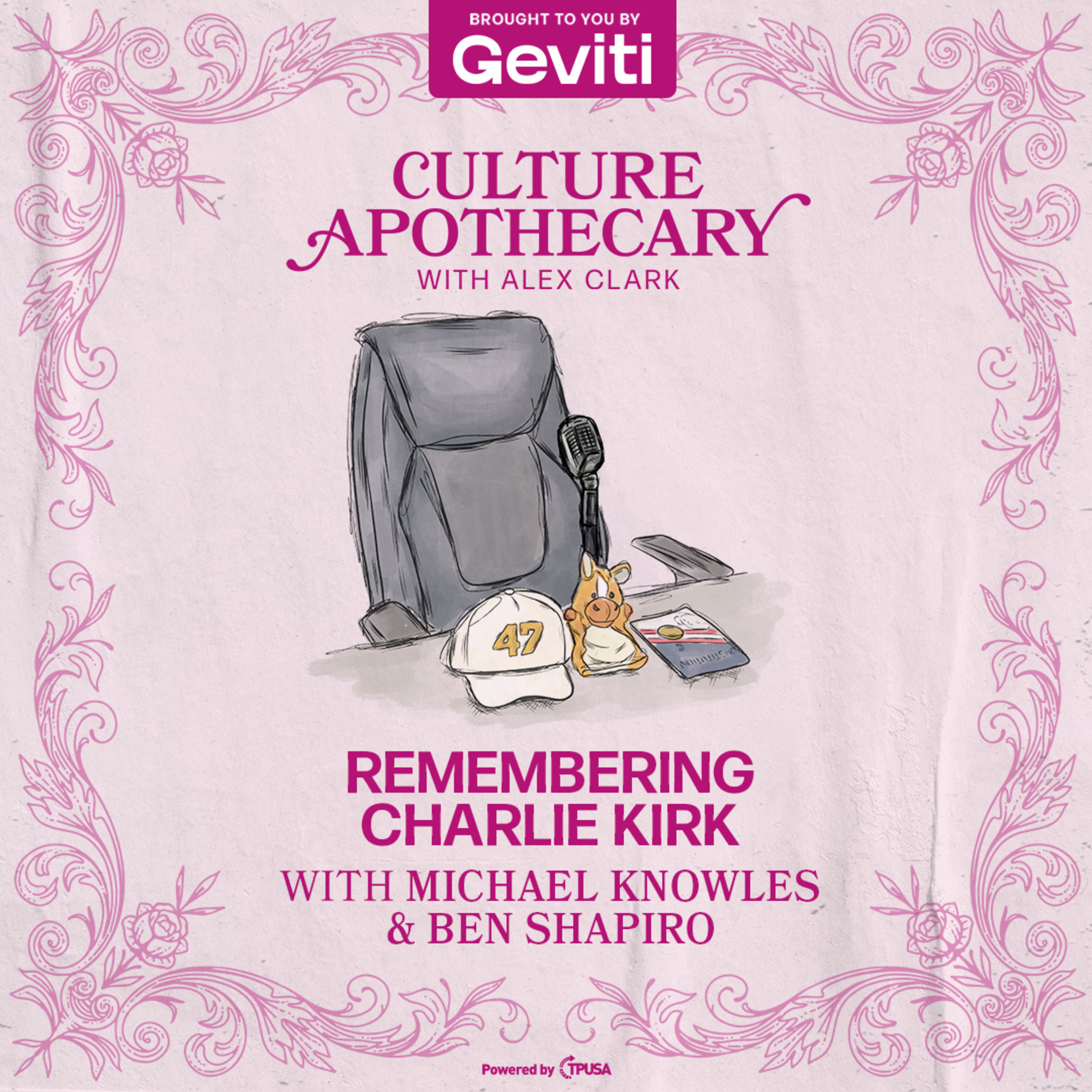
Culture Apothecary with Alex Clark
Remembering Charlie Kirk with Michael Knowles and Ben Shapiro
00:43:53
Loading summary
Transcript81 lines
- [00:00]
Alex Clark
Foreign.
- [00:22]
Ben Shapiro
My two guests today really need no introduction. This week I'm releasing three special episodes featuring guests who knew and loved Charlie in tribute to him. Today is it's the Daily Wires, Ben Shapiro and Michael Knowles. As per usual, no matter who I'm interviewing, it is my style to ask the tough questions, sometimes uncomfy ones, based on what I think people would want to ask themselves if they were the ones hosting a podcast. Ben and Michael share their first impressions meeting Charlie, what his assassination means for our country going forward, how they're coping with the aftermath. And we always end, of course, with asking what their remedy is to heal a sick culture. You can watch this episode on the real Alex Clark YouTube channel or culture Apothecary on Spotify, which now features features video. And right now, as we try to get back into the rhythm of releasing episodes after this tragedy, it would mean a lot for you to leave a five star review on Spotify or Apple and just say why you love the show. Find the show on Instagram at Culture Apothecary or find me at Real Alex Clark. You can get Show Merch or Charlie Kirk Legacy Merch to help support the organization. Tpusamerch.com you'll get 10 off with code. Alex Clark. Please welcome Ben Shapiro and Michael Knowles to Culture Apothecary. Tell us about the first time that you had even heard of Charlie Kirk or met him.
- [01:38]
Michael Knowles
Yeah, so the first time I met Charlie, I've told this story before is he was 18, I was 28 and I was working at the David Horowitz Freedom center and we were doing some sort of Horowitz Center Freedom event. And I see this gangly 18 year old kid with a very ill fitting jacket kind of bop up and he goes, Mr. Shapiro, I'm starting this organization called Turning Point. We're looking for donors. I really want to talk to you about what it is that we're doing. And so we sit together and he tells me about all this. Extremely energetic, obviously very bright, really, really gritty. I mean, one of the things we say at Daily Wire in terms of our hiring is you can't teach grit like Charlie. It was just grit and energy all day long. And I had this conversation. My co founder of the Daily Wire, Jeremy Boring, was there as well. And as Charlie walked away, I turned to Jeremy, I said, that kid's going to be the head of the rnc. Like you knew it the first time you met Charlie. And one of the things that I've said over and over about Charlie since this horrific act of evil is that Charlie is one of the rare people who got better at legitimately everything. So the, the kind of take when you see somebody who's very good at things is that they must have had some insane level of talent. Like obviously Charlie was innately incredibly smart, very bright and very fluid. But Charlie was not charismatic as a speaker. Charlie was not a great debater and he was a great organizer from the very get go, terrific fundraiser. All the things that, that made TPUSA sort of behind the scenes, an unbelievably large and powerful organization, that stuff. He was great at the beginning. The charismatic Charlie Kirk that the world knows through billions of views. The one who making great arguments on college campuses and going at it at Oxford Union. And the Charlie Kirk who was giving speeches in front of thousands of people at SAS or AmFest. That Charlie Kirk, he willed himself to become incredibly good at those things, like the best on earth at many of those things. And that is amazing. It's also, it contributes to the horrifying tragedy of what happened. Because of course, if his trajectory was that, then where would he have been in 10 years? I mean that's, that's the part that's astonishing. You know, when, when I first heard that Charlie had been shot, obviously everybody went into a state of shock. Everybody. But the thing that stunned me the most is when the headlines started to come out and it would say Charlie Kirk, 31, it's like he was 31 years old. And of course I knew that because I'm 10 years older than he is, I'm 41, he's 30. But because Charlie had accomplished so unbelievably much by the time he was 31, it's insane to think that he was only 31 years old and he had done all of this. And when a normal 31 year old person dies, obviously it's a tragedy. But you don't see the outpouring of grief from literally tens of millions of people all over the globe ranging from, you know, countries like the United States where you have tens of millions of people, to Argentina to London, to Italy, to Israel, to Canada, to, to South Korea to New Zealand. I mean like that's, that's an amazing testament to who Charlie was. It was a privilege to watch him go From a, an 18 year old go getter young man to a true man in every sense of the word. A husband, a father, and an iconic figure.
- [04:36]
Ben Shapiro
When I first was hired from Turning Point, so I've been here for six years, it was July of 2019, I believe you spoke at SASS or one of our gala dinners. Right. When I very first got hired. And then there was a little bit of a gap. There's a little bit of a gap between Turning Point, Ben Shapiro, maybe some rumors of, like, just a little bit of competition between you and Charlie, a little competitive nature or tension. Can you talk candidly about that gap?
- [04:59]
Michael Knowles
Yeah, I mean, I never felt that in terms of my personal relationship with Charlie.
- [05:03]
Ben Shapiro
Yeah.
- [05:04]
Michael Knowles
I mean, certainly it's not like we ran a campus organization. I mean, we run a media outlet. And so the idea that there was some sort of competition for whom would have been weird. I mean, the reason there was a gap is because there was Covid. Right. I mean, that was 2019. Then there was a gap in 2020 and 2021. And then last year.
- [05:20]
Alex Clark
Right.
- [05:20]
Michael Knowles
I spoke at. At AM Fest in. In December.
- [05:24]
Ben Shapiro
So no beef?
- [05:26]
Michael Knowles
No, I mean, what. What. What would the beef have been? I mean, that's the thing I keep asking people. So what. What is the supposed beef that I had with Charlie between, say, 2019 and 2023? What. What exactly would that have been? I'm unaware of it. I mean, we're in the game. Politics. That means that we have discussions all the time behind the scenes about how to pragmatically handle all the things that are happening behind the scenes. Are those conversations that. Of course. Are those conversations that. That ever got fraught and angry? No, not. Not one bit.
- [05:56]
Ben Shapiro
You may be one of, if not the only other, I mean, most threatened conservative commentator ever. Have you had to have these preparation type conversations with your own wife?
- [06:10]
Michael Knowles
A thousand times, yes. My. My wife, unfortunately, is quite used to this, and so are my kids. I. I have four kids. They. 11. 9, 5 and 2. And they do not know what it's like to live without 247 security. They've been living with it their entire life, essentially. And so, you know, honestly, like, for. For them, it's kind of normal. And they play lightsabers with the security guards and everything. But obviously, in the aftermath of what happened, security went into even higher gear. And, you know, don't go out to dinner, don't go into public spaces, all that kind of stuff. And. And I'm sure I'm not the only person who's felt that. But now I knew that Charlie was taking risk, you know, by doing the right thing. And that's the nature of the. That's the nature of what Charlie wanted to do. He knew he couldn't do what he needed to do unless he put himself at a Certain amount of physical risk. And he was incredibly brave for. For doing all of that.
- [07:02]
Ben Shapiro
One of the first things I said, I mean, I'm just, like, angry and sobbing and in tears. And I said to Colvette, I said, why was he allowed to be outside after Trump's assassination attempt? Why wasn't he wearing a bulletproof vest? And he said, we tried. He didn't want to do it. Like, there were talks of, hey, when we do these campus tours, we probably need to be indoors, all that. And he said, no.
- [07:30]
Michael Knowles
I mean, that's a decision that. That he wanted to make because he felt like he wanted to be with the crowd. Right? He wanted to do that. And that's. That is a decision. I mean, obviously, I used to do a lot of campus events. The campus events that I traditionally do are indoors, and they do require more security. And there have been situations, like back in 2017, I believe, when I spoke at Berkeley, that they had to have something like 500 police officers. And I was wearing a bulletproof vest at the behest of my security. And I remember saying to my security, do I need a bulletproof vest? Like, why? I remember actively saying my security. This is ridiculous. Nobody's going to shoot me for saying political things. And I think that to be in this business and to do what Charlie did, I think there's a baseline assumption. I think this is what got shattered for the country. There was a baseline assumption in this country, you do not get shot to death for having political debate with the people you disagree with. You don't do that. And I know I operated along those lines. I know Charlie operated along those lines because he was in the same business. And that's what I think is so shocking and horrifying about this, not just, obviously, most of all, most of all for his family, but for the entire country, is that we live in a new world where, yes, you very well could be shot and murdered for your political beliefs and for debating those in an open space.
- [08:39]
Ben Shapiro
You recently said that you're gonna get back out there, you're gonna go on some college tours. Are you scared?
- [08:45]
Michael Knowles
No. I mean, again, I've always operated under the assumption that everything's gonna be fine, because it would be hard to operate in the world without that. You couldn't. You couldn't exit. Well, the reason that I said that is because there had been a rumor that was promulgated immediately after Charlie shooting that I had canceled a college tour, which is not true. There was no college tour actually planned. And so I said, like, that's ridiculous. Everybody, everybody needs to go out and pick up Charlie's bloodstained microphone. You know, the, the Internet, of course, immediately decided that's not what I had said. But if you actually go and watch it, I say we. I use the plural pronoun we, because we all have to do that. No one is capable of filling Charlie's shoes. No one. I'm not capable of it. No one's capable of it. It's silly to even argue about it. Everybody needs to do their bit. Charlie was a giant. He was iconic in the movement. It's funny for me to say this about someone 10 years younger than I, but Charlie was, he was an icon of the movement and it's not possible. And no one should even try to replace Charlie Kirk or do what Charlie was doing. It's not, it's not possible. We all have to go out and, and do those things.
- [09:47]
Ben Shapiro
Are you taking over Turning Point usa?
- [09:49]
Michael Knowles
That is the biggest load of bull I've ever heard in my entire life, truly. As soon as Charlie was shot, we reached out to Andrew and to the rest of the team here and we said, what do you need? Let us put everything at your disposal. Literally everything. Like we, we put our talent at, at the disposal of TP usa. We put our support staff at the, at the disposal of TP usa, who monetary resources behind tpusa because we believe in what Charlie believed in and we believe in what TPUSA does and is going to continue to do on into the future. X is an incredibly stupid and, and bad place. And again, people need to touch some grass.
- [10:24]
Ben Shapiro
Does this change anything for policy or procedure at the daily wire?
- [10:29]
Michael Knowles
In terms of security procedure, we already had unbelievably high security precautions because as you mentioned, you know, the number of death threats that I receive or Matt Walsh receives. Yeah, extremely, extremely high. And so we have, you know, very strong security procedures and multi millions of dollars every year on my security, on, on Matt's security and all the rest. So, you know, I assume that it'll change some procedures. I can't imagine that it'll change too much because unfortunately we've been operating in this world for a while.
- [10:53]
Ben Shapiro
When you see all of these vigils in different cities, different countries, even that lean pretty radically left pouring out support for Charlie Kirk, what does that mean for the world?
- [11:03]
Michael Knowles
So I think that one of the big things that Charlie stood for and the thing that he was killed doing, which is what makes this so. Again, I keep using the word horrifying, but I don't know another word for it. It really is just horrifying. But the reason for this is because Charlie was not siloed. The big mistake for the right here would be to silo itself and not have the kinds of conversations that Charlie was having when he was shot. Charlie specifically went out there and said something that those of us in the industry who've been doing this for a while said for a long time. If you disagree, go to the front of the line. Right. Disagree. Front of the line. We need to have those conversations. We need to have those discussions. It's why millions of people became conservative because of Charlie. They weren't conservative before they bec conservative because Charlie was talking to them. And so while the right naturally is saying, let's unify, and I think that's true, the reality is that the biggest thing that Charlie stood for was the possibility of taking people from one political viewpoint to another political viewpoint, from one perspective about God, to a different perspective about God, from one perspective about their own life to a different perspective about their own life. And that's the thing that we need to get out there and do. And that's why I think you saw such a breadth and depth of grief. And again, I got texts from people and calls from people who radically disagree with me on politics, People who would be considered traditionally liberal, who were devastated at Charlie's death because of. And that's a testament to Charlie. It wasn't just the right that rose up in a cry of hurt and pain and anguish and rage. It was a bunch of people who either used to disagree with Charlie or, still on some matters, disagree with Charlie. And that's a testament to the breadth of his region and his capacity for. For conversation.
- [12:40]
Ben Shapiro
I have to ask you, what do you think about the rumors that Charlie was scared for his life, wondering if Israel was going to allegedly take him out before he died?
- [12:48]
Michael Knowles
I think there's a game that gets played online. Make a allegation. I use that word advisedly. And then when a bunch of people push back, you say, ah, you see, They've. They've now taken the allegation seriously enough to deny it. There's not one iota of evidence that that's true. Not one. I was not at the meeting in the Hamptons with Bill Ackman. I have friends who were at the meeting with Bill ackman. Right. People like Josh Hammer, for example, or Seth Dillon. I know that they'd been invited by Charlie, and they've spoken pretty publicly, I believe, about what it was that went down. Bill Ackman has spoken pretty publicly. First of all, the notion that Charlie would be blackmailed into taking a position is just unbelievably silly. People who are spreading these rumors, they're agents of demoralization, they're trying to split the movement, they're trying to smear Charlie's legacy. I mean, Charlie was two things. He was a principled man who argued in public, and he was also a coalition builder. Coalition building is a very difficult business. It's a business where you have to hold together a bunch of people who disagree in a bunch of different areas. And there can be real, as I said before, disagreements behind the scenes about how to handle those sort of pragmatic matters of building a coalition. But this notion somehow that Charlie, for example, was radically shifting on Israel and suddenly he was going to turn into a fan of Hamas and start preaching that. If you can show me evidence of that. I mean, I was interviewed on his show the day before he was shot, and we laughed together about some of the allegations that were being made along these lines. Nobody's gonna believe me. Who doesn't wanna believe me online, because that's how it works in the X space. But you know better than I do. You tell me. You are on the inside here.
- [14:27]
Ben Shapiro
So my perspective, being on the inside is actually, you said that perfectly about coalition building. So he was very disturbed by this splitting on the right. He was like, this is a way bigger issue than we even realize. Like, I mean, the whole movement is basically splitting in half. Pro Israel, anti Israel. What am I going to do here? Like, let's give everyone an opportunity to speak, share their sides. I mean, that's why he hosted this debate on Israel at SAS this year, this summer. He was planning on having, you know, you speak at our events, Tucker, speak at our events. Like, so it was like, let's just give everybody a platform internally. I never personally heard any, like, major worldview shifts on Israel like that. It was just very much I'm hearing what everybody's saying, you know, you would.
- [15:17]
Michael Knowles
Know better than I would. But again, that. That seemed to be my perception from the outside. I mean, again, until the day he was shot, he was publicly a pro Israel person in every debate that he ever personally held in terms of his.
- [15:27]
Ben Shapiro
Personal beliefs, which those were in the last couple months. I mean, that is very, very recent. Conversations after that interview, just a few days before he died, between you and Charlie on Israel, did he text you after the interview, anything?
- [15:40]
Michael Knowles
No. The last text that I received from Charlie was inviting me to speak at I mean, I can pull it up. It was. It was literally inviting me to speak at amfest.
- [15:48]
Ben Shapiro
Yeah.
- [15:49]
Michael Knowles
And. And I said yes. He said, great, we'll plan it. That was the last text that I received from Charlie, and that would have been the prior Thursday, maybe. And the last conversation I had with him was. Was the conversation that we had on air.
- [15:59]
Ben Shapiro
In three months from now, in five years from now, how will we make sure that people remember Charlie Kirk?
- [16:06]
Michael Knowles
The amazing thing about Charlie is his ubiquity. So I think that obviously the clips of Charlie are never going to die. Those live out there, and I think that they need to continue to be trafficked on Tick Tock, where obviously had an enormous audience and on the various other social media platforms. I think that the. The biggest thing that can be done is continuing to support tpusa, which, of course, as I said, Daily Wire, we're behind you guys. We believe that you're going to be able to navigate these waters. We believe in Charlie's mission and his legacy. And we believe that, again, that fractious business of coalition building, which is a tough business, is one that you guys are going to navigate properly. It's exactly what Erica said. Building this movement is what Charlie would have wanted. And doing it in his name, I think, is something that he would have wanted as well. And so we're going to contribute to that as much as we can as a company. I'll do that as much as I can, personally. What Charlie stood for in the end was a belief that people need to make America better and make themselves better. And that meant for him, people need to go to church. Obviously, Charlie was very religious, Christian. People need to believe in Christ. People need to go back to church. People need to engage with the country. People need to have open conversations. They need to believe in basic American values like family and faith and freedom. And these are the things that Charlie stood for. If we stand for that and if we continue to cite Charlie, I think that's a good thing. I think it's a very good thing to continue to promote Charlie and continue to promote his content. Again, we're lucky we're left with this enormous mass of content that he bequeaths to us that we can still. That we can still look at and gain inspiration from and pass on to our kids. I mean, I have kids who are, as I say, 11, 9, 5 and 2. I plan on showing them Charlie Kirk clips.
- [17:39]
Ben Shapiro
I ask every guest this. If you could offer one remedy to heal a sick culture, it could be physically, emotionally, or spiritually. What would that remedy be?
- [17:46]
Michael Knowles
Go to church. Go to church. I say this is a Jew. Go to church.
- [17:49]
Ben Shapiro
Why do you say that as a Jew?
- [17:50]
Michael Knowles
Because this is a Christian country. I want Jews to go to synagogue, but there ain't that many of us. So if you're, if you're a Christian or if you grew up in a Christian household, even if you didn't go to church, church is good for you. I've said that my entire career. Charlie said it his entire career. It ain't gonna stop now.
- [18:07]
Ben Shapiro
Thank you, Ben, for coming on Culture apothecary.
- [18:08]
Michael Knowles
Thanks so much.
- [18:12]
Ben Shapiro
How are you feeling?
- [18:14]
Michael Knowles
Actually, I'm okay.
- [18:16]
Alex Clark
You know, there people that we should be more concerned about and praying for. You know, closer to Charlie got the news and my first reaction was, oh, you know, I hope it. I hope it wasn't too bad. I hope, you know, he'll hope his recovery won't be too bad. It actually didn't occur to me that he could have been killed. We're all familiar with the threats and the attempts over the years, especially from the radical left. And he was extraordinarily prominent public figure globally actually, but especially in the United States. And so he understood those threats. But I thought, well, okay, I hope it wasn't too bad. And then when we realized what had happened, that was surreal. And my wife talked about it. She saw the video. I saw the faraway video. I did not, thank God, see the close up video. And I have not seen the close up video.
- [19:10]
Ben Shapiro
How did you.
- [19:11]
Alex Clark
All right, how do I have social media and I didn't see the video? Yeah, I was very intentional about it. I'd heard that there was a video beforehand and I made a very, very concerted effort not to see it. I don't need to see it. I know what happened. She saw it and she said it was the strangest reaction because on the one hand she said he can't possibly be dead. And then on the other hand, having seen it, she said, he can't possibly be alive, but he can't be dead. Charlie Kirk cannot be dead was her reaction. Obviously, we've all been talking to each other and then talking about it publicly for those of us who do that. And it took me about three days. You know what happens when a family member or friend dies and it's just weighing on you. And then you go to sleep and you dream about whatever. And when you wake up, anyone who's suffered a loss will know this. You wake up and there's this one second where you say, huh. Then one second later, it hits you again. So it was about the third day. Obviously there had been a lot of media, a lot of things happening behind the scenes, a lot of conversations happening. And I was sitting in my office at home, which is where I keep my Bibles and my religious items, and it's where I have real solitude. And it was about 11 o', clock, 11:30, and I had just been sort of staring at my computer, my phone. I was in principle doing work. What was the work? I had to write my show. And my show was Talk About Charlie. So I didn't need more than 11 seconds, really, to write that. I was just staring, staring. And then I just let it hit me for about 90 seconds to three minutes, really, just the full force of it hitting. And men, we don't like to cry. And so I. You let the tears come to your eyes and then you, especially right wing men, we just push it right back down. You say, okay, this is not what we're supposed to do. But that's when it hit me. Day three. Obviously, a lot of prayers. It's very helpful for those of us on the right especially. Charlie was quite certain about what he believed and quite certain about where he was going. So there's a consolation to that, but it's a soft consolation in the short term, you know, for, for Erica and for, for the whole family, obviously.
- [21:30]
Ben Shapiro
Have you gotten to talk to Erica at all?
- [21:32]
Alex Clark
Yeah, yeah.
- [21:33]
Ben Shapiro
How was that?
- [21:34]
Alex Clark
That was wonderful to be able to see her and, you know, but she's, you know, she's going through just about the worst thing that's imaginable. So she's, I know she's in the prayers of millions of people around the world and she's just done an unbelievable job, like a superhuman job of reacting to this with their children. The speech was, you know, superhuman that she was able to give. So she's a very strong and serious person. But, you know, doesn't matter how strong and serious you are. You know, one simply has to grieve this kind of loss. There's an outpouring of support from many, many millions of people all around the world. But, you know, Jesus wept when his friend died, even right before he raised his friend from the dead. So, you know, one simply has to mourn. And I know there are people who mean very well in the public space who, you know, their first reaction is to be really happy, clappy about everything. And Charlie had an absolutely certain faith, hope and charity, all three of the theological virtues. But one still grieves it's just a terribly, terribly sad thing. And. And there's. There's no getting past it, you know, that's really the point, I guess.
- [22:50]
Ben Shapiro
Do you remember the first time that you ever heard of Charlie Kirk or that you met him?
- [22:54]
Alex Clark
Yeah, I don't know about the first time I heard of him. I had heard of him before I met him. I do vividly remember the first time I met him.
- [23:02]
Ben Shapiro
Tell us about it.
- [23:02]
Alex Clark
I was in the Fox green room in LA. This was about 150 years ago, and it was 4 o' clock in the morning because the morning show LA time, you know, is awful. It's like 3am or whatever. So I'm sitting there. I lived in LA, and I'm sitting there half asleep, and Charlie walks in, probably off some flight, I don't know, hadn't slept in three days, bouncing off the walls, hey, Knowles. Hey, what's going on? This. And I'm there, you know, I should have been adjusted to the time. And I'm, you know, I was like, buddy, come on, I'm trying to sleep or whatever, and. But he was just full of boundless energy. And it gets to. Gets to the bigger point on faith and everything, which is they say that all the way to heaven is heaven. All the way to heaven is heaven. And you really could see it with him. I never saw him down. I could see him a little stressed out. Obviously he was managing the equivalent of five people's careers at the very highest levels of politics and media, but I never saw him down at all. Which is not accidental. That's not merely coincidental.
- [24:10]
Ben Shapiro
There were definitely, like, you could tell there were moments. I mean, just working here for the last six years and one of like the. I mean, we have exploded in the last few years. I mean, when I first got hired in 2019, there was like, I don't know, 40 employees. Like we could all fit in one building. Now we have tons of buildings. Like, it's. It's just crazy. I don't even know everybody who works here at this point. We've grown so much. But at that time, I mean, there were definitely those moments where it was like he was very motivated to get things done. That type of, like, stressed, but yet never raised his voice at people, never cursed at people, never spoke poorly about others, never gossiped about others. And, you know, J.D. vance, the Vice president, kind of echoed that. He said that that's something that Erica had told him. Yeah, that. That he had never raised his voice or spoke, you know, shortly with her. And he Said, well, that is just such motivation to me to be a better husband, because every husband falls short, I guess. Charlie was an anomaly. Thanks, Charlie. But when you heard that, what did you think?
- [25:14]
Alex Clark
Well, it totally rings true. The guy really was who he said he was. And that isn't always the case. Sometimes it's the case in public life, but not always. And those of us, though, who had spent some time with the guy over a long period of time, could tell no, he really was that guy, literally a boy Scout. And his faith really was sincere in some ways. I think it's one of the things that made him so successful. We have this idea in polit, you have to be a Machiavellian animal in order to succeed. And he really disproves that because with him, the truth is usually the simplest option. You don't have to keep track of all of your lies and all of these things. And he was a complete straight shooter with everyone, including not only his friends, not only his political allies, not only his colleagues, but with his enemies, too. And you can judge a man by his enemies. And he had. He had the caliber of enemy that would tell you that he was not only on the right side of things, but extraordinarily effective. And it's important to know the difference between your friends and your enemies. If for no other reason, as a friend of mine points out, if for no other reason than to know who to pray for. Christ tells us to pray for our enemies and love our enemies. And so it's good to know that. And he lived that out every day. You could see the great charity that he had, even. And especially for his enemies.
- [26:36]
Ben Shapiro
There was a little bit of news the day that we're recording this that just came out that the Biden administration had created a federal investigation that they called Arctic Frost. And whistleblowers allege that this was a corrupt FBI investigation, that they were looking into over 90 names in Republican politics and media, and that one of them was Turning Point usa, of course. And so my question for you is, what does it say about our justice system when the federal government investigates political opponents under the guise of security?
- [27:14]
Alex Clark
Well, that's nothing new. Barack Obama was also doing that in a. In a transparently corrupt way, and he was re. He was exposed for having done that, though they never faced any consequences, unfortunately. We saw the corruption of the DOJ from the earliest days of the Trump campaign all the way through Trump's first administration. This is the first I'm hearing of that, but it doesn't surprise me at all. In fact, I think most of us would have guessed that something like that would have existed. But I guess the coda to that whole story is, who controls the DOJ now? Who's in the White House now? And the answer is, we are. That's how this information is coming out. And one of the major reasons that we do have that political power now is Charlie. This is not hyperbole. This is not just a nice thing that one says after a person dies. This is a fact. There almost certainly is not a Trump second term without Charlie Kirk. And so even the fact that these sorts of things are coming to light now, days after Charlie was killed, is quite directly attributable to him and not only his clear vision. He had a very clear vision. It was very good. Not only to his great charity and generosity for everyone, which was manifest, but to his effectiveness. They didn't target him. Whether we're talking about the assassin or whether we're talking about the Biden doj, they did not target him because he was ineffective. Quite the opposite.
- [28:39]
Ben Shapiro
So here's what's crazy, you saying this. When we first were told officially that he had passed, I went through three immediate things popped into my brain. First thing was, and I had tweeted, it was, I am so thankful that Charlie loved and knew Jesus. Two, how in the world are we supposed to go on without him? And three, thank God Trump is president, because I knew that if this would have been a Kamala Harris administration and we didn't have Cash Patel and we didn't have Dan Bongino, I was like, we would never have answers.
- [29:16]
Alex Clark
It would have been downplayed. It would have been pushed out of the news cycle.
- [29:20]
Ben Shapiro
There would be no justice, or it would be, yes, swept under the rug. And I was just like, thank you, Jesus. And it was crazy because I was like. And the reason we have that, the reason we have it is literally because of Charlie.
- [29:31]
Alex Clark
Yes. And, you know, it's. I was going to say little things, I guess these aren't really little things. A national address from the Oval Office by the President of the United States that really focuses how people are thinking about it. The Vice President filling in to host Charlie's podcast, host his friend's podcast, that really focuses attention and the outpouring of grief and love and attention that actually preceded the Oval Office conference and the Oval Office address and the Vice President, that was all Charlie. That was people reacting to Charlie. Someone who in many cases were actually friends with him. Charlie had many, many real friends, but also people who just Felt that they were friends of his because he was on their phone all the time for years. I mean, some kids grew up listening to him. He really formed the way they thought about politics. Some people radically changed their views of politics and of man's relation to the cosmos, their religious views, because of Charlie. So they felt this really personal connection to him, and they were grieving him because of that. But the fact that then the political powers flew in and said, hey, hey. Yes, now let's focus and let's bring some justice, let's bring some reforms to punish the bad people, take the antisocial elements that are totally undermining our society out of polite society, and let's really do something here. Let's be effective, which is very much in keeping with Charlie's career.
- [31:06]
Ben Shapiro
There are two descriptions that are being thrown around right now about Charlie Kirk. One is that he was a civil rights leader, and two is that he was a martyr. Do you agree with any of those?
- [31:18]
Alex Clark
Well, it depends on how you define these terms. The left has taken the term civil rights leader to mean any race hustler or sexual deviant who wants to push some radical left wing agenda. But of course, Charlie was a civil rights leader in the true sense of that term, actually. He defended the right, not the wrong. And he was eminently civil. He was eminently civil. He was killed because he was civil. In terms of martyrdom, I think that one cannot escape the fact that he was killed not merely because of his political views, not merely because he liked low taxes or whatever. He was killed because of what he had to say about the nature of man and the relation of the body to the soul and about God, about Christ. He never let an opportunity go by when he did not preach the gospel to people. And so I guess theologians can quibble about the meaning of that term, but there is no question he was targeted because ultimately of his faith and religious convictions.
- [32:27]
Ben Shapiro
You said that in the aftermath of Charlie's death, it would be reckless to redevote ourselves to protecting the marketplace of ideas.
- [32:34]
Alex Clark
Redouble?
- [32:35]
Ben Shapiro
Redouble.
- [32:36]
Alex Clark
In the wake of Charlie's assassination, there are people who in great sincerity say that the most important thing to do right now is to redouble our devotion to the open marketplace of ideas. And this seems like a noble and courageous thing, and it comes from a good place, but it is, in fact reckless because we had an open marketplace of ideas or something like it.
- [33:01]
Michael Knowles
It.
- [33:01]
Alex Clark
And the left shot it up. And so we cherish the healthy exchange of ideas. No one did so more than Charlie. But nice words and soft soap will not accomplish that because marketplaces require rules. You can't have a marketplace of ideas or of anything else or of bananas if people are shooting up the marketplace. If there are not basic rules, common media of exchange, trust in that sort of system. And so what is required for any kind of liberty, for that matter, is.
- [33:41]
Ben Shapiro
First order in that sense. Do you agree then that that is why it's okay for people to be saying some need to be losing their jobs or being expelled from school if they are celebrating his death or saying that he deserved it?
- [33:54]
Alex Clark
Yes. So, for instance, the celebration of murder, that's a good example because it's so egregious. One cannot tolerate the celebration of murder for engaging in political debate within the so called marketplace of ideas. Because rather than that kind of thing expanding the marketplace of ideas, it actually undermines the whole thing. If someone comes out and says, I encourage everyone to go murder that conservative if he dares to open his mouth, you're not thereby increasing speech, you're not thereby increasing the exchange of ideas, you're completely shutting it down. This is why, and our founders and framers wrote about this extensively, but it's even in the Constitution and the First Amendment. This is why certain kinds of speech are not protected by the First Amendment. Things like direct threats, things like fighting words, for that matter, things like fraud, things like obscenity. There are a number of categories of sound that are not protected as speech. And the reason is not to shrink the marketplace of ideas, but to protect it. You cannot have, in the words of G.K. chesterton, a thought that stops thought. In the words of Chesterton, that's the only thought that ought to be stopped. You cannot simultaneously, for instance, be free and undisciplined. The founders and framers wrote extensively about this. You cannot simultaneously be free and totally ignorant. You have to know some basic things. This is why we don't let toddlers vote, because they don't know anything and they're not disciplined. We know this intuitively. We can also arrive at this philosophically. And so what is needed now, it would seem to me, is the reassertion of order and the kind of order that makes liberty possible, that makes the exchange of ideas possible. It's not that we arrive at these basic truths and moral goods as the asymptotic end goal of endless debate. Rather, these are the axioms without which debate is not possible. It's like in mathematics, within mathematics, you don't start from nothing, you have to start from axioms. And so an example would be A equals A. I can't prove that. A plus B equals B plus A. I can't prove that. However, I can't prove anything else without accepting that as a premise. And the same is true in speech and debate and public life. Asius Lewis talks about this. He calls this the dao. Others call it the natural law or the first principles of practical reason. Certain basic things that I can't exactly prove. I can't exactly prove to you that it's wrong to commit murder, but I can't prove anything else about morality if I don't accept that. That has always been the case in our society. And so if all of a sudden you have a society where people deny these basic axiomatic truths in a way that is, in fact, threatening and inciting violence, then you have to stop that. You have to punish that. You can't expect someone to send their children to a school at which the teacher is encouraging those children to be murdered. You cannot go to a hospital when the nurses and the surgeons are openly calling for the murder of you and half the country along with you. I can't go to a restaurant if the cooks and the servers are talking about how much they want to poison me. You cannot have those things. You cannot have a society in that way. And so none of this is particularly revolutionary. These were always considered basic truths.
- [37:28]
Ben Shapiro
Isn't that just conservatism, common sense?
- [37:30]
Alex Clark
Yes, it is, actually. And so in a political reform like this, which is something that we're talking about now, it's always good to err on the side of caution. So you say, look, it's not that we want to throw people out of the public square or ostracize people for saying things that we merely disagree with. We're talking about particularly egregious examples that undermine the whole public order. And so I think a good place to begin here is with those who would celebrate and encourage the murder of innocent people simply for speaking.
- [38:02]
Ben Shapiro
There's a lot of rumors online that Charlie was considering converting to Catholicism. You just did an interview, right, with Charlie about Catholicism or. We've had a million conversations, and that was recent. That was a recent conversation. So is there any legitimacy to Charlie potentially converting to Catholicism as of recent?
- [38:20]
Alex Clark
You know, it's funny because Charlie and I, we always jibe each other about religion. You know, almost every conversation, certainly publicly, we would get a kick out of doing that publicly. Privately conversations are a little bit different. And so, look, it's not really my place to reveal my own opinion of this or other conversations I've had with Charlie, and his publicly stated views speak for themselves. And if other people close to him want to reveal private conversations, they're welcome to. That's not my place to do it. All I will say on this fact is I feel good about Charlie. I feel good about Charlie.
- [38:52]
Ben Shapiro
His salvation, you mean?
- [38:53]
Alex Clark
Yes, I feel good. We trust to God's extraordinary mercy, and we pray for the dead. And I do, at least. But I feel good about Charlie. And the thing that I will certainly say that is obviously public is Charlie took religion very, very seriously, and he took truth very seriously. And he would pursue it rigorously, and he could do it bombastically, even zealously. So that's what he cared about, obviously, most of all. So people sometimes, whenever anyone dies, especially someone who really cares about religion, they say, well, what would this person have believed 10 or 20 years from now? I don't know. We don't have that time. So all that we can do is pray for our friend in faith and feel whatever consolation we have from our public or private conversations. And so the thing that is giving me personally some consolation is I feel good about him.
- [39:58]
Ben Shapiro
I ask every guest this that comes on the show, if you could offer one remedy to heal a sick culture, physically, emotionally, or spiritually, what would it be?
- [40:06]
Alex Clark
The first thing you have to do is pray, ideally on your knees. That's the first thing you have to do personally. And that's physical, emotional, and spiritual, by the way, because we're bodies, too. We're not just spirits floating in outer space. That's what modern ideologies say, gnostic ideologies. The transgender ideology, for example, says that our body has nothing to do with who we really are, but no, no, it's in our bodies. Our Lord is incarnate in the flesh in history, and he picks real apostles and he leaves them real sacraments. And then when he's crucified and resurrected, he broils them real fish. That's how he appears to them and eats it in his body. So the body really matters. And that's the first thing, because it gives you the ability to look up Chesterton again. This popped in one of his detective stories. One of the conclusions is, don't pray in high places, because from high places, everyone looks like ants. But when you're on your knees, you can look up to heaven. So that's the first thing you got to do personally. You have to talk to God. God's real, and so you should talk to him, shouldn't you? Before you call your mother even, you should talk to God. That's the first thing. But we're political creatures as well. We're a social animal. And so we need the public authority to recognize truths, to recognize goods like the common good, and to pursue them. This is statecraft101 going all the way back to the first caveman community, which is that good is to be done and evil is to be avoided. And there is much that flows from that basic observation. That is the first charge that we have. Good is to be done and evil is to be avoided. And one of the problems that we have in our modern culture is that we not only deny good, we deny that we can even distinguish between good and bad. It's not only that we deny truth, we deny that we can distinguish between truth and falsehood. If that is the case, not only should we hang up self government, we should hang up our humanity because we're surrendering our reason we can know these things. And so what is called for now is not only the clarity of vision that I think most of us have deep down, but it's the courage to say, no, no, no. I will promote the good and I will suppress evil and I will promote truth and I will suppress falsehood, and I won't. We'll have a light touch and we'll have all of these wonderful subsidiarity and federalism and all these nice things that attend to politics. But let's not mince words here. Let's do what we know is right. Those would be the two sides of it, because we're all going to face our particular judgment as individuals. But we are going to live in this life and in the life to come as part of a community, the political community here in this world and also in this world and in the life of the world to come as part of the mystical body of Christ. So we need to do things together, too.
- [42:55]
Ben Shapiro
Michael Knowles, thank you for coming on Culture Apothecary and honoring our friend Charlie with me.
- [42:59]
Alex Clark
Thank you for having me me. It's wonderful to be with you.
- [43:04]
Ben Shapiro
Big thank you to Michael and Ben for being so open and vulnerable and sharing so much with us. In the next episode, I'll be talking to arguably one of the closest people in Charlie's life. All about his marriage, how he managed a work life balance, why people on Charlie's team started taking down cameras immediately after he was shot. What will happen with the Charlie Kirk show? A more in depth look at Charlie's potential conversion to Catholicism and feelings on Israel. What Erica being CEO means for Turning Point USA and more. Please leave a five star review. Tell others why they should be listening to Culture Apothecary. We're on a mission to heal a sick culture. Twice a week, Mondays and Thursdays, 6pm Pacific, 9pm Eastern. Make sure you're subscribed. I'm Alex Clark and this is Culture Apothecary.