Podcast
CXOTalk
Hosted by Michael Krigsman · EN
C-Suite Conversations on AI and Strategy. Join industry analyst Michael Krigsman for unfiltered discussions with the leaders shaping the future of business. From AI implementation to digital transformation, hear directly from CIOs, CTOs, CEOs, and more from the world's largest companies. No scripts. No PR fluff. Just real questions from our live audience and honest answers from the C-Suite.
Want to participate?
Get invited to the next live show: https://www.cxotalk.com/subscribe
36episodes
Episodes
Newest firstAll episodes
AI-Enabled Software Development: AI Coding at a Global Insurer, with Blitzy | CXOTalk #917
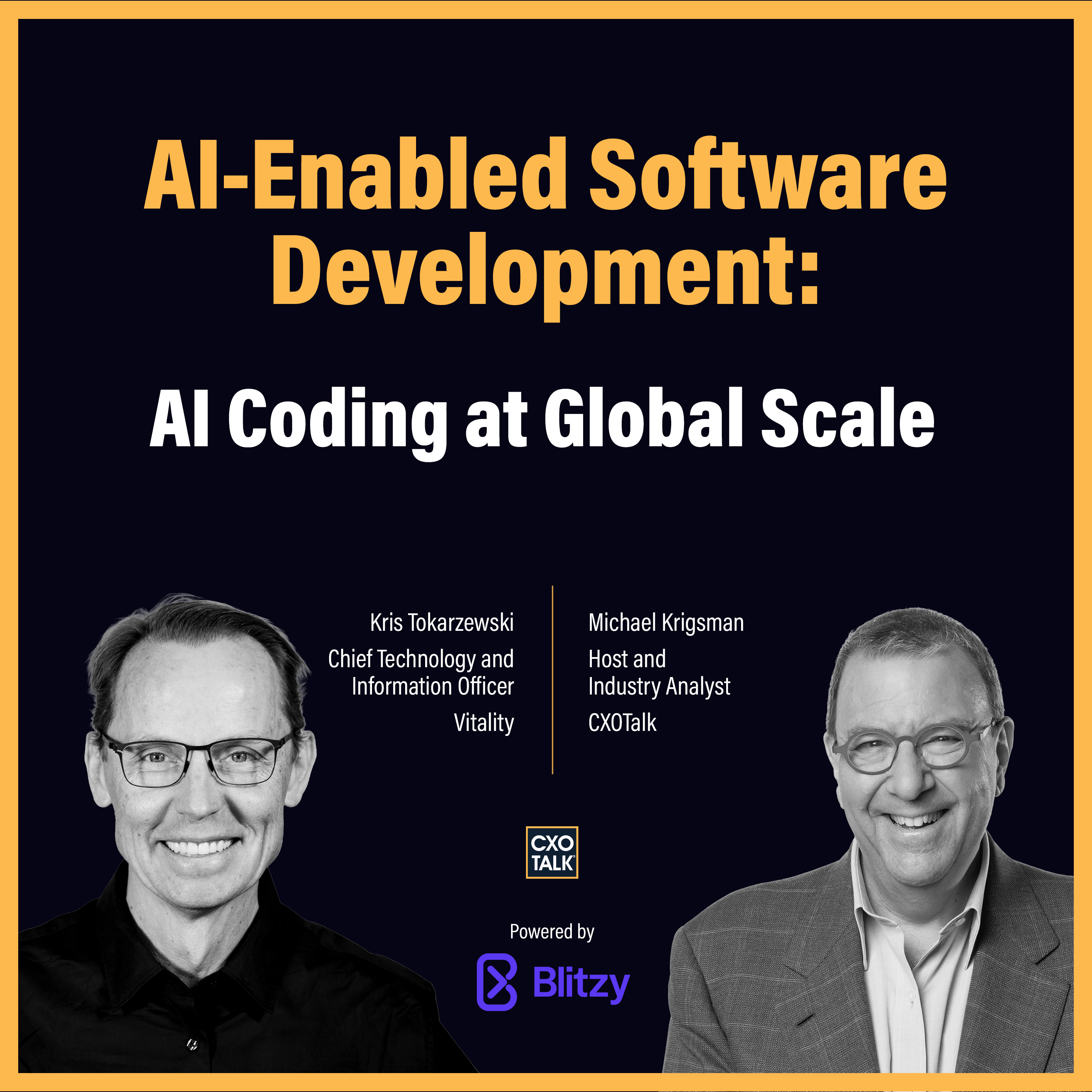
May 400:21:24Tap to summarizeAutonomous software development creates a dilemma for leaders in regulated industries: adopt AI coding at scale or fall behind on product velocity without compromising auditability and code quality. In CXOTalk episode 917, Kris Tokarzewski, Group Chief Technology Information Officer at Vitality, describes how a 14,000-employee multinational insurer is rebuilding its software development life cycle around AI. This episode examines the impact of agentic AI on software development in the enterprise.Recorded at Blitzy's headquarters, the conversation examines deterministic code generation, Blitzy's infinite code context, context engineering, test-driven development, and the shifting bottlenecks that surface as throughput accelerates.YOU'LL DISCOVER✅ Why regulated industries require deterministic, auditable code rather than the probabilistic output most AI coding systems generate✅ How Blitzy's infinite code context (ingestion of codebases, engineering standards, and business rules) creates high-quality software aligned with compliance requirements✅ How Vitality reverse-engineers legacy systems with autonomous AI, achieving a measured 5x acceleration over manual methods✅ Why optimizing end-to-end SDLC throughput matters more than local efficiency at any single stage✅ How code review of 50,000 to 100,000-line pull requests becomes the next limiting factor, and how AI reviewers close the gap✅ How test-driven development pairs with autonomous code generation to raise quality and compliance pass rates✅ How the roles of requirements engineers, software engineers, and product teams converge inside an AI-native SDLC✅ How to instrument AI spend against velocity, quality, end-to-end throughput, and customer value rather than isolated gainsTIMESTAMPS0:00 Deterministic code vs. probabilistic AI output0:14 Meet Kris Tokarzewski, Group CTIO of Vitality0:32 Why Vitality is modernizing legacy insurance systems1:30 Event-driven architecture as agentic AI's natural partner3:00 Building an AI-native software development life cycle with Blitzy4:28 Throughput optimization versus local efficiency6:02 Reverse engineering legacy systems and deterministic code generation9:05 Infinite code context: ingesting codebases, standards, and rules10:00 Test-driven development with autonomous code generation10:49 Results: 5x faster legacy reverse engineering13:17 Product, engineering, and DevOps convergence15:04 Roles level up: requirements engineers and software engineers16:18 Reviewing 50,000 to 100,000-line pull requests17:56 Instrumenting AI spend against business outcomes19:16 Executive sponsorship for autonomous development20:16 Advice for CIOs and CTOs adopting AI-driven development🔔 Subscribe for weekly conversations with the world's top business and technology leaders.📩 Get the CXOTalk newsletter: https://newsletter.cxotalk.com💬 Read the show notes: https://www.cxotalk.com/episode/autonomous-software-development-ai-coding-at-global-scale-with-blitzy🎙️ ABOUT CXOTALKCXOTalk features unfiltered conversations with C-suite executives from major companies about AI, digital transformation, and business strategy. Hosted by Michael Krigsman.Episode 917 | Recorded at Blitzy Headquarters#CXOTalk #AICoding #AutonomousDevelopment #DeterministicCode #AINativeSDLC #ContextEngineering #InfiniteCodeContext #LegacyModernization #RegulatedIndustries #EnterpriseAI #Blitzy
Transcribe →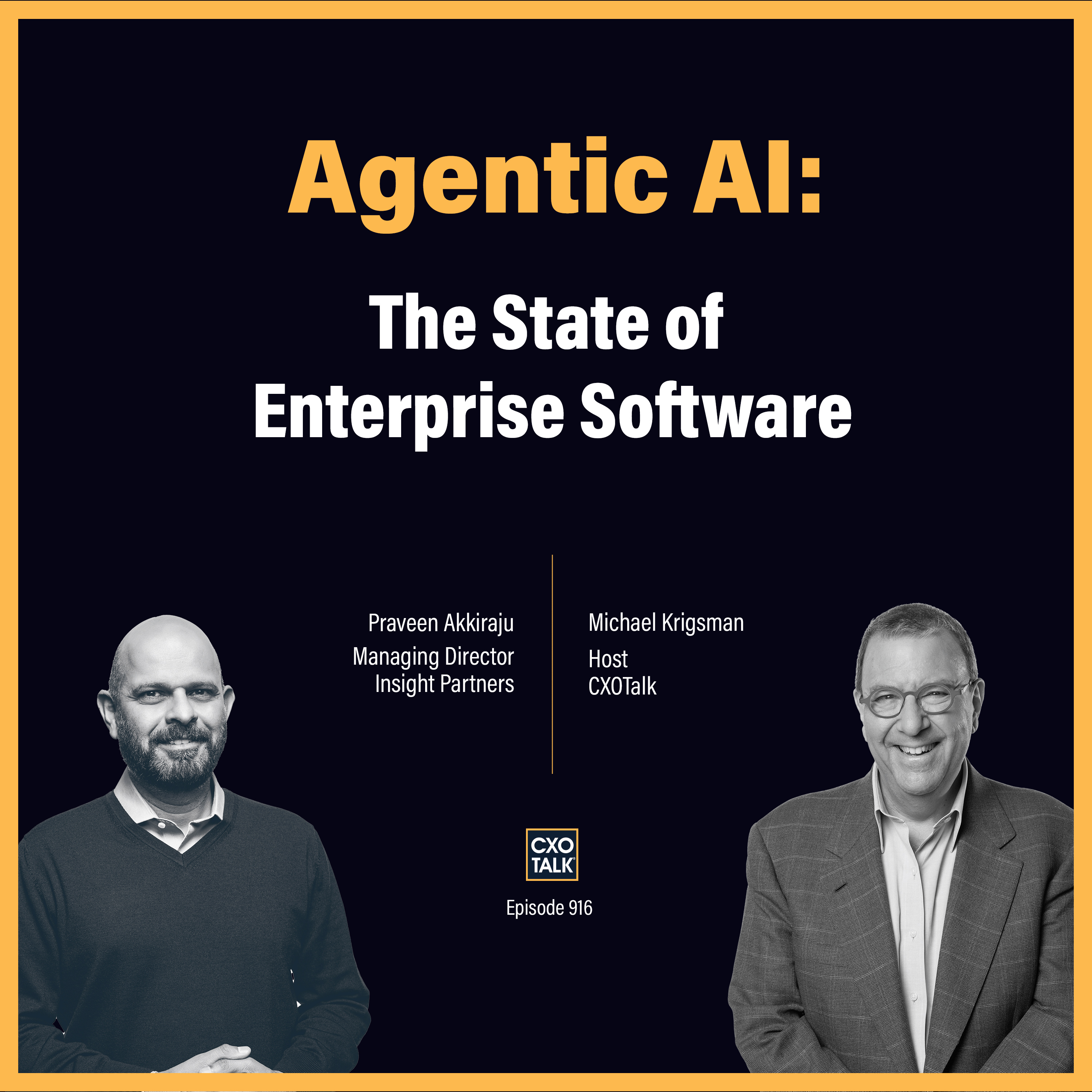
Agentic AI in the Enterprise 2026 | CXOTalk #916
May 300:55:52Tap to summarizeAgentic AI is reshaping enterprise software faster than most CIOs, CFOs, and vendors are prepared for. Praveen Akkiraju, Managing Director at Insight Partners, joins Michael Krigsman to examine the state of agentic AI in 2026: what works in production, what remains hype, and how sophisticated enterprises are now running more than 1,000 agents at scale. The conversation covers the engineering that separates reliable agents from unreliable ones, the economics of token consumption, and the build-vs-buy calculus facing enterprise buyer4s.YOU'LL DISCOVER✅ Why Praveen argues "the agent is actually the harness," and what a harness includes: tools, context, memory, and guardrails✅ "Jagged intelligence": why state-of-the-art models still fail on basic prompt variations, and the implications for production deployment✅ How leading enterprises are operating 1,000+ agents and the governance questions that remain unresolved✅ A bounded vs. unbounded framework for deciding where agent autonomy is realistic and where human approval must stay✅ Why "token maxing" is consuming annual AI budgets in 90 days, and what CIOs can do about it✅ How Stampli inserts agentic steps into invoice reconciliation rather than rebuilding the workflow from scratch✅ Build vs. buy: why front-end workflows favor buying and back-end, data-heavy workflows favor building✅ The fractional-FTE pricing model emerging for agentic products, and what it means for software economics⏱️ TIMESTAMPS0:00 Token maxing and the enterprise AI budget problem0:23 Model evolution: reasoning, DeepSeek, and the agentic inflection2:03 What is an agent: models plus harness4:46 Hype versus reality in agentic AI8:31 Where agents deliver measurable value today13:10 Agent negligence, guardrails, and sandboxes16:06 Data access boundaries: APIs, MCP, and policy files20:38 Bolt-on agents versus agent-native software26:53 Human in the loop or autonomous: the operating model question33:49 Fix your data first, or start now?41:54 Will agents replace Salesforce and Workday?47:28 Build vs. buy: front end versus back end50:45 Token costs and the return of variable-cost software54:09 Pricing agents as fractional FTEs🔔 Subscribe for weekly conversations with the world's top business and technology leaders.📩 Get the CXOTalk newsletter: https://newsletter.cxotalk.com💬 Read the show notes: https://www.cxotalk.com/episode/agentic-ai-and-the-future-of-enterprise-software-in-2026🎙️ ABOUT CXOTALKCXOTalk features unfiltered conversations with C-suite executives from major companies about AI, digital transformation, and business strategy. Hosted by Michael Krigsman.Episode 916 | Recorded April 2026 #CXOTalk #AgenticAI #EnterpriseAI #AIAgents #AIGovernance #CIOStrategy #InsightPartners #EnterpriseSoftware #DigitalTransformation #LLM
Transcribe →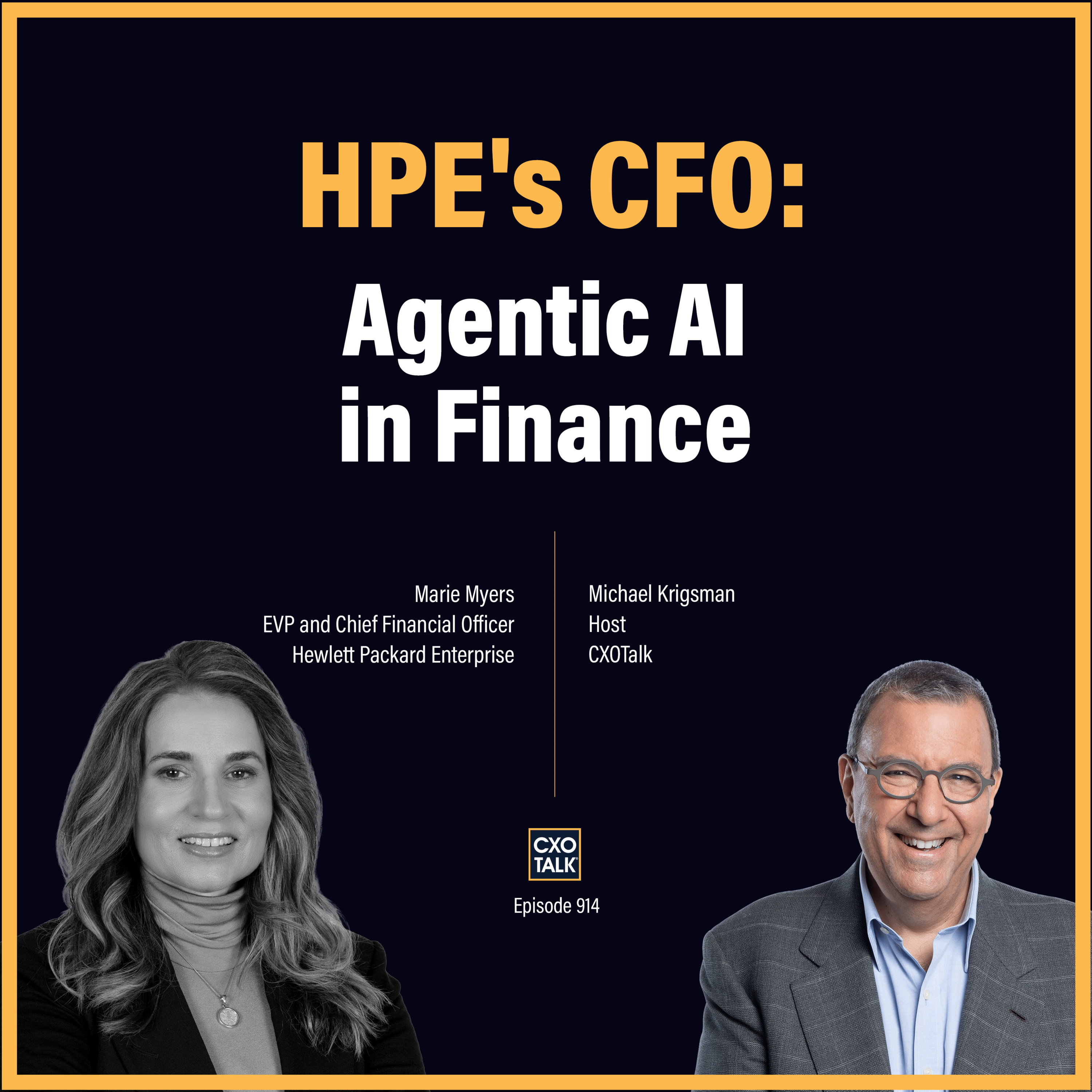
AI Agents in Finance with HPE's Chief Financial Officer (CFO) | CXOTalk 914
Apr 1000:55:43Tap to summarizeMarie Myers, Chief Financial Officer of HPE, explains how she measures business value while deploying agentic AI across a 3,600-person finance organization. Her framework separates direct ROI from indirect value (speed, accuracy, fewer errors) and the operating requirements that make finance AI trustworthy at scale.YOU'LL DISCOVER✅ How Myers separates direct ROI from indirect value, including speed, accuracy, and lower error rates✅ Why determinism was "foundational" for finance AI, and why HPE co-engineered with Nvidia NIMs to achieve consistent answers across half a million data elements✅ What "human in the loop" means in practice, and why accountability stays with finance leaders✅ How Alfred (built on Deloitte's Zora platform) moved from transactional workflows to core finance operating rhythms like HPE's weekly ops call✅ Why clean, reconciled data and a strong data layer are prerequisites for enterprise AI✅ How HPE redesigned FP&A workflows, centralized the team, and pushed "one source of truth" before layering in agents✅ How Myers thinks about agile experimentation, stage gates, and when to stop AI investments that will not pay off✅ Why change management and cultural adoption are often harder than the technology, and how training 3,000+ people was essential⏱️ TIMESTAMPS0:00 Measuring AI value beyond hard ROI3:40 Stage gates, scorecards, and when to stop an AI investment6:49 "This is a team sport": IT, business, compliance7:20 Determinism vs probabilism in financial AI9:38 Alfred, Deloitte Zora, and private cloud (on-premises) architecture13:04 Human in the loop and limits on agent autonomy14:31 Highest ROI AI use cases: engineering, marketing, IT16:23 Where finance sees ROI first: transactional workflows19:00 "AI slop" and maintaining quality standards25:32 Data quality and trusted, reconciled financial data33:49 Redesigning FP&A workflows, "one source of truth"40:35 Change management is the hardest part of AI🔔 Subscribe for weekly conversations with the world's top business and technology leaders.📩 Get the CXOTalk newsletter: newsletter.cxotalk.com💬 Read show notes and the full transcript: https://www.cxotalk.com/episode/hpes-cfo-making-agentic-ai-work-in-finance🎙️ ABOUT CXOTALKCXOTalk features unfiltered conversations with C-suite executives from major companies about AI, digital transformation, and business strategy. Hosted by Michael Krigsman. This is episode 914.#CXOTalk #HPE #CFO #AIROI #AIinFinance #AgenticAI #AIGovernance #FPandA #FinanceTransformation #EnterpriseAI
Transcribe →
Governing AI Agents at Scale: Identity, Scope, and Observability (with Glean and Cvent) | CXOTalk #914
Mar 2500:29:38Tap to summarizePradeep Mannakkara (CIO) and Ben Mayrides (CISO) of Cvent explain how they govern AI agents at scale across their 5,500-person organization, which now has over 6,000 agents in production. In this fireside chat recorded at a Glean event in NYC, they walk through the AWARE framework developed by Glean's Work AI Institute with Databricks and Palo Alto Networks, and describe the practical tradeoffs of moving fast while managing risk. The conversation covers agent identity, observability, cultural adoption, CIO/CISO dynamics, and what enterprise-grade AI governance looks like in practice.You'll discover:✅ Why traditional IAM and observability controls fail in agentic architectures where agents reason, delegate, and act autonomously✅ How Cvent deliberately encouraged 6,000 agent creations to build AI fluency before layering in moderation and metrics✅ The AWARE framework's five pillars: identity, context, guardrails, risk scoring, and ecosystem observability✅ Why "risk is too high" is never the final answer, only "risk is too high for now"✅ How Cvent filters AI demand through ROI gates before projects reach security review✅ Why replacing gut-feel security objections with shared criteria moves the CISO from gatekeeper to business partner✅ The sandbox-first approach that separates experimentation from production deployment✅ Why SOC 2 control criteria for AI agents are likely within 18 to 24 months⏱️ TIMESTAMPS0:00 Introduction and the AWARE framework0:34 Core challenges of agent governance2:43 What agents do for us and to us4:36 Applying the AWARE framework in practice7:09 Choosing platforms with built-in controls9:25 Making governance a cultural shift11:51 Earning trust through deliberate risk decisions13:49 Replacing gut reactions with shared criteria15:20 Managing the CIO/CISO tension18:54 Shared language for hard tradeoffs22:01 Go/no-go decisions are never one and done24:48 Advice for putting AWARE into practice26:38 Scaling to 6,000 agents🔔 Subscribe to CXOTalk and hit the bell for new episodes every week.📩 Get the CXOTalk newsletter: https://newsletter.cxotalk.com💬 Show notes: https://www.cxotalk.com/episode/ai-agent-governance-inside-the-glean-aware-framework-with-cvents-cio-and-ciso🎙️ ABOUT CXOTALKCXOTalk features unfiltered conversations with C-suite executives from major companies about AI, digital transformation, and business strategy. Hosted by Michael Krigsman.Episode 913 | Recorded March 10, 2026#CXOTalk #AIGovernance #AIAgents #CISO #CIO #EnterpriseAI #AgenticAI #AWAREFramework #AICompliance #CyberSecurity
Transcribe →
Deloitte CTO: Advice to CIOs on Enterprise AI | CXOTalk #912
Mar 2500:53:00Tap to summarizeBill Briggs, CTO of Deloitte, shares findings and advice for Chief Information Officers (CIOs) from the 2026 TechTrends report: 93% of enterprise AI spending goes to technology and tooling, while only 7% of funding goes to culture, change management, and learning. Briggs explains why this imbalance drives failed pilots and runaway costs, and what leaders should do about it. 📌 KEY POINTS-- Your AI spending ratio is upside downEnterprises allocate 93% of AI budgets to technology and tooling, while devoting only 7% to culture, change management, and workforce learning. Leaders who invest first in simplifying processes from first principles, before adding AI, consistently produce the strongest returns.-- Frontline trust in AI sits at 6.7%, and it's costing youC-suite executives report 70% trust in AI, while entry-level workers register only 6.7%, creating an inverted value chain where the people closest to broken processes stay silent. Organizations can close this gap by declaring intentions upfront and making it safe for workers to experiment openly, rather than hiding behind personal AI tools.-- Measure outcomes, not agent headcountCompanies broadcasting "tens of thousands of agents" substitute effort metrics for evidence of value; if real business results existed, those numbers would be the headline. Tie every AI initiative to specific operational and financial metrics and kill pilots that result in press releases but no movement that benefits shareholders and employees.YOU'LL DISCOVER:✅ Why applying AI to an inefficient process "weaponizes inefficiency" and drives costs through the roof✅ How trust in AI drops from 70% at the C-suite to 6.7% at the frontline, and why this inverted gap blocks real value✅ Why hospitals are putting robots on org charts and holding naming competitions for AI coworkers✅ The specific governance frameworks enterprises need for a workforce of AI agents (modeled on the HR lifecycle)✅ How inference costs create sticker shock and when to shift from cloud to dedicated hardware✅ Why Briggs says the CIO's most important skill is now storytelling, not systems architecture✅ What "success theater" looks like and how to spot it in your own organization✅ Why 99% of enterprises are fundamentally transforming their IT organizations right now⏱️ TIMESTAMPS0:00 Deloitte's CTO: Spend less on technology0:20 The 93/7 AI spending imbalance3:59 Why a technologist argues against more tech investment5:43 State of enterprise AI: 30% reach production scale8:05 Treating AI deployment like onboarding a coworker10:29 AI itself means nothing without culture change13:14 Redesigning work from first principles16:51 Quantifying AI financial risk and token economics20:03 Inference costs, shadow IT, and runaway bills23:14 The trust gap: 70% at the top, 6.7% at the bottom26:47 Governing a workforce of AI agents32:15 Success theater vs. real business metrics37:37 Responsible deployment, guardrails, and OpenClaw lessons42:37 How AI is transforming the CIO role46:05 Why storytelling is the CIO's most important skill50:02 Human times machine: the essential equation🔔 SUBSCRIBE for weekly conversations with global technology and business leaders who speak candidly about the strategies behind AI, transformation, and organizational change.📩 Get notified about upcoming episodes and exclusive insights: https://newsletter.cxotalk.com💬 Read show notes and get the transcript: https://www.cxotalk.com/episode/deloitte-cto-on-the-ai-investment-trap-cio-advisory-2026🎙️ ABOUT CXOTALKCXOTalk features unfiltered conversations with C-suite executives from major companies about AI, digital transformation, and business strategy. Hosted by Michael Krigsman.Episode 912 | Recorded March 15, 2026#CXOTalk #AIStrategy #EnterpriseAI #DigitalTransformation #Deloitte #CIO #AIGovernance #TechTrends2026 #AIInvestment #AgenticAI
Transcribe →
US Healthcare System Punishes Prevention: Former CDC Director | CXOTalk #911
Mar 800:57:00Tap to summarizeA healthcare CEO once told former CDC Director, Dr. Tom Frieden, he had "a fiduciary responsibility not to provide good diabetes care" because the ROI takes 7 years and patients leave after 4. That's not a villain talking. That's our system working exactly as designed, without preventive medicine.Dr. Tom Frieden ran the CDC under President Obama, served as New York City Health Commissioner, and now leads Resolve to Save Lives, a global nonprofit working in 50+ countries. His new book, The Formula for Better Health, lays out why the U.S. spends $4.5 trillion a year on healthcare, gets the most basic things right less than half the time, and what it takes to fix it.You'll discover:✅ Why preventing heart attacks actually costs providers money, and the one system (Kaiser Permanente) where that's flipped✅ How 100 million Americans lack primary care, and why tripling primary care spending could reduce total Medicare costs✅ The "See, Believe, Create" formula that has already saved millions of lives globally✅ Why Dr. Frieden says "it is now malpractice not to care for a patient with an AI as part of the team"✅ The 7-1-7 accountability system now used by 50 countries to find and stop disease outbreaks✅ How a $5 copay on preventive medication measurably increases heart attacks and strokes✅ The six specific health measures Dr. Frieden says matter most (with exact target numbers)✅ Why misinformation is the most lethal health threat: "a fire hose of falsehoods driven by the monetization of misinformation"⏱️ TIMESTAMPS0:00 A healthcare CEO's shocking confession about diabetes care0:45 Why the U.S. healthcare system is designed to fail2:10 Primary care: the most neglected piece of American healthcare4:28 Economic incentives that punish prevention6:43 Kaiser Permanente's capitation model and why it works9:44 CVS, concierge medicine, and halfway solutions13:20 Who can fix a system where no one is accountable?14:49 The "See, Believe, Create" formula explained19:08 Measles outbreaks and the misinformation crisis24:05 AI in healthcare: enormous potential, bad judgment34:18 What's happened to the CDC and vaccine infrastructure40:56 The 7-1-7 outbreak accountability system44:39 Why other countries get better results for less money47:39 The Big 6: personal health targets everyone should know53:11 Dr. Frieden's prescription for policymakers and healthcare leaders🔔 Subscribe and hit the bell so you don't miss conversations with world-class leaders.📩 Join our newsletter: https://newsletter.cxotalk.com💬 Read show notes: https://www.cxotalk.com/episode/former-cdc-director-how-to-fix-healthcare🎙️ ABOUT CXOTALKCXOTalk features unfiltered conversations with C-suite executives from major companies about AI, digital transformation, and business strategy. Hosted by Michael Krigsman.Episode 911 | Recorded March 8, 2026#CXOTalk #Healthcare #DrTomFrieden #PublicHealth #HealthcareReform #PrimaryCare #AIinHealthcare #CDC #PreventiveMedicine #ResolveToSaveLives
Transcribe →
SANS Institute: AI Agents Are an Attack Surface. Does your CISO know? | CXOTalk #910
Mar 300:55:08Tap to summarizeCyberattacks that used to take months now take minutes. And your defenders still can't keep up.Rob T. Lee, Chief AI Officer of the SANS Institute, and David A. Bray, Chair of the Accelerator at the Stimson Center, explain why AI gives attackers a structural advantage. Attackers don't care if their AI breaks something. Your security team can't take that risk. That asymmetry changes everything.✅ You'll discover:✅ Why attackers will always remove the human in the loop faster than defenders can, and the risk calculus that creates✅ How "death by 1,000 cuts" works: $300 per person times 10,000 targets via SIM farms equals a single ransomware payout✅ The federated learning approach that lets organizations share threat intelligence without exposing their own data or vulnerabilities✅ Why hackers are exploiting AI hallucinations by writing real code libraries for packages that models reliably hallucinate✅ How to identify the right cybersecurity talent: hire for learning velocity and the "fiddling mindset," not static AI credentials✅ Why boards must stop treating cybersecurity as prevention and start rewarding rapid detection and response✅ The pre-compute vs. post-compute distinction for AI agent safety that most executives are missing entirely✅ When autonomous cyber defense will actually be viable (hint: think pilotless planes and robotic surgeons)⏱️ TIMESTAMPS0:00 AI has made "death by 1,000 cuts" attacks scalable0:39 Why the AI security lifecycle matters now2:27 Military history lessons for cyber defense strategy5:00 Federated learning: sharing threat intelligence without exposing data6:48 How incident response must evolve for AI-speed attacks8:05 The human-in-the-loop dilemma: defenders vs. attackers11:37 Distraction attacks: coordinated multi-target campaigns15:37 Autonomous agents as a new attack surface19:44 Hackers weaponizing AI hallucinations against developers22:23 Development velocity as the real "swarm" capability24:20 Perverse incentives: why stopping an attack still counts as failure27:09 Your personal attack surface grew from 3 devices to 5031:22 Protecting AI tool chains from becoming prime targets34:25 Hackathons as the future of cybersecurity hiring36:53 Patterns of life: instrumenting your enterprise for anomaly detection38:18 When will we trust AI defenders without human oversight?41:09 Pre-compute vs. post-compute: where AI agent safety rules must live46:45 AI trust, hallucinations, and prompt injection as information warfare51:42 Building security culture: leadership, not blame🔔 Subscribe so you never miss a conversation with the world's top business and technology leaders.📩 Get notified about upcoming shows. Sign up for the CXOTalk newsletter: https://newsletter.cxotalk.com💬 Check the summary and full transcript for episode 910: https://www.cxotalk.com/episode/the-ai-attack-lifecycle-digital-forensics-and-intelligent-threats🎙️ ABOUT CXOTALKCXOTalk features unfiltered conversations with C-suite executives from major companies about AI, digital transformation, and business strategy. Hosted by Michael Krigsman.#CXOTalk #Cybersecurity #AIThreats #AutonomousAgents #CISO #SANS #CyberDefense #IncidentResponse #AIStrategy #EnterpriseSecurity
Transcribe →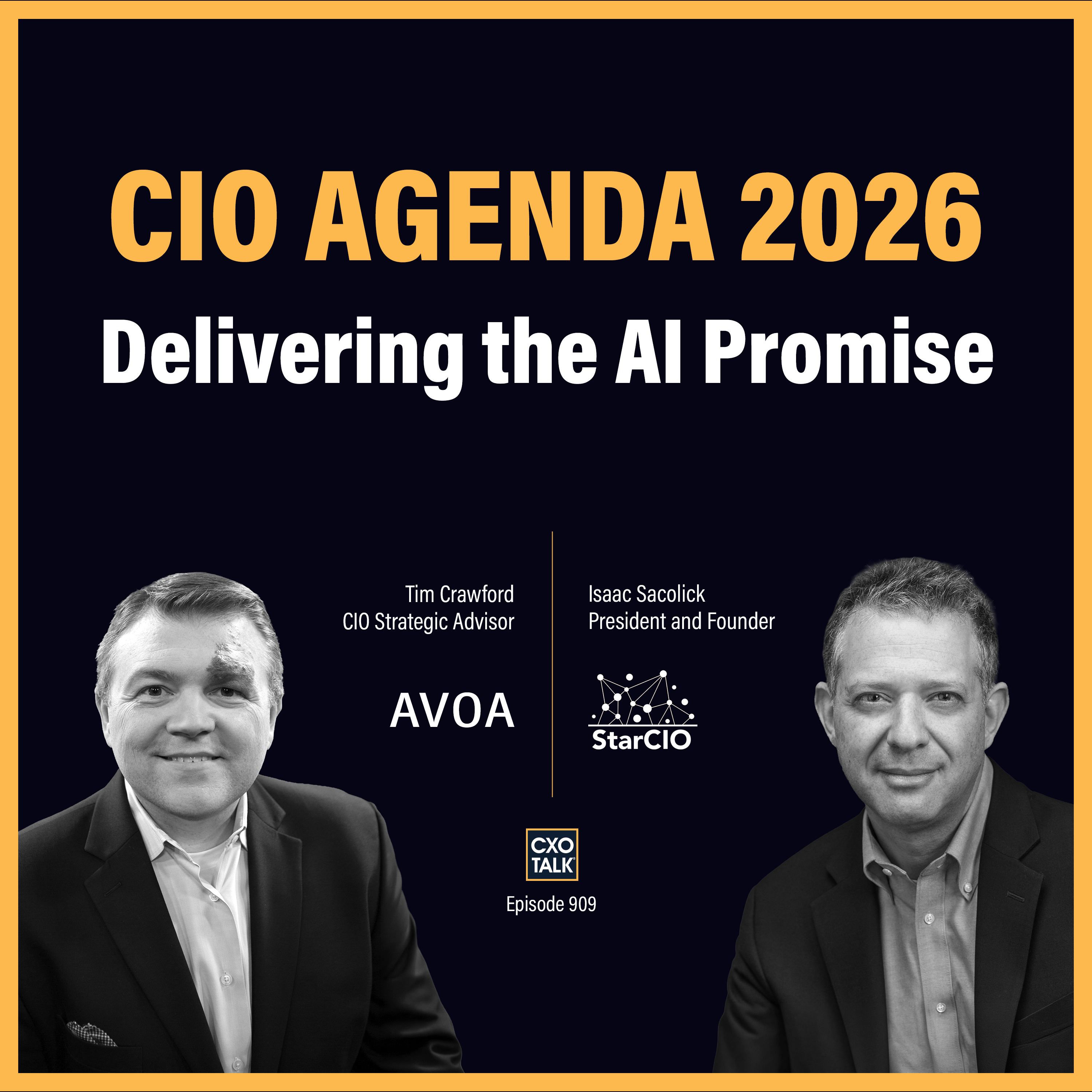
CIO Agenda 2026: The Enterprise AI Promise | CXOTalk #909
Feb 1600:55:42Tap to summarizeTim Crawford and Isaac Sacolick, both former Chief Information Officers and world-class CIO advisors, join Michael Krigsman on CXOTalk episode 909 to break down why enterprise AI strategies are failing, what separates transformational CIOs from those who are drowning, and why earning your seat at the table matters more than ever in 2026.You'll discover:✅ Why Tim says both AI strategy AND IT execution are failing, and what CIOs are focused on instead of outcomes✅ The "three-legged race" framework: how CIO behavior, IT culture, and external perception must align for strategic credibility✅ Why most CIOs have only a "layperson's understanding" of their own business, and how that kills AI value✅ Tim's two swim lanes of AI success: invisible integration or robust training (there is no middle ground)✅ Why Isaac says AI is "reshaping" business but not yet "transforming" it, and the product management shift that changes everything✅ How to evaluate agentic AI: the human-in-the-loop vs. human-out-of-the-loop decision framework and why cybersecurity proves you can't wait✅ The shadow AI paradox: why the best CIOs encourage it (with guardrails) instead of shutting it down✅ The three skills every IT professional needs now: business acumen, critical thinking, and data literacy⏱️ TIMESTAMPS0:00 Cold open: "If you think you should have a seat at the table, you've failed"0:35 Why both AI strategy and IT execution are failing2:08 The productivity measurement problem with AI2:45 What CEOs and boards want from CIOs in 20264:28 Why CIOs don't truly understand their business6:54 Why organizations are stuck in AI pilot mode9:04 Tim's 2 swim lanes: invisible AI vs. training-wrapped AI11:23 Audience Q&A: Inside-out thinking vs. outside-in thinking14:34 The 3-legged race: earning your seat at the table17:09 Moving from AI efficiency to true business transformation20:03 The shift from project-oriented to product-oriented IT20:31 AI governance, CISO alignment, and data sensitivity27:15 Agentic AI: fully autonomous vs. human-in-the-loop34:46 Agentic AI strategy and the value equation (opportunity minus cost)38:46 Shadow AI: innovation source or security threat?43:00 Governance as culture, not a bolt-on46:00 The AI skills gap: business acumen, critical thinking, data skills, and curiosity49:46 Are survival-mode CIOs sabotaging their careers?52:15 What CIO greatness looks like in 2026🔔 SUBSCRIBE to CXOTalk for unfiltered conversations with the world's top technology and business leaders.📩 Get notified about upcoming episodes. Subscribe to the CXOTalk newsletter: https://newsletter.cxotalk.com🎙️ Read the summary and full transcript: https://www.cxotalk.com/episode/cio-agenda-2026-delivering-on-the-ai-promise#CXOTalk #CIOAgenda2026 #AIStrategy #AgenticAI #DigitalTransformation #CIO #AIGovernance #EnterpriseAI #AILeadership #BusinessTransformation
Transcribe →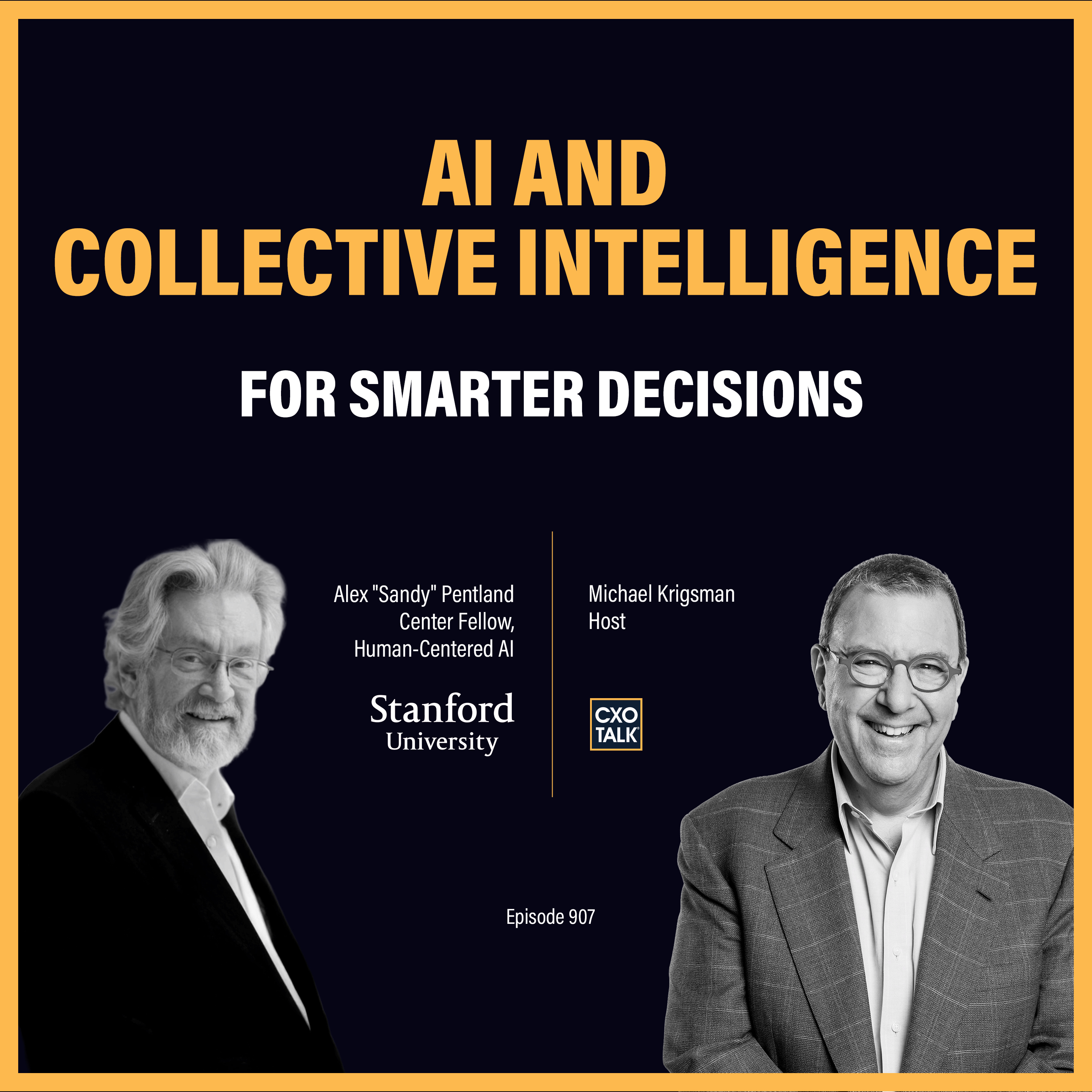
Renowned MIT/Stanford Computer Scientist on AI and Collective Intelligence | CXOTalk #909
Feb 1100:56:21Tap to summarizeMIT and Stanford professor Alex "Sandy" Pentland, one of the most cited researchers in the world with over 165,000 citations, explains why the real AI advantage isn't smarter models but collective intelligence. It's smarter humans working together with AI as the connective tissue. Drawing from his latest book Shared Wisdom, Pentland reveals the frameworks behind community intelligence and why data ownership, not frontier AI, will determine who wins the next decade.You'll discover:✅ Why "people plus AI" consistently beats AI alone, and the hedge fund evidence that proves it✅ How "AI buddies" are replacing corporate manuals, newsletters, and hallway conversations to keep distributed teams aligned✅ The Deliberation.io tool that makes meetings more than twice as effective by neutralizing power dynamics and keeping groups focused✅ Why a 350,000-person multinational is cutting in-house staff to 150,000 while hiring 100,000 more project-based workers, and how AI enables that shift✅ How a doctor with zero technical background built a hospital operating system in 6 weeks using AI tools✅ The staggering stat: AI costs are dropping by 50% every 3.5 months, a factor of 1,000 over three years, and what that means for personal, on-device AI✅ Why China's Belt and Road and India's Citizen Stack (1.4 billion customers signed up) are quietly winning the global data game while Silicon Valley focuses on frontier models✅ Sandy's provocative proposal: a 10% equity contribution to sovereign wealth funds at company formation, which would have created a $10 trillion US fund if started in 1990⏱️ TIMESTAMPS0:00 Why AI alone loses money: the hedge fund reality check2:07 Shared wisdom, community intelligence, and organizational culture4:25 AI buddies: the brilliant librarian inside your company5:44 Deliberation.io: making meetings 2x more effective7:01 Using AI for exploration and long-range strategic thinking11:29 Who's to blame when AI fails: executives or the machine?14:28 Why AI can't do causality and what that means for leaders18:14 AI's killer app for remote work and distributed organizations21:09 A doctor built a hospital OS in 6 weeks: small teams, massive impact24:09 Job displacement, social safety nets, and the sovereign wealth fund idea27:01 Reinventing education: Costa Rica's bet and the MIT Media Lab model32:16 LLMs vs. older AI: why you need both (and the loyalagents.org initiative)37:13 Practical starting points for redesigning work with AI40:16 Misinformation, data provenance, and the billion-dollar North Korea problem48:50 The global data race: China, India, UAE, and why frontier models aren't the game54:00 Cybersecurity warning: agentic AI creates massive new attack surfaces🔔 Subscribe so you never miss a conversation with the world's top business and technology leaders.📩 Get notified about upcoming shows. Sign up for the CXOTalk newsletter: https://newsletter.cxotalk.com💬 Check the summary and full transcript: https://www.cxotalk.com/episode/ai-and-collective-intelligence-for-smarter-decision-making🎙️ ABOUT CXOTALKCXOTalk features unfiltered conversations with C-suite executives from major companies about AI, digital transformation, and business strategy. Hosted by Michael Krigsman.Episode 907 | Recorded February 8, 2026#CXOTalk #CollectiveIntelligence #AIStrategy #SandyPentland #CommunityIntelligence #SharedWisdom #EnterpriseAI #FutureOfWork #AILeadership #DigitalTransformation
Transcribe →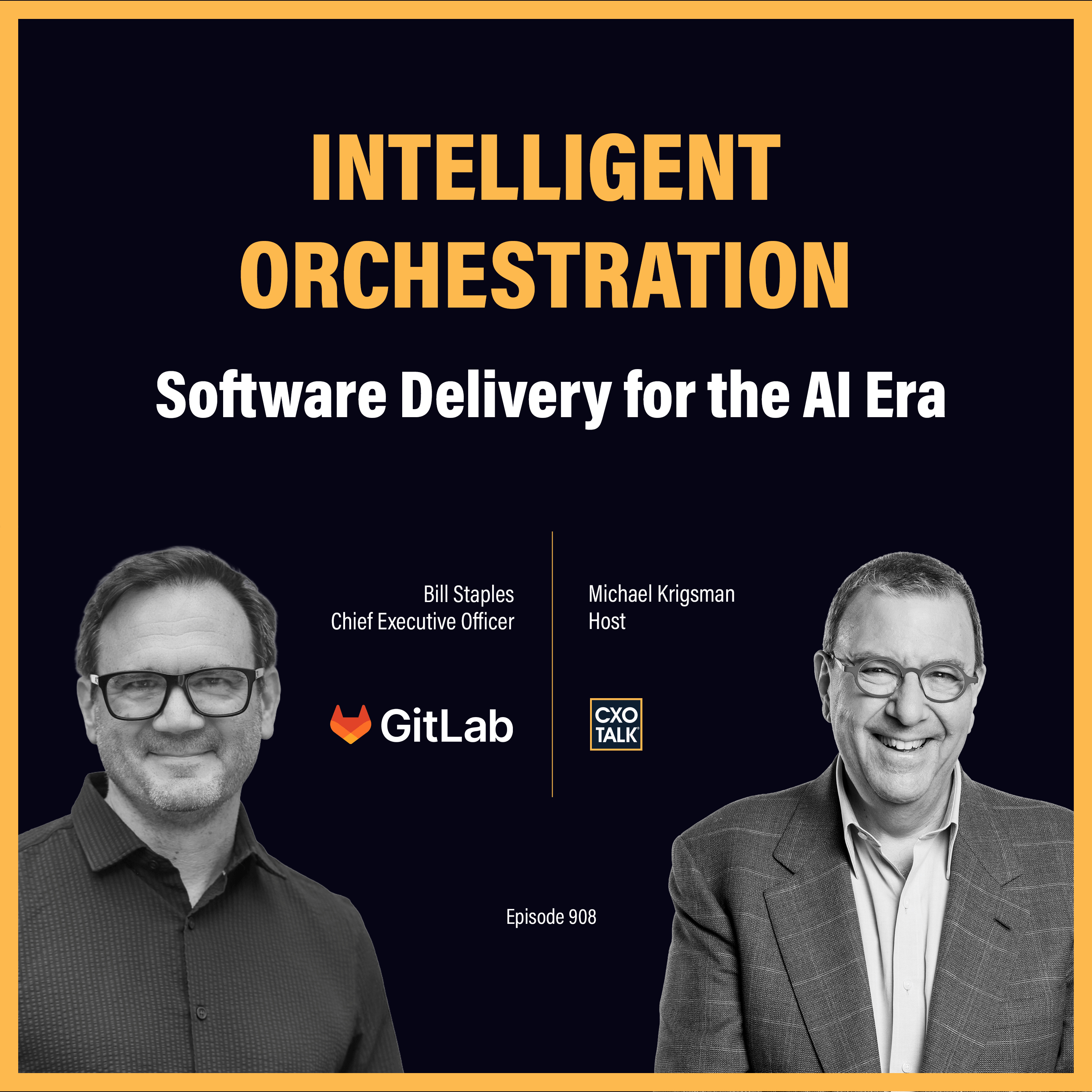
Intelligent Orchestration: Better AI Coding and Software Delivery | #CXOTalk #907
Feb 1100:25:28Tap to summarizeAI coding tools are writing more code than ever, but your software isn't shipping any faster. Welcome to the AI Paradox and the solution, intelligent orchestration.Bill Staples, CEO of GitLab, explains why AI-accelerated coding is actually creating massive downstream bottlenecks in code reviews, security checks, and deployment, and why adding more AI tools only makes the problem worse. GitLab's solution: intelligent orchestration across the entire software development lifecycle.You'll discover:✅ The "AI Paradox:" why faster coding isn't translating into faster software delivery✅ How tool fragmentation and context-switching are killing developer productivity✅ Why agents that thrive on context fail when your tools are siloed✅ The "inner loop architecture" that makes AI agents 40% more accurate and 25% faster✅ How GitLab's intelligent orchestration approach combines workflows, context, and guardrails✅ Why mid-level developers are about to become strategic orchestrators (not just coders)✅ The exact metrics CIOs should track, and why "lines of code" is the wrong one✅ First steps: audit, consolidate, and pilot before going all-in on AI⏱️ TIMESTAMPS0:00 The AI Paradox: Why faster coding doesn't mean faster delivery1:10 How tool fragmentation creates developer bottlenecks3:40 Why AI agents make complexity worse (not better)5:12 Solving the AI automation problem: people, process, and technology6:36 Inner loop architecture: co-locating agents and data9:14 Intelligent orchestration: workflows, context, and guardrails10:32 How GitLab's knowledge graph supercharges agent accuracy12:49 Universal guardrails for humans and AI agents13:39 Real-world results: 2-3x more merge requests, pipeline fixes in minutes15:00 Common threads driving customer success16:36 How AI transforms the mid-level developer's role19:06 Advice for CIOs and CTOs putting this into practice20:49 First steps: audit, measure, and pilot22:45 Core metrics to evaluate AI's real value25:02 Wrap-up🔔 Subscribe for weekly conversations with top technology executives.📩 Get the CXOTalk newsletter: https://newsletter.cxotalk.com💬 Drop your questions in the comments: Michael and our community actively engage.🎙️Read the summary: https://www.cxotalk.com/episode/intelligent-orchestration-software-delivery-for-the-ai-era-with-ceo-of-gitlab#AI #SoftwareDevelopment #DevOps #GitLab #AIAgents #DeveloperProductivity #CIO #CTO #DigitalTransformation #CXOTalk
Transcribe →