← The Curiosity Shop with Brené Brown and Adam Grant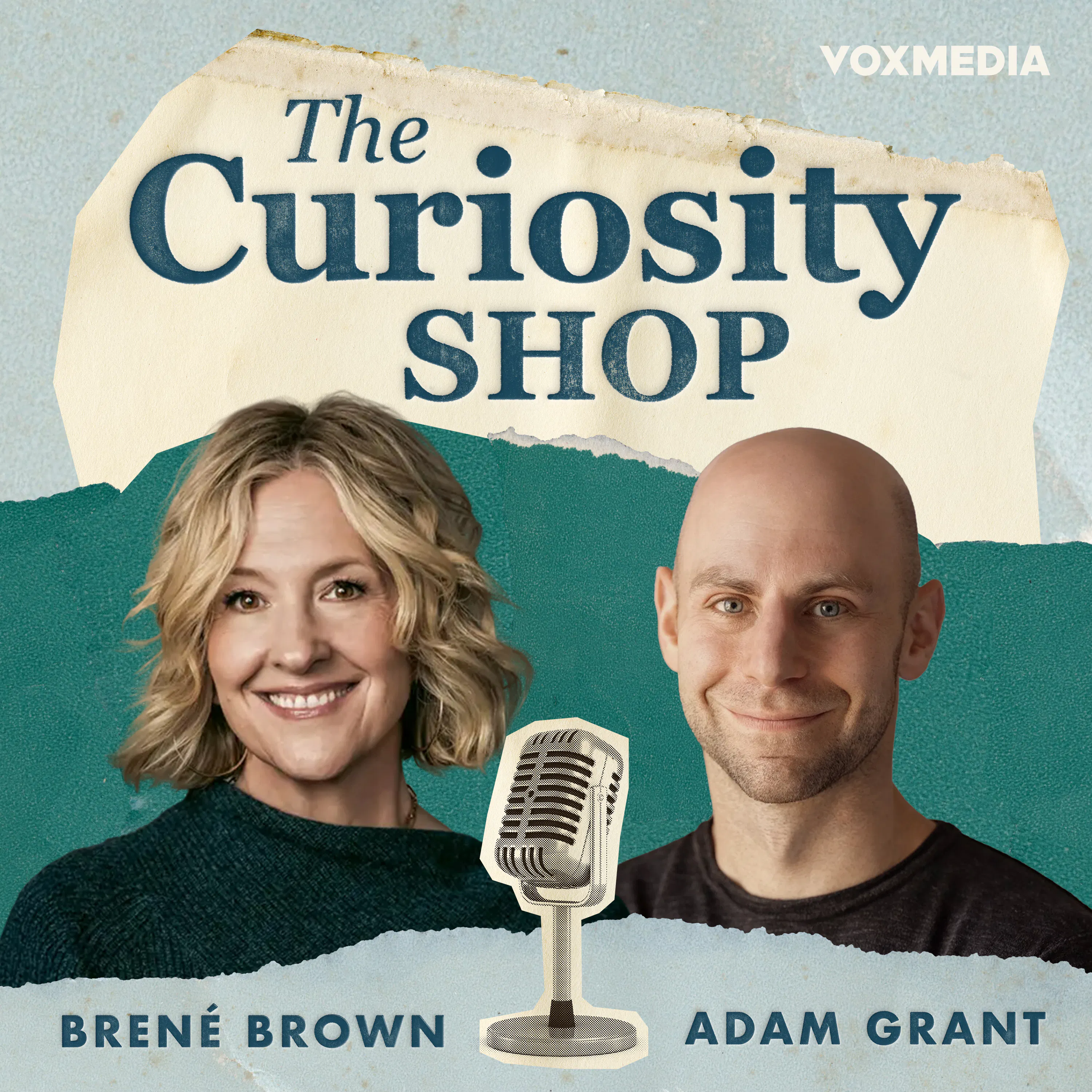
Loading summary
Transcript229 lines
- [00:00]
Adam Grant
In today's episode, we're going to try to do two things simultaneously. We're going to try to unpack paradoxes and why they're hard and why they're important. And we're also going to try to learn to tolerate dad jokes, maybe too tall of an order. We're going to talk about each of our favorite paradoxes, why groups go to places no one wants to go, why sometimes optimists end up shooting themselves in the foot. We're going to talk about the new anti grade inflation policy at Harvard and what we think of that as teachers. We might even talk about Twilight and why it might be underrated.
- [00:43]
Brené Brown
Welcome to the Curiosity Shop, a show
- [00:45]
Adam Grant
from the Vox Media Podcast network.
- [00:53]
Brené Brown
Hello, Adam.
- [00:54]
Adam Grant
Hey, Vernee.
- [00:55]
Brené Brown
How are ya?
- [00:57]
Adam Grant
I'm good. How are you?
- [00:59]
Brené Brown
Good. I'm asking you a question about your monthly stress cadence. A lot of people, especially the mothers I know, we believe that May is often more nutty than December. All right. Do you have wild maize in your house?
- [01:19]
Adam Grant
Yeah, I just think it's America, not the house.
- [01:23]
Brené Brown
Oh, really?
- [01:24]
Adam Grant
There's just too much. There's too much going on. We're moving toward the end of school. We're doing holidays. That should be times to celebrate. But there's so much to plan for for Memorial Day, for Mother's Day. Just, it feels like a lot crammed into 31 days. You.
- [01:40]
Brené Brown
I mean. Yeah, yeah, exactly. I think it's. We've had two birthdays, a graduation, two graduations, two birthdays, Mother's Day. We're still kind of in wedding debriefing, you know, anxiously waiting videos and photographs, that kind of fun stuff. And then also the wrap up of school kids moving out of dorms and apartments. You know, it's just. Yeah, it's a transition. It's a weird transition month, I think. So it's been a busy May for me.
- [02:15]
Adam Grant
Same. And so busy, in fact, that Alison and I just celebrated our 20th anniversary and neither of us remembered.
- [02:23]
Brené Brown
Tell me you've been married a long time without telling me. Yeah, yeah, like, oh, guilty as charged. Guilty as charged. Yeah. No, we're guilty of that, too. Well, happy anniversary.
- [02:33]
Adam Grant
Thank you.
- [02:34]
Brené Brown
You know, I'm a big fan of your wife and just I'm going to plug and you're going to be like, don't do that. I don't care. Alison is a writer and a poet and she's got a book coming out in the fall that's a collection of poetry about her experience with breast cancer. And the name of the book is lump. I got to read an early. I'm a big poetry fan, as many of you know, and I got to read an early copy of it, and it rearranged me internally. It's some of the most beautiful poetry I've read in my life. So highly recommend and can't wait till it comes out.
- [03:06]
Adam Grant
Well, thank you. It was so kind of you to read and support it. And I was blown away by it, but I'm a little biased, so your validation means a ton.
- [03:16]
Brené Brown
Yeah. I think the first line of my endorsement is, this is why we invented poetry like this, is to take on topics like this in a way that actually leads us right to something we're going to talk about today. The paradox, the beauty and the brutality of our bodies. And so, yeah, so I love Alison. Don't forget your anniversary moving forward. Dude, unacceptable. Give it to me. I'll put it on something. I'm gonna text you next year.
- [03:46]
Adam Grant
I just want the record to show I remembered before she did.
- [03:49]
Brené Brown
Okay, so noted. Mr. Grant. Dr. Grant. Oh, wait. Oh, this is a great segue.
- [03:56]
Adam Grant
You're not gonna make me dad joke, are you?
- [03:58]
Brené Brown
Yeah. Come on.
- [04:01]
Adam Grant
This show is brought to you by Geico. Trust is foundational. It's at the heart of every relationship, every decision, and every leap worth taking. And it's something you build over time, through everyday consistency, follow through, and care. Geico gets that. It's why they've spent decades showing up for their customers again and again with real savings and genuinely great customer service from people who truly care. Trust is everything, and it feels good to have it. It feels good to Geico.
- [04:28]
Brené Brown
We are going to talk about in this episode, one of my favorite topics in the whole world and probably a lot of other stuff as it comes up. But we're going to talk about paradox, the power of it. He's got a paradox he's going to share with me that I've never even heard of, which is crazy because it's named after a city in Texas. I'm going to share my favorite paradox, and then we're going to talk about why they suck for us and why they're great, paradoxically. But I'll start with this. While we were getting the cameras and everything situated, Adam goes, I've got a dad joke about paradox, but I can't bring myself to do it. I'm like, you have to do it. As soon as we hit record, he goes, no, I'm gonna do it now. And I said, well, then do it now. And he's like, we're gonna talk about paradox. And we are a pair of docs, and it was a pretty bad dad joke, but I'm outing you here. But it is so to know Aaron's laughing, but Aaron is also a dad joke guy, so paradox. That's funny. All right, where do you want to. Well, let's start here. Tell me how you think about paradox. Like, how do you define it? Is there research you go to in your head around it? Let's start there.
- [05:39]
Adam Grant
I think about paradox as two opposites coexisting. And I love the work of Marianne Lewis and Wendy Smith on explaining how those paradoxes are actually often the source of our best ideas, our most important decisions. But they can drive us crazy, too.
- [05:57]
Brené Brown
So tell me a little bit about that research. I'm not that familiar with it, to be honest with you.
- [06:01]
Adam Grant
They make a compelling case that a core leadership skill is being able to do both and. As opposed to either or. And I always see that and think, yeah, that's also a core parenting skill, friendship skill, marriage skill. So many of the challenges that. That we don't know how to get out of are like, to me, at their heart, are like, okay, I'm pushing against two opposites, trying to resolve in favor of one, and I need to hold them both in tension.
- [06:30]
Brené Brown
I love that. I think that's not far from. I think about paradox, definitely. When I think about my teachers, with one exception, the majority of them are probably spiritually oriented. So I think about Richard Rohr, I think about Carl Jung, I think about Joseph Campbell in some ways. But I also do think about Jim Collins in terms of how my obsession with paradox plays out in leadership. And we can talk about some of Jim's work later. Cause it's been very informative for me. I want to read something to you, so start with a couple of quotes that I love. If we can just ground us. And one of the things I think is interesting, besides being a paradox, which is so bad, I mean,
- [07:21]
Adam Grant
it didn't get better the third time, but you're still laughing.
- [07:25]
Brené Brown
You're so cute.
- [07:27]
Adam Grant
I know. I love it. It's like a good pun.
- [07:31]
Brené Brown
I don't know. It is a good. I do love a good pun. I can be punning, but, yeah, I'm gonna give you down to a five scale. I'm starting to believe we don't have the discernment for 10 scales. I'm gonna give you four stars on that paradox dad joke. It's pretty funny. It's pretty good. It's clever. Here's one Thing.
- [07:50]
Adam Grant
The bar has been lowered.
- [07:52]
Brené Brown
Potentially. Potentially.
- [07:54]
Adam Grant
It just happened right now. I think you mean 4 out of 10.
- [07:56]
Brené Brown
It was pretty good. It was fairly smart. One thing that happened before we came on. If it's okay for me to talk about Adam, is that I said I might share kind of how I think about paradox. You share, and I'm gonna bet yours is probably not gonna be as spiritual as mine. And you were like, safe bet. But then I said something that resonated with you. And I want to push on it a little bit before I read some Richard Orr to you. I experience you. I definitely don't think you're a religious person. I know that you're not a religious person, but I do experience you as a spiritual person. Because the way spirituality kind of emerged in our data is the belief that we're inextricably connected to one another by something greater than us. For some people, that's God. For a lot of people, it's not. But you do seem to move through the world with the belief that we're inextricably connected to each other.
- [08:50]
Adam Grant
I can't deny it. Does that mean I'm spiritual? It's a realization for me because I've never connected to the concept at all before. Until you described it that way.
- [08:59]
Brené Brown
Yeah. I think for me, the human spirit or spirituality is like. I believe personally that we are inextricably connected to each other by something greater than us. And for me, that's God. But it's also nature. It's also love. We should talk about that sometime on the pod. Because you definitely. The way you try to show up with people and the way you talk about even your work. I mean. New book called Vibe. That's inextricable connection, right?
- [09:29]
Adam Grant
Yeah. Yeah, it is. It is. I think. I don't. You've painted me into such a good corner here. There's no escaping it. It's true.
- [09:42]
Brené Brown
I love this moment. This is a holy moment.
- [09:46]
Adam Grant
You got me. Checkmate.
- [09:48]
Brené Brown
Okay, so.
- [09:51]
Adam Grant
But tell me about Richard Rohrer. Because I've heard you talk about his work at length and quote him very powerfully.
- [09:59]
Brené Brown
One of my favorite. Not the paradox we're talking about today, but one of my favorite paradoxes from him is what I call the grace paradox, which is in almost everything he does and teaches, he comes back to this idea. It's a very loving message that we grow spiritually much more by doing things wrong than by doing everything right. And thank God for me, literally. But he argues that. See if you can see what you think about this, he argues. This is Richard Rohr. That many core spiritual truths are inherently paradoxical and that the dualistic mind, which is wired for clear logical distinction, struggles with these realities. And this is a direct quote. We must learn to accept paradoxes or we will never love anything or see it correctly. That he insists that learning to love paradox is essential for wisdom, forgiveness, and healthy relationships. And he uses the metaphor of an untarnished mirror to describe those who can receive the whole picture, including light, darkness, and all the subtle shades in between, rather than insisting on clarity or certainty at the expense of truth's complexity. Thoughts?
- [11:14]
Adam Grant
Oh, I love it. I mean, I'm just thinking about all the paradoxes that fit within that. Like, I wanna live in the moment and plan for the future. I wanna take care of others and make sure I'm not sacrificing myself. I want to have autonomy and community.
- [11:30]
Brené Brown
Those are beautiful.
- [11:32]
Adam Grant
And I mean, all of these things,
- [11:35]
Brené Brown
you can't choose one over the other from becoming ordained. As a really loving Jesuit deacon, I don't want to do anything that's going to oust Allison or the kiddos. So I'll make you a deacon. But you. But yeah, we're going to. As the podcast evolves. Okay, what's your. Go ahead.
- [11:58]
Adam Grant
You know, you and Malcolm Gladwell both pushing me in the Jesuit.
- [12:02]
Brené Brown
Malcolm Gladwell.
- [12:03]
Adam Grant
And yeah, he loves Jesuit priests. He did a whole podcast about, like, the Jesuit view of wrongdoing, and I found it captivating and really compelling.
- [12:16]
Brené Brown
I think it's because I was raised by a wild pack of Jesuits. Like, we lived in New Orleans.
- [12:22]
Adam Grant
Yeah, a wild pack. I thought you were going to say
- [12:24]
Brené Brown
this is a wild pack of Jesuits. So I lived in New Orleans growing up and went to Holy Name of Jesus Elementary School. And this was during the heavy liberation theology days. And Jesuits would be moving, like, from different parishes around the country, coming through New Orleans to go do liberation theology work on behalf of poor people in Central America and bearing witness to a lot of the really violent kind of government, authoritarian killing of groups of people, especially indigenous people. And so a lot of times they would stop at our house as a way station. And I just remember that's where I learned the F word and had never seen anyone bounce a quarter into a shot glass before that. And I was a young. And it was. And talk about paradox. It was such a wild paradox of like, ooh, I'm not sure about this, about Catholicism as I'm experiencing it as a kid. And then I saw these Jesuits who were such radical political Activists. So that's how. Yeah. And Jimmy tell you how I got converted to Catholicism? We were Episcopal. Yeah, we were Episcopal pagan, I do now. And my dad got transferred to New Orleans and was working during the day and going to law school at Loyola at night, and which I look back now as a grownup and, like, wow, all I remember are cigars, coffee, and the smell of highlighters. That was like my dad's whole personality. And so one day I was in class and they pulled me out, and they pulled me into this room at Holy Name of Jesus, and a man walked in. I thought it was God. He had like a whole outfit on. They don't call them outfits, but you know what I mean? Like a whole get up. And he had a freshly copied piece of paper from a mimeograph that you could smell that was the Nicene Creed. And he said, I want to go over this with you. And I said, okay. And kind of line by line, he asked me what I thought it meant. I think it was in second grade, and the Nicene Creed's pretty deep theology. And so at the end, he said, congratulations, you're Catholic. We'll send a note home. And so, yeah, so then my parents converted from the Episcopal Church to the Catholic Church.
- [15:03]
Adam Grant
It's so interesting. It sounds like you never lost the allure of the Jesuits.
- [15:10]
Brené Brown
Oh, no, no, no. And my son went to a Jesuit high school, so. And then my daughter also went to a Catholic high school, like a kind of nuns on the bus kind of Catholic high school. Like nuns always in trouble, activists. So I think there's just. There's different understandings within the Catholic Church. There's a paradox. There is a very. Yeah, there's a very kind of Vatican II is a bad thing. And let's go back to the old days, which were bad days for me. And then there's a social justice wing that I relate to very heavily. So, yeah, clearly.
- [15:45]
Adam Grant
I mean, just. Just the idea that a religious person can curse was sort of foreign to me until a couple of years ago, I was at a conference, and one of the participants was a Jesuit priest, and he dropped a giant F bomb in the middle of a sentence, and everybody just stopped and stared. And he said, do you think I don't know these words as a person of color?
- [16:09]
Brené Brown
Person of color. Okay, okay.
- [16:12]
Adam Grant
The whole room.
- [16:14]
Brené Brown
You are two for two. That was funny.
- [16:19]
Adam Grant
It was his line. It was so well timed, and it just took the tension out of the room. And he was humanizing himself and saying, hey, I'm actually one of you. Even though I wear this collar. Yeah.
- [16:32]
Brené Brown
Yeah. And, you know, it's not like we learned it in ccd, but it's one of the. I just would be remiss if I didn't. If we didn't pause for a moment. A holy pause indeed. Just so I can shout out one of my favorite paradoxical Catholics, Stephen Colbert, who, while we're recording this, just had his last night.
- [16:53]
Adam Grant
Yes.
- [16:54]
Brené Brown
And it's one of the things about him that I really love. His ability to straddle the paradox of being a deeply spiritual, loving person and also making the love that he carries accessible to the world and not gated by Dogma.
- [17:14]
Adam Grant
That's so well put. And I think it describes one of his greatest virtues. Did you happen to catch him on Smartless?
- [17:21]
Brené Brown
Oh, my God. Was he on Smartless?
- [17:24]
Adam Grant
It was a masterclass in improv comedy, I think. I've listened to it three times.
- [17:29]
Brené Brown
What a great hookup. Okay, we'll put it in the show notes. Okay. That's amaz. That's one of my favorite podcasts to begin with, but then him on there. Okay, I can't wait. Thank you for the reco.
- [17:42]
Adam Grant
This show is brought to you by geico. We've talked a good amount on this show about dealing with uncertainty. It's about being prepared. Yes, but it's deeper than that. It's a balance of fortifying your mental attitude while getting ready. In the practical sense, it's about identifying the outcome you want and then securing for yourself and your people some solid insurance. In other words, building the kind of foundation that can handle what may come for a lot of things in life. The dealing with uncertainty toolkit involves having the right insurance partner. That's where Geico comes in. They've spent decades showing up for their customers again and again with real savings and genuinely great customer service from people who truly care, knowing that if something goes wrong, when you're on the road, you're not on your own, you're covered. If there's one thing you can be certain about, it's that Geico will show up for you when it matters. In the face of uncertainty, it feels good to be prepared. It feels good to Geico.
- [18:32]
Brené Brown
All right, let's jump into. You're going to share. I was at the grocery store and we were talking, and you asked me about the Abilene Paradox because there was something we were talking about and we were having. I wouldn't say an easy conversation, but I would say a meaningful conversation. Right. Would that be fair? Hard and meaningful? Another paradox. Tell me about the Abilene Paradox. I'm so curious.
- [19:03]
Adam Grant
Well, I think we were. I was starting to wonder if we were in the middle of it. So I'll tell you the original story and then we can.
- [19:10]
Brené Brown
Okay, we can connect the dots. Wait. I got nervous.
- [19:14]
Adam Grant
Okay, don't be too nervous. I think the sooner you recognize it, the easier it is to escape it. So go back half a century. It's a scorching hot day in Texas. A family decides they're going to take a long drive and their car does not have air conditioning, but they want to go out to dinner. They decide to take the drive to Abilene, which I had never heard of. You apparently have.
- [19:41]
Brené Brown
Yes. Hot as hell.
- [19:44]
Adam Grant
Anyway, yeah, they take the drive, they have dinner, they drive back. The whole thing is a four hour trip. And they're all overheated, they're exhausted. And they just sit there in silence. They can't even say a word. And then one of them starts venting about just how unpleasant the whole experience was. And they start pointing fingers. And then each person says, but I didn't want to go. I thought you wanted to go. Well, no, no, no. I didn't want to go either. I thought it was you. And even the person who suggested the trip in the first place says, I don't want to go. I was just trying to come up with something for us to do, but I wasn't into it. I just. I thought other people were excited about it. And it turned out that everybody went because they assumed everyone else wanted to go and nobody voiced their real preference. This happens so often. It happens in team meetings. It happens on family vacations. It happens when friends get together and try to figure out what they want to do. And I think we might have been doing it too. But I'm so curious to hear your reactions to the Abilene Paradox because it's such a common and familiar example of, like, we're misreading other people's preferences. We're assuming a norm existing when it does.
- [20:59]
Brené Brown
Oh, I think what a great story. I mean, not only is the paradox. I think I held my breath the whole time you were telling the story. Cause all I could see is the six of us in our fricking station wagon with no ac. But you would have had to add three or four instances of don't make me pull this goddamn car over. But. Yes. Okay, So I. This just feels like an important moment for us, like in some of the things that we're struggling with as we try to Figure out how we want to put this, how we want to share the podcast with the world and what we want to talk about on it. And I think I have found myself in that position less as I've gotten older, but certainly my whole life. And we definitely do it. And we definitely do it. And then when one of us. We've done it a lot.
- [22:03]
Adam Grant
I thought you wanted to do that.
- [22:04]
Brené Brown
Yeah. So I think.
- [22:05]
Adam Grant
What do you think is our worst example so far or our most vivid?
- [22:11]
Brené Brown
I can't think of a specific. I can't think of. I think it's been the underlying driver for everything we've done until things go sideways. And then one of us reaches out to the other and says, this was hard for me, or I'm not feeling flow, or I want this to be more joyful. And then if I call you, you know, if. Then one of us will say, what would it look like if it was more joyful? And, you know, one of us will say, well, I wish we were doing more of this. And the other goes, me too. I was only. I was doing that because I thought you wanted to do that. And so I think it's kind of been an underpinning of the whole thing that guessing what's important and what matters and what the other's preference is and then contorting ourselves to be able to do that and then wondering why it's hard sometimes.
- [23:04]
Adam Grant
Yeah. I mean, even a simple example that just happened of, I thought we had to record in one complete take. I thought you wanted to do that. And you're like, no, no. I wanna be able to pause and say, like, wait, is this a rabbit hole? Should we keep talking about this? We can cut that. And we just assumed that the other wanted to just record and be done.
- [23:28]
Brené Brown
Yeah, that is a great example. Let me just, for those, for everyone listening, going, what does he mean by rabbit hole? One of the things that we're trying to be very aware of is that out of respect for y', all, we're trying not to go down into like a half hour rabbit hole on a piece of research that we both are fascinated by and get really inside of the paradox pair of docs that we're like, what do you think about that? No. Stanley and Campbell, threat to validity, 1973. You know, like, ooh, ooh.
- [24:04]
Adam Grant
We talk too much about internal validity threats, not enough about external validity threats. Let's spend 10 minutes on that one.
- [24:10]
Brené Brown
If you're listening, is we actually really love that. It's like a love language for us. So we're watching rabbit holes, and maybe we'll do a bonus episode for, like, the bunny extra episode for rabbit hole people, but research rabbit hole people. So one of the ways that we thought we would avoid it, each silently, but didn't say, is that if we started to do it, we would stop and stop the recording. Get out of it. Time out. We're in it.
- [24:43]
Adam Grant
Time out.
- [24:43]
Brené Brown
Let's pick. Yeah.
- [24:44]
Adam Grant
Zack Morris.
- [24:46]
Brené Brown
Saved by the bell. So, yeah. So that's interesting. I think another thing that we have had so many debates slash arguments about was, I thought you wanted to edit out the pauses. And people are grateful for the pauses. Cause they're how real conversation happens. And there's so little of that. Cause you're like, we need to edit. We need to edit. And I'm like, absolutely not. I've done a qualitative analysis of all the reviews. The pauses are highly liked. Blah, blah. And you're like, great, let's keep the pauses. I just want to edit the fat. Like, when we're rambling or. So what do you think? How. When the family's loading up to get in the station wagon.
- [25:31]
Adam Grant
That's exactly what I said.
- [25:32]
Brené Brown
When the family's loading up. So I have to excuse myself from this example, from this metaphor, because in my. I did not grow up in a family where anyone would have said, hey, can I pause for a second and check in to see if everyone's actually excited about this? That. That would not have worked in my family. That's not how I was raised.
- [25:50]
Adam Grant
So, wait, wait, Brene, are you saying your family didn't premortem all of your trips?
- [25:56]
Brené Brown
No, we did a. If you try to pre mortem, there will be a literal post mortem, because that's not the way this. I was not raised in a democracy. Yeah, no, I was raised in a. Get your ass in the back of the station wagon now. So how. If it's not a family of six getting in the hot station wagon and to drive to Abilene for a steak dinner, if it's a group of six friends and they're thinking, hey, we're all broke. We have two days off, what is the practice that interrupts the Abilene paradox?
- [26:41]
Adam Grant
So, ideally, what they would all do is brainwriting, where they each jot down the ideas they're genuinely excited about and then submit them anonymously. Even do it on a piece of paper, throw it in a hat, and then shake it up and go around and read them. And then they could do an anonymous vote, or they could Each have a veto, but something to surface their independent preferences without having to necessarily own them, because otherwise they're starting to worry about. But what does everybody else want to do? And maybe even sometimes implicitly conforming to that.
- [27:15]
Brené Brown
Okay, so if it's a group of young folks, they may not get out the post it notes and write anonymously and do that. What's the conversation? Could. Could something. I could see that really working well with the team, actually, especially when everyone is like, let's go do this as a team. You know, relationship builder. And everyone's like, oh, yeah, yeah. And then when it's over, it was like, no one wanted to do that, including the person that put it together. So. But, like, what am I gonna do with Steve? Like, I can't cut out magazine letters and send a cryptic note to him that, like, party of one, here's my preference. I mean. But I will tell you, it took us 15 years of getting this wrong to get it right, and it was hard. And so the whole. What would really be fun for you, especially if someone was vulnerable enough to make a bid for connection and tee up a fun idea. That's absolutely. And sometimes you just have to give. Sometimes you have to, like. Yeah, if that's fun for you. Me being with you while you're having fun is perfect for me. But if we're looking for something. Yeah, but if we're looking for something
- [28:33]
Adam Grant
we both love, I love that. You know, I mean, first of all, yeah, I want you to have fun. And if you're having fun, I'm gonna have fun. I love that. Like, that. That's a mark of a real connection. I'm also thinking about the way we've solved this in our family. So even, you know, even when it comes to choosing what movie we're going to watch.
- [28:54]
Brené Brown
Right.
- [28:55]
Adam Grant
How many times have we watched a movie that nobody wanted to see but people. Everyone thought somebody else was excited about it. What we do now is we just rotate. So Allison chooses the movie this week, then it's Elena's choice next week, then Henry, then Joanna, then me. And that way, like, one person is in charge and they actually get to pick something.
- [29:14]
Brené Brown
Oh, and I love that because it's such a great insight, especially with our. You know, you have a house full of teens. It's. And almost teens. Right. A tween. Yeah. And so it's. I always think that's such a good insight into, like, what they're thinking about, what they like, how they're seeing the world. So I really love the Idea of you get to pick.
- [29:38]
Adam Grant
Sometimes we have to use a 20 minute rule, though, which is you can't say you hate it or you're bored until you've been through at least 20 minutes in the movie, because otherwise you're judging it too soon.
- [29:47]
Brené Brown
I have a great family story about this. Somewhere along the line. I don't know what year it was. It was right when this thing came out. So we could probably look it up right when Pitch Perfect came out and you could watch it on Apple or tv. So whatever. Ellen was like, let's do that. It was a holiday movie. And I said, okay. And we made it 20 minutes or 15 minutes into it. I'm like, I can't even watch this. This is. This is so terrible. Because it's like when the college kids are tabling and it's super inappropriate and not funny, it's cringy. And we've talked about that in my cringe Problem. Now, if a song or something from Pitch Perfect or even a scene from that comes on, I know every word of dialogue by heart. I've seen it a hundred times. And Ellen will be like, I cannot. I cannot even. I cannot even. You don't even sing that song. You have lost all privileges to do anything Pitch Perfect in front of. Because I teed it up as the family movie. We got into it. We were into it for 10 minutes and you exited. And now you're like, you know every word. She's like, I'm not having it. So I like that. I like your rule.
- [31:04]
Adam Grant
Oh, I love that. Yeah. I really hope you're not gonna dis Pitch Perfect.
- [31:08]
Brené Brown
Oh, my God, it's a favorite. I've seen all of them and I don't even care. Pitch perfect 37. It doesn't matter how bad they get. I'm in any group of people singing together. It's for me. And we'll talk about that later. We should make a note on. Because you and I had a conversation off podcast line where we were talking about things that we love to watch or listen to that other people thought were low brow and not high art and that we didn't give a shit. We should talk about that paradox. Yeah, let's do it right now. Let's just go. So do you wanna confess to the world what movie and book series?
- [31:46]
Adam Grant
All right, all right. So when we were expecting Joanna, I remember Allison's always loved vampires. And it's the closest I've ever been to being able to get her to love superheroes or fantasy or any of the genres that I love that involve superpowers or some kind of magical world. And so vampires are my closest connection to that. They kind of have superpowers. And she told me she was loving this book. And I started reading it and I couldn't put it down. It was Twilight. I read the whole series. We watched all the movies together. I actually really love it.
- [32:29]
Brené Brown
Do you hear Aaron laughing? Sorry.
- [32:34]
Adam Grant
You can laugh at me. But there's some. I don't even know how to defend this. I'm just gonna say there is an incredible. There's an incredible scene in one of the Twilight movies that just. That was not in the book, that could not have been written. And it was one of the only moments I've ever felt that a movie was better than a book. And what scene is it? It sort of blew my mind.
- [33:00]
Brené Brown
The imprinting scene.
- [33:01]
Adam Grant
It's the, ah, spoiler. I mean, you don't have to worry about spoilers.
- [33:04]
Brené Brown
No, I mean, like, okay, if you. If you're excited about reading or watching Twilight and you haven't done so yet, hit your 15 second button.
- [33:12]
Adam Grant
It's not gonna happen.
- [33:13]
Brené Brown
15 second forward.
- [33:14]
Adam Grant
Yeah. Yeah, okay, fair. It's that. It's that scene where, like, you know how Arrow can see the future? The. So it's that scene where this whole thing happens and then all of a sudden many of the vampires you care about die. I can't believe they just killed off all these people. And you're at the edge of your seat and then you realize, like, no, you're in Arrow's head and he's showing. I think he's showing Edward a preview of what's gonna happen. And I've always felt cheated when a show or a movie does a dream sequence and then it's like, ha, ha, Just kidding. None of that really happened. And this did not feel like cheating at all because this is really what it would look like to be in Arrow's head. Right? He shows you the future. And I just. I thought it was ingeniously done. I did not see it coming. And it gave me much more respect for the Twilight powers that be than
- [34:08]
Brené Brown
I had before I read this. So my Twilight story is. I was in San Francisco for a speaking event. I brought Ellen with me. She must have been, I don't know, 12 or 13, maybe, maybe 14 at the time. It was the worst weather I'd ever seen in sf. And I took her to the Passages bookstore and I said, pick out a book because tomorrow I've gotta take a couple calls. And you know, and she picked Twilight, the first book. And I thought I was going to have to get some kind of literary forceps to, like, pull her out of the pages of this book. She started reading this book and it was as if it had swallowed her whole. And then there was no stopping. It was like. It was my kids with a lot. What's the Katniss books? Hunger Games. Hunger Games, Divergent. So I watched all the films. I did not read the books, but I love them. But I love them.
- [35:16]
Adam Grant
You love them, too. What do you love about them? And why are we both a little embarrassed to admit it?
- [35:23]
Brené Brown
I'm not as embarrassed to tell you that I've watched the Eurovision movie with Will Ferrell 24 times. Why are you laughing? No, really, That's a lot.
- [35:39]
Adam Grant
That's a lot.
- [35:39]
Brené Brown
When they're at that party and they break into song, it taps into my Grease DNA like that. Like, I grew up when, you know, Grease was in the movie theater and literally, I would mow, sweep or babysit, so I could just go back to the theater every weekend and watch it over and over. Now it also got me smoking. So there's a lot of bad things about Grease in hindsight. Because who didn't want to be, you know, all the girls wanted to be Sandra. I wanted to be Rizzo, which tells you a lot about that. But anytime people break into song, I'm going to be a sucker for it. So I just like the movies. I like the storyline. I like the hero's journey of it. I like the clear act. Act one, act two. I liked. I don't know, I liked the whole thing. I just. I'm not afraid to like the serious, you know, existential threat French film. Some of those I really love. And I really love Eurovision. Like, I just don't. Maybe there's a paradox there, but I'm not going. You should see my Spotify wrapped.
- [36:51]
Adam Grant
It's gotta look like the weirdest quilt anyone's ever made.
- [36:54]
Brené Brown
No. People are like, this is the mind of a serial killer. Yeah. They're just like, this is. I'll post it in the show notes. It's really serious.
- [37:05]
Adam Grant
It does not go together.
- [37:06]
Brené Brown
No. I'm gonna hold on for a second.
- [37:08]
Adam Grant
That's the paradise.
- [37:09]
Brené Brown
Tell me how you think they do.
- [37:11]
Adam Grant
Well, I think you're an intensely curious person, and there are lots of things to be curious about in the world, and not all of them have to be highbrow.
- [37:20]
Brené Brown
No, I like that. It's. Yeah. I'm not curious about all highbrow. Stuff?
- [37:23]
Adam Grant
No, I mean, I think you're fascinated by what fascinates other people.
- [37:28]
Brené Brown
Yes.
- [37:30]
Adam Grant
That in and of itself is often a reason to listen or watch.
- [37:34]
Brené Brown
Yes. And I have. I don't know if this is true because I saw it on TikTok, but have you ever seen that TikTok that says if you get really bad goosebumps when you listen to music, you're part of a small group of people, like, neurobiologically, I don't know if that's true or not, but I'm a goosebumpy person with music. So any kind of show, it doesn't matter what it is, that has that.
- [37:58]
Adam Grant
Oh, you're speaking one of my love languages, Brene. Aesthetic chills.
- [38:02]
Brené Brown
Aesthetic chills.
- [38:04]
Adam Grant
So Costa and McCrae, who did a lot of the pioneering work to create the big five personality traits in personality psychology, they actually identified those aesthetic chills, the goosebumps or shivers on your spine when you're appreciating art, music, poetry. I would add natural beauty as well as a universal marker across cultures of being open to new experiences. And so somebody who's open minded and open hearted is more likely to get those chills. Sound familiar?
- [38:35]
Brené Brown
Oh, I like, at this point, I'm like, why even shave my legs?
- [38:42]
Adam Grant
I'm not going there. I'm sorry, that is not my terrain.
- [38:46]
Brené Brown
This is a real thing for me because I shave my legs every day in the shower. And then I'm like, what's the point? Because I'm gonna get goosebumps at some point today. Cause something is like, it might be a cardinal and it's really close to me. Like yesterday I saw. What's it called? The bird with the beak that goes into the honey. A hummingbird. And I was like, how are you staying still but flapping so furiously? And then I went, ooh, I got chills. That's so cool that that works like that. And then I've got razor stubble. What's the point? I am very. I am the most. I am a very goosebumpy person. Bergheim, the music. I can't even listen to the whole album because I just walk around my house going, yeah, they may study me. I might be an outlier. Okay, so it's interesting, the goosebump thing, because I think I'm not a churchgoer anymore at all. So I think you can be a spiritual person and not go to church for sure, I think. But when I went to church, I went for. I had a lot of goosebump moments. That's probably why I went. So I think passing the peace, like, peace be with you, and passing the peace with strangers felt so antithetical to the world that we live in that it was meaningful to me. I mean, to look people in the eye and say, peace be with you, like, is a really important thing for me. Singing and the collective effervescence of singing with strangers and then going to the rail to take communion. I eventually left the Catholic church and went back to the Episcopal Church. Mostly my head went. My mystical Catholic heart is still wrapped up there. But going to the rail to take communion again, breaking bread with strangers, like, I could see them down the rail and be like, there's gotta be something bigger than us at this moment, there is. Cause we're breaking bread together.
- [40:52]
Adam Grant
This show is brought to you by Geico. You know, so much of what we explore on this show comes down to one question. Who shows up? Not when it's easy, not when it's convenient, but when it actually counts. We talk a lot about trust on this show, and here's what I've come to believe. Trust isn't built in the big moments. It's built in all the small ones that prove someone will be there for the big ones. And honestly, the people and things we trust most are the ones that are consistent day in and day out. That's what I keep coming back to. Whether it's a relationship, a community, or, yes, even the insurance you choose, the question is always the when it counts, will they be there? That's what I appreciate about Geico. When something goes wrong, you know they'll show up. Real people who care. Straightforward coverage and the kind of service that makes a hard moment easier to get through. We don't walk around thinking about who's in our corner until we need someone in our corner. And that's when you can count on Geico. When it matters most. It feels good to have someone show up. It feels good to Geico. I want to hear about your favorite paradox, or least favorite.
- [41:54]
Brené Brown
Okay, now I'm going to tell you about this paradox, and then I'm going to go backward to where I learned it and where I learned a lot of the paradoxes. And this is not a spiritual genesis. But I'm bump. Shh. That was funny. I mean, how come you. It was funny. Did you get it? Spiritual Genesis.
- [42:20]
Adam Grant
That's good. It took me a second.
- [42:21]
Brené Brown
Thank you.
- [42:22]
Adam Grant
I'm like, wait, is this Phil Collins Genesis?
- [42:26]
Brené Brown
No, this is Genesis. Genesis. Okay, so my favorite, slash, least favorite, but most important paradox and the one That I spend the one that I have taught to probably every senior leader I've worked with over the last decade is the Stockdale Paradox. You familiar?
- [42:47]
Adam Grant
I've heard about it a little, not much. Tell me more.
- [42:50]
Brené Brown
So I'm gonna walk you through the story. I'm actually gonna read it to you. And I write about it in this book. I also write about Dare to lead cause it's just an important one. So this is. I read about this from Jim Collins. And Jim Collins sits down across from Admiral Jim Stockdale, who spent eight years as a prisoner of war and he was tortured more than 20 times during his imprisonment from 1965 to 1973. And while he was a prisoner of war, one of his survival mechanisms was committing to taking care of other prisoners of war, their physical well being and their spiritual well being, and to help them find, stay alive and find hope. And when Jim Collins interviewed Stockdale, he asked them this question, which I think you know, Jim. Jim is also a grounded theory researcher. So Jim and I talking about the rabbit hole. We have a three hour podcast on grounded theory methodology. There's 12 people who think it's the best podcast that's ever existed. And they're all grounded theory researchers.
- [43:57]
Adam Grant
I mean, have Glaser and Strauss ever been the subject of an entire podcast before?
- [44:01]
Brené Brown
This will be the first. This was the first, probably. So Jim sat down across from Admiral Stockdale and this was his, what we would call in grounded theory, his spill question. And the tenacity of this spill question, who didn't make it out? And Stockdale replied, and this is of course referring to the prisoner of war years. That's easy. The optimists, Stockdale. Yeah. Stockdale explained that the optimists would believe that they'd be out by Christmas and Christmas would come and go, then they'd be out by Easter and that date would come and go, and the years would tick by like that. He explained to Collins. This is a direct quote from Stockdale. They died of a broken heart. Here's the Stockdale paradox. Stockdale told Collins, direct quote. This is a very important lesson. You must never confuse faith that you will prevail in the end, which you can never afford to lose, with the discipline to confront the most brutal facts of your current reality, whatever they might be. So I mean, just let me say it again. You must never confuse faith that you will prevail in the end, which you can never afford to lose, with the discipline to confront the most brutal facts of your current reality, whatever they might be. So that Stockdale Paradox. For me, when I was trying to. As kind of the founder of our organization, I was trying to put it into action in our company. We ended up calling it Gritty Faith and Gritty Facts. I want them in equal measure every time we talk about something. And let's say, Adam, you were on my team and you were a gritty facts guy. I want gritty faith from you too. And when you present your facts, you know, I don't want people to be pigeonholed by. Here are the facts people on the team, and here are the faith people on the team. Because I need everyone to build muscles at areas that you don't have them. Does that make sense?
- [46:12]
Adam Grant
So helpful, yet not only does it make sense. Where have you been in every. I feel like about half the people I work with think I'm a gritty facts person and the other half think I'm a gritty faith person because I'm always trying to add the one that's missing and get people to understand we gotta do both.
- [46:32]
Brené Brown
So you're filling in the gap.
- [46:33]
Adam Grant
Yeah, yeah. But like. But then you get pigeonholed as the person who's always complaining or, you know, like, being a negative. What is it? A negative Nancy. A nervous Nellie. Why are these all women, by the way?
- [46:47]
Brené Brown
But yeah, or we can help Usher that. A nervous Nell. No, Nell's a girl. A nervous Nelson.
- [46:53]
Adam Grant
Neil.
- [46:54]
Brené Brown
Neil. A nervous Neil.
- [46:57]
Adam Grant
Or you get kind of. You get stereotyped as a little Pollyanna because you're saying, yeah, yeah, yeah, I get that there are problems, but I also believe that we can solve them. And otherwise, why are we here? How do you get teams to recognize that they need both?
- [47:13]
Brené Brown
This is it. We talk about the power of this. We talk about the power of this paradox. And I would say. And I just wanna. Let me just pause. I'm gonna take a pause and come back. It's gonna be weird, but I'm gonna take a pause again. Pollyanna. A girl's name. I've had it with this shit. I love that you called it out and not me. So we're going to. Adam and I are making a commitment together right now. We're gonna be. We're not even gonna change the names. We're just gonna find a new way to talk about them. Because I had not realized until you called it out in this second that all those negative things, all those negative attributions are connected to women's names. And that shit matters. Like, so we're gonna stop. Let's stop doing that. Okay, back to this. You and I are in weird rooms. Yes or no? We're in weird rooms together sometimes with like the people that are making big decisions and running the companies that feel like they're taking over and leaving us decisionless. Both. I think the one leadership skill that I would say in the last 12 months has risen almost to the top of what I think we need to be teaching leaders students is paradoxical thinking. Exactly what we're talking about today that you've got to be able to be, you know, in recovery. We'd say a rigorous inventory of what's true and maintain hope about what can be changed and different. And when I say hope, I don't mean like fluffy, gauzy hope, I mean CR Schneider hope. Like hope. Hope is. Hope is three pieces. Goal setting, pathway, meaning tenacity. Here's how I'm gonna get there. And if it doesn't work, I'm gonna do something else. And then agency. I believe in my ability to do this. So how can you hold both a rigorous inventory of what's true. Here's where we really are, and this is tough, and let's build a capacity for hope by setting goals, paths to those goals, and increasing agency about our ability to get there. That's what I teach. That's what we teach leaders.
- [49:41]
Adam Grant
I mean, you just, you just gave a near verbatim analysis of part of the power of the MLK I have a Dream speech.
- [49:50]
Brené Brown
Say more.
- [49:51]
Adam Grant
Have you seen the Nancy Duarte analysis of this?
- [49:53]
Brené Brown
I have. Incredible.
- [49:55]
Adam Grant
It's so good. And what I had not seen until she made it so clear is exactly what you're describing now, which is the. He spends most of the first part of the speech just talking about the brutal reality of what is, and describing the sort of the check that could not be cashed, the promissory note that basically was not good. And talking about this situation that is completely unacceptable. And it takes him 11 minutes of his 17ish before he even says the word dream. Because he has to first make it clear that the President is not okay before people will accept his vision of a better future. So the brutal facts first in his case, because they were so brutal.
- [50:48]
Brené Brown
Right.
- [50:50]
Adam Grant
But then the toggling like, here's what is, but here's what could be. But in order to get from here to there, here's what we need to believe and do. I mean, it's the dimensions of hope. I think you captured it much better than I just did. But you could overlay what you just said onto the arc of that speech, and it mirrors so beautifully.
- [51:10]
Brené Brown
I think that's why. I think that points very specifically to the dangers of jumping in at minute 12 and denying the brutality of white supremacy. That's laid out in minutes one through 11. That's not gritty facts and gritty faith. That's empty.
- [51:41]
Adam Grant
Yeah. Is it blind faith? Is it delusional optimism?
- [51:45]
Brené Brown
I think it's comfort. I think it's privileging comfort over reality. Yeah. And I think it's also. I think it's comfort, and I also think it's protection of. It's basically saying, I don't have to do anything uncomfortable. We just need to dream better.
- [52:08]
Adam Grant
Yes.
- [52:09]
Brené Brown
I don't have to self examine, interrogate. I don't have to look at structures of power. I don't have to do any of those things because everything's okay and let's dream about something even better. And I think that's. That's how systems are not only maintained, but fortified.
- [52:26]
Adam Grant
Yeah.
- [52:28]
Brené Brown
And so that's really. And I will tell you that, like when you take the Stockdale Paradox and you teach it, there are probably three or four times in the Dare to Lead work, especially because we use the stocktail paradox often around issues of power and identity. So the fact that you brought up the speech by Dr. Martin Luther King Jr. Is so apt. There are three or four times in Dare to Lead where the resistance is, like, if I'm in the front of the room, facilitating the resistance feels like a tsunami. And I even probably change. Barrett gave me this feedback. My physical stance, when I'm talking about this stuff, to more of an athletic stance, because I'm almost bracing for what's coming. I'm acknowledging the brutal facts of what's getting ready to happen while trudging forward with the hope that we can get there. And I don't even need everyone to get there. I just need the majority of people to get there, and not at the expense of the people in the room that live that experience. So I think the resistance to the Stockdale Paradox is I can't do both. I'm going to pick. And if it's just the dreamers, they pathologize the brutal fact people very quickly.
- [53:58]
Adam Grant
Yes.
- [53:59]
Brené Brown
Does that make sense?
- [54:00]
Adam Grant
Yeah. Yeah. I've seen it over and over again.
- [54:04]
Brené Brown
Yeah. And it doesn't matter what it's about, whether it. You know. And so, yeah, I think this is a. It's interesting because to straddle the tension of the Stockdale Paradox is to build capacity and strength to hold two Things at one time. To live into the Abilene paradox also requires a new skill set, which I think for me is I'm allowed to ask for what I want and still be cared for. You know, I can still say, hey, I have to be honest, this does not sound fun to me. It's really hot. I get car sick. This is. I'd love to do something with y' all that's fun and a break from, like, the shit that we've got going on right now. The four hours in the station wagon to a steakhouse is not something that's gonna bring what I'm looking for to me. I wanna connect with y' all for sure, but that's not gonna do it for me.
- [55:22]
Adam Grant
Yeah. And I think that requires all of us then to care. It requires all of us to care more about candor than consensus.
- [55:31]
Brené Brown
Yeah. And it's really interesting because underpinning both of these and underpinning everything Richard Warr has taught about paradox is if it's more important for you to be comfortable. If you choose comfort over courage, if you choose what, you know, over stretch, paradox is not going to be for you.
- [55:57]
Adam Grant
There's a paradox in that too, I think, which is. Well, there's a short term conflict between comfort and courage.
- [56:05]
Brené Brown
Oh, God. Yeah.
- [56:05]
Adam Grant
You just described one. But in the long run, I think that courage makes you less uncomfortable because you're not confronted with having violated your values 100%.
- [56:14]
Brené Brown
The thing is that this is something we talk about a lot in our work, is choosing. I don't know, I'm just having a thought. It's coming to me in real time. Like, this is a skill set. I don't think a lot of people, unless you were raised in a household where this was kind of named and normalized in that tension. I remember when. I think it was. Ellen was in fourth grade and she came home and she was kind of distraught. And when I asked what was going on, her favorite teacher had been kind of shitty to somebody in her class. And she said, you know, I really liked her. She was my favorite teacher. And I said, she's not your favorite teacher anymore. And she said she was kind of mean today to somebody in class. And it was just that moment where you had to do like, what's the fourth grade equivalent of asking the question, do you think both things can be true? Do you think she can be a great teacher and one of. And your favorite this year and have a moment when she was unkind to somebody? And she said, no. And I said, you know, and that's when I had to say, like, do you think you've ever been unkind to me? She said, yes, probably. I said, do you love me? And she said, yes. And I said, both things can be true. And she's like, can I watch tv? You know, she just said that, like this was this. And I said, you can. But one of the things we have to know is both things can be true. We can have moments where we're not our best selves and we can still be, you know, I could still be possibly your favorite teacher. And she said, well, this was like I gave birth to Buddha. How many times can you do that? How many times is there a quota? Yeah. Can you be unkind?
- [58:21]
Adam Grant
It's like, okay, we've got two columns.
- [58:23]
Brené Brown
Checking them off. Yeah. And I said, that's a really good question because I wonder if it becomes a pattern of behavior, if she would still be your favorite teacher. And I said, is it a pattern of be very. She said, no, it was kind of. I was like, I was shocked, I was surprised. And I said, it could be a bad day. And so kind of teaching that non dualistic mind. And I have to tell you this, and this is controversial. I think that's college and university level education at its best.
- [59:00]
Adam Grant
That should not be controversial at all. That is what higher education is supposed to do is to teach us to confront and accept paradoxes.
- [59:09]
Brené Brown
That's it in a nutshell. Right. How good do you think we are at doing that?
- [59:15]
Adam Grant
Not good enough. If you can't accept paradox, what you're constantly doing is closing your mind to the full picture. Right? You're faced with, okay, which of these stories is true? Which of these values is important as opposed to saying, how do we align them? How do we hold them in tension together? I think that's a pretty dangerous way to operate.
- [59:48]
Brené Brown
How do you teach people? I'm thinking about you and I both teach in MBA programs. How do you teach or talk about the fact that straddling the tension of a paradox is not about resolving by combining. It's about holding until something completely new and unthought of emerges. Do you teach that explicitly and.
- [60:15]
Adam Grant
No, no, but we probably should. Do you?
- [60:19]
Brené Brown
I teach it. I teach it for sure to leaders. So let me, like, I'm gonna go into this book right here. I'm gonna hold it up. So this is a beautiful book. This is.
- [60:32]
Adam Grant
Wait, hold it lower, do it again.
- [60:34]
Brené Brown
Jim Collins built. Have you read this by Jim Collins? It's beyond entrepreneurship. And then it's 2.0, his second version of the book, and he lists a bunch of he calls false. Let me just. Can I just read some of it to you? I think it's really important. This is under a chapter subheading called Embrace the genius of the and false dichotomies are undisciplined thought. In the words of F. Scott Fitzgerald, the test of a first rate intelligence is the ability to hold two opposed ideas in the mind at the same time and still retain the ability to function. Builders of greatness are comfortable with paradox. They don't oppress themselves with what we call the tyranny of the or, which pushes people to believe that things must be either A or B, but not both. Instead, they liberate themselves with the genius of the and undisciplined thinkers force debates into stark tyranny of the OR choices. Which is exactly what you just said, Adam. Disciplined thinkers expand the conversations to create the genius of the and solutions. Here's. This is stuff they found in their research. These are paradoxes. Creativity and discipline, innovation and execution. Continuity and change. I love this. You said this. You started the podcast with this. Short term and long term. Freedom and responsibility. Listen to this one. I love this. This just freaks people out. Humility and audacity. So beautiful. Purpose and profit, values and results. God, why can't I think of the name of the. You know him? I think it's a friend of yours. The head of the Nobel Prize winner for Google DeepMind.
- [62:24]
Adam Grant
Demis Hassabis.
- [62:26]
Brené Brown
Yes. When I saw him speak a couple of years ago, he talked about any departure from AI. Any departure from the paradox of AI will land us in severe trouble. Physics and philosophy, regulation and innovation, ethics and building. And I thought that was really beautiful. And I think that's where we are today. And that's why we have to build a muscle. We don't have to straddle them. It's like the farmer's carry. Do you ever do a farmer. Do you ever do a farmer's carry?
- [63:08]
Adam Grant
I have. Sure.
- [63:10]
Brené Brown
Like, you know where you have to. I think for guys, is it your whole weight? You should be able to like your whole weight. So if you weigh 150 pounds, you should be able to walk with 75 pounds in each hand. For I think women my age, it might be 50% or something. It's almost like every time I try to do a farmer's carry with kettlebells, I have to think about my form. It's such a disciplined exercise. It looks easy, but it's such a disciplined kind of the metaphor is straight up in your values, you know, engage the right muscles or you're going to get hurt. That's kind of the whole metaphor, I think the farmers carry for straddling the attention to paradox.
- [63:53]
Adam Grant
Yeah. And it. I think it's calibrated to be what psychologists would sometimes call adjust manageable difficulty.
- [64:00]
Brené Brown
Say that a word. It's adjust.
- [64:02]
Adam Grant
Adjust manageable difficulty.
- [64:04]
Brené Brown
Adjust manageable difficulty. What does it mean?
- [64:08]
Adam Grant
I mean, it's supposed to be describing a challenge that's right at the edge of your capability, so that it pushes you, it stretches you, but it doesn't overwhelm, overload, or injure you. And I think we seem to be increasingly living in a world that is afraid to confront those kinds of challenges. And I think our universities are responding to that right now by saying, well, we can't ever tell students they didn't do good work or else they might feel bad.
- [64:45]
Brené Brown
And it doesn't fit the consumer model.
- [64:48]
Adam Grant
Oh, no, it doesn't. Right. Because we have to please the paying customer who signed up for our classes with an A. Right.
- [64:57]
Brené Brown
You want to talk about the Harvard decision that was just made this week?
- [65:01]
Adam Grant
Yeah, we can. What did you. Well, first of all, do our listener. Are they all. Do they know what happened?
- [65:10]
Brené Brown
So it's my understanding, do we know enough about this to talk about this?
- [65:14]
Adam Grant
We can try.
- [65:17]
Brené Brown
I think Harvard just came down with a policy that only 20% of students can earn as in any given class. Thoughts?
- [65:27]
Adam Grant
Well, I mean, this conversation's been going on since I was an undergrad. There was a professor named. People called him Harvey C minus Mansfield because he gave a lot of C minuses and he railed against great inflation constantly. And I thought this was a paradox, and I still do. On the one hand, if everybody's getting as, you can start to wonder if the class is too easy and if people are being challenged enough. On the other hand, I think more than 20% of Harvard students are a students. And so setting an arbitrary bar, a limit, a ceiling on how many can excel in a given class seems ridiculous to me. And frankly, as a professor, I want as many of my students as possible to master the material. And so the way that I've navigated this in my own courses for years is I give extremely hard exams, and the mean on them is, you know, is often a 65 or 70%, but then I curve upward so that the student who does best is at 100. And then everybody is adjusted from there. And that creates a real distribution based on who has really learned the material of the class. But it also creates an incentive for everybody to excel and also to help each other. To me, the saddest thing about only 20% of students getting A's is everybody's gonna look around thinking, my classmates are now my competition. We can't study together. We can't learn from each other. We're not gonna collaborate anymore. Why would you want to pit students against each other to learn when in real life, learning is a collaborative activity?
- [67:04]
Brené Brown
And. And I have not been inside of an organization in 25 years where the unit of performance analysis is not a team. Yeah, this. This is so. This is so antithetical to the way
- [67:26]
Adam Grant
the world works completely. And you're solving one problem of giving out easy A's while creating a whole bunch of others.
- [67:35]
Brené Brown
I will be very curious your take on this when I tell you everything we do is group project, and I want to tell you how I grade those. And I'm going to. It'll be interesting. So if there are five people in a group, then on the final group project, which is the vast majority of the grade and requires a lot of mastery, not only mastery of material, but then teaching of material, if there are five people in your group, the maximum points that you can get is 500. I will give you. Let's say you earn 350 out of 500. Then you have 72 hours to let me know how the 350 are distributed among the five people. The team distributes the points among the five people.
- [68:28]
Adam Grant
Wow. So you're forcing them to have the real conversation about who contributed what.
- [68:32]
Brené Brown
Yeah. I've done it for 15 years, and in 15 years, I've never had a person come to me and say, brene's not showing up to any of the group meetings. She's not pulling her weight. We can't even get her to. I was like, well, this is the way world. This is the way the world works. And so when it. You know, and so let me back into the whole process. We start by saying, pick your groups. And then I give them a group cohesion worksheet where they have to answer questions together. This is the grade that I really want to earn on this project. This is when and how I can meet. This is what's going to really frustrate me. I teach them over the line and underline. This is going to take me underline. This is the group behavior that will take me under the line. This is the tendency I'll need to work on in this group project as a group member. And they go through that project and then they have the next class period to change and finalize groups. About 20% of students leave their teams after that.
- [69:43]
Adam Grant
What a smart way to foster both self awareness and other awareness. And I think this should be done in work teams, not just in your class.
- [69:52]
Brené Brown
Yeah, I mean, it's really helpful because it's like a grown ass person approach. And it's easier because I teach in graduate school, I don't teach undergrads. I think it could be really scary for an undergraduate undergrad to, I don't know that they have the, they have yet to develop the skills to negotiate some of that. But the other thing I tell them all the time is just like in anything, you'll need to make sure that the person, if you're, you know, if you've got 350 points to share among five people and you're going to give four of them, you know, enough to get an A or, you know, high
- [70:31]
Adam Grant
B,
- [70:33]
Brené Brown
you're going to have to really think that through. And it's going to require some communication skills on top of everything else. The other thing I tell them, which is really paradoxical for them, is in a real team at work, I don't want each of you speaking for an awkward 10 minutes to make sure you impress upon me the fact that you have contributed. That's not the way the real world. Put your best speaker up there, put your best deck builder on the deck, put your best writer to pull all the pieces together. I'm looking at your product.
- [71:07]
Adam Grant
Yes. We do something very similar with group projects where when there's a team presentation, we're not looking at how much each person speaks. It's were the talents of every member utilized. And that could be behind the scenes, it could be on stage, it could be in ideas, it could be in design. Yeah, sounds like we're driving at the same thing.
- [71:30]
Brené Brown
I think paradoxical leadership. I do think the farmer carry, the farmer's carry is a really good metaphor for the fact, to be honest with you, Adam. I don't think people have built the strength. I don't think they've gotten their reps in to hold the tension. And I think the more emotional dysregulation, the lack of self, I mean, I think self awareness, emotional regulation, mindfulness, I think these are things that allow us to hold, you know, allow us to hold paradox. Would you agree?
- [72:03]
Adam Grant
Yeah. And I think they're not always considered when people are, are selected or promoted into leadership roles, but they have a big impact on whether people can succeed and survive in those roles.
- [72:17]
Brené Brown
Say that again. That feels like really important.
- [72:20]
Adam Grant
Does it? You be the judge?
- [72:22]
Brené Brown
No, it does.
- [72:24]
Adam Grant
I'm just thinking when we try to figure out who do we want on our team or who do we want to put in charge, we're often focused on their skills and their competencies to do a task, their technical ability, are they a good speaker? And it's really hard to weigh the intangibles of can they see themselves accurately? Can they hold to opposing ideas and not lose their minds? And then all of a sudden, they end up in a position of responsibility or pressure or crisis? And the ability to do that dictates. It dictates. It essentially drives whether they are built to last or doomed to perish.
- [73:02]
Brené Brown
I mean, I just couldn't agree with you more. Maybe we can. If you'll indulge me. I wrote this about paradox, and I think, just to end on a more personal note, something that I've been working on for me, and this is kind of how Richard Rohr, how his work has helped me hold paradox within myself and for me personally, it's loving and accepting the weird contradictions that live in me. I think you and I talk a lot about the contradictions we see between us, but we also talk to each other a lot about the contradictions we see within each other. Like the contradictions I see in you. And you'll often say the contradictions that you see in me.
- [73:45]
Adam Grant
Yes.
- [73:47]
Brené Brown
But one of the things I wrote in Strong Ground is I am sensitive, but I dislike sentimentality. I'm comfortable talking to 10,000 people, but put me in a cocktail party situation where I have to engage with small talk with two people, I can get anxious and overwhelmed. I love to laugh, but I am actually a pretty serious person most of the time. I can be really scary when I'm scared. And while I've spent my career studying the power of vulnerability, I often dread putting myself out there. And so I think that the grace paradox, Richard Rohr's grace paradox of we become much more spiritually stronger, not from the things we do perfectly and right, but from the mistakes we made and the hard lessons we learn, that's helpful for me.
- [74:38]
Adam Grant
I love the way you articulated that. And you're not only full of those paradoxes, you can paradoxically describe them with the words that capture them and lead people who don't even experience them to say, yeah, yeah, that actually feels like me, too. Which is amazing. Just to sort of reframe the Richard Rohr observation in an athletic context, like, he. He's making the same point that my diving coach, Eric Best, did probably every week of my entire diving career. He would say, Adam, make it feel wrong. It has to feel wrong in order to get it right. Because the way you're doing it right now feels right and it's wrong. And so if you want to change, you gotta make it feel wrong. And those adjustments are how you're gonna get it right. And I think a lot of people are afraid of doing things that don't feel easy or smooth or comfortable. And I would just say, you know what, what's the worst thing that will happen if you make it feel wrong? You might actually discover a better way to get it right.
- [75:46]
Brené Brown
I love this conversation.
- [75:48]
Adam Grant
Me too.
- [75:49]
Brené Brown
I appreciate you. Okay. We will be. And I just have to say, Adam and I are inside of both of us. I think a ton of paradoxes are alive and well, and between us. There's a lot of paradox that is hard. But I appreciate navigating it with you.
- [76:09]
Adam Grant
Same, same. And I hope I'm not limited to only 20% A's in the assessments that I give of how this is going.
- [76:19]
Brené Brown
Same. Me too. And let's keep being okay when it feels so wrong, because it. I get. I mean, my trainer says all the time, I don't care if that feels wrong because the way you're doing it right now is super comfortable and you're not gonna be able to get it, you know, stand up off the floor when you're 70. So it's gotta feel wrong right now because. Yeah, so I love that. All right, I'll see you next time. The Curiosity Shop is produced by Brene Brown Education and Research Group and granted production. You can subscribe to the Curiosity shop on YouTube or follow in your favorite podcast app.
- [76:57]
Adam Grant
We're part of the Vox Media Podcast network. Discover more award winning shows@podcast.voxmedia.com this show is brought to you by Geico. Trust is foundational. It's at the heart of every relationship, every decision, and every leap worth taking. And it's something you build over time through everyday consistency, follow through and care. GEICO gets that. It's why they've spent decades showing up for their customers again and again with real savings and genuinely great customer service from people who truly care. Trust is everything and it feels good to have it. It feels good to Geico.