Podcast
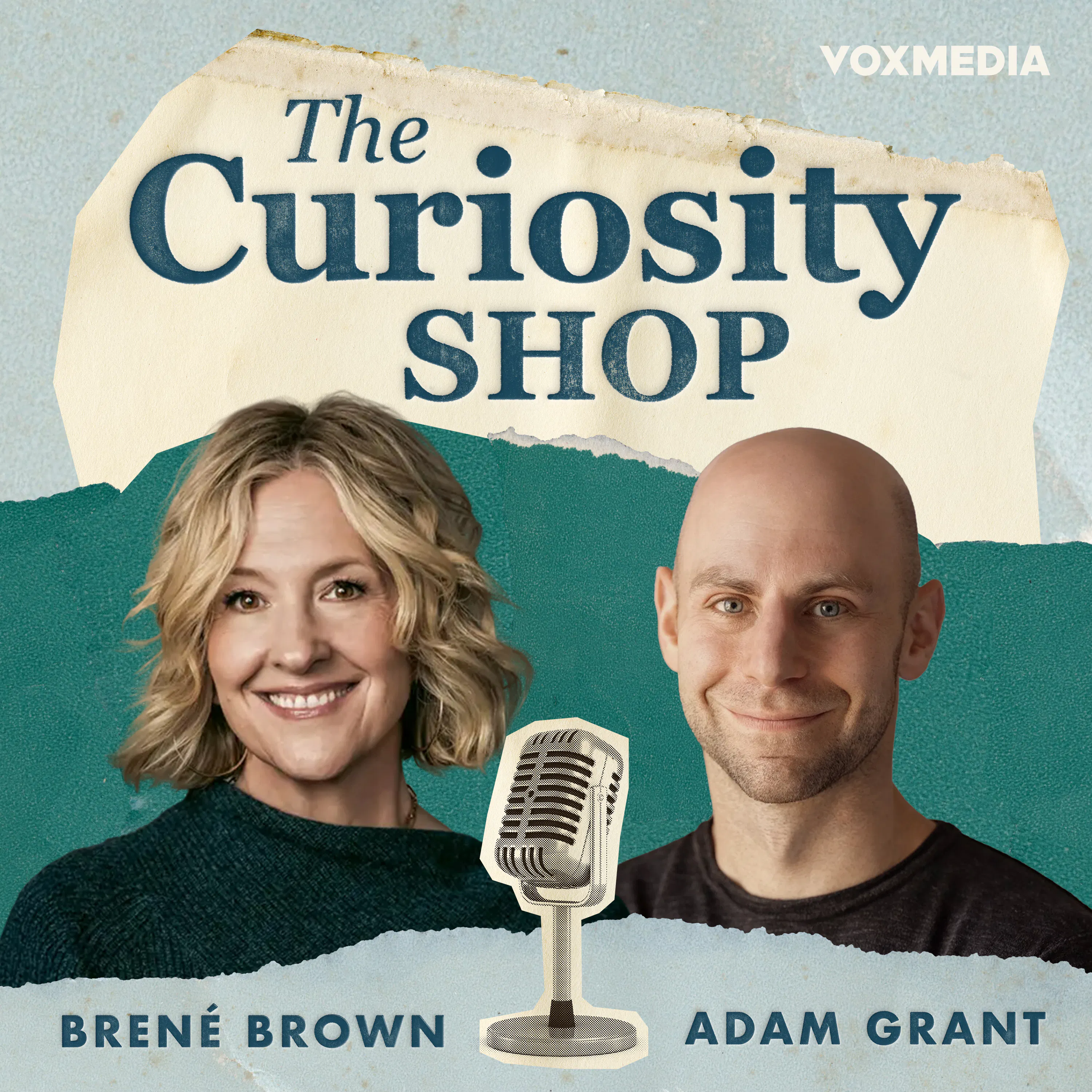
The Curiosity Shop with Brené Brown and Adam Grant
Hosted by Vox Media Podcast Network · EN
Research professor Brené Brown and organizational psychologist Adam Grant are partnering on a new weekly podcast grounded in an unflinching commitment to learning and unlearning. At a time when public discourse rewards certainty over inquiry, The Curiosity Shop features two of the world's most sought-after experts on connection, change, and leadership making the case for slowing down, asking better questions, and embracing informed complexity over easy answers. Bringing together their left and right brain sensibilities — she’s a qualitative researcher; he’s a quantitative researcher — they explore some of the defining questions of our time, unpack the research reshaping how we live, lead, and love, and dive deep into the ideas, evidence, and cultural moments intriguing them the most. New episodes drop every Thursday. Part of the Vox Media Podcast Network.
47episodes
Episodes
Newest firstAll episodes
Why Sports Matter Even When the Game Doesn’t with Roger Bennett
6d ago01:12:56Summary readyWhy do sports make us cry, unite strangers, and create memories that last a lifetime? In this episode, Men in Blazers founder and CEO Roger Bennett joins Brené Brown and Adam Grant fresh off a 39-day World Cup marathon to explore what the tournament revealed about identity, belonging, and the power of collective effervescence. Together, they unpack the difference between hero players and hero teams, what it means to be a true fan, the political complexities surrounding the World Cup, and how sports create shared experiences that shape our lives. Along the way, Roger shares stories from the road, reflects on the strange grief of “World Cup withdrawal,” and revisits some of the tournament’s most memorable stories, including Erling Haaland’s taxidermy shop detour, the Cape Verde goalkeeper who became a global icon overnight, the controversial red card reversal, and more. Roger Bennett – Men in Blazers Media Network The Englishman Who Became America’s No. 1 Soccer Fan – David Waldstein, July 16, 2026, The New York Times Men in Blazers’ Roger Bennett Eats Two Dinners During the World Cup “Chicken-tinga burros are the Messi of burros.” – Ben Widdicombe, July 17, 2026, New York Magazine Brené Brown on Surrounding Yourself With People Who Take Pleasure in Your Joy (Schadenfreude vs. Freudenfreude) – Ellen DeGeneres, April 1, 2022, TheEllenShow Premier League to bring all 20 clubs to U.S. in activation after 2026 World Cup – Victoria Hernandez, July 23, 2026, Yahoo Sports The Kansas City fanwalk had us all like… – OnsOranje, Royal Dutch Football Association The Numbers Game: Why Everything You Know About Football Is Wrong – Anderson & Sally, 2013, Penguin Men in Blazers - “The Women’s Game” and “Vamos” (Platform links) – The Men in Blazers Media Network New Volume Edited by Phil Smith and Sébastien Tutenges: Collective Effervescence – 2026, Yale Center for Cultural Sociology ROG’s Heartbreaking Farewell and Stunning Comeback at Goodison Park (Everton) – Roger Bennett, 2026, YouTube Brené Brown: The Power of Vulnerability & Joy in Liverpool! – Roger Bennett, April, 2025, Men in Blazers (Interview) Anfield sings 'You'll Never Walk Alone' to kick off new season – NBC Sports, August 15, 2025, YouTube We Are the World (Cup): A Personal History of the World's Greatest Sporting Event – Roger Bennett, 2026, HarperCollins Who Belongs? Football and the Reinvention of the Modern Nation – Josh Wilson, 2026, TIME The definition of a true fan – Adam Grant, Instagram Folarin Balogun's lifted suspension – Roger Bennett, CBS Morning News, Instagram This is so awkward: Modern puberty explained – Cara Natterson & Vanessa Kroll Bennett, 2023, Rodale Books Human challenges in polar and space environments – Sandal et al., 2006, Springer Strong Ground: The Lessons of Daring Leadership, the Tenacity of Paradox, and the Wisdom of the Human Spirit – Brené Brown, 2025, Random House Learn more about your ad choices. Visit podcastchoices.com/adchoices
SummaryThe Framework for Leading With Both Care and Accountability
2w ago01:03:53Summary readyThis episode is a master class in coaching as Aiko Bethea, one of the most respected senior leadership coaches in the country, takes Brené through a current leadership conflict in real time, showing just how hard it is to slow down and lead from your values instead of your urgency. The coaching session is underpinned by Aiko's new "Anchored, Aligned, and Accountable" framework that focuses on why self-leadership is so critical in today's complex operating environment. Together, they dig into the difference between assuming good intent and believing someone is doing the best they can, and why that distinction changes what accountability actually looks like in practice. Aiko also introduces and models the powerful coaching practice of "three levels of listening" and how it's central to developing a coaching mindset. Aiko Bethea — Aiko Bethea, aikobethea.com Dare to Lead Hub — Brené Brown, brenebrown.com Audre Lorde — Mariana Brandman, 2021, National Women's History Museum bell hooks — Asami Robledo-Allen Yamamoto, 2025, National Women's History Museum RARE Coaching | Aiko Bethea (@rare_coach) — Aiko Bethea, n.d., Instagram Psychological Safety and Learning Behavior in Work Teams — Amy Edmondson, 1999, Administrative Science Quarterly This Is Our Reminder of What Courageous Leadership Looks Like — Brené Brown, 2026, LinkedIn One of the Greatest Joys of My Career Has Been… — Brené Brown, 2026, LinkedIn Futurist Amy Webb on What's Coming (and What's Here) — Brené Brown, 2024, Dare to Lead podcast Brené with Aiko Bethea on Inclusivity at Work: The Heart of Hard Conversations — Brené Brown, 2020, Dare to Lead podcast Rising Strong — Brené Brown, 2015, Random House Feeling Powerless at Work? Here's Where Your Agency Still Lives — Jessi Hempel, 2026, Hello Monday with Jessi Hempel Without Accountability, Just Throw It All Away — Aiko Bethea, 2023, LinkedIn (Street Lights newsletter) Post on Learning and Development (#learninganddevelopment) — Aiko Bethea, 2026, LinkedIn Dare to Lead — Brené Brown, 2018, Random House Stop Outsourcing Your Judgment: Brené Brown in Conversation with Leadership Coach Aiko Bethea — Brené Brown, 2026, Fast Company Learn more about your ad choices. Visit podcastchoices.com/adchoices
SummaryYou Don't Get an A for Effort
3w ago00:38:34Summary readyPreviously released on Dare to Lead, this is part of a special six-part series with Adam Grant on Brené's book, Strong Ground. Brené and Adam unpack the difference between effort and excellence, why coaching matters more than judgment, and how unclear priorities can quietly derail even the hardest-working teams. From there the conversation moves further into prioritization, a consequential 2x2 decision-making framework, and how leaders inadvertently signal the wrong priorities through their emotional reactions. Circling back to effort, they also discuss why the first question leaders should ask when results fall short is whether they set their team up for success in the first place. Plus, Brené has a real-time realization that her own team may not be aligned on what's actually consequential. Think Again: The Power of Knowing What You Don't Know – Adam Grant, 2021, Viking Strong Ground: The Lessons of Daring Leadership, the Tenacity of Paradox, and the Wisdom of the Human Spirit – Brené Brown, 2025, Random House No, You Don't Get an A for Effort – Adam Grant, 2024, The New York Times Mindset: The New Psychology of Success – Carol Dweck, 2006, Random House Praise for Intelligence Can Undermine Children's Motivation and Performance – Mueller & Dweck, 1998, Journal of Personality and Social Psychology What Having a “Growth Mindset” Actually Means – Carol Dweck, 2016, Harvard Business Review “Both/And” Leadership – Wendy Smith, 2016, Harvard Business Review Genius of the AND – Jim Collins, n.d., JimCollins.com Reversible and Irreversible Decisions – Shane Parrish, n.d., Farnam Street The Highly Sensitive Person: How to Thrive When the World Overwhelms You – Elaine Aron, 1996, Broadway Books Sensory-Processing Sensitivity and Its Relation to Introversion and Emotionality – Elaine Aron, 1997, Journal of Personality and Social Psychology Above/Below the Line Practice – Brené Brown, 2025, BrenéBrown.com Fairy Tales and Script Drama Analysis – Stephen Karpman, 1968, Transactional Analysis Bulletin (Origin paper for the villain/rescuer/victim model of conflict) Learn more about your ad choices. Visit podcastchoices.com/adchoices
SummaryTime Scarcity and Pocket Presence
4w ago00:37:37Summary readyPreviously released on Dare to Lead, this is part of a special six-part series with Adam Grant on Brené's book, Strong Ground. The conversation opens on time scarcity, the devaluation of future time, and whether hope is actually a strategy. From there they discuss how great leaders don't need all the right answers (just the right questions) and the difference between executive presence and pocket presence. While digging into how the five C's of delegation build the situational awareness and critical thinking that pocket presence requires, Adam has a breakthrough realization that pocket presence isn't just an individual skill, it's a collective capability. Executive presence, they agree, is "party of one." Resource Slack and Propensity to Discount Delayed Investments of Time Versus Money – Gal Zauberman, 2004, Journal of Experimental Psychology Time for Happiness – Ashley Whillans, 2019, Harvard Business Review Can We Afford to be Time Poor? The Hidden Tax of Time Poverty – Celestine Rosales, 2024, The Decision Lab The Will and the Ways – C. R. Snyder, 1991, Journal of Personality and Social Psychology Hope Theory: Rainbows in the Mind – C. R. Snyder, 2002, Psychological Inquiry Golden Eggs and Hyperbolic Discounting – David Laibson, 1997, The Quarterly Journal of Economics Some Empirical Evidence on Dynamic Inconsistency – Richard Thaler, 1981, Economics Letters Future Self-Continuity: How Conceptions of the Future Self Transform Intertemporal Choice – Hal Hershfield, 2011, Annals of the New York Academy of Sciences The stranger within: Connecting with our future selves – Cynthia Lee April 9, 2015, UCLA Newsroom We normally think of a weakness as a strength you lack, but it can also be a strength you overuse – Adam Grant, July 10, 2018, LinkedIn Stop Overdoing Your Strengths – Robert Kaplan, 2009, Harvard Business Review Strong Ground: The Lessons of Daring Leadership, the Tenacity of Paradox, and the Wisdom of the Human Spirit – Brené Brown, 2025, Random House Research: Vague Feedback Is Holding Women Back – Shelley Correll, 2016, Harvard Business Review The New Rules of Executive Presence – Sylvia Ann Hewlett, 2024, Harvard Business Review Pocket Presence (Video) – Emmanuel Acho, n.d., TikTok Metacognition and Cognitive Monitoring: A New Area of Cognitive-Developmental Inquiry – Flavell, 1979, American Psychologist Essential social work theories & models – Syracuse University, n.d., OnlineGrad@Syracuse The 5 Cs of strategic thinking, decision making, and delegating – Brené Brown, n.d., brenebrown.com Atomic Habits – James Clear, 2018, Avery Learn more about your ad choices. Visit podcastchoices.com/adchoices
SummarySports as Leadership Theater and Recognizing Near Enemies
Jul 200:42:38Summary readyPreviously released on Dare to Lead, this is part of a special six-part series with Adam Grant on Brené's book, Strong Ground. They dig into the Buddhist concept of near and far enemies- and why the biggest threat to your values isn't the opposite of them, it's what masquerades as them. From there they move into discussion around the value of paradoxical thinking, why some tensions aren't meant to be resolved, and why sports are leadership theater. Plus a conversation about why future time is always undervalued. Strong Ground: The Lessons of Daring Leadership, the Tenacity of Paradox, and the Wisdom of the Human Spirit – Brené Brown, 2025, Random House The Near Enemies of the Heart – Jack Kornfield, n.d., jackkornfield.com Almost Everything: Notes on Hope – Anne Lamott, 2018, Riverhead Books (Chapter 2: “Inside Job”) 12 truths I learned from life and writing – Anne Lamott, July 13, 2017, TED (Video) Anne Lamott's thoughts on love, writing, and being judgy – Adam Grant (Host), April 16, 2024, ReThinking with Adam Grant, TED Audio Collective Genius of the AND – Jim Collins, n.d., jimcollins.com Exploration and Exploitation in Organizational Learning – James G. March, 1991, Organization Science Putting Feelings Into Words – Lieberman et al., 2007, Psychological Science How to Tame Reactive Emotions by Naming Them – Mitch Abblett, 2022, Psychology Today Maker's Schedule, Manager's Schedule – Paul Graham, 2009, paulgraham.com The Tush Push Explained – Kyle Brandt & Dr Neil DeGrasse Tyson, 2024, NFL (Video) Togethxr’s ‘Everyone Watches Women’s Sports’ T-shirts go viral – Callie Holtermann, June 28, 2024. The New York Times Dr. Linda Hill on leading with purpose in the digital age – Brené Brown (Host), April 18, 2022, In Dare to Lead, Vox Media The Pre-Mortem Method – Gary Klein, 2021, Psychology Today Golden Eggs and Hyperbolic Discounting – David Laibson, 1997, Quarterly Journal of Economics (PDF) Learn more about your ad choices. Visit podcastchoices.com/adchoices
SummaryCourageous Leadership as a Daily Practice
Jun 2500:44:08Summary readyIn this Re:Thinking podcast episode recorded at Authors@Wharton, Brené joined Adam to dig into her book, Strong Ground. They explore why courage now has to mean being a learner instead of a knower, and why values aren't just what you care about-- they're what you sacrifice for. The conversation moves through the four skill sets of courage, why a value that isn't operationalized into behavior is just a poster with an eagle on it, and how to use the "story I'm making up" framework for hard conversations. They also get into executive presence, vulnerability, care, and why fake courage is easy to spot. Strong Ground: The Lessons of Daring Leadership, the Tenacity of Paradox, and the Wisdom of the Human Spirit – Brené Brown, 2025, Random House Research – Brené Brown (n.d.). The discovery of grounded theory – Glaser & Strauss, 1967, Aldine Awareness of dying – Glaser & Strauss, 1965, Aldine De-tabooing dying control – Thulesius et al., 2013, BMC Palliative Care Never Split The Difference – Chris Voss, May 24, 2016, TEDx University of Nevada Expectancy Theory (Victor Vroom) – The Decision Lab, (n.d.) Dare to lead: List of values – Brené Brown, 2018 Dare to Lead Hub – Brené Brown Brené Brown brings Dare to Lead program to UT – University of Texas at Austin, 2020, UT News Neural processing of narratives – Jääskeläinen et al., 2020, Frontiers in Human Neuroscience The New Rules of Executive Presence – Sylvia Ann Hewlett, Jan-Feb 2024, Harvard Business Review The Gifts of Imperfection - Your Guide to a Wholehearted Life: 10th Anniversary Collection – Brené Brown, 2010 Learn more about your ad choices. Visit podcastchoices.com/adchoices
SummaryThe Highest Performance Strategy is Caring About People ft. Simon Sinek
Jun 1801:21:11Summary readyIn this episode of The Curiosity Shop, Brené Brown and Adam Grant sit down with their first-ever guest, Simon Sinek. Together, they explore the state of organizations globally, including the chaos hitting C-suites, the human cost of misaligned incentives, AI-driven layoffs, and leaders playing defense when they should be playing offense. They dig into what makes teams high-performing, why caring deeply about the people you lead isn't soft but essential, and what the military's culture of love and loyalty teaches us about business. The conversation also moves through nervous system regulation, shame and guilt in parenting and leadership, and what AI can or cannot replace about human connection. This episode is a reminder that the things we've been told to leave out of business, such as love, care, and human connection, may be the most important things we can bring to it. The Old Order Is Dead. Do Not Resuscitate — Sven Beckert, November 4, 2025, The New York Times A Friedman Doctrine — Milton Friedman, September 13, 1970, The New York Times Magazine The Man Who Broke Capitalism: How Jack Welch Gutted the Heartland and Crushed the Soul of Corporate America—and How to Undo His Legacy — David Gelles, 2022, Simon & Schuster ‘Take a simple idea and take it seriously’: Charlie Munger in his own words — Financial Times Jack Dorsey Blamed AI for 4,000 Layoffs. A Former Block Exec Says That’s Not the Real Story — Leila Sheridan, 2026, Inc. Brené Brown on values, vulnerability, and playing to win — Adam Grant, December 22, 2025, Knowledge at Wharton (Interview) Threat-Rigidity Effects in Organizational Behavior: A Multilevel Analysis — Barry M. Staw, 1981, Administrative Science Quarterly Finding our strong ground, part 1 of 6 [w guest Adam Grant] — Brené Brown, September 17, 2025, In Dare to Lead. Vox Media Podcast Network Start with Why: How Great Leaders Inspire Everyone to Take Action — Simon Sinek, 2009, Portfolio/Penguin The mental game of tennis: A scoping review and the introduction of the Resilience Racket Model — Konstantinou, G et al., 2025, Sports The Inner Game of Tennis — W. Timothy Gallwey, 1974, Random House Suppose We Took Groups Seriously… — Harold J. Leavitt, 1975, in Man and Work in Society Leaders Eat Last: Why Some Teams Pull Together and Others Don’t — Simon Sinek, 2014, Portfolio/Penguin Dare to Lead: Brave Work. Tough Conversations. Whole Hearts — Brené Brown, 2018, Random House The Fifth Discipline: The Art and Practice of the Learning Organization — Peter M. Senge, 1990, Doubleday/Currency Developing Brave Leaders and Courageous Cultures — Brené Brown, Dare to Lead hub The Infinite Game — Simon Sinek, 2019, Portfolio/Penguin Brené Brown: Focus on guilt instead of shame — 60 Minutes, March 29, 2020, YouTube Children’s Proneness to Shame and Guilt Predict Risky and Illegal Behaviors in Young Adulthood — Jeffrey Stuewig (lead), 2015, Child Psychiatry and Human Development The Altruistic Personality: Rescuers of Jews in Nazi Europe — Samuel P. Oliner & Pearl M. Oliner, 1988, Free Press The Toxic Handler: Organizational Hero—and Casualty — Frost & Robinson, 1999, Harvard Business Review Jensen Huang Says an Incorrect Nine-Year-Old Prediction About AI Shows Why It Won’t Destroy Jobs — CNBC, 2025, CNBC Relational Job Design and the Motivation to Make a Prosocial Difference — Adam M. Grant, 2007, Academy of Management Review Learn more about your ad choices. Visit podcastchoices.com/adchoices
SummaryAI, Commencement Speeches, and Why Human Thinking Still Matters | The Curiosity Shop
Jun 1101:23:00Summary readyIn this episode of The Curiosity Shop, Brené Brown and Adam Grant use this year’s booed commencement speeches as a launching pad to explore the role of AI in our lives. They dig into what some of those commencement addresses were missing: moral imagination, emotional honesty, and real empathy for the graduates. Brené introduces the concept of being “smitten with what’s written,” the trap of polished AI output that looks good but fails to move anything forward, and unpacks why writing is a tool for thinking, not just communicating. Adam proposes that signing your name on AI-generated content is an integrity violation, and together they work through how to give feedback, set expectations, and stay human in the middle of a technological transformation. Show Notes: George Saunders Reflects on his Famous Convocation Address at Syracuse University (2013) - George Saunders, 2023, Syracuse University College of Arts and Sciences Values and Messages Conveyed in College Commencement Speeches - Jenifer Partch & Richard Kinnier, 2011, Current Psychology Don’t Be Afraid to Fall - Brené Brown, 2020 University of Texas at Austin (Commencement Address) Make Your Bed – Admiral William H. McRaven, 2014 University of Texas at Austin (Commencement Address) Through Disappointment You Can Gain Clarity - Conan O'Brien, 2011, Dartmouth College (Commencement Address ) Be True to Yourself - Ellen DeGeneres, 2009 Tulane University (Commencement Address)) The Importance of Kindness - Steve Carell, 2025 Northwestern University (Commencement Address) Make Failure Your Fuel - Abby Wambach, 2018 Barnard College (Commencement Address) Wolfpack: How to Come Together, Unleash Our Power, and Change the Game – Abby Wambach, 2019, Celadon Books 2026 graduates boo commencement speeches on AI - Eric Schmidt (Former Google CEO) University of Arizona; Gloria Caulfield (Real estate executive) University of Central Florida: Scott Borchetta (Big Machine Records CEO) Middle Tennessee State University, May 2026, PBS NewsHour Exploring the Paradoxes of Human Nature: The Stockdale Paradox Explained, Brené Brown and Adam Grant, May 28, 2026, The Curiosity Shop with Brené Brown and Adam Grant Strong Ground: The Lessons of Daring Leadership, the Tenacity of Paradox, and the Wisdom of the Human Spirit - Brené Brown, 2025, Random House A Whole New Mind – Daniel Pink, 2005, Riverhead Books (source of 'Symphony') AI-Generated “Workslop” Is Destroying Productivity – Kate Niederhoffer et al. (BetterUp Labs & Stanford Social Media Lab), 2025, Harvard Business Review The Biggest Tell That Something Was Written by AI – Eve Fairbanks, 2026, The Atlantic Quote Origin: I Do Not Know What I Think Until I Read What I’m Writing - Quoteresearch, 2023, Quote Investigator Dare to lead glossary: Key language, skills, tools, and practices (including “Paint Done”) - Brené Brown, Pilots and Passengers – BetterUp Labs & Stanford Social Media Lab 2025, BetterUp The Ghost in the Machine’s Memory: A Teacher’s Lament - Hudson Mathew, 2026, AI & Society (A Socrates warning, voiced by Plato) The Enhanced Games – inaugural event May 24, 2026, Las Vegas (founder Aron D'Souza; doping-permitted competition) Atlas of AI – Kate Crawford, 2021, Yale University Press Learn more about your ad choices. Visit podcastchoices.com/adchoices
SummaryWhy Toughness and Kindness Need Each Other | The Curiosity Shop
Jun 401:09:21Summary readyIn this episode of The Curiosity Shop, Brené Brown and Adam Grant explore what happens when trust, vulnerability, grief, and performance collide. Using insights from the San Antonio Spurs and Gregg Popovich's leadership philosophy, they examine why caring deeply is an act of courage, how shame quietly undermines teams, families, and organizations, and how psychological safety fuels excellence. The conversation moves through ambition and rejection, miscarriage and loss, community, emotional intelligence and empathy, and the ways people show up for one another through life's hardest moments. This episode explores how strength and kindness are not opposites and why building cultures of trust may be one of the most important things we do. Victor Wembanyama on having Spurs legend David Robinson and Tim Duncan in the building - 2026, Yahoo Sports Armored Versus Daring Leadership, Part 1 of 2 - Brené Brown, 2021, Dare to Lead (Podcast) Victor Wembanyama Emotional After Spurs Advance to the NBA Finals - 2026, Bleacher Report Goals research summary - Gail Matthews, 2015, Dominican University of California Daring Greatly: How the Courage to Be Vulnerable Transforms the Way We Live, Love, Parent, and Lead - Brené Brown, 2012, Gotham Books Ring Theory Helps Us Bring Comfort In - Elena Sandler, 2025, Psychology Today Atlas of the Heart - Brené Brown, 2021 (Book) U.S. Surgeon General Vivek Murthy & Adam Grant on Loneliness - Murthy & Grant, Authors@Wharton, 2024, YouTube Andrew Garfield on grief and the loss of his mother – CBS, 2021, The Late Show with Stephen Colbert National Survey of Gun Policy - Center for Gun Violence Solutions, 2025, Johns Hopkins Bloomberg School of Public Health Empathic Joy and the Empathy-Altruism Hypothesis - Batson et al, 1991, Journal of Personality and Social Psychology https://psycnet.apa.org/buy/1992-05357-001 Human empathy through the lens of social neuroscience - Decety & Lamm, 2006, The Scientific World Journal The Making of an American – Jacob Riis, 1901, Macmillan The Coach–Athlete Relationship Questionnaire (CART-Q) – Sophia Jowett, 2004, Scandinavian Journal of Medicine & Science in Sports Bad Is Stronger Than Good – Roy Baumeister, 2001, Review of General Psychology Scarred for the Rest of My Career? – Erica Carleton (with Julian Barling), 2016, Journal of Sport and Exercise Psychology The evolution of shame and its display - Landers & Sznycer, 2022, Evolutionary human sciences Moral Emotions and Moral Behavior – June Tangney, 2007, Annual Review of Psychology The Inside Story of the Ever-Changing Brain - Brené Brown and David Eagleman, 2020, Unlocking Us with Brene Brown Podcast Unlocking the Mysteries of our Brain - Chris Anderson with David Eagleman, 2022, The TED Interview Winning coaches’ locker room secret - Blanding on the research of Barry Staw, 2019, UC Berkeley Haas School of Business Learn more about your ad choices. Visit podcastchoices.com/adchoices
SummaryExploring the Paradoxes of Human Nature
May 2801:17:32Summary readyIn this episode of The Curiosity Shop, Brené Brown and Adam Grant unpack the paradoxes that shape our lives, relationships, leadership, and decision-making. They explore the Abilene Paradox, the Stockdale Paradox, why groups often make decisions nobody actually wants, and how people balance gritty facts with gritty faith. The conversation moves through spirituality, teamwork, family dynamics, optimism, creativity, and even unexpected debates about Twilight and Pitch Perfect. Funny, thoughtful, and deeply human, this episode examines why two opposite truths can exist at the same time and why learning to live inside that tension may be one of the most important skills we have. You can find The Curiosity Shop on YouTube and Instagram (@thecuriosityshop). 00:00 Intro: Paradoxes, Dad Jokes & Big Questions 04:20 What Is a Paradox? 10:15 The Grace Paradox 19:02 The Abilene Paradox 27:04 How to Avoid the Abilene Paradox 30:45 Guilty Pleasures: Twilight, Pitch Perfect & Eurovision 38:38 Aesthetic Chills & The Big Five 43:08 The Stockdale Paradox Explained 46:48 Gritty Facts vs. Gritty Faith 49:47 Why Leaders Need Paradoxical Thinking 51:04 MLK’s “I Have a Dream” Speech 55:39 Candor Over Consensus 57:32 Comfort vs. Courage 1:02:06 Jim Collins & The Genius of the And 1:06:48 Harvard's Anti-Grade Inflation Policy 1:09:21 How Brené Grades Group Projects 1:13:19 Building the Muscle to Hold Paradox 1:14:54 Personal Paradoxes & The Grace of Getting It Wrong Lump - Allison Sweet Grant, September 2026, Little, Brown and Co. (Forthcoming book) Both/And Thinking: Embracing Creative Tensions to Solve Your Toughest Problems - Smith & Lewis, 2022, Harvard Business Review Press (Book) Toward A Theory of Paradox: A Dynamic Equilibrium Model of Organizing - Smith & Lewis, 2011, Academy of Management Review Vibe: The Secrets of Strong Connections in a Lonely World - Adam Grant, October 2026, Vking (Forthcoming book) Holding the Tension, The Wisdom of Paradox - Adapted, 2024, from Richard Rohr, The Naked Now: Learning to See as the Mystics See, 2009, Center for Action and Contemplation, Strong Ground: The Lessons of Daring Leadership, the Tenacity of Paradox, and the Wisdom of the Human Spirit - Brené Brown, 2025, Random House SmartLess (Guest: Stephen Colbert) - Arnett, Bateman & Hayes, SiriusXM/Wondery (Podcast) The Abilene Paradox: The Management of Agreement - Harvey, 1974, Organizational Dynamics Eurovision Song-Along: Story of Fire Saga: "Song-Along" - Dobking, D. (Director), 2020, Netflix (Movie clip) Grease: "You're The One That I Want" - Kleiser, R. (Director) 1978, Paramount Pictures (Movie clip) Brain Connectivity Reflects Human Aesthetic Responses to Music - Sachs, Ellis, Schlaug & Loui, 2016, Social Cognitive and Affective Neuroscience Aesthetic Chills as a Universal Marker of Openness to Experience - McCrae, 2007, Motivation and Emotion The Stockdale Paradox - Jim Collins, 2017, jimcollins.com Good to Great: Why Some Companies Make the Leap... and Others Don't - Jim Collins, 2001, HarperBusiness (Book) Dare to Lead: Brave Work. Tough Conversations. Whole Hearts - Brené Brown, 2018, Random House (Book) The Discovery of Grounded Theory: Strategies for Qualitative Research - Barney Glaser and Anselm Strauss, 1967, Aldine (Book) It's 2020, Stop Saying 'Negative Nancy' - Sexist colloquialisms to avoid - Eskreis-Winkler, 2020, An Injustice! (Magazine) https://www.feministlawprofessors.com/2008/07/nervous-nellie-was-not-a-woman/ The Will and the Ways: Development and Validation of an Individual-Differences Measure of Hope - Snyder et al., 1991, Journal of Personality and Social Psychology An analysis of Dr. Martin Luther King Jr's "I Have a Dream" public speech - Duarte, 2011 BE 2.0 (Beyond Entrepreneurship 2.0): Turning Your Business into an Enduring Great Company - Collins and Lazier, 2020, Portfolio/Penguin (Book) Learn more about your ad choices. Visit podcastchoices.com/adchoices
Summary