← The Curiosity Shop with Brené Brown and Adam Grant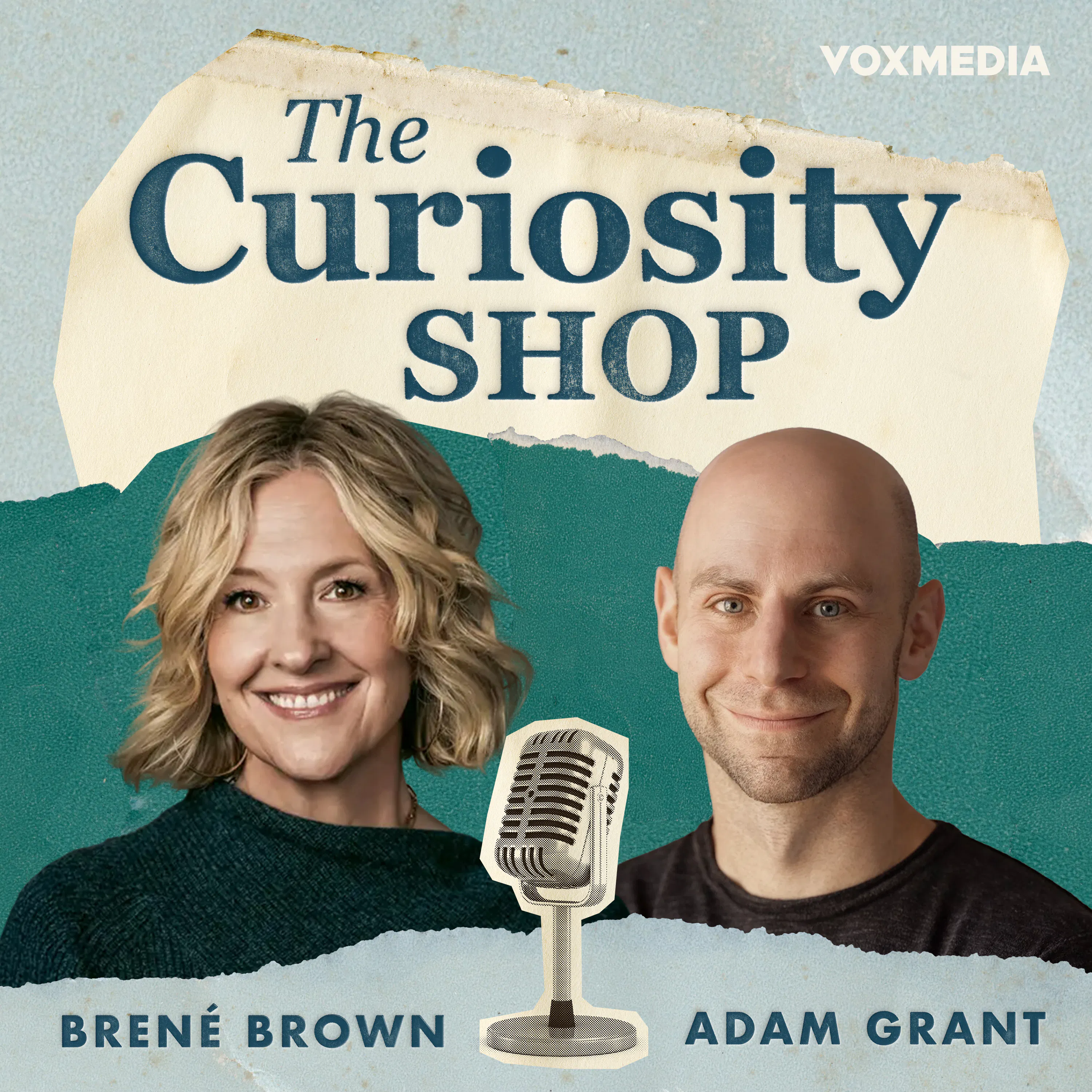
Loading summary
Transcript125 lines
- [00:00]
Adam Grant
Hey, it's Adam Grant. While the Curiosity Shop is on our summer hiatus, we're sharing a few conversations that we really love. Today's episode comes from a conversation we originally recorded during Brene's Dare to Lead series on Strong Ground. In it, we explore time scarcity and what it really means to be present as a leader. Spoiler alert. Thumbs down on Executive Presence and thumbs up on Pocket Presence. We'll be back with brand new episodes of the Curiosity shop on July 30th. Thank you for listening.
- [00:30]
Monday.com Ad Voice
This Monday.com ad was created by a team of people and AI agents. The agents wrote the copy and managed the timelines, while our human creative director made sure it all made sense. Easy create your own AI agent today on Monday.com right now, get up to
- [00:46]
Home Depot Ad Voice
15% off select storage solutions put heavy duty HDX totes to good use, protecting what's important to you. The solid impact resistant design prevents cracking and the clear base inside make items easy to find even when the totes are stacked. Find select shelving and tote storage up to 15% off at the Home Depot. To organize every room in your home from your garage to your attic, visit homedepot.com how doers get more done hey,
- [01:15]
Ryan Reynolds
it's Ryan Reynolds here for Mint Mobile.
- [01:17]
Adam Grant
Now.
- [01:17]
Ryan Reynolds
I was looking for fun ways to tell you that Mint's offer of unlimited Premium Wireless for $15 a month is back. So I thought it would be fun if we made $15 bills, but it turns out that's very illegal. So there goes my big idea for the commercial. Give it a try@mintmobile.com switch upfront payment
- [01:37]
Monday.com Ad Voice
of $45 for three months, $90 for six months or $180 for 12 month plan required $15 per month equivalent taxes and fees Extra initial plan term only greater than 50 gigabytes me slow when network is busy. See Terms
- [01:48]
Brene Brown
welcome to the Curiosity Shop,
- [01:49]
Adam Grant
a show from the Vox Media.
- [01:58]
Brene Brown
Hi everyone, I'm Brene Brown and this is Dare to Lead and joining us for more conversations around pretty much any topic you can think of, Adam Grant. Hi Adam.
- [02:09]
Adam Grant
Hey Brene. I'm excited to be back.
- [02:12]
Brene Brown
I'm excited to have you back. It's going to take me a very long time to get my head around my devaluation. A future time Our last conversation I I fancy myself a realistic person, but I do not think of my future time with the same amount of discipline as I think about my time today and it's really changing me.
- [02:47]
Adam Grant
Wow, that's fascinating. Okay, I want to hear more. Why
- [02:52]
Brene Brown
I think right now, especially in my life, I'm feeling a lot of time scarcity. And one way, one of the things I need to do right now is get more disciplined in my time now. So it's not driving me to think tomorrow will be different. So I think it's just a confounding variable for me. Like, is that the more scarcity I'm in with my time now, the more I project that the future is going to be easy.
- [03:30]
Adam Grant
Is that a coping mechanism?
- [03:31]
Brene Brown
For sure.
- [03:33]
Adam Grant
So you're telling yourself this is only temporary.
- [03:37]
Brene Brown
Yes, for sure. But for this is year 10,
- [03:43]
Home Depot Ad Voice
so
- [03:43]
Adam Grant
having done nothing to change it.
- [03:46]
Ryan Reynolds
Yeah.
- [03:46]
Adam Grant
I mean, hope is not a strategy. Is that the line?
- [03:50]
Brene Brown
That is the line. I have very mixed feelings about that quote, so we should talk about it sometime because I'm not sure that it's right. But I'm pro hope. I am radically anti magical thinking.
- [04:05]
Adam Grant
Yeah. Maybe the correction to it should be hope alone is not a strategy, but hope alone. Hope can be motivation for finding a strategy.
- [04:15]
Brene Brown
I think it's CR Schneider's work and hope agency pathways get goal, agency and pathway. So in some ways, hope is the ultimate strategy if you're a Schneider follower, because that hope. High levels of hopefulness are correlated with the ability to set a goal, to determine a pathway, to be relentless about the pathway, even if the first one doesn't work out, and then to believe in your ability to do it. So in some ways, hope is actually a strategy if you define it with his definition. Right. But I guess, I think, I wonder. Our last conversation makes me wonder. This is my exercise I'm going to do with my coach, when I am thinking, when I'm devaluating future time. What specifically does my world and my life look like in the future that's so radically different than today?
- [05:14]
Adam Grant
And why aren't you creating it today?
- [05:17]
Brene Brown
Damn. And why am I not creating it today? So if you're joining us and you missed the last podcast, I think it's really worth going back to because we had a really interesting conversation about paradox and about the paradox of discipline and freedom of productivity. And I was explaining to Adam that I thought, I always think it's going to be better moving forward. And tell us about the research you introduced from the Economist.
- [05:48]
Adam Grant
Oh, this is Labson on hyperbolic discounting. And the idea is that people value the same thing in the future much less than in the present, and sometimes with. With. With disastrous consequences. You give people the choice between, you know, I'll give you $5 today, or $50 in a year. And most people prefer the $5 today.
- [06:11]
Brene Brown
Yeah. Because this is the magical thinking. So I'm going to invest that $5 today, and it's going to be 100, not 50. And really, I'm just going to buy, like, a Diet Coke and, you know, a power bar.
- [06:23]
Adam Grant
Yeah. And also, I think there's a. There's. There's often an identity disconnect of, like, that. That future person is not me. Like, the now. The now is me, and I need to take care of the now.
- [06:34]
Ryan Reynolds
That's it.
- [06:35]
Brene Brown
Oh, my God. That's it. That's it.
- [06:40]
Adam Grant
Future Brene is a different person. That's. That's part of the challenge here, right?
- [06:44]
John Marco Cerese
Yeah.
- [06:44]
Brene Brown
Future Brene doesn't need to be thoughtful about time. She's got all this shit figured out.
- [06:52]
Adam Grant
I'm realizing as we talk this through, this is another difference between us.
- [06:57]
Brene Brown
Hmm.
- [06:58]
Adam Grant
You live in the present, and I live in the future.
- [07:01]
Brene Brown
Say more.
- [07:04]
Adam Grant
I. I think I've.
- [07:05]
Brene Brown
You.
- [07:05]
Adam Grant
When you. You were. You were talking last episode about seeing me as a disciplined person. I don't feel particularly disciplined. I just. I spend probably half my time thinking about tomorrow and next week and how am I gonna work toward the goal I'm trying to accomplish and how am I gonna solve a problem that someone I care about is facing. And it's. It's great for momentum and motivation, but sometimes it means I'm not engaged in the moment because I'm too busy thinking ahead. And you do the opposite. I think. From what I read, I do.
- [07:40]
Brene Brown
I do.
- [07:41]
Adam Grant
I got some really interesting feedback about this difference between us. I'm now realizing. A couple years ago, when I was doing a virtual event with a colleague, and afterward, I asked what I could do better, and she said, you should answer questions more like, Brene, Jesus. And I said, ooh, tell me more. What do you mean? And she said, brene pauses and thinks about a question, and you get to experience her thinking out loud in real time. And she said, you just rattle off the answer, and it doesn't have the same curiosity or engagement or mindfulness to it. And I had a hard time parsing it in the moment. And now I'm realizing some of the time it's because I already thought through the questions that I expected people to ask and tried to prepare a helpful answer. And now, like, okay, that's my job to deliver that, as opposed to the off the cuff, random thought that I had. But it means I wasn't connecting to the audience. Right. I was like, here I'M just gonna deliver to you my pre planned thought as opposed to I'm gonna work through this with you. And I think that present focus is one of your superpowers.
- [09:04]
Brene Brown
This is really weird and really interesting because I think all of our superpowers and our kryptonite are on the same continuum. Do you believe that?
- [09:24]
Adam Grant
I think my favorite definition of a weakness is a strength overused or misused.
- [09:30]
Brene Brown
Okay. So, yes, I agree. Yeah. So, yeah. So I think it's really interesting because my team gets feedback every now and then. The people that help, you know, help me get to events and plan them and execute against them and do all the really hard, tedious work of making sure they're successful. That the event organizer is not pleased with the fact that they've been told by my team, don't bother sending the questions, she's not going to read them. And I think it's because I don't want to think about them in advance. I want to be able to. If I'm in a fireside chat with a CEO and the CEO asks me a question, I want to be able to follow up with the 30 questions to that person that I'm going to need to understand better to answer. And I think there's some value in modeling that. Like, I even put one of those in the book in Strong Ground. I'm like, I don't know the answer to that. And they're like, well, here's this variable. I'm like, I still don't know. And I think sometimes there's really great learning in that. And I think that I've given my team different direction now, which is if this is something that's deep in my content area, great. If you think you've never seen this question come by, I may want to see it in advance.
- [11:06]
Adam Grant
Yeah.
- [11:08]
Brene Brown
So I probably have some really important learning to do there too.
- [11:13]
Adam Grant
But you know what's so interesting about this is I think in your case, it's really easy to do the same thing with a different framing. Right. To say, hey, what I'm hearing is you want a sense of predictability and control.
- [11:28]
Brene Brown
Yes.
- [11:29]
Adam Grant
And we're happy to give that to you, but we also want to preserve Brene's ability to be in the moment.
- [11:37]
Brene Brown
Yeah. I just don't read questions in advance, and it can make people really nervous and they have to be okay with. Sometimes they'll ask me something and I'll say, I actually don't know, and then I'm not sure. That's always what they think they Paid for.
- [11:56]
Adam Grant
This is, this is. This is the tension between. They're excited to learn with you, but they also want to learn from you. And if you take off your expert hat too much, they're dissatisfied.
- [12:06]
Brene Brown
Yeah. And you know what it reminds me of? It reminds me of my husband, Steve, who
- [12:12]
Monday.com Ad Voice
he.
- [12:13]
Brene Brown
He has taught so many medical students in residence and pediatrics over the years. And he said one of the most difficult things is to teach them is when you're working with parents, the patient is the child. There are so many occasions when a parent will look at you all welled up and said, I love that you shared how you're thinking about this as a parent. I love that you talked about the decisions that you would make. And this is why I come here. And you're amazing. And there are other times when I came here, because you damn well better be God, and you better tell me right now what to do. I don't give a shit what, you know, like. You know, it's like sometimes they just want the all knowing God when they're scared, and sometimes they want the empathetic kind of. And it's something that pediatric residents really have a hard time. And when they. They'll know when they make it wrong, right?
- [13:11]
Adam Grant
Yep.
- [13:12]
Brene Brown
But it's, you know, sometimes they want us to know everything, and then the other time, they're so grateful that there were human beings. And we don't know the answers, but we've got great questions. And what we study is how to be curious and ask the right questions. But if people are in scarcity, they want the expert with the answer. And I have to say, like, just if you're listening, I think I have a lot to offer in terms of how to get underneath what you're really worried about and what's keeping you up at night and how to ask the right questions. You and I can both like source research, but I don't think the definition of a great leader is someone who has all the answers. You know, it's just questions.
- [14:02]
Adam Grant
One, two, three.
- [14:04]
John Marco Cerese
I'm standup comedian John Marco Cerese.
- [14:07]
Brene Brown
And I'm actor penis model Russell Daniels.
- [14:10]
John Marco Cerese
The Downside is our podcast where we bring on guests to talk about how miserable their lives are. Because, let's face it, things are not getting better. Every episode, we talk about what's wrong with our lives. Our guests lives the world, but in a fun way. Bottom line is you're gonna walk away feeling better about your life. We've had so many cool guests. Caleb Huron, Busy Phillips, Stavros Halkias Laverne Cox, Hasan Piker.
- [14:36]
Adam Grant
Alana Glazer.
- [14:37]
John Marco Cerese
I promise you're gonna have a good time. Now on the Vox Media podcast network, this is the downside.
- [14:46]
Adam Grant
This connects so well to one of my favorite topics in Strongground.
- [14:51]
Brene Brown
Uh, oh, I'm curious.
- [14:52]
Adam Grant
Which is. Which is presence.
- [14:54]
Home Depot Ad Voice
Oh.
- [14:57]
Adam Grant
So one of the things we have a lot to talk about here, but one of the things, one of the things that, that you excel at, and clearly Steve does too, is, is. Is a form of presence that I think, you know, with. It brings a high degree of situational awareness, and it's different from the ways that we normally talk about presence in leadership. So I think the, the kickoff question for, for this conversation has to be, tell me what you have against executive presence.
- [15:32]
Brene Brown
Oh, my God, no. I'm gonna rat you out. I'm gonna rat you out right off the bat.
- [15:38]
Adam Grant
So.
- [15:40]
Brene Brown
Oh, man, where do I start? So, sports metaphors. We talked about this last episode. We both use them, we both love them, we both believe that sports can be an amazing kind of leadership theater where you can really point to where in the chain things go wrong. From ideation, strategy, execution, evaluation. You know, it's helpful. I think we're both committed to doing better jobs with a setup so that everyone can follow the metaphor, because that's probably key to being able to use them. But I'll tell people who are listening right now, actually, what happened is I am very. I was very. I was raised by a father who was a football player, played in college, played in high school. He was on the O line offense. He was someone who would protect the quarterback when the offense had the ball. And I grew up with a really interesting understanding of this term pocket presence. And in American football, the quarterback, who's the kind of the leader of the offense who immediately gets the ball, runs with it, throws it, needs to move the ball down the field to score a goal, to score a touchdown. Pocket presence is how you evaluate a quarterback's ability in this pocket. So when the play starts, all the big guys protect the port of the quarterback. They form a little pocket around him so that he can figure out what he's going to do with the ball. And a quarterback that has good pocket presence is someone who has a very strong internal clock, anticipatory awareness, situational awareness, major, major trust building with the line of folks that are protecting him. And so, through a series of events, I talked to Steve Sarkazian, the coach at University of Texas Football. Hook em horns, that's my team, about what is pocket presence? Because I was very curious, if I was really curious about the skill set that made up pocket presence. And it started with a conversation. I was on the sideline of a game and I was standing with Emmanuel Acho, who played for the Longhorns and ended up playing professional ball. And now as a writer and a speaker doing really interesting work. And I looked at him during the game and I said, hey, how would you define pocket presence? I'm curious. And he said, the ability to read the entire field without seeing it and the trust in your team to get something done, move the ball down the field. And I thought, man, I think what leaders need today is pocket presence. And I was talking about with my team and they said, is that like executive presence? And I was like, jesus, I hate executive presence. But I was scared because there are a lot of people who study executive presence, you know? So I texted Adam, I'm going to tell on you if you think if I'm going down, if I'm going down on the sinking executive presence ship, I'm taking your ass with me, dude.
- [19:01]
Adam Grant
Like, happy to come along for the ride.
- [19:04]
Brene Brown
So, yeah, we can both swim, luckily. So I texted you. What did I say in the text? I can't remember. Let me see. I'm going to try to find it.
- [19:14]
Adam Grant
Yeah, it's in here somewhere. I read it.
- [19:17]
Brene Brown
Hold on. It was funny. Wait, I'm going to look.
- [19:22]
Adam Grant
I have it marked.
- [19:23]
Brene Brown
There it is. When I texted. Yes, when I texted my friend Adam Grant, I'll read from the book, saying, I'm going to talk about the problem with executive presence in this book. And I asked his thoughts. The first thing I got was the dreaded three dot iPhone response. Like, I'm like, oh, my God, he's writing something. It's taking a long time. Maybe he's gonna be mad that I'm taking down. And then after waiting. Cause my thought was like, maybe this is like sacred territory in the leadership world. Finally your text came up and it said, yes, please, Executive presence is cover for discriminating against women and introverts. And. And half a second later, he followed up with, and while you're at it, could you do a smackdown of charisma too? I was like, that's why we're friends. I don't like executive presence because I don't. I think the world right now, especially on the political stage, is full of people who would tick all of the executive presence boxes. You know, like blustery and, you know, the, you know, your tie and you're you know, commanding, and they're saying nothing. And what they are saying is terrible. And so I don't know that executive presence, to me, I don't know what that means. To me, it is a prescriptive way of how you think a leader looks and sounds. Where you and I both agree that the quiet nerd in the meeting, he or she normally has the best answers of the group. Right.
- [21:07]
Adam Grant
Yeah. This. This captures so effectively what's. What's bothered me about executive presence for a long time is it's all styled, no substance. Like, executive presence is all about style, and it says nothing about whether there's any substance behind it. Yeah. So do you look the part, do you act the part, do you talk the part? But what are you actually saying? What's your contribution to the meeting? Not clear. And I think. I guess we haven't talked about this yet other than that little text exchange, but I have seen it used as an excuse to say, well, we can't promote her yet because she's not ready. She doesn't have the executive presence we're looking for. So what does that mean? Like, talk to me about what she's missing. And the most consistent answer I get when that happens with women is, well, there's just an air of confidence that we're looking for bravado. Like, I'm sorry, how is that relevant to being an effective leader? Is she competent? Is she caring? Has she demonstrated an ability to live by your organization's values and make other people around her better? Yes, yes, and yes. Promoter.
- [22:21]
Brene Brown
Yeah, I agree 100%. And I think you have to go back to a very dangerous leadership origin story to understand how the quote unquote style was first formulated. And I do think it's really hard for women, and I do think it's hard for black and brown folks. I do think it's hard for introverts. I do think it's hard for LGBTQ people. The definition, I think, of presence has been built on a leader from a 1950s movie. You know, and I. And yeah. And, yeah, I just. Pocket. Presence, to me is more interesting because, you know, I was really, like, when I was thinking about it, the ability, you know, anticipatory awareness, strategic thinking, critical awareness, internal clock, which we never talk about temporal awareness and leadership. And it's so huge, it's so complex. And it was interesting because you've read the book now, so, you know, but when I had to guess how much time a quarterback has in the pocket before the. The defense is on top of them, do you know What I guessed? 40 seconds.
- [23:53]
Adam Grant
Wow.
- [23:54]
Brene Brown
What would you, what would you have guessed? We know that we're talking about. What would you have guessed?
- [23:59]
Adam Grant
I mean, I, I, I spent way too much time on fantasy football as a kid and.
- [24:05]
Brene Brown
Okay, got it.
- [24:06]
Adam Grant
I would have counted three seconds, probably, or four seconds max.
- [24:12]
Brene Brown
It's usually 2.8 to 3.5 seconds before they're clobbered by 1200 pounds of fury and rage. And so I was trying to think, well, does the metaphor work or does it work to think about leaders in pocket presence? But I do, because I don't think you have 1200 pounds of fury coming at you as a leader and have three seconds, but I think you have 1200 pounds of pressure coming at you all the time. And I do think you have to make quick decisions. And I think the skill set of pocket presence is really important. And I'd much rather have a leader that has pocket presence than executive presence.
- [24:49]
Adam Grant
Me, too. I think the concept of pocket presence is so powerful. How do you think about building that?
- [24:57]
Brene Brown
Well, what's interesting is that takes years to build in a quarterback. So if we want to go to the original source of the metaphor, it takes years to build that, that internal cl. The footwork, the being able to read a field without being able to see it. I think it does take a lot of metacognition, meaning your ability to think about your thinking, self awareness, the ability to build trust, and then you have to hone situational awareness and anticipatory awareness skills. I think that takes time.
- [25:38]
Adam Grant
Brene, how did you build your pocket presence?
- [25:41]
Brene Brown
I feel really lucky. I think I have pretty decent pocket presence.
- [25:47]
Adam Grant
Pretty decent.
- [25:48]
Brene Brown
I do. I think it's one of my strengths.
- [25:51]
Adam Grant
Understatement of the century.
- [25:53]
Brene Brown
Well, I attribute mine to social work because that's my education. Bachelor's, master's, and my PhD, all in social work. And the foundation of social work is actually systems theory, weirdly enough. So I've studied a lot of systems theory, and so I think built into understanding how systems work is anticipatory and situational awareness. I think you understand if you move A, you're going to have repercussions in B, C, and D, and understanding the timing of those things is critical. So I think it's the way I think. And I'm a very. And social work is also about contextualized practice. So I think when we teach it in organizations, you know, because I'm using this metaphor of strengths, strengths building. In the, in the book, I say that there are Some kettlebell exercises that we talk about. So one exercise that hits 10 muscle groups, you know, as a kettlebell. A good kettlebell exercise would do. I think there are some exercises that we teach that really hit everything from situational awareness, temporal awareness, systems theory, critical thinking. And one of those is the five Cs. So we teach people how to talk about the five Cs of delegation strategy operations, which are help me understand context, connective tissue color, context and consequence.
- [27:26]
Adam Grant
Same again.
- [27:27]
Brene Brown
Yeah. So the five C's are give me context, connective tissue, color. Talk to me about the consequences involved in this decision and the costs. And it's so ingrained in our culture now that if a brand. You know, we hired someone about a year ago, right out of college, and we were in a meeting and all I said to her was, can you pull some data for me? And she looked at me and she goes, can you give me the five Cs? And I was kind of pissed off, to be honest with you. I was looking for more of a yes, Chef.
- [28:00]
Adam Grant
Who do you think you are?
- [28:00]
Brene Brown
Yeah, I was looking for more of a yes, chef response in that moment. And I said, I'm sorry. And she said, it would be helpful if I had the five Cs. And I was like, oh, my God, you know, be a good leader. So I said, here's the context. I'm going into a meeting at 3 o'. Clock. I need to be able to present this data. I'm trying to persuade the people of this. This is what I think we need to do next. Here's some more color on how this is playing out across our organization. Here's the cost of getting it wrong. Here's the cost of getting it right in terms of potential revenue, and here are the consequences. And then she says, straight out of our playbook in our training. Can I play back what I think you're saying? I was like, oh, my God, yes, please. So she plays back everything. She said, you want me to pull this data for you because you've got a meeting at 3 o' clock with this group of. You want to help them understand this because you're trying to persuade them to make this decision. Here's what this decision would mean for our organization, and here's what this decision, if we don't, if it doesn't go in our favor, would mean. And I said, that's correct. And she looked at me and she goes, you're asking for the wrong data.
- [29:07]
Adam Grant
Wow.
- [29:08]
Brene Brown
I said, what? And she said, you're asking for the wrong data. If that's what you want to do. The data you're asking for are not going to give you that. I would pull these data and I would slice and dice them this way. She was right. But that process, 20 times in, you know, a six month period. You're developing pocket presence.
- [29:34]
Adam Grant
I'm. I mean, talk about pocket presence. Here you are coming at her with a very specific and urgent request.
- [29:41]
Brene Brown
I am the 1200 pounds of defensive
- [29:43]
Adam Grant
lineman, and she has the wherewithal to stand there and ground herself.
- [29:51]
Brene Brown
Oh, yeah.
- [29:52]
Adam Grant
And help you realize, in fact, you don't want what you're asking for.
- [29:58]
Brene Brown
I mean, that's. Yeah. And we'll end on this note. One of the things we talk about when we do dare to lead transformations is you've got to build systems that are braver than people, because it's human nature to tap out of hard things. Sometimes we just, you know, we just. We're weary. I'm weary. Everybody gets weary. But when she was onboarded into our organization, she was taught that if you're not given those, you must always ask for the five C's. She was taught if someone says something to you that's complex, you have to ask for a playback. You have to say, can I play back what I think I'm hearing? So we're going straight into James, Clear. We don't rise to the level of our goals. We fall to the level of our systems. So to me, the kettlebell exercises that were in play there, that really saved my ass. And by the way, that meeting went exactly how I wanted it to go and exactly how it would not have gone had I had my way. But the kettlebell exercises, there are two. One, the five Cs, number two, the playback. Can I play back what I think you're saying?
- [31:10]
Adam Grant
Well, Brene, this is. This is my big aha from this conversation is I came into it thinking about pocket presence as an individual skill. But what you just spelled out is that it's actually a collective capability. It's. It's enhanced by the systems that you build into your team and the norms that then a group of people follow together that allows each individual to have that presence.
- [31:37]
Brene Brown
Oh, my God. You just put icing sprinkles and an edible flower on my cupcake of pocket presence. And I actually understand it different right now. Will you say it again?
- [31:50]
Adam Grant
Well, let me say it differently, which is if we go back to your Tom Brady example, which, of course I have to love as a Michigan Wolverine pre Patriots, the description that you gave was not just of, you know, of Tom Brady being cool under pressure. It was about his relationships with his offensive line and knowing that they had his back and knowing what they would do if, you know, if a blitz came in or, you know, if there was a bad snap. And that was a system. Right. He had faith in that system, and that allowed him to be present. And so I think that. I really think that part of what differentiates Pocket Presence from executive presence is not just substance versus style. It's also individual versus collective. Pocket presence is. It's embedded in a system, not just in a person.
- [32:43]
Brene Brown
If you're buying a copy of Strong Ground, please write this paragraph in on page two 18. Because I meant to say this. It just slipped my mind.
- [32:56]
Adam Grant
This is so.
- [32:57]
Brene Brown
Adam, this was so good.
- [33:00]
Adam Grant
That was such a fun. A fun realization that crystallized.
- [33:06]
Brene Brown
Yes, because Pocket presence is a collective effort made by a team that trains on these things together.
- [33:22]
Adam Grant
And it might manifest in an individual or it might look like an individual decision or set of behaviors, but it's actually. Yeah. It's a collective capability.
- [33:33]
Brene Brown
It's a collective capability. And you know, I'm gonna be saying that shit from the stage wherever I go talk about this book. I will attribute and send you a quarter every time I do it. But, oh, my God, this is so helpful. I have in here. You gotta trust your team and trust what you've built, but it's bigger than that. It's a collective capability. An executive presence is party of one. We are thumbs down. Adam Grant, Brene Brown. Thumbs down on executive presence. Yeah. I love it. Thank you, Adam.
- [34:08]
Adam Grant
No, thank you. I'll just say one other thing. Just quickly here. We can edit this out or not, but this is part of why we need book clubs, not just individual reading. Is you sat down and wrote the book. I sat down and read the book. And we just had a eureka moment talking about it that neither of us had independently.
- [34:31]
Brene Brown
Because I will go on the record here by saying I do believe that skills building happens in relationship. Yeah. I don't think you move from knowing something to integrating it and becoming it without relationship. I'm really grateful for this conversation.
- [34:48]
Adam Grant
Oh, so fun.
- [34:50]
Brene Brown
Grateful for you. Thank you.
- [34:52]
Adam Grant
Right back at you. We hope you're enjoying these conversations while we're on our summer hiatus. Again, just a reminder, we'll be back with brand new episodes of the Curiosity shop on July 30th. Thank you for listening.
- [35:06]
Brene Brown
The Curiosity Shop is produced by Brene Brown Education and Research Group and granted productions. You can subscribe to the Curiosity shop shop on YouTube or follow in your favorite podcast app.
- [35:16]
Adam Grant
We're part of the Vox Media Podcast Network. Discover more award winning shows at Podcast voxmedia.
- [35:21]
Ryan Reynolds
Com.