← The Curiosity Shop with Brené Brown and Adam Grant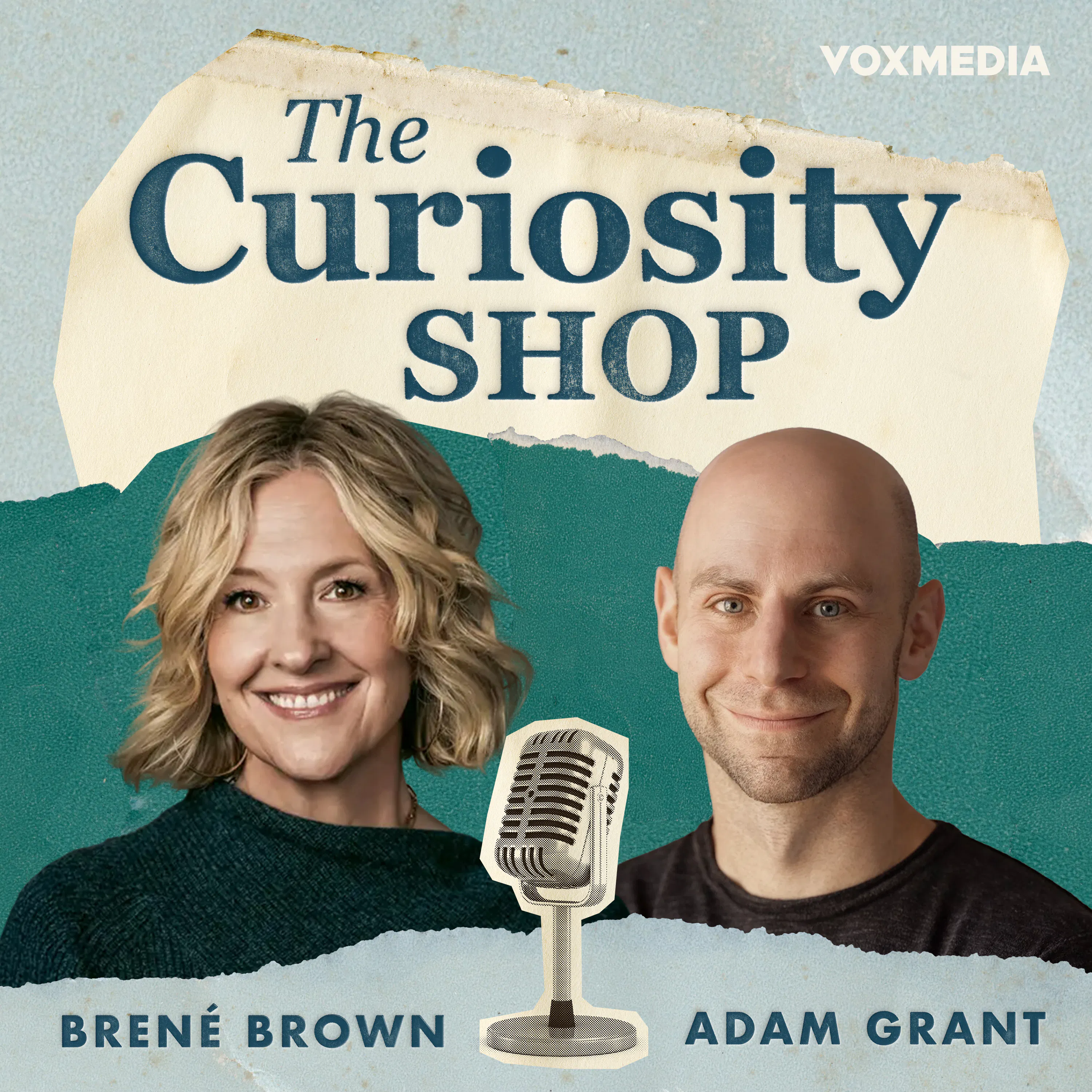
The Curiosity Shop with Brené Brown and Adam Grant
Sober AF, Michael Scott Phobia, and How to Politely End a Conversation
01:02:50
Loading summary
Transcript280 lines
- [00:00]
Brene Brown
Three topics for today. One, let's chat sobriety and my 30 years. I have some interesting thoughts I wanna run by you two. We're going to talk about not just the office, but why I'm incapable of watching shows that people love. And three, we'll talk about the art and science of gently leading conversations.
- [00:25]
Adam Grant
Love it.
- [00:26]
Brene Brown
How's that sound?
- [00:27]
Adam Grant
I mean, that's the perfect way to exit this conversation, is to talk about how to get out of one.
- [00:33]
Brene Brown
Welcome to the Curiosity Shop, a show
- [00:34]
Adam Grant
from the Vox Media podcast network.
- [00:42]
Brene Brown
Hi, everyone. I'm Brene Brown.
- [00:44]
Adam Grant
And I'm Adam Grant.
- [00:45]
Brene Brown
Okay. I thought we'd start with a new question because John and Julie Gottman, who I absolutely love the Gottman's work, are celebrating their 30th anniversary. And they taught me this question. I use it with Steve. It's such a good question. What's on your heart and mind?
- [01:06]
Adam Grant
Am I supposed to have different answers to both?
- [01:09]
Brene Brown
I don't know. It depends on how far apart they live in your mind, in your body, I guess. But what's on your heart and mind today, this week that we can talk about?
- [01:17]
Adam Grant
Well, 30 years. I mean, did you forget your post?
- [01:23]
Brene Brown
Oh, yes. John and Gottman are celebrating their 30th anniversary, and I'm celebrating 30 years of sobriety.
- [01:31]
Adam Grant
Congratulations, Brene.
- [01:34]
Brene Brown
Thank you.
- [01:35]
Adam Grant
Definitely want to talk about that.
- [01:37]
Brene Brown
Okay. We'll talk about sobriety. I am dying to talk to you about this conversation. I've had a small version of it with you, and then I spent an hour and a half talking to my kids. So. Charlie, Ellen and Ellen's new husband, J.T. i spent, like an hour talking to them about this. I cannot watch the shows that y' all all love, starting with the Office, which is a collection of some of my favorite actors of all time. But I. I cannot watch it. And so I want to get into why I can't watch it. And then I need you to cure me.
- [02:15]
Adam Grant
I definitely need to cure you. I'm not okay with this. You have to watch the Office.
- [02:20]
Brene Brown
Okay. And then the last thing, we're gonna talk. What? Tell me.
- [02:24]
Adam Grant
Well, there's one other thing I wanna talk about, which is we were at a conference together, and you mastered. Well, you did a masterclass in something that I've been struggling with. And I wanna talk about what your tricks are.
- [02:36]
Brene Brown
What is it?
- [02:38]
Adam Grant
Leaving conversations, how to exit.
- [02:43]
Brene Brown
I love that. I'm a specialist in leaving conversations. That checks out. Okay, we have talked about this before, and I wasn't sure if we were gonna Talk about it today. So I prepped with a lit review on leaving conversations. Cause I was. I'll tell you why I was curious. I had this weird experience, I don't know, maybe 15 years ago when the TED talk on vulnerability went viral. I saw someone like duo my talk and do a running commentary over the top of it. And I was so fascinated because this guy kept saying things like here you'll notice that she engineers a quarter of an inch head turn and moves her hips this way when she does a four second pause and moves her left foot. This is conveying. And I was like, what is he fricking talking about? What is this like post game analysis that none of those things were in my head or listen to the pause here and then look how you know. Have you ever seen people do that where they try to like build a system off something?
- [03:56]
Adam Grant
I have sometimes.
- [03:56]
Brene Brown
Have you seen this?
- [03:57]
Adam Grant
We're even guilty of doing that. Yeah.
- [04:00]
Brene Brown
Oh, that's true. We are guilty of doing that sometimes. But I'm talking about the people who don't do it. Well, just kidding. So I was curious about how I think about leaving conversations because we have talked about this before and then I was curious what the literature said. So we'll get to that.
- [04:19]
Adam Grant
This show is brought to you by geico. Trust is foundational. It's at the heart of every relationship, every decision and every leap worth taking. And it's something you build over time through everyday consistency, follow through and care. Geico gets that. It's why they've spent decades showing up for their customers again and again with real savings and genuinely great customer service from people who truly care. Trust is everything. And it feels good to have it. It feels good to Geico.
- [04:46]
Brene Brown
Okay, where do you want to jump in?
- [04:47]
Adam Grant
I think we have to start with sobriety. Take a. I think first of all, you have to take us back to 30 years ago.
- [04:54]
Brene Brown
This will be really interesting for you, I think, because I, I often say that my sobriety. I attribute my sobriety to the final project. One of the final projects in my MSW program, my Master's of Social work program, was to create a family genogram. Are you familiar with a genogram?
- [05:14]
Adam Grant
No.
- [05:15]
Brene Brown
It's a map of your family that uses different shapes and arrows and dotted lines to understand the relationships. And sometimes a therapist will say, let's do a. Tell me about your family. And the notes that they're taking is a geniogram. So they'll have like disrupted lines showing hard relationships. And so we had to do a Geniogram for this class. And I thought, this is interesting. A geni. Not a genie. A genogram. It's genogram.
- [05:42]
Adam Grant
Genogram. You were trying to turn it into, like a genie coming out of a magic lamp. A geneogram. I was, well, grant all your wishes.
- [05:48]
Brene Brown
A geneogram? Yeah, like something you send somebody on their birthday. So I started working on it, and I got confused when I got to extended family. So I called my mom and I said, where is this person? Oh, dead. Alcoholism. And. Oh, okay, got it. So what about these two people? Oh, both dead. Cirrhosis of the liver and alcoholism. And I was like, oh, my God, what is happening in this? This, you know, it's like, shake the family tree and all the alcoholics fall out. I kept thinking, what's happening? And I guess I was just ready. And I wanted something different for my life and my history, and that scared me. And I knew my propensity to. You're at the age in graduate school. Where are you a fun party girl or is there a problem emerging? And so. The last time I drank was the night of my. I graduated with my master's degree, and I was hungover and late to Mother's Day brunch the next day at my mom's. Yeah. And I thought that combined, you know, it was funny. Cause, like, when you're a fifth generation Texan, you just hear kind of stories about outlaws and folklore heroes in your family. But then when you, you know, you sit down and you map it out, you're like, wow, there's a lot of addiction and mental health issues. Really turned into funny stories, but not so funny.
- [07:30]
Adam Grant
Yeah.
- [07:31]
Brene Brown
And so I gave up smoking and drinking. I went to my first meeting that Monday, graduated from Saturday. Mother's Day was Sunday, Went to my first meeting. And you're supposed to find, like, a sponsor. And of course I have the rule book. And so this woman said, let's go grab dinner after the meeting. And I told her my story. And she looked up and she said, I believe you have the poo poo platter of addictions. I need you to stop drinking, using food to comfort yourself, and stop involving yourself and all of your family's problems and issues. I was like, shit, I'm gonna have a lot of time on my hands. And then that was it. Then I worked the AA program and went to meetings all the time for about a year and a half and was also working on that stuff in therapy and have been sober since.
- [08:23]
Adam Grant
It's incredible. First of all, congratulations.
- [08:26]
Brene Brown
Thank You.
- [08:27]
Adam Grant
Secondly.
- [08:28]
Brene Brown
Thanks.
- [08:28]
Adam Grant
It's no good.
- [08:32]
Brene Brown
No, it's. I posted about it, which we can. Is a weird thing. I posted about it on social for a really weird reason. I sometimes post things like that and sometimes don't. The number of people that have come up to me over the. The last 15 years and said, you sharing your story really helped me get sober, and putting a face on it that's different really allowed me to get help. And so I had to weigh kind of. It feels private, but at the same time, hearing other people's stories really helped me. So it was interesting, I have to say. It's got a million impressions on LinkedIn and thousands and thousands and thousands. I mean, just thousands of people engaging with it, leaving comments. But a lot of people in the picture on LinkedIn, I'm holding a coffee cup that says sober AF. And on LinkedIn people were just putting their date and sober AF.
- [09:37]
Adam Grant
Wow.
- [09:37]
Brene Brown
And it was so shocking. So many people wrote how much shame is still attached to talking about being sober, especially in a work environment. And again, you'll know whether it's safe for you or not if you're listening or watching. But. But I don't know. It was hopeful for me.
- [09:56]
Adam Grant
Well, look at you. Normalizing vulnerability yet again.
- [10:01]
Brene Brown
Hate it. Fuck it.
- [10:02]
Adam Grant
I have to tell you, there's something that's really amazing about your story that I don't think gets talked about enough. I don't know if I've ever heard it talked about, which is people always say you have to hit rock bottom in order to begin making a change, and you didn't do that at all.
- [10:22]
Brene Brown
I had a high bottom. Yeah. Yeah, but that's what we call it in the program.
- [10:28]
Adam Grant
I mean, it sounds like you just. You saw the writing on the wall and you didn't like the possible future you were staring at and decided to change. Why is that arc so different from the one we usually hear?
- [10:42]
Brene Brown
I think inside, you know, inside of the recovery community, my experience is it's probably 20% rock bottom. Wow. Maybe 40% an event that's like, I can't do this anymore. And then 40%. I want something different for my life. And I feel like that kind of high bot the writing's on the wall. This is not what I want for myself has actually grown in the last 10 years. When people say they're experimenting with sobriety, they want to do something different. I mean, I don't want to overstate this, but it seems like the medical community is five minutes away from just basically saying this shit's. Poison. And all the early findings about three glasses of wine will do you good to like. No, no, no. We're not sure this is good at all. So I think it's changing. I think just outside of recovery, the story is rock bottom and the power of community. One of my favorite sayings is the opposite of addiction is not sobriety. The opposite of addiction is connection. And so it's a connection fueled program. And sitting in a room with people who even having gone to some jailhouse meetings, you can look at anybody, maybe they killed someone in a drinking accident. I mean, you can look at anyone and think, oh, well, there but for the grace of God, you know. And I think that's part of the power of it. But for me it was much more of a thinking bottom.
- [12:33]
Adam Grant
Wow. You know, I guess it makes me wonder if people underestimate the possibilities they have for change. I'm thinking about say more. Well, I'm thinking about. Do you know the research led by Heng Chen Dai on the fresh start effect?
- [12:49]
Brene Brown
Mm mm.
- [12:51]
Adam Grant
The basic finding, which will not surprise you at all, is that people are more likely to make major life changes at turning point times and dates on a birthday, on New Year's, the first day of the month, the last day of the month. Like there's Nothing special about May 31. There's nothing unique about June 1. It's just a temporal marker that leads you to say, hey, I turned the page, now I'm in a new chapter. And it seems like you woke up that morning and basically decided to turn the page and start a new chapter.
- [13:21]
Brene Brown
I did. It was very deliberate and very intentional. And I think because I didn't have a physical addiction and I was very clear that I didn't have a physical addiction to alcohol. I remember Steve saying, I mean, you drink less than most of your friends. And I was like, that's a really dangerous indictment of the folks I'm hanging out with. But I did have the physical addiction to nicotine. And that was brutal. I mean, the only reason I don't smoke today is I don't wanna quit again and I don't wanna die. Other than that, I miss it every single day still. Every single day 30 years later. Every day, 30 years later. And there are some things in my life that I do not do now because I can't have a cigarette. I don't really sit in my backyard because what's the point if I'm not gonna smoke? I would never have a non alcoholic beer. Cause what's the point if I can't have a cigarette. And if a really good song comes on, like Boston or acdc, I'm gonna crack the window in my car and hold my pen like I'm smoking a cigarette and driving, like, for sure. It was so habitual for me that I knew the difference. And so for folks who have to go into a physical, you know, the physical detox is sometimes that requires a rock bottom because I don't know that you knowingly, even with a fresh start date, opt in for the brutality of that physical experience. That is rough. Does that make sense?
- [15:05]
Adam Grant
It does, yeah.
- [15:07]
Brene Brown
One thing I was thinking about that I wanted to talk to you about as I've been reflecting on my sobriety is how, and this goes back to. I talked about this in my, in the TED talk on vulnerability in 2010, how when we use alcohol, drugs, gambling, social media, whatever your drug of choice is when we use substances or processes to numb the darkness, we by default numb the light. And it's not like we can choose to, hey, I'm gonna get rid of all the hard emotions, but stay completely open and receptive to the positive emotions. It doesn't work that way. And one way that plays out in recovery that I think is really interesting, that no one talks about, which is terrible, is if someone that you know is in recovery loses their job immediately, people form a tight circle around that person, reach out, go to meetings. But we know from the research that if someone gets promoted or, or engaged or something really exciting happens, they're as or more likely to relapse.
- [16:23]
Adam Grant
Really?
- [16:24]
Brene Brown
Yes, because they're so overwhelmed by the positive emotion that they've also been numbing. And the community doesn't surround that person in that moment because there's not a hard time. So they're alone in these incredibly excruciatingly vulnerable feelings of joy, optimism, and gratitude, which they also don't have experience feeling. And so it can lead to relapse. I mean, to me, the hardest thing I've had to learn how to do was not grief or shame, but joy. That's the hardest for me.
- [17:04]
Adam Grant
Why?
- [17:05]
Brene Brown
Because I want to just rehearse tragedy when it happens. You know, in our research, we call it foreboding joy. So when something good happens, I immediately feel this quiver of danger. This is going to be taken away from me. Something bad's going to happen to balance us out. I'm going to get sucker punched by pain if I let my guard down. So I push away joy. And that was the hardest part of my recovery.
- [17:36]
Adam Grant
Wow.
- [17:37]
Brene Brown
I can Tell you this, in our research, we found that 90, over 90% of parents, while feeling a very overwhelming love for their children, immediately pictured something terrible happening to their children. You're tucking a baby in at night, you're overwhelmed with love and joy, and then you immediately picture something horrible happening. It's the same thing. It's.
- [18:07]
Adam Grant
That feels different to me.
- [18:10]
Brene Brown
Say how, Tell me how.
- [18:11]
Adam Grant
Well, love and the fear of loss, I think those go hand in hand. Like, joy, I'm having a good time. What is there to worry about?
- [18:21]
Brene Brown
I think joy for me would not be, I'm having a good time. That might be happiness or pleasure or something like that. But real joy to me is like, this weekend I was with Steve, all so fun to say, all three of the kids, now that Ellen, now I've got a new birdie in the nest with a son in law. And we all went out on the boat. It was a great day. It was just fun. And then I remember the kids, the older kids saying, we're gonna head home. And I was like, call me as soon as you get there. I think there's a real vulner. I think joy is the most vulnerable emotion we experience.
- [19:03]
Adam Grant
Really?
- [19:04]
Brene Brown
I'm so surprised by this. No, yeah. Hands down, I think joy is incredibly vulnerable. And some people would say it's like waiting for the other shoe to drop. It's just in moments of joy, if we're not practiced in. The people who can lean into joy, we found had one thing in common, and that's a very strong gratitude practice that where they're in joy, they can say, I'm really grateful for this moment.
- [19:33]
Adam Grant
Is that even necessary, though?
- [19:35]
Brene Brown
Because, yes, I think.
- [19:37]
Adam Grant
Yes, when I think about great moments of joy, you're so absorbed in the moment that you don't even have to think about feeling grateful for it.
- [19:45]
Brene Brown
I would say for the majority of people we've interviewed, real true joy, deep joy, like a spiritual sense of being interconnected in love, is vulnerable. Yeah, I think it's. I think maybe, maybe not for everyone, but when over 90% of parents say, yeah, the deepest moments of joy trigger insane fear in me, I think it's the same thing. But I can't think of a moment. You know, see if you can make sense of this. This is interesting. I'm so curious about your reaction to all this. One of the things we found in our early research is that some people choose to never get too high in emotion or too low. And the reason why they don't get too high in emotion is they don't want to feel disappointment, so they choose to live disappointed rather than feel disappointed. You know, they choose just to think, eh, it's okay right now, but it'll be bad and a little better. This is nice now, but it'll turn soon. And I just. I hearkened back to an interview with a man who was in his 70s and he and his wife were in a. An automobile accident and she was killed. And he said his greatest. He told me his greatest regret was never leaning into the great moments out of fear that they'd be taken away because now he had not accumulated those across his life. It's a gut punch. It's a gut punch. Yeah. And so I do think there's a vulnerability to letting, to giving over, to love and joy that's real.
- [21:41]
Adam Grant
This show is brought to you by Geico. We've talked a good amount on this show about dealing with uncertainty. It's about being prepared, yes, but it's deeper than that. It's a balance of fortifying your mental attitude while getting ready. In the practical sense, it's about identifying the outcome you want and then securing for yourself and your people some solid insurance. In other words, building the kind of foundation that can handle what may come for a lot of things in life. The Dealing with Uncertainty toolkit involves having the right insurance partner. That's where Geico comes in. They've spent decades showing up for their customers again and again with real savings and genuinely great customer service from people who truly care. Knowing that if something goes wrong when you're on the road, you're not on your own, you're covered. If there's one thing you can be certain about, it's that Geico will show up for you when it matters. In the face of uncertainty, it feels good to be prepared. It feels good to Geico. But we have to talk about the Office, which gives me, I thought a lot of joy.
- [22:36]
Brene Brown
It could for sure. Good television, good film, good music, brings me a ton of joy. It gives me a feeling of inextricable human connection.
- [22:47]
Adam Grant
Same. But why are you allergic to so many of our favorite shows and which ones? Let's start there.
- [22:55]
Brene Brown
I think let's focus on the Office for right now because it will be a representative of other things.
- [22:59]
Adam Grant
Okay. My
- [23:05]
Brene Brown
children can recite the dialogue from every Office episode verbatim. Sometimes when the show's not even on, they get into a back and forth on it that is like, you know,
- [23:19]
Adam Grant
bears beats Battlestar Galactica.
- [23:22]
Brene Brown
It's nuts. Since the time I was little and I Remember the first time it actually happened? I have such excruciating vicarious embarrassment that I can't. I absolutely just can't watch that show. When I was a little kid, there was a version of I Love Lucy, which I used to watch after school, where Lucy and Ethel get a job at a candy factory. It's a famous episode. Most people will know what I'm talking about. And they have to wrap the chocolates as they come down the conveyor belt, and the conveyor belt is going so fast that they can't do it, so they start, like, eating them, and then their mouth is full of them, and then they start shoving them right down their shirts or their little candy. Candy uniforms. And I just ran from the room.
- [24:10]
Adam Grant
Cringe, cringe.
- [24:14]
Brene Brown
A, you can't do that. B, I'm so embarrassed for you and my whole life. Like, I could never watch Three's Company because I'm like, oh, my God, the Ropers are going to find out. This is not going to work. This is a nightmare.
- [24:30]
Adam Grant
Why?
- [24:31]
Brene Brown
And so when I'm watching, the first episode of the Office I ever watched was called Scott's Tots, do you know the episode?
- [24:43]
Adam Grant
I think I do.
- [24:45]
Brene Brown
Yeah. Where he promises people he's gonna put em through college.
- [24:48]
Adam Grant
Yeah. And then he reneges on the promise. Yes.
- [24:53]
Brene Brown
Yes. I can't.
- [24:57]
Adam Grant
Okay, all right, so I can't.
- [25:00]
Brene Brown
I cannot. I cannot. I am having a meltdown right now in my chair thinking about it. All right, Brene, you cannot do that.
- [25:10]
Adam Grant
I have questions.
- [25:10]
Brene Brown
You cannot promise people stuff like that.
- [25:13]
Adam Grant
Yeah, but did you forget you're watching a TV show? It's fiction. Like, why? I know we're supposed to suspend our disbelief in order to engage with a show or a movie, but you're still supposed to remember it's a script written by a bunch of comedy writers to make you laugh. Do you lose sight of the fact that it's not real?
- [25:36]
Brene Brown
It's not okay that anyone thinks like that to write that down?
- [25:41]
Adam Grant
No.
- [25:43]
Brene Brown
Do I lose. Yes, I completely lose sight.
- [25:47]
Adam Grant
Do you have the same pro? Can. Can you not watch horror movies because they terrify you too much?
- [25:52]
Brene Brown
No. No. I would never in a million years watch something scary.
- [25:57]
Adam Grant
Okay, all right, so this is. This is deeper than just awkwardness. It's You. You feel everything that happens on a screen.
- [26:05]
Brene Brown
Yes, but otherwise, what's the point?
- [26:10]
Adam Grant
I don't know. It's.
- [26:13]
Brene Brown
Did you watch a remnant?
- [26:14]
Adam Grant
So, no, I haven't. Wait, hold on a second.
- [26:19]
Brene Brown
I'm not. I'm not even recovered yet.
- [26:24]
Adam Grant
Okay. It's a little bit like riding a roller coaster. You can get this sensation.
- [26:30]
Brene Brown
I love those.
- [26:30]
Adam Grant
Oh, you do? Okay.
- [26:32]
Brene Brown
Yeah, yeah.
- [26:33]
Adam Grant
But you also remember, like, you feel like you're falling and you're going to die, but you also know that you're buckled in.
- [26:42]
Brene Brown
I can. That's definitely what I do on a roller coaster. I can't do that in a visual medium.
- [26:54]
Adam Grant
Only in visual. So can you. Can you read a book with awkward interactions or.
- [26:58]
Brene Brown
Yes. Could you read Stephen King hysterically? I have read. I can. I can read. Far past my tolerance for visual violence. Yes.
- [27:08]
Adam Grant
And what is it about the visuals that transports you? I mean, is it. Is it literally just feeling like you're there and having all of your senses active?
- [27:17]
Brene Brown
I blame my parents because we were not allowed to watch anything. Like, we were. We were so straight. We couldn't even watch shows where kids were disrespectful to their parents. Like, and we could watch. Yeah, I saw Smokey and the Bandit with my grandmother who was like a pearl beard, drinking, cigarette smoking, like, no boundaries person. And even when I got home from my San Antonio summer, I was grounded for four weeks for watching a PG movie when I was 15. Probably. Yeah. Like, we just. We're very strict, and so I don't. Maybe I didn't learn to differentiate, but I don't think it's that. Maybe I'm just visually porous. I believe that I want to pose this moral question. Is there something wrong with me because I can't watch Game of Thrones? Or is there something wrong with the people who can watch it because they can watch it?
- [28:15]
Adam Grant
Well, there's a lot more of them than there are of you. So I guess something wrong with could be defined multiple ways.
- [28:22]
Brene Brown
I don't care about population. I mean, like, is it okay that I'm not desensitized to violence?
- [28:31]
Adam Grant
I am.
- [28:32]
Brene Brown
So maybe no one's wrong. Maybe no one's wrong.
- [28:34]
Adam Grant
Yeah, I was gonna say I don't see this as a moral issue at all.
- [28:37]
Brene Brown
Right, Me neither.
- [28:38]
Adam Grant
I watched the first two seasons of Game of Thrones and thought it was really interesting and well done, but found the violence too gratuitous and didn't wanna go on.
- [28:47]
Brene Brown
Why did you just tell yourself it's like a rollercoaster?
- [28:49]
Adam Grant
Oh, I did the images just. I was just like, ah, there's a lot of good content out there and a lot of the shows I watch I'm not ambivalent about. So I don't need to engage with this one.
- [29:03]
Brene Brown
Okay, you gotta Stop. I'm gonna take you back. You just said and went like this. The images were like. Like, let's go back to that moment. What? Unpack that for me. The images were what?
- [29:20]
Adam Grant
I mean, it's like it. How would I describe it? It's like. It's gross and it's a little upsetting. And it's not like watching a Civil War movie where there's a reason for depicting it. Like, you don't have to show me all this. It felt like. It felt like the. The gore version of clickbait. Whereas when you watch the Office, it serves a purpose. Like they're making a point.
- [29:52]
Brene Brown
Wow. I'm just realizing just how subjective all this is, Right?
- [29:55]
Adam Grant
It is. Because I guess, you know, as I listen to this discussion or as I reflect on what I just said, I think that maybe Game of Thrones was trying to make a point about the brutality of the world that they were depicting. But I don't know that that point needs to be made, or at least it doesn't need to be made to me. Whereas you don't get the Office without awkwardness. And, Brene, you are the queen of awkward. It's in your tagline, stay brave, and you say, stay awkward. So don't you want to raise your awkwardness tolerance?
- [30:36]
Brene Brown
Is it the. Oh, I don't even want to say this out loud. It makes me. I don't. I don't. I don't even think I want to know this about myself because I'm trying to think about whether it's the awkwardness or the rule breaking. Hmm. That's really hard for me. You know, it's like. And I'm not talking about political correctness, because, I mean, that doesn't really bother me, and I can find a lot of humor in that sometimes. But when you said maybe they were trying to. Maybe in Game of Thrones, they were trying to teach a lesson or make a point about the brutality of the world they had created. Maybe, but I don't need to learn that lesson. Maybe it's for me, maybe with the Office, they're trying to make a point about the just terrible idea of putting groups of people together in the workplace and expecting it to go well. I don't know what the point is, but that's funny. But they don't need to make it to me. I already know that, and I don't. And I just think it's the. It could be like, my. The firstborn rule following. Do you know what I mean?
- [32:00]
Adam Grant
Yeah.
- [32:00]
Brene Brown
That is just. Yeah.
- [32:03]
Adam Grant
It could be.
- [32:03]
Brene Brown
I just, like,
- [32:09]
Adam Grant
I can relate to that. But I think that. I think world class comedy is rare. And I think the Office was the funniest material on television for a whole decade. And the characters are so. They're so quirky and so lovable, despite the rules that they break and the norms they violate. I just. I think it's like not watching the Office is like not watching Friends or not having seen Star Wars. It's just a core part of our culture.
- [32:40]
Brene Brown
Don't bring Star wars into it. Star wars is like very much up my alley in Star Trek. But let me ask you this. I wish you were the kind of psychologist where you had, like, the couch and you could analyze me. What does it mean? That if I'm going to share a meme with someone to convey something, 90% of the memes I share from the Office,
- [33:03]
Adam Grant
it means you.
- [33:03]
Brene Brown
I just can't watch it.
- [33:05]
Adam Grant
You're a. You're a careful student of culture. Even when you're not fully up to speed or in the loop, it means you're paying attention.
- [33:15]
Brene Brown
Yeah, no, because I think they're really funny and the memes are so good. And like Dwight in the Beat, I could probably talk to you about it ad nauseam, as if I'd watched it. The other one I can't watch is Veep. I'm like, the thought bubble that's going off all the time in my head is, you can't say that. You can't do that. Saying that is not okay. You know, doing that is not okay. Like, that's what's going off in my head the whole time.
- [33:41]
Adam Grant
Brene. But this is. I mean, this is. It's one of the core pillars of comedy. I'm sure you've read Peter McGraw's benign violations theory of humor.
- [33:52]
Brene Brown
I doubt. No, I have not.
- [33:53]
Adam Grant
Oh. I mean, it's probably become the most influential theory of humor. And this, I mean, I think, giant warning label analyzing comedy almost always kills it. But Peter does these highly entertaining studies in his lab where basically the easiest way to get someone to laugh, other than just kind of simple physical comedy, is you create a benign violation so something happens that shouldn't, but it's also harmless and people find that inherently funny. I think it's really hard to create clever comedy without violations of norms and rules.
- [34:36]
Brene Brown
Okay, this is so helpful.
- [34:40]
Adam Grant
Why?
- [34:40]
Brene Brown
This is so helpful. I don't like it when people violate rules. Do you know what I don't like? This is probably why I struggle with a lot of comedians. Although I. But Although I can watch comedy specials and really laugh hard. I do not like your reverence.
- [35:03]
Adam Grant
It's related to the sarcasm discussion we had early. Early on.
- [35:07]
Brene Brown
Is it?
- [35:07]
Adam Grant
Yeah, I think it is. That's my favorite kind of humor.
- [35:11]
Brene Brown
But I'm very sarcastic. You are.
- [35:14]
Adam Grant
That's true. But we don't always like to receive what we send. Right.
- [35:20]
Brene Brown
I like sarcastic people too.
- [35:23]
Adam Grant
Case in point. Let's take a specific example. I just want to get your reaction to one of my all time favorite office scenes, which I think is a great example of a benign violation. Okay, so do you know that Jim likes to prank Dwight and that.
- [35:40]
Brene Brown
Yes, yes, yes, yes.
- [35:41]
Adam Grant
So some of the pranks I think are just genius. And my favorite one is there's an episode where Dwight picks up the phone and accidentally slams himself in the ear with it. Like, basically just clocks himself in the side of the head. And the camera cuts to Jim saying something to the effect of. Every day I've been unscrewing Dwight's phone. And the first day I put one nickel in it. And then the second day I added a second nickel. And for months I've been adding nickels to make the phone handle heavier and heavier and heavier. And today I took them all out and the phone handle is just too light. And he just whacks himself in the head. The first of all, I mean, the genius of the person who came up with this prank. I cannot. I want to hang out with that writer every day. But more important than that is the fact that this is a benign violation. I love. You're not supposed to cause your coworker to hit himself in the head. But also, it's not going to leave a mark. And it happened on tv. And the office is full of these kinds of moments. How can you not love that?
- [36:55]
Brene Brown
I do love that prank. I think that's funny. I do love a prank. Okay. I do love a prank. Yeah, that's funny.
- [37:03]
Adam Grant
So how many of these do I have to give you before you decide that the pros are worth the cons?
- [37:09]
Brene Brown
I don't know. I'm gonna have to think about it. I do love a good prank. I mean, like, I'm a terrible person. Cause like the funny. The Instagrams where I'm laughing so hard, where I think I'm gonna pass out cause I can't breathe, are like people getting scared. Those are really funny to me. I don't know why, because I scare really easily. I don't know. I'm gonna have to think about it. I don't like the. Did you think Scott's tots was a funny episode where he promised all the kids and they celebrate them their whole K through 12 life, and then it's time for them to graduate and they're gonna be the first cohort going to college.
- [37:49]
Adam Grant
And, I mean, that was a little sad. But what made me okay with that episode, even though it's not. It's not a storyline I would have written, it's not one of my favorite episodes from the show at all, is you have Michael Scott, and if you just take him at face value, you think he's a jerk. But what you forget is he's in this documentary stuck in Scranton, Pennsylvania, at a paper company, and he's trying to become famous. He's trying to become a reality TV star. And so he does all these idiotic things in front of a camera to try to get attention. And it's a parody of how reality TV works in our culture. And that makes it funny to me because he's basically saying, this is what somebody would do to try to get famous.
- [38:36]
Brene Brown
Maybe I could watch it with you.
- [38:39]
Adam Grant
You want me to. I'm going to pause and analyze every two minutes and I'm going to just ruin the whole show for you.
- [38:44]
Brene Brown
No, no. Maybe if you could just do a running. Like a running thing, that would be really helpful for me.
- [38:50]
Adam Grant
I'm in. I've been waiting for an excuse to rewatch it, but we should also listen to the Office Lady's podcast afterward.
- [38:58]
Brene Brown
Yeah, I've listened to the podcast. I've listened to several episodes of it. Like, you have no idea how much I love the actors in the office.
- [39:05]
Adam Grant
They are amazing. All right.
- [39:06]
Brene Brown
They are amazing.
- [39:07]
Adam Grant
We're adding this to our to do list.
- [39:09]
Brene Brown
Okay.
- [39:10]
Adam Grant
Okay, wait. One request for listeners. If you have an episode that you want us to either move to the top of the queue or to talk about the implications of, let us know. This show is brought to you by geico. You know, so much of what we explore on this show comes down to one question. Who shows up? Not when it's easy, not when it's convenient, but when it actually counts. We talk a lot about trust on this show, and here's what I've come to believe. Trust isn't built in the big moments. It's built in all the small ones that prove someone will be there for the big ones. And honestly, the people and things we trust most are the ones that are consistent day in and day out. That's what I keep coming back to, whether it's a Relationship, a community, or yes, even the insurance. You choose. The question is always the same when it counts, will they be there? That's what I appreciate about geico. When something goes wrong, you know they'll show up. Real people who care. Straightforward coverage and the kind of service that makes a hard moment easier to get through. We don't walk around thinking about who's in our corner until we need someone in our corner. And that's when you can count on Geico, when it matters most. It feels good to have someone show up. It feels good to Geico. Can we talk about how to get out of a conversation? So I need to tell you a story.
- [40:29]
Brene Brown
Okay. Oh, God, I'm worried. I'm so worried, y'. All. I'm so worried. Make me look good.
- [40:34]
Adam Grant
Oh, it's not about you. Don't worry.
- [40:36]
Brene Brown
Oh, perfect. Great.
- [40:37]
Adam Grant
You're the contrast.
- [40:38]
Brene Brown
I thought it was something you witnessed.
- [40:39]
Adam Grant
Okay, so we were at this conference last week and I went to the gym with a couple other attendees in the morning and one of them is a fitness nut and offered very generously to play personal trainer and lead the rest of us through a workout. And so we show up, we're a couple minutes into our workout and the other guy who's with us gets accosted by somebody I think I've met at the conference once before. And the guy basically just launches into what had to have been a nine minute story. And I'm watching my friend, he's got this look on his face like he's trying to be polite, but he's also trying to figure out how to get out of the conversation. And meanwhile, it's holding up the whole rotation that we're in. Cause we're on a circuit. And he's just too nice to say, excuse me, I need to do a set. Or could you cut to the chase? Which obviously would be a little rude. And I watched that happen and I realized I have been this guy my whole life. I am constantly in conversations that I don't know how to get out of. I avoid phone calls. Sometimes I just don't even answer because I'm afraid if I pick up, I won't be able to exit the conversation. It just, it feels rude to cut someone off. And the contrast between that and what I saw you do in the middle of conversations, just say like, excuse me for a second and then give someone a reason to walk away. I was like, okay, this is a skill that you have that I want to learn. How do you leave a conversation without making somebody Else feel bad.
- [42:24]
Brene Brown
Okay. I'm still like, shocked about the workout. Person that came in, saw people working out and jumped into a nine minute story.
- [42:35]
Adam Grant
It was. That was. Yeah, it was shocking. And he was not reading the room at all.
- [42:42]
Brene Brown
Okay. So I've been thinking about it, and I did pull an interesting lit review, which I actually think is helpful to talk about some of the research because I didn't really have words for what I did until I read the literature. The way I always think about it in my mind was I always thought about it, even tried to teach it to my kids with this metaphor. Pull the band, rip the band aid off and leave some relational sticky.
- [43:12]
Adam Grant
Ooh, tell me more.
- [43:14]
Brene Brown
That's how I always thought about it. Like, I'm going to. I'm gonna exit stage left when I'm ready and when I need to. But I am gonna do it in a way that's highly relational. And so had I not read the lit review preparing for this conversation, I wouldn't have understood what I was doing. So this is like a win for research. So I'm gonna do these things. I didn't know they were. I didn't know they had names. Have you ever had that experience with research? Like, you're like, here's what I do intuitively and then here's. Isn't it wild?
- [43:51]
Adam Grant
Love it.
- [43:51]
Brene Brown
God, I love. I love it. So why do I love it so much?
- [43:55]
Adam Grant
It's both validating and enlightening at the same time.
- [43:59]
Brene Brown
Yes. Okay.
- [44:00]
Adam Grant
I feel seen. And also now I can talk about it.
- [44:04]
Brene Brown
Yes. It gives me language because, you know, it's not helpful to say, just you gotta rip off the conversation in like a band aid at em, but just make sure you leave some relational stickiness on that person when you pull it off. Like, you're like, not helpful, right?
- [44:17]
Adam Grant
Not yet.
- [44:18]
Brene Brown
Not yet.
- [44:18]
Adam Grant
Keep going.
- [44:18]
Brene Brown
It's not that. Not yet. Okay, so here's. And we're gonna put all of this research in the show notes so you can go to the actual articles. But here's some interesting things I learned. The polite assumption that they want to keep talking is almost always wrong based on the research. Exiting earlier is usually doing the other person a favor. It's not a slight.
- [44:42]
Adam Grant
I love framing this as pro social.
- [44:45]
Brene Brown
Yes. It was a landmark study of 932 conversations.
- [44:50]
Adam Grant
Oh, wait, is this Master Yani and Gilbert?
- [44:52]
Brene Brown
Yeah. Yes, it is.
- [44:54]
Adam Grant
Yes.
- [44:55]
Brene Brown
Okay, so. God, it's so wild that you do that. Like, God, in this last season of my life, let me have the ability to recall the Research like Adam Grant.
- [45:06]
Adam Grant
You don't want it.
- [45:07]
Brene Brown
Amen. Okay.
- [45:07]
Adam Grant
It's a curse.
- [45:08]
Brene Brown
I do want it. Okay. It isn't. Okay.
- [45:11]
Adam Grant
I want to talk about some of the findings of that research actually, because I think they're very relevant here.
- [45:15]
Brene Brown
Let's do it.
- [45:16]
Adam Grant
But no, I want to hear the rest of what you found first.
- [45:18]
Brene Brown
Okay. This is what I thought was interesting. This is how you. Something that I just kind of do intuitively I guess, but it actually breaks it down. A typical closing has. Well, one thing to say is they are collaboratively negotiated, not unilaterally announced. So I want you to sit with that for a second. Yes. It's so good that a conversation end or graceful exit is collaboratively negotiated, not unilaterally announced. And what helps that is a four part sequence. One, a pre closing token which is. And this is across across culture. Okay, well oops, time's up. Or oh, some kind of. Oh great, catch up. I'll send that link. Some kind of pre closing token is really helpful followed by an arrangement or summary. So. Okay. Or well number one, I'll follow up on that. It was so good to see you. That's number two. Number three, terminal exchange. Take care you two have a great conference. And then four, a farewell which is bye bye. So one tell you a funny story about one. One. Okay. Or well, this is your closing token. Two, an arrangement or summary. Great catching up. I'll send that link. Good to see you. Some kind of summary. Three, a terminal exchange. Take care you two, four a farewell or buy. And then this researcher writes skipping straight to buy feels rude precisely because it omits the pre closing collaboration.
- [47:10]
Adam Grant
Yep. Yep. Where okay, this makes a ton of sense where you're signaling that it's time for the conversation to end before you've actually said it out loud.
- [47:19]
Brene Brown
Do you know, in another set of research the signaling is so strong with your body kind of like angling toward the exit area moving that in this other study that I read, when patients see physicians start to do the signaling of a close, that's when they're most likely to say, oh, I've got a couple of last minute questions. I've got just a couple more questions. Because they can see the collaborative dance start to happen.
- [47:49]
Adam Grant
Yeah, time's running out. I better spill.
- [47:54]
Brene Brown
Okay, this is why this is Brown and Levinson's politeness theory. Do you know this work a little bit?
- [48:02]
Adam Grant
Not well.
- [48:03]
Brene Brown
Okay. Frames leaving a conversation as a face threatening act. It can imply the partner is boring or unimportant or that you're imposing a constraint. So this four steps really helps collaboratively end something. I just do it intuitively. So I will say, oh, shoot, it was so good to see you. I've gotta run. Can't wait to catch up again.
- [48:34]
Adam Grant
Much harder when you're in the same captive location.
- [48:38]
Brene Brown
So I was thinking about the conference where we both were. Even if I've gotta run from one huddle of people talking or just one other person to another one on one that is literally 10ft away, I will still do this. Oh, shoot. I just saw so and so I promised him I'd give him some information. It was so good to catch up. Glad we get to be at the conference together. I'll see you soon. Tell me about these four steps for you.
- [49:02]
Adam Grant
Oh, I like. I like them a lot. I think actually to go back to the Gottmans, in Gottman language, you're making a bid, that you're making a bid. Here's a bid, like, I'm sending you a message that I would love to collaborate in wrapping up this conversation. And unless you're oblivious or from a different culture or neurodivergent, you're going to pick up that signal and start collaborating to close it out. Because it would be very awkward to drag me back into it as I'm trying to leave.
- [49:33]
Brene Brown
I mean, I think that's right.
- [49:35]
Adam Grant
Yeah, I like that.
- [49:35]
Brene Brown
But I think your list of caveats is also big important.
- [49:40]
Adam Grant
Yeah. I think a lot of these situations may. I think the caveats might capture some of the situations where it's. It's hard because you initiate the collaboration and the other person denies the bid as opposed to accepting it. What do I do? Should I just be more direct? I don't want to hurt their feelings.
- [49:56]
Brene Brown
Yes. I think that's when I do the soft hand on the forearm. I'm so sorry. I'm so glad you're here. I want to catch up later. I've got to run. It's so good to see you. That's my. What I talk about when rip it off but leave the relational sticky. One of the things I've been thinking about from a work perspective in the work that I do with leaders, is this is why it's so difficult for transactional leaders to lead real transformation. They don't leave behind any relational residue, even when they have to cut things short.
- [50:33]
Adam Grant
Exactly right. And so it feels abrupt and impersonal and just instrumental, task focused.
- [50:41]
Brene Brown
Yeah, I got what I need. I'm leaving now.
- [50:43]
Adam Grant
Yep. You're a means to an End for me.
- [50:48]
Brene Brown
I mean. That's exactly right. One thing that I highlighted in this little lit review that I did. I want you to diagnose this sentence for me. Are you ready?
- [50:56]
Adam Grant
Ready.
- [50:57]
Brene Brown
This is. Again, this is part of how to. This is my how to exit a conversation gracefully. Lit review for introverts, specifically. The literature suggests the discomfort that drives early exit is not a social deficit. It surfaces, a coordination signal the other person was likely also feeling, but suppressing.
- [51:19]
Adam Grant
Okay, so
- [51:24]
Brene Brown
do we read it again?
- [51:25]
Adam Grant
No, I'm just thinking. I'm connecting it to the Mastroianni and Gilbert paper for sure. Okay. So that study of nearly a thousand conversations, the thing I remember so vividly from it is that of all those conversations, only 2% ended when both people wanted them to.
- [51:49]
Brene Brown
That's right.
- [51:49]
Adam Grant
98% of the time, at least one person is not happy with how long the conversation went. And I think their takeaway, which is resonant for introverts, is it's better to leave too soon than too late. Leave people wanting more, not less.
- [52:06]
Brene Brown
I think that's true. I like in this research. Mastroianni. Is that how we're pronouncing it?
- [52:15]
Adam Grant
I think it's Mastroianny.
- [52:17]
Brene Brown
Mastroianny. Okay. The author's frame, ending a conversation actually as a coordination problem. The conflict is in coordinating the end, not in wanting to end.
- [52:32]
Adam Grant
Right? Yes.
- [52:33]
Brene Brown
Which is what you're saying.
- [52:34]
Adam Grant
Yes, exactly. And the coordination is tricky, in part because our feelings change during the conversation.
- [52:43]
Brene Brown
Yeah.
- [52:43]
Adam Grant
How often have you been in a conversation where the first few minutes you thought, okay, we didn't click, forget it, and then a few minutes later, you're really into it?
- [52:54]
Brene Brown
Many.
- [52:55]
Adam Grant
Yeah. So there's the dance of leaving is happening at the same time sometimes as the dance of, wait, I actually want to stay. You know what drives me crazy?
- [53:08]
Brene Brown
What?
- [53:09]
Adam Grant
When somebody says, sometimes people end meetings early and they say, I'm going to give you your time back.
- [53:18]
Brene Brown
I hear that all the time, every day.
- [53:19]
Adam Grant
One of my biggest pet peeves. You don't own my time. You can't give it to me. This is a coordinated decision. I chose to meet with you. If I want my time back, I will claim it by ending the meeting or we should decide together.
- [53:35]
Brene Brown
I've never thought about it that way. It does assume ownership of your time.
- [53:40]
Adam Grant
It does. And there's a little. It smacks of entitlement to me. Like, here, I'm gonna bestow upon you this gift. I have power over you. And I am unilaterally declaring that you have freedom, but without that, you'd be trapped with me.
- [53:56]
Brene Brown
What if I said I would love to get a little bit of my own time back today and hope maybe that's helpful for you? I think we can wrap here.
- [54:04]
Adam Grant
Such a win. You're my hero if you say that in any meeting ever, including right now.
- [54:13]
Brene Brown
Okay. One of the things that my takeaway from thinking about kind of how I do this and then reading this lit review again, which I found very helpful. If you really struggle with a graceful exit. So we'll put this research in the. Again. Again the show notes. But I would say the shortcut here is warmth and connection and genuine warmth and connection. I think if you have those things, it's easier to leave if those things are not present. I would rely on the four steps and practice it a little bit because I think it's very easy for me with people I genuinely care about to say even with people that I care about. I'm thinking about some people specifically right now. One or two people in my life who probably. I don't share. We probably have different levels of how long we'd like the conversation to go. And mine is much shorter.
- [55:23]
Adam Grant
Chronically.
- [55:24]
Brene Brown
Chronically. I mean habitually. Predictably longer.
- [55:29]
Adam Grant
Do you address that with a person then, as opposed to having to repeatedly find the graceful way to escape?
- [55:38]
Brene Brown
No, I think I'm just graceful in saying I loved our catch up. I've gotta run. It was so good to see you. No, because. No, because I think to address it chronically would be to get ahead of what they might be bringing up. If they bring up something that's really tough or they really need me for something, I'm happy to extend that time. But I'm. You know, the other thing is I'm not one lent many years ago, maybe 15, 18 years ago now. I gave up gossiping for Lent.
- [56:11]
Adam Grant
Wow.
- [56:15]
Brene Brown
And I realized that I have a few very good friends. And then I have a lot of friends where the connection is somewhat counterfeit. Because what we mostly talk about is shit around other people. We just talk about other people in not a positive way. Which is why I get it up for Lent. Because it just. It actually going back to sobriety. This isn't clean little tidy thing.
- [56:39]
Adam Grant
It's a cleanse.
- [56:40]
Brene Brown
It doesn't. Yeah, it doesn't work for my program. You know, so the folks that sometimes want more of my attention want to get my hot take on people that I'm not going to share a hot take on. Not that I don't want to it seems really fun and great and I would probably enjoy it and I'd be very good at being shitty, but I just can't afford it.
- [57:02]
Adam Grant
Yeah, I respect that. I think. I wonder if you have an exception, which is there's. Well, I think about the really critical function of what's called pro social gossip.
- [57:16]
Brene Brown
Oh, yeah? Yeah.
- [57:18]
Adam Grant
Like, I need to warn you that this person has a pattern of being a selfish taker. Watch out. That's different, right?
- [57:24]
Brene Brown
Yeah. That is different than all we have in common is to talk shit about some other people.
- [57:31]
Adam Grant
Yeah. That's not cool.
- [57:32]
Brene Brown
Like if. Yeah. If we can't find a way to have an interesting five or ten minute connection that doesn't involve being hurtful toward anyone else, then I'm questioning either how hard we're willing to work for it or if it's just not there. So I think that's a big one. I have to just end this. That I was telling Ellen and JT and Charlie this weekend that we were gonna talk about the graceful exit. And I asked J. JT told me the funniest story that he was. He had saw. He had seen a YouTube video about this conversation. In the comments, someone wrote, I don't know why I think this is funny. This is probably not going to be funny. But someone wrote, we always know it's time to wrap up in our family. When my dad is sitting down and slaps both of his knees and then stands up and all I thought of is like, well, in my family, whenever my dad would be like, well, I'd be like, oh, shit, get the casserole pot in your purse, because it's over. This is exit stage Brown family. So I thought that was really funny.
- [58:38]
Adam Grant
I love that. It seems like we should all build a simple norm that everybody reads the same way.
- [58:44]
Brene Brown
Oh, I'm gonna go with this one. Well, it was nice to catch up. All right. This was fun. Before we go, I have to ask, anything that you're watching, listening to, or thinking about that is interesting.
- [58:59]
Adam Grant
Yeah.
- [59:00]
Brene Brown
That I.
- [59:01]
Adam Grant
Did you watch Jury Duty?
- [59:04]
Brene Brown
No.
- [59:05]
Adam Grant
Oh, okay. I mean, maybe this will fail for you because it's too uncomfortable, but it was one of the cleverest reality shows I've ever seen. It's a show about a bunch of jurors. Only one of them doesn't know that all the rest are actors.
- [59:24]
Brene Brown
What?
- [59:24]
Adam Grant
Yeah. And I thought it was brilliant. And now they have a second season. It's Jury Duty presents Company Retreat. And it's a similar premise. It's a fake family company with all Actors hires one real person. And Allison and I just watched the first episode and I think it's very promising.
- [59:47]
Brene Brown
Okay, I will make you this. I'll make this commitment. I will watch how many episodes in the season of Jury Duty?
- [59:54]
Adam Grant
I think it was eight, if I remember correctly.
- [59:57]
Brene Brown
Okay, what about you? I'm gonna watch it. What am I watching right now? I'm mostly listening to stuff right now, so. Well, I did finish the Madison, which is Taylor Sheridan's kind of new. He's the writer person behind Landman and Yellowstone. I couldn't watch Yellowstone because of the violence. I'm gonna watch Landman. I love Billy Bob Thornton's Wild to me, and I like to watch him on screen. But the Madison, my sister told me to watch it and I was like, I don't know. I thought it was the most beautifully observed television on grief. I felt such a loss and longing. I mean, the way grief is explored in it I thought was really interesting. And it is beautifully shot in wide open spaces, which is a Taylor Sheridan hallmark. And it involves fly fishing, which I'm obsessed with. I've never done it, but I just think it's so beautiful. Like it's very River Runs Through It. So I. So I watched the Madison. I thought it was really great. Michelle Pfeiffer was wonderful in it. But I am gonna watch the jury duty. I will. Is it called the jury duty or jury duty? Jury duty. I will report back.
- [61:27]
Adam Grant
I'd rather you watch the office. Just saying I can't.
- [61:34]
Brene Brown
They're not following any protocol or whatever.
- [61:36]
Adam Grant
Doing a view of the party. It's happening.
- [61:38]
Brene Brown
I watched one episode where the folks are gonna push up an episode for us to watch together. And be thoughtful, y'. All. Don't push up the cringiest cause, you know, walk me into the cringe at the baby pool of cringe and then I'll do the deep end if I can make it.
- [61:53]
Adam Grant
And with that, Brene, it's been really delightful talking to you and I have some TV to watch now, but I look forward to chatting again soon.
- [62:01]
Brene Brown
This was so fun. I'll see you soon. The Curiosity Shop is produced by Brene Brown Education and Research Group and granted productions. You can subscribe to the Curiosity shop on YouTube or follow in your favorite podcast app.
- [62:15]
Adam Grant
We're part of the Vox Media Podcast network. Discover more award winning shows@podcast.voxmedia.com this show is brought to you by Geico. Trust is foundational. It's at the heart of every relationship, every decision and every leap worth taking. And it's something you build over time through everyday consistency, follow through and care. Geico gets that. It's why they've spent decades showing up for their customers again and again with real savings and genuinely great customer service from people who truly care. Trust is everything and it feels good to have it. It feels good to Geico.