
Podcast
Data Faces Podcast
Hosted by TinyTechMedia · EN
Data Faces is a data, analytics, AI, and marketing podcast that brings the human stories behind the numbers to the forefront. Hosted by David Sweenor — author and founder of TinyTechGuides — each episode features engaging conversations with the industry's leading voices: the data leaders, analytics practitioners, AI innovators, and marketing leaders shaping the future of data-driven decision-making. We explore the culture, challenges, and real-life experiences of the people behind the numbers — enterprise AI adoption, data governance, generative AI, analytics, and B2B marketing.
21episodes
Episodes
Newest firstAll episodes
Data Intelligence & Agentic AI | Stewart Bond, IDC
Mar 2400:39:13Tap to summarizeStewart Bond coined the term "data intelligence" in 2016. Now it's a market category. Here's how it happened — and why it matters more than ever for AI.Stewart Bond, Research VP at IDC, joins David Sweenor on the Data Faces Podcast to trace the origins of "data intelligence" from a single research note to a full-blown market category adopted by Collibra, Alation, Informatica, Databricks, and IBM. They dig into what data intelligence actually means, why it's distinct from data governance, and why the rise of agentic AI makes getting it right non-negotiable.Key takeaways:1- Data intelligence (intelligence *about* data) is not the same as data governance — governance is organizational discipline; intelligence is the technology that enables it2- GDPR was the catalyst that accelerated enterprise interest in data intelligence and metadata management3- Databricks redefined the term to mean intelligence *from* data, triggering a debate that's still playing out4- Agentic AI demands high-quality, trustworthy data at the source — "shift left" for data quality is no longer optional5- Unstructured data intelligence is the next frontier, and most organizations are not readyTimestamps:0:00 Opening and introductions1:06 Stewart's background — 30+ years in IT, IBM certified architect, IDC analyst since 20112:31 Personal interests: fishing, road biking, and competitive curling5:00 The origin of "data intelligence" — 2016, ASG Technologies, and one research note6:44 GDPR as the catalyst — data governance vs. data intelligence8:11 Market adoption: Collibra, Erwin, Alation, Informatica, and more11:05 Databricks makes a splash — and Dave Kellogg weighs in13:39 IBM rebrands its portfolio to WatsonX Data Intelligence15:00 What it takes to successfully define a market category16:02 How data intelligence is evolving: semantics, active metadata, unstructured data19:13 Buy vs. build: how organizations assemble data intelligence capabilities23:32 Agentic AI and why data intelligence matters more than ever27:27 "Shift left" — data quality must happen at the source for real-time AI29:14 Cracking the unstructured data quality problem31:21 What CDOs are actually complaining about35:07 Where organizations are under-investing37:46 Data catalog adoption challenges — and how agentic AI can helpListen on your preferred platform:YouTube playlist: https://www.youtube.com/playlist?list=PLzrDACjTQ4OBfdBJQiHax4oR1bXzs8JYYSpotify: https://open.spotify.com/show/3tFMqBPGioiMPxVJOmDPLjApple Podcasts: https://podcasts.apple.com/us/podcast/data-faces-podcast/id1779505301Amazon Music: https://music.amazon.com/podcasts/8465f3b3-5d41-4c84-a561-bf8af09560e3/data-faces-podcastConnect with Stewart Bond:LinkedIn: https://www.linkedin.com/in/stewartlbond/Connect with David Sweenor:Website: https://tinytechguides.comLinkedIn: https://www.linkedin.com/in/davidsweenor/#DataIntelligence #DataGovernance #AgenticAI #DataManagement #DataFacesPodcast
Transcribe →
Storytelling Is the Most Durable Data Skill | Michael Meyer
Mar 1000:36:05Tap to summarize"All the computer programs that have ever needed to be written have already been written." That's what Michael Meyer's guidance counselor told him in the late 1980s. 35 years later, he's still proving that advice wrong.In this episode of the Data Faces Podcast, host David Sweenor sits down with Michael Meyer, Solutions Engineer at Snowflake, to talk about the skill that carried him through every industry shift: storytelling. From creating a fictional character named "Walt the data janitor" to explain data governance, to building ML pipelines with vibe coding tools, Michael shares why the ability to make complex things understandable matters more than any single technology.Key Takeaways:1. Storytelling is the connective thread across every data role, from architecture to marketing to solutions engineering2. The semantic layer is a storytelling problem, and building a good one is still about 70% human work3. AI-assisted coding accelerates proof of concepts, but judgment about what the numbers mean is what separates useful work from dangerous work4. Early career data professionals should start with data modeling and fundamentals before chasing AI tools5. Getting out from behind the screen and learning from people matters as much as learning from platformsTimestamps: 00:00 - Opening and introduction 02:00 - Michael's background at Snowflake 04:00 - Joe's Brew Reviews and the storytelling instinct 06:30 - Walt the data janitor and internal marketing 11:00 - The mindset shock of product marketing 14:00 - Customer language and storytelling on a B2B web page 17:00 - Coming back to the technical side at Snowflake 19:00 - What is the semantic layer and why does it matter now? 23:00 - Facts, dimensions, metrics, and verified queries 25:30 - Building a semantic model: how much is human vs. AI? 28:30 - Vibe coding with Snowflake Cortex Code 32:00 - Career advice: fundamentals early career professionals need 34:30 - Find what energizes you and get out from behind the screen 35:30 - Craft beer recommendations and closing More insights and resources: Blog: [BLOG LINK] Connect with Michael Meyer: LinkedIn: https://www.linkedin.com/in/michael-meyer/ Drop your thoughts in the comments! Like, share, and subscribe for more insights. #DataCareers #SemanticLayer #DataFacesPodcast
Transcribe →
Your AI Has a Data Context Problem | Asa Whillock
Feb 2400:34:47Tap to summarize📢 Most AI initiatives stall not because of weak models, but because of weak execution.In this episode of the Data Faces Podcast, David Sweenor sits down with Asa Whillock, CEO of Euphonic AI, to unpack what it really takes to operationalize AI inside the enterprise.With experience spanning Adobe, Alteryx, and now a growth-focused AI startup, Asa explains why production AI depends less on model hype and more on data access, system alignment, and disciplined leadership. If you’re responsible for turning AI experiments into measurable business outcomes, this conversation will sharpen your thinking.🔍 Key Takeaways:1- Production AI is about context — not just model capability2- Vertical enterprise systems create horizontal friction for AI3- Metadata and human decision logic are often the missing layers4- “Boring” infrastructure work determines long-term AI success5- ROI comes from aligning AI to the metrics that actually drive your business⏳ Timestamps for Easy Navigation:00:00 – Welcome & episode overview02:00 – Redefining operationalizing AI04:15 – Why enterprise AI struggles across silos08:30 – Signals that AI is ready for production12:45 – Structured vs. unstructured data15:00 – The decisions leaders delay18:00 – Differentiation vs. distraction25:15 – Models vs. data: what matters more29:20 – Why infrastructure determines success32:30 – Finding real ROI in AI34:20 – Final advice for AI leaders📩 More insights & resources:👉 https://www.tinytechguides.com🔗 Connect with Asa Whillock:💼 LinkedIn: https://www.linkedin.com/in/asawhillock/🌎 Website: https://www.euphonic-ai.com/💬 What’s the biggest barrier to operationalizing AI in your organization? Share your perspective in the comments.👍 If this was valuable, like the video and subscribe for more conversations with leaders shaping data and AI.#OperationalizingAI #EnterpriseAI #AILeadership
Transcribe →
AI Governance vs Data Governance Explained | Gene Arnold
Feb 1000:37:59Tap to summarize📢 AI governance is moving faster than most companies can control—and that gap is where risk shows up.In this episode of the Data Faces Podcast, Gene Arnold, Partner Sales Engineer at Atlan, breaks down what AI governance actually looks like in real organizations—not policy decks or theory, but decisions, tradeoffs, and failures teams face every day.David Sweenor and Gene explore how AI governance differs from data governance, why most AI projects never reach production, and how metadata, accountability, and testing determine whether AI becomes an asset or a liability.This conversation is for leaders who want AI to scale without surprises.🔍 Key Takeaways:1- Why AI governance is not just an extension of data governance2- How biased outcomes emerge even when models “work as designed”3- The hidden risks of moving fast without ownership or traceability4- Why metadata and semantic context matter more than models5- A practical starting point for governing AI without slowing teams down⏳ Timestamps for Easy Navigation:00:00 – Podcast intro & Gene Arnold background02:10 – From data catalogs to AI governance07:05 – Data governance vs AI governance explained11:56 – The overlooked role of unstructured data16:31 – Why most AI projects fail in production19:18 – Real-world AI governance failures (Amazon, facial recognition)26:45 – How to detect and manage bias in AI systems27:02 – Practical advice for getting started with AI governance31:06 – Accountability, metadata, and the semantic layer36:10 – Final thoughts on adopting AI responsibly📩 More insights & resources:👉 Blog recap and show notes:https://tinytechguides.com/blog/why-the-biggest-ai-enthusiasts-care-most-about-governance/🔗 Connect with Gene Arnold:💼 LinkedIn: https://www.linkedin.com/in/genearnold/💬 What governance challenges are you seeing with AI in your organization? Share your perspective in the comments.👍 If this was useful, like the video, subscribe, and share it with someone leading AI or data initiatives.#AIGovernance #DataLeadership #EnterpriseAI
Transcribe →
Culture Eats AI for Breakfast | Randy Bean
Jan 2700:34:46Tap to summarize📢 Most companies invest heavily in data and AI—yet few see real business impact. Why?In this episode of Data Faces, David Sweenor sits down with Randy Bean to unpack four decades of lessons from the front lines of data, analytics, and AI leadership.Randy shares insights from his long-running Fortune 1000 benchmark surveys, explains why culture—not technology—remains the biggest blocker, and outlines what separates effective data leaders from those who struggle to deliver value.This conversation is practical, candid, and aimed squarely at executives responsible for turning AI ambition into operational results.🔍 Key Takeaways:1- Why the Chief Data Officer role has expanded—but still struggles2- How AI has reshaped executive attention on data foundations3- The difference between defensive and offensive data leadership4- Why culture and organizational readiness matter more than tools5- What a value-first data and AI strategy actually looks like⏳ Timestamps for Easy Navigation:00:00 – Welcome to Data Faces & guest introduction00:53 – Randy Bean’s career path into data and analytics03:24 – The origin and impact of the Data & AI Leadership Survey05:08 – What’s advanced—and what’s stalled—in CDO roles10:51 – Why culture, not technology, blocks AI adoption14:08 – GenAI adoption: hype vs. real progress17:23 – AI’s renewed focus on data quality and foundations21:43 – What separates effective data leaders from the rest27:59 – Business vs. technical leadership in data roles30:27 – What a value-first data strategy looks like33:51 – Where to find Randy’s research and writing📩 More insights & resources:👉 Blog & episode recap: https://tinytechguides.com/blog/culture-eats-ai-for-breakfast/🔗 Connect with Randy Bean:💼 LinkedIn: https://www.linkedin.com/in/randybeannvp/🌎 Website & research: https://randybeandata.com💬 What resonated most with you from this conversation? Share your take in the comments.👍 If this was useful, like the video, subscribe, and follow Data Faces for more leadership conversations.#DataLeadership #AILeadership #ChiefDataOfficer
Transcribe →
AI Predictions for 2026 That Actually Matter | Tom Davenport
Jan 1300:33:06Tap to summarize📢 AI is everywhere—but what’s real, what’s hype, and where is the business value actually coming from?In this episode of the Data Faces Podcast, David Sweenor sits down with Tom Davenport, Distinguished Professor at Babson College and one of the most trusted voices in analytics and AI. They unpack where AI is delivering durable value today, why generative AI may be overvalued, and what leaders should realistically expect as we move through 2025 and into 2026.This is a grounded conversation for executives and practitioners who want clarity—not speculation—on how AI is reshaping work, decision-making, and enterprise strategy.🔍 Key Takeaways:1- Why generative AI is overhyped—and where real value still exists2- What most organizations misunderstand about agentic AI today3- The shift from individual AI use to enterprise-level impact4- Why disciplined experimentation matters more than pilots5- How AI is quietly changing workflows, not just tools⏳ Timestamps for Easy Navigation:00:00 – Welcome & introduction to Tom Davenport02:10 – What’s real vs hype in AI today04:20 – Are we in an AI bubble?05:50 – Agentic AI: real use cases vs experimentation07:00 – Is generative AI analytics “on steroids”?08:55 – One underestimated AI shift coming by 202610:59 – Where enterprise AI value will show up first13:20 – Why generative AI requires new disciplines17:15 – Jobs, education, and the limits of AI predictions28:10 – Governance vs enablement in AI30:55 – The positive case: AI, workflows, and business change32:35 – Final thoughts📩 More insights & resources:👉 Blog & episode write-up: https://tinytechguides.com/blog/why-boring-ai-use-cases-will-win-in-2026/🔗 Connect with Tom Davenport:💼 LinkedIn: https://www.linkedin.com/in/davenporttom/💬 What’s your take—where do you see real AI value today? Drop your thoughts in the comments.👍 If this conversation was useful, like, share, and subscribe for more practical insights on AI, data, and analytics leadership.#AILeadership #Analytics #BusinessValue
Transcribe →Enterprise AI in Practice: What 2025 Taught Leaders
Dec 3000:13:37Tap to summarize📢 2025 was the year AI met the real world. No demos. No hype. Just results—and hard lessons.In this special Data Faces year-in-review episode, we synthesize insights from 27 conversations with leaders across data, analytics, and AI to surface what actually mattered in enterprise adoption.Rather than new models or bigger tools, the story of 2025 centered on strategy, operational maturity, agent management, and the human realities behind AI at scale. This episode distills a full year of dialogue into one clear narrative for data leaders who need signal, not noise. 🔍 Key Takeaways:1- Why most GenAI projects failed—and it wasn’t the technology2- How AI agents shifted from novelty to core infrastructure3- What governance looks like when speed still matters4- Where AI delivered value: narrow, unglamorous, high-impact work5- Why culture, alignment, and ethics became the real constraints⏳ Timestamps for Easy Navigation:00:00 – Opening & scope of the 2025 review01:10 – Strategy over technology: where projects broke down03:05 – AI agents move from tools to infrastructure04:35 – Real enterprise value in narrow workflows05:19 – Culture, alignment, and human failure modes06:09 – Ethics, fairness tradeoffs, and real-world consequences07:58 – Adoption shifts and governance as a value driver09:06 – Managing agents at scale10:02 – Automation that makes people better, not obsolete11:09 – What 2025 teaches us going forward📩 More insights & resources:👉 https://tinytechguides.com/data-faces-podcast/🔗 Connect with Data Faces:🌎 Website: https://tinytechguides.com/data-faces-podcast/🎧 Subscribe on Spotify, Apple Podcasts, and YouTube💬 What resonated most from 2025—strategy, agents, or people?👍 If this was useful, like, share, and subscribe for future episodes.#DataFaces #EnterpriseAI #DataLeadership
Transcribe →
Open Source Meets AI Innovation | Bruno Trimouille
Dec 1600:36:14Tap to summarize📢 Can open source, AI, and enterprise analytics really coexist? Absolutely—and Bruno Trimouille from Posit is here to explain how. How are open source tools reshaping enterprise data science? What role does AI play in bridging business and technical teams? In this episode, Posit CMO Bruno Trimouille breaks down how his team supports millions of users—while staying true to an open source mission.🎯 Whether you’re a data leader, marketer, or innovator, you’ll learn practical approaches to balancing innovation with governance, productizing models into apps, and using AI for both technical and marketing acceleration.🔍 Key Takeaways:1- Why a code-first approach delivers trust, transparency, and reproducibility2- How AI bridges the gap between business users and data scientists3- What Posit’s B2B open source flywheel model looks like behind the scenes4- Why governance doesn’t have to kill speed—in fact, it can enable scale5- How marketing teams can harness Gen AI for content, segmentation & insights⏳ Timestamps for Easy Navigation:00:00 – Intro & guest welcome00:52 – What is Posit? (formerly RStudio)02:06 – Bruno’s journey: Engineer to CMO04:53 – Open source, code-first, and the future of data science07:32 – AI’s impact on productivity and risk in analytics09:13 – Solving the governance vs. speed tension11:29 – Using models & apps to make insights business-ready13:13 – Building a business on open source: Posit’s flywheel15:31 – Why organizations bet on open data tools18:09 – Community-building as a growth engine21:31 – How Posit marketing uses Gen AI every day24:04 – AI for personalization, segmentation & ABM27:51 – Multimedia & interactive learning with Gen AI30:31 – Using AI for data insights & campaign analysis33:14 – How AI is reshaping the marketing org chart34:04 – Future of data-driven marketing leaders35:49 – Final thoughts from Bruno📩 More insights & resources: 👉 https://tinytechguides.com/blog/category/data-faces-podcast/ 🔗 Connect with Bruno Trimouille: 💼 LinkedIn: https://www.linkedin.com/in/brunotrimouille 🌎 Website: https://posit.co💬 What do you think? Drop your thoughts in the comments! 👍 Enjoyed this video? Like, share & subscribe for more AI insights!#OpenSourceAI #DataScienceLeadership #ResponsibleAI
Transcribe →
Data Lineage for AI: Why Truth Beats Hope | Tina Chace
Dec 200:35:43Tap to summarize📢 Most AI failures don’t come from the model—they come from the data feeding it.In this episode of the Data Faces Podcast, Tina Chace, VP of Product Management at Solidatus, explains why incomplete lineage, missing context, and silent upstream changes quietly undermine AI systems long before anyone notices.Tina shares lessons from deploying AI and machine learning in major banks, breaking down how column-level lineage and business context prevent cascading failures across systems, teams, and decisions.🔍 Key Takeaways:1- Why 90% of AI production issues trace back to data quality problems.2- How technical and business lineage work together to build trust.3- Why column-level tracking exposes the hidden transformations behind every metric.4- How visibility without control increases anxiety across data teams.5- Where organizations should start to get quick wins without “boiling the ocean.”⏳ Timestamps for Easy Navigation:00:00 – Intro: David Sweenor introduces Tina Chace00:54 – Tina’s early career and the origins of her data skepticism02:28 – The 90% data problem in AI and ML deployments03:24 – What data lineage actually captures06:47 – The rounding-error problem that compounds at scale07:59 – Bridging the language gap across data, reporting, and business teams09:46 – Who really owns data quality and lineage?12:43 – Technical vs. business lineage, with real examples16:24 – Managing complexity across systems, teams, and tech stacks18:16 – Why documenting “everything” never works23:28 – Data lineage in generative AI and RAG systems30:57 – Why AI makes complete lineage non-negotiable33:26 – The trust paradox: more visibility, more skepticism34:27 – How to get started without boiling the ocean35:35 – Closing remarks📩 More insights & resources:👉 Blog: https://tinytechguides.com/blog/data-lineage-for-ai-why-truth-beats-hope-in-banking/🎧 Listen to the Data Faces Podcast:YouTube: https://www.youtube.com/playlist?list=PLzrDACjTQ4OBoQ8qM1FMGBwYdxvw9BurRSpotify: https://open.spotify.com/show/6SmGkQGvZQSAT1O7g1l2yFApple Podcasts: https://podcasts.apple.com/us/podcast/data-faces-podcast/id1789416487🔗 Connect with Tina Chace:LinkedIn: https://www.linkedin.com/in/tina-chace-rho-5433133b/Solidatus: https://www.solidatus.com💬 What’s the biggest data trust challenge in your organization? Tell us in the comments.👍 Like, share, and subscribe for more conversations with leaders shaping AI, analytics, and data strategy.#DataLineage #DataQuality #AITrust
Transcribe →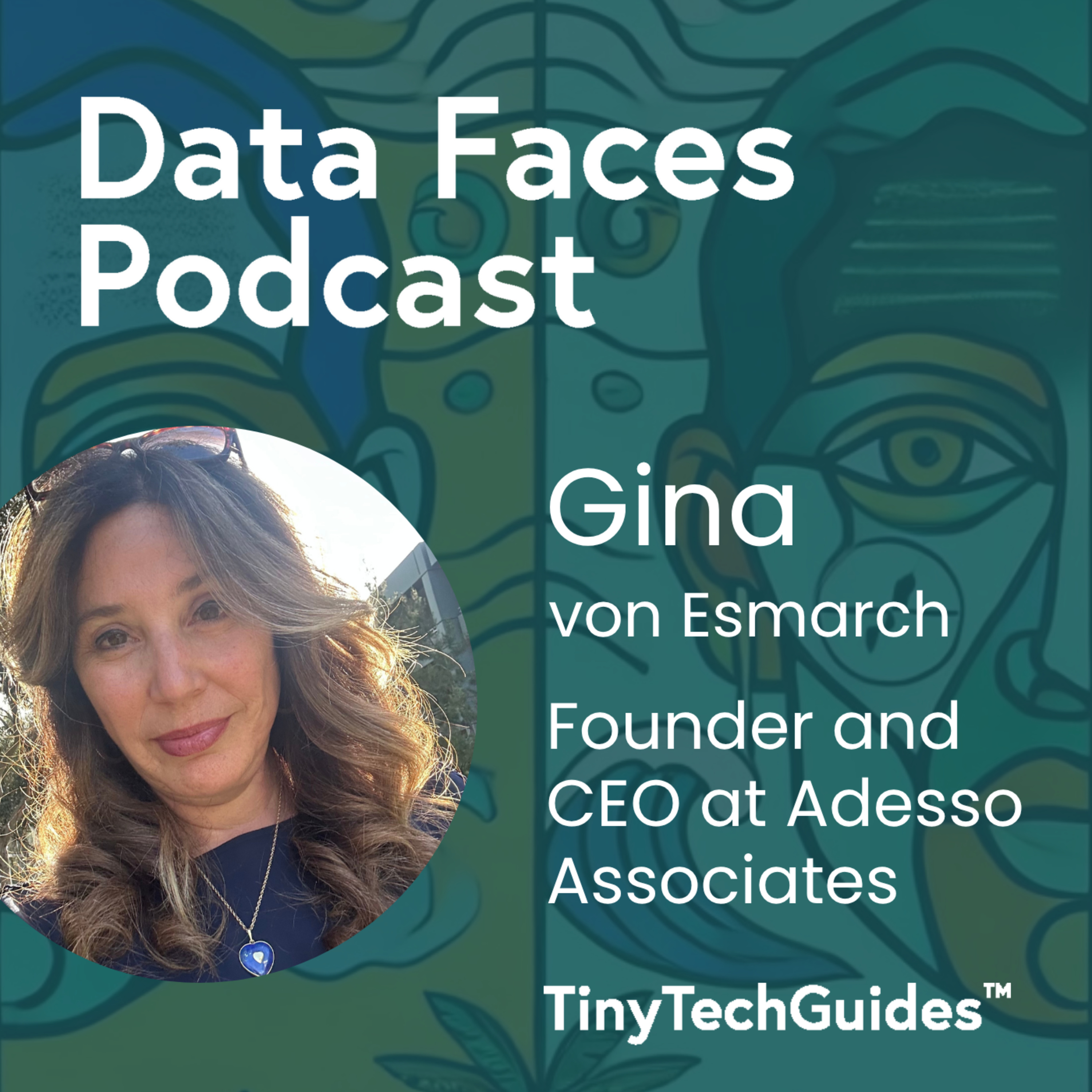
Culture Meets Code | Gina von Esmarch
Nov 1800:37:37Tap to summarize📢 What happens when culture and technology collide—do they compete, or do they enhance one another?In this episode of Data Faces, Gina von Esmarch, Founder and CEO of Adesso Associates, shares how cultural heritage, storytelling, and emerging technologies work together to shape stronger communities and brands.🔍 Key Takeaways:1- How AI and cultural identity can evolve together, not apart.2- Why authenticity and values are the foundation of innovation.3- How diversity of thought drives long-term business success.📩 Watch the full episode here: https://www.youtube.com/watch?v=F8-j7nqzsGk👉 More insights: https://prompts.tinytechguides.com/s/the-data-faces-podcast💬 How do you see culture influencing technology in your industry?👍 Like, share & subscribe for more insights.#DataFaces #AI #CultureAndTech #Leadership #Innovation
Transcribe →