← Dear Alice | Interior Design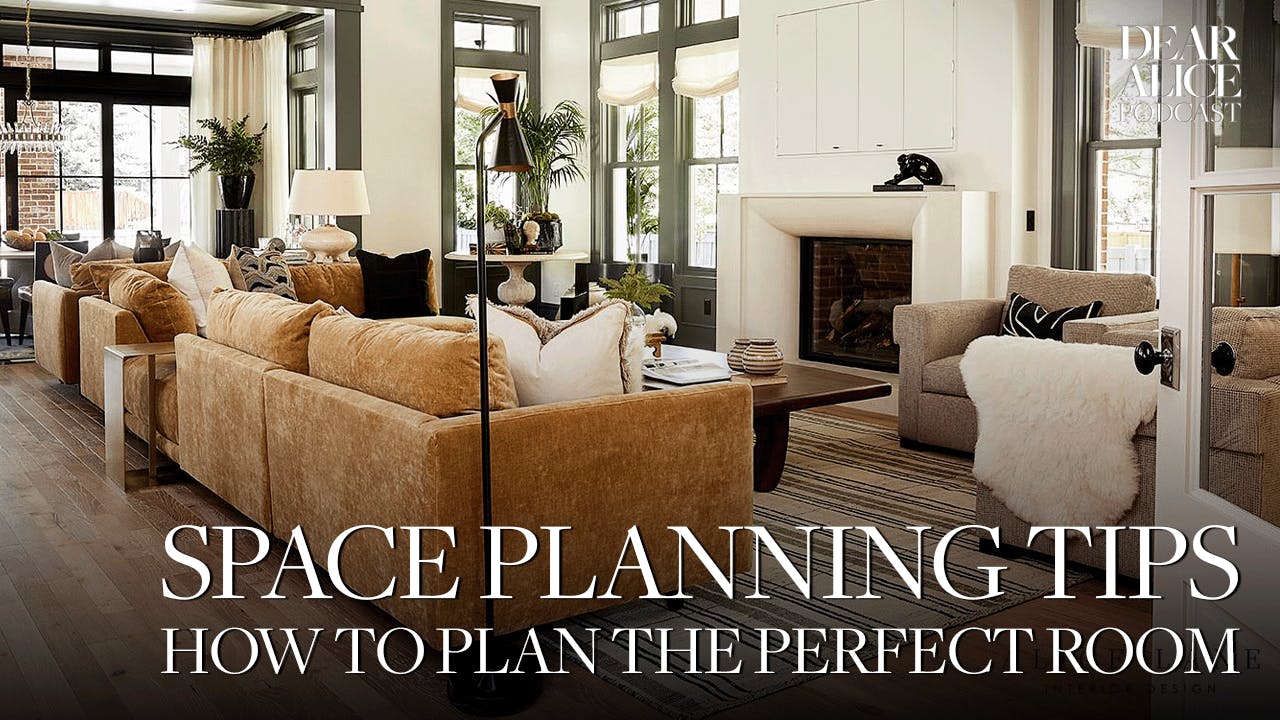
Dear Alice | Interior Design
How To Plan The Perfect Room: Interior Design Space Planning Tips
01:01:38
Loading summary
Transcript351 lines
- [00:00]
Alice
Foreign. Welcome to Dear Alice. A lifestyle approach to interior design.
- [00:23]
Suzanne
Hello everyone. Welcome to Dear Alice. Today we're going to be doing an episode on space planning. That is a fancy word for furniture arrangement.
- [00:33]
Jess
Yeah.
- [00:33]
Suzanne
It's what we call it in the biz. So make sure and call it space planning. When you're talking to your husband or your friends.
- [00:39]
Alice
Your fancy friends.
- [00:40]
Suzanne
Your fancy friends. Yes. Call it space planning. They'll think you're so wise. This is something that we do at the beginning of a project. As soon as we get the plans from the architect, we start throwing furniture blocks in, in that space so we can get a sense for how this space is going to function and flow. And also if the room is the right size for what the client really needs. And it's, it's a real art form. I feel like. Don't you?
- [01:06]
Alice
Oh, 100. Yeah. When we go to. Even when we go to market, like for the last. How many? Like the last decade.
- [01:12]
Suzanne
Yeah.
- [01:12]
Alice
Like you can definitely like see the boys from the Men.
- [01:16]
Suzanne
Yes.
- [01:16]
Alice
You know the, there are, there are very few showrooms that we walk into and we're like, stop, stop, pause. Um, do you see what he did right there?
- [01:26]
Suzanne
Yeah.
- [01:27]
Alice
You see that? Like, okay, we're seeing the same thing. And then like, anyway, you just like, you have to like. It's like a great museum. You go around it 10 times. Cuz there's just like different like angles and tweaks and things that make it so much more interesting and usable as like a human being. Our scale that it really, it really does I think just separate us and it's something that we, we pride ourselves on and that we're always just like in, in our own homes, we're like judging and like scooting and moving and angling and. And just because furniture is like sculpture, a lot of them, if you're getting interesting pieces and however you move those things, like you see it differently, you use it differently, people feel it differently. So anyway, space planning, it's an art and we are so we're invested, we love it.
- [02:10]
Suzanne
We are different focal points, a little sense of discovery, play and scale. We really want to teach you as much as we can teach you today in this podcast about the art of space planning. So that's what we prepared for you. And if you can watch, we've got some great visuals. You can see us on Spotify and on YouTube. If not, just listen in. And you're going to definitely want to rearrange your furniture after this podcast.
- [02:36]
Alice
I already have an itch I'm like, want to go home?
- [02:39]
Suzanne
Yeah.
- [02:39]
Alice
Yeah.
- [02:40]
Jess
Before we get into that, though, I just wanted to check in, see how you guys are doing. I. You guys know me. I love a project. I always have something going on. But, yeah, just wanted to see. Yeah. How things are going.
- [02:51]
Alice
Like, oh, man, hair on fire. We didn't even go to Spring market because we have so many installs this, like, spring, summer, and really it's been like, May, June, July, August. Like, we are just, like, fully booked. And it's really fun when you have install season because you've been working on these homes for years. Like the one that we were at beginning of June. We've been working since 2020.
- [03:13]
Jess
Jeez.
- [03:13]
Alice
So five and a half years, guys. Like, it is crazy, like, where we were to where we've come, how we've evolved it, and even, like, speaking of space planning, how we initially thought we'd arrange things, but then when you get into a place, you want to highlight things a little bit differently, and so you're switching things around a bit.
- [03:29]
Jess
So how much does stuff change, like, in five years, are you, like, ah, like, this was a good idea, but, like, we're. We're changing it up now. I mean, like, even deeper than space planning. Is there. Is there a lot of that? Or you're like, pretty true to script?
- [03:41]
Alice
Pretty true to script because, like, as far as, like, the base layer, I feel really good about, like, how much we understood the client, like, for Odessa, like, she likes quirky things. Like, she's such a fun client. And as we've even gotten to know her more and more over the last five years, I will say that the decisions that we continue to make and the layers we continue to make have become even more bold and more quirky and more haunted and more funky. And. And that's the real fun thing about a house is, like, we've already felt the evolution of where we started to where we installed it, and. And that's. It's really, really fun. I think it's a really great base layer for it to continue to build on.
- [04:21]
Jess
Yeah. Well, then, I mean, then you probably, like, know, you're like, hey, what we did was like, right, like this. We're. We're on the right path. Yeah, yeah, yeah.
- [04:28]
Alice
There was. There was a couple of things where, like, we're like, oh, this light's awesome. And then over the last five years, like, it got saturated or something, and we're like, we both felt this need to, like, we should find something more, like, funky, unique for this. Like, really key spot.
- [04:41]
Jess
That's right.
- [04:42]
Alice
So even like if something feels new, if it feels uniquely to you, you love it doesn't matter how many people have it, it's yours. But if you're just like, if you do have any hesitancies, you can afford it, like get a new light. You know, if you're just like, I want something different. I've seen it too many times now. So anyway, so I, I, it's fun because this is what we do. We watch the market and we see like things if they get over saturated and we have that, that knowledge is privy and we can. How many with our clients.
- [05:11]
Jess
Like I've just been heard, I've heard from a couple of people in the company that it's like install season. So how many installs are you guys doing in like the next couple months?
- [05:19]
Alice
So there's five. Yeah. June, we had site visits in Boston in May and then we have another site visit up in Beaver Canyon. We have an install happening in Fort Lauderdale in first week of August and then we have another big one. Actually, I think they're trying to move it up to July here in Orem. A massive, a massive one. So two in Utah, three out of Utah.
- [05:42]
Jess
You're. You're moving five families in the next couple of months.
- [05:45]
Alice
That's crazy.
- [05:46]
Jess
That is really, is crazy. I mean, all over the nation.
- [05:48]
Alice
Kids, I'll see you in August. It's nice. It's really.
- [05:52]
Jess
Have a good summer.
- [05:53]
Suzanne
Summer.
- [05:53]
Alice
Yeah, I know. Lagoon. Lagoon passes in the top drawer.
- [06:00]
Jess
We got a question. This, this episode came from a question from a listener. Her name is Jamie Rose and she just wanted us to do a deep dive on space planning. And like you guys were talking about like it's, there's an art to it and this is something like I want to learn more about and get better at. And so I mean, I'm going to have a ton of questions for you guys. It really is like, like you said, Suze, it like kind of, it separates the good from the great, you know? And yeah, yeah, it definitely takes thought and, and editing, I would say. Right. And just like, yeah, always just, just trying to find the part, like doesn't feel right and just switch things out until it, it does, you know?
- [06:44]
Alice
Yeah.
- [06:44]
Jess
So okay. Yeah, let's get into it.
- [06:47]
Suzanne
Let's do. Before we start though, I just want to give a shout out to a few of my favorite space planners.
- [06:52]
Alice
Oh yes.
- [06:53]
Suzanne
Just the masters of it. I think this is fun homework for just to. If you're not following these people On Instagram, you're gonna, after we do this episode, you're gonna look at either Pinterest or magazines or maybe your Instagram saved file. You're gonna look at rooms differently because you're gonna be really staring at the furniture arrangement that makes these rooms feel like professionally designed, really thoughtful, taking chances and some of the greats, in my opinion. I, I've always loved Thomas o' Brien. Yes. He's one of those. When sue talked about going to market and just like getting to the threshold of his, of his room, he himself comes in and, and like styles and arranges the furniture for. And it's a master class. You just sort of stand at the entry and you're like, okay, wait, nobody walk. Just everybody just sit here and look at it and just take in the scene. And then we can walk in and discover it and sit in things. But just see a pure arrangement of furniture is so artful and so interesting. So I think Thomas o' Brien, I also think Ray Booth.
- [07:57]
Alice
Yes.
- [07:58]
Suzanne
Does a fantastic job at space planning. And it's just artistic and interesting and functional.
- [08:05]
Alice
And I think one thing, like the last showroom from Thomas o' Brien that I walked through like a couple markets ago, I noticed that, like, there are rules that we're going to talk about. Distances that are like the average, you know, 18 inches from sofa to cocktail table and these things. And when you get really good, that's when you can break the rules. And like, so note that, like, when you look at some, as you're staring at spaces, you're going to see things that do feel like a little off, but it's, that's art at that point. Like, you figured out your rule and then you're going to it at a 90 degree angle, like, because, like, that's what you should do because that's the art of it. So, yeah. Thomas o' Brien, Ray Booth. I will say as I was like doing my research paper for this podcast, I didn't put an image of it, but I'm like, I remember like when I went into the proper hotel for Kelly Werstler. And as I study her stuff, what she does too is like when you're like looking to purchase furniture or like picking up something really, really special. She's great at the sculpture of furniture interacting and conversing with other pieces of furniture because that's part of it. It's a conversation of pieces. Something's on legs, something sitting low to the ground. Something's abnormally low to the ground over here. And how are those Speaking to each other. So that's like calculus of space planning when you get into that. But it gets really, really fun as you stare at your pieces and as you're collecting pieces to be like, that's the attitude that I need to pull in here for just that one chair.
- [09:25]
Suzanne
Yeah.
- [09:25]
Alice
Over in the corner or the pedestal with art that needs to be overarching like this whole space or the tree that I need to introduce. So anyway, I think Kelly Wisher does a really, really cool job.
- [09:36]
Suzanne
And I also think viewing the space from a certain vantage point, you all, you're all going to see something first impression, probably from a similar vantage point. And, and you're also solving for the first impression when you're considering the space plan of the room and even like the best looking part of the chair, if you know, like, I love this chair, but the three quarter shot of it is where you really get it in its full glory. You know, you're putting that thing in the far distance on an angle so you can discover that thing with the mantle at the same time. And it's just as much sculpture as it is chair. Um, so just finding the, the optimal angles. I know we joke around about that from some of these crazy, crazy rich Asians, but really, truly, it is just like knowing, knowing the heroic, most beautiful angles of these pieces so that you can play them up for that, that vantage point or as you start to wander into the room and discover more things that you've got these things sort of at, at different interesting angles that make the room feel more artistic and more designer. Yeah.
- [10:39]
Alice
The room should look like it's talking before anyone sits in there.
- [10:42]
Suzanne
Yeah.
- [10:42]
Alice
Like they need.
- [10:43]
Suzanne
Like there's a conversation happening. Yeah, exactly. Yeah.
- [10:47]
Alice
Okay.
- [10:47]
Suzanne
All right, well, let's get into the rules, shall we?
- [10:49]
Alice
Oh, should we define it really quick?
- [10:51]
Suzanne
Yeah. Let's define space planning.
- [10:52]
Alice
Thank you. Google Space planning. Interior design. Space planning is the process of determining the layout and functionality of a space to optimize its use and enhance its aesthetic appeal. It involves considering the purpose of the space, functional requirements, and the placement of furniture and fixtures to create a harmonious and efficient environment.
- [11:13]
Suzanne
So step number one is clear out the whole space. Step number two is to really reimagine your spaces with your architectural heroes. So some of this can be. It depends on how you like to solve the problem. Some might really like to doodle it out first because if you are involved in the furniture moving, um, sometimes for me, spouses like to fight during processes like that. And then it's really hard to do. So going in with a plan is usually less aggravating for whoever is moving the furniture. All parties. Yeah. Yeah. So I think having an idea of what you want to try. Um, and I'd say, you know, if. If it's just moving a sofa to try a different point of view, that's not that hard to just, like, swing it the other direction if you are wrong. But definitely look at it that way because it's. I think it's really exciting to consider something new.
- [12:03]
Jess
Yes.
- [12:03]
Suzanne
Yeah. So reimagining with the architectural heroes in mind. And then the next thing we would say start with your big pieces. You know, much like the whole rocks in the jar thing, we put the big rocks in first and then put the granular rocks in next. You're going to go through big pieces. So those are going to be your sofas, your sofa tables, cocktail tables. Oh, your rug first. Yeah. You're going to get your big rug down. Yeah. So you're going to start with those big pieces and then.
- [12:30]
Alice
Yeah, I was just gonna say with the big pieces, you're also. And this is kind of like one of those bridge points of, like, big pieces versus heroes.
- [12:36]
Suzanne
Is the TV a hero for men?
- [12:39]
Alice
It is for men? It is. Yeah. So, like, considering, like, the. The overall function, because sometimes the. The TV is larger than the fireplace.
- [12:46]
Suzanne
Yeah.
- [12:47]
Alice
As far as width goes. So you're just like, I have two masters yelling at me. A TV going over the fireplace. Or is it on a console? Like, where is that? And where is my eye need to be direction based on the function and how you use the space?
- [12:58]
Suzanne
I mean, for me, I would like to discover seeing the big black rectangle. So my vantage point coming into a room would be to see all the beautiful furniture staring at me. And maybe the TV is kind of behind me on a wall. Yeah, I. I really want to just see that room as it is. But if you're really, like, walking in and you're staring at this big black rectangle and the furniture, you have the backs of all your furniture. It's like such a missed opportunity to make that room feel really designer. So you almost want to completely 180 the room so that it feels welcoming and soft in just like a living room, even though there happens to be a TV in there.
- [13:34]
Alice
We're going to put a picture of Jess's family room. Because I think that this is like, the perfect opportunity of just, like, understanding that space planning. When you walk into a room, you see everything. You don't even know that the TV Is hanging out in there.
- [13:44]
Suzanne
Yeah.
- [13:44]
Alice
Until you curl the corner.
- [13:45]
Suzanne
Yeah.
- [13:46]
Alice
In the space.
- [13:46]
Suzanne
Yeah. Anyway, so that's something to think about. I really am not interested in seeing anybody's TV if we don't have to.
- [13:52]
Jess
How would you guys define, like, the heroes in the room?
- [13:56]
Suzanne
Like, yeah, from the furniture heroes.
- [13:59]
Jess
Yeah, like, how are people gonna identify, like, their own, like, heroes? Like, I. I just want to get your guys's take on that. I mean, there's. I don't know, if you go, like, you don't go buy a chart and someone's like, this is. This is a hero. Like, you know what I mean? Like, you kind of have to identify that yourself. So what your guys's mind tells you.
- [14:19]
Alice
That I think majority of people, like, they're going to be focusing more on, like, what is a fixed to the room. You know, just like the fireplace, the windows. When you become like, you start to curate, like, really interesting pieces, like chairs. I have a lot of heroes. I love a hero, you know.
- [14:36]
Suzanne
So anyway, Suzanne's door says heroes only.
- [14:40]
Alice
Heroes only.
- [14:40]
Suzanne
Yeah, the boys are always wearing superhero costumes. It's all heroes at Susan's house.
- [14:46]
Alice
Anyway, but just in. In to answer your question, like, which ones demand the most attention as far as, like, furniture heroes? If we want to, like, you know, define it as that, too, like architectural heroes versus furniture heroes. Like, what is, like, pulling your attention? You know, be it the big player. If I were going into a bedroom, the bed's the hero. Like, that's. That's the main key player. You know, if I go into. We just moved the golden rocker. We did a whole podcast on it. We just like. We. Speaking of space, mine, we just like, threw everything in the blender, got the kids, like, actual beds, and. And I had this golden rocker hanging out, and I put it in my living room. It became a hero. Yeah, it became such a hero. I'd never, like, thought about it in that space, but I see it completely different. And I'm like, you're a hero next to the Prague sofa.
- [15:32]
Suzanne
Yeah.
- [15:32]
Alice
So I guess. Does that help? Like, as far as just like, which I usually. It's like pieces that are like a little bit more carved, patterned, you know, just demanding to the eyeball.
- [15:42]
Jess
What it got me to think of is, like, have you. I mean, you kind of just set it with your room, like, with painting your room. It's like, have you bought the thing? And you just love to, like, set it there and just, like, look at it and you don't even need to interact with it. You Just like love.
- [15:55]
Alice
Just want to look at you.
- [15:56]
Jess
Yeah. Like, I just want to sit back and like look at you like so. Yeah, maybe that's it. Yeah, that's it too. Just like, I just, I love looking at it, therefore everyone else will.
- [16:05]
Suzanne
Yeah.
- [16:06]
Alice
But that is really good to define. Like, what are the things I really, really want to celebrate, you know, like a hero, something to celebrate. Be it architectural or furniture, like loose pieces. And then see how we can like bring those into like full focus when people walk into space.
- [16:19]
Suzanne
Yeah, yeah, yeah.
- [16:20]
Alice
I love that.
- [16:21]
Jess
Suze, we were just barely talking about the cozy Earth sheets and how much you love them. Tell the people about it.
- [16:26]
Alice
Yes. Okay. The cozy earth sheet set I'm so passionate about because my husband, he sleeps hot. I usually sleep cold. But this is like the grand temperature regulator. I love these. I love them in the summer months especially because like we can both sleep really, really comfortably. You know when you hang like one leg out of the sheet and you're trying to like regulate like that doesn't happen. They're so good. I love them so much. They're temperature regulating. It's guaranteed to give you a comfortable night's sleep. They're made from viscose from bamboo and they naturally wick away the heat and the moisture from your body, helping you sleep several degrees cooler. So we're not all fighting over the thermostat anymore. We just got cozy earth sheets. It's amazing.
- [17:04]
Jess
It's the way to go. And they also have a hundred night sleep trial, so you can try them during the hottest nights of the year. If you're not in love, return them hassle free.
- [17:13]
Alice
That's proof positive that these things work.
- [17:15]
Jess
Yes, luxury shouldn't be out of reach. Go to cozyearth.com and use code Dear Alice for up to 40% off. Cozy Earth's best selling temperature regulating sheets, apparel and more. Trust me, you'll feel the difference the very First Night. That's cozyearth.com code Dear Alice. Sleep cooler, Lounge lighter. Stay cozy.
- [17:37]
Suzanne
So as far as your functional pieces, we're talking about furniture now. I, I have this little bone to pick. I do not like a sectional. Yeah, in True Hollywood story. I know in the art of space planning, I love it for certain reasons in certain places, more casual spaces. It's certainly like where you're gonna live all day long with your family. But if I can, if I can do separates instead of one big huge connective piece, then I have the opportunity to rearrange more the furniture. More ways a sectional you're really locked into one space plan. You know what I mean? Especially if it's like a sofa. Sofa, sectional.
- [18:17]
Alice
If you move houses.
- [18:18]
Suzanne
Yeah. And getting that to work. So I. I would way rather invest in separates. And then that way you have the opportunity of, you know, you can put two identical sofas, you know, into a corner and put a big round table in between. And I think you can still have that really conjoined look. But you could always take one of those sofas away, or you could always take those sofas and mirror them and in a new space plan where they're doing a face off instead of an L position. But you have more options when it comes to rearranging the furniture. So I just don't like being locked in because I really like to change things up.
- [18:50]
Jess
Yeah. I mean, yeah, you said that the other day. And I have a. I have a sectional, which, like you said, I like for multiple reasons. Exactly. But like, I was just like, I have a sectional. You know, like, I disagree, but I actually do. I think you get about it. I agree. And it's like, it's way less versatile. And so it got me thinking. I was like, you know what? When we take that and are done with our sectional, we're gonna move it to the cabin that we're building. I'm. I'm thinking I'm just gonna do a sofa with a chaise maybe. Because I do like having, you know, like, place to put.
- [19:24]
Suzanne
Yeah.
- [19:24]
Jess
But I just feel like that's. It gives me more room and opportunity to kind of. To rearrange things. Because right now there's no rearrange.
- [19:32]
Suzanne
Yeah.
- [19:33]
Jess
So. Yep. Yeah.
- [19:35]
Suzanne
And, you know, usually people will have more than one, like, gathering spot. And so the sectional room could be the more casual space because you know that your people are just gonna be laying all over it. But if somebody comes to the door and you're like, oh, yeah, step in for a minute and you want to have a small conversation, you probably do that in your really cool music room. Gallery, whatever. So that's maybe your room where you're going to do all your heroic space, planning to make that look really dope. And then you have this more casual space plan where you live.
- [20:01]
Jess
Yeah.
- [20:01]
Suzanne
You know, but I just wanted to say, since all of you guys love design, because you're listening into this podcast, if you're switching things up, go for separates, because you're going to be able to have more fun long term with those. Yeah.
- [20:13]
Alice
So true.
- [20:13]
Suzanne
So your functional pieces, I talked about separate sofas. Those are also going to be your tables. Right. And then your chairs. Yeah. And then you're going to have fun with some of those smaller pieces, like.
- [20:24]
Alice
Your lamps and things. Like. Yeah, but yeah, as the essence of space planning, we have a bunch of different pictures and things we want to go through and even just to kind of discuss some of these rules. Um, so if you're listening to this, we'll try and explain this as well as we can. Um, but definitely try and tune into this when you pull over. Get stopped. So, okay, so this first one on the screen, this is actually in Odessa where we just were. And this is their man cave. There's like a bar and everything. But I want you to, like, see this because the actual space wasn't huge as far as, like, where the furniture. There's some spaces we do that are massive, you know, big parlors and things. But this one was, like, really nice because you have a sofa, you have two club chairs, and you have an accent chair with, like, neighboring tables and things. And what I do love about the. Yes, you are coming into the sofa, but it was important to the client to, like, focus on that because it's a two story room to focus on the fireplace. Like, you have the bar, which is vertical, and that whole big window bank, and then you have this fireplace. And so really the sofa is sitting opposite the fireplace in this scenario was ideal for the client and how they wanted to use the space. Um, but the thing too that I think both Jess and I just like, love is a lot of times people will just like put both of the club chairs side by side. They'll have a sofa and they'll have two chairs, like side by side, stacked, just stack. And it starts to feel really stale.
- [21:51]
Jess
Facing the same exact direction.
- [21:53]
Alice
Yeah, but there's something so artful about when you start to angle and corner those chairs so that, like, it becomes a conversation. Instead of just like, I'll look this way, you look that way. Let's not, let's not get too close. But when you have to, like, point your furniture toward each other again, you're conversing your furniture before anyone's sitting in there. Because that's how humans will. Will converse and interact with it. So again, and not everything is pointed toward the tv, you always need to have some chairs pointed toward the sofa. So you have, like, human conversations. Conversations and not just a TV viewing room.
- [22:24]
Suzanne
Yes. And we wanted, we wanted to point this out first, this little trick of cornering your chairs, because this is a trick that you can try at Your own house. I actually had the two chairs stacked in front of a big window in my family room. And it wasn't until probably like two or three years ago that I took one of the chairs from the stack and just angled it just kind of away from a side table. And it softened up everything in the room and actually felt more human. Like. Like this guy is just more relaxed and he's. He's loosened up. Right. And he's. It's more easygoing. Yeah. And it's funny because I. I come home and the cleaning lady would stack it straight, you know, and she likes a karate chop the pillows. And so I always have to come home and, like, mess up the house a little bit and throw this chair off on an angle again. Loosen up the pillows. Even the pillow position on your furniture is going to make your room feel more easy, relaxed, effortless. And if you're doing, like, the really stiff karate chop pillows that have these really angled points, it doesn't have that look that you can go and approach it and lay down or sit down or get comfortable.
- [23:35]
Jess
Yeah. Or that anyone has.
- [23:36]
Suzanne
Yeah. Or that anybody ever has in their life. Yeah, yeah, yeah.
- [23:40]
Jess
That's what I was gonna say about that chair. It's kind of like just angling one like that. It almost seems like, let's say they were stacked next to each other. It seems like someone sat down and wanted to have a conversation, so they took and they turned that chair. And then, like, when. When they get up, it feels lived in.
- [23:56]
Suzanne
Yeah.
- [23:56]
Jess
And to me, that. That. That's this. That's like the magic. That's this, like, special sauce.
- [24:02]
Alice
The spirit of space.
- [24:03]
Jess
Yes, exactly.
- [24:06]
Suzanne
On your screen right now. This is a sketch sue did, so it's really fun if. If you've ever had Alice Lane design home for you, you've probably been in a conference room where we're presenting things, and Susan's just sketching while they're presenting. And pretty soon. Really amazing.
- [24:21]
Jess
This is an actual sketch, too. Like, this is not. This is not computer render. Yeah. Computer rendered at all. That blows me away, Suz. Like, you're insane.
- [24:30]
Suzanne
So talented.
- [24:31]
Jess
Like, even the tiger, like, artwork. Like, come on.
- [24:36]
Alice
That's good. Yeah, there is a white peak. I'm excited for you guys to see pictures of this room, like, in reality, because there's a white peacock in here, too.
- [24:42]
Jess
I'd buy that as is.
- [24:44]
Alice
How about that? But you can see, like, even, like, you see the back of this chair. You know, people are watching. You see the back of this chair in the Corner or like facing that sofa and it's so much more inviting. You, like, you want to get in. It feels like a party to your point of just like. It feels like humans have sat there and already just like started to shift things to like the comfort spot of their body and like eye contact. And I just love this. You can see a party happening. You have like the spot in the bar. And I think that that's part of Space Bunny too, is creating little intimate moments. Because it's just usually she always says a party isn't where like you have a big round, you know, bop at tournament. You have like lots of little breakouts. And like, people have like, don't want to like, make a big announcement and have everyone discuss school the profit style.
- [25:26]
Suzanne
Yeah.
- [25:27]
Alice
They want to have like a single conversation and like, you know, just talk to somebody. I die. And so like, you can see so many of these happening at the bar. There's like, we had like this little back area where there was this like void where you have my. You might have some like wide spaces and like some voyager, like, what do I do there? A chair, you know, a table with a couple chairs. Or if it's big enough, you have a little breakfast table. You're just gonna have grapefruit or a game table or something. Those like spots can occupy something like this. You can see there's two little chairs with a little table to have a drink at. And then you have like the two corner. You have that one. You have a bench over on the edge that I could swing that little accent chair over by the corner of the fireplace and like talk over there. So there's so many opportunities to pull things around to make a really great party.
- [26:13]
Suzanne
Yes. This room will always be interesting. Yeah. Even at that on the screen. Now, this is from Instagram. This is Ray Booth's account. And I love the space planning in this scene. It's so good.
- [26:26]
Alice
Look at the size of that table.
- [26:29]
Suzanne
So great. So this is a rather large living room for those of you listening. And you have identical, like love seats doing a face off on opposite ends of this room with a lot of void in the middle. So he's broken this up with all different occasional pieces. If the word occasional is new to you. These are the smaller pieces, the little antique chairs, little, little tiny spot tables, side tables. Your occasional pieces are what are going to be. Bring those designer touches. They bring a lot of interest. They're usually smaller silhouettes and they play really nicely against the large ones. So you can just. You can just Feel the mix of things. The irregularity in these chairs thrown off on angles are what makes this room feel really designer to me. You have a few twinning pieces, which gives the room balance, which I do think balance feels good in space planning, especially when you're going to do something asymmetrical like this. You've got the balance of the sofas on the opposite ends that are twins, identical sofas, identical side tables. And then you start to get in the mix with the chairs. So you have four chairs, five chairs in the mix, two that match. All the rest do not match. And they bring a lot of just shape, silhouette, architecture, interest to the room. The palette is really serene. But these few things thrown off on an angle just give it that it factor to me. And I want to encourage you guys to just really try and throw things off on angles. It feels like real humans in a room, the way people would actually migrate into the scene and sit and have two conversations going.
- [28:06]
Alice
I will say I've done enough presentations like, with like, typically, like there's a male and a female and the male, the male portion of this presentation, they're always just like, that chair doesn't look comfortable. Like I'm looking at those two and then he's like, why am I buying two uncomfortable chairs that don't have arms? This is why. And I bet those are comfortable. It's not the five hour chair, but it is the perch chair that migrates from conversation to conversation. This is why you need those pieces.
- [28:35]
Jess
Jess, we've been getting a ton of questions on who makes your glasses.
- [28:39]
Suzanne
Oh, really?
- [28:40]
Jess
Yeah.
- [28:40]
Suzanne
Oh my gosh.
- [28:41]
Jess
Everyone wants to know you guys.
- [28:43]
Suzanne
I. So I'm at this age now where my near vision is leaving me. You're not quite as old as I am. Yeah, but sue, you're experiencing this 40.
- [28:51]
Alice
Hit and like, yeah, I need to make glasses before, but I really, really need them now.
- [28:56]
Suzanne
Yeah, between 40 and 45, that cell phone type gets really tiny. So I was in search for the perfect pair of readers and I tried look optic and I have to say I, I've loved them so much that I've actually begun working with them a little bit as an advisor. And my dad's an eye doctor, my brother in law is. I really, really love eyewear and it's been really fun to be back in the game. And I love the readers. I love the fashion frames. It's not a pair of frames that looks like I'm wearing something made for men. You know those readers, when you go to Walgreens, or, or when you go to the grocery store or somewhere and they're just like a three pack and they all look like they were made for men. Look Optic actually has really cute frames that are made for women.
- [29:39]
Alice
Especially for again, those ones that look like men's. They look like a giant man on my little head.
- [29:43]
Suzanne
Yes. Suzanne small. Suzanne has a child sized head and they actually have minis at Look Optic. The Diane Keaton collection. I gave you all my dying Diane Keaton.
- [29:53]
Alice
I love the Diane Keaton collection. They fit my like head great. They're comfortable. They have the cutest colors, like some from a matte. They have the bone ones. I love them so much.
- [30:01]
Suzanne
Yeah, they're cute. And one of, one of my little like fast passes I want to tell everybody is that if you do the progressive lens, it's clear up top, you just get magnification in the bottom where you need it. Because that's how you're looking in a cell phone or you're reading paper down here or on your laptop. You don't need magnification out the top because that's going to make your eyeballs look huge.
- [30:22]
Jess
Yeah.
- [30:22]
Suzanne
And then you really look like you're wearing a reader. So we're trying to like keep this low profile. And so I always go with the progressive. My favorite styles, I really love the Laurel and they have this cool one that's like the Muse. It kind of looks like a 70s update. It's cool. They have one with the pink lens too. In fact, my daughter steal that one from me. It's great. Anyway, you guys can discover your own styles. But I will say Look Optic has been such a gateway for me as I've needed to jump into that reader category.
- [30:52]
Alice
Right now you can receive some free glasses from Look Optic. All you have to do is text ALICE to 21252. That is text ALICE A L I C E to the number 21252. The first 20 new customers will get a free pair of readers. And if you're an existing customer, we also have an amazing discount for you. If you go to lookoptic.com you can use the code ALICE15 for 15 off. This is a perfect illustration. I cannot imagine that room, sir, without those.
- [31:21]
Suzanne
Those chairs are not for you.
- [31:22]
Alice
No.
- [31:22]
Suzanne
You're gonna sit in that big one with the tall back where you'll be most comfortable.
- [31:26]
Alice
You're the captain. That's your chair right there.
- [31:28]
Suzanne
These are for the cool cats with the interesting out. They're gonna sit in these chairs.
- [31:32]
Alice
Yeah. And you just wanna Stare at them.
- [31:33]
Suzanne
Yeah.
- [31:34]
Alice
They're just fun to look at.
- [31:35]
Suzanne
They're the scene makers.
- [31:36]
Alice
Yes, they're the scene makers. But that's why you need some of these smaller players that aren't your five hour chair that are just like the conversation pieces.
- [31:42]
Suzanne
Uhhuh.
- [31:43]
Alice
Just want to say that out loud.
- [31:44]
Suzanne
That's good.
- [31:44]
Alice
Can you imagine if those cocktail tables matched the fact that you have that sculptural like root situation.
- [31:50]
Suzanne
Yeah.
- [31:50]
Alice
Happening on one anyway that non directional like point of interest, like speaks back to like the organic nature of the trees and oh, it's just so good. Bravo, Ray.
- [31:59]
Jess
Yeah. I think this is honestly the confidence in this is insane to me. Like that. Yeah. So, so rad. Those two chairs in the middle, like I would never think of that, but it looks so cool. But what catches my eye the most is that easel like kind of on a bias right there because everything's, you know, like that whole settings like in a rectangle. But just kind of turning that a little bit is just.
- [32:22]
Suzanne
Yep. It's throwing things on the slightest bit of an angle that brings us human element to all these pieces.
- [32:29]
Jess
Yep.
- [32:30]
Alice
Those chairs, I'm like, even if we were space planning this on the floor, on our showroom floor, I can imagine us trying to making it a little bit perfect. But the fact that one of them is just like completely off.
- [32:39]
Suzanne
Yeah.
- [32:39]
Alice
Is the magic.
- [32:40]
Jess
Yeah.
- [32:40]
Alice
So good.
- [32:41]
Jess
Yeah.
- [32:42]
Suzanne
So a real key in all of this is throw. Throw something off. Yeah. You've got to give it an element of unexpectedness.
- [32:49]
Alice
Give it the wrong shoe.
- [32:50]
Jess
Does have to have a purpose though. I don't think you can just like haphazardly do it. It to feel like there was an intent to it. Like. Like I was.
- [32:58]
Alice
I was Kelly Werler. Absolutely.
- [33:00]
Jess
Yes. Yeah. But just like that someone like someone sat in it and turned the chair to face someone or. Yeah.
- [33:08]
Alice
I love.
- [33:08]
Jess
So. Yeah.
- [33:09]
Suzanne
Yeah. So good. Okay, we've got another space plan for you here. This is a.
- [33:15]
Alice
This is our Boston brownstone. This is like the living room. And this is an area where they have like a family room with a TV and everything. This is more of a living room. You could situate it to be a family room still with a TV and whatnot. But it was really important to. Again, this is where like they will have parties and like this is where they're conversing. So it makes for really, really fun space planning. So on the screen we're looking at a floor plan and you have two separates, two individual sofas, and they're actually These are going to be upholstered in the same upholstery to, like, connect them, but their profiles are different, which I think will be really, really cool.
- [33:49]
Jess
That is really cool.
- [33:50]
Alice
And again, make it feel a little bit more intentional and less yard sale. So two different profiles, same upholstery, but then you just have that one chair over in the corner that's on an angle. Like, we could have put two there, but, like, we already have two sofas. We have two chairs back here. So you kind of want a single player just kind of, like, showing off in the corner.
- [34:09]
Suzanne
Totally.
- [34:10]
Alice
That's that chair at an angle.
- [34:11]
Suzanne
Also circulation, because you can see there's adjacent a dining room, a bar. You know, people are going to be flowing here, through here to get a soft seat. So I think being able to circulate through and around that and giving space for that feels so much better than having that just be stuffed with furniture. Yeah, yeah.
- [34:28]
Alice
And I'll have an interesting back, too. So when you are shopping and finding, like, what are those heroes? The furniture pieces? Find things that are, like, cool from A. Like 360, right?
- [34:38]
Jess
Yeah.
- [34:39]
Alice
From all angles. They look really, really hot. So this is going to be one of those chairs that's just going to be a conversation starter. It's going to draw you into the session space, and especially with the rhythm of all those dining chairs of seeing that, like. And then you see, like, this one center of focus as it pulls you into the space. That's good space planning.
- [34:56]
Suzanne
That is.
- [34:56]
Alice
I want to say something about the two cocktail. This is a big space, too. So we could have done one large cocktail table, but sometimes, like, doing the two is really, really interesting. Do you remember, I think it was Thomas o' Brien we were in. Or not. Or Tom Felicia, we're in his. He designed a cocktail table that was like a split in two. And he's like, this is where you sneak out of the party. You know, like, this is. You're in the middle of the sofa in a really stale conversation, and you just need to get. He's like, that's the party. Like, you just, like, whip right out of there so you can arrange it so that whoever's in the middle of that sofa has a way to get out. He's like, that's really cool anyway. And it just makes it more interesting. Like, it's just. It's a collection of friends, and I just love the double. Like. Yeah, it's really.
- [35:39]
Suzanne
It's like alliteration. It's a repetition. It feels good.
- [35:42]
Alice
Yeah.
- [35:43]
Jess
What's the best way to do, to, like, take a risk like that, but also, like, make it feel like you know what you're doing. You know what I mean?
- [35:53]
Suzanne
Like, I mean, I'll show.
- [35:54]
Jess
That's the hardest part.
- [35:56]
Suzanne
I'll show you on screen. So we did this here in our coastal contemporary. You can see to the right of the screen, we've got two kind of peanut shaped cocktail tables kind of nest. Huh? Yeah. And they're covered in a goatskin that's called vellum. And they just. Yeah, they. They nest in really pretty. They're offset. But I think that rhythm gives it a lot of interest. It's very unexpected and it feels designer because you played that, you played that card, you know, and that's. I mean, that's really the point of this podcast today is that people want a deep dive on space planning. And they're like, what are the designers doing? What are the tricks we play? This is one of them, you know, So I think the repetition is really cool and unexpected. Besides the point that you can, you know, wiggle out of a party, too.
- [36:41]
Alice
Yeah, And I love too, like this is showing it in like a more. It's. It's still very, very sculptural, but it is, like relatively neutral. So even if you do, like, lean more neutral, you can, like, have the sculptural piece that makes it artful. Because for that Boston one, the previous floor plan, like we were showing them, they love loud art and they love, like that. So, like that center portion of those two cocktail tables, like, the options that we were showing them were like bright yellow lacquer, you know, things just to just like, get the party started again. They love a hero. So this is a real expressive moment where it can be more tame or. Or it can be more loud because it's kind of the center of the party. So that's great.
- [37:17]
Jess
Yeah.
- [37:18]
Suzanne
Okay, this is. This is probably your typical space plan. We've got separates, so the same sofa twice, they're cornered. We've got a really large side table right at the conjoining point where those two sofas come together. Large scale cocktail table. We're throwing things off a little bit here by doing the cornered chairs. So don't forget that trick you guys learned. You don't have to do an exact 90 degree. You can go 90 degree on one and then throw in the other one on an angle just to sort of soften it, give it asymmetry. And you can see the little round ottoman just ever so placed in front of the the mantle, not symmetrically, just thrown off a little bit. This gives it that human touch.
- [37:57]
Alice
Yeah. But functionally, it's also something that can be pulled easily to put your feet up on because the chairs are far enough away from the cocktail table, but they won't want to put their feet up. So give people opportunity to, like, relax and, like, face the room instead of face the tv.
- [38:09]
Jess
Or if there's, like, not another, you know, like, you have a party happening, pull that up and be a part of that conversation, you know, one of the.
- [38:19]
Alice
Exactly.
- [38:20]
Jess
A sofa adjacent to it.
- [38:22]
Suzanne
So, yeah, one note here is really considering the vantage point when you come into the room. So you're going to come in through those. Those big casings, and you're seeing a desk behind the sofa instead of a. Instead of a console, and you've got a little chair right there. So you kind of get to graduate your height from the chair to the desk. You have some interest there. It can also multitask. Instead of just being a console, you could open up a laptop here, and you could be getting a little bit of work done while maybe the kids are watching something animated. But the kids can color back there.
- [38:55]
Alice
While you're watching what you totally.
- [38:56]
Suzanne
Or do a puzzle or. Anyway, it gives more use to the space and adds interest because you're not used to seeing something like that. So that's a really fun trick to play in space planning as well.
- [39:06]
Jess
And then you're just not walking into, like, you know, 96 inches long of. Of upholstery.
- [39:11]
Suzanne
Yeah.
- [39:12]
Jess
There's something behind the sofa that.
- [39:14]
Suzanne
Yes, always. If you're gonna walk into the back of a sofa, always graduate the height of something back there. A beautiful case. Good. Something with rhythm, something with a lot of legs, something with interest, because that is your vantage point, and it's a huge missed opportunity if you're just.
- [39:30]
Alice
Just.
- [39:31]
Suzanne
Just having the back of a sofa. I. I've said this too many times on this podcast, but I'll say it again. When sue and I will go into homes and they're ready to move forward with design, we'll usually see their rooms as they are, and they only have upholstery in the room. No side tables, no lamps, Just two sofas or a sectional and a cocktail table. And you're like, oh, missed opportunity. Right. All the jewelry pieces, all the interest, all the points of light, all the surfaces that could have some sort of styling and storytelling, all missed opportunity. They're just buying the essential, which is, I need something to sit on, and I need Something to put my feet on.
- [40:08]
Alice
This is what they feel like on Queer Eye when they like first see the. And they're just like, oh, we're gonna do something good with this one.
- [40:13]
Suzanne
Yeah.
- [40:13]
Alice
That's what I see when I see a thing. A sea of upholstery with no end tables.
- [40:16]
Suzanne
Yeah.
- [40:17]
Alice
I'm like, okay, it's a blank canvas. I'm gonna show you.
- [40:19]
Suzanne
And really that could be the starting point is like, it's not that complicated. You're just missing all the fun parts.
- [40:26]
Jess
Yeah, yeah.
- [40:26]
Suzanne
All of the parts that give it style, that bring scale, that bring interest, rhythm, different materials. So much upholstery. You're like, oh, you gotta get some metal in the mix. You need some wood in the mix, some. Some glass or mirror or, you know.
- [40:39]
Alice
Skin and leather in the game. Something, you know.
- [40:41]
Suzanne
Yeah. It's like a good outfit. And all they got is like the top and the pants. No belt, no socks, no shoes, no jewelry, no, you know.
- [40:49]
Jess
Yeah.
- [40:50]
Suzanne
No chain around their neck. It's. Yeah, it's just a missed opportunity.
- [40:54]
Jess
So if you're gonna put, let's say, I mean, probably the most common thing behind a sofa would be like a console, right?
- [41:00]
Suzanne
Yep.
- [41:00]
Jess
It's gonna graduate the height if you have, let's say most sofas are around 90 inches, maybe 100 and. Yeah, 105 maybe. What's the ratio? Like, you don't want like a 36 inch.
- [41:15]
Suzanne
Right.
- [41:15]
Jess
Console sitting behind that. So if sitting behind 100 inch sofa. So what, what would you guys say? Like, is. Is that ratio most.
- [41:24]
Alice
I would say like two thirds.
- [41:27]
Jess
Okay.
- [41:27]
Alice
Or you know. Yeah, I think so because I'm like, a lot of our favorite consoles are about like 84 inches, you know, and so you have like a little bit left over. I would say most desks are going to be like 60, but probably 72. So like 72 to 84 is usually what you're looking for on the width wise with like a normal sofa.
- [41:45]
Jess
I mean, obviously if it's not extending out past the sofa, is there too long?
- [41:49]
Alice
Yeah, yeah, for sure.
- [41:50]
Suzanne
Well, just that you don't want it to. To go beyond the size of your 90 inch. You don't want it to be higher. Oh, it makes me so sad when the console is higher than the sofa and you can.
- [42:01]
Jess
Especially when everyone's banging their head on.
- [42:03]
Suzanne
Yeah, yeah. It should always be below.
- [42:05]
Alice
Yeah.
- [42:06]
Suzanne
Below that. That back rail or that back height of the sofa.
- [42:10]
Alice
Yeah. And I think the graduation too, of feeling like, if you're walking into it, feeling like that full extension of the sofa and then pulling in. That's so the pediment rule, you know, like, with architecture and stuff. Like, it just kind of graduates your eye up, you know, to ascend.
- [42:23]
Suzanne
So, yeah, graduation balance, all of those things to play on your screen right now. This is another beautiful room by Ray Booth. This is off his Instagram. This is his own home, I believe, in Nashville. And you can see those cornered chairs on the left. On the right, you get a chaise which corners up really beautifully, achieving balance, but asymmetrical. The hero is the view. So he played that up and put the sofa opposite that beautiful view.
- [42:51]
Jess
Like, the main sitting is. Is focusing on the money maker.
- [42:56]
Suzanne
Yeah, yeah, yeah. So beautiful. And you can even see Scott, the windows opened. It's a beautiful, like, spring day. And you just want to sit in there and. And study.
- [43:05]
Alice
You know, one thing I like is that you can imagine, like, a lot of people in here, but I could imagine just myself. I would probably go to the shade.
- [43:12]
Suzanne
Yeah.
- [43:12]
Alice
You know, if I'm just by myself and I want to just, like, not feel lonely. That's like its own little private Idaho over there.
- [43:19]
Jess
Yeah, yeah, yeah.
- [43:21]
Suzanne
So pretty.
- [43:21]
Alice
Really beautiful.
- [43:22]
Suzanne
I just wanted you guys to be able to feel what. What this feels like in a room. It's really nice. He's got some nice height on top of the side tables that bring your eye up. And then he's got a really beautiful console moment, too, with some sort of candle holder that's elevated above it with tape with pillars on it.
- [43:40]
Jess
Since then noted, the. The. Yeah, that is super cool. The side table in front of the sofa. Like.
- [43:47]
Suzanne
Yeah.
- [43:48]
Jess
That, to me, is, like, hard to place because you're like, do I do that? Does it make sense? Like, yeah. So what. Yeah. What's your.
- [43:55]
Suzanne
You know, what's your thought on that? You know, our Oscar stool that we make? So this. That is my favorite piece to do this with.
- [44:01]
Jess
Okay.
- [44:01]
Suzanne
And it's just. I. I said it offset from my cocktail table. I think he looks like he has a cocktail ottoman here, maybe with a big tray on it. And then this is just. Just there. And it's. I feel like everybody needs a place to put down a drink or their cell phone so they can just really feel at home if you serve them a drink and there's nowhere to put it down. They just have to sit and hold it the whole time. Right. Or try and, like, squeeze it between their knees or something to get some relief. If you like to talk with your hands. So I think that little Oscar Stool is just so fun to set off from the cocktail table. And then you migrate it around as you're serving people drinks or getting them a snack. It's so easy. You can lift it with one hand. So this, this sort of piece, it feels kind of carved and small like that, but you know, it's going to migrate to, you know, help accommodate guests with whatever snacks and drinks you're going to serve them. In this room.
- [44:47]
Alice
We call that like a pull up table.
- [44:49]
Suzanne
Yeah, spot table and pull up table. I have to say I just came from an inventory meeting from, from the showroom. Those of you that don't know, we have a store in Utah and then we also have the interior design firm. So I'll often walk the store side of things and sit in inventory meetings and see what we need. And they're like, like spot table sell all day, every day. And these are these little tiny drink tables like we're talking about to be able to accommodate that big chair or next to a little day bed. They're like punctuation in a sentence. They just add a little something. That petite scale, you get so much credit for it because there's big sofas, there's a big shades in this room, big chairs. And so something about seeing that little tiny spot table just gives it style. It's, you know, a pocket square moment. It's, you know, a cufflink. It's, it's a detail. And these you have to get in your space. Planning to make your room feel interesting and designer and accommodating too.
- [45:46]
Jess
If, yeah, if you were going to do a spot table in front of that, is it the same distance from this sofa as your cocktail table, which is. You want a little closer, right?
- [45:54]
Suzanne
Yeah.
- [45:54]
Jess
Okay.
- [45:54]
Suzanne
I think so. Almost touching. Like I have a little spot table next to our Gwen day bed and it's probably like 2 inches off and I have like a little coaster on there and you can just set your.
- [46:04]
Jess
Drink down and then that's where it feels like it's not floating out distance.
- [46:07]
Suzanne
Because if you're sitting back on something, then you're as far as your arm can reach, right? Yeah, yeah. You just want.
- [46:13]
Alice
It's not for my feet, it's for my hand.
- [46:15]
Suzanne
Yeah.
- [46:15]
Alice
You know, you're gonna put your feet up on the cocktail too, but I'm gonna put my hand over on that spot table. Ooh. And when it's like covering like kind.
- [46:22]
Jess
Of above the cushion, I have like.
- [46:24]
Alice
A little ollie table that like sits above my cocktail table and I can. That's My spot table that I can just like pull it over and throw my laptop on it or just like have something. But that like that composition overlap is just like chills.
- [46:36]
Jess
Yeah.
- [46:36]
Alice
So good guys.
- [46:37]
Suzanne
So good. One principle we love here at Alice Lane in Space planning is the pull up table.
- [46:41]
Alice
Yes. That's.
- [46:42]
Suzanne
This is using a smaller dining table, usually like a 36 or 48 inch round as kind of in a cocktail table position that overlaps in this case a bedroom chaise. In my house I have like a curved sofa in my bedroom and I use our Luca side table as a pull up. And that just allows you to really use this table where if it were cocktail height, it's below the eye level. You can't really open up your laptop unless you drop down and sit on the floor Indian style. So this lets things be elevated. It allows you to sort of throw a little bit of decor on it and layer things in and make it interesting. It's a real designer trick. So we've got, we've got a photo on the screen right now. This is from one of our projects in the mountains here actually in Utah. And we've got a pull up table with a chaise in a bedroom and an ottoman nested under it. And then also a really interesting fashionable chair. You get to sort of see three quarter angle. And this shot is just so Architectural.
- [47:42]
Alice
Digest the chair that he's not going to understand at first, but then. Yeah, this is why you do it.
- [47:48]
Suzanne
And this is why to do it. It's like a jewelry piece in the moment and it's just going to give back to the room in, in design. He can lay on the chaise. Yeah, right. Yeah.
- [47:58]
Alice
I just want to say like this is a space we did a long time ago and it's like it's.
- [48:03]
Suzanne
This is probably 2017. It's. But it's stunning.
- [48:05]
Jess
The graduating height too from the shades.
- [48:08]
Alice
Yeah, Positionally it's so good.
- [48:10]
Suzanne
So good. This is another example from Ray Booth on the screen. This is killing it, the pull up table. And I think for him, I mean this could be a dining table, but this also could be a center hall too table. And he's got.
- [48:23]
Alice
What's the difference? Jess, tell them like center hall height versus like dining height.
- [48:27]
Suzanne
Yeah. So center hall is a couple inches taller. So dining is 30. Right. And then I'd say center hall. What did we just barely do our two new ones. 32, I was going to say. Yeah, 32, 33. Yeah. Because it's in an entry and entries might be a little Taller.
- [48:43]
Alice
You're standing up, you're not sitting down.
- [48:45]
Suzanne
Yes. So you can see this one has a pedestal base, but then it flares out onto this. This plane with three really great feet. So this reads like a center hall table to me, used as a pull up table. We've got a settee that the center hall table is overlapping the seat on. And then he's pulled up two really interesting occasional chairs. And this could be you're gonna do a puzzle or you're. He's sitting and having morning coffee here in the window light. And I think this. We got cornered chairs. Right. You've got the throw that's kind of thrown off off a little bit and feels loose. And I just think this is such a moment. You've got low ceilings here, but the chairs are interesting. They're also transparent from behind, so you can see through and around, which makes small spaces feel bigger. Yeah, yeah, I'll say.
- [49:34]
Alice
We saw that in the one other room that raided also. But just that art easel.
- [49:39]
Suzanne
Yeah.
- [49:39]
Alice
Like when we've done this in our, like Capitol Heights project, when you don't have a lot of wall but you have a lot of art and you want to like, give the room something back. Our easels are awesome for that. Just like.
- [49:51]
Jess
Yeah, just even layered in front of a window seems really cool too. And then this is something I fall victim to all the time. But just where you want to like maximize the space in your room. So everything's just up against the wall. Yeah, like obviously there you can see that there's a console behind that city. And yes, it just. I. I feel like that creates more interest because then they're looking at it like right here. There is layer to that. You know, it's not just sofa or setti window.
- [50:18]
Suzanne
You know, another designer point for you guys when you're trying things out in your house is like Corey said, your instincts are going to tell you to push all of your furniture against the wall. But when you can float furniture in the middle of the room, this is what's going to separate the good from the great. Right. So the great move here is you get that center hall table and then things start. It gets to be a nucleus in the room and it can start to attract things like a magnet and have a purpose in the middle of the space so you don't have to push everything up against the walls, you know, and it gives, you know, this, this room, there's like, there's a passageway in the middle of it. There's a door right there. You can walk around this. You wouldn't be able to do as much as many things in this room if you weren't floating.
- [51:00]
Jess
Yeah.
- [51:00]
Suzanne
You know, so. So we want to encourage you to float, to throw things on angles, to try a different height of a cocktail table. And try this trick with the center hall. You might have an old breakfast table. You want to try it with. You might have a side table with a pedestal. You might have an old center hall table. This is a real. Or you need to buy a breakfast table and try this. Right. I just love this trick. Yeah. I feel like we can't do a house without doing the pull up table. Yeah. So good. Moving on. This is a little project on screen that we did in a basement actually.
- [51:37]
Alice
Heights Lounge, I believe it's called.
- [51:39]
Suzanne
Yes. Heights Lounge.
- [51:40]
Jess
It's a basement. It's walk out.
- [51:42]
Alice
Yeah.
- [51:42]
Suzanne
Okay.
- [51:42]
Jess
Yeah. Because I was like, that's a ton of light.
- [51:45]
Alice
It was a remodel.
- [51:46]
Suzanne
Yes. And they wanted this space just for entertaining. But a few key points in the space planning here. Sue, what do you. What do you think that we should teach people from this scene?
- [51:56]
Alice
I think just like, when you. If you are in the spot to buy new furniture, I think buying interesting pieces is really great. I actually really love this. This is one of those sectionals. You're seeing them a lot where they just have like the ottoman instead of like a full back tracing the whole thing. That allows, like, a little bit of, like, gap or absence of something to be able to, like, dip that art and to be able to see it. You can imagine if the bat continued there, you wouldn't be able to see that. And so again, I just think that that's interesting to either put your foot if you're by myself, I'm just going to sit over in that corner. My feet are going to go up. But it also allows, like, for people to sit on both sides.
- [52:32]
Jess
And it's way more interesting, like, then if the art. Think if the art was just like 8 inches higher up, that would just look compositionally.
- [52:39]
Suzanne
The overlap. Yeah, the dip. So cool. And the occasional piece, just getting to see it on that three quarter angle is really fashionable.
- [52:48]
Alice
And I think too, like, look at the different, like, heights on the seat from, like this one in the corner on the angle versus that one. Again, just the highs to the low. It looks like this piece could have been inherited, you know, from grandma's. But you brought it in. And the contrast intention is so good. With the modern pieces, I think the overlapping, like cocktail tables is rad. And Just the whole thing. Again, it's neutral, but it's really interesting form wise. And like, in that angle chair.
- [53:11]
Suzanne
Yeah.
- [53:12]
Alice
Eagle chair is everything.
- [53:13]
Suzanne
Totally.
- [53:14]
Alice
Okay.
- [53:16]
Suzanne
So last image we have for you. This is from our Capitol Heights project. This is a scene that is just getting a lot of attention right now, especially on Pinterest. This is a red lacquered library that we did, and we've got a red velvet or mohair sofa in this room. One of the key points we want to point out in space planning is a trick that I feel like we learned from Thomas o' Brien, and it's using this little perch chair just, like, at the end of a fireplace that's facing the same direction as a fireplace, and you put it right in front of it so that somebody could sit there and really warm their back. It's usually quite low, so you're. You're still able to see through and around that fireplace. But it's kind of a nice companion piece. It's a pocket square moment. And in this one, we did, like, a needlepoint fabric to make it feel historical. This chair definitely looks like something inherited and adds a lot of interest. But fashion because of that. Com on that. On that chair. Yeah, it's so good.
- [54:14]
Alice
The little. That little spot table. Hovering.
- [54:17]
Suzanne
Yes. Again, two good space planning principles right there.
- [54:20]
Alice
Your cocktail table, that is probably that 18 inches from the sofa edge. But then you have that little thing that your hands can interact with. You can pull it around. And also, I think it was make it out pen and tinkersley that said anything like, that's grand. You put something humble next to it.
- [54:34]
Suzanne
Yes.
- [54:34]
Alice
And again, that's that small little perch chair next to a fireplace. It's like, has a lot of grand attention on it, you know? So that is like, we love a perch chair.
- [54:43]
Suzanne
Yes.
- [54:44]
Alice
Again, you can't have too many chairs. Yeah.
- [54:46]
Jess
I'm convinced I'm probably getting into the weeds a little of it a little bit. But, like, how that chair is, like, straddling one leg of that mantle. Is that kind of where, like, you feel good positioning it? I mean, to me, it's the overlap. Yeah.
- [55:01]
Alice
It's kind of like the art and the layer sofa. It's just like you want those two, like, planes to, like, intersect and not just be, like, stacked side by side.
- [55:08]
Jess
Then they're working together, you see? Okay. Yeah.
- [55:12]
Suzanne
Also, there's something in my brain that loves this perch chair because it says it, like, kind of completes the conversation circle because usually everything just kind of makes a U around the fireplace and you stare at this fireplace, but nobody can talk back to you. You know what I mean? It's like you've lost a real key component. Yeah. You've lost a real key component to the conversation. So popping this in there, not only is it fashionable, interesting, your eye can see through and around it. It's something humble next to something grand. It's also completing the conversation circle. So this is a really good trick that you guys gotta try. If you have fireplaces, I love this so much.
- [55:50]
Alice
What about that one corner? My gosh.
- [55:52]
Suzanne
Yeah.
- [55:54]
Jess
Like, if you're gonna have just like an ottoman.
- [55:58]
Alice
Yeah.
- [55:59]
Jess
Like, would you group two ottomans.
- [56:02]
Suzanne
Yeah.
- [56:02]
Jess
In front of a fireplace? Yeah.
- [56:03]
Alice
That's a great.
- [56:04]
Suzanne
Yeah. Definitely more expected. So I would. I mean, I'd love to see those thrown off a little bit. You know, not perfect. Maybe you gang up two on one side instead of symmetrically placing them right in front. You know, just like kind of like those chairs that were off in rebooths, like, just so.
- [56:22]
Jess
Yeah.
- [56:22]
Suzanne
Do you know what I mean? You want that sort of element of surprise and design and interest. Every. Every designer has done the symmetrical ottomans between the mantle and the cocktail table. So that's what you're trying to. I mean, if you love that look, do that. You might be traditional, you might be southern. That might fit really right inside your brain. Maybe if you're more of a west coaster and you want to throw things off a little bit like the proper hotel, like Kelly Werstler did, then you're going to be looking for a little bit of tension and throw things off a bit, you know, at that interest.
- [56:52]
Alice
I will say the height differention, too, between, like, the cocktail table height. The cocktail table height and the ottoman height are probably going to be, like, similar. Yeah, it's just like staying a flat, like, like horizon lane. But then when you pop it up with the back of a chair, people aren't gonna. They're gonna want to go, like, interact with it and sit in it versus an ottoman. And it's also going to be more visually interesting.
- [57:11]
Jess
Yep.
- [57:12]
Alice
So that's what you do with purchase.
- [57:13]
Jess
Makes sense.
- [57:14]
Suzanne
Totally. Well, should we summarize some of this?
- [57:17]
Jess
Yeah, yeah, if.
- [57:18]
Alice
Thanks for sticking with us for that. I mean, a lot to go over.
- [57:21]
Jess
We really did a deep dive. But, yeah, like I said, this can be super complicated. So I guess just give me, like, the rules that. That I start with and follow.
- [57:33]
Alice
Yeah, okay.
- [57:34]
Suzanne
Totally. So first step, of course, we like to clear out the space. The next thing we want to do to reimagine it is to start with those architectural heroes, like really observe your space empty for once and consider what's there. You've got views, you've got the fireplace. What do you want to serve and the shape of the room. What's going to hold the pieces you know the best. And then we want you to start to. We're going to get the big pieces in the room, our rug, our sofa, our cocktail table, some. And then when we can start to bring in those smaller ones, this is when we're going to start to do those tricks. Right. We're going to throw a few things on angles. We're going to maybe try and corner chairs. We might try and do that elevated table trick. Right. The pull up table. That's really fun. Doing the. Whenever there's something grand, we're going to do something humble. Right. So we're going to throw scale off a little bit. We're still going to want to achieve some form of balance. Kind of like we saw in Rebooth's room with that corner chase and those, those corner chairs over there. But it doesn't have to be twins. Right. But you can still achieve balance, which is really fun and, and I think interesting. What else are we missing, Sue?
- [58:40]
Alice
I think that that was essentially it. You're just going to play at the end with like all the other little pieces to try and I think too with the balance, not only will you fill that with like those smaller pieces of furniture and like how you arrange things, you can fill a lot of balance between like art, easels, trees, you know, things that just like our last layer pieces to kind of pull height up or pull height down and focus more on this cocktail table. Do something daring over here to balance with this loud thing over here. So again, even in the space planning, those small pieces still count.
- [59:10]
Suzanne
Yep. And to you interior designers out there, we just also wanted to say that when you get the furniture in the room, don't be afraid to go off plan a little bit. Even though you've designed it to sit a certain way, you might be taking in a different vantage point. You might be like, oh, the client's going to discover this from this. And they should really always be able to see this three quarter angle of the chair. So let's actually take it from that corner, put it in this corner and sort of flop what we thought we were going to do. We always judge on site. Amber is exact and flatter for exactly how it feels in person.
- [59:43]
Alice
Yep.
- [59:44]
Jess
Or edit as you live with it. You're like, oh, actually it feels better this way or I actually. Yeah, I'm using. Yeah. Okay.
- [59:51]
Suzanne
Yeah.
- [59:52]
Alice
Okay.
- [59:52]
Suzanne
So good. Well, you guys, thank you so much for joining us today. I hope that this answers your questions on space planning. Jamie Rose, it's been really fun for us to dig in and I just want to say our new summer collection is launching on the 30th, so we're just four days away. If you guys want early access to that, we always give our insiders at least a two day head start so you guys get first pick before any of this stuff sells out. It's gonna be a good one.
- [60:19]
Alice
It's gonna sell out.
- [60:20]
Suzanne
We have just under 30 pieces that are launching. I'm so excited for you guys to get to see these. So you can sign up for that insider program@alisonehome.com just head to the Inspo tab and select Insider program to be the first to shop the newest collection. You're going to get the latest updates and you're always going to have early access to any of the sales. So you'll have till tomorrow, the 27th to get early access. Sign up for this for this launch that's coming up and if you want to leave us a comment or a review and invite your friends to watch that is going to continue to grow the show and it's going to keep the lights on here at Dear Alice. So we would love it. We love your reviews too. It's so fun. If you guys have any interior design questions, please please send those into dear alicellislanehome.com thanks so much for listening. We'll catch you next time. Hey, thanks for listening. If you like our show, please leave a five star rating.
- [61:28]
Jess
SA.