Loading summary
Transcript224 lines
- [00:01]
Prime Obsession Announcer
This episode is brought to you by Prime Obsession is in session. And this summer, Prime Originals have everything you want. Steamy romances, irresistible love stories and the book to screen favorites you've already read twice off campus. Elle every year. After the love Hypothesis, Sterling Point and more slow burns, second chances, chemistry you can feel through the screen. Your next obsession is waiting. Watch only on Prime
- [00:31]
Sue
Girl.
- [00:31]
Ross Store Promoter
Winter is so last season and now spring's got you looking at pictures of tank tops with hungry eyes. Your algorithm is feeding you cutoffs. You're thirsty for the sun on your shoulders that perfect hang on the patio Sundress those sandals you can wear all day and all night. And you've had enough of shopping from your couch. Done. Hoping it looks anything like the picture when you tear open that envelope. It's time for a little in person spring treat. It's time for a trip to Ross. Work your magic.
- [01:00]
Suzanne Hall
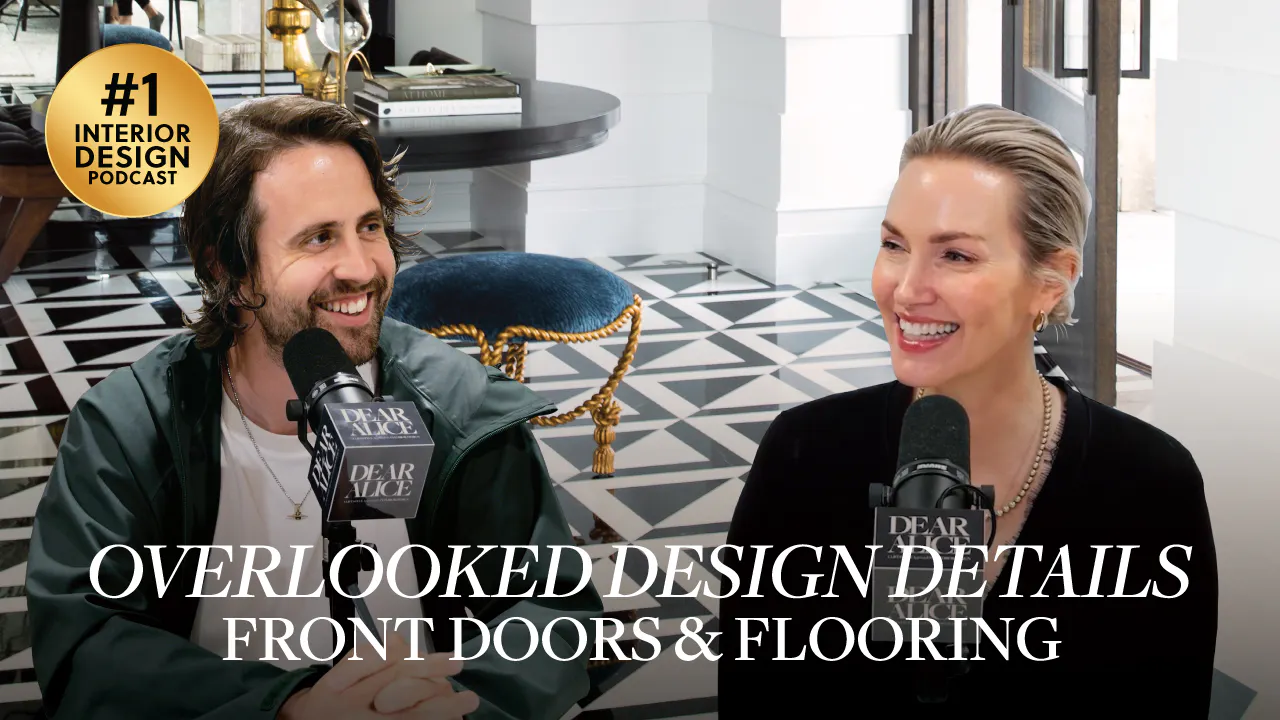
Hello everyone. Welcome to Dear Alice. Today we are starting a new series. This was a series that Suzanne hall was something that just gets her goat on. Every project that we're doing is these little overlooked design details and we're constantly adding them into the projects that we're doing. And we thought should we just tell everybody? Should we just give away the keys to the kingdom?
- [01:23]
Sue
Our closest friends.
- [01:24]
Suzanne Hall
Yes, that's you. So we're doing it. So this new series is called Overlook Design Details and today we're going to be starting outside.
- [01:32]
Sue
Yeah, just a couple little things that I've noticed on exteriors. Again we're interior designers, we're consulting on the exterior finishes, window grids, things like that. But there are sometimes we're brought in a little bit too late that then we can't correct some of these details that should have been thought about. So we're just going to give you high level exterior on a couple things that should be always considered, especially if you're embarking on a new build or you're remodeling. And then we'll get. Most of the series is just going to be on interior details and so we're just going to take off little bite sized portions and share it with our friends.
- [02:02]
Suzanne Hall
Yes. So we'll be hitting window grids, the front door and we're going to talk about your thresholds and, and flooring. We've got a question that came in that goes perfectly with questions about flooring directions and hardwood floors and how to lay them. So we're going to be addressing all of that in this episode. Guys, this is going to be such a fun series.
- [02:21]
Sue
I think so Too.
- [02:21]
Suzanne Hall
I'm so excited to be sharing all this information with you, especially if you're embarking on a new build or. Or a remodel. Just getting these little details in there just makes it feel like a well built home. Before we jump into today's episode, we want to remind you that we have our free design service available called Home Furnishing Design. Our designers are available to help you find new furniture, get that perfect rug, know what size to get, and so much more. And since the service is free, you can spend your entire budget on furnishing your room.
- [02:52]
Sue
We also have our very best sale going on right now, so if you hurry, you can get in with a designer and get up to 25% off the items you purchase for your room.
- [03:00]
Corey
All you have to do is go to our website, go to the design services tab, fill out the form, and a designer will reach out to you within 24 hours.
- [03:08]
Sue
Right. And we all want to know what not to do. That's probably like a top Google of what not to wear, what not to do in the house. So we're going to be sharing those things that'll naturally come up because we've seen them and. And we don't want you to do it. So. Yes. Anyway. So what not to do.
- [03:20]
Suzanne Hall
Exactly.
- [03:21]
Sue
Okay, Jessa, we're going to start on the exterior. We're going to talk about grids.
- [03:25]
Suzanne Hall
Wait, sue, before we get into grids, can I just talk about something that makes me a little bit crazy on just an exterior overall finish?
- [03:33]
Sue
Hit me.
- [03:34]
Suzanne Hall
It's when people use too many finishes on the exterior of the home, especially when there's a two story above ground home that you're starting to see. Usually some sort of masonry around the bottom, whether it be brick or rock.
- [03:50]
Sue
Yeah.
- [03:50]
Suzanne Hall
And then there's some sort of stucco component. And then there starts to be sighting details and they go ahead and take that sighting in different directions.
- [03:58]
Sue
Yep.
- [03:59]
Suzanne Hall
Sometimes it's horizontal, sometimes it's vertical, and it's usually both on the all on the face of the house.
- [04:05]
Sue
They went ahead and doubled it, and then they're going to throw some shakes on there too.
- [04:08]
Suzanne Hall
You guys, you've got to just be Chicago. We cannot do that. You can't use that many finishes and that many direction changes on the face of your house. It's too much.
- [04:20]
Sue
It's too much.
- [04:20]
Suzanne Hall
You want to create a monolith of one solid looking thing. I do love masonry around the bottom.
- [04:26]
Sue
It.
- [04:26]
Suzanne Hall
It feels heavy. So using stone on the base of the house and then if you're stucco. Then you're using stucco up top. Or if you're going to get into a shake detail, you've got to use just the same shape shake detail. We can't be doing all of the different directions and all the different shakes.
- [04:44]
Sue
I totally agree with you.
- [04:45]
Suzanne Hall
Yeah.
- [04:45]
Sue
100. Because honestly. And I know that this is like a builder spec idea that they do. They're just like, we're going to add perceived value to this exterior, and so we're going to go ahead and put just the front. It's like the accent wall of the exterior, guys. Oh, my gosh. Yeah. Where they put just, like, a little sticker of it. And it's not full brick. And we know that because we can see the side sticker. If you are going to embark on. You're finally getting to buy a home. You're building this home. I'd rather you go all stucco, honestly, than having a thin little sticker of brick or rock on the front face of that that I know doesn't continue onto the sides because I can see its side profile.
- [05:21]
Corey
Yeah.
- [05:21]
Sue
You know, don't do it.
- [05:22]
Suzanne Hall
I want you to run your masonry around the entire perimeter of your house. I want it on. If you're using it on the base of your home, I want it on the sides and the back. You're not doing the entire homestone. You're just hitting that base to give it really heavy. Don't just stop on the facade.
- [05:37]
Sue
And that way you can appreciate when you are enjoying your backyard.
- [05:40]
Suzanne Hall
Yes.
- [05:41]
Sue
And your side journeys and all those things.
- [05:43]
Suzanne Hall
Like, everybody can see the sides of your house when they drive by it. We can all see when you only hit the front with the finish and then stucco the rest of the way around. Yeah.
- [05:53]
Sue
You know who you are.
- [05:54]
Corey
I'm gonna say this. I totally agree. It's a worse offender when it's on a smaller spec home because there's just too much going on for such a small, you know, space.
- [06:05]
Suzanne Hall
Yes.
- [06:06]
Corey
I'm gonna say this about myself. This is a. I wish I would have.
- [06:10]
Sue
Yeah.
- [06:10]
Corey
So everybody listen up. When I was building my home, I was told it would be $35,000 extra to just brick the entire thing. What I wouldn't give to just take that $35,000 and add it onto my mortgage right now. Be like 25 bucks a month.
- [06:27]
Suzanne Hall
Amortize that 35k over 30 years.
- [06:30]
Corey
Yeah.
- [06:30]
Suzanne Hall
Hey, for an extra 25 bucks a month, you wish you had a full brick house.
- [06:34]
Corey
Exactly.
- [06:34]
Suzanne Hall
Yeah.
- [06:35]
Corey
If you're in the process right now, just do it that's when it's easiest, least expensive. Honestly, coming from a remodel, I like
- [06:42]
Sue
new build that mortgage. Yeah, for sure.
- [06:45]
Corey
Yes. So do it while you can. It's too many exterior finishes and then they look like add ons, you know, when there's like running like one gable with some, you know, shake on it or something, it's like, do they add on to that home that was built last year? It's the weirdest thing.
- [06:58]
Sue
To me, this is so good because often homeowners just don't know and they're just like, well, surely if I have more things, it makes it look more fancy, it makes it more. More interesting, there's more perceived value there. But really it is about just a well built home has one material, not more than like two to three, you know, in the right proportions, but covering the entirety of the house.
- [07:17]
Corey
Yeah.
- [07:17]
Sue
Not just one plane.
- [07:18]
Corey
I think they're trusting the builder as the expert builders. You know, there's a lot of them out there that are experts in building, but they're not the experts in the design, especially the decision making in the design. Most of the time when that happens, I'm going to say they're paying more attention to budget.
- [07:34]
Sue
Yeah.
- [07:34]
Corey
Than they are to the, the design, unfortunately.
- [07:37]
Sue
So this goes out to the builders and the developers. Go ahead and save yourself some money. Instead of putting that little sticker on the front face of that, make it more solid. Just use one material and it'll look more expensive and you'll get. Be able to get a higher dollar on it.
- [07:51]
Corey
It's going to look way better.
- [07:52]
Sue
Way better. And, and all those homeowners are going to be so happy.
- [07:55]
Suzanne Hall
That's probably for like all of the average homes out there. Right. Getting into that first home or maybe it's your first new build. I think that advice is good for that. Um, this advice, this next advice. We're going to talk about window grids. We're taking you inside of a project that we're working on right now in Texas. And this is a dream home. So this is not your starter home, but this advice is good for any home.
- [08:16]
Sue
Yes.
- [08:16]
Suzanne Hall
This could be your first home. This could be a remodel. So we just wanted to pay this forward as we were working on this project before we got. We forgot to say it out loud. So sue, show them the difference that window grids can make in a project. Yes.
- [08:29]
Sue
Okay. Grids are important, especially if architecturally your style of home should have a grid. Right. So we're working on this home and the client the architect was just like, we're going to forego the grids just because we don't want to block the views. And when we got brought onto the project, we're just like, oh, no, no, no. We need grids. Okay. And so the client.
- [08:49]
Suzanne Hall
The style that the client wants. Do you want to talk about what style the home is?
- [08:53]
Sue
It's traditional. It's art nouveau. So you do have a lot of details. And so to have no grids would be a real disruption to what's happening on the interior. But it needed grids and the house, the scale of it. The client often, I think people don't understand the scale of a home, of their home when they're building. So when you understand the scale, the grid, even taking a tape measure and saying, I still see my view, you can add the detail. These are the details that matter. So for these were some of the exterior, the north stars, for this kind of what they wanted the home to look like. All. All of these have grids.
- [09:25]
Suzanne Hall
If there's any way for you guys to watch this podcast, this is. This is so dramatic. So you can see this on Spotify and YouTube. Anyway, I just think the visuals here will. Absolutely. It'll convert to one.
- [09:40]
Sue
The way you look at other exteriors. I can't not look at grids anymore because I'm like, the proportion of that grid's fantastic. Or darn it, they didn't do a study.
- [09:47]
Suzanne Hall
Guys, there's a pandemic going around in neighborhoods all around me that don't have grids. There's something happening. It must be a trend or something's happening where all the builders are talking all the clients into losing the grids for the view. Wait till you guys see the difference grids will make.
- [10:03]
Corey
Have you guys ever lost a view through a grid?
- [10:06]
Suzanne Hall
No. Never.
- [10:07]
Corey
To me, that argument is just invalid because I've seen plenty of views through gridded windows, and it's totally fine.
- [10:13]
Suzanne Hall
Absolutely.
- [10:13]
Sue
And even if you're a contemporary home, like, there's certain grids that work for a contemporary home, it's century, all those things. A house, a divide that can, like, really accentuate the architecture.
- [10:23]
Corey
Yep.
- [10:23]
Suzanne Hall
The house just looks so much more expensive. Charming. It looks rooted in history.
- [10:30]
Corey
Finished.
- [10:31]
Suzanne Hall
Finished.
- [10:32]
Corey
Yeah.
- [10:33]
Suzanne Hall
Thoughtful. Exactly. Okay, sue, show them the visuals.
- [10:36]
Sue
This is the backyard overlooking the pool, and you can see this gallery of window sliding doors that have zero grid. And when I saw this and even the elevation, guys, I couldn't find it, but it looks commercial when you see these large pieces of glazing without A grid. And so we're. We went ahead and objected and really fought for this. And so we started to show them. Okay, can we start to throw a grid in there? And you can see how much better this looks. Again, if you're listening, the first image has this entire wall of just glass. Glass doors, no grids. The second one starts to show you how we break it up. And then we took just a really teach the client. We did some elevation studies that you can see on the screen showing the scale and height of this room. It's very, very large. And this is the height of our client. And so you can see when you start to lay out these different grids and these different ratios, you're not losing a view. And it's been one of the things that the client said. I'm so glad we fought for that, because now that the house is framed, we're, like, really rolling. We're about to drywall. You can. The windows are in. You can really feel that detail. And it feels so much more expensive, and it feels so much more in tune with what they want this dream home to feel like.
- [11:46]
Corey
Yeah. And charming, too.
- [11:47]
Sue
Yes.
- [11:47]
Corey
It doesn't look. It doesn't look commercial. I'm not beating up on builders here, are we?
- [11:52]
Sue
But maybe we are.
- [11:54]
Corey
Might be.
- [11:54]
Sue
Yeah, yeah, keep going.
- [11:56]
Corey
But just put add grids. It's not that much more expensive. And you know what? I honestly think you're going to find a buyer quicker if you do.
- [12:04]
Suzanne Hall
Yeah. Because you know why the house looks like home? It looks like that picture in your mind of what home looks like and
- [12:11]
Corey
when someone's spending the most money they're ever going to spend in their entire life.
- [12:15]
Suzanne Hall
Yeah.
- [12:15]
Corey
They wanted to. They want it to feel like home.
- [12:18]
Suzanne Hall
They want to feel something. It's weird how much grids give you a feeling of home. The clear story window gives you the feeling of a commercial space.
- [12:26]
Sue
Right.
- [12:27]
Suzanne Hall
The grid gives you the feeling of a residential space.
- [12:30]
Sue
Yep.
- [12:30]
Corey
100.
- [12:31]
Sue
Amen. Amen. Okay. All right, so grids. Make sure you include that design detail. Okay, Next up, front door.
- [12:39]
Corey
Again, builders. Come on, guys. This is something I've been noticing a lot lately, and this was not a thing when I was in the door business, noticing in my neighborhood, they're building all these new homes, so it's a little frustrating. When I drive past it, everyone knows what a sidelight is. It is a like a glazed window that is next to your door. It's inside your door system, meaning it is in. Sits inside of your brick mold or your casing. I'm noticing a lot of builders that are just taking the wall next to a door and then they're just framing that out to add a window there and calling that a sideline. And that is. I mean, to me, it might be the worst offender. We're talking about all day on this podcast.
- [13:21]
Suzanne Hall
If you're looking on your screen right now, this is what not to do.
- [13:24]
Corey
Yes.
- [13:25]
Suzanne Hall
Nobody's proud of this image. We just found this on the Internet to help illustrate what it is that Corey's talking about, which is this long, skinny window that is framed in next to the door. Not connected. Not touching the door. The casings aren't touching. It's just this hanging chad thing that's. Yeah. Not connected.
- [13:43]
Corey
Floating out on its own, doing who knows what.
- [13:46]
Sue
Like the cricket punch.
- [13:48]
Corey
Yeah, exactly.
- [13:49]
Sue
Did that on the house.
- [13:50]
Corey
The way to tell is you can see the exterior finish in between the two.
- [13:53]
Sue
And sidelights, we love a side.
- [13:56]
Corey
Yes.
- [13:56]
Suzanne Hall
First of all.
- [13:57]
Sue
Okay, let's talk about. That's a bird testimony of sidelights.
- [14:00]
Suzanne Hall
That is an overlooked design detail. The sidelight. Also, we love a transom.
- [14:04]
Sue
A transom.
- [14:05]
Suzanne Hall
If you guys don't know what a transom is, it's that window that goes above the door system and side lights. And so you're really getting all this light pouring into your entryway, but you still can have a solid front door, and you can have the privacy of having a front door. This first slide that's on the page, this is actually my house. That's me. And I just always dreamed of having a sidelight that was art glass. I don't want to say stained glass, because then you conjure up certain images that, you know, feel like a church or something like that. So I'm going to call it art glass glass, most of which is clear and textured. And then I have a couple little jewels, circular jewels in there. But I wanted to do that because I wanted the privacy, but I wanted to let light in. Oftentimes, if you have a side light, you're going to just have windows, and anybody can stick their head in there and just see right into your house. And so I. I felt private enough that I wanted to do an art glass, and I loved the charm that this added. So. But Corey, back over to you. Talk about the door system that we want to create. In the overlooked design details.
- [15:06]
Corey
The side lights are next to her door, and there's a mole post in between. So that whole thing is delivered on site as one, and then it's stood up into the hole and installed that way it's not the doors installed and then the side lights or vice versa. It's all one system that goes in and that's how it needs to be. Again, they are saving some money just building it into the wall because they have to build the wall anyway. Might as well throw a window in it.
- [15:29]
Sue
Right?
- [15:29]
Corey
That's what they're thinking. Looks horrible. Yeah, we're all pro side lights here. Needs to be in the door system. So encompassed in again the casing or the brick mold and divided by. Divided from your door by a mole post.
- [15:42]
Sue
I love that. And what I'm also going to say because I was pulling images, images of side lights, art glass and all those things. If you're not watching, make sure you go and just like zoom in and pay attention to what just did. It is so beautiful. And it is very, very rare to see a more modern take on this art glass. You can find a lot of bohemian glass or gypsy glass or stained glass. Things that are like arts and crafts. You know where they'll start to deliver that stained glass. Look, if you want that colored glass, that moment. I think that hers is a really great one to study if you want to embark on this.
- [16:12]
Suzanne Hall
Oh, thanks. So yeah, that's really nice.
- [16:14]
Sue
High five.
- [16:14]
Suzanne Hall
Yeah. And speaking of art glass, we're going to be showing you one of Susan's favorite entries. But first we wanted to show you one more image that includes a transom. That's this whole door system that Corey's talking about. This has a Dutch door. So, so cute.
- [16:27]
Corey
Guys.
- [16:27]
Suzanne Hall
This is just from. You grab this from online. I don't know whose work this is. It kind of looks like Stephen Gamble or something. But it's fantastic example of what do in a beautiful two story entry. You can see the staircase coming down. But love, love, love this Dutch door. Love the hardware, love the side lights, love the transom.
- [16:44]
Corey
The transom is going to be a part of that door system. It's not just going to be a hole in the wall above the door. It's a part of that. So it all feels cohesive together and not like broken apart in bits.
- [16:55]
Suzanne Hall
Yeah.
- [16:55]
Sue
One fun thing like looking at your door versus this other door is this other door has grids in it, has like a little thing again, makes it feel like home. Yours has natural leaded breaks in it because it's art glass. You do need some breakup in it. You need just having just again, it'll start to look commercial if you just have a panel of glass that's just solid.
- [17:13]
Suzanne Hall
Yeah.
- [17:14]
Sue
Think about it, those are the details we're talking about.
- [17:16]
Suzanne Hall
So also, let me just say this. If you're going to be embarking into building a home, I think it's very important to research front doors and figure out what you want. Like if you were to save an image like this and bring this as your slide deck to your architect and say, I've always wanted a transom, I brought to my architect and said, I've always wanted art glass side lights. And I brought different doors that I loved. And we made sure to incorporate this into the drawing so that I got the right type of door. Because otherwise, left to your own devices, the architect might have just given me double doors or might have given me a single door, maybe didn't give me a side light. Maybe he did. It's all just like rolling the dice with whatever your architect thinks. I mean, hopefully you're getting a really, really charming, highly skilled art. You know, just somebody that has all of these charming details in them. But maybe you don't. And so I just think of the front door as the face of the house. This is your first contact with it. You want to pay attention to this detail.
- [18:13]
Red Bull Summer Announcer
Ready to soundtrack your summer with Red Bull Summer All Day Play. You choose a playlist that fits your summer vibe the best. Are you a festival fanatic, a deep end dj, a road dog, or a trail mix mixer? Just add a song to your chosen playlist and put your summer on track. Red Bull Summer All Day Play. Red Bull gives you wings. Visit red bull.com brightsummer ahead to learn more. See you this summer.
- [18:39]
Corey
This is another advice about working with an architect or even or builder. If you think it in your head and you're like, should I say this? Just say it, get it out on the table. Because I think sometimes as humans we're like, should. Oh, they're probably thinking about it if you have that thought. Honestly, I would say most of the time the other person was not thinking about it. When I've had that thought and I've been like, oh, I should have said something when I had the chance because
- [19:02]
Suzanne Hall
you're going to be paying the architect to drop the wrong door for you anyway. And then you're gonna have to do a change order to drop that. Oh, I should have given you this door. I'm so sorry you dropped that one.
- [19:11]
Corey
Exactly.
- [19:11]
Suzanne Hall
Yeah.
- [19:12]
Corey
Might as well just do it right the first time.
- [19:14]
Suzanne Hall
Yeah, Just go in fully loaded.
- [19:15]
Sue
Yep. Our architecture professor at usu, and he's like, I'm not saying this in an arrogant asshole way. I'm just saying when you're talking to anybody and this is how you deliver information in your drawings is how you talk to the builder, to the architect. Just talk like you're talking to the dumbest person. Yes. Explain everything. That doesn't mean they're done. That doesn't mean you're a jerk. It's just like really, like communications. What is the clarity is kindness. Communication is everything. Don't drop anything. So I love that we're saying this
- [19:42]
Suzanne Hall
out loud also, though, design is the details.
- [19:45]
Sue
Yeah.
- [19:46]
Suzanne Hall
And so we're in the details. Every single detail of getting it right for the client or for ourselves. In this instance with mine. And so every single little tiny detail that lights you up inside, that's what you're giving to the architect because he's going to be like, okay, this girl loves the details. I should probably show her this little thing that I can do under the stairs. Or I should show her the. You know what I mean?
- [20:08]
Corey
Yeah.
- [20:08]
Suzanne Hall
I also feel like the level of care will go up inside of him because he sees how much you care. He or she. Right. Yeah.
- [20:15]
Sue
Yeah. And they'll ask you if they know that you are that particular. They're going to ask you, hey, before I do this thing, do you have any thoughts on this? That hopefully is the kind of builder you have that is asking for those things if you haven't delivered it to them.
- [20:27]
Suzanne Hall
Yeah.
- [20:28]
Corey
Again, speaking up is going to set the precedent of everyone speaking up.
- [20:31]
Sue
Yep. So this next slide is one that I've had on my board for years. And I want to do this. I were to do art glass and transom, this is what it would be. You saw it a lot in the south is. I feel like they called it their gypsy glass or bohemian glass. Anyways, kind of like where they used old depression wear. Create these.
- [20:47]
Suzanne Hall
It reminds me of quilt blocks. So colorful, so pretty. That extra tall transom. Because you've got that probably like 16 or 16 foot ceiling. So you can do that really tall transom. That's so charming too. That's so you.
- [21:00]
Sue
Someday.
- [21:00]
Corey
Okay. Your transom needs to be wider or taller, however, depending upon how you're talking about it, than your side. As wide or wider than your sidelines.
- [21:09]
Suzanne Hall
Yeah.
- [21:10]
Sue
Don't do a teeny sliver up there.
- [21:11]
Suzanne Hall
Yeah, yeah.
- [21:12]
Sue
Equal width.
- [21:12]
Corey
Yes.
- [21:13]
Suzanne Hall
Yeah. Okay, Good call out.
- [21:14]
Sue
Not to mention get a good handset. Your hardware should be great.
- [21:18]
Suzanne Hall
Yes. All the door hardware. You're gonna get the door knocker. I have a mail slot in my door. Even though the mailman doesn't me my mail. I just wanted all of them, just in case. Now I have the big brass handset. Well, you know, people like to open it and scream into my entryway because
- [21:32]
Sue
she doesn't have a. She doesn't have a doorbell, guys.
- [21:34]
Suzanne Hall
I don't have a doorbell because I want them to use the knocker.
- [21:36]
Sue
I know.
- [21:37]
Suzanne Hall
I'm like, talk about authentic charming.
- [21:38]
Corey
I'm using next time I come.
- [21:40]
Sue
Yeah, that's how you get her attention. That's right.
- [21:44]
Suzanne Hall
Yeah. Anyway, do all of that. That is definitely an overlooked design. Detail is door hardware. We'll get into that and maybe a future series.
- [21:52]
Sue
Now we've entered. We've gone through the front door. We're in the entry. We want to talk a little bit about that landing spot. What is the flooring there? Because you can. Oftentimes architects are saying, do you want to run the hardwood floor through, or do you want to do something different? When able. We're always going to want to do a funky little tile layout just because it can say so much about what the client, what their friends, what their family are going to experience throughout the rest of the house like. It can dictate so much style, so many style points. I think, by that tile.
- [22:19]
Suzanne Hall
I will say this. The tile floor in the entryways become a signature of all of our work at Alid. We don't use the same pattern, but we always take a moment to do some sort of beautiful natural stone. Using variations of multiple stones, we come up with patterns in CAD that we can make simple cuts to for the installer to give our client their own custom marble entryway. And the entry's not huge, but something about being able to click onto a stone entry just sets that space apart as being special. The rest of the main floor is probably going to be hardwood.
- [22:53]
Sue
Yeah.
- [22:53]
Suzanne Hall
Don't bring that hardwood into the entry. This is your moment to shine, ladies and gentlemen. Let's get it right. And so we wanted to show you a couple, four entryways that we've done the show. Stone floors. And then we're going to talk about thresholds.
- [23:06]
Corey
I'm going to say this with the function of it. Yeah, that's going to last longer than your hardwood floor is going to bring in water and mud and all of that stuff.
- [23:14]
Sue
Yes, we're in Utah, but even in, like, California, any of those spots, rain happens. Yeah, kids happen. It's a lot easier to wipe up a tile than it is, too, as far as, like, scrub the grout in between your planks. All right. This first one Is from Rachel Parcel's house. This is in her entry. And she's very traditional. But I love this combination. It feels rooted in history. We've seen this floor pattern when we've gone to Europe, and that was what she wanted. We kind of like really dug into her North Star. What was her spirit animal via a tile. This was it.
- [23:43]
Suzanne Hall
Yeah.
- [23:43]
Sue
So I'll.
- [23:44]
Suzanne Hall
I'll say this too. This isn't always. We'll usually throw these floor patterns on the diagonal. On the 45 degree diagonal, lines are space expanding. So if you have a small entry and you want to do a stone tile, throwing that on a 45 degree angle is going to pull those diagonal lines and make it feel bigger. But also it's going to make it feel special from the hardwood floors that are going to start after and they're all going to be straights. Right. So consider that. Or do a pattern that has some diagonal lines in it.
- [24:12]
Sue
Yep. One thing I just want to point out, when able, we usually will always try and do a border. So this one has a really good example of that border. That's really. And especially when you have cased openings into other larger rooms, a border identifies. It kind of creates like a rug moment for that tile. Gives you a good, like, start and stop. So also negate the border.
- [24:32]
Suzanne Hall
Key note here. This is often what separates the goods from the greats.
- [24:37]
Sue
Totally.
- [24:37]
Suzanne Hall
Is if they forget borders on their tile moments, then it feels like maybe it's the designer's first job and they didn't know to set it off with a border. It's just one of those defining details of great work to me. Yeah. So as a charming detail, since that's what this podcast is all about. Borders. Use them in your bathrooms, use them in your entryway. Whenever you're doing a tile moment, get that border in there.
- [25:02]
Corey
I think they help to find a stopping point too.
- [25:04]
Suzanne Hall
Yeah.
- [25:04]
Corey
You know, it's. That doesn't feel like it's just water falling into whatever the next, you know, flooring finishes the adjacent room.
- [25:11]
Suzanne Hall
Yeah. It's like the threshold in the doorway.
- [25:13]
Corey
Exactly.
- [25:14]
Suzanne Hall
Yeah.
- [25:14]
Sue
Threshold. Yep. Okay. I love that. Speaking of borders, transitions. And this next one, this is from our Manchester home, which they didn't have a huge entry, but we did want to make it a moment.
- [25:24]
Suzanne Hall
It almost feels more like a vestibule.
- [25:26]
Sue
It was.
- [25:26]
Suzanne Hall
Which. This is kind of an English home, and so that vestibule would make sense. So just the vestibule portion is tiled with this beautiful marble.
- [25:34]
Sue
And it's so fun because this is a quite A tall vestibule when you go in there, so to just kind of feel special. And you have, like, the entry door, and then you have another set of doors, all with grids. And then you have this, like, darling pattern happening below. I just think. I thought that this was a really, really fun one. If you go to that project in our portfolio, go peek at that and zoom in, because the pattern of it, the client. There's green tile, there's dark tile. There's just so many good tones in here. And the pattern really just did feel almost like a quilt. It was so beautiful. This next one. If you haven't listened to our master class on our Highland Manor project, go listen, because we show some befores of this entry. It was the yellow brick road of weirdness. Okay. But we were able to really define the space and give her an entry because we added the tile with a border.
- [26:20]
Suzanne Hall
Yes. So just really define that space. And those columns all hit. And it's just the before and afters are so dramatic, but really beautiful.
- [26:29]
Sue
And on design motifs, this circle, if you go listen to that masterclass, and if you kind of stare at little details throughout that project, that circular motif is a detail that you'll see throughout.
- [26:39]
Suzanne Hall
So this final one is a project on the portfolio called Coastal Contemporary. This was something we've talked about, this project, and the client, the. The husband actually had always wanted black and white checkered floors. His aunt had black and white checkered floors, and he look up to her, and she had fake eyelashes, and he just thought she was the most sophisticated thing. And so he'd always wanted them. And now, in this new build, was finally his chance to get them. So we took a spin on a black and white check, but we didn't want it to be so on the nose, and we came up with this, and I think it turned out really, really fashionable and really set off the entryway. It's a moment.
- [27:14]
Sue
This is over a decade old, too.
- [27:16]
Corey
Yeah.
- [27:16]
Suzanne Hall
This is probably 12 years old, and it's ever so cool. Yeah. Such a great project.
- [27:22]
Sue
Okay, so don't forget the tile. Now we're going to go into some. A question. Listener question from Karen.
- [27:29]
Suzanne Hall
Yeah, Karen wanted to know, how do you decide which direction to run the hardwood flooring? Do you ever change direction in adjacent rooms or hallways, like running the kitchen one way and then the hallway another?
- [27:41]
Sue
This is a great, great question. Karen and I thought it would be best to show you via a plan. Usually when I look at a plan, there's obvious things. I don't want it to look like railroad tracks be running short distances. I'm always going to try and make it go the long way. That doesn't always work depending on, like, the adjacent rooms. And so really kind of understanding what is happening in each room will help you identify what and where that direction should lay. So in this home that we're going to show you right here, this is just the entry portion of a home that we did probably about 10 years ago. And it shows. You come in through the entry right here.
- [28:16]
Suzanne Hall
Actually, Susan, I'm just going to really quick call something out. So if you're able to see the screen, this is an example of what we're going to do on every project. We're going to give them what we call a flooring schedule, so that you can see that the builder can see. Everybody working on the project can see whether it be the tile layer, whether it be the hardwood floor installer, that they can see the direction that we intend for the hardwood floor to go. You want to have a flooring schedule, you want to have tile drawings. You don't want to have this be a surprise to you ever. But you can also see just how thoughtful this is. And you can see overall that the hardwood flooring runs one direction throughout the whole house. Right. Except for when we do a special herringbone pattern in the family room. Back over to you, Sue. Okay.
- [28:59]
Sue
Yep. You can kind of see, just like Jess was saying, you come in on this entry tile, so we get that moment, and there's like real, real clear definition points with the doorways. But we do call that out with a border. And that's like with the wood thresholds. Then you can see on there's rooms to the right and left, we have just hardwood. Those are both running the same direction. And then in front of you, we have a herringbone. So because it's a specialty flooring, a hardwood flooring, we did border that out. So it kind of called some attention to that detail. Yeah, that's really important on all your thresholds. You make sure that there's some type of border, a start and start from what's happening in one room to the next room. And so this is just a great example of, you know, those thresholds. Another great example in this floor plan that I think is really, really fun, Karen, that if you have these moments, I would suggest this is a great detail, is you have the opportunity to do little details and vestibules with your hardwood. Okay. So you can see in two of these spots on this floor plan, we have almost this quarter Turned not concentric
- [29:59]
Corey
rectangle, but the room is quartered. And then each quarter is the hardware floors ran on a bias.
- [30:04]
Sue
Yes. Look at that. I'm going to show you a picture of it right here. This is a picture of this tile flooring installed in the entry. And then it shows again some of these details with the hardwood on. These like, little moments that become the most memorable. You could have ran that straight to just follow the direction it was happening in the next room. But this makes it so much more interesting.
- [30:23]
Corey
It's pattern on pattern, right?
- [30:24]
Sue
It is it. It is pattern on pattern. Thank you, Corey. Anyway, but it's it. They do become just like the highlights. So they're details that should not go missed. If you have a pocket where you can identify something cool, do it.
- [30:36]
Corey
Try to find those moments in your, like, aerial view of your plans where you can create little things like that. And if you do, they're really going to become some. Your favorite parts of your home. I, I think I remember that in my home, I had you guys look at it and you're like, oh, you should run that tile for your powder out to here. And really looking at it. That's my. One of my favorite things. And people remark on it all the time when they come into my home.
- [30:57]
Sue
That's awesome.
- [30:57]
Suzanne Hall
So these flooring details, they're not going to go unnoticed. They're attached to the house. They make it feel really well built. And it's really worth just staring at the floor plans and seeing where you can get those moments where you can make a threshold.
- [31:12]
Sue
Right.
- [31:12]
Suzanne Hall
Double down on a border so that you can really feel the difference between different rooms. This is really all up to you or the designer that's working on your project to get these little tiny things in. That will absolutely delight you.
- [31:24]
Corey
If you don't have a designer that's creating a floor schedule for you, your architect can do that as well. Yeah, you just need to.
- [31:30]
Suzanne Hall
Yeah.
- [31:30]
Corey
Push them to do it.
- [31:32]
Sue
And images like these, you know, and so anything that like, makes you light up, show your architect and say, I want to create these. And then that's going to change the way he frames in, like journeys from one room to the next.
- [31:41]
Corey
Yeah.
- [31:42]
Sue
Your corridors will change based on these design details that you want in your home. So. Yeah. Yeah.
- [31:47]
Suzanne Hall
Karen says this is the rest of her question. When should you consider using a border with hardwood flooring? And that goes back to the herringbone floor. If you're going to be doing a pattern like that, you can't run that herringbone all the Way to the wall, you guys. You've got to set that off with a double border is what we did here. It's just going to be so handsome and give you really nice termination points.
- [32:07]
Sue
And you can see that on the herringbone and then also on all these vestibules there is that same border. Just making sure you define what's happening there.
- [32:14]
Corey
Yeah.
- [32:14]
Sue
So love that.
- [32:15]
Suzanne Hall
And then her last question is, do you ever run hardwood one way on the first floor and on another on the second floor based on different architectural features and needs? Do you run the flooring a different direction at the top of this. Well, not just the top of the stairs, but the whole upstairs?
- [32:30]
Sue
Yeah, I have just depending on if the different plane. I think it's all subjective to your actual floor plan and where it makes most sense, how it lays.
- [32:37]
Corey
So yeah, because walls aren't going to be the same upstairs as they are downstairs. It's a different layout. So just consider the layout itself.
- [32:43]
Sue
You'll create rules where you like to see that wood going running, you know, lengthwise and then. But don't. I wouldn't like ground yourself to being like it's this way downstairs. So I have to have it this way upstairs. Give yourself a little bit of flexibility to make the right room look as good as it can.
- [32:57]
Suzanne Hall
So yep, I think that concludes overlook design details, guys. I hope that's helpful. I want to know all these things if I was about to embark on a build. Just getting in those little last things is going to really make a difference for you. I want to let you guys know our very best sale is on right now. We only have two of these in a year. This is it for the very first half of the year. So you're going to want to definitely go. The whole website is up to 25% off, which is really amazing. So that's the very best sell. And then make sure and follow us on Instagram. The store is at Alice Lane Home and then the interior design side is at Alice Lane Interiors. If you want to see the behind the scenes projects, launches and more, we would love for you to give us a follow over there. If you guys have any episode ideas or questions coming up. Knowing that this series is is going to be in the works, please send those to dear alice@alicelanehome.com and we'd love it if you'd leave us a review. Thanks so much guys. We'll catch you next time. Hey, thanks for listening. If you like our show, please leave a five star rating.