Podcast
Dementia Researcher Blogs
Hosted by Dementia Researcher · EN
Dementia Researcher blogs are written and then narrated by the authors. Through this podcast channel, we share the narrations, so you can listen back where ever you get your podcasts, as well as on our website - careers, research and your science. Brought to you by www.dementiaresearcher.nihr.ac.uk - everything you need, all in one place.
57episodes
Episodes
Newest firstAll episodes

Dr Clíona Farrell - An Alzheimer’s Cabaret
5d ago00:06:29Tap to summarizeDr Clíona Farrell narrates her blog written for Dementia Researcher.After a long week at AAIC in London, Clíona swapped the conference hall for the Bloomsbury Theatre and a one-woman cabaret called Unforgettable. It tells the story of Tamara, who lost her father to familial young-onset Alzheimer's at 45, and who lives with a 50% chance of carrying the same mutation. What Clíona expected to be an evening of tears turned out to be funny, dynamic and strange in the best way, with a bubble machine, a lit-up hula hoop and a family horse among the cast of characters. But it also landed somewhere personal. Clíona carries her own family experience of an autosomal dominant condition, and watching Tamara perform the agonising question of whether to get genetic testing made her rethink what her research is really for. A blog about grief, dark comedy, and why public engagement has to be a two-way conversation.https://www.dementiaresearcher.nihr.ac.uk/blog-an-alzheimers-cabaret/--Dr Clíona Farrell is a Postdoctoral Researcher in the UK Dementia Research Institute at University College London. Her work focuses on understanding neuroinflammation in Down syndrome, both prior to, and in response to, Alzheimer’s disease pathology. Originally from Dublin, Ireland, Clíona completed her undergraduate degree in Neuroscience in Trinity College, and then worked as a research assistant in the Royal College of Surgeons studying ALS and Parkinson’s disease. She also knows the secret behind scopping the perfect 99 ice-cream cone.--Enjoy listening? We're always looking for new bloggers, drop us a line. http://www.dementiaresearcher.nihr.ac.ukThis podcast is brought to you by University College London in association with the National Institute for Health and Care Research, Alzheimer's Association, Alzheimer's Research UK, Alzheimer's Society and Race Against Dementia, who we thank for their ongoing support.--Leave us a Tiphttps://dementia-researcher.captivate.fm/supportFollow us on social media:https://www.instagram.com/dementia_researcher/ https://www.facebook.com/Dementia.Researcher/https://www.twitter.com/demrescommunityhttps://www.linkedin.com/company/dementia-researcher https://bsky.app/profile/dementiaresearcher.bsky.socialDownload and Register with our Community App:https://www.onelink.to/dementiaresearcher
Transcribe →
Dr Connor Richardson - Small Vessel Disease: A Quiet Driver of Dementia
6d ago00:07:25Tap to summarizeDr Connor Richardson narrates his blog written for Dementia Researcher.Ask most people what causes dementia, and they will reach for amyloid and tau. But there is another contributor sitting behind almost half of all cases worldwide, and it rarely gets the attention its scale deserves. Connor introduces cerebral small vessel disease: what it does to the tiny vessels deep in the brain, why it so often travels alongside Alzheimer's rather than on its own, and what recent imaging work suggests about spotting the people most at risk before decline sets in. There is a hopeful thread running through it, too, because the main risk factors are ones we already know how to treat.https://www.dementiaresearcher.nihr.ac.uk/blog-small-vessel-disease-a-quiet-driver-of-dementia/--Dr Connor Richardson is a Neuro-epidemiology Research Associate at The University of Edinburgh. His research interests lie in using advanced statistical modelling and machine learning to measure dementia risk. Connor blogs about his research, Equality, Diversity, and Inclusion, and sometimes his Pomapoo’s.--Enjoy listening? We're always looking for new bloggers, drop us a line. http://www.dementiaresearcher.nihr.ac.ukThis podcast is brought to you by University College London in association with the National Institute for Health and Care Research, Alzheimer's Association, Alzheimer's Research UK, Alzheimer's Society and Race Against Dementia, who we thank for their ongoing support.--Leave us a Tiphttps://dementia-researcher.captivate.fm/supportFollow us on social media:https://www.instagram.com/dementia_researcher/ https://www.facebook.com/Dementia.Researcher/https://www.twitter.com/demrescommunityhttps://www.linkedin.com/company/dementia-researcher https://bsky.app/profile/dementiaresearcher.bsky.socialDownload and Register with our Community App:https://www.onelink.to/dementiaresearcher
Transcribe →
Professor Louise Serpell - Football, CTE and the Science Protecting Future Players
1w ago00:07:32Tap to summarizeProfessor Louise Serpell narrates her blog written for Dementia Researcher.As excitement builds around the 2026 World Cup final, Louise examines the darker side of the beautiful game: the relationship between repetitive head impacts, chronic traumatic encephalopathy and dementia. She explains what distinguishes CTE from Alzheimer’s disease, explores progress towards diagnosis and treatment, and considers how changes to the rules of sport could protect future generations.https://www.dementiaresearcher.nihr.ac.uk/blog-football-cte-and-the-science-protecting-future-players/--Professor Louise Serpell is an Emerita Professor of Biochemistry at the University of Sussex. Her research focuses on how proteins misfold and form amyloid structures linked to Alzheimer’s disease and other neurodegenerative conditions, using approaches from structural biology and molecular biophysics. Louise completed her DPhil at the University of Oxford and later established her own research group in the UK. Alongside her research career, she has been active in mentoring, public engagement, and supporting early career researchers. Find Louise on LinkedIn--Enjoy listening? We're always looking for new bloggers, drop us a line. http://www.dementiaresearcher.nihr.ac.ukThis podcast is brought to you from University College London in association with the National Institute for Health and Care Research, Alzheimer's Association, Alzheimer's Research UK, Alzheimer's Society and Race Against Dementia, who we thank for their ongoing support.--Leave us a Tiphttps://dementia-researcher.captivate.fm/supportFollow us on social media:https://www.instagram.com/dementia_researcher/ https://www.facebook.com/Dementia.Researcher/https://www.twitter.com/demrescommunityhttps://www.linkedin.com/company/dementia-researcher https://bsky.app/profile/dementiaresearcher.bsky.socialDownload and Register with our Community App:https://www.onelink.to/dementiaresearcher
Transcribe →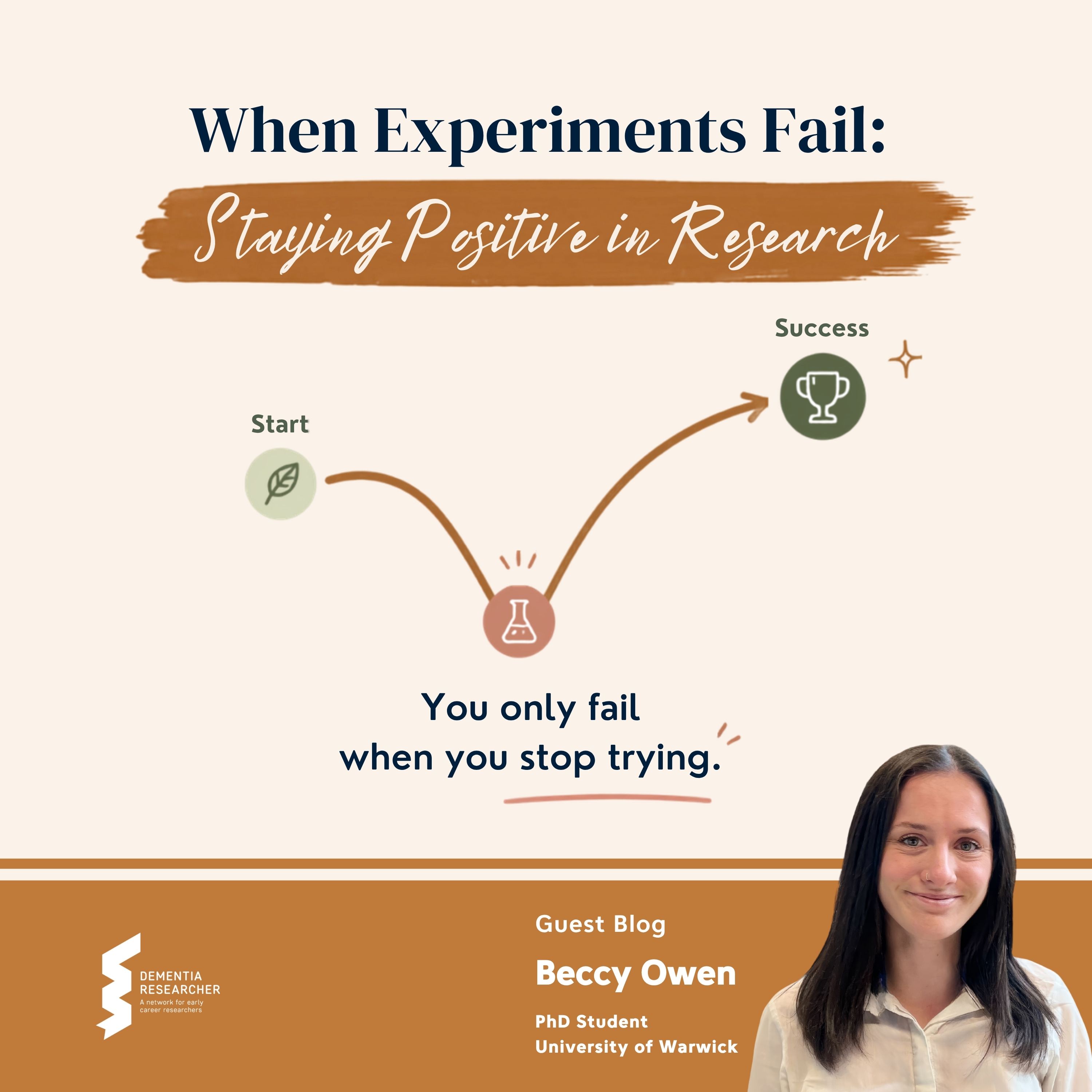
Beccy Owen - When Experiments Fail: Staying Positive in Research
3w ago00:08:18Tap to summarizeBeccy Owen narrates her blog written for Dementia Researcher.Every researcher knows the sinking feeling of an experiment failing after days, weeks or months of effort. In this blog Beccy talks about how she has learnt to stop letting failed experiments dictate her mood, and why they do not make you a bad scientist. She shares the best advice she has been given, from a lab manager who told her not to let a bad result follow her home, to knowing when to stop and re-evaluate rather than keep going down a dead end. Along the way she looks at accidental discoveries like X-rays and penicillin, the value of work-life balance, and why asking colleagues for help is a sign of a good scientist, not a failing one.https://www.dementiaresearcher.nihr.ac.uk/blog-when-experiments-fail-staying-positive-in-research/--Beccy Owen is a PhD Researcher at the University of Warwick, exploring how tau pathology disrupts neuronal ion channels and brain network activity in Alzheimer’s disease. As part of the Midlands Integrative Biosciences Training Programme, her work uses electrophysiology to better understand the molecular drivers of neurodegeneration. Originally from the Welsh countryside, Beccy’s passion for dementia research was shaped during her postgraduate studies and through personal experience with a family member living with the condition. She will be sharing her journey, insights, and lessons learned throughout her PhD here on the blog.Find Becky on LinkedIn--Enjoy listening? We're always looking for new bloggers, drop us a line. http://www.dementiaresearcher.nihr.ac.ukThis podcast is brought to you by University College London in association with the National Institute for Health and Care Research, Alzheimer's Association, Alzheimer's Research UK, Alzheimer's Society and Race Against Dementia, who we thank for their ongoing support.--Leave us a Tiphttps://dementia-researcher.captivate.fm/supportFollow us on social media:https://www.instagram.com/dementia_researcher/ https://www.facebook.com/Dementia.Researcher/https://www.twitter.com/demrescommunityhttps://www.linkedin.com/company/dementia-researcher https://bsky.app/profile/dementiaresearcher.bsky.socialDownload and Register with our Community App:https://www.onelink.to/dementiaresearcher
Transcribe →
Harriet Greene - How I Found My Way into Dementia Research: Give to Gain
3w ago00:08:20Tap to summarizeHarriet Greene narrates her blog written for Dementia Researcher.Harriet wrote her first essay on Alzheimer's at 15. What followed was not a tidy line to Oxford. She missed medicine by one mark, took her insurance place in Neuroscience at Queen Mary, topped her cohort's dissertation grades, then packed a backpack for a tiny island off Bali to learn to dive. A broken arm in Australia sent her home, a summer as a divemaster in Corfu taught her more than she expected, and somewhere between the dive boat and the papers she kept reading, she realised she missed science. In her first blog for Dementia Researcher, Harriet, now a second-year PhD researcher in Clinical Neurosciences at the University of Oxford, introduces the principle behind everything she does: give to gain. It is a story about mentors in unlikely places, her mum's question "Why not you?", and why a path does not have to be perfect to get you where you want to go.https://www.dementiaresearcher.nihr.ac.uk/blog-how-i-found-my-way-into-dementia-research/Harriet Greene is a PhD student at the University of Oxford researching dementia prevention, with a focus on how vascular risk factors such as hypertension affect the brain. Her project models the neurovascular unit in vitro, allowing her to explore biological mechanisms creatively and collaborate across departments and disease areas. Supported by the British Heart Foundation for research consumables, Harriet is also interested in biotech start-ups and translating lab discoveries into patient benefit. Outside academia, she is a scuba diving instructor, shell collector and lover of the sea, with a strong belief in paying kindness forward within the research community.Leave us a Tiphttps://dementia-researcher.captivate.fm/supportFollow us on social media:https://www.instagram.com/dementia_researcher/ https://www.facebook.com/Dementia.Researcher/https://www.twitter.com/demrescommunityhttps://www.linkedin.com/company/dementia-researcher https://bsky.app/profile/dementiaresearcher.bsky.socialDownload and Register with our Community App:https://www.onelink.to/dementiaresearcher
Transcribe →
Professor Frank Gunn-Moore: Do Cats, Dogs and Dolphins Get Dementia Too?
3w ago00:05:36Tap to summarizeProfessor Frank Gunn-Moore narrates his blog written for Dementia Researcher.In this blog, Frank asks whether dementia is really unique to humans. Starting with the story of his cat Cardhu, and moving through research on dogs, dolphins, whales and other long-lived species, he explores what animal biology can teach us about memory, ageing, Alzheimer’s pathology and why some species may be more vulnerable, or more protected, than others.https://www.dementiaresearcher.nihr.ac.uk/blog-do-cats-dogs-and-dolphins-get-dementia-too/--Professor Frank Gunn-Moore is an academic and researcher in neurodegeneration and dementia research at the University of St Andrews, Scotland. His group has advanced understanding of the early cellular and biochemical mechanisms of Alzheimer’s disease, including links between mitochondrial and synaptic dysfunction, and has pioneered new models including the identification of Alzheimer’s-like pathology in cetaceans. His research has also identified potential therapeutic targets, novel signalling pathways such as FRMD6/Willin in the Hippo pathway, and contributed to patented optical technologies developed with industry. He has published over 150 research papers across biology, chemistry and physics, reflecting the interdisciplinary breadth of his work.Leave us a Tiphttps://dementia-researcher.captivate.fm/supportFollow us on social media:https://www.instagram.com/dementia_researcher/ https://www.facebook.com/Dementia.Researcher/https://www.twitter.com/demrescommunityhttps://www.linkedin.com/company/dementia-researcher https://bsky.app/profile/dementiaresearcher.bsky.socialDownload and Register with our Community App:https://www.onelink.to/dementiaresearcher
Transcribe →
Dr Sam Moxon - Why Some Ideas Never Get a Chance
3w ago00:06:09Tap to summarizeDr Sam Moxon narrates his blog written for Dementia Researcher.You develop something genuinely different, cost it, build the team, submit it feeling confident, and then the rejection lands. In this blog, Dr Sam Moxon sits with the researchers who keep watching their most original ideas fall at the panel while safer, more familiar work sails through. He asks a question the field tends to avoid: are our funders too risk averse to back the ideas that might actually change things, and what does that caution do to the people early in their careers who cannot afford to fail?https://www.dementiaresearcher.nihr.ac.uk/blog-why-some-ideas-never-get-a-chance/--Dr Sam Moxon is a biomaterials Research Fellow at University of Birmingham. His expertise falls on the interface between biology and engineering. His PhD focussed on regenerative medicine and he now works on trying to develop 3D bioprinting techniques with human stem cells, so that we better understand and treat degenerative diseases. He is also the Founder and CEO of Aegis FibreTech. Outside of the lab he hikes through the Lake District and is an expert on all things Disney.--Enjoy listening? We're always looking for new bloggers, drop us a line. http://www.dementiaresearcher.nihr.ac.ukThis podcast is brought to you by University College London in association with the National Institute for Health and Care Research, Alzheimer's Association, Alzheimer's Research UK, Alzheimer's Society and Race Against Dementia, who we thank for their ongoing support.--Leave us a Tiphttps://dementia-researcher.captivate.fm/supportFollow us on social media:https://www.instagram.com/dementia_researcher/ https://www.facebook.com/Dementia.Researcher/https://www.twitter.com/demrescommunityhttps://www.linkedin.com/company/dementia-researcher https://bsky.app/profile/dementiaresearcher.bsky.socialDownload and Register with our Community App:https://www.onelink.to/dementiaresearcher
Transcribe →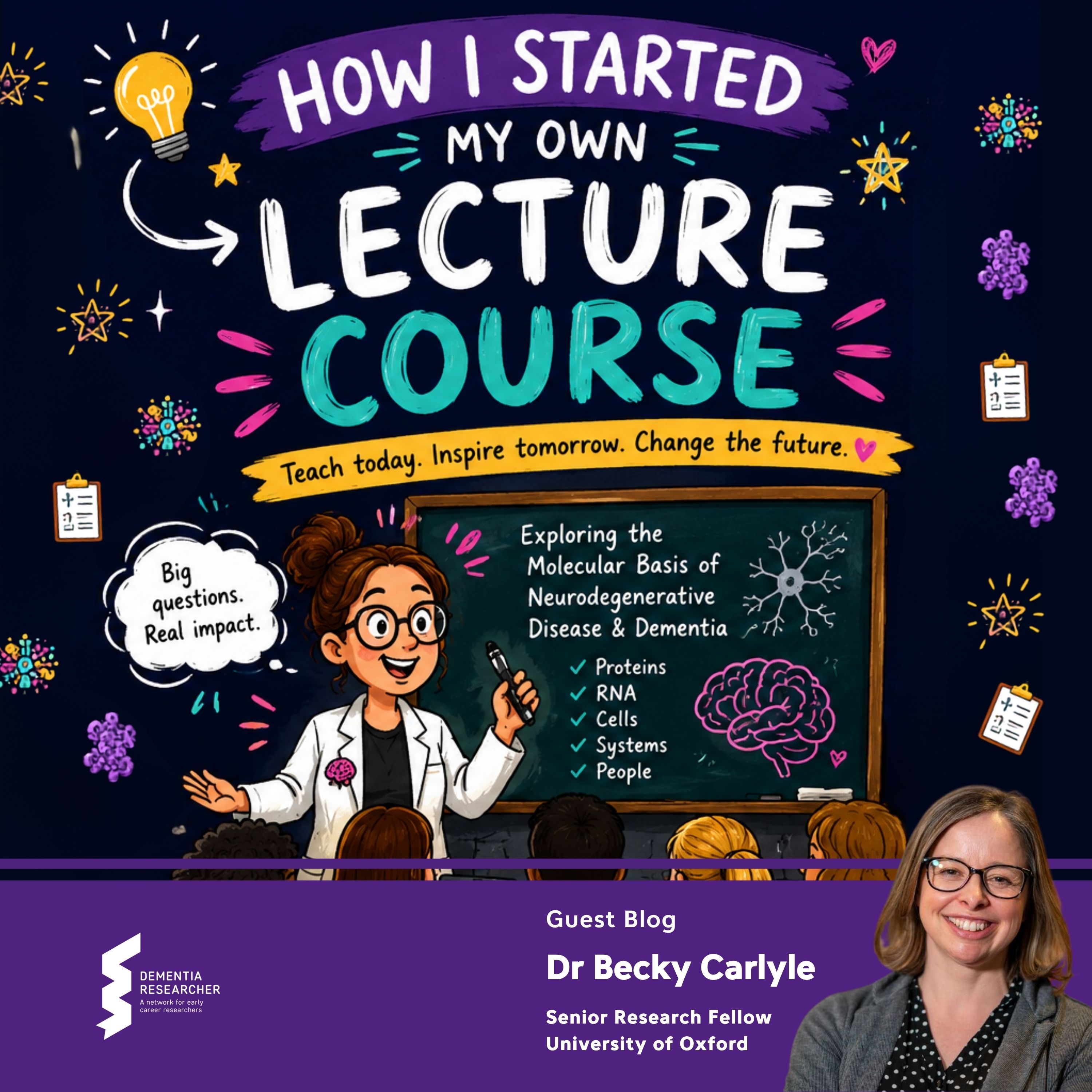
Dr Becky Carlyle - How I Started My Own Lecture Course
Jun 2500:10:25Tap to summarizeDr Becky Carlyle narrates her blog written for Dementia Researcher.In this blog, Becky reflects on creating a new lecture course for second year biomedical scientists, built around the molecular basis of neurodegenerative disease and dementia. She explains how teaching current research, from diagnosis and biomarkers to proteins, RNA, models, trials and uncertainty, helped students connect scientific discovery with the real challenges of dementia. The blog also offers practical advice for anyone thinking of building a course of their own, including teaching what you know, checking what students have already covered, giving clear handouts, designing fair exam questions, and remembering that students often treat a lecturer’s words as ground truth.https://www.dementiaresearcher.nihr.ac.uk/blog-how-i-started-my-own-lecture-course/--Dr Becky Carlyle is an Alzheimer's Research UK Senior Research Fellow at University of Oxford, and has previously worked in the USA. Becky writes about her experiences of starting up a research lab and progressing into a more senior research role. Becky's research uses mass-spectrometry to quantify thousands of proteins in the brains and biofluids of people with dementia. Her lab is working on various projects, including work to compare brain tissue from people with dementia from Alzheimer’s Disease, to tissue from people who have similar levels of Alzheimer’s Disease pathology but no memory problems. Becky is also a mum, she runs, drinks herbal teas and reads lots of books.--Enjoy listening? We're always looking for new bloggers, drop us a line. http://www.dementiaresearcher.nihr.ac.ukThis podcast is brought to you by University College London in association with the National Institute for Health and Care Research, Alzheimer's Association, Alzheimer's Research UK, Alzheimer's Society and Race Against Dementia, who we thank for their ongoing support.--Leave us a Tiphttps://dementia-researcher.captivate.fm/supportFollow us on social media:https://www.instagram.com/dementia_researcher/ https://www.facebook.com/Dementia.Researcher/https://www.twitter.com/demrescommunityhttps://www.linkedin.com/company/dementia-researcher https://bsky.app/profile/dementiaresearcher.bsky.socialDownload and Register with our Community App:https://www.onelink.to/dementiaresearcher
Transcribe →
Brandon Newman - Why data matters in human-centred dementia care
Jun 2400:08:08Tap to summarizeBrandon Newman narrates his blog written for Dementia Researcher.In this guest blog, Brandon Newman uses his experience as a paramedic to show how dementia care can be misread when clinicians only see a brief snapshot of someone’s life. He argues that shared care records and digital Comprehensive Geriatric Assessment can bring together information from paramedics, GPs, memory clinics, hospital teams and families, helping clinicians understand a person’s baseline, support network, history and wishes. The piece makes the case that better data is not about replacing clinical judgement or compassion, but about giving professionals the context they need to make safer, more person-centred decisions, especially when hospital admission may not be the best option.https://www.dementiaresearcher.nihr.ac.uk/blog-seeing-the-whole-person-why-data-matters-in-human-centred-dementia/--Brandon Newman is a Paramedic and Clinical Workflow Lead at Graphnet Health. After 16 years as a paramedic, he continues to work on the frontline while helping improve clinical workflows, with a particular interest in paramedic practice and care for older people.Leave us a Tiphttps://dementia-researcher.captivate.fm/supportFollow us on social media:https://www.instagram.com/dementia_researcher/ https://www.facebook.com/Dementia.Researcher/https://www.twitter.com/demrescommunityhttps://www.linkedin.com/company/dementia-researcher https://bsky.app/profile/dementiaresearcher.bsky.socialDownload and Register with our Community App:https://www.onelink.to/dementiaresearcher
Transcribe →
Rahul Sidhu - Sleep and Dementia: Should We Worry?
Jun 1800:06:52Tap to summarizeRahul Sidhu narrates his blog written for Dementia Researcher.Rahul explores the relationship between sleep and dementia, asking whether a few poor nights should really worry us. Drawing on research into the glymphatic system, amyloid beta, tau and long term studies of sleep duration, the blog explains why sleep is increasingly seen as an important part of brain health. It also offers reassurance. Occasional restless nights are unlikely to have a meaningful impact on dementia risk, but persistent sleep disruption over months or years, including conditions such as sleep apnea, deserves attention.The blog ends with a gentle nudge to tired researchers that rest is not wasted time.https://www.dementiaresearcher.nihr.ac.uk/blog-sleep-and-dementia-should-we-worry/--Rahul Sidhu is a PhD student at The University of Sheffield, focusing on the effects of heart disease on dementia in preclinical models of Alzheimer's disease. His research aims to uncover how cardiovascular health influences neurodegenerative conditions, potentially leading to novel therapeutic strategies. Find Rahul on LinkedIn--Enjoy listening? We're always looking for new bloggers, drop us a line. http://www.dementiaresearcher.nihr.ac.ukThis podcast is brought to you by University College London in association with the National Institute for Health and Care Research, Alzheimer's Association, Alzheimer's Research UK, Alzheimer's Society and Race Against Dementia, who we thank for their ongoing support.--Leave us a Tiphttps://dementia-researcher.captivate.fm/supportFollow us on social media:https://www.instagram.com/dementia_researcher/ https://www.facebook.com/Dementia.Researcher/https://www.twitter.com/demrescommunityhttps://www.linkedin.com/company/dementia-researcher https://bsky.app/profile/dementiaresearcher.bsky.socialDownload and Register with our Community App:https://www.onelink.to/dementiaresearcher
Transcribe →