← Design Better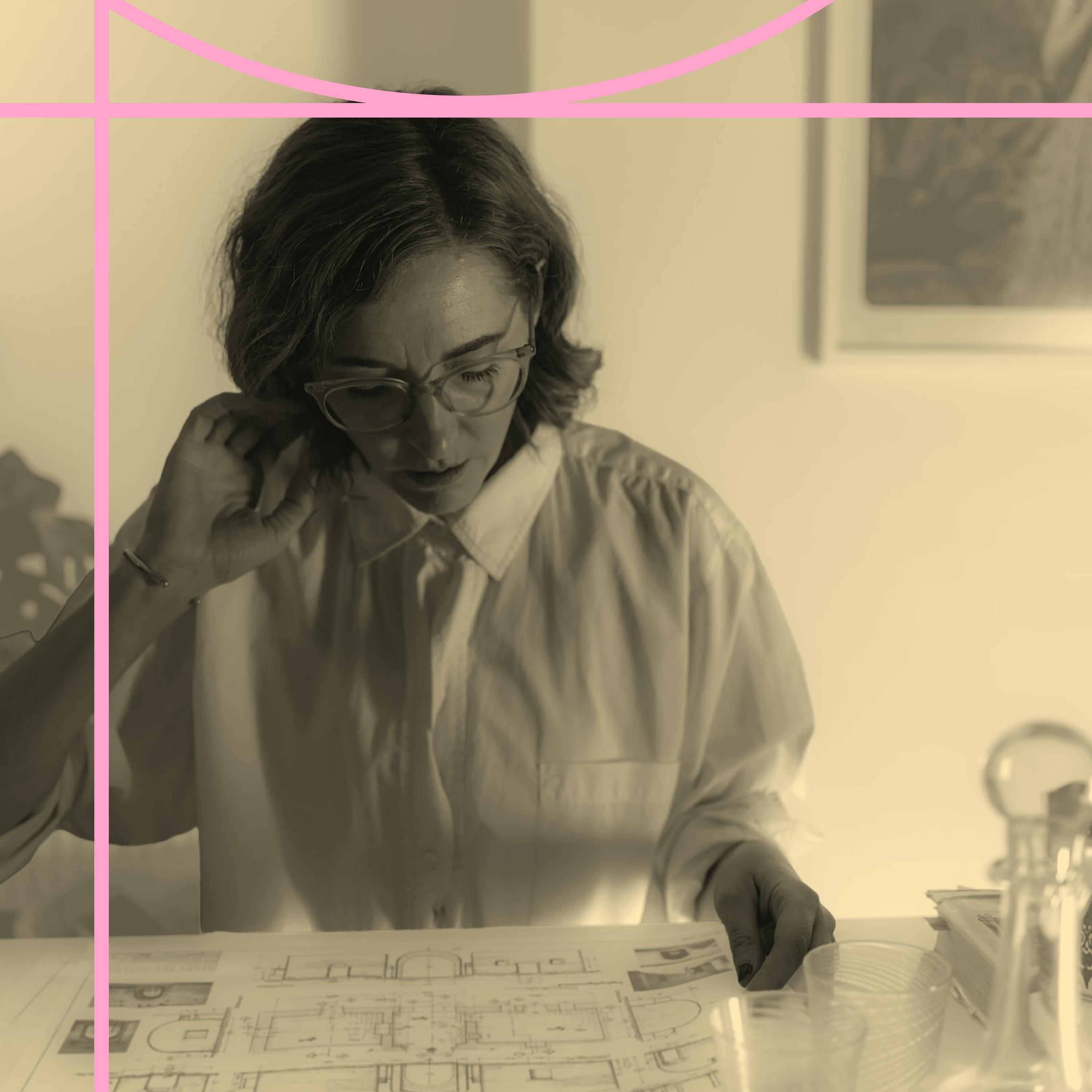
Design Better
Fiona Crombie: Academy Award-nominated production designer on storytelling without words
00:22:10
In our conversation with Fiona Crombie, we explore how production design shapes performance, how historical accuracy balances with storytelling, how a visual “mission statement” guides an entire crew, and what it means to create environments that carry grief, love, and memory.
Loading summary
Transcript31 lines
- [00:02]
Fiona Crombie
One of the really key things, I think on this film was that Chloe invited collaboration and the film was really a process of discovery and she invited us to do that with her. Everybody was invited to bring their best. Everybody was every day taking care of each other. We all knew we were experiencing something together.
- [00:26]
Eli Woolery
If you've ever wondered what a movie production designer actually does, our guest today describes it in the simplest terms. It's everything you see in the frame that isn't a costume. Turns out production design has a lot in common with product design.
- [00:39]
Aaron Walter
Our guest is the visionary production designer Fiona Crombie. You've seen her work in incredible films like the Favorite, and most recently, maybe you've seen the hauntingly beautiful film Hamnet. It's currently taking the industry by storm with eight Academy Award nominations, including a nod for Fiona herself for Best Production design. From the sprawling architecture of a Tudor estate down to the specific curve of a spoon or the texture of a tablecloth, Fiona's job is to build a physical reality that reflects the interior lives of the characters on screen.
- [01:13]
Eli Woolery
In our conversation, we explore how production design shapes performance, how historical accuracy balances with storytelling, how a visual mission statement guides an entire crew, and what it means to create environments that carry grief, loving, love, and memory. This is DesignBetter, where we explore creativity at the intersection of design and technology. I'm Eli Woolery.
- [01:33]
Aaron Walter
And I'm Aaron Walter. If you're hearing this, you're not currently on our Premium subscriber feed. DesignBetter Premium subscribers enjoy weekly episodes. That's four episodes per month rather than just two, and all of them are ad free. Plus you'll get an invitation to our monthly AMAs with the smartest folks in design and tech. And if you subscribe at the annual level, you'll also get our Toolkit, a collection of our favorite design and productivity tools like Perplexity, Miro, Read AI and more. You'll hear a preview of this episode, but if you'd like to hear the full conversation, please consider becoming a premium subscriber@designbetterpodcast.com subscribe. The podcast is available to everyone through our scholarship program, so if you can't afford a subscription, just shoot us an email@subscriptions.com we'll help you out. We'll return to the conversation after this quick break. DesignBetter is brought to you by WIX Studio, the the platform built for all web creators to design, develop and manage exceptional web projects at scale. Learn more@wix.com studio and now back to the show. Fiona Crombie, welcome to Design Better.
- [03:09]
Fiona Crombie
Thank you. Very happy to be here.
- [03:11]
Aaron Walter
So I want to start just with a disclaimer for any listeners who have not yet seen Hamnet, which you're nominated for an Oscar for. There will probably be some spoilers in our conversation, so if you haven't seen it, be warned. Yeah, it's a wonderful film. We want to dive into the specifics of the experience of working on that film, but maybe for our listeners who might not be very familiar with what a production designer does, could you walk us through the role and the type of work that you do?
- [03:43]
Fiona Crombie
Yeah. So production design, I mean, in really simple kind of basic terms, it's everything that is in a frame. So within every frame of film that is not a costume. So a production designer is looking at landscape or architecture, or I'm looking at a tablecloth, I'm looking at the knives and spoons, you know, like the big broad picture and then the detail. And obviously there's a bunch of people that you work with to achieve that. But really, I think for me, production design is an opportunity to storytell without words. And so it's looking at ways to illustrate elements of the story or the characters lives.
- [04:25]
Aaron Walter
Visually, it's a very broad scope. Maybe could you talk a little bit about the skills? Because you've gotta understand history. Certainly with this film, there's a ton of history objects, what's historically accurate and appropriate. But then there's also a lot of kind of having an artistic eye, so thinking like a dp, a director of photography, a cinematographer, being able to combine all those things into that vision that the director has set forward. What are the skills like, the background that production designers usually have?
- [04:58]
Fiona Crombie
It's actually quite varied. I mean, a lot of production designers come up through art department. In my case, I was a theatre designer. And so for me it was always very much about a text, that learning to design through, you know, reading plays and thinking about theatre and actually thinking about articulating design in a black box. Obviously you have to have an imagination, and in my case, it's very much about your relationship with words. So words will prompt me to imagine or to kind of have a sense of what I think something should feel like or look like. And it's not crystal clear, it's just like a very sort of sketchy response. There's a process of refining and you sort of end up with something that you're standing in. But it starts with just sort of impulse. I think one of the key skills that you need as a Production designer is your ability to communicate, because you're taking something that is amorphous, sort of just somewhere in your mind and then ultimately speaking to people who have to realize that, you know, painters, art directors, set decorators, and bring it to fruition. But meanwhile, interpreting a director's vision, it's also really practical because you're worrying quite a lot about money, like budgets, you're worrying about schedules, you're worrying about things like how will you build that thing that you have in your mind? What is the engineering? It's kind of this dual role that is both really, really creative, but also has to have a practical aspect to it as well.
- [06:28]
Eli Woolery
So at what point in the process do you come on board? And this particular film, Hamnet, is a collaboration, as we understand it, between the writer Maggie o' Farrell and the director Chloe Zhao. Talk to us about when you came in and how you were involved in the early stages of the film.
- [06:43]
Fiona Crombie
It sort of varies, but I tend to come on quite early, so I will be one of the first hires, usually. So after there's a script, sometimes I'm on before it's actually green lit. And we're doing some degree of development because, again, like this practical aspect, to some extent, design can help with the viability of a film, like how you're going to achieve a film. And so speaking to a designer will help producers realise what it's going to cost. Or is it a film that is location based? Is it a film that is going to be built on a studio? And all those things are worked out quite early and help with the methodology of the shoot. And so in the case of Hamnet, from memory, I came on maybe like February or March, and then we finished in like September, October. And so I had the soft prep, so. So it's just often me just doing reference and research. And then I started with one art director and then basically it accumulates like you're building up the team until you're standing on a set with 300 people.
- [07:40]
Aaron Walter
I'd love to go into your mind or the moment where you just got acquainted with the project. Is it the script is already written? Or in this case, did you read the book first? What I'm curious to hear is, like, what. Where you first touched the story and what you start to see in your mind.
- [08:02]
Fiona Crombie
I had read the book and I'd read it just because I'd heard about it. And so that was some years ago. Then I'd heard on the grapevine, like we all do, you know, that Chloe Zhao was coming to make this film. And I was like, oh, yeah. But I actually wasn't available, so I sort of didn't think much. I remember thinking, like, you know, lucky for some. And then the timing worked out and I read the script. It was such a great read. Like, I read it so quickly and had a very, very strong response to it. Really, honestly just came to me very, very quickly. The sort of textures and the things that I wanted to explore with the architecture. And very much I was connected to the sense of having an opportunity to talk about a family and make a period film of this sort of era that is really a domestic. Like, it's about a family, and you're getting close to a family in a way that I don't know that I've seen before. I was just really drawn to it. I found it, obviously, really moving. But the script that we had at that point really evolved through the process. I remember saying, I hope they don't change one word. But inevitably, with Chloe's process, there were many changes and for the better. Like, to create this film that is very much about this group of people that came together to make it. So it's not just an adaptation of the book. It was like an interpretation of the book. It was a very quick, very immediate connection for me. And then I met Chloe on Zoom, and she had seen reference images that I put together, and she felt like my images were articulating the film that she wanted to make. So it was a really quick process in terms of connecting and then just starting. And we sort of didn't need to then go back and forth a lot. It was sort of there in terms of, like, a core sort of visual structure. And then it just got into a process of refining, refining, finding the best version of what we were trying to get at.
- [09:58]
Aaron Walter
Can you say more about that part? The reference images, where do those images come from and how are they presented to Chloe?
- [10:06]
Fiona Crombie
Oh, I love a PDF. Like, I'll do it. Okay. I think PDFs are one of my strong. I can lay up a keynote beautifully. Yeah. They're a collection of drawings, paintings, photography, things that I think are telling me. So therefore, anybody, something about the story, the way that I try to do it is I do a sort of a loose map, I think, about how the film will start and how it will finish, and almost, like, episodically through the structure of the film. So I can look at the journey just in a really sketchy way in these images. And they're very much about initial impulses. So almost Always I can see the palette of the film quite quickly from what I'm drawn to immediately shapes things that I'm just drawn to. I just. Collecting. Collecting. Some designers really don't like doing this because they feel like it's sort of almost too prescriptive, you know, like it's saying to a director, this is my vision and what designers are. We're all malleable. Like, you can keep responding to a director, but in my case, I like doing it because I feel like it gives me a foundation for the film. So I start in a place and then we go ahead.
- [11:14]
Eli Woolery
Maybe you talk to us a little bit more about the early artifacts. And if we're talking about product design, we often may start with sketches and then we'll do wireframes for a digital product. And if we're working on a physical product, it might evolve into, like, foam prototypes or foam models. Maybe it could even be from earlier in the process, as you're working your way up the fidelity. You mentioned collecting things. And then how does that evolve into maybe models or other higher fidelity before it actually becomes a finished sort of product that you see in the movie?
- [11:44]
Fiona Crombie
I'll always have a collection of images that I think speak to the set. So it could be, like, textures or proportions or colors. And then there's drawings and we start drawing. Sometimes it's hand drawings. More often than not, it's on the computer. I don't do it. I have people who are, you know, amazing, who sit there and do it, and I'll be guiding them. And then we do build models, not just digital models, which are super useful, because in the case of this film, we spent a lot of time with the cinematographer, Lucas. He sat and worked out frames and camera positions. And we really created the house, really moulded it, thinking about camera and thinking about depth and how to capitalise on what is actually quite. It's not a small structure, but it's an intimate structure. But we'll also build white car models. I think they're so useful. And we built the house, white car model, the globe, white car. All of the set builds were white car models. Some directors will read a plan because obviously we do big plans as well. Drawings, technical drawings. And some directors can read a plan, some directors can't. So we'll sort of come at it in different ways. But there's a lot of capturing screen grabs from models, showing your angles so that everybody understands.
- [12:59]
Aaron Walter
When you're not engaged in working on a film, are you collecting stuff all the time on your Computer on your phone. If we opened up your photos app, would it just be like a bajillion photos of interesting items?
- [13:12]
Fiona Crombie
Yeah, but really badly framed. So when I go through my photos and actually my Hamnet collection, it's like a corner or it's like some little detail. I remember there was, like, this kind of mitered edges of floorboards. And of course, I'm like, snapping those. And then someone will say to me, have you got a photo of the location? And I'm like, oh, yeah, yeah, I would. And then I don't because I'm too busy doing some, like, little engraving that's in the corner somewhere. So, yes, and I do that all. All the time. Sometimes I'll go back to something and I'll think, oh, I had this idea. And then I'll realize, oh, it's because, you know, six months ago I saw something or other, like an interesting elevator button or something, and it'll appear in a film.
- [13:53]
Eli Woolery
Do you feel that the sort of authenticity and detail that you put in the set affects the actor's performance? And I think about something I heard. I think it was on Mad Men, where the production design was so detailed that even inside drawers that you never saw on camera, they would have objects in there that you might in that setting in an advertising office. And I imagine it helps build the world for the characters that are performing in it as well.
- [14:17]
Fiona Crombie
Yeah, I mean, it's one of the great pleasures, I think, when you can do that. And I love handing the set over to the shoot crew and to the actors and seeing them just take it on and inhabit it and suddenly look like they've lived there forever. Actually, this happened to me in theater. This thing happened where we had to build, like, it was a kitchen or something. And the doors were not practical. There was no action for the actress to go to this cupboard. And she went to the cupboard, and she could not open the cupboard, and she went crazy. And that's never happened again. So, like, you know, things are practical. There's things in the drawers. But the big thing is, obviously, we're all there to make an amazing movie. And if we can do that by giving that support with the design, then absolutely that's what we're going to do.
- [15:02]
Aaron Walter
I was struck by the rawness of the story, the film, the emotion. That was the word that just kept coming to mind when I was watching it. When I think of films, these Hollywood representations of this time period, they're very, like, polished, and it's a different time, but yet it still Feels like now these are like muddy roads. It looks like hard living. Even though it's a lovely, charming Tudor structure. But there's a rawness to the settings, and that is also the tone or the feel of the script. Can you talk about the conversations that you had with Chloe about how she wanted the film to feel and the creative decisions you had to make to bring that to life?
- [15:51]
Fiona Crombie
Well, Chloe's intention at the very beginning was always to build the Globe. For practical reasons, we always knew we were building that theater. But she really wanted to shoot the rest of the film on location, and that was because she's allergic to artifice. She's a person who really values authenticity. And I think she was really afraid that we would make something that just looked twee or fake. So it wasn't a conversation at the beginning. It was, we're building the globe, and we're going to shoot on location. And then we went through a process of looking at countless houses where I was taking all these little photos the whole time. And after weeks of looking, we arrived at the realization that we had to build the Henley street house, the attic, the London apartment, and obviously the globe as well. And we were going to build it on a backlot. In many ways, that process of going and looking and standing in spaces and talking about what we wanted it to be like was a great foundation for being able to design the sets, because we'd seen really clearly what we knew we needed to aim for. And also we had the farm, and the farm is a location. My favorite kind of work is when you get to do both. So you've got locations and you've got set builds and you're calibrating. And so you're always referring back from one to the other and making sure that you're making a film that hangs together visually. And so it just really became a case of, like, having this sort of record of all the places that we visited and paying attention and looking out and keeping our eyes open for all the details that then we could bring into the set. Build.
- [17:28]
Eli Woolery
One of the other things that struck me about the film was how the forest almost became a character. The forest and the cave. And some of it reminded me. It wasn't as composed, but reminded me a little bit of the artist, Andy Goldsworthy. I don't know if you're familiar with him, a British artist who does these amazing landscape works. Where did you take inspiration for that? How much of the sort of natural parts of the landscape were tailored to fit the symbolism of those parts of the film.
- [17:53]
Fiona Crombie
What was amazing was the first place that we went to find was the forest. In fact, the first time I met Chloe in person was at that forest in a car park. And we were going off, embarking on this journey together. We didn't plan on finding that tree. That tree with the hole was a discovery that then, of course, took on more and more meaning through the course of our pre production. And we built into it so we added root systems and we added all the ferns and did a whole lot of greens work the whole way through the film, we just did tons of greens work, so we sort of bumped it up. But actually that tree was there and we found the tree, which is amazing. It's like a needle in a haystack, you know, to find that tree in that forest. The forest is a private estate, so it's not something that people can go to. And then it just felt like we wanted to create this sort of nest where she would give birth and a place that she would gravitate towards where she. I don't know, she had her secret world as well. Like, she hid objects in the roots and we did all of that. It's her domain there. And it was just something that evolved and then, of course, took on more and more meaning the whole way through. I always felt really strongly about this idea of these kind of black holes. I wanted the house to have a sense that what's happening at the end of a corridor or what's happening at the top of the stairs, you know, the idea of death just peering out at you at any given moment was something that I felt really strongly about, that I wanted to put into the film at all times. And then the whole presented itself and became more and more important as we went along.
- [19:31]
Aaron Walter
That shape and the shot, there's an overhead shot of her laying in that, what you call a nest. I read it as like a yonik shape. Sort of like she's giving birth. And there's this connection to her mom, who was like the witch in the woods, but she's a woman who's sort of carrying on this naturalist tradition of herbs and so forth. It's almost like that's her mom holding her while she's becoming a mom. It felt really layered.
- [20:00]
Fiona Crombie
Yeah. And you know what? You don't really see it in the film film. But we actually.
- [20:06]
Aaron Walter
If you'd like to continue listening to this conversation, you'll need to subscribe@designbetterpodcast.com subscribe. Once you do, you'll get access to every full length episode all ad free monthly AMA's with inspiring people in design and tech and recordings of all our past AMAs. The podcast is available to everyone through our scholarship program. If you can't afford a subscription, just email us@subscriptionsuriositydepartment.com and we'll help you out. Your support makes design better possible. Invest in yourself and the design community by subscribing@designbetterpodcast.com. DesignBetter is supported by laundry sauce I have two teenage boys. Don't tell them I said this, but they stink. My wife and I have been teaching them to do their own laundry each weekend, but sometimes they totally botch the process. They put in too much detergent, not enough. So we ended up getting them Laundry Sauce to lower the learning curve. Laundry Sauce is like a bath bomb for your laundry. You drop in a high performance detergent pod in with your dirtiest of clothes and they come out smelling and looking fresh.
- [21:26]
Eli Woolery
Fresh.
- [21:26]
Aaron Walter
Each pod is enriched with a bioenzyme blend that tackles the toughest stains and revives fabrics for a brilliant clean. And I love the scents of Laundry Sauce that they've created with the help of the world's top perfumers. They have scents like French Saffron, Australian Sandalwood, Egyptian Rose, Himalayan Cashmere, Italian Bergamot. It is a treat to get dressed in the morning and smelling this good. And I love hugging my kids when they smell like bergamot and sandalwood. Sure beats the alternative. Make laundry day the best day of the week. Get 20% off your entire order at laundry sauce.com designbetter Use the code designbetter at checkout to get 20% off laundry sauce.com designbetter.