← Design Better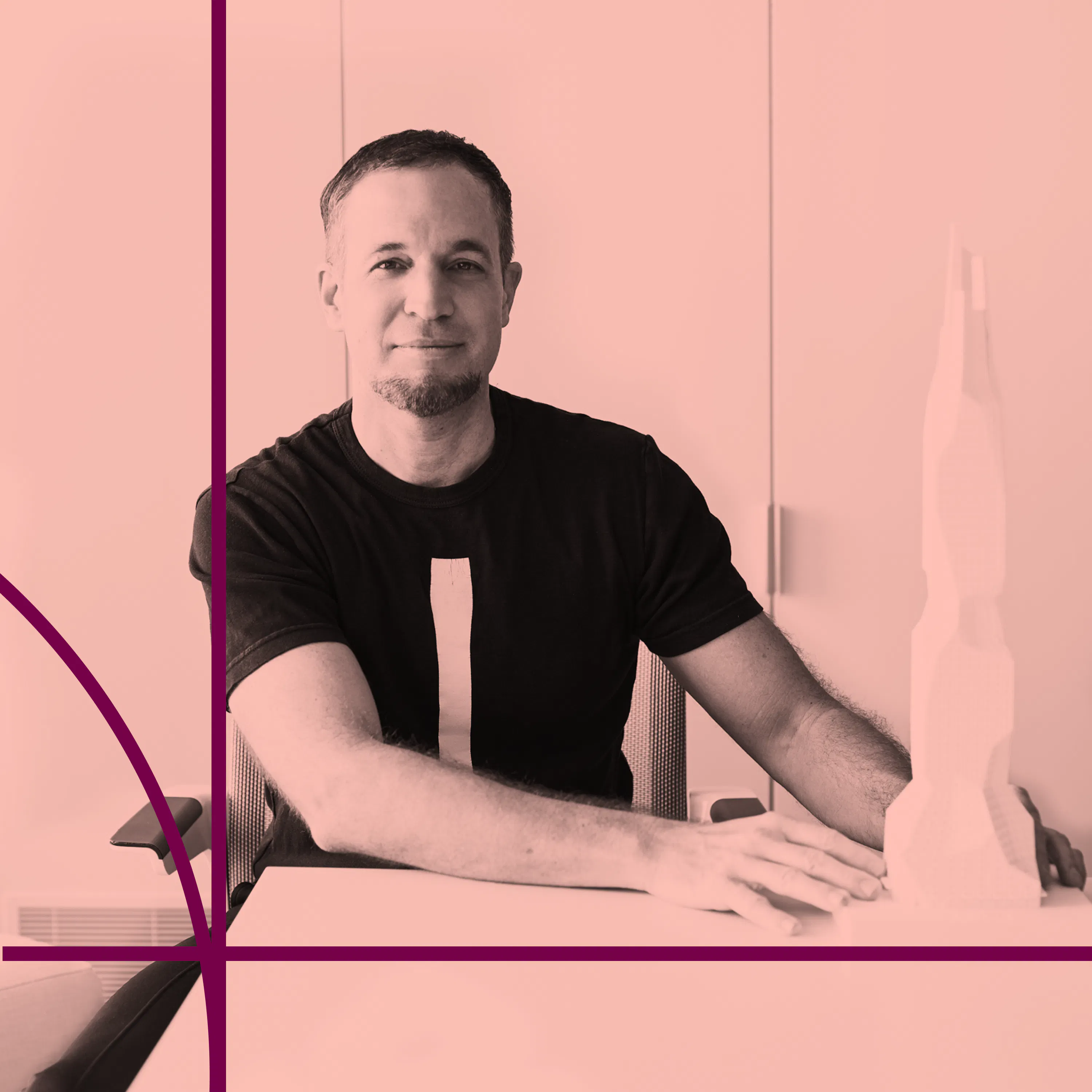
Design Better
Mattias Hollwich: AI & Architecture
00:52:12
We speak with Matthias Hollwich, principal and founder of New York architecture firm HWKN Architecture about how he and his team are using AI to imagine how buildings might fit into the existing design of a city, and take cues from local history and culture.
Loading summary
Transcript85 lines
- [00:03]
Matthias Holwich
A lot of people experimenting with using AI, but I see a lot of people try to use it to optimize what they have done before. And we are trying to use it to be surprised about other opportunities that we haven't thought about before.
- [00:21]
Eli Woolery
If, like us, you've been tinkering with.
- [00:23]
Aaron Walter
The plethora of AI tools that have emerged recently, chances are it's changing your.
- [00:28]
Eli Woolery
Workflow and creative process.
- [00:31]
Aaron Walter
AI is a great thought partner for.
- [00:33]
Eli Woolery
Writing, illustration and even user research, but we've been wondering how people in other creative disciplines are using it.
- [00:40]
Guest
Matthias Holwich, principal and founder of New York architecture firm Hawken Architecture, has discovered AI as a powerful addition to architectural design. He and his team are using it to imagine how buildings might fit into the existing design of a city and take cues from local history and culture. It's yet another way AI is unexpectedly expanding creative horizons. This is Design Better, where we explore creativity at the intersection of design and technology. I'm Eli Woolery.
- [01:07]
Aaron Walter
And I'm Aaron Walter.
- [01:09]
Eli Woolery
You can get AD free episodes, bonus content, discounted workshops, and access to our monthly AMAs with big names in design.
- [01:17]
Aaron Walter
And tech by becoming a Design Better premium subscriber.
- [01:21]
Eli Woolery
It's also the best way to support the show. Visit designbetterpodcast.com subscribe to learn more. Also, stay tuned after the interview for.
- [01:32]
Aaron Walter
A special look at wix Studio, the.
- [01:34]
Eli Woolery
Intuitive way for agencies and enterprises to design exceptional sites with full stack business solutions, multi site management and built in AI. We chat with Brad Hussey, who's designing.
- [01:46]
Aaron Walter
Sites for clients and has managed to.
- [01:48]
Eli Woolery
Scale his freelance business thanks to wix.
- [01:50]
Aaron Walter
Studio, and he'll tell you exactly how he does it. We'll return to the conversation after this quick break.
- [02:11]
Eli Woolery
Design Better is supported by Masterclass. It's usually around the holidays, as the year draws to an end, that I start to really reflect on my goals and how I want to grow in the coming year. I've often turned to Masterclass to help me expand my knowledge and satiate my seemingly unending curiosities about disciplines that I've yet to explore. Masterclass is the only streaming platform where you can learn and grow with over 200 of the world's best thinkers. I'm talking about people like Steph Curry, Paul Krugman, Malcolm Gladwell, Diane von Furstenberg, Margaret Athena Atwood, Levar Burton, and so many more inspiring thinkers who share their wisdom in a format that's easy to follow and can be streamed anywhere on a smartphone, on your computer, your smart tv, even in audio Mode. Former Design Better guest David Sedaris teaches a class on storytelling and humor. And I loved Bob Iger's class on business strategy and Anna Wintour's class on creativity and leadership. Oh, and Sarah Blakely, she's the founder of Spanx, has an amazing class on entrepreneurship that taught me so much. I've been through so many classes and I just learned so much each time. The wirecutter calls Masterclass an invaluable gift and I can attest to the truth of that claim. I gave my wife a Masterclass subscription last year for her birthday and she got so much value from it all year long. With Masterclass, your loved ones can learn from the best to become their best. Masterclass always has great offers during the holidays, sometimes up to as much as 50% off. You should definitely head over to MasterClass.com Design Better for their current offer. That's MasterClass.com Design Better. I'm so excited for you to try it. MasterClass.com Design Better Want to shop Walmart?
- [04:04]
Matthias Holwich
Black Friday deals first. Walmart plus members get early access to our hottest deals. Join now and get 50% off a one year annual membership. Shop Black Friday deals first with Walmart plus see terms@walmartplus.com.
- [04:21]
Aaron Walter
And now back to the show. Matthias Holbik, welcome to Design Better.
- [04:30]
Matthias Holwich
Great to be here.
- [04:31]
Aaron Walter
We're super interested in the work that you and your colleagues are doing at your architecture firm, Haken, but maybe before we dive into that work, let's talk a little bit about your background. So you grew up in Germany. I think listeners might pick that up, that you've got a German background and you can't really study any sort of design in Germany without the ghosts of the Bauhaus. Kind of informing, maybe haunting to some degree your sensibilities. A while back in 2005, you wrote a book specifically about Bauhaus and kind of revisiting that legacy. Talk to us about your background, how the Bauhaus has informed your sensibilities.
- [05:15]
Matthias Holwich
Yeah, so I always say that I studied at the worst architectural school in Germany because it was incredible technical in Munich. But I had this moment where I applied for a summer school where professors from America came over and I actually had to back my teacher that I can participate. And I ended up actually in Venice. And I got a little bit of a taste of a different thinking that a technical, disciplined way of working was kind of promoted at my university. And actually one of the professors who came by was Ricardo Scofidio, who was basically from De Los Scofidio, which now is de Los Scofidio Renfro, the legendary architectural firm here in New York. And that was actually the moment where I understood there's more to architecture than all the kind of technical problem solving, where it was about inspiration, about poetry, about all kind of different influences. So from the very early on, right, where came this kind of a Bauhaus boost of technicalities into the world of architecture. I got quickly twisted. That was in 1991, and it took them 10 more years. When I come back to the Bauhaus, where I was actually teaching at Werkstette, which is kind of the research center there, and then did a research project on updating modernism. And that's when I wrote the book, which was a interview session with like 30 different people discussing about how they could see the future of the Bauhaus be. And we documented this all into a book and a fun video.
- [06:59]
Aaron Walter
I think that's interesting, thinking about the Bauhaus as very technical. Because if we look at who they were and what they were trying to do and what was happening in that era, the futurists are doing their thing in the art world. There's industrialization, there's political change. Really the focus was on the future. They were trying to be very futuristic and to take a new look and step out of this conservatism. And so to look back at the Bauhaus now as technical and very constraining, it's a little ironic.
- [07:35]
Matthias Holwich
Yeah. And I think this is just what also different places have done with modernism. Right. I think Germany took over a little bit, let's say the technical and the kind of problem solving through logic kind of approach. But then when you look into modernism in Brazil with Niemeyer, it's a very different approach. But here I can tell you actually my funnest kind of answer I got when I did the book with the Bauhaus was an interview with Oskar Neymaier. And what he said, he said, my friend Le Corbusier once said, the Bauhaus is a paradise of mediocriss. So you see that actually, like, in that time, there was already like a dialogue about where does the future go? And I totally agree with you. Especially in Dessau in Germany, that was before the war. There was an incredible energy about kind of the merge between art and architecture, but also landscape. I think landscape design was such a big part of it. But it really got lost in translation, I feel like, over time. And that was so interesting. When we did the book, we asked architects and fashion designers and industrial designers and all of them for their kind of positions about the future or how would you actually update modernism in today's time? And they all had different answers and they were super inspiring.
- [09:03]
Guest
Matthias, I'm curious how the tools that you used have sort of influenced your work over the years. So you said you graduated or started working in the early 90s, is that right?
- [09:12]
Matthias Holwich
Yeah, so I graduated in 94, I believe, and then I had the opportunity to work for a couple of fun great architects around the world and then started the firm like 17 years ago.
- [09:25]
Guest
Yeah, so I graduated roughly in the same period and my focus was on physical product design. But I know that I was coming into this world where tools like CAD were primarily 2D, still like 2 dimensional CAD like AutoCAD. And prior to that, obviously everything was hand drawn. And over time you shift from that to this 3D, at least in the product world. 3D solid modeling and sure, 3D CAD available to architects. And now these AI enabled tools. And I'm just sort of curious about how that influenced your work along the way. Maybe, I'm sure you maybe started with kind of hand drafting even in school, and then shifting through these different phases of the technology. How did that influence your thinking and approach to architecture?
- [10:06]
Matthias Holwich
Yeah, so I think I was also in Germany, the last generation who still had to hand draft. And my rescue was that actually the computer became available because I was a really bad rafter. So it was a great help in the work and the thinking. But then working for Delos Cavidio, it was actually a lot of about aestheticizing the drawings, which I had to learn before they were more like technical drawings. And then they became communications, which I really appreciate that the drawings themselves became kind of piece of art. And then working with Ryan Kohlhaas right after that was all about kind of sketching and collaging and communicating. But the drawings were not important anymore. So I learned very quickly that there are many different ways how you can do things. And I think I'm in general a very curious and open person who can just mold into different directions. And now with actually the new tools that are becoming available currently for us architects through artificial intelligence, my enthusiasm is exploding. Right. Because there's a whole brave new world out there that is not defined yet in terms of what we do with it and participate in the exploration and maybe even in the shaping of the use of these tools is something that above and beyond open and interested in. And actually in the last 18 months we have retooled the firm that we're doing actually all the design work now through AI support kind of design processes. And for me, the biggest joy I get out of it is when I'm being surprised with new solutions that I even thought about it. A lot of people experimenting with using AI, but I see a lot of people try to use it to optimize what they have done before. And we are trying to use it to be surprised about other opportunities that we haven't thought about before.
- [12:02]
Aaron Walter
Tell us more about that. How are you working differently and how does AI fit into the workflow now?
- [12:08]
Matthias Holwich
Yeah. So at the beginning, Weissley tried to analyze our design philosophy and try to use MidJourney and ChatGPT to basically help us to create new designs that follow a little bit of heritage that we had created through our work before. Until we then were like, oh, we can use that kind of tool now to maybe ask different questions. And one of them was, for example, about redesigning New York or designing new buildings in New York that maybe derive out of the history of the icons of New York, like the Empire and the Flatiron Building and the Chrysler Building. And then there was a moment where we looked into branded condos, which is the big trend right now, especially in Miami and Dubai, and you see all of these big brands kind of trying to apply their kind of design philosophy, but not really authentically into architecture. So we ran a test where we looked into branded condos that really come out of brand values, and the forms were really fantastic that came out of it. But then we had the feeling maybe it's too limited because we already have branded condos. What else can we do? And now we created condos with a personality. We actually tested how we can translate people from the world of celebrity that could be a movie director or could be a supermodel and turn who they are and what they are into buildings designs from the exterior and the interior. And that was something that we were not able to do just a couple of months ago. And just to explore it. I don't know if it's the right answer yet, right to do these kind of things, but at least to see what it does and how it manifests itself is absolutely fascinating.
- [13:54]
Guest
How do you think about. Obviously, a lot of these AIs are trained on these datasets, and they're taking work from prior architects and cultural references. And I realize that you probably don't take an idea and carry it through straight from what the AI gives you, but how do you think about the provenance of where these ideas are coming from how to properly credit them, that kind of thing.
- [14:14]
Matthias Holwich
Yeah. So the good thing is that actually all of our work is also being used by the AI. So I think it's kind of almost like a give and take, right? Taking everything that we put ever onto the Internet and now it's part of the kind of data model. I think the problem would be if you would really say, oh, design me a building like Sara Hadid. Right. And interestingly, most AIs look a little bit like it because she's heavily published. And it takes a lot from the visual equity that was created by the company, but then you have to bring in other influences. And when you think about how the world has operated ever is we see things, we learn things, we iterate on it and we change it. Right. And these kind of incremental changes are the ones that then create uniqueness. And you just have to basically use the tool to push it towards the uniqueness and not just be blatant in terms of copying something. But it definitely takes inspiration now from so many different forces. Where before maybe I could say, right, I took inspiration from the work that I learned by being with Stello Scofidio and Peter Eisenman and Ren Kohlhaas. My unique sales proposition or design equity came from these influences and then other learnings. Now the field of learning is so much bigger and that's why I find it also interesting and I'm actually more open to let's use what we have as a tool to iterate forward and let's try to next step onto people's feet. But it is a reality that now all of this has become almost part of a global brain that is kind of existing that we can tap into here. It's almost like memories.
- [15:59]
Aaron Walter
Let's dig into that a little bit more because that is the one thing that I find fascinating about this, is that so often with a design project, whether it's architecture, software, design, whatever, we almost always get locked into the transaction. This is what a client is sort of asking for. This is a brief and we're operating within these narrow confines. But a building that exists in a large city, New York, Paris, London, Jerusalem, wherever it is, it exists as part of a cell in a larger organism. An organism that has thousands and thousands of years of history and context that are present, that we feel, but we may not, no, may not be part of our attention and AI, it could help us zoom out and see the bigger picture. How do you think about that? How do you think about bringing historical context into a building that makes it a little bit more palatable or even educational to the communities that surround it.
- [17:05]
Matthias Holwich
Yeah, I always had the belief that actually a city is more important than a building. And every building that is being designed and built in a building in a city should serve the city. And what you were just describing is actually that opportunity now that we can actually use a local language model where we say, let's just pull the design kind of heritage of Manhattan and use that for the basis of design so that it actually intensifies what Manhattan was with the Manhattan to be. And that is actually one of the exercises we did. We call it New York, where we actually used these old heritage icons and used the Lausanne language to portray the future of another New York to come. And especially in today, when you need a uniqueness to a place that people go there for living, for working, for tourism, it's actually important that a city like New York doesn't look like Shanghai and Shanghai doesn't look like Hong Kong. And also when we travel to Paris, where did we go? We normally go to the places that have a uniqueness and authenticity that is most likely something older than the new built areas because they all started to look the same. Now, for me, it's almost like a moment where we could go back to the future in a way where almost like heritage kind of qualities, even craftsmanship could come back into our design as an element because we have now the support of such a big language model.
- [18:47]
Guest
Do you have any examples of architects or buildings that you think have done that especially well of integrating maybe into an older setting historic district and both embracing it, but making something new?
- [18:59]
Matthias Holwich
Yeah. There was one example in our world in Jerusalem where we're asked to design the extension of the Jerusalem Academy of Music and Dance. And the first briefing I got was almost like a apology where they said, oh, we're so sorry you have to use Jerusalem stone. And I was like, oh, that's awesome. It's like a dream coming true. But you want to use this material, most likely clients going to tell you, oh, you cannot use it because it's too expensive. Or maybe we want to create something that is different, but here it was a mandate. And then we used basically an analysis of the big stone dimensions, and then we looked into the twist that makes it unique and novel, but still within the bigger language of the city. And so we actually ended up turning the stone 45 degrees and created kind of a gradient of sizes. And it feels instantly local, but also extraordinarily different. So, yeah, maybe Just describing one of our projects where I feel like it was very successful to create that kind of heritage and innovation in one of the buildings.
- [20:09]
Aaron Walter
It's interesting, a minute ago you alluded to a unique selling proposition of Haken and I think you said it was about being inclusive, taking an inclusive approach to design. Could you walk us through that?
- [20:24]
Matthias Holwich
I think for me the frustration was very often that your either way or buildings that just like modernism, well, in, let's say in the later phases was like, okay, here's our efficient box and this is how the building needs to be. And you plop it into a city and that's it. Right? Then that doesn't have a dialogue to it. Or you also have a lot of star architects, many of them, which I really appreciate, but they're basically designing the buildings that are much more about them and less about a place. And for me it was always about finding a design that integrates itself into the neighborhood, that is inviting and inclusive. Because I always believe that community building is what we have to do as architects. That's the core responsibility. And then the building is there to actually support the community building. And also that means it's also part of a collective of a city. And you look at all of our buildings, they never try to fully stand out. They always try to have something special. Right? So unforgettable. You look at it, but there's also something familiar to it because it feels like a contextual component is always integrated in the design. And that's why I think my enthusiasm about AI is like, now we have these incredible data that we can use to actually really bring out the contextual values and put them into the designs on a brand scale. It's not like one architect fighting for the right things. Now we can actually almost machine that kind of system of contextual architecture.
- [22:11]
Aaron Walter
We'll return to the conversation after this quick break.
- [22:18]
Eli Woolery
I love wine, but I often feel overwhelmed by the options out there. But I recently joined Wine Access and I'm learning a lot. Wine Access not only ship to your door some of the world's most inspiring wines, they also educate subscribers with full color information cards that accompany each bottle. I love these cards. They provide details on flavor profile, what food your wine pairs well with, how long to decant, the ideal drinking temperature, and plenty of fascinating information about the producers. This month I got a four bottle shipment from Wine Access new club called the Wait List, which is curated by culinary icons. The box I received is from Atomics, a two Michelin star restaurant and the top US restaurant on the World's 50 Best list. Other curators include Emeril. Yes, that Emeril of New Orleans and Daniel Boulud and his flagship restaurant Danielle in New York City, which is also a two Michelin star restaurant. It's such a fun way to learn about wine and everything you receive will be a winner. I've been super impressed by how thoughtfully wine access curates and educates. You should totally join the Waitlist wine Club. Just visit wineaccess.com waitlist and use promo code designbetter all one word for 25 bucks off your first shipment. That's wineaccess.com waitlist and Use the code designbetter to save 25 dollars. The holidays and snuggly weather are upon us. It's a great time to enjoy great wine with the people that you love. Wineaccess.com waitlist all right, let's be real. If you're a content creator, blogger, or an entrepreneur just getting started, the last thing you want to do is spend hours building a website. But you know you got to do it. You've got things to do. And that's where Bluehost comes in. Their AI powered design tool gives you pro level WordPress sites in a snap. No coding, no stress. Just type in what kind of vibe you're going for and then boom, you got it. And you also get added features like marketing and e commerce tools to help you build, grow and scale your online business. Like a boss. And upgrading to Bluehost Cloud keeps your site running 24. 7 with ultra fast hosting, 99.9% uptime and enhanced security. Always fast, never slow, so you can keep making that dough. It's seriously never been easier to build your website with Bluehost. You've got ideas. All you need now is the platform. All you need is Bluehost. Head over to Bluehost.com and start building your dream website today.
- [24:58]
Brad Hussey
Okay, I have to tell you, I was just looking on ebay, where I go for all kinds of things I love. And there it was.
- [25:04]
Matthias Holwich
That hologram trading card.
- [25:06]
Eli Woolery
One of the rarest.
- [25:07]
Matthias Holwich
The last one I needed for my set. Shiny like the designer handbag of my dreams. One of a kind.
- [25:12]
Guest
Ebay had it.
- [25:13]
Matthias Holwich
And now everyone's asking, ooh, where'd you.
- [25:16]
Eli Woolery
Get your windshield wipers? Ebay has all the parts that fit my car. No more annoying, just beautiful.
- [25:24]
Matthias Holwich
Whatever you love, find it on eBay.
- [25:26]
Brad Hussey
EBay, things people love.
- [25:32]
Aaron Walter
And now back to the show.
- [25:40]
Guest
So one part of the flip side to folks you know, caring understandably caring about the history, historical buildings, and preserving that is that there may be some inherent kind of resistance to anything that's seen as too futuristic or novel. I know there's a small example here where I am in Carmel area. There's very strict building codes and it's hard to get anything very new off the ground sometimes. So. Yeah, I'm just curious how you approach that in the context of a project where it may have a historic setting. You want to be respectful of that, but you also want to bring something new to the area.
- [26:16]
Matthias Holwich
Yeah. So there's a fun other strategy that's emerging now out of AI currently by like a building codes. And also the aesthetic codes are somewhere they emerged and then in the end they're being top down kind of instituted. And what you can do now with AI, you can actually integrate the community again and actually ask them questions and let them contribute to the data sets. And it's very easy now to generate multiple variations. We can say like, okay, look, we don't have to hire now this one architect who's going to come up with one design in three months and try to convince you that this is the right design. We can use now AI and we can run through 100 different options in the first month and then we can invite the community and everyone can look at it and say, like, oh, I like this one, I like this one. Why do we like this one? And then they can recombine it and in the end, right. If you have actually a community behind you and people feel they're here and that they're contributing to a creation of their own neighborhoods and places, then the goodwill is actually very often going into something that you maybe not expect that could be a more innovative approach or maybe a denser approach or something slightly different than what people expected it to be. And we have done this in Frankfurt. You would think that Frankfurt is a very progressive city, but it has become more and more conservative over time. And for a urban festival like last year, we just ran a design exercise where we showed 5,000 different designs about different places in the city. And then we basically asked people which ones do they like? And there were so many surprises and was really exciting to see that people were more open in the population than the people in the government expected them to be. And with this you can also change the conversation. And with this also the dynamic of.
- [28:21]
Aaron Walter
A place that's fascinating. I could see that being very powerful have some downsides too of like you could get a little bit of committee design which could lead you into messy places. But presumably you can manage that. But the priming effect of just sort of like letting people be heard and see it might be in this direction, presumably, would be very different than like in London. Famously. It's just popping up different, very novel shapes and designs for architecture all the time. And people come up with derogatory names for some of these buildings and so forth. But before we hit record, you were talking a little bit about how you see this introduction of AI into architecture as a shift in the lineage of architectural design. Could you walk us through that?
- [29:16]
Matthias Holwich
Yeah, absolutely. I see us at the moment where people were way back when, during modernism, or the beginning of modernism, right? So in the 30th of last century and before, where new technologies became available that were in the way how you could design buildings, but also how you could build buildings. And both together really created a whole new genre and new things that nowadays, especially when we look around and live in Manhattan, most buildings are informed from that period in architecture history. Now, there is a other element to AI that I'm very interested and excited about because I had conversations with people in robotics and they are seeing right now an incredible boost in the capabilities of robots and humanites because AI can train them to actually do new tasks and improve on the tasks and learn. And the fantasy from architects or also many developers is still to build machine build buildings, but in a factory. But what is so exciting about this new technologies? Now the factory is moving potentially into the construction site so that you can actually build with robotic systems these buildings on site with the efficiency of built in manufacturing plant, but then also with a lot more details. Again, because we had to actually dumb down the construction elements because the costs were exploding and we had to simplify things. But now when you actually bring in very complex machines that can actually respond to all kinds of different design ideas efficiently, then suddenly we can build buildings very different and much more emotionally charged, engaging, and maybe also even historic in a way, again, because, for example, the stonemason work, right, has kind of stopped 100 or 200 years ago because it was too expensive. But now maybe we can chisel stone again on site and create some of these beautiful, ornate kind of elements that everyone loves. So when you combine now the advancements in design through AI, but also the advancements in technology and construction logistics through AI, you could see a next kind of moment, like a Bauhaus moment, that will revolutionize the way how we will live, work and play in the future and build and design our cities and buildings.
- [31:53]
Guest
I'm curious the advice you might have for somebody who's just entering the field of architecture now, where the skills required might be very different from when you graduated back in the 90s. And I'm sure there's still sort of foundational stuff that you need to have. But for somebody who's just coming in and maybe as an intern or entry level employee, what are the things that you think are critical for folks to understand, know, be curious about?
- [32:19]
Matthias Holwich
Yeah, that is really interesting. Actually. A friend of mine recently told me that her kid is thinking about studying architecture and I was almost like, oh, do you still have to study architecture? Because we will be in a very different world in five years. How design really is created, like some of the principles and history and responsibilities that we all have to learn. And I think that is something that hasn't really changed, but how you really work with it and how you engage with it will be super, super different. So I think that is just important to keep in mind that it is a profession now in flux and you have to basically suspend you believe what's right and what's wrong and actually be really open for the experiment and then re judge it and then maybe eliminate some of the things that go wrong. But I think the openness is most important at this point. And it's not like the profession where you say like, oh yeah, you do one thing for many, many years and it will stay the same. It's quite the opposite at this point.
- [33:27]
Aaron Walter
You talked about Hawken, you kind of retooled the entire business. So people are presumably using lots of AI tools. Is it just mid journey or are there other things that designers in your company are using to design?
- [33:42]
Matthias Holwich
Yeah, so the early design phases, currently Smith Journey, there's also stable diffusion. But these are basically currently still 2D programs. Right. Create pictures and images and maybe movies. But then on the other side there's also spatial plan fit and there are multiple other ones which are more like urban design tools. But it's interesting here that we still see a lot of limits that emerge how either way free it can be or how it can be different between. Like zoning in New York is very different than in Miami. It's different than in dc, super different than in Germany. So there's not yet a winning tool that we have seen that is ahead in the game. But I think there are like 1,000 different programs that we have under observation and we see which one will be the one that kind of really captures like the industry and of course also the big kind of platforms like autodesk are working on integrations, but well, as very often it is, there could be like a novel new approach that maybe surpasses like the old kind of way of doing things and just the optimization of it. And there's something in, I think they're out of Israel, it's called swap, where they're looking into construction documents being very fastly done. If you have trained your model, they even claimed that you could do it in five days. But that means that you need to be an architect who does a lot of repeat topologies. Right. Because you have to learn your own model, teach your own model to be able to do so.
- [35:19]
Aaron Walter
You're kind of touching on where I was headed, which is it's one thing to have mid journey conjure up some ideas of what a building could look like in a city, in this cultural context, historical context. But is it safe? Like is it engineering feasible? Is it going to pass code inspections and so forth? There's just so many constraints. Architecture is very different than I'm an illustrator and I want to create a series of illustrations within these constraints. That is a problem that is being solved quite well. But architecture has so many places where it could fall apart. And your question, do we still need to study architecture? I mean, I would assume for at least a little while longer. We do have to kind of hold the hands of these models. So it's producing something that's feasible.
- [36:13]
Matthias Holwich
Absolutely. And we always have a parallel process that they actually had already for years. One of them was always the very creative process of coming up with multiple ideas. And then the parallel process was super technical. Like when you ask me about a typical apartment building in America, I can give you every dimension, I can give you every logic, how they relate to each other, how many elevators, the stairs, what the distance is and so on. So we basically building that model parallel. And there are some of the AI tools that can help in that, but you cannot combine them yet at once. We call the process reverse engineering. That means we understand what the visuals want to do, we understand what the technical requirements are. And then we combine these two systems with each other to basically create the buildings that have the logic, but also the beauty or the vision kind of combined together. It is still kind of a layered system that we're going through and there's not yet one AI that can combine everything. It's even like also when we do the AI on the exterior and onto the interior, we still have to figure out how we combine the two because they do not relate to each other yet.
- [37:30]
Aaron Walter
That's a huge problem.
- [37:32]
Matthias Holwich
Yes, I know, right. But you can train it always closer. Right. And that's kind of the interesting part of it. But yeah, it's not yet what a lot of people maybe would hope that you say, like, okay, just come up with buildings that are extraordinary, but also efficient and buildable and to code and so on. That is a future that will still take a few more years.
- [37:54]
Guest
Matthias, I was just looking through some of your work. In addition to the larger buildings and structures that you work on, there's also smaller kind of more intimate spaces. The one I'm looking at right now is called Casper Dreamery, and there's this beautiful entrance. It looks like it almost has sort of a constellation of stars as you walk through an archway or tunnel. And I'm just curious how your approach differs when you're working on something grander in scale, like a large building, and when you're commissioned to work on a smaller space and maybe also how AI factors into that too.
- [38:24]
Matthias Holwich
I think for me, the real combining element is actually what a place or a building really generates in terms of the experiences for people. And with Casper, it was really interesting because they wanted to showcase their mattress, but not just as something visual that's actually also quite beautiful, but also as something experiential. So actually we created the Dreamery where people could go in there and take a nap. It was actually finished before COVID I think during COVID kind of sharing a bed with people who you don't know became not a valuable kind of proposition. So they unfortunately closed it down during COVID But the design approach is basically understanding what you want to do. In this case, it was a brand in terms of the promotion of the product. But it's very similar with a building, right, where you look into what the building should do in terms of its engagement with the people. And you have it on an experiential level as a spaces that people walk through. But you also have the experience when you look at it. And when you're in the cityscape. And nowadays, of course, you also have the experience of a building in social media, where people show the pictures like, oh, look at this. It's great experience. So it has to actually kind of answer all of these different layers. And by using AI, it's actually almost like the same. If you do it for a big building or for a small space, it's just about the restrictions that you add to it and the language model that you allow to basically give the information for the design. But in the end, it's actually quite similar.
- [40:04]
Aaron Walter
How does AI help us solve some of the environmental impact that buildings have? How does it help us design more sustainable architecture?
- [40:14]
Matthias Holwich
Yeah, it's actually fantastic because we have always worked with a lot of consultants who are like climate engineers who give us data and where often it was like, okay, so here is your sun angle, here's your shading. And you bring these things together so that you can optimize the building volume or the facade, depending on it. And now through AI, it becomes actually much more interactive so that you can actually look at the model and you can immediately benchmark what it does and what changes can make it better. And it could be a really good, let's say, time saver. I remember for our building in London where we created a work resort in Kannada, water, we had to go through wind studies to optimize basically the wind performance on the ground floor. So that's not too windy. And it always took like six weeks until we got one study back. And then we're like, oh, no, you have to change a little bit the facade here to reduce the wind on this way. And now with these new tools, you can actually do that much faster and much more interactively with each other. So hopefully then also more affordable. Right? Because currently it's always like, oh, you have to have another consultant. And it costs money to get actually to a more sustainable building. But this is where I see a lot of opportunities to integrate that kind of knowledge into the design. And that would be again, the more rational element of the design before you combine it with the emotional one, with the visual one.
- [41:44]
Guest
Matias, in addition to your writing on the Bauhaus, you also have done some writing about aging. And maybe can you bridge that for us from your architecture work and your design work to your work in writing on aging?
- [41:55]
Matthias Holwich
The bridge is always my curiosity about things that maybe are under observed or underappreciated. One of them is, of course, the reality of our society getting older. And that there was an industry that was provided through Medicare and Medicaid, where you have nursing homes and you have retirement communities, and all of these kind of things made sense at its time, but nowadays, where people can live actually much longer and also quite healthy, and you realize that all of these products that were envisioned before are not really embraced anymore by the younger older generation. And the true integration of all generations into places is really where the solution lies. Because if you are embedded in the community, you can actually take away a lot of the emergencies that are happening right when people maybe need a little bit Help to go shopping or maybe a little bit support for food. All of these things are now available to us through all kind of different tools. So that's why I kind of really push this idea on aging and architecture. Still working also on an intergenerational living concept we call flexliffe. And out of all of this, actually to loop it back into AI, we're actually working on a digital concierge system that is not about connecting people with technologies, actually connecting people with buildings and people again. And we see that as a huge opportunity, especially for an aging society, because loneliness is kind of like one of the biggest issues. And by solving this, we already 40% or 50% there of making a difference in people's life. Because there was actually a really interesting statistic that I think 50% of people in a nursing home are there because of social deficits and not because of any other deficit. So that's what we're also working on.
- [43:58]
Aaron Walter
That's fascinating. I assume you probably read Dr. David Sinclair's book Lifespan. He's a Harvard researcher and has done a lot around aging and longevity and the tail end of that book for listeners who are interested, he talks about the ramifications of longer lifespans and when we start to live past 100, 120 and so forth on a regular basis, what does that mean for geopolitics, for diplomacy, for architecture, for communities? It has a knock on effect. But what are you reading, watching, listening to? That's inspiring you personally or your work?
- [44:40]
Matthias Holwich
The most inspiring thing that I'm doing these days is actually having endless conversations with ChatGPT. Yeah, it is awesome. I mean, it is awesome. Like literally, I'm curating my own stories, I creating new tasks. For example, I'm thinking about going to Norway for a few days and I'm just basically chatting with ChatGPT and they say like, okay, what are the 10 key things I should visit? How do I reach them? What are the ones that me as an architect would be very interested in? And I can make it more complex and combine it. There was a movie I recently saw which is Fight Club. I was like, oh, so this is such an interesting movie. ChatGPT. Can you write me an analysis of the structure of Fight Club? Here it is. Can you read it to me? And so it's almost like having now a super, super smart friend in your phone. You can engage with at any time you want to or not to. Right? No commitment on my side if I don't want to talk. But I can ask all kind of different questions. And I must say I do like that sometimes. ChatGPT is also adds a little bit fantasy. It's not super 100% accurate, but that is for me actually the kind of beautiful magic to it that there's another layer that's coming in that goes beyond the rationale. So that's actually I do spend a lot of time on it, but also for learning, education and testing. And nothing else beats it these days, I must say.
- [46:11]
Aaron Walter
Yeah, you gotta watch out with trip planning because it doesn't always have the latest data and it can send you to a closed restaurant. I've had that happen.
- [46:20]
Guest
Matthias, it's been a pleasure talking with you. Where can folks go to find out more about your work?
- [46:25]
Matthias Holwich
Yeah, I think on our website, hwkn.com that's where we tend to also just add all the newest that's there. And then I think I'm on Instagram, but you know, my social media has dropped really hard because of many social media related issues. But there I think you can find me under holbich H O L L W I C H and there's just one of me out there.
- [46:49]
Aaron Walter
Wieland Dank Yeah.
- [46:52]
Matthias Holwich
Ich thanke. Thank you both.
- [47:05]
Eli Woolery
In this episode of Inside Studio from Design Better, we chat with Brad Hussey.
- [47:10]
Aaron Walter
Freelance web designer and entrepreneur who strives.
- [47:13]
Eli Woolery
To double his output without doubling his time. Hey, it's hard not to get on board with that idea. Here's Brad.
- [47:20]
Brad Hussey
My name is Brad Hussey. I'm a web designer, but I do a lot more than that. I teach about web design. I like to say I'm all about the art business and craft of web design. So I've been freelancing since, you know, 15 years and working with clients all over the world. But these days I spend a lot of time teaching other people how to grow their business and their agency as a web designer and to build a lifestyle around that as well. What I love about the web is the opportunity that's created because of it. It's created this like rich playing field where you can create something and make a living out of it. When I create projects for clients, starting on a piece of paper is so freeing because you can't automate anything. You can't prompt AI to give you some ideas. You just take like a pen and you just put what's there on paper. So that's a great start for me. Now when it gets to my technology and the tech stack that I would use from that, if I sketch something out that I like, I'll then Go and do something in Figma to design some, like lo fi screens, low fidelity screens. I'll go rogue and I'll throw things in and there's no system at all. There's no consistency in terms of these are the exact same shapes or corners or colors or tones of black. It's kind of free chaos from that. I'll then refine it and kind of rope it in a little bit and start to create consistency. Once I've established something in Figma that I like, a mockup screen or an idea, I then jump in to start building it. Now in the past I would hand code it. I love coding and programming, so I would do that now. As my business grew and the client demands grew, I started to realize that coding it, at least myself, wasn't as sustainable and I couldn't keep up with what I needed to produce. Now I could hire people and I actually did do that to keep up with the inflow of projects. But I would go through different tools. There's lots of web builders. I would go from WordPress, I've done Squarespace, I played with Webflow, the classic Wix editor. But currently the new WIX Studio editor is what I use for personal projects, practice projects, client projects. To me, that simplifies so much because now I'll go from paper to a Figma mockup and then there's a plugin called Figma to wix Studio and it will basically, in a few clicks, in a few minutes, transfer my high fidelity mockup from Figma into a starting project in WIX Studio. Saves me a ton of time. And then from there, that's where I create consistency. I create my design system. I create my typography, colors, the palette, the spacing. I even can add custom code in WIX Studio so that I have some CSS to keep consistency across elements. So there's lots that I do in there and building sites, building out the pages, hooking it up to a dynamic content management system, animations, it's kind of endless. It's all there. And it's been such a time saver but a joy to work with. The phrase double your business without doubling your effort or stress, that to me kind of sums things up with what I like to teach people, but also my experience with WIX Studio. But in terms of tools, don't bother looking anywhere else. Obviously, you know, accommodate your clients and the different needs. You know, you should be versatile as a web designer running your business, but if you use Wix Studio as a core, like as a centerpiece, and branch out from there. That's going to save you so much time. If you want to follow along with my work or reach out, say hi. You can do that in a few ways. I'll direct you to my primary website which is creativecrewcommunity.com you can also find me on X, that's Brad Hussey or Instagram, which is also Brad Hussey. The YouTube channel is linked into all those, so you'll see my YouTube videos creative crew Community as well.
- [51:19]
Guest
To learn more about WIX Studio, go to DBTR co wickstudio that's DBTR co W I X S T U D I O.
- [51:35]
Aaron Walter
This episode was produced by.
- [51:37]
Eli Woolery
Eli Woolery and me, Aaron Walter, with.
- [51:40]
Aaron Walter
Engineering and production support from Brian Paik of Pacific Audio. If you found this episode useful, we hope that you'll leave us a review on Apple Podcasts, Spotify or wherever you.
- [51:51]
Eli Woolery
Listen to finer shows. Or simply drop a link to the show in your team's Slack channel designbetterpodcast.com.
- [51:59]
Aaron Walter
It'll really help others discover the show. Until next time.