← Design Matters with Debbie Millman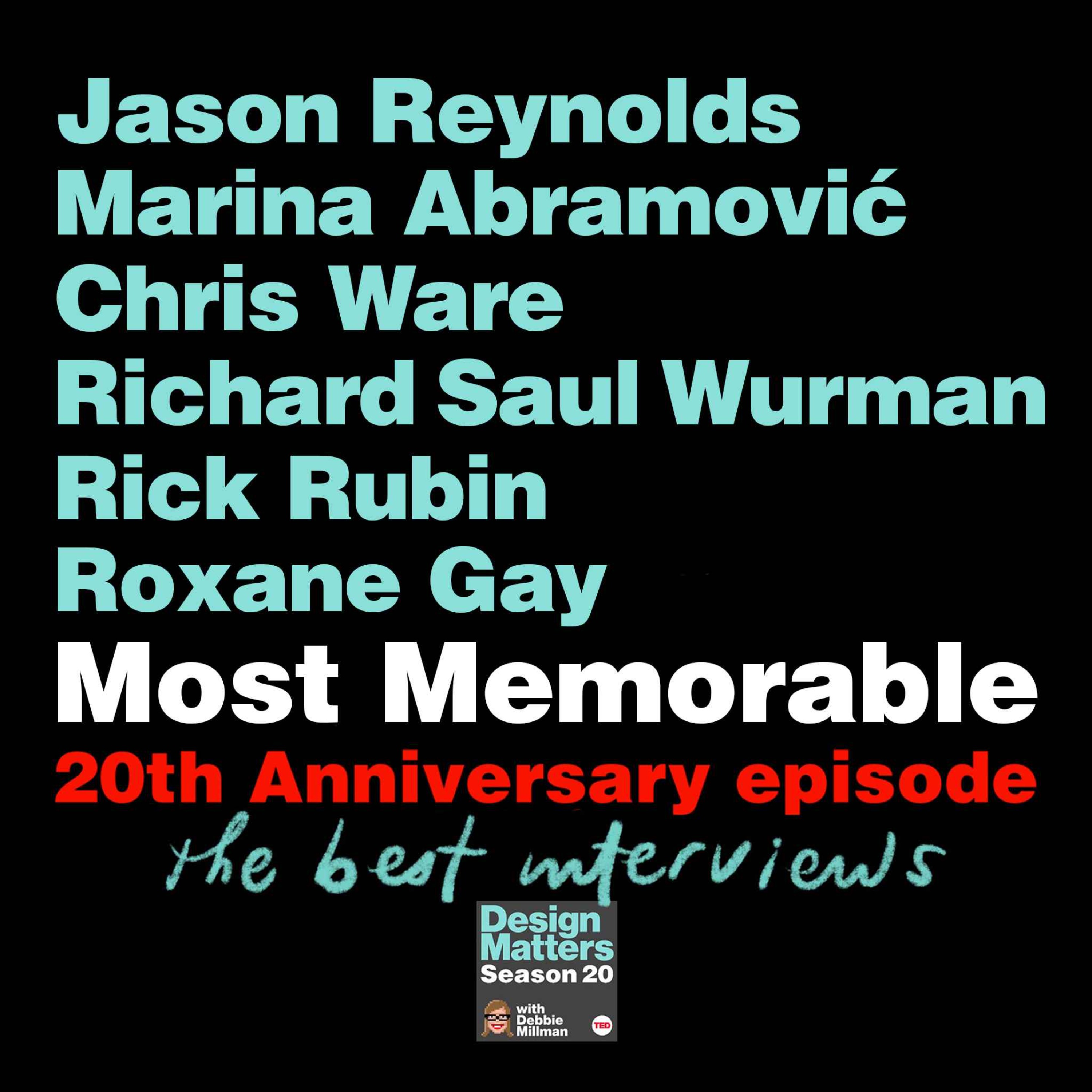
Design Matters with Debbie Millman
20th Anniversary celebration with the most memorable guests: Jason Reynolds, Marina Abramović, Chris Ware, Richard Saul Wurman, Rick Rubin, and Roxane Gay
00:46:02
Loading summary
Transcript151 lines
- [00:01]
Marina Abramovic
Okay, let's breathe.
- [00:02]
Jason Reynolds
First language has a way of living in the body.
- [00:05]
Richard Saul Wurman
My feet could be sticking out of my ears. I know that.
- [00:10]
Debbie Millman
From the TED Audio Collective this is.
- [00:12]
Rick Rubin
Design Matters with Debbie Millman.
- [00:18]
Debbie Millman
On Design Matters, Debbie talks with some of the most creative people in the world about what they do, how they got to be who they are, and what they're thinking about and working on. On this episode, in celebration of the 20th anniversary of design Matters, we'll hear from some of most memorable interviews that.
- [00:34]
Richard Saul Wurman
Debbie has done over the years.
- [00:35]
Rick Rubin
It's so interesting because it wasn't copying something.
- [00:39]
Chris Ware
I'm not trying to make it exciting either. I just want it to feel real.
- [00:43]
Roxane Gay
We have these very limiting categories into which we like to put women.
- [00:51]
Debbie Millman
At Schwab, how you invest is your choice, not theirs. That's why when it comes to managing your wealth, Schwab gives you more choices. You can invest and trade on your own plus get advice and more comprehensive wealth solutions to help meet your unique needs. With award winning service, low costs and transparent advice, you can manage your wealth your way at Schwab. Visit schwab.com to learn more.
- [01:15]
Progressive Insurance Announcer
This episode is brought to you by Progressive Insurance. Do you ever think about switching your insurance companies to see if you could save some cash? Progressive makes it easy. Just drop in some details about yourself and see if you're eligible to save money when you bundle your home and auto policies. The process only takes minutes and it could mean hundreds more in your pocket. Visit progressive.com after this episode to see if you could save Progressive Casualty Insurance Company and affiliates. Potential savings will vary. Not available in all states.
- [01:45]
Debbie Millman
This episode is sponsored by Gilt, your partner in taxes. If you're a business owner, you probably know that tax season shouldn't be just a once a year scramble. Yet for so many of us, that's exactly what it feels like. A flurry of forms, emails and missed opportunities. G is a modern tax planning and strategy solution for you and your business that takes a smarter approach, pairing real CPAs with AI to help you align your tax strategy to how your business grows. With Gilt, your dedicated CPA team reviews your strategy every quarter so you can optimize things like entity elections, retirement contributions and hidden credits or deductions before it's too late. It's proactive, transparent and built for growing businesses, from creative studios and design agencies to consultants and independent practitioners. Make taxes part of the business plan and schedule a call@joingt.com today to learn how your taxes can become a lever for growth. The very first episode of Design Matters launched on February 4, 2005, I recorded the show live from the Empire State Building building where I worked at the time. My first guest was the art director and designer John Fullbrook, who was also a dear friend in my archive of over 700 shows recorded since, it is the one episode I have no copy of, so if any of my longtime listeners have a download of the show, please hit me up. After my interview with John, I asked more of my designer friends to join me on the show and and as my guests began to send the links of the show to their friends, word spread throughout the New York City design community and I began to invite designers that I didn't know to join me on the show. By 2009, I began to extend invitations to people I admired in other creative fields. Now, 20 years later, I've interviewed designers and illustrators, musicians and podcasters, photographers, typographers, painters, graphic novelists, actors, directors, Memoir is fiction and nonfiction, writers, journalists, tech pioneers, poets, chefs, activists, and even a few scientists. Making this podcast has been one of the great gifts of my life over the decades. Whenever the tables are turned and I'm being interviewed the I inevitably get asked about my favorite episodes. I always fumble my answers, as it is truly impossible to choose who that favorite guest might be. So on today's show, the last of our 20th anniversary episodes, I want to take a different tack. Today we're going to play excerpts from some of what I consider the most memorable interviews I've done. Now, I know that it is a highly subjective act on my part. Certain interviews loom large in my memory for all kinds of reasons, and the list keeps evolving over time. But today I want to share excerpts from interviews that have helped shape or evolve or impact the way I conducted interviews thereafter. First up is author and MacArthur fellow Jason Reynolds. I interviewed Jason in 2022. Every question I asked led to a place much deeper and more nuanced than I anticipated. You've said you were raised in a household of really strong women who did not suffer fools and who believed in hard work and persistence. And from the time I think you were 2 years old, your bedroom routine included the affirmation I can do anything, as if it was a bit of a mantra. And you've said that she' did this to make sure you understood that the world was yours and that you could eat the world if you wanted to.
- [05:55]
Jason Reynolds
Absolutely.
- [05:56]
Debbie Millman
Did you believe her?
- [05:58]
Jason Reynolds
I didn't have a choice. I think that when you're that young and you, you know, this is the Beauty of language, right? That if you repeat that over and over again, language has a way of living in the body. It has a way of sort of fossilizing and attaching itself to the identity, right? This is why we have to be careful with language. We have to be careful with the things that we say, the things that we write, even the things that we say to ourselves silently. It's a tricky thing. And so my mother understood this because, I mean, this is a woman who basically is like 1960s, 70s hippie, right? Black hippie type, you know? And so, as you can see, right, there's like the psychics and the readings and the mantras, and this is all very early. This is before. All of these things have now been commodified in a really strange and very en vogue right, these days. But back then, as a little kid growing up in my neighborhood, it was important that my mother convinced me that I could do anything. Because she felt like if I believed that I could do anything, then I could, despite the challenges the world might have for me because I was a black boy, because I'm a human in the world, right? Life is complicated. She wanted to make sure that I knew that the world was whatever I wanted the world to be and that I could design my own life, right? That I could be the architect of my sort of human experience. That's a powerful thing to tell a child because as I got older and it was time for me to sort of take on a career or do this in school or do that, I only know that I can do anything. So I don't have any fear when it comes to trying anything or learning anything or like, I don't have any of that because that mantra is sort of tethered to my vertebrae in a different way.
- [07:36]
Debbie Millman
Is it true that you sometimes still whisper it to yourself?
- [07:40]
Jason Reynolds
Of course. Of course.
- [07:41]
Debbie Millman
I read that and I was like, oh, I wonder if that's true.
- [07:44]
Jason Reynolds
That is true. That is true. Especially in moments of doubt, right? I'm still a person who carries his insecurities, right? Like, that's just a part of who we are as human animals, right? And my insecurities are very real, very real. And I try to make sure people know that. I think sometimes we. We look at our heroes and we forget sometimes that they have vulnerabilities and weaknesses and insecurities that they too struggle with very basic things, right? And I think in those moments, I can do anything. It's something that I can always sort of run back to as an anchor.
- [08:20]
Debbie Millman
You've written about how your father was impossibly cool. He was covered in tattoos, he wore gold chains, he rode motorcycles, he had guitars and wore tight pants. And he was psychiatrist and the director of a mental health clinic. And I read that when you were a little boy, he wanted you to be comfortable around anyone who was neuro atypical or had addiction issues. And he often had patients over for dinner, which is rather atypical as well. What was your reaction to all of this?
- [08:51]
Jason Reynolds
You know, as a kid, I just thought it was all very normal. It's so funny, I look back on it all now and, you know, we'd have family barbecues, and my father's clients would come to the barbecue, you know, and some of them were living with schizophrenia. Schizophrenia or addictions, and, you know, bipolar two and all sorts of things that honestly never seem strange or abnormal because they're not strange and abnormal.
- [09:17]
Roxane Gay
Right?
- [09:17]
Jason Reynolds
And that was his point. He wanted us to make sure that we were okay with the fact that people's brains all work differently, including the people in our immediate family. Right. My older brother lived with all sorts of things. I live with my own mental illness. My father had his own. Right. And so I think his goal with that was to humanize everyone and to make sure that we understood that no one is any better or any worse than anyone else and that our brains do what our brains do, but our lives on this planet are all valuable lives, you know, and that was a gift. You know, he also, to his credit, he also, because he was all the. He was this very macho man, right? That the gold chains, the tattoos, the motorcycles, he. He really was all the cigars, right?
- [10:01]
Chris Ware
He.
- [10:02]
Jason Reynolds
The quintessential bad boy. But he was very affectionate, specifically toward his sons. He kissed his boys. It was a big deal for him. And the reason why I bring this up is because I think about my upbringing and I think about how my friends started to come out to me when I was very young, seventh grade, eighth grade, ninth grade, My male friends began to tell me that they were gay. Many of them, all of which were absolutely fine as far as I was concerned. Like, it was no big deal. As I got older, though, and you continued to sort of traverse homophobic spaces, which coming from my community was a normal thing, right? It was a. That was the standard. Homophobia was a standard. And as you sort of traverse the strange gauntlet of homophobia, you start to wonder, at least me, I started to wonder, why is it that I've never had a problem? And then I think back to My father. It is never strange for a man to kiss a man. Not to me, because my father kissed us so much. Right. He was so affectionate. Nothing seemed strange about this. As a young person, it never registered as different because it wasn't different in my household. You know, my father, who is now gone. You know, I'm forever grateful for that, for sure.
- [11:17]
Debbie Millman
You've talked about how when you were 10 years old and in the seventh grade, your whole life changed. Your parents split up, you started at a new school. This is when you first began being bullied. It was also the first time you ever started to fail. You gave up reading, your grandmother died, but it was also when you started to write. So I wanted to sort of talk about that time, take us back to that year. It's interesting. Seventh grade was sixth and seventh grade were when my life really blew up as well. My parents had gotten divorced right before that, but my mom got remarried to a man who was brutal to us. And everything changed. Everything changed. It's sort of a before and after line in my life. Talk about what you were going through and how you thought about it all.
- [12:08]
Jason Reynolds
Yeah, it was the worst and best year of my life. The first piece of context to that time, though, is that I was younger than I was supposed to be. For that age, Right. For that grade. So I was a 10 year old in the seventh grade. I had skipped a grade back in second grade. I skipped because I just had, like, advanced skills in certain ways and I was going to fail if they didn't skip me. I was going to fail because I was bored to death and refused to do anything. And my birthday's in December. So because of that, for the rest of my academic career, I was two years behind everybody else. So when I get to. So at 10 years old, I start middle school, my parents split, my father moves out. And because he moves out, he becomes the enemy because he's the person who left. Of course, we know it's more complicated than that. I learned much later down the line as you get older, Right. It's not quite as simple, but because he's the one who physically left the habitat, he's the enemy, right? So I'm dealing with that abandonment. And he was the coolest dad ever. So it also was a shock because I never saw my parents fighting and that they were like these loving, very affectionate, very fun and cool people who suddenly were no longer together.
- [13:13]
Richard Saul Wurman
Right.
- [13:14]
Jason Reynolds
So my life was upside down. Then what happens is I started a new school because my older brother took so many Lumps in middle school. My mom was like, I'm sending you to the neighborhood school. I just can't run the risk. Your father's not here to sort of keep his hand on you. The streets are calling, right? All of this stuff. And so she put me in Catholic school, which coming from my neighborhood, was a no, no, right? It's like, now I gotta wear a uniform. I gotta deal with, like, my. My neighborhood friends and, like, people, like, when you go to that, you know, why you don't go to school with us no more, all of this kind of stuff, right? And then I get to the Catholic school, and I'm outside of my neighborhood. I'm meeting new people, and I. But I'm smaller than everybody else because I'm younger than everybody else. And so the bullying begins, and I have to deal with that. And then on top of all of these things, and I'm dealing with the grief of my parents split. So I'm not doing well in school, and the school is a bit more rigorous than I'm used to. And so, like, I'm just struggling. I'm. I'm failing and I'm. I'm having a hard time. I'm trying to figure out how to be cool, which then causes me to posture. And I'm dealing with overcompensation, right? I should also note, my older brother, who was my hero, is also suffering in life, right? He's been stabbed, he's lost. I mean, all kinds. It was just one of those years, you know? And then my grandmother dies. And so now I'm dealing with the first time I'm seeing my mother, the strongest person I know, broken, right? Because even in the midst of the divorce, she was able to sort of hold it together for the kids, right? But with the death of her mother, I think that was sort of the final straw, and it broke her down. It was the first time I heard my mother cry. And all I knew to do was to write down a few words because I had spent so many years, actually, I had spent that year discovering rap lyrics. So all this is the same thing. This is the same year. That 10th year of my life is also when I start reading rap lyrics. And that sort of was opening my mind up to the possibilities of language, sort of evoking feeling and emotion and mental and emotional change. All of this is happening at the same time. And so when my mother begins to cry, I go to the one thing that's been helping me, which are these rap lyrics, and I write down a few lines and not thinking anything of it. Just thinking like, this is all I have to offer my hero. And she prints it on the back of the funeral program. They read it at the funeral and my life changes forever. The funny thing about this, though is also because this is my 10th year, everything I do, that's really the year that I'm pulling from all these books. Yes, the character might be 12 or 14 or 16 or 18, but I'm sort of arrested in that 10th year. I even ask people all the time, like, what? What would you thank your 10 year old self for? You know, when you look at what.
- [15:55]
Debbie Millman
Would you thank your 10 year old self for? What would you say?
- [15:58]
Jason Reynolds
I would thank my 10 year old self for his hopefulness, right. For his fortitude that he shouldn't have had to have. For his ability to, even in the midst of all the pressures of it all, to carve out who he was and to be firm in that.
- [16:15]
Richard Saul Wurman
Right?
- [16:16]
Jason Reynolds
Like, I only could overcompensate for a few months before I told my mother, I can't. I don't want no more name brand clothes. It ain't my jam. You ain't gotta buy me all of the. Let them tease me. They'll get over it, right? Like I was in the seventh grade.
- [16:29]
Chris Ware
Yeah.
- [16:30]
Jason Reynolds
Making bold decisions like, you know what? I just gotta be me and I gotta deal with me and I gotta deal with what's going on. And I'm grateful for that. You know, I'm grateful for that kid because that's the same kid that I am today. Deep down inside, I'm the same kid who was fighting for his own independence, individualism, who is trying to have his own voice, be his own voice in the world every day of my life.
- [16:52]
Debbie Millman
That was Jason Reynolds in 2022. Here we go. First step out of the gate.
- [16:59]
Marina Abramovic
Okay, let's breathe. First, close your eyes and breathe.
- [17:06]
Debbie Millman
That was the auspicious beginning of my interview with legendary performance artist Marina Abramovic in 2017. Now, I still get nervous before every interview, but with Marina, my apprehension was off the charts. She intuited that and helped me through it.
- [17:27]
Marina Abramovic
Air in, deep from stomach and then out. But I don't hear you breathing. Come on, really breathe. Breathe in art. Now open your eyes and ask me questions.
- [17:45]
Debbie Millman
Here's part of what we talked about. One of your next pieces where you actually did have a number of props was rhythm zero.
- [17:53]
Marina Abramovic
Yes. We are talking 74. This is Young, insecure artists.
- [17:59]
Debbie Millman
Well, this is an incredible piece. You place 72 objects on a table, including a rose A razor, a pistol with a solitary bullet in it, A real bullet. And you invited the audience to do whatever they wanted to over the funnel. Six hours. They started out rather kind and then became crueler. Can you talk a little bit about what happened?
- [18:20]
Marina Abramovic
First of all, it's very important why they did this. You know, every performance have a reason. In that time, we're talking early 70s performance was not seen as any part of art. You know, this was actually crucified. They were saying, we are masochists.
- [18:35]
Debbie Millman
We are sad that you needed to be put in a psychiatric hospital.
- [18:38]
Marina Abramovic
Exactly. And it's totally dismissing us. Any work. And then I was thinking, okay, if this is a kind of opinion of the public, general opinion of the people, what if I put this objects on the table for pleasure. But you know, I put a rose, I put shawl, I put beautiful things too. And then I put the chains and saw and needles and knives and real bullet with real pistol. I had the little text on the table saying, I'm an object. You can do anything on me if you want. You know, including killing me using the all objects and for six hours. So I. I give them permission basically to use anything. And I am not doing anything. I'm dressed and I'm standing there. So I'm not masochist, I am not exalted. I am not sadist. I'm not doing anything. I'm just artist standing there and see if you give complete freedom to the public, what will happen after this performance? I knew one thing, that the public can kill you. I will never kill myself. I know it's my limits and I don't want to kill. I mean, love my life very much. But the public can kill you. This is so important. But also I learned from this performance. One more thing. If you give the tools for the public to bring the spirit down, they will use it. But you also can give the tools to your public to lift the spirit, which took me 25 years to learn in an artist's presence. I gave them just the chair. The spirit went somewhere else. But this was 25 years between these two pieces that I learned that lesson.
- [20:09]
Debbie Millman
Were you surprised at the time how cruel people could be? I mean, they ripped your clothing, they scratched you, you nearly got shot. If somebody hadn't interfered, you very likely would have gotten shot. Somebody pulled the gun away from the man that put it to your forehead.
- [20:26]
Marina Abramovic
Yes. You know, I prepare for this performance to be completely without will, which is not easy. So six hours. If you put my hand up, I will leave my hand up if whatever you do, they will, they will carry me around, they will put me on the table, put nine between my legs. You know, it was so scary. All what I have to do is to just look in one point somewhere far away between all of this public and just be there like I am on the total disposal. But after six hours, when they pass and the galleries came and said our time is over. It was two in the morning and I start walking to them, you know, I was half naked, I was full of blood. There was the people, you know, they give me rolls, but then they cut the with knives, the claws. And then they put tor of the rose in my body. Then one cut still a scar and drink my blood. I mean, it was unspeakable what people can do. And also it was very important the time because if I give them one hour, that would be just okay. But six hours. So people start kind of opening more and more and more and you know, midnight pass and then become very, very difficult. One reason I was not raped, because it was a normal gallery opening. People's coming with their wives. It was like. But then do you think if the.
- [21:40]
Debbie Millman
Wives weren't there, you would have gotten married?
- [21:41]
Marina Abramovic
You know, this was probably but which was very interesting. Also the woman was not touching me. But they would tell men what to do to me, which was very, very scary too. But one thing would happen when six hours passed and I the. The galleries came and said to me, now it's finished. So I become me and I start walking to them and I was hell and mess. And you know, they start running. The people literally run out of the gallery and the next couldn't face you. And then they. And when I become, you know, normal human being and then when they, you know, the next day they will call, they'll apologize, they don'. Know what happened and so on. And I remember coming to the hotel and looking myself in the mirror and I had a big piece of gray hair. I just overnight your hair went gray. Since then, I paint. I hate gray hair.
- [22:27]
Debbie Millman
Marina Abramovic in 2017 in 2012, the illustrator and graphic novelist Chris Ware joined me on Design Matters to talk about his life and his now classic award winning graphic novel Building Stories. I love this interview, not only because I love Chris Ware, but I also love everything he has brought into the world. Here is a short excerpt. I was talking to Emily Oberman about you and asked her, if you had to ask Chris one question, what would it be? And she wrote back, why so sad?
- [23:03]
Chris Ware
I'm not trying to make it sad. I just. I'm trying to capture a feeling of life as I've experienced it. And I don't intend it to be, but I mean, life is generally long stretches of waiting or doubt or anxiety or nervousness and in my own case, sometimes sadness too. And that's part of life. I'm not trying to shy away from it. I'm not trying to make it exciting either. I just want it to feel real. But I'm not trying to be ultimately very depressing or to bum people out, as those younger than me might say. I really, really admire the movie Tokyo Story. I think it's my favorite movie. And I realized, I think maybe the second time I watched it, that he had captured this feeling of life that we spend so much of our time trying to tamp down and repress that suddenly I was feeling this sort of. I don't know what the word would be, maybe kind of heartache or profound sense of empathy or wanting to be good in some way that I remember feeling as a child all the time. And then as I became an adult, somehow I figured out ways of repressing it or setting it aside and somehow making it through life without having that be at the forefront just because it became too difficult to deal with. And I think, I mean, if I could Even just get 1/1,000th of a percent of that into what I'm doing, I'd feel that it somehow succeeded at what I was aiming for.
- [24:33]
Debbie Millman
Well, I think it's more than one thousandth of a percent. I think that one of the most remarkable characters in Building Stories is the building, the building itself. And the building has its own soul. The building loves the pitter patter of pink feet and tracks, keeps track of how many people live there, how many pregnancies removed radiators, squashed bugs, telephone calls, orgasms, punches, screams, breakfasts and so on. What made you dec to give the character of the building such a realness, such a humanity?
- [25:09]
Chris Ware
Well, on one hand it is the sort of self conscious creative construction on the part of the woman to write for her creative writing class. It's one of those big ideas that you try when you're a beginning writer or artist that sometimes can go horribly wrong, but then other times can somehow open up possibilities of feeling that you might not otherwise have expected. And on the other hand, it's just simply something I am interested in and think about a lot. I think about the history of a building and the things that have happened within. Sounds crazy, but if you start thinking about a building, it can almost start to seem like a living organism through time. My friend Tim Samuelson, who's the cultural historian of the city of Chicago, really genuinely feels empathy for buildings and for what they've experienced through various generations, and that he's been a big influence in my life in that way.
- [26:06]
Debbie Millman
You state in the book this is an actual quote from Building Stories.
- [26:10]
Chris Ware
Oh no.
- [26:11]
Debbie Millman
Who hasn't tried when passing by a building or a home at night, to peer past half closed shades and blinds, hoping to catch a glimpse into the private lives of its inhabitants? Anything the briefest blossom of a movement may be a hedge bobbing up, a mysterious shadow or a flash of flesh seems somehow more revealing than any generous greeting or calculated cordiality. Even the disappointing diffusion of a sheer curtain can suggest the most colorful bouquet of unspeakable secrets. And you then go on and you give the amputee character a statement and she says, I know it's dumb, but I can't help it. Ever since I was a kid, I felt sorry for things no matter how inanimate. I would get so carried away, I'd hug a table leg or kiss a chair goodbye. I'd compulsively dare myself to grant a personality to anything and everything. Do you do that in real life?
- [27:18]
Chris Ware
I used to. Yeah, me too.
- [27:20]
Marina Abramovic
Yeah?
- [27:20]
Chris Ware
For real? Yeah. I used to kiss the television at Christmas time when there were, you know, those holiday specials on. Because I know I wouldn't see him again for a year.
- [27:31]
Debbie Millman
I kissed Mr. Rogers.
- [27:32]
Chris Ware
You did? Oh, that's wonderful. He's one of my great heroes. Fred Rogers was one of the greatest Americans who lived in the 20th century.
- [27:40]
Debbie Millman
So Chris Ware this episode is sponsored by Gilt, your partner in Texas. If you're a business owner, you probably know that tax season shouldn't be just a once a year scramble. Yet for so many of us, that's exactly what it feels like. A flurry of forms, emails and missed opportunities. Galt is a modern tax planning and strategy solution for you and your business that takes a smarter approach, pairing real CPAs with AI to help you align your tax strategy to how your business grows. With Gilt, your dedicated CPA team reviews your strategy every quarter so you can optimize things like entity elections, retirement contributions and hidden credits or deductions before it's too late. It's proactive, transparent, and built for growing businesses, from creative studios and design agencies to consultants and independent practitioners. Make taxes part of the business plan and schedule a call@joingelt.com today to learn how your taxes can become a lever for growth.
- [28:51]
Jason Reynolds
In a world where January is supposed to be boring, one staple of the.
- [28:56]
Rick Rubin
Holidays refuses to end the great deals at Verizon. The joy just keeps on coming.
- [29:04]
Jason Reynolds
Right now you can save on four.
- [29:06]
Rick Rubin
New phones and four lines.
- [29:09]
Jason Reynolds
Critics agree it's the deal that keeps on giving.
- [29:12]
Debbie Millman
Come into Verizon and save on four.
- [29:14]
Rick Rubin
New phones and four lines on unlimited. Welcome additional terms. Apply@seeverizon.com for details.
- [29:20]
Debbie Millman
Schwab, how you invest is your choice, not theirs. That's why when it comes to managing your wealth, Schwab gives you more choices. You can invest and trade on your own. Plus get advice and more comprehensive wealth solutions to help meet your unique needs. With award winning service, low costs and transparent advice, you can manage your wealth your way at Schwab. Visit schwab.com to learn more.
- [29:43]
Progressive Insurance Announcer
This episode is brought to you by Progressive Insurance. Fiscally responsible financial geniuses. Monetary magicians. These are things people say about drivers who switch their car insurance to Progressive and save hundreds because Progressive offers discounts for paying in full, owning a home and more. Plus, you can count on their great customer service to help you when you need it. So your dollar goes a long way. Visit progressive.com to see if you could save on car insurance, Progressive Casualty Insurance company and affiliates. Potential savings will vary. Not available in all states or situations.
- [30:19]
Debbie Millman
And now for something completely different. My most contentious interview. I like to think my interviews are convivial. Not so with Richard Saul Wurman, a designer by training. Wurman has authored over 90 books and he founded the TED Conference. When he joined me on the podcast in 2017, I discovered that this was not going to be the usual Design Matters interview. The last question I want to ask you is about a question you have often started conversations with. You state you don't know me, but you owe me. Why is that a favorite conversation starter for you?
- [31:05]
Richard Saul Wurman
Sets an edge to everything else I say, and it's provocative and and to start something I want to make sure the audience is awake and they automatically don't like me and I have to win my way back into their belief system.
- [31:20]
Debbie Millman
Why do you want to do it?
- [31:21]
Richard Saul Wurman
Because that struggle is good. Why? Because I like that struggle. The edge. I like terror. I like the edge of things. It's the edge that keeps me awake. It's the edge that's interesting to me. Comfort is not your friend or my friend. I don't want to be comfortable. I want the discomfort of thinking of the next thing, the discomfort of what doesn't work, the understanding of failure and the joy of confidence and the discomfort of terror and the joy of admiration.
- [31:58]
Debbie Millman
What does the discomfort of terror mean to you?
- [32:03]
Richard Saul Wurman
It means that I can't figure it out yet. I mean, coming here and talking to you is terrifying. But I'm confident it'll be okay. But I'm terrified. But I'm confident it'll be okay. And I could keep on saying that.
- [32:13]
Debbie Millman
Why are you terrified?
- [32:15]
Richard Saul Wurman
I just always am. Because there's. There's always the edge of what I'm gonna think of or what I say or whether it's what I've said is clear to myself.
- [32:27]
Debbie Millman
Is it a lack of control that you're worried about?
- [32:29]
Richard Saul Wurman
No. No.
- [32:30]
Debbie Millman
So then why would there be?
- [32:32]
Richard Saul Wurman
I'm not very much under control, so I know I'm always gonna stick my foot in my mouth. I'm aware of that. You could edit this thing out. My feet could be sticking out of my ears. I know that.
- [32:41]
Debbie Millman
Why would I wanna do that?
- [32:43]
Richard Saul Wurman
I didn't say you wanted to do that. I said you could do. Quote my language. Okay. I said you could do that. I didn't say you would want to do that.
- [32:52]
Debbie Millman
I'm not saying that. You're saying that. I'm actually trying to respond with the notion that something like that wouldn't be something that I would consider. And so I'm curious as to why you think I would.
- [33:07]
Richard Saul Wurman
Okay. I didn't say you would. I said you could.
- [33:10]
Debbie Millman
Right.
- [33:11]
Richard Saul Wurman
But that didn't say you would. I know, but this is just back and forth.
- [33:15]
Debbie Millman
No, it isn't. No, this isn't. Richard, I'm actually trying to come back to you with a response that's genuine. And then you're spinning it around. You said that I could do that. And I'm saying, yeah, I could. But what would that benefit it be? Why would I want to do that? That's just not something that I feel would be noble.
- [33:34]
Richard Saul Wurman
Well, I think that's. I think that's good. And I now appreciate your nobility more.
- [33:38]
Debbie Millman
Thank you. I appreciate that. Anything else you want to talk about?
- [33:42]
Richard Saul Wurman
Sure.
- [33:44]
Debbie Millman
Richard started talking about a new project of exploring the importance of asking questions in an educational process. And then we got into my questions.
- [33:56]
Richard Saul Wurman
The interlocutory that you and I are having. And some of the granular friction between us is I don't think some of the questions are good questions. They're provocative, but I don't think they're really good questions. And I so deeply believe in the good question. The question that is so creative that you learn something from the question. But a good question is revealing to the next step. It is like a good conversation, and it never has to be friendly. I had a very tough back and forth lunch today with John Kamen, asking his advice. He's head of Radical Media, and it was questions back and forth, and it wasn't always pleasant. But it leads to the next step. It doesn't get stopped because it goes nowhere. So I think, again, a good question is a creative act that leads to an epiphany, a clarity about something.
- [35:00]
Debbie Millman
Do you think that a good question is one that you have to like?
- [35:05]
Richard Saul Wurman
No.
- [35:07]
Debbie Millman
So if you don't like the question, does it mean it's a bad question?
- [35:11]
Richard Saul Wurman
No. My not wanting to answer certain questions was an answer to the question.
- [35:15]
Debbie Millman
Right. But you also were clear that you didn't like some of my questions. Yeah, that's fine.
- [35:21]
Richard Saul Wurman
They might be good questions and I don't like them. And my mood in not liking them tells you a lot about what I feel about the question or the information. No, it's not a total waste.
- [35:29]
Debbie Millman
No, I don't think it's a waste at all. I think this is actually a really interesting conversation. I'm curious as to why you like to talk about certain things and don't like to talk about certain things when talking about yourself.
- [35:44]
Richard Saul Wurman
I like talking about things that lead me into the next thing I want to solve of hearing myself talk and hearing what the path is. I am not interested in legacy. I'm not interested in what I did. I'm just not interested in it.
- [36:00]
Debbie Millman
I want to thank you for being on the show today. It's been an enlightening and unusual experience.
- [36:06]
Richard Saul Wurman
I would love to do it over.
- [36:08]
Debbie Millman
Okay. Okay. And lo and behold, dear listeners, we did do it over. Well, perhaps it's more accurate to say that we kept the conversation going for a little while longer. My producer was mortified and wanted to kill the interview, but I insisted and we published it anyway. I got a lot of mail about this interview, and one of the reasons that it is so memorable to me is that Richard wrote me afterward and let me know he actually thought it was a good interview. That was really gratifying. In 2023, I interviewed the record producer, Rick Rubin, who at last count has won nine Grammy awards and has worked with everyone from Jay Z to Johnny Cash. We had our conversation shortly after his book the Creative act was published, and to date, the book has been on the New York Times bestseller list for over 32 weeks. You founded your next punk band, Hoze, in 1981. And I understand that at the time, the band Flipper was a big influence. I have been a huge Flipper fan for as long as I can remember. I think they had one of the greatest logos rock and roll logos of all time. In what way were they an influence to.
- [37:34]
Rick Rubin
Up until that point, I understood punk rock to be fast music. Flipper was the first punk band that played slow music, almost like sludgy music. And it was very innovative to me and it inspired me to start a slowpunk band. So I would say that that was probably the. As close as it got to flipping. But it's pretty close because it was. They were the only ones doing that. So it was definitely derivative of Flipper. I don't think so many bands came in their wake doing what they did. But then, you know, Kurt Cobain says Flipper was his biggest influence as well. So interesting to see the tentacles of a band because it's funny, everyone I knew, all the punk rockers I knew had the Flipper album. I knew the guys in the band and I met the people at the record company. And everyone I knew had this album. And it sold 10,000 copies. Which other albums sell 500,000 copies or a million copies at that time? Yet here's one that sold this many. And I know everyone I know has it. So I started having more of a sense. Well, it messed up my sense of. Of thinking I know what popular is, because I didn't. And the idea of how much love and energy can be created with a small group of people with a niche audience. Because for a period of time, Flipper was my very favorite band. Whereas maybe three years or earlier, four years or five years earlier, maybe it would have been acdc, who sold millions and millions of albums. So for me, they were in a sense the same. Like their impact on me was the same, but their impact on the world was not.
- [39:32]
Debbie Millman
Which I find really kind of upsetting. I think that their seven minute song Brainwash from the compilation Sex Bomb Baby is one of the best pop punk rock songs ever written.
- [39:45]
Rick Rubin
It's so cool. What a love canal. So cool. The Wheel. They have a song called the Wheel. That's Incredible.
- [39:53]
Debbie Millman
Your first 12 inch EP was titled Hose and according to the liner notes, it was recorded on one Sunday in April 1982, between the hours of 10pm and 1am And I believe he designed the COVID which was an homage to composition two made by Mondrian. Yes, and the Hose album was the first time the Def Jam logo was placed on a cover. I believe And Def Jam was a company, the record company you started in your dorm room at nyu. And your dorm room was literally the company's headquarters. And the NYU mailroom became Def Jams as well. And your dorm room address was on the album sleeves. How did you first come up with the name Def Jam?
- [40:38]
Rick Rubin
It was street slang for great music, great record. It was something you might hear somebody say who spoke the lingo of the street.
- [40:48]
Debbie Millman
And you've said that the large D and J letter forms were as much for the role of the DJ in Def Jam as for the words themselves.
- [40:58]
Rick Rubin
Absolutely.
- [40:59]
Debbie Millman
Why?
- [40:59]
Rick Rubin
So one of the reasons I started recording rap music at all was the people who were making it were experienced music makers who had made music before. And hip hop was a really revolutionary new genre. And the people who made music in other ways from before hip hop didn't really understand what it was. They made it more like the things that had come before. So it was not unusual to hear on the earliest of rap records before the Def Jam records, the musical track might sound the same as an R and B track that you might hear someone singing on if you went to a nightclub. The perception of the more experienced people at that time was, okay, we make this R and B song and instead of having someone sing the melody, we'll get a rapper to rap on it. And that's an aspect. That's one aspect of hip hop, but it's not the whole picture of hip hop. And I would go to hip hop clubs, and what was exciting about it was the dj. The DJ really was the star of the show. And it was all about montage. It was about taking old things and finding a way to reinterpret them. It's so interesting because it wasn't copying something. It was taking a tiny aspect and turning this tiny aspect into something new. And it was very exciting. And it was done through human DJing. It was done through dexterity. It wasn't done through machines. So there was a performance aspect, even in replaying someone else's music. And that's what hip hop really was. So I would have these experiences of going to these clubs with this incredible music rapping beside the rapping, incredible music. And I wanted to basically just document that, because as a fan, if someone had already done it, I probably wouldn't have done it. The only reason I did it was as a fan wanting to be serviced as a fan. And I wasn't being serviced. So I made it because I wanted it to exist.
- [43:21]
Debbie Millman
That was rick Rubin in 2023. Finally, I guess I can say this is my favorite guest of all time, my wife, roxane gay. In 2019, she joined me on stage for a live Design Matters episode at the On Air Fest. Back then, we were getting to know each other. I'm not going to tell you exactly where we were in our courtship, because I inadvertently gave it away in the interview itself, to Roxane's surprise. In the New York Times review of your book Difficult Women, the author declares what constitutes a difficult woman for Roxane Gay? She's easy. By the third date, one of her troubled, troublesome narrators tells us, we have already slept together twice. I'm not a hard sell. She's also needy, moody, and above all, unpredictable, which makes her dangerous. When I read that, I thought, that doesn't really sound like the definition of difficult to me. And I'm wondering if we could talk a little bit about why that even is something that is posited as difficult. Sounds interesting.
- [44:35]
Roxane Gay
It does sound interesting. I think anytime a woman demonstrates any amount of personality, self actualization or free will, we're like, oh, this bitch is fucking difficult. And that's really frustrating because we have these very limiting categories into which we like to put women and contain them. So anytime you try and get out of those categories, you start to create problems. And so it's interesting. And I don't think it's actually difficult, but I do think we are considered difficult in those circumstances. And so, especially in Difficult Women, I was trying to explore what are the circumstances in which a woman is behaving in a completely rational and normal way and is considered difficult.
- [45:22]
Debbie Millman
And we see that over and over and over again, whether it be Serena Williams, whether it be Hillary Clinton. And you've said that you want characters to do bad things and get away with their misdeeds.
- [45:32]
Roxane Gay
Yes.
- [45:33]
Debbie Millman
You want characters to think ugly thoughts and make ugly decisions. You want characters to make mistakes and put themselves first without apologizing for it. And as I was reading those lines, I was wishing that I could be a person like that. Like that is the definition of, for me, what a happy woman looks like. And I'm wondering if there was any projection in those lines for yourself too, because it really does sound like the perfect woman.
- [45:59]
Roxane Gay
Well, thank you. I am the perfect woman. Ha ha.
- [46:02]
Debbie Millman
She said she was easy.
- [46:05]
Roxane Gay
I mean, my fiction is indeed fiction. It is made up. But there's always a lot of wishful thinking. And I wish I could do this. I wish I could behave in this way. I wish I could could say this without consequence.
- [46:18]
Debbie Millman
But you could. I mean, now you could, you could.
- [46:21]
Roxane Gay
But there are always consequences. And so I think about consequences. And this goes back to, of course, caring about the approval of others. And so oftentimes, especially in difficult women, those women are doing the kinds of things that I think a lot of women would love to do if they were freed from the constraints of womanhood in the world as it is.
- [46:42]
Debbie Millman
You begin the book Hunger with this statement. Everybody has a story and a history here. I offer mine with a memoir of my body and my hunger. Writing this book is a confession. These are the ugliest, weakest, barest parts of me. Roxane, what about the book do you find to be ugly or weak? Or what part of the bareness is something that you don't like?
- [47:11]
Roxane Gay
Well, with Hunger, it was a book about my body. Now, when you live in a fat body and you move through the world, people make assumptions. They see you, they think they know the story of your body. And with Hunger, I was telling the truth of my body. And some of it may have met people's expectations and some of it may not have. And it's just terrifying to tell the truth about yourself, to tell the truth about what it's like to live, live in your body. And parts of it felt ugly to me. Sometimes the truth feels ugly. It feels like it's too much, it's too needful. And especially when I was writing that book, which was definitely the most difficult thing I've ever done, professionally at least, it just felt like, oh, this is hateful, hideous stuff. And part of that, of course, is shaped by misogyny and fat phobia. And even though you think I, I'm against these things, you internalize them nonetheless. And so a lot of that was just internalized self hatred brought about by what it means to be a woman in this world.
- [48:16]
Debbie Millman
Reading Hunger, I think, was my first foray into falling in love with you. So what was it like for you to.
- [48:25]
Roxane Gay
I like how she just dropped that little snippet.
- [48:29]
Debbie Millman
What was it like for you to receive such an immensely positive reaction to something that was so difficult to write?
- [48:34]
Marina Abramovic
Right.
- [48:38]
Roxane Gay
It was good. It was good. It was great.
- [48:41]
Debbie Millman
Did you ever feel nervous about everything that you'd put out there?
- [48:44]
Roxane Gay
Oh, yeah, I was terrified. I was deeply, deeply terrified. I was just deeply terrified. What are people going to think? What are they going to say? And yet people have responded in, in really moving and profound ways ever since the book came out. Like, women come up to me and just tell me, oh, my God, I see myself in this book and I feel kinship. It got me a girlfriend, which is pretty great. So it was A lot of really good things came from that book. And also it really helped me to recognize the chip on my shoulder where I think that only people who know experiences like mine can understand what it's like to feel need and to feel hunger and to feel loneliness. And the book has shown me that no, lots of people feel this way and lots of people can connect to what's truly at the heart of this story. And so that's been really meaningful as well.
- [49:40]
Debbie Millman
My future wife, roxane gay in 2019 okay, we are at the end of our celebration of 20 years of Design Matters and have started recording our 21st season. In the meantime, you can listen to an archive of over 700 interviews with some of the world's most creative people on our website, designmattersmedia.com or wherever you get your podcasts. We'll be back next week with a brand new episode. And remember, we can talk about making a difference. We can make a difference, or we can do both. I'm Debbie Millman and I look forward to talking with you. Okay, Design Matters is produced by the TED Audio Collective by Curtis Fox Productions. The interviews are usually recorded at the Masters in Branding program at the School.
- [50:33]
Richard Saul Wurman
Of Visual Arts in New York City.
- [50:35]
Debbie Millman
The first and longest running branding program in the world. The Editor in chief of Design Matters.
- [50:40]
Rick Rubin
Media is Emily Weiland.
- [50:45]
Debbie Millman
This episode is sponsored by Gilt, your partner in Texas. If you're a business owner, you probably know that tax season shouldn't be just a once a year scramble. Yet for so many of us, that's exactly what it feels like. A flurry of forums, emails and missed opportunities. YELT is a modern tax planning and strategy solution for you and your business that takes a smarter approach, pairing real CPAs with AI to help you align your tax strategy to how your business grows. With ghelt, your dedicated CPA team reviews your strategy every quarter so you can optimize things like entity elections, retirement contributions, and hidden credits or deductions before it's too late. It's proactive, transparent and built for growing businesses, from creative studios and design agencies to consultants and independent practitioners. Make taxes part of the business plan and schedule a call@joingt.com today to learn how your taxes can become a lever for growth.
- [51:52]
Jason Reynolds
In a world where January is supposed.
- [51:55]
Rick Rubin
To be boring, one staple of the holidays refuses to end the great deals at Verizon, the joy just keeps on coming.
- [52:06]
Jason Reynolds
Right now, you can can save on.
- [52:08]
Rick Rubin
Four new phones and four lines.
- [52:11]
Jason Reynolds
Critics agree it's the deal that keeps on giving.
- [52:14]
Debbie Millman
Come into Verizon and save on four.
- [52:16]
Rick Rubin
New phones and four lines on unlimited. Welcome.
- [52:19]
Jason Reynolds
Additional terms apply.
- [52:20]
Rick Rubin
See verizon.com for details.
- [52:21]
Progressive Insurance Announcer
This episode is brought to you by Progressive Insurance. Do you ever think about switching your insurance companies to see if you could save some cash? Progressive makes it easy. Just drop in some details about yourself and see if you're eligible to save money when you bundle your home and auto policy. The process only takes minutes and it could mean hundreds more in your pocket. Visit progressive.com after this episode to see if you could save Progressive Casualty Insurance Company and affiliates. Potential savings will vary. Not available in all states. Hey, it's Adam Grant from ted's podcast Work Life, and this episode is brought to you by ServiceNow AI is only as powerful as the platform it's built into. That's why it's no surprise that more than 85% of the Fortune 500 companies use the ServiceNow AI platform. While other platforms duct tape tools together, ServiceNow seamlessly unifies people, data workflows and AI connecting every corner of your business. And with AI agents working together autonomously, anyone in any department can focus on the work that matters Most. Learn how ServiceNow puts AI to work.
- [53:24]
Debbie Millman
For people@servicenow.com hey, it's Paige Desorbo from Giggly Squad, and we're partnering with Abercrombie for the launch of their new spring denim collection. This episode is sponsored by Abercrombie. Make Abercrombie denim the core of your capsule wardrobe because denim should feel like this. Abercrombie's 90s inspired fits are better than vintage, and the pair you need right now is the wide leg jean. It's lightweight, it's effortless, and elevates any outfit. Every pair available in both classic and curve. Love the viral fit that eliminates waist gap. It's easy to find your perfect pair, so shop Abercrombie Denim in the app, online and in stores.