Loading summary
Transcript104 lines
- [00:06]
Debbie Millman
Hello there. Hello Laverne.
- [00:08]
Laverne Cox
Thank you so much for being here and doing this.
- [00:10]
Debbie Millman
I want to say what I think everybody in the room is saying. How is it possible that you're even more gorgeous in person than you are on television? I am just awestruck. It's going to take me a moment to get my sort of wits about
- [00:26]
Podcast Host (Side Hustle Pro)
me
- [00:30]
Narrator/Producer (Design Matters)
from the TED Audio Collective. This is Design Matters with Debbie Millman. On Design Matters, Debbie talks with some of the most creative people in the world about what they do, how they got to be who they are, and what they're thinking about and working on. On this episode, Debbie speaks with Laverne Cox about her life and career and about the effects of fame on her aspirations.
- [00:54]
Laverne Cox
I know my job is to be myself and to become more of my foreign.
- [01:06]
Nick or Jack (Best One Yet Podcast)
This is Nick and Jack from the Best One Yet Podcast. Now, the last company we worked at, they used Paylocity and everything just worked. It wasn't until launching our own media business this show that we realized how rare that is.
- [01:17]
Paylocity/LEDN Advertiser
Because Paylocity is one delicious burrito of operational needs. They roll up HR finance and it seamlessly into one delicious bite.
- [01:26]
Nick or Jack (Best One Yet Podcast)
When everything wraps together like that, all at once, your workforce, your tech stack, your business. You don't need more tools, you don't even need philanthrop.
- [01:32]
Paylocity/LEDN Advertiser
You need one solution.
- [01:33]
Nick or Jack (Best One Yet Podcast)
And that is why Paylocity built a single platform to connect HR finance and IT with AI driven insights and automated workflows that simplify the complex and power what's next.
- [01:42]
Paylocity/LEDN Advertiser
Or as we call it, a delicious operational burrito.
- [01:45]
Nick or Jack (Best One Yet Podcast)
Yes, we do experience a one place for all your HCM needs besties. So start now at paylocity.com1paylocity.com O N
- [01:55]
Paylocity/LEDN Advertiser
E When opportunity requires capital, be ready. LEDN's Bitcoin backed loans give you liquidity across time zones. 20247 when timing matters, access to capital is critical. LEDN gives you liquidity so you can move quickly without disrupting your Bitcoin position. And LEDN has funded over $11 billion in loans since 2018, with a perfect track record of protecting client assets. Get a LEDN Bitcoin Backed loan today. Visit LEDN IO.
- [02:28]
Kohler Smart Toilets Advertiser
This episode is sponsored by Kohler Smart Toilets. The objects we interact with most are often the ones we notice least. The Kohler Smart Toilet challenges that assumption. What if the most overlooked space in your home could become the most considered their vail Smart Toilet is a sculptural silhouette that isn't just intentional, it's a philosophy that design changes everything. The KOHLER Vail Smart Toilet is sleek with a rounded shape that's more like architecture than just plumbing. And it goes beyond looks. The touch screen controls and customizable cleansing features offer a level of comfort and cleanliness that exceed expectations. It's all about elevating those ordinary daily rituals into something extraordinary through thoughtful design. Kohler has been pushing these boundaries for over 150 years, mastering that balance of stunning form and high performance function. That's a long time to get it right, and it should shows in every detail. Experience the difference of Kohler Smart toilets. Find out more@kohler.com
- [03:44]
Debbie Millman
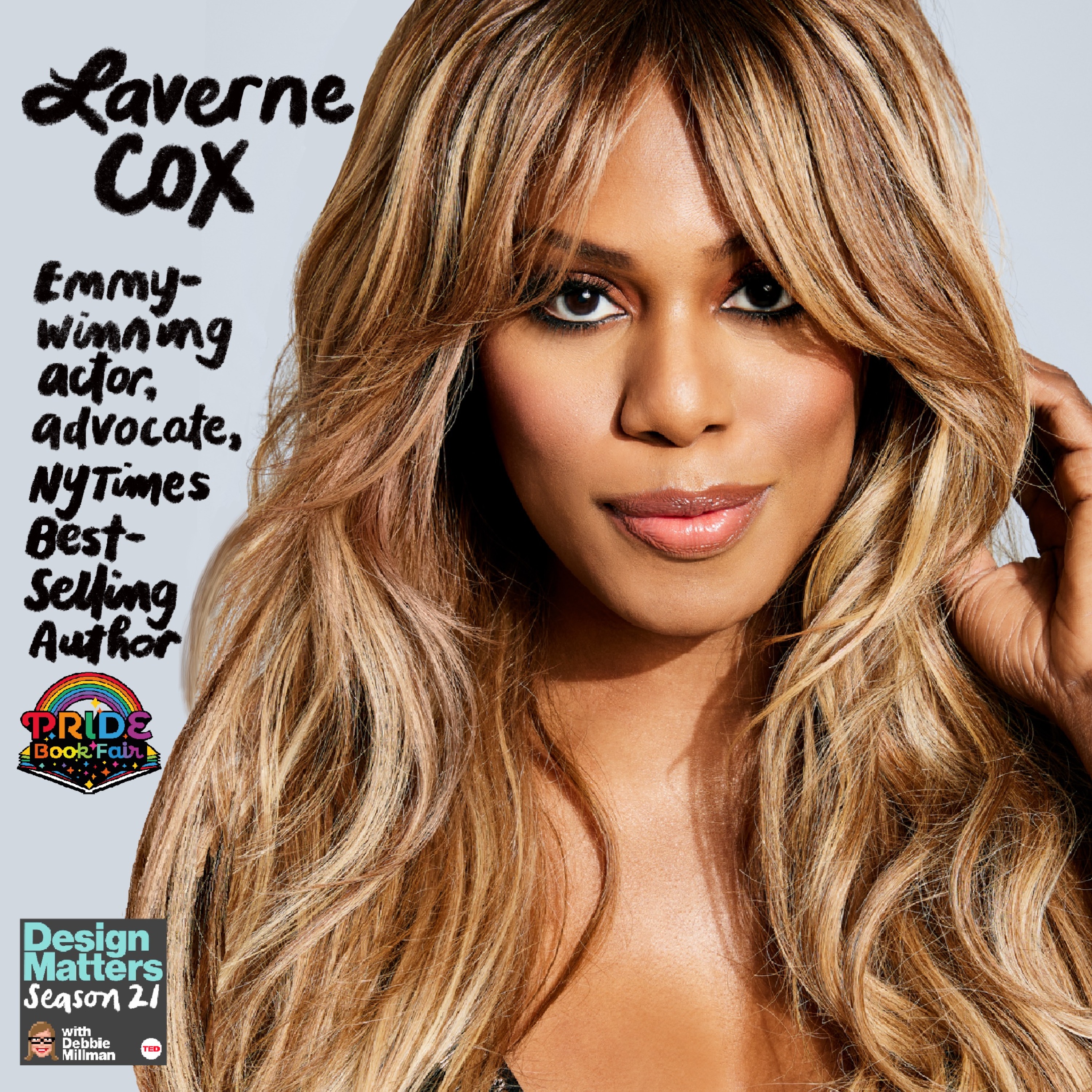
Laverne Cox is an Emmy winning actor, producer, advocate, and one of the defining cultural figures of our time. She became internationally known for her groundbreaking role as Sophia Brissette on the television show Orange is the New Black, a performance that made her the first openly transgender person nominated for a Primetime Emmy award in an acting category. Since then, she has continued to expand what visibility can mean as an actor, a producer, a host, a speaker, and an artist whose work insists on complexity, dignity, glamour, truth and humanity. Her brand new instant New York Times best selling memoir, Transcendent offers a portrait of an artist whose life has been shaped by survival, discipline, beauty and truth. Laverne Cox, welcome to this very special live episode of Design Matters at the
- [04:47]
Kohler Smart Toilets Advertiser
Pride Book Fair in New York City.
- [04:49]
Laverne Cox
Thank you so much. That was so beautiful. I appreciate that.
- [04:53]
Debbie Millman
Laverne. First, I'm wondering if you can talk a little bit about your love of salvation. Armani.
- [05:02]
Laverne Cox
It's a phrase I sort of coined in the book. I started in middle school, thrifting, going to thrift stores. And that's when I started dressing myself. And we had in walking distance from our house on Broad street in Mobile, Alabama, there was a Salvation army in Goodwill right next to each other. And this would have been the early 80s. And I could literally get like, you know, a pair of pants for 25 cents or a whole outfit for like 99 cents or something. So I would like, you know, with $5, I would come out with quite a haul. And it was fabulous. And I got to kind of experiment and begin to kind of fashion myself and create myself anew with my salvation Armani, with the clothes I got from thrift stores. And the great thing about me as an adult now is that I still love vintage clothes. Not necessarily, you know, we've elevated maybe a little bit. I am wearing Comme des Garcon today, not Mugler. And many people like, people like, it's always Mugler. It's mostly Mugler. But occasionally it's Comme des Garcons, as one does.
- [06:17]
Debbie Millman
Vintage, of course, Transcendent opens with the prompt, tell me something you don't want us to know, and then moves towards a sentence that reads more like a declaration. Let the truth in. As after years of being asked to represent history, visibility and progress, what truth about your own life finally needed to become speakable through your new book?
- [06:49]
Laverne Cox
All the things that I still had either shame about or felt if I told the truth, it would reinforce some narrative about trans people. That wasn't. Wouldn't be helpful. I had to let go of that. And a lot of. I've made a lot of choices and decisions about what I disclose publicly because I don't want to feed into a stereotype, a negative stereotype about trans people or set us back in some way. But my truth is my truth, and I have to. I mean, I quote. This is a quote from the book, the Rene Brown quote. And when we deny our stories, they define us. When we own our stories, we can write a brave new ending. And so this, this is me trying to own my story even more fully. And I thought I had processed all of my trauma. And with my wonderful therapist I've been with for 10 years and previous therapists I've been in therapy for 26 years, I thought I was like, good. And what the book made me realize is that there's a lot of unprocessed trauma still. Like the things that I've barely written about the childhood, sex abuse, the orphanage. Like, there are things that I've never really. I barely skimmed the surface with my therapist. I had never told my therapist orphanage story. Like, how do you. So there's some work to do. And then I thought that memories that were suppressed would say suppressed, but in the process, things came back and that. That was awful. They were suppressed for a reason. So it was hard. It was really, really hard. But what has been the best part is now talking to people, dear friends of mine who've read the book and didn't know all these things about me. But then one friend in particular who's like, our childhoods were so similar. We've been friends for like 15 years and she didn't know this about me. I didn't know this about her. How our childhoods were similar, how our relationships with our mothers were similar. And she hasn't. I mean, she just started therapy a few years ago, so she has so much to process. So it just brought up so much for her. But it's. She's Ready to kind of slowly start processing and healing. So that's more than anyone could ever ask for from their work. If you are able to, you know, touch someone and inspire them to uncover something or even just give them language for something that they've experienced in their lives that they don't have language for. And I found. I'm finding that as well. So that's been deeply humbling. Humbling is the only word that I can think of because it's like people are being affected in profound ways. And that's awesome.
- [09:57]
Debbie Millman
You talked about your hometown of Mobile, Alabama. It appears in Transcendent as a place of heat, church, family, beauty, danger, and constant surveillance. It also taught you very, very early on that the way you move through space was being watched and interpreted. Before you had the language for a lot of who you are, what were you beginning to understand about the danger of being seen there?
- [10:37]
Laverne Cox
I instinctively understood that nowhere was safe except my imagination, that the world wasn't safe, that people were not trustworthy, and that I had to go someplace else. So I disassociated. So I lived in my imagination. I dreamed about, you know, being on TV and on stages, and I danced and I made up characters, and I had music in my head, and I just went elsewhere. I learned that the world wasn't safe. My therapist, Jennifer, came. She's in San Francisco. We've been virtual since the pandemic and had a book event in San Francisco. And she came to the event, and then she finally finished the book. And we've been together. It'll be August, it'll be 10 years. And even after 10 years, she was like, I didn't realize the extent of the boundary violations you experienced as. As a child and throughout your young adult's life. And it's. The language of boundary violations is, like, really important. And it kind of contextualized for her more when I. When I became famous and people were sort of running up to me all excited. My whole life, people have been running up to me, trying to beat me up or harm me. So it just. It was. It's really intense, and it's still something I struggle with if I'm not prepared. So there's something about my therapist just saying that that's like, okay, like this makes sense, you know, like, again, having language, having context, you feel less like there's something wrong with you, and you understand that it's about what happened to you, and then hopefully you can lean into what's right with you.
- [12:28]
Debbie Millman
You begin the book with very vivid recollections of being beaten by your schoolmates over and over and then somehow making it home to your mom, who asked you what you did to provoke it. Yes, yes. Your mother was a teacher, disciplinarian. She was a woman carrying her own history of trauma and poverty and rage, which she takes out on you and your brother over and over. Your father is completely non existent. The one experience you do have with him I want to ask you about. But you seem towards the end of the book to have forgiven your mother. She comes to a lot of your events now. She seems to be very proud. Yes, but for a long time she was very ashamed. How have you been able to reconcile that?
- [13:28]
Laverne Cox
I don't even know. I guess ashamed, but also like there was. It was always weird with my mother because there was, you know, what's wrong with you? Why don't you act like the other kids? Why don't you fight back? What are you doing to make them, you know, treat you this way? Like never feeling safe around her? Her, she. She has a hyper vigilance and could just go off at any moment. I think a lot of it was the stress of, you know, trying to raise two kids by herself. She was a single mother working four jobs. Actually, my therapist thinks she might have some narcissistic tendencies. I think about. I've observed that she has some obsessive compulsive tendencies around cleanliness. So she's very compartmentalized because this, like when I was making straight A's and like winning talent shows, that was always something she celebrated, you know, so like the success. But there was also the, you know, why do you dress this way? And why are they. It wasn't even why do I dress this way? It was about the other kids and the. What the parents would be saying about her. And it felt like it was more about that than it was about who I actually was. It was more about how people would perceive her and bless her heart. Bless her heart,
- [14:48]
Debbie Millman
yeah.
- [14:49]
Laverne Cox
There is a lot of forgiveness and the forgiveness has come through me. Getting older and being in therapy, learning more about how trauma is passed down from generation to generation. Learning more, really, listening to the stories she told me about her childhood and my grandfather, who is really abusive, who was raised on a plantation, and just the brutal violence that she experienced as a child and witnessed him inflict on my grandmother. So there's just a lot of compassion I have for that little girl who didn't have the tools that I was lucky to find as an adult to process and heal some of my childhood. Stuff.
- [15:33]
Debbie Millman
Do you feel that your early achievement as such a good student, as somebody that was alive with such a vivid imagination, became a form of protection?
- [15:44]
Laverne Cox
Absolutely, yeah. My inner monologue was, one day I'm going to be rich and famous and I'm going to show all of you to the bullies. And it was also, I was very focused and determined to get out of Mobile, Alabama. And so all of the, all this stuff that the other kids were concerned about and saying, I just thought it was ridiculous and silly. I was just, I don't have time for this. I have to get to New York. I have to be prepared. I have to study. I have to learn as much as possible. So I was like, very. I gotta get the heck out of here. This is not it. I was very clear that Mobile, Alabama was not it. So I just. And even, you know, I realized as an adult when I started working in restaurants how some of my co workers would like to fixate on what customers would do and like a little minutiae. And I've always sort of been more big picture. And I, you know, I. I learned to adapt to some of that, like complaining about customers or whatever, but I'm like, I'm like the bigger thing around, around goals and even analysis. So that's just kind of who I am. So I'm just. That's what's right with me. The thing that I've always had that got me, that kept me alive. I mean, I came close to not being alive a few times, but I'm still here.
- [17:10]
Debbie Millman
Luckily, your father appears in the book, as I mentioned, in one devastating encounter,
- [17:16]
Laverne Cox
more of a sperm donor than a father.
- [17:18]
Debbie Millman
Yes.
- [17:19]
Kohler Smart Toilets Advertiser
Yes.
- [17:20]
Debbie Millman
Your mother drops you and your twin brother at his home, unannounced. She had had it for a moment. You'd never met him before. Upon meeting you, he looked at you and your brother and calls you fucking freaks. He then drops you off at a police station where you're then moved to the orphanage that you just mentioned. And it was weeks before your mother came and got you. You didn't even know if she ever would return. What did that abandonment teach you about trust? What did it distort for years? And how have you been able to reconstruct any of it? I know, big question.
- [18:04]
Laverne Cox
Yeah, this was. That story is like, of all the things that happened in my childhood and you read the books, there were many that was the most traumatizing and for my brother as well. I want to note that it was actually the woman that my sperm donor was living with who dropped Us off at the police station. I forget the pseudonym I gave her, but okay. It's kind of messy. It's my mother's messy business, but it's sort of mine too. But I'll save that for the book. If you haven't read the book yet,
- [18:42]
Debbie Millman
you have to read the book.
- [18:43]
Laverne Cox
It's Juicy girl. It's a mess. And I didn't Even figure this 10 years ago. My mother kind of gave me that. I was like, you were. And then it like kind of clicked. So they were other. And there were other kids there who were his kids, so presumably like half siblings as well. So anyway, so. Oh, gosh. The. I mean, the abandonment was. I already felt like, unwanted. I already felt like a mistake, like we were an accident. My mother didn't plan to get pregnant and my. I believe that children ruined people's lives. And I felt like, so horrible for being born and ruining this young woman's life. She has to take care of these kids and it's like stressing her out. So there was that. So I never felt wanted. I never felt loved or lovable. Yeah, I just didn't trust people. And my mother would always say, you know, if you don't act right, I'm gonna put you out. I'm gonna put you out in the street. And like, after the orphanage, I was like, oh, yeah, she will.
- [19:53]
Debbie Millman
Well, she did.
- [19:53]
Laverne Cox
She did. Yeah. So that was devastating. But how did I. I just. I just did another. I did another little interview podcast in this. And with this woman who met me in like, I think 2012 or 2013 in Chicago. And she was like, oh, Laverne's cool, but she's very guarded. And I. And I was like, thank you for saying that, because I am and I have and I always have been, and
- [20:20]
Debbie Millman
why wouldn't you be?
- [20:21]
Laverne Cox
Just very self protective and like, not trusting of people and like very reticent to let people in. And that's kind of been most of my life. I'm very careful about who I let in still. And I think, like, when you become famous, that's actually not a. It's a good thing because people don't always have the best intentions. But. So I don't mind that. I think that being guarded and protecting myself is a good thing, but learning how to let the guard. My guard down and when it's safe to do that has been the work. Figuring out who is safe and who isn't. And that's trust over time. That's people sort of showing that they are trustworthy and I feel it's wild because I feel more comfortable being vulnerable, like, on stage or on TV in a podcast than I do interpersonally, usually, which is fascinating. So I think it's just learning, doing some rewiring to trauma survivors. My therapist says turn dinner bells into alarm bells and alarm bells into dinner bells. So most of my. Right, that. When she said that, I was like,
- [21:43]
Debbie Millman
ah, thank God for therapists.
- [21:46]
Laverne Cox
I know, right? That one, like, just. That still just knocks me over. And it just was like, bitch, you're reading me. Like, every single man. And so much of the dysfunctional things play at lesson friendships of what very much played out in romantic relationships. And I. I let men in, some men in not full, not ever, fully, like, because I wasn't a. I couldn't. I didn't know how. But they were way in. Way more than they should have been because I turned dinner bells into alarm bells and alarm bells and a dinner bell. So I was. I was sort of dating and having sex with my bullies for years as a way of working through the trauma unconsciously. Not. I wasn't consciously doing that. It was very unconscious, but it was. I understand now that that's what was familiar, that people abusing me and being verbally abusive and speaking to me and like, I'm. Nothing was familiar. And, like, my mother would say she loved me and treated me that way. So that's what I thought love was. It's not.
- [22:57]
Debbie Millman
No. My therapist. Actually, my therapist taught me that you keep repeating a lot of the things or repeating patterns in your life of things that have happened to you in an effort to try to make the outcome different.
- [23:11]
Laverne Cox
Yes, it was. I mean, the Nate, the alcoholic ex of mine, who is emotionally abusive. I'm very clear after that relationship, that. That was like, he was my mother and I, through that relationship, I was like, I'm gonna make my mother love me. I'm gonna prove to her that I'm worthy and that I deserve to be loved and I'm lovable. It was girl, girl that almost killed me. But afterwards, I discovered Melanie Beatty's Codependent no More and Robin Norwood's Women who Love Too Much. You know that girl, I think we're
- [23:49]
Debbie Millman
in a room of codependent.
- [23:51]
Laverne Cox
No more is a must. Women who love too much is a must. So, yeah, so I haven't repeated that, done some other things, but I haven't repeated that relationship.
- [24:03]
Debbie Millman
So you left home, you went to the Alabama School of Fine Arts for high school and then went to Indiana University for college, where you studied dance and you were still moving quite a lot through harassment, danger. Lamar, your brother, your twin brother, introduced you to bell hooks.
- [24:23]
Laverne Cox
Yes.
- [24:24]
Debbie Millman
Her books gave you a language for the oppositional gays, Internalized racism, sexism, homophobia, transphobia, and the need to decolonize the mind. What did her work unlock that your talent alone didn't at that point?
- [24:42]
Laverne Cox
Critical awareness. I actually asked one of my exes, was there ever a moment in your life when you realized everything you've been told is a lie and you have to sort of relearn things and reconceptualize, like, the world and your place in it? And he said no. And I was like, wow. He was like, I just ready to get the best I can. But that was what that moment was. It was like. It was like the light being turned on. It was like, that's what woke is about. It's about like, you know, in the Matrix, what pill are you taking to sort of wake up? And that's what it was. And it was. It was intense because it was. It was. It was exciting. Just the way she writes is exciting and provocative and sexy, but it was also like, oh, my God, I am filled with self hatred because of race, class and gender, and I need to work on this. So it was mental health work. It was also a critical analysis of the world that continues to serve me. This has been 30, 30 plus years ago that I discovered her work and I keep returning to it. And it's a testament to the depth of the scholarship and the wisdom that's there. And that she, more than anything, was interested in optimal well being for first black people and women and just anybody who's oppressed. And I love her books. And I, you know, I got to meet her and I got to know her and I had a phone number when we talked on the phone. And she became a mother, the kind of mother that I figured that I probably maybe wanted to have. Belle had issues too, but I felt seen by her. I felt deep.
- [26:40]
Monday.com Advertiser
Please,
- [26:42]
Laverne Cox
deeply. I felt deeply seen by her. And there's something that's all. What we all want is to feel seen and known. And I understand now my mother didn't have the capacity, still doesn't really have the capacity to fully see me. And I accept that. But bell hooks did. And what a gift to have someone's work change your life, quite literally change your life. I was quoting bell hooks forever. She actually, I ended up meeting her because my first college tour, it was titled Ain't I Woman after her first book, Ain't I Woman? But was, you know, obviously inspired by this general truth speech from 1870 that
- [27:28]
Debbie Millman
Laverne was doing, going around to schools, not looking at colleges to go to.
- [27:32]
Laverne Cox
Yeah, correct. I had a speaking tour. Yes, I had a speaking tour that started in 2013 and I called it Ain't I Woman. And so of course I was referencing bell hooks, quoting bell hooks. And word got back to bell through the university system that this Laverne Cox from that Orange Is New Black Loves serves in bell hooks and bell loves to hear that. And she invited me to do a public dialogue with her at the New School. I think it was in 2014. And then we just kind of, we clicked, which was just lovely. I still can't even believe it. And I really, I wish she was still here. I write about getting the day before she died, she wasn't well and she was surrounded by people and she specifically wanted to talk to me. I'm sure she was calling a lot of people. So she called me and we spoke and it was, it was gut wrenching and she passed the next day and. But she's written over 35 books and there's such an incredible legacy that she has left and so many. I love seeing so many people who've been influenced by her and yeah, we need some bell hooks in our lives right now.
- [29:00]
Paylocity/LEDN Advertiser
When opportunity requires capital, be ready. Leadn's Bitcoin backed loans give you liquidity across time zones 24, 7. When timing matters, access to capital is critical. LEDN gives you liquidity so you can move quickly without disrupting your bitcoin position. And LEDN has funded over $11 billion in loans since 2018 with a perfect track record of protecting client assets. Get a LEDN Bitcoin backed loan today.
- [29:27]
Monday.com Advertiser
Visit lednio this Monday.com ad was created by a team of people and AI agents. The agents wrote the copy and managed the timelines, while our human creative director made sure it all made sen easy. Create your own AI agent today on Monday.com
- [29:46]
Narrator/Producer (Design Matters)
acast powers the world's best podcasts.
- [29:50]
Laverne Cox
Here's a show that we recommend
- [29:54]
Podcast Host (Side Hustle Pro)
if you've ever dreamed of quitting your job to take your side hustle full time. Listen up. This is Nikayla Matthews Akome, host of side Hustle Pro, a podcast that helps you build and grow from passion project to profitable business. Every week you'll hear from guests just like you who wanted to start a business on the side. If you can't run a side hustle, you can't run a business. They share real tips.
- [30:15]
Laverne Cox
And so I started connecting with all these people on LinkedIn and I saw target supplier diversity was having office hours.
- [30:21]
Podcast Host (Side Hustle Pro)
Real advice.
- [30:21]
Optum Advertiser
Procrastination is the easiest form of resistance
- [30:25]
Podcast Host (Side Hustle Pro)
and the actual strategies they use to turn their side hustle into their main hustle. Getting back in touch with your tangible cash and sitting down and learning to give your money a job like it changes something. Check outside HustlePro every week on your favorite podcast app and YouTube.
- [30:44]
Laverne Cox
Acast helps creators launch, grow and monetize their podcasts everywhere.
- [30:50]
Optum Advertiser
Acast.com Healthcare can feel complicated. That's why Optum uses technology to connect the people and processes that make healthcare easier, more affordable and more effective. We're making it clearer for you to know exactly what your benefits cover and to help you better manage your health. We're coordinating care between your doctors and your technology. We believe better, simpler healthcare is always possible. That's healthy optimism. That's Optum. Visit optum.com to learn more.
- [31:24]
Debbie Millman
You initially went to college to study dance and it really wasn't until your brother Lamar Said insisted that you were an actor that you really would started to think about becoming more serious about pursuing a career as an actor. And before Orange is the New Black, you went through 20 years of struggle, auditions, financial instability. At one point you were ready to give up your dream of becoming an actor and began studying for the GREs. What did you think you were going to do with the GREs?
- [32:04]
Laverne Cox
Well, I needed to get into grad school so like generally you have to take the GRE was my understanding. Anyway, I was looking into, I was getting, I was looking, I was. Because I had been writing some stuff for the Huffington Post pretty regularly and I was, I thought journalism was interesting. And then I was, I was, I was always interested in like gender studies and like post colonial studies and critical race stuff. So I was thinking of some sort of combination of all of those things that might have a media focus. So it would be designing my own major. And so like, I mean I was getting applications from every place. So and I was going to kind of figure it out. I was looking through the applications and just, you know, studying. And then before I could take a test or start writing applications, the Oranges New Black audition happened.
- [32:54]
Debbie Millman
In hindsight, what did those 20 years forge in you that a faster success
- [32:58]
Laverne Cox
might not have built life experience? Getting to like live live a life and you to be an artist you have to live, you have to have things to draw from. And so I had a lot of things to draw from from my work as an actor. And then when the responsibility of being a face for trans people came along, I had lived experience as a trans person. I hadn't just so often, like with a Chaz Bono or with a Caitlyn Jenner, like they come out publicly and they're already famous, but they've been, they haven't had to gone to live their lives as trans people. So they really can't speak to what that experience is. And I, you know, I used to sort of jokingly say, I don't think any trans people should be in front of a camera for at least five to seven years. And I certainly shouldn't have been. But I, you know, I medically transited medical transition in 1998 and Orange is New Black came out in 2013. And in that time, I was not just living my life as a trans woman. I was engaged in. I did work here at the center. We had a trans cinema night. And I even taught like a. A workshop using acting techniques. It's like therapy. And I testify with a lot of other trans people in the early 2000s to get the human rights law changed to include trans people. And I went to Equality and Justice Day every year in Albany to try to get credit agenda passed. And so I was involved in media that was in, in community with. With trans people. And I studied beyond like just being a community, I studied statistics and law and what's happening in the news. So I had some knowledge to speak about the lived experiences of trans people that, you know, a celebrity who transitions publicly might not have right away. And so that is a very good thing. I love that. I love actors, I really love us, and I love my profession. But a lot of us, when we get in to start talking about politics, a lot of us don't know what we're fucking talking about. And I say that with love, but it's a lot of work to continue to read up and be aware of various issues. And I try to stick to my lanes, but it's like, it's a lot of work. So sometimes people want actors to speak up, but maybe it's best that some of us don't. And so when I do, I try to be informed. I try to be as informed as possible. And I try not to speak about things that I don't have some level of proficiency or expertise in. But, you know, I think I can safely say, like what I talk about. I have a depth of knowledge. And I'd like to think, yes, your
- [36:00]
Debbie Millman
overnight success, so to speak, happened almost exactly 20 years after you moved to New York soon after, after Orange is the New Black. You received critics choice nomination, the COVID of Time magazine, multiple Emmy nominations, an Emmy win. You were designated Glamour Woman of the Year. And a new public identity. As a first. What is the difference between being celebrated and being seen?
- [36:28]
Laverne Cox
The difference between being celebrated and being seen. That's one of the best questions anyone's ever asked me.
- [36:38]
Debbie Millman
Thank you.
- [36:38]
Laverne Cox
This whole interview, you've turned it work. From my experience, I think being celebrated, for me, this is just my experience. It's been symbolic. Being the first trans person to blah, blah, blah, blah. It becomes a symbol, and it's not humanizing. It's not a bad thing, but it's not. You become a symbol. You become the way. The way the Obamas are, you know, because they're. And they. And they've handled all of it so eloquently, but they're symbols, and so you're a symbol. And so then if you want to insist on being a human being, which means that you're flawed. Human beings are flawed, and we struggle. That becomes more difficult. And being seen is fully seen. Is someone seeing the flaw, seeing the imperfection, seeing that what they may want to project onto you isn't exactly who you are, and it's. It's devastating to disappoint people. I've disappointed fans many times over the years, and that's partly why I have that prayer. Give me permission to do this imperfectly and allow me to be of service, because I know my job is to be myself and to become more of myself. And for some of my fans and followers, they want me to uphold a standard that they think I should uphold or that should be upheld, that I. That would probably be impossible for anyone to uphold. So being seen is flaws and all. To quote Beyonce. Because we must, as much as possible, quote Beyonce.
- [38:37]
Narrator/Producer (Design Matters)
Yeah.
- [38:38]
Laverne Cox
I think that's the difference, that you get to be flawed and human when you're seen and when you're celebrated. There is a little bit of dehumanization in that. You're not allowed to be flawed.
- [38:52]
Podcast Host (Side Hustle Pro)
Human.
- [38:52]
Laverne Cox
Human.
- [38:54]
Debbie Millman
This is my last question. Yes. At the end of your beautiful book, your book becomes not only a memoir, it's an offering to your brother Lamar, to your ancestors and transesters. Great. Such a beautiful word. And to readers who may need to hear and feel your very human story. In this moment of renewed backlash and scapegoating to the entire LGBTQ community, what do you want this book to make?
- [39:26]
Laverne Cox
Harder for people to deny the humanity of trans people? What we have witnessed in real time over the past seven years is a well coordinated, systematic, well financed, disciplined dehumanization campaign of trans people rhetorically and in the media. And that has created a permission structure to pass public policy that strips away rights from trans people. I said this before publicly, and people like, what rights? In the comment section. What rights? Name them. And I'm just like, oh, they're not paying attention or they don't know. And one morning I was in the. I had time. So I went through the comment section. I was in the comment section on People magazine when I. And I was like, you know, when you. In the comment section, you're typing, you run out of space in the comment section. And so you have to continue. I'm like, that's how many rights have been taken away. I mean, we don't need to list all. You probably all know here, but the dehumanization and. And we have a sense of some of the dehumanizing language when it comes to black people. And we saw a great example of that from our sitting president when he posted a video depicting the Obamas speaking of them as apes in a video that. Wow, deplorable. Yeah, Our president. Not my.
- [41:06]
Debbie Millman
Not mine.
- [41:07]
Laverne Cox
Not my president. Girl. And we understand this about other groups that I think we really need to get clear about how they're dehumanizing trans people, the language, and understand what the effect. And I have a few examples I've been giving lately. Or like, when they talk about trans girls in sports, they usually say men in girls sports. So they evoke, like, a grown man in girls sports. So they don't talk about a trans girl playing other girls. Because that's a different. Yeah, that's a different image. But a man in girl sports, dehumanizing gender ideology. Not an ideology. I'm a human being. What's gender ideology anyway? It's a turf word to dehumanize and, like, make it seem like trans people are some kind of rhetorical flourish or academic endeavor instead of, like, human beings who've existed since the beginning of time. I could go on. I could go on, but being really critical of, like, when they. When they do things like talk about gender affirming, care for young people as mutilating young people, or, like, just becoming aware that this is intentional language that invites the listener, the viewer, to not see a human being when they think about or see trans people, but to see an ideology, to see a monstrous person who is there to, like, jeopardize the safety of children and Women. And that is. That's an old, very old Anita Bryant kind of trope. And it's another way of pitting women against, you know, like, divide and conquer. And the reality is that all of the anti trans policies that are being implemented negatively affect trans people, but they really negatively affect CIS women as well, like across the board. And I mean, I can go into the weeds on this few examples just with the bathroom policies, when, like, random people are sort of deputized as bounty hunters to, like, find trans people in bathrooms, we see most of the people that they're, like, spotting as trans aren't. They're CIS women. So, like, who wants to be in a bathroom stall and somebody's knocking on it? You're not supposed to be here. And then you're terrified. And I will never forget one video of this woman coming out of the stall, pulling up her shirt. She had a bra on. I'm a woman. I'm a woman. Like, what. What are we doing? And then even with this sports thing, who are we inspecting genitals? Are we doing chromosome tests?
- [43:50]
Optum Advertiser
And.
- [43:51]
Laverne Cox
And then there's a bigger piece when it, when it comes to the Screammadia case, with that banned in at least in a limited way, gender affirming care for young people in Tennessee. But that was not a heightened scrutiny case determined by the Supreme Court, which actually affects, like, how all gender discrimination laws will be able to be brought forth to the Supreme Court. So we're all in this together, really, and all of our fates are tied. And so the divide and conquer, we can't allow that. No one's free until all of us are free. And I'm not. That's not just trans people and lgbt. That's like immigrants. That's like. It's everybody, poor people, everybody. So this is. If this is happening for us, this moment and not to us, and I'd like to believe it's happening for us. It's hard. It's hard. What's happening for us is, to me, the election the other day, Brad Landers in my. He's my. I'm in his district. I voted for him. But our mayor and the fascist regime that we're currently living under that is so deeply corrupt and just brazenly so. And just the lack of care that this regime has for regular people, for working people, and the lack of interest that the Democratic Party has shown for working people, we're really aware of that. We feel that in a really deep way. And we're mobilizing and we're saying no More. And I think the only way to defeat this fascism is a movement from the people, from, like, all of us getting together, organizing and demanding something new and better. You know, God, I want to end. But South Africa, South Africa, when they ended apartheid, they got a new constitution. It may be time for a constitutional convention. We need to start thinking big. Project 2025 is a robust document that is the wet dream of, like, the Heritage Foundation, Federalist Society for 50 years. They are having their dreams of 50, like, come true. Right now, we need our Project 2029. That is a vision for power back to the people. Power back to the people. Not corporations, not billionaires, but power back to the people.
- [46:25]
Debbie Millman
Laverne Cox, On behalf of us all, thank you for being. Being you. Thank you for being here. Thank you for writing this remarkable book. Thank you, thank you for doing so much work that matters. And thank you today for being with me here on Design.
- [46:50]
Laverne Cox
I just saw that Roxanne Gates. A shout out to Roxanne Gates, the icon, the legend. Thank you for being here. I know Laverne.
- [47:03]
Debbie Millman
She's my wife.
- [47:05]
Laverne Cox
You're married? Hi. Good for you. Aren't you both lucky? I'm single for two years and celibate for two years. But very happy, very happy. This is, this is. This is prime real estate. Honey, it's not for everybody. Not anymore. It's in the book.
- [47:39]
Debbie Millman
Liver and Cox, everybody.
- [47:41]
Laverne Cox
Thank you, you guys, thank you.
- [47:52]
Narrator/Producer (Design Matters)
Design Matters is produced for the TED Audio Collective by Curtis Fox Productions. The interviews are usually recorded at the Masters in Branding program at the School of Visual Arts in New York City, the first and longest running branding program in the world. The editor in chief of Design Matters Media is Emily Weiland.
- [48:17]
Laverne Cox
Dreams can come true. They can happen to you. If you're young at heart,
- [48:32]
Optum Advertiser
Healthcare can feel complicated. That's why Optum uses technology to connect the people and processes that make healthcare easier, more affordable and more effective. We're making it clearer for you to know exactly what your benefits cover and to help you better manage your health. We're coordinating care between your doctors and your technology. We believe better, simpler healthcare is always possible. That's healthy optimism. That's Optum. Visit optum.com to learn more.
- [49:01]
Paylocity/LEDN Advertiser
When opportunity requires capital, be ready. LEDN's Bitcoin backed loans give you liquidity across time zones 24, 7. When timing matters, access to capital is critical. LEDN gives you liquidity so you can move quickly without disrupting your Bitcoin position. And LEDN has funded over $11 billion in loans since 2018 with a perfect track record of protecting client assets. Get a LEDN Bitcoin backed loan today.
- [49:28]
Monday.com Advertiser
Visit lednio this Monday.com ad was created by a team of people and AI agents. The agents wrote the copy and managed the timelines, while our human creative director made sure it all made sense. Easy. Create your own AI agent today on Monday.com
- [49:48]
Narrator/Producer (Design Matters)
acast powers the world's best podcasts.
- [49:52]
Laverne Cox
Here's a show that we recommend
- [49:57]
Nick or Jack (Best One Yet Podcast)
what
- [49:57]
Jameela Jamil
if you laughed all through your commute? Or if you heard the funniest story while at the gym?
- [50:02]
Laverne Cox
Well, now you can.
- [50:03]
Jameela Jamil
I'm Jameela Jamil and guests on my new podcast, Wrong Turns share their most mortifying and hilarious disaster stories. I'm talking people like Mae Martin, Bob the Drag Queen, Katherine Ryan, Jake Johnson, Margaret Cho, Simon Pegg, Penn Badgley, and so many more. So listen wherever you get your podcast Wrong Turns where dignity goes to die,
- [50:27]
Laverne Cox
Acast helps creators launch, grow and monetize their podcasts everywhere.
- [50:32]
Pura Advertiser
Acast.com Summer Smells Like Summer road trips, ocean breezes, and long evenings under the stars, it's a feeling you want to hold on to. Restore your sen place With Pura's new Summer Fragrance Collection, we've captured the magic of the season in clean, premium scents that transform your home into your favorite destination. Discover the art of scentscaping and bring the summer in. Visit pura. Com to explore the collection.