Loading summary
Transcript157 lines
- [00:01]
Ada Limón
Sometimes they come out backwards, sometimes they come out almost done and I realize I've been writing it for a long time and so by the time I got to the page, it's complete. And then sometimes it takes me months, even years to finish a poem.
- [00:21]
Debbie Millman
From the TED Audio Collective, this is Design Matters with Debbie Millman. On Design Matters, Debbie talks with some of the most creative people in the world about what they do, how they got to be who they are, and what they're thinking about and working on. On this episode, a conversation with Ada Limon about how she became a poet and the power of poetry to bring people together.
- [00:46]
Ada Limón
Oh, there are other people that feel this way.
- [00:56]
T-Mobile/US Cellular Advertiser
Everyone deserves to be connected T Mobile and US Cellular are joining forces. Our networks are coming together, bringing more T Mobile coverage all over the country. Switch to T Mobile and save up to 20 versus Verizon by getting built in benefits they leave out. Check the math@t mobile.com switch and now T mobile is available in a US cellular store near you Bigger network. The combination of T Mobiles and US Cellular's network footprints will enhance the T Mobile network's coverage savings versus comparable Verizon plans plus the costs of options, benefits, plan features and taxes and fees vary. Savings with three plus lines include third free line free via monthly bill credits credit stop if you cancel any lines. Qualifying credit required.
- [01:28]
Adam Grant
Hey, it's Adam Grant from ted's podcast Work Life, and this episode is brought to you by ServiceNow AI is only as powerful as the platform it's built into. That's why it's no surprise that more than 85% of the Fortune 500 companies use the ServiceNow AI platform. While other platforms duct tape tools together, ServiceNow seamlessly unifies people, data, workflows and AI connecting every corner of your business. And with AI agents working together autonomously, anyone in any department can focus on the work that matters Most. Learn how ServiceNow puts AI to work for people@servicenow.com Are you really buying a
- [02:06]
Autotrader Advertiser
car online on AutoTrader right now?
- [02:08]
Ada Limón
Really? I can get super specific with dealer listings and see cars based on my budget.
- [02:13]
Autotrader Advertiser
You can really have it delivered or
- [02:14]
Ada Limón
or pick it up.
- [02:15]
Autotrader Advertiser
I think kid is walking up the slide.
- [02:17]
Ada Limón
Really? Autotrader? Buy your car online? Really?
- [02:24]
Debbie Millman (Interviewer)
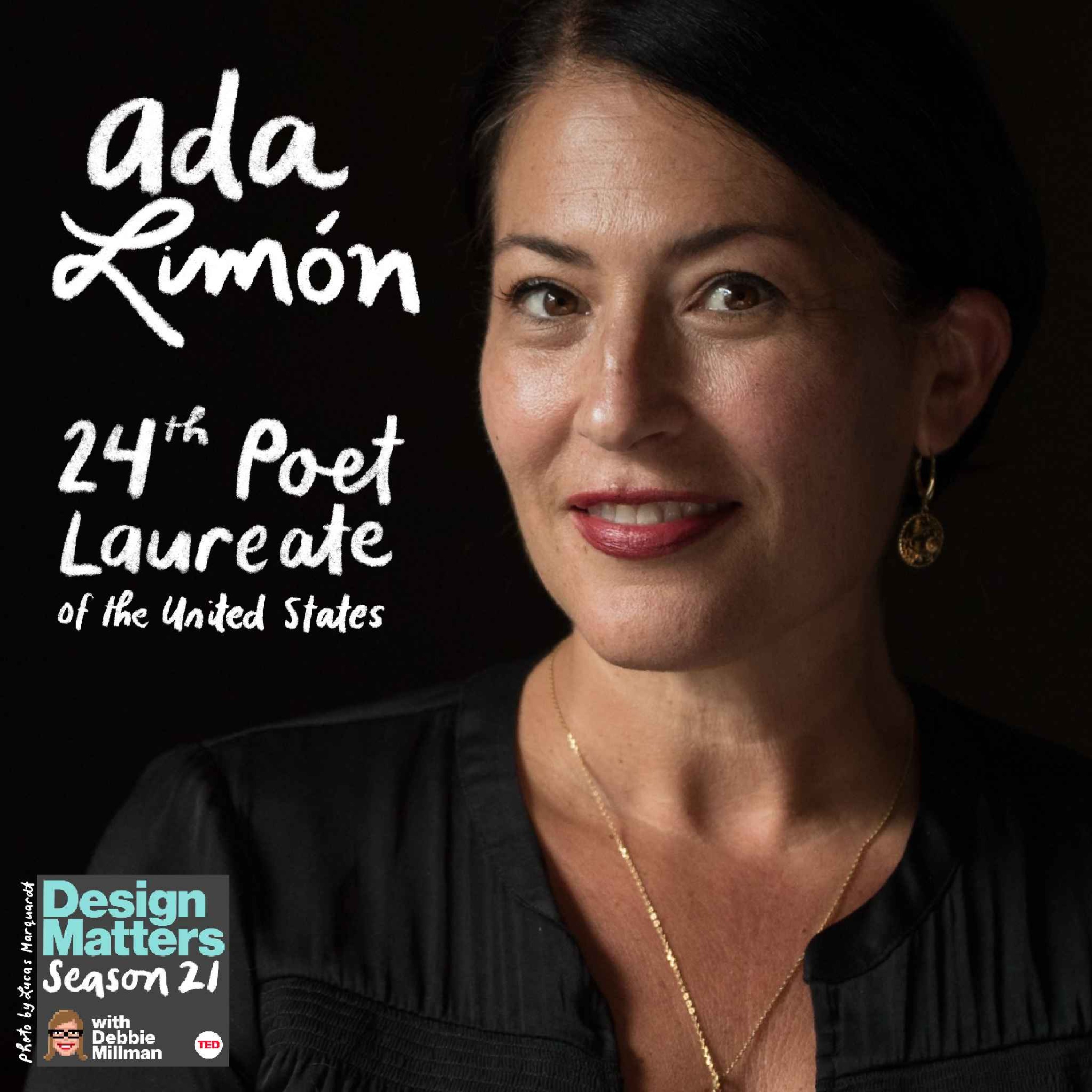
Ada Limone is the author of seven books of poetry, including the Carrying, which won the National Book Critics Circle Award, and Bright Dead Things, a finalist for the National Book Award. Her most recent poetry collection is Startlement New and selected poems. In 2022, Ada was named the 24th Poet Laureate of the United States. She served in that role for three years, bringing poetry into classrooms, libraries, and national parks across the country. Her many honors include a MacArthur Fellowship, a Guggenheim Fellowship, and she was named one of Time magazine's Women of the year in 2024 for. For being an extraordinary leader who is working toward a more equal world. Her brand new book is titled Against Breaking on the Power of Poetry. Ada Limone, welcome to Design Matters.
- [03:22]
Ada Limón
Thank you so much for having me. It's a pleasure to be here.
- [03:25]
Debbie Millman (Interviewer)
Ada, you grew up in Glen Ellyn in Sonoma Valley, across from the Calabasas Creek, in a landscape of hills, horses, and open land. Yet your pet of choice was a mouse you named Fred.
- [03:45]
Ada Limón
Yes, I did have a mouse named Fred.
- [03:48]
Debbie Millman (Interviewer)
Tell us how you came to own Fred.
- [03:52]
Ada Limón
You know, when my parents were divorcing, the nice thing about having a mouse is that you could carry the cage back and forth. And so for me, Fred was perfect because he was portable and. And he could come with me to each house. That was important for me to be able to bring my little mouse back and forth.
- [04:15]
Debbie Millman (Interviewer)
Your grandfather emigrated from San Juan de los Lagos in Mexico during the Mexican Revolution and worked hard to assimilate in the United States. And I'm wondering, has that family history influenced you think about heritage and cultural identity?
- [04:34]
Ada Limón
Yeah, I mean, I think it's hard not to live in the United States without thinking about cultural heritage and identity. I think that, you know, for me, I not only think about his journey and how proud he was of his American citizenship, but also how he struggled to make it in this country. And I find his journey to be both inspirational and a little hard sometimes because he was a very prideful person. And there are times where I know how much he was holding in. That's something that is a little bit of a family legacy there.
- [05:23]
Debbie Millman (Interviewer)
Your childhood included long stretches of solitude, walking creeks, watching animals, and you spent a lot of time outdoors. And as I was reading about your childhood and the ways in which you engaged with the world, I was wondering, were you lonely?
- [05:41]
Ada Limón
I don't know if I was lonely. I don't know if I've ever been lonely. I like to be alone. It's important to me to be alone. I think that I miss people. I miss specific people, but I don't think I was lonely. I think I was sometimes isolated, sometimes felt separate, and maybe had a sense of longing, but I don't think I was lonely.
- [06:14]
Debbie Millman (Interviewer)
What were you longing for?
- [06:16]
Ada Limón
I think I was longing for a way to connect with the strangeness that I felt the surreality of being alive in a body, and I didn't have words for it. And everyone else seemed to be able to function in a way that felt very. I don't want to use the word normal, but it felt as if everyone had the perfect way to move in the world. And for me, I felt like there was always this moment where I wanted to shout, like, isn't this bizarre? And I think I still feel that way. And so even as a child, I felt like at any moment I was going to break out and start shouting. Isn't it so strange to be alive? And where do we come from? And where are we going? And what is this about? And how are we supposed to pretend that this human experience is not deeply strange and otherworldly and in many ways overwhelming?
- [07:27]
Debbie Millman (Interviewer)
You just described my mood perfectly, especially these days.
- [07:34]
Ada Limón
Yeah, you.
- [07:35]
Debbie Millman (Interviewer)
You mentioned that your parents got divorced when you were very young. You were eight years old. And you've described your childhood as living in two households with very different environments. One where your dad was a school principal and your stepmother a speech pathologist, and one where your mother was an artist and your stepdad worked in restaurants. And there's a poem you wrote called before that I was wondering if you would read that described your life before your parents got divorced.
- [08:08]
Ada Limón
Yeah, I'd be happy to. Before no shoes and a glossy red helmet. I rode on the back of my Dad's Harley at 7 years old. Before the divorce, before the new apartment, before the new marriage, before the apple tree, before the ceramics and the garbage, before the dog's chain, before the coy were all eaten by the crane. Before the road between us There was the road beneath us and I was just big enough not to let go. Hanau Road Creek just below Rough wind, Chicken legs. And I never knew survival was like that. If you live, you look back and beg for it again. The hazardous bliss before you know what you would miss.
- [08:58]
Debbie Millman (Interviewer)
Thank you. How did growing up between those different households shape your understanding of identity and belonging?
- [09:12]
Ada Limón
Yeah, I think that for anyone that has lived in two separate households and had two separate parent units, and there's so many of us, there is a natural adjustment that takes place where you learn to navigate the two worlds. One house had different rules than the other. And whether it was even a dinner routine or something as simple as a bedtime or an after school routine, they were really quite different. And so I think that I learned, like most children do, to navigate those two worlds and figure out the ways in which I could feel at ease in both of them, my stepmother was very organized and was very much someone who was figuring out who she was in this relationship. She was quite young when she moved in, and so she had a list on the refrigerator that would list out the meals that we were all to make that week. And so even as young as, you know, 10, my brother and I would have a night where we would make dinner, and then they were pairings. So it would be, you know, one night dad and me, or one night Cyrus and Cynthia, and that would be on the fridge, and it would be all the meals listed out for a week. And then you imagine in the other household where my mom would just cook whatever it was that she was making, and she would ask us what our favorites was, and oftentimes we didn't even do the dishes. And so we sort of melted in a messy way at my mom's house. And we were very, I would say, somewhat rigid in my father's house. And so we learned how to navigate that together, sometimes not so gracefully and sometimes with. With ease.
- [11:16]
Debbie Millman (Interviewer)
Did you feel like the same person in both homes?
- [11:19]
Ada Limón
No.
- [11:21]
Debbie Millman (Interviewer)
How hard was it for you to go back and forth in your own sort of sense of self?
- [11:26]
Ada Limón
Well, I think that, you know, I had Fred, so that helped. No, I think that I learned to figure out who I was and listen to the core of me. After a while, when I figured out the patterns that took shape, I also, like many children, struggled where I found my temper ran hot at my father's house, and I found my emotions ran wild at my mother's house. And so I think that I was always trying to look for the right container for myself.
- [12:04]
Debbie Millman (Interviewer)
You wrote a poem titled Joint Custody, which I believe was about the experience or certainly influenced by the experience. And I'm wondering if you would share that with us now, too.
- [12:17]
Ada Limón
Yeah. You know, I was thinking about that experience and how for many people, it feels as if, I don't know, there's either an evil stepmother or there's this idea of a broken home. I still remember there was a woman who. She pulled me aside at my elementary school and said, I'm so sorry that you're from a broken home now. And I remember thinking, I don't think you're allowed to say that to me. And I also remember thinking how strange it was that I didn't think of my home as broken. I thought of it as it expanded. Even though there were difficulties, I felt that I had these really intact parental units. And. And I kept thinking I had never seen examples of that. In poems and literature and movies, it always seemed that if a family got divorced, that it was all disastrous. That was not my experience. It was difficult, but it wasn't disastrous. And I think that many years later, during the pandemic, I was thinking about how much I missed my family. And when I said family in my head, of course, I was picturing both my father and my new stepmother, and I was picturing my mother and my stepfather. And I thought, oh, isn't that sort of beautiful? That that to me is immediately in my head. I had never really written about it in this way. And so this poem sort of came to me with the first line. Joint custody. Why did I never see it for what it was? Abundance. Two families, two different kitchen tables, two sets of rules, two creeks, two highways, two step parents with their fish tanks or eight tracks or cigarette smoke or expertise in recipes or reading skills. I cannot reverse it. The record scratched and stopped to the original chaotic track. But let me say I was taken back and forth on Sundays, and it was not easy, but I was loved each place. And so I have two brains now, two entirely different brains. The one that always misses where I'm not and the one that is so relieved to finally be home.
- [14:55]
Debbie Millman (Interviewer)
Thank you, Ada. It takes you so back into the place in between that it feels as if you wrote it while you were in transit. Yeah, you've said that even as a child you felt a deep attachment to objects and elements of the natural world. Rocks and leaves and small discoveries on the pathways you were walking. How did that instinct to hold on to the world first begin in your consciousness and then evolve into writing about it?
- [15:31]
Ada Limón
What a wonderful question. I was always very attached to the world. I still am. I've always felt. I think in the beginning I was almost embarrassed by it, that it seemed like a strange thing to love a tree so much or to love a rock so much, or to look out and love the world so much. And like I said, it felt like everyone else sort of moved around and they could keep their head down. And I couldn't stop looking and I couldn't stop being amazed. And I also felt as if I was very tender to the world. And I was always surprised that people could be. It seemed unhurt by things. I was a very sensitive child. I once said I was precocious, but I meant to say precocious. And instead I said I was precarious. And I still think about that. Still think that I. Oh, I was a precarious child, but I think I was. I think There was this little sort of teetering that happened within me that felt like at any moment I was going to be sort of pulled over into a real emotional frenzy about whatever it was, whether it was good or bad, you know, that that went with things that were exciting and things that were hard at the same time. So I think I remember finding poems and music and thinking, oh, there are other people that feel this way and there are other people that feel really deeply and they sing about it and they write about it and they make paintings. And my mother was a painter and I knew she saw things differently. And I was really lucky that I think I had parents, I think all four parents who saw that, who didn't dismiss it, they took it seriously. They said, yeah, we understand, it was okay. I feel really grateful for that because I remember thinking I may be, for the lack of a more nuanced word, crazy and thinking, you know, I feel like the world is moving through me and I feel really touched by everything and all these things. And I remember separate times, my father saying, yeah, totally, I feel that way too. And my stepfather saying, oh, yeah, no, I understand that that was a gift. I don't think they've always 100% understood me, but I think that not being dismissed for that kind of attachment or deep feeling felt really important.
- [18:41]
Debbie Millman (Interviewer)
I read that as a teenager, you experienced or had an experience of having a powerful realization that everyone you loved and you yourself would eventually die.
- [18:56]
Ada Limón
Yeah.
- [18:57]
Debbie Millman (Interviewer)
And this is a realization that has deeply stayed with you. Has that awareness shaped the way you write?
- [19:09]
Ada Limón
I mean, doesn't it shape everything we do?
- [19:13]
Debbie Millman (Interviewer)
I think once you have that realization, yes. I didn't really have that realization until I was much, much older. Like, until when I. I would say it probably occurred in my 50s, where I no longer considered the possibility that my life was infinite. And I realized it was an expiration date.
- [19:30]
Ada Limón
Wow.
- [19:31]
Debbie Millman (Interviewer)
And that fundamentally has shaped every day since.
- [19:35]
Ada Limón
Yeah.
- [19:36]
Debbie Millman (Interviewer)
But at 15 or so, when you did experience it, I'm just wondering how that awareness shaped the way you write or shaped your day to day existence.
- [19:48]
Ada Limón
It seemed so insane to me that I wasn't going to exist. And I remember thinking, I remember lying on the bed and really thinking, what does that mean? That this body won't be here? That my consciousness won't be here? And I spiraled into a panic. And then I remember thinking, well, if that's it, that I have to love so deeply and tell everyone how much I love them, it was terrifying. It wasn't an easy experience. And. And then it Wasn't until I was 20 10. So I was 34. Is that right? My stepmother died of colon cancer, and she was 51. And I really had a moment of like, oh, this is it. This is. This is what we have. I think that reinforced it was those two experiences. That first awakening when I was 15, when I realized the mortality of all things and myself, but then the real moment of witnessing someone very close to me dying and recognizing that as the dual things that would fuel me the rest of my own time on this planet.
- [21:21]
Debbie Millman (Interviewer)
Yeah, I want to actually talk about that experience in a little bit, because I know that really was a defining moment in terms of choosing what you wanted to do with the rest of your life. When did you first realize that you loved writing?
- [21:42]
Ada Limón
I really, you know, I really enjoyed it very much as a child, even, but I had difficulty doing it. I'm sure you understand where it felt like I loved being read to. I mean, my favorite thing was laying in bed and having someone read to me. It's actually still one of my favorite things, and it's one of the reasons I love going to readings. Then when I tried to do it, I would feel so good in the moment, this real rush of making something. And then a week later, I would look at it and be like, this is awful. And this isn't anything like what I was reading or what I imagined in my head. And so I think when I was trying to write as a really young person, like 8, 9, 10, I began getting really frustrated with it because I could see what people could do. And I thought, oh, I guess I don't have the capacity for that.
- [22:44]
Debbie Millman (Interviewer)
So you were comparing yourself to published writers?
- [22:47]
Ada Limón
Oh, yeah.
- [22:48]
Debbie Millman (Interviewer)
Eight, nine, 10 years old.
- [22:49]
Ada Limón
Sure.
- [22:50]
Debbie Millman (Interviewer)
You have to model yourself after someone. I guess.
- [22:52]
Ada Limón
Why not? I mean, I remember going and reading, and I think this was probably maybe when I was 12 or 13 and hearing Lucille Clifton reading on the Power of the Word documentary that was so wonderful. It was a PBS documentary with Bill Moyers, and it was primarily set at the Dodge Poetry Festival. And I remember hearing Lucille Clifton read and being so amazed and inspired. And then I went into my room and tried to write a poem. And I thought because she made it sound so easy, the language wasn't extraordinary. It wasn't a vocabulary that I didn't have or was unfamiliar with, but there was something about it that was so profound and musical. And then I went to my little desk and I wrote really earnestly. And I looked at what I wrote, and I was like, oh, this is. This is really hard. And I remember, oh, this is. This is different than I think it is because I could hear it in my head, but I couldn't figure out the rhythm and I couldn't figure out how to get it on the page. And so, yeah, so I think that I was always in love with it. But I do think I. I wasn't sure I could do it until I would say, maybe high school, maybe 16 or 17. I wrote a few things that I wasn't totally appalled by. And I thought, oh, there's something there. There's something that I might be able to do.
- [24:37]
Debbie Millman (Interviewer)
Do you still have any of those early poems from your teenage years?
- [24:41]
Ada Limón
Unfortunately, I do. You know, I. Yeah, I. I keep expecting to open a journal or a box and think, wow, this is amazing. And instead I have this really sweet experience where I open the box and I look and go, oh, wow, this is so terrible. Not until undergraduate do I see some poems that I'm like, oh, this is interesting. You know, I don't love them, but there's something interesting happening, and there's a musicality and a risk that feels like me. I start to see myself on the page, and that's the first time. So that's, you know, very early 20s.
- [25:32]
Debbie Millman (Interviewer)
What do you mean by risk? I know you had discovered when you first read Elizabeth Bishop's poem One Art that you knew immediately it was both a love poem and a loss poem. So what part of risk is involved in your writing? What do you mean by risk?
- [25:53]
Ada Limón
What feels true to me is that I need to make something that surprises me, that feels true in a way that I know, but perhaps I haven't said before. And I'm learning something from the poem so that when I'm making shows me something about my life that I've never experienced or that I haven't said out loud. And so sometimes the risk is vulnerability. Sometimes the risk is plummeting into a place that feels scary. Or maybe the risk is simply admitting to a type of joy or contentedness. I mean, when I first met my partner, now husband, the riskiest thing I could think of was to write a love poem.
- [26:51]
Debbie Millman (Interviewer)
Really?
- [26:52]
Ada Limón
Because up until then, every time I'd fallen in love, it hadn't ended well. So I kept thinking, oh, no, if you write a love poem, how scary? Then what happens if the love fails? I was. That, to me, was just terrifying. So I think the risk changes with who I am and what is the big ticket item in front of me as I hurtle through time and space. But yeah, the risk always changes.
- [27:27]
Debbie Millman (Interviewer)
I'm wondering if you wouldn't mind, given it is one of your favorite poems, if you wouldn't mind reading Elizabeth Bishop's poem One Art because I'd really love to talk to you more about your realization that it was both a poem of loss and love and what it means to hold those dichotomies in writing.
- [27:50]
Ada Limón
So you have to imagine young Ada with her really long curly hair, dressed all in black with maybe a blazer on. It's the exact same look that I often wear now. I think that my 15 year old self just picked a style and I stayed with it. And being in love in a torturous love that was of course high school and a little bit beyond that and sitting in Mrs. Lael's high school class and reading this poem one art by Elizabeth Bishop. The art of losing isn't hard to master so many things seem filled with the intent to be lost that their loss is no disaster Lose something every day except the fluster of lost door keys the hour badly spent the art of losing isn't hard to master Then practice losing farther, losing faster Places and names and where it was you meant to travel none of these will bring disaster I lost my mother's watch and look my last or next to last of three loved houses went the art of losing isn't hard to master I lost two cities, lovely ones and vaster some realms I owned two rivers, a continent I missed them but it wasn't a disaster Even losing you the joking voice a gesture I love I shan't have lied it's evident the art of losing's not too hard to master Though it may look like Write it like disaster.
- [29:47]
Debbie Millman (Interviewer)
Thank you, Ada. I've read it several times. I was super intrigued reading that you fell in love with this poem at 15 and fell in love with poetry as a result and knew immediately that it was a love poem and a lost poem. And the love part I didn't quite get. I mean, I still question where the love is embedded in this because it does feel like a lost poem. But then I was also thinking you can't really have love without loss.
- [30:22]
Ada Limón
So I think for me, and it's hard to know exactly of course to go back there, I'm trying to revisit my little self in that room and I think that it was the intimacy of the you and that moment of even losing you and that the you which was so small compared to cities and realms I owned and rivers a continent but that the you was larger than all those things. And that to me was. Could only be described as love. And so I knew then this was an intimate love poem. And then with the parentheses, which is the first time the parentheses show up in the poem, the even losing you, the joking voice, a gesture I love. And so it felt really like behind closed doors. And then of course, you get the word love and it's like, oh, of course this is an intimate love poem. So that to me, even then felt like, oh, this is. This is a person who knows heartbreak. And even though I was new to it, I. I saw it.
- [31:41]
Debbie Millman (Interviewer)
What do you make of the second set of parentheses around the words? Write it with the exclamation point.
- [31:47]
Ada Limón
My fav. I love this. So, of course it's a villanelle. And I have tried my whole life to write a villanelle, and I've written many and they're all terrible. But this moment, which is in the last line, though it may look like, write it like disaster. She's telling herself, of course, that she has to meet the form because it's a villanelle. She has to finish it with the refrain, so it's going to end with like, disaster. And so it's forcing her to write it, but also forcing the completion of the form. So I remember thinking this was a container unlike anything I'd ever thought of making, that it was tercets all the way through and then followed by a quatrain. And it was the first time I could see how a poem was made. Of course I couldn't see how it was made, but I could see that it was made. And that was important for me, I think, as a young person, because every poem up until then, I couldn't see the formal quality. I didn't know about repetition, except that it existed. And this was the first time I saw, oh, there's a pattern and. And that felt important to me as someone who was interested in making that. Oh, it was a made thing, that it was crafted, that it wasn't just suddenly dropped down into the hands of the writer and ta da. It was done. But this was something that was work and it was wrought. Every line and word and every moment of punctuation was thoughtful and intentional. It stuck with me throughout all these years. It's still one of my absolute favorite poems, and it is actually a love poem. It was successful too, because, you know, Elizabeth Bishop wrote this for her lover, sent it to her lover, and then her lover came back. So I feel like there is this sort of. You forget that it's you know, we try not to add too much biography when we talk about poets, but I think the fact that she did send this to her partner and then her partner read it and returned to her feels to me like the most you could ask of a poem.
- [34:21]
Debbie Millman (Interviewer)
Well, what I find so crafty about it is that it's written. It's not an accidental villanelle. It's not something that. And a villanelle for our listeners that might not know. It's a very strict pattern of repetition where the first and third. Third lines of the opening stanza alternate as a refrain at the end of the following stanzas. And then it closes with a final couplet. And so it's sort of manipulative innocence until you get to the end where she's like. And write it. And I really wanted to get your sense of what that was and did
- [35:03]
Ada Limón
in the poem that last. Write it is something many writers have in their heart. In that moment where you don't want to say the thing, but then you have to say the thing.
- [35:15]
Debbie Millman (Interviewer)
Yeah.
- [35:16]
Ada Limón
It's like, admit it.
- [35:17]
Debbie Millman (Interviewer)
Admit it.
- [35:18]
Ada Limón
Yeah.
- [35:18]
Debbie Millman (Interviewer)
Yeah. Yeah. This episode is brought to you by Mint Mobile. We often talk about making deliberate choices instead of just defaulting to the way things have always been done. I think about that constantly in design. But it's funny how rarely we apply that same scrutiny to the things we pay for every single month. Without question. Like our wireless bill. If I were going to redesign my approach to wireless from scratch, I'd want exactly what Mint Mobile offers. Premium wireless plans starting at just $15 a month. High speed data, unlimited talk and text. All on the nation's largest 5G network. Bring your own phone and activate in minutes without long term contracts. If you like your money, Mint Mobile is for you. Shop plans@mintmobile.com design that's mintmobile.com design. Upfront payment of $45 for 3 month 5 gigabyte plan required. Equivalent to $15 a month. New customer offer for first 3 months only. Then full price plan options available, taxes and fees extra. See Mint Mobile for details.
- [36:35]
Autotrader Advertiser
Are you really buying a car online on Autotrader right now?
- [36:38]
Ada Limón
Really?
- [36:39]
Autotrader Advertiser
At a playground?
- [36:40]
Ada Limón
Yeah, really. Look at these listings from dealers.
- [36:42]
Autotrader Advertiser
Wow, your search can really get that specific.
- [36:45]
Ada Limón
Really?
- [36:45]
Autotrader Advertiser
And you just put in your info and boom. Car's in your budget.
- [36:49]
Ada Limón
Mom needs a second.
- [36:50]
Autotrader Advertiser
Honey, you can really have it delivered.
- [36:52]
Ada Limón
Really? Or I can pick it up at the dealership. One sec, sweetie. Mommy's buying a car.
- [36:58]
Autotrader Advertiser
I think your kid is walking up the slide, Kyle.
- [37:01]
Ada Limón
Again?
- [37:01]
Sarah Gibson Tuttle
Really?
- [37:02]
Ada Limón
Autotrader buyer Car online. Really?
- [37:05]
Capital One Advertiser
This episode is brought to you by Capital One. Capital One's tech team isn't just talking about multi agentic AI. They already deployed one. It's called Chat Concierge and it's simplifying car shopping using self reflection and layered reasoning with live API checks. It doesn't just help buyers find a car they love, it helps schedule a test drive, get pre approved for financing and estimate trade in value. Advanced, intuitive and deployed. That's how they stack. That's technology at Capital One.
- [37:34]
Sarah Gibson Tuttle
Hi. Who here loves when their nails are perfectly done? Me. I'm Sarah Gibson Tuttle and I started Olive in June because let's be real, we all deserve to have gorgeous nails. But who wants to spend a fortune or half their day at the salon? And that's why I created the Mani system. So you can have that salon perfect manicure right at home. And guess what? The best part, each mani only costs $2. Yep, you heard me, $2. No more. 30, 40, $50. Salon trips that eat up your day. Now you can paint your nails whenever you want, wherever you want. And trust me, you're going to be obsessed with your nails and everyone is going to ask you where did you get your nails done? And here's a little something extra. Head over to oliveandjune.com and get 20% off your first mani system with code perfectmani20@oliveandjune.com perfectmanny20. That's code perfectmanny20 for 20% off@oliveandjeune.com perfectmanny 20. You're all set for a nail glow up. Let's get those nails looking fabulous, shall we?
- [38:36]
Debbie Millman (Interviewer)
Ada, at that time in your life, I understand that you were more interested in theater and storytelling.
- [38:43]
Ada Limón
Yes.
- [38:44]
Debbie Millman (Interviewer)
So what kind of theater were you envisioning for yourself? What did you think you wanted to do professionally?
- [38:50]
Ada Limón
You know, I worked at the bookstore Readers Books in Sonoma. So I was around a lot of literature and poetry readings, which was fantastic and I loved it. But I was also doing a lot of theater at the high school and in the community theater. And I still remember doing Tom Stoppard's the Real Thing, which is just a
- [39:15]
Debbie Millman (Interviewer)
one of the greats.
- [39:16]
Ada Limón
It's so incredible. And I played Debbie and so there was this wonderful pattern of language that was so exquisite and Tom Stoppard was the best. And so I felt really drawn to that. The way that language could be brought to life and embodied and the physicality of it. I think also, if I'm honest, because I didn't feel like I could write the way that I imagined in my head that these poems existed. What I could do was perform other people's words. I think that that maybe gave me a way of accessing language that I wasn't able to access through writing.
- [40:08]
Debbie Millman (Interviewer)
Interesting. Oh, I. That's such a. It took. That took me in a direction I did not expect. Because I see you as somebody that even at 15, was able to recognize what was profound writing.
- [40:25]
Ada Limón
I could recognize that I couldn't do it. Yeah, but who can? Well, that's the thing. I had high expectations for my soul life.
- [40:35]
Debbie Millman (Interviewer)
I saw a performance in the early 80s of Jeremy Irons and Glenn Close. Wow. The real thing, which is just spectacular.
- [40:45]
Ada Limón
Incredible.
- [40:47]
Debbie Millman (Interviewer)
You ended up going. You graduated from the University of Washington with an undergraduate degree in drama, but went on to get an MFA in creative writing at New York University. What inspired that pivot? What gave you the sense that maybe you could write of the standard that you wanted to be able to achieve?
- [41:09]
Ada Limón
Yeah, I was in my. I think it was my third year at the University of Washington and I was at the drama department in Hutchinson hall, which was incredible and was really fun. It was just a fun group of people. You know how theater kids are. I mean, loud.
- [41:27]
Debbie Millman (Interviewer)
I was one, too.
- [41:27]
Ada Limón
Yes, we're loud and joyful and quick witted and we make Shakespeare jokes and actually laugh. I felt so at home there. I loved us. And I remember my. They're not career counselors, I guess, just college counselor saying, you know, you need to take an elective outside of the drama department because you've only taken electives inside the drama department and those are all going to your major, but you need something that is outside of that. And so I remember loving poems and I thought, oh, I'll try to. I'll take a beginning poetry course. And I remember from the very first day when we sat with our little packet of poems and then we were, you know, sent out into the quad to write. And I thought, oh, no, I love this. I love this so much. I took it very seriously and I really worked at it. I sat in my room and read things aloud and really tried to get good at the craft. And it was such a gift to have great teachers. From there I took intermediate poetry and learned more about, you know, form and the sonics of things and wrote in form and found myself becoming more and more obsessed with poems. And then, you know, my last year I took advanced poetry with a great teacher named Colleen McElroy was a wonderful poet who passed away, I think two years ago now, she was really tough, and she pulled me aside in the final class, and she said, what are you doing after this? And I said, I'm going to apply for graduate school for theater in acting. And she said, have you thought about applying for graduate school for creative writing? And at that time, I actually didn't know that that was something that you could do. And I thought, no. But suddenly it opened up this whole new realm for me. You know, I thought about it. I talked to a couple of my drama teachers, and they were really supportive. They just said, you know, if you feel called to do this, you should do it. So I took a year off. I took. I worked for King County Water and Land Resources Division in downtown Seattle, and I worked as a receptionist for a year, and I wrote poems and then slowly applied to the graduate schools that I had researched and eventually got into nyu. And it took a kind of a year for me to think, will I write poems on my own? Is this something I can do? The great thing about being a receptionist was that it was busy, but then it had a lot of dead time. So you could. I could write. And they expect you to be at the dust, so I could write. And I was never bored. I thought, oh, I'm just gonna read poems and write poems. And that was a really great lesson for me, was to do it on my own and to see if I could. And then when NYU called, I took the call as the receptionist and then pretended to transfer it over to whoever they were calling who was named Ada Limon. And I thought, okay, please hold. And then, hi, yes, how can I help you? And then moved to New York. I had never been to New York and just moved there. And suddenly I was in graduate school, studying with Phil Levine and Sharon Olds and Murray Howe and Galway, Canel and Agasha had Ali and all these really incredible teachers that, you know, are still with me when I write.
- [45:14]
Debbie Millman (Interviewer)
Did the shift in geography from the west coast to a city like New York influence the way you saw the world and communicated it in your writing?
- [45:23]
Ada Limón
Yeah, it was very interesting because, as you know, everyone in graduate school in New York are writing New York poems. You know, you got to write your subway poems, and you got to write your, you know, at that time, smoking poems and all those, you know, cafe poems. So, yeah, it changed the landscape. I mean, I think for me, every time I've moved to anywhere, my poems have changed and altered and shifted because I'm so influenced by the natural world around me, whether that's plants and Animals and trees, or whether it's the human. The human animals that are that make up New York City.
- [46:06]
Debbie Millman (Interviewer)
You said that when you first started in graduate school, you had a moment where you felt like you really wanted to write about whatever was happening to you. But since you were living in New York City, whatever was happening to you was not exactly beautiful. And you couldn't figure out how to write poems about something that wasn't beautiful. How. How were you able to figure it out?
- [46:27]
Ada Limón
Yeah, I did have a moment where everyone, and we all were doing this. We were trying to write poems that were about really hard things. And I still remember the first poem I wrote that was about not a hard thing. And I felt. I felt good about it. I thought, oh, this is something that I needed.
- [46:52]
Debbie Millman (Interviewer)
How did you come to understand how to best approach it?
- [46:57]
Ada Limón
For me, it was a moment of, what if my superpower was joy? What if it wasn't suffering? I thought it kind of pushed against this thought in my head, which was that all poems had to be hard poems. And so it suddenly felt like, oh, what if I make something that points to a beauty or a wonder or a kindness? How does that shift and change my own reality? And how does it shift me as a maker of things?
- [47:38]
Debbie Millman (Interviewer)
It's interesting because there is quite a lot of loss and some sadness in your writing, but there is also this sense of, I think, hope and possibility that wouldn't necessarily be associated with loss as much as I would say it does for you. But after you graduated, you went and worked in marketing. You worked at various magazines, Travel and Leisure, gq, Martha Stewart Living. And I read that you were the events manager for Martha Stewart.
- [48:22]
Ada Limón
Yeah.
- [48:23]
Debbie Millman (Interviewer)
What did that entail? And how were you able to write alongside all of those very intense jobs?
- [48:30]
Ada Limón
Yeah, they were pretty wild, you know, thinking about that job the other day, working for Martha Stewart. I was working for her company, so I wasn't always directly working with Martha, but there was a couple events where I did work directly with her, including an event I did at her house in the Hamptons. And I feel like I was able to kind of put myself in service, make myself useful. I do think that there were people in that position who were so epically creative because they cared so much about it, that they were doing incredible jobs for me. I was able to execute well, perform well, all of those things, but I don't think my heart was truly in it, as you might imagine. And so I think there was this part of me that I watched people in that work and thought, oh, they really like this. Like, this is what they really like. And I thought, well, especially at that
- [49:41]
Debbie Millman (Interviewer)
time when there was so much great work, whether it be Gail Towy or Hannah Millman or Margaret Roach, Barbara DeWilde. I mean, I remember Margaret well. Yeah. The work that they were doing was so groundbreaking.
- [49:56]
Ada Limón
Yeah. Yeah. And it. So it felt like there was this moment where I thought, oh, this is not my creative outlet. It is my place where I can be of service, I can help. I will show up, I will be on top of it. I will be organized, I will be all of those things. And if you need me to take, you know, the subway at 5am and get there to let the caterers in and make sure the menu is perfect and all that, 100%. And then I still remember when they gave me the first ad to write, I thought, oh, this. This is my skill. And I remember thinking, I can do this. This feels right. And so then I went from Martha to gq and I became the copy director there. And that felt really exciting to me. It was using my. My skills to make something fun. Even then, because I was writing my books, I didn't take myself seriously. I did my work, but I played, which I think allowed for me to have a kind of freedom with ad copy that other people, they were so worried about everything because it was their creative outlet. And for me, it was one of my creative. It was fun. And so I could make a bunch of headlines and a bunch of things, and then I'd just be like, oh, yeah, here's some ideas. But to me, the stakes weren't my soul because I was making poems. It was wonderful to work for gq and I cared about everyone and Martha Stewart and travel, leisure, but at the same time, I would go home and I was making art, which is what, to me, really mattered. I was making poems. And so in some ways, even though the jobs were hard and, you know, they asked a lot of us, I also, in some ways, played a little bit more because I wasn't taking my copy so seriously, which I think made me a good copywriter, to be honest.
- [51:51]
Debbie Millman (Interviewer)
Oh, I'm sure. I'm sure that there's some advertiser out there in the world that has no idea that Emma Limone actually wrote their headline. I read that you were doing an event at Martha Stewart's house in the Hamptons when you got the phone call about a manuscript of yours winning a prestigious writing award. What was that experience like?
- [52:13]
Ada Limón
Yeah, that was. I was actually not at her house, but it was in my Office at Martha Stewart Omnimedia. We were just sort of wrapping up for the day, and I got a call that my first book was being published. I couldn't believe it. I was so excited. And actually, about six months later, I got a second call that my second book was being published. There were manuscripts that I was sending out and had been sending out for years. But both those calls came while I was working at Martha Stewart Alma Media. And I remember when Lucky Wreck, my first book, came out, I got the box of books. My boyfriend at the time had carried them in and set them on the kitchen table. And I had gotten home very late from an event because we were in the middle of a sales meeting. And I just had time to sort of open the box and take one copy out, and I took it to the office to this. This was at Stair at Lehigh. And while the event was finally being catered and everyone was taken care of and everyone had checked in, I went into the event's closet and opened my first book and held it to my chest. And I thought, look what you made. And then, you know, I had, like, five minutes and then came out and continued my job.
- [53:34]
Debbie Millman (Interviewer)
Shortly after, as you mentioned, after you got the news about Lucky Break, you found out that your narrative poetry collection, the Big Fake World, also won a major prize and would be published as well.
- [53:47]
Ada Limón
Yeah, but it really. By the way, I love that you said Lucky break. It's called Lucky Wreck, but Lucky Wreck.
- [53:52]
Debbie Millman (Interviewer)
That's right.
- [53:53]
Ada Limón
But lucky break is such a fantastic phrase that, you know, I'm like, oh, lucky break. That's pretty good.
- [54:00]
Debbie Millman (Interviewer)
And you know what?
- [54:01]
Ada Limón
It was a lucky break.
- [54:02]
Debbie Millman (Interviewer)
Several times in my questions, for some reason, I had it in my head. I know it's Lucky Wreck, and I've written it as Lucky Wreck, but I've also said it as Lucky Break as I was practicing. And it's perfect. Thank you. Thank you for thinking that way. You had both of these books out. I believe your mother designed the COVID of Lucky Wreck. Is that right?
- [54:26]
Ada Limón
Yeah, my mother did the COVID of all of. Actually, the paintings for all seven books.
- [54:32]
Debbie Millman (Interviewer)
Well, you had these two books published, but it really was only after. And you mentioned this a little bit earlier in our conversation, it was only after your stepmother passed away that you decided to quit your day jobs. And this was 12 years later. 12 years. Your time in New York. And what made that the moment for you to decide what you were going to be prioritizing, doing in your life?
- [54:59]
Ada Limón
Yeah, so my third book had come out that was Sharks in the Rivers. And I remember Cynthia was on her deathbed and I remember asking her how she wanted to be referred to in the dedication. It means such a strange thing to think that, oh, this book will come out when you're not here anymore. So then it's, you know, you have three books and this big thing happened and I, I just, you know, I've said it in a poem, but it's the truth, which is I couldn't go back to my life. It was very different, you know. She died in February of 2010. February 21, 2010. So young. I went back to New York and I thought, I can't go back to the same jobs. I can't go back to the same life. What if I only have, you know, this many years left? What if I were to pass away at 51? What will I have made? What will my life look like? So I took a big risk. And so she died in, in February of 2010. And I quit my job in September of 2010 and decided I wanted to be a full time writer. I didn't even know what that looked like or what that would look like. And I thought, I'll write a novel. Of course, I was very lucky that I basically ended up freelancing for all the magazines I had already worked for as a way of making a living. But I was still much more free because I wasn't in the office. And honestly, I wasn't in New York. My first move was try to come back to California. And I lived in a small apartment that a friend had given me on her property. My dad lent me Cynthia's old car. I thought, okay, this is, I'll try it. I'll try to be an artist. And what does this look like? And how does it feel? And it was really scary, but it was like freedom. That's when I started writing Bright Dead Things, which was the fourth book.
- [57:09]
Debbie Millman (Interviewer)
There's a poem that I'd love for you to read. I don't know how much it is or isn't about your stepmother, but it is about mothers and loss and it's titled the Raincoat and it is one of my favorite poems of yours. And I'm wondering if you would read it for us.
- [57:30]
Ada Limón
I'd be so happy to. Yeah. This is a poem that was written for my mother and I'll just preface it by saying that I have scoliosis, which many people do. It's not that rare, but it is many different levels of pain often, and mobility issues. So I've had back issues my whole Life. And this is the really one of the very few poems I've ever written where the ending came out before the beginning. But this is a poem from a mother called the Raincoat. When the doctor suggested surgery and a brace for all my youngest years, my parents scrambled to take me to massage therapy, deep tissue work, osteopathy, and soon my crooked spine unspooled a bit. I could breathe again and move more in a body unclouded by pain. My mom would tell me to sing songs to her the whole 45 minute drive to Middle Two Rock Road and 45 minutes back from physical therapy. Me. She'd say that even my voice sounded unfettered by my spine afterward. So I sang and sang because I thought she liked it. I never asked her what she gave up to drive me or how her day was before this chore. Today, at her age, I was driving myself home from yet another spine appointment, singing along to some maudlin but solid song on the radio, and I saw mom take her raincoat off and give it to her young daughter when a storm took over the afternoon. My God, I thought, my whole life I've been under her raincoat, thinking it was somehow a marvel that I never got wet.
- [59:25]
Debbie Millman (Interviewer)
Thank you, Ada.
- [59:27]
Ada Limón
Thank you.
- [59:28]
Debbie Millman (Interviewer)
Your early books introduced readers to your ability to write narrative humorous with emotional depth. And your next collections, including Sharks in the river and Bright Dead Things, began to expand in both emotional and thematic range. And Bright Dead Things was a finalist for the National Book Award. As recognition for your work grew, did the visibility begin to influence the way you approached writing? I've spoken to so many writers who end up being somewhat thwarted by the success and the recognition and that they have to sort of keep rising to higher and higher bars. Did that impact you in any way?
- [60:17]
Ada Limón
I mean, I think that's a really important question because I think as writers, you want to share your work. You want your work to connect to people. You want someone to be sitting on the subway reading your poem the way you sat on a subway and read someone else's poem and wept. But then there's a moment where you realize that, oh, if you publish something, it may actually have legs and it might move around and more than one person will read it. And I think early on I would write books for my friends who were poets and my parents. And then suddenly it felt like it shifted. And I think with the carrying, I had to trick myself into making private poems and telling myself I would not publish them because it was a book that dealt primarily with infertility. And the way that I work through whatever's happening in my life is to write poems. And I had to write the poems in order to heal and to feel better and to recover, because it's the way I transform pain into, often gratitude or just setting something down. And so I had to trick myself and think, no one will read this, and you will never publish this. And then it took about a year, maybe more than that, and I thought I published like a first. First one, and then like a few. And I realized how many people needed those poems and heard those poems and saw themselves reflected in those poems. I thought, oh, I think I'm ready. I might be able to publish the book. So I think it's a moment where I start to think about tricking myself into just making art for art's sake. And sometimes I then tell myself, okay, it's time to go further and share it. And sometimes, you know, I write a lot, and there's lots of work that I don't share. That's important, too. I'm very intrigued and enamored of the private poem that is just for yourself or a lover or a friend. And I think there's a lot of power in just making a private poem,
- [62:40]
Debbie Millman (Interviewer)
sometimes in reading the poems, in the carrying and experiencing how deeply personal they were. And then reading about the things that you said about some of those poems led me to a pivotal moment that you shared of self acceptance while swimming in the Chesapeake Bay. And I'm wondering if you can share that experience for our listeners.
- [63:11]
Ada Limón
Yeah, I had a moment where I was swimming, and I thought, what if my body was just my body? And what if I was. That was it. What if it just got to be mine, that it didn't carry a child, that it wasn't meant to be a mother, but that it was just mine and how beautiful that could be and how complete that could be. And I think that if you've been trying to have a child or try to get pregnant, you have this moment where you feel like you're incomplete. And I was swimming, and I thought with all the water touching me, that these are my edges and I'm whole just as I am, and it was really beautiful. I'm profoundly grateful to the. To Water. To Water.
- [64:10]
Debbie Millman (Interviewer)
For giving you that gift and realization.
- [64:13]
Ada Limón
Yeah.
- [64:14]
Debbie Millman (Interviewer)
I mean, one of the most remarkable aspects of your work is the way personal observations and experiences open into much larger, utterly relatable, universal reflections. And I'm wondering, how does a poem usually begin for you?
- [64:33]
Ada Limón
They're always really different for me. Sometimes There is a background, like a story somewhere that I'm thinking, oh, that would be an interesting thing to try to write about. But sometimes it's just a sound or a sort of a sonic engine that excites me. You know, sometimes it's mishearing something. But I take notes all the time. And so oftentimes, if something interests me, I sit down and write a bunch of notes. And then if I have a moment of quiet where I am starting to be in the creative zone, I can open that notebook, and there's all these sort of alive things that I've tracked throughout the month or the year. So they begin entirely different ways. And each one is so unique. Sometimes they come out backwards, sometimes they come out almost done. And I realize I've been writing it for a long time. And so by the time I got to the page, it's complete or near complete. And then sometimes it takes me months, even years to finish a poem.
- [65:46]
Debbie Millman (Interviewer)
Ada, in 2022, you were invited by Librarian of Congress Carla Hayden to serve as the 24th Poet Laureate of the United States States. Did that invitation begin to expand your sense of poetry's place in public life?
- [66:06]
Ada Limón
I mean, it was the most overwhelming call I think I've ever received. It was a zoom call. And I logged on, and I saw Dr. Carla Hayden in the middle of the zoom call. And I thought, oh, is this really happening? And I said yes, and laughed. And then I thought, oh, wow, how am I going to do this? And it was at a time where I had just finished book tour. And as you know, when you get on book tour, you are there. There's a part of you that feels like this is the time where you go into retreat mode and you go into riding mode, and you sort of fall apart. You know, you're just like. You're out there. The forward fac person is doing this thing. And then you come back and you become the ball of jello. Which is my favorite part of the work is the actual work. And so it was hard because I thought, okay, you got to strengthen up, you got to stiffen up, you got to do this again. And it was really joyful and really strange because as an artist, you know that the majority of what you do is talk about your own work and the way you make things and sort of who you are as an artist. And that role is really about poetry with a capital P. Like the idea of poetry, the concept of poetry, why poetry? All of these wonderfully big questions. And I found myself feeling very uncomfortable with being any kind of expert. But as soon as I thought, oh, this is my chance to learn and be of service, then I really enjoyed it because I thought, oh, how can I serve? And how do I want to serve? What can I do so that a young person or anyone who's starting to write and needs to say something to feel, okay, how can I give them permission to do so and maybe even inspiration to keep writing and to keep reading through the tumultuous time that is this moment. So I really just started to think of it as service. And when I switched, you know, to that, then the role was. Was actually really meaningful. It became meaningful in a different way. And so in many ways, the Laureateship was where I was a student of service, and it was a gift.
- [68:50]
Debbie Millman (Interviewer)
Your time as Poet Laureate culminated in a closing lecture at the Library of Congress. And that lecture has become your new book, which is about to come out. It's called Against Breaking on the Power of Poetry. And in the book, you reflect on the idea that when language begins, becomes distorted or unstable, poetry can become a place where truth is reassembled. As you were shaping that lecture and later in the book, how did you begin to think about poetry's role in a time when reality itself feels so unstable?
- [69:33]
Ada Limón
I had a moment where I felt like I had lost faith in language itself because of the way I was seeing it used by our current executive branch of the government. I was very frightened, and I think that I had a moment where I thought, oh, we need to have a secular, sacred language that galvanizes us and is, in a sense, a type of gathering. And I thought, that's poetry. That's always been poetry. And when I made that final lecture, it was really towards gathering and towards lifting up the language that we already see as sacred, but recognizing that we all have access to it. Because I think that sometimes when we see something as the highest art form, we think, then I can't touch it. But in reality, poetry is meant to belong to everyone. That was where I was trying to approach that lecture. And then when I made it into the expanded version, I really wanted to drive that home, that it's not only important for those of us that write it, but for those of us that encounter it and read it. And it's not only important for those of us that make public poems, but for everyone who's written a poem and then stuck it in their drawer and decided, you know what? That just made me feel better. It just made me feel like I could get through the day, and that that's Pretty powerful in and of itself.
- [71:18]
Debbie Millman (Interviewer)
Yeah. I think the remarkable thing about this new book of yours is that it emphasizes the idea that poets write in conversation with centuries of voices that came before them. And that gives me the hope that. And in many ways the evidence that poetry does help restore clarity over time. And because it's existed for thousands of years and has survived enormous cultural change, it does give us this sense of this enduring humanity that we can still find.
- [72:06]
Ada Limón
Yes. Yes. I'm really glad that was your takeaway, because it did feel very important to me to talk about the fact that when we write poems, we are in conversation with everyone who has written poems before and everyone that will write poems after us.
- [72:24]
Debbie Millman (Interviewer)
In 2024, you were commissioned to write a new original poem which was engraved onto NASA's Europa Clipper spacecraft, which was launched on October 14, 2024. The clipper is en route as we speak, traveling to Jupiter's second moon, Europa, which scientists believe may have liquid water under its icy core. Before I let you go, I'm wondering if you would read the poem you wrote for Europa. In praise of mystery.
- [73:04]
Ada Limón
Thank you. In praise of Mystery. Arching under the night sky, inky with black expansiveness, we point to the planets we know. We pin quick wishes on stars from Earth. We read the sky as if it is an unerring book of the universe, expert and evident still there are mysteries below our sky. The whale song, the songbird singing its call in the bough of a wind shaken tree. We are creatures of constant awe, curious at beauty, at leaf and blossom, at grief and pleasure, sun and shadow. And it is not darkness that unites us, not the cold distance of space, but the offering of water. Each drop of rain, each rivulet, each pulse, each vein, O Second Moon. We too are made of water, of vast and beckoning seas. We too are made of wonders, of great and ordinary loves, of small invisible worlds, of a need to call out through the dark. Ada Limon.
- [74:28]
Debbie Millman (Interviewer)
It is not darkness that unites us, not the cold distance of space, but the offering of water. Thank you so much for writing so much work that matters. And thank you for joining me today on design matters. It has been an absolute honor to talk with you.
- [74:50]
Ada Limón
Oh, the pleasure was all mine. Thank you so much for having me.
- [74:55]
Debbie Millman (Interviewer)
Ada Limone's brand new book is titled Against Breaking on the Power of Portrait. Her most recent book of poems is titled New and Selected Poems. And to read more of Ada's work, you can go to her website, adalamone.com this is the 21st year we've been podcasting Design Matters and I'd like to thank you for listening. And remember, we can talk about making a difference. We can make a difference, or we can do both. We can write about it. I'm Debbie Melman and I look forward to talking with you again soon.
- [75:35]
Debbie Millman
Design Matters is produced for the TED Audio Collective by Curtis Fox Productions. The interviews are usually recorded at the Masters in Branding program at the School of Visual Arts in New York City, the first and longest running branding program in the world. The editor in chief of Design Matters Media is Emma Emily Weiland
- [75:56]
T-Mobile/US Cellular Advertiser
Everyone deserves to be Connected T Mobile and US Cellular are joining forces. Our networks are coming together, bringing more T Mobile coverage all over the country. Switch to T Mobile and save up to 20% versus Verizon by getting built in benefits they leave out. Check the math@t mobile.com Switch and now T Mobile is available in a US cellular store near you Bigger network the combination of T Mobiles and US Cellular's network footprints will enhance the T Mobile network's coverage savings versus Comparable Verizon plans plus the costs of options, benefits, plan features and taxes and fees vary. Savings with three plus lines include third free line free via monthly bill credits credit stop if you cancel any lines. Qualifying credit required with no fees or
- [76:27]
Capital One Advertiser
minimums on checking accounts. It's no wonder the Capital One bank guy is so passionate about banking with Capital One. If he were here, he wouldn't just tell you about no fees or minimums. He'd also talk about how most Capital One cafes are open seven days a week to assist with your banking needs. Yep, even on weekends it's pretty much all he talks about in a good way. What's in your wallet? Terms apply. See capitalone.com Bank Capital One NA Member FDIC
- [76:56]
Paige Desorbo
hey, this is Paige Desorbo from Giggly Squad and this episode is presented by Depop. Okay, be honest. How many things in your closet are just sitting there waiting for their next main character moment? Instead of staring at them, list them. You can list an item in just a few taps on Depop, snap a photo and their AI powered listing fills in the details and you're done. It's not giving stressful and it's giving efficient and make money easily. With no selling fees on Depop, no seller fees means what you earn is yours. Your personal taste has value. Someone is literally looking for what you're not wearing. Download the Depop app and list your first item today.
- [77:38]
Adam Grant
Hey, it's Adam Grant from Ted's podcast Work Life and this episode is brought to you by ServiceNow AI is only as powerful as the platform it's built into. That's why it's no surprise that more than 85% of the Fortune 500 companies use the ServiceNow AI platform. While other platforms duct tape tools together, ServiceNow seamlessly unifies people, data workflows and AI connecting every corner of your business. And with AI agents working together autonomously, anyone in any department can focus on the work that matters Most. Learn how ServiceNow puts AI to work
- [78:12]
Capital One Advertiser
for people@servicenow.com youm have the vision for your business. You have the plan, and you just got handed a huge opportunity. But is your business connectivity reliable enough to make a move? Spectrum Business delivers fast, reliable Internet, phone, TV and mobile services, so you're always connected when it matters most. Get connectivity packages built for your business with savings that keep your budget in check. And with fast, reliable Internet and 100% US based customer support, you'll stay connected and ready to bring your vision to life. Learn more@spectrum.com business restrictions apply services not available in all areas.