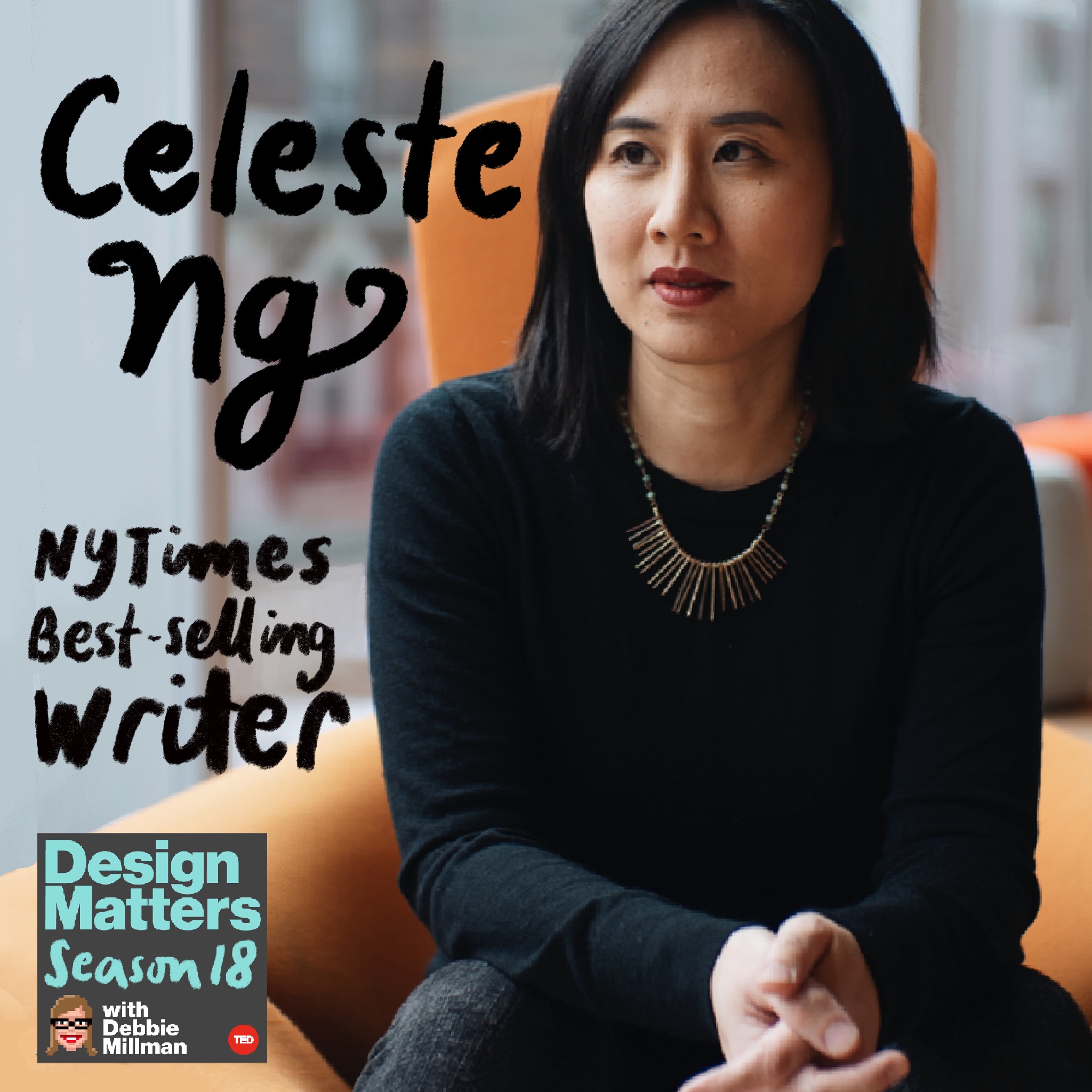
Loading summary
Transcript248 lines
- [00:01]
Debbie Millman
TED Audio Collective.
- [00:08]
Progressive Insurance Ad
This episode is brought to you by Progressive Insurance. Do you ever find yourself playing the budgeting game? Well, with the name your price tool from Progressive, you can find options that fit your budget and potentially lower your bills. Try it@progressive.com Progressive Casualty Insurance Company and affiliates Price and coverage match limited by state law. Not available in all states.
- [00:29]
Uncommon Goods Ad
Spark something Uncommon this holiday with just the right gift from Uncommon Goods. The busy holiday season is upon us and Uncommon Goods makes it less stressful with incredible handpicked gifts for everyone on your list. All in one spot. Gifts that spark joy, wonder, delight. And that it's exactly what I wanted feeling. Some of my favorite items that I've discovered on their site include a grilled personal pizza maker, some fabulous garden accessories, and my favorite, a pair of wine glasses personalized with a Maya Angelou quote. When you shop at Uncommon Goods, you're supporting artists and small independent businesses. And with every purchase you make at Uncommon Goods, they give back $1 to a nonprofit partner of your choice. To get 15% off your next gift, go to UncommonGoods.com DesignMatters that's UncommonGoods.com DesignMatterS for 15% off. Don't miss out on this limited time offer. Uncommon Goods we're all out of the.
- [01:40]
Celeste Ng
Ordinary.
- [01:44]
Narrator
This archival episode of Design Matters originally dropped in October of 2023.
- [01:50]
Debbie Millman
People that I've talked to have very clear opinions about what they think happens. After the last page, I found this actually about all three of my books. They come up to me and they're like, can you please confirm for me that this is what happens? And I'll be like, if that makes sense to you, then that's what happens. Right? That's the space I think that I want to leave open for the reader.
- [02:14]
Narrator
From the TED Audio Collective, this is Design Matters with Debbie Millman. For 18 years, Debbie Millman has been talking with designers and other creative people about what they do, how they got to be who they are, and what they're thinking about and working on. On this episode, novelist Celeste Ng on how fiction can change the world.
- [02:35]
Debbie Millman
It's trying to say, yeah, I know that's not true, but can you just imagine for a second? And that makes extra space for the possibility of.
- [02:49]
Narrator
This interview with Celeste Ng was part of a Design Matters live tour presented by On Air in Boston on September 19, 2023. Debbie was joined on stage to conduct the interview by Roxane Gay.
- [03:04]
Celeste Ng
Welcome to Design Matters, Celeste. My very first question for you today is this. I understand that you can fix Almost anything. The list includes leaky faucets, your dishwasher, your son's wind up toys, and even large appliances like dryers. How did you get to be so handy?
- [03:35]
Debbie Millman
I guess in the spirit of honesty, I should say I will try to fix almost anything. And I have managed to fix most of the things that you mentioned.
- [03:45]
Celeste Ng
Really?
- [03:46]
Debbie Millman
Yeah, it comes from my dad, actually. He was a physicist by profession, but I think he had this real mechanical engineer bent. And throughout my childhood he was just always fixing things. And I first was enlisted kind of unwillingly as like the flashlight holder and then the tool fetcher. But then through doing that, I think I learned that you didn't have to be afraid of taking things apart.
- [04:18]
Roxane Gay
Like if you paid attention, you could.
- [04:19]
Debbie Millman
Generally put them back together, figured out how things worked. And so now if something's broken, I will usually tinker with it for at least a while and try and fix it.
- [04:29]
Celeste Ng
Anything stump you?
- [04:31]
Debbie Millman
I was not able to fix our last washing machine, but I felt really redeemed because when we finally called a repair person, he told us that they're not really designed now to be fixed. They're designed to die after five years. So you have to buy another one. Which made me forced obsolescence.
- [04:47]
Celeste Ng
It made me really angry.
- [04:48]
Debbie Millman
But I also felt better about the fact that I had been unable to fix it.
- [04:52]
Celeste Ng
Fair enough. You were born in Pittsburgh, Pennsylvania. Your parents moved from Hong Kong in the late 1960s to Indiana. Your dad got his PhD in physics from Purdue University. Roxanne taught there as well. What made them decide to leave Hong Kong when they did?
- [05:12]
Debbie Millman
I think it really was the opportunity to come over and study. My dad was coming over to start his PhD program, and my mom had just finished college and she wanted to come over and continue her studies also. And my dad had gotten a scholarship over here, and so they decided to come over. And I think a lot, especially now that I am a parent, about how they just moved away from where all their family was and never went back. I mean, they went back to visit, but they never lived there again. You know, that I think has really shaped both how my sister and I grew up and our whole worldview, the idea that you can pick up your life and go somewhere and that there might be things that are worth that.
- [05:57]
Celeste Ng
Your family moved again from Pittsburgh to Shaker Heights, Ohio, when you were about 10. At that point, your dad became a physicist at the NASA John Glenn Research Center. I went to John Glenn High School, by the way. And your mom became the department chairwoman in chemistry at Cleveland State University and the president of the National Honor Society for Women in Chemistry. So you really come from a family of slackers.
- [06:26]
Debbie Millman
Yeah, we are known for just sitting around and not doing anything.
- [06:30]
Celeste Ng
Now, you said your parents chose Shaker Heights because it was relatively racially integrated. But I read that your sister told you when your family first moved that kids put firecrackers in your mailbox and a man accosted you and your aunt outside Tower City spitting and screaming terribly racist insults. How did this impact you as you were growing up?
- [06:59]
Debbie Millman
Yeah, the incident with the firecrackers in the mailbox, that was in Pittsburgh when we moved. When my parents moved, and I was, I guess, still in the womb. And so I didn't remember that, and they actually did. She didn't tell me that story for a really long time. The incident at the bus stop where there was a man who was shouting racist things at me and my aunt, who happened to be visiting from out of town, that was in Cleveland. And I think what I took from that is that even though Shaker Heights was known as this sort of model of integration, in that it was. I think at the time, it was about 50% white and 47% black and then 3% other. Something like that. That those numbers don't necessarily speak to the lived experiences of people who are there every day. Right. And that just having people living side by side does not mean that all the problems of racism are solved. Which, again, I know, sounds crazy, but it also, I think, sort of made me aware of the ways that just talking about race in the community, I think, made me see other experiences I had later on that had to do with racism or where I encountered racism. It made it seem like something that wasn't just this lightning bolt out of the blue. It made it seem like it was something that had roots in history and that had very deep sort of roots in our entire nation's history. And I think thinking about it that way made it feel like something, okay, we can try and do something about this. We need to try and do something about this. Right. It gave me a context for all of that.
- [08:37]
Unknown Speaker
You know, I'm also from the Midwest and not from a very integrated place at all.
- [08:43]
Celeste Ng
Nebraska.
- [08:44]
Unknown Speaker
Omaha, Nebraska. Hi, Mez. My cousin's here. We're holding it down for the O. And I know that it can be challenging to go back home in your writing, but Shaker Heights is a place that you have visited in your fiction. And so how do you think about writing your way home and exploring what that kind of a community is for the characters in your work.
- [09:10]
Debbie Millman
I will be honest, I was really scared to write about my hometown. And in fact, my first novel is set in a made up community because I wasn't ready to take on the sort of responsibility of trying to write about a real place. But when I started writing my second book, which is the one that takes place in Shaker Heights where I grew up, it really came out of a desire to do like exactly what you were saying, Roxanne, of actually trying to look back with at least some degree of separation and figure out what is this place that formed me for better and for worse, and how did that shape me into the kind of person that I am. So it was. I mean, that was integral to the whole writing of that book, was trying to understand what it meant to grow up in a place that wanted itself to be this really integrated, really harmonious, really forward looking place that succeeded in that in many ways, but that also really fell short in a lot of different ways and had all of its own sort of blind spots. Honestly. It felt like a huge responsibility to try and be accurate, but also not to be. I guess snide is maybe the word I'm looking for because I think many people, including me, you have certain feelings about your hometown.
- [10:26]
Roxane Gay
Right.
- [10:26]
Debbie Millman
Especially if you have moved away from your hometown. You know, there's often the things that you're like, of course they do that. Of course. Oh, I'm back here again. Right. That feeling. And I tried to kind of put that on the side, so to speak, so that I could try and be a little bit fairer. I don't know if I succeeded. I still get a little nervous when I go back to Shaker Heights to visit people because I always, I'm like, are they mad at me here for trying to look honestly. But I thought of it as like writing, like writing about, like maybe a family member that, you know, like an aunt or an uncle or a cousin, where you love them, you want other people to see all the things about them that are great, but you also feel like you maybe need to acknowledge a couple of the things that they do that maybe are really problematic and you want to kind of have both of those things sitting next to each other. Yeah.
- [11:18]
Unknown Speaker
You know, and I think that came out especially in Little Fires Everywhere. And I was thinking about the epigraphs at the beginning of the novel and the one from Cosmopolitan back in the 60s where the woman was explaining that Shaker Heights is like everywhere else, but where you might in another community have 100 people at your wedding reception. People from Shaker heights might have 800.
- [11:43]
Debbie Millman
Right.
- [11:43]
Unknown Speaker
And I thought that was a brilliant epigraph to put, because, first of all, like, 100 people at a wedding is a lot. So who on earth would be having 800? And so I was really interested in seeing how you kind of set the stage for readers to see that. The way people inside a community see it and the way people beyond the community see it can often be two different things.
- [12:06]
Debbie Millman
Absolutely. And that epigraph came because while I was doing research about the history of the town, which I didn't know a lot about being there, I think you don't often know all the stories of the place that you grew up in. I stumbled across this article from Cosmopolitan in the days before it was sort of a women's magazine. It was kind of a general family magazine. And they did a story about Shaker Heights being sort of the richest community in the country at that time. And I kind of read every line of that article. You know, my eyebrows just kept going up and up and up, because I think I was reading it as you were saying, you know, not exactly the way that it was maybe intended to be, you know, as it was written, but going, oh, you think you're just like everybody else. But I think that your sense of what everybody else is like may not be totally accurate. Right. And it was sort of things like that where I was really trying to strike a balance between being honest about how this community sees itself, has seen itself for a long time, but also the ways in which they might not be seeing themselves as accurately as they think they are. I think that's still one of the things Shaker Heights is working through to this day.
- [13:21]
Celeste Ng
As you were growing up, I understand at one point you wanted to be a paleontologist.
- [13:26]
Debbie Millman
I did.
- [13:27]
Celeste Ng
And then an astronaut.
- [13:28]
Debbie Millman
Yes.
- [13:29]
Celeste Ng
Were you assuming you were just going to follow your parents into the sciences?
- [13:33]
Debbie Millman
No, I don't think I really thought about either of those as science, honestly. I just thought they were really cool. So I grew up in Pittsburgh until I was almost 10. And there's an amazing museum there, the Carnegie Museum, and they have really cool dinosaur skeletons. In fact, I was just there for an event, and I had a couple hours, and I was like, I'm going to see the dinosaurs. I just thought there was something really cool about this whole other world and these, like, really big, kind of creepy bones. And that seemed like a plausible career choice when I was five. And then I got older and realized that maybe finding dinosaur Bones is actually a little bit more difficult than it sounds. And there's not actually that many spots for paleontologists. And then astronauts somehow seem more realistic. I don't know how to explain that one other than that. I guess it was sort of this sense of exploring a new world.
- [14:28]
Celeste Ng
It's interesting. We were recently in Mongolia, where there are quite a lot of dinosaur bones.
- [14:34]
Debbie Millman
Really?
- [14:35]
Celeste Ng
Yeah. There's a plethora of dinosaur bones there. There's whole groups of people that just go to dig up dinosaur bones.
- [14:44]
Debbie Millman
Wow.
- [14:44]
Celeste Ng
Yeah. Quite astonishing. You started writing stories, poems and plays in middle school. What inspired you to first start creative writing?
- [14:57]
Debbie Millman
The truth is, I actually started doing that a long time before that, even before middle school. The story in my family is that I was a really early reader. My mom says that I taught myself to read at 2. I can't verify that because I don't remember. But I do know that I don't really remember a time before I could read. I do remember being at daycare, and it was nap time and everyone else went to sleep, and I was bored, and I took out my book, and I got in trouble for reading the book because I was supposed to be taking a nap. But I think I just started writing stuff because that was how I made sense of the world. I would read books, and certain parts of them would speak to me, and they would help me explain myself to myself and other parts. There would be new places, and I would love the idea of learning about a different time or a different place, and I wanted to. And so I just started writing stuff, and I would write little poems, I would write plays, and I would make my cousins perform them, and we would charge our parents admission. I mean, it's just always been a thing that I wanted to do, monetize.
- [16:04]
Celeste Ng
It right from the beginning.
- [16:06]
Debbie Millman
I think that that might have been how I convinced them to do it, because they were like, why would we do this? I was like, well, we can charge admission and then we'll split it up. Right? And I think that was how I lured them in, because there was definitely some coercion involved on my part.
- [16:21]
Celeste Ng
Tell us, if you can, about the influence that Diane Derrick had on you, your fifth grade teacher at Woodbury Elementary.
- [16:30]
Debbie Millman
Oh, I love Mrs. Derrick. I love that you, like, looked and mentioned her and that I get a chance to talk about her. So at least at the time, we did these little pullout classes, and they called it, like. I think they called it Warp, which was like, Woodbury, the name of the school alternative reading program. But it was, you know, sort of for kids to get a little bit of sort of extra English Language Arts, I guess. And she was one of the first teachers who made me think that being a writer was something that I could actually do. She would ask us to write short stories, and she would ask us to write poems. She would encourage us to learn about different kinds of poetry. And so she'd be like, okay, you're going to learn to write a haiku. Try doing this. You're going to try and learn to write one that's rhyming. You're going to try and write something else. That was the first time that I'd seen creative writing treated like a school subject. And she also was, I think, the first person to introduce me to what I thought of as, like, a real published writer. There was a writer who wrote a series of books about, like, mice and different animals called Redwall and Moss Flower. And so these animals would, like, have adventures and, like, they had swords and they fought each other. And he came to our school to give a talk. And I remember she dragged me, because I was shy, into the library where he was signing books, and I had got a copy of his book.
- [17:53]
Roxane Gay
And she said, this is Celeste, and.
- [17:54]
Debbie Millman
She wants to be a writer. And he signed the book for me. And I still have it. It was the first time I was like, oh, she said that out loud. Like, she said, I want to be a writer. So that's actually a thing I could do. So, I mean, it seems strange to say that a teacher I had when I was 10 was such a huge formative influence. But I think that those teachers, do they leave their mark, and you feel their influence on you forever.
- [18:22]
Celeste Ng
You've said that what you were writing back then was really terrible. It was necessary for it to be terrible. And so I have two questions. Why was it terrible? And why was it necessary for it to be terrible?
- [18:40]
Debbie Millman
The terrible part, I feel like maybe if you take it in the context of a kid writing, maybe it wasn't terrible, and it was just not very good. There was a long period where I was like, if you use bigger words, the poem is better. And we had this big thesaurus in Mrs. Derek's classroom, and we were all doing it. So I remember writing a poem about a gemstone. And the only thing I remember was that it definitely involve the word pulchritudinous. And so, you know, there was a period where I was kind of learning about how to use language like the bigger word isn't necessarily the better one. You know, there's maybe other things you need to think about. You know, I also, I think that I was sort of experimenting. I remember I wrote another poem. I read some novel that took place on a whaling ship. And so I wrote this long, rhyming, semi metered poem about whaling and like, how great it was that they were going out and like, killing all the whales and like getting oil. Because that was the book I had just read. And my sister still, like, she's still really proud of this poem because I feel like for her that was one of the first real poems. But I think a lot of it was just I didn't know what I was doing. It's like if you gave a baby a musical instrument, they start making noises. And those early noises are maybe not super melodious, but that's how they're kind of figuring out how it works. And so that gets to the second half of the question. I guess it was necessary because it was me figuring out what my relationship to language was. It was me figuring out what my relationship to, you know, different genres was and me figuring out what subjects actually like, spoke to me versus, like, wailing and this, like, green rock that I had written a poem about. Those didn't have a connection to me, but I started finding my way to what did through that.
- [20:27]
Celeste Ng
When did you think your work wasn't as terrible?
- [20:32]
Debbie Millman
Oh, much, much, much later. I think by high school I maybe didn't loathe everything that I wrote. But honestly, I don't think it was probably until like, well through grad school that I would kind of look at something and go, I think this is actually okay. Like, I think this is actually good. And honestly, earlier today I was looking at my manuscript and texted a friend about how, like, was it too late for me to take back the pages that I had submitted to my writing group for feedback at our next meeting. So I think this is just still kind of an ongoing me problem, you know.
- [21:10]
Unknown Speaker
I have a question, because the more successful you get, the harder it is to find that space to experiment and allow yourself to write badly. Are you at all able to find that space that you had when you were a young person?
- [21:25]
Debbie Millman
Very. I think, like, that's what I'm looking for. But it's really difficult because you become more aware of the fact that if you're lucky, you've developed an audience.
- [21:37]
Roxane Gay
But then once you know that there's.
- [21:38]
Debbie Millman
An audience, it's hard to not think about them. And for me, I am sort of a people pleaser by nature. But I also it means a lot to me that there are people who care about what I write, and if they're going to read what I write, I want to do right by them. I want to give them something that is worthy of the time and the energy that they're gonna give to my work. And that puts pressure back on me. Right. Alex Chee, who is a writer that I really admire on the page and off the page, said once that when you are a beginning writer, you're writing in, like, a silent room. You're writing in a room where the doors close and you can kind of do whatever you want. And nobody tells you that when you publish something, you crack open the door, and then you can never quite get it all the way closed.
- [22:24]
Roxane Gay
So there's always gonna be this little.
- [22:25]
Debbie Millman
Bit of outside noise coming in. And so I think when I'm wr now, what I try to do is I drink a lot of caffeine, either coke or tea, and I eat some sugar. Honestly, this is what I do. Not sugar.
- [22:38]
Celeste Ng
Swedish fish, right?
- [22:40]
Debbie Millman
Yeah, I actually have a bag of them in my desk. And then I just try to kind of, for half an hour or an hour, write whatever comes out and just turn off that sensor. And for me, the Swedish fish and the caffeine appear to be part of that formula. But I think that's. You're right. You kind of have to turn that voice off. At least when you're starting a project or you. You kind of get paralyzed and, you know, you trip over your own feet.
- [23:04]
Celeste Ng
You went to college for English. Your major in English was in English at Harvard University. When did you decide, okay, I actually do want to pursue writing, not become an English professor or a journalist and take it seriously, and then go on to get an MFA pretty late.
- [23:27]
Debbie Millman
I went to Harvard thinking I would study English because I knew that literature and reading was really what I loved. And there wasn't at the time, a lot of support for creative writing. And so I wasn't even thinking about that. And I thought, okay, I'm gonna go work in publishing, and then I will write on the side. So that was my sort of like, get out of jail free card that would allow me to be a writer. And I did that. I got a job in publishing, and I think I started in September, and I think by October, I was like, this is not the industry for me. I need to leave this industry and do something else. And my escape plan then was, I'm going to go and become an English professor. I'm going to go. I will get a PhD, and then I will get tenure. And then once I have established myself, I will write on the side, which now is even less plausible than becoming an astronaut or becoming a paleontologist.
- [24:17]
Unknown Speaker
I love that that was your escape route from publishing. Like, oh, I bet it's EAS over there.
- [24:23]
Debbie Millman
I know. Well, that tells you something about how much I knew about anything at that point. And it was really at that point where I had an amazing teacher who had been the teacher for a couple classes. And I said, can you give me some advice? Can you help me write a rec letter? What do I do? And she was finishing her PhD, and I think she was the one who's like, you should really make sure you want to do this before you go down the PhD path. And she was like, look, if what you want to do is write, why don't you do that first? Why don't you move it from the side and put it right in the front and you should go get an mfa. And I think my actual response was, what is an mfa? And she was like, okay, let's talk. And it really. I mean, so I was, at this point, I think I was 23, 22, 23. And it was really solely because, again, of like, that one teacher who was like, would look over there. That might be what you're actually looking for. That I went and I started taking creative writing classes and really trying to put together portfolio, and kind of went from there. I never would have done it without her.
- [25:30]
Celeste Ng
I think it's so interesting. So many people that I speak to have a safety path, and they wrestle at the very beginning of their career about the safety path or the risky path. But the safety path is no easier. It's just safer because there's less to lose in someone's mind in terms of what is really at risk. At the University of Michigan, you won the Hopwood Award for a short story you wrote titled what Passes Over. And in this story, you begin to write about themes that you've continued to write about in your subsequent fiction and essays. The dynamics between family members, secrets, double lives, the impact of race in both relationships and societies. And as I read what passes over, and then another early piece you wrote titled Girls at Play, which won the PushCard prize in 2012, I found it really interesting to see the seeds of your work take shape. Do you look back at the work that you did 10, 15 years ago and think this was necessary to create this?
- [26:50]
Debbie Millman
Yeah, absolutely. It's interesting to look back at those early stories because they, in some ways, they Almost feel like a different writer wrote them, which I guess is sort of true. Like, with each piece, I like to think that I develop in some way as a writer. And so those stories I wrote almost now, 20 years ago, I sure hope that I have grown and developed some over those 20 years. But at the same time, I see sort of the same DNA running through them, like you say, you know, I see certain themes about, like, what are the things that parents and kids have real trouble talking to each other about?
- [27:27]
Roxane Gay
Right?
- [27:27]
Debbie Millman
Or what are the ways that they still try and connect despite loss, despite grief, despite all kinds of things? I see myself starting to just kind of dig at those themes. And they're still the themes that I'm working with now. You know, I'm still digging in that same hole. I'm just maybe like a little farther down.
- [27:44]
Celeste Ng
Roxanne wants to ask you about your novels, but I'd like to ask you a few questions about Girls at Play because it is one of those short stories that there's a before and an after in your life. It's a startling story. It is about a group of outcast high school teenage girls that meet a slightly younger new girl in town named Grace. And the girls indoctrinate her into some of their world, but have a hard limit on sharing everything until they don't. Until they can't. What inspired this story? And it's on the Internet. I want everybody to like, Google Girls at Play Celeste Ng and read it before you go to bed.
- [28:30]
Debbie Millman
Maybe, maybe read it in the morning. It depends on what your goals are.
- [28:38]
Celeste Ng
It's stunning.
- [28:39]
Debbie Millman
I remember actually, specifically, I don't always know what inspired her story, but in this case, I was having dinner with a dear friend from college and we'd met up with his sister who was connected to an elementary school. And we were just chit chatting about this and that. And she mentioned this trend that was happening where girls would wear these like, jelly bracelets on their arms. They're like kind of like a rubber band, but, like, not as stretchy and they come in all these different colors. And I remembered having some when I was a kid. And she said that the understanding among the teachers at this school was that this was basically a sex game and that different colors would represent different sex acts and the boys would come up and pull off the bracelet of what they wanted and then the girls would have to do it. And I don't actually know if this story was true or if this is just an urban legend, but she said that and this scenario popped into my mind about what girls are doing that and what would lead them to do that. And then what would happen also if this other person who wasn't sort of initiated into that game came in? Like, where would they want to sort of, like, guide her? Would they want her to go down that same path? Or would they want to try and keep her from that? And that's really where the story came from. It was one of the first stories that I wrote after grad school. So I feel like I wrote it like I took the training wheels off. And I no longer had teachers to ask for advice or other things. So that was one of the first ones that I kind of had to do on my own.
- [30:05]
Celeste Ng
Do you ever envision having a collection of short stories, maybe?
- [30:10]
Debbie Millman
I'm still proud of those short stories, and I still love them, but I feel like they aren't me anymore. Again, I wrote them a long time ago. And I think that now I would make different choices if I were writing those stories. Not that I did it wrong, but just I'd tackle things differently now. Or bits that I had taken from reality I might use differently.
- [30:33]
Roxane Gay
Right.
- [30:33]
Debbie Millman
I think, again, those are the sort of things where you're. You're feeling your way through and you're learning how to do stuff. So I don't know. I don't know if I. I don't want to disavow them, but I don't know that I want to put them out there again.
- [30:45]
Celeste Ng
It'll be in the box set, the Celeste box set. I feel like the early years.
- [30:50]
Debbie Millman
That's it. There would be, like, the early years. They'd be like, oh, this is before you learned what you were doing. Right. These would be, like, the taste.
- [30:56]
Celeste Ng
No, no, I have to hold you there. Because these stories are, like, pulsing through my blood right now. So. No, they're good.
- [31:05]
Unknown Speaker
They're very good. I know that you make miniatures as a hobby.
- [31:11]
Debbie Millman
I do. The secret has, like, gotten out now. Now everybody knows.
- [31:14]
Unknown Speaker
Listen, the minute you tell a reporter something, it goes in your Internet file. And then we get to pull it up for conversations like this. And I love miniatures. I'm obsessed.
- [31:25]
Debbie Millman
I did not know that.
- [31:27]
Unknown Speaker
Yes.
- [31:27]
Debbie Millman
I'm gonna.
- [31:27]
Roxane Gay
Okay, I'm gonna send you some miniatures now.
- [31:29]
Unknown Speaker
Oh, please. Do you, like, take something that's normally really big and you make it super tiny?
- [31:34]
Debbie Millman
Oh, my God.
- [31:35]
Unknown Speaker
I'm like. Do you watch the videos on YouTube where they make the tiny fucking food?
- [31:39]
Debbie Millman
The tiny food. The real. The tiny, real food. If you guys have not seen this, you should Go, like, just go, like, Google it. Or, like, there's. It will probably just pop up in your Instagram, now that we've talked about it, because that seems to be how the algorithm works.
- [31:52]
Unknown Speaker
Yes.
- [31:52]
Debbie Millman
Like, they crack, like, a little, tiny. Like a quail egg, and they put it in a tiny bowl, and they whisk it up, and then they put in, like, tiny flour, and then they light it over a candle, and they make, like, a little, tiny pancake.
- [32:03]
Unknown Speaker
And then they put a little tiny carafe of syrup, and then they go.
- [32:06]
Debbie Millman
They pour it over. Oh, wait, there's another one where. Similarly, where they make tiny food, but then there's, like, a gerbil, and the gerbil gets to eat the food. Have you seen those ones?
- [32:16]
Unknown Speaker
Oh, I haven't seen that one.
- [32:17]
Debbie Millman
They're really cute. So they only make foods that I guess gerbils can eat. Cause I guess there are some things that they cannot. But they'll make, like, the gerbil, like, a tiny little burrito with, like, vegetables in it. And then at the end, they give it to the gerbil and it eats.
- [32:32]
Unknown Speaker
Oh, my God, I'm so delighted. Because every time they open that little tiny dollhouse oven and then put the candle in it, and then that little candle heat makes the piece of bacon fry.
- [32:41]
Debbie Millman
Yes.
- [32:41]
Unknown Speaker
I'm just like. But anyway, you heard me here first.
- [32:46]
Celeste Ng
On Design Matters, Anything can and will happen in live radio.
- [32:51]
Unknown Speaker
I loved what you said about the practice of making miniatures is more about looking at something closely than it is about controlling a tiny world, which I thought was really interesting coming from a writer, because in many ways, when you're writing, you are trying in some way to control the tiny world that comes out of your mind. And so how are the ways that you look closely at your work and what comes out of that looking?
- [33:15]
Debbie Millman
Oh, I don't remember saying that, but I 100% agree with it. So good job. Past me.
- [33:21]
Celeste Ng
Exactly.
- [33:23]
Debbie Millman
You know, I bet there are miniaturists who do miniatures because they want to control things. Like, I think for a lot of people, that is, you know, they want to make a world in which they can control every detail. They can make it just how they want. You can't have a fancy palace in real life, probably, but you can have one in miniature. Right? And for me, that's not actually the appeal. For me, the joy of it is a lot of having an excuse to look at things. So if I'm making. For my mom's birthday, I made her a little miniature bookshelf that Had a lot of her favorite things on it. And one of her favorite things is water lilies. That's her favorite flower. So I was looking at all these photos of water lilies and looking at the colors of the petals. They almost glow. Like, the petals are so thin and translucent. And they often start with white, and then they kind of blush to this dark fuchsia at the tip. And the. I don't know what the flower part name is, but the part in the middle of the flower, it looks like something that was not made by nature. Like, it looks like the spout of a watering can. Like, it's kind of weirdly shaped. It's got holes in the end. And so I was spending a lot of time looking at it. I swear I'm going to answer your question in a second. But, like, there's something really kind of lovely about looking really closely at something and just paying attention to it. And I realize that's what I do when I'm writing. Also, I will spend a lot of time either physically looking at something or mentally looking at it and thinking about it and trying to find a way to give it shape. So in writing, I'm trying to kind of give it a shape in the right words and in miniature, I'm trying to give it a shape more physically. But I think for me, that is, it more than anything else, it's really an excuse to just kind of enjoy how cool the world is and how many really interesting and weird things there are out there that a lot of times we don't even notice. But if you're paying attention, there's like, tons of weird and interesting stuff.
- [35:26]
Progressive Insurance Ad
Support for this podcast comes from Odoo. Imagine relying on a dozen different software programs to run your business, none of which are connected, and each one more expensive and more complicated than the last. It can be pretty stressful. Now imagine Odoo. Odoo has all the programs you'll ever need, and they're all connected on one platform. Doesn't Odoo sound amazing? Let Odoo harmonize your business with simple, efficient software that can handle everything for a fraction of the price. Sign up today@odoo.com that's o d o o dot com.
- [36:03]
Unknown Speaker
Like Debbie, I love your short story Girls at Play. And anytime someone uses Collective points of view, it just makes me think, oh, we're all in this together. And there's a sense of foreboding because you think something happened to us. And there are these details of girlhood, this haunting ending, and it got me Thinking about all of the various craft elements that work in concert to really make that story into something so masterful. So how do you get there where you have an idea? You start with these wristbands, and then you come up with these young girls, and then Grace, and it all comes together. And so how do you make creative decisions about tone and point of view and place and all of these other things that come into good fiction?
- [36:56]
Debbie Millman
For me, it all really comes from the character, and a lot of times it comes out of the voice. And so in that story, it's told in the first person plural. So there's a group of girls, and they're speaking like almost like a Greek chorus. That voice came first, and then that basically made all the decisions for me. I could figure out sort of what things they, as a group, would talk about. They would say, we do this, we do that. Right. It tells me too, sort of what kinds of details that character or those characters would notice. For me, that's sort of like the first decision. It's like the first cut, and it removes all these other possibilities and then what's left? It's much easier to figure out once I've got that voice. So it always starts with figuring out who the character is and getting to know them, getting to know how they talk, getting to know what they think. It's a lot like if there's someone you know really well, like a sibling or a best friend, you have a pretty good idea of what they would do in any given situation. Right. You can kind of guess. And that's really sort of what I'm doing. I'm following that character and kind of letting them be them.
- [38:09]
Unknown Speaker
Oh, that's interesting. And that act of almost surrender where you let the character be what they're meant to be. I know that to do that, I think, in some ways requires hope. Like there's hope for the character to become what you know is possible for that character. There's hope for the world of the story. And one of the things you do in your fiction is bring in elements of the very real world that we're living in, including discrimination. And in recent years, we've seen a rise in anti Asian discrimination. We had a pandemic. And you've addressed this in interviews and social media. You've engaged in fundraising. And one of the things that has stuck with me across many interviews is that you still do believe in this idea of hope and that you've said that books do give us space for it. And so what do you find hopeful if Anything about fiction, and what does that hope give us as readers and writers?
- [39:06]
Roxane Gay
Oh, this is a big question.
- [39:10]
Debbie Millman
I think the thing fundamentally, that makes fiction seem really hopeful to me is that at its heart, it is imagining something that is not real. It's basically sort of saying, yeah, this is the real world, but can we make the universe a little bigger? Can we make it include something that isn't our regular world? And the sense that fiction, because you go into it knowing that it is made up, right, that it's very upfront about that and it's not trying to trick you, it's trying to say, yeah, I know that's not true, but can you just imagine for a second? And that act feels really powerful. It feels like kind of elbowing out space for us to then make actual change in the world. And to me, that feels really fundamentally hopeful. It makes extra space for the possibility of change. Right. Imagining a counterfactual is like a really human thing. And it's also one of the things, like early in childhood, they talk about kids, when they can start to hold in their mind the possibility of something that is not real and know the difference between those. That's sort of like one of the big stages of mental development. And I feel like we kind of need a booster on that as we get older as well. We need to be reminded that there's more stuff than just the world as it is and more stuff than just what we can see, or else we don't have anywhere to go.
- [40:34]
Celeste Ng
I think you quoted Margaret Atwood and the way she was, her approach to writing A Handmaid's Tale, how, though it might not be true, she wanted the toads to be toads.
- [40:46]
Debbie Millman
Yeah. She wanted. If she was going to make an imaginary garden, she wanted the toads to be real. And so, in that sense, even though she was going to make this space in which characters who do not exist in real life do things that they didn't do, she wanted to have roots in reality so that you could see the links between the world she was making up in the Handmaid's Tale and the world in which we live and the history we come out of.
- [41:12]
Unknown Speaker
In your latest book, Our Missing Hearts, you shift a bit from realism and literary fiction to speculative fiction, and it's really quite dystopian. And you've said that your reasoning for doing that was spurred by, of course, Trump's election. So how did writing this particular book help you think about hope differently? And is there anything that you've learned through a pandemic And a very tumultuous political climate that you've been able to incorporate in your writing.
- [41:44]
Debbie Millman
Yeah, I started writing this book really as a way to try and find hope. I think I had the. The roots of the story pretty early. And it started off as a fairly simple story about a mother and son. And then as we moved into the Trump years, I was really sort of struggling to find hope. And so part of the book is.
- [42:06]
Roxane Gay
Me working that out on the page.
- [42:08]
Debbie Millman
Like, why should we continue to have hope?
- [42:11]
Unknown Speaker
Right.
- [42:12]
Debbie Millman
Which was, I think, a question that I was asking myself a lot in those years. What I learned from it, I think maybe is part of what I just said earlier, that sense that even just. Just the act of imagining is kind of hopeful. But also I learned about myself that I turn to art of all different kinds to kind of balance myself and to give me hope. During the pandemic, I was reading a poem every morning because that would give me some strength to get through the day, basically. There is one poem in particular that I liked so much that I ended up typing it and I hung it over my desk so that I could look at it.
- [42:53]
Celeste Ng
Can you share that?
- [42:54]
Debbie Millman
Yeah. It's a poem by Muriel Rukeyser. I think it's helpfully just titled poem, which makes it really difficult to Google. But it starts off like I lived in the first century of world wars. And then it goes on and says most mornings I was more or less insane. And she goes on to talk about how the news is terrible, the newspaper is bringing these horrible headlines, the radio, the television are bringing terrible things, and she's trying to write her poems and she's really struggling. And all of her friends are also, as she puts it, more or less insane for similar reasons. And what ends up happening in the poem is that she eventually gets herself to work by thinking about who's going to read this poem in the future, who is she writing to? And thinking to herself that maybe she's writing these far away messages that are going to reach people who are far away from her or maybe even far off in the future. And that that act of conn is what is sort of making it possible for her to get to work. And that felt really resonant during the pandemic when we were all kind of physically as well as mentally isolated from each other. And it spoke to me because I'd been wondering, what am I doing? Like, I'm not a nurse, I'm not a scientist. I'm not working on the vaccine. I'm not helping people in the hospital. I'm sitting here with my laptop making up stuff and, you know, thinking that actually maybe writing stories and finding ways that people can connect with each other on the page, maybe that's also contributing. Maybe I'm just rationalizing. But at least that's sort of one of the things that I discovered through the process of writing this book.
- [44:37]
Celeste Ng
In our Missing Hearts, you describe Margaret, the mother of Byrd, who is the young protagonist of the novel. In this way, that was his mother, formidable and ferocious when her child was in need. Did you have anyone in mind as you were creating Margaret's character?
- [44:56]
Debbie Millman
Oh, I mean, my mom for sure. Myself also. And actually, I mean, honestly, most of the moms that I know, you know, broaden. Not even just about moms, but I think if you are a parent, there's kind of like a monster inside you that'll come out if your kid is in trouble and needs you. Right. It's the story about the mom who can lift up a car when the child is pinned underneath it. And something that. I kind of like thinking about that, like, you know, I'm super nice, but also, like, don't mess with me in the wrong ways. Like, that kind of feeling is.
- [45:30]
Celeste Ng
I kind of like that there isn't a date. As far as I can tell, in our missing Hearts, it could be a year from now, depending on the election. It could be. It could have been three years ago. I'm gonna talk about some of the specifics of the book, but I'm not going. I'm gonna try really hard not to do too many spoilers in the book. There are new laws of the land in the United States, and they're referred to as pact. Can you share what pact P A C T stands for?
- [46:04]
Debbie Millman
Yeah, it stands for protecting American cultures and tradition. And it essentially sort of makes it criminal for you to be doing that are seen as un American. And you think about that for a minute, you can also see the ways in which this law might be wildly abused or turned against certain groups of people.
- [46:22]
Celeste Ng
The three pillars of PACT are as follows. Outlaws promotion of UN American values and behavior. Requires all citizens to report potential threats to our society and to protect children from environments espousing harmful views. When I typed that up, I realized that there are certain parts of the US that are already living within these pillars. And I found that a bit terrifying.
- [46:52]
Roxane Gay
Yeah, like, Roxanne, when you said, like.
- [46:54]
Debbie Millman
It'S quite dystopian, I was like, it kind of was when I wrote it, but it wasn't actually as dystopian as I hoped it would be. And it is becoming less dystopian. Or I guess our world is becoming more dystopian. I mean, there are now multiple places in the country where I'm trying to think of how to put this in a way that you're allowed to put in the podcast.
- [47:18]
Unknown Speaker
You can say anything on the podcast.
- [47:20]
Debbie Millman
I can? Oh, yeah. So, like, I'm allowed to swear?
- [47:24]
Unknown Speaker
Oh, yeah.
- [47:24]
Debbie Millman
I wish I had checked that with you beforehand.
- [47:26]
Unknown Speaker
Oh, no, I'm a big swearer. I've sworn on her podcast.
- [47:30]
Debbie Millman
This is good to know. Well, so there are plenty of places now where if you are caring for your children certain ways, you know, if you give your child gender affirming care or you accept that they're going to use pronouns different from the ones that they were assigned at birth, you can have your children taken away from you. Right. If you are giving your children books to read that are deemed unsuitable by the state, you can get punished. You know, librarians can get punished for that. You know, that's not happening in just one place. It's happening in multiple places. And. And when I've been talking about the book recently and people describe it as a dystopia, I always want to say, how far away from where we are is it? It goes back to that idea of the toads being real, that all of the things that I put in the book, I didn't make up out of whole cloth. They were laws that had been proposed and a lot of them now have come to pass. That's the scary thing about dystopia is that what makes it feel resonant is the fact that we're not actually as far from it as we think we are.
- [48:32]
Celeste Ng
Right. Well, also, how people respond to being in the dystopia. One of the things that I was thinking about in relation to how people responded in the book to Pact, you outline how being a person of Asian origin or pow P A O is not a crime. And write pact is not about race. It is about patriotism and mindset. And I was wondering. People in the novel felt very unhappy, but there aren't more people in the novel objecting, or at least not that we're aware of. And I was wondering if that was a very intentional statement on the fear people have about fighting back or talking out or defending those that might not be treated properly or fairly.
- [49:27]
Debbie Millman
Yeah, that's absolutely something I was thinking about. If you heard echoes of the Patriot act when you heard that bit that Debbie just read, that was One of the laws that I was thinking about, I learned in researching this book that the Patriot act is not actually like one specific law. It's actually about a billion emendations to current laws that were there. Like, it's really difficult to read it, but one of the few parts that you can read is a little passage in there where they take pains to say, this is not about Muslims. We. We don't have any problems with Muslims. Muslims, we're totally fine with them. We accept them in America. But any Muslims who don't do what we want to, those are the ones we have a problem with. And it was very striking to read that kind of so blatantly stated. And that's one of the things I was thinking about, that. It's really easy, I think, for people to know that a thing is happening to a group, but if you're not in it, it's a little harder to step forward and do something about it. And that's understandable. That's human. You stay out of other people's business a lot of the times, and you don't put your own neck on the line unless there's a reason. But the question is always, at what point does it not become academic for you? At what point do you feel like this is an US Problem? Something's happening to us versus something's happening to you over there.
- [50:46]
Celeste Ng
You included Japanese myth about cats in our missing hearts and have said that you're fascinated by the way that folktales and language are both remembered and altered as they pass between generations. What made you decide to include this particular myth in the novel? And if you can extrapolate a little bit on what the myth is for our audience.
- [51:08]
Debbie Millman
Yes, the story, it's a folktale called the Boy who Painted Cats. And it was first rendered in English by this guy named Lafcadio Hearn, who. Super interesting guy in and of himself. He was an Irishman, then he moved to America, then he moved to New Orleans, and he wrote down a lot of their stories. And then he moved to Japan and became a Japanese citizen and took on a Japanese name. So he kind of had roots in a lot of different places. And I read this folktale when I was a kid. It was a children's book. It's about, as you can surmise, a boy who paints cats. But he. He's in trouble because he never does the things he's supposed to do. He's just always painting cats on the walls and on the floor, and it gets him into trouble, and he ends up finding out that the drawings that he makes actually sort of have a power. They help him fight a monster in the flesh. And I'd read it as a kid, and it made a really big impression on me, partly because the picture in which you actually see the monster was very striking, but also because I think it spoke to me on the level of, like, what maybe art can do. And it had a resonance with this story that I was forming. And then this interesting thing happened, which is that I asked my sister if she remembered the story, and she was like, kind of, I don't remember it exactly. Sort of. Ask Mom. I asked my mom, and my mom was like, I have no clue what you're talking about. I have never heard this story before in my life. I couldn't figure out where this story had come from. It's real. It's in the library. And I've been unable to find the version that I remember with that really striking picture. And I bought all these different versions, and the version that I remember is slightly different. And so for the second part of your question, you remember the parts of stories that resonate with you, and you kind of fit them to your life and the meaning that you make out of them. And a different person is going to get something different. You're going to get something different later on. I think that's why the fairy tales live on, because they're so malleable, they can kind of adapt to whatever we're trying to understand about ourselves.
- [53:14]
Unknown Speaker
You know, speaking of fairy tales, over the past several years now, you have sold millions of books, and you have a very passionate readership.
- [53:22]
Celeste Ng
Three New York Times bestsellers.
- [53:24]
Unknown Speaker
Yes, you've hit number one on the bestseller list. So not only have you written books, but you've written excellent books, which is not an easy thing. And in a piece in Time magazine last year, you talked about the different iterations of vulnerability that come with writing success. And I was really moved by that, because it's not something that there's a lot of space to talk about, because it is so hard to make it as a writer that when you achieve some measure of success, everyone just expects you to, like, be thrilled and that there's no downside. So I was curious about what you have learned from those vulnerabilities and what have been the pleasures and the challenges of writing success.
- [54:06]
Debbie Millman
This is where it's really helpful to.
- [54:07]
Roxane Gay
Have friends who are therapists.
- [54:10]
Debbie Millman
One of my best friends is both a poet and a therapist, which is, like, kind of an amazing combination. And as I think My books were.
- [54:18]
Roxane Gay
Starting to find their audience.
- [54:20]
Debbie Millman
I was feeling a lot of conflicted.
- [54:23]
Roxane Gay
Things, like you were saying, Roxanne, both.
- [54:24]
Debbie Millman
Really thrilled and honored and actually kind of humbled that people wanted to read what I had written, but also feeling sort of vulnerable about that and not really sure how to handle both of those things. And my poet therapist Fen, said to me, you know, those things don't cancel out. It's not like there's a positive and a negative. And you add those two numbers together and you get a zero. She's like, they just exist next to each other. As simple as that sounds. That was kind of an eye opening thing to just recognize that if you're lucky, you get success, but there's also going to be downsides and they come along together and you kind of have to accept that. And so I guess I've moved towards sort of a more Zen sort of feeling about it being like, this is what it is. It all comes together. There are so many, like, joys. And one of them, honestly, is when I hear from people and my books have meant something to them, really. It sounds so cheesy, but it's a huge gift. If I talk to a reader, a young reader or an older reader or anything, and they tell me this book reminded me of my family, or it made me understand something about myself or this expressed something that I was feeling but I didn't know how to put into words. And then you put it into words like, that's. I feel like that is the nicest thing that a writer can hear. And that's probably like the highest of the highs. And although they're not measured on the same scale, it does make me willing to put up with all of the bad stuff like that. There's nothing like hearing that you made a connection with someone.
- [55:54]
Unknown Speaker
Absolutely.
- [55:55]
Celeste Ng
Speaking of family, the ending of our missing hearts is ambiguous us. And without providing any slash, too many spoilers, I would like to think that Bird and Ethan and Margaret are eventually reunited and that Margaret's sacrifices were worth it. Is there a happy ending in your mind for this family?
- [56:24]
Debbie Millman
I think I wanted to leave that.
- [56:26]
Roxane Gay
Open as a possibility, for sure.
- [56:28]
Debbie Millman
I don't know that there is not a happy ending. This sounds like I'm being cagey and I don't mean to be. I am, but I'm not on purpose because I think that what happens to them, like, the hopeful part of the story has already happened in the book.
- [56:47]
Roxane Gay
Right.
- [56:48]
Debbie Millman
Whether they end up together or not, like, I want that for them too. But the change that's happened has already occurred by the fact that she's made a sacrifice and so on. This probably makes no sense if you've not read the book.
- [56:58]
Celeste Ng
I think it does a little bit. Top line, I think.
- [57:01]
Debbie Millman
I guess what I mean is that for me, the happy ending is that there is still a possibility that they may end up together. Right. There's this great quote from Ann Patchett.
- [57:11]
Roxane Gay
Where she talks about the meaning of.
- [57:13]
Debbie Millman
The book being between not the reader and the writer, but between the reader and the book itself. And what I take that to mean is that you bring your own experiences and your own interpretations to book. And that's actually a good thing. Like, that's actually, you know, part of the book. And people that I've talked to have very clear opinions about what they think happens. After the last page, I found this, actually about all three of my books. They come up to me and they're like, can you please confirm for me this is what happens? And I'll be like, that sounds great. And they go away and they're happy. And then another person comes in and they have the exact opposite.
- [57:52]
Celeste Ng
Like the Sopranos. Like the end of the Sopranos.
- [57:54]
Debbie Millman
Yeah. And they're like, okay, but I think this happens. Can you confirm? I was like, if that makes sense to you, then that's what happens. Right. That's the space I think that I want to leave open for the reader.
- [58:05]
Celeste Ng
Okay. I think I can live with that. Part of the reason we love to watch procedurals.
- [58:13]
Debbie Millman
Yes.
- [58:14]
Celeste Ng
And I think somebody years ago asked me, why do you like to watch those crime shows? After all the things you've been through in your life, why do you want to be reminded of. And I said, it's because there's always a happy ending because the bad guys always go to jail.
- [58:30]
Debbie Millman
Yes. I have a similar feeling about procedurals. Like, one of the things that I do like about being on the road is that, like, I think Law and Order is just always playing at some point on some station.
- [58:39]
Celeste Ng
Mariska is always there. She's always out there.
- [58:42]
Unknown Speaker
Usa ION hgtv. The most reliable television on the road.
- [58:48]
Debbie Millman
Yes.
- [58:48]
Unknown Speaker
And also internationally.
- [58:51]
Debbie Millman
Yes. It just always. So there's something soothing about that. But I like it for the same reason. And I've had this discussion with my mom. My mom is a huge mystery lover. And also she has not met a murder mystery that she does not love. And I find this really funny because my mom is a pretty mild mannered person. And what she says is she likes them for exactly like what you were saying. Debbie. She feels like they're very moral. She's. There is at the end, they get the person or they at least affirm like, that was wrong what you did. She feels like they're very affirming and.
- [59:29]
Celeste Ng
They get punished for it.
- [59:30]
Debbie Millman
And she finds that very satisfying. I do too. And so she goes back. Cause she's like, they're gonna get it. Father Brown is gonna figure out who did this and then he's gonna go.
- [59:39]
Roxane Gay
Back and have some tea.
- [59:40]
Debbie Millman
And the world has been put right again.
- [59:43]
Celeste Ng
We've just discovered murder. She raped.
- [59:44]
Unknown Speaker
I was just about to say we have. During the pandemic, we really got down with Columbo.
- [59:50]
Celeste Ng
All 10 seasons.
- [59:52]
Unknown Speaker
All of it.
- [59:52]
Celeste Ng
All 10 seasons. And the movies.
- [59:54]
Unknown Speaker
So good.
- [59:55]
Celeste Ng
And the pre movie that started the series.
- [59:57]
Progressive Insurance Ad
Yes.
- [59:58]
Unknown Speaker
And now it's Murder She Wrote. And it's just amazing how like Jessica Fletcher just shows up and the police in every city in the world are like, yes, yes, please, we can't solve.
- [60:09]
Celeste Ng
This because she's a famous writer. Right, right.
- [60:12]
Debbie Millman
You're also like. At least for that first season, you're like, how are there so many dead.
- [60:17]
Celeste Ng
People in this main town? Cabot Cove. Cabot Cove, yeah.
- [60:23]
Debbie Millman
Don't live there.
- [60:24]
Celeste Ng
So before we ask our last questions, I was wondering if you could read a passage from Our Missing Hearts for our audience mostly. I would like you all to hear this. If you haven't read the book because of the language, if you want to provide one or two sentences about where you're starting from.
- [60:46]
Roxane Gay
Yeah, this is well into the book.
- [60:49]
Debbie Millman
But I think it's right. You don't need to know a lot about what's led up to this moment. But the he in this section is bird, who's a 12 year old boy. And he is. Throughout the novel, he's been looking for his mother, who had left the family a number of years before.
- [61:06]
Roxane Gay
And so this is a scene in.
- [61:07]
Debbie Millman
Which they are together. And I think that's maybe that's all.
- [61:11]
Roxane Gay
You need to know.
- [61:11]
Celeste Ng
Perfect.
- [61:13]
Roxane Gay
The wail of a siren slices through the window.
- [61:16]
Debbie Millman
Plastic rising here, gone. The only sign of life in the world.
- [61:23]
Roxane Gay
With a finger, he drills into the corner of the plastic, stretching it until a pinprick hole spreads. He bends down, puts his eye to it. Outside, he expects only more blackness. But instead, what he sees is a.
- [61:36]
Debbie Millman
Dizzying array of light.
- [61:38]
Roxane Gay
Lights glimmer from window after window in a glittering mosaic.
- [61:41]
Debbie Millman
A sea of lights, a tidal wave.
- [61:44]
Roxane Gay
Of lights washing down over him in sparkling droplets. Each of those lights is a person washing dishes or working or reading, completely oblivious to his existence.
- [61:56]
Debbie Millman
The thought of so many people dazzles and terrifies him. All those people out there, millions of them, billions, and not one of them.
- [62:04]
Roxane Gay
Knows or cares about him. He claps his hand over the hole.
- [62:08]
Debbie Millman
But still he can feel the light.
- [62:09]
Roxane Gay
Sizzling against his skin like a sunburn. Even curling up inside the sleeping bag.
- [62:14]
Debbie Millman
The covers pulled over his head, brings no relief.
- [62:17]
Roxane Gay
Out of him pours a cry so long buried the sound of it is.
- [62:21]
Debbie Millman
Like an earthquake in his throat, a name he hasn't uttered in years.
- [62:26]
Roxane Gay
Mama.
- [62:27]
Debbie Millman
He cries, stumbling out of bed, and.
- [62:29]
Roxane Gay
The darkness reaches up and tangles around his ankles, tugging him to the ground. When he opens his eyes again, he's curled up tight in a ball, and a hand rests warm and heavy on.
- [62:41]
Debbie Millman
The tender V between his shoulder blades.
- [62:44]
Roxane Gay
His mother Shh, she says as he tries to turn over.
- [62:48]
Debbie Millman
It's all right.
- [62:50]
Roxane Gay
She's sitting on the floor beside him, a less dark shape against the dark.
- [62:55]
Debbie Millman
You know, I felt the same way.
- [62:57]
Roxane Gay
She says, the first night I spent on my own, her palm warm and soft on the nape of his neck, smoothing the hairs that bristle there. Why did you bring me here? He says at last. I wanted, she begins, and stops how to finish.
- [63:16]
Debbie Millman
I wanted to make sure you were all right.
- [63:19]
Roxane Gay
I wanted to make sure you would be all right. I wanted to see who you were. I wanted to see who you would become.
- [63:26]
Debbie Millman
I wanted to see if you were still you.
- [63:28]
Roxane Gay
I wanted to see you. I wanted you, she says simply, and this is the only explanation she can.
- [63:35]
Debbie Millman
Give, but it is what he needs to hear.
- [63:38]
Roxane Gay
She had wanted him. She still wanted him. She hadn't left because she hadn't cared. The understanding seeps into him like a sedative, limpeting his muscles, scooping smooth the hard edges of his thumb.
- [63:51]
Debbie Millman
Thoughts.
- [63:52]
Roxane Gay
He leans against her, trusting her to bear his weight, letting her arms twine around him like a vine around a tree. Through the tiny hole he's poked in the window covering, a thin strand of.
- [64:03]
Debbie Millman
Light pierces the black plastic, casting a.
- [64:06]
Roxane Gay
Single starry splotch on the wall. She strokes his back, feels the nubs.
- [64:11]
Debbie Millman
Of his spine under the skin like.
- [64:13]
Roxane Gay
A string of pearls. Gently she sets their hands together, finger to finger, palm to palm, nearly as.
- [64:20]
Debbie Millman
Big as hers, his feet perhaps even.
- [64:22]
Roxane Gay
Bigger, like a puppy, all paws, the rest of him still childlike but eagerly lolloping behind. Birdie, she says, I'm just so afraid of losing you again. He looks up at her with the fathomless trust of a sleepy child, but you'll come back. He says it is not a question, but a statement, a reassurance. She nods. I'll come back.
- [64:46]
Debbie Millman
She agrees.
- [64:47]
Roxane Gay
I promise I'll come back. And she means it.
- [64:51]
Unknown Speaker
Thank you so, so much, Celeste. I have just.
- [65:00]
Celeste Ng
Wait, wait. I just want to say one thing. Okay. Do you see why I want a happy ending? Do you get it just hearing that? Right, right. Don't we all just want that beautiful happy ending filled with love and comfort? You were going to ask a question, Lexan. I'm sorry.
- [65:17]
Unknown Speaker
No, it's all good. I agree. You know, this is a perennial question that writers are asked, and you may or may not have an answer. But what are you working on? What can we see from you next?
- [65:28]
Debbie Millman
I'm just starting to kind of dig into a new project. I. I think that it will deal with the same sorts of themes that I think I always come back to about families, in particular parents and children and what gets lost between generations. It will probably also be looking at the experience of being Chinese American and the experience of being other versus feeling like you are included. And I think it's going to have to do with miniature. Ooh, yes. I feel like I'm jinxing it now.
- [66:04]
Celeste Ng
That's a callback.
- [66:05]
Debbie Millman
I feel like I'm jinxing it by saying this, but I'm like, I think this is the book in which they're finally gonna work their way in. Check back with me in, like, two to three years. But I'm kind of looking forward to writing about miniatures as well as making them. So I hope they make it.
- [66:20]
Unknown Speaker
Oh, my God. You can, like, make little miniatures and take them on tour and give them to people. I mean, there's a lot here.
- [66:25]
Debbie Millman
I would absolutely do that. I love making miniatures, but I don't have a doll. So I'm constantly like, what do I do with this extremely tiny basket of apples? Like, I gotta find some. So I'm gonna send you some miniatures.
- [66:37]
Unknown Speaker
Excellent.
- [66:38]
Celeste Ng
Celeste Ng. Thank you. Thank you so much for making so much work that matters. And thank you for joining us today on this very special live episode of Design Matters as part of ANIR Presents at Arts at the Armory in Boston. And we're. Remember, we can talk about making a difference. We can make a difference. Or we can do be. I'm looking at the front row, and this young man is saying it with me, and he got me all flustered. You're adorable. We can talk about making a difference. We could make a difference. Or we could do both. I'm Debbie Millman. And I look forward to talking with you again soon.
- [67:19]
Narrator
Design Matters is produced for the TED Audio Collective by Curtis Fox Productions. The interviews are usually recorded at the Masters in Branding Program at the School of Visual Arts in New York City, the first and longest running branding program in the world. The editor in chief of Design Matters Media is Emily Weiland.