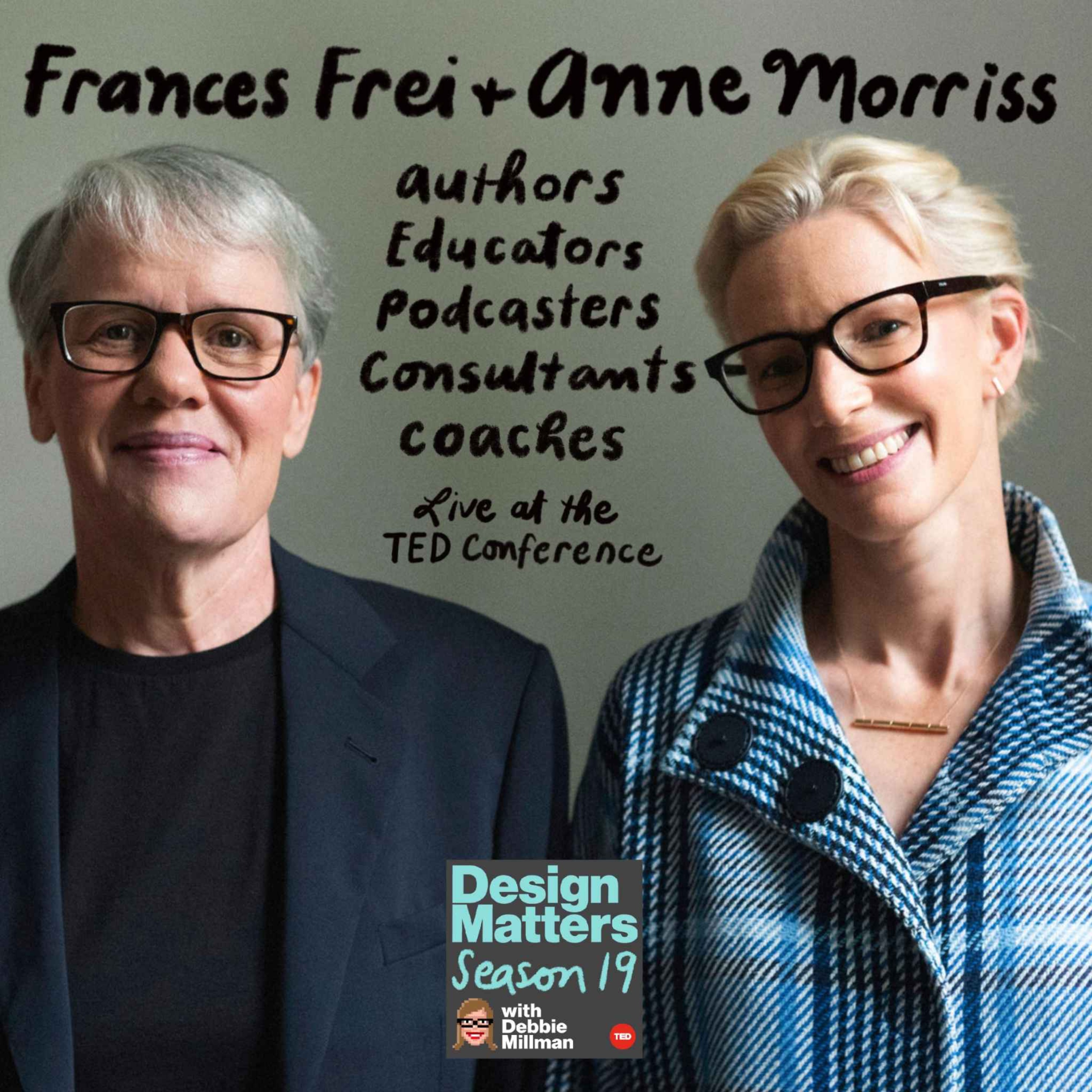
Loading summary
Transcript276 lines
- [00:01]
Debbie Millman
This episode of Design Matters originally came out in May of 2024.
- [00:07]
Frances Fry
So many well intentioned people go slowly out of fear of breaking things. And when I say so many, I'm going to round it off. To everyone.
- [00:22]
Debbie Millman
From the TED Audio Collective, this is Design Matters with Debbie Millman. For 19 years, Debbie Millman has been.
- [00:31]
Frances Fry
Talking with designers and other creative people about what they do, how they got to be, who they are, and what.
- [00:36]
Debbie Millman
They'Re thinking about and working on. On this episode, Frances Fry and Ann.
- [00:41]
Frances Fry
Morris talk about organizational transformation.
- [00:44]
Debbie Millman
There's a lot you can do in a week.
- [00:46]
Frances Fry
There's so much you can do in a.
- [00:52]
Paige Desorbo
This is Paige desorva from Giggly Squad. Opill is a game changer for sexual reproductive health. They're the first over the counter daily birth control pill available in the us. Finally, the days of needing a prescription to get birth control are over. Opill is FDA approved, no prescription needed, full prescription strength, estrogen free and available online and at most major retailers. So when there's no prescription, no appointment, there's no hassle, no more waiting at the doctor's office to get a prescription. Opill will be easily accessed over the counter, in store or online and will be ready for when you need it. Opill is available online and at most major retailers. Use code giggly for 25% off your first month of opill@opill.com if you're a.
- [01:39]
Ann Morris
Parent or share a fridge with someone, Instacart is about to make grocery shopping so much easier because with family carts you can share a cart with your partner and each add the items you want. Since between the two of you, odds are you'll both remember everything you need. And this way you'll never have to eat milkless cereal again. So minimize the stress of the weekly shop with family carts, download the Instacart app and get delivery in as fast as 30 minutes. Plus enjoy. Zero dollar delivery fees on your first three orders. Service fees apply for three orders in 14 days. Excludes restaurants. This is a mini meditation guided by Bombus. Repeat after me. I'm comfy, I'm cozy. I have zero blisters on my to blisters and that's because I wear Bombas the softest socks, underwear and T shirts that give back. One purchased equals one donated. Now go to bombas.com acast and use code acast for 20% off your first purchase. That's B O M b-s.com acast and use code Acast at checkout.
- [02:44]
Frances Fry
Dear old work platform.
- [02:45]
Ann Morris
It's not you, it's us. Actually, it is you.
- [02:49]
Frances Fry
Endless onboarding, constant IT bottlenecks. We've had enough.
- [02:53]
Ann Morris
We need a platform that just gets us and to be hon first, we've met someone new. They're called Monday.com and it was love at first onboarding.
- [03:01]
Frances Fry
Their beautiful dashboards, their customizable workflows got.
- [03:05]
Ann Morris
Us floating on a digital cloud nine.
- [03:07]
Frances Fry
So no hard feelings, but we're moving on.
- [03:10]
Ann Morris
Monday.com, the first work platform you'll love to use. Move fast and Break things this was an informal motto at Facebook for many years, and it exemplified an ethos in Silicon Valley about how to aggressively conduct business in a rapidly changing world. Move fast and Fix Things is the title of the latest book by Frances Fry and Anne Morris. The subtitle of their book is the Trusted Leader's Guide to Solving Hard Problems. Frances Frey is Professor of Technology and Operations Management at Harvard Business School and a business strategist for companies like Uber and WeWork. Anne Morris is a CEO and author. They are married and together they host the podcast Fixable, which, like Design Matters, is part of the TED Audio Collective. Frances Fry and Anne Morris, welcome at long last to Design Matters.
- [04:11]
Frances Fry
Yay.
- [04:13]
Debbie Millman
Thank you. We're so delighted to be here.
- [04:15]
Ann Morris
I am just thrilled. And listeners, we are at the TED Conference in a podcast studio and so that's why it might sound a little bit different than it might usually when I'm doing a podcast in my studio. So, Anne and Frances, ordinarily, for my first question, I like to ask my guest, or in this case, guests, a question that might surprise them. I do this to break the ice, so to speak, and hope the question and the answer will put my guests at ease. But in doing my research for the show, I discovered that you both have a go to question for your guests on your podcast to do or I've heard it a number of times and it was too juicy an opportunity to pose the question to ask you both. So here it is. What was your favorite breakfast as a child?
- [05:10]
Debbie Millman
Yeah, we do ask that frequently.
- [05:14]
Frances Fry
Wow.
- [05:14]
Debbie Millman
Out in the world. It's so revealing because you can't answer the question without giving away a lot about your childhood.
- [05:22]
Ann Morris
Yes.
- [05:24]
Debbie Millman
So my favorite breakfast was Golden Grahams with half and half, half and half, because that's what my mother used to eat at her most playful.
- [05:39]
Ann Morris
Wow.
- [05:40]
Debbie Millman
I would sneak it as a snack, I think, to connect to that part of her. She was a single mom and that wasn't always what she was leading with, but the Golden Grahams and half and half, which is an extraordinary choice, would give away. Would give away that side of her.
- [06:04]
Ann Morris
Frances, what about you?
- [06:05]
Frances Fry
A bacon sandwich.
- [06:06]
Debbie Millman
Yeah.
- [06:07]
Ann Morris
Now, I understand that you had to have it made very specifically so it was two pieces of lightly toasted bread with a little bit of butter and bacon. Yes.
- [06:17]
Frances Fry
And the bacon couldn't be too crisp.
- [06:20]
Ann Morris
That's the part that really concerned me.
- [06:23]
Debbie Millman
Yeah.
- [06:24]
Ann Morris
Why not crisp bacon? Is there anything better in the world than crisp bacon?
- [06:29]
Debbie Millman
It's such a good follow up. Such a good follow up.
- [06:32]
Frances Fry
Crisp bacon almost needn't be consumed.
- [06:35]
Ann Morris
Oh, man.
- [06:37]
Debbie Millman
What kind of statement, Gilbert, I can't.
- [06:39]
Ann Morris
Believe you married this woman.
- [06:40]
Debbie Millman
Well, no one she's never said this before. It's been 20 years.
- [06:44]
Frances Fry
But it's why we.
- [06:44]
Debbie Millman
She's now feeling safe enough to confess.
- [06:47]
Frances Fry
Well, it's also why when whenever bacon is delivered, we never fight over any of the pieces. Ah. You take the well done and I take the less well done. And it's not like I like anything else less well done. All meat has to be enormously well done for me to consume it. But bacon is meant to be chewy, just like the soft bread is meant to be chewy.
- [07:07]
Ann Morris
Okay, let's move on.
- [07:09]
Debbie Millman
This is a controversial interview already.
- [07:13]
Ann Morris
So now I have a bonus question for you both because I had my original icebreakers before I discovered the breakfast question. So, Frances, you first. Is it true that it's difficult for you to imagine 48 hours going by without consuming some standup comedy?
- [07:34]
Frances Fry
Impossible. There has never been a 48 hour period where I haven't consumed some standout comedy.
- [07:39]
Ann Morris
Who are your go to comedians?
- [07:41]
Frances Fry
Well, I go through them very quickly, as you can imagine. I metabolize them. So I'll, I'll consume everything, like literally everything they have, and then I'm done with them and then I go on to the next one. So recent meals, Leanne Morgan, who is late in life comedian, maybe started in her mid-40s. Kathleen Madigan is another one I'm consuming right now.
- [08:05]
Ann Morris
Well, what is it about comedy that you like so much?
- [08:07]
Frances Fry
It's super smart, it's unexpected, and the quality per unit time is through the roof. So some people who like poetry, I don't know how to consume it, but if I did know how to consume things, I would like poetry because of the quality per unit word. And there is almost nothing like it for comedy. I mean, it's just they will practice for five years and then show us the best 60 minutes from it. It is a love letter to us.
- [08:37]
Ann Morris
Yeah, I think it's in many ways a microcosm of how we all behave in our culture.
- [08:44]
Frances Fry
Say more.
- [08:45]
Ann Morris
Well, just that they're so astute about pointing out things that we might take for granted or might not even know that we know that we behave in a certain way or certain prejudices or certain biases they point out. So if they're really good, you know, point out so succinctly and they'll have.
- [09:03]
Frances Fry
Had the thought and then literally will test it in front of a thousand audiences before I ever consume it. Yeah, well, that's like unbelievable. My question is, why aren't others watching it?
- [09:17]
Ann Morris
Well, sometimes people don't want to face what they need to face, I think. But going back to Poetry after this podcast, I am going to send you five poems that I think will change your mind about poetry.
- [09:32]
Frances Fry
I would love to have my mind changed about poetry. I have always wanted to be able to consume it. I just never have been able to.
- [09:40]
Debbie Millman
What are the five?
- [09:42]
Ann Morris
Well, my Go to favorite poem of all time is a poem by Charles Olson called Maximus to himself, which is why Roxanne and I named our dog Maximus Toretto Blueberry Millman Gay. And that poem starts out with the line, I have had to learn the simplest things last, which made for difficulties. So that's definitely one of my go to poems.
- [10:14]
Frances Fry
Well, I know I will already like poetry better if it's read to me.
- [10:19]
Ann Morris
I'll send you a poem by Rainer Maria Rilke called the Panther. I will send you. I don't know, I'll have to pick one of many written by Ellen Bass, who lives in Santa Cruz and is frequently in the New Yorker, and she is remarkable. I will likely send you something by Marie Howe, H O W e who's also remarkable. And then I think I might throw in a surprise.
- [10:50]
Frances Fry
A surprise fifth and I'll read all.
- [10:53]
Debbie Millman
Of them to you, baby.
- [10:54]
Frances Fry
There we go.
- [10:56]
Ann Morris
So, Anne, your turn. Is it true that you spent a lot of time imagining that you were fighting in the American Revolution as you were growing up? Growing up like that one was so juicy I could not give it up even with the breakfast.
- [11:12]
Debbie Millman
An extraordinary amount of time.
- [11:15]
Ann Morris
One question.
- [11:17]
Debbie Millman
I mean, why? I assume you have many follow ups. I don't know why I'm a believer in the Examined Life, but I don't think I've spent any any time on this one. It's among the most vivid memories of my childhood and I would spend a long time in the woods.
- [11:40]
Ann Morris
By yourself or with other people?
- [11:42]
Debbie Millman
This wasn't a game that a lot of other people Wanted to play.
- [11:44]
Frances Fry
Hmm.
- [11:45]
Ann Morris
Surprising.
- [11:46]
Debbie Millman
So it really was in my head. It has been reported to me by my brothers that I also went through a period of sleepwalking, and their most vivid memory was me in the middle of the night standing at the top of the steps reciting the give me liberty or give me death speech. Nathan Hale, obviously. And I don't remember that, but it tracks with my other waking choices.
- [12:19]
Ann Morris
Now I'm going to volley back and forth by topic. So I'm gonna talk about your upbringing now, and then I'll go to yours. And so I don't want you to feel left out, that. I'm just gonna focus on Anne for a few minutes.
- [12:30]
Frances Fry
She's my favorite topic. I'll never feel left out.
- [12:33]
Ann Morris
Well, and vice versa. We're gonna get to you, okay? And you were born without a heartbeat. And the medical team at the time was not optimistic you would make it and actually told your parents that you were unlikely to have full cognitive functioning. How did you end up having a heartbeat and surviving that birth?
- [13:03]
Debbie Millman
Yeah, my APGAR scores, which are a measure of your vitality at birth. At, I think it's 1 minute, 5 minutes, and 7 minutes, a scale of 1 to 10. So I might be a little bit off, but I think I'm directionally right on. On the scale. But I was zero at birth, zero at one minute, and. And a one at. At either five or seven minutes, whatever the next number is. So it was not looking good. Somehow the medicine at the time, the technology at the time, kind of pulled me back from the brink. So I have no memory of that. Although I've been. As Francis know, I've been increasingly intrigued by the birth trauma, the category of birth trauma. But I think what probably impacted my earliest years more is I think the family kind of didn't know what direction this was going. And so my mother has shared with me that she didn't want to overwhelm me with conventional toys. And so she would give me, like, a. Like a spoon to play with rather than, you know, a teddy bear, a doll or something. And there's something so delicious about the. The idea of me, like, sitting on the floor with a spoon, just like, what the fuck am I supposed to do with this?
- [14:28]
Ann Morris
Yeah, I mean, I read that she had a fear of overstimulating you, but I wondered why playing with spoons and making the sort of noises that you can with spoons would be less stimulating than cuddling.
- [14:43]
Debbie Millman
No, I think it's probably more stimulating.
- [14:45]
Frances Fry
You have gotten to the riddle. Oh, the ultimate riddle of Anne's upbringing?
- [14:51]
Debbie Millman
Well, the. And then I think a developmental specialist lived down the block and so came for a visit. And I think my mother asked for some guidance on kind of what kind of informal testing she might do. And there was, at the time, there was this idea of a pincer test. So if I could pick something up with my two fingers, it was a sign that I was on track. And so according to the mythology, she spread some raisins out on the floor with my spoon. I guess I had to put my spoon down, and I. Not only did I pick up the raisins, Debbie, I ate the raisins. And I think just settled the discussion.
- [15:33]
Ann Morris
Well, you ended up having exceptional cognitive functioning. And I understand when you graduated from Harvard Business School, your mom wanted to find the doctor that delivered you to show him how you turned out. Did she actually find him?
- [15:47]
Debbie Millman
I honestly don't know. But it does reveal how much it got embedded in her own psychology, this question of whether I was gonna be okay. And I think that that question kind of hung over the household a little bit.
- [16:03]
Ann Morris
Your dad passed away when you were two years old. But before he passed, he taught constitutional law at West Point and was famously involved in banning the practice of mandatory chapel for cadets and was accused by some at the time of killing God. So killing God at West Point, post Nietzsche. But nevertheless, do you think you got your rebellious nature from him?
- [16:33]
Debbie Millman
I do think I inherited some piece of that on the personality front. I mean, the other feature of the household is we all grew up with this kind of mythology of this great man who was formative, kind of, for three brothers, two I grew up with in the same house. So this story of my father was everywhere, but he physically was absent. And so I think that had a big impact on me, how I thought about what a meaningful life meant. And I think the idea of not accepting the status quo as static and that you had a certain obligation to make the world a more just and righteous place, I think I definitely took that away from the story of his life.
- [17:33]
Ann Morris
I read that. I think Frances considers you, as a young girl, as a justice warrior.
- [17:41]
Debbie Millman
Yeah, it's a very Francis phrase. And maybe that was part of the American Revolution. The version of that story that so captivated me was a story of justice warriors refusing to accept the status quo.
- [17:57]
Ann Morris
Your mom raised you and your siblings in Cincinnati, Ohio, as a single mom. You're the youngest of your siblings and the only girl. Frances. You grew up on Long island, and you were the youngest of six. Your mom had four girls and two boys by the time she was 25 years old.
- [18:15]
Debbie Millman
And so astonishing.
- [18:17]
Frances Fry
So old school.
- [18:18]
Ann Morris
Now, you've said that being the youngest of six is a superpower. How so?
- [18:23]
Frances Fry
Oh, because Ann and I joke that every year around taxes time, we're like, did you do the taxes? Did you do the taxes? Only the youngest gets to do that. The oldest did the taxes.
- [18:38]
Ann Morris
I was the oldest of four. And so I totally, totally understand. But I think being the oldest is a superpower. I think it's the middle kids that just get, you know, screwed.
- [18:47]
Debbie Millman
Can I just say, for the record, we have always filed our taxes. It's just sometimes been a rush.
- [18:55]
Frances Fry
And for the record, I have never participated. So if you ask which one of us really embodies the youngest, it's me.
- [19:02]
Ann Morris
It's interesting because I know you really are a numbers person, and Ann is more of a words person, and so I would have thought that you did the tax.
- [19:09]
Debbie Millman
It's not an ideal distribution of labor.
- [19:11]
Frances Fry
Debbie, but Ann is more responsible.
- [19:15]
Ann Morris
Ah, okay. Frances, growing up, you were extremely gifted in math and at sports. Otherwise, you didn't really feel comfortable. And you stated this. I felt like I didn't get a lot of secret memos, and everyone would come to the table and everyone knew something that I didn't. My whole life, I was like, there's another secret memo I didn't get. And secret memo came up a few times in my research where you've said that in other instances. And so I'm wondering what gave you that impression, and what did you imagine was in the secret memo?
- [19:50]
Frances Fry
Oh, I can give you just the highlights, but we've just signed our next book, which is gonna be called the Secret Memos, because I feel like the greatest gift we can give to people is distribute the secret memos.
- [20:01]
Ann Morris
Oh, my God, I love that. Yeah.
- [20:03]
Frances Fry
So we're.
- [20:04]
Debbie Millman
We're breaking news. Breaking news.
- [20:06]
Frances Fry
Yeah.
- [20:06]
Ann Morris
Exclusive on who Insider matters at 10.
- [20:11]
Frances Fry
I remember. So youngest of six, but so the fourth girl. So as an example, when I got my period, scared the shit out of me. I had no advanced warning. No one ever look. You're looking at me like no one ever talked to me about it. That's what it's like to not get a secret memo. Okay. And I had that experience all the time.
- [20:35]
Ann Morris
So instructions for living, and then it's.
- [20:37]
Frances Fry
Instructions for learning and instructions for life. I remember on Anne's fifth reunion, when you had a lot of friends come and stay over, and you went to the fifth reunion at hbs, and they all Appeared before we were gonna go. And they all came down wearing like appropriate things, you know. And I was like, how did everybody know what to wear? Like, and everyone was wearing. It was all in like a set of acceptable ranges of things. I was like, did you guys talk about it? And she said, no. Somebody gave somebody a secret memo at some point. I have never been on the distribution list of any of those things. And so I am.
- [21:17]
Debbie Millman
You were sure that was a conspiracy?
- [21:19]
Frances Fry
I was totally sure it was a conspiracy.
- [21:22]
Ann Morris
Yeah, of course.
- [21:23]
Frances Fry
So I'm. The way I embody being a justice warrior is that I try to correct the memo. I am just like distributing pamphlets, secret memo pamphlets, everywhere I go.
- [21:35]
Ann Morris
Do you still feel left out by not being privy to the secret memos all the time?
- [21:43]
Frances Fry
Now, I admit that I'm probably not as accurate, but I am so prone to the conspiracy theory of being left off the distribution list of the secret memo. It is now instinctual.
- [21:58]
Ann Morris
You were also very ambitious. And you said that you weren't the smartest, the funniest, or the most creative in your family, but you were the most ambitious. Where did that competitive spirit come from?
- [22:12]
Frances Fry
I don't know. Because certainly not with anyone else in my family. There wasn't any ambition anywhere. I don't know. I've always been gnaw off a limb competitive. I don't know where it comes from. Maybe it was a way to get out. And also I feel like I was. It's not that I was underestimated. It's just that no one else had any ambition for me either.
- [22:38]
Ann Morris
Oh, maybe that's what it is.
- [22:39]
Frances Fry
And so I had to have the ambition.
- [22:41]
Ann Morris
I'm so ambitious that it scares Roxanne. My wife, we play Scrabble a lot. We love playing Scrabble with each other. But she says very accurately that I'm both a sore winner and a sore loser.
- [22:58]
Debbie Millman
What does being a sore winner look like?
- [23:01]
Ann Morris
Then I get guilty. I feel guilty that I've won and then I accuse Roxanne of letting me win.
- [23:09]
Debbie Millman
Oh my gosh.
- [23:11]
Frances Fry
Oh my God.
- [23:12]
Ann Morris
How so screwed up on so many levels. It's amazing that she even plays a game with it.
- [23:17]
Frances Fry
It is amazing.
- [23:17]
Ann Morris
It truly is amazing.
- [23:18]
Frances Fry
Yeah, I guess that is what love is.
- [23:20]
Ann Morris
Yeah, that is what love is. Absolutely. Anyway, by the time you were 12, you had a job, you worked from 8am to 12 to 12, almost at 12am I think every day you didn't have school.
- [23:32]
Frances Fry
Yeah, well, for the four hour block. So from 8am to no.
- [23:36]
Ann Morris
So you were making $1.25 an hour. What were you doing and what were you. How, how on earth were you only making $1.25 an hour? I mean, even when I, and I'm older than you, when I started working, minimum wage was like six bucks an hour.
- [23:51]
Frances Fry
Yeah. So this, it was below minimum wage. I remember going down to the corner store, which was just at the bottom of the hill. And it was. So it was a gross little town grocery store where everyone came to get their newspaper and coffee and sandwiches. Buttered roll. Cause it was Long Island. So I'm not sure that the rest of our listeners will react the way that you and I just non verbally did. But if, you know, you know, you.
- [24:12]
Ann Morris
Know, you know, sisters.
- [24:14]
Frances Fry
So I made a lot of buttered rolls. And when I went down there and I said, I asked for a job, and the store owner said, well, when do you want to work? And I said, from 8 to noon every day. I don't have school. And he said, how much do you want to make? And I said $1.25 an hour.
- [24:34]
Ann Morris
Like hired child labor lawyers be damned.
- [24:38]
Frances Fry
Yeah, I remember I didn't make minimum wage until I came back and worked there. When I wasn't at basketball camps in college, I would come back and work there. And that's when I got raised to minimum wage. I didn't become a good negotiator until later in life. And I've never been a great negotiator. For me, I became a great negotiator when I negotiated on behalf of others. And then I'm like super fierce and awesome, but I've never been a very good negotiator for me.
- [25:11]
Ann Morris
And you also started working early. You got your first leadership job when you were 14 in South America, where you were volunteering with an organization called Amigos, which is sort of a mini Peace Corps. You've described it as. What kind of work were you doing? How did you find a position like that and how long did you do it for?
- [25:33]
Debbie Millman
Yeah, I actually wasn't 14, but we had volunteers that were that young.
- [25:37]
Ann Morris
Oh, okay.
- [25:38]
Debbie Millman
So I was a little bit older.
- [25:39]
Frances Fry
How old are you?
- [25:40]
Debbie Millman
I did it in the summer. I started working with the program the summer after my freshman year in college.
- [25:46]
Ann Morris
Okay, so a bit older.
- [25:47]
Debbie Millman
Yeah, so it's a bit older. I did find my way to Latin America, Haiti actually, through a different program. I think when I was. I think I was maybe 14 or 15. And I do think part of that was just hunger to see the world beyond Ohio. I had a, A Dear friend across the street, whose mother was Venezuelan and in English, she was a fairly reserved woman. And then she would get on the phone to her family and speak this magical language and turn into a completely different human being. And the rules of my household were fairly typical WASPy. The range of permissible emotion was relatively narrow. And I was totally captivated by this magical language, this whole region. And I think from a young age started plotting ways to get down there and experience a different way of living, a larger emotional spectrum, a different relationship with life, a different relationship with vitality, a different relationship with the body. I think all that stuff was really captivating to me. And so public health was an industry that was willing to hire unskilled labor. And so I ended up working in rural communities on simple health projects. Typically they were being run by local governments. It was more an exchange program than a public health program. But that was the framework. And I had an extraordinary run with this experience. Got very interested in the idea of leadership, the idea of human capacity. What happens to human beings when you push them into experiences that they don't think they can handle? Finding shared humanity with people whose life experiences were radically different from mine. Like all the things that are deeply energizing to me at this point in my life, the seeds were all planted in those experiences.
- [28:04]
Ann Morris
I read that you spent your summers working in Ecuador, Honduras, the Dominican Republic and Brazil. And you ended up eventually working at Amigos headquarters as the regional director for South America and the Caribbean. And you've stated that it was a profound privilege to be part of the volunteers transformation and to help a young person evolve into their better future self at sometimes astonishing speed. And it was completely addictive. And when I read that, I felt like, oh, there, there was the birth of Anne Morris, the entrepreneur and leadership coach and consultant.
- [28:44]
Debbie Millman
Yeah, I think that's where all the conviction was born around the speed at human beings ability to change, the speed at which they can change. Just the profound impact of being exposed to difference. Different points of views, different life experiences, the alchemy of those differences coming together. I mean it all for sure, it all started there and I think probably back in Mrs. Fitzgerald's kitchen where she would transform into this other person, which was really just all these parts of her that were relatively dormant in a suburb in Cincinnati, Ohio.
- [29:26]
Ann Morris
So you were working in Latin America, Frances, you were working in a little grocery store. What did you think? What did you both think you wanted to do professionally with your lives?
- [29:38]
Frances Fry
At that point, I didn't know anything that I was going to Do I remember? Even in applying for college, it was such a haphazard thing, and I ended up sending drafts in instead of the actual things. And I mean, it was just. It was a disaster of all of the application process and knowing I ended up going to a college. I went to Brandeis University for my first year. I don't even recall applying to it.
- [30:08]
Ann Morris
You didn't visit it beforehand?
- [30:10]
Frances Fry
No, never. So. And then, you know, didn't, for example, know that it was a Jewish school, which didn't matter except for it is and it's knowable. That was the level of what the secret memos I didn't have even of what I was applying to. I didn't know how to apply, so. And then going to college, I couldn't imagine what I was going to major in. The only thing I could do was math. So the. The major was fine, but then you had to have a minor. And I was like, oh, my gosh, how am I gonna do that? I wasn't thinking very far ahead on the chessboard. It wasn't until after playing college basketball where I knew I was gonna be a basketball coach. By that time, I had worked coaching basketball every summer, working basketball camps. So that was the thing I was sure I was gonna do. But I got dislodged. My competitive instincts dislodged me from that. I had friends who. I hated school, like, even when I was in college.
- [31:07]
Ann Morris
Yeah, I read that when you went to Brandeis, it was the first time you felt misery.
- [31:11]
Frances Fry
That is true. I don't even know how you knew that. I don't recall ever saying it. It was the first time I ever felt misery. I just. And I had a lot to. I had a rough childhood, but I never felt misery. But Brandeis was a horrible experience for me. And then I went to. I transferred to Penn. I don't even know how that happened. And it wasn't as miserable. But I hated school. I hated. I hated going to class. And so imagine my surprise when I applied for graduate school and then a. And then a PhD and then becoming a teacher. All of these things surprising me among everyone else in my life when they were surprised. And it all happened because I had friends who were doing it, what I was gonna do. Lose.
- [31:56]
Ann Morris
Yeah. In the grand scheme of things, I wish I'd felt that competitive school wise, rather than having it all sort of projected into Scrabble, but nevertheless.
- [32:04]
Frances Fry
So I feel like I stumbled into all of these things, all of them.
- [32:11]
Ann Morris
Now, if you were really interested in becoming a basketball coach, what would a PhD in math do for you in that regard?
- [32:18]
Frances Fry
Well, it's a very good question. So my friends were all going to get PhDs in English. Obviously I was very fond of the English majors.
- [32:27]
Debbie Millman
She has a type, Debbie.
- [32:30]
Frances Fry
And as Anne likes to remind me, it doesn't always appear that it's my first language, but it is my only language. I couldn't major in English and so the only thing I could major in was something applied math. And so I went to business school for operations management, which is applied math, essentially. So I went, I got my PhD, and the only thing I could possibly get my PhD in. So it wasn't that I had any grand scheme or grand plan. In fact, my plan was to go be a college basketball coach, but there wasn't anything else I could do. And also I wasn't a very rigorous thinker at the time. Like, why not go? Like there must have been places you could go to college for, you know, gym or whatever one goes to. I don't know what one pe. Like there must have been somebody doing something in somewhere and. But it never even occurred to me. In fact, where did I go? I went to the same. I went to Penn as an undergrad, so I went to Wharton, which is in the same university. Like I wasn't a very broad. I was ambitious, but not specifically ambitious.
- [33:39]
Ann Morris
You started teaching while you were getting your Ph.D. at Wharton. And I think it's there that you started to feel that being in the front of the class was where you belonged.
- [33:51]
Frances Fry
That changed everything. I would teach review sessions for a class. So there were, I don't know, maybe 800 students in the Wharton program. And they would take this class and then I would hold review sessions. And very quickly people maybe wouldn't go to class, they would just go to the review sessions. And so I figured it out and I knew I hated going to class, hated it. And so I wanted to give people a compelling reason to go to class. And I provided the secret memos.
- [34:19]
Ann Morris
Right.
- [34:20]
Frances Fry
Well, it turns out that those are two key elements for teaching. And then a faculty member got sick at the last minute once. And so I actually taught the class, not just the review sessions. And that was the first time I thought, maybe it's not going to be basketball, maybe it's going to be this other academic thing. Although I had no idea how I was going to actually get my PhD because like the thought of how I would write a paper, none of that seemed possible.
- [34:50]
Ann Morris
What did you write your thesis on?
- [34:52]
Frances Fry
Showed it to Anne and when she came into the office. The first time, first date, I was in a field where everyone studied manufacturing and that was what operations was. I hated manufacturing. I was interested in services, which was 70% of the economy. And so I studied service operations. What I would call it is I studied everything you couldn't drop on your foot. And it's just how things work. And then like now, I thought everything was fixable. And so I would just look at where people had conventional wisdom that this would happen. And I just showed when it didn't. And that ended up being, I think every single paper I wrote my dissertation, all of it was questioning conventional wisdom.
- [35:36]
Ann Morris
You joined the University of Rochester Simon School of Business after completing your PhD, how did you begin to develop your teaching style? And as a very popular teacher at Harvard Business School and having been in your class, you have a very distinct, very charismatic teaching style. How did you develop that?
- [36:02]
Frances Fry
I do think it was the mixture of the secret memo and compelling reason to come to class. Like I hated class. I mean, I can't describe how uncomfortable I felt in it. I didn't feel like I learned when I was there, so I would have to go teach myself elsewhere, which turned out to be a useful skill. But I learned math through textbooks, not in a classroom. And I didn't want other people to have to do it. The charisma, I'm not even sure I know what it means in that setting. Although I am.
- [36:33]
Ann Morris
You sparkle in the front of a room.
- [36:35]
Frances Fry
Well, I do feel most comfortable one to many. So I'm at my least comfortable one to one. Sorry, baby.
- [36:46]
Debbie Millman
20 years.
- [36:47]
Ann Morris
She's looking at Anne, not me. She's looking at Anne, not me.
- [36:53]
Frances Fry
I feel most intimate when it's one to many. In fact, the larger the audience, the more vulnerable I'll be. The more human I'll be. The more that when you were describing the wider range of emotions I have, the wide range of emotions, the more permission I have. So there is something about if the bigger the better. That just works for me.
- [37:18]
Ann Morris
Ann, what did you want to be as you were traveling all through Latin America helping people find themselves?
- [37:29]
Debbie Millman
I think I, I figured out that public health was not a good fit for me. The premise of that world is that it's not a move fest and fix things and it's a community of extraordinarily talented and committed humans that are working on very long term problems. And I knew that wasn't the right fit for me. I loved being in motion. I loved trafficking and human potential and I didn't know what that could possibly translate into, in terms of a career. Where I ended up migrating was into the economic development branch of the development space. That felt like a better fit for me. I started working on the issue of how do you create environments where entrepreneurs can thrive in places that weren't designed perfectly for entrepreneurship? Silicon Valley is designed perfectly for entrepreneurship. Boston is designed almost perfectly for entrepreneurship. Sao Paulo, Brazil is not. What are the levers that you can push on in terms of policy, in terms of capital, that start to create an ecosystem where small, vulnerable companies can start and can ultimately thrive? Now, the most interesting thing part of small vulnerable companies to me are the human beings inside them. And so I knew when I got into that world that I was starting to circle something that could potentially turn into a career. And then I was working in a startup in that space where it was also clear to me that the human beings running the place were these big variables, particularly at that stage of company, in terms of whether the enterprise was going to succeed or not. And that question and those combinations of questions got very, you know, was very interesting to me, which is how I ended up on the MBA track, because it was a program, an environment that took those questions seriously.
- [39:41]
Ann Morris
This episode is sponsored by Quince. While the world may feel chaotic, I've been focused on creating a calm space at my home and Quince makes it feel possible to do this. From ultra lush duvets to premium silk pillowcases to stainless steel cookware, Quince has everything you need to upgrade your home. The best part is that by partnering with top artisans, Quince cuts out the middleman and offers their home goods at 50 to 80% less than similar brands. I just received their lovely Parisian inspired tumbler, uniquely designed with beaded detailing. I can't wait to use it for entertaining guests or enjoying a quiet evening at home. Plus, it's pink. Refresh your space with elevated home essentials from quince. Go to quince.com designmatters for free shipping on your order and 365 day returns. That's Q U I N C E To get free shipping and 365 day returns. Quince.com DesignMatters.
- [40:58]
Paige Desorbo
This is Paige Desorva from Giggly Squad. Opill is a game changer for sexual reproductive health through the first over the counter daily birth control pill available in the us. Finally, the days of needing a prescription to get birth control are over. Opill is FDA approved, no prescription needed, full prescription strength, estrogen free and available online and at most major retailers. So when there's no prescription, no appointment there's no hassle, no more waiting at the doctor's office to get a prescription. Opill will be easily accessed over the counter in store or online, and will be ready for when you need it. Opill is available online and at most major retailers. Use code giggly for 25% off your first month of opill@opill.com the old adage.
- [41:45]
Ann Morris
Goes it isn't what you say, it's how you say it. Because to truly make an impact, you need to set an example. You need to take the lead. You need to adapt to whatever comes your way. And when you're that driven, you drive an equally determined vehicle, the Range Rover Sport. Blending power, poise and performance, it was designed to make an impact with a dynamic drive, refined comfort, and innovations like cabin air purification and active noise cancellation. The Range Rover Sport is built to be as uncompromising as you. Explore Range Rover Sport@range rover.com USSport this.
- [42:21]
Paige Desorbo
Is Paige Desorbo, the co host of Giggly Squad. I have exciting news. McDonald's has all new McCrispy strips. It's chicken made for dipping. Tender, juicy white meat chicken with a golden brown peppery breading. It's chicken so good it deserves its own sauce, the creamy chili McCrispy strip dip. A sauce that's creamy, savory and sweet with a little heat. But it works with any of our sauces. I'm personally a barbecue sauce girl. Even sometimes I like ketchup. I'm just like, basic sometimes, but I also need it. In addition to any new sauces, I'm trying with a new creamy chili McCrispy strip dip. It's chicken made for dipping only at McDonald's.
- [43:02]
Ann Morris
Well, you started out at Brown University. You got a Bachelor of Arts degree, which really surprised me because you then went on to Harvard to get an mba. What inspired you? From what I understand, you applied to one business school and it was Harvard. That's like chutzpah.
- [43:20]
Debbie Millman
Well, I didn't know if it was the right path, and I thought that.
- [43:23]
Frances Fry
And you're a snob.
- [43:25]
Debbie Millman
I am. I. I can't totally deny that, but part of the calculus for me was I don't know if this is the right path. I'm going to give it my best shot. And I was pretty good at getting into things. I only applied to one undergraduate school as well, and so I knew how to apply to things. And so I thought, okay, I'm going to do my thing and if it's the right fit, this institution will respond and open its doors. And it did. And it was a great experience. And we have, you know, we overlapped on campus. For the record, Frances was never my teacher, but I did first see Frances on a stage.
- [44:04]
Frances Fry
The one to many.
- [44:05]
Debbie Millman
And in this. In this. Yeah, one to many. And it, the translation to one on one was confusing in the beginning, baby, it's like, wait, wait, where, where is, where is she? Where is she? And I was an older student. It was really fun to go back to school. The learning model is really fun. You know, it's much different than being a more passive undergraduate. But what I studied at Brown was the history of the Americas and the evolution of these societies and the clash, blending, creative friction of all of these different human elements. That is a through line from, you know, standing at the stop of the top of the stairs and saying, give me liberty or give me death.
- [44:53]
Ann Morris
Yeah.
- [44:54]
Debbie Millman
So that part wasn't a surprise to anyone around me. The business school left turn was a surprise. And if you had told my, you know, 15 year old self that I would end up at Harvard Business School and now be in the game of helping capitalists be better at capitalism, it would be an absurd ending to the story.
- [45:16]
Ann Morris
I'm more in Frances camp of applying to things. And actually I'm sort of in the Venn diagram of both of you because I also only applied to one graduate school, but didn't get in. And so I did quite a lot of that in my 20s. I would pick one thing that I thought I wanted to do, not really designating it as a sign, but just, this is what I want to do, but always was one after another, rejected from that one option. Frances, you applied to Harvard five times. They said no to you when you applied to go to college. When you applied for your PhD, you got turned down. You applied to be on the faculty for the first time. And when you went up for tenure, what kept you persisting in the face of so much rejection?
- [46:06]
Frances Fry
I do.
- [46:07]
Debbie Millman
Snob in me wants to clarify that you were ultimately tenured.
- [46:10]
Ann Morris
Oh, yeah, of course, of course, yes. That's. Let's be clear. But you know, you're a distinguished professor. Absolutely. And have won many prizes for the best professor.
- [46:21]
Debbie Millman
I recall I was like, we're not losing this one. Let's go.
- [46:26]
Frances Fry
I don't ever let the decisions of others influence my life's trajectory. So saying no to me is not the same as saying no to Anne Morris. Like you say no to Anne Morris. It's one strike and you're out. She will never revisit you. Me, I Just if you say no to me, I just hear, not now. I don't take it seriously. I think I probably could have presented myself better. A different person will be making the decision. And I had a feeling and it just became clearer and clearer. And then it turned out to be right, that it was the right place for me, and it has turned out to be the right place for me. So I just had an instinct that it was the right form of being a very practice oriented school. And so, for example, I love bringing everything I know to students, whereas many colleagues at many other business schools like bringing everything they know to colleagues so they'll read each other's academic journals. If I write a paper, I want it to be read by students. I mean, yes, I'll have it go into a publication, but still my main consumer are executives and students. There's lots of great schools, but Harvard is the number one school in that dimension. We call it being very close to practice. So I just knew it was where I was supposed to be. And I, unlike Ann, I don't know how to get in. I never got the secret. I still now wouldn't. If I applied for something, I would have no expectation I would get in. I consider that Anne applied for tenure for me the second time.
- [48:09]
Ann Morris
And the first step you took to starting your own company was from an ominous phone call you got. A few days after you and Frances had your first child. A man on the phone called and asked whether your baby boy, just a few days old and sleeping peacefully in the next room, was still alive. When you responded, yes, he's still alive. He asked you to go check and confirm and then come back to the phone. What happened next? That's just unthinkable.
- [48:42]
Debbie Millman
Yeah. So our oldest inherited a rare metabolic condition called MCAD deficiency. MCAD deficiency. And so he is essentially missing the enzyme that converts fat into sugar that you can use when your body runs out of sugar. It's a very important part of your metabolism. And in infancy, your sugars are all over the place. And so it's actually quite easy to sleep past the amount of sugar you have in your body. So by the miracle of newborn screening, that little heel prick that most parents get to kind of forget about, that happens within the first few hours of a kiddo's birth. The data came back and it was pretty clear that his levels were off, essentially. And I think they ran the test again to make sure there was a little bit of a lag. So we had, we had gone home and I can remember where I was in the apartment, I can remember what I was wearing. I can remember the. The floor. And it was not my doctor. It was this voice from the state of Massachusetts. And this voice said, well, you know, is your child still alive? And I said, I think so. I just put him down for a nap. And he said, can you go check? And then come back to the. I'll hold, I'll hold. And then come back to the phone. And the thing, in retrospect, having immersed ourselves in so many systems, that's so painful about that moment. Not for us, per se. I mean, our son's doing great, and I'll fill in the blanks, but I'm sure that's a protocol that they came by the hard way.
- [50:30]
Ann Morris
And your son is 15?
- [50:32]
Debbie Millman
He's. Yeah, he's 16. 16. He's doing extraordinarily well. On this list of rare diseases, it's kind of the one you want. He essentially outgrows it. But the first couple years, we had to feed him around the clock every couple hours, and it was. Those were just high anxiety times. And. And then when he would get sick with something else, which is metabolically stressful, you know, the. The flu or, you know, kid. Kids get sick all the time. So we would. We would go and fight it off with a special IV to keep his sugars up. And so there were a couple years there where there was hospital bag packed and by the door, and we were in and out of Children's Hospital just keeping this kiddo alive.
- [51:19]
Ann Morris
You decided to start a company aimed at reducing the odds of having an unhealthy child when using donor sperm. Tell us more about that decision.
- [51:30]
Debbie Millman
Yeah, well, as we get, you know, we have this kind of fix, it can do. Lesbian spirit, I'm sure, was also a way to metabolize, for lack of a better word, my own experience in those years. But one of the things that was kind of shocking to us was how much further advanced the genomic science was than clinical practice. And what had happened was, I mean, this was 16 years ago, but at the time, the scientists and clinicians had kind of stopped talking to each other 20 years previously. Motivated by different things. So, you know, the kind of two branches of genetic science, the clinical science and the research science, went in different directions, and they had different vocabulary for the same things. Like, it really was a dramatic break. And I was convinced that I could just get everyone in a room and reintroduce everyone to each other and realize we all wanted the same things. And there was a real opportunity to make the screening protocols for donor sperm and donor eggs, much better, because really, where the risk lives is at the combination of the two parents. It's not that it's. It's actually very, very rare that an individual donor is passing on disease risk and doesn't somehow know it and isn't somehow sick themselves. It's really what happens when the biological parents come together. And so I started a company with an extraordinary scientist named Lee Silver, who had invented a way to see that disease risk at much higher resolution. And we knew we had a better way of doing things, and he's kind of set out down this path. And we underestimated the complexity of changing clinical practice in America. You have to bring patients along, doctors along, the payers and insurance companies along, and then you have to bring the venture capitalists with you, and they have to literally run the numbers and be convinced that you're going to solve all of these problems on a timeline that's going to work for their own investors. And we started down the path, and I think this. We all kind of looked at this mountain and realized just the probabilities. Probabilities of any business hitting it out of the park are low. You know, it's a portfolio play. But I think we had a great run. It was the whole. The whole experience was, you know, six, seven years of building this company, but it just ultimately didn't make sense to the people writing the checks. And I. I understand. I was super frustrated because we had. You'd figured it out.
- [54:19]
Frances Fry
You had the thing.
- [54:20]
Debbie Millman
Yeah, we had the thing. We could have saved a lot of kids getting that phone call. Many fewer families would have gotten that phone call.
- [54:29]
Ann Morris
I think you sold the science, though, didn't you?
- [54:32]
Debbie Millman
Yeah, we. We did. The science did find a home, and I don't know where it landed, but it is not in clinical practice today.
- [54:41]
Ann Morris
You must have been able to learn so much that you can bring into your own work now. I mean, I think the most valuable thing that I bring to my students are overcoming the obstacles that have stood in my way. I couldn't be the teacher I am if I didn't have that experience.
- [55:00]
Debbie Millman
It was a big lesson for me in the gifts of, you know, what we label failure and frustration and Plan A not working out so much of what I learned in that ride. Thank you to all the venture capitalists who paid for my education in this regard. But so much of what I've learned, I've been able to pass on to other entrepreneurs. And it deeply informs the work we do helping people work through the challenges of leadership and building their own organizations.
- [55:34]
Ann Morris
In 2018, you founded the Leadership Consortium. So tell us what the goal of that organization was when you first started it and what you're doing with it now.
- [55:44]
Debbie Millman
Yeah, well, it was deeply informed, Frances's experience. She took a time out from the Harvard Business School, with the school's blessing, to go work with Uber at the height of its leadership crisis. And you got a very firsthand look at some of the patterns of where underrepresented leaders were getting stuck in their trajectory in Silicon Valley. And the pattern was really clear in that small investments in learning, exposure, peer to peer network, all of these things that were getting in the way of people having the careers and the impact that they wanted in these organizations were very solvable problems. And so we designed this program really, for anyone who is interested in accelerating their careers. And we bring in, many of them, are friends of Francis, you know, fantastic professors to work with students for just a couple months at a time. And really what we're trying to achieve in terms of the metric of success that we care about is greater confidence at the end of the program than when people started. And we have a pretty reliable hit rate.
- [57:04]
Frances Fry
Oh, it's an amazing hit rate. I mean, we learn so many things, but one, the power of education and all of the other things that we do. But it's also, you know, and it brings us to the current DEI debate. So as you were just speaking, I was like, yeah, this is one of the reasons where I get so enraged when I hear overconfident under informed people talking about dei. Like, the reason that DEI exists is because there were demographic tendencies associated with who thrived. And we saw people being artificially held back. You could see the profiles, you could see, like, it was unmistakable. And so we're removing the artificial obstacles that were getting in the way, which is, I think, what brought every single person to DEI to the table. It wasn't to give unfair advantage, it was to remove unfair disadvantage. And so then when I hear people saying, I want to blow up dei, I'm like, you want to go back to there being demographic tendencies associated with who's permitted to have a chance of thriving? I don't believe it. I don't. So. But that's where it came from. And it was so clear to me in Silicon Valley, not just at Uber, but I had a chance to go to all of the companies, and once you had that lens on, you couldn't not see it. So when he left, and I was like, I had taken a two year leave from Harvard, but it only took a year to turn around Uber. And so then I was like, well I can go back early. And then we had a conversation, we were like, we have this observation, do we think it's going to get addressed if we don't do it? And we estimated the probability of it being addressed at zero. And so that's what we did. And the nice thing about the companies that we, we now bring people together across company and that has been the magic of it. And so amazing. Companies that typically don't learn together, they all have very insular learning programs and they might send one person to a, they send a cohort to us at a time and so we get to really work with their companies to help accelerate them.
- [59:18]
Ann Morris
You and Anne and another writer wrote a really powerful op ed in the New York Times back in January. I believe it was January 24th. And for anybody that is interested in learning more about Ann and Frances viewpoints on this topic, I would suggest that you look up that article and we'll have it in some show notes. You've since gone on to write several bestselling books together. So you live together, you have a business together and you write together. So what is it like sharing your life on so many different dimensions with each other every day?
- [60:03]
Frances Fry
Unbelievably rich. Richer for it. Richer for all of it. And anytime we've had anything less than that, where one of us was doing something without the other, it didn't feel as fulfilling and it certainly wasn't as high quality. I can speak from myself, my doing anything in the presence of Anne, one plus one adds at least a zero and sometimes two zeros. It's just so much richer the more we get to do together and the conspicuous absence of it. So I genuinely can't imagine doing anything without her.
- [60:36]
Ann Morris
I want to talk about your most recent book, Move Fast and Fix the Trusted Leader's Guide to Solving Hard Problems. And I believe that the seed of the book was inspired by Mark Zuckerberg's five word motto, move fast and break things, which you've said you think is terrible advice.
- [60:55]
Frances Fry
It's terrible advice, you know, and of course a 24 year old boy came up with it. The harm I originally thought it did is that it gave people permission to break things. But then it wasn't until the larger harm revealed itself to us that we were moved to write the book, which is the deep harm is that it gave speed a bad name. So so many well intentioned people go slowly out of Fear of breaking things. And when I say so many, I'm going to round it off to everyone. I mean, everywhere I go, every day, I see people giving each other license to go slower in the name of some virtue. And I feel like I have the secret memo that going slower will give you lower quality with certainty. And yet everyone is inducing everyone else to go slower as a virtue. And so what we're trying to do is spread the word that the increased metabolic rate is what actually allows you to go further. It's a momentum thing. And that what is breaking things is not the speed, it's the other things you're doing, like breaking trust. Like all of the reasons that people want to slow down. Things don't get better when you slow down. They get better when you fix the other things. You can fix those at pace, but we keep telling each other to go slow. So now we just have people going slow and leading to mediocrity. It is an epidemic around the world. And so that. This is, to me, a classic example of a secret memo that needs to be distributed around the world.
- [62:44]
Ann Morris
Early on in the book, you state, a cornerstone of our work is that leadership is the practice of imperfect humans leading imperfect humans. If you accept this as a reasonable starting point, then it follows that any collection of us builds imperfect organizations. Is that okay to have an imperfect organization? Do you get. Do you suggest that we feel more comfortable being imperfect?
- [63:09]
Debbie Millman
Well, no. The idea with that statement is to forgive yourself for the imperfections. You know, there's. I feel like so much of our emotional energy goes towards the question. We're trying to say it's a given. Like, you didn't get it right, and.
- [63:26]
Frances Fry
You could be a better version of yourself tomorrow than you are today. Yeah.
- [63:28]
Debbie Millman
And so instead of worrying, did I get this right or not? Let's assume you didn't. Cause none of us do. So now that's the jumping off point of curiosity to go out and figure, well, can you make it better tomorrow than it was today? And we're trying to invite people into that orientation that's gonna allow them to make progress and build organizations where other people have a reasonable chance of thriving.
- [63:54]
Frances Fry
We know that rate of improvement matters so much more than wherever you are today. And yet there are so many organizations that are so protective of where they are today, and they have stopped improving. They're doing things the same way they were doing yesterday and last year and 10 years ago, and without shame. It's actually with pride. And I'm like, you have denied yourself a learning opportunity for 10 years. And you're proud? I don't understand, like, I genuinely don't understand it.
- [64:25]
Ann Morris
There's also, I believe, an epidemic of people being really unhappy at their jobs. I listened to an interview that you did with Chris Anderson where you talked about how 70% of the workforce in the United States is unhappy in their work.
- [64:43]
Frances Fry
And yet we are super proud of how we're doing things and we don't feel an urgent need to be better versions of ourselves tomorrow than we are today. That is the part that doesn't make any sense. And every single time we've gone into an organization that has said we want to be on an improvement journey, they get on it. They get on it quickly and steeply. And so it's also so possible. And so this is, I think, simply a storytelling problem, which is why storytelling figures so prominently in this book, which was a surprise to me as an.
- [65:19]
Debbie Millman
The Applied math.
- [65:20]
Frances Fry
As the applied math. And like, we just have to figure out how to do it. And yet that was not enough. And then that's where I think Thursday was born in our book.
- [65:29]
Ann Morris
Yeah. I mean, I think what's so inspiring about the book is that it's both a playbook and a journal. You learn how to do things differently, but you also are able to learn through seeing other people experience changing their behavior and what results when you're able to do that. So many leadership books are about how to lead others. And in many ways I felt like your book is about how to change your leadership style to inspire others.
- [66:03]
Frances Fry
Yeah.
- [66:03]
Ann Morris
It's not about getting other people to do better work. It's about you doing better work that inspires other people to follow your lead. The book helps people understand how to build their business and learn quickly while avoiding very costly mistakes. And the narrative arc of the book is inventive. The methodology is based on a five day work week, which you also talk about. Anne, in your TED Talk, what made you decide to organize the book in this way?
- [66:32]
Debbie Millman
I'm trying to remember if there was a decision point. I mean, I remember that we proposed it to our editor as a, you know, a five day plan to improve your organization. And she was like, oh, yeah, that's a great metaphor. We were like, no, we're fucking serious.
- [66:50]
Ann Morris
Right?
- [66:52]
Debbie Millman
There's a lot you can do in a week.
- [66:54]
Frances Fry
There's so much you can do in a week. And I do think it comes that we would go with organizations. We're always trying to get them to be more ambitious and to take less time. It's Always what we do. And when they are more ambitious and they take less time, they accomplish more. So a secret memo that needs distribution is, stop asking for incremental change over a long period of time. You're better off not doing it. So we knew it had to go faster. And so we're constantly coaching people to go faster and faster. And then a month was too long. And so then the week was the next unit of analysis. Like a quarter was way too long. Because you can do. I mean, when you were asking Anne about the astonishing rate that people can change, like, change can happen in an instant. Do you have any instants or in a week? Like, a lot of. A lot of instants. There's also, when we look at, like, the actual work that's done, if you just stack it all, doesn't 40 hours is a long time. I mean, that's a long time. And what we encourage people to do is take out all of the downtime and just stack all of it together. Now we have become, I think, less bold in saying we're like, look, it's going to take longer than a week. But honestly, what we think in our mind is it shouldn't. But we have learned in polite company to say it's going to take more than a week, but please don't think about it as six months or a year.
- [68:24]
Ann Morris
I'm sorry to ask you to do this because I know it's really sort of performative, but I really think it would be helpful for our listeners to take us through the five steps, even if you want to do it really quickly. But Monday, Tuesday, Wednesday, Thursday, Friday, Sure.
- [68:39]
Frances Fry
So on Monday, you have to identify the real problem. If anyone who listens to fixable, where people call in with their problems, you'll realize we end up solving a different problem than they call in every single time. Well, that's true in organizations, too. So the presenting problem is never the problem you have to solve. And there's a very systematic way to do it. So that's Monday, because you will spend an infinite amount of time solving the symptom. And so we get that there. The goal of Tuesday is to come up with just the first pass at a plan. We call it a good enough plan. And for sure, if you have a problem and it involves people, you have lost trust. And so we have to rebuild trust. So that's part of having the good enough plan.
- [69:22]
Ann Morris
Let me just interrupt you because I do have a question about that. If a leader in an organization is looking to build trust, which is so important now More than ever, what would be the first thing that you would.
- [69:35]
Frances Fry
Recommend that they do understand that trust is actually a summary statistic of three component parts. And the three component parts are authenticity, logic, and empathy. And if I am struggling to build trust with you, I shouldn't try to solve for trust. I should figure out, do I have an authenticity, logic or empathy problem? And solve for them. And so much of the unproductive effort is that I'm using an authenticity solution for an empathy problem, for example. So get down to the component part. Trust is so solvable. So you're right. It is the biggest problem, and it is so solvable at the individual and organizational level.
- [70:14]
Ann Morris
Wednesday's a fun day. Wednesday, you're making new friends.
- [70:18]
Debbie Millman
Wednesday's the best day.
- [70:19]
Ann Morris
Talk about Wednesday.
- [70:20]
Frances Fry
Yeah, On Wednesday, whatever you've done, you've done it by somewhat traditional means. On Monday and Tuesday, you've gone to the usual suspects. You've gone to the usual things, and that's great. And do it. And then on Wednesday, take note of every one you didn't talk to who could possibly be helpful and bring them to the table. And so by make New Friends, it's the clarion call to who could possibly have a stake in this that you haven't brought to attention. So the example I often give is that at the Harvard Business School, we are proud that when we talk about our promotion rate, like, we're like, oh, look, it's so stingy. We must be. We're so selective. But I see it as an unimproving operating system. We have never gotten better over decades. And we're not ashamed. We're proud. And I know why. Because the senior faculty get together all the time and talk about junior faculty without the junior faculty present. Well, that's because we skip Wednesday. We don't make new friends. And imagine if we brought in the perspective of junior faculty, we could then improve the promotion rates, and we could actually have an improving operating system. So Wednesday, I think, is the fun day. It's the invite everybody to the table that you haven't yet. You don't have to feel guilty about not having them before, but now's the day who's not there? And then once you invite them to the table, realize that they're gonna say things to please you in the beginning. And so what we have to do is convince them that we don't want to dwell on what they know in common with us. We want to know all of their uncommon thoughts. And so Wednesday is make new friends and get their Unique insights. And then your good enough plan goes, just adds a zero. Now we're.
- [72:12]
Ann Morris
Now we're going for somebody that's been at a company a long time, you recommend that they reach out to someone who started last week to get more information and learn more about what they don't know that they don't know.
- [72:26]
Debbie Millman
Yeah.
- [72:26]
Frances Fry
You want to get someone before they. That is still saying, we do things like what? And it's, you know, before.
- [72:34]
Debbie Millman
I mean, our ability to adapt is one of our great superpowers as humans. But you want. Before, before that, before you have truly adapted. You want to get the insight of someone who just showed up and is looking around.
- [72:45]
Ann Morris
So Thursday's about telling a story.
- [72:48]
Debbie Millman
Yeah, I mean, the. I mean, as human beings, we think in stories and learn metaphors. So one of our observations, we do a lot of work around change and changing organizations is that the power of storytelling is underutilized in that it's often an afterthought. And when you center it and really bring intentionality to it, it's a way to activate the entire organization, not just in your presence, but in your absence. It's about literally putting language to where were we? Why are we moving somewhere else? And what is it going to feel like when we get there? Even the most sophisticated organizations in the world are deeply hungry for this. We push all kinds of teams on this one, and it's a really, really profound lever for progress.
- [73:40]
Ann Morris
Friday is about going fast.
- [73:42]
Frances Fry
That's my favorite day.
- [73:43]
Ann Morris
I'm not surprised.
- [73:44]
Debbie Millman
All the tension gets released on Friday.
- [73:46]
Frances Fry
Yeah.
- [73:47]
Ann Morris
And so what does it mean to have that tension released and to go fast? I think it's the day of action, right?
- [73:53]
Frances Fry
Yeah. That's when you put into play all the things. So. And if you put Friday, I mean, move fast and break things is bringing Friday to Monday or to Tuesday or to Wednesday. Right. So you, you have to do it on Friday, which is why it takes a whole week. So there are so many things we do to go slowly, and you just have license to break through them. So, like, some of my favorite are when people try to be great at everything. You know, if you, if you want to go fast, you have to articulate, this is what I'm going to be great at, and this is what I'm going to be bad at. There are.
- [74:23]
Ann Morris
It's a sacrifice.
- [74:24]
Frances Fry
It's a sacrifice. And you have to be. And when you have to be articulate about it. Otherwise we're each going to make our own private decisions. And then you might have made progress. From 8 to 9, and then over here, I'm going to bring us back from 9 to 10. And so another one of my favorite ones is that, you know, conflict occurs, and most of us avoid conflict. So conflict will happen. We avoid it, hoping it will go away, right?
- [74:50]
Ann Morris
Magically.
- [74:51]
Frances Fry
Magically, poof. Turns out not only does it not go away, it grows without our attention. And so now the problem that I could have trivially solved today, it's a bigger problem in a week, it's a gigantic problem in a month, in six months. So leaning into conflict is what we do on Friday. Like, there's just all of these. I mean, Friday is just a whole list of delicacies of how do you remove the speed bumps so that you can go. So that you can go fast? And it's so liberating. And the reason it animates me so much is I get to watch people. It's where you teach people how to have good meetings. You teach people who to invite to, like, you just unlock all the things on Friday. It's the best day of the week.
- [75:34]
Ann Morris
I think we could have a whole separate conversation on how to teach people how to have good meetings.
- [75:39]
Debbie Millman
So that's the whole podcast.
- [75:42]
Frances Fry
I'm quite evangelical about it. Anytime, anytime.
- [75:45]
Ann Morris
In tandem with the book's launch, you also launched Fixable, your wonderful podcast, giving advice on workplace challenges. What has this new medium and realm been like for you?
- [76:00]
Frances Fry
You know, audio only is. I got captivated by it on over the Pandemic and started teaching cases on Clubhouse. And really, because I didn't think you could do anything, and I don't. I didn't listen to podcasts before. And then I was like, oh, my gosh, Audio only is better. It's more intimate. I'm not distracted by the visuals, particularly if I put a headset on, I'm never more present. So it's this superpower that's, like, within plain sight for us. So I love that part of, like, accompanying people intimately around the world. And then we get to practice what we preach. We can reach people anywhere, and we think you can solve hard problems in 30 minutes. And so that's what we do. And it's like flying without a net. I mean, I go every one of the episodes. Anne's the host, I'm the co host. But I hear the description of the problem, and I'm like, what are we gonna do?
- [77:02]
Debbie Millman
This is the one.
- [77:03]
Frances Fry
This is the one.
- [77:04]
Debbie Millman
We're not gonna solve this. It's not fixable.
- [77:06]
Frances Fry
It's not fixable.
- [77:07]
Ann Morris
And Then do you think that's gonna happen, though? Do you think you're ever going to.
- [77:10]
Frances Fry
I think at the beginning of every single call, every single call, Anne brings us to a place where she figures out what the real problem is and presents it as a layup, and then we can solve it. No, I don't think it'll ever happen. I think we can solve every problem. But I can tell you I can't alone. I could never do it without Anne.
- [77:29]
Ann Morris
My last question is about something I heard you say on Arne Vroy's podcast. You said that one of the things you have in common is that you both like to go towards burning buildings, not away from them. I'm wondering, how do you manifest that kind of courage?
- [77:48]
Debbie Millman
Well, you find a friend. So it's. That courage is possible for me to access with Frances standing next to me, and it's much harder when I'm alone. So phone a friend, find a buddy. Can be part of it. I also think the burning building metaphor for us is not about us. So I think that's what it may present as courage, but it doesn't feel like that. It feels like a possibility to have impact and play a role in helping people get out of their own way. Most people are very hungry for that permission. And it. And it often takes someone from outside the story to come in and make the invitation, and it's a total privilege to be able to play that role.
- [78:48]
Frances Fry
It doesn't feel like courage. It feels like the only thing we can't provide is the will to change. Well, the burning building provides the will. I wish we didn't need burning buildings. I wish people were more proactive. I want people to be more proactive, but with certainty. The burning building does it. And so what the reason I go towards it doesn't have courage at all is I know what's on the other side of it, and that impact is assured when you go there.
- [79:23]
Debbie Millman
And the other thing we love about the burning building is people are collectively at a point where they're open and willing to change. And it, you know, you kind of hit that willingness at a scale that makes rapid change possible. And that's what is really animating for both of us.
- [79:44]
Ann Morris
Anne and Frances, thank you so much for making so much work that matters. And thank you for joining me today on Design Matters. Frances, Kai and Ann. Anne Morris's podcast is called Fixable, and their most recent book is titled Move Fast and Fix Things. The Trusted Leader's Guide to Solving Hard Problems. You can read lots more about the work they do@annfrancis.com this is the 19th year we've been podcasting Design Matters and I'd like to thank you for listening. And remember, we can talk about making a difference. We can make a difference or we can do both. I'm Debbie Millman and I look forward to talking with you again soon.
- [80:26]
Debbie Millman
Design Matters is produced for the TED.
- [80:29]
Frances Fry
Audio Collective by Curtis Fox Productions. The interviews are usually recorded at the Masters in Branding program at the School of Visual Arts in New York City.
- [80:37]
Debbie Millman
The first and longest running branding program in the world. The Editor in Chief of Design Matters Media is Emily Wein.
- [80:45]
Frances Fry
You're awesome.
- [80:50]
Ann Morris
I hope you didn't turn off the tape. I'm just gonna have that as like my ringtone.
- [80:57]
Frances Fry
Wow. Thank you.
- [81:01]
Paige Desorbo
Hey, this is Paige desorbo from Giggly Squad and this episode is brought to you by Nordstrom. Summer's here and with weekend getaways, celebrations and more on your calendar, Nordstrom has everything you need for your best dress, best season ever. From playful prints and breezy fabrics to 70s inspired looks and bright handbags. Discover new arrivals from your favorite brands like Reformation, Veronica Beard, Farm, Rio, Levi's and more. It's easy too, with free shipping and free returns in store order pickup and more. Plus NordicLub members enjoy free two day shipping on thousands of items in select areas. Shop today in stores and at nordstrom.com.
- [81:42]
Ann Morris
@Schwab how you invest is your choice, not theirs. That's why when it comes to managing your wealth, Schwab gives you more choices. You can invest and trade on your own plus get advice and more comprehensive wealth solutions to help meet your unique needs. With award winning service, low costs and transparent advice, you can manage your wealth your way at Schwab. Visit schwab.com to learn more. Aging is a natural process as we all know and I for one don't mind embracing it. But I will tell you one part of aging that I don't care for. It's the symptoms that stick stem from changing hormones, especially as you get older to perimenopause and menopause. That's why we want to tell you about Happy Mammoth's Hormone Harmony. Happy Mammoth, the company that created Hormone Harmony, is dedicated to making women's lives easier and that means using only science backed ingredients that have been proven to work for women. They make no compromise when it comes to quality and it shows. For a limited time you can get 15% off on your entire first order@happy mammoth.com just use the code Happy Me at checkout. Ever wonder what your lashes are destined for? The cards have spoken. Maybelline New York Mascara does it all. Whether you crave fully Fan lashes with Lash Sensational Big Bold volume from the Colossal A Dramatic lift with Falsies Lash Lift or Natural looking volume from Great Lash. Your perfect Lash future awaits. Manifest your best mascara today. Shop Maybelline, NY and discover your lash destiny. Shop now at Walmart.