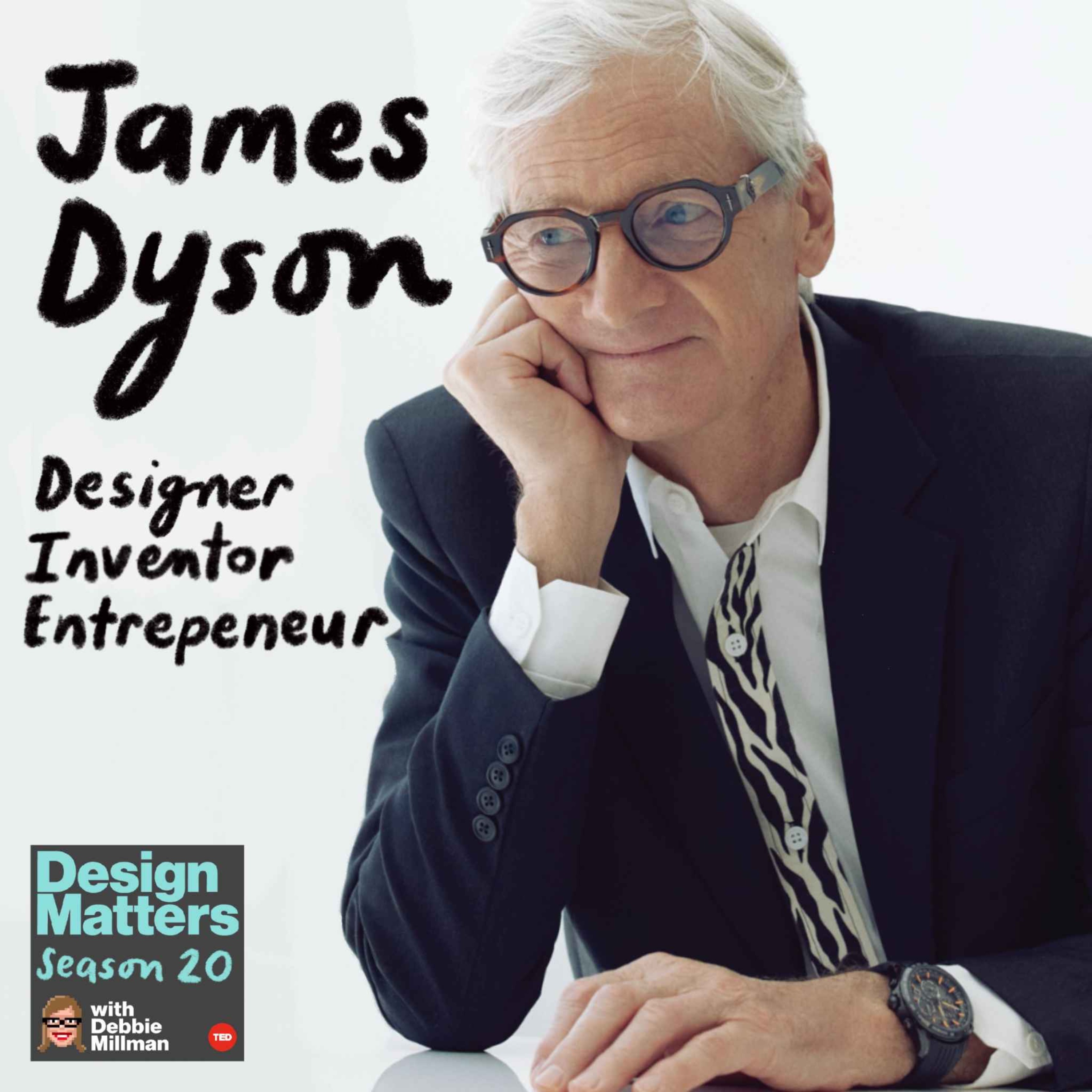
Loading summary
Transcript164 lines
- [00:01]
Narrator
This episode of Design Matters originally appeared in June of 2025.
- [00:06]
James Dyson
I mean, I'm a designer and an engineer. I'm not a money man or a manufacturer. I was making a product I loved. Strange to love vacuum cleaners, but I did and still do.
- [00:22]
Narrator
From the TED Audio Collective, this is Design Matters with Debbie Millman. On Design Matters, Debbie talks with some of the most creative people in the world about what they do, how they got to be who they are, and what they're thinking about and working on. On this episode, James Dyson talks about his life and some of the groundbreaking products he's designed.
- [00:44]
James Dyson
I wasn't aware that what I was doing was anything unusual or different. I was just doing it my.
- [00:57]
Monday.com Ad Voice
This Monday.com ad was created by a team of people and AI agents. Reece, our content agent, wrote the copy based on our best practices, like mentioning Monday.com three times. That was the second. Johnny, our coordination agent, built the timeline and kept everyone aligned. Olivia, our human creative director, stayed in the loop because agents are great, but they don't always know when a joke lands. She had one note tell listeners it only takes minutes to build an agent. So minutes. Create your own AI agent. Today on Monday.com
- [01:29]
James Dyson
acast powers the world's best podcasts. Here's a show that we recommend.
- [01:38]
Jameela Jamil
What if you laughed all through your commute? Or if you heard the funniest story while at the gym? Well, now you can. I'm Jameela Jamil, and guests on my new podcast, Wrong Turns, share their most mortifying and hilarious disaster stories. I'm talking people like May Martin, Bob the Drag Queen, Katherine Ryan, Jake Johnson, Margaret Cho, Simon Pegg, Penn Badgley, and so many more. So listen wherever you get your podcast Wrong Turns Where Dignity goes to die
- [02:08]
James Dyson
Acast helps creators launch, grow, and monetize their podcasts everywhere. Acast.com
- [02:19]
Debbie Millman
this episode is sponsored by Kohler Smart Toilets. The objects we interact with most are often the ones we notice least. The Kohler Smart Toilet challenges that assumption. What if the most overlooked space in your home could become the most considered? Their Vail Smart Toilet is a sculptural silhouette that isn't just intentional. It's a philosophy that design changes everything. The Kohler Vale Smart Toilet is sleek, with a rounded shape that's more like architecture than just plumbing. And it goes beyond looks. The touchscreen controls and customizable cleansing features offer a level of comfort and cleanliness that exceed expectations. It's all about elevating those ordinary daily rituals into something extraordinary. Through thoughtful design. Kohler has Been pushing these boundaries for over 150 years, mastering that balance of stunning form and high performance function. That's a long time to get it right and it shows in every detail. Experience the difference of Kohler smart toilets. Find out more@kohler.com My guest today is someone who has not only changed the way we clean our homes, but how we think about failure, invention, and even the air we breathe. Sir James Dyson is a British inventor, designer, entrepreneur, educator and philanthropist. First known for inventing the world's first bagless vacuum cleaner, James Dyson has built a global company that has reinvented how humans engage in and with technology. Sir James Dyson, welcome to Design Manners.
- [04:07]
James Dyson
Good morning.
- [04:08]
Debbie Millman
You have built a world changing company on the belief that the best ideas come from frustration, failure and relentless tinkering. You transformed not just how we clean our homes, but how we think about design, engineering and the very nature of invention. Sir James, my first question is this. What has mud taught you?
- [04:34]
James Dyson
Mud. Mud, Mud, mud, mud. Well, not a lot. I mean, I, I come across mud on my farms.
- [04:42]
Debbie Millman
Yes, I understand that when you walk you get a lot of ideas and mud has helped inspire you with new thoughts about how things are made. You don't have. We don't have to answer that question. It just came up a lot in a lot of my research that. Yeah, yeah, yeah.
- [04:59]
James Dyson
Well, I used to slide around on it when I was a child in the creeks of Norfolk and I guess it gets trodden into carpets and we have to, we have to clear it up, especially when it's dry. And we now clean it off hard floors with our hard floor washing machine, which I can just see behind me. And it turns into dust. Yeah, and we have to deal with dust.
- [05:20]
Debbie Millman
Skip that one. I just thought it would be fun to talk about because it, it came up a few times in my research. Oh, really? You grew up in Norfolk, A home where your family grew their own vegetables and collected eggs from your hens. There was no television, not enough heating, no new toys, and few if any consumer goods. Yet I read that your first memory is of being lowered into a swimming pool by your father who was teaching you how to swim. What do you think it is about that experience that prompted such a visceral memory?
- [05:55]
James Dyson
Well, I was a very skinny little boy and it was being done while the swimming pool was filling up. So it was filling up full of freezing water. Remember, this is Norfolk and there's nothing between me in Norfolk and the Arctic in one direction and Siberia in the other. So it was a pretty chilling experience. I remember that far more than the difficulties of learning to swim. I think I learned swim very quickly just to get out of the water.
- [06:23]
Debbie Millman
Your dad has been described as a cheerful polymath who was also a keen photographer. He coached the rugby and hockey teams at your boarding school. He was also a teacher there of classics. And you and your older brother attended the school as well. And while at school you studied bassoon, you were part of the combined cadet force and acted in the school plays and designed the set. You were also an athlete and began long distance running. What first drew you to running as a young child?
- [06:58]
James Dyson
I never walked. I always ran everywhere because I think I was in a hurry. I didn't see any point in walking. It seemed to be a waste of time. And I then discovered I rather enjoyed it. I don't enjoy it now. I do it now at the age of 78. I'm still running, but I don't enjoy it now. But in those days it wasn't such hard work. It wasn't so painful. It seemed much more natural. I also liked it because I could get out into the countryside on my own, across the heathland and across the sand dunes, along the beaches. So it was a wonderful way to experience and feel the countryside.
- [07:36]
Debbie Millman
Do you think that the stamina required for long distance running impacted how you approach the task of long term invention?
- [07:45]
James Dyson
Completely. That I experienced during my youth. That you, in order to be good at running, you have to run a lot and do a lot of weightlifting and other things and you must never give up. And I think the thing I learned most from it peculiarly is running the mile.
- [08:02]
Debbie Millman
Why is that?
- [08:03]
James Dyson
Well, I was a long distance runner and the mile was one of the. It was the longest distance we were allowed to run in those days. I think they thought running any further was bad for you. And what I learned was that at the end of the third lap, when the finish isn't quite in sight, you're feeling the most tired and the most down, if you like. And I realized that was the time to accelerate because success is just around the corner and people often give up at the point they're about to be successful. When everything's against you, everything you've tried doesn't work, you're feeling exhausted, it seems pointless. That's the point, to double down and really break through that last bit. That's where everybody else gives up.
- [08:45]
Debbie Millman
Why do you think that is? Just because of how difficult it feels at the time?
- [08:49]
James Dyson
Yes. Well, it does feel difficult and it feels that you not being successful, that you haven't achieved what you set out to achieve and you're a bit of a failure and there doesn't seem to be a solution to the problem. I mean, it's same in running, same in developing new technology. And that's the very point where you mustn't stop.
- [09:09]
Debbie Millman
Your father lost his battle to cancer when he was only 40 years old. You were nine. You said this about his passing. Perhaps I had to learn quickly to make decisions for myself, to be self reliant and be willing to take risks. Little could be worse than my father dying when he did. Yet you also wrote that you had to respond with a stiff upper lip. Why is that?
- [09:35]
James Dyson
Well, this was very shortly after the war and you know, a lot of people had died in the war and in Britain there had always been up to that point, the stiff upper lip of the upper classes and that, you know, you took disaster in your stride. You went away to boarding school, away from your parents, who were often maltreated by teachers. I don't mean physically necessarily, but mentally. And you had to learn to survive that system. So death at that time was not considered the awful disaster that it is now. I mean, of course it was in a way, but nothing like how it is now. But I did feel different because I only had a mother, whereas everybody else at school had two parents for another reason, actually, which was that divorces were far less frequent then. So everybody else seemed to have two parents and I only had one. So that made me feel different. I didn't feel sorry for myself, but it made me feel different.
- [10:37]
Debbie Millman
How do you think that impacted how you ultimately have crafted the arc of your life?
- [10:43]
James Dyson
Oh, hugely, because as you said, I had to rely on myself. I thought I had to rely on myself. Although I had a very competent mother, very loving mother, I somehow felt alone and I had to make my own decisions and find my own way in life. You know, I didn't have an awful lot to lose. So taking risks and living on the edge was something that came naturally to me.
- [11:05]
Debbie Millman
Before his death, your father had been a teacher of classics at Gresham's, a prestigious boarding school that you and your older brother also attended. And after he passed, the school's then headmaster, Logie Bruce Lockhart, allowed you to stay at the school despite not having the money to pay the tuition. And I believe Logie became a big influence on you while you were at school. Was he the first person, person to recommend you to consider furthering your education and product design?
- [11:35]
James Dyson
No, I think the school was very much against going into art, as they called it then. You were supposed to go into the Foreign Office or be a doctor or an accountant or something. So I, and I think indeed I was the first person from the school to go to a school of art and design when I left.
- [11:53]
Debbie Millman
Now, I don't know if this is true or not, but I did read that he was okay about you going to art school because he didn't think you had it academically in you to pursue anything else. Is that correct?
- [12:07]
James Dyson
Well, he's absolutely right.
- [12:11]
Debbie Millman
I mean, how did that make you feel at the time?
- [12:12]
James Dyson
Well, he was also, he was a polymath. I mean he admitted as a headmaster at the time that academia wasn't everything. There were other things in life. I mean he had been a very successful rugby player. He captained Scotland in rugby. He also was the first person to go into Belsen as a, as an army captain, young army captain. So he had a quite a broad view of life. That academia wasn't the only thing.
- [12:39]
Debbie Millman
I read that you thought since you sat on chairs you could be a furniture designer and quite liked the idea of constructing something useful.
- [12:49]
James Dyson
Well, that sounds incredibly arrogant, but you have to remember in the mid-60s, design wasn't the thing it is now. There weren't shops where you could buy design. I, there weren't design shops and the shops that existed were not interested in design. It was post war anything will do kind of setup. So I didn't know about design and I, the wonderful principal at my college said, what are you going to do next? Because I did painting and drawing for a year. And he said there's this thing called design. I think you might be quite good at design. And I said what's designed? I mean it was that basic. And he reeled off a few types of design and furniture was the only one I recognized. So that's what I chose to study. I actually switched to architecture while I was doing it.
- [13:39]
Debbie Millman
Do you remember when you first began to think about the world not just as it is, but how it could be redesigned?
- [13:47]
James Dyson
Well, I was really lucky because the mid-60s were a time of big cultural change, big technology change. You know, Concord was about to come out. The mini car had been invented. There were lots of interesting things going on and I, I got interested in that which I slight surprising for an artist turned architect. I discovered that engineering was actually very interesting. And it was the time of Norman Foster, Richard Rogers and Buckminster Fuller in particular. And Buckminster Fuller had just done the US exhibit at the Montreal Expo, which is this wonderful Dom, you know, complete dome made of aluminium tubes was the most wonderful, inspiring exhibit. And I suddenly realized that architecture and products for that matter, were really about their engineering. Not the style, not the outward appearance of them. And I realized that I wanted to do, which is a bit odd because I was a designer and a would be architect. I wanted to do the engineering, the technology, as well as design it, and most arrogantly also wanted to make it. And I don't know what gave me that.
- [14:59]
Debbie Millman
Why do you think that's arrogance?
- [15:01]
James Dyson
Well, I mean, there I was at the Royal College of Art in London, a school of art and design, imagining I could be a manufacturer and sell my products to the world. I mean, that is a huge form of arrogance.
- [15:14]
Debbie Millman
You attended structural engineering classes with Anthony Hunt, the designer of London's Waterloo Station. With what did he teach you about the relationship between design and engineering and integrity?
- [15:26]
James Dyson
Well, we had blackboards in those days and he used to draw structural problems on the blackboard. And I found it riveting, you know, why a bridge stayed up and why bridges fell down, how cable structures worked. The structure is at the heart of everything and engineering is at the heart of everything. And that's where you start. That's what it taught me.
- [15:46]
Aura Ad Voice
Yeah.
- [15:47]
Debbie Millman
My father in law is an engineer and he's astounded at how little design really appreciates in engineering and what it really takes to bring an idea to life.
- [15:59]
James Dyson
Well, yes, I mean, Tony drew and was a normal human being. And I didn't realize that engineers were like that. I thought they were very boring people in white coats. And suddenly I realized how wrong I'd been. And society then did divide people into the backroom boys with the white coats and the designers out front with the pink shirts and the felt tip pens. I mean, it's a stale analogy, but that's. The world was divided like that and I didn't think that was right.
- [16:26]
Debbie Millman
How did your experience of studying art and design affect the way you eventually approached engineering?
- [16:35]
James Dyson
Well, my structural engineers tutor who introduced me to Buckminster Fuller, through that I realized that you start with how the product works, the new technology it uses, and why it's therefore a better product or a better building for that matter. And that the design should evolve from how the product works, what it's used for, how you use it. Not the sort of Harvey Earl skin that the marketing department uses to help sell the product in a contemporary style. So I was sort of revolted by that and wanted to have the product know what the product's going to look like as you develop the engineering because of the way it works?
- [17:21]
Debbie Millman
Do you find that most people find that design and engineering are complementary or in tension?
- [17:29]
James Dyson
Well, strange enough, shortly after I left college, I went back as an examiner and then as a governor. We started in the Royal College, probably the first engineering design course in the world, melding design and engineering. And that started a trend. And I think most colleges now teach engineering with design. Thank goodness.
- [17:52]
Debbie Millman
Yes. Your first commercial invention was the ballbarrow. A wheelbarrow with a ball instead of a wheel. Where did that inspiration come from and what did that experience teach you about innovation and resistance?
- [18:12]
James Dyson
Well, my first product was actually a high speed landing craft, which I did for a public company. I did that straight from Gaja.
- [18:20]
Debbie Millman
That was a sea vessel, is that correct?
- [18:21]
James Dyson
Yeah, yes, it was a high speed landing craft. And I did that actually while I was still at university at the Royal College of Art, and then went to set up the company to manufacture and sell it around the world. And I then want to do my own product for humans, I mean, as opposed to armies and construction companies and oil companies, which is what my landing craft was used for. So I wanted to do something for the home. And I had been doing up a house, an old house in the Cotswolds, and the wheelbarrow kept getting stuck in the mud. It had a narrow wheel.
- [18:53]
Debbie Millman
Mud.
- [18:54]
James Dyson
That's mud. Mud again. Mud, yeah, it's all back to mud. And the legs, the tubular legs that get sunk in and the thing would tip over and whatever you put in it fell out. So I just. While I was lugging this thing around, I started to redesign it. My head. And the first obvious thing was to have a balloon fat tire, not this narrow tire that they have. And then it started from there while. Frustration.
- [19:21]
Jameela Jamil
Frustration.
- [19:23]
Debbie Millman
Envisioning something better.
- [19:25]
James Dyson
Yes, yes. Wanting to do something better.
- [19:27]
Debbie Millman
While spray painting the ballbarrow, you initially used a standard fan to keep removing the flying paint particles, but they kept clogging and stopping the production line. And you discovered that cyclone separators were the only thing that could do the job. And that discovery led to your reinvention of the entire vacuum cleaner category. And in the years leading up to its public introduction, you famously made 5,127 prototypes of the vacuum over five years before arriving at one that worked. That number has become part of the Dyson mythology. Was there ever a time in the journey to 5127 that you wanted to give up?
- [20:17]
James Dyson
Well, of course. It's like running the mile Again. So I'm back to that. Yeah. I mean, I don't know. When I got to the 4,000th prototype, I wonder, is this ever going to end? I'm like, did it ever.
- [20:29]
Debbie Millman
Did any. Any. Any specific prototype ever just break you?
- [20:36]
James Dyson
Well, none of them worked, but I was understanding more and more and certainly finding out what didn't work. And one of the reasons I built so many prototypes and one of the reasons we still do today, is that you can only make one change at a time. So a lot of people want to be brilliant and leap to the final answer, but you start and you make one change at a time and you wait to see what difference that change makes. And sometimes it makes it better and sometimes it makes it worse, and then you wonder why. And that tells you what to do for the next prototype and the next prototype and so on. So you're making slow progress, you're learning and you're taking often one step back, one step forward and so on. Many of the days are wasted, but you rule things out.
- [21:25]
Debbie Millman
So it's like a control.
- [21:26]
James Dyson
Yes. And you're narrowing the field and you're getting close to the solution. And often, I mean, a particular problem I had was that. Well, first of all, I was told by the highest authority in Britain on cyclones, that you can never make a cyclone that will clear cigarette smoke. You can only collect sand in it. You know, gritty sand, not cigarette smoke. So part of my research was proving him wrong about that. I rather like proving people, experts wrong.
- [21:55]
Debbie Millman
It's very satisfying, isn't it?
- [21:57]
James Dyson
And then the other problem was, which was actually a far greater problem in the end, was that a cyclone is for clearing very fine particles. But vacuum cleaners pick up lots of nasty things like scissors and coins and hair, in particular fluff and hair. And cyclones don't like fluff and hair because they're too big, go straight through it because it's only for clearing fine dust. So I had to solve that problem, and that was probably the most difficult one, and that's one where I most nearly gave up.
- [22:32]
Debbie Millman
You went into debt in this journey. You even had the house you lived in with your family on the line. What kept you going? Were you that sure that you could produce something that would ultimately become what it became?
- [22:47]
James Dyson
No, I wasn't sure at all. And I was beginning to doubt myself more and more as I couldn't find a solution. But I was in debt and I had to carry on.
- [22:56]
Debbie Millman
And your wife needed.
- [22:57]
James Dyson
My wife was hugely supportive.
- [22:59]
Aura Ad Voice
Yeah.
- [22:59]
James Dyson
She's an artist and she understands what a project is, but nevertheless, it's a big thing to put the house on, especially when you've got three young children and a dog.
- [23:11]
Debbie Millman
Was there an emotional difference between the first failure and the 5,000th, the 5,127th? Well, not really, because by the. By 500, 120, by 5,127, you're on the verge of success, whereas 5,000, you're still not sure how many more iterations you will need to be successful or if you'll be successful. Does it get easier? Does resilience get easier with repetition?
- [23:39]
James Dyson
I don't think so, no. I mean, it's interesting because you've done these experiments, you've failed, and you had some successes, and it's a fascinating time, actually. It may not sound it from outside, but when, when you're doing it, when you're making these discoveries yourself, it's. It's very absorbing. I mean, I was working at home at the time, and I used to come in for lunch covered with dust and sit down and I was happy, actually. Heavily in debt and worried, deeply worried, of course, but at the same time, professionally at least, very happy.
- [24:16]
Debbie Millman
Does failure do you. Are you afraid of failure?
- [24:20]
James Dyson
Well, yes. I mean, if it was a failure, but it's a necessary part of experimenting and ultimately succeeding. And I'm always very disappointed that school wants you to get the answer or academia wants you to get the answer right immediately.
- [24:39]
Debbie Millman
Well, I think we're living in a world now where there's this almost requirement for immediate gratification, immediate success. People that are successful early in their lives are lauded, and there seems to be a lack of real patience and rigor in the way most people approach the world these days.
- [24:59]
James Dyson
Well, I mean, almost any job you do, you don't know the answer. You have to work it out. But that's not what school teaches you. School teaches you to learn something, remember it, and then spout it when asked. It doesn't teach you about failure. I mean, I always think that school should mark people not on the number of right answers they give, but the number of wrong answers which they then go away and experiment and correct for themselves and find out for themselves viscerally, because that's what life's about. And I've looked at the people I was at school with who were very keen on getting top marks and coming top and all that kind of thing, and they haven't always had very interesting lives afterwards. Whereas the failures, a lot of the academic failures have had a much more interesting and Exciting life.
- [25:49]
Debbie Millman
As a teacher, I am going to borrow that phrase and encourage my students to ask as many questions as they can that might be giving them the wrong answers to get to the right
- [26:02]
James Dyson
one and also work things out for themselves. Get to the answer by failing. You know, there's no. Well, there is a hurry to get the right answer, but getting the wrong answer and then understanding why they failed and working out the right answer is what life is about.
- [26:19]
Debbie Millman
You founded Dyson Limited in 1991 and launched the DC01 in 1993. What were the early days of Dyson Limited like?
- [26:30]
James Dyson
Pretty scary. I didn't have any money for a start, so. And it was interesting. A lot of people put money into startups, so startups are quite well funded. I didn't have any money, so I had to make do without money. I couldn't advertise or do any PR or anything. It's a very good process to go through so that you. You work out how to do things the hard way without just spending money. So, for example, the first retailer who was. Because they all rejected me at the beginning because I wasn't a brand, you know, I can't sell an electrical.
- [27:07]
Aura Ad Voice
Yeah.
- [27:07]
Debbie Millman
Once you get to that 5127th prototype that works, then you have everybody saying, no, I don't. I don't want this.
- [27:15]
James Dyson
Yeah, they absolutely said that. And I got. I got one person who was vaguely interested, electrical retailer, and he said, well, you know, I've taken it home and I. What you.
- [27:25]
Monday.com Ad Voice
What.
- [27:26]
James Dyson
Everything you say about it is true, but why would anyone buy a Dyson in a shop that can buy a brand name by you? What about doing some advertising? I said, I haven't got any money. He said, well, I can't take you then. And then I said, well, supposing you. Every thousand machines you order, I'll spend £10,000 or whatever it was on television advertising. And we did a deal on that basis and that really got me going.
- [27:53]
Debbie Millman
And you were featured in the ads?
- [27:55]
James Dyson
No, not originally, no. I did that later.
- [27:58]
Debbie Millman
Okay. One of the things.
- [28:00]
James Dyson
That's my idea, by the way.
- [28:01]
Debbie Millman
Oh, I know, I know.
- [28:03]
James Dyson
I thought it was a very embarrassing thing to do.
- [28:05]
Debbie Millman
I think they're charming. Absolutely charming. One of the things that I was so fascinated, fascinated by, horrified when they
- [28:12]
James Dyson
saw what I was doing.
- [28:13]
Narrator
Why?
- [28:14]
James Dyson
Because, I don't know, I think they thought it was some terrible form of salesmanship. In Britain, we're quite snobby about selling. It's not a profession that's well respected at all. It's very different in the United States quite correctly. It's a wonderful thing to do, actually. A very exciting job.
- [28:35]
Debbie Millman
It is a very exciting job. In 1995, I joined a firm that had originated in the UK, Sterling Brands. And I came in as their salesperson, their business development person. And I was working with an entire team of British men. And I think they hated me at first because I was so over.
- [28:55]
James Dyson
At least sure they didn't. I'm sure that. Oh, because you, you were keen on selling?
- [28:58]
Monday.com Ad Voice
I was keen.
- [28:59]
Debbie Millman
I was like this weird American woman that was out there selling and they were horrified.
- [29:03]
James Dyson
Well, I, I hope you showed them away.
- [29:05]
Debbie Millman
I did, actually. That was very gratifying. One of the biggest resistances to the acceptance of your vacuum cleaner by the industry was the fact that it didn't have a bag, even though that was one of the great, great differentiators. Because people were concerned that it would change the vacuum cleaner bag industry, and therefore the people that were making the bags wouldn't be making money anymore. And that just blew my mind that.
- [29:37]
James Dyson
Well, it was two things, actually. One is that the vacuum cleaner manufacturers would have no further sales, like the razor blade, you know, and the shops were worried that they too would have no further sales of bags. And they liked selling bags because people had to come into the shop to buy them. So it brought them into the shop, which, which was a good idea. So, yes, there was a no bag resistance. And the, in fact, the term bagless wasn't coined by me, it was coined by my competitors who wanted to make it sound bad. So bagless was a derogatory term.
- [30:11]
Debbie Millman
I can't even begin to tell you how many times over the decades prior to your vacuum cleaner coming out, I would cease to be able to use my vacuum cleaner because I had issues getting the bags. And so it just sat in the closet dormant while dirt piled up on the carpet.
- [30:31]
James Dyson
This is a horrifying story. It is. Well, actually, that's how I started because the vacuum cleaner wasn't working right and I thought, oh, the bag must be full. So I, I, but I couldn't find a spare one. So I went and tipped the contents out into a garbage can and gaffer taped it, you know, Scotch tape at the end back up again,
- [30:51]
Monday.com Ad Voice
put it
- [30:52]
James Dyson
back in the machine, and still it wasn't picking things up. So I thought, well, that's odd. The vacuum bag is empty. Why isn't it? So I took my scotch tape off and looked inside the bag and there was a lining of fine dust all the way around the inside of the bag, and then the penny dropped. What's happening here is that the air is supposed to go through the bag and it's being clogged by fine dust particles.
- [31:16]
Debbie Millman
Right?
- [31:17]
James Dyson
So it's a con. The bag wasn't full, the bag was clogged. We need a better system.
- [31:23]
Debbie Millman
At what point did you realize that you weren't just making vacuums, that you were creating an entirely new category and a new design language?
- [31:33]
James Dyson
Well, I don't. I don't think it was a point where I thought that. I mean, I'm a designer and an engineer. I'm not a money man or a manufacturer. I was making a product I loved. Strange to love vacuum cleaners, but I did and still do, and that's what I was doing. So I wasn't aware that what I was doing was anything unusual or different. I was just doing it my way.
- [32:01]
Lead Human Podcast Host
What makes a leader worth following? What should you really care about in your job? As technology is changing so quickly, is it just gonna be about machines talking to other machines? I mean, should you quit your job and start something on your own? What would that take? What does success and risk look like when we're all at the starting gate together? These are the questions we answer each week on Lead Human with Jack Myers and Tim Spengler. Join us each week and subscribe at your favorite podcast platform and YouTube. We'll tell stories, we'll hear from some of the best, and we'll try to figure this out together.
- [32:36]
Jameela Jamil
Healthcare can feel complicated. That's why Optum uses technology to connect the people and processes that make healthcare easier, more affordable, and more effective. We're making it clearer for you to know exactly what your benefits cover and to help you better manage your health. We're coordinating care between your doctors and your technology. We believe better, simpler healthcare is always possible. That's healthy optimism. That's Optum. Visit optum.com to learn more.
- [33:05]
Lead Human Podcast Host
Monday AI agents took over my work, and I absolutely love it. Chasing deadlines, writing status reports, updating stakeholders. Agents handle the daily grind. Now they live inside Monday.com so they see the full picture. My work, my team, the whole company. And I don't have to worry about the data. It's safe, which means I'm free to focus on the big stuff. Knowing everything runs smoothly in the background. It's completely shifted the way we work. Create your own AI agent in minutes on Monday dot com.
- [33:35]
James Dyson
Hey, it's Sydney Sweeney.
- [33:38]
Jameela Jamil
Sid for short, for summer. I'm in the mood for comfortable.
- [33:41]
James Dyson
What am I wearing?
- [33:42]
Debbie Millman
Where am I going?
- [33:43]
James Dyson
What's the vibe?
- [33:45]
Jameela Jamil
The short answer, American Eagle shorts. They're cute and go with everything. They just work. It's Sid for short.
- [33:53]
James Dyson
An American Eagle for summer.
- [33:54]
Jameela Jamil
Shop my pics now@ae.com
- [33:59]
Debbie Millman
you've said that design is not about making things look pretty, it's about solving problems. Yet I'm sitting in your studio in soho, New York City, surrounded by the most beautiful products in your categories that you sell in existence. So talk about, if you can, the connection between your visual aesthetic and your innovation that's inherent in every product that you've brought to market.
- [34:30]
James Dyson
I think it goes back to the time I was at the Royal College of Art and Design. That's where I come from. And then wanting to understand engineering and designing engineering products, I mean, Buckminster Fuller led me to it. But being asked to design a high speed landing craft, which I'd never. I'd hardly been on a boat before, let alone design one. And the boat had to work. I mean, it had to float, it had to be unsinkable and had to go fast and had to land on beaches and all that sort of thing. So it's how it performed its performance, how you use it, what it's like to use, how it looks. Certainly. Does it look purposeful? Most people thought it didn't look like a boat and it didn't look like a conventional boat. It was his own version of a boat. But it explained its use when you looked at it. I didn't see the difference between engineering and design. For me, they were one thing, and I hate the idea that an engineer designed and develops technology and then someone comes along and makes it look good. I just don't like that approach.
- [35:37]
Debbie Millman
Has a need for a specific aesthetic in your work ever needed to be sacrificed because of an engineering need?
- [35:48]
James Dyson
Oh yes. Often you can't do what you want to do visually because of an engineering issue. But that's fine, you know, you've got to work with it. With those constraints in my research, I
- [36:02]
Debbie Millman
came upon numerous instances where you were dismissive of market research. And I read one interview wherein you stated most focus groups are wrong. Do you still believe that? And if so, why?
- [36:14]
James Dyson
Well, let's put it this way, they're dodgy. They can tell you some things, but they really can't give you the answers. And I always say that proof of that is that politicians rely on them. So if you want an example of why they don't work. But, and I'm. I'll give you a very Simple. A good example, when we were developing cyclonic action for a vacuum cleaner, we made all the parts see through so you could see what was going on and you could see the dirt piling up in the collection bin. And we thought that was rather nice. There was something very satisfying about this.
- [36:53]
Debbie Millman
It's evident.
- [36:54]
James Dyson
So I made the early prototypes with clear bins and when we showed them to retailers, they said, you can't sell that thing. People don't want to see the dirt. It's disgusting. But we decided to persevere because we thought it was right. We did some market research and the retailers were absolutely right. People didn't want to see the dirt and our components.
- [37:16]
Debbie Millman
Well, they said they did. Right.
- [37:18]
James Dyson
I think they didn't want to see it.
- [37:20]
Debbie Millman
So what kept it?
- [37:21]
James Dyson
It's disgusting.
- [37:22]
Debbie Millman
Well, I mean, it is disgusting. It's sort of horrifying to see what humans produce.
- [37:27]
James Dyson
Yeah, well, yes, and dogs, the. The world. But we were just convinced that it was interesting and satisfying because when you push around a vacuum cleaner, a bag vacuum cleaner, you don't know what you're doing. I mean, you're pushing it around, it's making a screaming noise and you hope you're cleaning. Maybe you could see some of the dirt coming off the surface. We don't know deep down what's going on. So we ignored it. We ignored the retailers and our competitors laughed when they saw it in the store. But it was something that people really liked because at last they. They got no pleasure is the wrong word, but they got some satisfaction for the half an hour an hour they spent vacuuming their home because they had collected that dirt out of the house.
- [38:10]
Debbie Millman
You made 5,127 prototypes before you launched your vacuum cleaner. There are a couple of products that you've designed that haven't been as successful in the market or you chose not to continue selling them. The electric vehicle and your washing machine, although it does seem like your washing machine, really, there's a moment in time where it could be relaunched, at least from everything I've read about how great it is. Talk about the decisions to not bring something to market or to remove something from the market
- [38:49]
James Dyson
that we should have carried on with the washing machine. At the time, it was very expensive to make, probably three times the cost of a normal washing machine and we didn't charge enough for it. And so it was losing money and we should have persevered because actually it was selling quite well and people who bought it really liked it. But we weren't very big in Those days and losing money is not something you want to do as a private business.
- [39:16]
Debbie Millman
Yes.
- [39:17]
James Dyson
Now, the car was a very different matter. We started developing that in 2014 when Tesla was the only other person doing electric cars. I looked at what the industry was predicting and it said that 2% of cars by 2030 would be electric. And I thought that was wrong. And we were developing electric motors, still developing electric motors. We are developing battery technology and were about cleaning air and moving air and chilling air and so on. So I thought that we were in quite a good position to do an electric car. But every manufacturer had started making electric cars but losing a lot of money on them, which they were prepared to do. Now, we couldn't compete in that environment because we had to make money out of our car. We couldn't offset our losses on the electric car by continuing to make gas guzzlers at the other end. So it was an entirely a commercial decision. You know, car business is a big business. You need a lot of money and a lot of capital. And we're a private business, a relatively small private business.
- [40:22]
Debbie Millman
You've been a private company since 1991. You are the sole owner. Talk about the decision to keep it private.
- [40:32]
James Dyson
Well, that wasn't difficult. I mean, I own all the shares because no one would back it. I did try to get people to back it, but no one would back it. They said, you're an engine engineer and we're not backing engineers. We want commercial people. So by default, I own 100% of the shares and I don't really want to sell any shares to anybody. I want it to remain a family business, a private family business whose sole interest is in producing new technology and developing new products and not be constrained by short termism and having to make an immediate profit.
- [41:09]
Debbie Millman
It the Airblade hand dryer, the bladeless air multiplier fan, the supersonic hair dryer, these aren't just technological household gadgets, they're game changers. But innovation is really expensive. What is your philosophy on risk and return, especially when the outcome is uncertain and you are the person that's funding everything.
- [41:32]
James Dyson
Of course we have to look at things commercially, but you have to take risks. And you don't know when we introduce a hand dryer, hair dryer, and from that time the hand dryer, we didn't know we'd sell any. You never know how many you're going to sell. So everything is a huge risk. As I said, I think from the early age I didn't mind living on the edge, you know, I'd lost everything and lost my father, not my mother, very loving mother. But I wasn't afraid of losing things.
- [42:04]
Debbie Millman
In 2016, you founded the Dyson Institute of Engineering and Technology. It is now a university and offers degrees while students work on real products. You also created the James Dyson foundation, which supports design education. What do you think is missing from how we teach engineering and creativity to young people today?
- [42:26]
James Dyson
Well, what the. We have a thing called the James Dyson Award, which is now in, I don't know, 35 countries, I think, where we ask people to solve a problem. Young people, these people at universities. And one of the interesting things is that in the beginning, 20 years ago, they designed windsurfers and sort of sporting things. But now they've fallen into two categories. Only one is things that improve the health, particularly an ability of old people, or environmental projects improve the environment. And there are some wonderful, wonderful examples of both of those. For example, as a Philippine student who discovered there's a lot of rotting fruit, happens in the Philippines because of hurricanes and so on, and he discovered that a mixture of certain rotting fruit, if you formed a paste from it and put it over a window as a sort of film, a green film, it created electricity from light, not sunshine, but light. And he showed me a pane of glass like a television screen, and he was charging his iPad from it. So that was utterly brilliant. And then a much sort of simpler example was a woman in Ireland who. A young student in Ireland whose mother had had cancer and lost her hair. And she designed. There weren't enough freezing things in the hospital to keep your. Freeze your head. So she designed a portable one where you put on something that looked like quite a stylish hat, actually, with some tubes that went down to a cooling device in a handbag that you hang on your shoulder so that you could cool your head if you had cancer. You could cool your head anywhere, actually, in the car, traveling or at home. And so the, you know, incredible. The thing I find interesting about this is it's wonderful that young people are thinking of things, those things, and coming up with those solutions. Rather than talking about problems, they're actually solving them. So that's why I have huge faith in young people.
- [44:34]
Debbie Millman
There seems to be a big difference between coming up with an idea where you see a problem. So hair falls out when you undertake chemotherapy. But the paste on the window, like, how does something like that manifest in somebody's mind? I think I'm just going to take the paste from these decaying fruit, smear it on A window and see what happens.
- [44:57]
James Dyson
Yeah, he was rather an interesting person, actually, because he had entered our award two years earlier and not won it. So he carried on, he kept trying and trying again, experimenting, and then he won our global award. So the. I mean, every year I'm just amazed at how people take intractable problems and solve them for the good of the world. Yeah, they're not skateboards or, you know, something fancy. They're really trying to solve serious problems.
- [45:30]
Debbie Millman
Sir James, I have one last question for you. If there was something you could invent tomorrow that would be instantly successful, anything at all, what would that be?
- [45:40]
James Dyson
Well, you can't think of things like that, so I'm not going to give an answer to that.
- [45:43]
Debbie Millman
Oh, okay, good.
- [45:44]
James Dyson
Because you don't know something's going to be successful until you do it.
- [45:48]
Debbie Millman
Okay.
- [45:48]
James Dyson
And it isn't always successful. Sometimes it's not. And I'm not sure. In a way, you shouldn't think of life in those terms because you should do what you want to do, something you have a passion for. And sometimes it works, sometimes it doesn't. But success or financial success isn't the only measure of success.
- [46:10]
Debbie Millman
What is the most important aspect of success to you?
- [46:14]
James Dyson
Solving a problem. Problem and making something out of it. And it can be a big thing, it can be a small thing. It doesn't matter. But. Well, maybe it does matter to some people, but either way, you know, you've achieved something. You've changed in a very small way, the world. It's your achievement and that's what you were there to do, make a difference.
- [46:37]
Debbie Millman
Sir James Dyson, thank you so much for making so much work that matters. And thank you for joining me today on Design Matters.
- [46:44]
James Dyson
Well, I enjoyed talking, talking to you. Thank you very much.
- [46:46]
Debbie Millman
Thank you. To learn more about the great work of Sir Dyson, you can go to dyson.com or jamesdysonfoundation.com this is the 20th year we've been podcasting Design Matters and I'd like to thank you for listening. And remember, we can talk about making a difference. We can make a difference or we can do both. I'm Debbie Millman and I look forward to talking with you again soon.
- [47:09]
Narrator
Design Matters is produced for the TED Audio Collective by Curtis Fox Production. The interviews are usually recorded at the Masters in Branding program at the School of Visual Arts in New York City, the first and longest running branding program in the world. The editor in chief of Design Matters Media is Emily Weiland.
- [47:35]
Monday.com Ad Voice
This Monday.com ad was created by a team of people and AI agents. The agents wrote the copy and managed the timelines, while our human creative director made sure it all made sense. Easy create your own AI agent today on Monday.com Healthcare can feel complicated.
- [47:54]
Jameela Jamil
That's why Optum uses technology to connect the people and processes that make healthcare easier, more affordable, and more effective. We're making it clearer for you to know exactly what your benefits cover and to help you better manage your health. We're coordinating care between your doctors and your technology. We believe better, simpler healthcare is always possible. That's healthy optimism. That's Optum. Visit optim.com to learn more.
- [48:21]
Aura Ad Voice
Most people don't realize how much of their personal information is being bought and sold every day. Data brokers are making billions, pulling details about you from public records and the Internet, then packaging and selling it, usually without your consent. That's how your information lands in the hands of scammers, spammers, even stalkers. It's why you get endless robocalls and why ads seem to follow you everywhere. That's where Aura comes in. Aura actively removes your data from broker sites and keeps it off. They also instantly alert you if your information shows up in a breach or on the dark web. But Aura goes beyond data protection. With one app you get a vpn, antivirus, password manager, spam call protection, dark web monitoring, and even up to 5 million in identity theft insurance, all backed by 24. 7 US based fraud support. Other companies might sell just credit monitoring or even just a vpn. Aura gives you all of it together at the same price competitors charge for just one service. Start your free trial today at aura.com safety protect yourself now@aura.com safety.