Loading summary
Transcript121 lines
- [00:01]
Bobby Hundreds
What you're doing when you do that is you're saying, oh, I'm relevant and what is relevance? Relevance just means that it matters, right? So you're saying I matter like I exist and you just want to know that you're not alone.
- [00:16]
Narrator
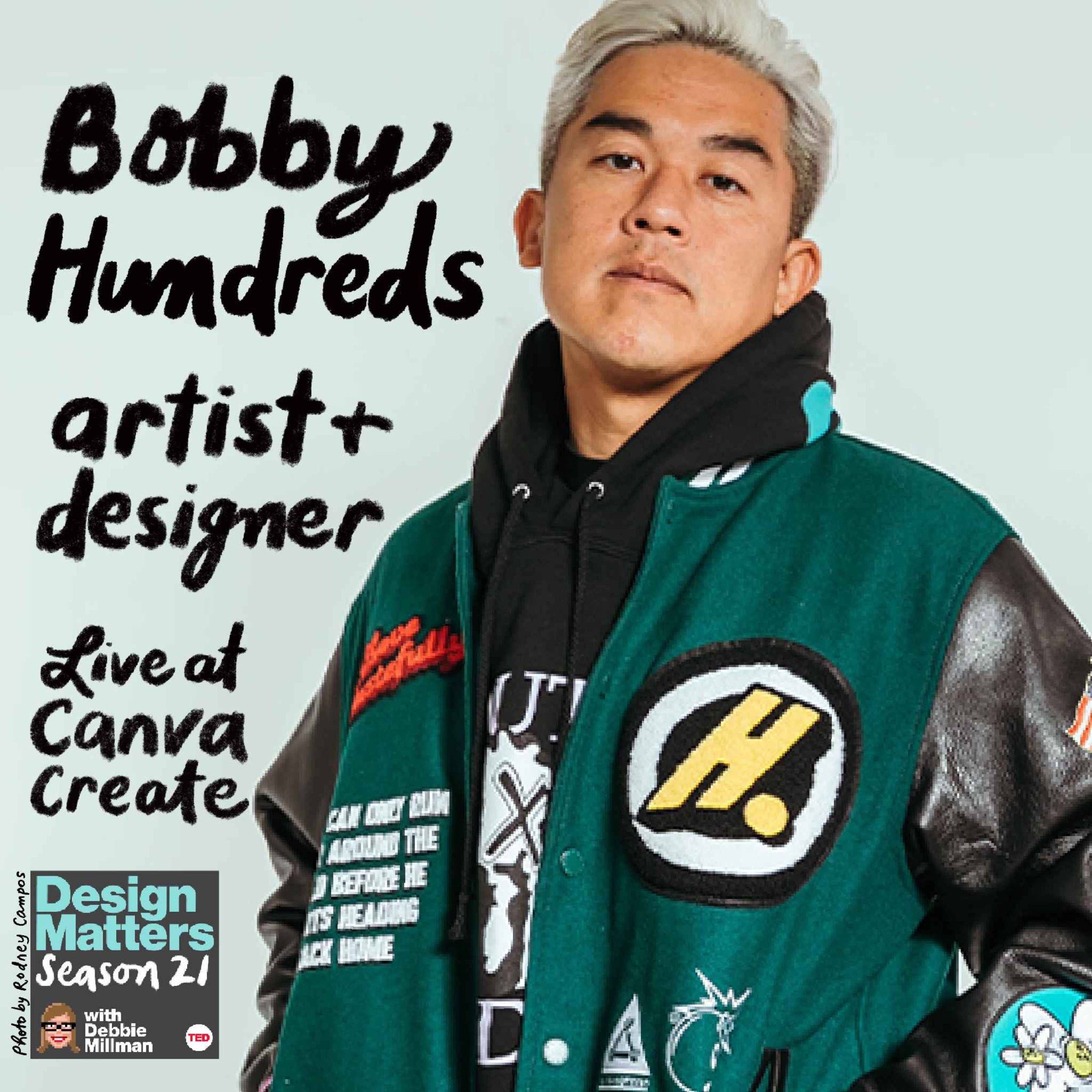
From the TED Audio Collective, this is Design Matters with Debbie Millman. On Design Matters, Debbie talks with some of the most creative people in the world about what they do, how they got to be who they are, and what they're thinking about and working on. On this episode, a conversation with Bobby Hundreds about identity brands and brand identity.
- [00:39]
Bobby Hundreds
I believe in brands that are living, that continue to adapt, that continue to grow.
- [00:47]
Verizon Advertiser
Now more people than ever can bring in their Bill for a better deal at Verizon. Got AT&T or T Mobile? We got you Xfinity or Spectrum.
- [00:53]
Bobby Hundreds
You too.
- [00:54]
Verizon Advertiser
So tell your friends, your family, your quirky neighbor Jeff, grab your megaphone and yell it from the rooftop. Get a better deal at Verizon because chances are anyone in shouting distance is included. Bring in your at&t t Mobile, Xfinity or Spectrum Bill and we'll give you a better deal on the Best Network Come by Verizon today. Best Network based on RootMetric's best overall mobile network performance US 2nd/2025 all rights reserved. Must provide recent consumer Mobile Bill in the name of the person redeeming the deal. Additional terms, conditions and restrictions apply.
- [01:17]
ActiveCampaign Advertiser
ActiveCampaign is the marketing automation platform built for big swings and big dreams with intelligent suggestions. Powered by AI and your data, generate ideas in seconds, import your brand and create full campaigns with simple prompts. Send personalized messages backed by real time feedback, smart segmentation and effortless reporting that tracks every win. Let's redefine what's possible together. Get started for free@activecampaign.com.
- [01:50]
Bill.com Advertiser
This podcast is supported in part by Bill, the intelligent finance platform that helps businesses and accounting firms scale with proven results. We often talk about the habits and systems that help people do their best work. For many leaders, that might include building processes that reduce friction and create clarity. That is exactly why so many finance leaders turn to Bill. With AI powered automation, Bill isn't just moving money, they're simplifying financial operations for nearly half a million customers. They're even trusted by over 90 of the top 100 US accounting firms to get it right. That trust is built on scale. Bill has securely processed over a trillion dollars in real transactions, supporting teams in handling payables, receivables and expenses. When financial tasks are organized and visible, it can Free up time and energy to focus on what matters most, whether that's your team, your mission, or your community. Visit bill.comproven and get a $250 gift card as a thank you after speaking with a bill expert. That's bill.com proven. Terms and conditions apply. See offer page for details.
- [02:54]
Narrator
This interview took place on April 16, 2026, in front of a live audience at Canva Create in Los Ang.
- [03:04]
Debbie Millman
Bobby is a designer. He's a writer. He's the OG Co founder of the Hundreds, a pioneering streetwear brand that really has helped redefine the relationship between fashion, storytelling, and community. And over the past two decades, his work has expanded beyond apparel into publishing cultural commentary. And today he is the global creative director of the Walt Disney Company. Right. It's a fascinating story. I have spent the last two weeks immersed in his world, and I can't wait to share it with you all. Please join me in welcoming Bobby Hundreds for a very special live episode of Design Matters here at Canva Create. Hey, what is up, Bobby, I understand that one of your favorite novels of all time is Pachinko by Min Jin Lee.
- [04:07]
Bobby Hundreds
By Min? Yeah. Who's read that book? Yeah. That's a beautiful book. It's a beautiful series as well.
- [04:12]
Debbie Millman
You said, though, that if anybody had read that book, they would understand your entire upbringing.
- [04:22]
Bobby Hundreds
Yes.
- [04:23]
Debbie Millman
So talk a little bit about how.
- [04:24]
Bobby Hundreds
Well, there's a lot of my familial history that is woven within that narrative. That's not that common, but it is a story that is recognizable and understood within the Korean immigrants community. That intersection between Korea and Japan and war and poverty and overcoming all odds and insurmountable obstacles to find success in the West. So my parents weren't the subject of that story, but it was very relatable. I think they saw themselves in it. My mom was the one who told me to read that book, and Min became a good friend of mine. And actually my manager, Theresa was. And Justin Sean, my writing partner, were involved in the series of Pachinko. So that's a story that's really close to my heart.
- [05:11]
Debbie Millman
Just as an FYI for folks, Min Jin has a new novel coming out in the fall called American Hagwon.
- [05:18]
Bobby Hundreds
Yes.
- [05:19]
Debbie Millman
And I've gotten a little bit of a sneak peek.
- [05:21]
Bobby Hundreds
Oh, really? Yeah.
- [05:24]
Debbie Millman
Amazing. It's amazing.
- [05:25]
Bobby Hundreds
Even that American Hawk 1 is about the SAT schools that the Koreans and Asian Americans are very familiar with. And so that's why she wanted to meet with me, because the first iteration of that I actually participated in participation is like not the right word for what that is. It was SAT boot camp. But that will maybe will show up in the book.
- [05:48]
Debbie Millman
You grew up in Baltimore. You were born in Baltimore, but you grew up in Southern California, where you described yourself as a minority of a minority. Can you talk about what that means and how that shaped how you move through the world at that time?
- [06:06]
Bobby Hundreds
Yeah. Born in Baltimore, for whatever reason, my parents ended up there, and then we moved to Southern California. And not a lot of Asian Americans in my community. And even beyond heritage, not a lot of people who were attracted to the types of interests that I was drawn to. Even the town itself of Riverside in those days, it was a little bit off the beaten path. People were looking at Los Angeles, and Riverside was kind of this developing community with the orange groves. But there was, especially within the 80s, and this is kind of hard to process even for, like, my kids today, but there was a really distinct delineation between the mainstream and the underground, what we would consider subculture now and mainstream and pop culture. And for someone like me, who. There weren't a lot of people who look like me, but I didn't necessarily feel like I was represented or that I belonged when within some of those mainstream spaces, mainstream sports that was largely devoted to jocks and jock culture. I was not a jock. I was not athletic in that way. I didn't know how to play with teams very well. So there was an entire bastion and a sector over here, a frontier known as the underground or the alternative. Alternative sports, alternative music, skateboarding. I grew up in the hardcore scene in punk, and that's where I found myself, being a minority within a minority within a minority town.
- [07:43]
Debbie Millman
You started drawing in secret when you were three years old.
- [07:48]
Bobby Hundreds
Yeah.
- [07:49]
Debbie Millman
But you felt you had to hide all of your drawings that you were making. Why did you have to keep what you were creating a secret?
- [07:55]
Bobby Hundreds
Yeah, I mean, look, no knock against my parents, especially if you have immigrant parents, you might be able to empathize with this plight and this struggle. You know, they were scared. They were just. They were so frightened. Moving to this country. It is very difficult, as you know, to emigrate and to enter into this nation and then pull yourselves up by the bootstraps and make it even in a traditional career path. And so it's. It's funny because both of my parents are very creative. They're both artists innately, and they saw that within me. They knew that I was drawn to the arts. I was. I was drawing from as early as I could remember. I was always really enchanted by Cartoons and animation. And they. They did everything they could to stifle that within me. Not because they didn't think it was great that I had that skill set or that interest and that intrigue, but that they were worried. And I had a lot of problems with that. You know, there's a lot of friction between us for it. It wasn't until I was older. You know, when you become a parent yourself, if there are any parents in the audience, you start understanding your parents a little bit more of how scary it is. And so that's essentially why you described
- [09:15]
Debbie Millman
a household where even a B plus or an A minus could be a problem.
- [09:21]
Bobby Hundreds
Yeah.
- [09:21]
Debbie Millman
Where achievement wasn't just encouraged, it was expected. But you were also extremely. An extremely good stud. You skipped first grade because of how early you were able to read and write.
- [09:33]
Bobby Hundreds
Yeah.
- [09:33]
Debbie Millman
You've also described yourself, though, as restless, hyperactive, and even anti authoritarian. And so I'm wondering, what did that teach you at that time about what made you valuable?
- [09:46]
Bobby Hundreds
Oh, wow. Yeah. Now I look at it as a superpower. Like, I really own that part of me. But in those days, you know, we didn't have a lot of literature, a lot of vocabulary to understand those types of personality, types of being adhd, of being saddled with various different mental health struggles that some of us might endure as creative people. And so we were all labeled as problem children. Right. Like we were miscreants, we were rebellious, if we were challenging the status quo or questioning authority. And I remember I was with my therapist a couple years ago, and I would talk about myself in this time of my life as being a mischievous kid, like a bad kid. Right. And that was a narrative that I had written within and that I had been told, and I had absorbed that for so long. And she questioned that. And she said, if your children were refusing to follow rules, coloring outside the lines, metaphorically and literally, you know, would you deem them as being a problem child? Would that look like a bad kid to you? And I was like, no, I would love that. Like, I think that's the best thing, especially for a creative person. They should be questioning all the rules. They should be reframing narratives. They should be looking at it from their perspective. And she was just like, then why do you do that with yourself? And so at that time, I always considered it a slight. I thought it was a burden. I thought I had this weakness and that I couldn't focus, I was a dilettante, I couldn't stick to one subject. I, as you'll see throughout my Career, I've kind of bounced all over the place. And you know, the, the narrative, the. The conventional understanding of what a career journey and a path and an artistic career should look like was really, really uniform. And I never wanted that. And so I was concerned growing up and I thought that that might have been a knock against me, but it turned out to be my best, my best strength.
- [12:03]
Debbie Millman
You said that when your creativity was restricted, it didn't disappear, it just found other ways to come out. Is that how you discovered skateboarding?
- [12:13]
Bobby Hundreds
Yeah, I mean, I was never a good skateboarder. But again, back to this dichotomy between. There were mainstream sports that I didn't find a home within. I didn't relate to a lot of the athletes that participated in that type of sport or culture. And for the rest of us we had skateboarding or snowboarding and surfing or some other types of action sports. And these were individual sports that toed the line of art and dance and were very creative. And I not only fell in love with the sport, but with the culture and the community that surrounded it. Skateboarding doesn't just come with the physical act of skate. Skateboarding comes with a different perspective on the environment around you. So it draws in a lot of artists, it draws in a lot of photographers, some who go on to become very recognizable names like guys like Atiba Jefferson. The musicians that grew up within the scene become some of the biggest bands like whatever, Blink 182. So skateboarding was a haven for young, creative folks like me that didn't find themselves necessarily represented within the mainstream dialogue.
- [13:23]
Debbie Millman
Well, that culture or the subculture really became a portal into music, into style, into identity. And you've described gravitating towards spaces like punk and hardcore where you could be louder, more visible, more fully yourself. What did that freedom unlock in you? What were you beginning to see that you could become?
- [13:44]
Bobby Hundreds
Yeah, it's the same thing that I see within my. I have a 16 year old son, I have two boys. The 16 year old, he loves going to rap shows and he loves moshing and they. And I'm sure some of you can relate to this. And that's something that when we were growing up, we would do that at rock shows and punk shows and now they do it at rap shows and it's amazing, but I think especially, especially now, there's so much societal pressure and there's so many expectations of young people and you have to be perfect, you have to be immaculate. You cannot trip. It's recorded. Tyler writes about this on his album These kids don't even dance because there's phones out and they feel like they're going to get flamed the next day. I think there's so much more expectation now of young people today than there were back then where we were allowed to kind of roam and make lots of mistakes. We were not on the public stage. We didn't have a YouTube channel or TikTok or an Instagram page where from the get go, all your moves were validated and crowdsourced by strangers. You could sing in the dark, you could sing in the shower, and that was okay. And because of that, now when my son goes out into these venues and he's at these rap shows and he's moshing, he can get it all out and he can be rambunctious and dirty and messy and it's okay. It's a safe place for you to exist. And I had that within the punk community also. These clubs, these underground basement shows, these living room shows, were a way to feel safe and to externalize all of the pressure and all of the stress I might have had where I didn't feel like I was doing the right thing in the. In the outside world, but within there I felt very comfortable and felt very much myself.
- [15:36]
Debbie Millman
You then went on to University of California in San Diego.
- [15:40]
Bobby Hundreds
Yeah.
- [15:41]
Debbie Millman
And got your bachelor's degree in media and communication.
- [15:45]
Bobby Hundreds
Yes.
- [15:46]
Debbie Millman
And you were writing, doing a lot of photography, freelancing. And when I got to the next part of what I thought was my research, I was like, this can't be right. This?
- [15:56]
Bobby Hundreds
Yeah.
- [15:57]
Debbie Millman
I have to double triple check this. He went on. Bobby went on to law school. Law school? He has a degree in law. Why?
- [16:10]
Bobby Hundreds
Yeah, I. I don't know. Sometimes I wonder myself. Well, I had graduated from college. I didn't know what I wanted to be when I grew up. I still don't know. I'm 46 years old. I tell everybody I can't wait to figure out what I'm going to do when I grow up. And I hope I never figure it out. To be honest, the world is just so big. There's so much to do. So I graduate college and by the way, when I'm in undergrad, I came in with four majors. I ended up, like, studying everything from media to psychology, theater. And then it was the first year they were offering some semblance of graphic design and they're calling Computing in the Arts. At UC San Diego, I took every single class I could take. At that time, UCSC had five colleges. I was a participant in all five colleges. By the end of school, I think I knew almost everyone on campus. I ran for office every year. I just had this voracious appetite for. I'm very curious, and I just wanted to know everything that that school had to offer. But it gets me into trouble when it's like, well, what are you going to do when you grow up? Now I'm like, I'm not sticking to one lane. So I couldn't decide. I had analysis Paralys, and I went to Japan, and I was writing for a year, and I was learning what this burgeoning street culture was doing out there that was inspired by New York and a lot of these incredible iconic classic artists from the city. And there were these brands that were coming up like a bathing ape and Neighborhood and Double Taps and Street Fashion and Bear Bricks and Collectability and the idea of Veblen goods within the street space. I mean, I just was so enamored by it all. But I. Again, I'm growing up with this narrative that I have to do the right thing, especially as a son of immigrants. I have to have a conventional and secure career somewhere. And so law school was inviting, very boating in the background. But also, I was doing a lot of social justice work at the time and had a lot of. My heart was really set on human rights. So I figured, I don't want to go into politics, but if I can understand the system from within, maybe I can enact change in a way that is more impactful than running for office or trying to become a political figure. So that was the primary motivation. And I'm sure I thought also at the time, like, here I'm going to make some money, then the money will afford me the luxury of being able to pursue art. That was my mindset going into it.
- [18:45]
Debbie Millman
You went to Loyola Law School in Los Angeles, and when you were there, you met two people that really changed the trajectory of your life. The first was one of your professors, a man named Abe Edelman. And when I read this story, my heart just kind of exploded a little bit. I was so charmed by how he influenced you that I was wondering if you would share that with the audience.
- [19:13]
Bobby Hundreds
Yeah, absolutely. So he actually wasn't a professor.
- [19:16]
Debbie Millman
Intern.
- [19:17]
Bobby Hundreds
Yeah. I interned for this guy Abe. I show up. It's my first summer after my first year of law school, Law school's three years. And by the end of that first year, I was already very creatively frustrated. I was excelling in all the classes. In fact, in some of those classes, I was ranked first I was getting the highest scores. But there was one class that I was failing in miserably. I was at the bottom. And it was illegal writing class because I'm a writer. And the way that legal writing is performed is that if the apple's red, you say it's red. You don't say it's crimson. They strip you of all adjectives and fanciful language. And I just. My brain couldn't process it. So I'm getting very creatively frustrated at this point. Everyone takes some type of internship during that first summer of law school, sets you up for your big job. I walk into the courthouse and I'm like, all right, who am I reporting to? And there's this guy, and he looked like he was homeless. He looked like somebody. A homeless Santa Claus. He had, like, this gray, wiry beard, and he was schlubby. He had these oversized sweats, and he was. He was just really abrasive as a person. I mean, today we would just say he was spectral. You know, he didn't necessarily, like, fit within society. And he approached me and I could smell him. Like, he was like. He just had, like, the scent. And I was just like, yo, what is this guy's deal? Like, I have to report to this guy all summer. And someone pulled me aside later and was just like, oh, you get to report to Abe. You know, he's the smartest person, not just in the courthouse, but in all of LA County. He's a legend. He's literally memorized the library. So he takes me to the research library. He's like, what's your first case you're working on? And I forget. It was like a crack in a pavement, and someone tripped on it, and they were suing the city. And he literally, like, felt the books. He, like, walked along the spines of the books, pulled out a book, flipped through, like, page 1039, and it was like, that's your answer. That's the procedure you're gonna follow and write a memo about that. I'm like, did you memorize library? He's like, yeah. So I work for this guy all summer long, but what I find out is that he has cancer and the cancer's bad. So his friends around him are like, look, you gotta go easy with the guy. He's on chemo, he's not acting right, and, you know, he's saddled with this disease. And as the summer goes on and I'm working for Abe, he starts disappearing. He starts disappearing in front of me. Physically losing weight. He becomes emaciated. And then he just starts disappearing altogether. He stops showing up. So the last two to three weeks, I show up to work, I'm starting to report to someone else. I'm doing my job. But the last day of work, I walk into the courthouse, and he is giving everyone their reviews, and there's like nine other interns beside me. And he's going through the. And I'm last as usual because I'm always late. And he's going down the bench, and one by one, people are scooting up on the bench, and he's just like, all right, you're good. I'll, you know, give you a letter wreck. See you later. Thank you. People moving in and out. And then he gets to me and I'm like, what's good, Abe? Like, how are you doing? It's been. It's been a minute. You're feeling okay? He's like, yeah, yeah, I'm good. He's like, you're amazing. You're gonna be very successful as an attorney. He's like, you're probably one of the best interns I've ever had. And I was like, amazing. He's like, you're gonna have it all. You're gonna have all the cars, you're gonna have all the girls, all the women. I was like, plural? Plural. Like all this. I was just like, yes, let's keep it going. And then he goes, but you should never do this. He's like, you should never, ever become a lawyer. And I'm young, I have this ego, and I'm just immediately defensive and combative. And I'm like, what do you mean? You just told me that I was going to be a billionaire being a lawyer. I'm going to be one of the biggest lawyers. He's just like, no, no, no. One day you're going to be 40 years old like me, and you might be dying of cancer. Is that a life that you want to live for the next 20 something years? And I was 23 at the time. The idea of 40 years old to a 23 year old. I know many of you in your 20s, you might like. I remember when my dad turned 40, I was like, this fool's gonna die. Like, I was like, that's it. Like 40 years old. Like, that's the end, you know? So I was just like, 40 years old. I was just like, no, man, I got, like a lifetime to lead. Nah, it's all like, I'm. And he was like, you should do what you truly love. And I was like, I love the law. I'm good at the law. He's like, no, I'm good at the law. He's like, this is what I'm passionate about. That's not what you're passionate about. What do we talk about every day when we go to lunch? And I was like, no. We talk about case memos. We talk about procedure. He's like, no, no. What do we talk about? I was like, okay. So every day at lunch, I would walk out with him, and I had a graffiti black book, if anyone grew up doing that type of work. And in my graffiti black book in the back of it, I had mapped out this brand called hundreds, that my friend Ben and I in law school had just started at the end of the first year. And it was a nothing. It was really a nothing. There were a few designs that I'd sketched out. There was a website, the framework that I built, because we did that at the time. And he's like, you take out that book, and you talk to me about these stickers you made, and you talk about this story you want to get into, these artists you want to work with. He's like, the way you light up when you talk about that. That's what you do. And I was like, okay, I take Abe up on it. He dies two and a half months later. Last time I saw him, he didn't recognize me. And then during COVID I turned 40, and I remember the day that I woke up in bed and I said, oh, my God, I'm 40 years old. It went that fast? So it can go that fast. And so it's just a reminder for everyone, please do what you love. If you're good at being a lawyer, we need you. By the way, this is no knock against the legal profession. It's very important, and God bless the people who do it the right way. But life can be very short. I'm 46 now, so life just keeps going. And I encourage you all to think about those passions of yours.
- [25:47]
Debbie Millman
Thank you for sharing that.
- [25:56]
Bobby Hundreds
I have something weird where I don't cry. I don't know what's wrong with him. Like a monster. And I almost started crying. I've only cried twice in my adult life when both my boys were born, and I was just like, whoa. But it's just been, like, amazing to look back on that story. Thanks for asking. I never get to tell that story anymore.
- [26:14]
Debbie Millman
I was about to start crying also, but I cry every day.
- [26:17]
Bobby Hundreds
But at least once.
- [26:24]
T Mobile Advertiser 1
We're lost, it feels like we're going round in circles. I'm going to ask that man for directions. Hi there. We're trying to get to the state fairgrounds.
- [26:34]
T Mobile Advertiser 2
Will, you're going to take a left at the old oak tree at this here road. Nah, I'm just kidding. Let me get my phone out.
- [26:40]
T Mobile Advertiser 1
How is their signal out here?
- [26:42]
T Mobile Advertiser 2
T Mobile and US Cellular are coming together so the network out here is huge. We get the same great signal as the city, saving a boatload with benefits. And there's a five year price guarantee too. Okay, here's the turn.
- [26:55]
T Mobile Advertiser 1
Actually, can you pull up the way to a T Mobile store?
- [26:58]
T Mobile Advertiser 3
America's best network just got bigger. Switch to T Mobile today and get built in benefits the other guys leave out. Plus our five year price guarantee. And now T Mobile is available at US Cellular stores in Hermiston. Best Mobile network Based on analysis by Ooklo Speed test intelligence data second half of 2025 bigger network the combination of T Mobile's and US Cellular's network footprints will enhance the T Mobile network's coverage price guarantee on talk, text and data exclusions like taxes and fees apply. See t mobile.com for details.
- [27:23]
Capital One Advertiser
With no fees or minimums on checking accounts, it's no wonder the Capital One bank guy is so passionate about banking. With Capital One, if he were here, he wouldn't just tell you about no fees or minimums. He'd also talk about how most Capital One cafes are open seven days a week to assist with your banking needs. Yep, even on weekends it's pretty much all he talks about. In a good way. What's in your wallet? Terms apply. See capitalone.com bank you have the vision for your business. You have the plan, and you just got handed a huge opportunity. But is your business connectivity reliable enough to make a move? Spectrum Business delivers fast, reliable Internet, phone, TV and mobile services, so you're always connected when it matters most. Get connectivity packages built for your business with savings that keep your budget in check. And with fast, reliable Internet and 100% US based customer support, you'll stay connected and ready to bring your vision to life. Learn more@spectrum.com business restrictions apply. Services not available in all areas hi
- [28:30]
Adam Grant
there, it's Adam Grant from Ted's Rethinking Podcast and this episode is brought to you by ServiceNow. I get to spend my days studying how people think and what it actually takes to change our minds. It's work I find deeply meaningful. But even in meaningful work, there's still busy work. The admin, the repetitive processes, the invisible load that pulls attention away from what really matters. That's where ServiceNow's AI specialists come in. They don't just tell you what you should do about your busy work. They actually do it. Start to finish, cases closed, requests handled, no extra work for you. To learn how to put AI to work for people, visit servicenow.com.
- [29:10]
Debbie Millman
So you started the hundreds. You and Ben start the hundreds.
- [29:12]
Bobby Hundreds
So we go the hundreds? Yeah.
- [29:14]
Debbie Millman
With a few hundred dollars, a box of T shirts, a silk screen, How'd you start?
- [29:21]
Bobby Hundreds
Well, there was no blueprint. There was no YouTube Academy for this type of work, for establishing a street streetwear brand.
- [29:30]
Debbie Millman
Not only that, but there was no definition of what streetwear.
- [29:32]
Bobby Hundreds
There was no set definition. There was skateboarding apparel, and there was urban apparel at the time. So late 90s, early 2000s skateboardings, DC anything in action sports, which was code for white kids. And then there was urban, urban echo, niche, Rocaware, black kids. And then you're looking at Ben and I, who's. Ben's a Persian Jew from the Valley. I'm a Korean American kid that grew up in Riverside. What about us? And so even for us, we didn't have models to follow. We didn't have an industry to necessarily excel and thrive in. And so it was on us to create what that roadmap could look like. Not just for us, by the way, but for the community, which was eventually what led to our success is that we created a stage for everyone to exist as opposed to just making sure that we were okay. It was very scrappy. No money at the. Still no backers or investors in what we do. $600? No, six. I guess, initially. $600 each. That's all we had in our bank accounts. We just put it right in, made a bunch of shirts with our friend who's a screen printer in the Valley. And there's a great story about this in my book too. And he ruined all the shirts. So we were out of business before we started. And then we had maybe 20 shirts that were salvageable, and we just sold them at the trunk of our car to our friends and said, like, anything you can donate, please throw it back in. And then we turned that over and we turned it over and over and over again. And we got to a place where we were starting to develop collections backed by an online narrative through a thing called the blog, which in 1999, blogspot launched blogger.com and it was a way to livejournal. And I thought that was really important for someone like me. As you can tell, I'm A storyteller. But I didn't want to just create another clothing company where the art was just because there had to be a reason and a purpose, and there had to be a narrative and a story that I wanted to tell through these T shirts. I didn't want just the art, just, well, that looks cool. I'll buy that. Or that brand is supposedly hot because so and so is wearing it. So I'm going to purchased that hoodie. I was like, no, I want to say something with it. This is a forum. Like, what a beautiful, beautiful stage for us to be heard as artists in these T shirts. And so if you take it all the way back, that was the initial impetus and the motivation for why I even wanted to do T shirts. Because I was an artist and I was a writer, but there was no way for my work to get seen. I would take my art to galleries. They said, there's no place for that here. We don't know who you are. And so I said, if I put it on T shirts, I could put it in everyone's face, and that'll be a way for my art to get seen. And it wasn't just about my marketing scene. But then there'll be a dialogue. If I wear a shirt like this, a person seeing it might say something. It might get a reaction. It might confuse it might make them angry. Or they might say, I love that shirt. What is that about? And now there's a relationship forging between the person wearing it and the person seeing it and observing it. And then that's community. So that's how. That's how I looked at the entire premise of a T shirt brand. And we went into these stores. We weren't just there to sell streetwear. We were there to sell community. Like, this is a way for us to. To forge new relationships and friendships within the cities that we sell in.
- [33:21]
Debbie Millman
There was also, and still is, quite a lot of wit and intelligence built into the design that you do. And very early on, you were parodies, and you did quite a few parodies with Mickey Mouse.
- [33:37]
Bobby Hundreds
So I did.
- [33:40]
Debbie Millman
So is it true? Well, is it true that Disney execs came to the hundreds booth at a trade show and told you to stop where they'd sue the pants off of you?
- [33:49]
Bill.com Advertiser
Yes.
- [33:50]
Bobby Hundreds
Yeah.
- [33:51]
Debbie Millman
So how did that turn into an actual official collaboration?
- [33:55]
Bobby Hundreds
Yeah, well, exactly. That they were someone that was sympathetic on their side. And it took him and his discernment to approach us at a show and say, you really have to stop doing that. They're about to sue, you back here, but I got you. There's a guy named Les Schetko. I was just texting with him right before I came out. But Les was the one that was at Disney at the time, and he knew what was happening within. He had the foresight, he had the sensitivity to culture to understand what was happening in this bubbling streetwear market. And he knew that Disney as an entity, as a studio, could always use more relevance, especially with young men. And if we collaborate with them, with these young designers that sell to these male demographics, that's a way that Disney can find more permanence within some of these different scenes and cultures. And so he's like, what if we did it the right way? Now, here's the thing with collaborations, and I still. I always followed this philosophy, which was number one when we collaborate with anyone. And I even carry this into the latter stage of my career. Now, you only do it from a place where it says something about you that you can't say for yourself. And so what we're trying to avoid is developing monolithic brands that are just one face. And I want to feel like we're multifaceted, not unlike people. So the best brands are like a best friend, right? You don't want someone who's just one note and says the same thing and can only deliver, like, the same type of response or comfort. You want friends that are complex and complicated and nuanced, because we are as humans. But we've gotten into such a rut and a routine the way that we develop brands, and it's because of even the way that the word sounds like it's a permanent brand where it's. This is what it's locked into, and this is forever what it'll be. But I believe in brands that are living, that continue to adapt, to continue to grow, that make mistakes that one day might be over here, one day might be over there, just like a person would. And so collaborations are the best way to express that and communicate that. I have a deep, deep love and adoration for Disney, for the animators, for imagineering, for the art departments there, and especially their storytelling. And so historically or traditionally, I would have never wanted to work with a big company or corporation or a studio like that. But was there a way for us to work with them in a way that highlighted a nuance of our brand that I couldn't share for myself? And that was doing a collaboration with Peter Pan's Lost Boys. And then more collaborations came along the
- [36:40]
Debbie Millman
way, and you did a few collaborations in the Meantime, the Hundreds is growing. You have some volumetric growth. Jay Z is photographed wearing a T shirt. He's on the COVID of USA Today. And then you make a very deliberate decision to scale back. You and Ben want to keep focused on community, and you want to keep it very intimate and with a lot of integrity.
- [37:04]
Bobby Hundreds
Yeah.
- [37:05]
Debbie Millman
12 years later, you're sitting in your studio, you get a call from somebody at Disney like, hey, Bobby, what's up?
- [37:13]
Bobby Hundreds
Yeah.
- [37:14]
Debbie Millman
Want to come be our chief design officer? How does that work?
- [37:17]
Bobby Hundreds
Sure, sure. Yeah.
- [37:18]
Debbie Millman
There's not a lot of detail out there about that.
- [37:20]
Bobby Hundreds
The timeline is not. It wasn't 12 years later, but we are working within the company. And look, that. That's a great question, because the Hundreds streetwear is all about this dance between integrity and credibility within a space. Space, which is actually what makes it kind of remarkable, is that there's so much accountability. The community holds your feet to the fire in streetwear, so you can actually only move in a specific way. There's a lot of code, there's a lot of rules, and there's a lot of honor and respect that you have to show the pioneers and also the people around you. So we move as one. And so it was really, really important for us to make sure that we were working with integrity, that we're moving in a way that honored the culture, but also honored the brand and preserved the legacy and the permanence of what this could be. You know what? Early on, when people would say, what kind of brand do you want to build? And I was like, I want to be like Ralph Lauren or Coca Cola. Like, I want to be around for 100 years Levi's. Like, that's a little bit of a different mindset than. I see a lot of newer, younger entrepreneurs coming out the gates with they want to build brands that they want to flip. And there's nothing wrong with that. Again, it's just two different doors into the same room of success. But for us, it wasn't about valuations, and it wasn't about a quick flip and behaving that way or finding capital. It was, I want to create a lifelong story that tells the story of us, of Ben and I and our friendship. And so I totally lost track of where we were going with that original question, which happens all the time.
- [38:51]
Debbie Millman
No, I mean, you're answering all the questions that I had in my head, so it's actually perfect.
- [38:56]
Bobby Hundreds
Yes.
- [38:57]
Debbie Millman
But I was actually.
- [38:58]
Bobby Hundreds
How did I get hoping you would
- [38:59]
Debbie Millman
get to where you get.
- [39:01]
Bobby Hundreds
I was hoping I would get there as well, I'm almost there now. We will get there right now.
- [39:08]
Debbie Millman
Take your time.
- [39:08]
Bobby Hundreds
I have been doing the hundreds for 24 years. Wild 23 in almost 24 years, which is insane, because the people who are buying the brand now didn't exist when we started. Which is very humbling also, because if any of you are owners or founders, you develop these brands and you think that people know, you're like, I don't need to tell them where I've been or what I've done. You don't have to tell stories like this. They know. And then I meet kids who are 17 years old who are just like, I think the hundreds means this, right? And I'm like, no, no, no. I got to start over. And you have to keep retelling your story. A year and some change ago, it was Thanksgiving week. I got three phone calls within 48 hours. Job offers. Now, I've never applied for a job in. In this stage of my life. The last job I had was I worked in a mall, you know, and then I was like, an editor at a magazine. I was like an internship. But that's when I was, like, 19 and 20. So I haven't had job offers, let alone three that were meaningful, that were actually kind of enticing, and they were very, very flattering, right? So the first one comes in and I'm like, wow, that is so nice. And that sounds like a lot of money, and I need that money. But no, I work for myself and I'm not interested. And then six hours later, another one came in. And then I was hiking in the Temescal Mountain, like, Temescal Canyon over here. And I get a phone call from a friend, and the phone's cutting out, and she's like, I have to ask you something. It's really weird. And I'm like, I'll call you later. I call her at 10 o' clock at night. I'm like, what's going on? And she's just like, I got a weird question for you. I was like, are you gonna offer me a job? And she's like, how did you know? I was like, and I knew she worked at Disney. I'm like, you asked me to come work for Disney. And she's just like, I know that sounds crazy. You're an entrepreneur. You have the hundreds. And I was just like, in any other week, I would have said, absolutely not. Like, not interested at all. I don't work for anybody. I work for myself. And that's the dream that I've pursued. And I've materialized it, I did it. And I was like. But for whatever reason, the universe keeps throwing this at me. I'm going to lean into it. And whenever I'm scared or whenever I'm confused or baffled by something that's going on in my life, I always charge towards it. I'm the guy in the scary movie. There's the murderer upstairs. Like, I run up the stairs like the idiot. Like, my three worst fears in life are drowning the dentist and public speaking. So I speak as much as I can. I go to the dentist every six months, and I surf to intentionally put myself in those situations. And so this actually scared me. I was like, why are there so many people? Do I look like I need a job right now? Like, do I need to start dressing better? Like, what's happening? So I take the meeting with my now boss, Marcus Rosie. He's an SVP of creative on the product side, and he paints the dream. He paints this beautiful portrait of what it's like to work for Disney. And for the first time, I actually considered this idea. I still want to do the hundreds. I write on the side. And Disney allowed and carved out the space for me to exist in that way. And they thought it would actually be. It would be beneficial to the work. Four, five, six months later. So almost a year ago now, I started at Disney as initially the VP of Creative for the Americas, and then eventually I became global Creative Director for Products.
- [42:42]
Debbie Millman
Thanks. Disney operates at a massive global scale.
- [42:50]
Bobby Hundreds
Yes.
- [42:50]
Debbie Millman
How do you bring community over commodity mindset into that environment? Or can you.
- [42:59]
Bobby Hundreds
Yeah, that's a recurring theme in the work that we did with the hundreds. It was always about people over product. And I love that you say community over commodity. I haven't even considered that way. That sounds cooler.
- [43:11]
Debbie Millman
All yours.
- [43:12]
Bobby Hundreds
That one's for free. I remember when I joined and. And I'm obviously from a creative and artistic community, and half the people, half of my community was like, amazing. Like, this is the coolest thing ever. And it makes so much sense. If you really, really know me and you've followed my journey, you know, I'm gonna. I'll never stay in my lane. I swerve all over the road, and every few years, I embark on. I did a food festival and sold it to Complex. I wrote books, I write. I have a show in development with FX right now. So I'm like, all over the board. So they're like, of course you end up at Disney. You've always been the biggest Disney adult. You love the ip, you love this world. And then there was another segment of my community who were like, oh, my gosh, you sold out and you work for the man. And I was like. At the time, I was just like, yeah, the man's name is Bob Iger. The guy's pretty cool, actually. He's like, a really nice guy. I was just like, I see that man at work, and I see a lot of these men, and they're actually, like, decent and very creative folks who support creative. But when they were asking about the community piece, and they were like, well, it's so corporate, and how does that fit within culture? I was like, dizzy is the master of assembling community. There are so many cultures and subcultures within, and they are so good about reinforcing and supporting these people in a way that they feel seen. It is almost like the last frontier. Like, it's a completely neutral and inclusive space where wherever you are on the social and political spectrum, you feel like it belongs to you. There was a day about a month ago, there was a very politically charged day at Disneyland. You could look it up where different factions were saying they were going to show up on the same Saturday. And I was idiot that didn't even know this was happening and woke up on a Saturday, and my family was like, let's go to Disneyland. And I was like, all right. And I tell my friends we're going, and they're like, not today. Like, it's going to be crazy, and there's going to be chaos. And it happened to be one of those days where it's been, like, 100 degrees for no reason. So climate change. Climate change. There is a reason. Thank you. And we're walking around the park, and I'm seeing these different tribes, right? These people wearing this color, and these people were waving these flags. And there was a black gospel convention happening at the same time that the Chicano Latino organization was showing up. So there was, like, everyone stirring together at the same time. And I'm standing in line for Pirates of the Caribbean, and the line is long. It's 45 minutes. And I'm with my kids.
- [45:59]
Debbie Millman
You don't get, like, a pass?
- [46:01]
Bobby Hundreds
No, no, no. I'm not that special. Yes. And, you know, they want me to earn my stripes. So they're like, you're gonna wait? And I'm watching these different groups interact. They're literally. There's 15 of these people. There's 15 of these people, and they're butted up against each other, and it's hot and everyone's sweaty. And complaining. And I'm like, ooh, I can hear them grumbling. And I'm like, what are they saying? What are they. They're getting into each other. And I lean in and I hear them go, oh, my God, it's so hot. And then this group is just like, oh, my God, it's like 110 degrees. Why is it so hot today? And. And then they're like, but I'm so excited to go on the ride. And they're like, I love Pirates of the Caribbean. I love this part. And I was just like, oh, my gosh. These people don't care at all about any of this that's going on in the outside world here. They have a shared love for Pirates of the Caribbean and a shared hatred for the weather, and it just brought everyone together into this one last remaining monoculture where everyone is invited in. And so when I think about community and I think about what Disney does in terms of welcoming everybody in, our greatest strength to me is the ip. We have thousands of characters across Marvel, Lucas, Disney, Pixar, 20th, Fox, even Nat Geo, ESPN. There's thousands of characters that we own. And just to bring it full circle, this is a big part of the human condition, which is. Is we're always looking for ourselves out there, right? So me growing up, I'm into skateboarding, I'm into hardcore. I don't see that in the media. I'm an Asian American kid in a neighborhood. There's not a lot of Asian Americans, definitely not in media. So anytime an Asian person pops up on screen, I'm like, asian, right? Like, It's a Leonardo DiCaprio meme. Like, every Asians know this. Other cultures know this. Where, you know, even if you're into punk rock and you see a punk rock kid on screen, you're like, punk kid, you know? And so what you're doing when you do that is you're saying, oh, I'm relevant. And what is relevance? Relevance just means that it matters, right? So you're saying I matter. Like, I exist, and you just want to know that you're not alone. We have thousands of characters within the Disney universe where everybody can claim their own, right? Some people are like, I'm an Olaf. And they're like, oh, why is it that one's mine? You know, Like, I'm a Winnie the Pooh. Like, I'm a Deadpool. Like, that's my guy. And what are you saying? You're like, that's the closest to my truth. Like, that's the closest Representation of me out there, the avatar of me. And so, just to go back, I think Disney are the champions of community. I think they have identified what people are looking for, which is belonging, representation, meaning. And they wrap stories around it, stories that help us make sense of very complex and complicated universes. Especially today, where nothing makes sense, we need these narratives to help us through and figure out what's going on.
- [48:58]
Debbie Millman
Abhi, we have officially run out of time. I know. I wish I could talk to you for the rest of the day and into tomorrow. I want to ask you one last question.
- [49:07]
Bobby Hundreds
Sure.
- [49:08]
Debbie Millman
You said that you made it by making it, and you hope to make as much as you can while you're here. What feels most important for you to make next?
- [49:19]
Bobby Hundreds
Oh, wow. I don't have any. I pie in the sky, dream of something that I want to create. When I look back on my career, it's even. You know, there's a lot of kids that walk up and they're like, hey, I have this shirt from this year. Or I have now. Vintage is so big that we are kind of like, it's. It's. We're seeing this cycle again of the hundreds where, again, young people who weren't around for it the first time are finding it in thrift and secondhand and saying, like, what is this about? And I don't even remember, like, they're showing me jackets or denim that I made or footwear, and they're just like, do you remember these? And what was this? Was the SKU number. And like, you know, when did it come out? What season? I'm like, I don't even remember, but I remember the people that I worked with all along the way. I remember everyone. I remember everyone I collaborated with. I remember all the artists that we put on a pedestal that we championed. I remember everyone that I worked with on staff at that time. I'm like, oh, But I remember at that time, this person was here. Oh, my God. We had, like, such a good time. We went to dinner, we went to this party. We, like, went to Coachella together. So I always say, like, the best thing I ever made were all the relationships. Not just my. The relationships with me, but within the community. So many people found each other because of the hundreds and because of greater streetwear. They found their life partners, they found their best friends, they found their business partners. Like, that's collaboration to me is that we brought people together, we provided these bridges that people could find each other in a world where we're more and more isolated and fragmented. We need these vehicles and we need these types of projects in order for people to find each other in the dark. They start with a shared interest and a shared love for the Hundreds. That's great. That's great. But then they're like, yo, but are you into this music? You know you want to go to this show? Are you down with this artist? And then they start doing their own thing. And so the collaborations amongst the community were the best thing I ever made. And I, I hope I get to just continue to do more of that in the work that I get to do at Disney, on a stage and at a scale like that.
- [51:28]
Debbie Millman
Bobby Hundreds, thank you so much.
- [51:31]
Bobby Hundreds
Thank you so much.
- [51:32]
Debbie Millman
You're good.
- [51:32]
Bobby Hundreds
Debbie Millman, everyone. Master interviewer.
- [51:37]
Adam Grant
Thank you.
- [51:38]
Narrator
Design Matters is produced for the TED Audio Collective by Curtis Fox Productions. The interviews are usually recorded at the Masters in Branding program at the School of Visual Arts in New York City, the first and longest running branding program in the world. The editor in chief of Design Matters Media is Emily Weiland.
- [52:03]
T Mobile Advertiser 1
We're lost. It feels like we're going round in circles. I'm gonna ask that man for directions. Hi there. We're trying to get to the state fairgrounds.
- [52:12]
T Mobile Advertiser 2
Well, you're going to take a left at the old oak tree at this here road.
- [52:16]
Bobby Hundreds
Nah, I'm just kidding.
- [52:18]
T Mobile Advertiser 2
Let me get my phone out.
- [52:19]
T Mobile Advertiser 1
How is there signal out here?
- [52:21]
T Mobile Advertiser 2
T Mobile and US Cellular are coming together. So the network out here is huge. We get the same great signal as the city, saving a boatload with benefits. And there's a five year price guarantee too. Okay, here's the turn.
- [52:33]
T Mobile Advertiser 1
Actually, can you pull up the way to a T mobile store?
- [52:36]
T Mobile Advertiser 3
America's best network just got bigger. Switch to T Mobile today and get built in benefits the other guys leave out. Plus our five year price guarantee. And now T Mobile is available at U S Cellular stores in Hermiston. Best Mobile Network Based on analysis by Uclo B test intelligence data second half of 2020 bigger network the combination of T Mobile's and US Cellular's network footprints will enhance the T Mobile network's coverage price guarantee on talk text and data exclusions like taxes and fees apply ct mobile.com for details.
- [53:01]
Choiceology Advertiser
This episode is brought to you by Choiceology, an original podcast from Charles Schwab hosted by Katie Milkman, an award winning behavioral scientist and author of best selling book how to Change. Choiceology is a show about the psychology and economics behind our decisions. Hear true stories from Nobel laureates, authors, athletes and everyday people about why we the things we do. Listen to choiceology@schwab.com podcast or wherever you listen.
- [53:31]
ActiveCampaign Advertiser
Ready or not. Summer is coming and Wayfair's Memorial Day Clearance is on now. Right now through May 25th. Get up to 70% off everything home at Wayfair plus score amazing doorbuster deals all sale long and surprise flash deals on Memorial Day. We're talking thousands of products at every style and budget. Now is the time to save big on on must haves for your patio, backyard and beyond. These savings won't last, so don't wait. Shop Wayfair's Memorial Day Clearance now through
- [53:57]
T Mobile Advertiser 1
May 25th Wayfair Every style, Every home
- [54:01]
Choiceology Advertiser
this episode is brought to you by Capital One. Capital One's tech team isn't just talking about multi agentic AI. They already deployed one. It's called Chat Concierge and it's simplifying car shopping using self reflection and layered reasoning with live API checks. It doesn't just help buyers find a car they love, it helps schedule a test drive, get pre approved for financing and estimate trade in value. Advanced, intuitive and deployed. That's how they stack. That's technology at Capital One.
- [54:31]
Adam Grant
Hi there, it's Adam Grant from ted's Rethinking Podcast and this episode is brought to you by ServiceNow. I get to spend my days studying how people think and what it actually takes to change our minds. It's work I find deeply meaningful. But even in meaningful work, there's still busy work. The admin, the repetitive processes, the invisible load that pulls attention away from what really matters. That's where ServiceNow's AI specialists come in. They don't just tell you what you should do about your busy work, they actually do it. Start to finish, cases closed, requests handled, no extra work for you. To learn how to put AI to work for people, visit ServiceNow.com.