Loading summary
Transcript117 lines
- [00:01]
Jodi Kantor
The Court will often issue a cryptic opinion. We're talking about like one paragraph. It will say what should happen, but it won't say why.
- [00:18]
Debbie Millman
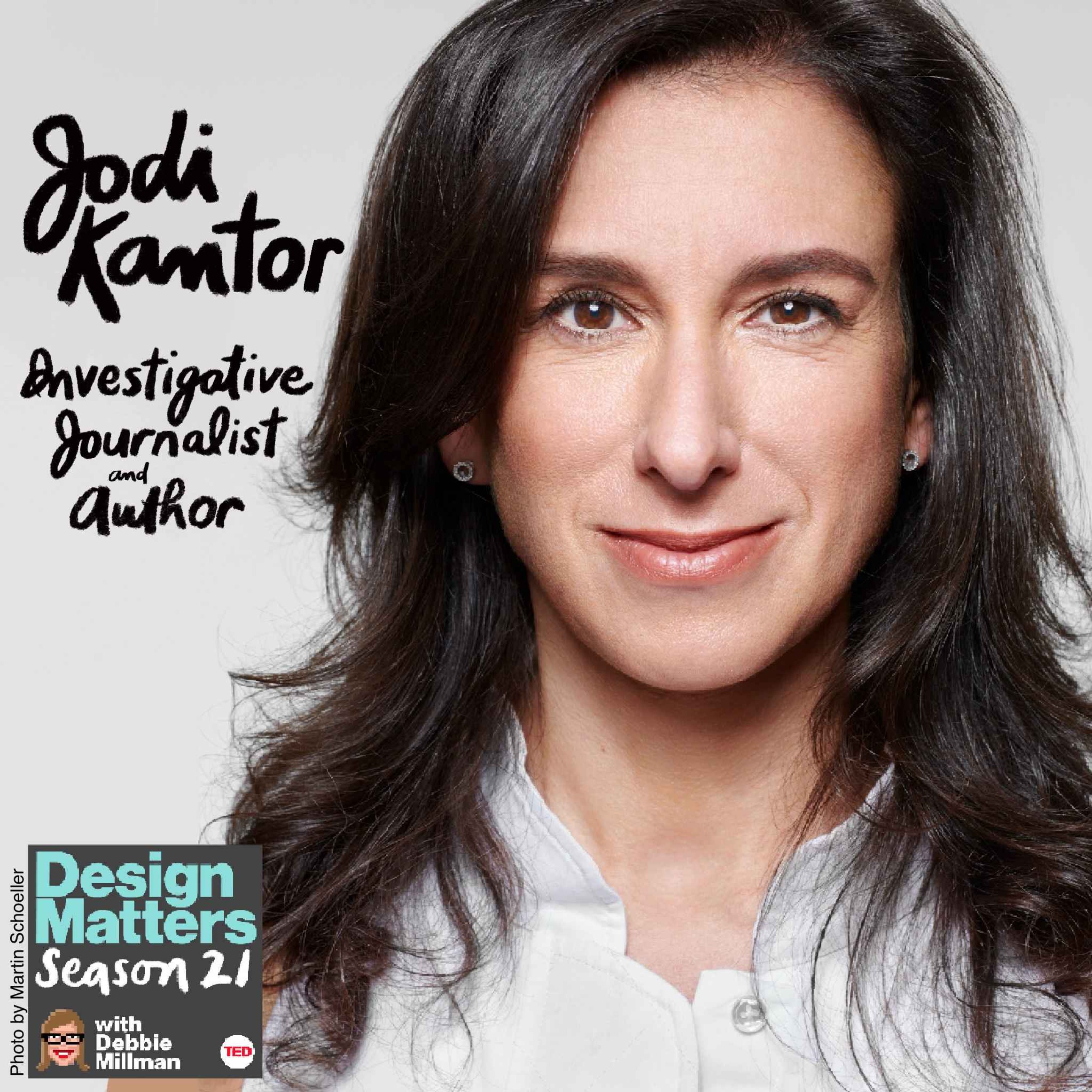
From the TED Audio Collective, this is Design Matters with Debbie Millman. On Design Matters, Debbie talks with some of the most creative people in the world about what they do, how they got to be who they are and what their thinking about and working on. On this episode, a wide ranging discussion with Jodi Cantor about her career in journalism, about Harvey Weinstein and MeToo, about the Supreme Court and the shadow docket, and about the importance of entry level work for young people.
- [00:48]
Jodi Kantor
It's hard and it's slow and it's hard and it's slow and then it turns into something wonderful.
- [00:59]
Verizon Mom (advertisement voice)
Hey honey, it's Mom. Did you know if we switch to Verizon, we can get four phones for $0 plus four lines for $25 a line. Call me back me again. That's just a hundred dollars a month for four lines on unlimited welcome plus four phones. No trade in needed. Call me. It's Mom. America's best network Verizon. That's the one we're talking about.
- [01:18]
Verizon Ad Voice
I'll send you text America's best network based on RootMetric's best overall mobile network performance US second half 2025 four new lines and unlimited welcome and autopay. See verizon.com for details.
- [01:28]
Optum Ad Voice
Healthcare can feel complicated. That's why Optum uses technology to connect the people and processes that make healthcare easier, more affordable and more effective. We're making it clearer for you to know exactly what your benefits cover and to help you better manage your health. We're coordinating care between your doctors and your technology. We believe better, simpler healthcare is always possible. That's healthy optimism. That's Optum. Visit optum.com to learn more.
- [02:01]
Bill.com Ad Voice
This podcast is supported in part by Bill, the intelligent finance platform that helps businesses and accounting firms scale with proven results. We often talk about the habits and systems that help people do their best work. For many leaders, that might include building processes that reduce friction and create clarity. That is exactly why so many finance leaders turn to Bill. With AI powered automation, Bill isn't just moving money, they're simplifying financial operations for nearly nearly half a million customers. They're even trusted by over 90 of the top 100 US accounting firms to get it right. That trust is built on scale. Bill has securely processed over a trillion dollars in real transactions, supporting teams in handling payables, receivables and expenses. When financial tasks are organized and visible, it can free up time and energy to focus on what matters most, whether that's your team, your mission, or your community. Visit bill.comproven and get a $250 gift card as a thank you after speaking with a bill expert. That's bill.com proven. Terms and conditions apply. See Offer page for details.
- [03:06]
Debbie Millman (interviewer)
Jodi Kanter is a Pulitzer Prize winning investigative journalist at the New York Times. Her pioneering work has reshaped how we understand power, accountability and the systems that govern our lives, from the workplace to the highest levels of American institutions. She has led groundbreaking investigations into corporate culture, labor practices and sexual misconduct, including reporting that helped ignite a global reckoning and earned her journalism's highest honors. Jodi is the co author of the New York Times best selling book she Breaking the Sexual Harassment Story that Helped Ignite a Movement which was Adapted into a Major motion picture and her reporting has led to measurable changes in policy and practices across multiple industries. Her new book, how to Discovering youg Life's Work, turns her attention to a different but equally urgent question how young people begin and how they make decisions about work, purpose and direction in a world where the existing rules no longer apply. Jodi Kantor welcome to Design Matters.
- [04:18]
Jodi Kantor
It's great to be with you, Debbie.
- [04:20]
Debbie Millman (interviewer)
Jodi, I know that you're a native New Yorker and I believe you've lived in four of the five boroughs, correct? Which one haven't you ever lived in?
- [04:30]
Jodi Kantor
I have never lived in the Bronx.
- [04:32]
Debbie Millman (interviewer)
I have to tell you that I am in a very similar situation. I've lived in all of the boroughs except the Bronx.
- [04:40]
Jodi Kantor
I think you and I have some Staten island history in common, Debbie.
- [04:44]
Debbie Millman (interviewer)
Yes, but I think that we should get a two bedroom apartment in the Bronx and just live there for a season so we can say that we've lived in all five.
- [04:52]
Jodi Kantor
Deal.
- [04:52]
Debbie Millman (interviewer)
Because I don't know anyone that's lived in all five. You grew up in Staten Island. I spent several years there as a child as well. Just different timing. You grew up in an immigrant family reading the New York Times obsessively as a child, even before you could fully understand it. But you've said you never imagined you could be one of the people writing those stories. What prevented that leap from reader to author in your early thinking?
- [05:23]
Jodi Kantor
You know, the funny thing about Staten island, especially pre Internet, is that you're very close to Manhattan, but you're also very far. It's a different world. I did not know any authors, I did not know any journalists. My parents fanciest friends were like dentists and even though I inhaled journalism, and, I mean, the arrival of periodicals at my house was like an event, you know, it was like this message from a world that I longed to be a part of. But I think my younger self thought it would have been very narcissistic to assume that anybody would want to read something I had written or edited. It provoked, like, a kind of internal who do you think you are? Reaction. Wow.
- [06:13]
Debbie Millman (interviewer)
When did you first start thinking that you could be a writer or an artist of any type?
- [06:24]
Jodi Kantor
I'll tell you two stories about Columbia. So that's where I went to college. And that was, like, my first entry, you know, into a world in which such things were even possible. So one of my best friends was and is named, we called him Frankie, for the new book is dedicated to him. His byline is Franklin Foer. And he was like, my first friend who really understood journalism. And senior year, he said, we're too cool to do our work in the Columbia library. We're gonna take the subway down to the New York public library on 42nd street and work in the main reading room. So that's what we did. And that Hanukkah, we were exchanging gifts, and I got him what I thought was the perfect gift because he loved the New Yorker. And so I went into the little gift shop at the New York Public Library, and I got him, you know, like, those posters that are New Yorker covers blown up. I got him one. Which one? I can't remember. But what I do remember is that when I gave it to him, his face fell and he said, jody, I don't want to hang a New Yorker cover on my wall. I want to write for the New Yorker. And I was like, you're crazy. Like, who talks like that? How do you think that such a thing could be possible? So that's kind of where he was at and where I was at. And part of the reason I dedicated this book to him is that he changed my thinking and made me see more in myself. But I'll tell you another story, which is that when I was a senior, I was kicked off the Columbia Daily Spectator. I had, like, a fledgling little column in the Spectator. This was the part of me that did want to be a journalist. Debbie. To say that it was not good is an understatement. Like, truly. But it still didn't warrant what happened next, which is that one day I opened the paper with, like, no warning, and there's this column by this other student attacking me and attacking me in such an out of bounds Crazy ugly way that I literally cannot say on this show what this kid said about me. Cause it was so offensive. It was humiliating. And also, the Spectator, not only did they publish this bananas thing, but they touted it, like, on the front page, they said, turn to page three to read an attack on a student. So I was mortified. Felt like, you know, everyone's looking at me, but also curious. I was like, this guy's in my class. How could he have written this? So I walked up to him, and I asked him politely, why'd you write this? And he didn't answer. So then I called him, and I left messages saying, I just really want to understand why you wrote this. And he didn't answer. And the next thing I know, I got a phone call from the editor of the Spectator, who said that this other guy was accusing me of harassing him and that we were both kicked off the paper later. Like, Megan Tuohy, my partner on the Weinstein story, she thinks this story is hilarious because she's like, jodi, you were fired from a newspaper for asking too many questions. But it was very painful. And also, it made me hate journalism. Like, I didn't. I was like, this is the most chaotic, unfair, uncivilized, insulting thing I've ever seen. How could I ever give my life over to this? And I made a mistake I think a lot of young people make, which is getting burned early by something and running away. And the reason I think it's a mistake is that being young is really chaotic. Like, I'm sure you have stories like this, too, Debbie. A lot of weird stuff happens between the ages of 16 and 25, and life kind of evens out afterwards. And then also to say the obvious, journalism is actually quite profound, professional and rigorous at its best. And I just. I didn't know enough to know that.
- [10:36]
Debbie Millman (interviewer)
How did the Spectator or the editors at the time of the Spectator allow something so vitriolic and so personal about another student to grace the pages of the newspaper? Why didn't they intervene?
- [10:56]
Jodi Kantor
I don't know. You know, it's really a question for them. I think they didn't know the basic rules of journalism. I think Those students from 1996 would be shocked if they could come into the New York Times today and see the way we deliberate and we parse and we agonize over the right thing to do and the right word in every situation. I also think, and I say this to student journalists all the time. Their jobs are harder than mine. They are not paid. They have no Experience, they are flying by the seat of their pants. Yeah, I think they were running a newspaper at a young age without any experience.
- [11:36]
Debbie Millman (interviewer)
I tried really hard to find out who this person is. 1996, there's not a lot of online archives of student newspapers.
- [11:48]
Jodi Kantor
Oh no, I have his name and I still can't find him. Cause remember, I'm an investigative reporter, right? I'm really good at finding this guy. Barely exists on the Internet.
- [11:58]
Debbie Millman (interviewer)
It's a good thing. After you were kicked off the paper, after you graduated from Columbia, you, drum roll went on to Harvard law school, presumably to become a lawyer. Now, within weeks at Harvard, you realized you wanted to leave. You described a late night reckoning while reviewing a book listing of hundreds potential summer jobs for first year law students, Wherein you didn't want a single one. And you admitted to yourself that what you really wanted was to be a journalist, despite having zero evidence you could succeed. But you've also written that as far as your family was concerned, journalism belonged on a long list of careers that seemed too flaky or low paying to pursue. So what happened after the late night reckoning and how did your family respond to your subsequent decision?
- [12:59]
Jodi Kantor
Well, let's remember I not only did not have evidence I could succeed, I had evidence to the contrary. I had been kicked off a newspaper. That was my sole journalism experience. It was like this admission to myself, you know, like, I really do want to be a journalist. I at least want to try. And people thought I was crazy. Like, like, as we now know, I'm a kid from staten island who got into Harvard law school and I admired what attorneys did writ large. What I discovered is that the way you have to judge a career is really based on the tasks that make up every day the stuff that attorneys do hour by hour. Like, I felt deadened inside. It was so slow, it felt tedious to me. It involved so much process. And I realized I hadn't paid enough attention to myself. Like in college, I had been everybody's editor. Debbie, I think, I think I. I think I fixed people's papers even without them asking me to. I had this like, bossy desire to make text good, if that makes any sense. I began to, like, finally see. Faced with the prospect of an unhappy life in the law, I began to see that and I began to see that, like being in the text of copy and talking to people and learning things about the world, like that was actually how I wanted to spend my time. And that's what I tell young people now. Like, the way to judge A career is, you know, pop quiz. It's 11:30 on a Thursday morning. Do you feel connected to the task before you? So, yeah, people thought I was nuts. You know, like the Harvard thing I mentioned, not to sound like a jerk, but to show that it was a big deal to leave. There was concern around me that I was giving something up. My parents are very supportive, but I think they were mystified. My dad, I think, is a kind of economic rationalist where he's like, you should earn as much money as you are capable of earning. And the idea that I was taking my earning power, which, you know, sky's the limit for Stuart. Harvard Law School. Who knows, you could be that person who makes $20 million a year. And I was, like, shrinking it and shrinking it and shrinking it into this tiny little box of not even journalism, but, like, the uncertainty of, like, maybe getting a job as a fact checker somewhere. I think that was really hard for him to take. And then I think for both young people and parents, it's a little like, what do I tell my friends? Right? There's something a little bit embarrassing about it. But I have to say that they. They ultimately trusted me.
- [15:54]
Debbie Millman (interviewer)
You said that dropping out was the moment you became the author of your own life. Was that scary? Did you feel empowered or were you nervous? Or both?
- [16:05]
Jodi Kantor
Both. I remember when I made the decision, I had, like, a day where I couldn't stop crying. Like, not crying here and crying there. Like, 24 hours of continuous sobbing because I just was like, oh, boy. Like, this is gonna be so hard. And, you know, the neat, clear track of law school versus the total uncertainty of trying to become a journalist. But there was also something really delicious about it. I think there was a twinge of I might get to actually do all day, like, what I really want to do, and I'm going to try. That felt really great.
- [16:53]
Debbie Millman (interviewer)
Reminding me of a scene in the movie as Good As It Gets, when Greg Kinnear is talking to Jack Nicholson's character about falling in love, even though at the time he feels it's unrequited. And he says, don't you realize how amazing it is?
- [17:11]
Jodi Kantor
You know who you love totally. And so I was lucky enough to get a job as an editorial assistant at Slate magazine.
- [17:20]
Debbie Millman (interviewer)
Oh, how did you get that?
- [17:21]
Jodi Kantor
That I. Frank Foer, the guy I mentioned. So he had worked there the year before. So think of Slate now, But rewind to 1998. This is a startup. It is owned by Microsoft. It is edited by Michael Kinsley. This, like, incredible figure in journalism. There's nobody like him on the scene now. Think of somebody impossibly witty, inventive, bold, skeptical of power, playful. And he was starting this new magazine to explore what could be done with journalism on the Internet. So I was lucky enough to become an editorial assistant, which, you know, I was, like, hired to, you know, do the floors and windows, like to do very, very basic tasks. But Slate was an amazing place to start. There was a lot of opportunity for young people. And also we got to witness everything that happened. There were three different offices, so we communicated by this magic new medium of email. And as a result, and because everybody was really included in, you know, all these group emails, you could witness the discussions between the more senior journalists. And so anyway, to answer your question, like, within a week of getting to Slate, I was home. I was like, this is it. There's no question I did the right thing.
- [18:54]
Debbie Millman (interviewer)
What did that early environment teach you about how journalism actually worked, as opposed from how it appeared on the outside?
- [19:02]
Jodi Kantor
The greatest lesson of Slate is that journalism can never be boring. Michael Kinsley was merciless on anything he thought was boring. I remember we were in a meeting at one point and somebody mentioned, like, some story they wanted to do, and he said, that sounds like a perfectly worthy story. I have no interest in reading
- [19:29]
Debbie Millman (interviewer)
florals and.
- [19:30]
Jodi Kantor
Exactly, exactly. And that kind of defined his sensibility. And I still think it's true today. And it's true. Even a very difficult investigative piece is. Journalism should not be homework. It's not academic papers written for a specialized audience. It needs to be enthralling. And even when the news is bad, I believe it can be enthralling. Journalism is the art of drawing somebody into a story and holding their attention.
- [20:01]
Debbie Millman (interviewer)
You were then recruited by Frank Rich to join the New York Times as the editor of the Arts and Leisure section, which was a significant leap at the stage of your career. How did you first meet Frank and what do you think he saw in your work that led to that invitation?
- [20:17]
Jodi Kantor
Debbie, I want to be blunt. This was a crazy thing to happen. I knew it was crazy at the time, but all these years later, now that I am a 50 year old grown up investigative journalist who does complex work, I can see even more fully how nuts it really was. They handed the Arts and Leisure section to someone who was 28 years old and had very little journalistic experience. Frank just really wanted to shake things up. The reason I was hired is because at that point I was the culture editor of Slate and I was doing things that were new and different. And I can say one more thing, which is I did have a vision for the coverage. I felt, and probably still feel that too much arts and culture coverage is dictated by the PR calendar. Like, it's dictated by. Like, this thing is coming out and this thing is coming out. Obviously, there is a lot of service in that. But what I really want from arts journalism is more of a sense of independent inquiry and asking the big questions. And so I wanted to do articles that ask tough questions of the cultural world and put in the newspaper information that otherwise would not come out well.
- [21:31]
Debbie Millman (interviewer)
At that time, working in Arts and Leisure, you were shaping cultural narratives rather than uncovering or investigating hidden systems. What did that period teach you about what gets attention, what resonates, and what endures?
- [21:47]
Jodi Kantor
I think it helped teach me to take big swings. The things we did in that section that really landed were ambitious. Calif. Asano, who's a wonderful writer at the New Yorker, was back then a critic at the Times, and he wrote an essay called the Rap Against Rockism, which was really about the place of rock in pop music versus the place of rap and hip hop and how rock gets venerated. He put an incredible amount of time and thought into that, and it really broke through. And I still see it cited these days. I know another story we did that I really loved. We wanted to ask whether a Juilliard education is worth it because it's so venerated. And Dan Waken, a great reporter in 2004, went back and he found all of the members of the Juilliard classical music class of 1994. And he said, okay, in a decade since graduation, what's happened to these musicians? Like, the best trained musicians in the world at this elite institution? And what he found was heartbreaking, Debbie. I mean, a small number of people in the class had gone on to be superstars. There was a decent chunk who were, like, fine. You know, like, they were fine. They were in music. They were fine. There was a really big group that had had to leave music. It just wasn't sustainable. I think the opening anecdote in the story was about a guy from the class selling. I can't remember if it was, like, his French horn, right, and selling it for, like, 500 bucks or whatever, because the life no longer worked. And so it was a way not of attacking or undermining Juilliard, but asking appropriate questions about that education and also saying, if you go to conservatory, are you leaving yourself vulnerable because you're actually not going to have a conventional BA
- [23:51]
Debbie Millman (interviewer)
You've also written that at a certain point, cultural reporting began to feel unsatisfying because it didn't clearly change outcomes, which is sort of an interesting way of thinking about that piece. It's revealing what is happening, but it's not really changing what the potential outcome could be for the next class of Juilliard graduates. What were you looking for in journalism that you weren't finding when you were doing cultural editing and reporting?
- [24:21]
Jodi Kantor
Well, first of all, I just wanted to be a reporter. I started, like, I had gotten this fancy editing job at a really young age, and I started becoming jealous of the reporters. I was like, oh, like, wow. To, like, get on a plane and witness something exciting and translate it for the New York Times audience, that's amazing. I want to do that. I had a little imposter syndrome. I felt a little bit like I was helping run a hospital, and I'd never practiced medicine. And then the biggest thing, Debbie, the entire culture of the Times venerates reporting, like, going out and getting information that people wouldn't otherwise have. Like, everybody kind of knows that's the best job in the building, and I wanted it. But back to your point about wanting to have impact, I don't think I really understood journalistic impact at that stage. I think it came later. I think it came through covering the Obamas for six or seven years, because my reporting assignment became an unbelievably exciting thing. Essentially, for six or seven years, I chased the question, who are Barack and Michelle Obama? Going from late 2006, there's still this relatively everyday couple from Chicago. And then watching them become president and first lady of the United States and covering the White House, and that was a thrill. And listen, I mean, hats off to my colleagues who do political reporting, especially now. But I think I had a craving to do journalism that could help people a little more directly.
- [26:09]
Debbie Millman (interviewer)
Around 2013, you began investigating gender and workplace systems not just as topics, but as entry points into how power actually operates. What did you start to see structurally that made those stories feel particularly urgent at that time?
- [26:27]
Jodi Kantor
Okay, so this was a time when the country was really, I think, on the cusp of a new gender discussion. Hillary Clinton had ran for president. She had failed. The questions of why that hadn't worked and would we ever have a female president? Were top of mind. There were publications like Jezebel, and it felt like we were in a more open period of talking about gender than we had been in a while. My stance on this question was like, yeah, like, I'm reading A lot of big feelings out there. I'm reading a lot of people's personal essays. That's not what I want to do. I want to bring new facts to the table that are going to help make the gender discussion in this country better. So I did stories about the workplace, about Harvard Business School with female characters, and there were a lot of fascinating things that emerged about gender. And that's also part of what led me to the Weinstein story eventually, because I had written a lot about women in the workplace by that point. However, there was something that emerged that is very relevant now that I did not expect at the time, which is that as early as 2014, I could see that the workplace was undergoing a transformation. It was being digitized. The way I first saw this was I did a story about hourly workers. They happened to work at Starbucks. I wrote about one woman in particular. And their schedules were all of a sudden being done by algorithm. Like the kind of job where in a previous era they would have been like, okay, Debbie, you're on Tuesdays four to nine every week. That was being wiped. And very sophisticated software was slicing and dicing people's schedules in a way that was brilliant for the business. Like, they could anticipate weather patterns. They could anticipate sales patterns. They could move people in and out of a Starbucks store in a way that was amazing for the business. But this meant that these hourly workers were only getting their schedules a day or two ahead of time, and they were completely irregular. And I began to explore the effect that this was having on their lives, and it was tearing them apart. The next year, a colleague and I did a story about Amazon's management practices. Not in the warehouses, actually in the corporate offices, but they were kind of managing by algorithm in a very different way. And what I saw was, was that the employer employee relationship was becoming mediated by technology, and a lot of the human elements were being cut out. And so I don't want to jump too far ahead in time, but to me, everything that's happening with AI in the workplace now is like the manifestation of what I first started to see back then is the work being done by AI. Yeah, to some degree. But it's also, you know, hiring has become digitized. Management is becoming technological. And so I think the question we have to ask is, look, like all of us in our lives, we know, like, the employee employer relationship is a really complicated thing. What happens when technology takes over?
- [30:09]
Debbie Millman (interviewer)
In 2017, you and Megan Tuohy began investigating information you heard about the Hollywood producer Harvey Weinstein for those that might not have read your book or seen the movie, she said, how did that story first come to you?
- [30:30]
Jodi Kantor
So my colleagues, Emily Steele and Michael Schmidt did an astounding story about Bill O'Reilly, the Fox News host. When I talk to student audiences who don't know who Bill O'Reilly is, I'm like the Tucker Carlson of his day. And Emily and Mike were able to show that O'Reilly and Fox had paid millions and millions of dollars to silence accusations that O'Reilly had crossed a line with women in the workplace. So the story was astounding for two reasons. One, the fact that it was published at all. I mean, it was really a feat of reporting because in the past, those kinds of secret settlements, like cash for silence, they had been reasons not to do this story. Like, oh, we can't write about it. It's all been silenced. My colleagues figured out that they were the story. Right. The exchange of money in these elaborate agreements didn't prove what had happened, but they were highly suggestive. And then the second astonishing thing is that Bill O'Reilly was fired. And it was like, whoa. Because the history on this issue had been a history of lack of accountability, from Bill Clinton to Justice Clarence Thomas. And the idea that somebody could actually be fired for this kind of behavior was wild. So after that, the editors got a bunch of reporters together, including me, and they asked what now seems like a very quaint question. They were like, are there other powerful men in American life who have covered up allegations of inappropriate treatment of women? And that's when I said, I want to investigate Harvey Weinstein.
- [32:18]
Debbie Millman (interviewer)
You spent three years investigating, conducting hundreds of interviews with women who he'd sexually assaulted. When you first started your investigation, did you have a sense of the scope of what you were taking on?
- [32:31]
Jodi Kantor
Oh, I didn't know if Weinstein had ever crossed a line with women, like, whether they were just rumors. You know, when I was alone, Megan was off having a baby, so it was me. I remember the blank Google document where I started the Weinstein investigation. And I just started listing every actress I could think of. And by the way, I didn't know any actors at the time, and so I wasn't sure how I was going to reach any of them.
- [33:02]
Debbie Millman (interviewer)
You started to use a line. When you did approach sources, you said, I can't change what happened to you in the past, but together we may be able to use your experience to help protect other people. What made that particular framing effective in giving somebody the sense that they actually could speak about what Happened.
- [33:27]
Jodi Kantor
That line was Megan's. So wait, let me back up and explain something. There's a key moment in journalism when you're cold calling somebody. You have a very narrow window to make the case, to establish yourself as a credible, trustworthy person calling for a good reason who is not going to manipulate or take advantage of the person on the other end of the phone. That can be hard on any story, especially now in a world of, like, robocalls and like, who even answers their phone anymore? And it was like 10 out of 10 hard on the Weinstein story because the stuff we were asking about was so private. And these famous people, by the way, spend their lives running away from prying eyes. So I had actually been getting somewhere on the story and people were talking to me. But I called Megan to say, like, how can I sharpen this further? And that's when she said that line. And that even though she was still on maternity leave, that's when we really became partners. There was like a click. Because that line, Debbie, is for me, everything that journalism is about, especially investigative journalism where people are taking risks in order to help you report secrets. They are making donations of information in the public interest. And listen, do people sometimes have sketchy reasons for giving out information? They're self interested, they're manipulative, whatever. I don't find that those sources tend to go the distance. The sources who go the distance and are involved in truly great work are doing it because they care about other people and they want to help in some way. They say, I have this knowledge and I realize I can no longer sit with it. And, you know, my job is. My job is not to tell them what to do. It's their decision. My job is to build their confidence and take someone who believes it's unthinkable they should ever speak to a newspaper reporter and make them believe that they can do it and actually go through the process.
- [35:50]
Debbie Millman (interviewer)
You and Megan were dealing with black ops that were hired by the Weinstein lawyers to pretend to be journalists, to try to get to your sources, to try to find out what they were saying. There was so much, what feels to be utterly immoral illegal activity, well beyond the actual crimes that were committed to try to keep this story from being told. How did you manage through that? Like, how did you resp. How did you feel when you found out that people that were talking to you, trying to supposedly help you, were actually lying to you to try to get information to bring back to the Weinstein crew?
- [36:40]
Jodi Kantor
Debbie, the most important thing I can tell you is that the women were more powerful than all of that. That's the lesson I want people to take. So it's totally true that cuckoo things happened. I mean, Weinstein went so far beyond the pale of what's acceptable and how he dealt with us. And you're right. I mean, they hired this Israeli ex int intelligence firm to try to track us and dupe us. And one of their agents posed as, wait for it, a women's rights advocate to try to manipulate me into giving information. I didn't fall for it. Luckily, they came to my apartment. They took pictures of the boring red brick building in Park Slope where I live with my husband and my children. None of it worked. None of it worked. The women were more powerful. The truth is more powerful. I appreciate you being aghast at it because it's nuts. And I want that to be the public's reaction. But just the way I want to build my sources confidence that they can tell the truth and that I can get them through the process safely, I want to build the public's confidence that these stories can be reported. And there is a danger here, and I've heard other writers do it, of exaggerating the peril we face. And I think it's a bad thing to do because I want people to know that the tools of journalism, which are time tested and powerful, they're not one offs. Like the Weinstein story was not an anomaly. It worked because our craft works. So the other reason not to exaggerate, Debbie, is that I have too many colleagues who are facing bigger threats, colleagues who report across the world. Life is really dangerous for journalists in Mexico. You know how many journalists died covering the Israel, Gaza war? So many different countries.
- [38:52]
Debbie Millman (interviewer)
So many journalists being put in jail in Russia.
- [38:54]
Jodi Kantor
Exactly. And in this country, we're more and more worried about threats to journalists and really anybody who participates in public life. So that's why I am very wary of being too melodramatic about what we faced with Weinstein, because I know a lot of other journalists who have taken bigger risks than I have.
- [39:20]
Debbie Millman (interviewer)
You've described the reporting as requiring hundreds of interviews and a rigorous accumulation of evidence. But we're living in a time now when public trust in truth itself is fragmenting. And it seems more and more every day that the leaders of this country are fragmenting it even more. And I'm wondering what distinguishes an investigation that produces consensus from one that remains contested.
- [39:51]
Jodi Kantor
Oh, I mean, that is the question. So we have to give the answer that's in the article and we have to give the answer that's out of the article. This is why it's so important, Debbie, not to forgive my language, not publish half assed stuff. The reason the Weinstein story had the impact it did is because Megan and I and other journalists had overwhelming evidence. Our first story had 25 years worth of allegations. We had women on the record, we had internal human resources memos. Memos, exactly. We had the legal and financial trail of 8 to 12 settlements. 8 to 12 times he had had to pay out money to women and silence them as a result. The ensuing debate was not about oh, did this happen? Did they exaggerate, are they just activists? It was about how could this have happened and how could all of these powerful people have helped Harvey Weinstein instead of helping these women? So that's the answer that's like under my control as a journalist. The one that's not and that's scarier. And you alluded to this in your question is about the way our conversation about fact is just breaking apart. I'll tell you one of my biggest worries which is that what's essentially a post Watergate formula of investigative journalism could stop working as well as it worked. Investigative journalism in our lifetimes has basically meant there's some terrible problem. That's A, it is responsibly and convincingly documented by a journalist. That's step B. Step C, there's a powerful public reaction when you publish Step D, some grown up decides to do something about it. Congress or the board of a company or regulators or litigation ensues. Well, A, I mean we know there's like no end of problems to report on, right? Like A is in strong shape unfortunately. B, journalists are still doing their jobs all over the country. Like the picture is not good in terms of what's happened to journalistic institutions. But we're still out there, we're still fighting. We have ProPublica, we have the Wall Street Journal, we have lots of really interesting startups in addition to the Times. C, the public believes us. It's getting harder, right? It's getting really harder. And you get it on the left and the right. You get people on the left who are like, I don't believe the corporate media. And on the right many people are like believe something in the New York Times. Like never wouldn't think of it. And then you have the last part with a grown up doing something, it's a little harder, right? Like Congress doesn't do much right now. So I'm not ready to call it over. But I'm worried that the formula is showing some signs of wear and tear. And I'm also wondering about whether this is a moment to maybe be a little creative and maybe play with the formula a little bit. I mean, I'll ask you a provocative question. I ask myself, if we published the Harvey Weinstein story right now, would it have the same impact? It might. I mean, look at the Cesar Chavez story that my colleagues did two weeks ago. It has had enormous, stunning impact. On the other hand, you have to say to yourself, oh, would Weinstein have been able to deploy an army of deep fakes in order to undercut our findings?
- [43:56]
Debbie Millman (interviewer)
Let me ask you a question in response to that question. Question with a question. And this is something that you wrote about in she Said. Your reporting brought down Harvey Weinstein. He was convicted of rape, sexual assault. He's serving a 23 year sentence. Your story and your investigation triggered global consequences. It led to workplace reforms, changes in laws, public and private reckonings over sexual harassment, violence. It ignited the MeToo movement. This new reporting about Cesar Chavez resulted in a complete rewriting of his legacy. Statues, street names. Why has this been able to happen to people like Harvey Weinstein or Cesar Chavez, but not seem to be able to stick for politicians?
- [44:51]
Jodi Kantor
That's not totally true here. Like, so let's do the history for a long, long, long, long time. The history is basically like one episode of after another of lack of accountability, whether we're talking about President Bill Clinton or President Donald Trump getting elected. After the Access Hollywood tape, then these stories come along. Fall of 2017, MeToo happens, Debbie, for a year, the impact is on both sides. For the first year, it was not politicized. I even remember seeing tallies in that first year of how many Democratic and Republican politicians had fallen, fallen because of me, too. And the numbers were equal. We forget this now, but it happened. And it was a beautiful moment because it was actually about the women, right? It wasn't about, like, I'm a Democrat, so I'm gonna come to this conclusion about what happened, or I'm a Republican, so I'm gonna come to this conclusion about what happened. It was like, no, this behavior is everywhere in the culture, and we are gonna fairly try to find out what actually ensued. And then what happened, and this really happened with the nomination of Justice KAVANAUGH is that MeToo became very politicized. And I'm not blaming the MeToo movement, but that is what happened. And that is largely where things stand today, where now, like, it's totally true that MeToo is kind of a blue state Democratic movement. And in Republican red state circles, we see a very strong backlash. But women keep coming forward. Debbie. I have like lived through so many prognostications about, oh, the MeToo movement is dead, you know, da, da, da. And then women still keep coming forward. It's remarkable. It has never stopped since 2017. We keep learning new stories and now, even in the middle of like a presidentially led backlash, these women are still unearthing what happened to them. So I, I don't, I don't think it's stopping anytime soon.
- [47:15]
Debbie Millman (interviewer)
Good.
- [47:19]
Ed Gamble
Hello, it's Ed Gamble here from the Off Menu podcast. And James Acaster here, also from the Off Menu podcast. Imagine a backyard tradition. Okay? A sun drenched afternoon, a massive vat of bubbling oil, and a man named Big DAV wearing goggles. It's a lot of effort for a bird. Well, what if I told you that Boar's Head has brought that exact backyard tradition right to the deli counter? Well, I'd say, James, you finally lost it. Boar's Head brings to the deli the taste of deep fried turkey. It's all the seasoning and that golden fried glory of the Friar's turkey breast. But without Big Dave having to set up a perimeter in your garden.
- [47:56]
Adam Grant
Oh man, that sounds genuinely incredible.
- [47:59]
Ed Gamble
The Fryer's Turkey breast in stores now. Discover the craftsmanship behind every bite at your local Boar's Head deli. Boar's Head committed to craft since 1905,
- [48:08]
Verizon Ad Voice
this podcast is brought to you by Wise, the app for international people using money around the Globe. With the WISE account, you can send, spend and receive in over 40 currencies with no markups and no hidden fees. Whether you're sending pounds across the pond, spending reals in Rio, or getting paid in dollars for your side gig, you'll get the mid market exchange rate on every transaction. Plus, most transfers arrive in less than 20 seconds. Join 15 million customers internationally. Be smart. Get Wise. Download the Wise app today or visit wise.com Ts and Cs apply.
- [48:42]
Optum Ad Voice
Healthcare can feel complicated. That's why Optum uses technology to connect the people and processes that make healthcare easier, more affordable and more effective. We're making it clearer for you to know exactly what your benefits cover and to help you better manage your health. We're coordinating care between your doctors and your technology. We believe better, simpler healthcare is always possible. That's healthy optimism. That's Optum. Visit optum.com to learn more.
- [49:13]
Jodi Kantor
We're lost.
- [49:14]
Choiceology Podcast Host / Advertisement Voice
It feels like we're going round in circles. I'm gonna ask that man for directions. Hi there. We're trying to get to the state fairgrounds.
- [49:22]
T Mobile Ad Voice
Well, you're going to take a left at the old oak tree at this here road.
- [49:27]
Jodi Kantor
Nah, I'm just kidding.
- [49:28]
T Mobile Ad Voice
Let me get my phone out.
- [49:29]
Optum Ad Voice
How is their signal out here?
- [49:31]
T Mobile Ad Voice
T Mobile and US Cellular are coming together so the network out here is huge. We get the same great signal as the city, saving a boatload with benefits. And there's a five year price guarantee too. Okay, okay, here's the turn.
- [49:43]
Choiceology Podcast Host / Advertisement Voice
Actually, can you pull up the way to a T Mobile store?
- [49:46]
T Mobile Ad Voice
America's best network just got bigger. Switch to T Mobile today and get built in benefits the other guys leave out plus our five year price guarantee. And now T Mobile is available at US Cellular stores in Hermiston. Best mobile network based on analysis by Ooklo speed test intelligence data. Second half of 2025 bigger network. The combination of T Mobile's and US Cellular's network footprints will enhance the T Mobile network's coverage price guarantee on talk text and data exclusions like taxes and fees apply. CT mobile.com for details.
- [50:14]
Debbie Millman (interviewer)
In recent years you've turned your reporting to the Supreme Court. Was that something that was triggered from the work that you subsequently did in reporting on Christine Blasey Ford?
- [50:28]
Jodi Kantor
No, not at all. Not at all. It was a complete. So I did cover the Kavanaugh hearings and the story of Christine Blasey Ford and it's part of the book, she said. And I thought that was like the last contact I would ever have with the Supreme Court. What happened is that In April of 2022, in the week of the Dobbs leak, I got a phone call one night from somebody I did not know very well. So let me tell you a trick of investigative journalism which is that if you want to get information, you don't want people to know what relationships you have. This tip came from a prominent person with whom I had been in like a pretty public setting and she had asked me something and later I said to her, you know, listen, I refuse to answer you because I don't want anyone to know that you and I have a link because someday you might be in a position to tell me something and I don't need to like broadcast a relationship with you. So anyway, that person came to me one night in April and said, jody, there's this guy, he has a story, you need to get it. And she gave me his name. So the guy turned out to be Reverend Robshank, ex anti abortion activist. He had been Very extreme about his anti abortion activities. He was a minister and he wanted to confess that he had led a secret influence operation inside the Supreme Court. This was mind blowing. He had recruited wealthy donors to befriend the Justices, to try to influence them. So through that story, which, like, I initially resisted doing, why? Because I was working on, like, I'm also obsessed with employment, and I was working on other employment stuff that I was really interested in. You know, at that point I was like a much more mature, experienced investigative journalist. And so I was able to say, wait a second. Nine of the most powerful people in the country work in the dark. The work they do is a locked box. They would argue probably that they're the most transparent branch of government because of arguments and opinions. But in fact, all we know about the deciding of the law is what they want us to know. And there are all these basic things we don't know about the justices even as they make these big moves. How partisan are they really? What are their relationships like with one another? Who's doing the work? Is it the clerks or is it the justices? What's the division? And I just said to myself, journalists scrutinize power. That is job one. And we can't have a Supreme Court sized exception in the middle of our compact with the public. And so I started to ask myself what information might be obtainable about the Supreme Court. I want to try to learn more. Not in the sense of the Dobbs leak so much and like getting one opinion or there had been a couple of books written in the past, but I thought to myself, could the New York Times create a system of sustained inquiry and scrutiny of the justices, essentially establishing an independent lens that lets us see them more clearly. So for four years, that's what I've been doing. And like, I'm very happy to tell you, Debbie, that story is not an impossible story. Over and over again, we have taken information about the Supreme Court that is supposed to be secret, and we have put it in the newspaper as a team.
- [54:28]
Debbie Millman (interviewer)
When you're reporting on an institution that is designed to resist exposure, what allows you to establish something on the record?
- [54:37]
Jodi Kantor
Oh, because there are a lot of varieties of on the record evidence. Like, for example, okay, so Adam Liptak and I reported the backstory of the immunity decision. Like, truly, one of the most controversial decisions the Court has made in our lifetime. The Court awards President Trump broad immunity. This is after he was going to be prosecuted for what he did on January 6. And the court awards him even more immunity than his own lawyers had asked for. And also the opinion was widely regarded by scholars on the left and the right to be very messy, like disjointed, like left. Too many holes didn't hold together well as an argument. So how could they have given him this much immunity? And also, like the Chief Justice, John Roberts is known as a pretty good judicial craftsman. So how could it have come out in this kind of messy way? In that story, we were able to quote from some of the Justice's private memos to one another. That is very unusual. That information was very hard to get. And so it's on the record information, but it's not like it's not an on the record interview. It's a quote from a document.
- [55:59]
Debbie Millman (interviewer)
Were those documents given to you?
- [56:02]
Jodi Kantor
Oh, don't even ask. I'm not telling you.
- [56:04]
Debbie Millman (interviewer)
Okay. Okay. That's what I want you to know. The Supreme Court is often presented as neutral, orderly, above politics. What has become visible now as you look more closely at the dynamic in this group of supermajority conservative Justices?
- [56:23]
Jodi Kantor
The reason it's very hard to find out is that the Court over the last 10 years, and especially recently, has essentially become more secretive. For anyone who doesn't know what the shadow docket or the emergency docket is, I want to define it for a sec. This is an alternate way of deciding cases. It's really just happened in the last decade in which the Court not only bypasses a lot of its usual careful processes of consideration and writing, they make these kind of fast track, shortcut decisions, but they often do it without explaining their logic. And the reason that is shocking is because judges explain their logic. That's how they get authority. You know, to write an opinion as a judge is an act of saying, I'm going to show you my work. I'm going to explain to you how I came to this conclusion. You may not agree with it, but I want to show you that I was diligent and I followed the steps and I applied the law, and I'm being sincere. And so to write in an opinion is to hope that even somebody who truly disagrees with the opinion will accept it. And therefore, it's really important in upholding rule of law. Right. It's like a real act of respect and glue for the public. In these emergency cases, shadow docket cases, the Court will often issue a cryptic opinion. We're talking about, like, one paragraph. It will say what should happen, but it won't say why. And these are not minor issues. They're technically temporary decisions. But They've had enormous consequences. They have been used to award President Trump a lot of power. For example, one of the questions dealt with in this cryptic way over the past year was like, about who can be deported and how. And we don't know what the courts logic is. So I just really want to make sure that listeners know that the court is not explaining itself in a lot of these cases. And it only makes our journalism more important. Right, because there's our rationale. Like we have this imperative to see and to understand what keeps you doing this work? Oh, I love doing this work. I love doing this work. The idea that a regular person like me, Debbie, can pose questions of the Supreme Court and actually get answers, it's so galvanizing. It's so empowering. Listen, I mean, we're living through really difficult times. Journalism is a coping mechanism and it's hopeful. It says, like, we can ask questions of people in power, we can get information. And you know, part of what I think is so hopeful about the Supreme Court work. And by the way, it's not just me, there's a whole team of five people at the Times doing it together. Journalism is on the defensive, right? Like journalism has a lot of problems. It is receding in the culture in so many ways. This journalism is not. We are expanding the aperture of what we can know about one of the country's most powerful institutions. So we are not in retreat. We are taking these time tested tools and we are using them to our fullest abilities.
- [60:12]
Debbie Millman (interviewer)
Thank you for doing that, Jodi. Thank you for doing that.
- [60:15]
Jodi Kantor
Oh, thanks for saying that in all
- [60:18]
Debbie Millman (interviewer)
of this work that you're doing, years after being removed from the Columbia University newspaper, you returned. You were invited to deliver a commencement address. That address became the foundation of your brand new book, how to Discovering youg Life's Work. What made you want to continue that conversation beyond the commencement speech? And, and were you seeing something more systemic that you wanted to address?
- [60:47]
Jodi Kantor
Oh, absolutely. I mean, by the time I was invited to give that commencement speech, I had been talking to young people for years, in part because after the Weinstein story, ever since the Weinstein story, Megan and I have been invited to a lot of campuses to speak, and there are journalism kids who want to talk about that. But the bigger conversation is, how do I do work that means something? And I had witnessed this rising tide of cynicism about the workplace from young people. And listen, it's a rational reaction in many ways, but I had seen it on campuses. I had, listen, my daughter's 20 you know, I'd seen it around my dining table. And when we think of young people starting their careers, sure, it's always been scary, but what you want to see is a spirit of, like, this is exciting and I'm learning and I can do great things and I can reach for the moon. And I had felt something really different in the last couple of years. Tremendous anxiety about finding a job, a feeling of apprehension about employers, a pessimism with rising housing costs, a feeling that even a good job wasn't going to be enough to make rent or eventually buy something decent. And I was. I was very concerned about those feelings. And I think I felt also pulled into them because, like, I've reported so many bad things about the workplace. I had told those stories and warned people, but privately, I didn't want young people to give up or write it off.
- [62:38]
Debbie Millman (interviewer)
You opened the book by describing the atmosphere at Columbia University when you gave the commencement address. It had an air of doom. You described students surrounded by institutional collapse, political conflict, a lot of uncertainty. And yet the question that they brought to you wasn't about any of that, but really about how were they going to begin their lives?
- [63:05]
Jodi Kantor
That's what was so stunning. Like, this was peak Columbia chaos like this. I mean, you remember just the mass upon mass upon mass, the feeling that there was no bottom and that this totally great and beloved institution that so many of us owe so much to was just totally falling apart. But you put it perfectly. I mean, they said, we don't want to talk about Gaza, we don't want to talk about Israel. We don't want to talk about President Trump. We don't even want to talk about the university administration we all hate for a million different ways. They said our class, for all of its political differences, is united in one anxiety. How do we find and start our life's work in this crazy environment? And, you know, their question is the question of a generation, Debbie. Like, I know it's, like, polite and the expected thing to say that, like, students on elite campuses are different from students at community colleges. True. Like, of course, like, obviously. But I'm finding this question up and down the economic spectrum. It is generational. So in throwing me that, I had this moment of, like, oh, my God, that is. That is a great question. That is a hard question. That is a worthy question. They really need help with that question. And it also called to me because I had covered the workplace for so long.
- [64:41]
Debbie Millman (interviewer)
I have been teaching for 20 years. I teach both graduate and undergraduate students, and that is the number One question that they are all facing, how do we create a life? How do we make a life in an AI driven world that's also now involved in hiring, collapsing job pathways, a loss of faith in institutions?
- [65:07]
Jodi Kantor
And also how do you maintain a sense of aspiration about work, which is important individually, like, you and I are people who love work. We've like gotten so much satisfaction, you know, in day to day happiness out of work over the years. But the stakes are collective. I mean, work is how society moves forward. Like this is our engine of progress. And so, I mean, a lot of students, as you say, are just concerned about like stability and survival. But we don't really want that to be where the bar is. Right? We want the bar to be at aspiration and invention and novelty and thrill and risk experiments and joy. We want the workplace to still be a place where people can reach for the moon, because if they can't, we're all in trouble.
- [66:05]
Debbie Millman (interviewer)
You state that careers are built at the intersection of craft and need. How did you arrive at those two principles? And how do they interact in practice?
- [66:19]
Jodi Kantor
I felt students were being given such bad advice. Like, I was really horrified. Like, there was the bad advice and there was the no advice, and each is sort of equally bad. The bad advice I would describe as these shifting fashions I've seen throughout my life where there's something you supposedly have to study when I was in high school, learn Japanese. Then it was you have to learn genetics, Then it was coding. Coding, Mandarin. And look, each of these things are amazing and wonderful, but the idea that, you know, it's a golden ticket or a sure path or that you have to do it is ridiculous. And it's never reliable. Then there's the no advice. Do I know what AI is going to do to entry level jobs full stop? No, it's too early. We're only seeing the beginnings of it. But I will tell you what AI is doing to jobs right now, which is it is making trying to get a job so lonely. I don't know if you're hearing this from your students, but we are talking about gigantic digital portals, totally faceless. We're talking about ghost job listings that stay up and stay up and get applicants, even though there's no real jobs. And we're talking about AI interviewing, I mean, students and young people. They're telling me they're searching for employment, which we think should be a social act, an act about conversations and handshakes. And they're not meeting anybody. So I wanted to give them something about etc. And I thought, what feels true, what feels durable, even as things are really changing, what can really help people? What can be an alternate to all this bad advice? And I looked around my life and I looked at my work and all the people I've covered over the years, and I said, great careers are made for marrying two things, a craft and a need. The people I see who are successful and happy at work are practicing some sort of craft. They're good at something that other people aren't good at. They have a special skill or expertise. Surgery is a craft. Running a restaurant really well is a craft. Directing a play is a craft. Setting up investment really well, a craft. By the way, we talked about, like, how careers are made of tasks and, you know, are you happy at 11:30 on a Thursday morning? All those tasks you're doing at 11:30 on a Thursday morning ideally add up to the performance of a craft. Craft gives you authority, right? It protects you from some of the cruelties of the job market because you can be fired anytime. But your craft, once you learn it, and especially if you spend years and years honing it, it can never be taken away. Then there's need. By need, I mean not like, what is the hollow conventional wisdom of the moment about what you should study or what you should pursue? What is your independent assessment of a need you want to fulfill in society? What do you think needs doing? My need that I'm fulfilling is that I think people need better, more high quality information. And then there's a real magic in pairing craft and need. Because if you, if you had, like, it's like a cycle. Like, if you have a craft that you get better and better at, you're gonna see new needs. Like, I'm sure you, Debbie, at this point are seeing needs that you couldn't have seen 20 years ago. You have new vision, so then to meet those new needs, you're gonna learn new crafts, right? Like, I'm sure you didn't know how to be a podcaster 20 years.
- [70:14]
Debbie Millman (interviewer)
I certainly didn't aspire to be one when I was a kid.
- [70:17]
Jodi Kantor
Yeah, you taught yourself a new craft. And also unexpected needs come up, right? Like, the world is crazy, but when your craft gets really good, you can adapt it to meet those needs. And so I think that if you marry those two things, I want to maximize your chances of you pulling yourself past all of these negative forces we see to something better. And the book has a lot of suggestions about how to find your craft and your need, which I think can be a Process like it can, it's. Listen, it's a struggle out there. But rather than having you have like, like a bad struggle in which you're depressed and in bed, I want you to have a great struggle and an exciting struggle that yields amazing results.
- [71:09]
Debbie Millman (interviewer)
I often tell people it takes a lot of work to get good work. And it also that anything worthwhile takes a long time. You write that early career work, what some might dismiss as entry level or shit work, is often where craft is actually formed. What do you think people misunderstand about that phase of their working life?
- [71:33]
Jodi Kantor
So first of all, we have this threat to entry level jobs and learning craft through AI. It's often through, you know, repetition and whatnot that we really learn. But then on the other hand, I was hearing too many young people disparage entry level work, right? Like calling it shit work. One of my favorite people I wrote about in the book is a guy named Arjav Ezekiel, who now is like the toast of the restaurant industry. He runs this place, Birdie's, highly recommend amazing restaurant in Austin. It's won all these, It's a lovely story. He's won all of these awards. He runs it with his wife. And the reason they're such hot tickets, I mean the food is amazing. But they've re engineered the fine dining model to work in a much better way. They're able to give paid time off to the people they employ. They're able to give parental leave. They're off two days a week. Their lives are much saner. They are held out as great hopes of people who can sort of fix the restaurant business. But I talked to Arjav about the early part of his career and he talked about the unglamorous learning of craft. So he became a waiter after college. He had a college degree from a good school. He wanted to be a lawyer or a policy person, but he was undocumented and he couldn't get hired and he could only get hired in restaurants. And so he resigned himself to waiting tables. And for years he did, you know, he wiped up spills and he dealt with unhappy customers and you know, all the hard stuff that waiters do. But in doing so, he really learned the craft of restaurants. And he describes in the book these like amazing moments of learning and aha, moments. Moments where it all comes together for him. And then we go through the story about how those hard won insights gained over years in repetitive work led him to a series of realizations that has now helped him reinvent the restaurant model. And that is Often the case with craft, it's. It's hard and it's slow and it's hard and it's slow and then it turns into something wonderful.
- [73:56]
Debbie Millman (interviewer)
I was speaking to a group of students at Syracuse University last week, and one thing that I realized is that they're the last generation that is going to learn how to craft anything without having had to learn about AI first.
- [74:16]
Jodi Kantor
Well, let's see. Right. Because what are we going to find out? I mean, listen, every day I hear these experts fight about AI. Is it a revolution? Is it a red herring? I don't think we know. I think we don't know how people will feel. In response to your question. My daughter in college is being given pop quizzes now in history class because that's the professor's route around AI and clearly a commitment to feeling that real learning still has to take place. I don't know, Debbie, you and I have also seen, we've seen a lot of technologies that made sense that people didn't end up liking. Like look at books. I mean, we're old enough to remember the period when ebooks were supposed to take over the publishing industry. And ebooks made sense. They're cheaper, they're more portable, but people don't like them. So I don't want to sound negative about AI, and believe me, I have studied and understand the threat to entry level work. But as someone who has a job that's about keeping us rooted in the facts, I don't know whether your prediction will be true or not.
- [75:28]
Debbie Millman (interviewer)
You describe a young person who feels caught between two paths, one oriented toward meaning and one toward financial security, and you push back on that as a false choice. What felt important to you about challenging that dichotomy so directly?
- [75:47]
Jodi Kantor
I don't understand why our universities don't say the following to students. If you have had the best education this country has to offer, meaning a four year degree studying really interesting areas of human endeavor. You have three goals for your professional life. One, you have to earn a living. And earn a living plus right. Financial stability, maybe you'll do better than that. But like, obviously your goal is to provide for yourself and your family. We don't want you to go without. That's number one. Number two, we want you to be fulfilled. We want you to feel connected to what you're doing every day. That's number two. Number three, you need to contribute something broadly defined. It could be through business, it could be through something more altruistic, it could be through art. But those three things provide for yourself, for better be fulfilled. Help other people in some way. That to me is the goal of education and the goal of a good life. And doing that requires some balancing. I don't like these extremes where students feel like they have to either choose a path to. Of self sacrifice and self abnegation on the one hand, or like a kind of relentless pursuit of opulence. Look, I think to be happy, we need all three.
- [77:19]
Debbie Millman (interviewer)
What would you like people to know most about this book?
- [77:22]
Jodi Kantor
Oh, thank you so much for asking. I want people and young people to not give up before they start. It's really hard out there. Failure is possible. Disappointment and frustration certain for all of us. However, if you give up the search for a satisfying work life now, you're putting it further out of reach. And even in these times, and in some cases it even kind of of because of these times, I think it's still possible to have a fulfilling and productive work life. But we need to help you because starting has always been hard and we need to bring you all the help we can.
- [78:11]
Debbie Millman (interviewer)
I don't see this as much as an advice book as sort of a guide for living, a guide for young people to understand what the world is doing and how to maximize their opportunities during these crazy times. Near the end of the book, you describe a moment that will come when someone has to decide whether to refuse to settle and take themselves seriously. How does someone recognize that moment when it arrives? And is there anything that you would recommend to give young people the courage to seize that moment when it happens?
- [78:54]
Jodi Kantor
Absolutely. A lot of the happiest and most successful people I know had this critical moment where they could have given up. They could have done the easier thing. They could have not bet on themselves. But they did. And it made all the difference for me. Dropping out of law school. A decision basically nobody else understood. It was the best decision I ever made. And I want to give more people the confidence to take on risk. I mean, this is such a hard environment in which to take on risk because everybody's craving stability. The problem is that if you don't take on risk, you don't get anywhere in business, in life. So here's the clue. There are more in the book, but here's like the clue I want to leave with anybody who's listening. I want you to listen to your positive emotions. And what I mean by that is there are a lot of negative emotions right now. Like we're all kind of freaking out, right? And especially anybody looking for a job, looking for a career. There is Going to be a ton of anxiety and discouragement and waking up at three in the morning and all the bad things. The problem with listening to negative emotions is that they can be deceptive. We've all been through situations where we were panicking about something and then it turned out fine. And like, ultimately you don't want to lead a life guided by jitters. I think positive emotions are more accurate, reliable guides. I think you will know that feeling when you in some professional realm, when you're starting, you feel a ping, you feel an attraction, you feel a pull. You're like, oh my God, I love this. It could be a person you feel really drawn to. It could be a task you love doing. It could be a company that lights you on fire. Listen to that. Write it down in a notebook. Even if you don't get hired at that specific place, write down what it means. Because that is really valuable data and I want you to figure out what it represents and I want you to run towards it.
- [81:18]
Debbie Millman (interviewer)
I want to challenge just one thing that you said about your book. You said that you hope it gives people confidence. I think this book does more than that and I really want to share that. After having lived in your world for the last couple of weeks, doing my research to prepare for today's show, I think this book does something more important. I think it will give people courage to do what they feel in their hearts is the right thing to do. Confidence will come after the courage. This book will give people the courage to step into the kind of life they hope and dream for. And when they do that, that courage will propel them towards the confidence.
- [82:15]
Jodi Kantor
Oh, Debbie. I mean, that means the world. Let's hope that would be.
- [82:19]
Debbie Millman (interviewer)
I think this is more important than anything else that we're doing in our worlds. To help young people feel like they can still do what their heart tells them they should be doing is the most important work there is.
- [82:36]
Jodi Kantor
I'm not sure what to say, but thank you.
- [82:39]
Debbie Millman (interviewer)
Thank you. Thank you for making so much work that matters. Thank you for illuminating the world for us in ways that help us understand it. And thank you for joining me today on Design Matters.
- [82:51]
Jodi Kantor
It's really been an honor and a pleasure. Thank you, Jeff.
- [82:54]
Debbie Millman (interviewer)
Jodi's latest book is titled how to Start Discovering youg Life's Work. You can read more about Jodi Kantor's work on her website, jodiekanter.com and her award winning writing in the New York Times. This is the 21st year we've been podcasting Design Matters and I'D like to thank you for listening. And remember, we can talk about making a difference. We can make a difference, or we can do both.
- [83:19]
Jodi Kantor
I'm.
- [83:20]
Debbie Millman (interviewer)
I'm Debbie Melman, and I look forward to talking with you again soon.
- [83:26]
Debbie Millman
Design Matters is produced for the TED Audio Collective by Curtis Fox Productions. The interviews are usually recorded at the Masters in Branding program at the School of Visual Arts in New York City, the first and longest running branding program in the world. The editor in Chief of Design Matters Media is Emily Weiland.
- [83:49]
Adam Grant
Hi there. It's Adam Grant from ted's Rethinking Podcast and this episode is brought to you by ServiceNow. I get to spend my days studying how people think and what it actually takes to change our minds. It's work I find deeply meaningful. But even in meaningful work, there's still busy work. The admin, the repetitive processes, the invisible load that pulls attention away from what really matters. That's where ServiceNow's AI specialists come they don't just tell you what you should do about your busy work, they actually do it. Start to finish, cases closed, requests handled, no extra work for you. To learn how to put AI to work for people, visit servicenow.com
- [84:27]
Verizon Mom (advertisement voice)
hey honey, it's Mom. Did you know if we switch to Verizon we can get four phones for $0 plus four lines for $25 a line? Call me back. Me again. That's just $100 a month for four lines on unlimited welcome plus four phones. No trade in needed. Call me. It's Mom. America's Best Network Verizon. That's the one we're talking about.
- [84:46]
Verizon Ad Voice
I'll send you text America's Best network based on RootMetric's best overall mobile network performance US second half 2025 four new lines and a limited welcome and autopay. See verizon.com for details.
- [84:56]
Choiceology Podcast Host / Advertisement Voice
This episode is brought to you by Choiceology, an original podcast from Charles Schwab hosted by Katie Milkman, an award winning behavioral scientist and author of best selling book how to Change. Choiceology is a show about the psychology and economics behind our decisions. Hear true stories from Nobel laureates, authors, athletes and everyday people about why we do the things we do. Listen to choiceology@schwab.com podcast or wherever you listen. Ready or not. Summer is coming and Wayfair's Memorial Day clearance is on now. Right now through May 25th. Get up to 70 off everything home at Wayfair. Plus score amazing doorbuster deals all long and surprise flash deals on Memorial Day. We're talking thousands of products at every style and budget. Now is the time to save big on must haves for your patio, backyard, and beyond. These savings won't last, so don't wait. Shop Wayfair's Memorial Day clearance now through May 25th.
- [85:54]
Optum Ad Voice
Wayfair Every style, every home Healthcare can feel complicated. That's why Optum uses technology to connect the people and processes that make healthcare easier, easier, more affordable, and more effective. We're making it clearer for you to know exactly what your benefits cover and to help you better manage your health. We're coordinating care between your doctors and your technology. We believe better, simpler healthcare is always possible. That's healthy optimism. That's Optum. Visit optum.com to learn more.