Loading summary
Transcript260 lines
- [00:01]
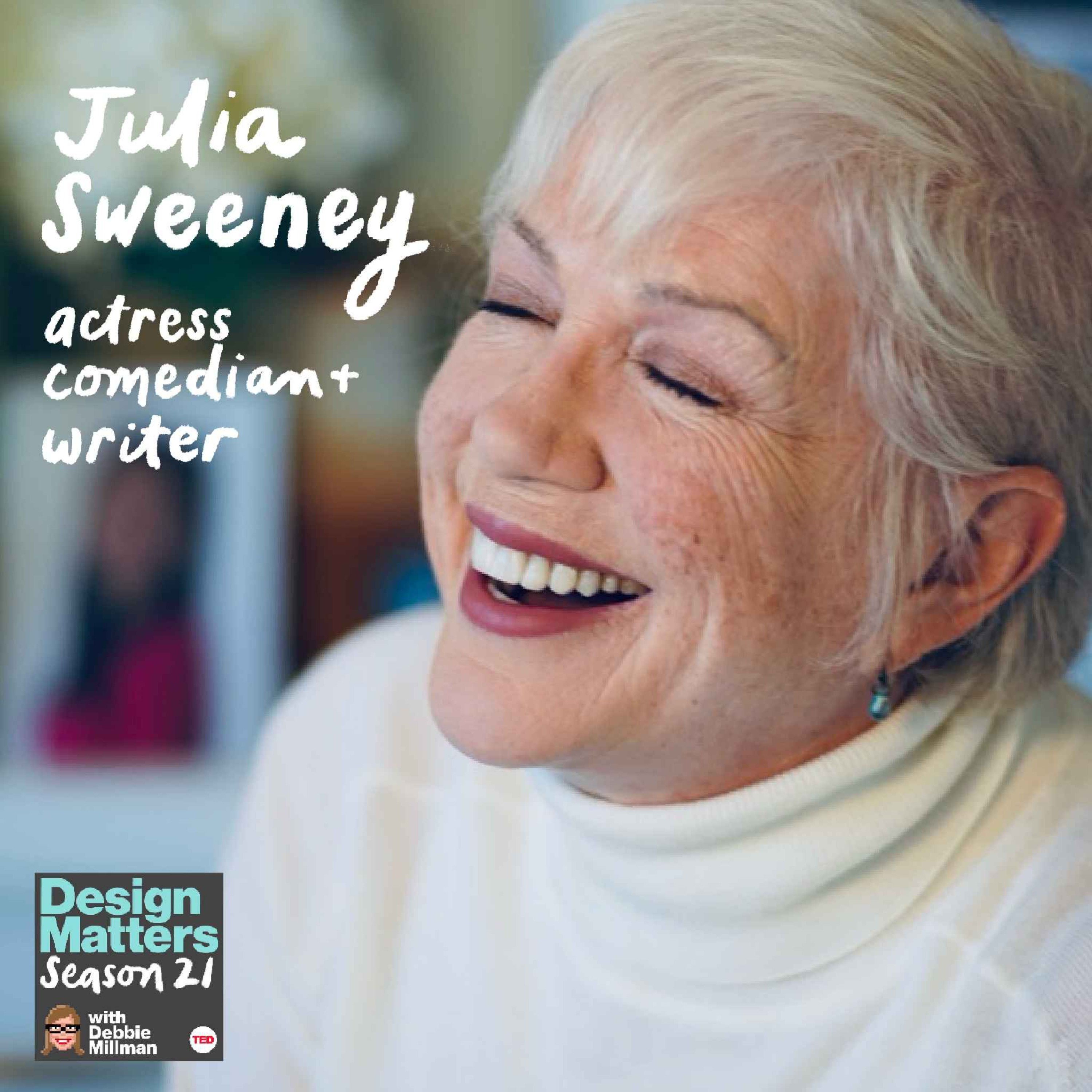
Julia Sweeney
All that stuff, but I couldn't believe anymore. So then I had to live in a world without God. And actually I think that's a more beautiful world and it's a more realistic world and I think it's a truer world. That being said, I've rejoined the Catholic Church
- [00:17]
Debbie Millman
from the TED Audio Collective. This is Design Matters with Debbie Millman. On Design Matters, Debbie talks with some of the most creative people in the world about what they do, how they got to be who they are and what they're thinking about. And working on this episode, a conversation with Julia Sweeney about her career in comedy and performance and about the attractions
- [00:40]
Julia Sweeney
of Catholicism and the music. Come on, it can't be beat.
- [00:53]
Interviewer/Host
When you manage procurement for multiple facilities, every order matters, but when it's for a hospital system, they matter even more. Grainger gets it and knows there's no time for managing multiple supplier and no room for shipping delays. That's why Grainger offers millions of products in fast, dependable delivery so you can keep your facility stocked, safe and running smoothly. Call 1-800-GRAINGER Click grainger.com or just stop by Grainger for the ones who get it done.
- [01:24]
Debbie Millman
This is Nick and Jack from the Best One yet and we are excited to tell you about Walmart Business. Staying ahead of business trends means moving fast and adapting quickly. Walmart Business helps you simplify operations so you can focus on building the next big thing. Find exactly what your organization needs with their ever expanding business assortment and everyday low prices. Keep your momentum going fast with reliable shipping and fulfillment. Eligible organizations can take advantage of tax free shopping both in store and online, saving you more while getting you everything you need. It's Walmart built for your business. Sign up for a free Walmart Business account today@business.walmart.com.
- [02:03]
Interviewer/Host
This episode is brought to you by Bill, the intelligent finance platform that helps businesses and accounting firms scale with proven results with AI powered automation. Bill removes the busywork from your accounts payable workflow. They handle capturing invoices, routing approvals and syncing with your accounting software so that your team can focus on growth instead of paperwork.
- [02:28]
Julia Sweeney
Bill is so reliable According to Bill,
- [02:31]
Interviewer/Host
98 of the top 100 accounting firms in the US trusted to simplify and secure their bill payment processes. Bill's handled over a trillion dollars in secure payments and is ranked number one overall on G2's 2025 list of best accounting and finance products. So stop the guesswork and start scaling with the proven choice. Go with a company whose financial infrastructure is trusted by nearly half a million
- [03:01]
Julia Sweeney
customers ready to talk with an expert?
- [03:04]
Interviewer/Host
Visit bill.comproven and get a $150 gift card as a thank you. That's bill.comproven terms and conditions apply. See Offer page for details. Julius Sweeney is a writer, a performer and an actor whose career has taken a path that very few people could have predicted. She first came to fame as a cast member on Saturday Night Live, where she created one of the most memorable and complicated characters of that era. She has also appeared in the Hulu series Shrill, the Showtime series Work in Progress, the Starz series American Gods, and had a recurring role on Frasier. Her performance work has broadened through a series of one woman shows where she has shared her crises, contradictions and questions and created an utterly original form of storytelling that blends wit and humor with intelligence and inquiry. Her work has been performed on stages across the country, adapted into books and films, and has helped redefine how personal narrative is performed. Julia Sweeney, welcome to Design Matters.
- [04:15]
Julia Sweeney
Thanks for having me.
- [04:17]
Interviewer/Host
Julia, is it true you wanted to be a nun growing up simply because you liked their outfits or.
- [04:22]
Julia Sweeney
Well, that's partly a joke. I actually like their lifestyle as well.
- [04:26]
Interviewer/Host
Oh, interesting. So you like that whole celibate, praying to God kind of thing?
- [04:30]
Julia Sweeney
Well, not the celibate part, but I went to all girls Catholic school and the nuns were absolutely the feminists in my particular environment. They were women who had chosen not to marry to devote themselves to education. They all lived together in this convent and this particular convention for my high school seemed very I just wanted to move in. That seemed like a much better future than the future of having lots of kids, although I think that's a perfectly wonderful future for someone now. But at the time they were the feminists and I still see many of the nuns that way. I really do admire the nun lifestyle.
- [05:11]
Interviewer/Host
You've described growing up in Spokane as something like a Norman Rockwell painting. You were the oldest of five children in a devout, tight knit Catholic household. You said that your family did everything as a gang. What were the kinds of things you were all doing together?
- [05:30]
Julia Sweeney
Well, I have to say this is fun for me to remember because my mom, as we all do, changed personalities over the years. And my best memories of her are when I was really young and there were five little kids and she would take us out like strawberry gathering and do a whole strawberry with shortcake and whipped cream thing in the kitchen. Or she really loved the chaos of little kids, especially before they could question anything that she was doing, which, you know, I'm sympathetic With. And yeah, and we laughed a lot. It was a lot of laughter in the young household before the drugs and alcohol really got a foothold in the family. I would say there was a lot of us all in the car together, all going out over to grandma's, all going out. We used to go out to the cemetery a lot and sit amongst all the graves. It was almost like kind of the Mexican tradition of doing that. But we were Irish Catholics, but that was just a destination, the cemetery. And so I have a lot of happy memories of that. And we all. And of course, we were going to mass all the time and we all went to Catholic schools that was just you could walk to. So we were together a lot.
- [06:37]
Interviewer/Host
Given the subsequent issue with drugs and alcohol, you really became what you've described as the face of dignity in your family. How did the two realities of strawberry picking and then having to deal with really such profound issues at such a young age affect you?
- [06:58]
Julia Sweeney
Well, for one thing, I'm still processing it all, so I'm still in process. But I would say where I am now thinking about it. And this is common for families that have a lot of trauma. And that doesn't mean there isn't a lot of love and laughter, but a lot of addiction issues and a lot of difficult personality issues that one of the kids kinds of becomes the public face. And that was me. So, like, I was always doing really well at school, doing things that brought pride to the family. My parents could point to me and say, look what a good job we did. And then often there's another sibling who becomes what they call the scapegoat. And, you know, I also hate these kind of pejorative psychological stereotypes, but they hilariously fit my family, so they're useful as well. So, like my brother Bill was breaking into people's houses, doing a lot of drugs, failing at school, you know, a truant. And I have so much compassion for him. I did, even at the time when he was still alive. Like, I remember standing on a street corridor saying, do you not understand? These are roles that we have been put into. Like you. You don't have to be that person. And in a lot of ways, I was just lucky enough to be a person who got assigned the role of the public facing achiever, because first of all, it allowed me to live, which many people didn't in my family, and it gave me the tools to process it, which some of the other kids did not have. So, anyway, I don't know if that answers your question.
- [08:34]
Interviewer/Host
No, it does and as I was preparing and doing my research for our interview, I was also the oldest of four, three brothers and myself.
- [08:44]
Julia Sweeney
Oh, wow.
- [08:44]
Interviewer/Host
I was also the sort of appointed face of dignity, overachiever. Look at what Debbie's doing. Which was really hard for my brothers because they were, well, why can't you be like your sister? And I'm like, they don't want to be like me. I'm hiding so much stuff that they don't want to have to ever think about.
- [09:03]
Julia Sweeney
Right.
- [09:03]
Interviewer/Host
But it's interesting how we take on that role. And I know you also were quite a caretaker to your brothers.
- [09:10]
Julia Sweeney
Oh, yeah. I was very much the caretaker and grew up thinking, I mean, I'm only just dealing with this psychologically now. From such an early age, I felt capable. That was the word. Like, I can do it. I would look at my mom and think, oh, I could do that better than you. Like, oh, you're having trouble getting the dinner on the table. That seems easy to me. You know, like, I can do that. I can clean this room. I can clean that room. And I used to think, oh, it was so narcissistic in a way. But I also don't blame myself either, because I filled a needed spot, and I just thought, I can do everything, and I'll have enough energy left over to do the things I want. And it's only now that I think, no, you didn't have enough energy left over to do the things you wanted. It really took up all your energy to do that.
- [10:01]
Interviewer/Host
You've said that your instinct to make people laugh may have been tied to things not being directly addressed at home.
- [10:08]
Julia Sweeney
Oh, yeah, for sure.
- [10:09]
Interviewer/Host
When you think about that period now.
- [10:11]
Julia Sweeney
Oh, yeah.
- [10:12]
Interviewer/Host
How do those sort of two tracks of life and personality all track to each other?
- [10:18]
Julia Sweeney
Well, first, I had a dad with an incredibly great sense of humor and a wonderful storytelling instinct, and he exposed me to a lot of other great storytellers and comedians. So I had good role models in that way. But I now see me being able to either just rant to my girlfriends or to my siblings about what was frustrating me about our parents and then other siblings, too, was the same level of relief that my brother got from doing drugs. You know, you separated yourself from it. You got the endorphins and the dopamine hit from people laughing. You got to share in this eruption of sound of laughter over the absurdity and the inability to escape the absurdity of the situation. It worked exactly like a drug. And. Yeah, and what a great drug. I'm not knocking It. I'm just saying that I now see, we all had our ways. So, like my sister Meg, she just withdrew. She just withdrew into herself in Japan. Yeah. And then she moved to Japan, where she's been for 40 years. Yeah. And she said at my mom's funeral, which was last summer, Meg said, my only way to escape our mom was to literally move to the other side of the earth and learn in a completely different culture and language. And language that is very different Japanese culture and language. And she didn't move to Tokyo. She moved to a small. The smallest of the bigger islands in Japan, in a city that has like 8 million people and 4 foreigners. I mean, like, she went there and I just said, meg, I feel so glad that you had the wherewithal to do that. That was a big thing to do.
- [12:06]
Interviewer/Host
Well, overachieving and productivity are as addictive as anything.
- [12:13]
Julia Sweeney
And also, it keeps you busy, so you're not really thinking about how sad it really is.
- [12:18]
Interviewer/Host
Yeah, yeah, yeah. All that being said, you were voted funniest girl in school year after year.
- [12:25]
Julia Sweeney
That's true.
- [12:26]
Interviewer/Host
What kind of humor were you developing? Was it just sort of a natural wit and whimsy, or was it more of a well thought out way of talking about funny things, joking, the beginning of standup talk about your humor at that time?
- [12:42]
Julia Sweeney
I'm not even sure. I mean, I remember my first time I got my big laugh, and I think it was second grade. There'd been an article about horse meat was being used in the local hamburger stand. It's probably not even true.
- [12:56]
Interviewer/Host
The Bugle.
- [12:56]
Julia Sweeney
The Bugle, yes, the Bugle thing. It's funny, okay. But it's so funny because when I told my husband that, he said, did you even make that joke up? And I said, no, I don't think so. I think I might have heard that joke somewhere. But I remembered it, or maybe it wasn't a bugle or something else. Anyway, I got a huge laugh, and it was like somebody shot me with something. Heroin or something. It was absolutely. I could feel it in my bloodstream, like, oh, God. Oh, that felt good. And I guess I was good at seeing ironic things and hypocritical things, and I was good at saying them. Not in a way that made people so upset. That got most of the room to laugh with me. I don't know why that is, actually. I don't think it was thought out. I just did that.
- [13:48]
Interviewer/Host
At the same time, I believe you were also competing in debates. You were writing and delivering monologues. What were you Writing about back then,
- [13:57]
Julia Sweeney
I remember Walcott Gibb had a thing where you memorized like a paragraph that was about a funny. It's very early David Sedaris kind of stuff, you know, like a play gone wrong, you know, Somebody I remember Ring Out Wild Bells was a Wolcock Gibb short story that I memorized and performed over and over again. And it was just all about a guy who doesn't sew all the bells onto his costume before the play until he's on stage during the play. And every time he moves, the bells ring out so loud no one can hear anything. And it's just. Just beautifully written and hilarious. So I like that. I like Catastrophic Calamity. I loved things where there's a small thing going wrong and then you're gonna watch it get worse and worse and worse as the plot goes on. And of course, my family was always a big font of material.
- [14:52]
Interviewer/Host
You went on to attend the University of Washington where you served as student body vice president. Continuing the overachievement, you studied economics while taking history and film classes. And is it true you were studying economic in response to your mother's very practical question about what a history degree would end up leading to?
- [15:14]
Julia Sweeney
Well, my mom likes business. Not because she likes business, but because she likes. She came from a family, her brother at least, and her where they just, like. They were very Reagan y. Before Reagan, you know, like, get out there, make a lot of money. And neither of those people made any money. They had no idea how to make any money. But they had this idea that business was like a club. You just had to learn a few rules. So my mom always had these ideas. She was gonna have a sing along bar. And then if you asked her any practical questions about it, she wouldn't have, you know. Sad, really. She just had no idea. And then her brother would get into crazy business things. He ended up at Lompoc Prison for many years for laundering money. Like, they just were terrible with money. That's how you get ahead. And you get ahead by making contacts with people. You gotta get in there and know it's not about skills, it's about who you know. So she kept pushing me to have a business degree. And then I didn't want to do that. I have no interest in that. But I did. I was interested in economics, mostly the economics of the poor. I was really kind of a socialist, almost communist, like when it was not fashionable when Reagan was running for president. And I loved it. So I thought, I'll just take an economics class to Kind of satisfy my mother, who, by the way, they weren't even paying for my college. Why was I even listening to them? But somehow I thought, oh, I have to do what they say, even though I'm paying for my own college.
- [16:42]
Interviewer/Host
Dutiful daughter.
- [16:43]
Julia Sweeney
I know. Dutiful daughter. And I took Economics 101. And I would say one of my not big regrets, everything's turned out okay, but I wish I had stuck with economics because I still, to this day, can't get enough of economics. I love it, but in a big scale, not in a business way, but like economics of the world kind of way.
- [17:04]
Interviewer/Host
One piece of advice that she did give you that I was really inspired by. She was talking about who you were gonna marry, and you said you wanted to marry a doctor. And she said, don't marry a doctor.
- [17:15]
Julia Sweeney
Be a doctor. Be a doctor. I know, that was good. It's so funny. I'm sure at least two years later she'd say, oh, marry a doctor. For a lot of sad reasons.
- [17:24]
Interviewer/Host
But, you know, like, that was why when you were talking about your brother and somebody had said in the family, oh, wish somebody had married a doctor.
- [17:31]
Julia Sweeney
Right, right.
- [17:32]
Interviewer/Host
Yeah.
- [17:33]
Julia Sweeney
But, you know, like everyone, she had a lot of contradictory things to say. I think she mostly wanted me to marry somebody wealthy to take care of me. That's kind of what you did. And that's common for women, you know.
- [17:45]
Interviewer/Host
Well, mothers back then.
- [17:46]
Julia Sweeney
Yeah.
- [17:46]
Interviewer/Host
We're in the same generation, so they wanted us to be well taken care of. This is probably before women could even have credit cards.
- [17:53]
Julia Sweeney
Yeah. Oh, yeah, for sure. Oh, I have so many sad stories about that. My mom trying to save money because she was gonna leave my dad, but she didn't have any money. And, like, getting $50 together. I mean, like, the saddest. Yeah, yeah.
- [18:08]
Interviewer/Host
While you were in school, you were essentially living in a movie theater. You were working there, working long hours at the Varsity Theater. What were you learning about storytelling from watching that volume of films?
- [18:22]
Julia Sweeney
Well, I was lucky, lucky, lucky to go to the University of Washington. And my first week, I met Jim Emerson, who became and still is a lifelong great friend. And he film critic and lived in LA and worked for the Orange County Register for many years as a film critic, so film lover. And then my film professors, Richard and Kathleen, I loved both of them. I took all the film classes, and we all were going to movies. And then I was part of the founding of the Seattle Film Society, this little group with little mimeographed essays about different films. And so working at the movie theater, they only had curtains. I had to. I had to hear the movies over and over again. So there's a few movies that I really almost know by heart. And watching people coming in and out, watching the film over and over again. I dated the projectionist for a while, and we both could, you know, it was very sexy and great and. And then just being around these wonderful people who kind of taught me about storytelling.
- [19:18]
Interviewer/Host
Yet you moved to Los Angeles intending to work in accounting in the film industry. I need to just say this again. You moved to Los Angeles to become an accountant.
- [19:29]
Julia Sweeney
Yes, that's right. You know, Bob Newhart also did that.
- [19:32]
Interviewer/Host
Oh, I didn't know that.
- [19:33]
Julia Sweeney
Yes, we bonded over that. He told me I was the only other one besides him. So it's the two of us. He did a lot better in the comedy department. But I just wanted to be near show business. I couldn't imagine having the guts to say I wanted to be. Be in show business. I would never have thought that.
- [19:52]
Interviewer/Host
Why?
- [19:54]
Julia Sweeney
I don't know. I just didn't let myself dream like that. I just thought, I'll be an accountant on a film and then I'll be around it all.
- [20:01]
Interviewer/Host
Well, your dream job, your dream accounting job that you'd been promised at MGM Studios fell through and you got a job as an assistant bartender selling drink tickets at a downtown hotel. This next series of questions is really part of, I think, the Julia Sweeney mythology, as. As reported by Ira Glass and Marc Maron and so forth. But we do have to talk about it because it's so funny. But during that experience, after finding out that your employer wouldn't pay for your parking at the hotel you're working, you essentially became a criminal.
- [20:33]
Julia Sweeney
I did become a criminal.
- [20:34]
Interviewer/Host
You became a criminal.
- [20:35]
Julia Sweeney
And I'm telling you, I still think about that every week at some moment I'll think of that. But it's also interesting how easy it was to become a criminal.
- [20:44]
Interviewer/Host
So talk about what happened.
- [20:45]
Julia Sweeney
Tell.
- [20:45]
Interviewer/Host
Tell our audience that might not have heard the this American Life episodes with Ira Glass or your inter. Tell us what happened.
- [20:52]
Julia Sweeney
Well, I was working at this hotel, and they didn't pay for parking. And parking was like $15. And it was. And there was no place to park near this hotel. It was downtown. And downtown was really being developed. And it was like, scary to be parking far away. So I was paying for the parking. And then I. And I. I told them I wanted them to pay. They wouldn't pay. And then I just thought, I'm going to just sell some drink. Ticket. I'm gonna take drink tickets they don't know about and sell them on the side enough to pay for the parking. And that was easy enough. But then I thought, they also doesn't pay for my meal. And sometimes I have to work, like, 12 hours, so I'll take enough to pay for the meal. And then it really just kept going. Like, I just kept. Like, it was so easy to do. And over the years I worked there, it did add up to, like, an amount of money that if I wasn't talking about myself years later, I could have been convicted for. But it really made me understand how easy it is to get into a situation like that where you just start taking a little bit, getting a routine. Yeah.
- [22:03]
Interviewer/Host
You started doing what you described as really kind of nutty things where you would increase the danger. And I described it as if you were flirting with getting caught. So in terms of the way in which you were taking the money, what kinds of things were you doing?
- [22:18]
Julia Sweeney
Like, I had a Volkswagen Bug, and I would have the money that I had taken, and I would just leave it on the seat of the car and not lock the car. Like, I wonder, was it ever stolen? No, but that's really nutty behavior. Yeah, things like that. I can't even remember the other things. It's actually so shameful. It's so shameful. I feel so filled with regret over that. I mean, it just was like. It's like I'm talking about someone else.
- [22:52]
Interviewer/Host
Well, I think that. Not to be your psychologist in any of this, but from what I understand from myself and from others, when you're taking something that you haven't been, you. Often people that haven't been given a lot or have been neglected will take things that they maybe aren't supposed to to fulfill the need of being taken care of because they were so neglected. And so here was another situation of neglect, and enough time has passed. I know the statute of limitations have. Have run out.
- [23:27]
Julia Sweeney
I hope so.
- [23:28]
Interviewer/Host
On being arrested.
- [23:30]
Julia Sweeney
Yeah.
- [23:30]
Interviewer/Host
But you describe feeling as high as you have ever felt in life and that you never really had that particular feeling again.
- [23:38]
Julia Sweeney
Wow, I love that you're talking about this. Yeah, it was really high. I am a risk taker, you know, Like, I can see, especially now my daughter, who's 26, who's really not a risk taker. I can see how much of a risk taker I was. And my brother Bill was like that too. Meg was. Well, I guess maybe in some ways you can say we all were. But we got our kicks from Having to conform to the world and the things we had to make ourselves do, we had an outlet for that that was either putting ourselves at risk by, like, in my case, taking the stuff that did not belong to me or for my brother. He would do physical acts of things. He would throw himself on his bike over, like, a hill. Like, he would do crazy physical things. And now I can just see how much of a thrill and then you get away with it. So it's like, I remember just thinking at the time, like, I'm doing something for me right now. And so to me, that says I was doing a lot of things in my life that weren't for me, really. And then I had to find some way that I did something for me.
- [24:42]
Interviewer/Host
But you were also, at the same time, going to church every Sunday and donating.
- [24:46]
Julia Sweeney
Oh, yes.
- [24:46]
Interviewer/Host
Some of the money back to the church.
- [24:48]
Julia Sweeney
I mean, if all the money I've given away over all these years was somehow fueled by my guilt of taking that money, I guess maybe the world is better off. I have no idea. But I. And it's also the craziness of religion because of the religious dictates and how you're supposed to be and how you. It's not even what they tell you. It's how you're presenting yourself, how you feel about yourself when you're in church, you're congratulating yourself. You're imagining you're being approved by a deity for being there. You're conforming. You're literally kneeling, standing, praying. You're doing things in conformity. That's all of a piece. It's like whenever I see a truly strong, law conforming, religious type speak, I just. Every person, except for our Pope, who
- [25:34]
Interviewer/Host
I love Pope Leo.
- [25:36]
Julia Sweeney
Pope Leo.
- [25:36]
Interviewer/Host
Oh, my God, talk about risk taking.
- [25:38]
Julia Sweeney
No, I know. I mean, I think he's the real deal in terms of wonderfulness. But you can feel it when you see these religious people. And I always think, what else are you doing? What are you doing behind the scenes that's making you be like that right now? Because I was thinking, like, we're all like an octopus who has, like, eight crazy things we wanna do, like legs, and you can't pull them all in at once, like one of them's gonna go flying out.
- [26:04]
Interviewer/Host
Yeah.
- [26:05]
Julia Sweeney
And I guess for me, that's how I balanced it out, by going to church. Yeah.
- [26:10]
Interviewer/Host
Well, you said that your relationship with God felt very bound up in what was happening.
- [26:14]
Julia Sweeney
Oh, yeah. Well, first of all, I thought God was telling me to do it.
- [26:16]
Interviewer/Host
Interesting.
- [26:17]
Julia Sweeney
Not like that makes me really seem like I had lost my nut. But I.
- [26:21]
Interviewer/Host
This is a long time ago.
- [26:22]
Julia Sweeney
But I really felt like it's so funny cause I've evolved so much in. But at the time I thought, well, I wouldn't have had the thought of taking this money without this opportunity that came my way. And God is making sure all these opportunities are coming my way. I mean, you could spin it any way. I mean, I could have thought, God's testing me to see if I'll do something, even though no one would know if I did that thing. But somehow for me, it was, oh, I'm gonna do this thing. Because God's showing me this opportunity. And it is unfair. They're not paying for barking. And it is unfair. They're not paying for my lunch. And so I almost felt like it was directed by God in a way that. That way in a really, like. I really get it when I see characters or people, how they can justify these things.
- [27:14]
Interviewer/Host
Yeah. How did you. You were never caught. How did you finally stop?
- [27:20]
Julia Sweeney
I was fired, but not for that. It turned out a lot of my fellow bartenders were dealing cocaine at the hotel, which I knew nothing about. They never said anything to me about it. I was so naive about those kinds of drugs. I didn't do those kinds of drugs. I'm sure I just presented myself as somebody you would never tell them. I don't think I seemed like a snitch or anything they'd have to worry about, but just probably very innocent. And about those drugs. I was very innocent. And it turned out all these people were dealing drugs that I was hanging out with all the time. Like, we were kind of a gang. We were going out after work. We were friends. And they put me with that. They fired all of them. And they came in and questioned me. And I honestly said, I have nothing to do. And I couldn't even believe it. And they fired me along with all of them, somehow, justifiably. And I was working as an accountant anyway in the daytime, so it didn't matter if I had that job. But I was upset that I didn't know about the cocaine. Like I could. I felt so betrayed by those guys. Not that I would have done it, but that I thought we were so close.
- [28:33]
Interviewer/Host
Isn't it interesting how much we don't
- [28:35]
Julia Sweeney
know about the cocaine? Yeah. And I was so disillusioned by everything.
- [28:39]
Interviewer/Host
It was like they.
- [28:40]
Julia Sweeney
Like, for three years we've been. They never even said anything about it or I didn't pick up on it.
- [28:46]
Interviewer/Host
Well, Interestingly, if they did follow your career and found out from listening to Ira Glass or Marc Maron that you had done that, they might have had the same feeling. Like, she was doing all that.
- [28:56]
Julia Sweeney
Yes. I know she didn't share it with us. I actually think they also were doing that, but I don't. I never talked to him about it.
- [29:04]
Interviewer/Host
You did finally get your coveted job as an accountant at Columbia Pictures, but when you were 25, you read an ad for a company called the Groundlings.
- [29:15]
Julia Sweeney
Yes.
- [29:16]
Interviewer/Host
And they were offering classes for non professionals.
- [29:21]
Julia Sweeney
Yes.
- [29:22]
Interviewer/Host
Tell us what the Groundlings is, was, and why you signed up.
- [29:27]
Julia Sweeney
Well, the Groundlings, that I'm still very involved with is an improv comedy group in LA that's been around since 1974. And one of their founding members is, like, Lorraine Newman, who ended up on snl, one of the first cast of snl, who's now a good friend. I was working as an accountant. Oh. They had come to me and said, we'll send you to either law school or to get an mba, but then you really have to sign on to the company because they're gonna pay for that. And I remember driving to work, crying, thinking, I'm so honored, but I don't like this job. Like, it's not fun for me. I don't wanna be better at being an accountant. I have no interest in getting better at this. So then I read a review of the Groundlings, and I hadn't even seen the Groundlings, but it said, you know, non professionals, like, cause a lot. Actually, I'm trying to convince my daughter to take an improv class at the Groundlings. She's a gaming coder. But it's like, it's good for everyone to take improv. And so I went down and I interviewed and I got in a class, and I immediately knew that I wanted to be in comedy. It was just, oh, yes, I have to completely change my life. Like, this has to happen now. And then I had Phil Hartman as a teacher. We became good friends. I met my first real friends at the Groundlings. Like, I'm still friends with these friends. It's like what most people who had a great college experience, that's my Groundlings. I'm still in their lives. I've still followed all of them. They've followed me four times a year. I have a Groundling alumni party. I see a lot of them. So I found my home with the Groundlings, and then the Groundlings was a feeder to Saturday Night Live. So I immediately started on the track of Trying to get on Saturday Night Live through the Groundlings.
- [31:09]
Interviewer/Host
But you said you weren't very good at first and even failed the first level.
- [31:13]
Julia Sweeney
I did. I failed the first level.
- [31:15]
Interviewer/Host
How does somebody get better at being funny?
- [31:18]
Julia Sweeney
Oh, there's a lot of ways. Well, being having a baseline comedic view of the world. I don't know if you can teach that, although you might. But some people, I now realize, just aren't gonna look the world that way. So that I don't know if you can be taught, but you can absolutely taught how to be funny. There are rules. There's rules of surprise, there's improv, rules of going along with the premise and then bringing information in this way. There's tools, like, they have, like, change the stage picture, have a big emotional response, just start crying or start laughing, and then justify it as you go with something by. Comedy's a lot about surprise and unexpected points of view, and you can 100% learn that.
- [32:03]
Interviewer/Host
How did you get better? Was it through learning, through working, through the grounding?
- [32:08]
Julia Sweeney
It was just the 10,000 hours of being on stage and being bad a lot of the time and then. And being around other people who are good, watching a lot of comedy. And also, I won't say that I did. I had an innate proclivity for it, but it definitely is like music or something. Like, you have to be able to hear the notes, but you can be trained to be good at it. I think it's the same with comedy.
- [32:33]
Interviewer/Host
So you were at the same time working as an accountant and going to study at the ground lanes and performing and building your comedic talent. How did you get the audition for Saturday Night Live?
- [32:47]
Julia Sweeney
Well, SNL people would come all the time. So Jon Lovitz had just gotten on, and of course, Lorraine had been on. And now I'm thinking other people, but it was just a place they checked out. Mostly Second City in Chicago. That's where most of the people came from. Like when I was on snl, it was kind of half stand up, half improv people. And they're very different, the improv and the standup people. But we all seem to get along. But you can really tell. Standups have a different set of rules than improv. Improvisational comedians have, but they always looked at Second City and the Groundlings, and it just seemed like for a year, increasingly slightly more important people associated with Saturday Night Live would be in the audience. And of course, we'd all hear about it and trying to do our best anyway. And then it came down to me
- [33:30]
Interviewer/Host
and Kathy Griffin and Lisa Kudrow.
- [33:34]
Julia Sweeney
Right. Well, it's so funny because I actually didn't include I thought it was just me and Lisa Kudrow and then Kathy in the last few years. No, me too. And that very well may have been in my mind, my competition was Lisa Kudrow. Not that Kathy wasn't great. Kathy was great. And then when I got it, I thought, oh God, I hope that Lisa Kudrow gets something. I hope she does something with herself because she is good, you know.
- [34:00]
Interviewer/Host
Oh, Phoebe.
- [34:01]
Julia Sweeney
Yes, exactly.
- [34:05]
Debbie Millman
Support comes from Wise the smart way to manage the currencies you need around the globe Fed up with losing out to hidden fees when you send money abroad with your everyday bank? Choose the smart way Wise. You can count on the exchange rate you'd usually find on Google. No unwelcome surprises. Plus, ditch that where's my money feeling. Most transfers arrive in under 20 seconds. Join millions saving billions on hidden fees. Be smart, get wise. Download the wise app today. Ts and Cs apply this is Nick and Jack from the Best One yet and we are excited to tell you about Walmart Business. Staying ahead of business trends means moving fast and adapting quickly. Walmart Business helps you simplify operations so you can focus on building the next big thing. Find exactly what your organization needs with their ever expanding business assortment and everyday low prices. Keep your momentum going fast with reliable shipping and fulfillment. Eligible organizations can take advantage of tax free shopping both in store and online, saving you more while getting you everything you need. It's Walmart built for your business. Sign up for a free Walmart Business account today@business.walmart.com youm have the vision for your business, you have the plan and you just got handed a huge opportunity. But is your business connectivity reliable enough to make a move? Spectrum Business delivers fast, reliable Internet, phone, TV and mobile services so you're always connected when it matters most. Get connectivity packages built for your business with savings that keep your budget in check and with fast, reliable Internet and 100% US based customer customer support, you'll stay connected and ready to bring your vision to life. Learn more@spectrum.com business restrictions apply. Services not available in all areas. You're listening to this podcast so I know you've got a curious mind. Here's a helpful fact you might not know yet. Drivers who switch and save with Progressive save over $900 on average. Pop over to progressive.com, answer some questions and you'll get a quick quote with discounts that are easy to come by. In fact, 99% of their auto customers earn at least one discount. Visit progressive.com and see if you can enjoy a little cash back. Progressive Casualty Insurance Company and affiliates. National average 12 month savings by $946 by new customers surveyed who saved with Progressive between June 2024 and May 2025. Potential savings will vary.
- [36:24]
Interviewer/Host
You were at Saturday Night Live during a period with one of the most distinctive ensembles. You were there along with performers who would go on to define the decade. Mike, Dana Carvey, Chris Farley, Chris Rock, Adam Sandler, Phil Hartman, Jon Lovitz, Kevin Nealon, David Spade. Very male centric.
- [36:42]
Julia Sweeney
Oh yeah. And you know what makes me the saddest about that? And I talk about this with like Lorraine and other people who were there with me. I was of course upset about it because there were so few opportunities for women, but I simultaneously completely bought into the paradigm I did.
- [37:01]
Interviewer/Host
Well, even your most famous character is androgynous, right?
- [37:04]
Julia Sweeney
Androgynous. Pat. I thought, okay, I mean women have come up with incredibly good characters. But I think it isn't completely an accident that an androgynous character hit with me. But also I did not want more women there.
- [37:19]
Interviewer/Host
Why?
- [37:19]
Julia Sweeney
Because it's competition. I mean like for me there was always three women. So it was Jan Hooks, Victoria Jackson and I, which by the way, I got along great with both those women and we both cheered each other on and put each other in stuff. We were very good with each other, but we didn't want more women there. I mean like more women meant the few parts. It was just. What shocks me now is how much I accepted it. And I think it wasn't till Tina Fey and Amy Poehler really. Tina Fey mostly. Cause she did the news and all that. I mean, Tina Fey is like a once in a generation talent that comes along in my mind and she out of just unbelievable force and talent and luck, I'm sure too. But mostly her ability. And by the way, I've only met her one time, so it's not even like I'm friends with her. But she changed the culture of SNL single handedly. I think everything was different. And even reading her book, the Girl Boss or whatever it's called, I learned so much myself and was so embarrassed about not even thinking about doing, let alone doing, not even thinking to do what she did.
- [38:29]
Interviewer/Host
Again, totally different time.
- [38:31]
Julia Sweeney
Yeah, like I think that there were
- [38:33]
Interviewer/Host
even three women on a show with that large a cast, with that many famous men was pretty revolutionary. And your character was so revolutionary. So Pat first began in A skate of the Groundlings?
- [38:46]
Julia Sweeney
Yeah.
- [38:46]
Interviewer/Host
How did Pat first come to you?
- [38:48]
Julia Sweeney
Well, when I had worked as an accountant, I worked with somebody who was very much like Pat, which now I realize was probably autistic or on the spectrum. I did not have any words for that. I just thought, first of all, I really liked this guy. It was a guy. I later incorporated qualities of a woman and another guy into this guy. Cause there was another person who was very influential in the Pat. But the initial idea was this guy. It was a guy, and I was just gonna do it as a guy. And by the way, like, when I see, like, Kate McKinnon do all these, like, now the women routinely play guys, I wouldn't have even have thought of that.
- [39:23]
Interviewer/Host
Yeah, but you started that.
- [39:25]
Julia Sweeney
Yeah. Okay.
- [39:25]
Interviewer/Host
Well, Julia, Julia, you have to give yourself some credit.
- [39:30]
Julia Sweeney
Well, I guess I did think, initially, I'll just play it as a guy. And then I thought, oh, no, you can't play it as a guy. And then nobody knew. Nobody knew. And then I thought, well, let's just make that we don't know if it's a man or a woman. I actually thought that was a side joke. I thought the joke was how annoying Pat was. And that Pat stood too close and asked you too many questions. Too close and didn't pick up on social cues and drooled a lot. I mean, really, when I think of it, it's, like, completely offensive. You never do that now. But I just thought that was funny. And by the way, it was funny because I couldn't get away from this person. They worked right next to me, and I couldn't get away from them all day. I had to deal with this person. So that was funny to me. So to me, it was like annoying coworker. And maybe you don't know if it's a man or a woman. And then that, of course, got the biggest laugh when I did it at the Groundlings. And it was like, oh, well, that's easy. We'll just write a few jokes about if it's a man or a woman. And then that, of course, became the whole thing. So it kind of evolved into that.
- [40:31]
Interviewer/Host
Once Pat moved into a platform like Saturday Night Live, what changed in how the character was or did anything change in how the character was written or performed?
- [40:41]
Julia Sweeney
Well, first I had the. I was lucky enough to have the most incredible writing staff coming up with ideas, too. So first it was Christine, Zander and I. We actually wrote every Pat sketch. But we had a lot of assist from a lot of incredible writers. And Sheryl Hardwick, who was the band running the band, helped come up with a theme song. So I had a huge benefit, I mean, by people coming up with really funny ideas and our ideas. And then Pat did become a little more transgressive, a little more androgynous. It was a little more about. Well, that was interesting to me to challenge the idea of male, female stuff. So, like, by the time it became that, it was like, yeah, well, why are haircuts. Why do they cost different for men and women? And why are these products on the shelves at the drugstore for women twice as much as the ones for men? And they're the same product. So there was a lot of things that were kind of political and about gender that I did care about. And then it did become a little more like that about androgyny itself.
- [41:42]
Interviewer/Host
You spent four seasons at Saturday Night Live. When you think about leaving or when you were thinking about leaving, did it feel like something ending or something beginning? Cause she went on to do so many more interesting things. Not that that wasn't interesting.
- [41:56]
Julia Sweeney
I love the way you're framing this, because in my mind, I say it. I tell myself the story so different.
- [42:01]
Interviewer/Host
Oh, really?
- [42:01]
Julia Sweeney
Yeah.
- [42:01]
Interviewer/Host
Well, I've read all your memoirs. I've seen all your shows. Sort of feels to me, looking at the outside, I mean, the average length of a tenure at Saturday Live is about four years.
- [42:11]
Julia Sweeney
Yeah.
- [42:11]
Interviewer/Host
So.
- [42:11]
Julia Sweeney
Well, then now people stay a lot longer. Yeah, the maximum was five years. Well, first, I left before the end of my contract. I remember my representative saying, don't leave till you have something else lined up.
- [42:22]
Interviewer/Host
Well, you. You had done the movie.
- [42:24]
Julia Sweeney
You started the movie, and then the movie was a big bomb. My brother got sick. That was kind of the beginning of my sort of seeing through show business. Like, it wasn't that exciting to me anymore. I am missing this kind of drive to really make it in a big mainstream way in me, because for good reasons and bad reasons, I mean, like, I'm not even making a judgment about it. I just don't. I can see other people that had this drive to really go create the show for themselves that I just, you know, like, I really didn't have that. But, yeah, I did end up getting cast on things, and, yeah, it all turned out fine. But I look back and think about the opportunities I had that I really just threw away. I didn't follow up on them or, like, I took, like, six months out of two years each year to just travel around the world, mostly by myself. Before I adopted My daughter, at the time when I, like, I didn't realize that all the opportunities were gonna go away for, like, creating a show of my own. Like, there was a very small window for that that I see now. And I'm not even regretful. My life turned out great, but I'm just shocked at myself that I was walking around that much opportunity and I was just throwing it away right and left.
- [43:46]
Interviewer/Host
Well, I mean, immediately after the film's release. And I think it's interesting looking at a life from two different perspectives. The person who's living it, the person who's viewing it. But immediately after the film's release, your brother was diagnosed with cancer.
- [44:00]
Julia Sweeney
Yeah.
- [44:01]
Interviewer/Host
Then you were diagnosed with cancer. Right. So you had taken your earnings from Saturday Night Live, bought a house in Los Angeles. Two bedroom, I believe. Two bedroom house.
- [44:11]
Julia Sweeney
I'm still there. Yep.
- [44:12]
Interviewer/Host
Your entire family moved into the little house that you bought with your savings in a house you intended to be a private sanctuary.
- [44:19]
Julia Sweeney
Yes.
- [44:19]
Interviewer/Host
To help care for first your brother and then you.
- [44:23]
Julia Sweeney
Yes.
- [44:24]
Interviewer/Host
So the idea of judging yourself during that time feels a little harsh, but,
- [44:30]
Julia Sweeney
you know, okay, good. I guess, I mean, I don't. It's more like I'm 66 now, and it's sort of like I feel like you start waking up in your 60s and going like, oh, wait, who was I? And why did I do that? And, oh, that's funny. Oh, I can see some things and then other things I'm still trying to figure out. And some things will always be a mystery because life is a mystery in a lot of ways. And so anyway, I guess that's where it's coming from. I'm in this time where I'm like, huh?
- [44:57]
Interviewer/Host
Well, I think as, as, as a, as a person nearly the same age, I feel like I definitely understand that looking back at decisions, why did I do that? What motivated that? And. And I actually had a friend recently say, wait, what is the story you're telling yourself about your 20s? Can I just remind you of this? And this and this.
- [45:13]
Julia Sweeney
Isn't that great? Yeah.
- [45:14]
Interviewer/Host
I wasn't such a failure, maybe.
- [45:17]
Julia Sweeney
So.
- [45:17]
Interviewer/Host
Totally get it.
- [45:18]
Julia Sweeney
Yeah. But, so thank you.
- [45:21]
Interviewer/Host
Well, also, I think looking at the ways in which you've developed your craft, the one woman shows, the films, the books, the other TV opportunities that you've had, that seems pretty, they seem pretty amazing to me.
- [45:36]
Julia Sweeney
Yeah.
- [45:36]
Interviewer/Host
And as somebody that's sort of lived in your life the last couple of months working on this, you know, you use these real life experiences to create material that resonates that's really real in a very different way than your work was on Saturday Night Live.
- [45:53]
Julia Sweeney
Oh, yeah, definitely.
- [45:56]
Interviewer/Host
You started performing monologues at UN Cabaret in Los Angeles, which has a really interesting way of presenting monologue. It has to be different every time, new material. So you started performing at Uncabre. Stories about your family, stories about what you were experiencing. And those monologues became part of a larger effort that became a one woman show you titled God Said Ha, which was about what you'd intended for that time to be and what that time ended up being. What was that like to see those experiences turn into monologues? Then a one woman show, then a woman show that was at the Lyceum Theater on Broadway, then a film, then a memoir. How do you translate that material into such distinct entities?
- [46:48]
Julia Sweeney
Well, first of all, it wasn't that distinct. It was pretty much the same material over and over again.
- [46:53]
Interviewer/Host
But secondly, but in different formats that felt very. Yes, the different formats still felt like they had a lot.
- [47:00]
Julia Sweeney
And there was a pilot in there. We even had a pilot for a TV show. It didn't go. But like. Yeah, I mean, I guess what I have to say about that now is there's this double edged sword. Well, first of all, I'm so glad I did that because I would have forgotten all those things about my family if I hadn't been doing the uncab and they weren't recording it, which I was barely aware they were recording it, I would have forgotten 80% of the crazy shit that went down. I really would not have remembered it. And I was so thankful to Beth and Greg who were running the uncab, who they gave me all these tapes of myself. I'd forgotten so many things that had happened during that whole cancer year, that terrible time. So if I hadn't turned it into a show and then a book and then a Broadway show and then a stage and then a TV pilot, blah, blah, blah, I wouldn't have remembered all those things. On the other hand, turning all that stuff into a narrative almost hijacks your memory, your authentic memory of things. I mean, I guess the alternative is forgetting about it. So that's not good. Although sometimes I think it is good. It becomes, because we all know how the brain works, what you remember is what you repeat. So even though everything I said in that was true, I obviously rearranged it to be a dramatic narrative that built and then had a crescendo and so forth. So I had to, like, I'd always say everything's true, but not necessarily in the order I'm telling it. Okay. And now I just remember what I wrote that time. What I remember is telling the story on stage, not the actual memory.
- [48:38]
Interviewer/Host
It's probably easier that way.
- [48:40]
Julia Sweeney
Yeah.
- [48:40]
Interviewer/Host
Given it was about cancer.
- [48:43]
Julia Sweeney
Yeah. It's just a reminder of how ephemeral life is because it would have gone away. I wouldn't have remembered it. I'm glad I remembered it. But then even the remembrance of it isn't exactly how it went. Now I just remember the telling of it, which is a different thing. And that's how life is. And that's how it's gonna keep going. And then I'll vanish. And then everything will vanish around me. The world will continue on.
- [49:08]
Interviewer/Host
I was thinking about. Somebody had written about how they wonder who the last person on Earth will be that will remember their name.
- [49:19]
Julia Sweeney
Oh, wow, that's great.
- [49:19]
Interviewer/Host
And I thought that was so profound.
- [49:21]
Julia Sweeney
Yeah, it is. Well, I keep. In fact, I've had to tell myself to stop saying this because I've been saying. I've been going around going, in a hundred years, no one's gonna know you ever existed in 100 years. No one. No one's gonna think of you in a hundred years. Do you know how short 100 years is? Babies born right now who are gonna end up being a hundred? By the time they die, no one on Earth is gonna know anything about you.
- [49:46]
Interviewer/Host
One word. Well, two words. The Internet.
- [49:49]
Julia Sweeney
Yes.
- [49:50]
Interviewer/Host
All of your witnesses on the Internet.
- [49:52]
Julia Sweeney
Okay. But I have this new idea.
- [49:54]
Interviewer/Host
Tell me.
- [49:54]
Julia Sweeney
I wanna erase myself completely from the world by the time I die.
- [49:59]
Interviewer/Host
Why?
- [50:00]
Julia Sweeney
Because I don't like that.
- [50:03]
Interviewer/Host
You don't like that you've left these remnants of yourself?
- [50:05]
Julia Sweeney
No, I don't. I feel like it's private. Like, I didn't when I was doing these things and starting out and there wasn't an Internet. I was just somebody telling stories in a theater. And then, yes, it became a film. So on some level, I understood that. And a book that. I understood that. But it's not like a book that's gonna live forever. It's not, you know, Cervantes writing Don Quixote or something. I mean, it's just something that's gonna be around and then go away. And then the Internet, this permanent record. I just don't like it. Like, I really. Sometimes I see those ads where they can go and wipe you away from the Internet. It's like, sign me up, man. Like, I just wanna. It's not that I'm not proud of what I did, I guess. I just feel. There's a part of me that just feels like, no, no, I'm gonna vanish. And I don't like the idea of things about me hanging around after I'm gone.
- [51:00]
Interviewer/Host
What about your daughter?
- [51:02]
Julia Sweeney
Well, she'll remember me and her, I hope, and who. The person she becomes is influenced by me in a positive way. It doesn't even have to be memories of actually me. It can be just the way she sees things or does things or how she treats people. I know it sound. I sound like so. I can just hear myself. I sound so sanctimonious. I don't know. There's something about me that doesn't like it.
- [51:23]
Interviewer/Host
Well, In God said, ha. Your belief in God is still present. Maybe this has something to do with Back to religion. But In God said, ha, Your belief in God is still very much present. It's part of the world you're living in. But by your next one woman show, Letting Go of God, you're really examining belief itself, which seems like you're still doing in a lot of ways. How are you feeling about the notion of God and religion now?
- [51:51]
Julia Sweeney
We're gonna have to do this podcast for a really long time, and I know we can't.
- [51:54]
Interviewer/Host
I knew that was gonna happen when
- [51:56]
Julia Sweeney
they gave me a lot because I have so much to say about that. And my bottom line is I really did believe in God and I needed to believe in God. And I understand the benefits of people who need to believe in God, because my one sentence thing is that it's an imaginary loving force that's watching you and knows you. We want to be known. We create this fantasy figure that knows us and watches over us, and that is 100% beneficial, especially if you didn't get that from actual people. Okay. So I didn't really get that from actual people, but I got it from God. Okay. And then I really relied on God and I really loved the idea of God and I wanted to be a nun. I loved the Catholic Church, blah, blah, blah. And then I had a few religious experiences, I would say. And then I had a religious experience where I had a big breakup and I couldn't get over it for a really long time. And I was crying a lot and really at my wit's end and just huge grief over this relationship ending. And I thought God really came to me in the middle of the night. And now I realize it was probably this prefrontal seizure or whatever they call it that happened, but I felt like a light came in the room and said, you're gonna be okay. It was a loving feeling, all great, but then another part of my brain was like, what was that? So then I started on like two years of what was that? And at the end of two years, you can go watch Letting Go of God if you wanna know the play. I realized I couldn't believe that there is a God. And I could understand why people believed and I could understand why it could be beneficial to believe and all that stuff, but I couldn't believe anymore. So then I had to live in a world without God. And actually, I think that's a more beautiful world and it's a more realistic world, and I think it's a truer world. That being said, I've rejoined the Catholic Church.
- [53:42]
Interviewer/Host
This is something I didn't know.
- [53:44]
Julia Sweeney
No, it's only happened since November.
- [53:47]
Interviewer/Host
Why and how?
- [53:48]
Julia Sweeney
And okay, I'm still an atheist. I can't imagine that changing. I just know too much about it. Well, we believe in science, so yeah. And I don't even have a motivation for that to change. That being said, the comfort that I feel completely from it, coming from my childhood. I was just telling my husband today, one of the great things about going to mass is that I can't be on my phone for an hour. Like just sitting there in a beautiful space. The church I go to is very beautiful with candles lit and incense and saying words that are ridiculous but that are familiar to me. And I'm chanting them with a group and the music, Come on, It can't be beat. It just can't be beat. And I just have accepted that I'm gonna go to this church and I look forward to it and I love it. And somehow, because this particular church doesn't do their masses in English. It's Latin. Yeah. No, no, it's Korean, Filipino and Spanish and then little English. Yeah. No, it's a great church. And even though it's a very conservative church, they have a lot of right to life stuff going on there. And somehow before when I visited that church, I was so upset about that, I couldn't go back. And now I'm just like, okay, I disagree with so much here. That's just one of the things. And hearing things said in a different language is helpful. I know. I said to Michael, my husband, they never should have changed the Mass from Latin because I would have still gone all the way because I get very tripped up by hearing the words.
- [55:29]
Interviewer/Host
Yeah, I actually went to a Mass. I visited my wife's sister in law and her niece and she was in A play, fantastic Play. Back in 2025. And they go to church every Sunday as a family. And I went with them. I'm Jewish, but I really wanted to be with them and spend as much time with them as I could. And this is something really important that they do every week for their family. And I have to tell you, the singing, the joy.
- [56:02]
Julia Sweeney
Oh, yeah.
- [56:03]
Interviewer/Host
The being kind to each other, which was so much of what this was about. It really wasn't so much about a higher power as it was about each person's ability to be the highest they could be in the world with kindness and generosity and giving. I was like, okay, set me up. Like, it really felt. Not that I want to convert at all, but there was something about the notion of being the best we could possibly be to each other, which felt like if this is what our leaders are talking about, you know, being good Christians. Yeah. I was like, yeah, maybe. Maybe go to church and see what they're saying to really remind yourselves of what that means. Because it's not about fighting and it's not about taking away from others. It's about. Actually, for me, it felt very spiritual.
- [56:51]
Julia Sweeney
Yeah.
- [56:52]
Interviewer/Host
And I still am a science person, you know, I'm still like, where'd the helium and the hydrogen come from?
- [56:56]
Julia Sweeney
Right.
- [56:57]
Interviewer/Host
Let's talk about that as our origin story. Not, you know, and then there was light. In any case, do you feel that coming back to the church is changing how you feel spiritually about your life?
- [57:13]
Julia Sweeney
Well, first of all, I hate that word spiritual because I think it's just corrupt all the way around. I was just thinking, can't you say something like profound or meaningful?
- [57:20]
Interviewer/Host
I feel like it's magic.
- [57:22]
Julia Sweeney
Well, in a good way.
- [57:24]
Interviewer/Host
Like in a good way.
- [57:25]
Julia Sweeney
Yeah. Magic in the non superstitious way or the non magic in the way where there is an explanation for how it happens. I am more. I don't know, it's like I don't even think of it that way. I think of it as the human condition. What helps the human condition? What are we drawn to? Obviously ritual and thinking about a higher power thing coming together. Music, repetitive gestures have been a balm and a soothing thing and a community strengthening thing from the beginning. Any kind of tribe, all those things are part of it. That is a big part of the human connection and condition. And to not have that is kind of cheating myself out of a human legacy that has been corrupted and manipulated and part of a dominance power structure and all that kind of stuff, but has also been an advancing wonderful thing too. And I'm just going to not overthink it. I'm just gonna go enjoy it. And yes, I'm gonna laugh about it and I'm gonna be angry about certain parts of it and sad about certain parts of it, but I'm also gonna see what's great about it and that
- [58:47]
Interviewer/Host
they all greet themselves there with, may peace be with you.
- [58:52]
Julia Sweeney
Oh, I know, I love that. So it's so peace and all the peace, please. That's what we need, peace. And also I've been doing. I'm doing this Bible studies academy thing anyway. I've been studying the Bible really closely for the last couple years. And now I'm in the middle of this big like 47 class thing that I'm doing online about the first two centuries of Christianity, which by the way, is so screwed up. There's so many screwed up things about it. And, and who won out this idea over this person and how much got changed and how much retroactively got changed in the Gospels. And I mean, it's hard to know what was even there to begin with. Okay. Still, in all the attraction of those groups to be together and saying, peace be with you, those things were always there. And that is really powerful to me that that feeling was there.
- [59:40]
Interviewer/Host
After letting go of God, your work continues to evolve. It's continued to evolve. It's moving away from a single defining crisis into something broader time, aging perspective. And in your most recent show, older and wider. Greatest name of all time for a show. You're no longer working through one central event. You're drawing from a lifetime of experience. What has changed for you and how you've decided what belongs in a piece.
- [60:08]
Julia Sweeney
Well, I'm not. I'm just. I'm not deciding that anymore. Cause I'm not doing that anymore.
- [60:12]
Interviewer/Host
You're not gonna do any more one woman jokes? No.
- [60:15]
Julia Sweeney
Well, I don't think so. I hate to speak for my future self. You haven't done anyone in a while. No, no, I'm really done when I did older and wider. First of all, there's physical limitations to it.
- [60:29]
Interviewer/Host
I don't know how you memorize all of that.
- [60:30]
Julia Sweeney
Well, the memorizing I can do. I'm not worried about the memorizing. My voice doesn't hold up. I can't. I mean, I could do something maybe on the Internet or something, but then I don't want it. I don't like social media. I don't like that whole I'm not. I really don't like it. It's like it's not fun to be famous anymore. It's like, for some time it was kind of fun. And now, like, the followers and the responses and who noticed what you said, and I just can't. And you have to do that if you're doing stage performance. And then that along with my voice not holding out, then I think when my mom died, I realized I didn't care about being famous. I don't like the word famous. I didn't care about being notable anymore. Like, I just didn't want to be notable person.
- [61:18]
Interviewer/Host
Well, maybe you just are intrinsically notable now.
- [61:20]
Julia Sweeney
That's right.
- [61:21]
Interviewer/Host
No, truly, no.
- [61:23]
Julia Sweeney
But I guess I just. I don't know. I like it when if people. I just bought a book, and I just was in Spokane and there's Auntie's bookstore there, and I love it, and I bought a few books there, and a guy was telling me about letting go of God, and he watches it every year with his family and how it means so much. And of course, I laughed and said, you know, I have joined a Catholic church now that I go to every Sunday.
- [61:43]
Interviewer/Host
I have a feeling there might be a show in that. Julia, Just saying to your future self.
- [61:48]
Julia Sweeney
But so that's meaningful to me 100%. That's meaningful to me. But I got off on people knowing me as a sparkly, special person, and I don't care about that anymore. And I like to observe the world, and it's an impediment to observing the world because you have people noticing you, and then they want to tell you something about you, and then you're not even getting a good version of them or an accurate one. That's been a big heartbreak over the years. A lot of people finding out that they didn't treat other people the way they treated me because I was a sparkly, notable person. But if you weren't a sparkly, notable person, they really turns out they weren't such great people. That's been heartbreaking. And then it just makes me wary of all people. You know, I just feel like, okay, can I just live another 25 years where I just sit at the bus stop and watch everyone go by?
- [62:48]
Interviewer/Host
Well, you have still continued working in some television. You were on the show Shrill with Aidy Bryant. Most recently, you appeared on Work in Progress, which was absolutely magnificent.
- [63:00]
Julia Sweeney
Oh, my God, Abby, she's so funny now.
- [63:02]
Interviewer/Host
It also. The show plays with autobiography, identity and narrative, very direct ways. And this also created a full circle moment regarding your character, Pat.
- [63:13]
Julia Sweeney
Yes.
- [63:14]
Interviewer/Host
What was that experience like for you?
- [63:16]
Julia Sweeney
Well, it Is it's kind of funny because, you know, there's this documentary about Pat that's coming out this summer, I think, on Showtime. I'm not sure where they sold it, but anyway, that I was participating in. So I had, you know, when I created Pat, first of all, I was so naive about the. I mean, I used the word androgyny in it. So I knew that word, but I didn't know about the non binary community. There wasn't that word. Then I knew obviously, about the gay community. I'm in theater, Lots of my friends are gay. Like, that part wasn't a shocking thing to me, but that there was a whole group of people for which this was going to be a complicated, sometimes in a good way, sometimes in a bad way character I was completely unaware of until Abby. Well, like when I met Abby and she said people used to think she looked like Pat, and then people would call her Pat and derogatorily. And that was really upsetting. And I was shocked by that. And then part of me was like, well, why was it upsetting? Because I like Pat, you know, like, so why isn't it great that somebody calls you Pat? But then I thought, yeah, but it is true. There were things about Pat that were obviously not flattering for anyone. So it was just a big education for me. And I'm actually so thankful to Abby and the people who made the documentary because mostly it's like the education of Julia for me where I'm like, oh, yeah. Oh, wow. Oh, I never really thought about that. And in a way, I feel like both of those projects caused me to both feel kind of frustrated with myself that I wasn't a little more enlightened when I created that. Well, I probably wouldn't have created the character, you know, but also defending myself a little bit because I actually, I am a big promoter of androgyny. Like, I like, I think there's like a gender apartheid in our culture that I don't like. I think there should be a lot more. I always just think, let's just bring down the gender needs to in any way, which actually kind of challenges, like the trans community, presentation of gender and all that stuff. I just wish we'd just bring it all down. 80%. Like, can men and women just be like 20% different from each other, not 80% different from each other? And that I always felt so. I'm proud that I always felt that. Just instinctively I felt that. And that is a part of Pat. But then a lot of it was just like God, Julia, just. It's embarrassing. So it's been a big education for me and I'm so thankful for it. I'm so thankful to Abby and to the documentarians that they made it. Even though I don't know if I come off that great. But that's because I was kind of naive about it and I kind of didn't know what was going on. And I don't blame myself for that because I wouldn't have. But once Pat became really popular, I didn't pursue it that much. Like Katie Lang, who loved Pat and we'd talk about Pat. Why didn't that make me really see that world in a deeper way? I mean, partly, maybe it's cause I'm not gay or I. But I just. I guess I had almost like a philosophical idea about gender that was admirable. But I didn't get to know the communities at all. Like I didn't spend time with people or get to know their lived experiences in a way that I really regret.
- [66:44]
Interviewer/Host
Well, I think that the opportunity to have these conversations in a way that is so open and so vulnerable making is so important to people to hear what you have to say about the creation of this character, your evolution of thinking. It was a time in our society and in our culture where that's a lot of how people thought about things. And that was both something that was socialized and taught behavior, but also an opportunity to expand what we now all think and feel. I mean, I didn't come out until I was 50 because I was so afraid of how I would be judged and I didn't want to be othered and that was my own homophobia. And I'm gay. So, I mean, these are the ways in which people of a certain age at a certain time live their lives.
- [67:37]
Julia Sweeney
Yeah.
- [67:37]
Interviewer/Host
And what a gift now to be able to talk about this in this open way where we do have the opportunity to show people in fact, how far we've come.
- [67:47]
Julia Sweeney
Yeah. It is true, I have to say, when it comes to not just, you know, marriage equality, but like the gay rights and acceptance, which is so huge for all humanity and needs to keep happening, you know, in other places where it isn't. Hasn't come as far is really one of the greatest advancements probably in my lifetime. It will end up being. Yeah, yeah.
- [68:14]
Interviewer/Host
We are here at the TED Conference, the final TED Conference in Vancouver, Canada. The show is moving to California next year. You are the closing. You are the closer.
- [68:25]
Julia Sweeney
I'm the closer.
- [68:26]
Interviewer/Host
Closer of the show.
- [68:27]
Julia Sweeney
I know.
- [68:27]
Interviewer/Host
Can you Give us a little bit of a hint as to what you will be talking about.
- [68:32]
Julia Sweeney
Well, no, I don't, because I haven't seen anything yet. So all my material comes from watching all the talks. And fortunately, my husband, who's really funny, he's the quietest guy. You can barely hear him, really. Only I can hear him. We always joke that if there was a fire in the house, no one would know about it because he would be screaming his head off and no one would hear it.
- [68:53]
Interviewer/Host
Okay, fingers crossed that doesn't happen.
- [68:56]
Julia Sweeney
So he whispers funny things to me. And I'm funny, too. So, like, even this morning, I don't know if this will make it. Cause we were going, all of us, all of us, Some of us, all
- [69:08]
Interviewer/Host
of us is the theme of the coverage.
- [69:10]
Julia Sweeney
So maybe a few of us. And then I was thinking the chosen ones. And then I was thinking maybe the area in front of the stage. The chosen ones, the choosy ones. And then we were just. So that's something. We just are looking at things and I really want to try to come up with something for Chris Anderson, who I love so much and has been such a lovely fan of mine and wanting me to come. And I just love Ted. And I'm so honored that they like me. And I do feel like I do a good job. And I do feel like I look at Ted in the way they want to be looked at, which is what I agree with personally, which is because it's enlightening. It's great, it's dynamic, your mind's exploding. And then there's stuff that's just ridiculous about it, too, and funny about it, too. So I'm honored to do it.
- [70:05]
Interviewer/Host
I can't wait to see it. I can't wait to see you on stage, Julia Sweeney. Thank you, thank you, thank you for making so much work. That matters to me.
- [70:13]
Julia Sweeney
Thank you.
- [70:14]
Interviewer/Host
And thank you for joining me today on Design Matters.
- [70:16]
Julia Sweeney
You are such a lovely person to talk to. Thank you.
- [70:19]
Interviewer/Host
You can read more about Julia Sweeney in her most recent memoir, if It's Not One Thing, it's yous Mother. And you can see her four one woman shows on numerous streaming services. This is the 21st year we've been podcasting Design Matters, and I'd like to thank you for listening. And remember, we can talk about making a difference. We can make a difference. Or we can do both. I'm Debbie Nullman. I look forward to talking with you again soon.
- [70:45]
Debbie Millman
Design Matters is produced for the TED Audio Collective by Curtis Fox Productions. The interviews are usually recorded at the Masters in Branding program at the School of Visual Arts in New York City, the first and longest running branding program in the world. The editor in Chief of Design Matters Media is Emily Weiland.
- [71:05]
Julia Sweeney
I feel bad that you had to learn so much about me. Oh stop it. I was like, oh God. Okay, yes.
- [71:11]
Interviewer/Host
But you know what I didn't talk about? Which I really wanted to talk about, but there's just no way to bring it in with the time that we had. The whole story about
- [71:20]
Debbie Millman
you have the vision for your business, you have the plan, and you just got handed a huge opportunity. But is your business connectivity reliable enough to make a move? Spectrum Business delivers fast, reliable Internet, phone, TV and mobile services, so you're always connected when it matters most. Get connectivity packages built for your business with savings that keep your budget in check. And with fast, reliable Internet and 100% US based customer support, you'll stay connected and ready to bring your vision to life. Learn more@spectrum.com business restrictions apply. Services not available in all areas hey,
- [71:57]
Julia Sweeney
it's Paige DeSorvo from Gigli Squad. Okay, wait, have you ever had one of those moments where you're like I should be doing something fun tonight and then you just don't because you don't have what you need because same. But recently I've been trying to be more of a yes person. And honestly, Amazon prime has been enabling that energy. Like the other night I randomly decided I was going to host a last minute girls night. No planning, no groceries, nothing. And instead of spiraling, I just ordered everything I needed and got it that day. Snacks, drinks, even like random hosting things I absolutely didn't need. But emotionally I did. And suddenly it went from maybe next time to yes, yes tonight. That's what I love. Prime Same day delivery makes it so you can say yes before the moment slips away. Because let's be real, the only thing worse than a bad plan is a plan you never make happen. Same day delivery. It's on Prime. Available in select areas. Terms apply. So if you're trying to be more spontaneous or just less chaotic, go to Amazon.com prime to find millions of items delivered fast.
- [72:56]
Debbie Millman
Insurance isn't one size fits all. That's why drivers have enjoyed progressives name your price tool for years. Now with the name your price tool, you tell them what you want to pay and they'll show you options that fit your budget. So whether you're picking out your first policy or just looking for something that works better for you and your family, they make it easy to see your options, visit progressive.com find a rate that works for you with the name your price tool Progressive Casualty Insurance Company and affiliates Price and coverage match limited by state law hi there, it's Adam Grant from ted's Rethinking Podcast and this episode is brought to you by ServiceNow. I get to spend my days studying how people think and what it actually takes to change our minds. It's work I find deeply meaningful. But even in meaningful work, there's still busy work. The admin, the repetitive processes, the invisible load that pulls attention away from what really matters. That's where ServiceNow's AI specialists come in. They don't just tell you what you should do about your busy work, they actually do it. Start to finish, cases closed, requests handled. No extra work for you. To learn how to put AI to work for people, visit servicenow.com this episode
- [74:03]
Interviewer/Host
is brought to you by Capital One Capital One's tech team isn't just talking about multi agentic AI. They already deployed one. It's called Chat Concierge and it's simplifying car shopping using self reflection and layered reasoning with live API checks. It doesn't just help buyers find a car they love, it helps schedule a test drive, get pre approved for financing and estimate trade in value. Advanced, intuitive and deployed. That's how they stack. That's technology at Capital One.