Loading summary
Transcript210 lines
- [00:01]
Kim Hethrider
To me right now, what we're going through that I feel like I have to put art out in the universe. Artists have to like put the best art, the best inspiration out in the universe right now. From the TED Audio Collective, this is Design Matters with Debbie Millman. On Design Matters, Debbie talks with some of the most creative people in the
- [00:27]
Sponsor/Advertisement Voice
world about what they do, how they
- [00:29]
Kim Hethrider
got to be who they are, and what they're thinking about and working on. On this episode, a conversation with Kim Hastrider about New York City art magazines and about breaking the Internet. No one ever heard of paper and in 24 hours everyone knew paper in the whole world.
- [00:52]
Sponsor/Advertisement Voice
When it comes to managing money, forget the hype and look at the results. Bill has a trillion dollars of secure payments powering our bill pay tools. Instead of just moving money, Bill Pay Bill is powering the financial operations of nearly half a million customers. So stop the guesswork and start scaling with the proven choice. Ready to talk with an expert? Visit bill.comproven to get started and grab a $250 gift card as a thank you. Terms and conditions apply. See Offer page for details. This episode is brought to you by Progressive Insurance. Do you ever think about switching your insurance companies to see if you could save some cash? Progressive makes it easy. Just drop in some details about yourself and see if you're eligible to save money when you bundle your home and auto policies. The process only takes minutes and it could mean hundreds more in your pocket. Visit progressive.com after this episode to see if you could save Progressive Casualty Insurance Company and affiliates. Potential savings will vary. Not available in all states, this podcast is brought to you by Wise, the app for international people using money around the globe. With the Wise account, you can send, spend and receive in over 40 currencies with no markups and no hidden fees. Whether you're sending pounds across the pond, spending rials in Rio, or getting paid in dollars for your side gig, you'll get the mid market exchange rate on every transaction. Plus most transfers arrive in less than 20 seconds. Join 15 million customers internationally. Be Smart, Get Wise. Download the Wise app today or visit wise.com Ts and Cs apply
- [02:25]
Debbie Millman
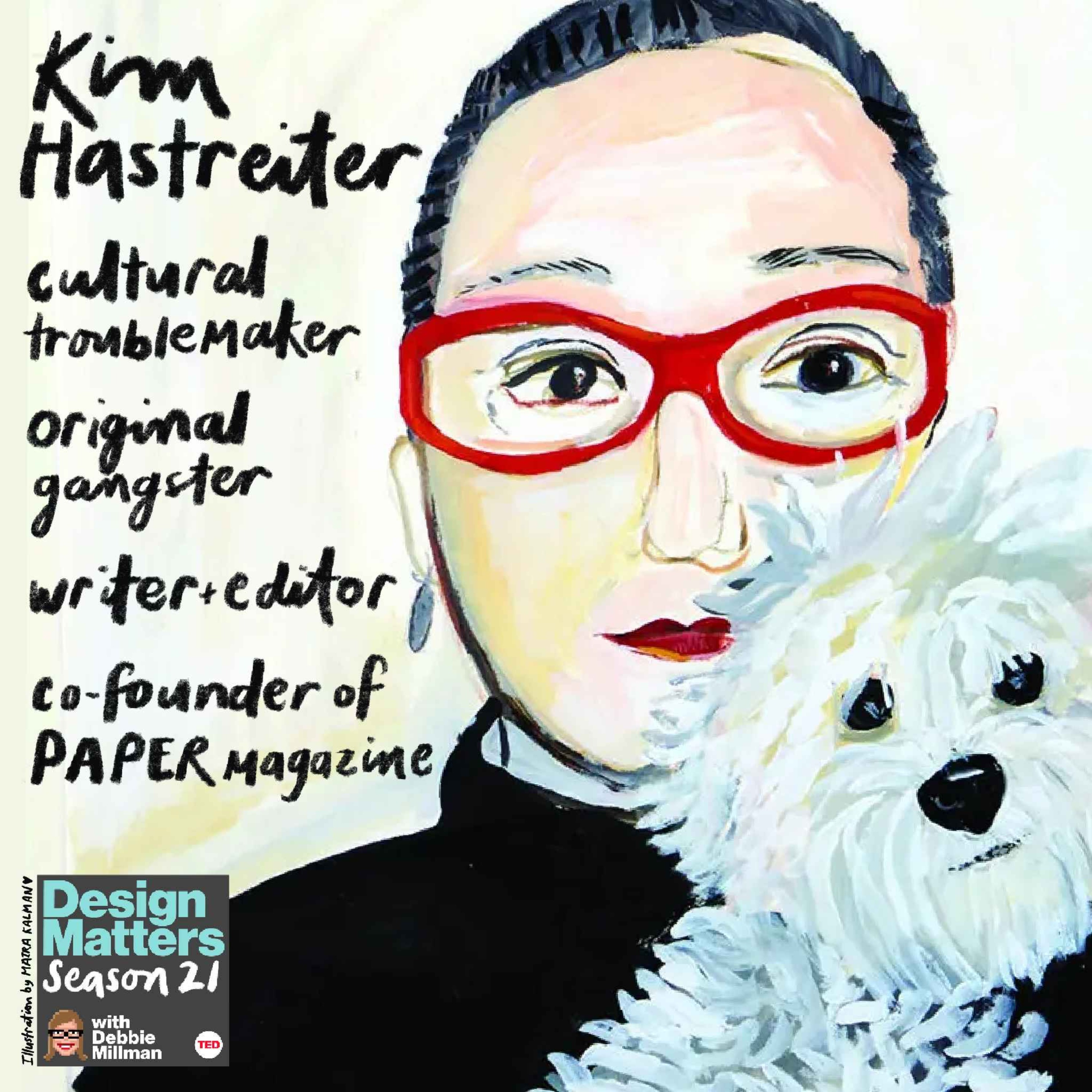
Kim Hastrider is a creator and a connector of worlds, as well as an editor, curator, collector and catalyst who has spent more than four decades at the center of cultural emergence. As the co founder and longtime editor of Paper magazine, she built one of the most influential platforms documenting the intersection of art, fashion, music and nightlife in downtown New York and beyond. She's also worked with Everyone from Keith Haring to President Barack Obama. And her new book, A New York Life of Cultural Chaos, tells the story of her life through the objects and people she has encountered and gathered along the way. Kim Hastrider, welcome to Design Matters.
- [03:13]
Kim Hethrider
Thank you. I'm so excited to be here.
- [03:16]
Debbie Millman
Kim, I understand that you identify as both a loudmouth and a snob. Why is that? Why those two particular things?
- [03:26]
Kim Hethrider
I think it has a little to do with DNA. I hate to tell you, but it's not a learned thing. But I am kind of stubborn like my father was, and super opinionated. And also, the older I get, the more I get that way because the time is running out. I mean, now I'm kind of like in fast motion because I turn 70. When I turn 70, you know, you kind of see the end. And then I become, like, completely a maniac about, like, not wasting time. There's no transactional stuff. It's all has to be like, high bar. I have a high bar.
- [04:02]
Debbie Millman
Yeah. As I'm getting older and older and just right behind you, a couple of years behind you, everything becomes more urgent.
- [04:09]
Kim Hethrider
Yeah.
- [04:11]
Debbie Millman
You grew up in West Orange, New Jersey, and by your own mother's account, she described you as a square suburban girl. How was that possible?
- [04:23]
Kim Hethrider
I was just young, you know, I was. I don't know if you remember villager outfits, but, you know, I wore like villager outfits with high socks and like a line skirts and like little circle pins. I went to high school, junior high school. I walked. It was in the suburbs. And so I. I had a lot of friends, but I wasn't. No one was kooky or like, outrageous. And then, you know, it all happened when I went to. When I left.
- [04:47]
Debbie Millman
Your mother was curious, political, intellectually hungry, and an avid reader of the New Yorker and the New York Times. What did you learn from watching her move through the world?
- [04:58]
Kim Hethrider
Well, crossword puzzles. I mean, we did the crossword puzzle maniacally. And so my grandmother. I had a great grandmother, too. My nana, her mother. And so, you know, when you're 17 and 16, you don't register any of this stuff. So you register it later on, and you look back and you're like, oh, my God. She would read about stuff. She'd read about an artist, George Rickey, for example, and she became obsessed. She read about him in the New Yorker. And then we had a schlep up to Connecticut with my father. Made my father drive us all to Connecticut to buy a sculpture. You know, it was like $1,000 in those days. But George Rickey did these beautiful. I don't know if you know his work, but he did these beautiful sculptures that kinetic. And, you know, I grew up with the George Rickey. And she always went to the restaurants. She always knew everything. Like, we always went to the city. We were a half hour outside of the city in New Jersey. So we were very close to New York. And she always wanted to live in New York. And she always wanted to live in the Butterfield house, which was on 12th Street. And she took classes at the New School. She was always in the city, so it was just kind of like part of the deal. My father was completely eccentric. He had a jewelry store in Newark, New Jersey, that my grandfather started and my mother started. She really was like, what should have been. She wanted to be a psychologist or psychiatrist. But it was in those days, you know, you raised your kids. You were in the suburbs. But the second she could leave, they did.
- [06:24]
Debbie Millman
I read two different descriptions that you spoke about your father. And both of them were really wonderful. You stated that he was utterly unembarrassed by himself. And that he also would have driven you to the moon if you asked. How did that kind of unconditional support, both internally and externally, shape your sense of possibility?
- [06:50]
Kim Hethrider
I mean, he was just. Both of them. Anything I did, it could be, like, completely crazy. They were like, how can we help? Like, what can we do? And my father would, like. One time, when I started paper in my house the first year, he calls me up urgently. Like, before cell phones, we had, like, dial phones. And he's like, kim, I was just on 12th street, and we're Woman's Wear Daily. Used to be on 12th Street. Fairchild, it was called. He said, they're moving. And they have all these desks on the street. There's those huge gray. Remember those desks? Yes. He said, there's, like, 20 of them. You want them? I was like, yes. So he went and, like, basically stood there for the whole day guarding them. Cause he wanted them. And then we got, like, a mover, and we moved them all into Lis Bernard street, into my loft. And I couldn't even walk. It was so many desks. And then he used to go to. When I started paper, he would go to all the newsstands and torture them, like, completely. Cause he could be torture. And he'd make them. He's like, what do you think of this newspaper? And it was a poster. It was like a zine, you know? Yeah.
- [07:54]
Debbie Millman
It was a broadsheet, right?
- [07:55]
Kim Hethrider
Yeah. And the news dealers would look at him, like, who is this? And he'd say, well, I think it should be here. And he would hang it, like, in front. So he was my, like, man on the streets. He would go to every news store. They used to have magazine stores, and every newsstand. There used to be newsstands. And make it and put it in the front. Like, all throughout the Village and the East Village and the West Village in soho. And he was like a maniac.
- [08:18]
Debbie Millman
Well, he did a really good job because that's where I lived and hung out. And I always saw it front and center in the newsstands because I'd always be looking at what was happening in the little newsstands.
- [08:29]
Kim Hethrider
But he was very eccentric. I had a very eccentric father. And when you're young, you're completely embarrassed. He was embarrassed. Oh, my God. I was embarrassed by him. So embarrassed. Because he would do these crazy things, especially with food. If you were in a restaurant. Like, he would, like. I can't even tell you what he would do in a restaurant. Like, we used to go to this restaurant every Sunday. It was called Don's. It was like hamburger restaurant. He would take the pickles, and then he would dip them in ice water. Then he would dry them all off. We would be. Have finished already. And he would take the coleslaw, and then he would drain the coleslaw. He'd ask for an extra dish, and then he'd have a big dish of coleslaw juice. And then he'd make the waiter take it away all before. I mean, he was, like, crazy. And then he would take the hamburger, put napkins on top. He would take the bun off, and then he'd squeeze the juice out of. Like, he was crazy, my father, but. So I was, like, embarrassed completely.
- [09:19]
Debbie Millman
My father once threw a plate of salad across the room in a restaurant just for the fun of it, not because he was angry. He could do things like that when he was.
- [09:29]
Kim Hethrider
Oh, he was really.
- [09:30]
Debbie Millman
Well, he was very complicated. He was both eccentric and also very stern. And so that combination always kept me sort of on my toes. But I do think that it inspired me to be much more aware of my surroundings than I might have ordinarily have been. And that's a good thing.
- [09:51]
Kim Hethrider
The weirdest thing about my father, the best thing that I always loved, was that he lived in his own universe and people were all the same. I would catch him sometimes talking to a drag queen for, like, a half hour. He had no idea it was a drag queen, nor did he care, but it was a drag Queen in full drag. And he would just talk to them the same way he would talk to the guy in the farmer's market that sold the tomatoes. And he talked to everyone equally. He never had thought there was a difference between people.
- [10:20]
Debbie Millman
So he didn't have any judgment of himself or others or us. And that's incredible. That kind of unconditional support never goes away. I think once that is instilled in you at a young age. Good job, Mr. Hasbrider. Good job. Your childhood home was filled with carefully curated design. Dansk Flatware Nakashima Furniture Jack Lenore Larson Textiles did you understand at that how taste was a bit of a language?
- [10:55]
Kim Hethrider
Well, for my mother, my mother had really good taste. And so she had this friend named Milton Klein, who is a really great architect from South Orange, New Jersey. And so she loved him and she loved his taste. She thought he had the best taste. And my grandmother also had really good taste. So she was brought up with good stuff. And my mother loved clothes, she loved fashion. She always was, like, kind of chic. And my grandmother had a clothing store she sold Glamour Cardle. That was her friend. I mean, you know, so we always ate off of Dansk Silverware. It's called Variation V. And it's designed. I forget who it's designed by. It's like my favorite knives, forks and spoons.
- [11:30]
Debbie Millman
You still have them, right?
- [11:31]
Kim Hethrider
Oh, yeah, I eat off them. I have them. I bought more of them. I have, like, service for like 30 of those. And then all the Dansk Enamel stuff. And then Nakashima. She fell in love with Nakashima because she, like, read about him in the New Yorker. And then she made my father schlep to, like, Pennsylvania to meet him. And then they. She was. And I didn't know what she was talking about, but she would come back and she had bought, like, the table, the chairs, the shell, you know, all this Nakashima stuff. And my father, because he was so open, you know, she was definitely bossy, my mother. And so she would bought. He would just do whatever she wanted, you know, so, okay, we'll go. And he didn't have any clue, but he would drive her and he would go with her. And what else did she collect? And she got the George Ricky sculpture, which is like in. It's in the Museum Modern Art Garden now. His sculpture, it's in like. He's a famous sculptor. I still have it in my house, the sculpture, this little sculpture. And my dog used to knock it over all the time and all the little, like, things would come out because it was all about balance. The sculpture was all about balance. So we'd have to schlep up to Connecticut to get him to redo everything, like, a hundred times.
- [12:37]
Debbie Millman
Now, you said that you collected crocheted clown dolls instead of Barbies as you were growing up.
- [12:44]
Kim Hethrider
Well, no, not when I was growing up. That was after I grew up, when I was in school. But when I was growing up, I had this thing called a Ginny doll was before, you know, and I had a monkey.
- [12:55]
Debbie Millman
But not a real monkey.
- [12:57]
Kim Hethrider
No, a stuffed monkey named Flop Ears. I didn't really have a lot of dolls. And then I always liked art classes in school. I played tennis. I liked sports. I mean, I was just like, you know, I used to, like, gab on the phone with my friends. Like, as a teenager, we would My princess phone in my bedroom, you know. But I wasn't, like, a crazy teenager.
- [13:20]
Debbie Millman
You chose to go to Washington University in St. Louis in 1969 and arrived at Washington University dressed in Peter Pan costum and penny loafers. Why that school? And what did you think you wanted to do professionally at that point?
- [13:34]
Kim Hethrider
No, it was really pretty.
- [13:37]
Debbie Millman
That's why you chose it.
- [13:38]
Kim Hethrider
Yeah. And it had this beautiful quadrangle. I was like, oh, I loved how it looked. I only went there because of how it looked. I had no idea. I applied to all these different schools, and that was the one I went to. You know, I didn't know I was doing. What's it called? Like, just General Arts and Sciences. And I took all these classes, and it was like. I was kind of, like, bored. But then I met art students, and I started becoming more like. There was this art school down the hall, down the hill, there was a hill. And I decided I wanted to go to art school. So I went to Europe, traveled around Europe, and then went to art school there for just, like, one semester. And then I was, like, sick of it already. And then I went to Nova Scotia.
- [14:19]
Debbie Millman
You protested the Vietnam War.
- [14:22]
Kim Hethrider
Yeah. So when I arrived at, you know, 1969, when you went to college, that's when Kent State happened. And it was like, a really wild year. So my first year of college was half shut down. The college shut down. I mean, Washington University was like, a huge youthquake of revolution. And we took over the ROTC building, like, climbing through windows. I mean, it was wild.
- [14:46]
Debbie Millman
I think you just narrowly avoided going to jail.
- [14:48]
Kim Hethrider
Yes, I did. And I had friends that went to jail, and we were all, like, taking. Smoking pot and taking acid. And then I remember my friends all went to jail because they got pots sent to them in a package. And it got. I had friends that, like, went to federal prison also for, like, doing this radical, revolutionary stuff. And the girl got killed in Kent State. And that was, like, a big deal. So really, like, it was a crazy year.
- [15:14]
Debbie Millman
What made you decide to apply to Nova Scotia College of Art and Design?
- [15:19]
Kim Hethrider
Cause I was at art school. I went to art school at Washington University, you know, but it was more like painting and drawing. And I wasn't into that, but I was really getting into. Like, my family lived in New York, so I would come back, my friends were in New York, and I would just always come back to New York and go to the galleries. And I just started reading avidly, like, Art Forum. Like, Art Forum was kind of like my bible. And they kept talking about this school called Nova Scotia College of Art and Design, which was. Most people haven't heard of, if you are in the art world. It was a really major, special place. It was this crazy art school that existed. And it was in Canada. It was in Nova Scotia. And it was completely no classes. It was, like, the most avant garde, conceptual art, like, amazing people taught there. Like, Joseph Beuys taught there. Art Pank taught there. I mean, amazing from. It was international. They had tons of money. And I applied and I got in because I was doing this body of work. My work was, like, already, like, I had a thing that I was doing.
- [16:22]
Debbie Millman
You're doing these really large paintings. Metal paintings.
- [16:25]
Kim Hethrider
Yeah. With metal dust. Yeah. And it was inspired by tantric art. And then I started kind of like, the same essence. I started doing these performances and these, like, kind of installations. And my work was, like, very specific. And I got in and I was. It was like $100 a semester. It was really cheap. And my parents were like, okay, go there. You know, that's fine. And I got a pickup truck and I drove to Nova Scotia by myself. And, like, I remember Danielle Burem was one of my teachers.
- [16:54]
Debbie Millman
I mean, it was like, wasn't Vito Acconci one?
- [16:56]
Kim Hethrider
Vito was there. I was his intern. Because a lot of those people also worked at CalArts. They were connected. CalArts was connected to Nova Scotia in those days.
- [17:05]
Debbie Millman
How did that environment shape your understanding of what art and artists could be?
- [17:10]
Kim Hethrider
Huge, because there were no class. So all they would do, they had so much money, they would bring artists in and they would do these, like, kind of seminars. And I met, like. I don't know if you know who R. Penk was from East Germany. I mean, this Is before the Wall came down, it was like we had Enviedo and then all of the Arta Povera people, like, all. I don't know if you know that. That group of artists, like, they were from Italy and they were doing, like, conceptual art. And like. Like, Richard Serra was there and Robert Smithson was there. And, like, Eva Hess had already died, but she was one of my favorite artists. She. She was a really great sculptor who died very young. And then Jonas Mikas taught me there. I met him there. I mean, so it was like every single. And then they would all come in because Nova Scotia had a tamarind press. So they had so much money, they would print books for artists and they would do series of lithographs for artists. And if you came and all you had to do was teach and you could get a free book published or, like a series of lithographs printed, you know, so all these great artists from all over the world, Klaus Oldenburg even came, I think, and the great artists from Europe everywhere came there. And a lot of them were more conceptual artists from that moment. Art Povera was like this movement in Italy that was like a certain movement of, if you look it up, there's all these artists that are attached to it. Yannis Kunalis. And, you know, there was amazing art. So I really, like, My mind was completely blown.
- [18:47]
Debbie Millman
And from there you went to CalArts?
- [18:49]
Kim Hethrider
Yeah. Cause that was kind of the logical thing. So, like, Laurie Anderson and all those people, all the CalArts people would come to Nova Scotia, and then Nova Scotia people would go there.
- [19:00]
Debbie Millman
And you studied with John Baldiserri, who I know is also your neighbor. You came deeply immersed in fine art, but you said you longed for more fun than the art world was offering.
- [19:11]
Kim Hethrider
Yes.
- [19:12]
Debbie Millman
What fun did you feel was missing?
- [19:14]
Kim Hethrider
I just felt like, oh, my. I mean, you know, I loved art and I love making art, but, I mean, I just kept thinking, like, there is more than just this. So I met this guy, Joey Arias, who's like a performer who I'm actually trying right this minute. I'm gonna produce this amazing extravaganza musical show that's gonna come out next year of his work. We're best friends. And I met him, and he was so amazing. And then I met this whole group of people that went clubbing, and they just were outrageous. And then they just kind of took me under the wing. And I would be going to Cal Arts every day, which was like an hour drive on the freeway, but I would start to spend time with them, and then they would show me. We started going to thrift stores. I mean, I just fell in love with these people. So I had a dual life. And then I would bring Joey up to Cal Arts. And they all looked at me like, what? Like they didn't get it. But then some of them did get it. There were some really great artists and all the women at CalArts, just so you know, when we graduated, not one woman got into a gallery. It was like this whole. I have that. That's what really set me off. But, you know, we thought everything was about the work. And if you did great work, you would get in a gallery. And John was really a great teacher. He really loved my work. And he was a great teacher. And he was very generous. He never competed with his students. And he helped the students that he respected their work. He really helped us.
- [20:40]
Debbie Millman
Next, you decided to move to New York City. So you left CalArts with a master's degree, loaded your wagon, which you called a dragon wagon, with your massive paintings, and you drove back to New York with Joey. And you stated that you were determined to become the artist of your imagination. What did you think that life would look like?
- [21:01]
Kim Hethrider
Well, John kept telling me, like, I'll get you a gallery. I'll get you into the Whitney program. Like, John was really positive, like, don't worry, I'm gonna take care of you. And so he kind of got me excited. And I knew I was gonna move to New York. Cause New York was the only place the art world was. California didn't really have an art world at that point. I knew I wanted to move there, and that's where I was from. And my parents still lived in New Jersey at that point. They were ready to move to New York. But it just felt the right thing. I had to go to New York. And so John gave me all this courage. And then, you know, you get there and I'm kind of like, okay, what do I do? Well, I don't have money. I had to get a job. So Joey wasn't even going to stay. He was just helping me drive, right? We went to New Jersey. We stayed in New Jersey. My mother welcomed us. And my mother had met Joey when I graduated and fell in love with him. So she already had met him. Cause I had this crazy college graduation. CalArts with, like, Jack Lemmon did the speech. I mean, it was, like, crazy. And my sister went to Yale. So my parents had just had that graduation with, like, right, the marching and the thing and the caps and gowns. And then she came to mine. And like when we got our diplomas, this giant inflatable penis went up and it was like in the middle of the desert. And there was Balinese monkey chanters that were like leading the procession. And then Jack Lemmon, the comedian like did the speech. I mean it was so wild. And then I had my graduate graduation lunch at Musso Frank's, which is my friend. And Joey had this Cadillac. So he fell in love. My mother fell in love with Joey and she was like, who are these? She just loved it. So anyway, and then I moved to New York and I had to move out of the apartment, out through my window because my friend Mary Kay wanted my apartment. And so Joey, we pulled out my truck. I was in 3rd street in Santa Monica in this building that's still there. And my landlady, kind of the manager lived next door to me. I was on the second floor and I was kind of like, how are we going to move her in? Because it's not really legal. So I said, we're in the middle of the night, I'm going to move out. And you're going to move in at like three in the morning. And then the landlady is, you're just going to be there and like she won't even know anything happened. I'm like that. Of course she got caught finally, eventually. But I moved out through the window. Joey helped me because she was driving. And we moved all my stuff, my paintings, all my belongings out the window into my truck. And then Mary Kay came and moved everything through the window into the apartment. I mean it was crazy.
- [23:26]
Debbie Millman
So you've just given me the perfect opportunity to bring up renting. It might not have been your first apartment, but it was certainly one of your first apartments. And this is the way you described it. The so called realtor woke me up from a deep sleep at 2am on a weekday. Hello Kim, this is Ellen from Garretts and Mansions. Sorry for waking you like this, but I think I found you an apartment. It's a one bedroom for $140 a month on Prince and West Broadway. The only thing is you have to come see it right now. And if you want it, I need three months up front and a $500 cash fee from my friend who will transfer his lease to your name at 9am this morning. What happened next?
- [24:13]
Kim Hethrider
So in New York it's always like a thing to get an apartment. Please. I mean even today people are like, you know, people wait in line to get an apartment in New York. So I had been looking for Like a few months. And I even got an apartment on Carmine street. Because you're so hysterical that, you know you have to take it right then.
- [24:30]
Debbie Millman
Yeah.
- [24:31]
Kim Hethrider
And I even took an apartment on Carmine Street. And then I went home and cried because I saw there was a bullet going through the front door. And there was no kitchen. Had no kitchen. It didn't even have a toilet. I mean, I was like, what did I just do? And my father. It was like Mafia. My father had to go talk to the Mafia landlord and kind of get you out of it. Get me out of it. So that had already happened. So this. And I went to this girl who was like a young girl from Garretts and Mansions. It was like a little realtor. And she knew she got it. 140 was my budget. You know, I want to live in an apartment. So this hat. All of a sudden, I've been looking, looking, looking, looking. So when she woke me up, I literally had to slap my face awake. And I was like, okay. She's like, I'll come pick you up. And we have to meet the guy who's gonna say you're his cousin, right? So she picks me up at like in the middle of the night. I was subletting on like 67th street or something. And then we go in her little Volkswagen to Hell's Kitchen, which in the 70s was scary.
- [25:33]
Debbie Millman
Was Hell's Kitchen. That's why it was called Hell's Kitchen.
- [25:35]
Kim Hethrider
And he was a punk in a punk band. And he had this basement in the punk band that he was practicing in. It was like three in the morning. And we had to go and meet him. This kid, this punk guy. I had to give him $500. Cause he was like. That was like the best. Is that Ellen from Garretson Mansion? She had already taken this apartment and given him the $500, actually, because she wanted it. But then she found something better, so she had to dump it. So she got me. So I had to actually give her the $500. Cause she had already given. You know, it was like that.
- [26:10]
Debbie Millman
This is so New York.
- [26:11]
Kim Hethrider
And then she said, well, when does the bank open? So eight in the morning. I was at the bank. I withdrew the money like three times. $440, plus the 500 I had to give her. And then by 9 o', clock, we had to go to the appointment with the landlady, who turned out, I walked in and she lived in those buildings that have the Picasso sculpture in Greenwich Village on Houston Street. You know, those two buildings that are nyu, that's where she lived or that's where her office was. And she was this sweetest, kind of not hippie, but she had a bun. She was kind of elderly, but she had this sign behind her that war is not healthy for children and that other living things. Yeah, she had like sister Corita. I couldn't believe it. And she was so naive. And the guy was like, this is my cousin Kim, and I want to transfer my lease to her. She's like, okay. And it was all. It took like 15 minutes. It was done. I got the apartment and I had to, by the way, in the middle of the night, go look at the apartment. Because I said I have to see it. So Ellen from Garretson Mansion took me there. And it was a fifth floor walk up on West Broadway and Prince. The tub was in the kitchen. I went and there was no electricity. It had been turned off. There were people sleeping on the floor. When I went to look at the apartment, no lights. And I was like tiptoeing, trying to see. There was like a toilet room. And I just remember going in the toilet room and I flushed and it
- [27:35]
Debbie Millman
worked and that's work.
- [27:36]
Kim Hethrider
And then I saw a tub and there was a sink. And it was one bedroom that was the best. It had a bedroom? Yeah. For 140.
- [27:43]
Debbie Millman
Yeah.
- [27:44]
Kim Hethrider
So I had seen it and I was like, I'll take it. Cause I was like, you're desperate when
- [27:49]
Debbie Millman
you need that apartment. Joey got a job selling clothes at Fiorucci, one of the great stores of all time. That's where he got you a leopard dress that you apparently wore every single night to go out clubbing. At that time, I believe you were a salesperson at Betsy Bunkinini, the boutique located on Madison Avenue that Betsy Johnson owned with two of her friends. And there you waited on customers, including Nora Ephron, Barbra Streisand, Linda Ronstadt, Jacqueline Kennedy Onassis, who I believe stated that you were her favorite salesperson.
- [28:22]
Kim Hethrider
Well, no, Nora. Nora Ephron. I was Nora's favorite. Jackie Kennedy used to come in and I was her salesperson. She always would ask me. She was more like shy. And she was the only one that we were allowed to send clothes for her to try on there. Cause it was a communal dressing room and she didn't want to get undressed in front of people. But all the other stuff, doors got undressed in front of people. Nora Ephron was the best. I loved her the best. And she would invite me to her house and everything. But Jackie Kennedy used to Ask me, like, questions, like, with the deer eyes. Like, is navy blue in, like that. The craziest question. I mean, I was kind of like. And I remember, like, she wrote down her address. I put it in the book and her phone number and everything. And we would deliver the stuff. And then what she didn't want, she would bring it back.
- [29:08]
Debbie Millman
While walking to work from the subway, you were wearing a fringed castel Baja coat made from a Hudson Bay blanket. You were spotted by the legendary New York Times style photographer, Bill Cunningham, who took your picture. That began a lifelong friendship. Did the picture ever end up in the Times?
- [29:32]
Kim Hethrider
Yes, yes, definitely. It's actually in his book. But. But he would always be standing on Madison Avenue and 60th Street, I think 60th. And I would get out of that subway, take the Prince street subway. Cause I lived on Prince street and West Broadway. And then I would walk up Madison Avenue to 64th, where the store was. And that store was like a really kooky store. It was owned. Had a lot of money because one of the partners, I think, was a Rockefeller. But it was three very kooky girls. One of them Betsey Johnson, one of them Bunky, who I loved. She was like my boss. And another one, Nene, who never. I don't know where she went, but they used to really buy avant garde clothes. Like Zandra Rhodes. And like, crazy. They were, like, buying, like, Kanze Yamamoto and. And Bunky loved, like, crazy clothes. And she would buy, like. People would come schlepping and with, like, handmade sweaters, and she would buy them. She was, like, eccentric. And she always hired artists to do the windows and to be sales girls. And then all these women would come and shop there that loved Betsy Bunchanini. They were hooked on Betsy Bunchanini because it was eccentric and it was one of a kinds. And they always had kooky salesgirls. But it was expensive. It was, like, so it was fancy. And they'd all get undressed in this big dressing room.
- [30:49]
Debbie Millman
I'm just envisioning, like, Nora and Barbara.
- [30:51]
Kim Hethrider
I'm telling you.
- [30:53]
Debbie Millman
They all came stripping down.
- [30:54]
Kim Hethrider
Just like a lot of really important women were there.
- [30:58]
Debbie Millman
You and Bill became fast friends. And he told you about a publication titled the SoHo Weekly News.
- [31:03]
Kim Hethrider
Well, I knew that because I lived downtown. So that was my bible. The soho News. That was my bible. Cause they didn't have computers. So we would find out what to do. And we lived for the Soho.
- [31:12]
Debbie Millman
But he told you about a job there.
- [31:13]
Kim Hethrider
Job. Sorry about that.
- [31:14]
Debbie Millman
Yes. And he wanted you to take a job as a style editor. What do you think he saw in you at that time because you hadn't any experience?
- [31:22]
Kim Hethrider
All he wanted, they wanted to hire him. He didn't want the job. He had to find someone else and convince them to hire someone else. That's what I realized later. But I was like a downtown girl. He knew me from downtown cause he used to go to the flea markets. I dressed crazy. And he kept saying, you'll be perfect. And you don't want to keep selling clothes, do you Kim? He said, you're just perfect for them. But they wanted him, they didn't want me. So he had to like hustle them and he told them they had to hire me and they hired me.
- [31:51]
Debbie Millman
Cause of him, you were responsible for filling 10 pages a week without any prior experience. How did you go about fulfilling your obligation in that book?
- [32:02]
Kim Hethrider
Well, I'll just say no. I also had this friend from calarts named Branka. So I kind of brought her along to be like a co editor because I was kind of like, I don't know if I could do this, this myself. And she didn't want to work selling clothes either. So we split the salary. So it was Kim and Bronco. We were like a team. So there I did have that. And that kind of gave me more confidence that I wasn't doing it all by myself. I had no idea. I said to Bill, like I'm not a journalist. I don't know what. I don't. I'm an artist. He said, oh, you'll be perfect. You know, he made me do it and I was kind of like, I don't want to. I don't. I'm not happy like selling clothes. I don't want to do that. So I'll try. And also I love the sofa. I and news. So I went and it was really like a crazy wonderful place that was self run by all these crazy people. People bring their babies. Everyone was smoking pot in the office. We didn't get there till one in the afternoon. Cause we were at the Mud Club all night. And all the people in town would come there. I remember like when the Sex Pistols were in town, they would come in and it was always like. It was just amazing place. And then like this artist came in one day, he hated his review and he chopped his finger off it before
- [33:09]
Debbie Millman
you read that in your book.
- [33:10]
Kim Hethrider
I couldn't.
- [33:12]
Debbie Millman
And then they tried to sew it back on and it didn't take.
- [33:16]
Kim Hethrider
And there's this whole. You're always like Listening to people snorting coke in the neck because the walls didn't go to the ceiling. And then everyone had, like, green hair, blue hair. People brought their babies and had these dangling things for the babies. Like the typesetter. Cause you had to typeset. And one time, like, David and I. My partner David, who I met at the soho News, we went to Odeon for dinner. And this waitress came up to me. She goes, like, I just wanted to tell you that I was a baby in the SoHo News office. My mother did the typesetting. I was like, oh, my God. She was one of the dangling babies. You know those things that dangle? Yep.
- [33:52]
Debbie Millman
I imagine them sort of hanging from the pipes. Exactly. By the podiums that held up the walls.
- [33:58]
Kim Hethrider
And we grew pot in the window on Broadway. We had pot plants. They had no idea.
- [34:05]
Debbie Millman
When soho News folded, you and David Hershkovitz chose to start your own magazine.
- [34:10]
Sponsor/Advertisement Voice
Yeah.
- [34:12]
Debbie Millman
Tell me, if you can, about that first conversation. Like, you and David. Who said it to who? Like, let's.
- [34:20]
Kim Hethrider
Well, David was kind of like, first of all, Soho was like, nothing. And then all of a sudden, it started having restaurants. It was like, kind of like the hottest new thing. And these stupid people from England. The reason why it closed was these stupid people from England bought it from the original guy. They were like, Murdoch type people. It was called Lord Harnsworth. It was like he owned the. They owned, like, the Daily Mail or something hideous. And they really didn't know what they bought. Someone told them to buy it, and they bought it. And one day these English people arrived, and everyone announced, oh, they sold the Soho News. And they arrived. They were all wearing suits, and they came at 9 in the morning, and no one's there till, like, 1. And they were freaking out. And then we all freaked out. We were like, what? Who are these people? And then they came in my office and started giving me notes to go to the Ralph Lauren Show. And I was kind of like, no, that isn't what we do here. And so we had this rig rebellion, and all the yippies. There were all these yippies that worked there.
- [35:22]
Debbie Millman
Like, they were, like, really radical, more intense than Phillip.
- [35:26]
Kim Hethrider
These really famous yippies all worked there, and they got a union. They said, we're going to unionize. So then all these union people came in. We didn't. It was crazy. And these English people were like, where is everybody? And we were like, well, we don't come in till. And then the babies and the green hair and all the crazy shit, they were like, oh, we made a big mistake. So they just shut it down one day. Yeah, they were only there for six months, and then we didn't have jobs. But David, he was the one that said, okay, soho's bloom, they are so stupid. They, like, closed the thing that was just on the cusp of becoming a big thing. So David said, we have to, like, do a new. We have to do a new weekly. So David. It was David's idea, not my idea, to do a weekly. So I said, I think right now we need to have style, but let's make it stylish, because the Village Voice is, like, so ugly and nobody wants it. And I think we could even go further with style. And it has to look good and look chic. So he was like, okay. So that's how we did it. I kind of convinced him to let me be his partner. Yeah.
- [36:26]
Debbie Millman
You laid out early issues of paper secretly at the New York Times overnight. How did you end up there? And what did that clandestine begin? Give the magazine?
- [36:35]
Kim Hethrider
Well, we tried to raise money for, like, two years. Everyone was like, well, what is it? What kind of magazine? Is it a music magazine? Well, not really. Is it a fashion magazine? You know, no one understood what was going on, but there was this explosion of culture, and we wanted to be that, and we wanted to really do a weekly, not a monthly. So, anyway, I met this art director named Richard Wigan, who was at the New York Times, and he actually. They hired him to kind of, like, do my special sections at the soho News. And he was kind of a kooky. He was avant garde, but he looked really straight. Like, he passed, but he was crazy. He looked. Wore a suit and tie and everything, but he was English, you know, so he was that kind of crazy. And we became friends. He loved me, and I loved him. And so I called Richard. I was like, we want to do this newspaper. What do you think? He's like, oh, let me come and look. Because you could bring him to a meeting and people would be, like, impressed because he was at the New York Times, and he worked at the New York Times full time in the art. He was the art director. So he came and he, like, said, okay, I'll do it, you know, for free. Everybody was for free. And then he said, oh, I want to bring in my friend Lucy, Lucy Sisman, this art director. So I was like, okay. So we started having meetings, and then David Herskovitz, my partner, came in and had this Michael Jackson poster. He said, maybe we should just do a poster. It's like one piece of paper. And we were like, we just have to do something because we'd been talking about it for so long. And I said we should call it paper. Because there was this whole post postmodern thing that was going on with Gaetan. All that stuff I hate from Italy was like the big rage, like Gaetano Peche. And it was like this aesthetic that every magazine had and every furniture and every fashion. It was hideous to me. I hated it. Really ugly stuff. But it was like, of the moment. But then Agnes B. Opened up and I died over Agnes B. I was like, this is the future. It was kind of generic. Black and white, white, plain. I said, that's what I want paper to look like. Okay. So Lucy went back and she. And I said, let's call it paper. Because then it could be a different sort of paper every month. It could be like a generic. Because I love the food, generic food in the supermarket in those days. And I did a whole piece on generic food for the soho News. I did. Because they used to have generic food in the supermarket. Black and white, just called spaghetti, just
- [38:58]
Debbie Millman
called coffee, tomato sauce.
- [38:59]
Kim Hethrider
Yeah, it was fabulous. I collected it. I did a whole lot. And so I said, let's do call it paper and make it black and white like Agnes B. So she came up with this amazing design. And it wasn't even a poster. It was like a magazine. I have the prototype. It's outrageous. You'll die. You have to come to.
- [39:16]
Debbie Millman
I have to see it. I have to see it.
- [39:18]
Kim Hethrider
You'll go crazy at my archives. I had the best archives. So anyway, I went to a printer on 7th Varick street, which is where everything. All the printers were. And it was like $3,000 to print, I think. And we had the distributor and everything. And so we decided it was che. All we could print was 16 pages for $3,000. So we decided that's what David was. Let's just make a poster instead of like cutting it. Because 16 page magazine is weak. You know, a poster is cuter. So we took these giant pictures and we filled in. That was Lucy's idea and Richard's like, they did this concept of, like, working around these big pictures. And it was really beautiful. It was really, like, amazing. And we each put in $1,000, the four of us. And then we printed the first one. And I went and sold ads for $250 each. There were these squares and it was like. Do you ever see a paper? An early paper?
- [40:10]
Debbie Millman
Yeah, yeah.
- [40:11]
Kim Hethrider
And the second one, they'd have to pay for. I said, I'll give you the first one. But I went to all my friends. So the Pyramid. Agnes B. Took ad screaming Mimi's Odeon.
- [40:20]
Debbie Millman
Didn't they also?
- [40:21]
Kim Hethrider
Yeah, well, that was a little bit later. Yeah. Oh, yeah, that was a big. Odeon was big. And same with Indochine. And all of them are still friends. The Pyramid Club Danceateria. I love the Pyramid. They all advertised. There was only room for 20 ads. So that's how it started. And we were in my house. We did on Espinard Street.
- [40:40]
Debbie Millman
Your apartment was the first headquarters.
- [40:42]
Kim Hethrider
And then the first few issues, though, we did in the New York Times. Because that was like, Lucy and Richard both worked in the New York Times, so they had jobs there. So we would go on the weekends. They would sneak us in and we learned how to, like. We would pay off the typesetter. We would typeset everything there. David would sit in the cafeteria, which was on the same floor. And they used to feed the homeless. But they also. Bill Cunningham worked at the New York Times. And he was always there. And he's like, what are you doing here? And we told him. He was the only one we told because we were sneaking around. We were in the New York Times for the weekend. We would stay up all night and stay there. One time, Carrie Donovan, who was the fashion editor, came in and, like, we had to, like, be pushed into a closet. We were with all the boards, because there was big boards and matte knives. It was like, you know. Yeah.
- [41:29]
Debbie Millman
Everybody worked on drafting tables, right?
- [41:31]
Kim Hethrider
And then they had this system of, like, typesetting in the New York Times. These tubes that you would put, like, the copy in, and it would go like. Yeah, exactly. What is that? Like some kind of vacuum thing? We'd have to typeset the whole thing. David would proofread it in the cafeteria, and then we'd do the corrections. And then we would have to untypeset. We have to erase it by the morning when they all showed up for work. And we would be giving money to all the, like, the photostat people. I mean, it was totally crazy. Like Guerrilla and the New York Times. I had my ads delivered there. People thought we worked there.
- [42:09]
Debbie Millman
Well, you did. Did they ever find out while you were doing it?
- [42:13]
Kim Hethrider
Well, the best is I finally, one time at paper, like, when paper was 20 years old, I found. I caught a girl who worked for me, this Spanish girl, doing a magazine out of paper. Isn't that the sweetest? So. So she had been doing the same thing. What we were doing, but she was doing it out of paper. She was doing like a Spanish language, like hipster magazine, some kind of zine, you know. And I died when I like found out. She was so scared we were going to get. She was just, I think she was an intern or somebody, just whatever she was, she wasn't making a lot, hardly any money, but she was doing what we did. She came in the middle of the night. She used all our. I was like, you have to know. So I told her the story. I loved it. She was so scared when we caught her. And I was like, oh, you know, I have a good story for you. And then I never. I wrote about it. I don't think I ever wrote about it in paper, but I wrote about it in my book.
- [43:09]
Sponsor/Advertisement Voice
When everything is moving all at once, your workforce, your tech stack, your business, you don't need more tools.
- [43:16]
Debbie Millman
You need one solution.
- [43:18]
Sponsor/Advertisement Voice
That's why Paylocity built a single platform
- [43:20]
Kim Hethrider
to connect hr, finance and IT with
- [43:23]
Debbie Millman
AI driven insights and automated workflows that
- [43:26]
Kim Hethrider
simplify the complex and power what's next.
- [43:29]
Sponsor/Advertisement Voice
Because when everything comes together in one place, growth comes easy experience. One place for all your HCM needs.
- [43:36]
Kim Hethrider
Start now at paylocity.com 1.
- [43:39]
Debbie Millman
Taste the Mediterranean at Whole Foods Market with a vibrant selection that captures the flavors of the region. Shop coastal favorites like responsibly farmed whole Bronzini and jumbo white shrimp and pair them with specialty pastas, robust olive oils and aromatic sauces directly sourced from the Mediterranean. Want a fast and easy dinner? Grab refreshing Greek salads and tortellini from the prepared foods department. Taste the Mediterranean now at Whole Foods Market.
- [44:08]
Sponsor/Advertisement Voice
This episode is brought to you by Progressive Insurance. Do you ever find yourself playing the budgeting game? Shifting a little money here, a little there and hoping it all works out well? With the name your price tool from Progressive, you can be a better budgeter and potentially lower your insurance bill too. You tell Progressive what you want to pay for car insurance and they'll help you find options within your budget. Try it today@progressive.com progressive casualty insurance company and affiliates price and coverage match limited by state law. Not available in all states. This podcast is brought to you by wise, the app for international people using money around the Globe. With the WISE account, you can send, spend and receive in over 40 currencies with no markups and no hidden fees. Whether you're sending pounds across the pond, spending reals and rent or getting paid in dollars for your side gig, you'll get the mid market exchange rate on every transaction plus, most transfers arrive in less than 20 seconds. Join 15 million customers internationally. Be smart, Get Wise. Download the Wise app today or visit wise.com Ts and Cs apply.
- [45:13]
Debbie Millman
You ran paper for 33 years, and in that time, you did more than publish a magazine. You created a living archive of cultural emergence. Paper documented and amplified the collision of art, fashion, music, nightlife, and politics long before mainstream media recognized their convergence. And you championed unknown artists, designers, performers before they became institutions, writers too. We had great writers. You preserve the radical DNA of the 1970s and 80s. Downtown New York, even as the magazine navigated digital virality and mass attention, you functioned as the editor, the connector, the cultural anthropologist and instigator, building a magazine that not merely reported on culture, but actively helped create it. But you also followed Bill Cunningham's advice to you, which was to never sell, act out. How did you manage to do that?
- [46:17]
Kim Hethrider
One thing Bill's mantra was. And even when he caught us at the New York Times, he was like, print on cheap paper. Don't ever, like, go fancy. Don't ever get glossy paper. He said, you'll be a slave and you'll lose your freedom. And he always, like that was his mantra to us. Don't sell out. Don't get your prices too high. Don't get. Don't go fancy on me. Keep it newsprint, keep it cheap. And. And none of us ever made money. You know, when we started paying writers, it was like the biggest deal, but we never paid. But we people loved. We all worked so hard, and we made this thing that was so amazing that we had these amazing people writing for us and photographing for everyone. And it was like a communal art piece. We never used journalists. We weren't journalists. We weren't. And so we would just. If there was a weird kind of underground genre of like movies that this guy was like an expert at, we would teach him how to write. You know, David would teach him how to write. I mean, bell hooks wrote a column for us. Yeah, I mean, we had Linda Ublonski wrote a column for us. I mean, we had the first AIDS column. I mean, we lost so many people during the AIDS epidemic from paper. But we really had complete freedom. And Bill always reminded us, don't sell out. Over the years, like, we almost went bankrupt, like a lot of times. And we were like, trying raise money, and then we got money from friends, like little people donated like 5,005, you know, that kind of thing to make us survive. But no one ever won't give us money. I have all the rejection letters from every company, so I. Neuhaus used to write me letters. He loved paper.
- [47:55]
Debbie Millman
I want to talk about some of the artists you championed before they were famous and how you worked with them and supported their work. You invested in artists like Keith Haring and Jean Michel Basquiat well before the market validated them. In fact, you felt so strongly about Keith Haring, you bought several with a loan from your mother, which you paid back in $15 installments. I love that. What gave you the sense that they were both destined for greatness? You've recognized so many people before. You introduced the world to so many people. What gave you the sense that these were the people to bet on?
- [48:32]
Kim Hethrider
Well, in my early, early years in St. Louis, I had this friend named Michael Green who was, like, really good taste. And he was, like, amazing. He was kind of. He died of a. He would always lecture me on, like, mediocrity versus, like, greatness. And he was like, kim, if you're gonna buy a pencil, don't just buy a pencil. Buy the best pencil. Like, find the best of everything. Don't ever buy anything that's not the best. And I always practiced that. Like, so if I was gonna buy a coffee cup, I wouldn't just buy any coffee cup. I would find. And not about money. It wasn't about, like, a fancy. It wasn't about a Hermes coffee cup. Just buy, like, a great design, whatever it is, get great, not mediocre. And so that kind of became my mantra. And then as I grew up and as life passed, I started living that. So everything I did had a really high bar. Whether it was people, whether it was what I art, I collected. And then I do have, I think, one of my gifts that I was born with. It's a DNA thing, maybe from my mother. I have a really good eye, and I have a really good sense of yes, no, yes, no. And I practiced that. And I didn't even know that what an editor was, but I was a really good editor. And, like, bring me a thousand pick photographs, and I'll pick the, like, best photo in five minutes. And bring me to the biggest thrift store on earth. I'll find the Hermes scarf in, like, you know, 15 minutes. I'm really good at that practice of, like, as editing. Like, I can put me in a room with, you know, 100 people. I'll find the best person and talk to them the whole night. And I always joke that I could be in a room of billionaires. And there's one artist And I'll talk to the artist online. You know, I'm really bad at money. That's like, my. Not my gift money. So I can see someone. That's rough. And I know when I saw Keith, and I just knew him when he was at Club 57. I met him at Club 57, and he was drawing on the sidewalks. And he had this very first show that he put up with thumbtacks on the wall. And I was kind of like, holy shit, I have to have these. And then I saw Jean Michel, who was also doing on the walls. They all started on the walls. And I was, like, dying over his work. Certain things really speak to me. And then I go crazy, like, talking about them. I won't stop talking about them. And I have a big mouth. And I'm really kind of very. I don't waver. That's why I always hated fashion, even though I had to cover fashion. Because fashion's like, today it's in and tomorrow it's out. Like, no, that's not correct. Like, if you're great, how can you not be great tomorrow?
- [51:17]
Debbie Millman
You declined to purchase a Basquiat d' or because you didn't love it.
- [51:21]
Kim Hethrider
Well, I didn't see it.
- [51:23]
Debbie Millman
That's what it was.
- [51:23]
Kim Hethrider
I didn't see it. Yeah, I really, really wanted to get something from Jean, and he wasn't cheap. It was like $1,000 or something, which to me was, like, a lot. Keith's drawings were one.
- [51:35]
Debbie Millman
Yeah, but this is also 40 years ago. That was a lot more money then.
- [51:38]
Kim Hethrider
Yeah, but my friend was his pot dealer. Yeah. And called me in the middle of the night once and said, john has a door. Because I told him, because I knew he knew John. I didn't really know him that well. John. He said, you know, John has a door. Do you want it? It's a thousand dollars. I was like, oh, yeah? What is it? Can I come see it? He said, well, you have to come now. It was again, three in the morning, in the middle of the night. He woke me up. He's like, you have to bring thousand dollars in cash. Where am I gonna get a thousand? Three in the morning? He said, and you can't see it. You just have to, like, take it. And I was kind of like, a thousand dollars is like a million dollars to me. I mean, that was, like, so unspeakable. But if I loved it, I would have, like, asked my mother for a thousand dollars. I mean, I. She was, like, on board. My mother drank the Kool Aid with Keith because I made her, like, loan me $300. And then she saw he got so famous really fast. So then my mother. I had my mother. Oh, my God. And anything I. And I ended up, like, telling my mother. Cause when John got kicked out because of the drugs, he got kicked out of his gallery. They had this mother. But this night, I was kind of like, I just can't. I can't, like, give you a thousand dollars. Just. Also, the other part of my editorial thinking and not having anything mediocre is when I bought something. When I bought Keith's things, I spent seven hours going through, like, thousands of drawings. Like, I only wanted the best pieces of these artists. So my art collection is amazing because I only get the best pieces from the artist. I don't buy just any piece. I hate when people buy it just because it's the name of an artist.
- [53:17]
Debbie Millman
We can't talk about paper without talking about the break the Internet concept.
- [53:22]
Kim Hethrider
Yeah, I know. That's a whole story. It's a good story.
- [53:26]
Debbie Millman
It's a good story. You learned how to command the Internet and understood virality long before most, if not all, magazines. How did you come up with the break the Internet concept?
- [53:36]
Kim Hethrider
It's a good story because people don't know the story. So we were turning 30. Paper was turning 30. It was our 30th anniversary, and I was kind of over it. I was kind of, like, not having as much fun anymore. And because it was all about celebrities. I don't like. I'm not a celebrity person. I really don't like celebrities. We like to put people you never heard of on the COVID And then 20 years, they're celebrities, and then they love us and they do our cover again. But so it was our 30th anniversary, and I had these two, like, great young people that I adored who worked for me. One is named Drew Elliott, and one is named Mickey Boardman. And so I was starting to delegate to them because I could see. I was trying to, like, how can I get rid of. How can I get out of this paper? I need to, like, move on, you know? And Drew was so genius and creative and amazing, but he also loved commerciality. He was more commercial than me. I'm like, not commercial. And it wasn't a time wasn't right for being not commercial commercial. It was like the Internet. You had to, like. And it was all accountable. And, you know, I would have gone bankrupt if they kept me. So Drew and Mickey come up to me and said, we want to put Kim Kardashian on the COVID of our 30th anniversary. And I was like, over my dead body. Are you going to put her on the COVID And then they looked at each other with ashen faces and said, well, we already asked her. And she said yes. And I was kind of like, I don't. I don't care if we're doing our 30th anniversary. Kim Kardashian does not represent paper. You know, this is 10 years ago. So it was like a long. You know, when she was like, ew. I didn't want Kim Kardashian on the COVID of our 30th anniversary issue. I'm like, ugh, I can't believe you told her. And everything is like, you know, she was with Kanye, and he had a. So I was like, I'm sorry, we're not doing it. I said, do it for the 31st issue. You know, the one after that. She's like, but we already. So then Drew and Mickey go out, and Drew smokes a pack of cigarettes. I could tell they were really upset, but I was like, no, no. But Drew went out for a half hour, him and Mickey. And then Drew came back to my office and said, okay, Kim, we have an idea. This is how great Drew is. He said, how about we do Kim for the issue after the 30th anniversary? I was like, okay, and let's call it Break the Internet. This was Drew's idea. Break the Internet. He invented that saying. And he said, the entire issue will all be all these people who are viral right now, like, the fat Jew. And I didn't even know half these people, you know? And the fat Jew. You know who. The fat Jew.
- [56:13]
Debbie Millman
Yeah, of course.
- [56:13]
Kim Hethrider
Well, the fat Jew. I said, let's make him, like, we'll nominate him for president of the Internet. It was, like, the beginning of the Internet. We were kind of making fun of the Internet. But then Drew, like, knew all these people that were doing everybody. They all had millions of followers, and I. And then we'll do Kim Kardashian. So Jean Paul Goode is one of my heroes.
- [56:31]
Debbie Millman
Yes.
- [56:31]
Kim Hethrider
He's also known for asses. Right? I mean, you've seen his book, John.
- [56:35]
Debbie Millman
Yes.
- [56:36]
Kim Hethrider
So I was like, okay, we're going to use Jean Paul Goode. We have to use Jean Paul Goode, Mickey, for this. This is the only person that can do this. So they call Jean Paul Goude. We call Jean Paul Goode, and Jean Paul never heard of Kim Kardashian. I loved him even more. He didn't know the Internet. He didn't even know she was. So Mickey and Drew were going to Paris Fashion Week and they were going to be there. So they said. And then they said, we have to get Kim's permission because, you know, it was all like, permission because she was so famous. But Kanye was the one giving the permission. And then Kanye remembered and he knew that John Paul had done this Chanel thing and so he approved it. And we were like, oh, thank God. And what happened in this shoot? Mickey and Drew were going to Paris for the shows and Jean Paul and they had this date and Kim was going to be in Paris. So they were all going to be in Paris and they were going to do it at Jean Paul's studio. And at that moment, Kim had fired her PR person, which was like a fucking gift from heaven. Because PR people are cock blockers. You know that, right? So they called me from the studio. They said, Kim just. She said, can I bring my hair person, I think, or makeup person? And we were like, oh, fine. You know, meanwhile, Jean Paul. Paul does everything in advance, so he makes drawings. So we knew that we were going to have like the bottle shot and
- [57:58]
Debbie Millman
the s. It was already decided that he was going to do the Carolina Beaumont Champagne incident. Redo.
- [58:04]
Kim Hethrider
Yeah, redo. Because he had done. But meanwhile, also he had this idea to do a two page spread of Kim Kardashian's ass, right? Two pages. And she's looking through her line legs so you see her face upside down. But I mean, everything. Yeah, everything. Pussy, everything. And the best is we had to show Kim the plans and she didn't have a PR person. We just were dealing dress with her. And Mickey kind of knew her. And she's really nice. She's actually a really nice. If you get around all the shit. She was so nice. She's like, okay, cool. She said, okay, it looks great. And like. So she arrived with one person. Her hair person or makeup, whatever. And Mickey and Drew and Jean Paul and his assistant. That's all it was. No entourage, it was nothing. No cockblockers, no PR people. It was like a blessing that there was no. Because the PR people never would have let us do it. And they shot it. And Mickey called me in the middle. He said, she is naked. She's completely naked. And she had. She just went there and she was like so nice. And she like went there and he
- [59:12]
Debbie Millman
got that close up shot right at the end.
- [59:15]
Kim Hethrider
He said, we have it. We don't need that other shot. She said, what about that other shot? She wanted to do that other shot. So somewhere in the universe, that shot. And Jean Paul afterwards, he called me, said, kim, you're not going to want that other shot. It's like too much. He said, it's like you want to go to the gynecologist, but somewhere in the UK that picture photo exists. Isn't that crazy?
- [59:41]
Debbie Millman
Yes.
- [59:41]
Kim Hethrider
And then when we saw the pictures, I was like, oh, we have to do something because this is going to break our website.
- [59:48]
Debbie Millman
And it did 50 million hits, like within a day.
- [59:53]
Kim Hethrider
I know. Well, we had 13 million in the first hour. And so our website was all like cobbled together. We didn't have money. It was all so we. It was like a NASA space launch. I swear that night, I remember we had all these people in the office and I got all these tech people and everyone was like, they had boosted everything so it could. And it was kind of like, okay, we're going live. And you could just see it was like going up and up till it hit 13 million I think at one in the morning. And then the next morning it was like all over the world. It was insane.
- [60:24]
Debbie Millman
It was insane.
- [60:25]
Kim Hethrider
No one ever heard of paper. And in 24 hours, paper was like, everyone knew paper in the hall world.
- [60:32]
Debbie Millman
After decades of being told that paper was uncommercial, couldn't sell ads, how did that moment land emotionally?
- [60:42]
Kim Hethrider
I'm always like, I told you, come on. Like, you know, I knew it. Like, I know things and I keep going, I keep pushing. I knew paper would be amazing and I knew what it was going to be. And our hot, we knew it. So it's kind of like, see, and that's why like my book, like every single person like rejected my book. You know what they said to me? What have we done before that's the same as this? That's what they asked me.
- [61:06]
Debbie Millman
Yeah, they look for the comps.
- [61:08]
Kim Hethrider
Isn't that insane?
- [61:09]
Debbie Millman
It's insane.
- [61:09]
Kim Hethrider
When they say that to me, I'm like, I can't even like answer your question.
- [61:13]
Debbie Millman
Yeah, they have no imagination.
- [61:15]
Kim Hethrider
No. And they want it to be the same as something else. And they only want it to be one thing. Cause it has to sit on the fashion shelf or it has to sit on the art shelf for the design. One big publishing company said, we did a book of this guy who collects Italian glass and it didn't sell. So sorry, we can't do your book.
- [61:33]
Debbie Millman
Well, meanwhile your book is sold out. So. Yeah, fuck that.
- [61:37]
Kim Hethrider
That's kind of like, you know, you just have to do it yourself.
- [61:40]
Debbie Millman
Diy well, let's talk about your book. Last year you published your memoir, Stuff A New York Life of Cultural Chaos. And I'm gonna try to describe it for our listeners as it is, really, despite whatever obstacles you had in getting somebody to publish, is one of the most original and unique memoirs I've ever experienced. I have a book here. I have a book in my house in Los Angeles. I need to have it around me. It's not a conventional memoir. I see it more as a life told through objects, as witnesses. And the book is structured around the art, clothing, ephemera, furniture, collaborations, and cultural artifacts you've collected over six decades before paper, during paper, after paper. And it functions both as autobiography and as archive. And each item contributes to a radical cross pollination of art and fashion and music and activism, and reveals how you participated at the center of those collisions as connector and as catalyst. And at the same time, the book is deeply personal. It's about family, loyalty, taste, grief, risk, the discipline of choosing what and who belongs in your life. And the book reads like a manual for cultural stewardship and really argues that what we keep is not accumulation, but memory made tangible. Congratulations on this completely original piece of art.
- [63:15]
Kim Hethrider
It's heart sing to hear you say that because, you know, I worked like a lot, a lot hard on that.
- [63:21]
Debbie Millman
It's magnificent.
- [63:22]
Kim Hethrider
But the second one is half of it. There's gonna be another half. Good.
- [63:26]
Debbie Millman
Can't wait. I want to talk about the COVID Oh, yeah. Oh, my God, the COVID It's stunning.
- [63:32]
Kim Hethrider
It's my favorite.
- [63:33]
Debbie Millman
Designed by Jim Jo. What was the process of choosing the COVID design? Did you just see it and go, that's it?
- [63:39]
Kim Hethrider
Jim Joe is an artist that I adore. I love him. He's a young artist, he's Canadian, and I love his work. And I met him and, you know, he's one of these secret artists, but he doesn't let his name be known. And we became really good friends. And I love his work so much. And, you know, young people, really now, I think they're feeling what they're missing, looking on the phone all the time. And I think they're very intrigued by Analog. You know, at least the young creatives, they love coming to my house, they love coming to dinner, they love looking around. And Jim Joe, all the young kids really helped me with my book. And I love young people, so I'm addicted to young people. And I just became really good friends with Alex, and I said, I want Alex. Would you ever consider doing, you know, doing my book jacket? So he did that one on the inside, the word stuff. And then he did the outside. Yeah.
- [64:31]
Debbie Millman
And stuff is 448 pages. It includes over 1,439 images of your art glass collection, collections of clothes, bags, rugs, dishes, wood objects, clay objects, objects made by Ted Mewling. Dansk and in your essay why this and not that? You state that your strict rule of thumb has always been that you would never live with anything that you don't think is excellent. How do you define excellent?
- [64:58]
Kim Hethrider
I guess it's subjective, right? So it's like. I mean, it's my opinion, like, I hate certain things that other people love. So it's just personal. People are always like, kim, tell us how you really feel. I mean, I do not hide what I don't like. I'm very kind of out there.
- [65:19]
Debbie Millman
In the book, you include a piece of art made by Jim Rod for a show at R company Gallery, and the work contains a manifesto titled the Ten Principles of Bad Design. And I'm wondering if you could both share the 10 principles and also also how they ended up in the book in the first place.
- [65:40]
Kim Hethrider
So should I read from my book?
- [65:41]
Debbie Millman
Sure, I would love that.
- [65:44]
Kim Hethrider
Before I read my 10 principles of bad Design, I'm going to give you context. So my taste in everything I surround myself with has always ranged from the sublime to the ridiculous. It reflects my roller coaster life and passions, from high to low, shallow to deep, classic to avant, avant garde, modern to vintage. I live by the yin yang, for sure. I mean, how boring would it be if everything was the same? If I only lived with everything tasteful, or if I only lived in a house that was kitsch and jelly bean colors. To me, it's all in the mix. I live by this philosophy too, from the people I befriend, old, young, hilarious, serious, quiet, loud. To the furniture I live with, whether my insanely psychedelic printed sofa by Jack Lerner Larson to my simple favorite Hans Wegener perfect dining room chairs. From my loud grass green reform storage cabinets to my perfect, nearly invisible vitto bookshelves. Balance has always been my intuitive mantra, and I've lived it as well as lived in it my whole life. One thing I cannot abide with or live with is bad or mediocre design. What is bad design, you may ask? To me, bad design is when the design has no meaning or function. My pet peeve is an uncomfortable chair. Pure decoration just doesn't float my boat. For example, I've always detested that ugly post modernist genre of design and furniture that was the rage in the 70s and early 80s. Why? Because it's bad, in my opinion. I've always hated the Memphis movement and all that Italian hideousness passing as good design. Sorry, Edero. Sorry, Gaetano. As with many what comes around goes around trends. I began noticing about a decade, decade back that this one was coming back with a vengeance. Oy. When I started hearing all the cool young design kids I knew buzzing about it, worshiping it all, they all laughed as I of course rolled my eyes, bitterly complained, and was a big curmudgeon about this resurgence of what I felt was horrible and ugly. But hey, everything's cyclical and I love kids. So I tried to be open minded. Yet no matter how hard I tried, I just couldn't force myself to. To like it. I used to rant to my late great friend, designer friend Jim Walrod, who I adored, even though he loved and collected this. He texted me one night to excitedly tell me that he was putting together a fabulous show of all this terrible mintage Memphis stuff he'd gathered at a gallery in Tribeca. He'd call the show difficult, and since he knew how much I hated it all, he thought it would be funny to invite me to write some sort of ESSENCE essay for the wall as you enter the show. I wrote this diatribe about bad design and installed it at the entrance of his show. With a hat tip, of course, to my great design hero, Dieter Rams. So this is what was on the wall. It was blown up really big. The 10 principles of bad design. 1. Bad design is tasteless and ugly. 2. Bad design is confusing. The 3. Bad design is obtrusive. 4. Bad design is not very functional. 5. Bad design is trendy. 6. Bad design is overly complicated. 7. Bad design is uncomfortable. 8. Bad design is imposing. 9. Bad design is never timeless. 10. Bad design is difficult. Difficult.
- [69:17]
Debbie Millman
Thank you, Kim. Do you think that objects hold memory differently than stories?
- [69:25]
Kim Hethrider
That's a good question. I don't know how to answer that. I mean, I think that they're connected, they're attached. So I think the object without the story and the story without the object are weaker.
- [69:36]
Debbie Millman
What makes something worth preserving?
- [69:39]
Kim Hethrider
A bunch of things. So, like, I'm old, so I don't really buy stuff. That's my rule, you know, I'm old. I have so much stuff. Like, don't buy anything, Kim. Try not to buy anything. But the other day I bought something. I bought this insane QR code. This company makes these QR codes and it's like they come small, they come medium, they Come large and they're on scarves. And when you hold your phone up, it says, fuck Trump. And I bought, like, one for everyone I know, and I bought the big one for me. And they even have a bigger one that could hang them. My terrace. But it's a QR code. It's just a square. And I was like, this is collector's item, right? This is a collector's item. This is, like, the biggest collector's item. So I went and I had it all flattened, and I had it framed like a piece of art. So, like, I needed it. Why did I buy that? Why did I buy that? Because to me, it represented, like, this moment that was, like, amazing. Like, incredible. Like, right?
- [70:44]
Debbie Millman
Yeah.
- [70:44]
Kim Hethrider
And it was a collector's item. Like, I know it'll be. Could be in a museum in, like, 50 years. But anyway, so there's things that like that that are historically important. And as an editor of paper, I would get, like, every day, millions of packages and PR stuff. And, you know, a lot of most of it I would give away or throw away. But there were some things. Like when Prince changed his name to a symbol, they sent me this, like, floppy disk and this crazy press release that said, from now on, you're not allowed to call him Prince. And you have to call him. And it was like a symbol. And we've enclosed a disc, so you're never allowed. You have to just put this symbol. It was the goofiest thing I'd ever heard. I saved that. I mean, that's too.
- [71:27]
Debbie Millman
That's worth preserving for sure.
- [71:28]
Kim Hethrider
So there's those things, and then there's just things that. The excellence is just unbelievable. Like, why do I collect Children's Hero as China? I mean, because it's like a circus. Why do I have Nakashima? I mean, a lot of things. Because they're my friends. So a lot of things are done by my friends. And that always has a lot of meaning to me. A lot of it has meaning to me. So it's really, like, meaningful things.
- [71:58]
Debbie Millman
In addition to deciding what to collect, it seems right now, at this time in your life that you also have to decide what you're going to work. I know that during COVID you created a new publication project titled the New Now. You have an ongoing series of zines that you're creating and publishing to document and commemorate the fleeting moments of culture that occur regularly on Instagram until they inevitably disappear. And you're calling them Meme zines, which I love. How do you decide now what you
- [72:31]
Kim Hethrider
want to Work on to me right now what we're going through, that I feel like I have to put art out in the universe. I have to. Artists have to put the best art, the best inspiration out in the universe right now. That's what we do. That's what I know how to do. And it's so dark right now. And creation is the opposite of destruction. So I have so many projects. I'm making nine new meme zines. I'm almost done with them. They're amazing.
- [73:00]
Debbie Millman
How can people find them?
- [73:02]
Kim Hethrider
I don't. I just make them. And I give them away when I meet people or I feel such an idiot. I didn't bring them to you. I'll get them to you tomorrow. But I look at memes like, I remember the Bernie Sanders when he had the mittens and everything, right? And I remember my interns like, they didn't. They were too young. They don't remember them that. So these things, these moments happen. No one remembers the Kim Kardashian cover because that was so long ago. The young people don't know. You know, they don't even know. So it's history that can bend end. If you don't document the importance of it and the truth of it, and especially now with this AI, there's no truth anywhere. I really am calling on young people to, like, realize that if you don't, like, document what you're living through, someone else is going to make it up and do it wrong.
- [73:53]
Debbie Millman
While history belongs to the victors. Right. Or is written by the victors.
- [73:56]
Kim Hethrider
Yeah.
- [73:58]
Debbie Millman
You're working on, I think you said, three or four new books, one of which is work. You're working on the Toledo documentary. How has your relationship to ambition evolved?
- [74:08]
Kim Hethrider
No, I think it's not ambition at this point, but it really has to do with when you've turned 70. You see the end. I realize I have so much in my head. That's why I'm dying to teach. I am dying to teach. I just am dying to empty my head before I die. I want everything that I know and learned and I to want. Want to give it away so that I don't want to die. I want to die with an empty head, you know? And when you turn 70, it's kind of like, okay, this is like the last decade, you know, whatever I could get, anything could happen, and this is it. So I feel that very urgency. I'm very, like, maniacal. I'm doing a lot of things more than even those things that you listed.
- [74:53]
Debbie Millman
I'm doing I have one more question for you and a request. Yes, here's my last question. It's a long one. In his foreword to your book, Jeffrey Deitch stated that you are more of an artist than a collector. He also writes that your collecting project can be understood as, quote, a conceptual artwork, an extension of the art of assemblage into the cultural space and ongoing storytelling project documenting the exhilarating radical history of downtown New York from the 1970s to the present, and a cultural crucible that you both witnessed and helped to create. How would you like your life's work to be understood?
- [75:39]
Kim Hethrider
Just to encourage continuity and like, have people pick up where I left off. I just think that generosity and like, community and like, all I want is really to teach the kids to also a little be self aware and, you know, what they're living through is nothing like what I lived through. I can't Even imagine being 18 and having done Covid and then Trump and I mean, you know, it's like nuts. Like, what are they thinking? Like, what's going to happen? It makes me happy that at least people are getting young, people are starting to get involved, thank God. But I just feel like I did as much as I could and I put out as much good shit into the air, into the ether. I just want to put goodness and like, inspiration. I hope I inspire people and I hope people do the same.
- [76:36]
Debbie Millman
Speaking of kids, before I let you go, here's my request at the end of stuff, you write a beautiful letter to the artists of Twitter tomorrow. And I'm wondering if we can close the show with you sharing that letter with our audience.
- [76:50]
Kim Hethrider
Definitely. So I. I ended with this page. A letter to the kids. Dear kids, as an older person who adores and surrounds myself with young people, I want to write this letter to all the talented, curious, ambitious young kids I know, and even those I don't know who are deep in the world of culture creation, they these days. I just felt I should give you a heads up from where I sit so you can be more aware of the great value and fragility of the cultural history you're all creating at this energetic, epic time of your lives. Hey, I know you're all just slammed living it, but humor me for a minute because damn, I wish someone had sat me down and schooled me about this when I was 25. You see, the older I get, the more I've learned that history is like a game of telling telephone. As time has moved forward, I'm always shocked to see the amazing cultural stuff that I lived through and participated in being reinterpreted and sometimes even rewritten by each new young generation that comes of age. It's like a slow motion car crash. At first, the interpretations can be close to the truth. But as time, more time passes and new generations come of age and firsthand storytelling becomes rare, rarer, a subtle warp begins to set in that grows with each new interpretation. Not a bad warp, just a Small Lost in translation 1. I guess this is what happens through no ill intention, when past culture is celebrated by people who haven't lived it and who instead learned of it by reading, looking at pictures, googling, or just hearing about it. As each generation gets further away in time, history definitely begins to to bend. And as enough time passes, I'm beginning to see a lot of stuff that to me was historically important in my past not only getting muddled, but even actually getting erased. Hey, I accept this and usually just have a laugh when I see or hear something very wrong. But it makes me realize that I did the same thing when I was young. I now see that everything historically and culturally that I thought was real and true when I was 25 years old probably was actually not. I keep asking myself, is it critical to know where shit truly comes from? Is it important to know what New York used to be like and how it got to be what it is now? Is it valuable to watch an amazing film like the documentary by Jenny Livingston called Paris is Burning to understand about the extraordinary and magnificent genius LGBTQ house bull scene that germinated in Harlem in the early 80s during the AIDS epidemic? I'm so grateful that this film exists and is documented perfectly in stone so it doesn't warp. I guess what I'm saying is, yes, it's always better to know the difference between truth and an interpretation. As a devoted lifetime cultural anthropologist, I see that knowing true cultural history raises the bar on creativity going forward because it's all really a continuous continuum. So kids, for God's sakes, you're now living in, creating in, participating in and leading the charge in one of the most radical, shocking, amazing, shifting times in our history. Now, the majority of you are natives in a now digital world and are witnessing its repercussions from political to business to art. Please don't leave it up to a generation 50 years from now, or God forbid, a to reinterpret what you're witnessing, document it, write about it, film it, make art about it, collect important stuff that tells stories. Because when you're sitting many decades from now watching the 25 year olds make art, music, film and books about it, you can bet you'll be shaking your head wishing you had Love, Kim.
- [80:39]
Debbie Millman
Thank you Kim Hethrider, for making so much extraordinary work. So, so much extraordinary stuff that matters. And thank you for joining me today on Design Matters.
- [80:51]
Kim Hethrider
Thank you, Debbie.
- [80:52]
Debbie Millman
Kim's stunning book is titled Stuff A New York Life of Cultural Chaos and you can read more about her on her substack. This is More Stuff and her website, Amazing Unlimited. This is the 21st year we've been podcasting Design Matters and I'd like to thank you for listening. And remember, we can talk about makeup, a difference, we can make a difference. Or we can do both. I'm Debbie Melman and I look forward to talking with you again soon.
- [81:20]
Kim Hethrider
Design Matters is produced for the TED Audio Collective by Curtis Fox Productions. The interviews are usually recorded at the Masters in Branding program at the School of Visual Arts in New York City,
- [81:31]
Sponsor/Advertisement Voice
the first and longest running branding program in the world.
- [81:35]
Kim Hethrider
The Editor in Chief of Design Matters Media is Emily Weiland.
- [81:44]
Sponsor/Advertisement Voice
This episode is brought to you by Progressive Insurance. Do you ever find yourself playing the budgeting game? Well, with the name your price tool from Progressive, you can find options that fit your budget and potentially lower your bills. Try it at progressive.com, progressive Casualty Insurance Company and affiliates Price and Coverage Match Limited by state law. Not available all states.
- [82:04]
Debbie Millman
When you manage procurement for multiple facilities, every order matters. But when it's for a hospital system, they matter even more. Grainger gets it and knows there's no time for managing multiple suppliers and no room for shipping delays. That's why Grainger offers millions of products in fast, dependable delivery so you can keep your facility stocked, safe and running smoothly. Call 1-800-GRAINGER click granger.com or just stop by Granger for the ones who get it done.
- [82:36]
Sponsor/Advertisement Voice
Hey, it's Adam Grant from ted's podcast Work Life, and this episode is brought to you by ServiceNow. AI is only as powerful as the platform it's built into. That's why it's no surprise that more than 85% of the Fortune 500 companies use the ServiceNow AI platform, while other platforms duct tape tools to get together. ServiceNow seamlessly unifies people, data, workflows, and AI connecting every corner of your business. And with AI agents working together autonomously, anyone in any department can focus on the work that matters Most. Learn how ServiceNow puts AI to work for people@servicenow.com
- [83:15]
Debbie Millman
oh, could this vintage store be any cuter? Right? And the best part they accept Discovery Discover in a little place like this? I don't think so. Jennifer.
- [83:24]
Kim Hethrider
Oh yeah, huh? Discover's accepted where I like to shop.
- [83:27]
Debbie Millman
Come on, baby. Get with the times. Right. So we shouldn't get the parachute pants.
- [83:33]
Kim Hethrider
These are making a comeback, I think. Discover is accepted at 99 of places that take credit cards nationwide. Based on the February 2025 Nielsen report.
- [83:45]
Debbie Millman
Pro athletes don't spend their time meal prepping. They eat smart, train hard and recover fast. Factor makes it easy with dietitian design Chef prepared meals built to fuel your performance. Choose from high protein calorie smart GLP1 support and vegetarian options designed by nutrition experts to support strength and recovery. Train like a pro. Eat like a pro. Right now go to FactorMeals.com healthy50off and use code healthy50off for 50 off and free breakfast for a year. That's Factor meals.com healthy50off code healthy50OFF.