Loading summary
Transcript97 lines
- [00:01]
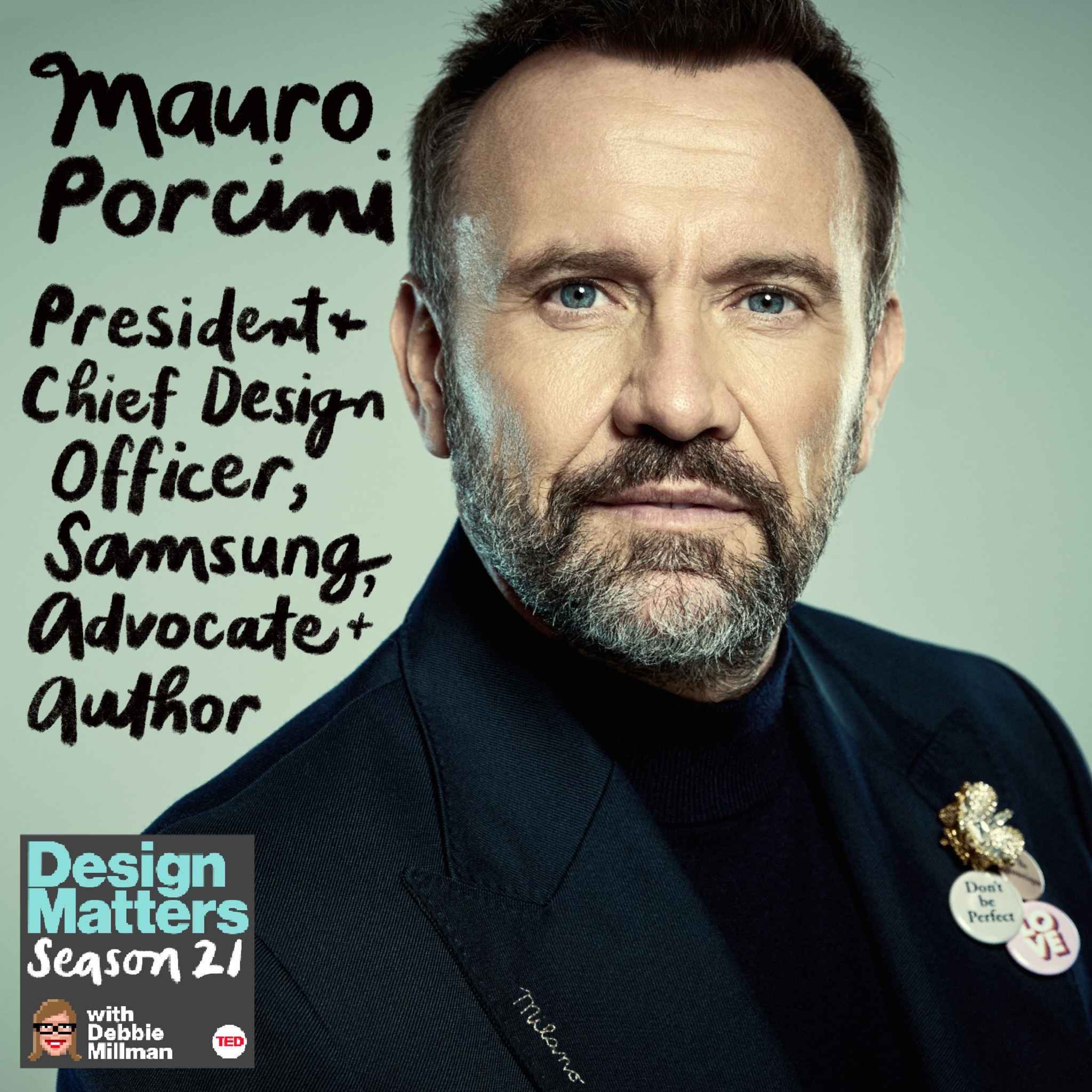
Mauro Porcini
The entire tech world started to shift towards minimalism and this very essential design aesthetic. Inspired by this mantra, form follow function, I'm proposing a new formula that evolves from form follow function to form and function follow meaning.
- [00:24]
Narrator
From the TED Audio Collective, this is Design Matters with Debbie Millman. On Design Matters, Debbie talks with some of the most creative people in the world about what they do, how they got to be who they are, and what they're thinking about and working on. On this episode, a conversation with Mauro Portini about technology and design and about what a designer really does.
- [00:49]
Mauro Porcini
If the technical skill is what defines you as a designer, maybe you're not a designer. We're lost. It feels like we're going round in circles. I'm going to ask that man for directions. Hi there. We're trying to get to the state fairgrounds.
- [01:10]
T-Mobile Advertiser
Well, you're going to take a left at the old oak tree at this here road. Nah, I'm just kidding. Let me get my phone out.
- [01:16]
Mauro Porcini
How is their signal out here?
- [01:18]
T-Mobile Advertiser
T Mobile and US Cellular are coming together so the network out here is huge. We get the same great signal as the city, saving a boatload with benefits. And there's a five year price guarantee too. Okay, here's the turn actually, can you
- [01:32]
Mauro Porcini
pull up the way to a T Mobile store?
- [01:34]
T-Mobile Advertiser
America's best network just got bigger. Switch to T Mobile today and get built in benefits the other guys leave out. Plus our five year price guarantee. And now T Mobile is available at US Cellular stores in Hermiston. Best Mobile network based on analysis by Ooklo Speed test intelligence data second half of 2025 bigger network the combination of T Mobile's and US Cellular's network footprints will enhance the T Mobile network' price guarantee on talk, text and data exclusions like taxes and fees. Apply CT mobile.com for details.
- [01:59]
Wise Advertiser
This podcast is brought to you by Wise, the app for international people using money around the globe. With the Wise account, you can send, spend and receive in over 40 currencies with no markups and no hidden fees. Whether you're sending pounds across the pond, spending reals in Rio or getting paid in dollars for your side gig, you'll get the mid market exchange rate on every transaction. Plus most transfers arrive in less than 20 seconds. Join 15 million customers internationally. Be smart, Get Wise. Download the Wise app today or visit wise.com Ts and Cs apply.
- [02:35]
Bill Advertiser
This podcast is supported in part by Bill, the intelligent finance platform that helps businesses and accounting firms scale with proven results. We often talk about the habits and systems that help people do their best work. For many leaders, that might include building processes that reduce friction and create clarity. That is exactly why so many finance leaders turn to Bill. With AI powered automation, Bill isn't just moving money, they're simplifying financial operations for nearly half a million customers. They're even trusted by over 90 of the top 100 US accounting firms to get it right. That trust is built on scale. Bill has securely processed over a trillion dollars in real transactions, supporting teams in handling payables, receivables and expenses. When financial tasks are organized and visible, it can free up time and energy to focus on what matters most. Whether that's your team, your mission, or your community. Visit bill.comproven and get a $250 gift card as a thank you after speaking with a bill expert. That's bill.com proven terms and conditions apply. See Offer page for details.
- [03:40]
Debbie Millman
Mauro Porcini has built a career at the intersection of business, design and humanity. Born in northern Italy, suspended between cultures and identities, he began his career with a restless curiosity that has carried him From Philips to 3M, then to PepsiCo, where he became the company's first ever chief design officer and helped embed design into the DNA of a global enterprise. In doing so, Mauro was recognized as one of Fortune magazine's 40 under 40, a Fast Company master of design, and one of the 50 most influential designers in America. Today he is president and Chief Design Officer at Samsung, the first role of its kind at that scale, where he is advancing a bold manifesto he has titled the Human side of Technology. At a time when technology sits at the center of financial instability, digital toxicity, and existential anxiety, Morrow is asking profound questions about what technology can do, and he is providing some provocative and rather optimistic answers that we're all going to talk about today. Mauro Portini, welcome back to Design Matters.
- [04:57]
Mauro Porcini
Thank you for having me, Debbie.
- [04:59]
Debbie Millman
Mauro, let's talk a little bit about your origin story for those that might not have listened to our previous interviews. You grew up in a small town outside of Milan in Italy, with two passions, the world of literature and philosophy, which was influenced by your mother, and the world of art, architecture and drawing, which was influenced by your father. But you also described yourself as growing up in the middle, not fully northern, not fully southern, and suspended between identities. Did that early experience of cultural tension shape the way you design for global audiences today?
- [05:40]
Mauro Porcini
I think is a big, big part of who I am and therefore what I do. You call it tension because usually that's the definition when There are two opposites and you are there stuck in the middle. But paradoxically, I always found my comfort zone in the middle of those two opposites. And again back then it was me growing up in the north, from a family from the South. Then it became me designer in the world of at the point that sometimes the business leaders look at me, you know, obviously as a designer, the creative, the alien that is landing on the planet of business. And then other times I have the designers looking at me as the business person. And this person that understand creativity is close to the world of creativity, obviously is the designer himself, but is more belonging to the business world. And at the end of the day, I end up not belonging to one world or the other. Or I'm Italian, you can hear from my very heavy Italian accent. But I've been living 15 years in the United States. I was an alien in the United States, even though over the years I became also a citizen. And New York today is still home. And I became an alien in my own country. And now I live in Seoul in Korea. Imagine I'm even more of an alien there. But at the end, I feel a citizen of the world. Belong in any kind of situation, in those gray areas is where I define my identity. And so, you know, it's a very human need, the one of belonging. I mean, Maslow in his pyramid defined that need, that sense of belonging. You know, many years ago I found my belonging in those gray areas, in those areas where you can define your label, define your identity, define in a very original and authentic way who you are, who you want to be, and what kind of contribution you can give to the world.
- [07:45]
Debbie Millman
You've said that now, decades into your career, you tried to preserve the mindset of an apprentice. Did you approach your roles at running design at 3am and at Pepsi that way?
- [07:59]
Mauro Porcini
Well, I always came into these companies with a lot of respect for the companies. They were big companies, extremely successful. You didn't come in with the arrogance of thinking, well, I'm a designer, I know what you need to do because we designers know better how to design products. And you're not getting it either because you are a tech driven company or because you are a marketing driven, brand driven company. No, I always started from a position of profound respect for what they were able to achieve. I knew very well what I was bringing to the table. Obviously, the more years, the more experience, the more confidence I had in what I knew. But I always knew that I had so much to learn, so much to learn for a variety of different Reasons in the first experiences was obvious. I mean, when I started to work at 3M, I was very young, I was 27. I had so much to learn. I never worked in a corporation of this size, you know, in a stable way. You know, in Philips, I was less than a year at the beginning of my career. There was all the world of technology, technology to discover in PepsiCo the same. I'm an industrial designer, I never work in the world of food and beverage. And I had to learn that industry. I had to learn the product category and to learn so much from the marketing community, from the brand community and now Samsung. I'm mixing and blending the two dimensions. But there is so much to learn about the Korean culture, about a different way of doing, innovation, of working. But beyond all of this, on top of what you can learn practically in your profession, there is the awareness that as human beings, we never end learning. I mean, there is so much, the more you learn, the more you realize that you know nothing. Socrates thousands of years ago was telling us already. The reality is that the more humble you are, the more you know that there is so much out there to learn as an apprentice once again. And the more you blend that anyway with a profound confidence about what you already know, but also with the ability and readiness to steer direction, to change direction, and again, confidence give you that kind of ability. The more I think you can flex to the different situations, the more you can keep growing and not become sterile. So many people at a certain point with fame, success or, or certain achievements, they stop learning because they think, well, I made it, now I know.
- [10:47]
Debbie Millman
And that's, that's the beginning of the end.
- [10:49]
Mauro Porcini
Yes.
- [10:50]
Debbie Millman
What are you still learning and from whom?
- [10:53]
Mauro Porcini
What I'm learning right now, there is a lot that I'm learning, but one of the things I'm learning the most is about myself. You know, I told you that I love the comfort zone of the gray areas. But after 13 years in New York City, 15 in the United States, with such a stable position like the one I had, PepsiCo, you know, with the success in the company, the credibility had in the company, it was difficult to keep discovering yourself, to keep finding new aspect of yourself. Going to Korea, getting completely out of my comfort zone, bringing my family with me, my young kids, my wife, my three dogs, and the sense of responsibility that comes with bringing all these people out of their comfort zone to a completely different kind of culture and way of thinking, working, behaving, connecting is not easy. It's not easy. And so right now, when I face Day after day, different behaviors, different ways of approaching design, innovation, business or of living. Sometimes is easy because it's inspiring and is exactly, you know, what I wanted to do and it's really exciting. Other times instead is complicated because it's so different from what I'm used to. And in those moments that are complicated, you need to find strength in yourself, stability in yourself. You need to find your resilience. And what I know right now in my 50s, is that that's growing, you know, that uncomfort is growing. And this is beautiful because even in the most difficult moment I'm like, yes, I'm discovering new things about myself and I'm learning how to react to things that don't make me comfortable. But it's exactly what I was looking for and it's fantastic.
- [12:52]
Debbie Millman
At PepsiCo you were embedding design into food, beverage, brand and experience. Did you ever consider not taking the call from Samsung because of how much you had already established for yourself, for your career, your reputation, certainly the level of design excellence that you'd been recognized for. Did you ever worry that you might be leaving all of that behind for something that was completely uncertain?
- [13:23]
Mauro Porcini
Look, fear of the unknown and the risk connected to death is human. It's a problem because fear is a mechanism of self defense, right? The nature God gave us. So of course I thought is it the right choice? And again, because I have young kids, when I in the middle of that decision, my second kid was born. Literally I was having conversations with Samsung while my son was coming to life. And so of course there is this sense of responsibility that is very, very strong. In the meantime though, I am somebody that needs to keep innovating and inventing things and growing. So I knew that it wouldn't be easy to give up to this opportunity. So that was one reason I was not looking for a new job. I could have stayed at PepsiCo 20 more years and I would have generated new challenges for myself. Think about the challenges of that industry in sustainability, health and wellness or even just pushing design as a driver of business growth and brand relevance in that industry, in that company. So I would have found my challenges to stay motivated. But again, a completely different kind of culture, in a different country, in a different company, different industry for sure was really motivating. But there is also another reason my passion as a child, what my passion in university was consumer electronics. I did my thesis in Consumer Electronics in 1999 on wearable technologies. So on clothing that are smart with flexible screens and pins that look and see and hear what you see and what you hear and can record all this information in a virtual memory that back then were not calling the cloud, but it was what today is the cloud, and so on, so forth, a variety of different products and objects. You were enabled by technology. Back then was a dream, was just, you know, a vision of the future. And I started to work in Philips on that vision of the future. And then life brought me to completely different directions. And what is, 26 years later, I find myself in a company in a moment in time that gives me the possibility to translate those dreams into reality. But there is a big difference between the kid that graduated from school with that thesis on wearable technologies and what I am today is these two decades of experience. On one side in the world of 3M and then with my own agency is experience in technology and really understanding how to leverage technology to create meaningful solutions for people. Then the other part of my journey is experiencing branding and experience and really understanding how to create something meaningful for people through those levers. And so right now I'm connecting back the two dimensions to really take the intuitions that I had many, many years ago and bring them to life. But with this awareness, with an experience, with a knowledge of how to do it that is much broader.
- [16:59]
Debbie Millman
It's so interesting. I first met you when you worked at 3M and I remember when you got the design, the big design job at Pepsi, the design community was wondering, well, can he take his knowledge and expertise in a discipline that was very much about household goods at that time? You know, you did that gorgeous tape dispenser and bring that alive to fast moving consumer goods. And now you're moving from fast moving consumer goods to shaping technology used by billions.
- [17:29]
Mauro Porcini
Can I, can I? You know, I'm sure you're about to ask me a question, but there is something people tend to look at just the few years of experience you have and the company you've been working for before the next experience, right? So it's so paradoxical and sometimes it's funny how many people right now are like, oh, but it's coming from PepsiCo Consumer Goods. They don't know you. Like, I know you and like, come on. I mean, if you look at my 26 years of work, literally 13 are in consumer goods branding experience and 13 are in tech. And tech is where everything started. It was my passion, is my knowledge. And even in the 13 in consumer goods, tech was always a reference. Every new technological product, new gadget, I will buy it right away, you know, to try to. Because it's exciting to me. And yes, but again, exactly what happened 13 years ago in PepsiCo. Many people now are like, well, but it's coming from brand and consumer goods. Well, actually no, now I have the two experiences.
- [18:41]
Debbie Millman
What changes when the object of design becomes as much about infrastructure? When your work lives in people's homes and pockets and on their bodies? How do you. Is there a different way in which you approach that type of design as opposed to a fast moving consumer goods, or do the tenants really remain very similar?
- [19:05]
Mauro Porcini
I think there are a lot of similarities. What you need to do is to deeply understand the people you serve. And in consumer goods there is a tendency that is probably driven by a culture of marketing or looking at people as consumers and focusing so much on the moment of purchase. What Procter and Gamble used to call the first moment of purchase, the moment of truth.
- [19:30]
Debbie Millman
It's so quaint now. Right.
- [19:32]
Mauro Porcini
But you know, that moment is what often defines cpg, you know, that industry, because there is so much focus on what happened in Walmart, in Target, in the store. As an industrial designer, I've been trained to think about the user, you know, how people use those products. And so when I joined the world of cpg, when I entered the world of cpg, my mission was to remember everybody, that we shouldn't look at people as consumers and think just about that first moment of truth, but focus on that second moment every other moment after that.
- [20:07]
Debbie Millman
Yeah, once it's in your house, what do you do then?
- [20:10]
Mauro Porcini
So for me, that was through in consumer goods and therefore is still even more relevant in a world where once you buy the product, you bring it home and you live with a product, sometimes a few years, sometimes decades. If you think of a refrigerator as an example of an oven or, or even TVs, you know, they have a long lifetime. But again, deeply understanding people, their needs, their wants, and creating real authentic solutions, something that they really need both functionally and emotionally, that's really what is important to do. And that's really the key formula to create relevant businesses, meaningful brands and sustainable growth for those companies.
- [20:59]
Debbie Millman
You have moved from the United States now to live and work in Korea, a very different cultural context from Italy, from New York, Minnesota. How has relocating shifted your perspective on leadership and hierarchy and creativity? You really are, as far as I know, the only president of design that I've ever heard of. It's a real new ceiling breaker for our discipline. How has your perspective changed?
- [21:32]
Mauro Porcini
Well, I had to challenge many assumptions about how to be a leader.
- [21:38]
Debbie Millman
Really, you won't tell me how.
- [21:40]
Mauro Porcini
My first challenge in my journey was the one of an Italian moving to America and trying to understand how to be a leader in America. And it took many years to figure out exactly how to protect my roots, my way of thinking and behaving all the way to my body language and my passion. So how to protect them first and then later on leverage them without alienating the people I was interacting with that had a very different kind of culture. And after a while, I found that balance. I found the ability to speak the language of business, of America, of the United States, the ability to navigate the complexity of these corporations, the culture of these corporations, but being always myself, being always this Italian with this thick accent and this weird way of dressing and this passion and the ability to talk about love in a boardroom and connect love to productivity and efficiency. As an example. Now in Korea, the body language is completely different. The Korean language obviously is very different than the English one. You know, here I was the one not speaking the English language and somehow trying to connect. Now I am there and the language that is spoken in the company is Korean. And of course with me, we interact in English, they interact in English, but it's not anymore the language of the company. There is a sense of hierarchy and roles and responsibilities that is very different than the American one and the European one. And so I'm trying to understand, I'm still in a phase of understanding how to be myself, how to be authentic, how to work in a super collaborative way, blending the definition, roles, responsibilities, but also respecting what works in that kind of culture and try to understand how to inspire people without alienating them, how to find the right balance between change and respect for the incredible culture and business success that the company has. And so it's not easy. The company is really trying very hard to help me as well. And this is beautiful.
- [24:10]
Bill Advertiser
In what way?
- [24:10]
Debbie Millman
How so?
- [24:11]
Mauro Porcini
Well, they understand that. But to become more and more global, you need to embrace more and more diversity. I am the first president non Korean in the history of the company, not just in design, in the history of the company. And so for them it's something important that transcends the discipline of design, the function of design in the organization. They are betting on diversity. They are betting in bringing in people that think different. And they really want me to be successful in mixing my original point of view that is different from the one of the company historically, just because of the nature of the culture of the organization, we the one of the company. So we need myself with their help. We need to find the right balance between the two dimensions. And this is when you become more and more global, when you are able to blend different kind of point of views, diverse point of views, into one original point of view. This is, I think, what they're looking for in me. Not just the design component, but the cultural component as well.
- [25:23]
Debbie Millman
Is there anything you've had to unlearn?
- [25:26]
Mauro Porcini
What do you mean with unlearning?
- [25:28]
Debbie Millman
Well, you've had to learn about new ways of thinking and doing things. Have you had to stop doing certain things that you relied on in order to get a point across or to persuade people?
- [25:41]
Mauro Porcini
Well, there is for sure one thing. I'm very passionate. This passion sometimes makes people eventually even uncomfortable. I had to tune it down already. Maybe it's hard to imagine because I'm still very passionate, but I had to turn it down when I moved from Italy to the US because at a certain point I realized that people may think that was almost aggressive. Instead, it's just our way of talking. It's the passion that come out of everything we do. In Korea, I need to tone it down even more because the body language is really, really different. And so I need to understand how to still leverage the passion, because I think has been key in my journey. And I think it's going to be important also in Korea, in Asia in general. But I need to really make sure that it's tuned in the right way not to intimidate people around me. Because one of the key things in innovation is dialogue is exchange. And when you are too passionate and when you're also confident. So this confidence together with passion, people may not feel comfortable in exchanging ideas, in building a dialogue. And so, again, every culture reacts differently. I'm Italian, think about the Latin American culture is very similar to mine. The American is different, the Asian is different. In Asia, different countries of different cultures. And so I'm learning how to be so passionate without losing my passion and communicating in a way that is tuned in the appropriate way, in the right way, to be impactful in a positive way versus being alienating. It's for sure something I'm trying to learn.
- [27:38]
Debbie Millman
Shortly after arriving at Samsung, you penned something rather provocative titled the Human side of A Manifesto for a New Era of Innovation. You describe technology as both admired and feared. Why do you think technology anxiety feels so acute right now?
- [27:59]
Mauro Porcini
Because in the age of AI and more and more in the age of robotics, because the robots are about to come, people are concerned that this kind of technology may start eroding human qualities. There are Some people that arrive all the way to the fear of technology, the annihilation of human speech is, you know, we arrive to that kind of extreme. But in the middle, there is also very practical fear of losing my job or if you have kids, not knowing what is going to be the future for these kids in this world of technology. And so these are real fear. And that's why I think that the role of, of any company working in technology, as well as any government and policymakers, is the one of making sure that technology is developed at the service of humanity, that is tame, to really create value for people, for humans. And they were not going after technology just because we can, but we should do it because we care. We don't go after technology because it's a driver of profit and power and wealth, but because it's a driver of progress for society. And so I think especially the design community, you know, I'm a designer. And what we learn at school is to serve people. We don't learn at school to grow a business or invent a new technology. We learn how to create something. A solution could be a product, a brand, a service that solves some human needs and fulfills some human dreams. And so as a design community, I think we have an opportunity and a responsibility right now to elevate ourselves, become the voice of humanity in these companies of any kind. And for companies like mine, the one I work for, for Samsung, to play a role, to lead with humanity, to put people at the center of everything, to make sure that once again technology is there, serving the people, humans. And this is very, very important both for society. But I think right now it's very important also to create at the end also business value for these companies.
- [30:28]
Verizon Advertiser
Now more people than ever can bring in their bill for a better deal at Verizon. Got AT&T or T Mobile, we got you Xfinity or Spectrum. You too. So tell your, your family, your quirky neighbor, Jeff, grab your megaphone and yell it from the rooftop. Get a better deal at Verizon because chances are anyone in shouting distance is included. Bring in your at&t t Mobile, Xfinity or Spectrum bill and we'll give you a better deal on the best network come by Verizon today. Best Network based on RootMetrics Best Overall Mobile Network Performance US 2nd Half 2025 all rights reserved. Must provide recent consumer mobile bill in the name of the person redeeming the deal. Additional terms, conditions and restrictions apply.
- [30:58]
Wise Advertiser
This podcast is brought to you by wise, the app for international people using money around the globe. With the Wise account, you can send, spend and receive in over 40 currencies with no markups and no hidden fees. Whether you're sending pounds across the pond, spending rials in Rio, or getting paid in dollars for your side gig, you'll get the mid market exchange rate on every transaction. Plus most transfers arrive in less than 20 seconds. Join 15 million customers internationally. Be smart. Get Wise. Download the Wise app today or visit wise.com Ts and Cs apply with no
- [31:32]
Capital One Advertiser
fees or minimums on checking accounts. It's no wonder the Capital One bank guy is so passionate about banking with Capital One. If he were here, he wouldn't just tell you about no fees or minimums. He'd also talk about how most Capital One cafes are open seven days a week to assist with your banking needs. Yep, even on weekends it's pretty much all he talks about in a good way. What's in your wallet terms apply see capitalone.com bank capital1NA member FDIC. You have the vision for your business. You have the plan, and you just got handed a huge opportunity. But is your business connectivity reliable enough to make a move? Spectrum Business delivers fast, reliable Internet, phone, TV and mobile services, so you're always connected when it matters most. Get connectivity packages built for your business with savings that keep your budget in check. And with fast, reliable Internet and 100% US based customer support, you'll stay connected and ready to bring your vision to life. Learn more@spectrum.com business restrictions apply. Services not available in all areas.
- [32:40]
Debbie Millman
You and I are almost we're in the same generation, we're almost the same age. I'm a bit older, but I know that we both were very much a part of the move toward technology and design in the 80s and 90s. And back then, designers were aghast at the role that technology might have in design before we even knew what the full role was going to be. And there were immediate calls for the boycotting of technology and the continued use of wax machines and X acto blades and rubylith and so on and so forth. I was trained on a drafting table, so I witnessed that firsthand. What we didn't anticipate back then, when the beloved designers of our time at that time were all lamenting the potential loss of jobs, the potential loss of our careers was in fact how technology was going to actually create hundreds of thousands of jobs for designers and move design from really a fringe discipline into the center of creativity. We're hearing a lot of the same fears again. Maybe this time they'll be more prevalent, maybe they won't. I'm wondering what your thoughts are on the repetitive nature of these fears that always seem to come to the forefront at the beginning of a new era of technology.
- [34:22]
Mauro Porcini
Well, look, we live in a sort of paradox as humans. On one side, nature, change, evolve is the law of the world. You know, it's been there forever, is history of humanity and actually even before humanity. On the other side though, we have this instinct to protect the status quo because it's linked to our instinct to be safe. So every time there is change, change is inevitable. But we resist to change as human beings because again, is a form of self defense. It's a paradox because the best self defense is actually to change and evolve and adapt. So we live in this paradox. So these fears that humans designers had for technology are perfect humans. Once again. They are part of our nature. We need to learn, I think, as innovators to embrace change, to embrace changes in technology in the world around us and see them as incredible opportunities. And this is really, really important if we want to innovate in the best possible way.
- [35:39]
Debbie Millman
Several years ago in the Harvard Business Review, you stated that design and innovation are exactly the same thing. Do you still feel that way?
- [35:47]
Mauro Porcini
Yeah, I profoundly believe that design and innovation are the same thing. You know, designer starts always in the same way, understanding people, their needs, their wants, their dreams, and then creating a solution for those needs and those wants. The solution is innovative by definition because it changes the status quo. It modifies something was already existing and evolving in something different or eventually create something from scratch that didn't exist before. So by definition, an act of design is an act of innovation. There is no design without innovation.
- [36:22]
Debbie Millman
You argue that human centered innovation is not optional. It is the only sustainable competitive advantage in a world where barriers to entry have collapsed. Is human centered design now less about philosophy and more about survival?
- [36:39]
Mauro Porcini
Well, you need to be focused on human needs if you want to innovate for real. The big difference between today and the past is that in the past, if you are a big organization, a multinational corporation, you could build these barriers to entry and build a dynamic balance with your competitors in your industry around products. Eventually, even if those products were not ideal for the people you are serving today, in a world where those barriers to entry are down, driven by the wind of globalization, new technology, digitization. In this kind of world, the most powerful competitive advantage you can build for your company is human Centricity is a culture that obsessed around the creation of real value for Humans, a culture where your designers, but also your marketers, your finance people, your hr, every function in the company, feel sick in the stomach if your product is not ideal, if it's not the best for your consumers, if it's not the most beautiful, the most functional, the most sustainable, the most ethically viable. You want a culture of people that even if that product and the brand is extremely profitable and successful, they're not satisfied until the product is also ideal for people. And once again, this is more important than ever. Because in this moment in time, finally, human value is aligning with financial value. In this moment in time, you can't protect your mediocrity in any formal way with your barriers to entry, because in this moment in time, new startups, new innovators, new entrepreneurs can come and attack you exactly in your area of weakness. So it's survival for your company, it's survival for humanity, because you need products that are really, really good for people. So I think there is a lot of negativity often about this moment in time, but actually I think is a very positive moment in time. And earlier you asked me about the designers and the fear of technology. You know, we should remember what designers do. Designers are not defined by the media that they use. We're not designers just because we know how to use a CAD program or Photoshop or in the past, because we knew how to use a Pantone or different kind of technologies. What defines us as designers is our ability to imagine incredible solutions to human needs, to imagine incredible chairs or mobile phones or posters or pieces of communication or Internet sites. It all starts with your mind, your heart, your critical thinking, your ability to decodify those unarticulated needs that are out there and transform them in solutions that are meaningful, inspiring, relevant. So then, yes, we need to take them to life. And that's why we learn the technical skills of taking them to life. But if the technical skill is what defines you as a designer, maybe you are not a designer. You know, if in the future I can be so much faster through artificial intelligence, to transform what I have in my mind into something concrete, that's amazing. The world we still need your mind, your heart, your sensitivity, your empathy, your imagination, your creativity, your ability to imagine those solutions, AI won't do it for us. And even though AI may inspire us with certain solutions, it won't replace us. I think the power right now of AI is that we go to our projects. We start with this blank page in front of us, with the law of our biases, our culture, our Experience, you know, I am Mauro, you are Debbie. And we have an history. We learn in a certain way, we have a certain kind of experiences. So when we go to the project, we are biased by our history. Now, how you break those biases, you do research, you talk with people, you travel, you do as much as possible to open your mind and infiltrate your biases, your experience, what you know, your knowledge, with something different.
- [41:21]
Verizon Personal Caller
Different?
- [41:22]
Mauro Porcini
Well, AI can do exactly that, but in this exponential way, AI go to a problem with a completely different kind of background, without your biases, maybe with other biases. AI may have biases. The developer of AI are trying to remove those biases. We are very familiar with this topic. But no matter what biases AI may have or don't have, the perspective is different. So the value is not in what AI generates, it's not in what I generate. The value once again is in the dialogue between me and AI. It used to be me and other people. There is still the dialogue. We must preserve the dialogue with other human beings. But now you have a new actor in the mix with a lot of knowledge that can access any kind of information. So that's an amazing value. So both for inspiration, because it can break your biases, generate new ideas if you combine what you think with what AI thinks and then obviously in execution as well. If I don't need anymore to use a CAD program or a software of any kind or any kind of manual tool to create something, I can do it in a much faster way. Fantastic. Now it means that schools of design will need to teach even more. Critical thinking, imagination, creativity, the ability to solve solutions. Because that is what is going to define the design profession of the future is not anymore. It was already not anymore now, but even more in the future. The craft and actually the craft, yes, but in terms of thinking, but the ability to do things, the tools shouldn't define us and won't define us in the future.
- [43:05]
Debbie Millman
And you know, AI is still not going to ever really be able to feel something. I saw a wonderful meme on social media a couple of days ago that we're not going to really have to worry about AI until they can experience jealousy, rejection and failure. And, you know, I think that there's something really important about those emotions and how they do fuel creativity.
- [43:25]
Mauro Porcini
Do you think AI is not going to be able to feel that? I don't know. We will see.
- [43:31]
Debbie Millman
Do you think the ChatGPT is going to be jealous of Gemini?
- [43:34]
Mauro Porcini
That's an interesting question. I think that sooner or later he will Be able to reproduce human feelings to that level.
- [43:43]
Debbie Millman
Butterflies in the stomach, falling in love.
- [43:48]
Mauro Porcini
It may, you know, at the end of the day, what happens in our body, there is something magic that we can't explain, but from a pure scientific standpoint is chemistry. Right. And physics and biology. Yeah, all of these. Then recreate something that is impossible to define. It's so magic that, that often we explain it with God or, you know, in ways that transcends humanity and what we know. But if AI is able, learning how we feel, how we behave, how we think, to recreate those feelings, the question and we go into, you know, real philosophy, can they become new human? You know, as human. As human or not? I don't know. I don't have the answer. But my hope is that we drive AI in a direction in which even if you become as human as humans is gonna still be at the service of humanity. So if AI is able to learn, as you say, jealousy together with empathy together with fear together with a series of other emotions, and those emotions fuel creativity and make those solutions more and more human, and now all of this is used at the service of humanity, then why not imagine AI being able to do a lot of things that we don't want to do as humans at work or in a variety of different circumstances, so that we can be even more human. So that while AI does certain things that requires human qualities. I can spend time with my kids, I can go run in a park, I can go ski or swim or read a book. So this is really what we need to talk about, what we need to focus on. It's not AI is going to be or not as human as possible, or is the fear of AI being too human if AI become really human and therefore is able to do everything we do even better, and it free us from tasks that we don't need to do unless we really want. That's wonderful for humanity. But the problem is we need to make sure that AI and the fourth technology is always developed at the service of humanity.
- [46:23]
Debbie Millman
So what does that mean exactly? What does at the service of humanity mean?
- [46:28]
Mauro Porcini
It means that it needs to be a tool to solve specific problems, to help people. And we often talk about people and problems and dreams. Once again, I mention it multiple times today. The hierarchy of needs of Maslow has been always, for me, for decades, the most important framework to understand people and to understand how I could help people and solve real problems. I translated this hierarchy of needs now that I'm in Samsung, in four categories that are relevant to the world. Of tech, the world of Samsung, our portfolio of products. But if you want, they are relevant to any company, any brand, any situation. In general, the categories are live longer, live better, live loud, live on, on. So I want to help people live longer, better, loud and on. What does it mean? Live longer is all about physical and mental health and is about safety. So creating products that help you in all of this. Think in our world. Wearables, technology that monitor your body for your physical and mental health, or a variety of different technology that monitor your house, your loved ones, your pet. So that's all the word of livelonger, that is the base of the Maslow pyramid is survival and safety. Live Better is about using technology to work on your behalf, ideally, or to work with you to become more productive. But translated that means I want to free up your time so that you can do whatever is most relevant and most important to you and technology will work on your behalf. Think about the implication here. I'm using technology so that eventually you can do things that have nothing to do with technology. You know when technology can do work on your behalf. As I said earlier, go run in the park, leave your mobile phone at home, leave even your wearable at home. If you don't need to monitor your body in the moment, be free, reconnect with the people you love with nature. So it's amazing when technology can enable you to do something like this. That's what I mean with at the service of humanity.
- [48:47]
Debbie Millman
Over the course of history, human history, we have as a species constantly made improvements to the way that we live. Whether it's through the agricultural revolution or the industrial revolution, for ways in which humans could have more leisure time. And yet we don't really ever take that opportunity and fulfill it. What we do with that extra time tends to be more work. And I've been really thinking about that a lot lately as I was preparing for our interview today and I was thinking about live longer, live better, live loud, live on. I was thinking about the fact that humans have been in pursuit for technologies to improve the quality of our lives, to let us do more of the things that we love for millennia. And yet when we get that time, we seem to fill it with more work to do. Where do you think that comes from? Or do you disagree? I mean, do you feel like you're seeing more people do things?
- [49:48]
Mauro Porcini
I agree, but I don't think it's driven by individuals, is driven by the business world and the need of producing more. And that's why I think we are living in A magic moment and an optimistic and I think is a positive moment of dramatic change and transformation. Because when you will have machines, robots and AI that can do the work of many, many people, yes, we'll be able to produce new kind of jobs, but there is a high probability that a lot of jobs won't exist anymore. And therefore we need to rethink our society and the idea of working. And this will be the job, not of companies and brands and corporations, but it will be the role of policymakers and governments and nations that we need to rethink how you sustain a population even when they don't work full time. And so that's the most beautiful design project of the future to understand how you redesign a society. Thinking about how to drive happiness in this society, how to make people happy even if they don't have their jobs. And the idea of working as it is today. You know, in our work we find a lot of happiness. You know, at the end of my book, I talk about how to design happiness. And there are three dimensions for designing your happiness and achieving your happiness. The first one is the definition of your identity. That starts, since you are a kid, I have a four years old and a one year old, and they're there already. Now you see that they're there defining their identity. So this is a journey that is lifelong. But often when we arrive to our jobs and we start to work, we use that job and that title to define our identity. I mean, in New York City, the first question that they ask you is what do you do right? Always, right away, they define you, they label you with your job. But again, many of us define ourselves through your job. The mistake is when your job is the only thing that define you. Because the moment you lose your job, you're lost, you lose your identity. So work, life, balance, super important. Not putting everything living just on your job to define yourself, very important. The second dimension is the connection with others. And so spending time with others, giving love and receiving love back. But you give love in a selfless way, you receive it back just because of the nature of the people close to you. Your family, your friends, your close community. At work you find a lot of this. How many people find a work, their significant other or their friends and their community. And then finally the third dimension is doing something bigger than you that at the end is that thing that give purpose to your life, meaning to your life, and make you immortal. So often we arrive there later in life because is when we start to understand that we're not eventually physically Mortal. And so we try to defeat death by doing something that is bigger than us. It could be, you know, from inventing a new product that changed the life of people all the way to a simple act of generosity for a stranger. And people will remind you like that kind person forever. And the work give you often that sense of purpose. So in the work world you won't need to work, but still the governments will give you the possibility to sustain yourself. So you'll be happy. The base of Maslow is safe. You know you're there, you exist. How do you define your identity? How you find ways to connect with others and how you give purpose to your life without the traditional interpretation of a job. That's, I think is one of the most beautiful design projects of the next decade.
- [54:06]
Debbie Millman
You've talked about how human centered innovation is first and foremost an ethical and moral responsibility. Have you faced resistance when you position design in moral terms in the various organizations you've been a part of?
- [54:22]
Mauro Porcini
I don't talk too much about that for a simple reason. In business, these companies, they're there to make a profit. I mean, it's the nature of the business and it's okay, it's good. I mean, it's the nature of the entity, the industry and the world business. So you need to talk the language of business and you need to show these companies how whatever you do drive business. The ethical responsibility is what human beings in these businesses have have. One and two is what the organization, the corporation decides to have. Because it's a responsibility that these companies have, especially if they're big, is a decision. The more you create a connection between the business value, the financial value on one side, and the ethical responsibility on the other, the more powerful the equation is. But mostly the more you can push that ethical responsibility. So what I pitch is for people, not just designers, but for people in these companies, big and small, to have that ethical compass, to have that need that is very moral. To start from that in a very, very authentic way, not as a lever for business, but because you profoundly believe in it. First step, second, learn the language of business. Understand what is relevant to these companies from a financial standpoint, from a business standpoint. Third step, try to link the two. Now, it may have been difficult, more difficult in the past, but today, once again, in a world where financial value is aligning to human value because you can't protect mediocrity with your barriers to entry anymore, is easier. It's easier. But a lot of people are not understanding these alignments and they are not leveraging the business opportunity when I talk to the business world is leverage the business opportunity. When I talk to my friends and people I know that care, I'm like, this is an incredible ethical opportunity we have right now.
- [56:42]
Debbie Millman
As a leader working on a global scale, you've made impact in all of the companies you've worked at, worked with. You're now at the very beginning of your journey at Samsung. And I don't think it would be an exaggeration to say that there are a lot of people looking at you to see what you are going to do next. How do you introduce a new aesthetic?
- [57:10]
Mauro Porcini
Respectfully, if you try to define what respect is, it starts with empathy. Deeply understanding the entity that's in front of you. Let's say it's a person or is a brand or is a company. So respect starts with empathy. And this empathy mixed with knowledge. Studying profoundly the history of this person or this brand of this company give you awareness about what is authentic for the company or the person. So you start with that, you understand where the company or the brand or the person is coming from and then you try to understand how to evolve it in an authentic way. So what I did when I joined Samsung, the first thing was to study the history of the company and the history of design and products in the company as well and try to understand both from a purpose standpoint, from a branding standpoint and from a product standpoint, how to evolve it in a way that is relevant for a world that is evolving, is changing, is transforming, but doing it in a very authentic way for the company. So in more practical and pragmatic, if you look at the history of the company, first of all, this is a company that's been changing and transforming continuously. It started in the 30s as a trading company selling dry fish, noodles and flour. And then it started to evolve with the evolution of the country of Korea. So back then it was literally feeding the poor people of Korea. They were farmers, the country was really, really, really poor. And then as the country was evolving and the level of wealth was increasing, the company moved with the country and started when the Korean could afford the first appliances. Samsung would provide the first appliances at an accessible cost, not the premium tier, but an accessible entry level tier. Washing machines, televisions, refrigerators, ovens. And then with the evolution of the country, the country becoming one of the most iconic country in the world with K pop and this new trend and fashion, yeah, all the world of fashion, music, film combined obviously with the world of technology. You know, the country now is up There, and the company is there as well. And so first of all, change, transformation is in the DNA of the company. And then from a pure design standpoint, the company in the 90s, in the early 2000, used a very expressive design language. It was charged with emotions. And then around 2008, 09, the entire tech world started to shift towards minimalism and this very essential design aesthetic inspired by this mantra of form follow function. Brown was an example of that kind of aesthetic, an aesthetic that was challenged in the 80s by companies like Olivetti, by Memphis, you know, in my Italy, at the resort, Memphis were grown challenging the more traditional aesthetic of the Bauhaus and bringing back colors, emotions, shapes. So if you think about this tension, it was a healthy tension. It was a tension that reflect the diversity of humanity. There are people that may prefer minimalism, people that prefer maximalism, and a lot of people that love things in between. The tech world lost somehow that diversity, the variety, and converge towards this world of beliebolism. This is not the case in other industries. In fashion, you have brands that are very minimalistic and brands are maximalist and everything between the same in architecture, in automotive, in lighting, in furniture, in tech. Instead there is this homogeneity, this uniformity of design language. So, so what I'm trying to do through Samsung is moving from minimalism to what I call espressit as a language that is nothing else than the reflection of human diversity, where there is space for minimalism, but there is space also for other kind of languages. And this is going to be more and more relevant in a world where technology will give us the possibility to flex and adapt the products, the user interfaces that we use, through the use of AI as an example to what is meaningful for us. I'm proposing a new formula that evolves from form follow function to form and function follow meaning. And the meaning of this formula is essentially in a world where AI will give you the possibility, for instance, to totally customize the user interface on your phone or your TV on the basis of what is meaningful to you. You, form and function will be balanced to achieve the perfect meaning for you, and it will be different than the balance that they will find to achieve what is meaningful to me or in hardware is about customizations of products and the ability to really personalize products as much as possible. And new technologies are giving us that opportunity more and more and more. So to answer your question, this is a company, they used to have a very diverse and expressive portfolio and language of design. A company that has been changing and transforming Evolving continuously, also in dramatic ways. So the idea that the company can keep evolving and transforming is totally authentic. The idea that it can embrace, again, this more expressive design language is rooted in the DNA of the company itself. So this is what respect and change in action looks like.
- [63:18]
Debbie Millman
The initial introduction of minimalism in tech solved a lot of problems at the time. But I think as we've evolved and as culture has evolved, it's created other new ones. Can you talk a little bit about how the decisions that you're making now for more human centered design, more expressive design, might show up in the ways that you're making things?
- [63:45]
Mauro Porcini
First of all, in the world of tech, it takes time to develop products. So a variety of these products will come to market in the coming months or years. We were able to launch already at the Consumer Electronics Show a couple of televisions that were going into that.
- [64:04]
Debbie Millman
Yes, Roxanne wants one. We can talk after the show,
- [64:10]
Mauro Porcini
but you know, already there we launched television with the same technology but different designs. That sounds kind of obvious, but it's not at all in the industry where usually you have a specific technology and you have this frameless design and it is what it is. So the idea that you can have different kind of designs because your living room is different than mine is somehow, you know, innovative in that industry. But again, this is the very, very first step in that direction. In Milan Design Week, we share a series of concepts that visualize the kind of aesthetic, this idea of variety and diversity in the portfolio so that you can have different kind of languages attached to different kind of products. Now, one of the key challenges of doing something like this is how you build, build your design identity with a portfolio where products look different from one another. And this is something I've been wondering for a while. And the answer is that if I really want to be human centered, and if, for instance, Debbie, your needs are different than mine, if your living room is different than mine, why do I need to force on you one aesthetic? Why can't I give choice to people? Why can't I build, therefore a portfolio that give choice to people? Either because there is flexibility in the product. As an example I mentioned earlier, AI is going to totally customize user interfaces of people, or because there is flexibility in the hardware. So customization of products. We have, have this new TV where you can customize the frame, and we used to have it also in the past, the frame tv. So we are launching a new model with a different approach. But again, customizations of products and these happen in fashion. You go to nike.com and you can totally build your shoe from scratch. Just as an example.
- [66:19]
Debbie Millman
You can do that with cars too. Why can't you do that with televisions?
- [66:22]
Mauro Porcini
Exactly. And then all the way to. In the portfolio, you can have multiple choices of different kind of designs for different kind of needs. Now, if you do this, there is no way you can build an identity through your products. So the identity is going to be built in our world, first of all through the branding on the product. So we need to be smart about how we brand the product. And then it's going to be built through the brand identity in visual communication. And then it's going to be built through the experience in retail events or anytime you experience the brand. And then what is linking everything together? The glue of everything is the brand purpose, the philosophy, the vision. Now this is more common in other industries, like in fashion, you know, even though you have a language, if you buy Prada or Gucci or many other brands they offer you products are super minimalistic. And then they go all the way to different kind of languages within the same brand, the same portfolio. But in tech is not the habit. And so you can choose. You can be one of those brands and those companies with a very, very clear identity, or you can be a company with a product identity that is very diverse. Olivetti in my Italy was the example of this great diversity. But then you link it all through your philosophy, your vision, your purpose, and then once again, your experience in retail and then your visual communication technology seems
- [68:04]
Debbie Millman
to be privileging the screen. Do you see technology evolving so that we are looking equally at the eye and the body as well as the screen?
- [68:17]
Mauro Porcini
What do you mean? We're looking at the eye and the
- [68:18]
Debbie Millman
body that we are.
- [68:21]
Mauro Porcini
We just don't look at the screen. We look at the people in front of us.
- [68:23]
Debbie Millman
And as well, the aesthetic experience is as important as what we're looking at. So the aesthetic around the experience is as important as the experience.
- [68:35]
Mauro Porcini
But look, we are very visual animals. But obviously we have five senses. And actually, if you look at the etymology of the word aesthetics is what is perceived by the five senses, not just by one sense, that is the sight. This is very important, for instance, in the world of product design, because you look at things, what we call aesthetics. But the reality is that you decide the quality of what you look at also through the other senses. As an example, the sound of a product, for instance, the door of a car when it closed, because depending on the sound, you have a perception of quality or Lack of quality. When you touch a material, if it's cold, it's metal, if it's warm, it's plastic. By touching it immediately, you have a perception of quality or lack of quality. So we use all the senses. So aesthetic, as it was used by the Greek philosopher Aristoteles, Plato was exactly this, what is perceived by the five senses. So. So I think you need all the senses, so you will always need screens. Now, the screen of the future could be an hologram. The screen of the future could be something flexible on your clothing that doesn't look as a screen anymore. But there will be always space for this visual interaction. What we need to make sure, though, and I think is where you are going with your question, is that this screen is not what focus all our attention. We need to make sure that we interact with the world surrounding us, from people to nature to everything in between, in the most meaningful way, in the most human way. And we need technology there once again, helping us, enabling us in this kind of interaction. And so thinking about the wearables that are about to come, they're already there, but, but they will grow more and more in the coming years. The wearables for sure will help us free up our attention from a screen. Looking around glasses, as an example, will give us the possibility of still looking at people and things and nature, but having all the information. Eventually, AI and the cloud and technology can give you to amplify that experience. So that's just one example. But earphones, earbuds with AI will give us the possibility to be our companion, our mentors, and then I can still look, actually. I will finally be able to look more at the world surrounding me with an audio device that is helping me navigate in the world both with knowledge and facts and data and information, as well as also through an emotional engagement.
- [71:34]
Debbie Millman
I'm looking forward to seeing what you do with movement and texture and sound and even temperature and how they become part of your new design vocabulary. I have one last question for you. Five years from now, what design decision do you hope billions of people can
- [71:59]
Mauro Porcini
feel grateful for in my journey or in general in society?
- [72:05]
Debbie Millman
I was thinking more in your journey, but I'm going to take the opportunity to say both.
- [72:11]
Mauro Porcini
Well, this has been also a theme of my entire professional journey, is more about this focus on human centricity than on a specific product. So the design decision that I been pushing for many, many years, and now in this industry, in this company, this moment of time is more relevant than ever, is this idea that we need to Keep focusing on people. But why is more relevant than ever. Because in the age of artificial intelligence, reminding the world that humanity is the center, that we need a moral compass, an ethical compass, that we need to put technology at the service of humanity is probably the most important decision that I can take, the most important design decision I can take. But if it's just me or even it's just Samsung is not enough. So what I hope, even through platforms like the one that you're giving me right now, is the ability to reach as many designers as possible, as many innovators, entrepreneurs, and remind them that we have a responsibility in this moment of time. The world is changing, it's transforming and can go in different directions. It's up to us innovators of today, designers of today, entrepreneurs of today, to make sure that it's going in the right direction. So I hope that this decision is not Mauro or Samsung decision, but is a collective decision starting with our design community and then beyond the design community of putting people first and taming technology, AI, robotics, and anything between at the service of humanity.
- [74:04]
Debbie Millman
Mauro Porcini, thank you so much for making so much work that matters. And thank you for joining me today on Design Matters.
- [74:12]
Mauro Porcini
Thank you for having me, Debbie.
- [74:14]
Debbie Millman
This is the 21st year we've been podcasting Design Matters and I'd like to thank you for listening. And remember, we can talk about making a difference. We can make a difference or we can do both. I'm Debbie Melman and I look forward to talking with you again soon.
- [74:30]
Narrator
Design Matters is produced for the TED Audio Collective by Curtis Fox Productions. The interviews are usually recorded as the Masters in Branding program at the School of Visual Arts in New York City, the first and longest running branding program in the world. The editor in chief of Design Matters Media is Emily Weiland.
- [74:53]
Capital One Tech Advertiser
This episode is brought to you by Capital One. Capital One's tech team isn't just talking about multi agentic AI. They already deployed one. It's called chat concierge and it's simplifying car shopping using self reflection and layered reasoning with live API checks. It doesn't just help buyers find a car they love, it helps schedule a test drive, get pre approved for financing and estimate trade in value. Advanced, intuitive and deployed. That's how they stack. That's technology. At Capital One.
- [75:22]
Schwab Advertiser
Investing with Schwab is like spending a Saturday at a great farmer's market. You can fill your reusable tote with a bit of everything. Maybe you go for some free range self directed investing or perhaps you pick up a few farm fresh trades while you peruse. You can even get help from a dedicated advisor. That's full service, wealth management. Mix, match and change your mind whenever you want. Because at Schwab, you can invest your way no matter your goals or appetite. For investing, Schwab has everything you need all in one place. Visit schwab.com to learn more.
- [75:55]
Paige Desorbo (Amazon Prime Advertiser)
Hey, it's Paige Desorbo from Giggly Squad. Okay, wait. Have you ever had one of those moments where you're like, I should be doing something fun tonight and then you just don't because you don't have what you need because same. But recently I've been trying to be more of a yes person. And honestly, Amazon prime has been enabling that energy. Like the other night I randomly decided I was going to host a last minute girls night. No planning, no groceries, nothing. And instead of spiraling, I just ordered everything I needed and got it that day. Snacks, drinks, even like random hosting things I absolutely didn't need. But emotionally I did. And suddenly it went from maybe next time to yes tonight. That's what I love. Prime Same day delivery makes it so you can say yes before the moment slips away. Because let's be real, the only thing worse than a bad plan is a plan you never make happen.
- [76:42]
Mauro Porcini
Same day delivery.
- [76:44]
Verizon Advertiser
It's on Prime. Available in select areas. Terms apply. So if you're trying to be more spontaneous or just less chaotic, go to
- [76:49]
Mauro Porcini
Amazon.com prime to find millions of items delivered fast.
- [76:54]
Adam Grant (ServiceNow Advertiser)
Hi there, it's Adam Grant from Ted's Rethinking Podcast, and this episode is brought to you by ServiceNow. I get to spend my days studying how people think and what it actually takes to change our minds. It's work I find deeply meaningful. But even in meaningful work, there's still busy work. The admin, the repetitive processes, the invisible load that pulls attention away from what really matters. That's where ServiceNow's AI specialists come in. They don't just tell you what you should do about your busy work, they actually do it. Start to finish, cases closed, requests handled. No extra work for you. To learn how to put AI to work for people, visit servicenow.com
- [77:32]
Verizon Personal Caller
hey honey, it's Mom. Did you know if we switch to Verizon, we can get four phones for $0 plus four lines for $25 a line. Call me back. Me again. That's just $100 a month for four lines on unlimited welcome. Plus four phones. No trade in needed. Call me. It's Mom. America's best network. Verizon that's the one we're talking about.
- [77:52]
Wise Advertiser
I'll send you text America's best Network based on RootMetrics Best Overall Mobile Network Performance US Second Half 2025 Four new lines and a limited welcome and autopay. See verizon.com for details.