← Design Matters with Debbie Millman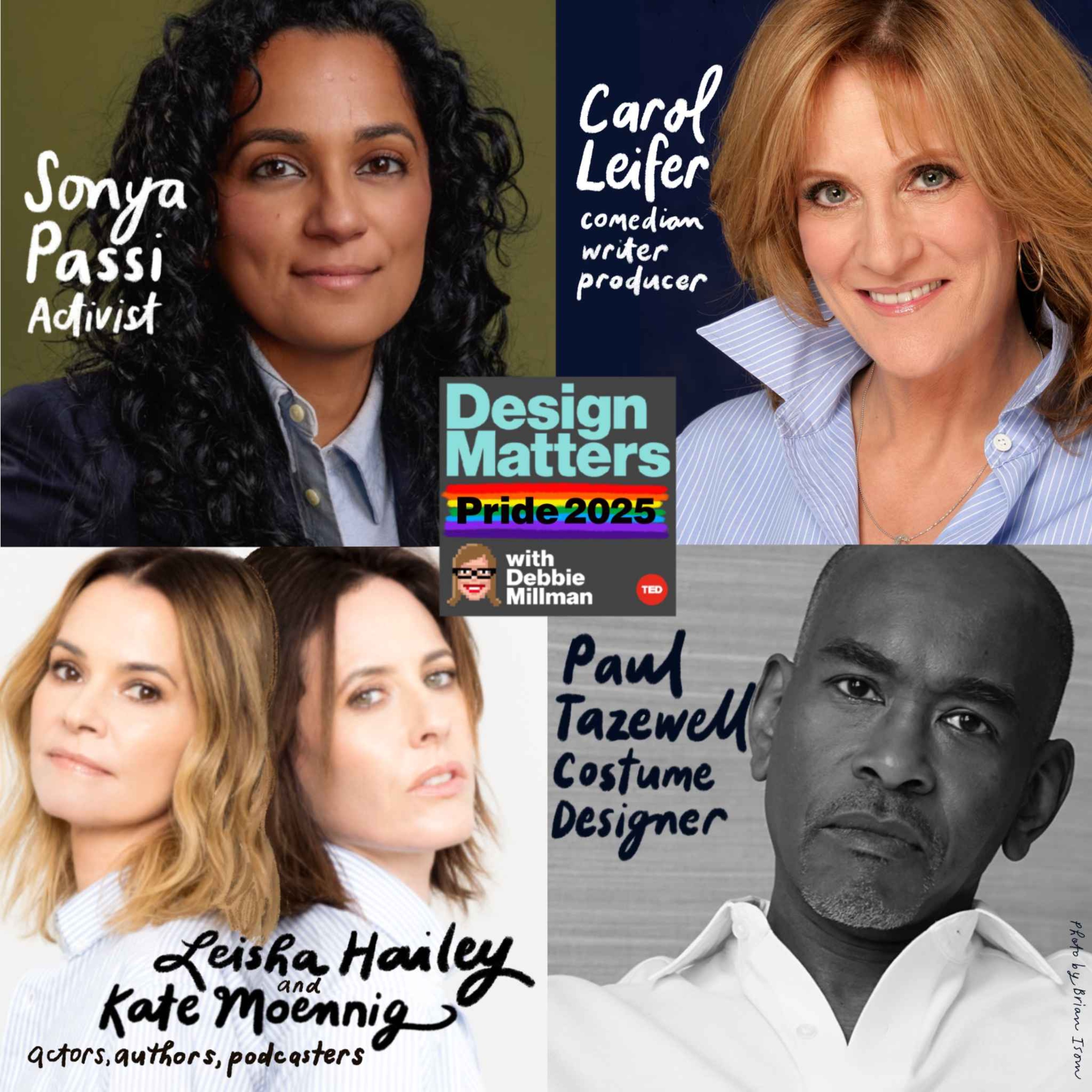
Design Matters with Debbie Millman
Pride 2025 with Carol Leifer, Sonya Passi, Paul Tazewell, Leisha Hailey, and Kate Moennig
00:43:30
Loading summary
Transcript118 lines
- [00:01]
Sonia Passi
In that moment, it crystallized for me that this was my life's work.
- [00:06]
Paul Tazewell
All of those things, I think were additive to create what I do now.
- [00:15]
Debbie Millman
From the TED Audio Collective, this is Design Matters with Debbie Millman. On Design Matters, Debbie talks with some of the most creative people in the world about what they do, how they got to be who they are, and what they're thinking about and working on. On this episode episode in celebration of Gay Pride Month, we're going to hear excerpts from some of the interviews Debbie has done over the past year.
- [00:39]
Carol Leifer
There were comedy albums playing in my house all the time.
- [00:44]
Leisha Haley
It always fascinated me and I thought, that looks like fun to do.
- [00:50]
Capital One Bank Guy
Banking with Capital One helps you keep more money in your wallet with no fees or minimums on checking accounts and no overdraft fees. Just ask the Capital One bank guy. It's pretty much all he talks about in a good way. He'd also tell you that this podcast is his favorite podcast too. Ah, really? Thanks Capital One Bank Guy. What's in your wallet? Term Supply See CapitalOne.com Bank Capital One NA Member FDIC.
- [01:18]
Lumen
This episode is sponsored by Lumen. Your metabolism is like your body's engine. It powers everything you do, from how you move to how you feel. And when it's running smoothly, you feel the difference More energy, Better sleep, Improved recovery. Lumen is the world's first handheld metabolic coach that helps you understand what your body is burning fats or carbs just by breathing into it each morning. Then the app gives you daily nutrition guidance personalized to your body's needs. This summer, stay in sync with your metabolism and feel your best, whether you're active, resting, or anything in between. The warmer months are coming. Spring back into your health and fitness. Go to Lumen Me ted to get 10% off your lumen. That's L U M e n me Ted for 10% off your purchase. Thank you Lumen, for sponsoring this episode.
- [02:10]
Vanta
Trust isn't just earned, it's demanded. Whether you're a startup founder navigating your first audit or a seasoned security professional scaling your GRC program, proving your commitment to security has never been more critical or more complex. That's where Vanta comes in. Businesses use Vanta to establish trust by automating compliance needs across over 35 frameworks like SoC2 and ISO 27001 centralize security workflows, complete questionnaires up to five times faster, and proactively manage vendor risk. Vanta not only saves you time, it can also save you Money. A new IDC white paper found that Vanta customers achieve $535,000 per year in benefits and the platform pays for itself in just three months. Join over 9,000 global companies like Atlassian, Quora and Factory who use Vanta to manage risk and prove security in real time. For a limited time, get $1,000 off vanta@vanta.com tedaudio that's V A N T A.com tedaudio for $1,000 off.
- [03:12]
Kate Menig
Race the rudders.
- [03:13]
Carol Leifer
Race the sails. Race the sails.
- [03:16]
Kate Menig
Captain, an unidentified ship is approaching.
- [03:18]
Vanta
Over.
- [03:19]
Carol Leifer
Roger, wait.
- [03:20]
Capital One Bank Guy
Is that an enterprise sales solution?
- [03:23]
Paul Tazewell
Reach sales professionals, not professional sailors.
- [03:27]
Capital One Bank Guy
With LinkedIn ads, you can target the.
- [03:29]
Paul Tazewell
Right people by industry, job title, and more. We'll even give you a $100 credit.
- [03:34]
Kate Menig
On your next campaign.
- [03:35]
Vanta
Get started today@LinkedIn.com results.
- [03:39]
Paul Tazewell
Terms and conditions apply.
- [03:44]
Kate Menig
I started this podcast 20 years ago. 20 years ago, George W. Bush was president. President and had endorsed a constitutional amendment banning same sex marriage. The majority of states had constitutional amendments or laws defining marriage as between a man and a woman. Don't ask, don't tell was official military policy. Culturally, though, things were starting to shift. Twenty years ago, Will and Grace was a popular TV show and Brokeback Mountain was an Academy Award winning film. Twenty years ago, the L Word was becoming a huge success on Showtime. Now, 20 years later, to be gay in America has been normalized to an extent that a lot of people feel they don't have to dramatically come out to their friends and family anymore. They're just gay. No big deal. Yet we're now in a political moment wherein LGBTQ rights are under attack, particularly trans rights. Which makes Pride Month, June, especially important this year to demonstrate that we're here, we're not going anywhere, we're not going back, and we're going to live our lives the way we want to. So to celebrate Pride Month, I want to play a few excerpts from interviews I've done in the past year. I'm always interested in how all my guests have come to terms with their identities, and especially my LGBTQ guests. But that not really what we talked about in these interviews. These were conversations with very accomplished people who happen to be gay about how they became who they are professionally, what were the influences shaping the choices that led them into lives doing exactly what they wanted to be doing. First up, Sonia Passi. She's a veteran activist who has spent much of her life fighting gender based violence. She's the founder and CEO of the national organization Free From. You mentioned you were raised in Manchester, England. I believe you were also born there. And aside from your fascination with paper products, what kind of little girl were you?
- [06:02]
Sonia Passi
I was always very confident. The stories I've heard from when I was young are that I used to stare intensely for long periods of time at all of my dad's friends. And these older men would get very nervous by my stare. And my dad would always tell them, she's. She's trying to figure out if she can trust you.
- [06:28]
Kate Menig
Wow.
- [06:29]
Sonia Passi
So I definitely had a capacity at a young age to make grown men feel very nervous.
- [06:38]
Kate Menig
I did not think you were going there with that statement. Very good.
- [06:44]
Sonia Passi
But I was full of life as a kid. I was full of. My mom used to describe me as the bubbles of champagne.
- [06:52]
Kate Menig
Where do you think that early confidence came from? Usually that comes from good parenting, but I'm not sure in your case if that's. If that's accurate.
- [07:00]
Sonia Passi
I think part of it is who I am, and I think part of it is that I have the very good fortune of having gotten the best of both of my parents. My mom really is a force to be reckoned with. A manifesto of all of her dreams. My father is too. And so I got that. I witnessed it and I modeled it. And certainly in my younger years, I was very much raised with the idea that I could do and be anything that I wanted to be. And that's a great, a great blessing as a little girl.
- [07:41]
Kate Menig
I read that from a very early age you wanted to be a police officer, but in a complete about face, by the time you were 16, you created an anti violence Amnesty International community group in your high school. What inspired your interest in social justice, human rights at such a young age?
- [08:04]
Sonia Passi
You know, when I was a teenager, Tony Blair was the Prime Minister of England and his wife Cherie Blair was a very famous and successful human rights lawyer. I think it was the first time it was sort of like the equivalent of Hillary Clinton here in the us but it was the first time that a Prime Minister's wife was a powerhouse in her own right. And it was a very public and prominent display of a woman, woman with power and leadership. And so it was a model, I think, for a lot of young women in the UK at the time. And so, you know, 12 years old, I'm like learning about what a human rights lawyer is and therefore what human rights are. And the through line between wanting to be a police officer. I think it was a police officer and then it became a teacher and then it became a pediatrician and then it became a human rights lawyer was I have known my entire life that my life is in service of others. And so it was just sort of finding what that looked like for me.
- [09:13]
Kate Menig
You went to the University of Cambridge for your undergrad degree and then went on to get a Master's of philosophy. What made you decide to go back to school to pursue a law degree at UC Berkeley at that time? Was it that realization that, yes, I want to be a lawyer? Was it what? What happened in that timeframe between the Masters of Philosophy and then wanting to go on for the law degree?
- [09:38]
Sonia Passi
So at 16, when I started this Amnesty International group, the very first pamphlet that they sent me in the mail was around their campaign that year, which was Global Violence against women. And I remember reading, one in three women globally will experience gender based violence. And I was so utterly shocked. Not by the statistic, but why? This was the first time that I was reading it, and the first time I was reading it was on page two of a pamphlet that I sent away for in the mail because it was very clear to me that this was a global crisis and should be breaking news every single day, front page of every newspaper. And in that moment, without having any consciousness as to my own experience, but in that moment, it crystallized for me that this was my life's work at that age. I started hosting domestic Violence awareness weeks at my high school that were intended both to educate people about the issue, but also to raise money for local shelters. I then went on to do similar work at Cambridge. And by that point, I knew this was my life's work. I had absolutely no idea what contribution I had to make to it. But because it had been introduced to me as a human rights issue, not as a domestic issue, not as a personal issue, but a human rights issue, I felt clear that understanding law and how you create laws and change laws and policy was clear going to be critical to my future. And so I actually chose to go to law school. And I had the good fortune to go to law school and be able to afford to go to law school knowing that I didn't want to be a lawyer. But there was a certain piece of education that I needed in order to enact the kind of change that I wanted to.
- [11:39]
Kate Menig
During your studies, you were also a JD fellow, which meant you were 1 in 12 women law students selected nationally based on leadership potential. You also worked as an intern for the U.S. house of Representatives and were a volunteer for Obama for America before he became president. So at that point, were you considering a career in politics?
- [12:04]
Sonia Passi
I actually was. I had previously interned For a parliamentary member in the UK at that age, I felt very strongly that politics was a way to create changes. And certainly that was a different time politically than it is now. And there was a lot more hope and potential. And I was younger and then I spent time in D.C. interning for the House of Representatives for a member of Congress, and volunteering nights and weekends for the Obama campaign in Virginia. And what I learned in that time was that the real innovation, the real systems change doesn't actually happen in D.C. it happens outside of DC. And then I went to California to go to UC Berkeley and I saw some of the most groundbreaking organizing and community work and systems change work happening there. And I understood better that there's a lot more that I could do with the skill set and the vantage point and perspective that I have outside of DC than in dc.
- [13:14]
Kate Menig
Sonya Passi Paul Tazewell is having an exceptionally award winning year. He's won both a Tony Award for best costume design for the Broadway musical Death Becomes Her. This is his second, by the way. And an Academy Award for the costume design for the film Wicked. Clearly he's at the top of his profession. How did he get started? Now, I understand the very first play you designed and created the costumes for was the Wiz way back when you were in high school and I believe you also had a part in the production. Who did you play?
- [13:54]
Paul Tazewell
I played the title character. I played the Wiz.
- [13:58]
Kate Menig
Oh, wow.
- [13:59]
Paul Tazewell
Not Dorothy. I did. I played the Wiz. I wanted to be a performer. Once I was stung or bitten by the bug of theater, I really wanted to be a performer and costume design was a side gig. I happened to be in a program where they put a lot of money into a public school to integrate. And so whenever Wicked became available, the head of that program decided that we should do that, you know, and I think that was very smart of him because it was a largely black school.
- [14:38]
Kate Menig
Now, I believe that your mother helped make the white suit and the cape with the green lining and that your dad helped spray paint Glinda's gold cape for that production.
- [14:50]
Paul Tazewell
All that true. All that true. I have memories of asking my dad to spray an ombre of rainbow colors on the Glinda cape on gold lame. And he did his very best. He was a research chemist for Firestone. Yes, that was not his profession. He wasn't creative in that way. But the fact that he took that on was really beautiful.
- [15:15]
Kate Menig
You grew up in Akron, Ohio. You're one of four boys.
- [15:18]
Paul Tazewell
That's right. What order do you follow I'm number three.
- [15:22]
Kate Menig
Ah, yes.
- [15:23]
Paul Tazewell
Yeah. So my two older brothers were about a year apart and then there's a three year break and I was born. And then my younger brother is four years younger than me.
- [15:33]
Kate Menig
Now you mentioned your dad was a research chemist for Firestone Tire and Rubber. And your mom, Barbara was a French and English teacher.
- [15:41]
Paul Tazewell
That's right.
- [15:41]
Kate Menig
But also a painter, a puppet maker, a performer and a seamstress.
- [15:45]
Paul Tazewell
That's right, all of those. And her mother was a painter and her dad was a professor at Akron University.
- [15:53]
Kate Menig
My mom was also a seamstress and a painter. And when I was living on Long island through junior high school and high school, she would put ads in the Penny Saver to advertise her business. She worked in a little room that she carved out for herself. And what really entranced me about it was she did something that I guess now in doing my research for today's show, quite a lot of costume designers do, which is, you know, you draw the person and the outfit and then you cut out little samples of the fabric and then attach that to the drawing. And she did that. And there were drawings all over her little space that she had with her Bernina sewing machine, which I remember.
- [16:40]
Paul Tazewell
Oh my God.
- [16:41]
Kate Menig
And she taught me how to draw as well from, from doing that because I wanted to draw the, the models that she did of, of hers. So I loved seeing everything that you did. It took me way back in a very sort of wistful, bittersweet way.
- [16:54]
Paul Tazewell
Oh, that's wonderful. So many different parts of, of what you just said ring true for me. Paper dolls and dressing of paper dolls and color forms. I don't know if you remember color forms.
- [17:06]
Kate Menig
Oh, of course. And paper dolls. Oh my God. The Betsy McCall paper. I still have mine, Paul.
- [17:13]
Paul Tazewell
So I mean, you know, all of those things I think were additive to create what I do now. It just happened that I diverted into performance for a little bit and then I, you know, I came back.
- [17:26]
Kate Menig
Now, your mother taught you how to sew, is that correct?
- [17:28]
Paul Tazewell
That's right. I was probably in the fourth grade maybe, and I was making dashikis, the first thing. So it was a very simple T shaped garment and it was fashionable at the time. So, you know, it all made sense.
- [17:41]
Kate Menig
I was in seventh grade when she first taught me how to sew and I started making my own clothes. Probably the most memorable was a pair of red corduroy, bright red corduroy overalls, form fitting, nice. That I appliqued a butterfly on the front panel of the Overalls. And I really wish that I had a picture of them to show you because it was probably my best moment as a seamstress. In training, you and your brother studied quite a lot of music. You studied the Suzuki violin. You also studied piano and sang in the church choir. It really seems like your childhood was. You were really surrounded by culture and arts.
- [18:27]
Paul Tazewell
And that is very true. I mean, you know, we were in Akron, albeit. And even so, like, my grandmother took. Would teach piano. She played the piano and she also taught piano. She went to Oberlin to study music. So that element of culture, you know, of the arts was always a part of her life. I mean, it then bled into our time at church and, you know, being an acolyte and singing in the choir there. But my oldest brother, Joe, he pretty much led our experience with Suzuki violin. I mean, and he was excellent for his age. Then each of us needed to follow suit.
- [19:10]
Kate Menig
I read that when you were nine years old, you saw a production of Oklahoma, and that was when you decided that you wanted to become an actor and a dancer. What was it about that show in particular? Did you see it as a play or did you see the movie?
- [19:23]
Paul Tazewell
No, it was a high school production. So it was at the same high school that I ended up going to. I was in grade school. It might have been in the fifth grade or sixth grade. I was familiar with live performance, but there was something about seeing that story as a musical being presented with the kind of excitement that was coming off the stage. And it was infectious. And I really wanted to. You know, I decided at that moment that I wanted to be a part of that energy. I mean, there was something that was really magical that was coming from the stage, and I held to that until I was able to actually do it. I think my first plays were probably in junior high, you know, and those were just very simply presented plays. But then it was the production of west side Story, which was produced by the. It was a summer musical program again at my high school, but it was pulling many students from all over the greater Akron area to do a production of west side Story. And in that production, I played Officer Krupke.
- [20:29]
Kate Menig
Wow.
- [20:31]
Paul Tazewell
And that was probably my first full on performance, and that was great. It was a lot of fun and life changing because again, it was creating a community of artists coming together for this single goal of creating art. And what's turned into creating something beautiful for me. So that's been a consistent part of my professional experience. Yeah.
- [20:59]
Kate Menig
And is it true? For a very brief period of time, you Thought you wanted to be a psychologist.
- [21:06]
Paul Tazewell
You dug very deep. Well, I mean, yes. Yeah. You know, when you go through this process of, you know, as a kid, a doctor or a lawyer or a fireman or. I actually had a child psychologist. You know, growing up, it was a group kind of group therapy situation. And I had loved that time. It was, you know, for me, it was kind of playtime. And, you know, so I think that it made me very self aware in a good way. But I then also realized that as a profession, you know, I could choose to be a psychologist or a psychiatrist. It served me that interest as I investigate characters and that, you know, wanting to understand personalities, people, why we make certain decisions, you know, and how that informs what we choose to dress ourselves in. You know, I think that it is all part of how I have made sense of what I do.
- [22:15]
Kate Menig
You started college at Pride Institute in Brooklyn, majoring in fashion design and intended to continue taking dance and acting classes. And I understand that it was your parents that insisted that you study fashion so you would have something to fall back on if auditioning didn't work out. And it's the first time I've ever heard of parents insisting that a backup safety job would be a job in fashion. Well, I mean, they must have had a lot of faith in your talent.
- [22:50]
Paul Tazewell
I think that that was okayed by my mom. I think my dad, who was a very pragmatic man, wanted to make sure that his children took care of themselves and could take care of a family and making choices according to that. So really, theater and the arts for my father wasn't. I mean, that wasn't an option, really, you know, and I think that my mother probably talked him into this as an idea, because indeed, you could get a degree in fashion design. It allowed for me, I mean, my intention was to get to New York come hell or high water. I mean, I realized that, you know, when I think that my class took two trips to New York while I was in high school, and I knew that I wanted to be in New York, you know, I wanted to mature, you know, as an artist in New York. And that was where I could actually start to do theater. So it put me in the right place to start to take lessons, voice lessons, and audition and eventually join a cast, you know, on Broadway. That was my hope. But indeed it was, you know, at least having some degree that I could excel in. Why not have it be fashion? Because it was something that I really enjoyed. And I think that my mother knew that I would excel in a profession that I really enjoyed.
- [24:13]
Kate Menig
You transferred to North Carolina School of the Arts after one year at Pratt. Why did you make that move?
- [24:21]
Paul Tazewell
Well, coming from Akron, Ohio, that was a huge culture shift to enter into New York and Brooklyn in 1981. 82.
- [24:34]
Kate Menig
Right. It was before Brooklyn was really Brooklyn.
- [24:36]
Paul Tazewell
Yeah. I mean, that neighborhood, I live in the same neighborhood that I was going to school in now, and it was completely different situation, you know. But that aside, I was living in a roach infested apartment because that was the housing for Pratt Institute students. Huge high rise, full of students that were under the age of 21. So that was a little traumatizing. And then I just wanted to get back to really what my passion and love is. There was this program that offered costume design or major in costume design, as well as a major in dance, as well as a major in acting, music of all sorts. And it was close to family. It's close to Greensboro, where a lot of my family lives. So there are a lot of pluses for shifting. What I didn't know is that I would not be able to double major, which is what my hope was, that I would double major in costume design and in dance or acting. You know, one of those. That second year there, I needed to make a decision about what am I going to do and what are my next steps with my life, really. And I made the decision to really set down performance and really embracing what seemed to be working at that moment, which was costume design. One of the things that led into that decision was also being aware that the roles that I had the potential to be offered at that time were not necessarily roles that I saw myself in, meaning I was not necessarily gonna be cast as a leading man in a musical. Or those would be few and far between because I'm a black man, you know, and those roles were not offered up very easily. So I thought that given all of the, you know, everything that was being communicated to me, that my longevity as a costume designer would be. Would be much greater.
- [26:39]
Kate Menig
Paul Tazwell, I'm really excited to tell you about a podcast that I am loving. It is from one of my favorite places on earth, the Metropolitan Museum of Art. The show is titled 5000 Years of One Material at a Time. Hosted by Camille Dungey. Each episode examines a material of art, clay, stone, trash, and even intangible things like space. You'll gain a deep understanding of what these materials make us feel and reveal about our history and our humanity. You'll also get a sense of the meaningfulness of these materials in art. And how to see them in a whole new way. To listen to Immaterial, just search for immaterial in your favorite podcast app. That's immaterial. 5,000 years of art. One material at a time. I love this show and I think you will too.
- [27:43]
Instacart
Instacart is on a mission to have you not leave the couch this basketball season because between the pre game rituals and the post game interviews, it can be difficult to find time for everything else. So let Instacart take care of your game day snacks or weekly restocks and get delivery in as fast as 30 minutes because we hear it's bad luck to be hungry on game day. So download the Instacart app today and enjoy. $0 delivery fees on your first 3 orders. Service fees apply for 3 orders in 14 days.
- [28:11]
Capital One Bank Guy
Excludes restaurants Banking with Capital One helps you keep more money in your wallet with no fees or minimums on checking accounts and no overdraft fees. Just ask the Capital One Bank Guy. It's pretty much all he talks about in a good way. He'd also tell you that this podcast is his favorite podcast too. Ah, really? Thanks Capital One Bank Guy. What's in your wallet? Terms apply. See capital1.com Bank Capital One NA Member FDIC.
- [28:41]
Vanta
Trust isn't just earned, it's demanded. Whether you're a startup founder navigating your first audit or a seasoned security professional scaling your GRC program, proving your commitment to security has never been more critical or more complex. That's where Vanta comes in. Businesses use Vanta to establish trust by automating compliance needs across over 35 frameworks like SoC2 and ISO 27001, centralized security workflows, complete questionnaires up to five times faster, and proactively manage vendor risk. Vanta not only saves you time, it can also save you money. A new IDC white paper found that Vanta customers achieve $535,000 per year in benefits, and the platform pays for itself in just three months. Join over 9,000 global companies like Atlassian, Quora and Factory who use Vanta to manage risk and prove security in real time. For a limited time, get $1,000 off vanta@vanta.com tedaudio that's V A N T A dot com tedaudio for $1,000 off.
- [29:44]
Kate Menig
Carol Leifer is a groundbreaking standup comedian, comedy writer, and producer. She's written for Saturday Night Live, Seinfeld, Curb youb Enthusiasm, Modern F, and many other popular television shows. She also won an Emmy this year. Her success in Comedy at a time when there were very few women in the business, had a lot to do with her family. You grew up on Long island in a household of academics. Your mom was a psychologist, your dad was an optometrist. But I believe it was your Uncle Bernie who was a writer for let's Make a Deal. Who was your first link to show business and what impact did he have on your understanding of a potential career in entertainment?
- [30:30]
Carol Leifer
My Uncle Bernie, may his memory be a blessing. Well, to my little neck of the woods in Long island, someone being having a job in the entertainment business was a faraway dream. I didn't know anybody who made their living in show business, but my Uncle Bernie, he had been an actor and had had some small roles in New York City. And then he moved to California and he got a job writing for let's Make a Deal. And people was like, well, what did he write? Well, you know, he wrote Monty Hall's Patter. He also interviewed the. The line of people outside. He would kind of suss them out who'd be a good contestant. But basically it was a good job. It was a great job that he had for as many years as let's Make. It's still on with Wayne Brady. But it was job, not only job security, but it also sounded as a kid very exotic to me. I mean, my grandmother had a photo of his credit, you know, written by Bernie Gould, you know, in an 8 by 10 frame. Everybody was so proud of my Uncle Bernie. So I always felt like, well, you know, my Uncle Bernie is in show business, so maybe I could be in show business. And we went out to California, right on vacation with my parents. Right when I wanted to start being comedian, I was interested in it. And he took us to the improv and we saw a show there and it just became more of a reality than a dream. Knowing that here I had this uncle living in California and doing it for a long time and making a very nice living at it. My Uncle Bernie also was the one who, when I decided I wanted to be in show business or be a comedian and I needed a day job, he set me up with someone to meet in the city, a producer. And I was like, oh, great. So I made the appointment with the producer. It was raining that day on Long Island. I was late on the Long island railroad. I don't know that I brought an umbrella or not.
- [32:54]
Kate Menig
You know, I read that you were soaked. Actually.
- [32:56]
Carol Leifer
Yes, I didn't bring an umbrella. Yeah, I think you remember all the details of this nightmare. And I Think I wound up a half an hour late for this meeting. I was drenched, maybe didn't bring a raincoat, and then proceeded to talk all about myself and what I had done at SUNY Binghamton, Harper College. And I look back now and it's like I broke every rule of what you do when you want a job. Getting there late. It was no secret. It's probably going to rain the next day. Could have looked at the forecast plan for that, brought an umbrella. And also while I was there, it's a job interview. You're there to find out what they need, what they're looking for. It's not a time to rattle off your resume and what you think you should be doing. So I thanked Uncle Bernie for the contact, but I did not. I don't think I handled it quite well.
- [34:04]
Kate Menig
You described your parents, Anna and Seymour, as the original comedy enthusiasts, and regularly, along with them, listen to comedy albums at home. I also understand your father actually collected jokes.
- [34:21]
Carol Leifer
Mm.
- [34:22]
Kate Menig
So why did he do that?
- [34:24]
Carol Leifer
Well, my dad was king of the joke tellers, as we call them in our community, the tribe of Jewish people, the Tumler. He was always ready with it. He liked being funny. And more than that, as a kid, I saw him tell jokes as a bridge to people. If he didn't know somebody particularly well, meeting somebody, pretty soon he'd be telling a joke. I worked for him at his optometry office. I also like to add, my father was an optometrist, and of course, his name was Seymour. Perfect. Talk about predetermination. But what he would do with jokes is when patients were nervous or had some anxiety for an eye exam, he would tell a joke, and it was literally like, give me a subject. I got a joke on it. My dad, really, his dream was to be a comedian or a comedy writer. So that I got to fulfill his dream was so exciting for him. I always felt sorry that for his generation, people would always ask him, say, seymour, you're so funny, how come you never pursued it? And he would always say, you know, I had to make a living. And I think for that generation of my parents, generation, really showbiz, this was a very far off dream and seemed irresponsible in a way at the time, like, you weren't serious about providing for your family. And I look back now, and I think my dad could have had a bit of maybe jealousy at my career, but he was there for me a thousand percent. When I did my first Letterman, Debbie, you know, he wanted to tape it on a vcr. A VCR at that time was like a thousand dollars.
- [36:15]
Kate Menig
Oh, I remember. Yep, yep.
- [36:18]
Carol Leifer
And he ran out to Crazy Eddies or wherever it was, and, you know, he got a VCR to be able to tape me. So I always loved that he had a love of humor. There were comedy albums playing in my house all the time. And what I also love about when I grew up, when we grew up, was there was a community to listening to entertainment. What my parents listened to, everybody in the house listened to, and thank God for me, they had great comedy taste. Now, you know, it's everybody with their own earphones and listening to their own thing. Back then, it was nice to hear laughter together in the house. So Mel Brooks and Carl Reiner's album, Vaughn Meter's album. I mean, I'm going way back, but these were the comedy giants of the time. Bill Cosby and Bob Newhart. And besides Wayne Newton on the Ed Sullivan show were the great comics. Rodney Dangerfield, whose young comedian special I eventually was pleased to be on, and Jackie Mason and Jackie Vernon. I mean, I know I'm pulling out a lot of names that people may not be familiar with, but to my generation, those were the kings of comedy.
- [37:36]
Kate Menig
I can really relate. My dad wanted to be a football player, but became a pharmacist because he also had to make a L. And I worked in his pharmacy and did all kinds of fun things with the signage. As I was learning to be a designer and whatnot. He introduced me, actually, to George Carlin, who I was just enthralled by and was enthralled by for the rest of his life. I thought he was a genius.
- [38:08]
Carol Leifer
Yeah.
- [38:09]
Kate Menig
When did you begin to think you were funny? Did your parents tell you you were funny? Did you believe that you were funny? Talk to me about how you even began to consider a life in or with comedy.
- [38:23]
Carol Leifer
Yeah, my parents gave me a lot of feedback as a kid that I was funny. I always loved to perform. I mean, I used to put on shows in our basement.
- [38:34]
Kate Menig
Yeah. And didn't you go around the neighborhood and see tickets?
- [38:38]
Carol Leifer
I would, yes. Yes. And I remember one time our across the street neighbor, you know, they were probably like 5 cents a ticket. You know, he was like, oh, buy them all. You know, he felt, you know, thinking that maybe I wasn't getting a lot of business around the block so then I could have free tickets to give to people. So I always got a lot of feedback early on that I was funny. Yeah. Especially starting school, being in shows, being in skits at summer camp. That Kind of became the thing I was known for.
- [39:13]
Kate Menig
Luckily, I know you just won an Emmy Award and a Golden Globe Award and have so many other awards in your arsenal, but I understand that your Hammy Award that you won at summer camp is your prized possession.
- [39:30]
Carol Leifer
That really is.
- [39:31]
Kate Menig
What's a Hammy Award and what did you win it for?
- [39:36]
Carol Leifer
Well, the Hammy Award at Sunset Ranch Camp in Orford, New Hampshire, was offered to the camper who had been in the most comedy skits and shows around camp. Of course, hammy, deriving from the word ham, meaning someone who steals the spotlight at a drop of a hat. So to me as a kid, that was a big deal at my summer camp. You know, the proud recipient of, you know, it was a akin to winning the Mark Twain Prize at my summer camp. So that was another piece of validation that I needed to pursue my life in comedy.
- [40:23]
Kate Menig
You went to college. You went to Binghamton College, State school. I chose Albany, by the way.
- [40:30]
Carol Leifer
I almost went there.
- [40:32]
Kate Menig
Your dad told you that you could go to any college you wanted as long as it was a state school. Same year at Binghamton, you met a person who became a real defining figure and friend in your life. Paul Reiser. And that's comedy genius Paul Reiser of All about yout Fame and so much more. And I understand he was in the Hinman Little Theater, your dorm's theater group. What was your first impression of him?
- [40:59]
Carol Leifer
My first impression of Paul was he's the funniest guy I've ever met. And maybe to this day, Debbie, he might still have that title. He is so naturally funny. And so when I was in the Hinman Little Theater, I just was stupefied at how funny he was. And not only that, how we connected. He also came from a comedy family, and his family played the 2000 year old man record over and over so we could practically together lip sync the whole album. So I love that we shared that same passion for comedy and knew the same comedians. It's so funny. He was just on a podcast yesterday with Jason Alexander, and I saw that he was the guest before me, and I just burst in. I was like, I'm sorry to interrupt, but I like to tell the story of how if I hadn't met Paul, maybe I wouldn't have found this exact path into comedy. Because what happened was Paul just mentioned in my junior year, he was a year older than me. He was like, you know, during the summer, I like to go down to New York City to these comedy clubs that are springing up open Mic nights and anybody can go on. You just get a number during the day, tells you what time you can go on. And I do five minutes of material. He said, I think you should try it, It'd be fun. And that's how I started doing comedy. I went to an open mic night and I got my number and that's when I knew that I wanted to pursue standup comedy because as opposed to acting, Debbie, you know, and it's still what I love about stand up acting. It's like such a process with the headshots and you gotta go to acting school and then you gotta audition and you know, it's such a rigmarole of avenues that you need to take stand up comedy. You go to an open mic night, they tell you when you're on and you're on and it's just like it was such a direct route into show business that I just loved it and it's why I still love it. Nobody how far technology goes. It's still the same process. You go on stage and I forgot, is it Malcolm?
- [43:27]
Kate Menig
Who's Gladwell? 10,000 hours.
- [43:29]
Carol Leifer
Yes, yes, yes, yes. And you go on and you go on and you go on and that's how you get good. And the first time I went on at this audition night, I mean, I just killed. And I thought, oh my God, this is so amazing. And how easy. Oh, this is incredible. And it wasn't until the second time that I went back that I completely bombed so badly that I had invited friends from Binghamton to come. Because the first time I killed and I literally had a tape recorder on the table so I could hear my set where my friends were sitting and playing the tape back. You can hear one of my friends from college during my horrific set going, just mortified at how badly I was doing.
- [44:19]
Kate Menig
Kara Leifer. Finally, even though we released this episode a few weeks ago, I want to play a brief excerpt from my interview with Kate Menig and Leisha Haley. Kate played Shane and Leisha played Alice on the L Word and they co wrote a book called so Gay for Friendship, Found Family and the show that started It All. You both were drawn to the performing arts when you were kids. When did you each think you wanted to pursue acting professionally more seriously?
- [44:58]
Sonia Passi
I dreamt about it in high school and knew that not only did I want to leave Nebraska, but I wanted to move somewhere where I could make that happen. And I just started to look. I knew I wouldn't get into university, my grades weren't good enough, so I started looking at specific acting schools. And that's when I found the American Academy of Dramatic Arts and basically set my life on a course that was going to get me there no matter what.
- [45:29]
Leisha Haley
I. It kind of dawned on me at a young age. I just watched movies my entire childhood, and my dad would show me things. Like, I think I said in the book, the first film I saw when I was five was eight. Alien.
- [45:43]
Kate Menig
Yes.
- [45:44]
Leisha Haley
Because that just seemed to make sense in his brain. And he was like, it's a great film. It's a piece of art we should watch. Always fascinated me. And I thought, that looks like fun to do. And I believe at one point my father's like, oh, that's what your aunt does. I said, oh, okay. I didn't think of it. And then, like Leisha, I. I also didn't have the grades to get into a university, and I didn't want to go to one because my school was a college prep school, and I. And I was flailing there. So when it was time to figure out where to go after high school, my mom was like, why don't you try a conservatory and do something you want to do? You've done your time with what was required. And that's how Leisha and I wound up at the same school, but at different, like maybe five years apart.
- [46:28]
Kate Menig
You mentioned your aunt. I'm wondering if you can share this story about thinking that someone you were watching in a movie looked like your aunt.
- [46:40]
Leisha Haley
Yeah, freshman year, I was in guidance class class, and Ms. Gallagher wheels in the TV cart to watch something, and you're like, yes, this is a good day. And she said, all right, we're going to watch this movie. She says the name, it doesn't ring a bell. And she puts it on, turns off the lights. And I'm sitting there and I'm watching this film, and I'm looking at the woman who's playing the wife of the lead actor, who was played by Robert Duvall. And the whole time I'm like, she looks familiar. It's like, why do I know that face? And then at certain angles, I'd think to myself, she kind of looks like my dad. But I don't know why that is. And I just sat there sort of flummoxed for, like, the hour, just not getting it. And then later that night at the dinner table, my. My dad said, how was your day? And I said, it was great. We watched this movie, but this woman looks so familiar to me, and I. It just. I just sort of took me out of it and I just. I don't know why, but I feel like I've seen the movie before. I don't know, something familiar about it. And he said, what was it called? And I remember trying to think of the name because the name wasn't sticking to me. And it finally landed and I said, it's a movie called the Great Santini. And that's when my dad just looked at me and he goes, that's your Aunt Blythe. He just was like, what is your problem?
- [47:53]
Kate Menig
But there's so many angles to that story that I love. I love the fact that you didn't know that it was her, but I also love the fact that apparently or clearly she wasn't walking around all highfalutin, despite the fact that she was one of the great, great actresses of her generation and that you would. You didn't know. I think that's such a. That's such a wonderful sort of appraisal of her in a lot of ways.
- [48:21]
Leisha Haley
Yeah. To me, she was just my Auntie B. Who, you know, held my head when I was little from getting car sick and long car rides and would bring me backstage on her plays and just be always so warm and loving. She was just my aunt. I never looked at her as an actor. She was my. My dad's sister.
- [48:40]
Kate Menig
Kate Minnick and Leisha Haley. You can hear my full interview with them and the full interviews of everyone you've heard in this episode on designmattersmedia.com or wherever. You love your podcasts. This is the 20th year we've been podcasting Design Matters, and I'd like to thank you for listening. And remember, we can talk about making a difference. We can make a difference. Or we can do both. I'm Debbie Millman and I look forward to talking with you again soon. And happy pride, y' all.
- [49:13]
Debbie Millman
Design Matters is produced for the TED Audio Collective by Curtis Fox Productions. The interviews are usually recorded at the Masters in Branding program at the School of Visual Arts in New York City, the first and longest running branding program in the world. The editor in chief of Design Matters Media is Emily Weiland.
- [49:37]
Capital One Bank Guy
Banking with Capital One helps you keep more money in your wallet with no fees or minimums on checking accounts and no overdraft fees. Just ask the Capital One bank guy. It's pretty much all he talks about. In a good way. He'd also tell you that this podcast is his favorite podcast too. Ah, really? Thanks. Capital One Bank Guy. What's in your wallet? Term supply. See capitalone.com bank capital1na member FDIC.
- [50:04]
Kate Menig
This is a clash of maps. The generals arrival, cartographers and their soldiers wield type and copper plates to create ever larger atlases.
- [50:14]
Capital One Bank Guy
The prize a new image of the.
- [50:15]
Kate Menig
World and with it vast wealth. I'm historian Gerry Broughton. To hear more about this story, remarkable people and the fascinating maps behind them, subscribe to what's yous Map?
- [50:27]
Capital One Bank Guy
An oculimundi exploration available on all good podcast platforms.
- [50:34]
Instacart
There's nothing better than treating yourself, except maybe treating yourself to high end top quality pieces at half the cost. That's what quince is all about. From European linen apparel starting at just $30 to handbags crafted from the finest Italian leather, Quince can elevate an everyday outf at a fraction of the price. By working directly with top artisans and cutting out the middlemen, Quince gives you luxury pieces without the markup. Go to quince.com style for everyday, affordable luxuries with free shipping and 365 day returns.
- [51:05]
Lumen
This episode is sponsored by ZBiotics. There's a surefire way to wake up feeling fresh after drinks with friends. Enter Zebiotics Pre Alcohol Probiotic drink, invented by PhD scientists to tackle rough mornings after drinking. Here's how it when you drink, alcohol gets converted into a toxic byproduct in the gut. It's a buildup of this byproduct, not dehydration, that's to blame for the rough next morning. Pre alcohol produces an enzyme to break this byproduct down. Now that spring is here, there are more opportunities to celebrate and soak in the warm weather before drinks on the patio or the cocktail hour at your best friend's wedding. Just remember to make Pre Alcohol your first drink of the night. Drink responsibly and you'll feel your best the next day. Go to ZBiotics.com TTD to learn more and get 15% off your first order when you use TTD at checkout. ZBiotics is backed with 100% money back guarantee, so if you're unsatisfied for any reason, they'll refund your money, no questions asked. Remember to head to ZBiotics.com TTD and use the code TTD at checkout for 15% off.