Loading summary
Transcript134 lines
- [00:01]
Pum Lefebure
It is here and AI will be able to do more and more of your work. What will people still coming to you for? What is your value? I think that's all of us to answer.
- [00:16]
Debbie Millman
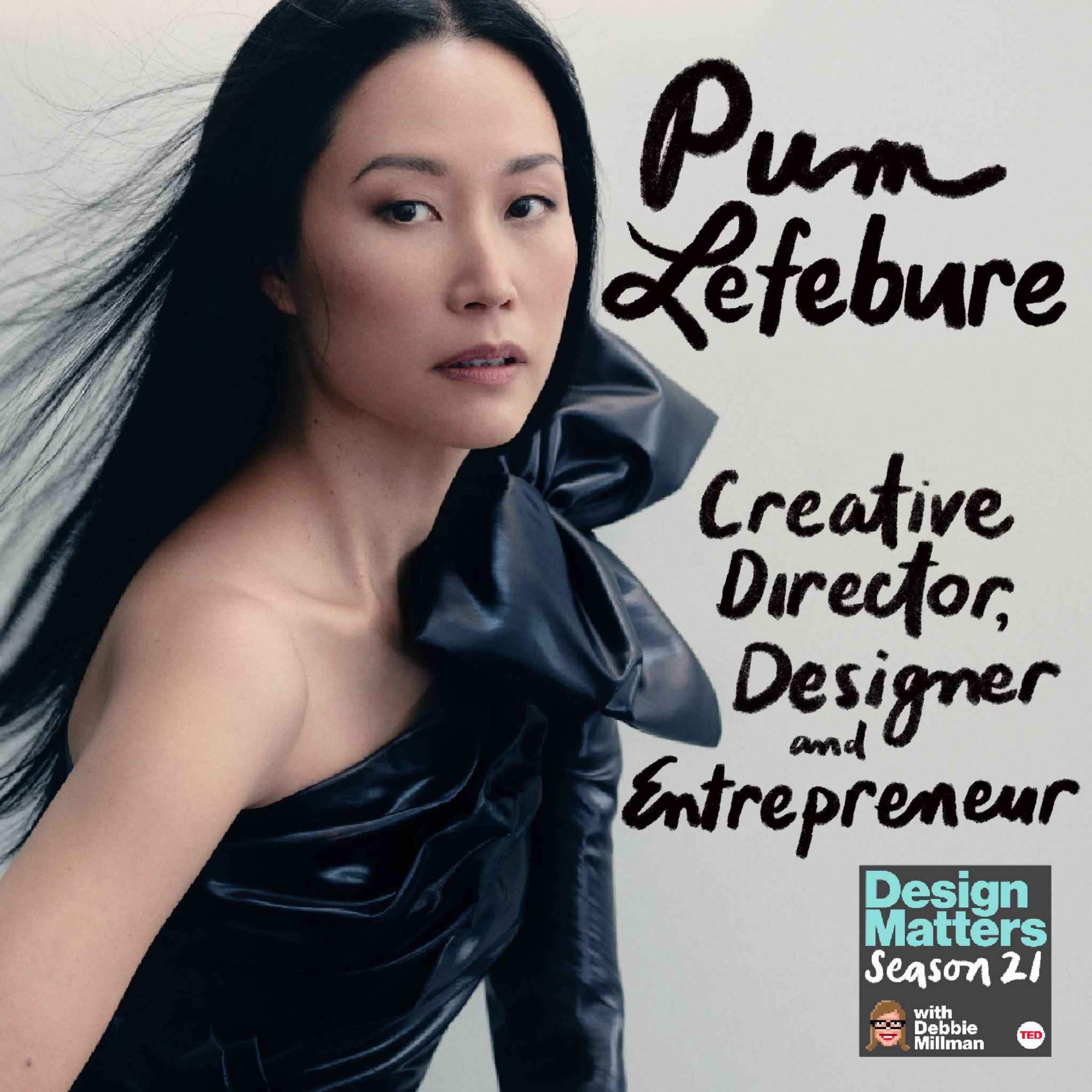
From the TED Audio Collective this is Design Matters with Debbie Millman. On Design Matters, Debbie talks with some of the most creative people in the world about what they do, how they got to be who they are and what they're thinking about and working on. On this episode, a conversation with Poom Lefebure about her career and about AI and design.
- [00:39]
Pum Lefebure
You have to be a good creative director to your AI and giving specific feedback for them to get better.
- [00:51]
Paylocity Sponsor
When everything is moving all at once, your workforce, your tech stack, your business, you don't need more tools, you need one solution. That's why Paylocity built a single platform to connect hr, finance and IT with AI driven insights and automated workflows that simplify the complex and power. What's next? Because when everything comes together in one place, growth comes easy experience. One place for all your HCM needs. Start now at paylocity.com 1 this podcast
- [01:22]
Wise Sponsor
is brought to you by Wise, the app for international people using money around the globe. With the Wise account, you can send, spend and receive in over 40 currencies with no markups and no hidden fees. Whether you're sending pounds across the pond, spending rials in Rio or getting paid in dollars for your side gig, you'll get the mid market exchange rate on every transaction plus most transfers arrive in less than 20 seconds. Join 15 million customers internationally. Be smart, Get Wise. Download the Wise app today or visit wise.com Ts and Cs apply this episode
- [01:55]
Capital One Sponsor
is brought to you by Capital One. Capital One's tech team isn't just talking about multi agentic AI. They already deployed one. It's called Chat Concierge and it's simplifying car shopping using self reflection and layered reasoning with live API checks. It doesn't just help buyers find a car they love, it helps schedule a test drive, get pre approved for financing and estimate trade in value. Advanced, intuitive and deployed. That's how they stack. That's technology. At Capital One,
- [02:27]
Debbie Millman
Pum Lefebure is the co Founder and Chief creative officer of DesignArmy, an Internet nationally recognized design studio known for its distinctive fusion of art, commerce and cultural storytelling. Born in Bangkok and now Based in Washington D.C. levapure has built a body of work that spans global campaigns for clients including Netflix, PepsiCo and the Smithsonian Institution. Work that is as visually arresting as it is strategically precise, her approach resists easy categorization. She has described design not simply as a discipline, but as a language, one that must be both deeply felt and rigorously constructed. Under her leadership, Design army has become known for a process that privileges individual vision over consensus, craft over convenience, and long term cultural impact over short term trend. At the center of her practice is a set of ongoing questions. How design creates meaning, how it moves between art and business, and what it takes to make something that doesn't just capture attention, but stays with you. Pum Lefapure welcome to Design Matters.
- [03:44]
Pum Lefebure
Nice to see you again, Debbie.
- [03:47]
Debbie Millman
Nice to see you too. It's been 15 years since our last interview. We have a lot of catching up to do. Exactly one thing that I didn't know when I interviewed you in 2011 was this. So it's a question. Is it true that you read 30 magazines every month for inspiration?
- [04:07]
Pum Lefebure
I used to, but not anymore. Now consume magazine more of through like social media and really want to see what's going on in the culture because the world is moving so fast and it's part of the job as chief creative officer to make sure that we know what's going on. Because with brands, whatever we create today might not be relevant two months from now. So it's quite important to force myself to watch those TikTok or I mean any platform I'm just interested in, but I love print as well. That will always be my love. Look at prints and books and I would just go to a magazine store in New York and stand there for an hour and just consuming visual.
- [05:03]
Debbie Millman
You grew up in Bangkok in a family of scientists. After an elementary school teacher noticed your talent and mentioned it to your parents, they were determined to provide you with access to numerous creative activities which included painting and music and dance. As scientists, what do you think your parents understood about creativity that allowed them to support it so vigorously in you?
- [05:31]
Pum Lefebure
I think they just realized that I'm not good at anything else. I was the oldest child of the four. My sibling, my all my sister and brother. They are genius. They are Fulbright scholarship students and I'm just anything but science. I don't like science. I didn't like math. I'm good at math but you know, that's not my passion. I love art, dance, creativity, you know, from drawing, painting, dancing, choreograph, you name it. I was really good at it as a kid and my parents just pretty much gave up because I was just not interested in any of the academic stuff.
- [06:17]
Debbie Millman
You said that your favorite toy as a child was a giant box of colored pencils, several hundred of them, that they felt like a kind of magic wand. What did that wand allow you to create?
- [06:31]
Pum Lefebure
The wand allowed me to be the fairy godmother in Cinderella. You know, I remember I grew up because we grew up, my two sister and my little brother, we watched Disney movie a lot growing up because, you know, English was not the first language. It's the movie and it's the animation that help us learn the language. That's why our parents let us watch and it's easy to understand. I remember, like my sisters love to be Cinderella or they want to play like, you know, all those princess that come to the ball. And I was quite interested in the fairy godmother. I was. I want to be her when I grew up because she turned pumpkin into carrots and turned a dress to be something wonderful. So the idea of this magic, to be able to transform or imagine something in my head and creating a magic for clients or friends or families or culture, I think that is very honorable thing as a human being. And pretty much I knew that if I don't create, I die.
- [07:46]
Debbie Millman
You have described yourself as a very introverted, shy child, but that art gave you a voice. What kind of voice was it? Was it expressive? Was it a way of being understood? Talk about the timbre of that voice.
- [08:04]
Pum Lefebure
I think when you are introvert, you know, as a kid, everyone's very good at being in front of the class or being in front of the stage. They express themselves, you know, in front of many people. But the way I express themselves is through painting and drawing and imagine what's in my head and get it out through my drawing and painting. And it's quite shocking when people see it because it's strange color. It's like drawing something that kind of strange and weird, especially in Thai culture. Because Thai culture, the way they teach us is about almost like traditional way. So you go to the museum, Thai museum, and you just draw exactly of what you see, which is like, you know, very like traditional way of learn how to draw. But the way I draw, I feel like I master that early on. Like, I can see I can draw exactly what I see. I was getting bored, so I start messing things up as a kid. So it looks quite messy and, you know, going over out of the lines, which is like a big no, no. In Thailand, when you learn as a kid, you. You have to like, stay in the line, stay in the line, you know, and like, share it within the line. And then I just kind of go overboard So I think when people saw was like strange or like new way of drawings. And that's how my art teacher like noticed me. And I grew up become this girl who any Bangkok competitions, they would send me to the art competition, which is quite tough, you know, in Asia they would give you, you go in and then they will give you a piece of paper and you read one page of the assignment and they start timing you. Within three hours you have to draw the concept, create a concept painting and deliver within three hours. When the bell ring, pencil down. It's a lot of pressure, which means you have to be extremely fast at thinking and executing at the same time.
- [10:28]
Debbie Millman
Now I believe you also attended Catholic school.
- [10:31]
Pum Lefebure
Yes.
- [10:32]
Debbie Millman
Did you grow up very religious? Were you around a lot of religious students?
- [10:37]
Pum Lefebure
No. The Catholic school in Thailand that I went was the same one that the Queen of Thailand went. It's a very well known school and majority of people are not Catholic necessary. But it's a good private school that you will learn a lot of western culture as well that's integrated to the curriculum. And that's why my parents want us to attend. But I did grow up have to pray three times a day at school, in the morning, before lunch and right before we leave for school. So it's in me, you know, it's in me.
- [11:16]
Debbie Millman
You have described seeing an ad, a Benetton ad that the late great Tibor Kalman designed featuring a then infamous photo of a priest and a nun kissing. And it was something that you said both scandalized and intrigued you. And I thought that was such an interesting combination, especially for a shy, introverted young girl in a Catholic school. Why both reactions and then how was it a turning point for you?
- [11:52]
Pum Lefebure
Well, I always knew that I was gonna grow up, become an artist. And not until my high school year I saw those campaigns right by Benettone, which is quite shocking. When you all your life you attend Catholic school and you saw an image of a priest kissing a nun is just shocking, especially for a 15 years old girl. Your hormone is like, you know, changing at that time. It's like, whoa, what is this? And I remember feeling butterfly in my stomach. It just, I could not get that image out of my mind because like at that time you kind of want to be kissed by someone. But this is like the nun and the priest. It's like, whoa, what is this? And then I saw another campaign with Benettong and it has picture of three raw hearts and they have type say black, white and yellow. Wow, what a profound way of talk about Humanity, that all of us are the same on the inside. So that, to me, was a turning point. I did ask myself, do I continue to want to pursue, become an artist, or is there something else, that kind of more badass career, in a way. And at that time, I thought design and advertising was a maybe a very cool career path for me. And I told my mom, I don't know, I want to do it, become an artist anymore.
- [13:31]
Debbie Millman
What do you think that image showed you about what design could do?
- [13:36]
Pum Lefebure
It has ability to stop your breathing, it take your breath away. It's an image. It's beautiful photography. It has no words. It just little green tabs say United Colors of Benetton. And you say two people united in a way that they're not supposed to be united. To me, design is not about being the loudest or funniest. Sometimes you can be shouting really quietly.
- [14:14]
Debbie Millman
It's interesting. I was also very influenced by the work of Tibor Kalman, the Benetton work, the Florent work, the Talking Heads work. And it's interesting. I'm a bit older than you, but I can envision you in Bangkok seeing that, me and Albany or New York City seeing that. And it's interesting how it could have such a similar impact on people that are in the midst of living their lives in very different ways, but also hope for very similar ways.
- [14:54]
Pum Lefebure
And that's why design is so powerful. Because, you know, at that time, I did not really speak English. But as human, when we see the picture, we see the design, we feel it. There's some subconscious thing for us to understand what that messaging means through photography and design.
- [15:18]
Debbie Millman
You came to the United States for your senior year in high school. You came on a foreign exchange program, and you just mentioned that you didn't speak English fluently. You've said that you couldn't even order food at McDonald's. So what did that kind of disorientation do to your sense of self? Did it make you more quiet? Did it make you more determined? Talk about how you felt when you got here as somebody that was highly communicative visually, but also unable to communicate in the ways that you had learned?
- [15:55]
Pum Lefebure
It was one year I came to a high school in Virginia beach, and I could not communicate with everyone. I mean, it was a huge High School, 2,000 students. They don't care who you are. They make fun of you. You are from another country. You don't speak English. I eat lunch by myself, and it can get lonely be a foreigner. But I think art is something that always carries me through.
- [16:30]
Debbie Millman
Did your students, did the students in the school begin to recognize how talented you were and how much you could make with your hands?
- [16:40]
Pum Lefebure
Yeah, I think, you know, because when I in algebra class, when I'm in English class, I mean Hamlet, I mean, what the hell? I don't understand US Government. I don't understand. I literally, it's too me almost an hour to read a page of US Government because I don't understand every English word on that page. So I know I have to work three times harder to get there. And that's always as an immigrant. That's the rule. Right. But when it come to art, I'm the shining star because everyone, like there's 30 students in there, they draw. I can draw anything. So. And again, that's why the art is the thing that carried me through all my life. And we enter to the Virginia beach or Tidewater competition in the area and I won first place, like right away, in two months after I came to the United States. And that's how I get scouted, you know, like the college saw my work and that's why like, the art is. The art is my language, design is my language.
- [17:57]
Debbie Millman
Yeah. You were translating everything word for word with a Thai dictionary.
- [18:02]
Pum Lefebure
Yes.
- [18:03]
Debbie Millman
What did that level of effort teach you?
- [18:06]
Pum Lefebure
It's discipline. I remember two o', clock, I'm out of school. I came back and I studied from 2 o' clock to 6 o', clock, had dinner with my host family, spend time with them, and I study again, like six or seven, dinner, 7:00 clock to 2:00am in the morning. I study all the way through because I don't want to be as a foreign exchange student from Thailand. I do not want to embarrass my country, you know, because to me, I representing Thailand and I don't want to get an F, you know, as simple as I want to do well. And it's changed me completely as a person. I've just become extremely diligent person.
- [18:55]
Debbie Millman
You stayed in the United States, you attended Radford University on a scholarship and majored in graphic design rather than fine art. What were you envisioning doing professionally at that point? Were you hoping to go to a graphic design studio or an advertising agency? What were your ambitions and did you want to stay in the US when you finished school?
- [19:17]
Pum Lefebure
I dream of stay in the United States. I came to this country and the freedom of expression, it's unbelievable. You know, in Thailand, there's certain things you cannot draw, there's limitation, you know, you can't say certain thing with the king or royal family or like if you say it can get people get offended quite easily in Thailand. Whereas here if you have a voice, whatever you can dream, you can draw it and create it. And I knew for sure that I would never go back to Thailand again. I would do whatever it takes to stay here on my own.
- [20:05]
Debbie Millman
You were learning English and design simultaneously. How did that shape the way that you think both about language and about design?
- [20:16]
Pum Lefebure
I think in order for other people to understand me, I speak with hand gesture a lot. You know, it helps. I draw things or communicate things to my friends or my teacher or when I was in second year in college, I work at university department and I'm such a sketcher. So I communicate everything through drawings. And by the time my sophomore year in college, I already designed a view book for the university and that was like 60 page view book. I did the whole thing with the art director. I went to press check. So I start quite young. And the summer before that I also interned at Ogilvy in Bangkok too. So I see that side of the advertising and design and I love advertising. But I decided I much better at the design department do the branding. So that's why I kind of pivot to design at ad agency.
- [21:23]
Debbie Millman
While you were still in college, you got an internship at Supan Design Group, which was a very hot agency in the 1990s. That led to a full time job. And you've described those early rooms as full of people flexing.
- [21:40]
Pum Lefebure
Oh yeah.
- [21:41]
Debbie Millman
Talk about what that was like and how you managed through that flex.
- [21:49]
Pum Lefebure
I think as a designer you can flex all day long with your mouth.
- [21:55]
Debbie Millman
Yes, you can.
- [21:56]
Pum Lefebure
But what is coming down to I don't need to say a lot. Let my work speak for itself. You cannot say a lot. But then the work is just incredibly smart Logo design, it's just like it's undeniable. It just pick itself. Like it's a strong clear winner. I mean I was like win every award. It was like print magazine, regional design award like and they used to have different region, right. So if you look at Washington D.C. it's like half of Washington D.C. the East coast is what it's called. It's like like my logos and design. So like, you know, you don't have to say much. But I did learn as a young designer, if I want to progress to be an art director one day, you have to get pretty good at presenting the work. So I learn on the job or like try to kind of break through my fear of Speaking through practicing at work.
- [23:02]
Debbie Millman
In all the research in prep for the show today, I read quite a lot about how you were constantly facing loud people in large rooms, flexing and pontificating. I never got the sense, in reading the various accounts that you've shared about that experience, that you were ever intimidated, that it ever made you less secure about your work. And I'm wondering if that's an accurate assessment and if you can share what that sort of inner countenance was to keep you sitting there and feeling worthy of contribution.
- [23:48]
Pum Lefebure
Great question. I think for young designer or young creative, you know, I was intimidated absolutely because every art director, every creative director, everyone above me, they, you know, have their opinion. Oh, I don't like this. This color is not good. Or the typography. I mean, the design is so personal and everyone can have different opinions, right? It's not Math, it's not 1 +1 =2. So it just depends on who is judging the work. But I always knew that while I was intimidated, my goal is quite clear that I wanted to become an art director one day. And I'm not going to win in by contributing negativity. Let the design speak volume and show them what is joy and positivity. And when you work with good creative director, they will turn the table to you and let you speak and explain. And they will maybe even protect you from other noises that say, oh, it's not good or whatever. And they'll give you a chance to shine. And then once that work, one communication, art, print, magazine, D&AD, then. Okay, you guys are not judging anymore. This is at world global stage. Someone have seen the work and it's global work level.
- [25:17]
Debbie Millman
So you met your now husband, Jake Lefebure at Supan Design. He was a designer when you first arrived. When did that partnership shift from work to something more?
- [25:30]
Pum Lefebure
Well, when you start, you know, working back then, you work long hours because Photoshop Volume 4 or something, it's so slow, so takes forever to rendering something. So you design and then you wait for it to render. You go out, get a drink and then come back to render it, right? Yeah, yeah, yeah. It's just probably one, one year out we start dating. But it was secret for two years. No one knows. I did not want that to be, you know, the gossip or anything of the company. Just keep it quite quiet.
- [26:08]
Debbie Millman
Were you fairly certain early on that this was a partnership that was going to be lifelong?
- [26:16]
Pum Lefebure
Not at all, no.
- [26:18]
Debbie Millman
What changed? What gave you that sense?
- [26:20]
Pum Lefebure
I mean, he's a country boy. I'm A city girl, right? I mean, he's from a very small town, Pennsylvania. I'm from Bangkok, Thailand. It cannot be any more different, but it's like a puzzle, like we. Like a puzzle that he's good at something that I'm not good at and I'm good at something that he's not good at. But we were both designers. He actually got promoted before me because Jake is really good at managing team. I was a stronger designer, but he was a very good manager though.
- [26:53]
Debbie Millman
You started as an intern at Supine, you worked your way up to senior art director. And despite what you might be saying about your lack of management skills, you were managing a 50 plus creat in just a few short years. But in 2003, after observing layoffs and instability at Supan, you and Jake chose to start your own firm. 2003 was a very sort of dubious time to start an agency. Did you both quit your jobs and start Design army together or did you do it in stages?
- [27:27]
Pum Lefebure
Stages, Jake start Design army first. I actually went to another firm as creative director and I thought, okay, it's probably going to take two years for Jake to settle and get the clients and you know, I'll just do the freelance on the side on the weekend. After two months, Jake's like, you have to quit that job because I'm busy. And right away I joined him. After two to three months, I joined Design army full time.
- [27:58]
Debbie Millman
Now, is it true that you found your first client through a yard sale flyer?
- [28:02]
Pum Lefebure
Yes.
- [28:05]
Debbie Millman
Tell us about that. Young designers are going to be going and looking at yard sale flyers now in droves.
- [28:11]
Pum Lefebure
You know what, luck has a lot to do with it, but you have to create your own luck, right? That's the famous quote. So we moved to a new house and we need to get rid of some of the junk that we don't want that anymore. So I decided to let's just create this cool Martha Stewart like turn our garage to retail experience. That is really fun because I love retail. So we do visual merchandising, poster, clothes, purse, whatever I don't want. And then I was like, I'm going to design this thing like a fashion brand. So we designed three. I designed like three different poster with different colorways and posting all around D.C. and one Saturday. So it was good. We were able to sell a lot of stuff. You didn't want it anymore. One guy at 4 o' clock came in and he helped our poster, the yard sale flyer poster. And he's like, is this a yard sale? He's like, yes, but we are about to close. And he said, who designed this yard sale? And I was like, I did.
- [29:20]
Debbie Millman
He's like, I love that you designed a yard sale.
- [29:23]
Pum Lefebure
And he was like, I love this. I'm starting a new company with my partner and we are looking for a graphic designer. And he turned out to be the right hand person of President Clinton.
- [29:40]
Debbie Millman
Oh, yes.
- [29:42]
Pum Lefebure
Yes. Him and his partner is Scott Yandura and they are starting the new political consulting firm, DC and then we took them and then we created the coolest branding for them. They hand out the business cards to all their contract clients, including the Washington Ballet. And that's how I met Septine Bever and you know, like human rights campaigns. Washington Ballet. So all their clients also become our clients because they need graphic designer.
- [30:16]
Debbie Millman
And many of those clients, I believe are still your clients.
- [30:19]
Pum Lefebure
Yes.
- [30:19]
Debbie Millman
All these years later, 23 years later.
- [30:21]
Pum Lefebure
Yeah.
- [30:22]
Mint Mobile Sponsor
Yep.
- [30:23]
Debbie Millman
What made you decide to name the firm Design Army?
- [30:27]
Pum Lefebure
Because love is such a bad design firm name.
- [30:34]
Debbie Millman
That's your maiden name?
- [30:35]
Pum Lefebure
Yeah, maiden name. It was Lover Bior and my last name was Mega Rung, which is difficult. Terrible name.
- [30:43]
Debbie Millman
Well, I think it's actually quite a beautiful name. But I can understand that it might be hard for people to pronounce when seeing it in letter forms because I was actually wanting to ask you about it, but I was afraid that I'd mispronounce and I didn't want to do that.
- [30:58]
Pum Lefebure
But I thought we were brainstorming the design, you know, the name, and I just want the dot com. I was just like, I don't want dot net, whatever. I want anything that a variable that had dot com on and we had like hundreds of name. And I also told Jake I want the word design in it. You know, Design Army. I was like, oh, okay, that's cool. There's army of two.
- [31:23]
Debbie Millman
Great.
- [31:23]
Pum Lefebure
You know, and then we literally take the name because it's so easy to remember. And we have a vision that we will have international clients too. So the language has to be quite easy. And then we went with Design Army.
- [31:38]
Debbie Millman
It was available three months after starting Design Army. You found out you were pregnant.
- [31:44]
Pum Lefebure
Yeah.
- [31:45]
Debbie Millman
What did that moment do to your sense of control about the business and your life?
- [31:52]
Pum Lefebure
I'm such a control freak. And when that happened, you know that you thought you were going to start Design army and make it so cool. And in five years we will have kids and you find out three months, it's like, shit, Jake. I blame it on Jake.
- [32:11]
Debbie Millman
I love how you're blaming Jake for this.
- [32:15]
Pum Lefebure
I mean, you're like young and you're in your 20s like this. I'm not ready to be a mom yet. Like, why don't you, like, get it together? So, like, I was mad at him but excited at the same time. And my mom's like, oh, let's take a look. We're going to go to the Fortune tailor and let's see. And he's like, it's going to be a boy. Absolutely. This is like a year that if you have, it's going to be a boy. And of course it turned out to be a girl. We have no control. As much as want to control everything in my life, certain things, it was just kind of like you can't control it.
- [32:52]
Debbie Millman
One of the things that I loved most about reading about your history was how you shifted the question from why can't I have both? To how can I have both? What allowed you to do that and what shifted in you to bring that realization to life?
- [33:18]
Pum Lefebure
I think the why and the how is a mindset, a why. You pick the why put you in a position of victim in a way, like why this happening to me now, why it has to be this way. So the more you ask yourself that question, you're going to get more depressed. Whereas the how is like, because I am now pregnant, how do I make Design army the best design firm in the country? And how do I make sure that I'm a good mom? It's a completely mindset and that's like power of human, you know, like you can really train your brain to think, think positively and find a way to get what you want. I am a firm believer that you either satisfy with dissatisfaction or do something about it. And the only person that can make that change is you. No one else tell me.
- [34:32]
Debbie Millman
And I'd love for our listeners to hear about what you called Sophie Sundays.
- [34:40]
Pum Lefebure
Sophie Sundays. I worked all the time, you know, as a young designer in my 20s. You know, you have to do whatever it takes. So you're not only looking at the design, create design, go see the client. You have to be in charge of the financial as well. I look at Excel file quite closely every weekend. Sophie Sunday is a day that it's I do nothing, do nothing. Except Sophie. That's her day. Unfortunately, she only have one day because majority of other day pum is usually at photo shoot. I'm on the road a lot, so Sophie spent a lot of time with Jake growing up, you know, because he's in charge on the business side, whereas I'M always constantly on the shoot and be with clients and spread the word of Design army out there. So I'm on the road quite a bit. But then Sunday, it's no one else day except her and I. We sit in the tub together, we play, we go shopping, get ice cream. Just basic stuff.
- [35:52]
Debbie Millman
You, I love this about you. Sophie, your daughter was featured. She's now in her early 20s, and she was featured in an article in New York magazine in the Cut about what it was like to grow up with a highly ambitious, highly entrepreneurial mom. And one of the things that she said was if you don't like being bossed around, then you probably wouldn't like working for her.
- [36:23]
Pum Lefebure
She's so funny because she's 8 years old at that time or something quite young, maybe probably 10, 8 to 10, I can't remember. But she's being honest. That's her perspective of how she sees things. Right? I mean, at that time, we still have our own building, the design army. Probably 25, 30 people, three different floor. First floor was social media department. Second floor and third floor is design department. And it's constant. I had two assistants at that time. It was really, really busy. Time that I work constantly, nonstop.
- [37:04]
Debbie Millman
Is the business as big as it was then?
- [37:07]
Pum Lefebure
We charge less because we were young. I charge more now because I'm older and we have so much more experience and we take less project now, actually. But at that time, when you, you know, when you're in your 30s and you're so hungry and you want to take company in Washington, D.C. to become nationally recognized or even internationally recognized, the drive took me there. And I know time is something that we all don't have, but I knew if I work all the time, I have to be quite disciplined and be quite clear with my team. I don't like long meetings at all. You know, everything is increment of 15 minutes, half an hour max. When people come to the office, they have to be prepared because, like, I don't like, spend a lot of time wasting at all, so. Which maybe appear quite bossy or too direct, but, you know, I'm proud to do that because I feel like I don't want to. To take away their valuable time at work. And I don't believe working weekends.
- [38:20]
Debbie Millman
One of the things that I read after you left Supan was that you learned that what you didn't want was your own company to be big and unwieldy. And you've always wanted Design army to be a boutique, which is why I was really surprised when you talked about the sort of size earlier on. But you also said that there's no Kumbaya at Design Army. You do not sit down and have brainstorming sessions. You prioritize working alone first. Why is that?
- [38:50]
Pum Lefebure
My philosophy about Kumbaya is that sometimes when you have a group meeting you have a group thinking and not things really come out of it purely. It is better that I give assignments to a design team and everyone go there on own separate way to dream. When you dream, you dream alone, you don't dream as a group and that's when I get the most purest human emotionally work from each one of the designer go dream alone and bring their dream into the table and then we have a meeting and listen to each and every one of their dreams separately. And sometimes, you know, this person can have this dream quite similar to this person, then they come together. But I just think the process when you think individually is much better because it's like no one. Like no creative director can overshadow an intern. Like I want to hear the interns as much as the creative director because sometimes the idea is fresher. Maybe it's crazy, but it's fresh.
- [40:14]
Capital One Bank Sponsor
With no fees or minimums on checking accounts, it's no wonder the Capital One bank guy is so passionate about banking with Capital One. If he were here, he wouldn't just tell you about no fees or minimums. He'd also talk about how most Capital One cafes are open seven days a week to assist with your banking needs. Yep, even on weekends it's pretty much all he talks about in a good way. What's in your wallet terms apply see capitalone.com bank capital1na member FDIC
- [40:44]
Wise Sponsor
this podcast is brought to you by Wise, the app for international people using money around the globe. With the Wise account, you can send, spend and receive in over 40 currencies with no markups and no hidden fees. Whether you're sending pounds across the pond, spending riyals in Rio, or getting paid in dollars for your side gig, you'll get the mid market exchange rate on every transaction. Plus most transfers arrive in less than 20 seconds. Join 15 million customers internationally. Be smart, Get Wise Download the Wise app today or visit wise.com Ts and Cs.
- [41:17]
Mint Mobile Sponsor
Apply Ryan Reynolds here from Mint Mobile with a message for everyone paying big wireless way too much. Please, for the love of everything good in this world, stop with Mint. You can get premium wireless for just 15amonth. Of course, if you enjoy overpaying, no judgments. But that's weird. Okay, one judgment anyway, give it a try@mintmobile.com Switch upfront payment of $45 for
- [41:41]
Capital One Sponsor
three month plan equivalent to 15 per month required Intro rate first three months only, then full price plan options available, taxes and fees extra. See full terms@mintmobile.com this episode is brought to you by Choiceology, an original podcast from Charles Schwab hosted by Katie Milkman, an award winning behavioral scientist and author of best selling book how to Change. Choiceology is a about the psychology and economics behind our decisions. Hear true stories from Nobel laureates, authors, athletes and everyday people about why we do the things we do. Listen to choiceology@schwab.com podcast or wherever you listen.
- [42:21]
Debbie Millman
You recently created a campaign for an eyewear company and the concept revolved around high fashion Mars explorers who had to wear glasses to protect their eyes from the harsh dry air and UV light. And you've been very upfront about using artificial intelligence in the creation of the campaign. And you were really one of the first high powered, well known designers to talk about using AI. The campaign that you did got quite a lot of press because I don't think anyone could have possibly considered the idea that you were using artificial intelligence in the creation of this campaign for a few reasons. One, because it was just extraordinarily well art directed and also it felt very much in the Pum lefebure design army milieu. I'd really love to hear your thoughts on using artificial intelligence. How you learned how to do it, how you talk to your clients about doing it, how you have been able to integrate it into both the campaign that you did for the eyewear company as well as what you might be doing currently.
- [43:45]
Pum Lefebure
I was really curious about this AI 4 years ago, like even.
- [43:51]
Debbie Millman
Yeah, you were the first.
- [43:52]
Pum Lefebure
Yes.
- [43:52]
Debbie Millman
Like honestly hum, there was no one that was doing this but you in any kind of real genuine artistic manner. It blew my mind when I saw it.
- [44:02]
Pum Lefebure
Thank you. I remember during COVID I heard this thing called Midjourney and I was just super curious because I was trying to renovate my room, my house and I always want to be an architect and design a room. So I was like okay, since I don't know Cat, let's just design a room. So I was like imagine, you know, creating a prompt and upload some photo and then it start showing me what kind of interior I can create. So more and more I was obsessed with Mid Journey and it was like how do I test this with a client? And then at that time we have a client called Georgetown Optician. And they have like five different retail store in mid Atlantic regions. And they sell eyewear as well. You know, like a very well known eyewear brand like Cartier and Chrome Heart and so forth. And it was during COVID No client wants to spend money. So usually we do like really elaborate movie with huge cast for this client. But at that time the client's like, okay, I'm not spending. So I thought, okay, what can I do? Because I'm like itching and dying slowly from not creating. So I pitched to the client an idea. Hey, I know you have library of eyeglasses on your E comm site, which is just glasses on the white background. Can I have those JPEG files? And I want to do something with this thing called AI Midjourney. So I was working with the concept of how to take the glasses, creating the AI character and the AI world. And then I finally figured out how to do it and pitch the client this campaign called Adventure in A I E Y E and use it as an artist experiment and do a social media campaign for them. And they were mind blowing because it's like it looks like a very expensive photo shoot, but we create it in a way that it doesn't look so real. It looks kind of like a 1950 poster. So it has like, you know, not we not try to make AI look real. I don't like that. I think it should look like AI intentionally so it looks like a 1950 era. But there's something is rooted in the future. So is it 1950 or 2050? You can't tell, right? But then everyone's wearing pink and recreating the story with it. And that was the first time a design agency figured out how to use this thing. And that's why Fast Company and at Vegan adage everyone was like, how did you do it?
- [47:03]
Debbie Millman
Well, it doesn't even seem possible that that level of creativity can be rendered with artificial intelligence. I read that you spent months understanding how to write prompts. You said it took many long, frustrating sessions spewing out people with seven fingers and three ey eyeballs, but that your knowledge of art and photography helped a great deal. Can you talk about how you were able to iterate your prompts to be able to get the high level of expertise that is embedded in what looks like highly styled on location photography?
- [47:55]
Pum Lefebure
I think because I have been in so many photo shoot in my life, I have the vocabulary to train my AI to give me exactly what I want in my head. And it takes a while to get there. You know, for example, I was extremely specific with AI that the lighting has to come from the top left and it's, you know, we want the temperature to feel like 72 degree in a foggy morning with the sunlight coming through the left using, you know, Kodak films. You know, like it's quite specific knowledge. And the reason I can do that, because I did it in real life before, right? So like without that knowledge of being a creative director on set and really observing how photographer adjust the lighting and what lens they use, you would not have that vocabulary to train AI. So it's funny because I was the one that started this AI experimental because at that time my designers are too busy and I didn't want for them to have to do this extra work after office hour because we're busy during the day. So I spent a lot of time learning it first myself before I can pitch to my design teams and say, hey, you guys, take a look at this. I think this is going to be the next move and we should jump on it quite quickly with this project with the client and use it as a test. And we will be far advanced than other competitor. There's a famous quote that say, I won't replace you, but someone that know AI will. And we didn't want to be left behind. We want to experiment even though it can be a huge waste of time. But you have to be bilingual in AI languages. It's a new language that we all must learn.
- [50:11]
Debbie Millman
You spent months training systems to be able to give you the output. At what point, if at all, did the systems begin to understand you and what you were asking for?
- [50:25]
Pum Lefebure
I think after probably two months. But that was like every single night through three, four o' clock in the morning. Because I was trying to create this character, Alien. Like alien, you know, but alien. And it just looks so bad for five weeks it just looks ridiculous. And then somehow you, you, you giving a feedback to like it looks too cartoony, it needs to be more of this, this, this and it start training itself and it get better. But you have to be a good creative director to your AI and giving specific feedback for them to get better.
- [51:07]
Debbie Millman
I have been experimenting with AI now for probably the last year and a half, two years. And I find it really helpful in gathering information. Quite a lot of people feel that it somehow will eliminate jobs or diminish jobs. One of the things that I am worried about that I've been witnessing is how people are using AI that don't have that knowledge that you've already Gained through your work as an art director and your knowledge of art and photography. How are you feeling in general about how and when people should or could or what would your recommendation be for using AI as a practitioner? Talk about when you feel AI is most useful for the human spirit.
- [52:10]
Pum Lefebure
I think the AI can either make you better or make you become more stupid. I have seen because I test with my team too, right? So some people who use AI correctly, they will use AI almost as a back of the house, as a process of creating. But they bring their own knowledge and their own idea into it. And you can tell that it's not just like give me a picture of Annie live with. That's not because like AI going to go scrape the Internet and it's going to project out whatever was out there. And you can tell if someone was not thoughtful at their prom and then it just feel like AI is losing soul. You have to be very thoughtful when you use AI because if you're not thoughtful and you just write down random prompt, their job is just to spit picture or information. But it's up to us, the human, to reject the stupidity. That's why the feedback today is so important. But back to the do I fear of how people use AI? I do. I have seen our work for Washington Ballet was a reference for someone and someone used AI looks kind of like that. So it's a wild west and some regulation would be good because not every kids know they don't understand copyright infringement. So it's just like, okay, let's prompt. AI is fast and easy, it's done. But then the next thing you look at is like, hey, this look exactly like this campaign from the 80s, you know? So then that's when it's become embarrassing when you rely too much on AI to spit whatever they come up with and just say done without having knowledge of like really make sure that it doesn't look like something that's already exist, which is come back to like, you have to have a knowledge and be a good curator to say yes, acceptable. No, it's not acceptable. No, this is too close. This looks, you know, look and smell like something. So no, I'm not showing to the client. So the human has to be in the lead, not just in the loop. For me now looking toward year 2030, I'm asking myself, when AI can do more and more of your work, what will people still coming to you for?
- [55:05]
Debbie Millman
What are your thoughts on that right now?
- [55:07]
Pum Lefebure
I don't know. I think that's a question for me to ask to everyone in this audience, you know, because it is here and AI will be able to do more and more of your work. What will people still coming to you for? What is your value? I think that's all of us to answer.
- [55:25]
Debbie Millman
Well, do people want the AI version of Pum Lefebure's Mind Design army or do they want whom Levabure's mind to Design army that is directing the AI? I think there's a very different output. I. I think that if somebody else is using your prompts, they're still not going to necessarily make the same work. Or do you disagree with that?
- [55:51]
Pum Lefebure
No, it's not the same work because the feedback is different.
- [55:56]
Debbie Millman
Right.
- [55:57]
Pum Lefebure
I'm just, I just feel like, you know, I'm just trying to think 10 years from now on, I really believe that AI can do a lot of entry level design work. But I still think the client still going to be hiring Design army and many of great firm that we know because of the founder and the people and the creative director in that agency because we are bringing in the human knowledge means. Okay, AI can creating this looks great, but do you feel anything? Look at it. I mean now it's so many AI images. I'm just kind of like meh.
- [56:40]
Debbie Millman
I'm assuming you can always tell.
- [56:42]
Pum Lefebure
It's getting harder to tell. Yeah. Like Prada just did an ad campaign with AI you know, have this kind of big ego AI character but mixed with fashion model and they interact with each other. So I thought it was cool. Like it's memorable and catchy right away. For me, that's really smart way to use AI. I did a huge installation in downtown Washington D.C. called Cityscape. And we created this beautiful Renaissance painting. So we create each flower like tulips and cherry blossom, even have panda hanging. Like create this huge mural using AI but then we still kind of composite and collage them together. So there's so many way to use AI. I don't think we all figured out how to use that completely yet. It's more to come.
- [57:41]
Debbie Millman
I'm old enough now to have lived through three big technological moments in design. The first with the transition from the drafting table to the computer. And then the second from in real life to online. And both times, you know, with the birth of the Internet, with the birth of the computer as a tool, we heard over and over and over again how this was going to destroy the design business, destroy design jobs. In fact, it volumetrically increased design jobs. And there are hundreds of thousands of designers now in all walks of, of discipline, whether it be product design, industrial design, interactive design, graphic design. Does this feel different to you than those other transformational shifts? Are you more worried about AI than you were about the other two transitions?
- [58:41]
Pum Lefebure
No, I welcome new technology, but I'm more worried that people will become more stupid. I think it's like when we start realy too much on what the AI can spit and say it's good enough, then it's almost like how good does design have to be in the future? I hope it has to be really good because there's going to be so many mediocre normal AI can do this, this and this. But there has to be like someone that can do very human level, that touch you. Just like United Color Benetton touched me when I was 15 and I don't know if AI going to get us there. I think human going to get us there.
- [59:35]
Debbie Millman
One of the things that I've been thinking quite a lot about was the moment I started using computers back in the 80s. And in many ways I got lucky because I was one of the last generations that was trained on the drafting table and then moved into using the computer in my 20s. I suspect that we are now in this particular moment in time, in 2026, probably one of the last generations that will have learned how to create without AI as a tool.
- [60:18]
Pum Lefebure
Interesting.
- [60:19]
Debbie Millman
And I'm wondering if there will be a vacuum in not having that experience of using AI as a creative tool, just using our own sort of abilities to provide the work that we create. One of the great things about AI is that it does let you do more than you know how to do. But it also requires a great deal of knowledge, I think, to do something really interesting with it.
- [60:54]
Pum Lefebure
Yeah, I mean that's why at Design army, believe it or not, I still tell my team to like sketch to death. It's funny because we present a work to a really big brand last year, last week, big global brand. And the client was like, wow, I have not seen the logo that this much thinking and thoughtful for a very, very long time. I thought it was a dying art. And the reason is that we didn't show the client sketch. But the thinking is came from a deep, deep place of human. It was not go right in computer. And that's why we still sketching. Whether it's logo or ad campaign or key visual anything, it's still hand sketching. Then you know when you close your eyes and you draw it and you know what it's going to be, then it's easy to tell AI when it yes, good enough or no, this is crap because you know where it has to land. So without really understand where you need to end up and you start like splitting and experimenting with AI, then there's no goal. Then you're just like, okay, that's good. Wherever the wind blow, I'm blowing with it. Versus having a very clear goal of where AI have to hit to hit. Your vision.
- [62:23]
Debbie Millman
We talked earlier in our conversation about being in a room where you were witnessing a lot of people flexing. You were the more introverted, shy participant. You are now the co founder and chief creative director of your firm. You're also the chair of the board at the One Club for Creativity, where you are leading the organization into bold new times with quite a lot of innovation and leadership. So talk about how you approach leadership in your life now.
- [63:03]
Pum Lefebure
I am currently the chairman of the board of the One Club for Creativity and I have been on the board for 13 years. Let me tell you a little secret. When I first started, Yes. I was one of three women on the board. The rest are all male. And it was intimidating time. It's, you know, ad agency, big guys from basically network, lots of flex, plenty of flex. Ms. Pum does not talk. For two years, I observed everything. And on top of that, you have to understand you are one of the three females. You are the only designer. There's one other male designer. So back then, designer, it's just like, okay, they just do pretty stuff and I'm Asian. So it was a lot to get through. But you learn to observe and you learn to not say silly things in the meeting. And then after year, I was advocate of having more female on the board because it's so lopsided, you know, and guys and girls, we all good, we all friends, but we don't think the same female has much more empathy and understanding. And you know, it's just like we must have more female on the board. And then come diversity, you know, I don't want to be the only diverse person, you know. So we have more diversity and inclusion and we are proud today. We are very diverse on the One Club board as well as adc, which you are part of the board too, lead by Brian Collins and TDC too. So. So the organization, I think is very well represented and is really important because our industry, creative design, technology, we need a lot of voices.
- [65:06]
Debbie Millman
Absolutely. My last question for you, when you think about that child with the colored pencils as wands, what still feels the same in the way that you approach creativity and what has changed and evolved for you.
- [65:26]
Pum Lefebure
The same is I feel like the one, it's still here. You know, as long as I live, I will always look out the window or staring at the ceiling and think about ideas. I love ideas. And the one now is like I'm not sitting down and designed every day. I have design team now. So I work with them and they make that magic even more beautiful and more sparkle, even better than me. I'm very fortunate with my team. So like the same is just like because as long as I leave, I want to create. If I don't create, I die. So that's always going to be the same. The difference is I think the media landscapes change a lot, right? So the graphic design, like literally I Remember in the 90s it's like annual report, you have KN and associate, you have, you know, like no one does annual report now. So and, and everything is moving to much more video, social media. And now it's not even social media, it's much more about interest media of whatever you interested in, it will come to you. Like if I'm looking at, you know, hotel and beautiful vacation in Thailand and then that's what I want to see on my feet. So like the difference is like as a creative, creative person, you always have to put yourself in an uncomfortable situation and a newness all the time because the world is moving really fast. And if I don't ever want to be a creative director, let's say, oh kids this day, they don't do this, this and this. No, I want to be like Gen Z. I want to be Gen Z. I want to think like them. I want to work like a startup. I don't think that this army is a well established company. I want Designe to think like a startup every single day coming to work and that's how it keep us grounded and keep us relevant to very fast changing world.
- [67:44]
Debbie Millman
Pum Lefebur, thank you for making so much work that matters. And thank you for joining me today on Design Matters.
- [67:51]
Pum Lefebure
Thank you, Debbie.
- [67:52]
Debbie Millman
You can read more about Pum Lefabur and see the work by Design army on their website designarmy.com this is the 21st year we've been podcasting Design Matters and I'd like to thank you for listening. And remember, remember, we can talk about making a difference. We can make a difference or we can do both. I'm Debbie Melman and I look forward to talking with you again soon.
- [68:15]
Design Matters is produced for the TED Audio Collective by Curtis Fox Productions. The interviews are usually recorded at the Masters in Branding program at the School of Visual Arts in New York City, the first and longest running branding program in the world. The Editor in Chief of Design Matters Media is is Emily Weiland.
- [68:38]
Capital One Sponsor
This episode is brought to you by Capital One. Capital One's tech team isn't just talking about multi agentic AI. They already deployed one. It's called Chat Concierge and it's simplifying car shopping using self reflection and layered reasoning with live API checks. It doesn't just help buyers find a car they love, it helps schedule a test drive, get pre approved for financing and estimate trade in value. Advanced, intuitive and deployed. That's how they stack. That's technology at Capital One.
- [69:09]
Capital One Bank Sponsor
Spring Fest is heating up at Lowe's and for a limited time we have the extra big deals you need to impress guests. Get your outdoor space ready and save $50 on a select cobalt 24 volt blower kit now $79 plus save $80 on a char broil performance four burner grill now $199. It springs up and our best lineup is here at Lowe's, valid through 413 while supplies last selection varies by location.
- [69:37]
Capital One Sponsor
This episode is brought to you by Choiceology, an original podcast from Charles Schwab. Hosted by Katie Milkman, an award winning behavioral scientist and author of best selling book how to Change, Choiceology is a show about the psychology and economics behind our decisions. Hear true stories from Nobel laureates, authors, athletes and everyday people about why we do the things we do. Listen to choiceology@schwab.com podcast or wherever you listen.
- [70:07]
Hannah Burner
This is Hannah Burner from Giggly Squad. Opill is the first over the counter daily birth control pill available in the us. Let's be real, getting a birth control prescription is not always easy and it's so much admin. In fact, about a third of women face barriers to access prescription birth control between scheduling appointments, missing work class or just trying to exist. It's a lot. But now opill is putting birth control in our control opill is a daily birth control that's FDA approved, full prescription, strength and estrogen free and 98% effective when used as directed. Grab it online or at most major retailers. No prescription or doctor's appointment needed. So if you're thinking about birth control, check out opill to see if it's right for you. Use code giggly for 25 off your first month of opill at O-P-I-L-L.com that's code gigliopil.com birth control in your control. We love to see it.
- [71:02]
Paige Desorvo
Hey, this is Paige desorvo from Giggly Squad and this episode is presented by Depop. Okay, be honest. How many things in your closet are just sitting there waiting for their next main character moment instead of staring at them? List them. You can list an item in just a few taps on Depop. Snap a photo and their AI powered listing fills in the detail sales and you're done. It's not giving stressful and it's giving efficient and make money easily. With no selling fees on Depop, no seller fees means what you earn is yours. Your personal taste has value. Someone is literally looking for what you're not wearing. Download the Depop app and list your first item today.