Loading summary
Transcript105 lines
- [00:01]
Debbie Millman
TED Audio Collective.
- [00:08]
Unknown Sponsor
This episode is brought to you by Progressive Insurance. You chose to hit play on this podcast today. Smart Choice make another smart choice with Auto Quote Explorer to compare rates from multiple car insurance companies all at once. Try it@progressive.com Progressive Casualty Insurance Company and affiliate is not available in all states or situations. Prices vary based on how you buy. Proving trust is more important than ever, especially when it comes to your security program. VANTA helps centralize program requirements and automate evidence collection for frameworks like SoC2, ISO 27001, HIPAA and more. So you save time and money and build customer trust. And with vanta, you get continuous visibility into the state of your controls. Join more than 8,000 global companies like Atlassian FlowHealth and Quora who trust VANTA to manage risk and prove security in real time. Now that's a new way to GRC. Learn more@vanta.com Ted Audio that's vanta.com Ted Audio.
- [01:10]
Sarah Lewis
Where would we be in our understanding of the United States without culture, without art? Like, try to explain it to someone and you really can't.
- [01:25]
Debbie Millman
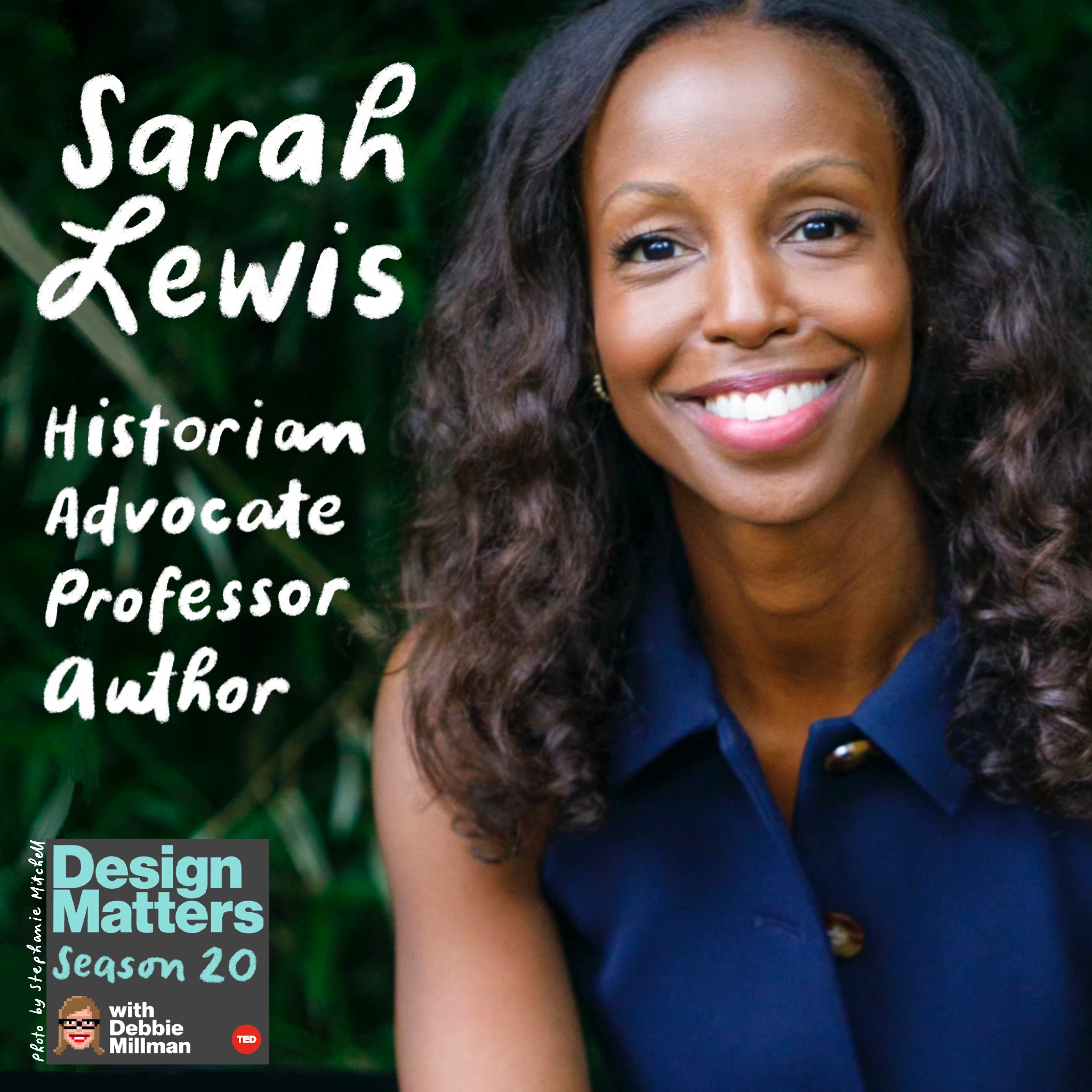
From the TED Audio Collective this is Design Matters with Debbie Milner. On Design Matters, Debbie talks with designers and other creative people about what they do, how they got to be who they are, and what they're thinking about and working on. On this episode, Sarah Lewis talks about how art and images shape our political and social reality.
- [01:48]
Sarah Lewis
We construct narratives to bolster regimes of who belongs and who counts through visual landscape.
- [01:59]
Debbie Millman
Some people think that race is a fiction, yet it is a fiction that our society has kept lethally alive for a long time now. How? Well, it is all about the details. To make a fictional world seem real, you have to fill it in with images and sensory information. You also have to leave most of the real world out, but if you succeed, the real world will look a little different for your readers. In her new book, the Unseen When Race Change Sight in America, Sarah Lewis traces the visual history of race in America. She explains how art, photographs, movies, and pop culture turned the fictional idea of race into a destructive cultural fact. It's a scholarly tour de force and a literal eye opener. Sara Lewis is a celebrated art and cultural historian and a professor at Harvard University. She's also the founder of Vision and Justice, a civic initiative to reveal the important role of visual culture in shaping how we think. Sarah Lewis, welcome to Design Matters.
- [03:13]
Sarah Lewis
Thank you so much for having me. It's really an honor to speak with you, Sarah.
- [03:17]
Debbie Millman
I understand when you were in high school you were a 400 meter sprinter.
- [03:21]
Sarah Lewis
Ah, how did you find this out? Yes, I was. I loved running. That was my race. Hard, hard race.
- [03:30]
Debbie Millman
And so did you have hopes to be an athlete of some sort?
- [03:34]
Sarah Lewis
I did. You know, I grew up in the era when Flo Jo was running and, you know, made us understand that, you know, dreams were realized on the track. And those dreams I thought might be mine too. I thought I might run professionally and, you know, genetically I was vast. But, you know, I didn't love the training, I didn't love the regimen. So in the end, I still run. I don't run competitively, but I keep threatening I'll do more marathons and things like that to keep it going.
- [04:10]
Debbie Millman
You were born and raised in New York City and you were named after your grandfather, Shadrach Emmanuel Lee, with whom you share the initials s. In 1926, when he was in the 11th grade, he was expelled from a New York City public school for asking why his history textbooks only showed images of white Americans. Can you talk about what happened next?
- [04:38]
Sarah Lewis
My grandfather went through the experience that you described so beautifully, and I knew nothing about it until he died when I was in college, getting ready to go to his funeral, I asked my mother why he didn't have a high school diploma. You know, he was so sharp and understood so much, and I didn't understand it. I was in college at Harvard at the time. And she told me this story. She told me that what came next is. And that's really what transformed my own understanding about the power of the arts was. It was startling to me, she told me, that he dared to ask his teacher why he was receiving that answer, that African Americans in particular had done nothing to merit inclusion in those textbooks. And he was asking about the whole world. He wanted to know where Asian Americans were, Latin Americans were, indigenous folks were. He didn't accept her answer. And he was expelled from public school, from high school, for his so called impertinence at refusing to do so. He became an artist, he became a musician. And in those paintings and drawings, he created the very genre scenes he knew he should have been able to find in those textbooks. He was consistent and insistent on ensuring that the whole world was present in those images. I grew up at his knee, wanting to draw, learning to paint from him, stunned by this visual display that I described. And so when I learned about what he did next there, really that day at his funeral, I realized, well, of course, that in bearing his initials, S, E, L, my name is so much less cool than my grandfather's. Though Shadrach, Emmanuel Lee. I was in lineage, and I realized in that moment I could be in lineage with a set of questions that I now realize would occupy the mission of my life. What is the role of art for justice in American society? That's really what he was asking his teacher, and that's. And the answer, he is one that he lived out at that time. You know, in college, I think many of us studying the arts were not told much about the connection between culture, art, and racial politics. So I began to teach myself, and that worked, results in the courses I teach at Harvard and many of the publications that have come out since.
- [07:18]
Debbie Millman
As you were growing up, in addition to sprinting, you also took salsa lessons. And inspired by your grandfather, you also started painting. What kinds of things were you painting at that time?
- [07:30]
Sarah Lewis
So I was painting the way that my grandfather did. I was in a class. I went to Brearley All Girls School in New York growing up. And the program, the curriculum there really focused us on still lives and figurative painting. So I was doing what was asked of me as I learned to paint, but I was, without knowing it, making sure the whole world was present, too. My mother showed me recently a very early painting I made when we were asked to paint Pilgrims, and it was maybe in eight or nine. My pilgrim was black. My pilgrim was black, you know, with these same kind of black buckled shoes. And I love that no one corrected me right, that young age. No one told me about this history. And in so doing, they were letting me create a visual image that inserted my own identity as the center. Right. And, of course, I now deeply understand the tensions in the fabric of this country between slavery and freedom, and teach on this, of course, at Harvard. But at the time, the paintings I made telegraphed that I understood that we all count, you know, in American society. So that's what I was up to. I thought I might, after I abandoned my, you know, running ambitions, be an artist. And even in my first year, not really after that, but first year at Harvard, I thought I would be a painter still, but love that I'm able now to think about the significance of the arts in a broader way than I probably could have if I was an artist full time.
- [09:10]
Debbie Millman
When you applied to Harvard, you wrote your application essay on failure. Why that topic?
- [09:20]
Sarah Lewis
Can I just say, I need to salute the extraordinary research you do with all of your guests, and I'm feeling the benefit of it here myself. Oh, my goodness. You know so much about the journey. Thank you.
- [09:33]
Debbie Millman
Thank you.
- [09:34]
Sarah Lewis
I did. I wrote about failure from My application essay to Harvard. And it was, I thought, without even asking anyone, such an ill advised idea that I didn't tell anyone about it. I made this decision and I remember even asking my parents to leave the house one day over the weekend so I could write the piece in peace. And then it was a Sunday, you know, the next day, bring it to school and submit it. It was about failure broadly, but really more about the gift of failure that comes and that we all know happens in the creative arts. I was interested in the improbable but irreplaceable foundations of these experiences we wish we didn't have for the transformation and potentially the triumphs that could come. You know, I'd had this experience that was unique at the time and I wrote about that experience. It was the NAACP when I was growing up, had an Olympiads. It was this Olympic competition, multiple fields, so you could enter it in painting or, you know, the sciences. And every state had a competition. And then there was a national competition and it would take place in an arena the size of a football field. The awards were given out, you know, to an audience that large. It's extraordinary. And I had one in the painting category in one year as a ninth grader, and then one at the national level. You know, the prize was a computer and some money. And so as a kid it had a huge impact on me. And I didn't think anything of my work on that level until that award. I tried again two years later and I don't think I even placed enough to go to the national level. And it felt like a massive failure because of how public it was for my peers. It began my own just pursuit, which led to other work, other publications about the gift of failure. Because I think, especially when you're going to schools that really condition you to believe in your own success. Failure goes against your very understanding of who you are and can rock you to your core, especially as a young person. So I want to, to write a piece that was a vulnerable one, you know, for the application to speak to a kind of resilience that I thought I'd cultivated through the process and I'm glad it worked.
- [12:12]
Debbie Millman
How did you cultivate? But how did you. I mean, that's pretty young to cultivate. I'm still working on trying to understand my own rejections and failures in a more sort of productive, mature way. How were you able to do that at such a young age?
- [12:27]
Sarah Lewis
It's a great question. I'm not sure that I've. I can process it with you I don't know that I've asked myself that question internally, but at that age, I, you know, 17, 18, young black woman growing up in New York City, in Manhattan at that. I think I had learned even then to take the gift of being underestimated seriously. And it's connected to the idea of failure. Right? Because when you're underestimated, you are seen to be a failure, in effect, in the eyes of whomever is judging you as compared to who you actually are and who you could be. And you're aware of that gap in their perception of you and the fact of who you can become. And that gap is failure. Right. That gap is a failure of imagination. It's a failure of judgment. It's a failure of the history of narratives that have told women who they can be, that told black women who they can be. So what I was already gleaning from what the world was telling me was that I was going to have to contend with this sort of environment in which failure was around me despite my successes. That experience, you know, is one that I derive strength from now still, because we. I think the odds of me just walking a street and someone assuming that I do what I do, if they look at me, are pretty low still, right?
- [14:02]
Debbie Millman
Yeah. I hate to say yes, but yes.
- [14:04]
Sarah Lewis
Even though I'm a deep optimist.
- [14:07]
Debbie Millman
How do you feel about failure now?
- [14:12]
Sarah Lewis
I'm inspired by failure and try to push myself to that edge. As you know, I wrote about failure and the rise over 10 years, nearly 10 years ago now. What that book taught me was just how little we speak about the importance of failure in our lives. And so on a personal level, after publishing it, I challenged myself to try to be as brave as the entrepreneurs and athletes and explorers and artists that I profile in the book. You know, when you work as a writer or in academia or even in the arts, you have to secret away those experiences of failure. So what I try to do is create space for the innovation that happens only through failure. I will, you know, in, say, teaching with the students, I'll ensure that there's a gift of failure policy in the larger classes so they can experiment with, say, one piece of writing and then produce another piece of writing and drop the lower grade of the two so they can feel free. Right. In that sense. So I think you have to build it in programmatically, and I build it into. With my own experiments in writing in particular. But lately I'm trying to do it through pursuits. I used to mention salsa dancing. I used to dance a Lot after work and things. And just I love taking classes, and now I want to do that, too. I'm going to try to pick up another form of dance because I know I'm not going to be good at it at the start. I think that's part of the point.
- [15:42]
Debbie Millman
Yeah. I mean, one of the issues that I contend with on the regular is feeling afraid to start something new because somehow I'll humiliate myself with the lack of talent or knowledge or just sort of savoir faire. But I'm trying to work on that. I'm working on it. Initially, you went to Harvard pre med, which I read and was sort of shocked at. But I understand a proctor in your freshman dorm room gave you a copy of Richard Powell's book, Black Art and culture in the 20th century. Is that what sort of motivated you to begin to shift your idea about what you wanted to study?
- [16:24]
Sarah Lewis
Yes. Yes. That sweet proctor, that spirit, she's actually a dear friend of mine now. April Yvonne Garrett. That was a moment I really hope, and I know that people are. But I really hope people pay attention to those dew drops on your journey, those moments that feel amplified in your own sense of what happened during the day, because it matters. That moment mattered when she gave me that book, and I sensed it and I knew it at the time. It mattered because, well, now I think people privilege and honor the role of the artist even more so than they did, say, 20 years ago. But to go to Harvard and to be a young black woman going to Harvard with the sacrifices my family made for generations, for me to be there, being in the arts was nearly the last advisable path to take. So, yes, I was pre med. I was thinking I would be a doctor. That's safe, and I can help people, and my spirit is to help. To help heel. But. So it was necessary for me to have lanterns on an alternate path. And that book was one of those lanterns. It was to say, this can be done. You can be a writer and do this. There's a whole history that you could be part of. And this book really was the guide to looking at that path. Richard Powell's book.
- [17:52]
Debbie Millman
You went on to get a master's in philosophy from Oxford University and a master's of art at the Courtauld Institute of Art in London. Sarah, why two master's degrees? Were they concurrent? How did you manage this?
- [18:09]
Sarah Lewis
Yes, so I received a Marshall Scholarship to go to study abroad for three years after college. And it gives you this opportunity. It's fantastic. To study anywhere in the UK that you can get in. And I decided to do 2 degrees, 1 in Economic and Social History at Oxford and the other in Art history, hadn't yet committed to a doctorate. And I at the time certainly wasn't going to do it in the uk because I wanted to be around my friends. And so I wanted to come back, but I hadn't. You can see with the choice, the sort of split between economics and social history and the arts, I hadn't yet found a way to bring together this connection between art and politics. So I felt as if I had to go down two different paths to kind of give myself the arsenal. I needed to understand it more fully. So it's not an unusual thing to do on that fellowship, though. A lot of people end up with those 2 degrees. But it was also right after 9, 11. And I think because I had lost a good friend in the towers and had a lot of friends just pass from accidents of different kinds, I really benefited from having a three year period to figure myself out, to understand how I could best contribute, if I could, to society.
- [19:35]
Debbie Millman
I understand that when you were in London, you saw Olafur Liasson's the Weather Project. I just interviewed Olafur about his current exhibits that he's having in London, in New York, in Korea, about how we see what we see reflected back to us, which I think has some really interesting overlaps with your work. What was it about the Weather Project that inspired you so much?
- [20:07]
Sarah Lewis
My God, do you know? I think I've just put together for the first time when I became interested in studying vision itself. It was through that exhibition, it was through seeing that show. Oh, wow. So at the time I was curating at the Tate Modern in London, working with Donna DeSalvo, who came over to the Whitney after that. And throughout the time of that really was an internship as a curatorial assistant. The weather project was up. So every day I would leave my office and experience people having a Truman show like experience. In effect, they were able to see themselves seeing and see the artifice of the world around them. But what stunned me most, and just for those who haven't seen it, it's in the Turbine hall at the Tate. Ulfhrer Lyson created an extraordinary half dome that feels like a sun and then with mirrors, completes it so that it appears to be a circle and you look up at it and can see the artifice. But the response to it was people lying on the ground as if they were on a beach somewhere underneath the sun. And it was stunning to witness because of Course, it would be winter months, and people were doing that. And the floor is the floor. And you know what happens on the floor. People were just so. It was such an embodied response. And it made me think about how seeing transforms being, how just the act of looking at something can change your not just behaviors, but your even kind of rational sense of what to do in a space. So that probably was the moment I wrote about that piece for one of the Masters papers, and I loved. I still remember how much, you know, the research excited me, and it gave me a sense of just how much we miss when we don't address the power of the arts for transformations in society. Right. That was the beginning.
- [22:11]
Debbie Millman
In one of the interviews that I read, you said that that experience got you thinking about James Joyce. And of course, my eyes and ears perked up because I'm a big fan. And you described it as a kind of wonder, an aesthetic experience that you're not moved to possess or critique or judge, but simply to behold. And I think that's such a wonderful way of thinking about what art can do, how you jud just behold it, and it sort of takes you over in some way.
- [22:46]
Sarah Lewis
That's it. I mean, even the words, as you so well know, to describe the power of an aesthetic experience, you know, conveys that we're in an altered state. We're stunned or we're dazzled or we're knocked out. These are the words we use because there's a suspension in those judgments that's as if you vividly describe it with those words. And that's why the arts have, I think, the capacity to transform how we see the world. We've. In that altered state, you can revise what you see when you emerge out of it.
- [23:23]
Debbie Millman
Yeah. So you published the Rise, Creativity, the Gift of Failure and the Search for mastery in 2014. And I believe that you actually began working on your book first from that experience, writing your essay for your application to Harvard. But then when you were getting your Ph.D. from Yale, you've said that writing that book was an audacious act. In what way?
- [23:52]
Sarah Lewis
Yes. Well, you know, for a number of reasons. Practically speaking, when you're a graduate student, you're supposed to be. And I was writing a dissertation, you're not supposed to be writing another book alongside of it, you know, with, of all places, unless you're Sarah Publisher.
- [24:09]
Debbie Millman
Unless you're Sarah Lewis. Sarah Lewis does that.
- [24:13]
Sarah Lewis
Apparently, ignorance is bliss. I guess. So I did it. And my commitment to myself was, you can do this so long as the excellence of the academic work doesn't suffer. So in my mind, it was anytime I would say, take a break from academic work and binge something, I would be writing instead. So I wrote the Rise instead of doing those other things. And it gave me so much nourishment. My God, that process of writing that book is one of the greatest gifts I gave to myself. I had no idea what it would do in the world. I did not write that book thinking that it would go on to be translated into seven languages and take me around the world in terms of the conversations it would prompt. No idea. I wrote it really to save my own sense of possibility and sense of becoming. It's a book that looks at those improbable foundations, so called failure near wins that artists of all kinds have that led to the works we celebrate, whether it's a Kafka or a Faulkner or a Cezanne or you name it, and how that takes place in the lives of those who are innovators, Nobel prize winning scientists and explorers. But it really is a book that is helpful for anyone who wants to understand the process of their own becoming. Right, because we, no matter what our role is, that is going to be an experience that we have. We are going to fall short of a goal that we have. The question becomes, how do you give yourself the propulsion to move forward, you know, to become the self, you know, you can be? Well, you know. So I wrote it because I wanted to understand that myself, truly, and then realized that the guides and the different themes that were emerging through interviews and research were not just helpful for me, but apparently helpful for others. So doing all of that while being a student, yeah, I did seem audacious, but I now look at the lifespan of an artist process and actually look at what's happening in their 20s and 30s differently. As a result, I think there is an increased risk taking that can come when you simply don't know what an endeavor entails. And so you're willing to do it? If I really knew, I don't think I would have, but thank God I did it anyway.
- [26:35]
Debbie Millman
There were some lines that I found in the book and also in my research that really sort of stopped me in my tracks. You said that failure is not something that might be helpful. It actually is the process. And it sort of made me reconsider how much I avoid doing anything that I'll fail at in that process. I'm avoiding actually doing the thing. But then you also said that success is a hollow word and it is typically a designation that someone Else gives you. So it's an evaluation which also kind of took me. It seemed like I could understand the steps to get to the Unseen Truth in terms of what people tell you that something means, I love that you've.
- [27:27]
Sarah Lewis
Landed on the term evaluation. You know, is it evaluation and assessment that really is the bridge between the projects? The term failure was once used to describe financial ruin, bankruptcy.
- [27:41]
Debbie Millman
Yes.
- [27:42]
Sarah Lewis
It was never meant to be applied, I don't think, to the human spirit. But we do use it, and it's a term applied to us from others. So it's an evaluation which never really takes into account someone else's goals for themselves or who they will become after that moment. In writing the Unseen Truth, I was interested in evaluations of other kinds to do with race and society. And it led to that book, writing the Rise. There's a chapter in the Rise where I meditate on leaders like Frederick Douglass thinking about societal failure. Frederick Douglass gives a speech that was really unknown when I began writing the rise in 2010, about the power of pictures in the middle of the American Civil War. And it stunned his audience. He delivers it in 1861 in Boston, and they're expecting. You can imagine him to think about anything else but the power of imagery, this new technology. He becomes the most photographed American man in the 19th century. Right. Because he understands the function and the force of images to change how we evaluate who counts and who belongs in society. And so he's thinking through the impact of this technology for societal failure to not understand the dignity and humanity of all that chapter. Beauty, Error, Injustice and the Rise led to the work, vision and justice, but specifically the Unseen Truth, because I wanted to understand, really, the failures of evaluation in a more rigorous way, in a more detailed way.
- [29:31]
Debbie Millman
Well, what's so interesting to me about your notions of failure and success? You know, we do so much to avoid failure, yet when we achieve success, for most people, they're never content with just that. Then there's the next success and then the next. And so there's this really interesting tension between the sort of avoidance of failure and the pull towards more and more success. And it seems like you can't really have one without the other.
- [30:00]
Sarah Lewis
Yeah, that's exactly the irony. Right. And the paradox. You know, I love. There's a sort of parable, in effect, that opens the book. You know, my barn having burned down, I can finally see the moon. Right. Like, there's this way.
- [30:13]
Debbie Millman
Yes, I love that quote.
- [30:17]
Unknown Sponsor
Support for the show comes from Lumen. Still curious about what is Lumen? Well, it is the world's first handheld metabolic coach. You know how growing up people might have said like, oh, you must have a fast metabolism, you must have a slow metabolism. It's really not about fast or slow, it's about efficiency. Lumen helps you measure your metabolism through your breath. It's paired with an app that lets you know if you're burning fat or carbs and then gives you tailored guidance to help improve your nutrition and workouts and sleep and even managing stress. I love to check in on how my metabolism is functioning on my lumen in the mornings, but you can do it any time of the day. All you have to do is breathe into your lumen and you'll know what's going on with your metabolism. Then Lumen will give you a personalized nutrition plan for that day based on your measurements, and it will adjust its recommendations to keep your metabolism healthy through hormonal shifts. So if you want to stay on track with your health this holiday season, go to lumen to get 15% off your lumen. That's L u M E n me Design for 15 off your purchase. Lumen makes a great gift too. Thank you Lumen for sponsoring this episode. Support for this podcast comes from Odoo. Imagine relying on a dozen different software programs to run your business, none of which are connected, and each one more expensive and more complicated than the last. It can be pretty stressful. Now imagine Odoo. Odoo has all the programs you'll ever need and they're all connected on one platform. Doesn't Odoo sound amazing? Let Odoo harmonize your business with simple, efficient software that can handle everything for a fraction of the price. Sign up today@odoo.com that's o d o o dot com.
- [32:10]
Debbie Millman
In 2008, President Obama formed an arts policy committee and inv to serve on it. And he was actually the first presidential candidate ever to form an arts policy committee during his campaign. What was that experience like?
- [32:26]
Sarah Lewis
What?
- [32:26]
Debbie Millman
How did that. Like one day like hey Sarah, it's Barack. Like how does that happen?
- [32:33]
Sarah Lewis
I do remember receiving a call from the co chair and around that time I was up for a position at the National Endowment for the Arts. You know that I accepted and then realized wasn't exactly right for me as deputy director and and being I think at that stage in my career I had a sense that there's more writing I wanted to do curating I wanted to do and not policy work just then. So at the time it was probably natural for me to be Part of it. And he was the first. I think if we think back to the impact of Shepard Fairey's poster, you know, hope poster. Right. It's probably really easy to envision why this extraordinary presidential candidate would understand the importance of visual messaging. Right. For politics.
- [33:23]
Debbie Millman
Yes. And language. Just the word hope and what that signifies was that the most important thing you learned from President Obama, you mentioned.
- [33:32]
Sarah Lewis
Language and his ability while speaking in conversation or in speeches, to let silence speak and to allow himself time to consider how an idea will land, I think was instructive for me as a young black woman in particular, because in those pauses in that silence, there is a modeling of the kind of mindfulness, I think, that's still required in our civic life to ensure that, especially, I think, African Americans are not misunderstood or underestimated. Or underestimated. Exactly. So that model has stayed with me for some time, I will say. I mean, he's a generational talent. Right. There's so much we learn from the Obamas, both. Right. The model of their partnership, their love, the bravery. But in terms of how we present ourselves, you know, as black people to the public, I think that what I've just described, he was able to do so effectively, is, I think, the most salient lesson.
- [34:43]
Debbie Millman
You've stated that in the history of the United States, perhaps the biggest question we have is how to tell the story of who we are. And in representational democracy, the answer has always been representation itself. The arts, images, culture, performance have long been a way to work through the blind spots of norms and laws that did not honor the full humanity of all those who live in this extraordinary country. Sarah, is that what first inspired your Vision and justice project in 2016?
- [35:17]
Sarah Lewis
Yes. Where would we be in our understanding of the United States without culture, without art? Like, try to explain it to someone, and you really can't. The project began with that idea, but it found its roots and I think its fire through honoring the legacy of which we're a part. Frederick Douglass really first had this idea in American politics. And to see, as I did, this speech he delivers about that in the Library of Congress, untouched, you know, as I did as a student, gave me a sense of lineage, made me understand that, yes, the realization I had about the function and power of art and culture for justice was important, but I was certainly not the first to have it. And I'm not even speaking about, you know, my other colleagues who've written about this too. Frederick Douglass states at the end of his speech so poignantly, it might take over 150 years for this idea to be understood about the importance of representation in our democracy. And it's a humble line. And it really was a call to action as I read it. It really was stating, will you be one of the individuals I had in mind to continue this work? And so Vision and Justice was born of answering that call and pointing as I did in the first Vision and Justice issue of aperture in 2016, in the publication to the many artists who I know Douglass had in mind, whether it's latoya, Ruby Frazier or Carrie Mae Weems or AWOL Rescue, Deborah Willis, so many others and the writers who give us a sense of the importance of understanding visual literacy for racial literacy, like the late Maurice Berger, so many others. And that convening through the framework of vision and justice, of makers who are transforming narratives of who counts and who belongs, is really how Vision and Justice began.
- [37:28]
Debbie Millman
The Vision and Justice Project is now part of your core curriculum at Harvard. Your Vision and Justice organization has become an initiative that marshals resources, whether it's public facing courses, publications, conferences to educate the public about the urgent work of art and culture for equity and justice in the United States. And I think from my understanding of your body of work and your practice, all of this has led to the publication of your new book, the Unseen When Race Changed Sight in America. Would you say that's correct?
- [38:10]
Sarah Lewis
Absolutely.
- [38:10]
Debbie Millman
Would you say that's accurate?
- [38:11]
Sarah Lewis
That is accurate.
- [38:12]
Debbie Millman
Now, the book took you over 10 years to write and in the process you had a near death experience in a gruesome car crash. How did you recover? How did you survive? How did you recover and how did that impact the journey of this book?
- [38:34]
Sarah Lewis
Yes, that experience was a miracle and I truly have nothing but gratitude for it. It is not a physical experience I would wish on anyone. It was a pandemic experience. It was, you know, pre vaccine. I was driving on the west side highway and a car hydroplaned after a long day of rains or hours into my vehicle, lost control of his car and my own, nearly flipped over, hit the concrete divider and the airbags deployed in the car. And it's really because of that fact that the airbags deployed when they did, and I'm sure divine intervention that I'm still here. When the EMTs came, they kept asking at least twice, is there anyone else in the vehicle? Because of the speed of the impact that they registered and all the rest. And I didn't have any. I think I have a minorly fractured rib, which we realize later, but really nothing that you would imagine would have taken place given that the car was totaled. The gratitude that I have for that experience is to do with how intensely I experienced this just love for the fact of life itself. It's indescribable because I would walk around with gratitude for life before, but to come so close and know that unless there's some kind of interaction, you are going to go and you don't and you're all right and it's painful, you can walk around, you can heal and continue to do this work. I don't take a second of it for granted. A second of it. I mean, I look at a little flower on the street and I just think of just the gift I have to still be here to enjoy these small beauties, these large experiences of other kinds. The unseen truth was on my laptop in that car. I was driving up to Harvard to keep writing. And as I healed, I realized that I had to include a lot more fire. You know, the foundation of the book was there and the research was there. But when you crawl out of a burning car that has just crashed to save your own life, and I've seen way too many movies, you know, what can happen when you open those cars? I, despite thinking that did that and are all right, it changes your filter for what you think you're actually afraid of. So, you know, this is a book that required me to be fearless and I hadn't yet arrived at that point when I began. So thanks to that experience, the book, I think, is what it needed to be. And I'm in the place I need to be to be, you know, excited about life in all of its forms.
- [41:36]
Debbie Millman
The book tackles one of the greatest lies in American life, in American history, that there is no basis to the radicalized world of American society that puts white Americans on the top. And the true significance of this history has gone unseen until now. This all began for you with an image you discovered in your first week at Yale in the library. Can you describe the image for our listeners?
- [42:14]
Sarah Lewis
Yes. I came across a photograph taken by the most celebrated photographer of the era, Matthew Brady, of a woman who was standing kind of full frontal to the camera, looking quite powerful in a dress, the kind of sash. Her hair is teased to look as if it's in an Afro. She herself was alabaster white in terms of her complexion. And I learned that she was a performer known as a Circassian beauty performer, a so called exemplar of white racial purity put on stage by P.T. barnum in the 1860s. And she would go on to become his highest grossing performer at the time. I could find so little scholarship on what the real implications of that performance was for the American public that I decided I had to write. So that was the photograph I landed on. And there were others I did find that same day that showed the development of the performance into one that really lampooned the idea of race itself. Women who looked like Angela Davis being put on stages as exemplars of white racial purity, that kind of thing. That's what began.
- [43:43]
Debbie Millman
You begin the Unseen Truth by detailing the story of the Caucasus during the Civil War era in America. So for our listeners that might not know what was that and who were the Circassian people.
- [43:57]
Sarah Lewis
So we use the term Caucasian and we think we know what it means, right? Wrong, wrong. And that's what American society understood in the 19th century. So we think we're referring to a group of people that we consider to be white. Why do we use the term Caucasian? Well, it came about the work of a naturalist who designated the caucus region in the Black Sea area as the so called homeland of the white race. For regions that seem ridiculous to us.
- [44:29]
Debbie Millman
Today because there weren't white people there.
- [44:31]
Sarah Lewis
There were no white people there. Exactly. So how did that come about? Well, this is how racial lore gets hardened into fact. The lore was to do with the beauty of the women, which became an indication of racial superiority. It was the symmetry of the skulls, another indication of racial superiority. The lore of the skin and the complexions of the women there, which proved to be false. And biblical lore in the Bible, in Genesis, Noah's ark, it's claimed it comes to rest in the region. Right. This was the so called data that was used to define that region and inaugurated as the homeland of whiteness. And the term stuck for centuries. It was debunked, though still used during the American Civil War. And this is what's been forgotten in history and it's critical that we recall it now. So at that same time there was something happening called the Caucasian War and not a metaphor, an actual Caucasian war. And it's taking place, right, because. Because Russians and the Ottoman Empire are battling for access to the Black Sea and are creating incursions on the caucus region itself. It results in what many now consider to be a genocide of the peoples in the caucus region. But the reporting that comes out in the newspapers at the time debunks all of the different lies that had hardened into fact about the type of people that were actually there. So it became clear that there was no such thing. As racial whiteness in the region. And you can see what could have happened next but didn't. When you see a very lie at the basis of the whole regime of racial hierarchy, you realize that you must dismantle it. But we didn't.
- [46:22]
Debbie Millman
So an 18th century German physiologist coins the term Caucasian as a synonym for white in color and claims that the Circassian people were the purest Caucasians of all. P.T. barnum, who I think was reincarnated to Donald Trump, then brings these women, we think maybe, who knows if they were really Circassian in 1864 to his museum on Broadway as the purest example of the white race. And this is the origin story of Caucasians in America.
- [47:04]
Sarah Lewis
Yes. And he puts them on stage as a visual exam and a prompt and a prodding to really ask the American public if they're willing to hold on to this term. Right, because the performers he's putting on stage are meant to represent white racial purity, but look nothing like that idea. We forget how central the world of performance and the entertainment complex was for dealing with racial politics. So Barnum's American museum, which we think of as all these kind of humbugs and fakes and curiosities, he was provoking the American public. He was creating a space to work out how these fictions had become fact. So that's exactly what happened in 1865. So seeing that image made me think about what has been unseen in American life. I don't know that I would have written the book, though, if not for stumbling across in the footnote of someone else's book, Charles King, the fact that Woodrow Wilson himself was fixated and interested in this idea. And we can talk about that too. But at the end of World War I, he effectively creates a P.T. barnum spectacle. He asks in 1919 from his chief of staff of the army stationed in Azerbaijan if he can have a report about the look of the women from the caucus region. And in the archive you see it, they produce a report. They produce a 70 person party of so called Circassian women that they admit were not really Circassian, some were Georgian, et cetera. And they say no one can tell the difference anyway, it doesn't matter. But why? Why would he ask for this in the middle of the codification of a racial regime that seems to be absolute in American life? You know, this is a period where the Klan is active. We have white racial supremacy dominating the land. In terms of the history of racial terror, why ask for a report? Well, it indicates the Nervousness at the heart of the racial project about whether there's really any factual basis for racial domination at all. And there is no basis for this.
- [49:30]
Debbie Millman
So essentially, he got this information but ignored it.
- [49:35]
Sarah Lewis
You know, accident of history. He asked for the information. He suffered a stroke, so he never could receive it. But it didn't really matter, you know, because he, through his administration, through the federalization of segregation. Segregation. And through his understanding of the power of visual culture, cohered a regime to instantiate racial domination, you know, with impunity. Despite the fiction of it all, Woodrow.
- [50:05]
Debbie Millman
Wilson authorized the widespread imposition inside the federal bureaucracy. He opposed women's suffrage. He was very much an orchestrator of segregation at that time. Yet I discovered that, and I learned from your book. Scholars have generally ranked Wilson in the upper tier of US Presidents.
- [50:34]
Sarah Lewis
That's right.
- [50:36]
Debbie Millman
It's another perpetuated misrepresentation of reality.
- [50:40]
Sarah Lewis
Exactly. And flies in the face of what he actually did, which was. Was not to represent the type of racism that existed in the period, but in fact, to go steps further, another way in which we distort our own history.
- [50:58]
Debbie Millman
So your discoveries show that there was really a widespread confirmation bias to secure very intentionally, this vision of white physical, moral, intellectual, and spiritual superiority that were. Were completely based on lies.
- [51:15]
Sarah Lewis
Yes. And to do one thing more, which is to instantiate that unspeakable idea that there is a basis for legitimating racial hierarchy without using outright decree, he inaugurates the idea that we're working through today, that we can use tactics that are aesthetic, that are creative, that are about public and signaling through monuments to state what will never be said publicly. So what I most was excited about in the book was being able to salute the black clerks who work for Woodrow Wilson, who see that he's using visual tactics to cohere this racial regime. One of them is Freeman Henry Morris Murray, whose. Who's an activist, a writer, and sees what Wilson is doing and writes the first book in the United States about the relationship between race politics and aesthetics in 1916, on his own printing press. Publishes this book, tries to get it published by others, and they reject it. It really details and outlines the origins of the debates we've had about monuments today. He saw these Confederate monuments going up on courthouse lawns and understood what it meant and what it allowed politicians not to say. Right. Because the monument spoke. So Wilson's work was to marshal the force of this and signaling power of the arts to cohere this regime of racial domination. And that's what's so insidious. And that's what is part of the legacy we're working through right now.
- [53:05]
Debbie Millman
I want to read a couple of. Really a paragraph that you write. In the Unseen Truth. You state, the project of modernity requires that we modulate our understanding of how race transformed what we even call vision. And you quote W.J.T. mitchell, who said that race is a medium and a frame, something we see through. And you go on to state that race is a frame, a window, a screen or lens, rather than something we look at. And you call this conditioned sight or visual conditioning. And I'm wondering if you can talk a little bit more about how we are conditioned to see the things that we see.
- [53:52]
Sarah Lewis
One of the avenues and case studies that might be most vivid is to think about how, in fact, the court system worked through these lies that became facts. Right. To think about how our site was conditioned. So what happened when the lies, the fiction of the caucus region, was laid bare through visual culture? The Supreme Court needed to figure that out because immigration cases were based upon the terms, these fictions themselves, racial science created the term Caucasian. And you see Supreme Court justices trying to work out whether they could use this term anymore at all. And what happens in the 1870s is they begin to state, instead, we're just going to use, quote, common knowledge about the idea of who's Caucasian and who's not. Literally. That's the term, common knowledge. So what that comes to mean is that everyday evaluative modes of determining who is who form the basis of Supreme Court cases regarding who's granted entrance into the United States. Right. So when we describe in this seemingly abstract way, race is a frame, well, it's a quite literal frame. Right. For the portal of entrance even into the United States. Visual tactics we use to determine who enters the category of whiteness. That has stakes and consequences. Right. For who's demonized, who's exalted, who's granted citizenship and who is not. You know, visuality is a deeply political tactic, and we've been conditioned to think, to understand how we utilize it best through this account of racial narratives over time.
- [55:48]
Debbie Millman
So when white people are filling out a form or a census, they really have no idea that the term legitimizes a racial regime.
- [55:58]
Sarah Lewis
That's exactly right. That's exactly right. And those that fill out that form and happen to be from the caucus region know it best. I went there to finish the book with Nell Painter, the extraordinary historian, and I heard a number of those stories of actual Caucasians coming to the United States and being completely confused about why the term for their ethnic group was used as an umbrella for racial whiteness. And there's the irony. And also when you look at the accounts of the attempts to make sense of the languages that those, the Adegi people in the Caucasus region speak, it's just, you know, it's comical because there's. The use of the term doesn't match the understanding of what's actually happening there. The details about the language are completely misunderstood.
- [57:00]
Debbie Millman
There is another term that I learned while reading the Unseen Truth, and that is an aesthetic encounter. If you can, please, for our listeners, share what an aesthetic encounter is, because I think anybody living in America has experienced at least one or two.
- [57:25]
Sarah Lewis
A way to consider it is how many movements began when a work of art with extraordinary aesthetic force transformed our perceptions of the world entirely. I mean, and it's more times than we can possibly know. I began the Unseen Truth after learning about a few of these aesthetic encounters. One most gripping for me was learning about the life of Charles Black Jr. Who listens to Louis Armstrong, understands the genius and the lyricism coming out of his trumpet, his horn. And it's 1931, it's deep segregation in Austin, Texas, where he's hearing Louis Armstrong. And because of this aesthetic encounter, he is able to question the rational world around him that has legitimated segregation. He asks himself if there is genius coming out of the body of this black man, can segregation be right? So much of what we owe the arts is the ability to understand and see what we don't know, we don't know about ourselves and about each other. And Charles Black Jr. Goes on in that moment, after really processing what he doesn't know, he doesn't know to walk towards justice, as he describes it. He goes on to become one of the lawyers in the Supreme Court case Brown v. Board of Education that outlaws segregation in the United States, or works to. And he goes on to teach constitutional law at Columbia and Yale. And he holds this annual Armstrong Listening Night to honor the aesthetic encounter, to honor the power of the arts for the transformational moments that lead to justice with a capital J, right In public life. These aesthetic encounters I think we don't honor enough because they are so often private, not discussed, unheralded in the Unseen Truths. I write about these aesthetic encounters as moments which. Which I myself was forced to reckon with the false construction that legitimates racial hierarchy in the Metropolitan Museum. I passed one day, actually, after that miracle car collision. I was kind of healing and taking my time doing things and Walked through an area of the Met. I've never gone in fully the arms and armor collection. And Wayne.
- [59:54]
Debbie Millman
Oh, yes, this is a good story.
- [59:57]
Sarah Lewis
And there saw arms and armor that were labeled Caucasian armor. And I thought, because I had sustained a concussion, you know, okay, maybe I need to read this again. And I read the label more closely and realized that it referenced armor from the Caucasus region. But the term Caucasian was not being used to signal whiteness necessarily. But the label counts on my knowing the difference, counts on my holding in suspension that for the moment, we're not gonna think about racial whiteness. We're gonna look at the actual geography and ignore the fact that there is this contradiction in the two terms. And there are other encounters. The MFA, Boston, had a painting called A Circassian from 1870. You know, one of the first that enters the museum collection, later called the Caucasian Soldier. And it' nested up in this wall and salon hang of other works by American painters who travel abroad. And I stopped in my tracks and thought, wait a second. Is this meant to be a painting of a quote, unquote, white person? Or is it meant to be a representative figure from the caucus region? And where's the arena to process this? There's none. So writing about these aesthetic encounters surface the way in which visual culture gives us evidence of these moments of fracture. When you see the breakdown of terms that we've used just to cohere this regime racially in American life, you write.
- [61:39]
Debbie Millman
How seeing is not just a retinal act. It's never been about observation. Only seeing is about reading the world. And it seems as if these experiences have really solidified how the world is sort of presented to us, and then the sort of bias that we have in believing it all. How do we begin to create more representational justice?
- [62:12]
Sarah Lewis
So I find the most important way to be to slow down and ask yourself what you were seeing and why. What's the strategy behind it? I recently, you know, went to a building that made the importance of this seemingly simple act very significant. And it was the Washington National Cathedral, I went and was asked to speak on a panel about the removal of the Confederate stained glass windows that that cathedral had, you know, for decades. And after. After the killing of the Emmanuel 9 by Dylann Roof, white supremacist, the Dean and canon decided to remove the propaganda that saluted the Confederacy in this building. Now, this building is meant to be a place of worship for all, and it's set on a mountain site in D.C. that really rivals the height of the Capitol. So So you can imagine my surprise when I went into this building and saw something that seemed to contradict the very ethos of the building itself. The canon Leonard Hamlin, beautiful spirit. He took me through, and I wanted to see the site where the newly installed windows would be. These are now installed. Kerry James Marshall created the new stained glass windows, and Elizabeth Alexander, the poet, offered the text and the tablets below. So we walked towards this site in the nave, and I stopped, because to the right, directly next to these new windows, was a tomb. And the tomb is that of Woodrow Wilson himself.
- [64:02]
Debbie Millman
Oh, my God.
- [64:03]
Sarah Lewis
He's the only president who's buried there. And I was stunned by the juxtaposition, the redemptive, racially redemptive new windows and his tomb. Now, when I say tomb is right there, I mean ground floor of the nave, where parishioners worship is. His tomb is to the right. So you could be in your chair and his tomb would just be directly next to you. It felt as if I was looking at an American portrait.
- [64:31]
Debbie Millman
You were, yeah.
- [64:33]
Sarah Lewis
And so you have to pause long enough to ask what you're seeing and why. The tension, though being willing to reside in that tension, in that moment was key for me. We could talk forever about the history of that church and just how many civil rights leaders were part of that work as well. It's the site where Martin Luther King, Jr. Delivers his final Sunday sermon and where there was a memorial a week later for him with 4,000 attending. But yet, and still, we have a marker and a reminder of the extension of Jim Crow rule through Wilson's tomb and the stained glass windows that are meant to honor his regime. How could that have gone unmentioned in all the reporting about the new stained glass windows, I wondered. There was no article that mentioned that Woodrow Wilson's team was there. And I wouldn't have known myself unless I stopped and took the time to think through how we construct narratives to bolster regimes of who belongs and who counts through the visual landscape. What we are seeing and why. Well, you know, this is a question that we see our politicians taking more seriously. Think of the work of Bryan Stevenson, the leader who is really focused on criminal justice reform, who's argued successfully before the Supreme Court countless times. He has taken to what he calls narrative work. He has decided to marshal the resources of the Equal Justice Initiative to create a complex of memorials and monuments to honor lives that have not been saluted, that were taken unjustly from racial terror and lynching. Right. This is a lawyer who's seeing the Importance of cultural work, of what we're seeing, not seeing, and asking why. I mean, Sherilyn Ifill, the former NAACP Legal Defense Fund leader, has taken to having conversations with artists from Mark Bradford to Glenn Ligon to Carrie Mae Weems about the importance of the cultural narratives that they're putting forward to right this balance. So if we start to get away from the idea that, as you know, culture is not a respite from life, design is not just a kind of luxury, but instead salute the indispensable work of visual culture for conditioning us to see each other justly, you know, then I think we'll be on a path to a more true sense of the levers that have been required for justice in the United States.
- [67:15]
Debbie Millman
In Susan Sontag's book on photography, she asked if we've become desensitized to images because there are so many around. And it seems like we're also doing that with language and the general acceptance the public seems to have now more than ever for the racist language we're experiencing from politicians that at one point would have outraged us. And we're now just like, oh, you know, boys will be boys, men will be men, politicians will be politicians. Are we becoming more and more conditioned to not see and not hear what we don't want to, what is around and surrounding us?
- [68:02]
Sarah Lewis
Yeah. I mean, I share your same concern. I see it the same way. One of the questions, though, I have is whether we are becoming less tolerant of viewpoints that aren't our own, or whether we are letting the switches that shift through just technology itself, what the algorithmic changes determine what we see and what we don't. Meaning. I don't know that it's will. I don't know that it's personal choice. I think programmatic and platform decisions that have, by and large, shifted our viewing tactics. You would think, given the coarseness of our politics. Right. That teaching vision and justice, as I do at Harvard, would be a really contentious process, that I would have a lot of rancor in the classroom. You know, I'm teaching some of the most difficult topics in American life. That's not the case for me. Why? Well, well, and I should say it's been difficult for a lot of us. But when you're teaching from an object, when you're teaching from an image, it depersonalizes the history or even the current event you're dealing with. Right. So it's no longer a fractious debate about what I think and what you think. It's about a fact in the room embodied by that object, embodied by that sculpture or that image. And it allows for, I think, the creation of a kind of arena as opposed to a conflict. So if that can be the case, just without the power of an Instagram or another platform transforming what's in front of me, if I can have a conversation like that with 18 to 22 year olds, with my colleagues, I have conviction still in the power of the image to elicit extraordinary conversations. The question becomes, what happens when you are. When you're only given to see a certain set of images through devices that are not your own? I was on a panel recently at the Boston Book Festival and one question came from an individual who wanted to know what I thought of photographs of conflict. And they were thinking about Gaza. And Eddie Glaude, who's also on the panel, added that there are decisions made to switch on and off the number of images you're seeing about a political event. So at a certain moment, you remember a lot of images we were seeing about Gaza. I don't see as many and I have not done a thing to my own algorithm. But we know the same amount of images are being taken. I think that just speaks to the invisible actor who's kind of behind the question that you're asking there.
- [70:50]
Debbie Millman
In the epilogue to the Unseen Truth, you describe the foundations of racial hierarchy as a photograph with no true negative.
- [71:02]
Sarah Lewis
Yeah.
- [71:03]
Debbie Millman
Where do we go from here to correct this false narrative?
- [71:07]
Sarah Lewis
The book presents the evidence, the evidence of the fictions that we have chosen to live with after seeing them. Where we go from here is to ask whether we have the will to no longer willfully deliberately ignore it and move forward, but to make a new choice, to see each other justly.
- [71:33]
Debbie Millman
Finally, Sarah, my last question is. It's about a new course you're creating at Harvard on Beyonce. Tell us about that.
- [71:45]
Sarah Lewis
So there's a class on Taylor Swift. Why not a class on Beyonce? That's first. What?
- [71:50]
Debbie Millman
Absolutely. I told my wife about it and we decided that we're gonna ask if we could sing.
- [71:55]
Sarah Lewis
Come on. I love it. I love it.
- [71:58]
Debbie Millman
Well, no, I understand that it's really not about her music as much as it is on the visual stylings behind her film and videos and so forth, which is always so extraordinary. I'm actually, once I saw that you were doing this, I was really surprised that it's not been talked about more in a scholarly way, because it so extraordinary. And investigating where she is inspired to find these images and use them and expand upon them is such an important part of understanding who she is.
- [72:30]
Sarah Lewis
Well, you just created the summary for the course description that matches what I've got on my computer. So there you go. It's exactly why I'm changing a class. And it is a Trojan horse, right, to be able to think through all the ways that she's referencing sources that are focused on the black diaspora, broadly defined performance, visual culture, music. I can't wait. I can't wait.
- [72:54]
Debbie Millman
Sarah Lewis, thank you. Thank you, thank you for writing your new book. Thank you for making so much work that matters in so many ways. And thank you for joining me today on Design Matters.
- [73:06]
Sarah Lewis
And thank you for your extraordinary work that's really nourished me for many years. I'm excited to have this chance to talk to you.
- [73:12]
Debbie Millman
Thank you. Yeah, thank you. Sarah Lewis new book is titled the Unseen When Race Changed Sight in America. And you could read lots more about her at Sarah Elizabeth Lewis dot com. I'd like to thank you all for listening. And remember, we can talk about making a difference. We can make a difference or we can do both. I'm Debbie Melman and I look forward to talking with you again soon.
- [73:38]
Design Matters is produced for the TED Audio Collective by Curtis Fox Productions. The interviews are usually recorded at the Masters in Branding program at the School of Visual Arts in New York City, the first and longest running branding program in the world. The editor in chief of Design Matters Media is Emily Wilent.