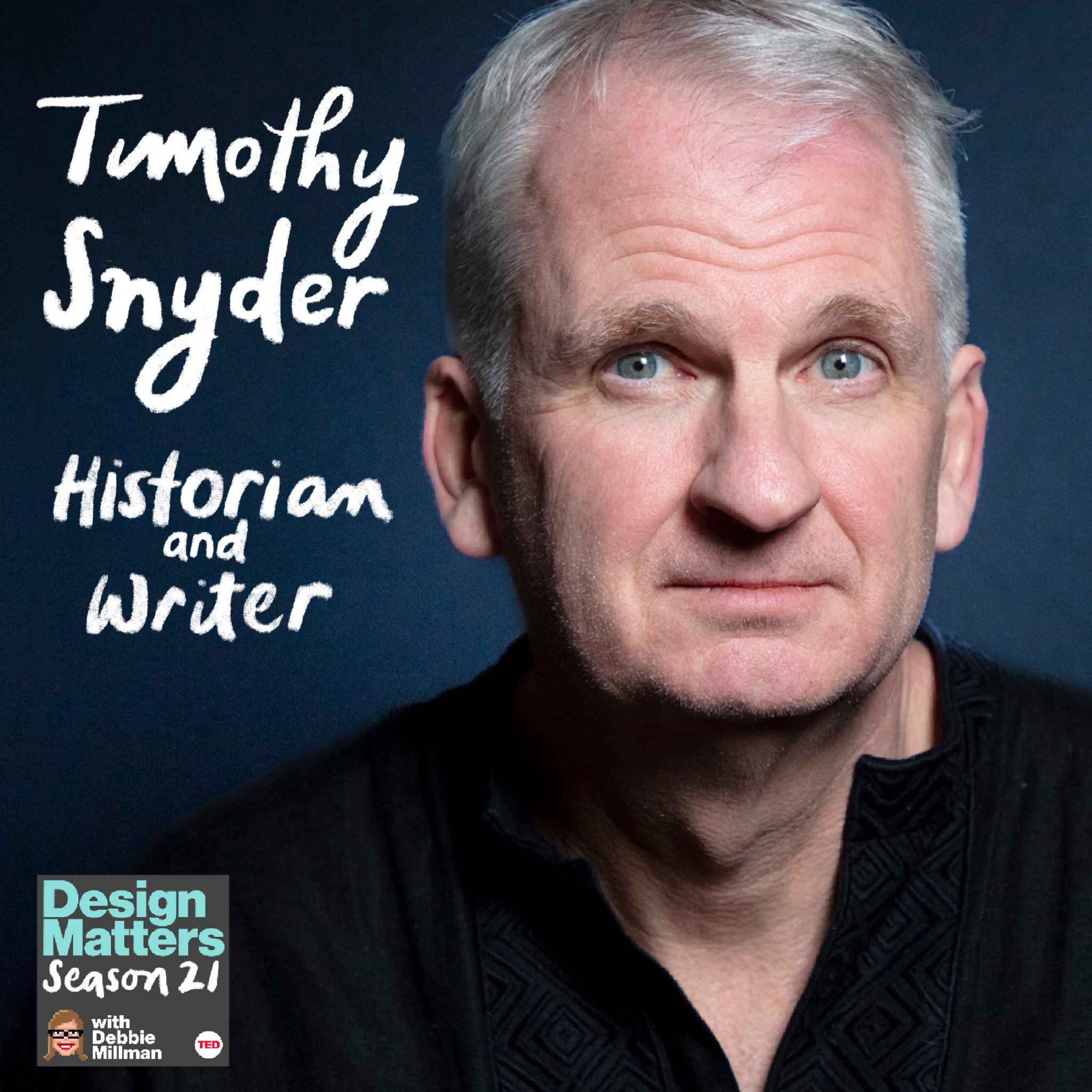
Loading summary
Transcript120 lines
- [00:01]
Timothy Snyder
Freedom can't be understood as something which just happens or which is morally neutral. Freedom is the value of values. It's a thing you have to care about in order to care about other things. And so like all values, it demands a certain amount of courage. From the TED Audio Collective, this is
- [00:19]
Debbie Millman
Design Matters with Debbie Millman.
- [00:24]
Timothy Snyder
On Design Matters, Debbie talks with some of the most creative people in the world about what they do, how they got to be who they are, and
- [00:30]
Debbie Millman
what they're thinking about and working on.
- [00:33]
Timothy Snyder
On this episode, a conversation with historian Timothy Snyder about our current political moment and what the idea of freedom has to do with it. The ideological thing that is deeply wrong with the US is that we misunderstand freedom.
- [00:52]
Sarah (Founder of Olive and June)
Hi, it's Sarah. I'm the founder of Olive and June and can I tell you the one thing that always makes my day better? A fresh manicure. But who has the time or the money to go to the salon every week? That's why we created the Olive and June Gel Mani system. It gives you that same mani that you get at a salon for so much less. It comes with everything you need. A pro level lamp, salon grade tools, our damage free gel polish that lasts up to 21 days. All you do is prep, paint, cure and you're good to go. And the best part? It's super easy and so affordable. Each mani breaks down to $2. So let's skip that $80 salon appointment and get the salon quality look at so much less and on your schedule. Head to OliveInJune.com DIY Gel20 and use code DIY Gel20 for 20% off your first Gel Mani system. That's OliveAnJune.com DIY Gel20 code DIY Gel20 for 20 percent off your first Gel
- [01:49]
Hayden (Fantasy Fan Fellas Podcast Producer)
Mani system Everyone deserves to be connected. T Mobile and US Cellular are joining forces. Our networks are coming together bringing more T Mobile coverage all over the country. Switch to T Mobile and save up to 20% versus Verizon by getting built in benefits they leave out check math@t mobile.com Switch and now T Mobile is available in a US cellular store near you Bigger network the combination of T Mobile's and US Cellular's network footprints will enhance the T Mobile network's coverage savings versus comparable Verizon plans plus the costs of options, benefits, plan features and taxes and fees vary. Savings with three plus lines include third free line free via monthly bill credits credit stop if you cancel in lines. Qualifying credit required. Howdy, howdy ho and welcome to Fantasy Fan. Fellas, I'm Hayden, producer of the Fantasy Fan Girls podcast and your resident lover of all things Sanderson.
- [02:28]
Timothy Snyder
And I'm Stephen, your bookish Internet goofball. But you can call me the Smash Daddy.
- [02:32]
Hayden (Fantasy Fan Fellas Podcast Producer)
And we are currently deep diving Brandon San fantasy epic Mistborn. But here's the catch. Steven here has not read Mistborn before.
- [02:40]
Timothy Snyder
That's right.
- [02:41]
Debbie Millman (Interviewer)
Hey.
- [02:41]
Timothy Snyder
Hey. So each week you'll get my unfiltered raw reactions to every single chapter.
- [02:45]
Hayden (Fantasy Fan Fellas Podcast Producer)
And along the way, we'll do character deep dives, magic explainers, and Steven will even try to guess what's next. Spoiler alert. He'll be wrong.
- [02:52]
Timothy Snyder
News flash. I'm never wrong. Episodes come out every Wednesday, and you can find Fantasy Fan fellows wherever you get your podcasts.
- [03:03]
Debbie Millman (Interviewer)
Timothy Snyder is one of the most important and urgent intellectual voices of our time. A historian of Eastern Europe, the Holocaust, and political conflict, he has spent his career using the past to help us see and understand the present with clarity. He is the author of more than a dozen books, including Bloodlands, Black Earth, on Tyranny, and most recently, on Freedom. Timothy Snyder, welcome to Design Matters.
- [03:30]
Timothy Snyder
I'm very glad to be with you, Timothy.
- [03:32]
Debbie Millman (Interviewer)
You speak six languages and can read 10. How many languages can you think in?
- [03:37]
Timothy Snyder
I think the real question is how many do you dream in? And I do dream sometimes in Polish, and I do dream sometimes in French, and there are bits sometimes of my dreams that are in German and snatches occasionally in Ukrainian. I don't really think in languages at all.
- [03:54]
Debbie Millman (Interviewer)
You've said that if you don't know the languages, you don't really know the history. What does native language make available to you that translation doesn't?
- [04:05]
Timothy Snyder
Well, capability in language means that you can talk to other people in their own language. So as, as Americans, we're used to people speaking our language, but what we're not used to thinking about is how the other side might be getting more out of the exchange than we are, because they're looking at how we behave natively, whereas we're looking at how they behave in a second or a third or a fourth language. If you can speak the language, the other person, you're more likely to learn more about them. And if you can read in the original, each book that you read is taking you a step further into a whole culture, into a whole way of embracing the world. And then you can bring that back to yourself when you're in your own language. And then, of course, I'm a historian, and the vast majority of archival materials are not, in fact, translated, and you can translate them yourself if you want. But it's not the same thing as proceeding document to document, context to context, and trying to figure out what was going on.
- [05:07]
Debbie Millman (Interviewer)
You grew up in a Quaker family. Your parents served in the Peace Corps in the Dominican Republic and El Salvador before settling in Centerville, Ohio. And I read that growing up, your weekends were often spent writing letters to prisoners for Amnesty International. You vacationed at Quaker dairy communes in Costa Rica. How do you look back on that environment and upbringing now?
- [05:31]
Timothy Snyder
Well, someone has clearly done her homework. So the Quaker part is certainly relevant in the sense of the insistence that there is a moral component to everything. And I believe that's actually correct. I think all of the forms of politics which attempt to say that morality doesn't matter, that for example, it's all about efficiency, or it's all about technocracy, it's all about just finding a solution, those tend to end up serving certain people and not everyone else. Right. So if you say efficiency is the thing, what you're saying is we have to have what we have now, just more of it and faster. But why do we have to have more of what we have now? Why? Exactly. Right. There's always the why, whether the why is explicit or not. And the Quakerism helps with that. Because in Quakerism there's a moral aura around everything. And there's also also the attempt to find the good in other people, which admittedly is not always an easy task. It can be a very challenging task. But it means that within religion you already have, from the beginning, so to speak, built in the attempt at empathy. And empathy is not, as a lot of the worst people in our politics, like Elon Musk would have us think, empathy is not some kind of a luxury, it's not something harmful. It's actually the beginning of self understanding. Because you can't understand yourself unless you see how other people see you.
- [06:57]
Hayden (Fantasy Fan Fellas Podcast Producer)
You.
- [06:57]
Timothy Snyder
And you don't see how other people see you unless you take them seriously. Empathy is also the beginning of democracy because we're not all the same, we're different. But if we don't understand a little bit about the differences, then we don't get along well enough to have a democracy. So the Quakerism is helpful in that. I think the Latin American part was also helpful. Like my Spanish is terrible. I only speak it to make people happy. I can read it. But it's more that it helped me to understand that we weren't alone in the world. And it also helps to understand if you're an American, if you start a Bit from Latin America. It helps you not to see your country as innocent. So I didn't become a historian of Latin America. It hasn't been. In a way, it always felt too close to me. But it helps you to understand that the story of American innocence has got to be wrong. Because for 100 years we've been intervening in these countries with either bad or worse justifications.
- [07:50]
Debbie Millman (Interviewer)
You were an avid reader as you were growing up, and immersed yourself in your maternal grandmother's books about the past and the present, alternative futures, paleontology, zoology. And I read A Wrinkle in Time. Why that particular book?
- [08:06]
Timothy Snyder
Okay, I'm realizing now that I gave a lot of myself away in my book on freedom. I think I wasn't counting on anyone actually reading it. So there you go. I'm sitting there. A lot of this research.
- [08:14]
Debbie Millman (Interviewer)
Sorry about that.
- [08:15]
Timothy Snyder
No, no, this is good. This is good. Don't apologize. On the contrary. So that. Why that book in particular? A Wrinkle in Time is important for about three reasons. The first is A Wrinkle in Time is about kids who don't feel as though they fit in and feel as though they have access to other things that maybe special people in their lives, or maybe books, or maybe math, or maybe science is showing them reality, which is not the everyday reality, and that other people don't see it, but it's real anyway. The second reason Wrinkle of Time is special is that it tells you that the hardest things in math and physics can be intuitive, that you can grasp them. And if you do grasp them, then the way you see the world can then become enriched. And the third thing about Wrinkle in Time and about a lot of science fiction that I might have read around that age is that it's imagining better futures. And that's like something which might seem trite, but it's something that we've really lost the habit of. Now. Science fiction itself is generally catastrophist, and I understand that. But this thing that we still had in the 70s and 80s, where you imagine that, okay, there are dangers, there are risks, but if we as humans with knowledge of math and physics address them, we could get somewhere better. That's something which I still actually believe, and it comes from there in part.
- [09:36]
Debbie Millman (Interviewer)
One of the things that I like most about A Wrinkle in Time is something that I also like most about the movie Interstellar, in that love becomes a factor in reality that's so strong it can actually manage to get through gravity as a way in which to rescue Us.
- [09:56]
Timothy Snyder
Yeah, that's. That's a wonderful point. Wrinkle in Time's a hard book because things don't necessarily go well for children. It's, it's. Things sometimes go very badly for children. And then in the instance you're talking about, the only way to reach someone is by way of love. But it's so, it is so important because in our one way our kind of authoritarianism works is to laugh at things like empathy and to laugh at things like love and to try to bully us out of believing that anything is good. And that's very dangerous because when you accept that you can't love or you can't feel empathetic, then you're accepting that nothing is really good. And when you accept that nothing is really good, then you're on the terrain of the nihilists. And the nihilists have much more wealth and much more power than you do. It's a little bit the same with knowledge, like factual knowledge. When you accept that nothing's really true, that science doesn't really matter, then you're also conceding the ground, right? Because it's the belief that there are factual truths and there are moral truths that gives you some kind of purchase, some kind of ground to stand on when things are going badly.
- [11:00]
Debbie Millman (Interviewer)
Thinking about that book now, it makes me wonder if Madeleine l' Engle had a bit of a crystal ball in thinking about what we might be encountering, that there would be a group of overlords that tried to debunk science and debunk empathy in particular and love, and try to control us and try to bully us into believing that those things didn't matter.
- [11:26]
Timothy Snyder
Yeah, it's wonderfully true. And it's part of a tradition, right? Like it's one of the things, and I did write about this in On Freedom that's so striking about the tradition of that particular tradition in science fiction is that we have again and again from actually from the 1920s, you know, through the 1980s, book after excellent book predicting some Kind of Scenario, which is like that. And you make such an excellent point that connected with the attempt to suppress scientific knowledge is the attempt to suppress humanist feeling and that those two things are actually connected. Right. And that it's. And so when you see like present day technocracy, the way it works is to say you don't need either feelings or facts because this special group is going to monopolize all of them. Right? It's currently the Silicon Valley oligarchs because they're allowed to have all the feelings. They have feelings all the time. Right. And then they tell us, oh, yeah, we understand science, and like, some of it they do, and some of it they don't. But the notion is that they have a monopoly on all of it, and therefore it's not important for the rest of us.
- [12:26]
Debbie Millman (Interviewer)
Well, and also that they are somehow the single source of truth. That somehow, especially in the case of Trump, he is the one that holds the truth and everything else is fake. And I'll wanna talk to you about that shortly. You first went to college at Brown University thinking that you might become a lawyer working on nuclear disarmament, and then two courses into your junior year, fundamentally changed your mind. One beginning weeks after Nicolae Ceauescu, the authoritarian leader of Romania, was executed. Why did that impact your direction so dramatically?
- [13:06]
Timothy Snyder
So I should start with what the direction was. I, I was a high school debater, I was a high school mock trial person. I, I, I was someone who very much believed in the rule of law. And I was also someone who grew up in the 1970s and 1980s with the notion that the worst thing that could happen would be nuclear war. This was an ever present threat, but it was also a threat that could be somehow dealt with in the existing U.S. soviet condominium. That there was a tradition, there were ways, there were means, there was a logic of deterrence, there was a structure to arms control agreements. And so therefore it would make sense to get inside that legal and political and strategic tradition and work within it. And that's what I studied in college to a large extent. And it served me well that I studied those things because they're still relevant. It's relevant to have that terminology still. But what changed me was the good fortune that I was able to study Eastern Europe right at the moment when new governments came to power. I mean, the execution of Ceausescu and his wife was at the end of a chain of events that began with the elections in Poland that summer, or with the formation of a new non communist Polish government at the end of the summer. And then you have events catching up in Hungary and Czechoslovakia, Bulgaria. But I was taking a course in West European history. Then I was taking a course in East European history, as you say, the following spring. And that was just my good fortune because I was able to say, now this situation, this Cold War lock, the lock has been picked. Things are opening. And even in terms of security, which is where I was focused, it's going to matter now what happens in Eastern Europe, and not just in Moscow, but more for Me, it was the chance to say, aha, because of the form these revolutions took, because of solidarity, because of the specific role that intellectuals took, because there were interpreters of these revolutions who were speaking a language which was different. I mean, a political, cultural, moral language that was different than the one with which I was familiar. I had the opportunity, the chance to say, okay, there's something deeper in the history of Eastern Europe than the Cold War. Certainty that things are frozen. Right. And so that was extremely attractive. And that's why I leapt towards Eastern Europe.
- [15:23]
Debbie Millman (Interviewer)
It's become central to your work, yet you have no familial ties to Eastern Europe that I sense you're aware of. Talk about what it was at that time that gave you the sense that this would be an area that would be so central to what you were doing.
- [15:43]
Timothy Snyder
Yeah, it was, first of all, just the invitation of the literature and the political thought. So I was familiar with figures like Adam Michnik and Vaclav Havel at the time, in English, of course, then I didn't know any languages then except Spanish and a little German. So there was the invitation of these thinkers who had considered politics in a different way in the 70s and 80s, who had made arguments that seemed to be applicable a bit also to my own society. And there was the general possibility that culture and politics were closer than I had thought. So if you're an American, then you tend not to question certain things. You tend to think, okay, there's an overarching rationality to all of this. And without comparison and without knowledge of other places, you don't realize how much of what we do internationally actually is connected to very strange things about our own culture. And so this notion that you could openly accept that culture and politics were somehow close together, I found very attractive. But the other element was just like the obvious. Like, when you're young, you want to do something new other people haven't done before, and suddenly you could just go, like, you could just go to Warsaw, you could just go to Prague, you could just go to Moscow. I went to Moscow at the end of my junior year in college. You could just go to these places suddenly and have the experiences and write it anew. As a historian, that was what was incredibly compelling. And then not long after that, I mean, when I went to graduate school, not long after that, it was the friends who I made there who were sympathetic to all of this. They were crucial. They were what was determinative.
- [17:24]
Debbie Millman (Interviewer)
In quite a lot of my research, I came across a line that you've said about history, how you describe history, and you describe it as uncovering what people did not anticipate. And I was thinking about that quite a lot, very intentionally, you didn't use the term what people do not anticipate. So it's past tense. History as uncovering what people did not anticipate. How do you find that undercurrent in your analyses?
- [18:02]
Timothy Snyder
One of the things that we do as humans is we. We rationalize after the fact. That's one of our strongest capacities as humans. We have an intention, we take an action, something completely different happens, and then we rationalize after the fact. And, you know, now wanting to jump ahead too much to politics, but we're in a very intense moment of that right now in the United States where, you know, Trump does something, it has completely different consequences. He rationalizes. And then it's a kind of political test of whether you follow that rationalization or not. As a historian, when you're trying to pull things apart as historian and see what actually happened, what you rec. You see always the gap between the intention and the action. And it's your job as a historian not to focus only on the action or only on the intention, but on the relationship between them and the overall situation. And so, as if you were writing a play or as if you were writing the novel, you need to let everyone see the things that came into play, even if the actors themselves didn't see it, because, of course, they.
- [18:56]
Debbie Millman (Interviewer)
So the conditions that made these things possible.
- [18:58]
Timothy Snyder
Yeah, but the. The underlying point, though, that I want to pull out of this is that it's really important to understand that at any given moment in history, people generally don't know what's going on. And when you. When you understand that, then you. It. It gives you a certain comfort about the present moment, but it also gives you a certain openness about the present moment. Like it's legitimate to have political imagination. It's legitimate to make hypotheses, because whatever it is we think is going on right now, whatever the headlines are today, that's probably not the point. The point is probably somewhere else.
- [19:30]
Debbie Millman (Interviewer)
Do you have a sense of what that point is? Do you have a sense of what we don't know, that we don't know that's going on right now?
- [19:36]
Timothy Snyder
Well, at a superficial level, it's the oligarchical corridor. It's the fact that a lot of what happens in politics is determined now by conversations between a very few, a very small group of people. So the Iran war, for example, no doubt there's no Doubt that Trump decided in some sense that he didn't decide in consultation with the people or Congress or with anybody who knows anything about war, apparently. But he did decide in consultation with Witkoff and Kushner, with people who are themselves essentially embodiments of international oligarchy. That's something which by definition is hard to see, but which clearly matters at a deeper level. I think what's really going on in the US Is wealth inequality. I think wealth inequality is the. Is the larger force which changes things. You can't spot it directly that wealth inequality changes conversations, it changes concepts. It teaches people that life is about having a patron and being a client. It shrinks people's imagination about what the future can be. It forces us to listen to the wrong people, the people who happen to have money. Right. So I think wealth inequality and then I also think social media. I think those are the two things that are really going on in our country. If you were writing a structural history,
- [20:54]
Debbie Millman (Interviewer)
In April of 2016, you wrote an article about Donald Trump in the New York Review of Books that seemed rather radical at the time. And you declared that Trump's weakness and vanity made him an easy mark for Vladimir Putin, who had already started cultivating him as, quote, a future Russian client. Trump has denied any Russian interference or support in either of his elections. Can you talk about what gave you such certainty back in 2016?
- [21:26]
Timothy Snyder
I'm going to say something that we both know, but which I think is important for media in general. Trump almost never says anything which is true. And we make mistakes when we. I realize why one feels like one has to do it, but I think we make mistakes when we quote him on anything because it frames things the wrong way. Like the fact that Trump denies something means that more likely than not, it's true. But if it's not that, then it's irrelevant. The reason that I thought it was the evidence. The evidence was right there before our eyes. That article in the New York Review was simply based upon the empirical evidence, which was that Trump was speaking warmly of Putin and Putin was speaking warmly of Trump. And when I noticed that, I then going back to languages, I looked a bit into the Russian sources and found, ah, Trump is actually a bit of a media star in Russia. There's actually quite a lot of excitement in Russian television networks about Trump. Something is clearly going on here. And that's when I picked up the thread and the thread led to this incredible web of support. It turns out that in 2016, and this was part of my book, Road to Unfreedom. There was an extremely systematic attempt by the Russian Federation to support Trump's candidacy, mostly on social media, but it was their policy. The sources make it completely obvious, and so the sources are the obvious answer, but the logic is not hard to guess either. It's clear that Trump makes the United States weaker and more vulnerable. I mean, that's clear to everybody in the world. Everybody except some Americans. That's the basic reason why. And then if we look at the outcome, I mean, where we are in 2026, Trump acts like Putin's client. He defers to Putin regularly. Our foreign policy at pretty much every step has been to strengthen the Russian Federation under Trump.
- [23:09]
Debbie Millman (Interviewer)
I want to talk to you about the power that Trump seems to have over a contingent of people in the United States. A lot of people call that his charisma. I don't believe that that is the correct word for it. Not because he isn't charismatic, although I don't think he is, but because I think it's something much more specific. But I've yet to really be able to describe what it is. And I was looking forward to speaking with you today to get a sense of what you think it is, because I would suspect that you don't think it's charisma either, but I wouldn't know exactly how to describe it.
- [23:54]
Timothy Snyder
Yeah, I think it's a number of things. And with charisma, it's, of course, tricky, because I don't find him charismatic at all. I find him repulsive. But these things are deeply personal. And so I don't. In practice, I find that other people do find him charismatic. And so, as a concept, I wouldn't reject it, but to try to be more specific, I think he's a sado populist. So one way of doing politics is to say, there's going to be more for everybody. It's going to be better for everybody. Some people might do a little better than others, but in general, it's going to be better for everybody. Another way to do politics is to say, yeah, it's getting worse, things are terrible, but I can serve you up a spectacle in which the people you don't like suffer more than you do. And that's the politics of mass incarceration. It's the politics of deportation, and that's Trump. Trump gives people. He doesn't give them anything positive, but he gives them a view of hurting other people more. That's one side of his appeal.
- [24:47]
Debbie Millman (Interviewer)
Why does that titillate people so much? Why did they seem to Enjoy that. What does that say about our humanity?
- [24:59]
Timothy Snyder
Yeah, I mean, what it says about humanity is that democracy was never an easy project, and that the last 35 years or so, where we've tried to persuade ourselves that democracy is about human nature or that capitalism brings democracy or the founders bring democracy or some nonsense like that, that. That. No. Democracy arises when the people want to rule, and the people wanting to rule involves the people behaving in a certain way. And if we're going to behave in that way, we have to educate ourselves and take seriously models and take seriously moral ideas, because if we don't, in fact, quite a lot of us, a lot of the time do enjoy hurting other people or letting other people hurt. And if we can't do it ourselves, we'll enjoy other people doing it for us. Right. So we don't have democracy because we're angels. We have democracy because we're not angels. But democracy is only one half of the deal. The other half is that we prepare ourselves to be people who could rule ourselves democratically.
- [25:51]
Debbie Millman (Interviewer)
You actually didn't think Trump was going to win the 2016 election, and you were stunned by his victory. Throughout Trump's presidency, you continued to warn that Trump would try to hold onto power unlawfully if he didn't get elected again. Did you think that he would lose the 2020 election or that he would indeed run again and when.
- [26:13]
Timothy Snyder
Yeah, so in 2020. I actually wrote in the fall of 2020 that he's going to lose and that he's going to mount a campaign to try to stay in power anyway. I wrote that in multiple places. I said, people should be prepared for this. It's what's going to happen. So that's. That's one that I've gotten right. I tend to be a little bit too hopeful about elections in general, but he was so far down. I was pretty sure as an amateur he was going to lose, but I was even more sure that he was going to try to stay in power. And I think that's if we're in politics already. That's the essential thing to understand about Trump. He doesn't care about the United States. He doesn't care about any American. None of these notions of national interests that we like to apply have anything to do with him. He doesn't care about the Republican Party. What he cares about is staying in power indefinitely. That's it. And if you start from there, it's much easier to predict what Trump is actually going to do.
- [27:02]
Debbie Millman (Interviewer)
You've said that post truth is pre Fascism. And I think that means that Trump is a post truth president. And like historical fascist leaders, he's presented himself, as I mentioned, as the single source of truth. But when we as a society can't agree on basic facts, how can we fight against any single source of truth we know to be false?
- [27:29]
Timothy Snyder
Yeah, no, it's a wonderful question and a wonderful, A wonderful diagnosis. I agree with you completely. Part of being a fascist leader is to say that essentially I am the truth. I embody the truth. Right? There's no, there really is no such thing as factual truth. There is the truth that you, the people, and I, the leader are together. And whatever happens in the world, you're going to accept my interpretation of it, because that's, so to speak, the larger truth. Right? And the larger truth is that we're together and that the enemies are against us. And if inconvenient facts present themselves, that somehow has to do with the enemies. And I will help you understand how it has to do with the enemies case. That's it. Right? That's it. And so I agree with you. That is the outcome and that is the problem. And you can't solve the problem just by criticizing the fascist leader. Like, that's indispensable, of course. But there are at least two deeper levels you have to go to. One is, and this is one where I've noticed a lot of Americans have trouble. You have to say that you believe in truth yourself. You have to say that there is truth. Right? I mean, we can have all kinds of interesting debates about what it is. I, I'm reasonably well versed in the epistemic questions, but you have to say, I believe in truth, or at least I believe in the pursuit of truth. Or you can start with baby steps. Like, I believe that lies are not true.
- [28:44]
Debbie Millman (Interviewer)
Right?
- [28:44]
Timothy Snyder
You can start with baby steps. But if we can't affirm that there is truth, then the absence of facts or the disagreements about facts are irresolvable. And then the second step is that you have to take steps to produce facts. Right? You have to treat it as an institutional question. So insofar as you have authority and you do as an individual, for example, subscribe to things where they do investigative reporting, that's our individual agency right there. And then the level of municipalities and states and hopefully eventually the United States, we have to create the incentives and the structures so that local journalism can actually prosper. We have to think in terms of facts as a public good, like water or clean air or whatever. And so those are the steps we have to take moral and practical in order to handle individuals like this, because once you get to the point where it's an individual, if you engage them just at the individual level, in a way, you're just sort of playing their game. You have to see them also as a symptom of a larger problem which is both moral and institutional.
- [29:41]
Debbie Millman (Interviewer)
What is the role of the media today in an age of fake news?
- [29:46]
Timothy Snyder
Well, the media means all kinds of different things. And I can't start to answer this question without pointing out that we get the media that the state allows us to have. So it's, it's, it's absurd that we're on the brink of having local television news be owned by one conglomerate, which would be about, I think, 60%. It's absurd that we have, as a situation in which nepotistic oligarchs are going to control our main television news network or networks. It's absurd that we have so few news organizations in general. That is bad news, and it shouldn't be like that. So before I get into criticizing what people do, I just want to point out that the overall monopolistic centralized situation is exactly what you create if you're trying to get to an authoritarian regime. Right. And so within that, like if you are the New York Times or if you do have a certain amount of freedom. So within that structure, you have to be very careful not to allow leaders to frame the debate. You have to be very careful when essentially you're confronted by an authoritarian regime and its legion of propagandists, which is what the president's cabinet is, not to start your stories with what they say, but to instead try to figure out what is actually going on. On. You have to be very careful not to use two sides framing, because two sides framing always favors the people who are gaming you who have the resources and tell an extreme story. Two sides framing never leads to the truth. And it's not. It does. The sense of balance is totally illusory, and it makes you feel like you're doing your work when you're not actually doing your work. And so, I mean, I don't want to get too moralizing about this because resources are limited in time and time is limited, but the real stories are the investigative stories, and people do actually read them when they can be produced. And so insofar as we have time and resources, the investigations which actually change how we understand reality, that's what's important.
- [31:40]
Sarah (Founder of Olive and June)
Hi, it's Sarah. I'm the founder of Olive and June. And can I Tell you the one thing that always makes my day better. A fresh manicure. But who has the time or the money to go to the salon every week? That's why we created the Olive and June Gel Mani system. It gives you that same mani that you get at a salon for so much less. It comes with everything you need. A pro level lamp, salon grade tools. Our damage free gel polish that lasts up to 21 days. All you do is prep, paint, cure and you're good to go. And the best part? It's super easy and so affordable. Each mani breaks down to $2. So let's skip that $80 salon appointment and get the salon quality look at home for so much less. And on your schedule, head to OliveAndJeune.com and use code DIYGEL20 for 20% off your first Gel Mani system. That's all of Ann June.com DIYGEL20 code DIY GEL20 for 20% OFF your first Gel Mani system.
- [32:37]
Debbie Millman
You have the vision for your business. You have the plan. And you just got handed a huge opportunity. But is your business connectivity reliable enough to make a move? Spectrum Business delivers fast, reliable Internet, phone, TV and mobile services. So you're always connected when it matters matters most. Get connectivity packages built for your business with savings that keep your budget in check. And with fast, reliable Internet and 100% US based customer support, you'll stay connected and ready to bring your vision to life. Learn more@spectrum.com business restrictions apply. Services not available in all areas.
- [33:13]
Hayden (Fantasy Fan Fellas Podcast Producer)
Howdy, howdy ho and welcome to Fantasy Fan. Fellas, I'm Hayden, producer of the Fantasy Fangirls podcast and your resident lover of all things Sanderson.
- [33:21]
Timothy Snyder
And I'm Stephen, your bookish Internet goofball, but you can call me the Smash Dadd.
- [33:25]
Hayden (Fantasy Fan Fellas Podcast Producer)
And we are currently deep diving Brandon Sanderson's fantasy epic Mistborn. But here's the catch. Steven here has not read Mistborn before.
- [33:34]
Timothy Snyder
That's right.
- [33:34]
Debbie Millman (Interviewer)
Hey.
- [33:35]
Timothy Snyder
Hey. So each week you'll get my unfiltered raw reactions to every single chapter.
- [33:39]
Hayden (Fantasy Fan Fellas Podcast Producer)
And along the way, we'll do character deep dives, magic explainers, and Steven will even try to guess what's next. Spoiler alert. He'll be wrong.
- [33:46]
Timothy Snyder
News flash. I'm never wrong. Episodes come out every Wednesday and you can find Fantasy Fanfellas wherever you get your podcast.
- [33:53]
Debbie Millman
Over 90 of the top 100 US accounting firms trust bill to handle bill pay processes. Why? Because our tools are built on over a trillion dollars of secure payments. We're not just moving money. We're powering financial workflows for half a million customers. That's a level of expertise you just can't fake. Ready to talk with an expert? Visit bill.comproven to get started and grab a $250 gift card as a thank you. Thank you. Terms and conditions apply. See Offer page for details.
- [34:26]
Debbie Millman (Interviewer)
You've pointed to Poland as an example where media independence help democracy return. What can that example show us or teach us or help us understand?
- [34:40]
Timothy Snyder
It's so interesting. I mean, for one thing, the New York Times, much as they sometimes drive me crazy, especially with their headlines and especially with the tendency to continue to both sides things, although they've got gotten, in fairness, they've gotten much better about this. They are a national newspaper which does a lot of excellent reporting. If we didn't have them, we would be in a much worse situation. Poland has a similar newspaper which is even more national and that helped them a lot. It's called Gazeta v Borcia. The other lesson from Poland, which is hard to apply to the US when their state television went the wrong way and became entirely regime propaganda, they had a private television station which did news and which was much big better. And the reason that private television station survived was because it was American owned. Okay? And that's a problem that we have because like we don't have any like Canadian owned or you know, Norwegian owned media in the US which is going to give us alternative news. If our American oligarchs buy up all our American television stations and give us regime propaganda, there's no other country to bail us out.
- [35:45]
Debbie Millman (Interviewer)
You've said that parts of your most recent book on freedom were written on trains in Ukraine and near active war zones. What did writing in that environment make possible for you?
- [35:57]
Timothy Snyder
I finished it on a train from Kyiv to the Polish border. I took drafts of it with me three times to Ukraine since the full scale invasion of February 2022. I had Ukrainian colleagues read it in Kyiv and I had a seminar about it in Lviv and I presented it. My first book talk was in Kharkiv in a bomb shelter in September after the book was published. So yeah, the book owes a lot to Ukraine in those practical senses. The argument of the book owes a lot to Ukraine because it's about freedom. And going a bit back to your very first question, freedom can't be understood as something which just happens or which is morally neutral. Freedom is the value of values. It's a thing you have to care about in order to care about other things. And so like all values, it demands A certain amount of courage. And so Ukraine isn't the only environment in which people are courageous, but it's an environment where I spend a lot of time, where I know a lot of people who are being personally courageous. And my argument is that freedom is positive. That is to say that freedom involves a moral commitment to create conditions in which other people can be free. And war helps you to understand the significance of conditions. So if you liberate a village, to use that word, you've done something important, you've removed something negative. But for people in that village to be free, they have to have access to water, and the buses have to run again, and they have to have access to a doctor. Right. And those things are also part of freedom from being a baby forward. These conditions are the things that give us a chance to be free. So Ukraine gave me conditions, it gave me examples, and it also helped me to think out what I meant by freedom.
- [37:37]
Debbie Millman (Interviewer)
You posit that freedom is not exhausted by freedom from, but involves freedom to. To build, to act, to create future. Can you talk about the distinction between freedom from and freedom to?
- [37:51]
Timothy Snyder
Yeah, that's a great question, because I think you asked earlier about what's like, what's deeply wrong. And I said wealth inequality, and I said social media. But for me, the ideological thing that is deeply wrong with the US is that we misunderstand freedom. So let me start with this as a misunderstanding. If we think that freedom is just freedom from, then we are trapped because we're not then asking ourselves the basic question of what do I want to be like? If I were free, who would I be? As soon as it's. If it's only freedom from, then I'm inviting you, I'm inviting others to tell me what the enemy is, what the problem is, who I'm supposed to be fighting against. So if it's just freedom from, you jump very quickly to where we are now, which is, okay, I'm not the problem. It's the black people who are the problem. It's the women who are the problem. It's the immigrants. Somebody else is the problem, Right? So just freedom from is a trap. Logically, philosophically, the reason why barriers are an issue, right? And barriers are an issue. You ask about Ukraine, like a lot of. Quite a number of my friends were in Russian detention. It's. It, of course, it does matter if there's barbed wire and there's walls, Right? But the reason why it matters is because they're holding back something that could be. It's not the wall itself. It's that the wall holds back a person. And so even the most extreme cases, even wars, even camps, they raise precisely the question of when the wall is down, when the barbed wire is cut, what can we then be? And some of our best writers, including my Ukrainian friends, like Maxim Bulkevich or Stanislavasev, who came out of Russian captivity, that's then the question that they ask, and that's the direction in which they think. Right? And then in terms of direct American politics right now, I mean, I mentioned the quick jump to fascism. But the other problem is that if you think. Think that freedom is just freedom from, then people say, okay, the government's the problem. The government's keeping you from being free. So let's just make the government small. And that leads you to the Elon Musk logic of let's disable the government completely. But if you disable the government completely, power doesn't go away. It just falls into the hands of the oligarchs like Musk. Right. And so freedom, that argument of freedom from ends up weakening the government, but it doesn't make you free. It actually puts you in the hands of people who are much worse. Worse. And so we have to start again. We have to recognize life begins with infancy. If we're going to become free, we need conditions around us. We need people around us. We need structures that help those people. And we have to recognize that freedom is freedom too, in that if we have those conditions around us, we can become the kinds of people who are unpredictable, who affirm our own values, who choose our own futures. That's what freedom actually is.
- [40:37]
Debbie Millman (Interviewer)
You argue that the idea of freedom as simply being left alone has historical roots in slavery. And I'm wondering if you can talk about that a little bit.
- [40:47]
Timothy Snyder
Yeah. It's a large argument from world history. Like opponents, opponents of freedom in general tend to be people who are fortunately situated such that they personally enjoy a lot of freedom at the expense of others. So if you're a plantation owner in the south, just to take the example you asked me about, you have slaves who are making money for you. You probably have women around you who are taking care of you. Why would you then want the federal government? You don't. You don't want the government. And again, this is a situation you can find around the world. It was true. People on serfs in Eastern Europe as well. If you can be like the little nobleman or the little plantation owner and you can control your own little structure of power, then of course you don't want the big Government, Right. You don't want the government to come in and say, everyone has the right to vote. The blacks can vote, the women can vote. Of course you don't want that because you have your own little structure of power. And so in the specific history of the United States, that is the logic of what people often call states rights, or used to. That is the logic of a lot of our racism, that we think, okay, I can actually control things, and that makes me free. As opposed to everyone has the right to be free, to be free. But the only way everyone can have the right to be free is to have a government in which the government recognizes certain rights for everyone, but also build certain structures for everyone.
- [42:04]
Debbie Millman (Interviewer)
Well, you state that freedom is the condition in which we can choose among real values, loyalty, honesty, grace and beauty, and create character through those choices. But how are those values impacted by freedom?
- [42:23]
Timothy Snyder
Yeah. So the book I start out from the idea, and this goes back to where you began the conversation, that things like grace or integrity or honesty are real. They're not real the same way that a rock in the field is real, but they are no less real than a rock in the field. And our life is made up of these things just as much as it's made up of physical objects. And the way we interpret physical objects, the way we make our way through the world, depends largely on which values we have we've imbibed, which ones we have affirmed, and how we combine them. So the notion is that if conditions are given to you such that you can become free, such that you can take risks, you then learn about various values. Values. And in learning about various values, you are free because you choose them, you affirm them, you create a combination that no one else has ever created. And that combination is your character. Right? So you're free because of who you are or of who you are making yourself. But that's. That involves morals or that involves values. Like, you say you're not free just because you dodge a falling boulder. Everybody's going to dodge a falling boulder. You're not freeing just because you're hungry. Everybody gets hungry. Right? We're not free because we're objects that react like physical objects. Of course we are. But we're not only that. We're free because we can see a different world and we can navigate in that world. And that's not easy. Like, it takes a state, it takes examples, it takes moral authorities, it takes friends and families, and it takes all of us trying to create structures in which the friends, the families, the other structures can function.
- [43:55]
Debbie Millman (Interviewer)
Part of what I like so much about your work is the philosophical components of your arguments. And you draw on Edith Stein's idea that we do not fully know ourselves, that part of the self remains a stranger. You talk about morals, and in order for, I think anyone to develop morals is part of getting to know ourselves, part of getting to understand what our impact is in the world, in the people around us, in our behavior. Is there such a thing as a moral compass anymore?
- [44:32]
Timothy Snyder
Well, I mean, yeah, of course there is. I mean, I. I mean, for some
- [44:37]
Debbie Millman (Interviewer)
of us, of course there is. But in general, it feels like there is no morality anymore.
- [44:42]
Timothy Snyder
I mean, I just. I have to start with you. Of course there is, because I wrote a book and we're talking about the book, and we talked about Ukraine in terms of that book. But Ukraine for me is also an example of engagement. So I go to Ukraine, Ukraine, because I'm doing things there. And the same is true in the U.S. i mean, I can think with the U.S. as I did in the book, but I'm also engaged in the US and when you're engaged, you're engaged, you're around people who have a better moral compass than you do. And so, like, that's. There's a relationship between our sense of hopelessness or our sense that there are no morals and what we do and how we spend our time. Right. And so even in the worst. I understand what you mean. I agree with you, but it's just that I just want, say, to say that when we get involved, we realize there are people around us who have very strong moral compasses, and they're. And, and. And the admiration of those people is part of the answer to your question. Because morality has to begin with getting out of yourself, with realizing that other people have appetites, other people also hurt. And that's. That's the first step towards recognizing, well, if you hurt just as I hurt, then there's something in the world besides just you and me, and that's hurt, hurting. Right? And if. If you can love and I can love, then there's something in the world besides you and me, and that's loving, right? Or to be more trivial, if you can. If I can be late for our interview and you can be on time, that means there's something in the world called punctuality. Right? And so you move from the experience of other people towards the recognition that there are these things in the world that are real. And so when we create a world, when we accept that everything is technique, when we Spend too much of our time in front of machines. When we create all this artificial isolation, then we're just making it hard for ourselves as beings to be moral.
- [46:20]
Debbie Millman (Interviewer)
On Freedom was in part your attempt to answer a question left open by. On Tyranny, what are we defending? Can you answer that question now? Do you feel that the majority of Americans have the capacity to defend what freedom really is?
- [46:38]
Timothy Snyder
So, yeah, that's just. I'm going to just step back a little bit. I wrote On Tyranny as a kind of political pamphlet. And I wrote it.
- [46:45]
Debbie Millman (Interviewer)
I know, I love that you call it a pamphlet. It's like the doctrine of our times. You think it's a pamp,
- [46:51]
Timothy Snyder
but I wrote it. That's. That's kind. I wrote it as a. I wrote it in a few days at the end of 2016. And I'm glad it's been helpful for so many people outside the US as well. It's. It. I'm really happy. But On Tyranny is about recognizing that there is a problem and taking steps in the right order. Right. So don't obey in advance is the first thing. It's a kind of guidebook to a certain situation. But even if it works entirely at its best, it's defending you and it's preparing you for what's next. Because when you behave well in the face of challenge, you're becoming a person who can then behave well when the challenge has been met. But the next question is, if, you know, if. On Tyranny, fine. So what's freedom then? Like, what's the opposite of tyranny? Because going back to your question about presences and absences, about negative and positive freedom, freedom isn't just the absence of tyranny. If you defeat a tyrant or a tyrant dies, that doesn't mean you're going to be free. All kinds of things can happen then. And so at one level, yeah, I mean, On Freedom was much harder because the philosophical questions are harder. And I was trying to be honest about all of them. And I was also trying to write in such a way that people could be interested in the argument and follow it. And I'm old fashioned enough to believe that there's a right answer to certain questions. Like, I think there is a right answer to what freedom is. I think the right answer is that it's the value of the values. It's the value that enables the exercise of other values. That doesn't make it the highest value, but it makes it something which is special, which is prior. And so at some Level, I am satisfied that freedom is the right answer, that freedom is the. It's the right answer for modern politics and that it's something which we can understand. So whether at a given moment, a majority of people, that's probably Saint Too much much. But I do believe that we need. We need to be led into a future. And that future has to have a big idea in it, whether it's my idea of freedom or somebody else's idea of freedom or somebody else's idea about something else. And I do believe that that idea can't just be metaphysical. You know, it has to be. Has to be something like freedom, where it touches the body, it touches life. It has a corporeality and a sense of plausibility to it in terms of America. It has to be something that touches on our traditions. I think we get freedom generally wrong, but we are right to be talking about freedom. You know, I think that part of us is definitely right. And so you begin with a misunderstanding or a limited understanding, and you try to make it flower. You try to push it into something greater. So that's what I'm doing. And I'm doing my best. And I have the. I have no kings on my mind because I'm about to go to the next one and the last two. When I was in Philly and Cincinnati, I had people. When I said I had people respond. Freedom to no kings. And people seem to really like that, like the notion that it's not just that we're resisting something, it's that we have something in reserve, something in mind. Right. Something which is going to come next. So, you know, I don't know about majorities and calculations. I do know that we need the idea and that people seem to welcome, like, the possibility to break through the present into some kind of future.
- [49:56]
Debbie Millman (Interviewer)
Speaking of going to no king, you write that history can become a factory of excuses, that uncertainty can become a reason not to act. In the past year, we've seen some of the largest street protests in American history, in world history. And there are more to come. How effective are protests really? What do they actually achieve?
- [50:23]
Timothy Snyder
Yeah, I mean, first of all, I'm going to start by saying. Saying they are definitely more effective than not protesting. So and so, like, I'm very happy. I like to have this discussion and this debate, but frankly, most of us don't have anything better to do. Like, if there is a protest which is scheduled for a given two hours on a given Saturday, there are very few of us honestly have anything better to do than go to that protest. That's where I would start. I don't think there's any excuse excuse to not go like when people say like how important is it? I know this is not your attitude. I'm just talking about conversations I've had including with colleagues and people I respect, like, well, why should I actually go out there? Well, because it's going to matter. But also like even if you're not sure how much it matters is is the stance you really want to take, Is it like sitting home and doom scrolling that that was better because face like that's what you're going to be doing if you're not protesting, you're going to be doom scrolling or something like that. But it is effective. And first of all, we have the scholarship that shows that, that it's effective. The political scientists are quite clear on this. We know that it works. We have some idea why it works. It challenges the sense that authoritarianism is normal. It empowers people watching the protest to take action themselves. It is a gateway towards further self organization into groups which take regular sustained action. And protest movements tend to be part of big coalitions that win decisive elections. So we have clear ideas about why it works. In fact, I think the main thing that people think is this isn't exactly normal because it's not something I've done before, right? And so since I haven't done it before and it doesn't seem normal, it must not be necessary. But these are not normal times. And so if it doesn't feel normal to you, you know, the times aren't normal and you need to kind of meet that moment. But the other thing that's important to say in this is that protesting actually really has been important in U.S. history. If it hadn't been for protests, we wouldn't have the Civil Rights Act. If it hadn't been for protests, we wouldn't have women's suffrage. Right. Certain Americans certainly have protested at certain times and it's been effective. And so in part the question is for certain demographics in our country, the fact that your group maybe hasn't done a ton of protesting doesn't mean that it hasn't been effective. And so maybe you should think a little bit more broadly.
- [52:50]
Debbie Millman (Interviewer)
I have one last question for you and it might be a bit pie in the sky, but I'm going to ask it anyway. If freedom is something that must be created and extended and not simply defended, what does that ask of ordinary citizens right now? What can we be doing to make a difference?
- [53:12]
Timothy Snyder
Having conversations with people you think might be on the fence paying for your journalism. If you have a little bit of money, look out for state level groups that are working on election participation. Go to protests. Don't act as if everything around you is normal because it's not normal. And try to think actively about your sense about what would be normal and what would be better. But above all, realize that history is not just a matter of the larger factors that make things inevitable. It's also a matter of the surprises, the unexpected sets of circumstances, and the moments when people recognize a moment and actually do something inside it. That's what makes history different than physics. That's what makes freedom different from two billiard balls bouncing against each other. So if we want to be free people, we can say, yeah, you know, here's the situation. But I am also part of the situation. And it does make a difference whether I go to that protest, subscribe to that magazine, make that contribution, have that conversation. But there's even one more fundamental thing. It's very demoralizing when you think this is all on me to fix. But it's not all on you to fix. It's just on you to do the little thing that you can do. And if millions of people do the little thing that they can do, that actually will turn history.
- [54:30]
Debbie Millman (Interviewer)
Timothy Schneider, thank you so much for making so much work that matters and making such a difference in our world. And thank you for joining me today on Design Matters.
- [54:39]
Timothy Snyder
It's been such a pleasure. Thank you. Thank you very much.
- [54:41]
Debbie Millman (Interviewer)
To learn more about Timothy Snyder and his work, books and lectures, you can go to timothysnider.org this is the 21st year we've been podcasting Design Matters, and I'd like to thank you for listening. And remember, we can talk about making a difference. We can make a difference. Or we can do both. I'm Debbie Melvin and I look forward to talking with you again soon.
- [55:04]
Timothy Snyder
Design Matters is produced for the TED Audio Collective by Curtis Fox Productions.
- [55:09]
Debbie Millman
The interviews are usually recorded at the Masters in Branding program at the School
- [55:13]
Timothy Snyder
of Visual Arts in New York City,
- [55:15]
Debbie Millman
the first and longest running branding program in the world.
- [55:19]
Timothy Snyder
The editor in chief of Design Matters
- [55:21]
Debbie Millman
Media is Emily Weiland.
- [55:28]
Paige Desorbo (Boost Mobile Ad)
Hey, this is Paige desorbo from Giggly Squad, and today I want to talk to you about Boost Mobile. Quick question. Why are we letting our phone bills bully us? Here's a money tip. Stop paying a carrier tax when you bring your own phone and switch to Boost Mobile's 25 Unlimited Forever plan. You can unlock up to $600 in savings. That's real life money, not money trapped in a pricey phone bill. $600 is a trip, a shopping spree, or paying something off. Your money belongs in your life. You get unlimited data, talk and text for 25amonth with no contracts and no minimum line requirement. Your phone, your rules. Head to boostmobile.com to switch today and unlock the savings you actually deserve. After 30 gigabytes, customers may experience lower speed custom $25 per month while active on Boost Mobile Unlimited Plan savings claim based on a January 2026 Boost Mobile survey comparing average annual payments of major carrier customers to 12 months on the Boost Mobile Unlimited plan. Visit boostmobile.com for details.
- [56:22]
Debbie Millman
You have the vision for your business. You have the plan, and you just got handed a huge opportunity. But is your business connectivity reliable enough to make a move? Spectrum Business delivers fast, reliable Internet, phone, TV and mobile services, so you're always connected when it matters most. Get connectivity packages built for your business with savings that keep your budget in check. And with fast, reliable Internet and 100% US based customer support, you'll stay connected and ready to bring your vision to life. Learn more@spectrum.com business restrictions apply. Services not available in all areas Howdy,
- [56:58]
Hayden (Fantasy Fan Fellas Podcast Producer)
howdy ho, and welcome to Fantasy Fan Fellas. I'm Hayden, producer of the Fantasy Fangirls podcast and your resident lover of all things Sanderson.
- [57:06]
Timothy Snyder
And I'm Stephen, your bookish Internet goofball. But you can call me the Smash Daddy.
- [57:10]
Hayden (Fantasy Fan Fellas Podcast Producer)
And we are currently deep diving Brandon Sanderson's fantasy epic Mistborn. But here's the catch. Steven here has not read Mistborn before.
- [57:18]
Timothy Snyder
That's right.
- [57:19]
Debbie Millman
Hey hey.
- [57:19]
Timothy Snyder
So each week you'll get my unfiltered raw reactions to every single chapter.
- [57:23]
Hayden (Fantasy Fan Fellas Podcast Producer)
And along the way we'll do character deep dives, magic explainers, and Steven will even try to guess what's next. Spoiler alert. He'll be wrong.
- [57:31]
Timothy Snyder
Newsflash. I'm never wrong. Episodes come out every Wednesday and you can find Fantasy Fanfellas wherever you get your podcast.
- [57:38]
Debbie Millman
Over 90 of the top 100 US accounting firms trust Bill to handle bill pay processes. Why? Because our tools are built on over a trillion dollars of secure payments. We're not just moving money, we're powering financial workflows for half a million customers. That's a level of expertise you just can't fake. Ready to talk with an expert? Visit bill.comproven to get started and grab a $250 gift card as a free thank you. Terms and conditions apply. See Offer page for details on Big Lives.
- [58:09]
Hayden (Fantasy Fan Fellas Podcast Producer)
We take a single cultural icon, people
- [58:11]
Debbie Millman
like Jane Fonda, George Michael, Little Richard,
- [58:14]
Hayden (Fantasy Fan Fellas Podcast Producer)
and we pull apart the story behind the image.
- [58:17]
Timothy Snyder
And we do this by digging through the BBC's vast archives, discovering forgotten interviews
- [58:23]
Hayden (Fantasy Fan Fellas Podcast Producer)
that change exactly how we see these giants of our culture.
- [58:26]
Timothy Snyder
We're here for the messy, the brilliant,
- [58:28]
Debbie Millman
the human version of our heroes.
- [58:31]
Hayden (Fantasy Fan Fellas Podcast Producer)
I'm Emmanuel Jochi.
- [58:32]
Timothy Snyder
I'm Kai Wright.
- [58:33]
Hayden (Fantasy Fan Fellas Podcast Producer)
And this is Big Lives.
- [58:35]
Timothy Snyder
Listen to Big Lives wherever you get your podcasts.