← Diabetes Connections | Type 1 Diabetes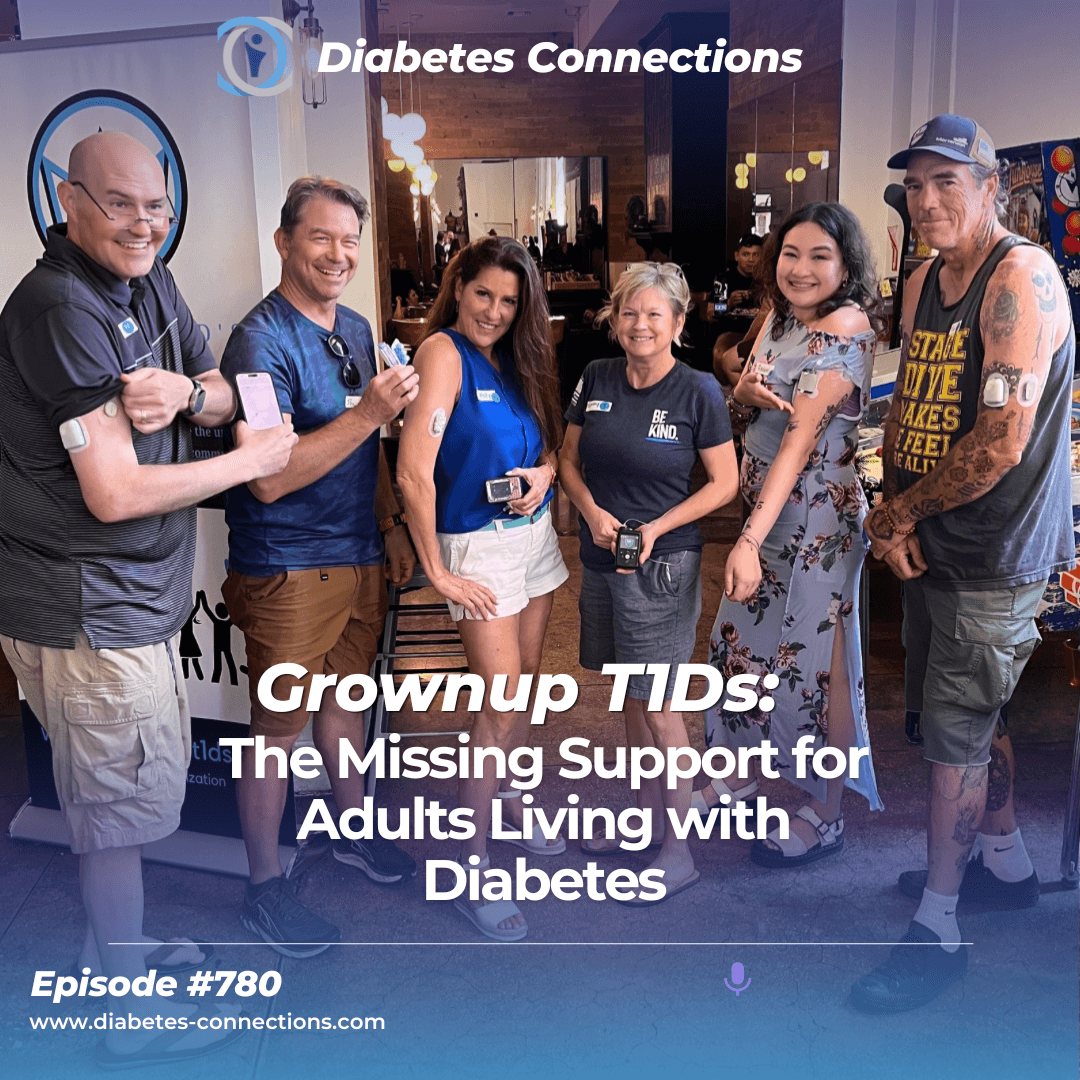
Diabetes Connections | Type 1 Diabetes
Grownup T1Ds: The Missing Support for Adults Living with Diabetes
00:37:16
Loading summary
Transcript94 lines
- [00:01]
A
Support for this episode comes from Dexcom. You've probably heard me say this before, but it's worth repeating. Dexcom G7 isn't just great tech, it's accessible. Dexcom is the number one covered CGM brand, and most people pay $20 or less per month. Dexcom is also the leader in CGM connectivity, offering the most connected CGM systems connect to a wide range of compatible pumps, pens and and health apps to create a setup that fits your life your way. For us, Dexcom has made managing diabetes feel less overwhelming and more in control. Check out Dexcom.com or your local pharmacy to get started. This week on Diabetes Connections. There's a reason we don't call it juvenile diabetes anymore. But even though we all know you grow up and T1D doesn't go anywhere and that you can be diagnosed with Type one at any age, it often seems like adults are forgotten. I hope that's not the case around here, but boy do I hear about it in the greater community. Kelly Dawes wants to do something about it. She's started Grown Up T1DS, a community built specifically for adults with Type 1 who are finally finding connection, understanding and support in a way they may never have before. This podcast is not intended as medical advice. If you have those kinds of questions, please contact your healthcare provider. Welcome to another week of Diabetes Connections. I'm your host, Stacey Sims. You know, we aim to educate and inspire about diabetes with a focus on people who use insulin. As this episode goes live, I am just back from the Nevada Chapter Breakthrough T1D Summit that happened in Las Vegas, but I am taping the episode before I travel. You know the way podcasting works, there's some time travel involved, but I'm a little nervous about this just because of all of the airport stuff with the TSA and delays and knock on wood, so far, Charlotte has been okay. But yeah, I won't know until the morning of but I'm sure it all went swimmingly and there were no issues whatsoever getting to Vegas and I won lots of money playing Pai Gow. Um, I mean, obviously, who the heck knows? But I am confident that the summit is fantastic. I met lots of great people and if you're a new listener that I met there, welcome and I'm really glad to have you here. We have opened registration for Mom's Night Out Seattle. Detroit is happening this fall as well. So Detroit is in September. Seattle is in October. Please head on over to diabetes-connections.com click click on the Events tab and you can Learn more about our Mom's Night out events and see pictures at past events. And please check out our Club 1921 events. Those vary. The next couple are Atlanta and Philadelphia, New York City area. And those are gonna be for healthcare providers and patient leaders. We have a couple later this year that are going to be for the greater community. So always a lot going on. And I do wanna point out that we have always welcomed women with Type one at our Mom's Night out events. They don't have to be moms, you know, for many reasons. And mostly it's because I think that we caregivers, we moms of kids with Type one can learn a lot from them. I know I certainly did when Benny was smaller. But these events are also one of the only times that these women can meet each other. And it's really amazing. They always have a good time. They always thank me for bringing them together. And I'm surprised, frankly, that there haven't been more opportunities for that. I was glad to see that happening at the Breakthrough T1D Summit in Vegas. I think this, that breakthrough's doing a better job, frankly. It's one of the reasons why they are now breakthrough T1D and not JDRF. But, you know, for so many adults who've lived with Type one for decades, there's a big gap in support and in care. You know, a lot of you have been navigating this since NPH in regular, you know, no cgm, let alone in regular, no pump, let alone a cgm. And honestly, not a lot of guidance. And now you're navigating midlife and beyond with a new set of challenges. So I'm really excited to be talking to Kelly Dawes. She has lived with type 1 since 1981, and she is leading grown up T1DS. We're gonna talk about what it was like to grow up with diabetes in the 80s. Why, and we really both agree on this, why in person, connection matters more than ever. And what she hopes to accomplish with grownup T1Ds. You know, I hate to say it this way, but many of you have told me you were not supposed to live this long. How many people diagnosed as teenagers or younger before the 1990s or, you know, a little bit later even were told that they wouldn't live to age 30, they'd never have kids. And, you know, you've proven them wrong. So now we have a generation that is not only, you know, retiring, but they're also living long enough to introduce the joys of T1D to Medicare. One quick note, we did tape this interview a while ago. There may be some outdated information in terms of where she's having events, but I'm going to link up their website in the show notes. Please check that out and you will find where grown up T1DS is going in the weeks to come and how to get involved. My conversation with Kelly Dawes right after this. From the very beginning, they mean everything to you and that means you do anything for them, especially if they're at risk. So when it comes to type 1 diabetes, screen it like you mean it. Even if just one person in your family has type one, you, you are up to 15 times more likely to get it too. Screen it like you mean it, because one blood test could help you spot type 1 long before you need insulin. Talk to your doctor about how to screen for type 1 diabetes because the more you know, the more you can do. So don't wait. Visit screenfortype1.com to learn more. Again, that's screenfortype1.com Kelly Dawes, welcome to Diabetes Connections. How are you doing? It's good to talk to you.
- [05:56]
B
Oh my gosh, it's so good to talk to you as well. I'm so happy to be here. Thank you for having me.
- [06:00]
A
You got it. Tell me about Grownup 2 Indies. I know your story started long before that and I want to, you know, get your history and talk more about it, but what you're doing, you know, I'm a big fan of in person stuff. I think what you're doing is great. So tell me about grown up T1DS.
- [06:15]
B
Grown up T1D started basically it started after the pandemic and we were locked up and I had sat through a meeting, doctor virtual meeting. Dr. Ann Peters was presenting and she was saying how some of her most resilient patients were breaking down due to the isolation and asking for anxiety medications and so on. And it, you know, occurred to me, well, geez, living with diabetes is isolating enough. And then here we've been locked down. It was pretty bad. So after everything opened up, I'd have already been involved in the diabetes community for years. And so I was able to reach out was to some friends and say, do you guys want dinner? And everyone's like, yes, yes. We got together, there's about 15 of us. And it was incredible. I mean, you know, there's so many virtual meetings, but it's not the same as in person. That just hits different and it, it went from there. But prior to that, honestly, something that had Bothered me for a long time is that I felt there was no support out there for those of us who are in midlife and aging with long term T1D being that, you know, we're finally living longer thanks to improvement in insulin and technology and science. And we never had that before. Not everyone made it from back then, you know, and there's a group of us and then you bring in, like my sister was diagnosed two years ago in her 50s. You've got these adult onsets who also have really no support. I feel like the largest group of people living with type 1 diabetes is midlife and older, yet there's nothing out there for them as far as support.
- [07:55]
A
Okay, so let's back up because you have quite a story. As you said, your sister was diagnosed in her 50s, but you were diagnosed as a kid.
- [08:02]
B
Yes.
- [08:03]
A
Talk to me about your diagnosis and if you wouldn't mind, like kind of set the stage of the time period and what was, what was diabetes like at that time?
- [08:12]
B
Oh my gosh, it was so I always refer to it as the dinosaur days. You know, we didn't even have blood sugar meters. There was no way to monitor or manage what was happening. And it was back then, it was pig and cow insulin, which worked very different. And everyone has heard about that type of insulin, but don't, people don't really realize how awful that insulin was. It was very. The way it was processed back then was inconsistent, so it didn't work the same every time. The low blood sugars hit hard, I mean, they were awful compared to the lows I have now with the better quality insulins. And I remember being diagnosed in the hospital. They, they called it juvenile diabetes. And they just kept saying, she has diabetes. They'd never mentioned anything about autoimmune or the seriousness of it, though I was in the hospital for weeks and did have to attend a class and learn some things.
- [09:07]
A
How old were you, Kelly?
- [09:08]
B
I was 12.
- [09:09]
A
Okay.
- [09:10]
B
I was 12 years old and it was one shot a day. We just mixed the long and fast acting insulin in one vial. This is what I was taught. You take one shot a day and that's it. So that's all I knew. I didn't know to question anything. I didn't really have help from my parents. We had a really terrible home life. Unfortunately. We were on the run from my dad, often at times homeless, foodless. My diabetes was not put front and center or even managed. So I was on my own, basically. And all I knew was one shot a day. I wasn't Taken to doctors. And so I remember in school, I mean, I would ask to go to the water fountain all the time, because clearly that one shot a day wasn't covering it. I didn't know. I know now.
- [09:57]
A
Right?
- [09:58]
B
Yeah. So at one point, a teacher in front of all the kids, it was so embarrassing. Called me out, told me I was a flake. I'm always asking to leave the classroom for water and just things like that. We just didn't know enough.
- [10:14]
A
Yeah.
- [10:14]
B
I didn't even know how to explain it.
- [10:16]
A
And what year were you diagnosed?
- [10:18]
B
1981.
- [10:19]
A
Oh, yeah?
- [10:20]
B
Yeah. So there was no A1Cs. There was no such thing as time and range or.
- [10:25]
A
Well, like you said, there were no home blood glucose meters in 1981.
- [10:28]
B
Not at all. We peed on a little stick, and then it gave you a wide color range. You know, you might see between 1 and 200. You don't know what number. You know, it just. It was all guessing around what age or what.
- [10:42]
A
Did anything happen as you got older that helped you kind of take more control? Was it the technology getting better? The insulin's getting better? I mean, like you said, you were pretty much on your own.
- [10:52]
B
There was so much that happened in between. Honestly, as a teenager, not long after my diagnosis, my mom was hit by a car as a pedestrian and was in neurological icu. We spent months there, and she was in a coma, and she. So. And that she had brain damage. She survived miraculously, but she had brain damage. And I was a lot of scolding. Even then, relatives, aunts, you know, they would say, kelly, did you do. Are you taking care of yourself? You better take care of your. People always say, you better take care of yourself. And you sitting there going, like, what? No, I'm trying to die.
- [11:27]
A
Yeah.
- [11:27]
B
Yeah.
- [11:27]
A
And I mean, I hear that all the time. Like, was.
- [11:29]
B
My.
- [11:30]
A
My husband's family has a lot of type 2. And things were said like, well, that person didn't take care of themselves. I'm like, it was also 1973 and nobody knew anything. You were smoking while you were pregnant. What are you talking about? She didn't take care of herself. Nobody knew anything. Oh, my heart goes out to you, Kelly.
- [11:47]
B
Yes, that's a pet peeve of mine because I hear it all the time, too. Someone will say, you know, my brother had type 1 diabetes, but he didn't take care of himself. We lost him. He was diagnosed back in the 70s, and I'm thinking, one, you have no idea. Not only the physical part, but the mental load of being Given a death sentence, we were told we weren't going to live. I remember being told I wouldn't live 20 years. And so I hate when people say that. But, you know, for me, the turning point was during college. I had been on my own since I was about 17 and moved out. And during college, I ended up picking up a job off the job board. It was for a physician owned dialysis company. And I ended up working in dialysis for several years. And it wasn't an outpatient unit, it was what was called acute and then later also staff assisted department. So it was the worst of the worst. And so we would bring, you know, people who are on dialysis need their treatment regardless of what's going on. So if someone has a heart attack and they're hospitalized, we would bring in portable equipment. So I worked in hospitals and this is what educated me. I was in my 20s, it opened my eyes. I learned so much. I started asking questions and kind of comparing my background to some of the patients, like, look at the patient's charts and oh, she was diagnosed at my age. And I'm seeing this patient who's a social worker, she's educated, she's blind, she's missing a limb, she's on dialysis. These things started becoming very serious to me. And that's when I, I think I started to take it more seriously.
- [13:19]
A
But to take it more seriously, you were doing what you were told doing that one shot a day. When did that start to change for you?
- [13:26]
B
Um, yeah, and even when I was working dialysis, I couldn't afford test strips. I couldn't afford. A lot of the stuff was awful. It was physician owned and. But anyways, it was. When I got pregnant, I was pregnant with my son. I was told I would never have children. And then when we did get pregnant, they were telling us to terminate the pregnancy. And that's a whole other really terrible story. But I didn't listen. I was young and they upped me to three shots a day. That was a big jump. And I had my first A1C. I had never heard of A1C before, and it was six.
- [14:04]
A
Amazing.
- [14:05]
B
Yeah. But no, you know what, I was like the queen of lows. I was passing out all the time, I mean, for years. And so I know it was just an average of me being in the 30s, 20s, 30s, 40s, up to the 400 back then. I didn't know that. All I know is that they did this test and they said, there's a number. And this number was fantastic. They were really happy. And I thought, okay. I didn't even know what any of it meant. But they upped me to three shots a day from one shot a day. And I bought my first blood sugar meter. This was 1989. And it was so expensive, I paid out of pocket. It was expensive. But the insulin, between being pregnant and taking now triple the amount of insulin I was having low blood sugars that would come on so fast. I would pass out while I was driving.
- [14:52]
A
Oh, my God.
- [14:52]
B
I mean, there was no warning, so I lost my license. I mean, stories I could tell you are crazy, crazy, crazy. But that's where, in addition to working in dialysis, my pregnancy and seeing all these specialists who were telling me, you have to do this, you have to do this. And I'm saying, okay, okay, okay. And it just went from there.
- [15:12]
A
Wow. When did you find. I mean, we're skipping all over the place because as you said, there's stories upon stories here. And I'll read your book someday, but when did you find the diabetes community?
- [15:23]
B
Um, gosh, I'm trying to think. You know, we didn't have Internet. We didn't have. For the majority of my time living with this. So you hear everybody say I didn't know anybody, but. Well, so many of us didn't know anybody who had it. So it was probably more when I got real involved. So fitness has always been my thing, and I really believe exercise has helped keep me alive. And I became a nationally certified personal trainer decades ago. And in addition to the medical background, I also received a paraprofessional CD CDE certificate through the Association Diabetic Care and Education Specialist, because I ended up working with a ton of diabetics and I was getting referrals from certified diabetic educators, endocrinology offices and so on. And I had a specialty certification in that. So that's when I probably started to get more and more involved. And then years ago, prior to the pandemic, I used to work TCOYD every year and met so many people. And that's how it all kind of. And then the Internet, social media. Yeah.
- [16:23]
A
And tcoid, to be clear, is an incredible online resource, but also has in person events. Take control of your diabetes and that big one in California once a year. That's what you're talking about?
- [16:32]
B
Yes. Prior to the. Now they do what's called 1o, n e1. Prior to that, they used to do for type 1, type 2, everybody. Huge conferences all over the country, and it traveled all over. And they were based here in San Diego. So I used to work their San Diego one every year, and that's how I got to meet so many people, including Dr. William Polonski, who serves on our board for Grown Up T Wendy's.
- [16:57]
A
Excellent. And so all of these things you're talking about, the, you know, the one shot a day, the teacher shaming, you know, no blood sugar meter for the first years of diagnosis. I imagine that those are all things that you have in common with a lot of those grown up T1D folks. But as you said, there's a whole cohort of people who are diagnosed later than you in terms of chronology. Like diagnosed in the 2000s or diagnosed much later in life.
- [17:26]
B
Yes.
- [17:26]
A
What's it like to be, like, the same age as somebody who has type one, but they were just diagnosed three years ago? I guess I can ask you about your sister. Tell me about your sister's diagnosis. Right back to our conversation. But first, Diabetes Connections is brought to you by Omnipod.
- [17:45]
B
Did you hear the pod drop?
- [17:54]
A
Did you know all the sounds used to make that song come from a sight? Change with the Omnipod 5 automated insulin delivery system. Pretty cool, huh? With Omnipod 5, pump site changes are simple. The pod lasts up to three days, 72 hours. And to change it, you just fill up the pod with insulin, place it on your body, tap a few buttons in the Omnipod 5 app, and you're ready to go. There's no tubing to prime like with traditional insulin pumps, and it's virtually pain free, so you never have to see or handle the insertion needle. Want to try Omnipod 5 for yourself? Request a free Omnipod 5 starter kit today by visiting omnipod.com diabetesconnections Terms and conditions apply. Eligibility may vary.
- [18:43]
B
Yeah, so, you know, it's really opened my eyes and helped me to keep an open mind to everybody, you know, other people's experience. Yeah, I do feel like those of us diagnosed back in what I call the dinosaur days, I do feel like we're different. We're a very different version of type one, not only physically and what we've had to survive and the worries of what damage was done back then, but also mentally and the load we carried with that because they did tell you you're not going to live. And so it's different at the same time, that doesn't diminish the fear and the experiences adults, you know, later in life who are diagnosed. Right. So, you know, especially having my own sister, I was used to being the sick one. In my family, it was always me. Kelly's the sick one. Kelly's sick. And then when it happened, you know, I even went through. I was so upset. My sister and I are a year apart. We're best friends. We've always been best friends. And incredibly protective of each other. But I was so angry. I'd been through. I had been over 40 years I'd been living, and I was very okay with being the one who had to carry this. And then when it happened to my sister, I was mad at God.
- [19:52]
A
Yeah.
- [19:52]
B
How could you? We've lived through so much ugliness our childhood. And then I was okay. I've made it, and I've been okay, and I found peace. And then now, why her? You know, that was a tough one for me.
- [20:05]
A
Did she find out through a general checkup was she sick for a while? I mean, type one in adults come. You know, you hear all sorts of different stories.
- [20:13]
B
Yeah. You know, it's funny. She had been in dermatology for 30 years, and so she was. She's super savvy. She's smart. Plus, she grew up with a sister who lived with type 1 diabetes. But no. No clue. So her labs, they kept saying, her annual lab work, they kept saying, you're pre diabetic. You're pre diabetic. So she was exercising, drinking more water, doing what she could, and then when Covid hit, she did get. She thinks Covid probably triggered it.
- [20:40]
A
Yeah.
- [20:41]
B
It was after that, she called me one day. I was about to speak to Congress. So I advocate with DPAC at adces, and we had virtual Hill Day for adces that day. I was gonna speak, and I'm getting calls from my mom, my sister, everyone, and she's saying, I'm so lethargic. I've lost a bunch of weight. She's telling me all this, and I'm like, oh, my gosh. At the time, she had not heard of adult onset. You know, we're barely hearing about this the past year, Right. And so I'm telling her, go in, ask for this test, this test. Go to the hospital. And then her husband's saying, no, it's just type two. I'm saying, no, I'm really afraid that it's not type two. And sure enough, she did. She called her doctor. The doctor said, go to the hospital. They did all the proper tests, screening, and she was sent home. Here's a typical situation of what's going on with our type ones, and my sister, who's savvy, is sent home with a Baby bag full of prescriptions. She FaceTimes me. She's in Arizona. I'm here in California. She FaceTimes me and she goes, what am I supposed to do with this?
- [21:42]
A
Oh, my God.
- [21:43]
B
She has an insulin pen. And the pen needles that are disposable. Right. They didn't tell her or teach her what to do. She was used to me as a child with a syringe and vial and she me with a pump, but she'd never really saw me using flex pens. And no one told her. And we hear this all the time in our gatherings at grown up 200, especially with our adult onset. Like, you know, there was no education.
- [22:05]
A
Yeah, yeah.
- [22:06]
B
No support. We. I was just thrown out. Tossed out there on my own.
- [22:10]
A
It's. It's bananas because with children, you know, you get at least two to three days of education.
- [22:15]
B
Right.
- [22:15]
A
Even if, like, our son was not, thankfully, in dka. And so he didn't need to stay in the hospital for three days, but they insisted because we needed to be educated. They needed to make sure I knew what I was doing. And yet an adult needs the same care, but they don't. Nobody I know gets to stay in the hospital. Gets like, it's a privilege, but you know what I mean?
- [22:33]
B
Yeah.
- [22:34]
A
They are not allowed to stay. It's just horrible with grownup t1ds. Tell me what happens here. Cause we mentioned in person gatherings, but this isn't just happening in California where you live.
- [22:44]
B
No. Yeah. So they're in person gatherings. In person is just so much different. That human connection's different than virtual, and virtual meetings are fantastic. It's serving a great purpose, but it really feels different when it's in person. And we've had several people who've told us that because of these gatherings, they actually want to take better care of themselves. Not out of fear, but because they feel supported. One of the big ones that I love is that we hear over and over that the connections don't end when the meetup does. People are making real friendships. They're texting each other, checking in, and finally having someone that they can reach out to at their age level. We've had people say, oh, my gosh, this is the first time I've attended a diabetes event that wasn't for children. You know, we hear that a lot and we love our children, of course, you know, I was a child when I was diagnosed, but it's just different in midlife. It's so different for us whether someone's going through a divorce. We're Having more medical screenings and procedures and which are hard, by the way, to navigate. My dad died of colon cancer and I remember having to have a colonoscopy and going, wait, I can eat for four days. Who do I. You know, luckily I had a good friend who's a CDCs and has lived with Type 1 over 50 years who could help me. But this isn't stuff we see on social media. And who the heck is going to post, hey, how do you navigate the colonoscopy? You know, I'm not writing that all over social media,
- [24:14]
A
Kelly. This is where I have to interject that I never talk about this, but I have. I have ulcerative colitis. So I am an expert on colonoscopies, baby. Not with type one, though. I mean, but we could. That's a different show. That's a different show.
- [24:28]
B
Yes, yes. Well, and even things like menopause, you know, we're not going to shout that all over social media. You know, there's just things. And it could be something as simple as raising children and the stress with that as, you know, midlife and adulthood is different. Different in older adults, you know, because there are many more procedures. We're having screenings also. Just the things that we're worried about, like long term care and what's going to happen because they're not prepared for us.
- [25:01]
A
No, you weren't supposed to be here.
- [25:03]
B
No, we were not supposed to be here. And as a result, no one's really prepared for it yet. We're the largest group.
- [25:10]
A
Yeah, I'm a huge fan of in person gatherings, as I've said many times. And I do think that there is a wonderful thing about the entire diabetes community getting together, but it's the cohorts. Like, everybody needs their own group in a way, at least every once in a while. I mean, that's why I do the mom's night out stuff. But like, when my son was a toddler, we were so lucky. In Charlotte, somebody started. They called it D Buddies and it was for toddlers with type one. Right. And then, yeah, it was a complete circus. You know, you'd get these kids together on a play and we're the moms screaming like, get back here and eat that cookie, young man. You know, but then you'd have like a middle school group so they could sit around and roll their eyes at each other. You know, you have like a teenager group. I wish there was something for dads of kids with Type one, but I'm so excited to see this kind of group happening. Because there aren't the resources. So you have it in California. I know you have it in Boston. Where else do you have these groups? And how can people get involved?
- [26:08]
B
Oh, my gosh. So we've had an overwhelming since word got out, and we've only been a nonprofit for two years, and word got out and we've exploded. I am receiving message after message and people saying, hey, I'm in, you know, Kentucky. When are you guys going to come here? And I feel so isolated. I've lived alone with this for 35 years. And oh, my gosh, I just got a message yesterday. She said, I'm an adult who was just diagnosed two years ago, and there's absolutely zero support. It does not exist. And it breaks my heart. So, yes, we are expanding. It's happening sooner than what I had planned. I won't keep up. Boston has already started. Philly Metro is what we're calling it, the Philadelphia area. Gary Scheiner is one of the people leading that. He's so excited. Yeah. And so they're about to kick off. I've got meetings with Birmingham, Alabama. One of the gallups is the CDCes, who's involved. And then, oh, my gosh, North Carolina, Phoenix, Washington, Seattle, Washington, and then Virginia, possibly Connecticut, and also New York.
- [27:14]
A
But these are all like little chapters or affiliates. Like, how does it work?
- [27:18]
B
What I tell people when they reach out is, you know, we are so happy to expand. We're already a nonprofit organization. You don't have to reinvent the wheel. You'll fall under our umbrella of the nonprofit. We just need a volunteer chapter leader who can organize and be that person, that contact person in that city so you can set up the meetups, greet people, follow up with emails, collect your emails so that you can send out, hey, this is what's happening when. Because I can only barely keep up with California. But, you know, so they'll be the lead person, and they're going to be the lead community person in that city. I mean, they're going to end up being someone everyone is so appreciative of and thankful for. And it's something that has become such an urgent need. I didn't realize how much this was needed until these emails and messages just came flooding in. And so that's what they're just going to lead those chapters. So I have to set up meetings. It's just been meeting after meeting with people who are stepping up to lead chapters in their cities. And I'm trying to keep up, but, yeah, we're exploding and expanding so what
- [28:27]
A
do the chapters do? I mean, in your vision as a nonprofit, is it the idea? And this is a great idea, and it is enough. Is the idea a social meetup every once in a while? Is there more of an advocacy? Ben, because you already mentioned Deepak and there are lots of other groups doing good things, I guess I'm asking what the mission is.
- [28:46]
B
So my advocacy is separate from, you know, it's just something I do. In addition to this, our mission is to serve this underserved demographic, population, midlife and older people, adults living and aging with type 1 diabetes, whether it's long term, type 1, decades in, or newly diagnosed. And though we welcome everybody, we really do, it's a support. I call it social support. So instead of sitting in a clinical setting, which I'm very much against, and I tell the chapter leaders, we don't need any more clinical settings. We don't need any more lectures on foot care. We need social support because as we know, with age, isolation increases.
- [29:29]
A
Yeah.
- [29:30]
B
And then living with diabetes as it is is isolating. So what's happening is this is helping people. It's improving their health. You know, we're fighting isolation and decades long burnout and so much more. I like minimum quarterly meetups in a restaurant, sports bar. It can be a park. We've done a hike. Whoever leads that chapter, it's their baby. They know their culture and their city, and they'll know what would work. I just try to tell them, you know, I really prefer not to do a clinical setting.
- [30:05]
A
Yeah, right. And no folding chairs. It's not a support group that way. That's what I always try to describe it. Yeah.
- [30:12]
B
Yeah. I feel like that this population has grown quietly over time and support just hasn't caught up. And it's unfortunate. Even other organizations, they really are tailored to children or young adults and social media as well. So there's really never been a place for us, but. Well, until now. And we're coming and we're spreading all over, you know, the country. And I just want to make sure people know that it's happening and we're there and they don't have to feel alone. No one should have to T1D alone or feel lonely or isolated. And this includes men, women. We have so many men that attend.
- [30:54]
A
That's great to hear.
- [30:56]
B
Yeah. It's just so much more complicated with age as our bodies change, our hormones change, and yet life expectancy has risen sharply and more and more are being diagnosed after the age of 65.
- [31:10]
A
Really?
- [31:10]
B
Yes. And so you Know, there's a big group and with age also, like financial burden, a drop of income, you know, there's things. It's so accessing things and kind of helping each other navigate insurance or, you know, we. At one we did a hike and then I had a gal who's lived with type one for over 50 years, Lori. She's a licensed Medicare agent and she came and for anybody who had questions on behalf of, you know, Medicare with type 1 diabetes, she specializes. You know, there's so much. We're kind of a different group. That's our goal is to get to these people that nobody else was really addressing.
- [31:48]
A
That's amazing. This year I am asking all of my guests to talk about a diabetes organization that is meaningful to them. It can be your own. It can be something that helped you along the way. Any thoughts on something, you know, that you want to give a shout out or let other listeners know about?
- [32:05]
B
Yeah, of course I'm passionate about my own org, very much so. But I would say probably the ADCEs I have had made so many incredible connections there and getting my certification years ago and advocating on Congress with their teams. I feel like I don't care how many years into this you are, there's always something to learn. And I learned so much from them. I feel like they're really an integral, fantastic organization. And also the other one would probably be tcoid. I've always loved how they approach things and the education, the personality, and they make it fun. It was always. I miss those huge conferences. It was always very uplifting.
- [32:48]
A
Okay, before I let you go, Kelly, what's your next event? Are you hiking? Are you bowling? What are you doing?
- [32:54]
B
February. Boston is planning something in February. It looks like Philadelphia. Philly Metro is going to have their new launch in February.
- [33:03]
A
Nice.
- [33:03]
B
I'm still got to meet with all these other cities to work things out for here in Southern California. I'm working out details. We will start again in February and have a new one, and then it'll be every couple of months. And in the meantime, you know, I'm just trying to get these leaders and cities. I have to, you know, the other thing too is fundraising because we are a nonprofit and there's. So there's overhead costs. There's, you know, so when these other cities become chapters, I have to pay fees in every state in order for us to operate there. I'm trying to do fundraising as well, because I really want to keep this afloat. This thing has exploded because the need is there and I don't Want to just stop, you know, but the financial support's a big part, too.
- [33:52]
A
Sure. So if I'm doing the math right, you've lived with type one for 44 years.
- [33:59]
B
Yeah. A couple months will be 45 years. Wow.
- [34:02]
A
It's amazing to think about how much has changed, but a lot of type 1 stays the same in terms of the mental load and needing community and all of that. I don't want to ask you to wrap it all up in a bow here, because I don't think anybody can do that, but any reflections at 45 years of type one? Almost.
- [34:20]
B
Yeah. You know, I've seen a lot and heard a lot from people who attend our meetups that we and a lot of our regulars, they'll drive three, four hours. So I go all over Southern California, but they'll come to every single one because support has been. We've had people break down tears out of fear of ending eye surgery coming up, and then others will come in and gather around and help that person. And we've had people with cancer in addition to Type one. The support is incredible on my part. I have dealt with complications and I've accepted it. What I'll say, and I know this might sound crazy and I have some people go, really? But I had to make peace with it years ago, so I made peace with it. This is the life I was given. This is the hand I was dealt. So I can either choose to be miserable and woe is me and sad, or I can choose to find happiness and every single day, even if I'm knocked down by stubborn blood sugars that make absolutely no sense. You know, I'll say tomorrow's a new day and there's always something positive. And I have somehow found a way mentally to make peace with it. This is just my life. Wow.
- [35:27]
A
Well, Kelly, thank you so much for joining me. I'm so excited to see the growth and continued growth of grown up T1Ds. Keep us posted. Thanks for being here.
- [35:36]
B
Oh, thank you. I'm so glad to talk with you. I really appreciate it. This was fun.
- [35:46]
A
More information about everything we talked about. I will link it up in the show notes over@diabetes-connections.com Every episode has its own homepage with the links and everything that we talked about and we talked a lot about the importance of in person connection. This is something I have been passionate about for many years. If you've listened to the end of this podcast, you know exactly what I'm talking about. I mean, the show is called Diabetes Connections and that is why. And I am thrilled to see more organizations sticking their toes in the water and trying to figure out how to do in person events. This is the way people. I am so excited to see this happening. I think we're past Covid long enough that people are happy to get back together again. It is hard to get together in person. It is hard to get people to go. It's hard to get people to commit. It's a hundred percent worth it. If you see a diabetes organization talking about getting together, whether it's two people or 20 or 200, go. Encourage them, help them, maybe make your own. Do your own meetups. It's hard, but I'm telling you, it is so rewarding. Okay. Thanks to my editor, John Buchenis from Audio Editing Solutions. Thank you so much for listening. I'm Stacey Sims. I'll see you back here soon. Until then, be kind to yourself.
- [37:02]
B
Diabetes Connections is a production of Stacey Sims Media. All rights reserved. All wrongs avenged.