← Diabetes Connections | Type 1 Diabetes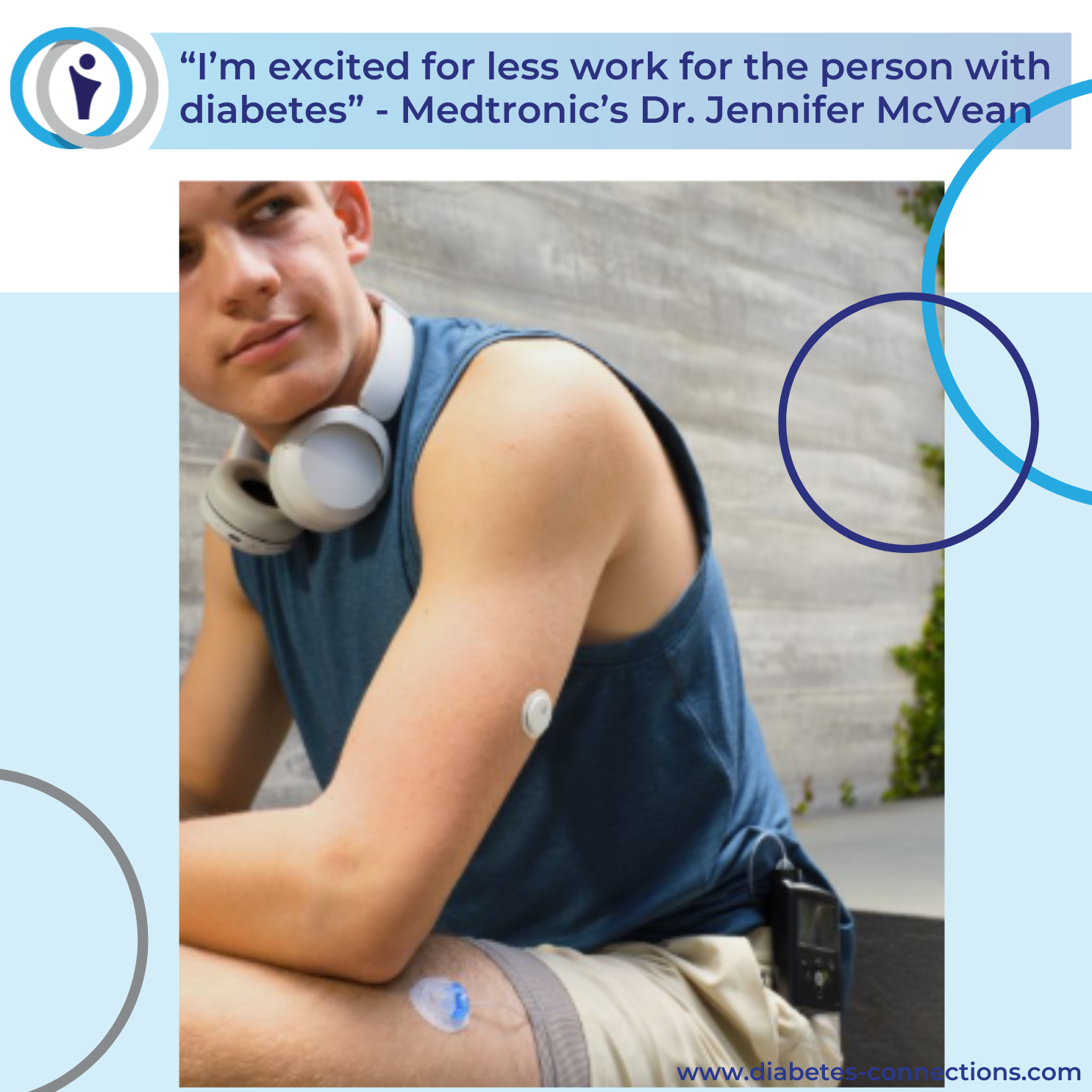
Diabetes Connections | Type 1 Diabetes
“I’m excited for less work for the person with diabetes” - An update from Medtronic’s Dr. Jennifer McVean
00:43:53
This week on Diabetes Connections.. Medtronic is making some big moves.. from new sensors, to spinning off the diabetes division. Dr. Jen McVean, medical affairs director at Medtronic’s diabetes business. Dr. McVean lives with type 1 and has a...
Loading summary
Transcript62 lines
- [00:01]
A
Support for this episode comes from Omnipod. At one of our recent Mom's Night out events, the Omnipod team was on site asking moms about their experience with the OmniPod 5 automated insulin delivery system. It was so much fun and it was great to hear what the moms have to say. Here's what Angela, mom to Dominic, told us.
- [00:21]
B
My son is 10 years old and he uses an Omnipod 5. It's the only pump he has used since he was diagnosed. It's been a life changing piece of equipment for him to have. He's a competitive swimmer, he is able to keep it on in the pool and we don't have to worry about disconnecting. So we absolutely love Omnipod and it has really just made a big difference in his life.
- [00:40]
A
Want to try Omnipod 5 for yourself? Request a free Omnipod 5 starter kit today by visiting omnipod.com diabetesconnections Terms and conditions apply. Eligibility may vary. This week on Diabetes Connections, Medtronic is making some big moves from new sensors to spinning off the Diabetes Division. Dr. Jennifer McVeen is Medical Affairs Director for Medtronic Diabetes. She lives with type 1 and has a real passion for better access and better outcomes using technology. We talk about their latest real world studies, questions doctors ask about aid systems, the new sensors that are available, and a lot more. This podcast is not intended as medical advice. If you have those kinds of questions, please contact your healthcare provider. Welcome to another week of Diabetes Connections. I am your host, Stacey Sims. You know we aim to educate and inspire about diabetes with a focus on people who use insulin. If you are new to the show, welcome. And a little bit about me. My son was diagnosed with type 1 back in 2006 just before he turned 2. He is now almost 21. My husband lives with type 2 diabetes. I don't have any kind of diabetes, but I have a background in broadcasting. I worked in local television and radio for many years and that is how you get the podcast. It's been 10 years of this podcast. We started it in June of 2015 and you know what? We haven't run out of things to talk about yet. In fact, we have expanded into in person community events and we have two left in 2025. Our next mom's Night out event is coming up. It's just it's two weeks away. We're going to be in Phoenix October 24th and 25th. Not too late to register. You can head over to diabetes-connections.com and click on the Mom's Night out page. It's also an events page, depending on how you're looking at the website. That's an event for the Women of Type 1 for moms of kids with diabetes and women living with T1D. We also have another Club 1921 community event coming up November 13th, and that is in Charlotte, North Carolina. You'll be hearing more about these Club 1921 events in the new year. These are for the full community, caregivers and people with type 1 1, moms, dads, grandparents, men and women living with T1D. I got this question last time I Talked about Club 1921. This is a very local event in Charlotte and registration fills up extremely quickly. So it's actually not on the website yet. But as I said, we're going to be doing more of these in different cities in 2026. I'll let you know when you can start looking for those. And of course I will let you know where we are going. All right, let's talk about Medtronic Diabetes. You know, many of you will recall they were first in the space with a commercial aid system. They called it the artificial pancreas and it was FDA approved in 2016 almost 10 years ago. And in that time the industry has come a long way. They don't call it an artificial pancreas anymore, of course. It's automated insulin delivery aid. And Medtronic has made some changes as well. The most recent and perhaps most significant, depending on your point of view, is that they are now taking orders. These are commercially available now for their new sensors. There is the Instinct sensor made by Abbott and the Simplera Sync sensor made by Medtronic. I'm going to link up more information in the show notes about both of these, both the announcement and how to order and some information from Medtronic. I do have to tell you that we didn't really get in depth about the sensors here. This interview was conducted before the announcement that they would be rolling out commercially, which is why I'm going to put a lot of information in the show notes and we'll definitely follow up in the weeks to come. There's a lot coming in the Medtronic pipeline tubeless patch pump, a screenless pump where you will control it only from your phone. And we actually did a long interview about the pipeline, what's coming in the next year or two just a couple of months ago back in May. And I'm going to link that interview up. You can go back and listen if you haven't already. And One more thing. We do talk briefly about the naming system that Medtronic uses. You know, numbers like the 570, the 780 versus names. And I meant that as kind of a lighthearted question. But since the conversation, I did a little digging and I found what could really be the names of the next Medtronic devices. And I'll come back and talk about that after the interview. My conversation with Dr. Jenn McVean, Medical Affairs Director for Medtronic Diabetes, right after this. One of the things we loved the most about the Dexcom G6 is that it helped Benny become more independent. But maybe not in the way you're thinking. I mean, remote monitoring using the Dexcom share and follow let us be more confident letting him do more away from home, with friends or at camp. But just the Design change of G6 meant Benny could use one hand to insert the sensor.
- [05:42]
C
He was 14.
- [05:43]
A
He didn't want our help anymore. It was perfect timing. Dexcom G7 is even more simple to use and gives effortless diabetes management that fits into your lifestyle without the disruptions. Ease of use helps everybody and I'm grateful the Dexcom product designers kept that in mind with G7. Learn more go to diabetes-connections.com and click on the Dexcom logo. Dr. McBean, welcome back to Diabetes Connections. It's great to talk to you. I really appreciate you being here. How are you?
- [06:11]
C
I am great. I'm so excited to be back here with you again.
- [06:15]
A
So you're in Bogota right now. Can you tell me what you're doing for Medtronic?
- [06:19]
C
Sure. I am in Bogota right now and we are hosting, over the next couple of days, healthcare providers from all over Latin America to learn about our technology and all of the recent and exciting things that are going on. Yo hablo espanol y poreso y o.
- [06:38]
A
Estoyaqui ahora and Bogota, that is amazing. I love it. So, a little off topic here. Did you grow up bilingual? When did you start speaking Spanish? How helpful must that be in the healthcare field?
- [06:49]
C
Yeah, well, it's a really great, great question. No, I actually grew up in Minnesota, which is not a place where you would necessarily expect that. But I always, as a child loved the Spanish language and the culture and the food and everything. And I knew I wanted to be a doctor shortly after I was diagnosed with type one when I was 11. But the wonderful thing about, you know, when you go to medical school is that when you're in college, as long as you do all the pre med classes, you can major in anything you want. And so I was a Spanish major. And so I majored in Spanish and then I went straight away to medical school. But I've had some different opportunities. I did my pediatric residency in Denver, Colorado, and there was a large Spanish speaking population in Denver. And so I remember very happily the days that I was taking care of a lot of young children in Denver and using my Spanish. And then more recently, in the last few years working for Medtronic as a global company, I've had the opportunity to speak in Latin America, Puerto Rico as well as we held a patient webinar in Spanish in the United States. And so one of my personal missions is to increase access to technology for all people and especially Latino individuals. So it's something I really enjoy.
- [08:06]
A
That's wonderful. One of the really interesting things about podcasting right now with AI is the promise. And I say that I'm a little concerned, but I'll use the word promise about translation. So I am looking into translating diabetes connections into different languages using AI, which I'm a little nervous about because it's medical, but it would be amazing to reach more people. It would just be really cool. So stay tuned.
- [08:29]
C
It is really exciting. What I'll say is, as you do your first couple, find a native speaker who listens to the AI translation so they can make sure. Because I have learned traveling around Latin America, there are certain words that mean different things in different places.
- [08:45]
A
Yeah, well, I mean, even when we started transcription services a few years ago, it's gotten much better, but for a very long time it didn't speak diabetes. So A1C would be through the, the transcription software would be something like, you know, a Wendy or, you know, hey, 1B. It was, it was really bad. It was really bad. But that's neither here nor there. Okay, let's bring it back to Medtronic. Lots of information and studies come out this time of year because of easd, the European association for the Study of Diabetes Conference. Uh, that happened in September in Vienna. And one of the studies that came out with Medtronic was real world evidence about improvements in glycemic control for people with type 1 with minibed 780G. Can you give me some of the high spots of that and then we can kind of dig in?
- [09:31]
C
Yeah, absolutely. Well, when we were thinking about what we want to share and what we want to showcase, we've had the opportunity to have the MiniMed 780G available for many years now in Europe. And we wanted to take a look at well, what are the outcomes of people who've been using it for three or more years now? There hasn't been any data on any other system that has been published with data for that long of a period of time. And in addition, we wanted to look at not only what are the glycemic outcomes because of course those are critically important and necessary, but we also wanted to take a look at user burden as well as trust in the system. And so those are the really the big picture things that we wanted to look at with this analysis.
- [10:18]
A
It might be helpful to a reminder that the 7ADG system, I believe, has been available longer in Europe than the U.S. yes. Is that correct?
- [10:27]
C
So, yeah, I can give you a little background. So that's.
- [10:29]
A
Yeah, that'd be great.
- [10:30]
C
So the MiniMed 780G system is an advanced hybrid closed loop system. So what does that mean? Well, that means that it has of course, the autobasal or background insulin, but it also has the ability to autocorrect as often as every five minutes. And that is really a distinguishing feature because autocorrections are one of those things that really can help people with diabetes. For times when they undercount carbs, forget to bolus, they enjoyed Ben and Jerry's or a piece of pizza before bed and they fall asleep and then the system can kick in that extra insulin that they need overnight. And so it originally came to Europe in 2020 and was approved in the United States in 2023. We're incredibly excited right now as we've had the MiniMed 780G system already for the last couple of years. But this fall we are rolling out two new sensors and making life with diabetes even easier. So that's kind of the big picture on the MiniMed 780G system. And yes, it's has been available in Europe longer than the U.S. excellent.
- [11:36]
A
Thanks. I just think there's a lot of systems. There's been a lot of advances since the seven, I can't remember, 760, 670 came out in 2018. I really would love if Medtronic would give these names, if they would, if all the companies would give them names instead of numbers. But that's neither here nor there. That's just.
- [11:51]
C
Well, I will tell you, Stacy, our next hardware, which is slated for next year, is going to have a name.
- [11:59]
A
Come on.
- [12:00]
C
Yes, yes. So we are very excited about that.
- [12:04]
A
All right now. Okay. We're tabling these questions for later, but I'm writing down more questions about names and numbers. Okay. I'M very excited. Talk to me a little bit about what these studies show, because everybody who uses an aid system in general gets better glycemic control. No matter what the system is, people get used to using it. No matter what the system is. In, in the aggregate, there's always going to be a few people who do not. What did these studies show specifically about the 780G system?
- [12:31]
C
Well, this study specifically was a look at the three year real world data from Europe, the Middle east and Africa. And so what we did was we took seven ADG users who were 16 years or older and they had given consent for their data to be used in an anonymized fashion. And we looked at three different things. We looked at the glycemic control, we looked at user burden and system trust. And as far as glycemic control, we looked at time and range, time and tight range, gmi, time below range, all of those things. And in this study, the way we described burden, because burden can be described in different ways, we have to look at metrics right when we're reporting something. So what we looked at is the percentage of the insulin that was delivered by the user versus the percentage delivered by the system automatically. And then we also looked at the same time the number of user initiated boluses. Now talking about system Trust, with the MiniMed 780G system, there are adjustable targets as well as adjustable active insulin time. And what we've seen in our pivotal trials, as well as nearly 400,000 people using the MiniMed 780G around the world, we have some recommended settings that help people achieve the highest time and range with our system. And those recommended settings are a target of 100 milligram per deciliter and an active insulin time of two hours. And I will say that is for individuals who are seven and older. Okay, so those are the things that we took a look at. Now as far as automated insulin delivery systems, we know that there are many of them. And you know, what do they include? They include an insulin pump, they include a continuous glucose monitor. And then they include the algorithm, the brains behind the system that delivers the outcomes. And so for us, the outcomes have always been incredibly important. Right. We want to keep people safe and healthy and their glycemic control as good as possible. And you're right, people using aid systems all do better than multiple daily injections. That is the nature of aid systems. But we wanted to take a look and see how are people on our system doing? What kind of outcomes are they Getting that can be achieved and sustained. And so that is where we took a look. And what we saw was that prior to starting the 780g these individuals were relatively well controlled. Their time and range was already in the 60s, but within the first month it increased to 78.6% and it remained pretty stable over three years.
- [15:24]
A
I want to make sure something that you said that went by kind of quickly, the range to which the system is trying to correct, you said that's down to 100.
- [15:33]
C
Correct. So there are adjustable targets of 100, 110 and 120. And so this was really, when we look at older technology, the targets were higher. But what we as kind of innovators, Medtronica's innovators in the, in the field, we saw from our first aid system that had a target of 120 that we would actually be able to target 100 in a safe and effective manner. And so that is what we brought with the 780G. So the ability to target down to 100. So every five minutes the system is delivering autobasal and or auto correction insulin to achieve that target.
- [16:14]
A
Okay, so that's great. Right? One of the first things my listeners said and many people in the community said is they wanted a lower target. But 100, 110, 120. I sound like I'm being nitpicky. I promise I'm not trying to be that. And maybe because I have a 20 year old son, that doesn't seem to be a big difference. Like 100 and 120 might as well be the same number in some ways in my life. Right. They're all fantastic. Why, why three settings that are pretty similar, like no option to run a little higher for exercise or things like that. Is it safe enough to use those three numbers? And people are happy with that? Am I the weirdo that thinks they're just too close together?
- [16:53]
C
So the mini med 780G does I, I just talked about the standard three targets. It also has a target of 150 milligrams per deciliter, which can be set for exercise or any other time that the person desires to run the glucose a little bit higher. It does have that as well. And yes, a hundred milligrams per deciliter is safe. We have seen that the system is consistently and, and this real world data demonstrates it as well. The time below range, the time below 70 is consistently below the recommended 4% and the time below 54 is consistently below the recommended 1%. And so we can target a hundred. And is there a big difference between a hundred 110 and 120? Absolutely. Now, for the next two hours, if somebody's glucose is a hundred versus 110, that probably doesn't matter as much. But when you look at the fact that someone living with type 1 diabetes has to live with diabetes for the rest of their life, it does add up. Every minute matters. And so I'm only 37 years in, but, you know, I hope to live at least another 37, if not more. And so what we know from the data, we started with time and range. So we know that the recommendation is to be over 70% of the time, between 70 and 180. But now what we're actually moving toward is time and tight range, which is the time between 70 and 1:40, which actually more closely reflects what a person without diabetes, what their glucose levels look like. So Dr. Viral Shah actually did a really interesting study where he put CGM on people without diabetes. And what he saw was that people without diabetes, they spent 96% of the time between 70 and 140. And so that's what we're chasing now. We don't expect people with diabetes to achieve that goal. Right. We know that our pancreases don't work, but with the advancements in technology, we are always chasing that goal. And so time and tight range is something that is being talked about more. And there was actually at ATTD in Amsterdam in March, a conversation of international experts about what will the recommendation be for time in tight range or the time between 70 and 140? And we are anticipating to hear the recommendation for that in at ATTD of this coming year. And so to answer your question, yes, those differences, 10, 20 milligrams per deciliter over days, weeks, months, years, decades, are of critical importance to people living with diabetes.
- [19:37]
A
I want to stay with asking you about the systems. When you mentioned you've been living with type one for 37 years, can you have imagined 30 years ago, 20 years ago, that we would have been quibbling about a system that brought you to either 120 or 100? It's pretty remarkable.
- [19:52]
C
Yeah. I have to say, when I look back on the evolution, I started this journey in 1988, and I was fortunate to have a blood glucose meter at the time. It took two minutes to get a glucose value. You had to wipe the strip off in between. I went to College in 1994. There was no CGM. I was just talking to somebody the other day about how I ran a marathon when I was in medical school in the year 2000 without CGM. So yes, there have been incredible advancements and I think that that's what's really exciting is that as technology continues to evolve that we keep chasing better and better outcomes, but at the same time, we're the person with diabetes. It's easier for them. They don't have to do as much. They can spend more time living their life. I spent 13 hours traveling yesterday from Minneapolis to Bogota and when I got here I glanced at my pump and I was 100. Now I wasn't 100 that entire 13 hours, but that was pretty amazing because I didn't spend a lot of time focusing on my diabetes. And when I think back 5, 10, 15, 20 years ago, if I had made a trip like that, I would've spent a lot of time having to deal with my diabetes.
- [21:12]
A
It is really pretty remarkable. Okay, let's talk a little bit about the new sensors. Now most of the questions that my listeners have and have sent me for this episode are not questions, frankly Dr. McVeen, that I think you can answer there about rollout, commercial cost insurance, stuff like that. But just to set the table here, as you know, but as you know, Dr. McVeen, but as you listen, Medtronic has now started rolling out the Instinct sensor which is made by Abbott and the Simplera Sync sensor. Both are proprietary to the Medtronic system or the Minimed systems. I have to remember to correct my terminology now that the name of the company has changed. But high level Dr. McBean, these systems are truly made, as you have already noted, of different components. A sensor is one of the components. Better sensor has got to mean better use of the system from your perspective. You know, what are you hoping to see from these new sensors? Right back to our conversation in a moment. But first I want to tell you how to lend your voice to the future of diabetes care by participating in in paid diabetes research studies that can make a difference. Join Thrivable when you sign up to become a member of the thriveable community, you make yourself available to share your story, insights and perspectives with companies that design, develop and deliver new healthcare products, services and technologies for people living with diabetes. Who's eligible? Well, it depends on the study, but caregivers, people with type 1 and healthcare professionals. Healthcare professionals can join the HCP research community. Find out more, go to Thriveable app Stacy or just click on the link in the show Notes. Your voice can make a difference.
- [23:07]
C
Well, I think that what I'M really excited about for people living with diabetes specifically in the United States, is that we're providing more options. You know, we are still Medtronic Diabetes, but we will be Mini Med. And you know, Mini Med is actually who we were when the company was founded. And the company was always founded on helping people with diabetes. And I feel very strongly and firmly and our data demonstrates what amazing glycemic outcomes that our systems deliver and frankly always have. But have our sensors been the easiest? No. And this is the place that we really needed to work. And so now we also have options for people and people love choice. And so what is this going to do? It's going to allow people to make a choice among sensors and to have sensors that are easier to use. Both the Simplera as well as the Instinct sensor are very easy to insert. There isn't a separate transmitter, which is huge. When you look at the instinct, it's 15 day wear. And so when you think about a person using the MiniMed 780G system who's using our extended infusion set that lasts for up to a week, they're only poking themselves about six times a month, twice for the sensor and four times for infusion set changes that. Stacy, back to your earlier question as to how things have evolved. I mean, thinking back to the days on poking fingers six to eight times a day as well as giving injections six to eight times a day, 12 to 15 pokes a day. And now we're talking with the MiniMed 780G with instinct about six pokes a month. So that is what I am excited for. Less work for the person with diabetes easier.
- [24:57]
A
Did those EASD studies for Europe include the different sensors or either? I know the Abbott one is new, but it didn't include the. The Simplera.
- [25:06]
C
Yes. So that the easd, the three year data, that was retrospective, you know, we looked back at the people who are using our systems and Simplera has been available in Europe for over a year. And so some of those individuals that were part of that were using the Simplera sensor. So primarily Simplera and the Guardian 4 sensor for that data. Now when we look at next week, we're really excited to be kind of doing a sort of more of official launching to healthcare providers about the 780G with Simplera with Instinct as well as our newer indication for type 2 diabetes. And we're going to be sharing some of our pivotal trial data which was our pivotal trial for the 780 with Simplera. We're going to be Sharing that as well.
- [25:58]
A
You're talking about people with type 2. Let's talk about that for a minute. More and more people with type 2 diabetes who use insulin are using insulin pump systems. Can you give us any information about what you're finding for people with type 2 diabetes?
- [26:09]
C
Well, in general, what we're finding with type 2 diabetes is that using the MiniMed 780G system is incredibly helpful in achieving glycemic goals. Very high time and range. The glycemic outcomes are even better than the people with type 1 diabetes. Now why is that? People with type 2 diabetes sometimes still make some insulin and things like that. You know, I'm going to have to say, Stacy, I don't have the data in front of me, top of mind, in order to tell you what those are outcomes are, but that's where we really shine. I mean, even more than with type one. And I think the other thing too is the ease of use. Some things about the mini Med 780G that are helpful for people with type 2 diabetes in addition to just, you know, what's helpful for type 1. Often people with type 2 are using more insulin, they have insulin resistance. And so we have a 300 unit reservoir and it can also be swapped out if needed midweek so that infusion set lasts up to seven days, but they can swap out the reservoir midweek. So again, kind of less for the person with diabetes to do. The meal detection technology that we have, which I haven't really talked about so much today, but the meal detection technology looks at if the glucose is rising at a certain rate, indicating the person with diabetes might have missed a bolus altogether or undercounted their carbs, the system can kick in extra insulin. And so for people with type 2 diabetes that maybe carb counting isn't as easy or something like that, and they're maybe not quite as accurate. Sometimes the system has that give and take that allows it to kick in extra insulin. Got it.
- [27:52]
A
You know, beck, with type 2 though, this might be my ignorance here, but quite often people with type 2 diabetes need even more insulin. Does that. And again, not really specific to the medtronic systems here, but is that true? And you know, does that make it more difficult to use an insulin pump? Because pushing really large amounts of insulin through those infusion sets could be hard.
- [28:13]
C
Well, what I'll say is that we technical aspect of that, we, we ran a large pivotal trial with people with type 2 diabetes and they're able to, you know, absorb the insulin from the system just as anyone else. Now, if you're talking about using large amounts of insulin, one of the things that we see in people with type 1 and type 2 with all insulin pump therapy and aid systems is that let's say that the person with diabetes, their glucose control is not quite where it needs to be. Let's say they have a hemoglobin A1C of 8 and a half or 9, and then they start an aid system. And the aid system, if it's targeting a glucose of a hundred, they probably are pretty easily going to be able to get to an A1C somewhere around 7. And so then they're gonna be using more insulin. So we see that anytime that the glucose control improves that, you know, the person is using more insulin. And you know, sometimes I think that that information can be really helpful to healthcare providers because then they can have really kind of targeted conversations about, wow, you know, when you were on injections, because perhaps we didn't have as easy of a way to quantify how much insulin you were getting. You really are getting quite a bit of insulin now. And let's see what we can do. Let's have you meet with the dietitian maybe, if that's necessary. Let's see what we can do to try to, you know, help you stay active. We know that activity increases the sensitivity to insulin. And some of those other conversations that maybe weren't always so obvious in the past.
- [29:51]
A
This is not really germane to Medtronic or the systems. You meet with a lot of healthcare providers. You're meeting with them in Bogota right now. What do healthcare providers want to know about these systems? What kind of questions do you run into from the doctors who are explaining to their patients about this stuff?
- [30:09]
C
You know, that's a really fascinating question, Stacey, because it is not necessarily the same in every part of the world. When we look at Europe, the healthcare providers are asking about outcomes. Outcomes, because in Europe, that is number one, we are looking to treat diabetes, you know, help treat people with diabetes, help them get glucose levels as close to normal as we possibly can. Because the data is so compelling and has been for decades, since the DCCT was published in 1993, that tight glycemic control is critical to decrease long term complications. And there's newer data showing how critical it is to decrease different. And I think we talked about this before in children. We know that hyperglycemia can cause negative impacts on brain development. And so in Europe, when you an hcp, a healthcare provider, they want to know what kind of outcomes does your system deliver and how can you help my patient get to those target time and range, target A1C, whatever it might be. Now, I would say healthcare providers ask about outcomes all over the world, but in Europe, that's the number one. And when you look at the data in Europe, you look at their time and range data, their hemoglobin A1C data, it's better than the rest of the world. And it's because of that, when you look at the United States, the. I would say that healthcare providers are more likely to ask, how easy is it for the person with diabetes? But also, you know, you think about a busy diabetes practice and you think about all these healthcare providers who are constantly being asked to do more with less time. I mean, right? And so they want to know, how is this easy for me and my staff? And those are reasonable questions, too. You know, working with people with diabetes is incredibly rewarding. It's also time consuming. And so they want a system that is just easy to use.
- [32:12]
A
That's really interesting. You hinted that the next set of systems may have a name and not a number. I know better than to ask what it will be. Although if you want to let us know, that's fine, too. But why? Do you know why?
- [32:26]
C
Yeah, no, it's a great question and that I'm excited that you're asking about. And we at Medtronic Diabetes Mini Med are incredibly proud, as I've been talking about, about our outcomes. Right. And about our data and all of that. And developing these systems requires a lot of amazingly smart engineers. And I think what's happened is over time, you know, we've defaulted to numbers, and so now we're really looking at how do we make life for the person with diabetes in addition to the glycemic outcomes, but the rest of the stuff. How do we make their life easy? I shouldn't say easy. How do we make their life easier? I will say living with diabetes is never easy, but our goal is to make it easier. So how do we make it easier? How do we make the device fit into their lives? Right? And that's really something that resonates with people with diabetes. A name, not so much a number. We want to be taking care of those numbers in the background. Right. Our system, the algorithm, is doing the stuff it needs to do to help the person with diabetes have their best diabetes life possible. But then at the same time, we want it to be easy to use and something that they enjoy using, too.
- [33:43]
A
I really understand that. I mean, not to get too Philosophical. But you know, these are such personal devices. This is unlike so much in medicine as, you know, living with it for so long, as I know as a, not a person with diabetes, but as someone who's helped my son for so long, you know, not everybody needs the personalization, but I do think it's, it's fascinating to reflect how, you know, you wear these devices day in and day out. And any little step that can be taken to, I don't know, make it more comfortable, make it more personal, I think is to be applauded. So I'm really looking forward to this. And I mean, we're laughing a little bit about it, but it, it matters. It really does matter.
- [34:21]
C
It absolutely matters. And better is better. And I think that there are all sorts of different types of people with diabetes, just like there are all sorts of different types of people in the world and even the same person with diabetes where they are in their journey as a teenager versus as in their 30s versus their 50s, it varies. And what is really important to them varies as well. You know, when I was younger, I actually did injections for 19 years. I didn't want people to know I had diabetes.
- [34:54]
A
Yeah.
- [34:54]
C
Now I'm at a different place in my life. For me, outcomes is the most important. I want to live to see my grandkids and things like that. And so for me that's the most important. But when you talk to different people at different stages in life with diabetes, we all have different things that are the most important to us. And I think one of the things that we're really excited about at Medtronic and Mini Med moving forward is providing options just like we now are with the sensor. Right. We look forward to the day where we're able to provide a tube to pump as well as a patch pump. Right. Because different people want different things. We're also excited about our smart NDI system because some people with diabetes choose to use injections. And if they're choosing to use injections, we want to try to make their life with diabetes as easy as possible, just like if they were using a pump. And so I think that's really our goal is to try to help everyone living with diabetes really live their best life and find what works best for them.
- [36:01]
A
Speaking of which, how are you doing in your journey with diabetes? I mean, 37 years, diagnosed at age 11, pretty single minded, focus on going into medicine. How are you managing these days? How are you feeling about it all?
- [36:13]
C
Gosh, I feel really grateful. When I think back, had I been born Two generations earlier, I would not have made it past my 11th birthday because insulin hadn't been discovered. And so when I look at the fact that I grew up, went to school, went to medical school, became a doctor, um, I have a lovely husband and three children, and I get to do all the kinds of things in life that I want to do. Has it been extra work? Yes, but it isn't something that is stopping me. And, you know, my real interest and passion from a research standpoint is new onsets, especially children, and starting automated insulin delivery, as well as other things shortly after diagnosis to try to preserve beta cell function. And I believe in a day, I see a day where children who are diagnosed now with type 1 diabetes will no longer be on insulin. And I'm here for that day, too. But I. I believe it and I know it. And so I just. I'm always really inspired by all the different research that is going on around the world to improve the lives of people living with diabetes now, but also hopefully at some point, prevent it from occurring. I'm probably talking myself out of a job here, but I have to say that that's okay. I'll find something else to do. You know, I guess what I would say, Stacy, is this. When you look back at the history of Minimed, which has been making insulin pumps for over 40 years, and we were acquired by Medtronic, and we now have announced that we are again going to be a separate company called Mini Med. And when I look around the world and I travel around the world, I see Medtronic, Mini Med pumps all over. But the one thing that I guess I would say in the United States is, and this isn't going to be a surprise is some people used to use Medtronic, used to use Mini Med, but they really, you know, struggled with the sensor. And what I'll say is, and this is going to sound marketing esque, and that's not my goal. This is really coming from the place of a person who's lived with type 1 diabetes for more than four decades. The Medtronic MiniMed 780G system provides phenomenal glycemic outcomes. We have the data to show that the sensor has been a challenge. Try it again. Right? Like, see what happens when you try one of the new sensors. I just want for more people with diabetes in the United States to see what it's like. That would be my parting words. Give it a try. Anyway, that's. That's all. Stacy. It has really been a pleasure, as it always is, spending time with you today.
- [39:11]
A
That's awesome. Yeah, I think that's. That's, you know, and that's very honest. We know you hear us, right? We know you know, we hear you. But listen, before I let you go, you've mentioned that you're in Minnesota. You spent a lot of time in Denver. We've got this Bombs Night out event. I feel like we're following in your footsteps. We were in Denver last fall. We were in Minnesota just this past weekend. As you and I are talking, is there any chance you'll be in Phoenix in October or Nashville in March? Cause those are our next stops. You should come to one of these events.
- [39:41]
C
I will not be in Phoenix in October, but I mean, theoretically, like, I don't have. I have not planned out March. So depending on when it. When it is, maybe.
- [39:53]
A
I would love to. This is my ask. I'll talk to Medtronic, but I'd love to have you come and speak at one of these events. I think the moms would just love to hear your experiences, you know, your. Your wisdom of living with diabetes for so long, and, of course, to learn more about Medtronic.
- [40:06]
C
But we'll.
- [40:06]
A
We'll take care of that.
- [40:08]
C
It would be a lot of fun. I have to say, one of the things I've really enjoyed with moms and what your son probably always had. Well, maybe not always had cgm, but. Oh, no, not.
- [40:19]
A
Not for the first seven years. Not from ages two to nine.
- [40:21]
C
Okay. But when he. I don't know. Does he still live at home?
- [40:24]
A
Yeah.
- [40:25]
C
Okay. He does. I was just gonna say, when he launched out into the world, he probably had cgm, because one of the conversations that I always enjoy having with moms of children with diabetes is when we're talking about going to college and they just look at me like, well, what if the CGM breaks? Or what if they don't? They. They don't let me follow them. And anyway, I just always enjoy just, like, sharing. Like, people. They've never thought about it. It's like, well, you know. So anyway, I would.
- [40:57]
A
That's the kind of conversations we need to have. So your input would be invaluable. Dr. McVeen, thank you so much for joining me for being up, for talking about all of this, for being so honest about it. I really appreciate it. And, of course, great information about Medtronic diabetes, as always. Thanks for being here.
- [41:15]
C
Oh, thank you, Stacey. It's really been a pleasure. Until next time.
- [41:24]
A
As I said, lots more information. Information about the studies that Dr. McVeen talked about and also about the sensors that have been in the news that are brand new. Just really last week I believe they became commercially available and able to order. We've put that in the Show Notes. Just head over to diabetes-connections.com click on the show Notes. Every episode has its own homepage. If you can't find it, just email me. Stacyiabetes-connections.com and again, much more to come with Medtronic. I'm sure in the weeks and months to come and you heard us talking about names versus numbers there. I found an article from a couple of weeks ago in Drug Delivery Business News which says the next Medtronic minimed pump is going to be the Minimed Flex and the Patch pump is going to be called the Minimed Fit. I don't have any confirmation on these, which is why I saved it to the end of the interview here. I did send this over to Medtronic after the interview I did with Dr. McVeen and they, they wouldn't really confirm it. Just as an aside, I love talking about the names in this industry because if you get the information early enough, the names are always different. You know, a good example of this is the T sport. For years we were talking about the what is now the Mobi from Tandem as the Tandem T sport. That was never an official name, but it was the way people kind of talked about it inside the business. There was a sensor. I believe a sensor could have been an infusion set. Correct me if I'm wrong here, you careful, careful listeners from Medtronic, that was called Zeus on the inside of the business before it got out commercially. So I'm fascinated by this kind of stuff. I love knowing how things get their names. Years ago, I did an interview when Baximi was approved the emergency Glucagon nasal spray. I was like, what does this name mean? And I swear to you, they said because they did market research and they've got your back. Vaccine. Yes, that was the. I don't know, maybe somebody made that up in the marketing department or elsewhere. But you never know how these names come about. All right, see a little bonus for you as you listen to the end of the episode. Thank you as always to my editor, John Buchenis from Audio Editing Solutions. Thank you so much for listening. I'm Stacey Sims. I'll see you back here soon. Until then, be kind to yourself.
- [43:39]
C
Diabetes Connections is a production of Stacy Sims Media. All rights reserved. All wrongs avenged.