
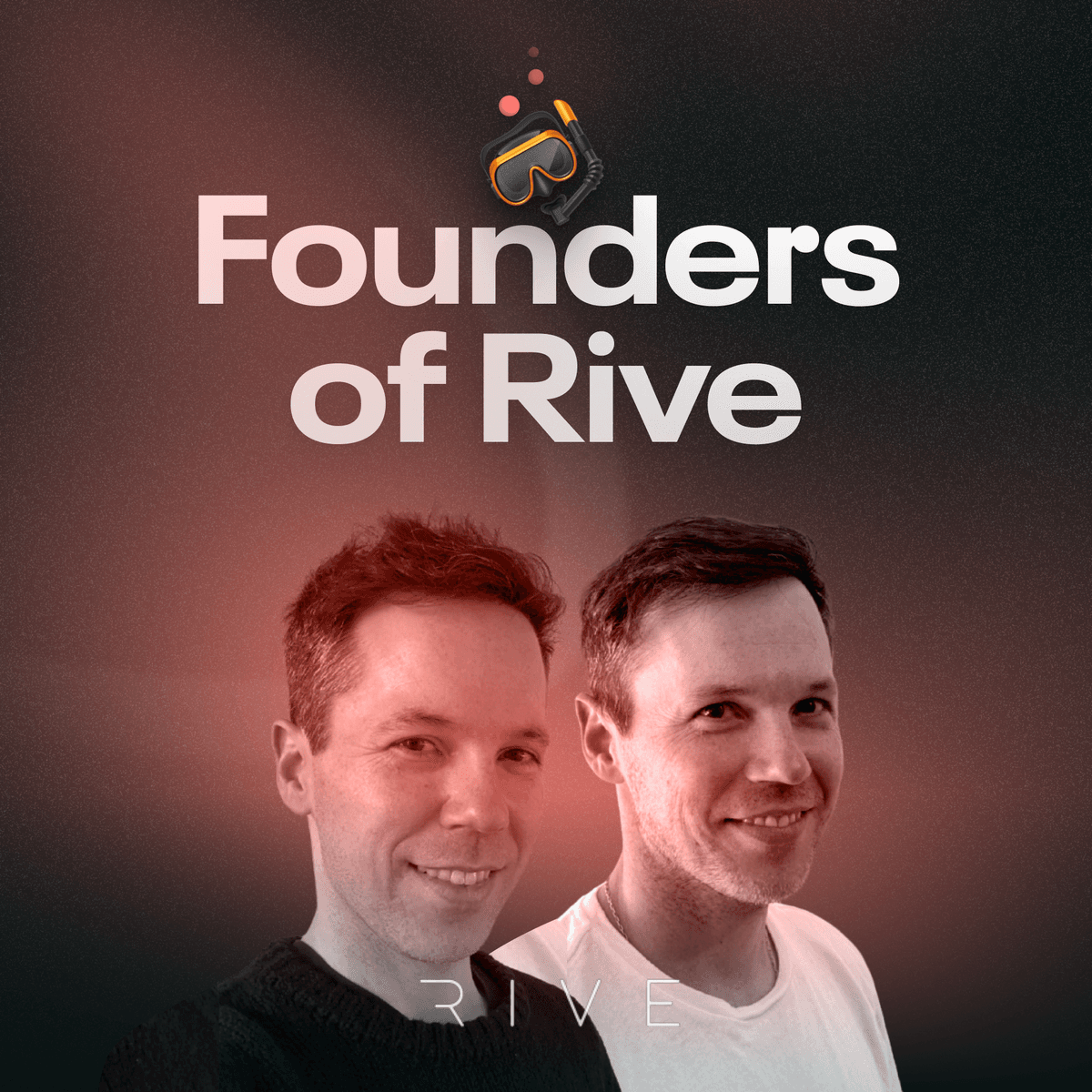

Dive Club 🤿 — "Why Rive is a Big Deal for the Future of Design"
Host: Ridd
Guests: Guido Rosso and Luigi Rosso (Co-founders, Rive)
Date: February 2, 2026
Episode Overview
This episode features an in-depth conversation between host Ridd and Guido and Luigi Rosso—identical twin co-founders of Rive—about why Rive is set to dramatically reshape the future of interactive design. While many still view Rive as "just" a motion design tool or an After Effects/Lottie alternative, the Rossos articulate a much higher vision: Rive as a creative operating system and truly modern experience engine spanning motion, data-driven UI, and collaborative workflows that blur the lines between designer, developer, and animator. The episode covers Rive's journey to V1, its unique approach to animation, data binding, tooling philosophy, and glimpses into its ambitious roadmap.
Key Discussion Points & Insights
1. Rive’s Cultural Moment: Spotify Wrapped ([00:51]–[03:40])
-
Why Spotify Wrapped was Significant:
- Rive powered the interactive 2025 Spotify Wrapped, giving the platform huge exposure.
- Huge uptake on social media, widespread speculation about 'how was this made', and rapid feature development in response to Spotify's needs (data binding, Android improvements).
- Validated Rive as a full experience engine, not just a motion tool.
"Spotify Wrapped was really a special moment. ... There was a bunch of tweets on that first day... like, how is this made? I can't even wrap my head around it." — Luigi Rosso [01:29]
2. Origins & Vision: Fixing the Graphics–Code Divide ([05:37]–[07:53])
-
Twin Founders’ Background:
- Luigi (engineer) + Guido (designer), with a 20+ year history building deeply custom, cross-platform experiences for major brands.
- Struggled for years with loss of fidelity between “mockups” and shipped code.
-
Rive’s Mission:
- The end of handoff: Designers, animators, and developers create in the actual runtime format with live constraints, reducing translation errors and waste.
- Not just an editor, but a new, performant runtime format and renderer, built from scratch.
“Let’s give designers an ability to actually work on a graphics format that ships... not a mockup or prototype that an engineer has to convert to code.” — Guido Rosso [06:29]
3. Rive’s Technical Philosophy: Real-Time, Interruptible, Feedback-Oriented ([07:53]–[10:38])
-
Immediate Feedback Loop:
- Drawing inspiration from games: design requires immediate, interruptible, real-time feedback, not wait-to-compile loops.
- Rive needed to build its own renderer and spec (eschewing SVG/HTML constraints) to support this vision.
“You need to not be able to hit compile... you need to see that right away. ... No runtime format, no vector graphics renderer had been built to really think that way.” — Luigi Rosso [09:01]
4. Beyond "Motion Tool": Towards an “Experience Engine” ([10:38]–[14:15])
-
Motion as Proof, Not the Goal:
- Rive’s seemingly “just motion” strengths were required by the core vision—but real endgame is full, interactive experience-building.
- Focus: Three creative archetypes (designer, developer, animator) collaborating in one space, on one format, with shared constraints.
“Rive is an animation tool... instead, that really wasn’t our intention. Our intention was to go after something much bigger, building those full experiences.” — Luigi Rosso [12:28]
5. The Rise of the Hybrid Creative ([14:15]–[16:22])
-
Emergence of Multi-Disciplinary Roles:
- Rive is empowering a new breed (“creative creator”) who can design, animate, and code all in one.
- Data binding, scripting, and engineering concepts are surfaced as-is—not watered down for “designer-friendliness,” leveling-up all users.
“Instead of accepting that, oh, designers aren’t smart enough to understand the engineering terms, we need to dumb them down.” — Luigi Rosso [15:26]
6. Lightweight but Powerful: Rive as an Add-On or Foundation ([16:22]–[18:35])
- Flexible Integration:
- Rive is so lightweight it can power a part of an app (e.g., Spotify Wrapped) or a full product.
- Intense focus on performance, leading to innovative features (e.g., vector feathering rather than brute-force blurs).
7. Innovations: Vector Feathering ([18:47]–[22:28])
-
What’s Special:
- Most engines do blurs by layering and CPU/GPU resampling—a bottleneck.
- Rive’s “vector feathering” calculates blur in the vector edge during rendering, not as a post-process = much more efficient and direct WYSIWYG.
“We can run the actual Gaussian formula for doing a blur directly as we are drawing the shape. ... That means the pipeline is unified.” — Guido Rosso [19:40]
“If someone designed something in a different tool, they would import it and it would never look exactly the way they want... if you’re designing directly in Rive, you’re working within the same constraints.” — Luigi Rosso [21:33]
8. Tools Do Matter, and the Iterative Loop ([22:28]–[23:35])
- Why Tools Must Evolve:
- “Photoshop was a tool for a different era. ... The right tooling for something fundamentally interactive must be interactive.” — Guido Rosso [22:28]
9. Data Binding: Dynamic, Real Experiences ([27:59]–[33:35])
-
Data at the Core:
- Every property in Rive can be data-bound: images, states, text, position, animations.
- Enables truly dynamic components—e.g., a car dashboard or a personalized Spotify Wrapped race using actual user data.
- Designers can preview with real or sample data, anticipate all states, build truly “adaptive” graphics.
“Every single property in Rive can be data bound... you get this very dynamic race that looks very different [for every user].” — Luigi Rosso [28:13]
10. Scripting & AI: The Future of Tooling ([25:41]–[36:19])
-
Scripting Engine:
-
Allows users to inject custom logic without bloating the runtime for others.
-
Lets designers “compose” with more complex logic, connect data to visuals, dynamically instance components, and even build internal interactive tools (like facial mocap editing for Duolingo).
-
AI Integration:
- Designers and engineers (even low-level C engineers!) use the AI agent to scaffold and optimize code in Rive’s scripting environment, lowering friction for non-programmers.
- Scripting layer timed for after all core fundamental “building blocks” were present in the editor.
“...The scripting engine was really meant to come at a time where the fundamentals of changing states of animation applied to text, images, audio, layouts—all the things—were there first....” — Guido Rosso [25:41]
-
11. What’s Next: Roadmap to V1 and Beyond ([36:19]–[41:17])
-
Near-Term Unlocks:
-
Text input & rich focus management—requirements for full apps.
-
Accessibility baked-in (screen reader/tab support).
-
Better edit-time scripting: Users able to add procedural or creative tools directly inside Rive.
-
Longer-Term:
- 3D experiences, video publishing, “app to app store” full pipeline.
- Expanded plugin ecosystem and tool extensibility, akin to or beyond Figma’s plugin model.
“The biggest thing that's missing today from someone building their entire app in Rive... is a few small things. Not so small, but small in the scale of the five years that we've been building. ... Text input... focus management... accessibility...” — Luigi Rosso [36:27]
-
12. Encouragement & Final Vision ([41:42]–[42:56])
- Against Design Homogenization:
- Rive is positioned as a generative engine for creative diversity in a world where AI is leveling the floor.
- "The number one reason is that you can just build stuff with it that you can’t with anything else." — Luigi Rosso [42:20]
Memorable Quotes & Moments
-
On Real-Time Feedback:
"The tool needs to give you that in real time immediately.... You need to see that right away...." — Luigi Rosso [09:15]
-
On Breaking Down Barriers:
“Every designer has this ability. They just need to trust themselves enough to give it a try.” — Guido Rosso [15:20]
-
On Data:
"You can bring in the real data so you can see ... does this fit in like a lucha, sing Thai or in Japanese?... Is all my wrapping setup right?" — Luigi Rosso [29:10]
-
On the Philosophy:
"Photoshop was a tool for a different era.... The right tooling for something that is fundamentally interactive must be interactive." — Guido Rosso [22:28]
-
On the Core Goal:
“The number one reason why Luigi and I started building [Rive] and why we care about it is that you can't do bone and skeletal deformations that also interact with UI in any other tool.... That's what we want: to enable these really creative experiences.” — Luigi Rosso [42:20]
Notable Timestamps
- 00:51–03:40: Spotify Wrapped, cultural validation, and rapid feature iteration.
- 05:37–07:53: The designers’/engineers’ handoff problem and the birth of Rive’s mission.
- 09:15: The need for real-time design feedback and constraints parity.
- 12:28: Rive’s "bigger game": not just animation/motion, but holistic interactive experiences.
- 19:40: Technical deep dive into vector feathering.
- 25:41: Why scripting came after core fundamentals.
- 27:59–33:35: Practical examples of data-driven design/tooling; Spotify/auto dashboards.
- 36:27: Upcoming features on the road to/after V1.
- 41:42: Rive as the antidote to design sameness in the AI era.
Conclusion
This episode of Dive Club cracks open the box many have put Rive in, revealing a transformative vision for the interaction design industry. Rive represents a future where the boundaries between prototyping and production, designer and developer, static and dynamic fade away—replaced by a new experience engine that’s real-time, expressive, and natively shared across creative disciplines. Whether you’re a designer, animator, or code-curious creative, Rive aims to be the tool—and the format—for the creative software future.
For more episodes, key takeaways, and resources: Dive.club