
Podcast
Divergent Files Podcast
Hosted by Divergent Files Podcast · EN
If a story feels too neat... too polished... or a little too rehearsed... I start digging.
That’s Divergent Files.
I’m Ralph, and around here, we don’t do partisan nonsense.
No political teams. No sacred cows. No blind loyalty to anybody’s narrative.
This is a truth-first show. Brutally fair. Equal-opportunity assassin.
If it involves buried history, black-budget weirdness, media manipulation, intelligence games, lost science, ancient anomalies, government cover-ups, declassified documents, UFO and UAP mysteries... or an official explanation that somehow gets dumber the longer it talks... we’re probably already in it.
This isn’t a conspiracy show. It’s not a debunking show either.
I read the paperwork. I follow the incentives. I pressure test the narrative.
Because reality is usually messier than the script...
and stranger than the people running it want you to notice.
Stay curious, stay sharp... and remember:
no matter what they tell you... the truth is still out there.
Prefer visuals?
Many episodes have a companion video version featuring documents, footage, and visual evidence. You can watch those episodes on YouTube at:
www.YouTube.com/@DivergentFiles
168episodes
Episodes
Newest firstAll episodes
[PODCAST AUDIO VERSION] Did Shakespeare Ever Exist — Or Was He a Mask?
Jan 2500:27:47Tap to summarizeThis is the audio-only podcast version.The full video investigation is available separately.Before we begin, a quick note.This is a Sunday Archive release.This episode originally aired when the Divergent Files audience was much smaller.Over time, it became clear this investigation deserved another listen.The episode you’re about to hear hasn’t been re-edited.It reflects the research, tone, and questions as they existed then.If you’re new here, this is part of the Divergent Files archive.For centuries, William Shakespeare has been celebrated as the greatest playwright in history. His works shaped the English language, transformed literature, and defined an era. But the historical record behind the man himself is surprisingly thin — and in those gaps, a persistent question has survived: who actually wrote the plays?This episode examines the Marlovian theory, which proposes that Christopher Marlowe — a playwright, poet, and intelligence-linked figure of the Elizabethan era — did not die in 1593 as officially recorded, but instead continued writing under the name “William Shakespeare.” Rather than arguing certainty, this investigation follows the documents, literary patterns, and unresolved anomalies that keep the question alive.We explore:• The circumstances surrounding Christopher Marlowe’s reported death• Why Marlowe’s biography intersects with espionage, exile, and secrecy• The sudden emergence of Shakespeare’s plays without a documented literary trail• Overlapping themes, linguistic fingerprints, and stylistic parallels in the texts• Historical inconsistencies in Shakespeare’s education, authorship records, and personal archive• Why authorship debates have persisted for over 400 years without resolutionThis is not an attack on literature, nor an attempt to rewrite history by assertion. It is an examination of why one of the most important cultural legacies in human history rests on a biographical foundation that remains strangely incomplete.We do not claim to solve the mystery.We ask why it was never conclusively settled.If Shakespeare was a man, the record should be clear.If he was a mask, the silence makes more sense.Stay curious. Stay grounded.And remember… no matter what they tell you, the truth is still out there.
Transcribe →
Bay of Pigs: The Failure That Changed the Cold War
Jan 2400:38:57Tap to summarizeThis episode is produced exclusively for the Divergent Files Podcast.The Bay of Pigs invasion is one of the most documented events of the Cold War — yet many of its consequences are still misunderstood. What began as a covert operation to influence Cuba became a turning point that reshaped U.S. intelligence practices, foreign policy decision-making, and global power dynamics.In this episode, we examine the Bay of Pigs as a historical case study in Cold War strategy, intelligence coordination, and unintended geopolitical outcomes. Using declassified documents, official reports, and historical records, we trace how planning decisions made behind closed doors produced consequences that extended far beyond the beaches of Cuba.This documentary-style analysis explores:• The origins of the invasion during the Eisenhower administration• How intelligence agencies framed risk assessments for political leadership• The role of psychological operations and Cold War media strategy• Why air support decisions became the operation’s defining failure• The experience of Cuban exile forces and the humanitarian aftermath• How the invasion hardened U.S.–Cuba relations and deepened Soviet involvement• The direct connection between Bay of Pigs and the Cuban Missile Crisis• Lessons later applied to intelligence oversight and policy reformAll material is presented in historical context and grounded in publicly available records, declassified memoranda, and scholarly research. Where historical debates remain unresolved, competing interpretations are clearly identified and separated from established fact.This episode does not argue ideology or hindsight morality. It documents how complex systems — intelligence agencies, political leadership, and international pressure — interact under crisis conditions, and how decisions made in secrecy can reshape history in ways no one intended.The Bay of Pigs was not just a failed invasion.It was a warning — and the Cold War listened.Stay curious. Stay grounded.And remember… no matter what they tell you, the truth is still out there.
Transcribe →
The Quantum Measurement Problem — Did Observation Go Too Far?
Jan 2100:29:31Tap to summarizeThis episode is produced exclusively for the Divergent Files Podcast.For more than a century, science has struggled with a question that refuses to resolve: is consciousness created by the brain, or does the brain interface with something deeper? Quantum physics suggests reality behaves differently when observed. Neuroscience still cannot locate where thoughts, memories, or awareness actually exist. And quietly, governments and research institutions have explored whether the human mind may interact with reality in ways not yet fully understood.This episode examines documented experiments, historical research programs, and peer-reviewed anomalies surrounding quantum consciousness — without drawing conclusions beyond the evidence.We explore why quantum particles don’t appear to exist until measured, the observer effect and the unresolved measurement problem, and theories proposing quantum processes inside brain microtubules, including the Penrose–Hameroff Orch-OR model. We look at biophotons, quantum coherence, the quantum Zeno effect, and decades of mind–machine interaction experiments conducted at Princeton’s PEAR Lab.The investigation also reviews declassified CIA research such as the Gateway Process, Cold War–era remote viewing and altered state studies, DARPA-funded brain research, and efforts to model consciousness as an interface rather than a byproduct. We examine David Bohm’s implicate order, holographic models of reality, and how these ideas intersect with near-death experiences, reincarnation research, quantum memory theories, and simulation hypotheses suggesting reality may be rendered through observation.This is not mysticism. These topics come from real laboratories, real scientists, and real declassified documents — examined carefully, skeptically, and without sensational claims. Some findings remain controversial. Some are unresolved. And some challenge the limits of what science currently knows.We don’t tell you what to believe. We follow the sources, the experiments, and the questions that refuse to disappear.If consciousness is not confined to the brain…If attention can influence probability…If reality itself responds to observation…Then understanding consciousness may be the most important scientific question of all.Stay curious. Stay grounded.And remember… no matter what they tell you, the truth is still out there.
Transcribe →
Was MH370 Lost — Or Removed?
Jan 1800:45:02Tap to summarizeThis episode is produced exclusively for the Divergent Files Podcast.Today’s episode comes from the Divergent Files archive. It originally aired when our audience was much smaller. With time, it became clear this investigation deserved another listen. The episode has not been re-edited and reflects the research and tone of that period. If you’re new here, welcome to the archive.On March 8th, 2014, Malaysia Airlines Flight MH370 vanished without a trace. No explosion. No distress call. One moment it was cruising through clear skies — the next, it was gone. But according to radar data, satellite handshakes, and military monitoring zones, that disappearance wasn’t the end of the flight.For nearly six more hours, MH370 continued moving through monitored airspace, slipping across radar boundaries and satellite coverage like a ghost… before vanishing again.This episode revisits the MH370 case from the ground up, focusing not on speculation, but on what remains unresolved in the official record. From the final radio transmission to radar blind spots, satellite anomalies, and the continued absence of definitive wreckage, the disappearance still challenges investigative timelines and the limits of modern aviation tracking.Rather than pushing a single explanation, we examine the questions that refuse to go away:• Why radar data suggests the plane stopped being tracked — then reappeared• Why no recoverable black box transmissions were ever confirmed• How passengers traveled using stolen passports• Why multiple onboard passengers were connected to sensitive technology sectors• Why patent-related theories continue to surface despite official dismissals• And why the Diego Garcia connection has never been conclusively resolvedThis is not an episode about certainty or sensational answers. It’s an examination of gaps — in data, transparency, and explanation — and why, more than a decade later, so many core questions remain unanswered.MH370 didn’t just vanish.It disappeared twice.And no one has fully explained how — or why.Stay curious. Stay grounded.And remember… no matter what they tell you, the truth is still out there.
Transcribe →
The Louisiana Purchase Was Legal — The Consequences Weren’t
Jan 1600:48:54Tap to summarizeThis episode is produced exclusively for the Divergent Files Podcast.The Louisiana Purchase is commonly remembered as a clean diplomatic agreement that peacefully doubled the size of the United States. The historical record tells a more complicated story.In this episode, we examine what the treaty of 1803 actually transferred, how U.S. law defined sovereignty at the time, and how expansion unfolded through contracts, legislation, and court decisions rather than simple conquest narratives. Using treaty archives, government correspondence, Supreme Court rulings, and congressional records, this investigation follows the administrative systems that shaped westward expansion and relocation policy across the 19th century.Rather than retelling a simplified classroom version, we focus on what the documents show:• What France legally transferred in 1803 — and what it did not• How Native nations were recognized as sovereign governments in early U.S. law• The role treaties played in territorial expansion and land administration• How legal frameworks were used to justify relocation and control• The Indian Removal Act and its documented implementation• Why some treaties remain legally relevant in modern court casesThis is not a modern political debate or a retrospective moral judgment. It is a review of primary sources and historical outcomes that continue to influence land rights, jurisdiction, and governance today.By following the paperwork — maps, treaties, court opinions, and correspondence — we see how expansion occurred not only through conflict, but through administrative systems designed to formalize it.The records still exist.The legal consequences still matter.
Transcribe →
The Adam and Eve Story: Did Earth Reset Before?
Jan 1400:46:39Tap to summarizeBefore we begin, a quick note. Today’s episode comes from the Divergent Files archive.It originally aired when our audience was much smaller.With time, it became clear this investigation deserved another listen.The episode has not been re-edited and reflects the research and tone of that period.If you’re new here, welcome to the archive.In the middle of the Cold War, the CIA quietly classified a book called The Adam and Eve Story — a controversial work that proposed Earth experiences recurring, catastrophic extinction cycles driven by geomagnetic instability and rapid crustal displacement. When the book was partially declassified decades later, 57 pages were still missing. Those redacted sections reportedly addressed timelines, mechanisms, and patterns behind these proposed planetary resets.No official explanation was ever given for why the book was classified in the first place. And no explanation has been offered for why parts of it remain hidden.Was author Chan Thomas simply speculating beyond the science of his time, or did his ideas intersect uncomfortably with classified Cold War research into geomagnetism, planetary risk, and civilizational vulnerability? Why did U.S. intelligence restrict the book for years, and why do some of its core claims echo questions modern researchers still wrestle with today — from geomagnetic reversal and climate instability to continuity-of-government planning?In this episode, we examine what is documented, what is disputed, and what remains unresolved. We explore the historical context of The Adam and Eve Story, the science of geomagnetic change, ancient flood myths, extinction narratives across cultures, and the parallel rise of government continuity planning during the same era.This is not an episode about proving a theory. It’s an investigation into why certain ideas refuse to disappear — not because they’re confirmed, but because the official record around them was never fully explained, fully released, or fully closed.Stay curious. Stay grounded.And remember… no matter what they tell you, the truth is still out there.
Transcribe →
MK-Ultra Never Ended — It Just Learned How to Hide
Jan 1100:42:14Tap to summarizeBefore we begin, a quick note.This is a Sunday Archive release.This episode originally aired in [year], when the Divergent Files audience was much smaller. Over time, it became clear this investigation deserved another listen.The episode you’re about to hear hasn’t been re-edited.It reflects the research, tone, and questions as they existed then.If you’re new here, this is part of the Divergent Files archive.-----------------------------------------------------------------------------This episode is produced exclusively for the Divergent Files Podcast.MK-Ultra is remembered as a Cold War scandal—an era of LSD experiments, hypnosis, and psychological abuse that ended with Senate hearings and public outrage in the 1970s.Officially, the program was shut down.But the documents tell a more complicated story.In this investigation, we examine MK-Ultra using declassified CIA files, FOIA releases, Senate testimony, and verified subproject records to trace what actually ended—and what didn’t. Rather than focusing on speculation, this episode follows the paper trail: internal memos, program transitions, destroyed files, and the quiet emergence of successor initiatives that carried similar research goals under different names.This is a receipts-driven examination of the historical record.We explore: • Verified MK-Ultra subprojects and documented objectives • The death of Frank Olson and what the official files confirm • The transition from MK-Ultra to MK-Search and related programs • Why so many records were destroyed—and which ones survived • How behavioral influence research shifted from analog experiments to modern systemsThis episode does not claim certainty or assign modern blame. Instead, it asks a narrower—but more uncomfortable—question grounded in evidence:If MK-Ultra truly ended, why did its core research priorities continue appearing in new programs, new language, and new domains?Because sometimes programs don’t disappear.They evolve.And the hardest part of studying history isn’t proving intent—it’s recognizing patterns that refuse to go away.Stay curious. Stay grounded.And remember… no matter what they tell you, the truth is still out there.
Transcribe →
The Library of Nineveh: The Oldest Knowledge on Earth—and Why It’s Still Unread
Jan 900:52:38Tap to summarizeThis episode is produced exclusively for the Divergent Files Podcast.Long before Alexandria burned, the world’s first true library was already buried.In 1849, archaeologists excavating the ruins of Nineveh uncovered more than 30,000 clay tablets from the Assyrian Empire. What emerged wasn’t a loose collection of myths or religious texts, but a deliberately organized knowledge system assembled under King Ashurbanipal—covering astronomy, medicine, law, mathematics, ritual practice, and early human storytelling.This episode investigates the real Library of Nineveh: what it was, how it functioned, and why so much of it remains untranslated nearly two centuries after its discovery.Among the confirmed contents: • The Epic of Gilgamesh, including a flood account predating the Bible • Astronomical records tracking eclipses, planetary motion, and celestial cycles • Medical tablets detailing diagnosis, symptoms, and treatments • Legal and administrative records outlining early governance • Ritual, dream, and omen texts tied to ancient consciousness practices • The Planisphere star map, later analyzed using modern astronomical softwareDespite its scale and historical importance, only a fraction of the Nineveh tablets have been fully translated, digitized, or made publicly accessible. Thousands remain stored in museum archives, including large collections held by the British Museum, where translation and publication continue at a slow pace.This investigation does not argue for hidden conspiracies or predetermined conclusions. Instead, it focuses on what can be verified and what remains unresolved: • What archaeology and scholarship have confirmed • Where translation gaps still exist • Why certain tablets resist clear interpretation • How academic caution and institutional limitations shape access • Where mainstream explanations end and speculation beginsWe clearly distinguish documented evidence from interpretation. Where theories extend beyond what the tablets explicitly show, those boundaries are stated openly.This episode isn’t about proving a forbidden secret.It’s about confronting an uncomfortable reality: the oldest library in human history is still only partially read—and its contents continue to challenge what we think we know about ancient knowledge, early science, and human capability.Because the question isn’t just what was buried.It’s why, after all this time, we’re still only reading fragments.Stay curious. Stay grounded.And remember… no matter what they tell you, the truth is still out there.
Transcribe →
Hoia Baciu Forest: Where Time Vanishes and Reality Breaks Down
Jan 700:30:18Tap to summarizeThis episode is produced exclusively for the Divergent Files Podcast.In the heart of Romania sits a forest locals refuse to enter—and scientists struggle to explain.Hoia Baciu Forest has earned its reputation as one of the most disturbing locations on Earth, not because of legends, but because of patterns. Missing time. Disappearances. Instrument failure. Neurological effects. Environmental readings that shouldn’t exist together in one place.This investigation moves past ghost stories and folklore and focuses on what’s actually been documented.Visitors and researchers have reported: • Sudden loss of time lasting minutes, hours, and in rare cases, far longer • Compasses spinning uncontrollably and GPS coordinates jumping • Electronics failing instantly with no mechanical cause • Batteries draining, cameras glitching, and instruments desynchronizing • Intense dread, disorientation, and auditory phenomena • Disappearances followed by impossible reappearancesAt the center of the forest lies a perfectly circular clearing where nothing grows. No vegetation. No regrowth. No accepted explanation. Soil samples, electromagnetic readings, and radiation measurements show irregularities that remain unresolved.This episode examines: • Geomagnetic and electromagnetic field instability • Infrasound and its neurological impact on perception and fear • Environmental conditions linked to memory disruption and dissociation • Gravitational fluctuation and time distortion hypotheses • The 1968 Emil Barnea UFO photographs and official investigations • Historical missing-person cases tied to the forest • Fringe theories involving controlled anomalies and interdimensional gateways • What has been debunked—and what has notThis is not a paranormal entertainment episode.And it’s not blind belief.It’s a truth-first investigation into a location where multiple disciplines—physics, neurology, environmental science, and psychology—collide and still fail to fully explain the results.If even part of the data is accurate, Hoia Baciu Forest isn’t just haunted.It’s operating.And once someone enters its system, something changes—whether they realize it or not.Stay curious. Stay grounded.And remember… no matter what they tell you, the truth is still out there.
Transcribe →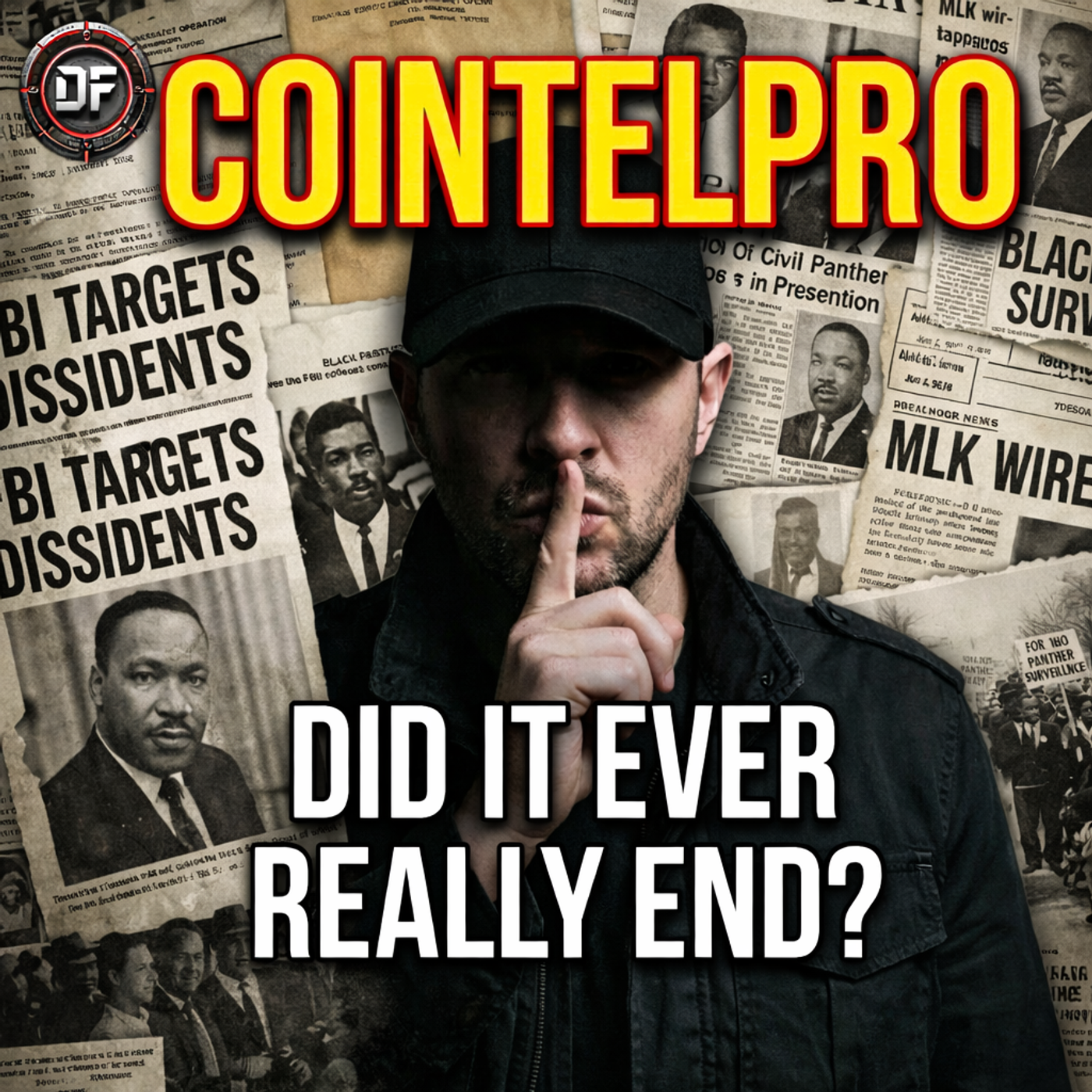
COINTELPRO: The FBI Program That Never Ended
Jan 400:32:35Tap to summarize[Archive Re-Release: This episode originally aired earlier in the Divergent Files catalog and is being re-released due to its continued relevance and historical importance.] COINTELPRO wasn’t just an FBI scandal from the 1960s and ’70s.It was a blueprint.In this archived episode of Divergent Files, we examine COINTELPRO—the FBI’s Counter Intelligence Program designed to surveil, infiltrate, destabilize, and psychologically neutralize American citizens who challenged power.Using declassified FBI documents, Church Committee testimony, and historical case studies, this episode breaks down how COINTELPRO targeted civil rights leaders, activists, journalists, musicians, environmental groups, Indigenous movements, and even alternative scientists—often without arrests, trials, or public accountability.This investigation explores: • How COINTELPRO operated as psychological warfare • The infiltration and destabilization of civil rights movements • The FBI’s role in discrediting Martin Luther King Jr., Malcolm X, Fred Hampton, and others • Forged letters, planted informants, media manipulation, and character assassination • The transition from analog surveillance to digital influence operations • How COINTELPRO tactics evolved into modern algorithmic suppression • Why many of these methods still appear in today’s information environmentThis episode originally aired earlier in the life of Divergent Files and is presented here as an archive re-run because its relevance has only increased. The names have changed. The technology has changed. The methods have not.This is not speculation.This is not partisan commentary.This is documented history—and a pattern that never stopped repeating.If you care about civil liberties, free speech, psychological warfare, surveillance, or how power manages dissent, this episode provides the historical framework most people were never taught.
Transcribe →