← Dominican Sisters Open Mic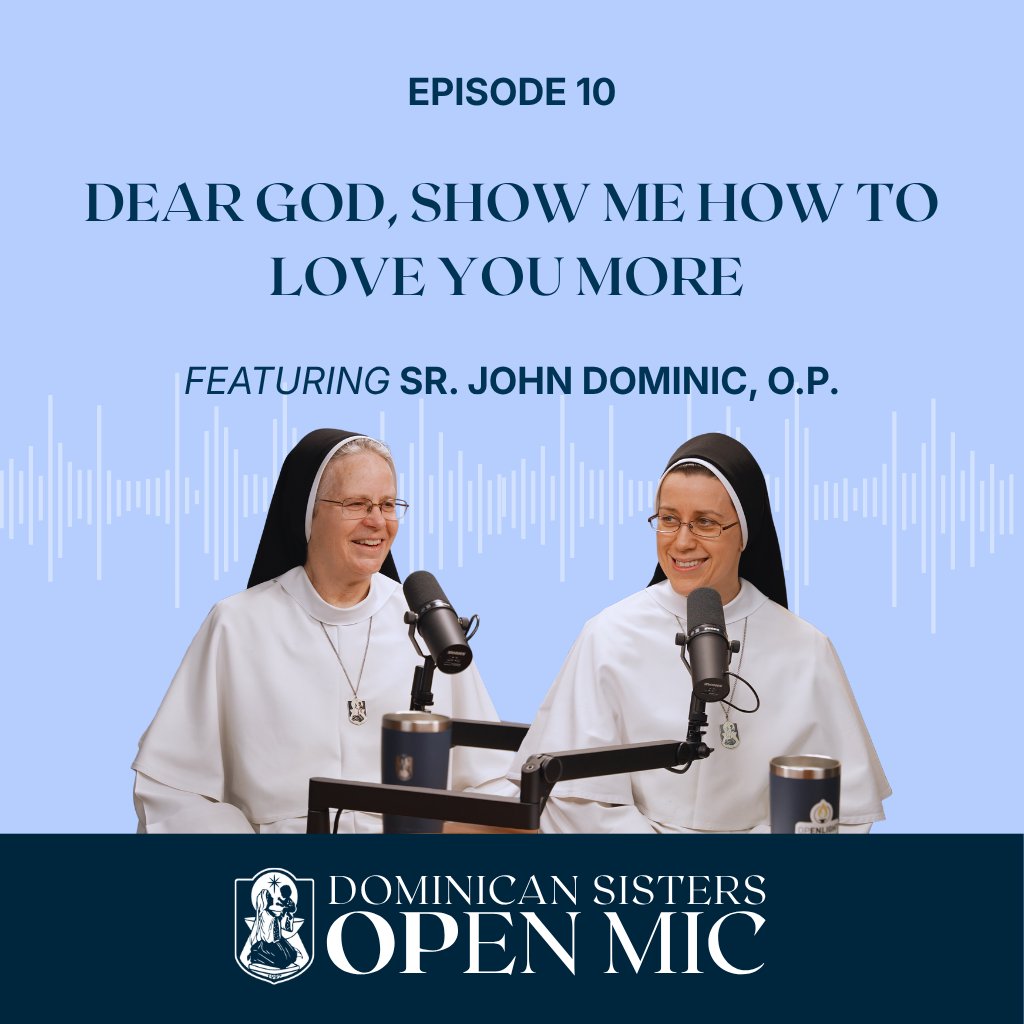
Dominican Sisters Open Mic
Ep. 10: Dear God, Show Me How to Love You More (Sr. John Dominic, O.P.)
00:59:21
Loading summary
Transcript233 lines
- [00:00]
Sister John Dominic
I remember writing down, sitting here in your presence, and I thought, wow, I believe that Jesus is truly present here. And going back to this understanding, like, I believe that. So I need to do something about this. So I expressed that to Sister, and I was like, I really think I need. I want to become a Catholic. Wow. Yeah. And my closest friend, she started thinking about religious life, and we shared that together.
- [00:34]
Sister Miriam
Okay.
- [00:35]
Sister John Dominic
And. But when. When my mom and dad began to see that I was starting to think about that, they were like, whoa. Because their only frame of reference was a cousin of ours, that was a Hari Krushner in California. So it was like a cult to them.
- [00:50]
Sister Miriam
Oh. Seeing the goodness of my sisters inspires me to greater goodness.
- [00:56]
Sister John Dominic
Right. Because it could be really easy to see the not so good. You foreign.
- [01:18]
Sister Miriam
Hi, and welcome to Dominican Sisters open Mic. My name is Sister Miriam of the Dominican Sisters of Mary, Mother of the Eucharist, based out of Ann Arbor, Michigan. On our podcast, we're talking all things Dominican. And today I have a very special guest. Special because she is one of the foundresses of our community, Sister John Dominic. Sister, thank you so much for coming.
- [01:44]
Sister John Dominic
Thanks, Sister. It's great to be with you.
- [01:46]
Sister Miriam
It is an honor to be with you. And we want to get a little. Little bit of information about. About how you. How you came into the faith and also some of the work that you're doing.
- [02:00]
Sister John Dominic
She said a little. That's a long journey, so we'll keep it short. So.
- [02:05]
Sister Miriam
So, sir, what do you want me to start? Let's start a couple biographical details. So you're from. Originally born in California.
- [02:13]
Sister John Dominic
That's right. Berkeley, to be exact.
- [02:15]
Sister Miriam
Berkeley. And then 60s in the 60s. And then you moved to Tennessee.
- [02:21]
Sister John Dominic
Yes, Nashville.
- [02:23]
Sister Miriam
Nashville, Tennessee. Tennessee. And then you enter the comment. I like to give. Just in general, you enter the comment. 1982. So you've been in the religious life for.
- [02:36]
Sister John Dominic
It's a quick mental math.
- [02:37]
Sister Miriam
Quick mental math. Some 40 years. Yeah.
- [02:39]
Sister John Dominic
Right, right. I'm gonna say over 40. Right.
- [02:41]
Sister Miriam
Over 40 years. And you are a teacher. You have taught many grades, kindergarten through.
- [02:49]
Sister John Dominic
Not kindergarten, but first. Yeah. No, no, no. You wouldn't want me teaching kindergarten. So first grade was the lowest I've done. So first grade through eighth grade.
- [02:59]
Sister Miriam
And then you've also been principal.
- [03:02]
Sister John Dominic
Right. For 20 years.
- [03:03]
Sister Miriam
Over 20 years. You actually founded our schools here in Ann Arbor, Michigan. Spiritu Sanctus Academies. Of course. You founded the Dominican Sisters of Mary. Mother.
- [03:14]
Sister John Dominic
Seems like I like to start things a little bit of a startup.
- [03:16]
Sister Miriam
Right, you like to start things up, which is great. And now you're the director of Open Light Media as well, which is the reason why we're here. I know it's a blessing doing this podcast. So thank you, Sister, for all these things that you've been involved in and. And got going. And I know you've. You've done it for the Lord.
- [03:35]
Sister John Dominic
Yeah. You say yes, and he just kind of pushes you on, so. Yeah.
- [03:41]
Sister Miriam
So, Sister, tell us about growing up, your life. Growing up. You were in California and was your family Catholic?
- [03:51]
Sister John Dominic
No. No. So I'm the. Actually, to this day, I'm the only Catholic in my family. So we moved. I. I would describe my family. We came from California, so naturally. Good. More of a secular mindset now. My dad is a Christian today, which is wonderful. And my sister. But that's a whole long journey for everyone. My mom since passed away, but when we moved, can imagine moving from California to Nashville, Tennessee, which is the Bible Belt. So that was a little bit of a transition for us, but I had really just a more of a secular mindset, but just good. And. But what's interesting is that they. In Nashville at that time, instead of going to a public school, I went to. I. I went a couple years to a public school, and then we moved to a private Christian school. Okay. And that's. That's common in Nashville. There are a lot of these small schools that came up around many of the churches. So the church was a Methodist church that had the school that I went to. Okay.
- [04:54]
Sister Miriam
So would that have been your first exposure to. To prayer and scripture at that school?
- [05:00]
Sister John Dominic
Yeah. So. So what's really interesting is that, as I mentioned, when I was. I was about five years old when we moved to Nashville.
- [05:06]
Sister Miriam
Okay.
- [05:07]
Sister John Dominic
So I had a lot of separation anxiety from my grandparents. They were. They were very loving. And my grandfather, we. We love The San Francisco 49ers. Yeah. And he used to take me to go watch him practice. Like, the shrine was always like, there's candlestick in the. Candlestick park in the distance. Which is. I don't think it's there anymore. But when I went to the Christian school, we would have assembly on Fridays.
- [05:32]
Sister Miriam
Okay.
- [05:33]
Sister John Dominic
And on Friday, they would sing this song about the end of the world. Like, and people were being left behind. And it scared the Bajee out of me. I mean, it's just like, what is this about? You know, I mean, we were doing some Bible and then. And so I started following my mom around the house because I was afraid. And I think it is probably was rooted in some sort of Separation anxiety. It made it probably deeper, you know, and she was like, you know, why are you just like this little shadow? What's going on? And so she talked to a neighbor who said, well, why don't you have. Why don't we make arrangements for her to come talk to our pastor, who is a Presbyterian. So we went to the church. I can still remember walking in and it was very plain and the pews were empty. And my mom walked in there with me and sat down and. And talking to him. And he was the. The kindest, most gentle man. And I think they must have told him a little bit ahead of time
- [06:33]
Sister Miriam
about what was going on with you,
- [06:35]
Sister John Dominic
because I think he was prepped.
- [06:36]
Sister Miriam
Okay.
- [06:36]
Sister John Dominic
You know, so he got it out of me, and I. I was just expressing this fear that I had. So he said, this is my suggestion for you. I want you to get a Bible and put it beside your bed so that when you're afraid or you begin to feel this fear, just pick it up and just read the Word of God. So I started doing that. My mom, you know, I didn't have a Bible, so my mom went out and purchased me a Bible and I kept it by my bed. And so when I would start being nervous or afraid or having this fear, I'd read the Word of God and I'd be peaceful. I can't tell you there was a verse that I would ever say, but just the Word of God calmed me. And. And then I started saying this little prayer. This is a little bit of spoiler alert of my story, but, you know, dear God, show me how to love you more.
- [07:29]
Sister Miriam
So that prayer, did you just come up with it? I mean, I just made it your.
- [07:32]
Sister John Dominic
I didn't know no one taught you
- [07:34]
Sister Miriam
to say this particular prayer, but it's a beautiful prayer.
- [07:38]
Sister John Dominic
Yeah, I know. Thank you.
- [07:39]
Sister Miriam
And you would have been pretty small.
- [07:42]
Sister John Dominic
Yeah, it was like a third grader. And I was like, it's kind of. I just like, keep it simple. Dear God, show me how to love you more. And. And he just kind of. That's. That was kind of like the beginning is gradually, you know, throughout my life has shown me that, you know, that path as I've. As I've grown older. Yeah.
- [08:00]
Sister Miriam
I wonder if you. Did you tell anyone about the prayer?
- [08:03]
Sister John Dominic
No. No.
- [08:05]
Sister Miriam
It was between you and the Lord.
- [08:06]
Sister John Dominic
It was between the Lord and I. And then even. I don't even think I told anyone until later, you know, about my conversion, that I'd even had. Had the Bible there to pick it up, you Know that I was. I was a little bit embarrassed about being so afraid, you know, because everyone else was kind of fine. They were singing that song on the top of their lungs, but it was scary.
- [08:29]
Sister Miriam
So then going into high school, we jump ahead a little bit. But going into high school, what were your aspirations? Did you. Did you have a career in mind? You were thinking about marriage or what? What was on your mind at that time?
- [08:43]
Sister John Dominic
One of those things, I don't think. I mean, like, I went from. So it's interesting. I went from the. The Christian school. And then at that time in Nashville, there was an option between the all girls Catholic school that I went to, and there was another all girls private school. And I had a lot of friends that went there, but we made the decision just for distance and, and people that we could carpool with. Just practical reasons. That I went to the all girls Catholic school. I could have gone to the other one. I had never. I didn't even know what Catholics were. And I had never seen a sister before in my entire life.
- [09:17]
Sister Miriam
The sisters were at this school?
- [09:19]
Sister John Dominic
Yes. The Nashville Dominicans owned the school, ran the school. And I can remember, like, look into them. Like, what are they? You know, what's going on here?
- [09:30]
Sister Miriam
Were. They were your teachers?
- [09:31]
Sister John Dominic
They were the. Yeah, so they were. Some of them were the teachers. And. And they were. Since I was non Catholic, they would put the non Catholics in one class and the Catholics in another class.
- [09:40]
Sister Miriam
That was for learning theology.
- [09:42]
Sister John Dominic
Yeah. Yeah. So my first formation, we had scripture, and this older sister taught us. She was the sweetest thing. But. But I didn't, you know, I. I wasn't. I didn't go there to. To be a Catholic to. For this. I went there really just for the academics and to play basketball.
- [10:00]
Sister Miriam
That's right. I was right, sister. And you've still got it.
- [10:04]
Sister John Dominic
I know. I'm pretty shocked that I can still actually do, you know, sink it.
- [10:10]
Sister Miriam
I don't get involved with basketball when it's going on.
- [10:12]
Sister John Dominic
You're Frisbee. You're a Frisbee. You don't do the basketball. I'm. I'm shooting the hoops. Yes. But I can still make it. Yeah, it's pretty much of a shock.
- [10:21]
Sister Miriam
This is a bit of a tangent, but when the sisters are playing basketball, it's pretty competitive.
- [10:27]
Sister John Dominic
Oh, yeah, yeah, yeah.
- [10:28]
Sister Miriam
And so I think. I always think it's best for me to stay out of people's way at that point.
- [10:33]
Sister John Dominic
Well, I kind of do that when we're playing. I'll kind of hang Back a little bit. I don't get underneath, you know, but, yeah, they're very competitive. Yeah.
- [10:41]
Sister Miriam
So you were playing basketball. This is where you got your skills. You're developing your skills in high school. I mean, how did you. How did you move towards Catholicism?
- [10:53]
Sister John Dominic
That's a. Yeah. So my first experience of ever attending a Catholic mass was a Melkite rite. We had a priest, an archbishop that was there, and it was in the gym of the school. And in that rite, the Melkite rite, they had lots of incense. So I kind of walk in and there's all this smoke and. And everyone's there. And I was like, what is happening here? You know? And it was. It was very unusual. That was my very first exposure to it.
- [11:20]
Sister Miriam
Okay.
- [11:21]
Sister John Dominic
So I managed. We would have masses, but I don't think. I don't know if I always went. I always found someplace else to go
- [11:30]
Sister Miriam
during the truth comes out.
- [11:33]
Sister John Dominic
You were somewhere else, skipper. I was a mass skipper. Right,
- [11:39]
Sister Miriam
Sister. I've busted people like that.
- [11:40]
Sister John Dominic
I know. Well, yeah, there. There you go. I would have been the first one. So really, it wasn't until my sophomore year that actually Stuart Joseph Andrew was my teacher. But again, they put us in the Catholic and the non Catholics.
- [11:54]
Sister Miriam
Okay. So just the background for some of our listeners. So Sister Joseph Andrew is also one of our four foundresses of our community. So you have worked very closely with her over these last 30 years.
- [12:06]
Sister John Dominic
All these years. Right.
- [12:08]
Sister Miriam
But she was at your high school at that time?
- [12:11]
Sister John Dominic
Yeah. So she taught. Yeah, she taught me morality. And she was there actually all four years that I was there. She. She taught at the high school.
- [12:20]
Sister Miriam
Wow. Okay.
- [12:21]
Sister John Dominic
And Mother Sumter was the priorest general at the time.
- [12:25]
Sister Miriam
Okay.
- [12:25]
Sister John Dominic
Of. And Mother Sumter was another one of the foundresses, right? She was general at the time.
- [12:30]
Sister Miriam
Yes.
- [12:31]
Sister John Dominic
Yeah.
- [12:31]
Sister Miriam
So were you. You were spending time with Sister Joseph Andrew?
- [12:35]
Sister John Dominic
She was, yeah. All the sisters were around. Okay. No, it was really. It was really beautiful because it was an all girls school and they were very. It was very natural and. But I didn't. I didn't, like, choose it like. Like I was. Since I was on the basketball team. The sisters were smart. They'd be like, okay, I need. They'd ask the coach, can you get the girls to come volunteer to wreck leaves or can you have them come do this?
- [12:58]
Sister Miriam
That is so classic.
- [12:59]
Sister John Dominic
And I was naive as a freshman. And I. And I get there and be like, where are the seniors and why am I here and they're not here. And so I finally figured it out.
- [13:11]
Sister Miriam
Jen. So just being around the sisters and getting to know them had had a impact on your spiritual life.
- [13:18]
Sister John Dominic
Right, right. So I think just. It was a gradual again, you know, you think about that prayer, you know, dear God, show me how. Yeah, that was. That was the extent of my prayer. So I maybe prayed five seconds a day, you know. But then as I began to. In the class and the. The more moral theology, I think, is what we were studying. Sister was really smart because she would. She had it more where she would just pose questions and. Okay. So she would be like, what's more important? Thinking or feeling? So, okay. My dad was a very. Is a very practical man. So my sister and I were taught at a young age to think, you know, being real logical. So I was like, of course, thinking is more important than feeling. I mean, you have to think. So that was kind of like a little debate that we had. But I'd say those are. Those type questions and those discussions, it began to stir in my heart, this understanding for what is true, you know, And I thought, oh, gosh. Well, I believe what this. I didn't know. You know, there are a lot of things we would talk about. Be like, gosh, I believe that that's true. You know, and it really wasn't until again, this is one of these things that we would go. We would go to the Mother House and they would take, like, a whole class for a retreat. So my sophomore year, I don't know how inspiring this is to people, but my friends, we went to do the retreat, and it was on a Saturday night.
- [14:46]
Sister Miriam
This was like a mandatory.
- [14:47]
Sister John Dominic
Yeah, we'd have to all go. Okay, so they take the whole class. So I brought my little TV so we could make sure we saw Saturday Night Live later that night. Yeah, Sister, I know. And that. Terrible, you know, But. But I had just True Confessions. But, however, on that same retreat, so the Lord worked through those things. Maybe I was feeling a little guilty sitting in the chapel, but we were in adoration. And I remember writing down, sitting here in your presence, and I thought, wow, I believe that Jesus is truly present here and going back to this understanding, like, I believe that, so I need to do something about this. So, okay. I expressed that to Sister, and I was like, I really think I need. I want to become a Catholic. Wow. Yeah. Yeah. You know, I want to. You know, I believe he's present. I want to be able to receive Jesus. And, you know, this is something, you know, it's just. It was a gradual understanding of the truth. Yeah. Yeah.
- [15:54]
Sister Miriam
How do You. How would you describe knowing. Knowing God or coming to know God? How. How did that impact your life at that time as a high school student?
- [16:06]
Sister John Dominic
Right.
- [16:07]
Sister Miriam
Coming into relationship with the Lord?
- [16:09]
Sister John Dominic
Yeah, that's a great question. I think as this. This under this gradual unfolding of what's true, and then if I'm moving towards this relationship and believing that Jesus is there, then my life needed to be. I need to live in conformity to that. So, like my junior year, I couldn't take my TV to watch it, you know, I mean, like, I had to start making decisions.
- [16:32]
Sister Miriam
No more skipping out on that.
- [16:34]
Sister John Dominic
And again, you know, it was all girls school, so it was fun. You know, we had great friends. We. We, you know, we ran the streets of Nashville before. You know, we know everything in Nashville at that time and every end. But. But then I would just have to make decisions. But I mean, I could still have fun, but I just wouldn't, you know, engage a lot of the other things that.
- [16:56]
Sister Miriam
Right.
- [16:57]
Sister John Dominic
You know.
- [16:57]
Sister Miriam
Yeah, we would do.
- [16:59]
Sister John Dominic
And. And they respected me for that too, so. Yeah. As a matter of fact, my senior year, when we all went to Florida for spring break, most of the parents were like, well, if I was going with them, they were chaperone.
- [17:11]
Sister Miriam
Wow, sister, good for you.
- [17:14]
Sister John Dominic
I know. I don't think many adults would do that today. We all went. I was like, we all went with no chaperones our senior year to florid.
- [17:23]
Sister Miriam
So now tell us about the process of becoming Catholic. You were making that decision around junior year.
- [17:28]
Sister John Dominic
That's my sophomore year. And the sisters. I think the sisters began to see that I had a vocation. And you had to be a Catholic two years before you could enter. Of course, I didn't know any of this because I had. It was like the thought of becoming a sister was like the furthest thing. I mean, like, was like even was anywhere on my radar. My mom worked in the music industry, you know, and so we had a lot of fun. I mean, she. We could get tickets to any concert we would want to go to. I mean, it was. I mean, there's a lot of excitement being.
- [18:00]
Sister Miriam
Yeah.
- [18:00]
Sister John Dominic
Nashville.
- [18:01]
Sister Miriam
Yes.
- [18:02]
Sister John Dominic
And that was like the furthest thing from my mind. But this is the. Arranged for their chaplain to come and give me instructions. So I would go once a week and meet with him. And he was so sweet. He. He'd be like, the good sisters will teach you all you need to know. And I was like, I don't think they're teaching me because I'm that ready to get Confirmed. And I don't know what confirmation is, so they had to teach me, so. Yeah.
- [18:31]
Sister Miriam
So when did you actually receive the sacrament?
- [18:33]
Sister John Dominic
I did. So, I mean, I knew enough to receive the sacraments, but we. At that time, there wasn't, like, the RCIA or the oci, so there wasn't just the formal instruction. So, I mean, between that and having the classes every day, I mean, I think that's what he meant. Like, you're. You're getting religion class five days a week.
- [18:55]
Sister Miriam
Exactly.
- [18:55]
Sister John Dominic
And so I did, you know, I knew when I received Holy Communion, I knew when I went, so I was baptized. So I received everything in the month of May. Oh. So I was baptized. I did a conditional baptism. My family, we didn't go to church. I remember asking my mom. I mean, this. This desire was kind of in my heart. I remember asking her, you know, do we. Do we want to go? Should we go to church? And she's like, well, we'd be hypocrites if we went, you know, because we don't go. Like, it's like Easter, you know, maybe we should go, you know, So, I mean, I. There's a truth in that, you know, she's like, we need to be true. We don't go any other day. So I don't know. So I was like, okay, you know, so. But I. You know, they were fine when I wanted to become. I mean, this is the advantage of coming from California. It was like, okay, you know, that's. That's what you want to do. You know, you need to be responsible to getting you to yourself, to church and take responsibility for that. So I did. And so I was baptized conditionally. And I don't know why they did this, but I guess they wanted me to get used to it. After I got baptized, catechetically. This makes no sense. They had me go to confession.
- [20:10]
Sister Miriam
Oh.
- [20:10]
Sister John Dominic
Because when you're baptized, all your sins are removed. But I guess they wanted me to practice.
- [20:15]
Sister Miriam
I don't know, make sure you had that day.
- [20:18]
Sister John Dominic
Okay, whatever. And then I received my first Holy Communion the next day at the Mother House.
- [20:24]
Sister Miriam
Okay.
- [20:25]
Sister John Dominic
And then a couple weeks later, there was a confirmation at one of the parishes, and somehow they got permission for me to go there and get confirmed.
- [20:34]
Sister Miriam
Okay.
- [20:34]
Sister John Dominic
So I think I learned about confirmation afterwards.
- [20:37]
Sister Miriam
Oh, wow.
- [20:38]
Sister John Dominic
I mean, more about it. Yeah.
- [20:40]
Sister Miriam
Right. Did you know that the Sisters of Mary offer more than just this podcast? Our apostolate, called openlight Media, offers a wide variety of resources for faith formation, virtue education, and catechesis development. One of the Programs that we're really excited to be able to offer is called Raised in Grace. It's the only Catholic social emotional learning program that explicitly integrates faith with modern neuroscience, raising graces for both adults and children. And it invites them to participate in their own neurodevelopment with strategies based on cutting edge neuroscience. To learn more about race and grace and Open Light media, please visit openlightmedia.com or click the link on this description where faith meets learning. You'll find us at Open Light Media. So then it's still. It's still a big jump to entering the comment. So, sir, you entered the comment right after high school, right?
- [21:45]
Sister John Dominic
Yes, yes.
- [21:46]
Sister Miriam
So how did you go from, okay, now you're baptized and you're Catholic and you're living a sacramental life as a high school student. Go going from that to, okay, I'm gonna enter the job, Right?
- [22:02]
Sister John Dominic
So again, we were. We were around. It was really natural for us to be around the sisters. And the sisters are so joyful. I mean, they were present at our lives. You know, they came to our basketball games. You know, they had plays. I mean, it was just really natural interaction. And they were. There was just a presence. So all of us enjoyed being around them. And so I think that's what kind of caught my parents off guard because it was just normal for like a group of us to go to the mother house and do something or the sisters being present. And. And my closest friend, she started thinking about religious life and we shared that together.
- [22:43]
Sister Miriam
Okay.
- [22:44]
Sister John Dominic
And. But when, when my mom and dad began to see that I was starting to think about that, they were like, whoa. You know, because their only frame of reference was a cousin of ours that was an Ahari Krushner in California. So it was like a cult to them. Oh, which makes sense. I mean, a lot of it looks the wear something different. You have rules you're going to follow. So, I mean, in fair fairness to them, they had no frame of reference because they had no exposure to the Catholic Church or even what religious were. So. But my friend's mom was very encouraging of us and helped us. And so we entered, she and I entered another person from our class or three people from my class had entered. Right after high school, both of them left. As a matter of fact, my friend who left, when you enter, you have clothes that you wear in. So she went where my clothes were and she wore mine as she left, she said, I liked yours much better. And she said that I knew you weren't going to leave. Really, she knew you know.
- [23:48]
Sister Miriam
Wow.
- [23:49]
Sister John Dominic
Yeah. So, so they, eventually my family came along, but it was very difficult for them. Yeah, it was very challenging. And for my little sister, as she was younger, and a year after I entered, my parents divorced.
- [24:05]
Sister Miriam
Okay.
- [24:06]
Sister John Dominic
So that was very much of a trial for me, personally worrying about my younger sister, how that was going to impact her. And then, and I just had to just trust the, trust the Lord. I can remember kneeling and being like, lord, if this is my vocation, you're going to need to take care of my sister and I'm going to need your grace. But I, I, I mean, divorce is a very, very, it's a deep source of suffering. You know, it's very difficult. And that's a whole nother show.
- [24:40]
Sister Miriam
So what would you say is something that you love about living as a sister?
- [24:47]
Sister John Dominic
Golly, you know, I think, you know, as I look back and you go back to that moment, you know, dear God, show me how to love you more. I think that that prayer is kind of like the thread of my life and that every day you have that opportunity, no matter of if you enter right after high school, if you're teaching, whatever you're doing, you're living in the presence of God. And when you're living in God's in the moment, you know, like this moment, at this time, there's a peace and a joy that comes with it, you know, and he shows us in that moment. He shows us in the people we encounter. Counter this, because this is all we have. This is all we have control over, you know, and we can't, you know, get stressed out about the past. We can't stress out about the future. It's just right here and now. And I think there's so much about our life that provides that. And you just learn that what I'm doing at this moment that I'm in, I'm living in God's. And what God desires for us is our happiness. And, and it's, it's not like a happy birthday happy. It's because I also would say it's a joke. There's a, it's more related to a joy because joy comes from suffering, you know, and when you, when suffering and you move through those difficult times, you, you step back and you know that, that the Lord is with you, but he's the one that, that brings that deep consolation within. So it's, I think it's this, is that so, so it's every part of the life and in the moment. Yeah.
- [26:36]
Sister Miriam
Is there anything that has surprised you looking Back over the years.
- [26:42]
Sister John Dominic
Well, I never, I mean, like, I didn't enter the community to become a teacher, so. Which is kind of crazy because now times what, you know, people are thinking about if they have a vocation. There's so many. Maybe they just go on the Internet and they'll be like, okay, I want to be a nurse. I, I love pro life or whatever. There's communities around to support that. I didn't go in thinking that I was going to be a teacher or a principal. I just, like, this is what the Lord was calling me to do. I went in responding to that and wanted to do something for the salvation of souls. And this, this was the path that. And I didn't really know of any other religious community and. Because that's all I ever knew, you know, was the sister.
- [27:25]
Sister Miriam
So as it turns out, you love teaching.
- [27:28]
Sister John Dominic
What I did, I. Yeah, exactly.
- [27:30]
Sister Miriam
Yeah, I loved. You know, it's funny because when I
- [27:34]
Sister John Dominic
struggled as a first grade teacher, I loved all the kids. I love the. I love the children. But if you know me well enough, phonics is not. Was not my strength. And so I had to teach these. But I, I looked at those sweet little first graders and I thought, okay, you're going to have these teachers that follow me and they'll kind of, they'll pick up for where I left.
- [27:59]
Sister Miriam
Sister. And I think, I think many, many sisters would. I think it's true for me that many sisters would say that God knows what's gonna make us happy. And maybe you hadn't thought, okay, teaching is the thing. But our Lord knew that that would be for you, right?
- [28:20]
Sister John Dominic
Yes.
- [28:21]
Sister Miriam
And that would be fulfilling for you. And it's amazing to think now, like, looking back, all that you've done through teaching in your leadership, founding schools, and I think this is a good segue into your passion for teaching virtue.
- [28:39]
Sister John Dominic
Yes, very much so.
- [28:40]
Sister Miriam
I mean, I think what I know about virtue and my passion for teaching virtue at the high school level comes from or flows from what I learned from you and what you have given us. So tell us about your passion for teaching virtue. And as part of that, I think would be good to. To flesh out, like, why do we want to help people?
- [29:05]
Sister John Dominic
Right.
- [29:06]
Sister Miriam
Virtuously.
- [29:06]
Sister John Dominic
That's a great. That's a great question. I think the. Well, of course, you know, virtue is so much a part of the Dominican charism, so it's just naturally a part of our life. But I think when you get down to really to the heart of it is that every person we're all created in God's image and likeness. And after God created man, you know, he said, and it is very good, you know, and that in every single person there is goodness, you know, and that's, I mean, that's what I, even, what I would talk about my family or even my extended family now, you know, they, where they are in their faith journey, I don't know, but they're all, they're good. They desire to be good, you know, and my patron saint, John Bosco, you know, so there's no such thing as, as a bad boy or a bad girl, you know, there's goodness. And I think that's really what, what, what was with the driving factor as being a teacher? It's like, how can you pull this goodness out of the student that's in front of you, you know, in that moment? And, and what. Virtue is very, you know, virtue is like this habit of doing good. But most especially all, everybody also asked the question, what does it mean to be a Christian? What does it mean to be a disciple of Christ? How do we, you know, we, you know, we named a disciple of Christ. Education and virtue. How do I live as a Christian? You know, what, what does that mean? And Jesus is the perfectly virtuous man, you know, he's. He's the, you know, the Son of God. And when we live virtue, virtue is what it looks like and sounds like to be like Jesus. So if, and when we're, when we're baptized, we've been infused with the virtues, we've been fused with the gifts, we've been immersed into the life of the Trinity, you know, we become, you know, you know, temples of the Holy Spirit, you know. And so if we're not teaching the young or anybody about virtue or how to live virtue, we're not really showing them how to live fully their baptism, how fully to become the person God's created them to be. Because everybody has a purpose, you know? Yes. So what we've taken with virtue is we've taken all these virtue words that St. Thomas Aquinas has given us, you know, that we can use. And we've shown people like, this is what it looks like and sounds like to be courteous. This is what it looks like and sounds like to be magnanimous. This is what it looks like and sounds like to be generous, you know, to be prudent, to be patient and make it really simple and concrete.
- [31:55]
Sister Miriam
Very practical.
- [31:56]
Sister John Dominic
Practical, exactly. That you can do it. So, so it isn't like this. Something, this. And, and, and what, what Happens when this language I just talk about, like, the language of virtue is infused into a school or to our home or into somebody's life. We have this way of, like, I can look at you, Sister Miriam, and I can say, I don't even know what your top virtues are, but what I experience. And. And Sister, what you're really good at is. I'll use your line, right? It is. Is sincerity. I mean, insincerity is like, you just, like, you're sincere. You know, you. Anybody you meet, no matter who the person is, that you are present to that person, and the other person experiences that. And that's a gift, you know, it's something you are good at, you know, But. But that's what we want to look for in the people we meet. You know, God the father told St. Catherine of Siena that he's gifted us with everybody as a primary virtue. I would think. Right. You know, everybody in the world should, you know, we. That's why we did the Virtue Quest survey, you know. Right. Discover what that is in yourself, and that's true humility and truth. You know, God has given me something that. That is a goodness in me, and then I can lean into that.
- [33:24]
Sister Miriam
That's unique.
- [33:25]
Sister John Dominic
Yeah, exactly. Yeah, exactly. So to know that and let children see that, you know, they're all trying to figure out their. Especially, you know, middle school and high school, what's my identity? Who am I? You know, I'm a son and daughter of the Father. I'm loved by God. And these are the. The virtues, the. The good things that he's gifted me with, to live from that place. So that's what drives me, you know, that's what drives all that we're doing, is that. So that people can see that and recognize that. And.
- [33:58]
Sister Miriam
Yeah, I work with the high school
- [34:01]
Sister John Dominic
students, an amazing job.
- [34:03]
Sister Miriam
I love the high school age. And we teach them the virtues. I think there's about 40 some virtues, I think. Right, Sister. That. That we cover and teach them the words to the language of virtue and pract what it looks like as a high school student. And I've always found that the students, they love learning about it. They love the practicals, and they love to rise up to it.
- [34:28]
Sister John Dominic
Right? Yes. Because it's. Because there's so much, you know, and there's so much that's coming down. And if you could, we need to raise the bar. Right. You know, and. And to give them something that, like. And what's really neat, you know, we know from the neuroscience, right. Is that this neuroplasticity that's going on is the brain' ability to wire and rewire itself. So virtue is this habit. So when we begin to intentionally think about saying thank you or, you know, being grateful or being generous, you're. You're really just wiring, you know, goodness into yourself. But also because, you know, vices or addictions, those are all wiring towards something that leads. That leads to isolation. Virtual. Yeah, and. Right, exactly. And. And virtue leads to freedom and community, you know, you know, it's really true. Birds of a feather flock together, you know, and if you have youth or people that are together and they're desiring to be fully alive, I mean, I think that's what I, you know, experienced even in high school. I mean, we just. You just had fun together, you know, and whatever it was. Yeah.
- [35:44]
Sister Miriam
And even us as sisters, we're always working on virtue, needing right to work on virtue. And seeing the goodness of my sisters inspires me to greater goodness.
- [35:57]
Sister John Dominic
Right. Because it could be really easy to see the. The not so good, you know, because you live really close with one frustrating thing, you notice everything about the other person. I mean, I mean, we see the beauty of St. Teresa, the little flower. Right. That, that, you know, being next to the. Being next to the sister that was on the. Doing the laundry with her, that kept splashing her with the water, or the sister that kept playing with the rosary beast. We can give a list of things that drive us crazy. But if you. If you begin to have this worldview of understanding virtue and look for the good in your. The sisters, or as a teacher, look for the good in your students or spouses to look for the good and each other. I mean, it's transforming.
- [36:42]
Sister Miriam
Yes. And the good outweighs whatever the frustrating tendency is. I think a question my students like to ask is, is there drama? You know, is there any drama in the comment? And here we are, 140 women that we live. We live together, and on a natural level, there are things that can rub you the wrong way.
- [37:06]
Sister John Dominic
We're human, and that's why we have lots of silence. Right?
- [37:10]
Sister Miriam
Yes, we're human, and things frustrate us. But to be able to see the goodness of my sister and to appreciate it really brings. Brings our community life together and makes it whole. And celebrating the success of my sister is. Is worth it. And that's a success for me when. When my sister does something, well, now I want to celebrate that too.
- [37:36]
Sister John Dominic
And yeah, it's. And it's true that you. Beautiful because it stretches you. Because if sometimes you can look around and you think on a natural level, I wouldn't really pick these people to be my friends. But what you do in community is you learn. If you, if you have this lens, you, you begin to look and see the good in your sisters and you're like, lord, thank you for bringing me together with them, you know, and you learn so much from just the diversity. There's a unity in the diversity and that's a blessing, you know, and, and you know that. And again, again you go back to that present moment. Like wherever I'm in a mission or I'm teaching or whatever I'm doing, this is who I'm, at this time in my life, this is who I'm, I'm with and I need to be with. And I could either spend my time looking for fault or I can spend my time looking for the good. And looking for the good is so much more life giving and refreshing. That, that's what I, that's what I desire. So that's, that's what really drives this with virtue, to, to like, you know, let's get this out there in the culture. There's so much negativity, so much division, so much, you know, things that are separating us. Why, why can't we just refresh it with the language? And in a school or in our classroom or wherever it may be that we begin to see each other, to see the good, because there's good in every single person.
- [39:09]
Sister Miriam
And sister, you've worked a lot with just practical tips on growing in virtue. How can we get better at it? We, we want to, and it's good for us, right, to get better at virtue. One of the things that you developed was the virtue survey. So I wondered if you could tell our listeners about that.
- [39:26]
Sister John Dominic
Yeah. So if you're curious. So like, you're listening to this and you're thinking, oh my goodness, I want to know, Know my virtues. And you do, right? So we developed, it's called Virtue Quest and this was a team of people. So, you know, I, I often times I can have an idea and, but I didn't have the skills to make this happen. We had a team of people. So it's a fully validated survey. So we went through a R board and I think that's how you say I. It was at Claremont University in California. We had people that are experienced in this field and our website, you can read some bios about them and see it. But so we had to, like, for the, for the youth survey, we had to have thousands of Youth across the nation to take it so it's validated. And then we have the same survey for adults, and that's fully validated. That just happened recently. Okay, so you can take the survey, you go to the website is free. You know, you take the survey for the adults, you log in, you've got to give your email and all that so you can get your results. We can't, we don't do that for the youth because there's, you know, laws and things that, to protect their, you know, protect them. So that's, we honor all of that legally. But if you, you take it and you answer the questions and you get this little printout and it tells you your virtues and I tell you it's spot on for people. It really is. And I've watched, you know, when I've done, when I've gone to do a faculty meeting, I've watched the faculty and staff do this. And then they take it and they find their strengths. And then I'll ask them to share with each other. Like they say, like, this is my top virtue. And they say why that's hard for us to do. But this is so important. So important. When you begin to understand virtue is to recognize that God has gifted you with that virtue. That's your strength. And to celebrate that and to give praise to God for that because he's the one that gives the growth. Right? But then you say it, and then the others will say back to you, yes, I see that in you. So you do that. The faculty and staff. But also we've seen this change of classroom, of students. I've seen this is a good idea to do out there if you're a teacher, especially I have 8th graders. We did this one year before they graduated and went to high school. All the students in the 8th grade class wrote down the virtue that they would see in that one particular student. And the parents made a word cloud of with the virtues. They got that frame when they graduated.
- [42:03]
Sister Miriam
Nice.
- [42:03]
Sister John Dominic
And it's like, so when they went to high school, when they were like 8th grade, they were king of the school. And you go to high school and it's a huge transition. But I just imagine as a person having that on their dresser and looking at that and saying, this is what my classmates saw in me. And if you can live from that truth, you know that. But then also to take it a step further, to be able to see it in other people, we call that virtue spotting. Again, we talked about that. Seeing the good and others, I find
- [42:37]
Sister Miriam
it's Very, it's very helpful. Again, I work with high school students so when they know their virtues, they become less focused on trying to get, trying to be the, the best. I have to be the best athlete, I have to have the best grades. I mean, we want them to work hard to have excellence in, in those areas. But, but when it becomes affirmation about who they are as, as a person, it's deeply meaningful to them.
- [43:08]
Sister John Dominic
Right.
- [43:08]
Sister Miriam
And, and I've had students, I've given them little shout out virtue shout out cards in high school and be like, oh, I just want you to know I recognize your kindness. I'm so grateful about that. And they were supposed to put it in a Dropbox because they could win a prize, but they weren't putting it in the Dropbox for the prize. And I was tracking the students down. Why didn't you put your car, your virtue card in the Dropbox? Because I'm doing my prize giveaways. And this student said, sister, I put that shout out card in my shoebox at home where I keep all my most special things because it's about who I am.
- [43:49]
Sister John Dominic
Yeah. And that's, I mean, see, and that, and because that's one of the things so much too. Why? Because the young people need to be seen, you know, for this path to secure attachment. You know, Dr. Dan Siegel talks about that, that they need to be safe seen, suit and secure, and young people need to be seen, you know, and they need to be seen by the adults of their life for who they are, not for who everyone may think they may become. And, and I've had even parents share that same thing with me. That, you know, we want to give that gen is so beautiful that you would give them that feedback. I've had them tell me, like, they'll put that card next to their bed, you know, in some place because some other adult in their life or even a classmate has seen them and seen the goodness. So that's why we want to just, just, you know, just spread this because just, you know, I say, like, you know, goodness radiates. You know, I, I sometimes I wish that I had, like you go through that. You've gone through the airports now, and they have this thing about, like, keep it going this, these campaigns, like with Oprah or they had Dolly Parton someplace. There are these big billboards on the airports as I travel. And I was like, how can we start this campaign with virtue? Like, you know, like, goodness radiates, you know, and you have this because that's so much what Our culture, we just need that, you know, and people need that. There's so much isolation and loneliness and. And it's so sad to see the youth that are anxious and depressed, you know, how can we. And they, you know, they. If they're. They're living their life on the social media, they're in this constant thing of comparing themselves to everybody else instead of stopping and like, what's. What's good in me. So I'm so happy that your high school students are so blessed to have you. You know, it really fun.
- [45:45]
Sister Miriam
Yes, it really is fun.
- [45:46]
Sister John Dominic
Yeah.
- [45:47]
Sister Miriam
Any other tips for growing in virtue? So we have the virtue survey that. That people could do just to learn about what their strengths are and what they might need to work on in virtue.
- [45:58]
Sister John Dominic
Yeah. So. Right. So what A couple things is one thing really quick is that, you know, what we did with the. Looks like sounds like. So if. Whatever age level that someone may teach and you could even do this at home, but you take one of the virtues and you say, we would we have had the students, or we, you know, draw a picture of what generosity looks like or what does affability look like and sound like? And then the sound like is, you know, can I sit with you at lunch? For affability, you know, affability is friendliness.
- [46:27]
Sister Miriam
Oh, hi, what's your name? Welcome.
- [46:29]
Sister John Dominic
Exactly. That.
- [46:30]
Sister Miriam
Having those examples really practical is the very practical things.
- [46:34]
Sister John Dominic
Yes. But another way, Another thing I'd like to. To emphasize is that again, oftentimes we can get into this rut of just seeing everything in ourselves that's bad, you know, like, you know, we. We stone ourselves. You know, we. We beat ourselves up and we play this script of what we're. I'm not good enough or I'm not matching up. Especially if we're just kind of, you know, getting into that, comparing ourselves to others and what's so wonderful and free and about the virtuous life that is that, you know, if. If we. Let's suppose I struggle with jealousy of somebody, okay? And no matter what that person does, I just have this surge. And, you know, jealousy is a feeling, you know, it's a different, you know, saying, you know, and. And so feelings are in nurture, you know, neutral in themselves. It's. It becomes sinful when we try to deliberately tear down the person we're jealous of. But I may be having these feelings which can lead into envy of another person who may be better as something to me, you know, basketball. Oh, yeah, right, right. Yeah. And there are some sisters that are Better than I am. So I. I will. You know, I. I'm pretty good on the outside shots, but there's some that are really good on the inside. But if, if, if we see that, we. We tear that down, right? And we rejoice when other people tear that person down. And then we try to say, oh, I shouldn't do that again. So we're. We get in this cycle of like, I shouldn't do that again, as opposed to working and cultivating the virtue that's opposite of that. And so let's say it's kindness. Kindness is a virtue, you know, that I. That I need to cultivate in myself to be more kind and looking for the good and of others, or in particular, this one. But I may not be able to do it to that person. So I start praying to God because he already sees I'm struggling with that in my heart, Lord. So that's an act of kindness to pray for this person. I'm struggling with jealousy. And you allow God to enter into that struggle, into that messiness, into that jealousy. We're inviting him into that. And what is he going to do? He's going to. He's going to free us, right? Over time, he's going to let me struggle. He's going to, you know, untie what's binding me from that. And he's going to enter into that to where I can get to where maybe I can smile or maybe I can eventually gets to the point where I can recognize the good and that person. I'm not enslaved by that, by that jealousy. So focusing on the opposite, cultivating that and inviting God into that, that's another way when you really want to get down to the practice, you know, the practical part of living it. Yeah, that's the heart of it. And it's. It's a much freer way to live.
- [49:30]
Sister Miriam
And I love. You have a motto. I heard you say so many times, God gives the growth.
- [49:34]
Sister John Dominic
Yes.
- [49:34]
Sister Miriam
Right.
- [49:35]
Sister John Dominic
Yes. Yes. God gives the growth. He's the one.
- [49:38]
Sister Miriam
And just turning to him and asking for the help and for the grace,
- [49:42]
Sister John Dominic
taking him at his word. He said, come to me, all you who are labor and heavy burdens, and I will give you rest. Take him at his word. You know, there's many times I've been up at that tabernacle, like, are you in here? I'm giving you. I'm giving you the struggle, you know?
- [49:55]
Sister Miriam
Yes.
- [49:56]
Sister John Dominic
Are you taking it or not? You know,
- [50:00]
Sister Miriam
sister, you have a big project you're working on right now. Do you want to Give us a, a quick overview about, about what you got going on.
- [50:09]
Sister John Dominic
Oh, there's a lot of things so. Well, I mean, in particular. Well, there's this, I mean there's this great things that, that thankfully, you know, you've, you've come in to be able to really help us to get out of the word about with the podcast and we have the. The Torch app, which is free for people, but in particular making this connection with virtue and neuroscience and really giving Catholic schools or Christian schools or anyone authentically Christian viewpoint of social emotional learning and that it comes from the core of who we are and, but really. And just to say it in a nutshell, what we're, what we've done through this whole curriculum that we've developed from grade three up to eighth grade and we're doing cartoons and everything that's in it, but really inviting the youth, just like with virtue to invite them to participate in their own character development where in which we would say in the church is becoming saints, right, to become insane. But also inviting them to participate in their own neurodevelopment so they understand their brain and their nervous system and so that they can self regulate themselves or when they're getting these, these feelings of anxiety or you. I talk, you know, or anger or whatever, that we're giving them the strategies and the skills that they can do to give them that agency that they need and that. And help them along that path to secure attachment. So Dr. Karen Villa is a clinical neuropsychologist.
- [51:44]
Sister Miriam
She's wonderful.
- [51:45]
Sister John Dominic
She is. She's worked with me with race and Grace is kind of the program we say, and these are the curriculum that we have to kind of follow that. But we have that for adults. Adults, we have it for students and everybody. It's all encompassing so that we can come into a school community or a parish community and you know, bring everyone together. But, you know, I couldn't do it without the sisters. You know, the sisters contribute so much. And then the wonderful staff that we have that make everything happen.
- [52:13]
Sister Miriam
Yeah, it's exciting.
- [52:14]
Sister John Dominic
Yes, it is.
- [52:15]
Sister Miriam
I don't know how you do it all really, but I don't either.
- [52:18]
Sister John Dominic
God gives the growth, right? Yeah, I guess so. Well, I'm looking, I look at this picture in here and it's Jesus showing the mustard seeds of the little girl. And you know, he. He's the one that takes it and makes it happen. Yeah, yeah.
- [52:33]
Sister Miriam
Sister, I want to get to the speed round, but, but just as a last question to you, do you have any words of Encouragement or spiritual advice. You want to finish off?
- [52:44]
Sister John Dominic
Yeah. So I may have said a lot of things that may sound complicated, but this is going to be really simple.
- [52:48]
Sister Miriam
Okay.
- [52:49]
Sister John Dominic
It's going to be like my. My prayer, like, dear God, show me how to love you more. But I. I think of First John 4:19, where he says, God first loved us. So that if you can imprint that scripture verse, a mind upon your mind and your heart. You know, John was the evangelist, was the apostle that leaned up against the heart of Christ at the Last Supper. He heard the heartbeat of God, and he couldn't write it enough that said that God. God is love. God first loved us. And that you, you, all of us, are just immensely loved by God. That we. He can do nothing else but love us, like, with every beat of his heart. Every beat of our heart is, I love you, I love you, I love you. We. We don't even need to earn it. You know, It's. It's there. And. And so oftentimes we can get complicated about prayer. We can get complicated about what does that relationship look like. And so I just encourage people really, really simply is to think of that, that. That God first loved me. And then when you start your prayer, just say very simply, I love you, too. Because in any relationship that you have the. Your best friend, if they say, I love you, you're going to say, I love you, too. So if you say to God, I love you, too, you're recognizing this relationship. And this is so important and so foundational to remember, especially when you're thinking about living the virtuous life, because you don't live virtues so that God will love me. He already loves you. You're living virtues because you're becoming the person he's created you to be. You're becoming the person who he loves and. And sees. And you have a special purpose in this life. And the virtues are what give shape to that and what it means to become, you know, like Christ. We're creating God's image and likeness, and that's how we are. Do this. That'd be a little bit longer than what you said. But just remember, I love it. Start out by saying, I love you, too.
- [54:57]
Sister Miriam
Thank you. Okay, Are you ready for speed round?
- [54:59]
Sister John Dominic
I'm ready.
- [55:00]
Sister Miriam
Okay.
- [55:00]
Sister John Dominic
And these need to be one or two ants. Quick answers, right?
- [55:04]
Sister Miriam
Yeah. Just the first thing that comes to your mind. What's your favorite liturgical season and why?
- [55:13]
Sister John Dominic
I don't have one. It's all of them. If anything, I'd be boring. It'd be ordinary Time,
- [55:20]
Sister Miriam
Sister, do you have a hobby?
- [55:22]
Sister John Dominic
No.
- [55:25]
Sister Miriam
At the moment, what is your favorite game? I know it can change over time, but at the moment, the only game
- [55:30]
Sister John Dominic
I really like to do is Scrabble.
- [55:34]
Sister Miriam
You do play Scrabble a lot.
- [55:35]
Sister John Dominic
That's the only thing I do. Card games are too complicated for me.
- [55:39]
Sister Miriam
Well, words. That. That game. I know.
- [55:41]
Sister John Dominic
I know these. The games you guys play are very complicated. I just like Scrabble, give you my seven diet tiles, and let me spell words.
- [55:49]
Sister Miriam
Okay. So do you have a book that's impacted your spiritual life that you'd recommend besides the Bible?
- [55:56]
Sister John Dominic
Oh, one book. Abba Father, by Father Bonnervicher. Abba Father. Okay, that'd be it. And then that flows naturally into the dialogues of St. Catherine of Siena.
- [56:08]
Sister Miriam
Okay. What is your favorite title of Our lady and why?
- [56:14]
Sister John Dominic
Oh, gosh, there's so many. The first thing that comes to my mind is help the sick, and I have no idea why. Oh, it just pops in Help of the Sick. I wish I had something more pious to say. I mean, it is beautiful, but that's it.
- [56:29]
Sister Miriam
We all need healing.
- [56:30]
Sister John Dominic
I know. That's. Maybe that's it. Maybe I realize I'm sick. Help me, Lady.
- [56:36]
Sister Miriam
If you could have dinner with a saint, who would it be? And what would you ask them?
- [56:42]
Sister John Dominic
Oh, my goodness. Okay. It would definitely be one that didn't eat. Like, I wouldn't have it with Catherine. Santa. Because she didn't eat. That's hard. Because the saint fasted so much. I have to want to have one that enjoyed a good meal. So that would have to be St. Thomas Aquinas because he was larger, so. And he was a little bit of Italian, So let's say St. Thomas.
- [57:01]
Sister Miriam
Interesting.
- [57:02]
Sister John Dominic
Okay. I'd want a good meal. Italian meal. Yeah.
- [57:05]
Sister Miriam
What age group do you most enjoy teaching and why?
- [57:09]
Sister John Dominic
That was middle school.
- [57:10]
Sister Miriam
Okay.
- [57:11]
Sister John Dominic
Because they were just fun. And they were different every day because they're going through this difficult time of their life called adolescence. And some things. Some days are harder for them or others and just loving them in the moment. And yeah, I love them. They are just great.
- [57:29]
Sister Miriam
What is an activity that brings you peace and refreshes your spirit?
- [57:34]
Sister John Dominic
Walking. It used to be running, but now it's walking because I don't want to have to have knee replacements later on.
- [57:42]
Sister Miriam
Sister, I really want to thank you and also to take this opportunity to say my gratitude just for your role in my own formation as a sister that I entered in 2006. So that was nine years after you founded our community and seeing your example and your zeal for souls.
- [58:02]
Sister John Dominic
Thank you.
- [58:03]
Sister Miriam
Has always inspired me. So I'm. I'm so grateful to you. And thank you for sharing your thoughts as well on our podcast today. And hope and we gotta have you back. We can talk more topics. There are lots of things.
- [58:15]
Sister John Dominic
Whatever you need, Sister. And thank you. Thank you for hosting each of these and it's just been wonderful. So thank you.
- [58:20]
Sister Miriam
Yeah, thank you. And we want to thank our viewers for watching today, for listening. If you would like to learn more about Open Light Media or some of the resources that we have discussed, please click on the link in the description to learn more. And also we wanted to encourage you that if you know somebody among your family or friends who might benefit from hearing our conversation today, from hearing Sister's conversion story to the faith and our discussion on virtue, please pass along and also know that you are in our prayers, you and all your loved ones. We, this is just pray for you daily and we wish you the best. May our Lord bless you and keep you. Have a wonderful day.
- [59:07]
Sister John Dominic
Sam.