← Dominican Sisters Open Mic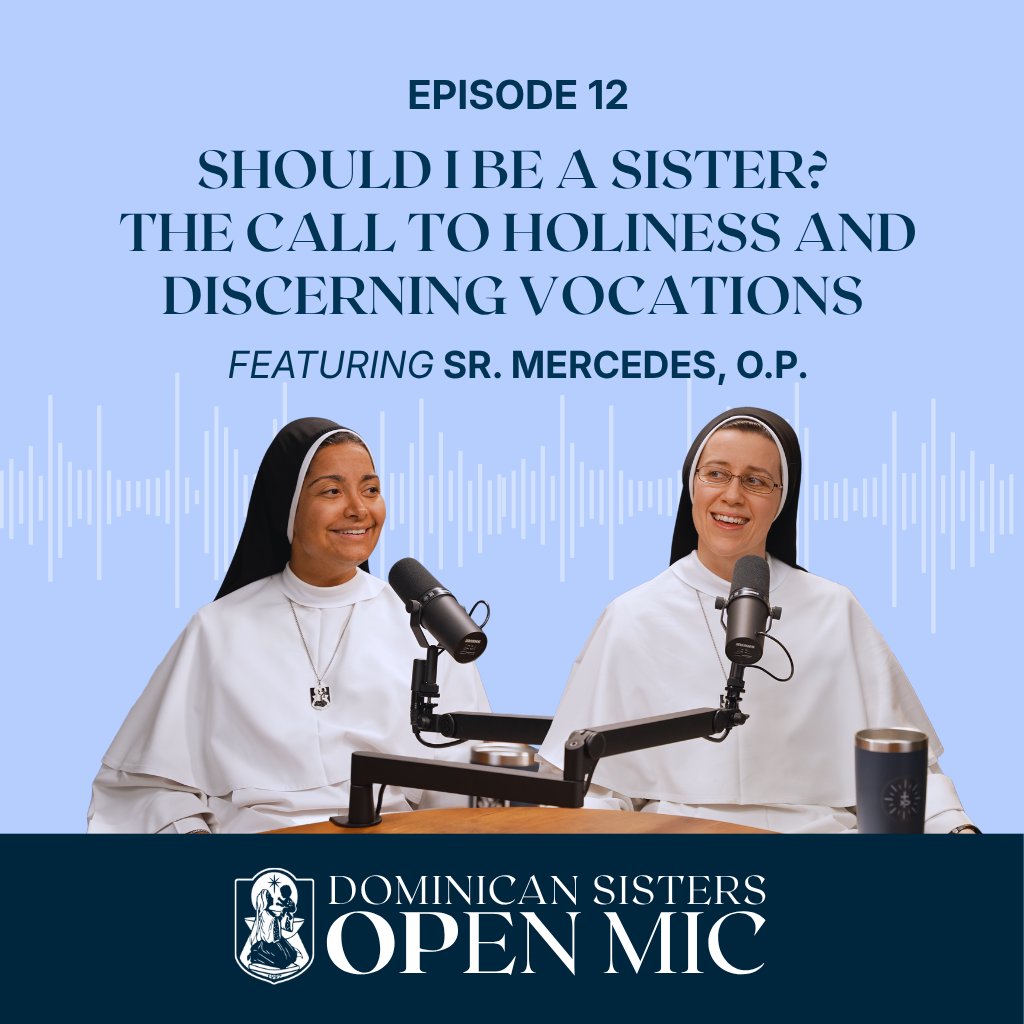
Dominican Sisters Open Mic
Ep. 12: Should I be a Sister? The Call to Holiness and Discerning Vocations (Sr. Mercedes, O.P.)
00:52:41
Loading summary
Transcript241 lines
- [00:01]
A
Ought to young woman who is thinking about the religious life be dating? Or ought she to completely just discontinue any kind of dating in order to discern the rel. The vocation? What are your thoughts on that, Sister? Did you hear?
- [00:18]
B
Did you hear I had something to say about this? Such a healthy part of living your sacramental life on your Christian life and your human life is to develop friendships. Good, good friendships, you know, to have people that are supporting you and that you support. That was a key thing in my own, just like, I guess, I guess discernment, my own, like, living my Catholic life was just living a Sacramento life. Having friends that, like, you know, we told each other, well, let's go to confession. Like, let's go to adoration, right? Or, yeah, let's go do a baseball game. Like, be normal about these things. But like, yeah, like, authentic friendships are so essential. You never get bored in religious life, and you never get bored in vocations where it's true. You just don't foreign.
- [01:15]
A
Hi, and welcome to Dominican Sisters open Mic. My name is Sister Miriam. I'm one of the Dominican Sisters of Mary, Mother of the Eucharist, based out of Ann Arbor, Michigan. We are having conversations on our podcast about all things Dominican. And this week we have with us Sister Mercedes, and she is one of our very own sisters. Welcome to the show, Sister. Thank you for coming.
- [01:40]
B
Thank you, Sister. Thanks for having me.
- [01:42]
A
And our topic for today is going to be vocations and discerning the vocation that God is calling you to. But before we get to that, Sister,
- [01:52]
B
Okay, I was ready.
- [01:54]
A
We need some biography information. So you are from Brooklyn.
- [02:00]
B
Absolutely.
- [02:01]
A
Brooklyn, New York. And you are. When did you enter? What year was it?
- [02:07]
B
2011.
- [02:08]
A
2011. And tell us what your role in community is right now.
- [02:12]
B
Well, Sister, I have the blessing of being our vocation director this year and for the past few years, which is wonderful. So what I get to do is I get to walk with young women and pray with them and go to universities and give talks, all just rounded about discernment and discerning God's will in their lives. So. So in particular in walking with young women, I pray with them, walk with them, listen to the Lord and help see where the Lord can be guiding them within their discernment, religious life, married life, our community and other community. So it's such a blessing as a sister to get to do this.
- [02:44]
A
I could imagine it's really special to just walk with somebody and accompany the young woman as she's figuring out what God has for her. It keeps you busy, huh? Sure does. You don't get bored in the vocations office?
- [02:57]
B
Nope. You never get bored in religious life, and you never get bored in vocations work. True. You just don't.
- [03:03]
A
You just don't get bored.
- [03:04]
B
No.
- [03:04]
A
Which could be a misconception because people might think it's boring.
- [03:08]
B
It's true.
- [03:09]
A
But I've never been bored.
- [03:11]
B
Me either.
- [03:11]
A
Me either.
- [03:12]
B
Like, none of us have been bored.
- [03:13]
A
No, no.
- [03:13]
B
Like, I promise, like, if you've seen any of us around, like, we are not bored and we're not boring people. So just letting you know.
- [03:20]
A
Exactly. Exactly. Well, Sister, we appreciate the work that you do on behalf of our community. It's very. A special role and an important one. So as we start our conversation about vocation, I think it would be beneficial to have a definition. What is the meaning of vocation?
- [03:41]
B
Vocation. This is a big word, but it's a really simple word, actually. So we all said a lot. Vocations comes from the landward vocate, to call, right? And so as baptized people, we all have a call to holiness. And that's true. We have this call to holiness where, you know, we're called to love God, to know him, to serve him in this world and be happy with him the next. Right. But we have to live that in a special in a particular way. Like we're here on earth and the church, the Lord, he gives us ways to be able to live out this called holiness here on earth that will help get us to him in heaven, fill us with a joy and holiness here on earth to get to him in heaven. That has to be in particular way. So your vocation actually in that case is most people are called to marriage, like blessed, beautiful marriages. Some men are called to the priesthood and some young women, some young women, and some men are called to religious life for consecration, created life. And so those are three means in which we are able to live out our call to holiness. So when we're discussing vocation, we're discussing this call to holiness, but specifically we're discussing like the call to holiness that you are living here now on your way to heaven. Like, what is that given way? Which is that?
- [04:51]
A
So, Sister, how is this to be distinguished from a job or a career?
- [04:56]
B
Okay, well, a job or career is a job or a career, right? I mean, some. Some refer to that as vocation, and that's something that they're called to do, or maybe they're called to teach or they're called to serv. In the armed forces and things like that. But in that way that is actually just you're serving the greater society. Right. It's not still your call to holiness to get to heaven. It's not the means as which necessarily you're directly getting to heaven, but it's the way you're serving people here. And that way that you are giving of yourself because you're always called to give. So even in your job, you're in some way being called to give. And so that can be, I guess, in some way related to vocation.
- [05:33]
A
And, and I would say too, in sort of figuring out what job might be right for you definitely would want to bring to the Lord and say, hey, Lord, what pathway of career wise, what college should I go to? What ought my career to be given my gifts and my strengths and putting that before the Lord and seeing what doors he opens for you and who he puts on your path to assist you in discerning that. So definitely something to bring to God, but not at the same, I guess, almost like gravity of location.
- [06:04]
B
Right, right. Because it's not necessarily like your vocation is going to be kind of that permanent state, whereas your job is not. Right. Your job is going to be a way that you're serving that's animated by your vocation as like a priest or a sister or, you know, or a married lay vocation.
- [06:19]
A
Maybe another point to be to add would be that you retire from a job. Yeah, but you don't retire from your vocation.
- [06:26]
B
Sure don't. Yeah, you don't want to.
- [06:29]
A
You don't want to. If you're a mom.
- [06:30]
B
Yes.
- [06:31]
A
You're a mom for life. You're married and have children. That's for life. And so you live that out.
- [06:36]
B
That's what gets you to heaven. You know, that's like, helps you give the greater gift to them, be able to. You're giving that gift to God to get to heaven.
- [06:44]
A
So sister, you, you work with young women as, as they're discerning the possibility of a religious vocation to, to be a sister. What, what do you think? How, how does somebody know, a young woman know if they have a vocation? Just in a general sense, how would she know that?
- [07:05]
B
This is a big question. I think everyone is just waiting, Every young woman is currently waiting to hear me say this. And it is. You should be inclined to it, you should want it. It's actually a very simple thing, which is very funny. But in all reality, it's like if it's something that you're Drawn to in some way. If it's something that maybe like the Lord is speaking to in some way or can bring you a little joy or that piques your, like, kind of your interest in a deep way, that's something to look into. Because again, not everyone is called to religious life. Most people are not. And all of us who are religious started out wanting it. Right. If you don't want to be religious at all, it's probably not your vocation. Right. And that's okay because most people are called to marriage. So, like, that's actually all right. But if you have a sort of inclination to it, if you're praying, you know, if you're living a sacramental life. Gosh, you know, like there's something about religious life that keeps coming up. Or there's something when you meet religious, like it just keeps coming up, keep going, pray with it, give it to the Lord. See what he opens up. And each. Each step, each step that opens. I mean, that's just one step closer to God. And he's going to keep on bringing you in your inclinations, in your desires. That's either going to lead you more towards a religious life or lead you more towards, you know, a lay vocation or a priestly vocation for young men.
- [08:25]
A
And it certainly would be normal for that young woman as growing up in her life. Maybe she did desire marriage. She would have desired marriage and motherhood. But that there's something that happens in the heart where her inclination becomes more toward. I mean, there's. I guess there's some that from the time they're little, they're thinking, I'm going to be a sir. I want that.
- [08:44]
B
Absolutely, yes. Yeah. The Lord, I mean, he makes every heart specifically for himself in a different way. So we're not going to hear the call in exactly the same way as someone else does. I guarantee you, every single sister in our community heard the call in a different way, maybe similar. Of course, we're called to religious life. We're called this community. So there's something about it. But in reality, it's like some sisters, like you said, they've known since they were very young that they wanted to be religious.
- [09:11]
A
Yes.
- [09:11]
B
I didn't know until maybe a year before I entered. So in reality, God uses everything and. But he uses your desires. He puts the desires on your heart. I always wanted to get married, you know, and have children. But when I met religious, you know, I started talking to religious. That's when I started to realize there's something different and that difference I think actually impacts me, has something to do with me and how my. How I love. Right. So, yeah, that's the thing. He speaks to every heart, specifically how he created it. And he desires that heart, though. So he's not trying to hide it. That's a huge thing. He's not trying to hide your vocation from you. Like, that's the last thing that he wants. He wants you to get to heaven, remember?
- [09:56]
A
Yeah.
- [09:56]
B
That's a very important part of getting to heaven, is your vocation.
- [09:59]
A
Yes. So, Sister, can we talk top tips? Like pro tips? Pro tips on discerning your vocation. Top three.
- [10:09]
B
Okay, three.
- [10:10]
A
How about top three pro tips? Discernment of religious vocation.
- [10:13]
B
Okay. First off, Sacramento Life, the sacraments. I mean, I actually just want to say that's one and stop. Right? It's like that important, right? Yeah. So if you're listening one. If you just want to say one highlight circle, like maybe put like, like stars around, like the sacraments, the sacramental life. Yeah. It's just. Sister, it's so important because in all reality, like, the sacraments are actually what. What Christ has given us, what Jesus has given us. It's the means to transmit his. This grace, a life of grace here on earth. That is what we need. That's what the Church gives us. That's what he's given us. I mean, you're a baptism. That's what gives you that gift of eternal life, confession that heals you, sustains you, your confirmation. I mean, like, that's. You're just empowered and inflamed with that. But then it's like the Eucharist, see, of Jesus, like, he's actually like transform you into himself and drawing you to Himself actively. Whenever you receive the Eucharist, you know, adoration, you get to be before. Before him in adoration. Like, what more powerful place is there in this world than to be before God in adoration? Right? Like, he obviously uses all of these things. And if you wanted to give us more than the sacraments, he would have given us more than the sacraments. Like, if we needed anything more to become a saint, like, to be with him in heaven, to experience like that grace here on earth. Because grace in heaven is same as on earth, so experience that grace. If we needed anything else, he would have given it to us. But he gave the sacraments, so how is that not enough? Right?
- [11:49]
A
So you're right. You're right. The sacrament. And when you think about. I mean, I've heard a lot of Sister stories of, of their Process of discerning.
- [12:01]
B
Right.
- [12:02]
A
I mean, the sisters, I would say it seems like everyone was. Was living a sacramental life. They were increasing mass attendance, maybe daily mass, even going to confession, more frequently going to Christic adoration.
- [12:20]
B
Yeah.
- [12:21]
A
And that, that. That way of living was a key aspect of them knowing God's will for them.
- [12:29]
B
It has to be, you know, if he's forming us to be. To be with him in heaven, we can experience and begin to experience that some. Now he gave us the sacraments for that. So obviously it's going to help us know how to get there. Right. He's going to use that to help us get there.
- [12:42]
A
Right.
- [12:43]
B
But it's just so essential. I mean, young women come to me, even young men, they say, okay, Sister, what do I do? Like, that's the biggest question, Sister, what do I do to know my vocation? Like, what do I do? Do the sacraments. Like, there's really. I mean, if you come away with anything, I just want you to know everyone to know that the sacraments are what's going to get you to heaven. Because he gave us the sacraments to the church. Like, these graces we have are real. So never discount that because it's so beautiful, that opportunity to be able to live like the Sacramento life and to be brought deeper into the mystery of the Trinity here on earth, even though DW within us in a baptism. Right. But that's huge. So Sacramento life is really just one of the biggest parts of your. Just discern your prayer life, because discernment's actually newsflash. Discernment is prayer. It is not this whole, you know, change my life around for this moment in time when I'm gonna specifically, like, change my life for six months so I can know my vocation. That's not what discernment is. That's not what discernment is. Discernment is prayer and living a sacramental life.
- [13:48]
A
Okay, so we have pro tips. Number one, Sacramento Life. We could stop there.
- [13:52]
B
We could, but alas, we're doing three. Right. All right, we're just going to do three. All right, so I'm going to throw in the next one. It goes with Sacramento Life, but it also is reinforced in a fruit of his contemplation.
- [14:03]
A
Okay, okay.
- [14:04]
B
So I want. I'm going to, like, contemplation conversation type of thing and with prayer, because prayer is one of those things that everyone, we can really find difficult to just say, well, then pray. Okay, well, Sister, like, how do I pray? But honestly, like, prayer is like speaking to God, you know, like, prayerfulness is a virtue, and it's something we can grow in. It's like they're being still listening and being willing to talk. God is friend, education, virtue, you know, like, you know, it's beautiful because we teach this and we form people in this, but it's a real thing, prayerfulness. You can grow in prayerfulness. And that's the being still listening and willing to talk to God as friend. And so learning how to be a friend. Right? When we are becoming friends with someone here on here, you know, it can be awkward. You know, it can be awkward to make friends. So you may show up and not know what to say to someone that you're getting to know. Maybe try and, like, figure out, well, if I say this and she says that, like, what's the response going to be? What is she? Like, what should I say? Like, what I say? And then you get to know someone, and you could just talk and talk and talk and talk for hours, and you have no idea what you talked about at the end of it. Like, who knows? But then you get to the point where in a friendship where you just like being with a friend and, like, the presence of a friend is so comforting and good. And you can really see that in prayer, like in your prayer life. In the very beginning, when we. When I really say, like, show up to prayer, like, you could have no idea what you're going to tell God or what you're going to do, but just show up because that's what's most important. You can't become friends if you don't show up.
- [15:30]
A
Right?
- [15:31]
B
You know?
- [15:31]
A
Yes, that's so true.
- [15:33]
B
Developing that friendship with the Lord is the showing up. Like, he created your voice in your heart and he wants to hear it. So they're showing up, that becomes that conversation, speaking to him as friend. Then they're just trusting that, oh, he wants me to be here and I want to be here. So that continues and develops. And then there's just, like the prayerful presence and that contemplation and that bringing that time to him. But that's the essential part in the prayer within. Discerning your vocation is developing that friendship, developing that conversation, and developing that desire for presence, which is that contemplation. And there's no better way to do that than living a sacramental life, right? And increasing your time and adoration. When you're actually, like, with him, like, like before God, you know, like, he's going to reveal your vocation to you. It's like I said, he's not trying to hide it. Like, God is not trying to hide your vocation from you. Like, he wants you to get there. So it's such a gift that in building that. That conversation, that contemplation with the Lord, that time, that prayer, he is leading you. And, like, your desire for prayer is like a desire put on your heart by God, and you can trust that. You can trust these desires that he's putting on your heart.
- [16:41]
A
All right, Sister, what you got for number three?
- [16:45]
B
Number three, Friends and family.
- [16:47]
A
Okay, Friends and family.
- [16:49]
B
Yes. Because you need to talk to people about this. Like, you need to talk to people about just, like, what you're thinking about, what you're praying about. You need people just kind of reflect yourself back to you and that you get to build up, because that's actually another essential thing that God gave us, like, with the sacraments. He also gave us the church. So he wants us to have community. It's such a healthy part of living your Sacramento life on your Christian life and your human life is to develop friendships, good friendships, you know, to have people that are supporting you and that you support. That was a key thing. In my own, just, like, I guess. I guess discernment. My own, like, living my, you know, Catholic life was just living a Sacramento life, having friends that, like, you know, we tell each other, well, let's go to confession. Like, let's go to adoration.
- [17:31]
A
Right.
- [17:31]
B
Or, yeah, let's go do a baseball game. Like, be normal about these things. But, like, yeah, like, authentic friendship are so essential because seeing your friends grow and you growing because your friend, like, it's just supporting your friends and being supported, it really brings you outside of yourself and helps you get to know God in them and. And them in you. So I think it's really an essential part to this discernment because it's. That it's growth and that growth in community and that growth in friendship.
- [18:01]
A
Right, Sister? Thank you. Great tips. Great tips. What do you think are common misconceptions about. About discerning religious life?
- [18:11]
B
Yeah.
- [18:12]
A
That you've seen. I mean, and you've had a lot of conversations with people.
- [18:16]
B
You know, I've thought about it and a couple things, actually. But one thing I'm going to say is you have to choose the hardest thing. Like, you actually don't have to choose the hardest thing. A lot of people think, well, religious life would be so hard for me because I really want to be married and have children to be so hard. And I, like, I just. It's I would just. I would hate religious life. So I must. I must be religious. It's like, no, God wants you to be happy and joyful. And, like, the point is that, like, you're. You're developing that joy, anticipation for heaven here on earth. And the way that he's doing that is through your vocation. So he desires your joy and your happiness. So honestly, it's just that idea, like, you don't have to feel like doing it. Like, your vocation is not an idea of, like, choosing the hard thing. Your vocation is a joy and it's a call, and it's a beautiful thing. And so it's not just thinking, okay, like, I. I need to suffer.
- [19:11]
A
Yeah. I've. I've heard people, some, some times people had. Talking away, oh, I really desire the married life. I should sacrifice that.
- [19:22]
B
Yes.
- [19:23]
A
For God to do this other thing.
- [19:25]
B
Yes.
- [19:26]
A
Yes.
- [19:26]
B
It's like this idea. It's like, no, like, if you truly want, like, marriage, you know, and actually most people are called to marriage. Right. And that's something that, I mean, I really would like people to really pray through and think about and, like, receive is that most people are called to marriage. Like, we're. It's actually, it's. We're made for marriage. Like, it's a natural, beautiful vocation that the church has elevated to sacrament. Like, that's amazing. And so few people are actually called to religious life in the priesthood as compared to the entirety of the human race. Right. But I think it's a call. It's a supernatural call. So there are many people called to it, but not everyone. Right. And it can't be everyone. So most people are called to marriage, and it's a sacrament, which just shows how sacred it actually is. But there's a particular supernatural call to religious life that not everyone has. And that's okay. That's why that inclination I mentioned earlier, like, if there's an inclination, like, pursue that desire, because God does put, like, these desires on your heart and whatever it is, it's going to lead you closer to God. And so moving into that, like, stepping into that, just knowing that, like, he's with you in whatever it is that you're doing and he's not. He hasn't designed that you must suffer in all things. Like, he wants you to be happy.
- [20:50]
A
Yeah. That's a. That's a great reminder, Sister. Thank you. Did you know that the Sisters of Mary offer more than just this podcast? Our apostolate called Open Light Media, offers a wide variety of resources for faith formation, virtue education and catechesis development. One of the programs that we're really excited to be able to offer is called Raised in Grace. It's the only Catholic social emotional learning program that explicitly integrates faith with modern neuroscience. Race and Grace is for both adults and children, and it invites them to participate in their own neurodevelopment with strategies based on cutting edge neuroscience. To learn more about race and grace and Open Light media, please visit openlightmedia.com or click the link on this description. Where faith meets learning. You'll find us at openlight Media. Now, I wonder if this might be a little controversial or there might be different opinions about this sister, but maybe you could give us your take. Young woman who is thinking about the religious life be dating or ought she to completely discontinue any kind of dating in order to discern the vocation? What are your thoughts on that, sister? I know there's different things.
- [22:20]
B
Did you hear I had something to say about this?
- [22:26]
A
I may have picked up on it.
- [22:30]
B
The main thing is, okay, you cannot discern with a divided heart. Heart. So if you're in a relationship, be in the relationship, enjoy the relationship. Don't feel like you have to. Then also be discerning religious life because you're actually not the like. Enjoy the relationship. Be free to enjoy that relationship and have your heart there with the Lord and with young man and young woman. Right now, if you're thinking, oh, like, I maybe I should discern religious life, or maybe, like, I'm just kind of open to it, that means, like, I need to go on like a dating fast immediately because I'm thinking about religious life and I'm praying about it, and I'm sitting here, I'm doing that. No, I actually don't think that you need to be on a dating fast, strictly dating fast, because you're discerning. I don't really believe that, actually. I know it's controversial. It's like a big controversial thing that I say, I drop it and then people don't like it. But I don't care because I believe it's true. So, see, I don't believe in that strict dating fast. If you're discerning, there could be other times in life where that may be necessary. Right? But when it comes to discernment, I don't think that's strictly necessary. Because if, like, the Lord forms you, forms you to choose goods, he puts goods in your life all day, every day. He's a good father, right? He's always providing These goods for you. And if you are living a sacramental life, you can trust that the. These goods he's putting in front of you there for you to choose and for him to work out his will in your life, right? So, like, if there's a good. And there's a young woman or young man in your life, if you're a young woman discerned, like, thinking about a certain religious life, like, if a young man comes and he seems like a good young man, like, he's like, actually like a good guy, right? Go ahead and date him. Like, if that, like, if that's what a good God's putting in your path, then. And it seems like it could be good, go ahead and date him. If you have vocation, it's not gonna work out. So there you go, like. But that's the thing. Like, you'll know through various circumstances whether or not it's gonna work out. What I find difficult is that when a young woman says, I'm just starting a religious life, so I'm going on dating fast right now, because if not, I won't be able to discern, it's like, well, the thing is, is that then if a young man comes in one's path, then there's. There's anxiety. And so when things start to introduce anxiety into this. This space of prayer, this space of just entering into God's goodness, understanding his love for you, then there can be a problem and there can be a tension there. So I don't necessarily like when young women, or I guess young men, but young women end up going, being very anxious about everything around them because they're strictly doing something like. Like God wants you to be free. Like, prayer is a place of freedom. Embracing his will is a place of freedom. So actually just trusting the goods he's putting in your path, and that any good that you choose is actually going to lead you to heaven and reveal his will to you is actually, I think, a greater good and a greater exercise of faith and trust and, you know, and all these things because he's a good father and the things he gives you are good. And you know what? You can't ruin his plan. That's also a big thing, though. You can't.
- [25:33]
A
One of your lines.
- [25:34]
B
I know it is one of my lines. I have lines. I have lines. You can't. You can't ruin God's plan. That's a huge thing that we all need to, like, pray with and know. Because he, again, he's just a good father and he loves us.
- [25:49]
A
Right. I'd imagine that's gotta be such a relief for people to hear.
- [25:53]
B
I know. It really is. I mean, like, I need to hear it too. But, I mean, I lost my luggage last week in New York. It didn't go with my plan. You know, I had a whole plan. I was gonna. It wasn't. Anyway, it didn't get there there. And so that's. That was my having to let go. I realize it's actually not that big a deal because it came on the next flight, but it really rocked my world. So I have to also know that my plans aren't exactly even on that level.
- [26:20]
A
Yes, the best. The Lord is always instructing us in his ways.
- [26:24]
B
I got to meet some great people in that process. So that's the idea. But yes.
- [26:30]
A
So, Sister, let's say that a young woman feels. Feels like she's got a vocation to the religious life, and this is the inclination of her heart. And she wants to know where to go, what community. So, I mean, there's options out out there. How does she figure that out?
- [26:48]
B
Yeah, there are. That's really daunting. Yeah, that's a really good question. So the thing is, is that really what you have to do is look around you, and if we're on the theme of, like, God's putting goods in your path, like, look at who he's put in your path. You know, look, are there religious studies put before you? Are there people who know religious that. That, you know, that may be able to recommend to you different things? Because he's speaking to you in that, like, if you have an inclination to religious life, he's speaking to you in all of those people he's putting in your path. I mean, I knew. I'm from New York, so I knew the religious of New York. I knew the CFRs and stitches of life. That's actually how I first realized I could have vocation. I was like, wow, like, there's something here. But I didn't feel called to be a Franciscan or a Sister of Life, so I figured I didn't have vocation. Right. Like, great, moving on with my life. But of course I did. And I eventually met our community. But that's what the Lord used to help me realize I might have a vocation is just those religious and knowing I'm not one of them. But it is that process of just seeing who does he put in front of you. Okay, explore that. Speak to them. See what God does. If you don't know any religious at all, you know, Google works too. Is there something that you're interested in and go from there? Are there religious in your area, in your city? Like start there. There are really beautiful resources. CMS WR has beautiful resources as well. And just seeing what God puts out there. Because like if you're called this life, your community is there and is out there. And that's really a great gift and comfort to know as well. Again, he doesn't want to hide it, but again, just like following his lead is so like just following his lead because if he's putting the inclination on your heart and you're following it, then he's going to help you and he's doing.
- [28:26]
A
And he wants you to know.
- [28:27]
B
Yes, he wants you to know. It's not, you know, it doesn't. It's not going to be a secret, but you had to attention, pay attention. But if you're praying, you know, like you're learning how to pay attention to listen to his voice. And again, it's going to be specifically how he speaks to you. Right?
- [28:41]
A
Right.
- [28:42]
B
But he is speaking because he's speaking through everything he puts in your path because he's putting everything there for a reason. He's just. It's all providential and it's all grace because we're Dominicans.
- [28:54]
A
So speaking of Dominicans. So but how you do. If someone knows. Yeah, Dominican.
- [28:59]
B
That's true.
- [29:00]
A
Is. Is what it is what the fit is for them. Like our, our with our charism.
- [29:07]
B
Yeah, that's actually really great because basically like a charism is not necessarily the same thing as like an apostate, like what we do. Right.
- [29:17]
A
Okay.
- [29:17]
B
That's not. I say what a charisma gift, gift, like from the church to the church to serve the church. Right. So as Dominicans, I mean, looking back at what the Dominican order is, you know, it's teaching and preaching for the salvation of sou souls. Like that's what really attracted me was just that like zeal for souls, the desire for people to know truth. Right. And we teach as a community. We teach. Right. I never saw myself as a teacher, but I love teaching. Right. Because it's just that like I get to be a space of truth for these young people every single day. Like that is so awesome. That's just cool. You know, the Lord is using my consecration as a Dominican specifically for them to encounter truth in a particular way. Because I've given my life to God as, you know, a sister member of the Eucharist and the Dominican order. And each charisma is lived in a particular way. In each community. So even Dominicans. There are a lot of Dominican communities out there, you know, that's sure are right. That is true for all, just different families. So that's also a really great thing. Like as Dominican Sisters of Mary, Mother of the Eucharist, we have a devotion to the Eucharist, right? And Our lady and like loving, loving our Eucharistic Lord with our heart, a lady's heart, loving others, a lady's heart in that givenness. And, and that's just a beautiful way that we get to live our Dominican charism. But there are other Dominican communities that also live Dominican charism very beautifully. And you know, same with Franciscans, you know, other Franciscans, they live the Franciscan life and in slightly different ways, but with the charisma of St. Francis. And really the way to know is to reach out and to see who's around you, like what's possible, what retreats are possible. Like are there any Dominican sisters in your area? Reach out, send an email. There are vocation directors everywhere, everyone.
- [30:56]
A
And we know because you meet them, you meet the other vocations directors when you're on events.
- [31:03]
B
Oh, we have so much fun. Like all the vocation directors out there. We have so much fun because the thing is we love our communities like each vocation director, we love our community so much and we love the young women, young men that come to us, us and we want every young woman, young men to love God. That is the primary purpose of what we are doing here. If I said vocation is like your call to, like that call to holiness, how you're like, like made to live that call that called givenness to God. We as vocation directors, our like graced job, like our grace task from the Lord like for our communities is to help young men and young women hear his, hear him that call, you know, pray through and hear that call and see where he could be directing them in his will and in his love. Whether it be to religious life, priesthood, you know, the lay life, married life and or community, you know, a different fit. But the thing is, is that like we are privy, listening and each of us like it's. It's a privilege like I ever vocation director that I know we all just, it's such a privilege and we all just enjoy each other too, you know, and we want God's will and that's the biggest thing. We just want God's will in people's lives.
- [32:19]
A
And I know the spirit is that if that young woman might be called to the Franciscan sisters, you would be in favor of that. Because you want what God wants for her as well.
- [32:30]
B
Yes, of course.
- [32:32]
A
Helping her out.
- [32:32]
B
And I love that. Yeah, I love that. You know, it's such a fun thing to participate in. It's a special way to participate in the church, you know, and the beautiful way that, like, the church is just so big and so beautiful and all these religious communities and charisms are so big and so beautiful. And it's like. And there are young men and young women called, each one of them.
- [32:52]
A
Right.
- [32:53]
B
And we have retreats throughout the year. And they're on their bigger retreats, right?
- [32:57]
A
Maybe, maybe. Yeah. Give an outline of that.
- [33:00]
B
So we have three retreats a year. So typically November, February and sometime in April. And our retreats, they're discernment retreats. So they're not common seas. They're just kind of open discernment retreats. So pretty much everything I've just been talking about is what we kind of provide within our retreat. We usually have maybe like 30, 40, 50 young women that come and these
- [33:19]
A
are at our Mother House, Ann Arbor, Michigan.
- [33:21]
B
Yes, they're here in Ann Arbor, Michigan. And they basically, we just, we, you know, we have a Dominican priest that comes and preaches. We have our sisters, give talks. And it's an opportunity for young women to just receive the graces that God would like them to receive, to meet other young women that are just open to this question and just like asking this question of prayer from the Lord. And we put everyone before the Eucharist, you know, all nights, silent adoration. And just like having that time with our sisters as well, and getting to know our sisters, seeing our Mother House. We have a beautiful Mother House. We're so blessed here in Ann Arbor. So seeing our Mother House having mass at our chapel on Sunday, they do
- [34:00]
A
all night adoration too.
- [34:01]
B
Telling you all night adoration is where it's at. That is where it's at. But it's so special. And it's even, you know, it's at one of our adoration. All that's one of our schools here. And I often think, I mean, as vocation director too, it's really special. But just thinking it's like all of our sisters, like our vocations came through that school.
- [34:18]
A
True.
- [34:19]
B
You know, like all of our sisters, they like our vocations came through that school. We had that common experience.
- [34:25]
A
We came on a retreat at some point.
- [34:27]
B
Yes.
- [34:27]
A
And we stayed overnight at the school.
- [34:30]
B
We sure did. Everyone.
- [34:31]
A
And then we came to the Mother House and experienced Mass.
- [34:34]
B
Yes.
- [34:35]
A
At the Mother House. And we got to talk with sisters and hear the talk. So, yes, it's just beautiful.
- [34:41]
B
And the Lord uses these retreats really powerfully because obviously not every young woman that comes comes is called to our community or called religious life. But every young woman that comes encounters the Lord in a special way. And the way in which he draw them to the. Drew them to that retreat and the way in which he desires to give Himself to them at that retreat and meet them. Because, I mean, we are so certain that if we put you before the Lord, if you step before the Lord, he will meet you there exactly the way he's called you to be there. And that's what we do with these retreats. We just trust he's going to work. Our Lord loves you in the Eucharist record. He's here and he's given for you. So of course we want you to come and be with Him. Of course you want to encounter our sisters and the beauty of our community. But having that space, that's. That's discernment, right? It's that prayer. It's a sacrament. It's like that's what discernment is. So these retreats, they're open to young women. So 18 out of high school through 30 years old. And it's a gift. I got to host them. I'm devocation director at the retreats and to seeing my sister so beautifully loving and serving all the young women there.
- [35:39]
A
So it is really beautiful. So we, we. We'll put a link for people to be able to learn more about those retreats if they would like to come and check it out.
- [35:51]
B
Absolutely.
- [35:52]
A
Now I have a couple more questions for you, sister. What about families who have young children and maybe they want to foster vocations or just foster an openness.
- [36:04]
B
Yes.
- [36:05]
A
To God's call. What would you recommend?
- [36:08]
B
Well, I mean, the family's first church, you know, so it's just really cultivating a life of. Of prayer in your children. Very simple, you know, just having them know that like cultivating the fact that like they can have a personal relationship with Jesus, that God loves them infinitely. That personal aspect of prayer that will build over the years, obviously. But just having them know and understand, like in the habit of prayer even, it's very simple things. The habit of turning to God is huge and will just really impact their life, obviously tremendously over time. Time. But being able to understand that you can always turn to God, that God loves you, he's with you, he's in your life. He's you're not just alone. He's not separate, you know? And then additionally, lives of the saints, like, so many people. So many people. I mean, the first time they've heard of a sister is Saint Therese. Right. Like, I mean, really.
- [37:00]
A
Yes.
- [37:01]
B
You know, or just one of these, like, these saints, you know? And so a lot of that's what. That's a great thing. That's how we have saints. Like, they help us. They really help us.
- [37:09]
A
Us.
- [37:10]
B
But, yeah, so exposing the lives of the saints and just knowing that, like, God, we have a personal God that loves them, and you can turn to. You can turn to Jesus, you can turn to God the Father, be, like. Be, like, animated by the Holy Spirit,
- [37:21]
A
you know, and seeing examples of. Of how happy they are and fulfilled.
- [37:27]
B
Yes.
- [37:27]
A
Our saints in living a life of virtue and dedication to our Lord is. Is always inspiring.
- [37:34]
B
Yes, yes, exactly. And then if they're religious in your area, you know, if they have prayers open at a given time or something, you can bring your. Bring your children there just to see religious and see what it's like, because it's also a beautiful opportunity to see, like, live real nuns. Right. And that's a big impact, too. And not everybody has that. Right. But if you do, it's nice to be able to do that as well.
- [37:55]
A
Right. Right. Okay, Sister, any last words of encouragement that you'd like to give for someone who is discerning the religious life? Final thought.
- [38:06]
B
I know the final thought. Well, Well, I mean, really, the thing is, we can't ruin God's plan. That's like a big. Okay, you know, that's the big one. But, yeah, just like, the knowing and trusting that he just. He loves you, he has a plan for you, and he has had that plan from all eternity. And so his desire is your joy and that you just know him and love him. And that's our desire for you as well. Really. Like, our desire is that same. And so the Lord, he knows your vocation. He wants you to know it, too.
- [38:33]
A
All right, Sister, are you ready for speed round?
- [38:36]
B
I am so ready.
- [38:38]
A
Bring it on, Sister, what is your favorite liturgical season and why Advent?
- [38:44]
B
Because Baby Jesus, I love just the anticipation, you know?
- [38:51]
A
Okay.
- [38:51]
B
It's like, ah, this. We get to welcome our Infant King. We get to welcome Baby Jesus. Like, I just. Three weeks of excitement over that. Four weeks. I'm just ready.
- [38:59]
A
Like, I just.
- [39:00]
B
I love the excitement every time. Like, I love Christmas, obviously, but, like, the Advent, that anticipation and that, like, growth and the desire. I love that.
- [39:11]
A
Do you have a hobby Cooking, sister.
- [39:14]
B
Yes. I love cooking.
- [39:19]
A
Teach me your ways. Teach me your ways, Sister. You are top notch.
- [39:28]
B
We've cooked together before. It isn't fun.
- [39:31]
A
I'm like, I'm good at chopping. I like to. I like to assist people like you and be a part of it. I don't like making big decisions about seasoning, but I can chop, I can season.
- [39:46]
B
We need that. We need that, sister. I need that. I need that support. I need, like, you can't do it alone. I'm a kid kitchen hurricane. Like, I have, like, category 1, 2, 3, 4, 5 and hurricane status in the kitchen. Like, it is real.
- [40:03]
A
What's your favorite thing to cook? I feel like you can cook anything.
- [40:07]
B
I was. I like cooking hard things.
- [40:09]
A
Yeah.
- [40:10]
B
Which is really funny. It's like, I. I'm. I'm Dominican. Double Dominican, everyone. Just so you know.
- [40:13]
A
Double Dominican.
- [40:14]
B
Double Dominican.
- [40:15]
A
Let's flesh that out. How are you double Dominican?
- [40:18]
B
Well, I'm a Dominican, Sister Maimer of Eucharist, as you can tell. But I'm also Dominican. My parented from the Dominican Republican public, so I get the great distinction of being a double Dominican. I have not yet met another double Dominican, so I am going to live this up for as much as I can. They can't take it away from me when I do meet them, but I am double Dominican and I love it. I love Dominican Republic. My family's from there. My parents live there.
- [40:42]
A
And you're fluent in Spanish.
- [40:43]
B
I am, yeah. I taught Spanish, so. I taught Spanish in high school for four years. Yeah.
- [40:50]
A
All right, sister, sign me up to cook with you.
- [40:53]
B
Anytime, sister. You're welcome. We're going to put something hard, though.
- [40:58]
A
What is your favorite game at the moment?
- [41:01]
B
Okay. Well, not even at the moment because really, it's like a steady.
- [41:05]
A
This is consistent.
- [41:06]
B
Yeah. This is like, steady. Like, you know, always go back to Trivia Tuesday. Like, Trivia Tuesday. Like, I love games, you know, I love kind of group games. I These things. But Trivia Tuesday is enduring, right?
- [41:19]
A
Yes, it is. It's been years of Trivia Tuesday.
- [41:22]
B
I really enjoy trivia. I spent especially like it when, like, the group is there and we just. We're just all there for the game, you know, we're all there just to kind of learn. I love the moments and people, like, realize they know something. I didn't think they know something. It's like, all know something. That's the point of trivia. It's like. But I really love it because I love learning, so learning new facts and so you Wanted my fact from this week.
- [41:43]
A
This week's trivia.
- [41:45]
B
So we pray trip Thursday, though, this week, which I was totally happy about because I wasn't here on Tuesday. I was traveling. I was so excited.
- [41:53]
A
Trivia can actually happen any of day of the week.
- [41:56]
B
But Tuesday is so alliteration. We're Dominicans. It's so fun. My trivia fact of the week, which was so interesting. Okay. Did you know that, like broccoli, cabbage, et cetera, like, they actually come from the mustard seed. They not. Like when the Lord said, let there be vegetation. He actually did not say let there be broccoli or let there be cauliflower.
- [42:18]
A
Okay.
- [42:18]
B
He did it like, he actually said, let there be a wild mustard plant.
- [42:23]
A
Mustard seed. Okay.
- [42:25]
B
And then people decided, I like this leaf. We're going to make kale out of this. Oh, I like this bud. We're going to make cauliflower, we'll make cabbage, we'll make kabi, whatever that is. We'll make broccoli, we'll make Brussels sprouts. Like, all these things actually were man made over the course of millennia and hundreds of years. So that. So really, every eight year old can say, we do this to ourselves when they see broccoli. Like an 8 year old could say, we did this to ourselves,
- [42:55]
A
sister. There. That is a fun trivia fact.
- [42:58]
B
I'm just saying it's very fast. I learned so much. That was like additional research after the game by myself and sister Elizabeth Ann.
- [43:05]
A
Yes. Which is a great part of Trivia Tuesday. Continue to learn.
- [43:10]
B
Yes. I've been proclaiming that fact all week.
- [43:12]
A
No, the thing that cracks me up is when, okay, sometimes I join on trivia.
- [43:16]
B
Yeah, she does. Which is great.
- [43:18]
A
And I enjoy it from afar, even if I'm not, you know, stuff in the circle. I might be playing scientist. What was I playing? Pinochle. I was playing pinochle. You were playing trivia. And. And it's fun hearing you, you know, crack up about things. But the funny thing is when someone will be like, oh, no, we had this one before. We had. I mean, really, We've been buying trivia. Do you know how many cards are in that box? Relaxed. We've been playing trivia for so long actually repeating on trivia questions.
- [43:54]
B
I also want to let it be known that the trivia that we play is like a 1982 trivia.
- [44:01]
A
Right.
- [44:01]
B
So whenever we get a history or like geography or anything question, we're like, think 1981 Soviet Union exists and Reagan is the president.
- [44:11]
A
Like, everything goes right which we ask for ourselves because I think we've had newer versions of the game that didn't like as much. So we go back to the 80s.
- [44:22]
B
Classic trivia Tuesday is enduring the real original trivia. So great.
- [44:28]
A
All right, sister, what is a book that has impacted your spiritual life, besides the Bible that you would recommend?
- [44:35]
B
I would say interior castle by St. Teresa of Avalon. Blah. I just love her. She's just, I just like a friend of mine in heaven. I just, I get what she says. But Interior Castle, I really recommend that. It's a beautiful, just deepening understanding of prayer, of life with Christ, love life with God, and knowing that, you know, the spiritual life is not linear. So you don't just end up just, you know, not doing a good job if you're not moving forward in the spiritual life. No, he, he, like, he's actually guiding you through all the castles. He's like, bringing you in and out to have a look at his gun goodness and his creation. And that's all that process of growth in spiritual life.
- [45:13]
A
All right, what is your favorite title of Our lady and why?
- [45:17]
B
Okay, so Our lady of Lords. I don't know we're supposed to do with this, but Our lady of Lords is my favorite. Okay, so I just love her. I, so I haven't really had like a ton of Marian shrines, but I just, I, I, I went there a few years ago, and it was just such a beautiful experience. I went the Order of Malta. I was helping. You went on those two. That, the young adult one. Yeah. So it's just a beautiful experience, I guess, like, even like Mother of Hope, you know, like seeing the beautiful trust of everyone there, helping unload people from the trains, like helping in the bats. Like, this beautiful experience of seeing hope just really brought me great hope. And just trusting of knowing God has the plan. God is in charge and he gives all these things, even gives, you know, he allows his suffering because he wants to draw you to himself in a very special way. Way. And everyone there, they just want to know him more. They want Our lady to, like, bring them closer to God, bring them closer to their, to her son. And yeah, just that hope that I saw there in everyone, the desire for God is so deep and present Our Lady's presence there. I've never felt her presence more than our Lord. So I don't know about you, but for me, it's just so special. So, yeah, that's like my favorite.
- [46:27]
A
All right, what age group do you most enjoy teaching and why?
- [46:30]
B
Oh, sophomores in high school.
- [46:34]
A
I Like them too.
- [46:35]
B
You like them too?
- [46:36]
A
Yeah. Yes, I do.
- [46:37]
B
Why do you like them?
- [46:38]
A
Well, I, I like freshman, sophomore. I find them to be very docile and I, I probably have the most experience teaching freshmen. Yeah, but the docility to. To the way that. The way that we're gonna do things in class, but also an openness to virtue and goodness and the kinds of. They're responsive to the kinds of. Of ways I want them to grow in virtue. And I, I don't have as much experience with upperclassmen. I'm sure I would love it too.
- [47:14]
B
I know. Same, actually. Yeah, I've done freshman, sophomore pretty much. But what I like about sophomores is kind of. So they are on that docile phase, but particularly the beginning of the year, they really are. They have like this spike of thinking they know everything about the school and about their lives. Like, it's so real. Everyone sounds about sophomores, it's so real. But then I love. Like they're there, but then you just get them into the process of coming back down. That docility, who they like, who they are, where they are in their life. And that process is actually what I love. That process of just being like, hey, like, look, this is like what you gotta do is come back to the ground, you know, And I like bringing them there because then they. They end up in a better place of home, you know, And I love seeing that, like that process of bring. Coming back down and being open and also to as well.
- [47:58]
A
Something I also think is I love, love working with soft sophomore freshmen is that. Is that then when they continue on through the years in their junior and senior years, I love being able to continue to accompany them.
- [48:12]
B
I love that too. I love seeing the mayor and still being at school, that's so great.
- [48:15]
A
And then it's outside the classroom and you have ways of interacting with them that. That's different and beautiful. And so I think that's a real plus that I've enjoyed about, about getting to know the underclassmen.
- [48:29]
B
Yeah, no, I totally. I love that.
- [48:32]
A
Okay. If you could have dinner with any saint, who would it be? And what would you ask them?
- [48:37]
B
This was hard. Okay, so am I having the dinner here on earth or in heaven? Because that's like, totally relevant. Because if I'm in heaven, I don't have to ask how to be holy, but like, if I'm on earth, pretty much I want to know, how do you be holy?
- [48:49]
A
You know what I mean?
- [48:50]
B
Like, this is like a real thing. But I would say John Paul ii, either on earth or in heaven, either way. Way.
- [48:58]
A
And what would you cook for him?
- [49:00]
B
Oh, okay. So once I tried to cook the poke cake, and it worked, but it was a. It was a drama. Everything I cook that's hard is drama, but, like, it was a major drama.
- [49:08]
A
Oh, really?
- [49:09]
B
Because we decided at 4:20 to make this, and we have prayers at 5:00'. Clock.
- [49:13]
A
Yes.
- [49:13]
B
It takes. It takes making a pastry and a custard.
- [49:16]
A
Oh, my goodness.
- [49:16]
B
It was out of control. But I, again, I'm like a cooking hurricane. I was at level 4, probably of Hurricane level that with Pope cake. But, yeah, I just. I would love to sit with John Paul, St. John Paul II. I just want to know about his love for God, you know, I want to know how he loves God. I just want to look him in the eyes, you know, he's just, what a saint and what a gift to the church. And I love divas. Cordia. My name, Sister Mercedes, is Mercy. So I just love that document. It's just. Yeah, I just feel like. Like he's. He's my Pope. Like, everybody know everyone. So many people say that. But I'd love just to sit down with him and we can eat Polish food and all.
- [50:00]
A
Right, this is the last one. Name an activity that brings you peace and refreshes your spirit.
- [50:06]
B
So, yes. Cooking, actually, is that really. Yeah. Like, I could cook all, like, retreat Sunday. Like, if I were just cooking. Like, I would love that if I.
- [50:14]
A
And you're so generous because you do side up. I've noticed that you sign up to make a little treat for us on retreat Sundays. And for me, that would not be refreshing or peaceful. And so when I see you doing that, I'm like, whoa. I'm like, I'm not at that level.
- [50:33]
B
So. You are at that level. We are. Listen, listen. This is community.
- [50:43]
A
No, it's beautiful.
- [50:44]
B
So fun.
- [50:44]
A
Yeah. Thanks, Sister.
- [50:46]
B
So fun.
- [50:46]
A
We appreciate it when you do that.
- [50:48]
B
Yeah. But it's just great. I think that's. That's a gift of community. Everybody does that. Like, everybody brings what they bring. Yes. And so that's. That's a beautiful part about community. Even, like, with my cooking. Like, I actually do not like baking, but I've intentionally. Like, one year, I baked every single dessert when I was home, every single feast day dessert. And I became. I started, like, actually kind of liking. I don't love it still, but I also. I love doing hard things.
- [51:12]
A
Yes, Yes.
- [51:13]
B
I just love creating. And I love love. Just like I'm love Lang. My food is love. Language. You know, it's like that's like what it is. But I just love that part of it and so yeah, I just love it just really refreshes me and I bring me joy. I love bike riding too. It's another thing.
- [51:28]
A
Oh yes, yes.
- [51:30]
B
We beautiful area for that. But yeah, if I can cook all day retreat Sunday, I'm happy.
- [51:36]
A
Well Sister, thank you so much for sharing your insights on this topic. I I'm praying it up be helpful and fruitful for peaceful people to be able to learn more about this process.
- [51:47]
B
Yes and yes prayer.
- [51:49]
A
So we'll continue to pray for you in your role. Thank you in gratitude for all you're doing for our sister. So keep it up Sister.
- [51:55]
B
Yes.
- [51:56]
A
And we want to thank all of our listeners for listening today. And we will have a link in the description if you would like more information about the discernment retreats that we have available to young women as part of their discernment process. And we want you to know from the Dominican sisters that we are praying for you and we pray for the Lord to bless you and all of your family members and we hope you have a wonderful day.