← Dominican Sisters Open Mic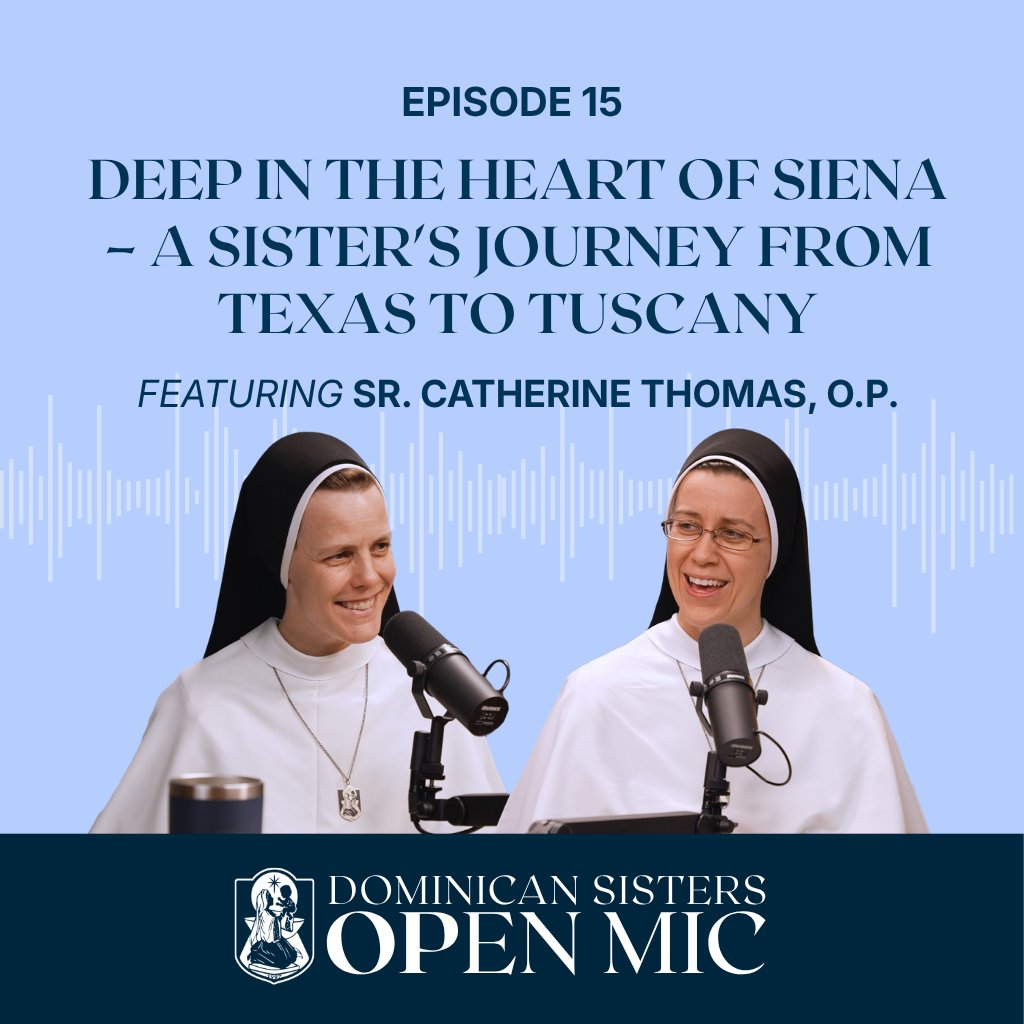
Dominican Sisters Open Mic
Ep. 15: Deep in the Heart of Siena – A Sister's Journey from Texas to Tuscany (Sr. Catherine Thomas)
00:57:44
Loading summary
Transcript225 lines
- [00:00]
A
So I'm requesting that you speak on St. Catherine of Siena. Now, there's a couple reasons for that.
- [00:07]
B
Although she never learned in. She never attended school, she miraculously learned how to read and write. And so she was able to pray the divine office, which are the psalms and other prayers of the church that religious pray daily.
- [00:23]
A
And she.
- [00:24]
B
She didn't like it. Actually. She thought it was conspicuous. She lived by Holy Communion alone for years, which is miraculous. I mean, there's no way that a human being could stay alive. But Jesus was her only food.
- [00:52]
A
Hi, and welcome to Dominican Sisters open Mic. My name is Sister Miriam, and I'm one of the Dominican Sisters of Mary Mary, Mother of the Eucharist. On our podcast, we're talking all things Dominican. And today we have one of our very own sisters, Sister Catherine Thomas. And she is going to be sharing with us her love for a wonderful Dominican saint, Saint Catherine of Siena. Sister, thank you so much for coming and joining us.
- [01:21]
B
Sister Miriam, thank you for having me.
- [01:24]
A
So, Sister, you entered the comment in 2007, right? One year after I entered the convent. So we go way back. And you are from the great state of Texas.
- [01:36]
B
That I am.
- [01:37]
A
Where did you grow up?
- [01:38]
B
I grew up in Houston.
- [01:39]
A
Okay. And like all of our sisters, you're a certified teacher. And what are you qualified to teach?
- [01:49]
B
I was certified in high school and middle school social studies and also have a theology degree. So I spent all of my teaching life teaching theology for about. About 10 years before to high school students before this year.
- [02:04]
A
And this year you have a different and new assignment.
- [02:07]
B
I do.
- [02:07]
A
Tell us about that.
- [02:08]
B
I do. So I am back this year at our Mother House for the first time in 15 years. And I am the prioress, which means that I help make sure the house stays running and that the sisters have all that they need in order to live our religious life and to bring souls to Jesus and the apostolate.
- [02:28]
A
And Sister, I have to say, I benefit from your attentiveness. So thank you for. Thank you so much for all you do. It's great to be back in the Mother House. I, too, am back after 15 years, so it's nice to be together after our years in the novitiate and now here we are. So thank you for coming to share. Now, when I was thinking about a topic for you to discuss with us, there were many things that came to mind. You have two amazing patrons.
- [02:57]
B
I have two amazing patrons.
- [02:59]
A
St. Thomas Aquinas and St. Catherine of Siena. Those are heavy hitters.
- [03:05]
B
They are, Sister. That is how much Help I need. We have a great big brother in St. Thomas Aquinas and a great big sister in St. Catherine, and they've both been wonderfully present throughout so much of my life and all of our life as Dominicans.
- [03:24]
A
So. And Sister, I, when I was trying to figure out which of those two I should ask you to share on, I also polled other sisters to say which of these two should sister discuss. And it was very hard for people to choose.
- [03:41]
B
Yeah, I never try to choose between them.
- [03:46]
A
So I'm requesting that you speak on St. Catherine of Siena. Now, there's a couple reasons for that. One being you have a. I feel you have a certain energy and passion and love that reminds me of the beautiful heart of Saint Catherine of Siena, but also because I think she might be lesser known than St. Thomas Aquinas. And so we would benefit from hearing your thoughts and the fruits of your contemplation.
- [04:18]
B
Well, I would love to help spread her fire a little bit more. So what do you want to know about St. Catherine, Sister?
- [04:24]
A
Thank you so much. We want to start with biography, just fact, factual details about her life, when she lived, where she was, from, what she did.
- [04:34]
B
So St. Catherine was born and grew up and spent most of her life in Siena in Italy. She was born in 1347 on the feast of the Annunciation, and she died in 1380. So she was 33 years old, same age as Christmas, when she died. And her life was almost, you could say, like an almost uninterrupted series of really just deep experiences of intimacy with Jesus that overflowed into love of neighbor and love of the church and the salvation of many, many souls. So she was the 24th of 25 children. So really big family. But many of her siblings died in childhood, so she actually ended up being the young surviving child, the baby of the family, and very much loved by, by all in her family and especially her mother as kind of the little one. And when she was a young girl, she had an experience that marked the rest of her life. She was as a six year old walking through the town with her brother, her older brother Stefano. And while she was in the middle of the marketplace, people going back and forth all around her, engaged in just the business of the world. She looked up and above the Church of St. Dominic, which she could see in the distance. She had a vision of Christ dressed in papal robes, wearing the papal crown and blessing her, surrounded by various saints. And the beauty of Christ and the love of his blessing just filled her soul so much that she just stood There rooted to the spot. And her big brother kept on walking and then eventually realized that he left his little sister behind. So he came back to her and, you know, saw that she was just staring there at the sky and tried to shake her. And she took her. She took her. Her eyes away from the vision to look at her brother. And when she looked back, Christ had vanished. And she wept to be no longer seeing that beautiful sight and seeing his love for her in that really intensely profound and personal way. And it was shortly after that that she made as a little girl, a private vow of virginity. She wanted to take Jesus as her one and only spouse and be all his. Also around that time as a little girl, she had a cousin who lived with her family, who eventually became a member of the Dominican order and, and who eventually became her confessor. So the Dominicans had a house in Siena. So she would see them going by and she would run out and she would kiss their footprints in the street because she had heard about and really loved the Dominican charism of preaching the truth to save souls. And she was so taken by that. She had plans and dreams as a little girl of running away to either be a hermit or be a monk. But the Holy Spirit inspired her to remain at home. And as a young teenager when, when her family started to think about setting her up with a suitor and think about marriage, she didn't say anything to anyone about her private vow. But she remained faithful to her resolution to be Christ's bride only and cut off all of her hair so that her family would try to give up the idea of marrying her off to somebody. And they didn't give up that idea, but instead really, really tried to oppose her and make her life difficult in all kinds of ways that they could. So they fired all of their family servants and made her do all the housework so that she couldn't have her own room anymore. They were trying to take away all opportunity for her to have personal prayer to weaken her resolve, but didn't work. She just contemplated while she worked. And eventually one day her father saw her kneeling in a corner with her little clipped off hair and he saw this dove just hovering over her head. And then he came closer, it flew away. And he saw that as a sign that his daughter was being led by the Holy Spirit. And he gathered all the family together and he said, do not persecute or put any obstacles in the way of my beloved daughter. She is going to. She's going to belong to the Lord and none of us are going to stand in your way. Please pray for us.
- [09:12]
A
So did things get better for her after that?
- [09:14]
B
I mean? Well, you know, St. Catherine's family, they. They went along with it. Although Catherine and her mother never fully ever really understood each other, or at least Catherine's mother never understood the. The. The outpourings of Catherine's love that would lead her to a life so unexpected. Catherine ended up becoming a Dominican tertiary, which was a group of Dominicans not living in a monastery, but lay men and women living in their own homes, but bound together, living the Dominican charism together and wearing the Dominican habit.
- [09:55]
A
So. So was she living in her own home at that time? She was.
- [09:58]
B
She was. She never entered a convention.
- [10:00]
A
Okay.
- [10:00]
B
She was living out her consecration in her Dominican life, in her family home. She had many mystical experiences, and one of them that I find really beautiful. Well, I find them all really beautiful. But when she was about 18 years old, she'd been a Dominican for about three years at that point, I believe, give or take. Give or take the ages and the dates. But she had this vision on Mardi Gras, the day right before Lent began, when everybody in. Everyone around her was, like, gorging themselves on every kind of bodily indulgence. She was fasting instead and doing penance and just engaging in prayer. And Our lady appeared to her with Christ. And Our lady took her hand and offered her hand to Jesus, and he mystically wedded her and put a wedding ring on her finger that she could see the rest of her life. And not too long after that, he started to appear to her just on a very regular basis. So she saw and heard Jesus a lot of the time.
- [11:16]
A
Could you imagine, Sister?
- [11:18]
B
I mean, I can try to imagine. And what I try to imagine is so beautiful that I can't imagine what the reality would be. And Catherine was so docile. So Christ, she wanted. She actually really just wanted to spend all of her time in prayer. And he had to talk her into, no, actually, you should do normal things. Do normal things like go and have dinner with the family, go and serve the poor. But when she could hear the voice of Christ asking her, she just wanted to put no obstacle on the way. And so when she was in her late teens, early 20s, there was this very active period in her life where she was tending to the sick, giving people her own clothing, who needed clothing. And Christ would sometimes appear to her afterwards and say, oh, today you gave this food, today you gave this garment. Here, Here it is. Do you recognize it? And she would say, wow, it looks really like he, like, had added, like, diamonds and jewels and beautiful things. And she said, well, Lord, it wasn't that. It didn't look that good when I gave it away. He said, well, you gave it to me and, and, and I'm. And I'm. And I'm keeping it for you. So she really saw in all of, and all that, those that Christ was under to, Christ himself. And the missions just started to get bigger and bigger. Her, she became really well known for her wisdom and for her ability to melt the hearts of people who were really confirmed in sin or confirmed in hatred and discord, to be reconciled to God through confession and to be reconciled to their enemies. So she became a really great peacemaker, first in her own town of Siena, and then eventually Jesus called her to speak a difficult truth to the Pope. The popes at that time and for several decades had been, instead of living in Rome, had been living in France, in Avignon, really under the thumb of the French. And there had been previous saints like Bridget of Sweden, who had attempted to speak to the Holy Father to persuade him to return to his diocese in Rome, to no avail. But when Jesus asked Catherine to go, she tried to convince him that she wasn't the right woman for the job. But when he insisted, she surrendered and she went.
- [13:43]
A
So she went to France.
- [13:44]
B
She went to France to speak to the Holy Father to try to persuade him to return to Rome. And he followed her advice.
- [13:53]
A
Wouldn't she like to be a fly on the wall in that conversation?
- [13:56]
B
In basically every conversation that Catherine ever had?
- [13:59]
A
Yes, that's true.
- [14:00]
B
Okay. And you might wonder, like, why, what would convince the Pope that this, you know, young girl wearing black and white had, you know, anything to tell him about the future of his papacy. But she also had the gift of reading hearts, and she could often tell, just by being in a person's presence, what they had on their conscience. And she could tell the Pope some things about himself that only he knew.
- [14:27]
A
Wow.
- [14:27]
B
And so he. He really recognized the story.
- [14:29]
A
He knew this was the real deal.
- [14:31]
B
Yeah, yeah, she. She spoke. She spoke truth. It was clear to him that she was speaking truth to him from the Lord. So he followed her advice, went back to Rome, and then several times afterwards, he called upon her to be an ambassador in Italy. So at that time, the Pope was also the temporal ruler, the Prince of the Papal States. And there were times where the other Italian city states, which many of them were independent and self governing at the time, would be at odds with the Holy Father. And he would send her at times to negotiate peace. And so she was an obedient daughter of the Church, faithful. Faithful to the Holy Father in love with peace. And so she, as a daughter of obedience, would joyfully go.
- [15:23]
A
It's amazing she did all that, given the age. And she died at 33.
- [15:29]
B
She died at 33.
- [15:31]
A
She's doing all these things.
- [15:32]
B
Yes.
- [15:33]
A
As a young woman. Then where did she end her. Like, her final days were those back.
- [15:42]
B
Her final. Her final days were spent in Rome. So towards the end of her life. Well, I should say there were. Can I talk about a few, like, really awesome musical experiences that happened first? So when she was. When she was, I think, in her early 20s, she had an experience where she was offering her heart to Jesus and he took her up on it and he just took the heart right out of her chest. She told her confessor, and. And then she had an experience several days later of Christ giving her his own heart. And. And from that point, her biographer, who was also a blessed and a Dominican, Blessed Raymond of Capua, tells us that her will was so united to Christ that no matter what happened, she was always happy, peaceful and contented.
- [16:33]
A
Wow.
- [16:34]
B
And so she was able to endure a lot of suffering in her life and say yes to grace without fear, because really, her will and her heart were so united with Christ.
- [16:44]
A
And this is why we see with the statues of St. Catherine.
- [16:48]
B
Yes, that's often why you see her in sacred art, holding. Holding her heart. And also very often in sacred art, you see her with the crown of thorns and the wounds of Christ's passion. Oh, that's great. She also received the stigmata at about the age, I think, of about 23, and could feel the wounds of Christ on her body for the rest of
- [17:09]
A
her life in her hands. And did she have a stigmata?
- [17:13]
B
She had all the wounds of Christ on her hands and head and feet, her side, but they were not visible to anyone but her until after her death.
- [17:23]
A
Oh, okay.
- [17:24]
B
Because she asked Jesus not to make it obvious. She didn't want her life to point to herself. She wanted to point to Jesus. So in the last few years of her life, a very terrible schism broke out in the Church. Pope Gregory xi, who she had prevailed upon to return to Rome, died, and his successor, Urban Virginia, began to be opposed by the very cardinals who elected him Pope. A while after that, turned around and said, no, actually, really, we didn't really elect him to be the Holy Father. This other guy, we're going to make this other guy, we're going to name this other guy. Pope and Catherine wanted to be as faithful a daughter of the Church that she could. So she went to Rome to just offer her support and she would write letters to high ranking churchmen, to lay people, to kings and queens, to ordinary folk to try to persuade the sons and daughters of Holy Church to be faithful sons and daughters of Holy Church. And she spent her last days praying and offering her life for unity in the Church. And. And there she died at the age of 33. It was a confusing time. There were saints who were actually on both sides, even some Dominican saints who ended up supporting the false anti Pope. But she knew the truth was truth and she was faithful to the end.
- [19:10]
A
So Sister, could you also comment on, did she go through a period of time where she was only receiving holy. The Holy Eucharist and she wasn't eating other food or how much the Lord gave her grace, that that was enough for her? Sustenance was the Holy Eucharist.
- [19:29]
B
So Jesus actually it's like almost literally true to say that Jesus was everything for Catherine. She reached a point she, she fasted regularly from when she was little, but she reached a point where her longing for the things of the Spirit was just so much more than, than any of her bodily needs that she lived by Holy Communion alone for years, which is miraculous. I mean, there's no way that a human being could stay alive. But Jesus was her only food and she lived by that union with him. And other people thought it was weird, including her own confessors. And she didn't like it, actually. She thought it was conspicuous. And she tried to eat food, but it actually made her physically unwell. And so her confessors ordered her to try to be normal. And she was like, I would love to be normal, I'll give it a try. But it made her sick. And so she was actually more physically healthy and physically robust when she was fasting to that really unusual degree. And so eventually her confessors were like,
- [20:50]
A
okay, okay, you can go back.
- [20:53]
B
You know, they recognized that she was not being, you know, led by a spirit of pride or waywardness or, but that she was just being faithful to grace. And that grace was being really unusual in her case. But they, the, yeah, they. St. Catherine let the Holy Spirit have a very free hand with her. And St. Catherine's confessor also let the Holy Spirit have a very free hand with her. She was blessed to have good spiritual guides who understood when to advise her and when to take her advice.
- [21:31]
A
And they could see God working through her. No doubt she impacted them, yes, towards holiness. And love of God and her.
- [21:41]
B
Her. Actually a couple. One thing that was really remarkable in her own. In her own life is that although she never learned in school, she never attended school, she miraculously learned how to read and write. And so she was able to pray the divine office, which are the. The psalms and other prayers of the church that religious pray daily. And she also dictated a great book while she was in ecstasy. It's a conversation between herself and God the Father called the Dialogue.
- [22:14]
A
So how did that work, sister? I mean, you said she dictated the book. Was she speaking out loud?
- [22:21]
B
She was.
- [22:22]
A
To someone who was taking notes.
- [22:25]
B
Well, she was speaking out loud, and there were people there who were taking notes. So for a lot of the time, Catherine had very little time alone because of her reputation for wisdom and her own just great love of people. She had just a great power of attraction, and people wanted to be near her. And so people were constantly flocking around her. And she would counsel them, she would listen to them, but sometimes she would just go into ecstasy when the Lord had things to say to her. And she was surrounded by people who would often witness Catherine's prayer. And sometimes she would speak out loud.
- [23:04]
A
Okay.
- [23:04]
B
And she had, I think it was two or three or four secretaries who would write down what they would hear Catherine say while she was in ecstasy or in prayer. And they were able to take down the words that she was hearing from God the Father and that she was speaking back to him. So.
- [23:24]
A
And this has been compiled, and it's called the Dialogue. That's right.
- [23:28]
B
Okay.
- [23:29]
A
It's a pretty thick book.
- [23:31]
B
It's about ye. It's about ye. And then. And she. On, I think probably on account of that work, she, along with St. Teresa of Avila, were declared by Pope Paul VI, Doctors of the Church in 1970.
- [23:49]
A
That's right.
- [23:50]
B
So. Meaning that they had a teaching, a doctrine that would enrich all the faithful and the whole church, and that we all are her little brothers and sisters who have something wonderful to learn from our big sister.
- [24:04]
A
Did you know that the Sisters of Mary offer more than just this podcast? Our apostolate, called Open Light Media, offers a wide variety of resources for faith formation, virtue education, and catechesis development. One of the programs that we're really excited to be able to offer is called Raised in Grace. It's the only Catholic social emotional learning program that explicitly integrates faith with modern neuroscience. Raised in Graces for both adults and children, and it invites them to participate in their own neurodevelopment with strategies based on cutting edge Neuroscience. To learn more about race and grace and open light media, please visit openlightmedia.com or click the link on this description. Where faith meets learning. You'll find us at openlight Media. And she's certainly special among Dominicans. I mean, I think we hold her up as one of the great women Dominican saints. We have a lot of great ones. We do a lot of beautiful holy women. St. Catherine is so unique with all her mystical experiences and the fact that we can read these words. So, sister now, thank you for giving the overview of her life. And I know St. Catherine kind of had you singled out in a way.
- [25:33]
B
Thank God.
- [25:34]
A
Before you were a sister, even. I think this is part of the reason why you love her so much. But can you tell us, going back to before you were a sister and you're.
- [25:47]
B
Do you want to know how I met St. Catherine?
- [25:48]
A
How you met St. Catherine and really how she helped bring you to the Lord?
- [25:53]
B
I am super happy to talk about this. So when I was in college, I went to St. Louis University after high school. And when I started college, I had been raised Catholic, but really fell away from the practice of the faith and from believing. Believing in the faith, really from any faith in God. And as a young college student, I was really, really searching, really confused. I wanted to know what was true about God, but I didn't know what that truth was.
- [26:28]
A
And you had received all your sacraments?
- [26:30]
B
I had.
- [26:30]
A
Including confirmation?
- [26:32]
B
I had. Okay.
- [26:33]
A
What were you studying there?
- [26:36]
B
I eventually became a philosophy major and a history major, but that was after I met St. Thomas Aquinas. I met him first, and then I met Cather.
- [26:44]
A
What did you start studying there when you first.
- [26:47]
B
Undecided? You know, I just took all the classes that you take. And I had. I had some wonderful friends who loved their Catholic faith, loved Christ, loved the sacraments, and were really patient with a lot of my questions and a lot of my sass. And one of these friends. One of these friends, I was in her dorm room one time and she had this little card on the wall. She did beautiful calligraphy. She had this little card that she had made, and it was on her wall, and it was a quote, and it said, if you are who you should be, you will set the world on fire. And I just remember looking at that and being so taken by the idea of being able to set the world on fire. I wasn't sure what that meant, but it sounded pretty amazing and that that could happen if you were who you were supposed to be. And that's like really What I was looking for at that time, I wanted to be. I wanted to figure out who I was called, you know, who I was supposed to be. And the idea that simply be who we're supposed to be can have a profound impact and can start a fire. I thought that was amazing. And I was like, who's Catherine Estana? So who's your friend? And I think that's the first encounter I ever had with her. And not too long after that, I was in a philosophy class where I met St. Thomas Aquinas. And the professor of that class was a graduate student at Saint Louis University who is now a Dominican priest, Father James Brent. And he offered to basically sit down with me and answer any questions that I had about the faith. I eventually got to a point where I just didn't really like all of my objections to the faith and to Catholicism had reasonable answers. And the only thing for me to do if I was going to be honest with myself was get myself back to confession.
- [29:01]
A
Okay, was that after the conversations with Father when you were able to discuss these things, that then you realized you needed to go to confession and come back to the faith?
- [29:14]
B
Yes. So I would say so he was Jim at that point. Now, Father James, Jim and St. Thomas Aquinas answered a lot of my last objections that were standing in the way of me practicing the faith. And then I came back to confession. And shortly thereafter, I was given the Dialogue of St. Catherine to read as a class assignment. Parts of it, anyway. And so I was reading the beginning of her dialogue, and it was like a hot poker in my heart. I could take, like, a paragraph at a time, and it was like looking into a really bright light and seeing all kinds of things about myself that like, wow, God really loves me. And wow, here's. This is overwhelming. And there's a lot in my life that needs to be brought into the light, and, wow, it kind of burns.
- [30:16]
A
So you learned about your own self and your own relationship with God and his love for you?
- [30:22]
B
Very much so.
- [30:23]
A
From reading this book?
- [30:24]
B
Very much so. Except I couldn't really read the whole thing on account of, like, the hot poker in my soul experience that I. That I could do about a paragraph or a page at a time.
- [30:34]
A
Had anything like that happened to you before when you read a book, a spiritual book?
- [30:39]
B
No, I was pretty new to reading spiritual books at that point, but that was. And I've been a reader my whole life. I tear through books. I like big books.
- [30:52]
A
And the fact that that's the first book that you were Reading.
- [30:58]
B
Well, I will say the dialogue is a notoriously intense read. Many people. I've heard many other people say that since then. So I know that I'm not alone in finding it to be intense. But I wasn't able. I wasn't able to read the whole thing, but I was intrigued. Her words had power, and I was more intrigued by her. A few. A couple years went by. I was living college life, and I became a philosophy major. I wanted to learn everything about the faith that I could. I was also discerning my vocation at the same time asking God where he was calling me. And I had this growing desire to be a bride of Christ. And I had a growing love for the Dominican charism. But the idea of being a religious sister terrified me. And so I was.
- [31:56]
A
Did you know any sisters specifically at that time? I mean, you had contact with priests
- [32:01]
B
And I knew some sisters. I had a couple of sisters who taught me in grade school who were very kind. And I have a great aunt who was a Dominican sister who was very loving. And her sisters who I grew up knowing, some of her sisters were just very lovely and very loving to me and my family. It just never seemed like a possibility for my life. And I never really had lived an active faith life of my own until I was a college student. And I ended up visiting a lot of religious communities. And eventually I met our community when Sister Joseph Andrew, who was then our vocation directoress, came on campus for a visit around that time. I'm not sure if it was before or after I met Sister Joseph Andrew. I discovered that there was a biography of St. Catherine of Siena that had been written by this Raymond guy who was a Dominican blessed. And I really actually don't remember how I found out about this book, but I checked it out from the library and I tore through it like I couldn't. It was like the opposite of the dialogue. I was like, I give me more. You couldn't put it down, and I couldn't put it down. And her life was so beautiful. And, you know, I just. I talked through a lot of her life just now. But at the time, what struck me the most was actually none of the things that I said. What struck me most at the time when I read it was the fact that Raymond said that Catherine and Jesus were so close that no two friends enjoyed each other's company more intimately than did Jesus and Catherine. He spoke about how they would walk up and down in her bedroom praying the psalms together. And when she got to the glory, like they Would say it back and forth, line by line, like we do at vespers. The way we pray one side of the chapel, praise lines, and then the next side, and then we go back and forth. Jesus and Catherine did the same thing. And whenever she got to the glory be, she would bow and say, glory be to the Father and to you and to the Holy Spirit. She had. She was so intimately united with him. And I.
- [34:30]
A
I.
- [34:31]
B
If I could have. If I could have had a life like that, I wanted a life like that. I think of all the things that were amazing in her life. That intimacy with Jesus and tangible sense of his presence with her all the time, and love for him. If I could have that, I wanted it. Even if I couldn't have it, I wanted it. So that really captured me with her. And then I entered our community. And on her feast day, the Lord planted this name in my. This name idea seems fitting in my head for both Catherine and Thomas.
- [35:09]
A
And now, Sister, you're actually teaching the novitiate sisters about saint.
- [35:15]
B
I am. This is such a topic.
- [35:17]
A
Saint Catherine. And also, are you reading the book by Raymond?
- [35:22]
B
We are. We're reading Raymond's life together and then bringing in some of her other readings as well.
- [35:28]
A
And in the novitiate, we read the dialogue as part of our formation. And I was kind of curious, now, when you read the dialogue, does it have the same kind of impact on you as that initial reading when I think our Lord was really capturing your heart and instructing you in that time? Is it like that for you now or.
- [35:49]
B
Reading the dialogue is so different every time?
- [35:52]
A
Okay.
- [35:53]
B
I think, okay, now the dialogue is not scripture, But I do think that the same Holy Spirit that was inspiring the authors of scripture was also alive and speaking to St. Catherine in the experiences that were recorded. So there's a really deep continuity in what God says when he speaks. And, you know, the way that the word of God in Scripture can pierce our hearts, I think often his words through the saints can reach us differently. The second time that I read the dialogue, I tore through was like, I couldn't put it down because it speaks to you, I think, wherever you. And it's been different to me every time I've read it since then. And different. Different truths stand out. I think at different times of our life, there's just different truths that we're more ready to receive or that we need for what we're living right now or to who? To whomever Jesus wants to send us next.
- [36:58]
A
Sister, I'm feeling convicted that I need to revisit this book.
- [37:01]
B
I think maybe the Lord's telling you that you need to revisit this book. I think you'll be glad that you do.
- [37:08]
A
I. I do not doubt it, Sister. And I do.
- [37:12]
B
I can get you a copy.
- [37:16]
A
Now, as I sort of gear up to reread the dialogue, perhaps you could give us, like, top three nuggets, spiritual wisdom of St. Catherine. Sister, I know it's not possible to sum up the vastness of the beauty of what she brings out in that book, but maybe top three nuggets.
- [37:38]
B
Okay, so I was. I was thinking about. I was thinking about, what does St. Catherine most have to say to the world today? What does the world most need from her wisdom? And I asked our novices the same question yesterday, and the three of us, you know, we. We were pretty united in what we thought some of her key truths are. And then I decided to look and see what the catechism had to say. And so I think I can one up giving you my top three nuggets. I think I can give you Holy Mother Church's top three nuggets. It turns out that Catherine is quoted, and her dialogue is quoted in three different places.
- [38:25]
A
Wow. In the catechism.
- [38:27]
B
In the catechism. Pointing to three different, just really beautiful truths of who God is and who we are. So the first of those truths. If I can just grab mine.
- [38:39]
A
Yes, Sister, please. You have come prepared.
- [38:41]
B
Oh, thank you so much.
- [38:43]
A
No wonder she's a doctor of the church. I mean, she's quoted and referenced here.
- [38:50]
B
So the first place where Catherine is referenced is Catechism, paragraph 313, which is speaking about God's love. I think the first nugget of wisdom for the world that shines through the life of St. Catherine is that God loves us first. His love is primary. He created us from nothing, and he's constantly holding us in being because he chooses that it's good that we exist and it's his love. St. Catherine will say that, but she has this. She has this image for how what God was thinking before he created you. So let's. We'll just take Sister Miriam as an example. She says she. She's talking about, in her own prayer, about God's creating herself. But I'm with you. So she. She thinks it's true for you, too, that God had this idea of Sister Miriam, and He fell in love with that idea. And that idea. He delighted in that idea of you inside of himself. And it was so beautiful that he drew that idea out of himself. And created you in his image and likeness and just delights in you and gave us a share in his being so that we might taste the sweetness of his goodness. And like, who does not want to be loved like that? And who could not do anything? You know, like. I think a woman who knows that she's loved like that, a man who knows that he's loved like that as a beloved son or daughter is unstoppable and very free. And very free and able to be really bold and fearless and just live for God's glory and trust that he's going to take care of everything. I think there's a lot of fear and anxiety in our world. I've seen. I've seen it in my, you know, I can see it and the, you know, the families that we're privileged to walk with and so many students that. That we walk with. And, you know, I think there's a temptation to anxiety and fear and in every life, including. Including the lives of sisters or of. Of. Of priests. I don't think. I think it's just a serious temptation today. And this truth that God's love is first and that it doesn't depend on anything that I've done or not done, and I can't lose it because God's unchanging is a deep healing to the fear and the anxiety that seem to be such a cause of pain and affliction so many today. So I think that's the first nugget. God loves us first, and he can't even lose it. So Catherine, in her writings, in the dialogue on just God's goodness and divine providence, even bringing good out of evil. Another nugget of Catherine that Holy Mother Church points out to us is the dignity of human beings made in God's image and likeness. So, Catherine, this is Catechism, paragraph 356, okay? Catherine is quoted as saying to God the Father, what made you establish man in so great a dignity? Certainly the incalculable love by which you have looked on your creature in yourself. You are taken with love for her. For by love, indeed, you created her. By love you have given her, being capable of tasting your eternal good. So she's so in love with God who loved her first. And she looks around and she sees herself and her own dignity and beauty made in his image. She sees his image in her family, in the souls of every person who comes her way. And she just loves the image of Christ that she sees in everyone, not just in holy people. She could smell people's sins.
- [42:49]
A
Oh, okay. Wow.
- [42:52]
B
It's kind of a scary prospect. And she would just weep for their conversions. And she was. She would relentlessly pray for them, regardless of how they treated her. Jesus gave her that gift of seeing souls and said to her one time after she. He gave her the gift of seeing that a soul that she had prayed for was being purified in purgatory. And she said, wow, that soul wasn't even in heaven yet, but it was in the state of grace, and it was so beautiful. You would give a thousand lives to save a soul so beautiful. Wow. And so she was happy to laid aside her physical comfort, lay aside anything to work for the salvation of souls, make sacrifices because they were so beautiful and because Christ had offered himself to do the same. So, first nugget, God's love is primary. Second nugget, human dignity is so breathtakingly beautiful. And the third nugget is an extension of that love of neighbor that you get from seeing human dignity. We're skipping way ahead in the catechism to the section that speaks about Catholic social teaching.
- [44:12]
A
Okay.
- [44:13]
B
Catherine has sometimes been called a social mystic because her mysticism, her life of prayer, overflowed so much into a life of self giving love for the corporal works of mercy and the spiritual works of mercy. And the catechism speaks about the need for human beings to depend upon each other. I think there's a lot of ideologies right now in our world that I think really need to hear this truth. There's a lot of ideologies that promote conflict as this essential part of human nature and a good thing that should be pursued, and we should get rid of injustice by. By fighting it and by coming into conflict. But Catherine sees that, really, human beings are fundamentally not in conflict. Human beings are fundamentally interdependent. God the Father tells her, I distribute the virtues quite diversely. This is Catechism 1937. God the Father continues, I do not give all virtues or gifts to each person, but some to one, some to others. And why does he do this? I have willed so that you may be constrained to practice charity towards one another. I will that one should need another, and that all should be my ministers in distributing the graces and gifts they have received from me. So every human being stands in need of receiving something from every other human being, and every human being has something to give as well to every other human being. So I can never say, I don't need you, or I have something to give you, but nothing to receive from you. There's a real social dignity that human beings also have. So I think the three nuggets that, at least in this present catechism, our Holy Mother, the Church, is holding up for us, that St. Catherine has to say to a world, I think truths that will heal its hurts are that God loves you, and God loves you first. You have an incredible, beautiful dignity, and the world needs the gifts that you have, but you also need. Have needs, and we need to depend on each other. There's. That's a real, I think, cure for the isolation that many people experience.
- [46:48]
A
Sister.
- [46:49]
B
And division.
- [46:50]
A
Thank you so much. I mean, you really summed it up in a beautiful way to be able to highlight those aspects of our life which are actually so applicable to our culture now. I mean, these are kind of timeless, timeless truth.
- [47:08]
B
Truth is good medicine.
- [47:09]
A
God loves us first. These are things people in her day and age, the 1300s, were grappling with. And we still. We still need these truths today. And our saints are. Are important to. To tap into, even now, for our lives. So thank you, Sister, so much. Really beautiful. I. I do need to go and read. Read the book.
- [47:35]
B
I think you'll be glad he did,
- [47:40]
A
Sister. Now, are you ready for a speed round?
- [47:44]
B
I was born ready for a speed round.
- [47:48]
A
Okay, Sister, let's go. We're gonna. We're gonna wrap this up with a speed round. Questions. Okay, Sister, now, what is your favorite liturgical season and why?
- [48:02]
B
I really love Lent because I always need conversion, and I always get a lot of it during Lent.
- [48:07]
A
Okay, good. Do you have a hobby?
- [48:12]
B
I have many. Do I have to say just one?
- [48:14]
A
Yeah. No, you can say them.
- [48:16]
B
Okay. Well, I love to make music, and I love to read, and I love to have conversations in the spirit about the deep and beauty and true and good things in life.
- [48:32]
A
Okay. What's your favorite game at the moment?
- [48:36]
B
I think my favorite game at the moment, it's a new one to me. It's called Ito I T O. And it's a game where it involves conversation and a lot of laughter, where, like, the group of people who are playing try to. It's really hard to explain. I just think that everybody should get the game and play it, and you'll be so glad you did.
- [49:00]
A
I haven't played that one yet. I saw that. I think I've.
- [49:03]
B
Sister, you were sitting in the circle, but you.
- [49:05]
A
I was there, right?
- [49:05]
B
You were. You were, but you were not there.
- [49:07]
A
One time.
- [49:07]
B
Yeah. Next time, I really want you to chat with us. You can chat in the game. That's the best part.
- [49:17]
A
The game requires chatting Exactly.
- [49:20]
B
Yeah. If everything you love about chatting in a game,
- [49:27]
A
Sister, next time you're playing, let me know.
- [49:30]
B
Want to play tonight?
- [49:32]
A
Okay.
- [49:33]
B
See you there.
- [49:36]
A
What is a book that has impacted your spiritual life that you would recommend? And besides the Bible,
- [49:46]
B
I'm going to recommend the Life of Saint Catherine of Siena, written by Raymond Capoeva.
- [49:50]
A
Okay. What is your favorite title of Our lady and why
- [49:57]
B
I love so many of them? I think the first one that came to mind is Mother Most Amiable. Amiability is a really beautiful virtue. It's the virtue of friendliness. I love that Our lady is not only a mother and a queen, but she's also so approachable and easy to be with and enjoy.
- [50:22]
A
Great. Okay. What age group do you most enjoy teaching and why?
- [50:26]
B
The novitiate, Our sisters in formation are. You know, they are thirsting for everything, everything that they're receiving in classes, and that's such a joy. I've also really loved being a high school teacher. I love. I spent 10 years teaching 10th grade and the other four grades as well. And I have a great. I have a great love of teenagers. I did my student teaching in middle school. I deeply love that, too.
- [51:01]
A
So
- [51:04]
B
I just. Yeah, it's an amazing gift to be able to share the truths that you fall in love with with others who. Who receive it. So.
- [51:17]
A
All right. What if you could have dinner with a saint? Who would it be, and what would you ask them?
- [51:29]
B
I want to have dinner with all of them.
- [51:31]
A
Oh, the saints.
- [51:32]
B
And I want to ask all of them, how did you become holy? And how can. What do. What do I.
- [51:41]
A
How do I do it, Sister, that would. That would truly be a heavenly banquet.
- [51:45]
B
Sure would.
- [51:47]
A
I could think. There's plenty of time.
- [51:51]
B
But I definitely want Katherine and Thomas to be, like. As I'm talking to everyone about that, I want them, like, to my right
- [51:57]
A
and to my left on either side of you. Yes, Sister, what is an activity that brings you peace and refreshes your spirit?
- [52:07]
B
Well, definitely prayer and then tunes. Making music.
- [52:14]
A
Okay, so reading good books because you're a musician, right?
- [52:17]
B
So I like making. I mean, I love making music.
- [52:20]
A
You can sing. I've heard you singing. And you can sing harmonies.
- [52:23]
B
It happens, which is great.
- [52:25]
A
And I've seen you playing the piano.
- [52:28]
B
I also love playing the piano. My mom tells me that when I was little, I don't remember doing this, but I would be the first one awake in the house, and I would run around waking everybody up singing.
- [52:43]
A
Do you play the guitar?
- [52:45]
B
I don't. I have tried multiple Times to learn the guitar, and I. I'm gonna have to have Sister Miriam guitar lessons, probably. That's. That would be my next.
- [52:55]
A
I think at one point I was giving some lessons way back.
- [53:00]
B
I had one guitar lesson with you.
- [53:02]
A
Oh, you did?
- [53:03]
B
I did. It didn't do the whole job. So we're gonn maybe return to my guitar school sometime.
- [53:13]
A
Sister, I'm happy to help you out with that if you need, but there are other superior guitar players than myself, so you might benefit more from someone else's tutelage. But I'm happy to help you if you want. How about the ukulele?
- [53:32]
B
I. I do play the ukulele, so.
- [53:34]
A
Sir, I am so happy to hear that because now don't be mad at me for. What did you do, ask me to do this in front of everyone? But I've actually brought your ukulele.
- [53:49]
B
You did not. Yes. You brought Katerina.
- [53:53]
A
Yes. Folks, this ukulele is named Katarina and it has a picture of St. Catherine of Siena on it.
- [54:02]
B
It's true. It does. S. Oh, my gosh.
- [54:06]
A
Sister, we were wondering if you would play us a tune on that. I know it's pressure. Well, I actually brought a tune request.
- [54:16]
B
You brought a tune request? What's your request? Are the chords easy? I can only play easy chords. No E chords.
- [54:26]
A
Sister, it's because you're from Texas and I think this is a great state. So I brought us. I thought you might share. I was hoping you might share with us this classic Texas tune, Deep in the Heart of Texas. I think our listeners want to hear this Sister, from you.
- [54:48]
B
I'm gonna.
- [54:49]
A
I don't know. When's the last time you actually played the ukulele? So it's been a.
- [54:53]
B
It's been a hot minute. It's been a hot minute. But.
- [54:58]
A
But you're willing to give it.
- [54:59]
B
I'll give it a go. Okay. Now, Sister, if we're gonna do. If I'm gonna do this. Yeah, if I'm gonna do this, Sister, we're gonna do this. Okay, so this.
- [55:08]
A
You know, I'm Canadian. I'm not from Texas.
- [55:11]
B
That's true, sister, but. Lone Star, Maple Leaf. One star, One leaf. We can do this together. Okay, so if I'm gonna play.
- [55:20]
A
Okay.
- [55:21]
B
You've gotta do the claps.
- [55:22]
A
Okay. Tell me more about that.
- [55:23]
B
So. So Deep in the heart of Texas it has some claps.
- [55:29]
A
Okay.
- [55:29]
B
Okay. So the stars at night are big and bright Clap, clap, clap, clap. Deep in the heart of Texas the prairie sky is wide and high Clap, clap Clap, clap. Exactly. Deep in the heart of Texas. Okay, all right. Got it. Let's try it with. Let's try it with. The stars at night are big and bright Deep in the heart of Texas the prairie sky is wide and high Deep in the heart of Texas Sister, you are so good.
- [56:09]
A
Sister Way.
- [56:11]
B
There we go. You too.
- [56:12]
A
Okay,
- [56:15]
B
the next time, you're gonna learn the harmony, and this is gonna be so good.
- [56:19]
A
A duet.
- [56:20]
B
Yes, Sister.
- [56:21]
A
And then I'll teach you a song, too. We can.
- [56:25]
B
We can take this show on the road.
- [56:26]
A
On the road. Sister, thank you so much for coming in.
- [56:32]
B
You are so welcome.
- [56:33]
A
I'm so joy.
- [56:34]
B
Thank you for having me. It is such a wonderful gift to
- [56:37]
A
have you as my sister tonight for
- [56:39]
B
a game of Ito for Ito.
- [56:42]
A
And we'll enjoy that together. And hopefully you can come back and share more about perhaps St. Thomas. We'll see.
- [56:50]
B
Looking forward to spending more time with you, sister.
- [56:52]
A
So thank you. And thank you to all of our listeners today for tuning into our podcast. And we want to encourage you if you know anyone that might benefit from knowing more about St. Catherine of Siena. Perhaps you have some friends or family members, loved ones, Please. We encourage you to pass the podcast along to them. And please know that we keep you in our prayers. The sisters are praying for you. We pray for the Lord to bless you, and we hope you have a wonderful day.