← Dominican Sisters Open Mic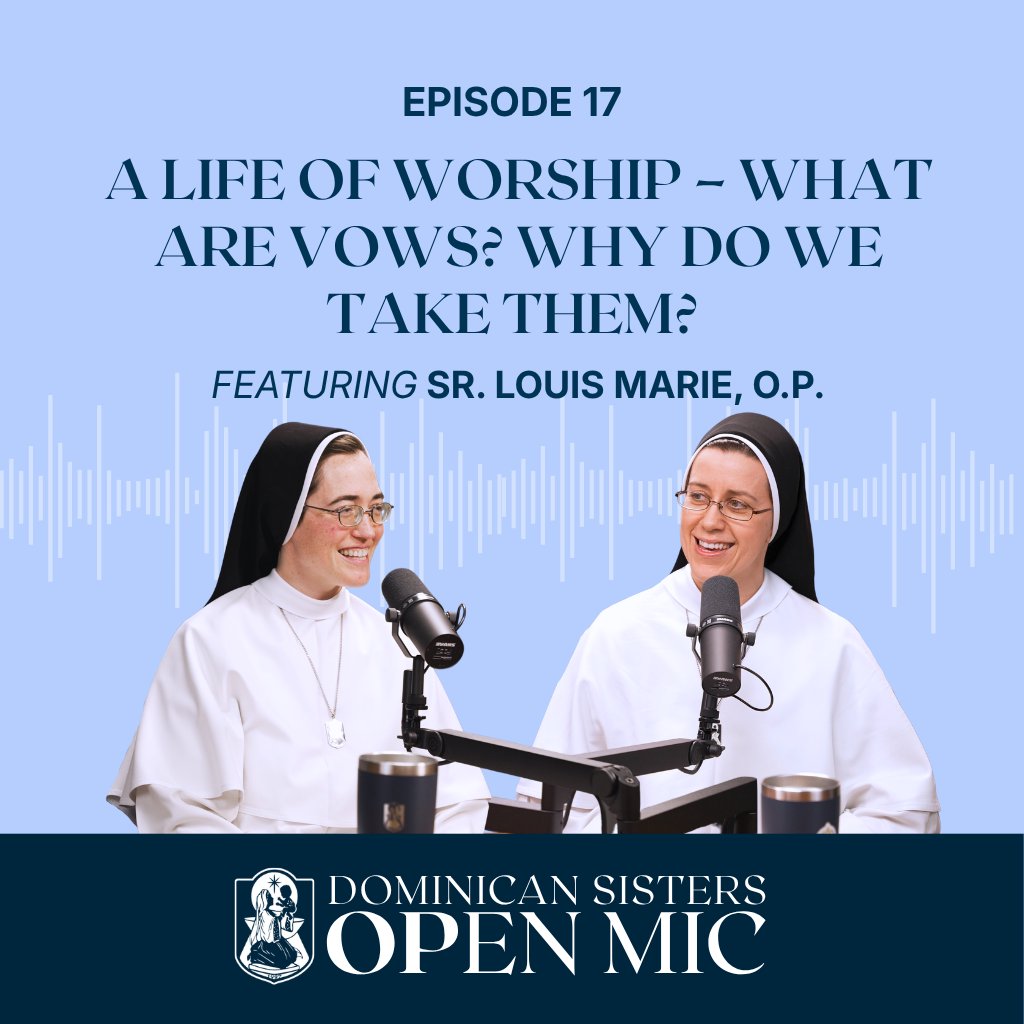
Dominican Sisters Open Mic
Ep. 17: A Life of Worship – What are Vows? Why do we take them? (Sr. Louis Marie, O.P.)
00:53:58
Loading summary
Transcript226 lines
- [00:00]
A
So the vocation that we live is not natural, it's supernatural, which is why it's a prophetic and charismatic witness. It's like of the other world. Right. It's possible because of God's grace. Okay. You need God's grace to live all of these vows. It's really not true that we want choices. Right. Because you would never have chosen. I think I could say this. You would never have chosen to study philosophy. Right?
- [00:28]
B
Right.
- [00:30]
A
We don't really want choices, though. What we. What we want to know is, is what's going to. What's going to bring about fulfillment.
- [00:55]
B
Hi, and welcome to Dominican Sisters open mic. My name is Sister Miriam of the Dominican Sisters of Mary, Mother of the Eucharist. We are sitting down with members of our community to talk about all things Dominican. And this week, we have our very own Sister Louis Marie. Welcome to our show, Sister. Thank you for coming.
- [01:17]
A
Thank you, Sister Miriam. Thanks for having me.
- [01:19]
B
So a little bit about your background. You entered the Convent in Dominic 2007, which was just a year after me. So Sister and I enjoyed a lot of time together in our initial years of formation.
- [01:33]
A
That was very fun.
- [01:34]
B
It really was. And then you entered from the great state of Iowa. I know you have a lot of pride about. About Iowa, and I'm sure you've learned a lot about Iowa just having got. Got to know you, the heart and your family. Family, yes. And I. I'm a fan of Iowa. I'm from Canada originally, but Iowa seems to be a great state. Cedar Rapids, is that correct? Now, your training in. To teach you, you are able to teach a number of. Of subjects, one being science, biology and chemistry. Another thing we share in common. But you're also trained to teach philosophy as well, right?
- [02:23]
A
Yes, Sister, we, we did that together.
- [02:25]
B
We studied together at Catholic University of America, which was a blast.
- [02:29]
A
That was really fun.
- [02:32]
B
And Sister, I have to say. Okay, so I don't know if you're going to like me saying this, but when we started philosophy at Catholic University of America, you and I were both coming from a science background.
- [02:45]
A
Yes.
- [02:45]
B
You had studied science at Notre Dame. I had received a pharmacy degree prior to entrance, so we had a lot of science training. But here we were asked to study philosophy, and this was using perhaps a part of our brain that we hadn't really tucked into ever. And. Yes, but Sister, the thing that I was in awe of was the fact that when we started that program and we're in undergrad philosophy classes, we were in graduate level philosophy classes when we started we were not familiar with a lot of the vocabulary and terminology. It was very new to us. We had a lot of reading that we're doing. We were in conversations with our. With our classmates, with our professors, and it was a wonderful program. But the thing that really just put me in awe was how quickly you were able to learn the language and be able to converse. And I thought you have such a gift for that. I. I thought it was very inspiring at the time and to be able to see you continue to grow and learn in your ability to discuss philosophical things and teach.
- [04:07]
A
Yeah.
- [04:08]
B
Philosophy.
- [04:09]
A
Thank you, Sister. I appreciate that.
- [04:11]
B
It's amazing.
- [04:12]
A
Yes. And I.
- [04:13]
B
And I was always thinking, you know, how it is with. With the sisters is if one sister is good at something, it's. It's a success for us all. Oh, yes.
- [04:22]
A
Yeah. And actually, we. We really help one another out. I mean, I was thinking about how, you know, from my perspective, watching you at cua, where you really excelled in witnessing to and really drawing the young. The young people there, that we were the other students into not only considering maybe the religious life, but also even into the Catholic faith. That was so. It was so fun for me to see how you did that. And for. Also. I know we helped one another in both of our realms.
- [04:58]
B
We did. We did.
- [04:59]
A
To enter in and sort of participate in one another's strengths, I think. And that is such a blessing about religious life, isn't it?
- [05:11]
B
We had a band together that was so.
- [05:14]
A
Speaking of. And outpouring up the Holy Spirit.
- [05:17]
B
We had a band at Catholic University of America.
- [05:20]
A
Absolutely.
- [05:21]
B
Sister Louis Marie played the saxophone.
- [05:23]
A
Yes, absolutely did. Sister Miriam was tickling the ivories as much.
- [05:28]
B
I was. I was. We had a good time. Battle of the bands. We entered competitions, and it was a great way to engage with the students and meet people and really to evangelize. I love being present to people in a way that maybe it's surprising for them to see Our band. We were. Our four sisters, plus two priests in our band and called Force of Habit. And. Yeah, that was a real blast.
- [05:57]
A
That was a real way of opening up evangelization, too, because. Brought a lot of conversations about. They saw us having a lot of fun. Yes, A lot of fun.
- [06:06]
B
Yes. Great memory, Sister.
- [06:09]
A
Thanks, Sister.
- [06:09]
B
Good times. So we want to talk a little bit about the role of consecrated religious. So sisters, nuns, brothers, the role of consecrated in the church. And this might be an area where people haven't really had the opportunity to read or study or learn. So I think you're going to help Us make some good distinctions. Like a good Dominican to say, put
- [06:37]
A
that philosophical training to use.
- [06:39]
B
Exactly. So how can we describe the nature of religious life?
- [06:46]
A
Yeah, I think, you know, there's a lot of theology and philosophy we can jump right into. But I think actually a really good place to start is what you and I experience all the time, just going out into the public and the way that people immediately come up to us and they think of God. It's so natural. So they might not be able to articulate all of those distinctions that maybe we'll talk about, but they see us in the habit and they want to tell us about how God is working in their life or they want to tell us about even something that they regret and they want to hand over to God or something they need prayer for. Exactly. Yes. So, yeah, just lots of. Of stories like that. Whether you're in the airport or in the store.
- [07:45]
B
Yes. I actually remember frequently when I'd be walking along the beach. I was teaching in Southern California for about six years, and we would enjoy walks on the beach. And sometimes I'd be with the other sisters, sometimes on my own, just praying the rosary. How frequently people around me were impacted just by seeing me. And I'm just kind of in my. My own zone, my prayer zone, walking along. But I remember specifically one lady, and there have been more that have done this, but this lady, the memory of it still strikes me is that she just started crying as. As. As we were approaching each other to pass each other on the. On the beach. She just started crying and she said, oh, my goodness. I have been struggling with something really big in my life. And I just turned to God this morning, and my heart went out to the Lord. I. I reached out to. To God. And now I saw you. Yeah. And even though I'm not doing anything specific, just walking, but when she saw me, it reminded her of God and that God works through that so that she experiences his presence and she experiences his love in a way in that moment and is touched by the love of God in that moment. And that happens frequently when we're out and about. And so we really are a sign to people.
- [09:21]
A
Absolutely.
- [09:22]
B
Of. Of God and what we're made for.
- [09:24]
A
Yeah. And. And the church calls that in her religious life documents. This has got this really long word, eschatological sign.
- [09:33]
B
So that's a big word. Can you say that three times fast?
- [09:37]
A
Eschatological sign. Eschatological sign. Eschatological sign. Nice.
- [09:43]
B
Oh, yeah.
- [09:44]
A
So basically, that word, the root of that word is A Greek word, eschat, which means the la of the last things. So what we're bearing witness to and, and the reality that the religious life, the, the role of the religious life is really to bear witness to what every baptized Christian is called to, which is union with God forever in heaven. And they bear witness to that now. So these, this sort of reaction to us is a part of that prophetic witness that we give, you know, that we're all called to that union with God in heaven. And it's just revealed by our being. You know, it's not necessarily about what we're doing. It's just revealed by our consecration. It's amazing. It's a huge gift to the church. And that eschatological sign, that kind of language began actually in form with Vatican ii.
- [10:54]
B
Okay.
- [10:54]
A
So the teaching of Vatican II began to teach that the role of religious is to be a sign of the kingdom of heaven here and now before, before we're actually fully living the divine beatitude in heaven. That's amazing.
- [11:11]
B
It brings with it a big responsibility in a sense too, because we hope to do that well and we're human beings like everybody.
- [11:20]
A
That's right. Right.
- [11:21]
B
But God gives us so many graces in the way that we live our daily life and receiving the sacraments that hopefully we're bearing this responsibility in a beautiful way to really be a sign to people.
- [11:39]
A
I think one of the ways that the, the Church describes that is it's its charismatic grace. In other words, it's a, you have to have a grace. You have to be called by God. It's on his initiative.
- [11:52]
B
And he chooses the religious life to.
- [11:54]
A
The religious life. He chooses women to the, to, to enter into this life. He invites them. He doesn't force. He invites them. So he calls forth your participation as a human being, bringing your whole self to this gift of self. It's, it's, it's a total self giving. That's what the canons of religious life say. It's a total self giving in sacrifice and charity to God. But he calls, he calls us as a gift to the whole church so that the whole church might know that she and all baptized Christians are called to that fullness of life in heaven with Him. So yeah, you can't do without God's grace.
- [12:41]
B
And the other side of it is that God forms our hearts so that we desire that. He's not going to ask a young woman to be a sister if it's completely contrary to what the desire is. Say she desires married life. Perhaps that really for, for us to enter the comment, God did something in us where our hearts grew in our desire for this life.
- [13:12]
A
Absolutely.
- [13:13]
B
And, and it unfolded, it unfolds in a unique way for each sister, but he shows us his will and, and it's very fulfilling for us. It is living this life.
- [13:23]
A
Yeah, it is. I think it's important to realize that in entering religious life, there is.
- [13:32]
B
You.
- [13:33]
A
It's. It's fully and importantly possible that you would naturally desire married life. You know, it's not that you don't, you don't think.
- [13:41]
B
Trying to run away from it.
- [13:43]
A
Exactly. It's not that you don't think that. That the spousal union of. Of man and woman is a beautiful and holy gift. It's actually a way. It's the na. It's the normal way by which we reach heaven. This is, this is the human way, the married life, you know, and it's sanctifying. It's sanctifying. It's. It's beautiful. It's a gift. Family life is holy and sacred. You know, giving yourself to husband and your family is sacred. So naturally, speaking a young woman who has a religious vocation, she naturally would still desire marriage. And yet she feels that God in her prayer life and in her desire for union with God, she feels that he is calling her by his grace to uphold her in. In a supernatural vocation. So the vocation that we live is not natural, it's supernatural, which is why it's a prophetic and charismatic witness. It's like of the other world. Right. So she can feel that he's inviting her to actually sacrifice that natural desire in order to enter into a fullness of life with Him, a direct union with Him. So in, in the married life, the union with God is real, but it's mediated through marriage and family life. In the religious life, our first and foremost obligation is to love God above all things. It talks about in the canons that our. Our primary obligation is assiduous union with God in prayer. So to enter into and to give our energy and time to contemplative union with God. And so because we're human, we really, we. We couldn't do both in the same way. This is why we forego marriage and family life in order to take the time and energy we would invest in marriage and family life to invest it in our union with God. Our contemplative union with God.
- [16:05]
B
Sister, you explained that so well. And I had forgot to mention at the beginning, you're actually forming our novices at this time. You're the Novice Mistress for our community. So is this part of what you teach them and instruct them once they enter the convent?
- [16:22]
A
Yes, it's been a gift to be the Novice Mistress. I've been the novice for five years and it has been for me a moment of deeper reflection on my own consecration and a real time of gratitude for the glory of this vocation in the Church and the beauty of this vocation in the Church and a deep desire to share that with the novices, but then to live it very authentically in my own personal life.
- [16:56]
B
So it's amazing, I think back how we learn about it in the initial formation. And it's like you never really get to the depths of it all. And hearing you talk and hearing what you're doing with the novices, I think to myself, can I sign up for your, for your class and just to be able to, to go deeper. You can always go deeper. And the Church has many beautiful documents about the religious life to be able to learn more about it and to meditate on it, right?
- [17:31]
A
Yes. And it's the difference between theory and like theoretical knowledge and experiential knowledge, you know, completely different.
- [17:40]
B
So, Sister, you, you were explaining in a way, juxtaposition, married, married life with religious life.
- [17:48]
A
Right.
- [17:48]
B
How about comparison of priesthood versus religious life, religious side?
- [17:55]
A
Right. That's a great question. One of the things that Vatican II made clear is that religious life is not a midway point between the lay state and the priesthood. Each vocation has a very particular and an absolutely essential role in the life of the Church in this world. And the lay state, which I just described, is about ordering temporal affairs according to the kingdom of heaven, including the sacrifice of their life in their married and family life, the kingly ordering of temporal affairs. So economics, business, political life, the places where they are working, their spheres of influence, if you will. And then they give a prophetic witness just by living the Christian life, their baptismal consecration, which. They are children of God, you know, lights in the world. The lay vocation was really held up, especially during Vatican ii in, in sort of a clarifying. No, you are called to holiness and you, you have an essential role in the Church. But then the, the Holy orders, which is another sacrament by, by holy orders, priests, bishops, deacons, they are ordained for sacred ministry to the Church. They are given the authority to govern and guide and teach according to the doctrines of the faith, but also to govern and guide the various charismatic branches of the church, such as religious life, to validate and say, yes, your community, your Constitutions, for example, are truly an avenue of holiness. So they govern and guide the whole church. And then they also, very importantly are priests in, in, in line with the, the priesthood of Jesus Christ, whereby they minister the sacraments to the body, which, so they're, they're, they provide for the sanctification of the body of Christ. Absolutely essential. Absolutely essential. Right.
- [20:26]
B
I mean. Right, yeah.
- [20:28]
A
Um, so that's a, a beautiful particular configuration to Christ that's for the sake of the rest of the. The sanctification of the body. Religious life is actually, interestingly, not a sacrament.
- [20:42]
B
Right, yeah. People wonder about that. Yes, they do, because there's seven sacraments of the Church. And becoming a sister is not one of those sacraments.
- [20:51]
A
It's not one of those sacraments.
- [20:52]
B
So what. So can you explain that one?
- [20:55]
A
Yes, I will, Sister Mary.
- [20:59]
B
So with the ch, the Church teaches,
- [21:01]
A
and John Paul II says this in Vita Consecrata is that religious consecration is a fuller and deeper and more fruitful expression of the baptismal consecration. In other words, it's, it's basically living the total. It's sort of a. Trying to live the total trajectory of the baptismal consecration here and now. In other words, the trajectory of baptized Christians is heaven, union with God in not just, not just sort of like going up there and watching God, but an entrance into the very life of God. What we call divine participation, participation in the divine nature. Right. That's what we're all ordered to. And in the religious consecration, we actually, we renounce certain goods which we can talk about with the vows that are good in, in this life in order to open ourselves up to that kind of union here and now. And then by doing that in the church, we become a prophetic witness of what will happen in heaven for all baptized Christians. So we are not priests because they're there for the minute sacred ministry. We are inspirational, more like. We show forth the beauty of God's plan for every soul that's baptized and consecrated in that way to him. We show them, we inspire them. We tell them, keep going. This is what you're called to. And that's why people are moved in their hearts when they see us.
- [22:50]
B
Did you know that the Sisters of Mary offer more than just this podcast? Our apostolate, called Open Light Media, offers a wide variety of resources for faith formation, virtue education and catechesis development. One of the programs that we're really excited to be able to offer is called Raised in Grace. It's the only Catholic social emotional learning program that explicitly integrates faith with modern neuroscience, Race and grace is for both adults and children. And it invites them to participate in their own neurodevelopment with strategies based on cutting edge neuroscience. To learn more about race and grace and Open Light media, please visit openlightmedia.com or click the link on this description. Where faith meets learning. You'll find us at openlight Media. And the vows are a key part of our life. So that's probably a good segue into the three vows that we take. Right? And which one do you want to start with, Sister?
- [24:01]
A
Well, maybe just quickly, Sister Miriam, you know.
- [24:03]
B
Oh, I think it's important to.
- [24:05]
A
To start with just what a vow is, don't you think?
- [24:07]
B
Yes. Genius.
- [24:08]
A
Genius. So basically, consecration, that word means to be set apart. To be set apart for God and in the church. A vow is a promise made to God freely and deliberately about a possible and better good that must be fulfilled through the virtue of religion. And I know that's kind of long, but let me just try to describe that very simply. So it's a promise and it's made to God. And so it's a permanent thing. It's really meant to be permanent eventually. With perpetual vows. Okay. And it's made to God, it's not made to the church, it's not made to the bishop, it's not made to the community. Okay. It's made to God. So it enters you into a covenantal relationship with God, a spousal union. And then concerning a possible. It's possible and better good. It's possible because of God's grace. Okay? You need God's grace to live all of these vows to sort of forego any of these goods. You need God's grace. And then a better good. The better good is that direct union with him.
- [25:33]
B
Okay.
- [25:34]
A
Right now that we are given the grace to live in order to be a witness to the rest of the church, of the marriage that God will bring about between the bridegroom and the bride, the church in heaven. Okay. So that's why we're given that gift, is in order to witness the rest of the church. But it's also a personal gift of a special union with him in this life, a special love union with him. And then the final part, it must be fulfilled by virtue of religion. That's where we get the name religious vows. And that word religion has to do with giving God what is his due,
- [26:12]
B
which is worship, which falls under justice.
- [26:15]
A
It sure does. Is Samaria. Yes. So first of all, like, it's kind of laughable that we could ever give God his due. But here we are, as we might. Right.
- [26:28]
B
So.
- [26:29]
A
But worship is what you're consecrated for in your baptism. This is why, again, it's not really another. It's not really another sacrament because we're just living our consecration to the hilt. And what the Church says is that by entering into the religious vows, religio means to bind. You're binding yourself to God in a particular way, to a better good. But what that means is that we are giving ourselves to continuous worship of God. In other words, in all of my actions, by the vows of poverty, chastity and obedience, all that I do is worship.
- [27:14]
B
You're cleaning the floor.
- [27:16]
A
Worship.
- [27:17]
B
You're standing in choir practice.
- [27:19]
A
Worship.
- [27:20]
B
You're playing in a band. Worship.
- [27:23]
A
It's pretty amazing.
- [27:25]
B
Playing Frisbee worship. That is amazing.
- [27:30]
A
Yeah, it's amazing.
- [27:31]
B
It's beautiful.
- [27:32]
A
So the other thing to just mention about these is that they're called councils, not commands. Right. So again, just to emphasize that God Jesus doesn't command anyone to make the vows of poverty, chastity and obedience. He counsels them, he invites them to do so.
- [27:53]
B
And I always felt that way when I was considering the religious life.
- [27:57]
A
Yes.
- [27:57]
B
I felt that it was an invitation, actually, when I like the imagery that I have in my mind in those years when I was discerning was. Was Christ extending his hand like this as an invitation. And I didn't think I had to or feel like I have to do this.
- [28:17]
A
Yes.
- [28:19]
B
But at the same time, I thought I'm going to be missing out on something really beautiful that the Lord has for me if I don't accept this invitation. Because I had a sense that it would be so beautiful.
- [28:30]
A
Yes.
- [28:31]
B
When you get that invitation, why would you say no? And it seemed so beautiful to me that I thought, oh, I do want to accept that invitation. But I didn't feel that I had to. Was that similar to your.
- [28:43]
A
Absolutely, Sister. I think two words that I kind of went through quickly is it has to be free.
- [28:50]
B
Right.
- [28:50]
A
Love always has to be free. It can't be compelled. And God is so gracious. He never forces us. Sometimes we try to force each other. It's so interesting. You know, we try to compel one another to even to be virtuous or the way that we sometimes. But God never does that.
- [29:11]
B
Yeah.
- [29:12]
A
He always invites and he does so as a lover. And there's never any, like, hammer that's going to fall, you know, if you. You know, if you say if you. You have to be free to say you know those are counsels. You know, I don't. You have to be free. I think. Otherwise. Otherwise it's not love.
- [29:38]
B
Now, are we ready to get to the vows?
- [29:41]
A
You gave a great open for my little se. The three vows of poverty, chastity and obedience.
- [29:47]
B
Yes.
- [29:48]
A
So we live these vows in imitation of Jesus Christ. That's the only reason.
- [29:54]
B
That is the important reason that's so important.
- [29:58]
A
They are to be a portrayal of the gospel in our lives here and now. So the first is poverty, which involves renouncing the. The free use and disposition of goods. I don't own things and use them as own. I receive everything from the community, actually. Okay, so this is implicit in all these vows is that you have to be living the community life.
- [30:26]
B
Right. Because we're provided with what we need.
- [30:29]
A
We are provided with what we need. So we're not. It's not destitution. But I don't own anything. My shoes, I don't own them. Okay. Now anyway, we don't get extremely. You can't. That may not be good for beer back.
- [30:46]
B
That's true.
- [30:48]
A
Um, so. But we don't own anything we receive. And that puts us in a disposition of. Of being able to take on the spirit of poverty, which includes virtues like humility, dependence on God, docility, vulnerability, openness to receiving the great treasure that God is so it. And also responsibility for the gifts that he has given us and true gratitude for what we have received. Yes.
- [31:18]
B
I think the word. The word renounce might have. It might be interpreted to sound like these are bad things that we're giving up, like material things because they're bad, which is not at all.
- [31:29]
A
That's right. Thank you Reminding our listeners of that.
- [31:33]
B
Yeah, absolutely.
- [31:34]
A
So these are goods regularly, obviously in the natural human life. God. God does provide for people to have personal and exclusive use of things in order to reach their fulfillment. In order to. To grow physically, emotionally, socially, we need things. We're material beings, which is really fascinating. Totally. Another podcast, right?
- [32:06]
B
Come again, sister.
- [32:08]
A
But we need things. So we have things for our use, but we don't get to own them. So we are dependent in needing to rely on and receive from the community.
- [32:21]
B
I remember that being something that was very attractive to me when I was discerning whether God was calling me to be a sister. At the time, I had got my pharmacy degree and I was working and I was making money and I just remembering just desiring to have no things and as a way of relying on God and letting him be my treasure, my greatest treasure. And so it was very appealing to me the thought of, of the vow of poverty. And, and I actually really enjoyed giving away all my things when it was time. It was very freeing.
- [33:05]
A
You had more things than me, a poor college student. And my parents were like, we'll pay your debts, God bless them.
- [33:14]
B
Yes, it was, it was freeing. And, and that's what this vow does. As you mentioned earlier, the, the way that this life frees us and, and it enables us to just be deported. Spirit dependent on our Lord.
- [33:29]
A
Absolutely.
- [33:30]
B
Yes.
- [33:30]
A
Yes.
- [33:31]
B
Great. Okay, so next vow. Where do you want to go?
- [33:34]
A
Vow of chastity.
- [33:35]
B
Okay, stop.
- [33:37]
A
So by the vow of chastity, we renounce again. Which is not to say that these things aren't good, holy, necessary. We've already talked about this. Actually. We renounce family life and the married state, which are profound and beautiful blessings. The theology of the Body, John Paul II talks about the beauty of married life and how it teaches us that total self giving and love that we're all called to. Right? So we renounce that in order to receive the great gift of Jesus Christ as our spouse and the fullness of contemplative union. Not that others can't reach that they certainly can and do in other states. But we make use of these means. They're, they're just a more efficient means because we have simply, we have more energy and time to devote to, to, to, to, to prayer and to the things of God. Paul talks about this and I don't think any married woman would deny that she's a little busy, you know, and not able to go to mass. I mean, think about the first thing that we get to do every day is get up and go to a holy hour. I think of my, I have a couple of really good friends in the married vocation and I think they would think, oh my gosh, I would just love to have one hour with Jesus a day, right? I mean, a week probably, they would say, or a month, let alone every day, you know, so that kind of time and energy to be about to give to him is a gift that we have in this life in order to foster that direct union with him right here and now. And that's, that's a huge gift and
- [35:31]
B
for the good of the whole church, the universal church in the sense that we're continually able to offer prayers.
- [35:37]
A
Exactly.
- [35:38]
B
When someone, because of their obligations in family life, they just wouldn't have the time to be able to give to prayer. But we've got it covered. I like to think we got it Covered. We're doing the liturgy of the hours and praying throughout the day.
- [35:52]
A
Yes.
- [35:53]
B
And we can pray on behalf of other people who don't, who aren't able.
- [35:58]
A
Everybody's always asking us, sister, will you pray for me? We pray for this. Will you pray for that? And we can always say, yes, I do.
- [36:06]
B
Yes.
- [36:07]
A
The other thing is, is that John Paul II says that this, this leads to more a fruitfulness, a fecundity in her life because of her union with Christ. So the reality that we live in our spiritual motherhood, which is a profoundly beautiful experience. And married women are also spiritual mothers. They really are, especially to their own children. But in a special way we experience God's heart for the whole world and especially for those who he brings into our particular and individual assignments where we're sent to, to show forth that love and care of God. We share that with them. And that's, that's our spiritual, our spiritual mother. We, we actually bring to life or we seek to foster the Christ life, you know, that's growing in their little hearts or to just sort of like breathe it in to begin with if we need to get them baptized, you know. So, yeah, that's a beautiful aspect of the religious consecration.
- [37:22]
B
I'm glad you mentioned the motherhood component, because I think it could be another misconception that we become sisters because we're trying to get away from being mothers. Like, as we already discussed, it'd be a misconception to think we're running away from, or we don't want, or rejecting married life or men, or we don't exactly, we don't like children, we don't want children.
- [37:48]
A
Right.
- [37:48]
B
That's not at all the reason why a person ought to enter religious life.
- [37:54]
A
Yeah, absolutely. So it's, it's un, it's an unqualified statement that marriage and family life are good. You know, they're holy, they're sacred. And that really you cannot. The way to holiness is through them unless you're invited in another way, namely in the religious vocation or for men to the priesthood, you know.
- [38:23]
B
So.
- [38:24]
A
Yeah.
- [38:25]
B
So thank you. Okay, so we have one more vow here to go.
- [38:28]
A
Last vow.
- [38:28]
B
Obedience.
- [38:29]
A
Obedience? Yes, the vow of obedience, which I think actually there probably are a lot of misunderstandings about the vow of obedience also, but the vow, by the vow of obedience, we, we let go of our own self determination in, in life. And what this means is that we are, are subject to the commands of the superior in accord with like our assignments and things like that. But we are also we also, by our vows, promise to live according to our rule and constitutions, which is unique for each community. It's unique for each community.
- [39:11]
B
We have our own constitutions.
- [39:13]
A
That's right.
- [39:14]
B
Which we live by and which we study before we take the vows to know and understand.
- [39:19]
A
Absolutely, yes. So the background of the vow of obedience, very simply is that it must be motivated by the virtue of faith. So an insight into the fact that God can, by his divine providence, order all things unto his good. Right. And that He. He is doing that when we freely surrender this, this very good and great thing of this, this, this self determination, which is a gift that's given when you're created as a human being. Right. And we surrender that it actually, what, paradoxically, you could say it brings about a greater freedom or liberty. And the reason is, is because our capacity for freedom is for excellence. Okay. For full flourishing and fullness of life. And there's nothing more full and flourishing than totally giving yourself to God. And remember, it's not. I'm not, I'm not making this vow to the superior. Right. I'm making this vow to God. And what I'm saying is. Yeah, I don't really understand necessarily why that superior is asking me there.
- [40:37]
B
Yeah. Asking you to do something certain assignment to teach somewhere. Exactly. Why am I going.
- [40:43]
A
Yeah, I really. That's happened in my life. Why am I. Another podcast, we'll cover another podcast on that one where you're like, really God? But I understand that God can use and does use as an instrument the, the, the he, the movements of my superior's desire. Right. Wherever my superior puts me, actually God's putting me there. This, that's the, that's the superior things there. But no, the spirit doesn't really. Because we know religious life, so our superiors realize that it's actually God. There's something that God has for that person, you know, So I think, I think that's really important. And then living our constitutions is. We know those are approved by the church as basically a way to heaven, you know, to live according to the prescriptions that are in our constitutions, which has to do with our prayer life, our community life, the vows, the apostolate, that is a way to heaven. Isn't that so? Such a gift.
- [41:49]
B
And again, we're an imitation of our Lord, right? Him being obedient to the Father.
- [41:56]
A
Yes, thank you for pointing that out, Sister Mary. Even unto death, every single one of these are in imitation of Him. But yes, especially obedience. We can see that my food is to do the will of the Father. I say nothing on my own, but only what the Father says. I do what my father is doing. You know, he says these things in John, these. I'm kind of paraphrasing right now, but he says those things. So that's. That's the other thing. So we have to have the virtue of faith, but we also have to have the virtue of love for God and this desire that my will be in conformity with his will. Even if on a natural level, I experience a little bit of angst or a little bit of what's going on right now, Lord, or a little bit of suffering as I try to. But I know that his grace is there for me in the assignment.
- [42:44]
B
I think for me, an example was when we were sent to Catholic University of America to study philosophy because I felt not equipped to get a master's degree coming from science background. And I felt that I didn't necessarily have an aptitude for that area of study.
- [43:07]
A
Right.
- [43:08]
B
And I gave it my best shot. Turns out I loved it. I mean, I loved being able to be with the sisters that were there. We were on campus as we were sharing earlier, just with the students there. And that was wonderful. But I also could see God providing for me in unexpected ways to help me where I felt I was lacking in being able to accomplish the papers and the exams and all the different things. But I could really feel the Lord near to me. And I think that's always been the case when I've received an assignment. And maybe there was apprehension about it, but God can really work through that and do great things. And it's a reminder that it's not me doing this, that our Lord is with me. And it doesn't mean that there's not crosses and difficulties along the way, but. Yeah, but God will give me the grace.
- [44:08]
A
Right. I think one of the things that. That brings to mind as I'm listening to you is this. It's really not true that we want choices. Right. Because you would never have chosen. I think I could say this. You would never have chosen to study philosophy. Right? Right. We don't really want choices, though. What we. What we want to know is, is what's going to. What's going to bring about fulfillment. And in this case, we're talking about, like, union with God. And so what you experienced is that. And while you wouldn't have chosen that. So freedom of choice is not really. You didn't determine that yourself. Okay. So we've given that up by the vow of obedience. But that you reached a greater level of freedom in knowing that God's love was working through you. And the joy that we had there at CUA and that we moved into was really palpable. And it's because both of us. I was also, as you recall, a little bit uncertain my capacity for philosophy, you know, but turns out that it has been. I just came in awe and in gratitude for what God wrought in me. And then also he was so looking forward to what I would be doing in the future.
- [45:34]
B
Right.
- [45:34]
A
That's the other thing that unfolds as you just, okay, Lord, I surrender. Take me to the next stop.
- [45:41]
B
Right, right.
- [45:42]
A
Eventually you stop kicking and screaming. You're like, okay, I'm used to this, Lord, because I know that you're bringing about a marvelous work, you know?
- [45:52]
B
Yeah, totally. It's unfolding before my eyes, and you never know how God's gonna use it. I know for myself, after I studied and I went back to teaching science after that, but my science teaching was different because I could incorporate philosophical discussions about God's existence and the universe.
- [46:12]
A
Yes.
- [46:13]
B
Coming into being and comfort with that in. There are students where that really reached them. And God used that to open their minds to even the possibility that there's a God and that I'm made for God. And here you are, you're working with the novices and teaching. So, yes, it's amazing in hindsight, it's like, oh, this all makes sense.
- [46:39]
A
But at first you're thinking, what are you doing? What are you thinking?
- [46:43]
B
Lord, Big mistake. Big mistake. Sister, what do you love about the religious life?
- [46:52]
A
Okay, Sister Miriam, I really. This might sound trite, but it's really true. I love God. I remember when I was determining, you know, when I had. I had visited the community, I was really convinced that this was my vocation. And I was. I was going. I went back to Notre Dame, and I was having breakfast with my best friend. And she had been my best friend in high school. Then we went to Notre Dame together, and I was eating a Notre Dame waffle. It had, like, the MD imprint. I still remember it because it was a really pivotal moment for me. She looked at me and she said, so why are you thinking of doing this? And it was like, kind of like the world stopped. And my heart, actually, I felt like it stopped, too. Like, everything. I could see that this was a big moment, what was going to come forth from my heart. And I said, well, I love Jesus. That's it. You know, I love God. And although, Sister, you know that I love Our community life. I love our apostolate.
- [48:01]
B
I love teaching.
- [48:02]
A
I love teaching. I love, I love it all.
- [48:05]
B
Yes.
- [48:06]
A
And it's so, it's so fun, even and fulfilling. It is not the reason.
- [48:12]
B
Right.
- [48:12]
A
All those things are not the reason that I'm a consecrated religion.
- [48:16]
B
You didn't enter to be a teacher.
- [48:17]
A
No.
- [48:18]
B
Enter the comment.
- [48:18]
A
No, I entered because I fell in love with God. Right. And I'm here and I say because I love God. And, and I'm growing. I can, I can feel his. His providential care and love for my own soul. And I'm growing in love for God.
- [48:37]
B
So is there anything that has surprised you about the religious life?
- [48:42]
A
Well, also God. God. Yeah, God. And God in the sense of like, okay, how good he is. Right. How, how gentle he is, how kind he is, how compassionate he is, how he sees me and how he knows me and how patient he is with me. Sometimes I, I mean, I've been like that unruly little two year old in the store or, you know, that seventh grader who's like, forget you rebelling, rebel. I've been all those things at different points in my religious life life. And God has been so patient with me and he just pours out grace upon grace, grace upon grace. And he also has shown me so many things about my own heart, particularly particular ways that he's created me to be and, and wants me to love that are unique to me. You know, he's just taught me that I am unique and unrepeatable and chosen by Him. You know, chosen by Him. So it's really extraordinary. Surely you've experienced the same things.
- [49:54]
B
Yes, I do. I think I've been surprised by the way God just makes things beautiful.
- [50:00]
A
Yeah.
- [50:01]
B
The situation. He can make it be beautiful. Me, my sisters.
- [50:07]
A
Right.
- [50:07]
B
The situation. Even the cross, our obedience, our chastity, our poverty that God makes, makes us beautiful and helps us to love him in a beautiful way. And seeing his hand in things, it always surprises me.
- [50:25]
A
Absolutely.
- [50:25]
B
Oh, the Lord is here. He's with us.
- [50:28]
A
I heard this great quote from St. Augustine that love is the beauty of the soul.
- [50:34]
B
Wow.
- [50:34]
A
Isn't that beautiful? And what you just said reminded me of that. Because the love of God is in your heart and it radiates. That's what everybody sees in you. Sister Muriel.
- [50:46]
B
You too, Sister Whismarie. Are you ready for speed round?
- [50:54]
A
Yes.
- [50:55]
B
You are, I think, Sister, you are born ready, right? You're born ready. Speed round. Do you have a favorite liturgical season?
- [51:03]
A
And why Easter? Because of the glory.
- [51:08]
B
Do you have a hobby? Does reading count? Yes, great reading. Do you have a favorite game at the moment?
- [51:21]
A
Probably cards.
- [51:23]
B
Anything.
- [51:23]
A
Cribbage.
- [51:24]
B
Cribbage, Okay.
- [51:25]
A
I like cribbage.
- [51:27]
B
What is a spiritual book besides the Bible that has impacted your life that you would recommend for people to read?
- [51:33]
A
Well, besides the catechism.
- [51:36]
B
Okay.
- [51:36]
A
True Devotion to Mary. I'm named for St. Louis de Montfort.
- [51:40]
B
That's right.
- [51:40]
A
And it's an acquired taste. And if you need me to explain it, just.
- [51:44]
B
You'll come back on another podcast. More to come on St. Louis de Montfort. What's your favorite title of Our lady and why Our lady?
- [51:56]
A
Seat of wisdom? St. Louis de Montfort. His consecration to Our lady is actually about acquiring eternal wisdom, and that's his name for Jesus Christ. But wisdom is sort of this con. Natural tasting of divine things, you know, and seeing the world as God sees. And that's something that I've always deeply desired. It comes forth from. From love and becoming more and more his child.
- [52:27]
B
So what's an activity that brings you peace and refreshes you?
- [52:33]
A
I love walks. Nature walks.
- [52:37]
B
If you could have. Oh, wait. What age group do you most enjoy teaching and why?
- [52:43]
A
Well, I mean, I'm not counting the novices. I've really only taught sophomores. And I love them. I do love them.
- [52:49]
B
So if you could have dinner with any saint, who would it be and what would you ask them?
- [52:55]
A
John Paul II. St. John Paul II. And we would. I have so many questions about theology of the body. Another podcast.
- [53:02]
B
Another podcast. Sister Lewis, Marie, you'll have to come back again. Thank you. Thank you so much for making time to come and share the fruit of a lot of your own meditation of the beauty of our religious life. Thank you so much, Sister.
- [53:16]
A
Thank you for having me, Sister Miriam.
- [53:17]
B
And we want to thank you for tuning into our podcast and encourage you. If you know someone who might benefit from listening to our discussion today, please pass along our podcast. And also please know that you are in our prayers. All the Dominican sisters of Mary, Mother of the Eucharist, praying for our listeners, and we wish you all the best. God bless and have a great day. Sam.