← Dominican Sisters Open Mic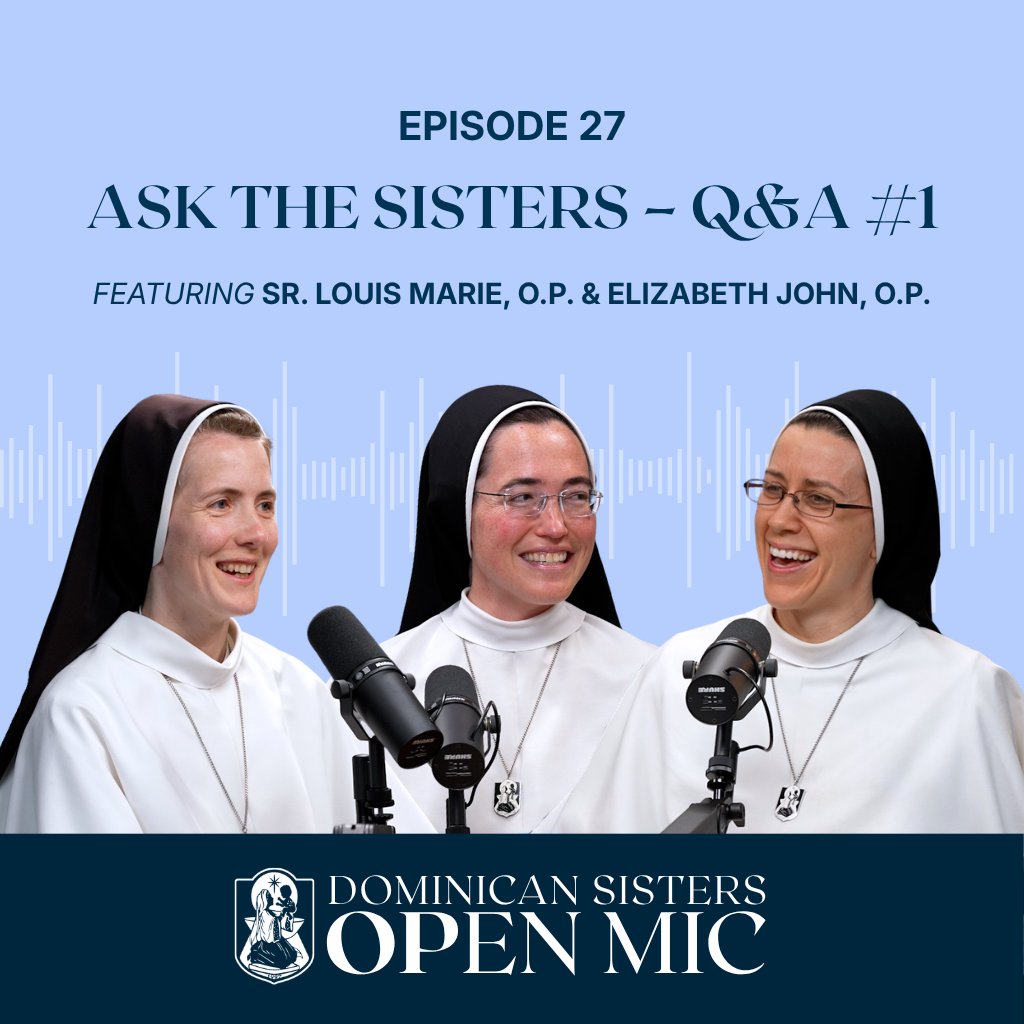
Dominican Sisters Open Mic
Ep. 27: Ask the Sisters – Q&A #1 (Sr. Louis Marie, O.P. & Sr. Elizabeth John, O.P.)
00:54:45
Loading summary
Transcript316 lines
- [00:00]
A
Hope this is not an offensive question, but can someone explain the difference between a sister and a nun?
- [00:07]
B
That's not offensive at all. That's a great question, actually.
- [00:11]
A
All right, here we go. If you're sick, do you get to stay in bed?
- [00:15]
C
I'm currently serving as the infirmarian this summer.
- [00:18]
A
Oh, you are?
- [00:18]
C
So this is a really personal question.
- [00:20]
A
Do sisters play video games?
- [00:25]
B
I mean, there's no rule about that,
- [00:27]
C
but no, we don't own any consoles.
- [00:48]
A
Hi, and welcome. My name is Sister Miriam, and this is Dominican Sisters open mic, a very special edition, because today we're doing Q and A, and I have two of my dear friends here. I have Sister Elizabeth John and Sister Louis Marie with me. We're going to be addressing actual questions that have come into us, which we're very excited. We have all kinds of things, I'm sure. And before we get started on these, we do want to let you know if you have questions that arise in your own mind as you're watching. We have a special button on our Torch app. Now, you have to download the Torch app, and there will be a button there for you to submit questions for future episodes. So keep that in mind as you're watching. If you have questions about the faith or about how we live our religious vocations, we'd be happy to share with you. All right now to my guests. Welcome, Sister.
- [01:49]
C
Thank you, Sister.
- [01:50]
A
So good to be with you, Sister. Okay, we have to give some background on who you are and how we know each other. So Sister Elizabeth John.
- [02:01]
C
Hi, Sister.
- [02:04]
A
You are known to our viewers, if they've been watching all along, by your episode, which was aptly named from Zombie Movie to religious system.
- [02:16]
C
That's right.
- [02:18]
A
This is episode number two.
- [02:20]
C
That's right.
- [02:21]
A
Have people been bringing up the whole zombie movie thing with you since that was released? Well, do they ask you about it?
- [02:27]
C
Zombie movie, my students who found that episode have. And including some former students, has actually been really neat. But. But most importantly, you know, Sister, you've sent me some comments from viewers who, you know, have found their way to the Lord or found their way into the church, actually, particularly those who grew up in a background without any faith, for whom my own story had had spiritual resonance. And so I think, most importantly, even though no one's stopping me in the airport to say, like, so, zombie movie. Most importantly, the Lord's used my story. And so that's both humbling and what I would want to hear. So happy to have shared about the zombie movie.
- [03:13]
A
Yes. And this is episode two. And you were one of the first ones to come on and do podcast. So thank you. Thank you for being willing at the beginning and now to be able to come back. And Sister, you're teaching right now. You're a high school teacher.
- [03:27]
C
That's right.
- [03:28]
A
And you also have a master's in theology.
- [03:32]
C
That's correct, yes.
- [03:33]
A
Okay. Are you certified to as a administrator?
- [03:38]
C
That is also true. Yes, we are. We were joking about that earlier.
- [03:41]
B
That out there.
- [03:43]
C
Now we have a permanent record.
- [03:45]
A
Everyone knows.
- [03:46]
C
Everybody knows.
- [03:48]
A
Sister Lewis Marie. Okay, now you were on our episode 6 17, which was a life of worship. What are the vows? And you are currently working as the novice.
- [04:01]
B
Mr. That's right. So that was a great episode for me to just teach about our life because I'm regularly talking and teaching about what our life is to our young sisters.
- [04:11]
A
So, yes, yes, I think I was struck in that episode because as you're talking about the vows, it's evident how much they are on the forefront of your mind and your thoughts because you're contemplating them in prayer so that you can teach them in a beautiful way to our novitiate. So a lot of people really enjoyed learning more about those vows because I think lay people might not have a chance to. To know more about that. So that's episode 17 if you want to hear more about Sister Louis Marie's thoughts on our religious vows, poverty, chastity and obedience. All right, now let's say. Let's talk about the fact that we go way back. We go way back to the roots.
- [04:55]
C
Yes. Okay.
- [04:58]
A
So we were joking about how we're sitting in the order of when we entered. So I enter the comment 2006 and then you were 2007 and 2000.
- [05:10]
C
That's right.
- [05:11]
A
So this means that we were in the novitiate together.
- [05:13]
B
Yes, yes, we were. Which is like growing up together kind of. It's like that kind of analogy.
- [05:19]
A
Yep. Do you have any favorite memories of that time?
- [05:22]
C
Oh, I do.
- [05:23]
A
Or what do you appreciate about the
- [05:24]
C
time it involves Sister Lewis? I have many that involve Sister Lewis Marie. Okay, So I don't know if this has come up in other episodes, but one of our beautiful customs that I love is actually we do a retreat day once a month. It's a silent retreat day with all day Eucharistic adoration. And so there's really a relaxed schedule. And I was a postulant. So it's my first, first retreat Sunday, so I'd probably been in the community about a month. And I'm like, I don't know my way around the property. And I saw Sister Lewis Marie lacing up. And I went up to her and I was like, are you going outside? She kind of was like, yes. And I was like, could I come with you? And she said, yes. And then we took a really awkward silent walk together on our retreat day. So that's one of many of my favorite Sister Louis Marie stories. I forgot about that. I don't know how you did. I looked back and it was really awkward.
- [06:09]
B
One of my favorite memories, too was I had like, just gotten here, I think basically I was still on maybe prepostulant week. This is what I remember. And Sister Miriam found out right away that I play the saxophone.
- [06:23]
A
Oh, yes. Oh, yeah.
- [06:25]
B
And she comes up to me and says, do you want to be in my band? With her Canadian accent. Wow.
- [06:34]
A
We went far. Okay. We went really far.
- [06:36]
B
Because Sister Lewis, that was the beginning
- [06:37]
A
of great things in our band. Force of Habit at Catholic University of America. She plays the sax. So yes, I can recognize talent when I see it. I think I would recruit people. The singing parts, too.
- [06:53]
B
Oh, yes. I. You definitely got me into the tenor part. Remember that?
- [06:57]
A
Oh, yeah.
- [06:58]
B
For choir.
- [06:58]
A
Oh, yeah.
- [06:59]
B
You occurred to me right away I
- [07:00]
A
would look for the talent.
- [07:02]
B
I think you can sing tenor with me.
- [07:04]
A
Come sing this part with me. You'd be good at it.
- [07:07]
C
There weren't many tenors, so
- [07:12]
A
it's basically. Yeah. Just the lowest part. So. Yes. And what else? We. We studied at CoA together, which is great. And I live with Sister Lewis Marie during.
- [07:24]
B
Right now.
- [07:25]
A
During the school year at the Mother House. Yeah. It's like a reunion, which is great. I haven't lived with you.
- [07:30]
C
We haven't had the chance.
- [07:31]
A
Not since the novitiate.
- [07:32]
C
Not since the novitiate. But for over a decade now, Sister, you and I have. Have dedicated time every afternoon to our special walk.
- [07:43]
A
Yes.
- [07:44]
C
We do our very. Our life changing 5k every day. And we talk about everything from the Lord to school to evangelization to our families and catching up with our families. And it's one of the highlights, Sister, that I love about it. Besides the fact that we're getting some, you know, getting some sun and some. Some exercises, you know, it's nice when I come home, we just pick up where we off.
- [08:06]
B
Right.
- [08:06]
C
And. And I feel like I. I feel like I've seen you just yesterday when I come home. So it's a highlight.
- [08:13]
A
Yeah. So typically we are able to go on our walks during summer here and there, and then during the Christmas.
- [08:19]
C
That's right.
- [08:19]
A
Is when we see each other for those walks. But yeah, it has been at least 10 years.
- [08:23]
C
It has been 10 years. And everybody's welcome.
- [08:25]
B
Everyone is. I haven't been on it.
- [08:27]
C
Yes.
- [08:28]
A
You just have to be able to keep up with. You have to be fit.
- [08:30]
C
Yeah. There's an entry fitness level.
- [08:33]
B
There is.
- [08:33]
A
Yes.
- [08:34]
B
You can test it out on the driveway and know if you need to turn back.
- [08:39]
C
But there is. This is not for this episode, but we do have a point system, so you can even win at the walk.
- [08:44]
A
You can get points. More on that next time. Tune in again. What else? Any other. Any other topics?
- [08:56]
B
I think all three of us love Frisbee.
- [08:59]
A
Oh, that's true.
- [09:00]
B
That was one of our favorite back in the novitiate. And then even now,
- [09:06]
C
Sister Lewis Marie and I have known to play basketball together a few times.
- [09:10]
B
And then Sister Elizabeth John and I were at fgr.
- [09:12]
C
That's right.
- [09:13]
B
We did our student teaching. Father Gabriel Rashid High School together. I was in the science department. Sister was in history.
- [09:19]
C
That's right.
- [09:20]
B
Yeah.
- [09:20]
C
We got so many snow days. It was the best student teaching.
- [09:22]
B
I forgot about all the snow days.
- [09:25]
C
I was like, are they going to certify us?
- [09:28]
A
That's the great thing about teaching in Michigan. You get snow days. I mean, I was. I tried in California for 10 years. There aren't any snow days happening. Did you ever have a random day off?
- [09:39]
B
Did you ever have a random day off?
- [09:40]
A
Rarely. No. I don't really recall.
- [09:42]
B
That must have been really hard to say.
- [09:44]
A
Yes, Yes.
- [09:44]
C
I powered through Houston's catching on. We had two ice days this year. And I was like, where is it? I don't see it. So. But I'm fine with that. It's win, win.
- [09:55]
A
Oh, I do want to. Okay. I thought of something else. I just want to give a shout out. Sister Lewis Marie and I, we both did master's in philosophy together at Catholic University of America. And I have to say, Sister Louis Marie is amazing when it comes to study. And philosophy. You're very good too, Sister. I just never studied with you, but I love listening to you talk about it.
- [10:21]
C
Well, maybe we can go get. I don't know.
- [10:23]
B
You have a philosophy degree also, right?
- [10:25]
C
I have. History is undergrad.
- [10:27]
B
Didn't you get philosophy?
- [10:28]
C
Theology? Oh, when I. When I was. Before I entered, I was halfway through.
- [10:32]
B
That's what I thought.
- [10:33]
C
Yes.
- [10:33]
B
Okay.
- [10:34]
C
I was like, what do I. What am I doing? Yeah.
- [10:36]
B
I knew you had studied it.
- [10:37]
C
I studied it. Yes.
- [10:38]
B
We all have a little philosophy.
- [10:40]
A
Sister, you helped me so Much with that because you would help me to really synthesize the material.
- [10:46]
B
Oh, I know I did.
- [10:48]
A
She knows.
- [10:50]
B
But you helped me keep it sort of balanced. I remember we had during the summer, we were studying together and you had like this goal. You put up a whiteboard. Do you remember that Whiteboard? And it said personal goal, Study goal. Word count. We were writing our thesis. Word count, page count, all these things. So we would like write our little. Anyway, to keep ourselves motivated. Exactly.
- [11:12]
A
Exercise, goal. Yes. And I helped you keep your saxophone skills up.
- [11:16]
B
You did.
- [11:16]
A
Because that's when we had our band.
- [11:18]
B
Yeah, you organized the. The band. We also had the choir. We had our singing group too.
- [11:23]
A
Yes. Our singing group name was called none of the Above.
- [11:27]
C
I don't. I don't think I know about this. I never heard about this.
- [11:31]
A
It's the best kept secret.
- [11:34]
B
Not anymore.
- [11:35]
C
You should have called it none of your business. I didn't know this existed.
- [11:40]
A
That was our acapella singing. Okay, well, should we get to the questions? I'm ready. We could probably keep going like this for a while, but it's question time. People have all kinds of questions. I'm sure.
- [11:55]
B
Oh, can I tell about the cup, please?
- [11:57]
A
Yeah.
- [11:58]
B
Well, there's a history to the cup because we were. When we were at. Actually we were driving to Cua, and all of a sudden sis Miriam pulled out this cup and said, I did. Yeah, this cup is the question cup. And we're gonna just go through these questions and get to know each other a little bit. Because we had sisters who we never really lived with who were going with us.
- [12:17]
A
Yeah, we were just moving out there.
- [12:18]
B
Yeah. So this cup has a history.
- [12:20]
A
And the question cup, we kept it all year long.
- [12:22]
B
Exactly.
- [12:23]
A
Yes.
- [12:24]
B
The questions are in the cup.
- [12:26]
A
Yes. I'm excited to see what we've got. All right, here we go. First question. Okay. This person is wondering if we're sick. If we get sick, do we get to stay in bed? Now, to get to give some context, this was probably posted after the Day in the Life episode where we had gone over our schedule, which of course is pretty packed. And if you want to know more about the day in the Life, you can Refer to episode 19, Sister John Michael. But if you're sick, do you get to stay in bed?
- [12:58]
C
I'm currently serving as the infirmarian.
- [13:00]
A
Oh, you are.
- [13:01]
C
So this is a really personal question. You know, if a sister is feeling unwell, you know, oftentimes she will just kind of take the day for. For rest. If. If she's not Feeling like she can be up and moving around. And as the infer, Mary and I've been able to prepare meals and take them to. To the sisters and check in on them and see if they need any medicine or any. If I'm overfeeding them. It tends to be a thing when you're sick. You're like, here's this plate full of food. Eat up. But above all, the sister rests, and she does her prayers in private. And we'll pray and read and sleep. And when she feels ready to get back up, she's back up and living community life. And I can say from being on the other side of being sick, usually one day is like, the next day you're like, I gotta get up. Right? Like, I'm like, yeah, I gotta get back to you. It's maybe it's. It's great to be sick. If it's ever great to be sick for the first day. And then you went out.
- [14:01]
A
Well, especially as teachers, because typically we have all this lesson planning.
- [14:05]
C
All lesson planning is you gotta keep
- [14:07]
A
your kids moving forward even when you're not feeling well.
- [14:10]
B
So the sisters are usually really sweet too. They will, like, slip notes under your door.
- [14:14]
C
Oh, yes.
- [14:16]
B
Sister Elizabeth Ann helps me out because she knows all these really great books. So if I'm sick, I'll send her a message, be like, get me a book. And so she gives me fun books to read.
- [14:25]
C
So it happened a couple weeks ago. I went to go check on somebody and there was, like, some, like, literature on eucharistic adoration that was partially under the door, such that I was like, is she passing me things now and then? And then I think someone just didn't give it a complete shove. And it was for her. So that was disappointing. But I thought. I was like, oh, she's giving me things. And I was like, if she's not well, she'll be touching this.
- [14:46]
A
But.
- [14:47]
C
But, yeah. So the notes and the books and the sisters are very, very kind to each other when they're not well.
- [14:54]
A
I think it's sweet when someone. If they've been out and then they kind of. Back in community life, everyone's like, good to see you. Welcome back. Glad you're back. Yeah. Because you really do notice that.
- [15:04]
C
We do.
- [15:05]
B
Especially on a mission with just four people.
- [15:08]
A
Yes.
- [15:09]
B
But even at the mother house.
- [15:10]
A
Okay, next question. What? When do sisters who are not in the novitiate exercise? Well, we kind of touched on that already. You. You. I think all three of us are pretty. We're pretty active to exercise.
- [15:29]
B
You know, I'm not teaching right now at school, so I have more flexibility in my day. But exercising for a half hour to an hour every day as much as possible, is really going for a walk, or sometimes I'll go for a quick run. It just really keeps you able to focus and actually pray and be engaged.
- [15:51]
C
So that's right. Feeling.
- [15:52]
B
Feeling good.
- [15:53]
C
It's body and soul, right. And. And I. So speaking as someone who is on the teaching missions currently, you have to be a little bit more deliberate and I think also be willing to, you know, the temptation can be with prayer, with exercise, with so many parts of our life, you know, when you're working to say, well, I have to earn these things. If I get much grading done, this much lesson work, lesson planning done, this much computer work done, stuff that feels the most useful by utilitarian standards, then maybe I've earned a run, or I've earned quiet time in the chapel. But that's like an inversion of priorities, right? And I've found that you have to. Those are the fixed things, right? Prayer, your relationship with the Lord, taking care of your body, which is.
- [16:36]
A
Right.
- [16:37]
C
A temple of the Holy Spirit. And I think, too, just spiritual lessons. I. I like running. And I think part of it is this experience of physical perseverance. Right. If I. If I get tired, I actually know I have two more minutes in me. And that carries over then into other aspects of my life. Right. Things get hard. I know I can. I can persevere. So it's. I think it's. It's an important part, you know, for just our. Not just physical health, but spiritual and mental and emotional health. So. So I think, yeah, it's an important part of my own daily life out on the missions.
- [17:13]
A
All right, next question. This person, okay, it says, seems. It seems sad to do everything just like everyone else. God did make us individuals. Can you not express yourself and your joy in your own ways?
- [17:35]
B
Do they mean like that? We do everything like everybody else, I
- [17:39]
A
think, as sisters, because we. We have a kind of uniform schedule and we're wearing. Okay, similar things. So I think this one probably got posted after the day in the Life episode. We got a lot of questions after that episode.
- [17:53]
B
Okay.
- [17:54]
A
Seems sad to do everything just like everyone else. Can you not express yourselves in your joy in your own ways?
- [18:03]
B
I think I'm. I mean, my initial thought is, okay, well, we do follow. We do have the same schedule, but I've never seen any sister do anything like anyone else, including, like, walking down the hallway, you know, wow, okay. You know who that is? Even from back, you're like, I know who that is.
- [18:24]
C
The sound of the rosary sometimes. Yeah.
- [18:28]
B
So I think one of the things. Actually one of the most. One of the things that I reflected on as I got, you know, 10, 12, 15 years in to the convent is how vastly different the sisters are and how I would never have exposed myself to certain people like that, you
- [18:48]
A
know what I mean?
- [18:49]
B
Because I would have found my own people or people who absolutely always thought the same way that I did or liked the same things that I did. But because I'm in a convention and I have learned sort of the goodness and the beauty of all different kinds of women, you know, that we live with. And even also too, the men and women in the apostolate that I wouldn't necessarily have. I would have chosen to not. You know, you would have just chosen your own path of least resistance. Whereas our life really challenges us to be with one another and get to know one another. And everybody's so different. In my experience, we do kind of wear the same. So I could see, like, manifestly we might look similar or. But after you've been here, you realize, wow, I just don't think like that. That's so amazing, you know.
- [19:47]
C
And I think too, what's paradoxical to the. To the world at large is that religious life, the spiritual life, holiness in general, is also about interior freedom, right? And as you're living the life and. And it's not we all need to grow in virtue, but as you're growing in virtue and living the life, you become more of who you really are. And in some sense, like the. We talk about the church, right? The kingdom of God is a garden, right? It's. Gardens have lots of different plants. And. And so as the Lord is, you know, cultivating you right, through grace, who you authentically are, those. Those distinctions stand out, right? And I think that's what the. That's. But there's a. You always in unity, right? And I think our. The fixed parts of our life, they ground us in unity, right? It's unity and unity and diversity, which is a beautiful thing I do love.
- [20:37]
A
I love the fact that what is unique about each sister that comes out is her goodness. That's the part that shines so that it almost becomes odd to think. For me, to think the way I could be an individual would be to wear a certain kind of watch that or like maybe adding additions to my habit. That. That. That seems like, not as beautiful of a way for me to show my Individuality. I want to shine in the gifts that God has given me in my goodness, in virtue, and to be able to see those things in my sister. And so that, I think that's what we really celebrate in the religious life is the unique goodness and that, that's the individuality.
- [21:31]
B
What's fun too is, as I was thinking about, you're talking about goodness and I know you're now you're giving shout outs about virtue on the podcast. And even the same virtue, some sisters practice it in such unique and special ways. And, you know, I'm thinking of specific sisters right now, which I know that the listeners might not be familiar with who they are, but everybody is generous, for example, in really special ways. Some are very generous in the kitchen or very generous in assisting with those technology issues, or, you know, there's just all these kind of ways of being generous and we help one another be with those gifts. So, yeah, it's just amazing how, how everybody can be. Like you said, good, but in sort of a special, special way.
- [22:31]
A
All right, next question. Do sisters play video games?
- [22:42]
B
I mean, there's no rule about that,
- [22:43]
C
but no, we don't own any consoles. When I was working on my master's in theology, we dormed at the seminary. And I will say I was grateful to whatever newly ordained seminary and leftist Nintendo Wii behind, because Mario, is that
- [23:00]
B
the one you can like?
- [23:01]
C
Yeah, you can do all kinds of things. Sister Maria Fabet. Tennis and dance, bowling and dance. We didn't dance. No dancing happened. But, but a lot of Mario Kart. Sister Maria Fadim and I played a lot of Mario Kart in the evening when we needed a brain break. But we just, we want to spend time with each other, right. And have authentic, you know, have just authentic encounters. And, and I'm trying to visualize right now if I went into the community room and saw sisters playing, I don't even know what people are playing nowadays. It would just be awkward. So you know that there's, there's more authentic ways to spend time with one another. And we like to play a lot of board games. And, and, and the difference is those are human facing activities versus having one more screen.
- [23:46]
B
Right.
- [23:47]
C
Through which my life is mediated.
- [23:51]
A
All right, thank you. This one says, hope this is not an offensive question, but can someone explain the difference between a sister and a nun?
- [24:02]
B
Oh, yes, that's not offensive at all. That's a great question. Actually, many, many people don't realize the difference, even Catholics. So the nun is cloistered, so she is living in and, and remaining within the convent that she's assigned to or spending her time with her sisters and praying for the world. Very, very powerful prayers and a very important vocation in the church. And then sister usually, and they still call each other sister, but their, their term is none. We are not nuns because we also have this apostolic charism where we have a dimension where we go out and teach. So we're not just remaining in the convent and so were called sister.
- [24:58]
A
It seems with a lot of articles coming out about our sisters or other sisters, they will typically use the word nun.
- [25:06]
B
Right.
- [25:07]
A
Or do you encounter that? Oh yes, people will say are you a nun? Right, right.
- [25:13]
B
And I don't think we really worry too much about correcting it usually because, you know, it's sort of understandable. I mean the nun was around first, she that I don't really know the history, but there were nuns before there were sisters who were going out in the history of religious life. So.
- [25:35]
A
All right, next question from the question cup. Is there a priest that comes to celebrate Mass and expose Jesus for adoration? Is it a diocesan priest? How does that work? Is it 247 adoration? So I think this was another one from the day in the Life episode.
- [25:58]
C
We do have daily Mass at all of our, our convents. And I think the arrangement is, I mean you could speak to the Mother House. I know on our missions we have, you know, if we're a convent is located within a parish or we have established relationships with priests in the area that they will come and offer Mass at our convent. That's the most important part of our life. And we really couldn't serve in an area if we didn't have regular daily access to the Holy Mass. And of course the heart of our life right in the morning, first thing every day is Eucharistic Adoration. And so that being said, and most of our houses, Eucharistic adoration starts at 5:30 in the morning, which is not exactly ideal for our dear priests. So we do have permission from the bishop, you know, to expose the Blessed Sacrament ourselves. And I, you know, we don't in a four or five person mission, you know that all day Eucharistic adoration is not really feasible, sadly. I know at our Mother House we have the custom of first Friday adoration with more sisters. So that's definitely the, the mission experience of both Mass and adoration.
- [27:10]
B
Yes, that's pretty much the same at the Mother House.
- [27:13]
C
Okay.
- [27:13]
B
And then we have first Friday through the night, which is a special time to pray. With Jesus.
- [27:18]
C
I was 5 o' clock last month.
- [27:20]
B
5am Oh, I was 1:30am we missed each other. Pray 4am Nice. I just love that, you know, we're praying for the world through the night. It's beautiful.
- [27:33]
A
Next one. You ready, sisters? Everyone's doing okay. You're good.
- [27:37]
B
Hang on, let me take a drink.
- [27:38]
C
I'll take a little coffee break. Coffee break.
- [27:41]
A
Did you know that the Sisters of Mary offer more than just this podcast? Our apostolate, called Open Light Media, offers a wide variety of resources for faith formation, virtue education and catechesis development. One of the programs that we're really excited to be able to offer is called Raised in Grace. It's the only Catholic social emotional learning program that explicitly integrates faith with modern neuroscience. Race and Grace is for both adults and children, and it invites them to participate in their own neurodevelopment with strategies based on cutting edge neuroscience. To learn more about race and grace and Open Light media, please visit openlightmedia.com or click the link on this description where faith meets learning. You'll find us at openlight Media.
- [28:39]
C
I like your Aquinas sticker, Sister.
- [28:40]
B
Well, thank you, Sister. Yes, Thomas Aquinas. There he is. Great Dominican saint.
- [28:46]
A
Oh, I got our open language.
- [28:47]
C
Oh, you're branded. And I have DSMM right here. I think this was the yeti that I used on episode one.
- [28:57]
A
Consistency right there.
- [28:59]
C
That's important.
- [29:01]
A
Sisters, you're so good at scheduling. However, what do you do if you find the routine starts to feel less intentional and more rote? Any scripture to help with that? I think, again, this was one from our Day in the Life episode.
- [29:28]
B
While we were talking about scripture. Psalm 8, which I love that, that psalm because it. I can't quote it off the top of my head, but it just reflects on the beauty of creation. Like, you look at the world, the heavens, the stars, and all that God has made, and man is even greater than that.
- [29:52]
C
Little less than a God. Yep.
- [29:54]
B
It's amazing. And so sort of everything that we do is imbued with God's presence. And I think learning to look again at what you're doing and sort of seeing that you carry the Lord with you in all things and he's actually speaking to us and manifesting himself to us in all that we do. I also really have never been bored in religious life, so I have to admit, the little rote, I've never really felt that it's rote.
- [30:30]
A
Okay.
- [30:30]
B
Because each day seems so different. I know that might sound crazy to our listeners, but Every day you're encountering new people. I don't know. I don't know if you found that. And every day I'm facing a new, a new challenge or a new task or a conversation or an encounter or something new that God's doing in my life. So I've never really felt like any day has ever been the same.
- [30:58]
C
I think there, there can be sea. No matter your vocation, there can be seasons in life. And I wouldn't, maybe I wouldn't have resonance with the word rote, but you can go through maybe interior dry spells. And I think those things are never, you know, whether it's in our own consecrated life or married life. Right. And relating with your spouse that those shouldn't be alarming moments, but they're always invitations to go deeper.
- [31:23]
A
Right.
- [31:23]
C
Because like if every day we're actually. Sister can discover. I would. Sister can discover new things every day because there's fixity. Right. There's things in place. And if every day was this you know, wild and crazy adventure where maybe she's going to get up at 7 this morning and maybe, I don't know, like that, I'm sorry, for our viewers, that sounds wild, right. Seven o', clock, but. Or maybe she's just going to go, you know something, she's not going to be the novice mistress today. That would be disruptive. Right. Interiorly and in community and because of the, the, you know, because there is, there is, you know, a consistency. It frees you up to kind of go deeper and look, look for the Lord in places. And it's the logic of liturgy, actually.
- [32:05]
B
Right.
- [32:05]
C
Liturgy is the same. So we can seek him more deeply. And our lives, our lives are liturgical.
- [32:10]
B
Right? Yes.
- [32:11]
C
But regardless of your vocation, not to be, not to be alarmed by that, you're like, so that's a good, that's
- [32:17]
B
a good way of putting it. Yeah.
- [32:19]
A
I also like the fact that we have opportunities to be refreshed in aspects of our life. So one example is that we have yearly retreat that we do that's a week long retreat. We typically have a Dominican priest come and preach the retreat and it might focus on a certain aspect of our life. Maybe for example, it focuses on the Mass or maybe it's on adoration or about a saint or aspect of a spiritual life. And it gives you space to just kind of reconsider how you're doing in, in being attentive to the Mass or, or how am I pouring myself into my adoration? Time to re examine that. And we get those Opportunities frequently. And the Holy Spirit brings things to mind over time of areas where I might realize I need to give myself more to the, the recreation time. And when we're, when we're together, I, I need to work on being more present to my sisters in that time. Like maybe that. Maybe I'll be struck by that even during confession or something where the Holy Spirit puts that on my heart. How can I pour out myself in my recreation time with my sister? So the, the Lord works through it. And we are also on this journey of growing in holiness of life. So I think, yeah, it's. It's a process of really enter. Being able to enter into the aspects of our day to hear God's voice in them. We want to do that more and more deeply as we journey through religious life.
- [34:04]
C
As you were speaking, Sister Miriam, I was thinking of. You know, we hear this, it's a reading we hear often when we pray the Liturgy of the hours. But in St. Paul, in his letter to the Romans, he exhorts us, right, to be transformed through the renewal of your mind. Right? And, and the, the rhythm of our life, right? It invites us to renew the way we see the world, right? How we see ourselves, how we see others, how we see the Lord in himself, but also in our relationships with one another and manifesting Himself in our life so that we can actually come to see him more in these things. Right? And come to think the way he thinks and see the way he sees. Right? And that requires a daily transformation of, of the mind, right? That, that I think the, that the routine in our lives allows us, right? It creates that space, right? But that, that's another scripture. I know our. That came to mind, right? Be transformed by the renewal of your mind. I know it's in Romans. It comes up probably once a week in office, so I don't. But sadly, I can't remember the verses, so. Yeah.
- [34:59]
A
All right, next question. This one looks long. Okay. Oh, do they have to wear habits all the time, even when playing sports? Follow up. Do you wear lighter fabrics when you guys play? Like more athletic material or just the same as the daily garments? And another follow up is how do they keep them so white and clean?
- [35:26]
C
This is like bullet points, right? There's like, this is like. It's like a dichotomy if this, then this.
- [35:33]
A
I wonder if it might have been like a sort of chat string on one of the. In the comment section.
- [35:40]
C
Okay.
- [35:41]
B
But as you said, like, and another follow up, it seems like the same
- [35:44]
A
person, you know, so do you have to wear habits all the time, even when playing sports is the first.
- [35:52]
B
Oh, yes. Oh, yes. But we do have ways of keeping the hem clean. It's called the pin up, you know.
- [35:59]
A
Oh, yeah.
- [36:00]
B
So we are able to sort of fold up half of our habit and pin around.
- [36:04]
C
That's right. So very important.
- [36:05]
B
That is very important. But it's actually quite comfortable.
- [36:09]
A
So.
- [36:10]
C
And I think even there's not a part of our life where we aren't witnessing to the world the joy of a life lived in Christ, but also to ourselves, right?
- [36:19]
B
Yes.
- [36:20]
C
Whether it's. I mean, even fun. I know that there's a rich tradition of offering our sufferings to the Lord, but we offer. We pray this in our morning offering every day. We offer the Lord our joys. Right? And the joy of the Lord. Right. Is manifest even in how we clothe ourselves. And so actually, a story came to mind just about the witness of the habit. This was two years ago. Another sister and I were on. We were driving through Houston. We're on a major interstate, and we blew a flat, and we had to pull over into the, like, shoulder of the road, which, actually, because we're in hov, straddled, like, we had traffic on either side of us.
- [36:53]
B
Wow.
- [36:53]
C
And we get out the car, we pop the trunk, we're getting out the gear, right. The tire iron, all that kind of stuff. And this woman pulled over. This is like rush hour. Traffic was building. It was in the afternoon. And any Houstonian viewers know what I'm talking about? If you know, you know, if you know, you know. But she got out of the car and she came over, and I thought she was gonna help. And. And she. She said, can you excuse me? Can you pray with me? My marriage is struggling. And so right there on eastbound I10 headed towards downtown Houston, we, you know, we PR together for healing in her marriage. And then she got in her car and drove away. But. And. But I couldn't be affronted by that. I was it that evangelized me, right? Because it was like she saw the habit and was willing. Right. As only Houstonians would know, to take her life in her hands and pull over on the side of the highway. Because she believed in the power of prayer and she saw the habit. And if I had been wearing something more fit for, I don't know, changing tires, I. If I'd been wearing something else, she would have moved on her day and in her day, and who knows how that day would have gone, But. So that's not exactly fun athletics like the Question asked. But just the power of the habit to witness to the Lord. And that. That's there. That's all the time.
- [38:07]
B
I like what you said, too, about the fact that it's a witness to ourselves. And I think. I don't know if I reflected on this. You know, obviously it has an impact on people who see us. But after I receive the habit, and even as I wear the habit, I find myself seeing that this sister and I, we share something. It's sort of visually made manifest that we share a love of the Lord, you know, and we share a common consecration and a way of being with each other and seeking after him. And, you know, there's a way in which this, okay, this is my family, and this is a bride of Christ, and this is my sister. And all of those things are visually made present to me because I'm not. Right now, I'm the novices, so I'm mostly staying in the Mother House. But we see our commonality, we see our unity in the fact that we're wearing the same thing. And then when I see myself in the mirror, I'm reminded that I belong, or even looking down at myself, I belong to. And I have given myself to the Lord and to the community and to the Church. And that is something that sort of is in the background of our life at all times. And every aspect, like you said, every aspect of our life is given to the Lord.
- [39:33]
C
That's right.
- [39:34]
B
And so we. We remember that by wearing the habit.
- [39:38]
C
That's right.
- [39:38]
B
We make it present to ourselves by wearing the habit.
- [39:40]
C
That's right. I remember we had the same novice mistress. And I remember when I received the habit, I got a little note from Sister. And to this day, I remember this is. She wrote a little reflection on the habit. And then she said, never get used to wearing it.
- [39:53]
B
Right.
- [39:54]
C
And I recall that from time to time, where. It's a beautiful thing to wear the habit, it's quite comfortable. People often want to ask if we're hot all the time. And I'm no, no, you must.
- [40:07]
B
When you're hot, we're hot.
- [40:08]
C
We're hot. Yeah. And when you're cold, we're cold, too.
- [40:10]
B
Exactly.
- [40:12]
C
But it is a thing that I put on in the morning, and I still have moments where I'm like, oh, yes, wow. Like I'm here. Right. And so it's a beautiful part of our life.
- [40:24]
A
One thing I was thinking with the wording of this, do they have to wear habits? And I think from our perspective, we feel like we get to Wear the habit. And we actually, we love it and we wouldn't want it any other way, Right?
- [40:37]
B
Absolutely.
- [40:38]
A
I thought of a time. Sister, weren't you with me when we went skiing?
- [40:42]
B
Yes, we were.
- [40:43]
A
Right, I forgot about that. Okay, so. So fun. A story that happened because we were with the Polish sisters, remember?
- [40:50]
B
Right, right.
- [40:51]
A
And so there was a gentleman who worked at the ski patrol and he hosted us to be able to go skiing, which was such a treat and blessing. We were in our habit and I think some of us maybe weren't even wearing jackets.
- [41:04]
B
Sister Peter Grace, she has a lot
- [41:07]
A
of skiing backgrounds and she. She went off.
- [41:11]
B
She was skiing backwards and taking pictures of us.
- [41:14]
A
Yeah, she made me very nervous while we were. Because we're taking the easier slopes. And then she went off and did like the double black diamond, like moguls. And the. In her habit, the people were seeing her on the ski lift going down the mountain and. And you know, they're shouting out, encouraging things to her, like, way to go, sister. Like, yeah, and stuff like that. But at one point, the Polish sister had wiped out that we were with. It was a different order of sisters. And so anyway, we had invited them along because we were spending time with them and they would love to go skiing too. So she wiped out and the rest of us were at the bottom of the hill and we could see her and a gentleman had gone to help her. Like she was, you know, completely in the snow and he's helping her up. Well, then they're just chit chatting on the slope and we're down at the bottom being like, what are they talking about? We want to get our next run in right? We're like ready to take the ski lift back up and we're just waiting and waiting. And finally she makes her way down and we're like, sister, what were you talking about on the slope? And she said, the mercy of Jesus. Do you remember that?
- [42:30]
B
I remember that
- [42:33]
A
they had this lengthy conversation about it. But it is such a great opportunity to. To meet people and to be present to them. And I feel blessed. I feel that I'm changed by my encounters with people and by their goodness and the way that they share their stories and their sufferings and being able to pray with them is. Is a really. It's a wonderful opportunity community.
- [43:00]
C
The amount of faith that is present in the world is. It's always. I'm always surprised and edified by that. You know, when people come and share their stories or ask for prayers and people, there's a lot of great Faith out there.
- [43:12]
A
Now, there is more to this question.
- [43:14]
C
Oh, that's right.
- [43:15]
A
Do you have lighter fabrics, like more athletic material for when we're playing sports?
- [43:23]
B
No.
- [43:24]
C
What would that be?
- [43:26]
A
Like a lightweight?
- [43:28]
B
You know, like some.
- [43:29]
A
But some sisters, like a. Communities do have different habits that they
- [43:33]
C
wear for different circumstances or like, seasonal ones, like the way they do.
- [43:37]
B
Some communities.
- [43:37]
C
That's right.
- [43:38]
B
That's. And, well, some communities are living in places that are really hot. Like, really hot. You know, I.
- [43:46]
A
But.
- [43:46]
B
But it is. It is. It is good that we would match or habits should match kind of where you're at.
- [43:53]
A
Or like the.
- [43:54]
B
The Mother Teresa sisters wear the sari, you know, because they began in India, so the. The Missionaries of Charity,
- [44:03]
A
but we wear the same habit for everything. Follow up. How do they keep them so white and clean? I'm like, don't look too close.
- [44:12]
B
Yeah, I know.
- [44:13]
C
Don't zoom in. Don't. Don't zoom in.
- [44:17]
B
The wonders of. We use a little blend of dawn and water.
- [44:21]
C
Here's our commercial product placement. Don and water gets it all out. Does a lot.
- [44:27]
A
Yes. That's key. Next question. Can you please talk about how Catholics pray to saints and Mary and the Holy Spirit's role in the Church?
- [44:45]
C
That's like two.
- [44:45]
B
Those are big. Two big questions.
- [44:47]
A
Yes.
- [44:48]
B
Yeah. Well, the first part was how the Catholics.
- [44:53]
A
How Catholics pray to Saint. Saints and Mary and the Holy Spirit's role in the church.
- [44:59]
B
So, I mean, when we are praying to saints and to Mary, it's almost like asking a friend for help. You know, that's. That's the best way to think about it. Because of. Because our Lord and Savior Jesus died for all of us. Even those who have died are still remaining in union with us. So even those who are no longer here remain in union with us. And so we have a connection, and they can respond to our prayers by interceding for us before the Father. And so especially Mary, you know, she's. She's the queen of heaven and of earth. She is Jesus's mother and our mother. And so she has this beautiful and very preeminent role in mediation of grace. And so she hears our cries. And just as a good mother, she's our mother. She hears our cries, and she knows what we need. She might even preeminence attemptively ask her son for some grace or blessing for us, but we can ask her for. For what we need, and we can develop a relationship with her, which really just enriches us, just like our relationships with one another really enrich our hearts and Our love and also our relationship with God. Even my relationships with other people enrich my relationship with God. So to our relationship with saints and with the Blessed Mother, enrich our relationship with God and enrich our hearts with, with love and communion. So that's the way I like to think about praying to the saints and to Mary.
- [46:46]
A
Yeah.
- [46:47]
C
And I would say too that, that when we do invoke the saints or Mary, they're not, they're not taking the place, they're not stand ins for our relationship with Christ. Right. We're not going to them because I'm unworthy, you know, through Christ I have access to the Father, you know, Aquinas and I missed. I'm gonna might misquote this exactly. But you know, I believe it's in his treatise on charity or on, on merit actually that God loves to honor, right. The desires of his friends or his closest friends are in heaven. And, and so when, when someone who is, you know, that close to God comes and says, you know, Sister Louis Marie really has this need, look, look Father, look at this need. And he loves Sister Louis Marie, but he also has a special closeness to the saints in heaven. And so there's a union and charity that I think gives even more glory to God than when sometimes I'm just praying directly for my own intentions. And I think sometimes like as someone who grew up in a non Catholic background, there's this question of like well, how does a human who's albeit one in heaven know, right? And the scriptures tell us, right? Well, know as we are known, right? So the souls in heaven, right, Know, they know and they move, they're in God, right. And that maybe is needs a little bit of unpacking itself, but they, they know in God and so through their union with him they can be attentive to our needs here on, on earth. And, and that seems part of God's both mercy and charity and justice, right. That someone who's in heaven isn't. Now suddenly who would want to be cut off, right from the, from the needs of their loved ones who are still below on earth. It seems part of God's mercy that he wouldn't kind of cut you off. Now you're just in this ignorant bliss with, with the Lord. So that, that always, that made a lot of sense to me. I know as I conversions journey, I
- [48:31]
A
would like to also suggest, if there's anyone listening and maybe you'd like to know the saints and marry better is just to start incorporating it into your spiritual life. For example, with the Saints, maybe there's a saint that you share a lot in common with that's that you could, that you could get to know, read some biographies of saints and then actually start asking that saint to pray for you in your life and just see what happens. And I think you'll see that there's a friendship that develops and you could see graces of the saints intercession happening in your life. And I would also say for Mary as well that if you don't know Our Lady, a beautiful thing to start with might just be one decade of the rosary is and Our Father ten Hail Marys and a glory Be. I mean if that's too much, just maybe three Hail Marys a day. And ask Mary to pray for you. Ask her to lead you to her son. And I think if you give that time, you'll see beautiful fruits in your life. And so I think it's really worth it that the some steps that, that we would encourage our listeners to take. We also actually. Okay, this might make it easy if you've never prayed the rosary before, but on our torch app we have recordings of the rosary of our sisters praying the rosary. And so you could, you could play that as well if you're on the go. That's an option. But there's, there's, you could easily find how to pray the rosary as well any anywhere you look online. So those are some good suggestions I think for people. Now how about the Holy Spirit's role in the church? I guess we could probably do a whole podcast on each of these topics.
- [50:23]
C
It's true.
- [50:24]
A
How are you going to flesh that one out?
- [50:27]
B
Well actually I remember I taught the catechism to the postulants like a years ago and I love what the catechism says about the Holy Spirit is that it's. And this is going to be a little bit philosophy nerdy. Just a little bit it.
- [50:41]
A
Go for it, sister.
- [50:43]
C
Work that degree, sister. Work your philosophy.
- [50:46]
A
Just warning our listeners.
- [50:47]
C
Here we are.
- [50:48]
A
This is why I invited you on the Q A show.
- [50:53]
B
But it says that the, the Holy Spirit is the animating principle of the church.
- [50:58]
C
It's the soul of the church.
- [50:59]
A
It's the soul of the church.
- [51:01]
B
Yeah. So the soul of the body gives life to the body. The Holy Spirit gives life gives life to the church. And it transforms us into Christ. You know, it transforms us and it unites us in the body into Christ. And everyone is unique and unrepeatable in the way that the Holy Spirit moves and gives gifts, charisms to up build the body. And every person is given gifts. And, and in that sense, we, we need one another, and we're blessed by one another. No one is. Is the same. And, and that's, that's. It's just mar. It's really marvelous. So. And we receive the Holy Spirit at our baptism, you know, in a. In a very profound and. And beautiful way, and there's continued outpouring in our life.
- [51:59]
C
That's beautiful, Sister.
- [52:00]
B
I love that animating principle.
- [52:05]
A
I feel like that's a good note to end.
- [52:06]
B
You think so?
- [52:08]
A
No, Let me add about the Holy Spirit, say, just invite the Holy Spirit into your life. I mean, just, just to say, come, Holy Spirit, set my heart on fire. Renew me, renew the world. The Holy Spirit has beautiful gifts for us. That a person transformed by the Holy Spirit shows forth these really beautiful fruits that they have joy, they have. They have peace, patience, they have gentleness, kindness, goodness, self control. That there. There's beautiful fruits that come out of a life in the Holy Spirit. And so just welcoming the Holy Spirit in and saying, come, Holy Spirit. Also, if. If there's. You have a difficult conversation coming up, maybe there's a relationship in your family where you're struggling or in a friendship, say, come, Holy Spirit, into that and restore and make new and sanctify this. Make it holy. And the Holy Spirit's powerful. He can come down like flames of fire. Amen. That's what happens.
- [53:20]
B
Yeah. He changes the course of your life, transforms you.
- [53:23]
A
So it's. It's beautiful. So that's the note I want to end on. So we want sisters. Thank you. And we're going to do more Q and A in the future, so will you please come back?
- [53:35]
C
We'll be here, Sister.
- [53:36]
B
Okay, since you asked.
- [53:41]
A
Thank you so much. I appreciate it. And it's always good to be with you as well. So thank you, Sister.
- [53:47]
B
Thank you, Sister.
- [53:47]
C
Thank you.
- [53:48]
A
And we want to thank all of our listeners today for joining us for our Q and A. We encourage you to submit your faith questions to us on our app. So our app is called Torch, and there is a button there for you to be able to submit your questions for the podcast, and we'd be happy to address those in future episodes. We also want to remind you that we have a prayer request button as well on our Torch app. So if you have something you'd like the sisters to pray, please send that in. And we'd be happy to. To keep that in our prayers. We ask the Lord to bless you and all of your family members and have a great day.