← Don't Cut Your Own Bangs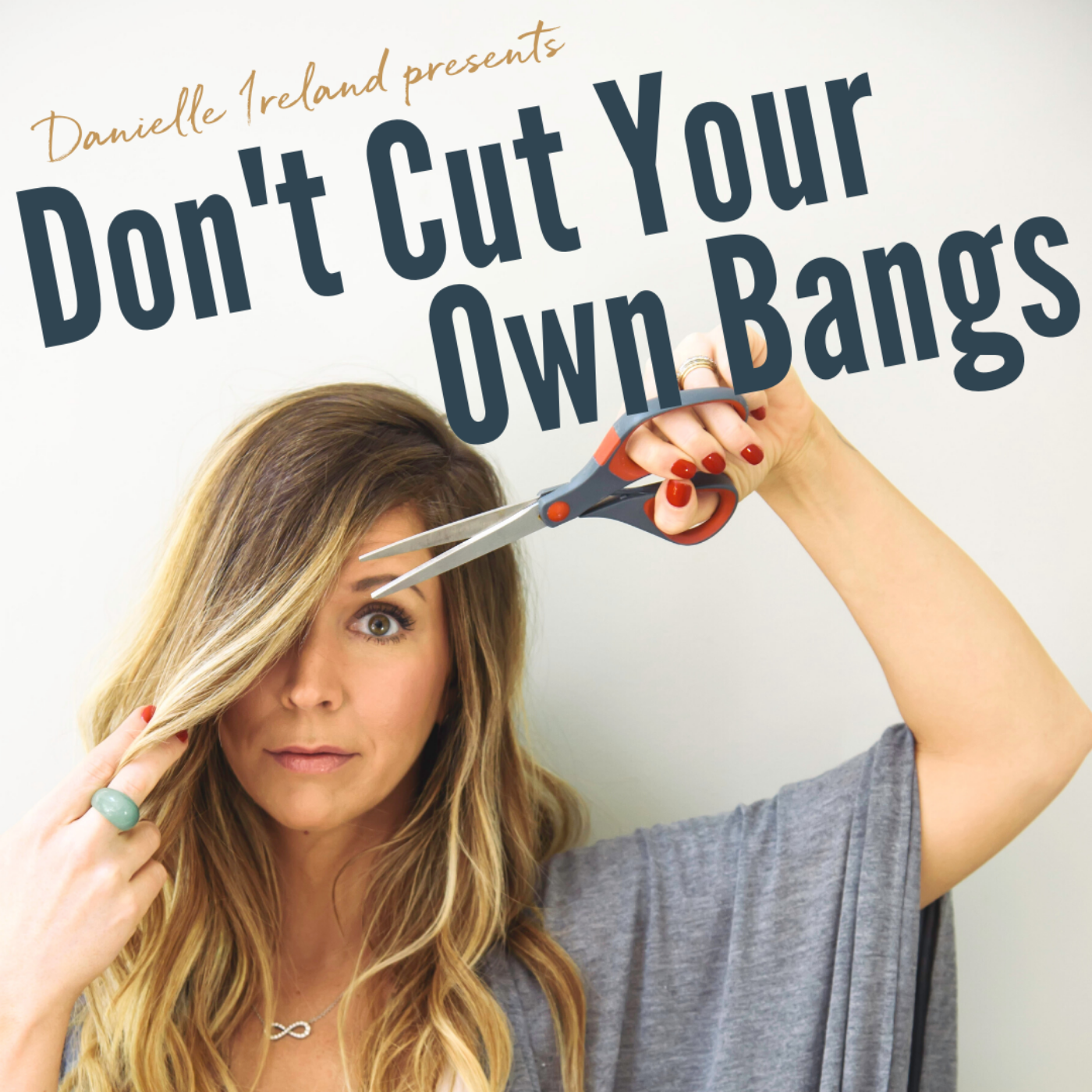
Don't Cut Your Own Bangs
Unlock the Power of Self-Validation. A solocast.
00:18:14
Unlock the Power of Self-Validation Inspired by a recent therapy session, in this solo episode of 'Don't Cut Your Own Bangs,' Danielle Ireland explores the practice of self-validation. She shares insights on how to validate your own...
Loading summary
Transcript2 lines
- [00:00]
A
This episode is brought to you by Progressive Insurance. Do you ever think about switching insurance companies to see if you could save some cash? Progressive makes it easy to see if you could save when you bundle your home and auto policies. Try it@progressive.com Progressive Casualty Insurance Company and affiliates. Potential savings will vary. Not available in all states. Hello? Hello, this is Danielle Ireland and you are listening to don't cut your own bangs. Today. I'm coming at you with a tasty little treat, a little snack of a solo cast. We're gonna talk about validating the self. How this is a practice that you can do on your own, in your mind, in a journal. You can take this anywhere with you and it is a fabulous tool to regulate the nervous system, to calm down the chatter of self doubt. Those that overwhelming spiraling self talk that we can get lost in. And I'm gonna talk about what validation is and what it's not and how you can actually practice this in your own life. It came out of a really powerful therapy session that I gave this week and almost as soon as I signed off of that call, my first thought was, oh, dang, I need to share this. So here we are, validating the self. Simply put, it is naming your experience. If we were thinking about it in terms of relationships, if it was me communicating with somebody else, validation is that I can hold space. I can see the reality and the truth of your experience and I can honor that as true for you. So for example, if with my, my four year old daughter, for example, I can see for her experience, you really want a popsicle? You really want a popsicle right now and I'm telling you it's time to go down for a nap. You're really upset that I told you you're not gonna get a popsicle and I can see how hard that is for you. I'm validating that you are having an emotional experience that is different from me in this moment. Even though we're having, we're in the same room, right? We're breathing the same air, but you're having a very different experience than me. And I can see that is true and that is real for you. That is just a silly small example, although it's based on very real, very real experiences. But that is how we can offer validation for somebody else. The benefit of doing that for someone else is it lets them know that they're not crazy. It's not just in their head. It's all of the invalidating language that I'm sure we are all very familiar with like, you're being dramatic, you're being over the top. Calm down. It's not that big a deal. You just need to get over it. You're not being logical, too emotional. Those are all ways that we can be invalidated, that we have been invalidated and that we can invalidate somebody else. So to repeat, what validation is, is I can see the truth of your experiences based on the circumstances that are before you. You, there's something you really want or there's something that you didn't get. Your experiences, you're disappointed and upset. You're telling me you don't want to go to bed, and I can see that as true for you. And I can hold space for myself for having a different experience. So now we're talking about validating the self. And I'll talk about how you can also do that outside of an interaction with somebody. In my experience, my daughter's upset. She's screaming about a popsicle. She's telling me she doesn't want to go down for a nap. She's telling me she's not tired. And then here's my experience. Here's what I know. What I know is it's 12:30. You normally go down for a nap at 12. You're already getting tired. I've seen you rubbing your eyes. I've been down this road with you many times before. I know it's hard for you to stop having fun when you want to keep having fun. And I also know I'll pay for it later. If I don't get you down for a nap, there's likely going to be a meltdown later. So my experience is I'm witnessing the emotional eruption and upheaval of having to tell you, no, you can't have a popsicle, and yes, you are going down for a nap. That's stressful for me. This isn't what I want either. What I want is to just give you what you want so that I can go chill and read my book. I don't want to deal with a tantrum. This is hard for me, too. I know that it's the right thing to do, so I'm going to do it anyway. And I also know that you are four and your brain is only developed four years, and your job is to want what you want. And my job is to do the best I can to take care of your beautiful brain and body so I can honor that. That is my experience. And I'm not making her responsible for my experience because she's entitled to have her own. And it's very different than mine. Even though we're breathing the same air, we're in the same space. I can regulate myself and I can regulate my own nervous system by honoring. You're doing what you know is right. You're doing the best you can in this moment. You're frustrated, too. You're disappointed, too. You don't like dealing with this either. You wish this were easier. All of those things that are true. And each time I allow myself to acknowledge the truth of my experience to myself, even if it's just in my own mind, I can feel what I actually physiologically experience. I physically experience, like, tingles in my legs. That must be a way that my nervous system is letting me know that it's calming down. But I breathe, and I'm speaking the truth for myself, to myself. That always puts me in a clearer frame of mind. If you've ever wanted to start a journaling practice but didn't know where to start, or if you've been journaling off and on your whole life but you're like, I want to take this work deeper. I've got you covered. I've written a journal called A Journal for Unearthing you. It's broken down into seven key areas of your life, filled with stories, sentence stems, prompts, questions, and exercises, all rooted in the work that I do with actual clients in my therapy sessions. I have given these examples to clients in sessions as homework, and they come back with insights that allow us to do do such incredible work. This is something you can do in the privacy of your own home, whether you're in therapy or not. It has context, it has guides, and hopefully some safety bumpers to help digging a little deeper feel possible, accessible and safe. You don't have to do this alone. And there's also a guided, treasured meditation series that accompanies each section in the journal to help ease you into the processing series state. My hope is to help guide you into feeling more secure with the most important relationship in your life, the one between you and you. Hop on over to the show notes and grab your copy today. And now back to the episode. So in this session with a client where this concept came out, this was one of those moments where my client, it just made a really, really hard decision about her life and her family. And she was in that really tender early stage of making a new decision where there's a fork in the road and you're starting down this new path based on the new choice that you've just made. You're not so far down the road. It's like you're almost walking parallel paths before they really start to split off into a V. And I'm making these new steps forward. But it's hard and it's scary and it's new. This is definitely unknown. And then I can still see the well worn path next to me that I could have been on if I had just stayed the same. And it's in that space where validating the self can be. If you find yourself in a similar couple steps past a fork in the road moment, this too may be really impactful for you. And it's not about knowing the outcome of your choice because that is impossible. It's so easy to just try to get our hooks into something that feels safe and sturdy and stable. But all you know, I'm here, I've made this decision. This is hard, this is scary, this is new. And even though you're not making a false promise to yourself and you may actually be admitting something that's hard, like this is really challenging, I feel really uncertain. I don't know what tomorrow's gonna bring. I feel lost. Those statements, it's not false hope and it's not toxic positivity. You're not trying to spin the truth into something palatable. You're letting the truth exist. And you're also making the statement with a period at the end of the sentence. I feel lost. I don't know what to do tomorrow. I'm here, I've done it, I'm scared. It's a statement. And then there's a period at the end of that sentence. Each time you do your own version of that, which is self validation, your nervous system calms. There is this activation that can happen with anxiety and self doubt, especially when we feel lost. Our mind is looking for certainty and so it will start asking us questions and in particular questions like why? Why did this happen to me? Why are they doing this? Why aren't they calling me back? Why aren't they texting me? And the problem with those types of questions raised in that particular way, you're asking yourself questions that you can't know the answer to. That will activate more anxiety because more questions you can't know the answer to will lead to more questions you can't know the answer to. And you will start to experience that as dread and doom. And. Or you will also very likely, and this is referencing Brene Brown. Here you will insert your worst fear with your uncertainty. Like your uncertainty gaps of knowledge and understanding. I'm just going to insert the worst fears I have about myself or the worst possible outcome I can think of. This does not help your nervous system. This does not help you feel safe. Validating the self, it's not false hope, it's not toxic positivity. It is to the simplest, most base way you can say it. What is the truest thing, the truest thing about what you're experiencing in this moment and let it exist. Take a breath, say the thing. And it might be a hard thing. It also might be a simple thing. It might be I don't know. But even saying you don't know is radically different for your brain and body in terms of being able to regulate and de escalate. Saying you don't know is different than asking a question you cannot answer. And sometimes I don't know is the truest thing you can access. But I can guarantee you, even though I probably shouldn't be making a guarantee, I can guarantee you. You say you don't know and you take a beat. You follow up with, well, what do I know? You will have an answer. I promise you will have an answer. What I know is I can't go back. What I know is I made the best possible decision I could in the moment. What I know is I'm here. What I know is I'm breathing, I'm sitting in a chair. What I know is I can feel my blanket on my lap. Whatever it is, if you sit with the unknown and you let it exist for just a couple of breaths, something will reveal itself to you. And this is why self validation can be so powerful. Your body responds to truth. So just a little information about lie detector tests, they don't detect lies. There's actually no way to measure physiologically a lie. What lie detectors measure is your body's stress response. Most of us, not all, some people can hijack the system. Especially if people have low empathy that are affected by lies or it's not practiced out of them. But I would say for the majority of us, when we speak something that isn't true in our mind or aloud, our heart rate will raise, perspiration will increase, and your body will have a reaction to stress. And so when you speak the truth, whatever that truth may be, there is a reason why when I am in obsession with somebody and either it comes out of my mouth or it's their own knowing in the moment when the truth is known, it stabilizes you. And sometimes it is a really hard, hard truth. But the truth, no matter how hard it's the right kind of hard and arguably more certain and more safe than any well told, pretty half truth. And if anybody who has either been in therapy or had, you know what Oprah calls an aha moment, it's like you go, oh, that's what it is. That's the thing I haven't let myself see for so long. That's the thing I've been afraid to admit or say for years, and now it's here. And there's often work to do after. But what we're talking about is in that moment when the truth is spoken, your body relaxes, the shoulders come down, the jaw unclenches, the pressure in the chest releases, the legs. For me, tingle a little. The truth is settling and calming to the nervous system. And what validation is not is feeling somebody else's feelings, knowing somebody's experience. For them, it is acknowledging that there can be more than one truth that exists in any given moment, and yours matters as much as anybody else's, but validating the self. We're really just talking about you. There is a truth to your experience that only you know. And when you admit that truth to yourself, it will set you free. What I encourage you to do Grab a journal, a blank piece of paper, or take a voice memo app on your phone and go for a walk. If there is something that you're wrestling with, a conversation you keep having with somebody in your mind, or a memory that your mind keeps going back to, there's almost always a thought that catches up to us when we're in those calm, relaxed, stable moments. So when a thought like that sneaks up on you, grab your pen and paper. Grab your journal. Maybe it's the Treasure Journal. Take a breath and ask yourself, what is true about this for me, if the answer is you don't know, that's okay. Start with you don't know. I don't know. I don't know yet. I don't know. I'm going to figure it out though. I don't know. But what if I did know? If I had to say something about this, what would that be? Then take another breath and see what comes. When I set out to write a book, I only knew two things. One was I wanted to make big feelings feel less scary and more approachable. And I wanted to bring some lightness to the feelings themselves. What I know to be true as a therapist is that emotions are energy in motion. They have information to tell you, to inform form the next right step to take. And self doubt, fear, anxiety, live in that space between knowing and not knowing. The second thing I knew was that I wanted to have fun in the process of making this thing. The result is this Wrestling a walrus for little people with big feelings. Beautifully illustrated children's book that has a glossary at the end for some of the bigger feeling words. What this story does in a light and loving way is create context for those those relationships you can't change, those people that you wish would treat you different. The things in life that we cannot control and yet we face that are hard. This book, it's a conversation starter for any littles in your life who want to create more safety and love and patience for some of those experiences. So hop on over to the Show Notes. You can pick it up@Amazon.com barnesnoble.com or my website. I hope that you do because I believe in this little book. I freaking love this little book and I cannot wait to hear your experience with it. Thanks so much for listening. And back to the episode. Thank you so much for joining me on this Little Nugget episode of don't cut your own bangs. I love sharing these insights here with you and your time and attention here mean more to me than you could possibly know. This is such, such a joy and such a pleasure. So I want to hear from you. Let me know what did you think of this concept? What questions do you have about it that you would like me to help answer? I want to to grow this conversation with you. The best things in life are shared and so being able to share this space is an absolute joy for me. A 10 out of 10. Thank you for listening. Thank you for being here. And before you hop off, I want to invite you to take a look at the Show Notes because there are always links and resources for you. Whether it's resources that I offer or when I'm in interviews with other guests, links to their amazing content too. So make sure to check that out before you pop away. And please remember to rate, review and subscribe to the podcast. It is the best way to help this podcast reach other people that could benefit from it too. It helps it grow and we can just continue to build things together. Thank you so much for being here and I hope that you continue to have a wonderful day.
- [18:33]
B
Marketing is hard, but I'll tell you a little secret. It doesn't have to be. Let me point something out. You're listening to a podcast right now and it's great. You love the host. You seek it out and download it. You listen to it while driving, working out, cooking even going to the bathroom. Podcasts are a pretty close companion and this is a podcast ad. Did I get your attention? You can reach great listeners like yourself with podcast advertising from Libsyn Ads. Choose from hundreds of top podcasts offering host endorsements, or run a pre produced ad like this one across thousands of shows. To reach your target audience in their favorite podcasts with Libsyn Ads, go to libsynads. Com. That's L I B S Y N Ads. Com Today.