← DTC Podcast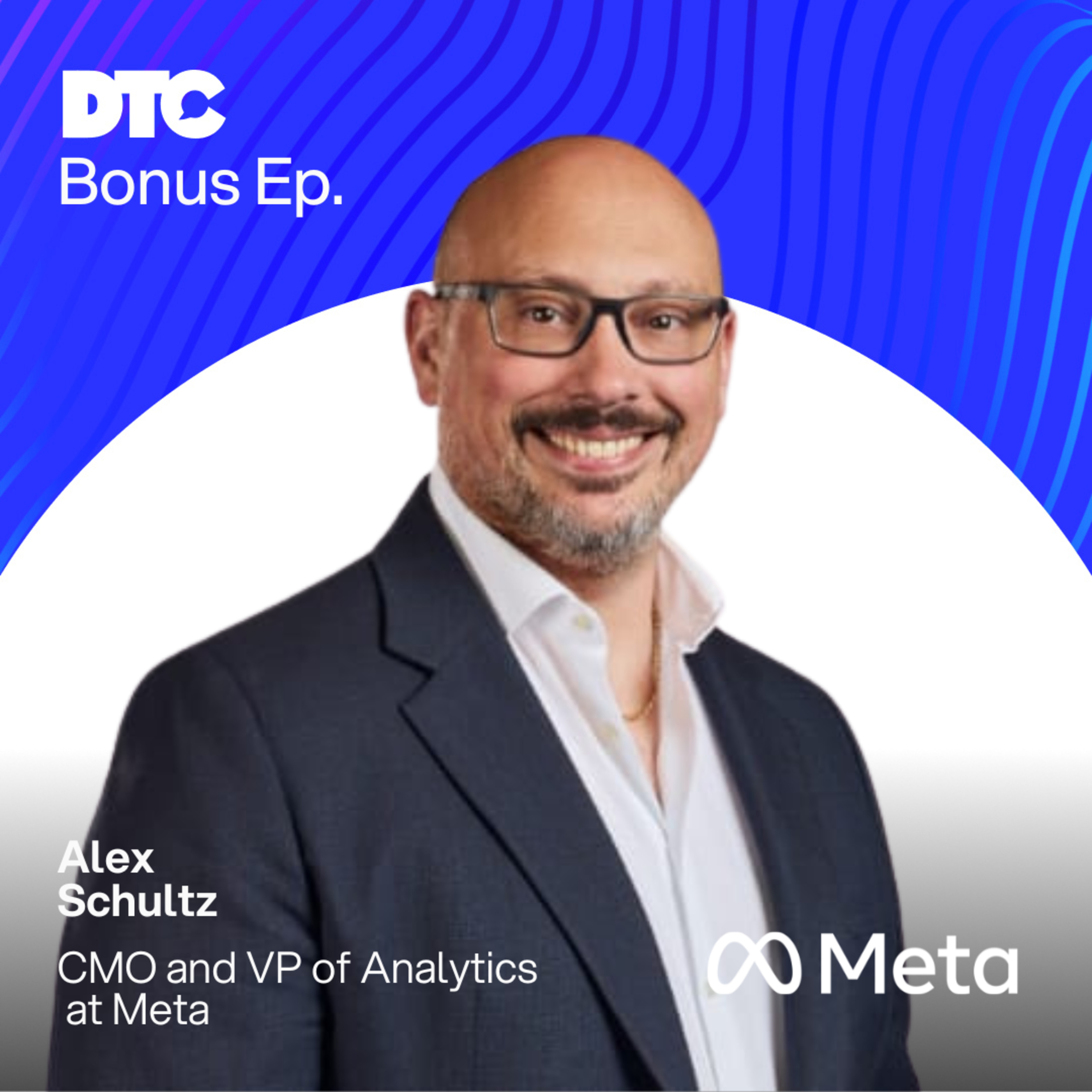
DTC Podcast
Bonus: Alex Schultz, CMO of Meta — Scaling Growth and Rebranding a Trillion-Dollar Brand
00:30:10
Loading summary
Transcript66 lines
- [00:01]
A
Twenty years ago, creative was where the agencies made their money. Now the media buying is where they make their money. Probably that is going to change. Like, I use automated ad campaigns myself. Now when I buy on Google and on Meta's properties, what's creative is what data we feed to the automated ad campaigns. My first conversation with Mark, I said, look, the Facebook company brand is really confusing. People don't know if we mean the company or we mean the app. And after a few months, Mark phoned me. I was in the shower, and he starts saying, yeah, I think we should rebrand the. The company. Do you think you can do it in seven months? I've never done this before. So I say, yes, of course I can. And then I go and talk to my team who are like, you have lost your mind.
- [00:50]
B
Hello and welcome to the DTC podcast. Today we have a very special guest here, Mr. Alex Schultz, CMO of Meta, the platform that all of a lot of what I have kind of built my career on has been based on. And you have been there since 2007, growing the world's most revolutionary social network ad platform. All of it. Welcome to the DTC podcast. Alex. How you doing?
- [01:14]
A
I am good. I'm sweltering in the middle of the British night, which is not what none normally says.
- [01:20]
B
Yeah, you don't hear that, but it's good to get the good weather in while you can. So you've written a book, which I'm really excited to dive into because it's funny. We're my. The agency that I'm based on has Confessions of an Admin. We have David Ogilvy's book on our front table for people to come in and peruse. It's sort of a bit of a business bible. And I've kind of seen your book positioned as sort of, you know, potentially an update for the digital age. Which would be. Which would be amazing.
- [01:46]
A
That would be really nice.
- [01:47]
B
That would be really nice. That would be. Yeah. Hey, we'll talk in 50 years and.
- [01:51]
A
We'Ll see if we're still around the Singularity game.
- [01:54]
B
Yeah, that's right. Oh, well, we'll get into that too. But maybe just walk me through a little bit of your history at Meta, because you've been there for almost 20 years now.
- [02:02]
A
Yeah, so, I mean, I started my career in online marketing as an affiliate.
- [02:06]
B
Yeah, me too. That's where I came from as well.
- [02:08]
A
As did Daniel Ek, by the way. Daniel Ek, Affiliate marketer, before everything happened for him. Yes. I started as affiliate marketer, was an affiliate for ebay. Joined ebay to do affiliates in house, moved to the States with ebay, paid search, affiliates, all that stuff. And then I joined Facebook as it was in 2007. I was given a job offer in 2006, but I didn't have a visa, I was on a L1A visa, so I couldn't transfer. So yes, I joined Facebook in 2007 the week after we launched the self service ad platform. So I joined the week after Pages launched and the week after self service ads and Beacon. And my first job was grow our small business community and grow the people buying self service ads. And I did that for like a long time and actually that's still part of my job today. So that bit grow self service, small business, organic use of Facebook has been part of my job the whole time I've been at Meta and then I layered other stuff on. So my friend Naomi, who's now VP of Products, she's amazing, runs like 10,000 people, she's brilliant. She was doing SEO and we just launched in September. Before I joined in November, they'd launched public profiles for indexing on search and they weren't ranking and they thought, oh, it's because Google hates us. And actually it was because it was six clicks before you could find a non Facebook employee when you were trying to get the site indexed. And so I just gave them some SEO advice and that took me from doing advertiser growth to helping user growth. And that was where my whole career took off at Facebook Meta. And yeah, like I joined the user growth team when they started it. I did more than SEO. I did things like on site merchandising to get people to import contacts, paid search. I launched an affiliate program for a while which I thought was silly. Email, lots of email marketing, which today is push notifications and SMS as well as email, but it's all the same thing. And I just gradually been doing more and more of that. Around 2012 we, we obviously IPO'd and everyone said, oh, Facebook missed mobile. But the weird thing was for users we had the users were active on mobile, we didn't have ads. And so Mark asked the growth team, well, how did you guys know to optimize to get users to register and use Facebook on mobile? And we said, well, it's analytics. We had the data, we saw they were trying to. So we, we got out of their way. We did conversion rate optimization, we made sure they could register. And so he then said, go build an analytics team for the whole organization. My boss Javi and I set up the analytics function for Facebook. We recruited this guy, Ken Rudin, who's great, and we built out the analytics team. Few years later it came and reported to me directly. And basically ever since then I've done direct response marketing and analytics. And five years ago, our CMO at the time, Antonio Lucio, left. Great guy. One of the legends of modern day creative advertising. And he suggested to Zuck, well, you've tried a classic product marketer with Gary Briggs. You've tried a classic brand marketer with me. Why don't you try a classic direct response guy with Alex and see what happens if you make him cmo. And I've been doing that ever since. So that's my various jobs at Meta.
- [05:22]
B
I love to hear it. As a former reformed affiliate coming up in those early days of sort of aggressive directors. Not aggressive, but direct response marketing where in order for us to get paid, we have to create funnel congruency. We have to, you know, we have to change the color of the buttons, we have to change the headline, we have to optimize for performance.
- [05:41]
A
Yes.
- [05:42]
B
And so I love to hear other affiliates who've gone on to such amazing things. What do you think it is about the affiliate mindset that has served you best in your career?
- [05:50]
A
Oh, I mean, this I actually go into in the book. Like, I think for me, I had to pay for college as an affiliate. Like, I was in a place where, you know, I'm very lucky. I have great parents, they looked after me. But dad lost his job and like, we didn't have as much money. And so I was like, I have to pay for college myself. And so affiliates was driven out of need. And I really learned how to do online marketing. And instead of, you know, just having vanity metrics, they weren't vanity metrics. It was a question of me actually paying for my life and the lifestyle I wanted to live in to actually do the marketing. And I think that is the thing that makes like Daniel has this guy Shaq, who's a really amazing guy. Shaquille Khan, he was a Viagra affiliate back in the days when I met him, which now is very mainstream with hymns and everything, but back then was a bit more dodgy. And like, those guys are just like, they know what drives results because it was how they put food on the table. And so whenever you bump into someone who's lived in the world of affiliates and was an affiliate and it was actually their income, like they know online marketing naturally, in a way that someone who's just come to it as a.
- [07:02]
B
Profession doesn't know it, there's nowhere to hide.
- [07:05]
A
Yeah, well, you also know about net 90 payment terms. Yes, which was my big mistake. I was minting money because ebay let you buy keyword. Ebay was allowed to be bought and nobody was doing day parting back in 2004 or whatever. So I'd buy it in the middle of the night. So the conversion rates were astounding. But then I had to wait to get my credit card paid off by getting the check from Commission Junction. And so I ended up in this place where I had this massive ROI, but I only had £2,000 every three months to spend on it.
- [07:36]
B
I haven't heard Commission Junction in a while. My very first event I ever went to was a Commission Commission Junction event in San Diego. And it was, it was a magical entree to this wonderful industry that has been ever since. So you have been in charge of the marketing of so many key products within the Meta ecosystem. Can you give me any anecdotes of sort of like the strategy that kind of went into one of these launches that you're maybe particularly proud of that might be reflected in your book?
- [08:04]
A
The big one I'm most proud of because it made my career take off at Meta was the self service advertising platform. What happened was the company thought we'd get all of our users for the self service advertising platform through buying paid ads. And so I was put in charge of paid search and our own buying on Facebook.
- [08:23]
B
Where, where were you buying ads before Facebook?
- [08:26]
A
Paid search? Google.
- [08:28]
B
Google, that's right. Yeah.
- [08:29]
A
We found every keyword that Google bought to acquire advertisers and we bought all of those keywords smart. But what was amazing was like they didn't have, they didn't have conversion tracking. They literally were buying all this paid search. Like at that time it was like 10 million a year, which was huge for Facebook. And they had no conversion tracking. So I just put in conversion tracking and that meant that we suddenly were able to rebalance and get loads more roi. I then started tracking what was happening on the site. We created custom audiences. So, you know, now everyone uses custom audiences. The first custom audiences were built by this guy, Danny Ferrante, core data scientist who was working with me. Brilliant man. Still works, still works with me today. He built the first custom audiences so we could target small businesses on Facebook and encourage them to buy ads and do funnel drop offs. So did they enter the funnel and start to buy an ad but not convert? And so we'd like, we built custom Audiences for that purpose, like fundamentally to grow that. And that became a big product down the line.
- [09:29]
B
It's very Meta.
- [09:31]
A
Yes. And then the last thing we did during this period and I had to do it in this sequence because nobody believed me. So I started by showing I could make the search better. Then I showed I could make the Facebook ads buying to get Facebook advertisers better. And then the last thing we did was we looked at the traffic that was coming from on site linking. And so I go into this in the book a lot because in the end, if you've got a product you want to promote to your own customers, to buy more, to shop, the shop, to do things. And so putting the right link at the right time in front of the person is really important. So with the right wording. So we did have a fun thing where we found our create an ad was way better than the phrase advertisement. But yeah, so putting links in the interface when you as a small business are thinking about buying an ad is way more important than putting them on the homepage in front of the same customer. And so that process of like, okay, show I can do search, show I can do Facebook ads. And now they'll let me play with the product, which is actually the big thing that drove growth that I'm really proud of because it was a way in and it was the way I broke through. So that Meta does direct response marketing fully integrated with the product teams. It isn't siloed.
- [10:46]
B
Literally eating your own dog food and building the business on the tools that.
- [10:51]
A
You'Re building and also changing the tools. I mean, that's the one thing I can do is I can add a link in Facebook, which is important, hugely important. Super cool.
- [10:59]
B
You're also there for the rebrand. That was, that one came out as someone, as a, as an observer, that one came out of left field. And it's just, it's happened. It happened so seamlessly. I think some, I think some people still call, say, say Facebook, but talk a little bit about that decision and the fallout from having to rebrand this icon.
- [11:17]
A
Well, sometimes I still say Facebook so I can forgive people. I think when people deliberately say Facebook, I'm like, come on, it's not like Alphabet. This is a user facing brand. We have products that are called Meta products. So yeah, so when I took over as cmo, my first conversation with Mark, I said, look, the Facebook company brand is really confusing. When we say Facebook, people don't know if we mean the company or we mean the app. Not only is it very confusing. It blocks people understanding that as a company, we do more than just Facebook the app, so we need to get away from it. And I was thinking something like BMW Group as opposed to BMW, you know, like Facebook Group or FB Inc. Or something that like, like put us in a gap. And after a few months, Mark, I think it was only a few months Mark phoned me. I was in the shower and my phone starts going off. It was actually a text messaging. It was WhatsApp. And he starts saying, yeah, I think we should rebrand the company. Do you think you can do it in seven months? And obviously I've never done this before, so I say, yes, of course I can. And then I go and talk to my team who are like, you have lost your mind. Rebrand a trillion dollar company in seven months. That's never been done. But we pulled together a really great team. David Droga, externally was really important. This chap, Andrew Sturk, who now does brand anthropic, absolute genius. He was super important. There was this lady, Mayumi. She project managed the whole thing. These were brilliant people. We got this tight gang together and I rebranded it from this house in Norfolk. During the pandemic, I was in this house. My favorite moment in the whole thing was there was this one small group meeting, Mark staff school group, where I just bought this house and I've just got a new gray and I'm setting up a fire for the first time. And I'm like, I'm not involved in small group. I'm going to sit on my laptop and I'm going to make this firework. And I got the fire started. And then I said to. And then Mark said, alex, could you give us an update on the rebrand? And I messaged my friends Naomi and Javi and I'm like, guys, I've just started a fire. And Javier replied very kindly. He's like, no, Alex, you didn't start the fire. Mark started the fire. He's pushing to do this. It's an important change for the company. I'm like, no, no, no, no, no. I've literally just started a fire.
- [13:38]
B
That's hilarious.
- [13:39]
A
So it was. But it was. I mean, it was, it was. It achieved what we wanted, which was it gave separation for the company from the apps. And it allowed us to say that the company did more than just legacy social media. It does a lot more. And those two things, you couldn't have Oakley Facebook glasses. That wouldn't make sense. Or Ray Ban Facebook glasses. But Ray Ban metas make sense, Meta AI makes sense. If you're sticking Facebook AI and WhatsApp, that doesn't make sense. So I'm like really proud of what we've opened up with the word meta.
- [14:11]
B
One of my pet topics on this podcast has been top of funnel advertising and really thinking about how to establish brands in the world and whether that can be done through just through direct marketing. Enough, you know, good storytelling through direct marketing, what role, you know, brand elevation and different brand executions kind of come into that, into, you know, the e commerce world. I'm curious about your thoughts about brand establishment at this point. Can it all be done on, on self serve meta platforms or do you need to be thinking about other even non meta top of funnel exercises to grow a brand?
- [14:46]
A
So look, my, my perspective on this is that top of funnel performs. The problem is you've got idiots out there who track everything on Last Click and they don't actually do incrementality analysis and that. I think actually if you go back to the Ogilvy book Ogve on advertising, not Confessions of an Ad man, he has a useful idiot in it. And I think for me the useful idiot is someone who just does post click tracking like, of course you can build a brand on Facebook. Of course you can build a brand on Instagram, of course you can on Google, of course you can on TikTok. 100% we have countries around the world like Indonesia where we've never spent a penny on brand marketing and we have an incredible brand, but we have spent a lot of money on direct response. So 100% you can build just on direct response. But that doesn't mean that you can't do performant top of funnel marketing like in traditional ways too. You just have to measure it right, just have to understand it. So for example, in the US for WhatsApp, it's much harder. Everyone's using iMessage. So in a world where everyone's using iMessage, I can't just win with a direct response marketing campaign. I have to pair it with a top of funnel brand marketing campaign. Because people aren't aware of WhatsApp. When they're aware of it, they're like, I've already got a messaging app. What are the properties of this that are going to get me over the hump? And actually, if you're in this totally competitive dynamic against someone like Apple, you need to buy some traditional media as well as some direct response media. If you're starting in a greenfield site like Indonesia 10 years ago, growing Facebook and Instagram you don't need to do top of funnel brand marketing. You can really just concentrate on direct response.
- [16:25]
B
I think that's a great answer. I was actually reading or watching your interview that you did at Cannes Lions this year sort of about the role of WhatsApp and the content that you actually created for WhatsApp being about. I think it was Afghani women essentially being able to communicate about something that had to be private. And I actually hadn't thought of WhatsApp as like an encrypted privacy app as much. I just thought about it as another messaging app. But it's cool to hear you guys, you know, met a storytelling about the importance of privacy in certain situations, right?
- [16:56]
A
Yeah, it's totally broken through in the US now and it is down to our brand marketing. We track this very closely. I mean I've got this guy, Tom Tang, Tom Two Brains Tang, T2D2, a PhD from Beijing and a PhD from MIT. This guy's brilliant.
- [17:09]
B
Don't meet him on a poker table.
- [17:11]
A
Yeah, no, no, no. But no, no. Tom Tang is absolutely incredible. And he was my mentor at ebay and then he ran analytics for Walmart for their marketing team. And now he sort of works for me, works me now. And he's doing an incredible job. And when we look at what we've done on WhatsApp, we've been able to show with testing control groups, geographic match markets, and then also on a pre post basis as well that we have directly moved WhatsApp up so that in the United States, for people aware of WhatsApp and iMessage, WhatsApp is the leading most private messaging app and that has been 100% driven by marketing things like the Afghani girls in the soccer team right the way through to. We did this really interesting ad with Modern Family last year that came across very well.
- [17:55]
B
And a Super bowl ad.
- [17:56]
A
Yeah, the super bowl ad was for meta Glasses though.
- [18:00]
B
How did the CPMs work on out on that?
- [18:02]
A
You know what, the CPMs were great. We just spent an awful lot on the creative. So actually like for that ad, the guy shooting it was Matthew Vaughan Kingsman. Yeah. And for me, Layer Cake. My favorite movie all time.
- [18:15]
B
Oh, what a great movie.
- [18:16]
A
Such a great movie. And there's a, there's a sequel book to it as well, which you should buy after you buy my book. Let me have Kris Jenner, Chris Hemsworth, Chris Pratt. It was very expensive to film, but the actual cost of the cost of the ad didn't work out as that much. And I can prove to you that that gave us a 1/3 uptick in our total sales of the Ray Ban metaglasses. These are the Oakley metas. What is true though is it wasn't actually necessarily the super bowl media. So we got a lot of, we got a lot of influencer coverage from the three main stars. They have huge followings on social media. So they just hosted the ad and it went really, really well and went viral. We used it as a moment for us to actually promote in our own product. We used it as a forcing function, the moment of the super bowl to promote in our own product, that we had these glasses. We took influencers to the super bowl who posted about it as well. So it wasn't just, oh, there's these two slots in the Super Bowl. It was all of that around. And then we used the creative consistently for the next four or five months. We didn't like change the creative at all. And so there was this drumbeat of the creative too. So it was a real step up. It was totally visible. And then it's been an angle change since then.
- [19:30]
B
I love that. The word that we're talking about all the time this year at Pilothouse and on the podcast is strategy. And just about how all of these tactical things you can do are meaningless if they're not, you know, knitted together with a strategy that thinks about, you know, the entire campaign and what you actually want people to do and think about.
- [19:50]
A
Yeah, I mean I honestly like that's in classic marketing they call it the brief. Right. But yeah, you just. Yes, I feel like I don't have to say than just yes.
- [20:01]
B
Let's talk about click here. Why? So you got, you know, 20 years plus in the trenches growing a trillion dollar brand, as you say. Why did you decide to right click here and what's its main thesis?
- [20:12]
A
Yeah, look, I mean I decided to right click here because I felt that there was a gap in the market. What's good is the Hachette who do, for what it's worth, they publish the publishing house that owns the group that publishes Ogilvy. So Hachette felt there was a gap in the market as well. There's been no major marketing book that addresses the channels and how to use them for the last 40 years. And 100 years ago there was Claude C. Hopkins Scientific Advertising, lots of it still relevant today. Then there was Rossa Reeves Reality and Advertising and then Ogleby Confessions of an Ad man and Oglebeam Advertising. And so there's a gap. I don't have a book to recommend to my friends. And so what I wanted to do was go out and write the modern Ogilvy on advertising, which is really aggressive and I feel slightly ashamed as a British person to say that, but that is what I tried to do, aim big. And I'm really, really proud of it, honestly. Like, the goal of it is to help people be really good at online marketing. Whether you're starting out or whether you're a veteran, whether you're a business leader who wants to use these tools but isn't a marketer but has a company and whether small or large and wants to use it. There are examples throughout the book that work for all of those different people. Core theses are principles of timeless channels change. Like what you learn on snail mail is the same as you're going to use an AI. It really is. Like a postcard through the mail is the same as a chat with an AI agent. It's just the turnaround time that's quicker. It's very, very similar. And there is a thread through history of like snail mail, email, sms, push notifications, AI chatbots. It's a continuum. So that's point one number one. And point number two is incrementality is everything. You've got all of these people who, not to be rude, but Ogilvy has an idiot in his book. I will say I've got an idiot too. It's someone who uses post click tracking as the way they measure results. You gotta do holdouts, you gotta do on off tests. You can't use the same tools. Social media is great at being able to lift studies. We offer them Snap, TikTok or the other ones do search. You can't do lift studies, so you have to do matched markets. You have to do on off. You have to do all these things. But, but really don't use post click tracking. Do incrementality measurement which your customers for your blog, your listeners for your podcast understand.
- [22:23]
B
Well, I think you're probably preaching to the choir, but it never hurts to hear. I think that's been the main. Like the channels change, you know, but the strategy can be timeless. I think it is the analytics side of things that's probably updated the most since the time of Ogilvy, I guess, right where I guess they were still doing basic holdouts and they were doing, you know, but, but I think you know, what I mean is that I think that analytics piece is the big evolution.
- [22:49]
A
See, I think the tools are, but the underlying isn't. You go back to the Wanamaker Quote, that everyone knows half my advertising is wasted. I don't know which half. That's because he knew incrementality. That's because he was actually doing holdouts. You look at Claude C. Hopkins Scientific Advertising, the book is over 100 years old and it went with that title. They have holdout testing now. We would say a bunch of the stuff they said in here is not well done, it's not particularly competent. That's because we have a century of learning behind us. But I think actually it's very much the same job. We've just got slightly better tools to do it now. So I don't know, I don't know. And the other thing that's crazy is everyone thinks what's easy is coming up with a creative idea. You go to any board meeting, the board is always telling you, oh, here's my latest creative idea. Here are my thoughts about what a good creative would be, whatever. But they think like, oh my God, the ad tech's hard, like the numbers are hard, like all of that targeting and stuff, that's hard. Whereas in my mind, actually the targeting, the metrics, the measurement with the tools we have today, that's the easy bit. How you do the creative insight, like that's really difficult. So people have it asked about face.
- [23:59]
B
Yeah, I think so. And increasingly that's the stuff that AI is doing. Right, like all the, you know, bid cap adjustments or you know, the actual, the way the campaigns layout, that's all Mr. Zuckerberg made very clear his intentions months ago or was there any follow up from that? Because from the performance marketer community, when we hear Mark start talking about, you know, taking media buyers out of the equation a little bit more. I know that's the company goal, but we're, we're always looking for ways that we're, you know, adding value for clients and things like that. How did you deal with the fallout of, of these statements about AI and what are, what's your general outlook about AI at Meta?
- [24:33]
A
Yeah, it's actually really interesting. This one caused a lot of thrash and the thing is he was like, they'll take out their credit cards and they'll buy. And it's like all of the big agencies got pretty upset and the investors in the big agencies in particular got upset. So actually most of the big agencies didn't get upset. The investors got upset. And what big agency client uses a credit card, they pay via insertion order anyway. So yeah, I mean, there was a bunch of sort of noise around it fundamentally. Here's what we think small businesses are going to be enabled more and more and more to do the whole suite of things without an agency. They don't have an agency today. They're going to be given superpowers that only big businesses could have before. Big businesses are going to use an agency because they want to buy across Facebook, Instagram, Google, YouTube, all of these different properties. Snapchat, TikTok. And they're not just going to sort of go all in, in one property without having some platform that's looking across the properties for them. And so those companies are absolutely going to use an agency. The agencies are going to be transformed and they are working on this right now.
- [25:41]
B
Right now.
- [25:42]
A
Twenty years ago, creative was where the agencies made their money and the media buyers were in the back room. Now the media buying is where they make their money. Probably that is going to change. Like I use automated ad campaigns myself now when I buy on Google and on Meta's properties, what's creative is what data we feed to the automated ad campaigns. Like how do we actually set ourselves up to convert? What are we thinking? What are we telling the machine so it can optimize itself? That's where the creativity comes in. But they'll transform themselves just like they did when mobile came along, just when they did, when the web came along, just like they did when targeting and media buying overtook creative. Agencies will be around a long time yet. What they do will be different, but it's totally different than 20 years ago today.
- [26:25]
B
Yeah, it's been a fun landscape to be a part of and it just feels like, what a great time to be alive with all of this stuff. There are big challenges, huge, huge challenges. But there's just so much opportunity. It seems like an amazing time to be, to be at my professional peak.
- [26:40]
A
Oh, I mean we're absolutely, I mean we're blessed to be in this career at this time. We just picked the right field at the right time, you know, who knew?
- [26:49]
B
But way back in those affiliate days when I was slinging toolbars and dating networks and things like that, that I'd end up talking to another fellow affiliate at the absolute height of this industry.
- [27:00]
A
I had a paper airplane site. That was how I got started.
- [27:03]
B
What was it?
- [27:04]
A
Paper airplanes.co.uk and then I built a cocktail site because the paper airplanes weren't cool. And then once I had the cocktail site done, I started, ah, you can do SEO, you can do keyword research. Because cocktails. I managed to rank number one for the phrase cocktail recipes, cocktail making. And everyone searched for cocktail recipes. So I ranked for the wrong phrase. I didn't do my keyword research. So then I did keyword research and I was like, ah, there are lots of searches for butterfly tattoos and there are no websites. So I built the largest butterfly tattoo website on earth.
- [27:33]
B
Amazing. I'm curious, with your book, what are some of the marketing principles you're applying to marketing your book that you've kind of pioneered at Meta? Yeah, I mean, besides this podcast, I.
- [27:44]
A
Was going to actually say, first and foremost, I do think the creator economy is exactly the place. I was talking to the publishers of the book because you got to learn from the industry, right? Like different tools work well for different industries. You know this really well. So for books, it used to be you went on the book tour and you went to lots of bookstores and you would go on radio shows and you'd go on tv. Now what they care about is podcasts. They care really, really deeply about podcasts and targeting the right audience. So the creator economy, influencers, creators, including podcasters like yourself, that is a big, big strategy for this book launch, which fits with all books. The second thing that we're doing is we're doing email marketing. Like, understandably, I think this book is very aligned with matters view of the world. Like, we think you should use lift studies and incrementality measurement. We think that's really, really important. I wouldn't be the CMO of Meta if I didn't believe in those things. And so actually promoting it to the small businesses on our service via email, via in product placement where appropriate, and via buying our own ads. We're also doing that. The next phase of it will involve buying, you know, retargeted ads on the Internet. We are going to use all of the data we have, things like assuming my legal team approves it, because everything must be fully compliant. But the plan is to look at people who showed interest by opening the email and then retarget them with ads and say, hey, you looked at this book, have you considered buying it? So it's the whole gamut. We're going to start with like influencer marketing creators. We're going to look at email, we're going to look at in product, and at the end we're going to buy ads at the bottom of the funnel. That is what we're doing.
- [29:18]
B
Well, I want everyone who listens to this podcast to click the link that we'll have in the show Notes to go by. Click here. Thank you by Alex Schultz. I think you sent a couple to our office, but it hasn't made its way to me yet. I've just moved house and this is the very first podcast in my new studio.
- [29:34]
A
Oh, very exciting.
- [29:35]
B
Well, thanks again for coming on. This is fantastic. People will follow your journey on LinkedIn. I've added you there. Thanks again for coming on the DTC podcast.
- [29:43]
A
Well, thank you very much for having me. It's wonderful to talk to a like mind.
- [29:54]
B
Thanks so much for listening to today's episode. If you're not a subscriber to our newsletter, you can do that right now at directtoconsumeralloneword co. I'm Eric Dick and this has been the DTC podcast. We'll see you next time.